So, who is Conrad Aiken? I don’t fully know yet, but I came upon one of his poems this spring, and found out that as a critic, anthologist, short-story writer, and poet, that he’s one of those first-part-of-the-20th-century Americans who helped establish American poetry in the Modernist era. He graduated from Harvard University in 1912, and before that decade was out, he’d established his literary footprint. In 1919 he published what he claimed was the first comprehensive anthology of American poetry, explaining in the book’s introduction that previously there was no clear call for such a collection as American poetry was such a small part of world literature. Here’s what I found most interesting about that anthology: he would retain only a smattering of poems by Longfellow and the Fireside poets, though using Poe, Dickinson,* and Whitman to fill out much of the 19th century section – and here’s the boldest part: he would give his early 20th century contemporaries a great deal of space.
In things like this I sense that Aiken is reflecting or creating a canonical moment that lasted well into his 20th century. His choices are similar to the choices I was presented later with the mid-century textbooks of my youth, but I recall being frustrated back then: why were the poets and poetry worth studying ending with Eliot and Frost? While that pair were still living as I began to study literature, their anthologized poems were 30-40 years old then, seemingly ancient to my teenage self. OK, Aiken’s canon may have been much like the one I was later presented, but back then his 1919 book included poems not even 5 years from publication. Not just a handful, some appendix set aside as a gesture, but around a third of the anthology!
By that year Aiken had published five books of his own poetry, one of which shares its title with its lead-off poem inside: “Nocturne of Remembered Spring.” The nocturne is a musical form, and references to musical forms and the experience of music abound in the Aiken poetry I’ve read so far. Oddly, I don’t consistently fall under the spell of his word-music off the page. His poems do have some lyrical moments, but they are obscured by a problem I’m having: his long windiness. As I page through Aiken’s early books many poems span a dozen pages or more, and while he did try his hand at sonnets, they don’t seem to be is métier. Perhaps I’m not appreciating the sense of the tune behind the poems. Unlike many of his contemporaries, I rarely hear strains of American folk musics in these early poems. I can’t help but think that his evident attraction to the related art of music is more conceptional or one-abstraction-layer-removed impressionism than simply producing dancing words and prosodical earworms.
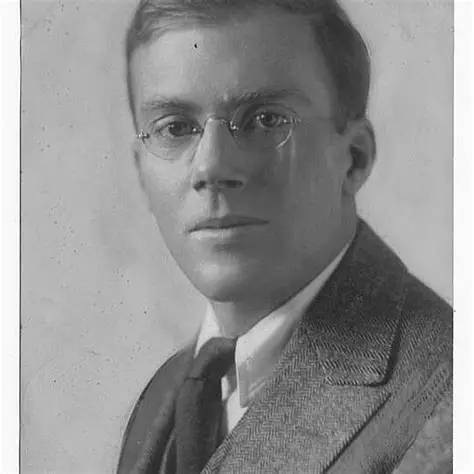
Aiken at around the post-graduate age when he was helping form the canon of American poetry.
Luckily for your composer/presenter here, he will often break up his longer poems in shorter, numbered, sections. So, the seven pages of the poem “Nocturne of Remembered Spring” are split in six sections, each obsessively recalling the same youthful love affair, each going over memories of it. Given the length of the poem I’d have liked to see more contrast in the sections, but for page after page it remains inside the head of the poem’s voice as it goes over memories. This psychological internalism may have been a novel effect in 1916 when the poem is dated, but it tires me. Aiken’s work is new to me, but I can’t help but compare his theme here unfavorably to early work by Mina Loy (her extravagantly expressive “Songs to Johannes”) or Neruda’s extraordinarily popular “Twenty Love Songs.”**
My choice for a musical setting of Aiken was to select out only the final section, numbered “VI.” It sufficiently summarizes the poem, and I think it has more chance of listener impact by compressing its expression and it highlights there a musical device by refraining lines about remembrance.*** As so often in this Project’s choice of texts, this was the section with words that “asked” to be sung. I’m a composer who tends to bagatelles due to lack of time and sophisticated skills. The length was right. I wrote a simple cello line, quickly extrapolated a series of chords for nocturnal piano and improvised a second cello top line melody to be played via my MIDI guitar sounding a good cello VI**** which would also help guide my rough-hewn vocal. As I wrote earlier this month, a musical piece like this would seem to be Art Song of a type, but one which classically trained and skilled singers would find outrageous. My hope, aware of my limitations, is that it can still communicate something and help vivify a presence for writers like Aiken who have fallen into the cracks in the canon.
You can hear my performance of part VI. from Conrad Aiken’s “Nocturne of Spring Remembered” with the audio player gadget below. What no player? I, or rather some ways of reading this blog, haven’t forgotten it, it just won’t show in every kind of reader. I provide this highlighted link that will open a new browser tab with its own audio player so it can still be heard.
*Though Dickinson wrote her remarkable work in the middle of the 19th century, none of it was publicly known until it’s posthumous publication began with three book-length volumes in the final decade of the 1800s. This means that even when including Dickinson in his survey of American poetry in 1919 that Aiken was featuring poems less than 30 years from publication date. In 1924 Aiken published a selected poems of Emily Dickinson, a step in establishing her place in the American poetic canon. Last time, when I presented a Dickinson poem, I almost presented a capsule history of the tangled provenance of Dickinson’s poems, using “A Something in a summer’s Day” as an example. Tight summary: decendents of Susan Gilbert Dickinson (Emily Dickinson’s sister-in-law, neighbor, friend, and presently oft-assumed lover) and of Mabel Todd Loomis (the mistress of Susan’s husband/Emily’s brother) each had a tranche of Dickinson poems and claimed rights to them, and each was publishing them as well as letters and recollections of the poet. Both sources were editing the poems, normalizing their distinctive language and punctuation, and ordering them in chapters of common high-minded themes. Aiken’s Selected Poems of Emily Dickinson issued from his seat as a critic and anthologist offered additional canonical approval to the poet who he judges in his introduction is “among the finest poets in the language.” At the time he was drawing from less than half of the now known poems of Dickinson! And the Dickinson that we know today – all dashes and abrupt leaps of thought – only became available when I was a schoolboy!
**A decade later Aiken’s Selected Poems won a Pulitzer. That book didn’t include any of Nocturne of Remembered Spring. The author himself may have moved on.
***As I enter into the month of August, I’m in my annual period of personal remembrance of the summer now long ago when my late wife was dying. The refrain in section VI. of “Do you remember” coincidentally brought to mind the translation in English of the name of the Twin Cities based indie rock trio Hüsker Dü. I missed my chance by not setting Aiken to reflect that.
****A pun, and with Roman numerals! A “VI” is a “virtual instrument.” These are made when a company records snippets of a real cello playing its range of notes in a variety of performance articulation and puts the result into what is in effect a database of all those sounds which can be played with an otherwise silent device – most often a piano style keyboard, but it can be another instrument control surface such as my MIDI guitar which tells it what to play in notes, timing, and expression, all of which are retrieved in real time.

 Frank Hudson