For the American Hendrix

Today’s piece uses my own words to present some images regarding American musician and songwriter Jimi Hendrix. Just like William Carlos Williams meditation on a small plant last time, I pretty much follow the famous Imagist rules: direct treatment of the thing, no unnecessary words, and musical phrasing instead of mechanical metrical feet.

Each one of the images opens up what I hope is a rich question. It’s my hope that the resulting poem and audio piece assists you in remembering these questions that I see as posed in Hendrix’s life. Here is the poem I wrote and used with today’s music:


For the American Hendrix


And then he laid the guitar down, and set it afire

Which seems silly or sacred, depending on the art

He had only to keep himself alive, which would kill him.


He took every stop on the three 21 fret train tracks,

Slid between the rails, rode them underwater,

Understood the train-whistle called his ancestors


Living in the amplifiers, that he could not shake out,

That he could not know, that were here,

Before European words, that were here,


Brought in shackles, that were here,

Building in electricity, that were here

Now, for children who did not know they were children.


Voluntary orphans, immigrants discovering new worlds,

Walking on squatters’ land, not forgetting to bring their chains.
 

Jimi Hendrix

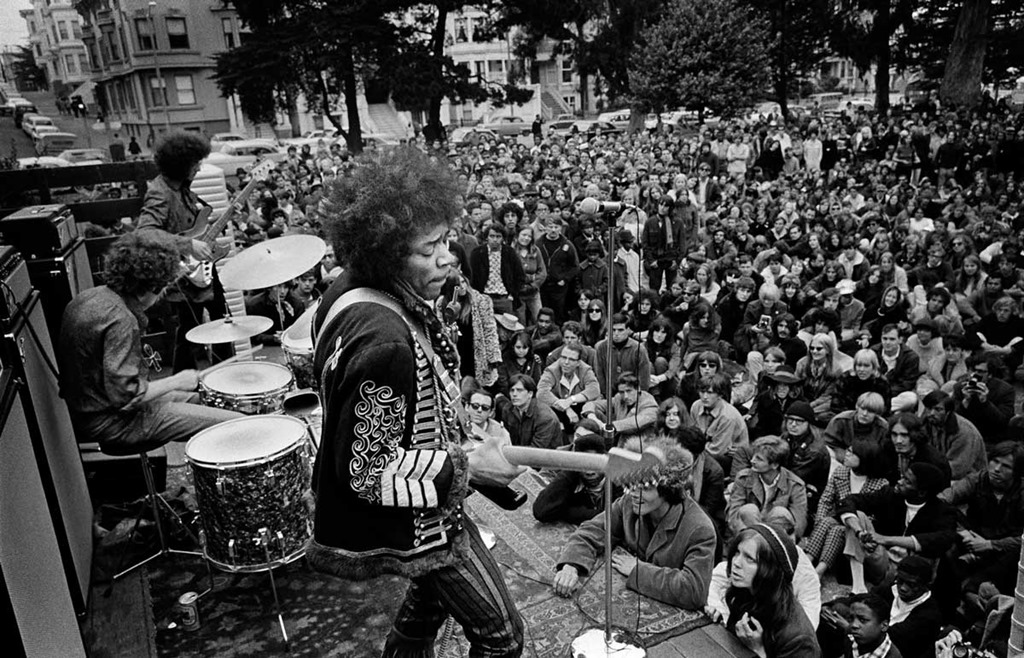
Jimi Hendrix plays for hippies in 1967. Do you envy them or feel superior to them?

In the first stanza, I remind us that Jimi Hendrix was a consummate showman, and that he used showmanship to wrest attention for his art, specifically when he appeared at his first significant concert as a bandleader at the famous Monterey Pop Festival and burned a guitar at the conclusion of a flamboyant act. I present this performance as being consistent to Hendrix’s commitment to his art, as a rock’n’roll musician, an itinerant life with associated dangers, which in his case lead to short life and career. Worth it? Necessary for success?


Hendrix ends his first American show as a bandleader with a sacrifice to his art.

The next stanza acclaims Hendrix for expanding the vocabulary of the electric guitar, using an image of the six-string guitar fretboard, which he transcended with notes beyond the temperament of the frets and though the use of feedback where the notes from the amplifier speaker reflect back to the guitar in the musician’s hands producing sustaining overtones that can be difficult to control but produce extraordinary effects. The question here: these sounds can be harsh, discordant, even painful, but do they too have a necessity?

Next stanza: this feedback is presented as Hendrix’s ancestry: part indigenous, native-American; part Afro-American, a descendent of slaves. This makes Hendrix the point where two arcs of American heritage cross: those that were brought to American against their will, like as to livestock; and those that that were already here and were supplanted by brutal or conniving invaders. The questions here should ask themselves, don’t you think?

The final lines move from Hendrix, to his audience while he was alive and performing: largely white, largely young, many taking a hippie bohemian voyage I liken to America’s famous immigrants, choosing to leave the world of their homes for some promised new world that cannot, and will not, be exactly as promised.

Whatever generation you reside in, you cannot get on a boat or plane to visit another generation’s time; but when you look at a picture or video of a crowd watching Hendrix play, consider those faces. They may be distracted by the day, transfixed or stunned, ignorant and seeking, intoxicated but intent, pleased and puzzled—they may not look like Hendrix, many will seem by their faces to not share his heritage, and none can know the depth of that heritage—and yet, they are dealing with the experience of his art. I ask you not to feel superior or inferior to them from the position of your age or the accident of your generation, but to instead to look to your own heart and ask if there you find some blindness or power, and then to ask, as the concluding words of “For the American Hendrix”  does: when coming to your new land, did you carry with you chains?

47 years ago today, Jimi Hendrix died, perhaps alone, perhaps ignored by his companion of itinerant convenience, trying to continue his art, ignorant of the strength of European sleeping pills.  To hear my performance of “For the American Hendrix,”  use the player below.
Parlando Project Status Report

This summer I completed the goals I set out for the Parlando Project, which I originally envisioned as a one-year project to combine performances of various words with various music which I could present to the public here on this blog, or as podcast that could be automatically downloaded if desired. My original goals was to try to present 100 to 120 pieces during that year, and I hoped, despite (dare I hope, because of?)  the variety that I would achieve a few thousand downloads for the entire series of pieces.

What a year it has been! The 100 pieces goal looked ambitious to me, and indeed the amount of time to write most of the music, produce and record the performances, and the research into their presentation—most of which remains unseen to the readers and listeners—was considerable. As of this week, there have been 128 Parlando Project pieces since our official launch. Hundreds of hours have gone into this year, and as with all such intense pursuits, the artist’s family gets to wonder why someone would spend that much time staring at the thing the artist is making instead of the very real people who surround them. That’s a very good question that no artist really has an answer for, save for most artists’ recognition that they seem to have no choice in the matter once they feel what the thing they are making could be. So I thank them. And Dave Moore, who’s not only written several of the most popular pieces here, he has been key to this. He’s allowed me to use his voice so you don’t have to always hear mine, as well as playing most of the keyboard parts on the Parlando Project music pieces. The Parlando Project wouldn’t be what it has been without Dave.

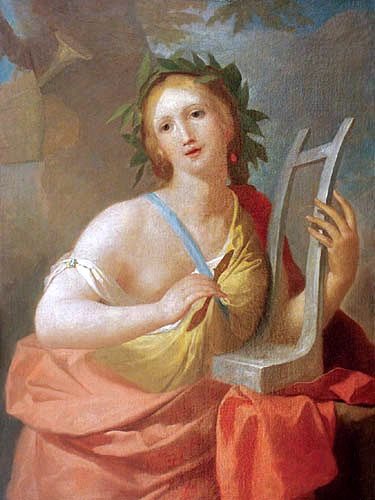
Calliope_by_Marcello_Bacciarelli

I suppose I should thank the muses too, but she thinks it’s a lyre,
even though it has no strings. Is it just part of an old chair?


Audience growth has been beyond my expectations over the year. Streaming web stats, at least as I get them and understand them, are less definitive than I would have hoped, but by this summer thousands of streams or downloads a month had become the norm. Blog readership here is more in line with my initial expectations, and lower than the podcast stream numbers, but the blog readership is still it’s growing steadily from what I can tell.  This only concerns me in that the show notes with the podcast are a poor substitute for the richer presentation of the material about the piece in this blog, and through iTunes the show notes are about to get much briefer and simpler. Maybe this is a sign I should stop talking and simply Kick Out the Jams?  If so, I’m going to be a bit dense and put even more emphasis on the blog in the next few months.

But I can’t leave this discussion on audience without thanking each of you who read this, and to thank several times over those of you who’ve linked to Parlando Project pieces on social media or other blogs, or who have taken the time to click the “like” star on a post here. I’m fine on focusing in close on creating what I hope are interesting pieces, but I’m not good at promoting them. You are the ones who’ve done much of that. I’m not always sure who’s done this linking, I only see the result when a piece starts getting more attention. If you’ve one of the readers/listeners who’s done so, and don’t mind saying so, please let me know in the comments.

Going forward I’m intending to keep the audio pieces coming. If I have the time, I even hope to spend a little more time looking for permissions to include works still under copyright. It’s distressing to me that there are authors whose work I’d love to present here, some of whom are long dead and whose work still speaks to us, but I feel constrained by law from doing so, and feeling lost as to the methods to get around this issue.

It’s this connection with authors who can no longer speak for themselves that has been a surprising, but most moving part this project. Reading and translating Du Fu, coming across writers I knew only as names like HD or T. E. Hulme. Finding out more about Yeats or Carl Sandburg, their poetry and politics. Finding out that Bob Dylan was the second or third songwriter to win the Nobel Prize for literature, and that the first Nobel songwriter,  Rabindranath Tagore, was such a mammoth figure standing outside my view until I looked. Or that Christina Rossetti spoke to me more clearly as a poet than the other Pre-Raphaelites. Without this project I’d never have learned that I had this unscheduled train layover in the English village of Kingham one hot summer day just down the track from where Edward Thomas was still listening to all the birds in Oxfordshire and Gloucestershire. That the teenage love poem of George Washington still could have a listenership. That the simpler Emily Dickinson speaks, the more sharp the ambiguity, all needle and no embroidery. Hearing and relaying the words of Viola Davis about art being the “Only profession that celebrates what it is to live a life.”

Calliope with long blog post by Charles Meynier

I know I’m supposed to be inspiring and all,
but isn’t this blog post getting a little long?


So I’m going to continue here with the Parlando Project to “Tell Other People’s Stories,” but here, with this blog, I’m also going to spend some time talking about art, particularly about the intersection of music and words. These blog posts are going to be longer, perhaps more theoretical, but don’t fear too much theory. I’m still going to be elbow deep in making more Parlando project musical pieces, and work rounds off the sharp edges of theory.

Sky

I describe the Parlando Project as various words (mostly poetry) combined with various music. The limits on the music portion are largely the limits of my own musical abilities and those of the LYL Band, but I try to stretch those limits as much as I can. The words we’ve used have been poetry more than 90% of the time, but I like to mix up eras and writing approaches there too. Today’s piece uses words that weren’t published as poetry, but they are instead taken from an interview with Laurie Anderson published in The Believer  magazine about 5 years ago. The interviewer (a couple of whose interjections I’ve included) was Amanda Stern.
 
Just before the small section I used from the interview, Anderson was relating that artists do not necessarily need to invent something new themselves, rather they can use art to just call attention to things that already exist. That’s an idea that we honor here with the Parlando Project. Instead of endless creating and featuring new sets of words that Dave or I write, we instead largely seek to pay attention to the work of others. That thought, attention versus creation, led Laurie Anderson to her meditation on the sky that I have now combined with my music for today’s piece, “Sky.”

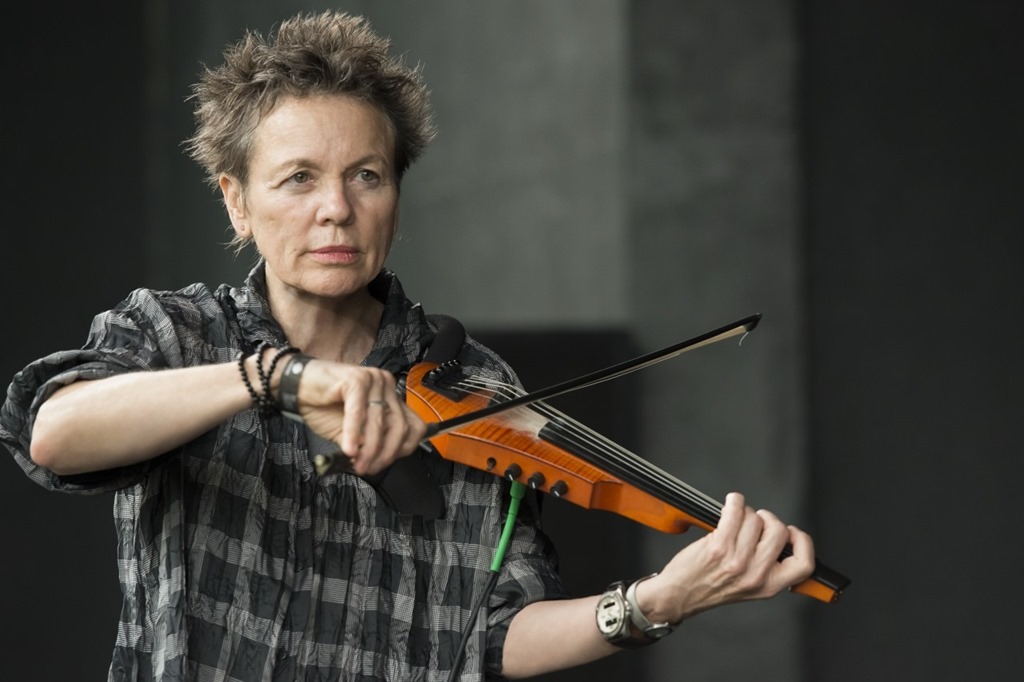
Laurie Anderson and electric violin

American artist Laurie Anderson:  famous long ago for playing electric violin…

Part of what attracted me to this was her attribution of her sky meditation to growing up in the American Midwest, in a town without big mountains or large bodies of water. In such matters I could easily resonate with her feelings, having been similarly enraptured myself by the sky blue and clouds or the black with serious stars in my youth in Iowa. The book of nature has few words and a lot of blank spaces, but it reads deeply if you look at it.

The book of nature has few words and a lot of blank spaces, but it reads deeply if you look at it.

While I write this, I’m still reading more about the last episode’s author, pioneering English modernist T. E. Hulme, finding out that he felt the need to change his art after spending time on the Canadian Great Plains. Certainly, there was sky where he grew up in England, but the sky of great open places, with its null, yet present reflection on the earth, is the whole garment, after which having seen it, one can be reminded of it, even if all one currently has is a tattered swatch.

Laurie Anderson gives some advice to young artists—might work for old ones too.

 
I cannot describe Laurie Anderson fairly in the space I take for these things here. There are no other better-known artists like her, and so resorting to record store clerk shorthand such as: “She’s like Garrison Keillor combined with Yoko Ono and Andy Kaufman and…” is so strained it doesn’t really get the point across. I can see the lineage from Dada though the developments of 20th Century art in her work, but after all, everyone has influences and comes upon things they resonate with, just as Laurie Anderson’s way of combining spoken word with music is an influence on me.

Anderson’s spoken voice phrasing and speaking style is one of the distinctive things about her audio art. Some describe it as a monotone, but I’d say that’s incorrect. Yes, there’s a compression of affect, but that doesn’t mean there isn’t considerable impression of mood and attitude in it. Perhaps she’d ascribe that to Midwesterness as well. Even her non-pitched performance speaking has in intensely lulling cadence and music to it, not just hypnotic in metaphor, but very much in the mode of the spell-casting of a stage hypnotist.
 
That shouldn’t work—and as much as I love her work, in larger doses I sometimes find it hard to retain even sub-conscious attention throughout the whole work—but with the right amount of attention, it’s extraordinarily powerful stuff.

As she has developed her audio style over the years, she’s added singing and a strong use of electronic voice modifications. As far as I know, she’s one of the pioneers in the use of that electronic voice manipulation. I even considered using some of that in “Sky,”  but opted instead for a more straightforward presentation.

To hear my music accompanying words excerpted from this print interview with Laurie Anderson, use the player below. The whole interview, is also a great read for any artist.

What is Poetry and What Is It Good For?

People blog about these allied topics elsewhere, and there seems to be a bloomlet of books answering the same questions. I’ve lived a fairly good number of years, writing, reading, and listening to what I consider poetry, and I can’t say that I’ve thought of this for a long time.

There are inductive and deductive artists: ones who think of, or latch onto, a useful theory, and produce art from it; and those that, if they think of theory at all, derive it from what they have already created. I’m in that later, and I think larger, group.

The concentrated amount of work I’m doing with the Parlando Project means I am working a lot with poetry, and making constant choices. To give me focus in this process I did take on a few principles for Parlando, but  having handled this much poetry in the past year means that I can’t help but observe my choices and what those choices say about what I believe about poetry.

Poetry is musical speech.

Simply, poetry is musical speech. And good poetry not only sings with its words, it sings twice, as its thoughts flow like the logic of music. Do that and I think it’s poetry. Fail to do that (or rather, if I fail to hear that) and it may be a perfectly good something else, but it’s not poetry.

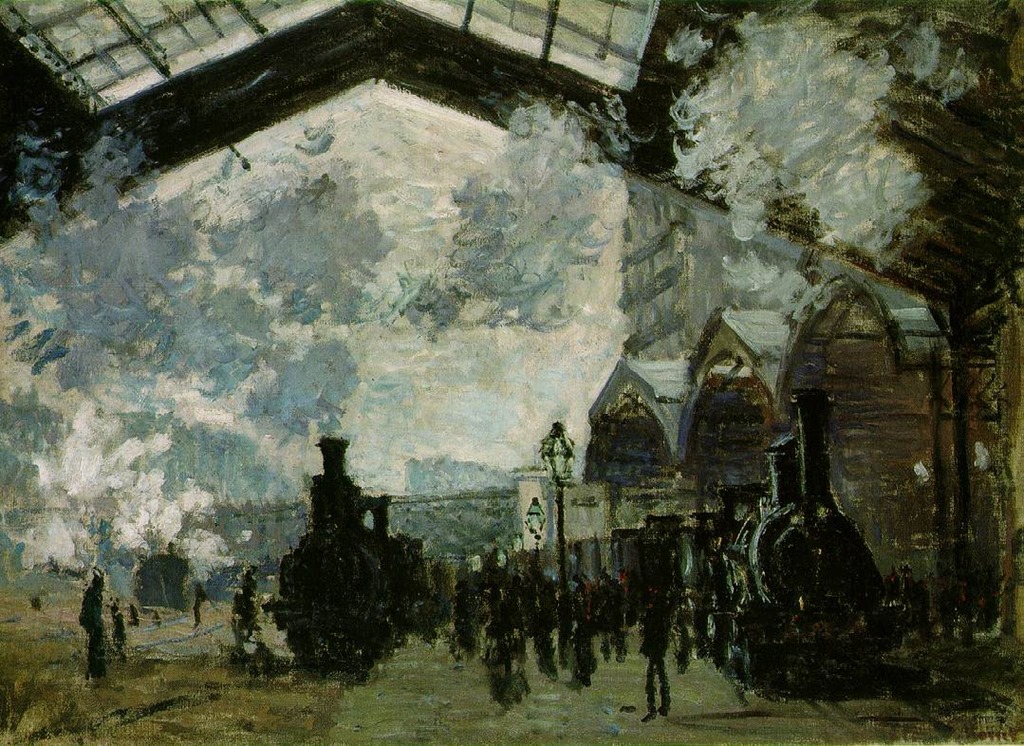
Hold it, some of you may be saying to your screen, what about free verse? What about those decidedly non-rhythmic pieces that are published as poetry, and are widely considered as such? Let’s take Ezra Pound’s famous short imagist poem “In a Station of the Metro” as an example of that:
 
“The apparition of these faces in the crowd;
Petals on a wet, black bough.”

No meter, no rhyme, is that musical speech? To me, yes, it is. I hear this music, as I hear the music in other poems, as a musician, but you could hear it too, even if you are only a listener of music. Music does not need to be a drill team march or four-square polka or sound the bass drum of some dance music that expects regular, repeating beats. The top melodic lines of much music vary in rhythm constantly, and musical speech should have the same freedom, as Pound himself declared in his famous short list of Imagist rules.

Monet St Lazare Station

They say the best things in life are free, but you can give them to the birds and bees!
I want Monet! Monet!  That’s what I want!

I could read other poems, ones that do follow conventional accentuated syllabic meters, and not hear much music in it. If I turn on a metronome or a simple drum machine pattern, I may hear rhythm, but I don’t necessarily hear music.

Yes, this sense of musical speech is subjective, particularly for a poem sitting mute on the page.

And what about the second music that good poetry will also sing, the musical logic of thought? I’m not even sure that “thought” is the right word, as it’s more at apprehension or experience, but as a listener or reader those subjective transferred experiences are felt as thoughts are and engender my own thoughts in response. When Emily Dickinson looks at a bird in her path, or Meng Haoran awakens after a stormy night, or when Ezra Pound comes to the subway stop and sees this throng of urban humanity as a transitory and eternal natural grouping I get to share my understanding of their understanding, if I have the patience and openness to seek to do so.

Music is not how to get from one note to the other as quickly and predictably as possible, rather it is how to pleasantly surprise, or even confound, you in those journeys between related notes.

Any of those experiences could alternatively be a chapter in a memoir, or a scientific observer’s log entry, or a character’s chapter in a novel. Some experience or apprehension of experience is transferred in those ways too—that’s what all art does—but in poetry, the transfer happens in the context of musical expression. This can work, like a meditation chant, a hypnotist’s spell, or any experience where the normal stops and starts of thought are interfered with. And the flow of the order of the data has an internal meaningful structure in good poetry, as a melody or a chord progression has in music, which is not necessarily the flow that works the most efficiently. Music is not how to get from one note to the other as quickly and predictably as possible, rather it is how to pleasantly surprise, or even confound, you in those journeys between related notes.

Consider an image, a set of relationships set out in a poem to be related at once to each other, as chord is in music.

Consider an image, a set of relationships set out in a poem to be related at once to each other, as chord is in music. And the relationship between one image and the next is like a cadence or sequence of chords in a musical composition.

When one thinks of poetry, as I now do, as a musical thing, and not a literary thing, then the presentation of it as we do in the Parlando Project, should make sense to you. Not that it must make sense first, it can simply be experienced.

All this implies some of what is the worth in poetry; and to be honest, some also of what is problematic in poetry, but I’ll leave a further discussion of those things to another post.

How to Make Speeches

I’m going to ask you to not read these notes yet. Listen to today’s audio piece first at least once. It’s short, two minutes long, it won’t take long. The audio player is at the bottom of this post.

OK, now you’re back and you’ve listened to the piece at least once. Do you think the words were written recently? Do think it’s a satire, some kind of sly Machiavellian comment on a particular modern politician?  Do you think it’s Donald Trump’s first draft of his recent speech to the Boy Scouts? Or perhaps is a secret litany of personal affirmations? It does at times seem like a twisted take on self-help.

So what is it?

It’s my quick and dirty attempt at a version of a section of the “Surrealist Manifesto”  written by André Breton in the early 1920s. The Manifesto  is sort of a grab bag, part a sincere plea for a deeper and broader application of imagination in art, part a catalog of examples of how unleashed imagination has already been applied, and part is indeed a parody of a certain genre of self-help, the kind published by occult gurus of the time.

Surrealist Manifesto cover

Not the Boy Scout manual

 
My piece is taken from that parody segment, and I’ve departed from conventional translations in two ways. First, to disguise it, I removed one phrase specifically mentioning Surrealism, and secondly, I’ve chosen my own idiosyncratic translation of the phrase “Peau de l’ours” in it. This is a condensed version an old and French saying, “Don’t sell the bear skin before you have it.” (a French version of “Don’t count your chickens before they hatch.”) Breton may have been using that cliché to contrast with the religious campaign-promise of heaven, but he also could have been refereeing to a hedge fund of his time which used that exact Peau de l’ours” name. And critically, what the investor group bought (and later sold for tremendous profit) was modern French art. “Hedge fund” gave me both ideas in a way that would be meaningful to a 21st Century English speaker.

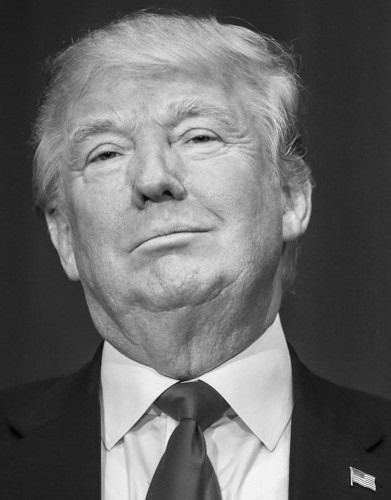
andre bretonDonald Trump

André Breton and perhaps the Surrealist Party’s first President, Donald Trump.

 
So Breton, as he often does in his pronouncements, is mixing the absurd, with recognizable satire, with sincere advice. But briefly, before I go, I ask you to think about a bigger question. What does it say that some modern artistic principles sound like they could be descriptions of Donald Trump’s (or other similar politicians) philosophy? Is it that Trump doesn’t have a philosophy, only that he finds excuses or rationalizations? For past politicians, we would say they lack a sense of irony, but Trump speaks ironically so often that one wonders if there’s a word for unconscious irony. Could it mean that the sincere iconoclastic individualism and commitment to their own personal freedom that 20th Century artists thought they needed as a corrective to disasters like WWI and a restrictive society and its expectations, is now leaching upward to more powerful men in conventional professions?

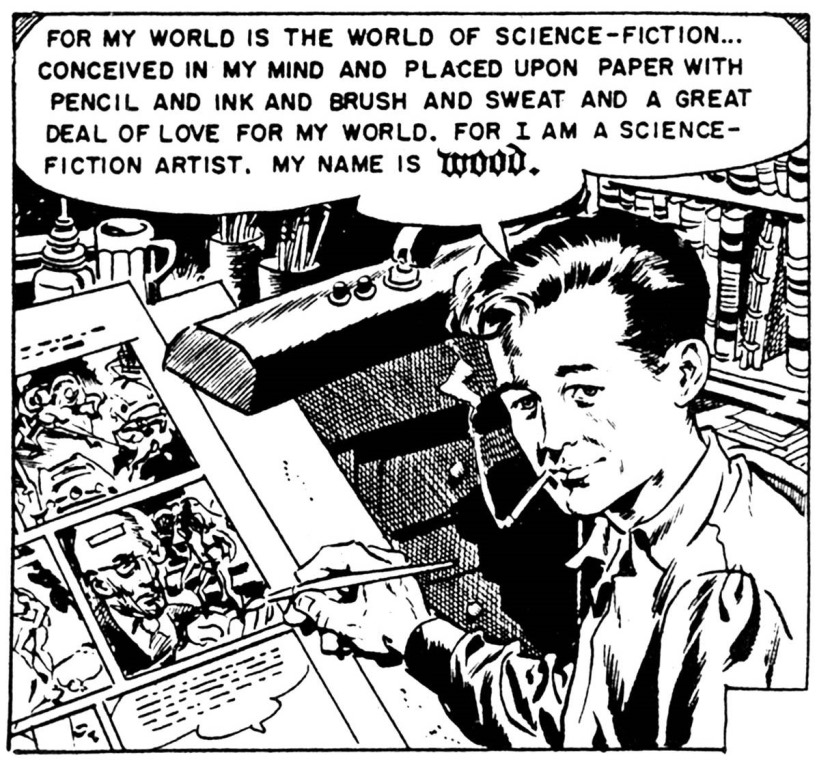
Wally Wood

Back when I was kid there was something we were taught to be concerned about, our “vocation.” This was somewhat like the perennial question “What do you want to be when you grow up?” but with a religious and spiritual aspect.

As the word “vocation” suggests, we, while still children, were asked to consider our calling, what task God would ask us to do with our lives. Yes, there as an expectation inherent in that, that some of us would find that we had been called by God to become Christian clergy, but at least in my small town and church, this was not set out as the answer most of us were to find. It was assumed that each of us would obtain a distinct answer fitting to our talents and the universe’s needs.

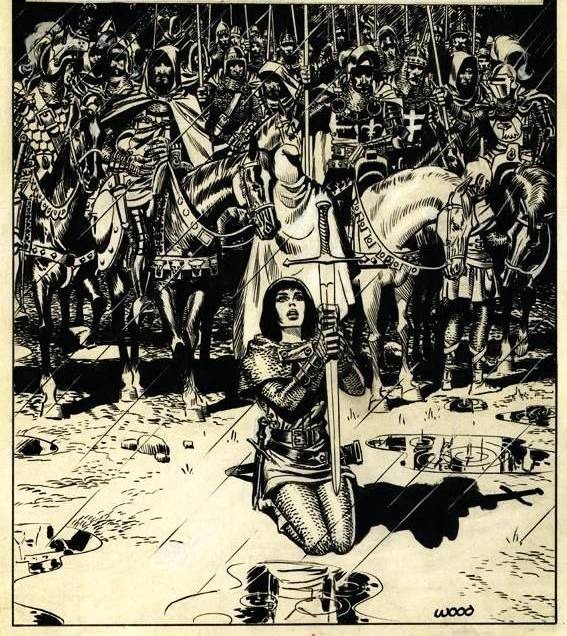
Jesus BaptismWally Wood's Joan

Religious paintings depict a calling as a clear and vivid action,, like in a comic book

The folks who provided religious instruction in my town were practical people, and I couldn’t picture any of them expecting us children to be visited by spirit birds, or hear mystic voices to lead our country into battle. Rather they expected a small inner voice to whisper to us that we should be family farmers, or mechanics, or nurses and so forth. In my family, I could look to a grandfather who I never knew, who was called to the Christian ministry, or to an uncle who followed his father’s path, or to the more complex stories of my parents, whose vocational path I’ll defer talking about for reasons of space now. It never occurred to me, but I could have asked my teachers or myself about my great-grandfather and namesake, who would have had to have been called to be a common laborer by this scheme. Somehow this talk of calling and vocation seemed a bit grand a process for that.

I never knew what to answer that question with until my late teens when I decided that I would be a poet. That’s certainly a grandiose enough answer for this religiously-infused process, but even in my naïve youth I knew that meant I’d be doing something else beside that with my lifetime. So, a calling, but no answer to what I wanted to be when I grew up.

Most decisions to become an artist of any kind expose a person to things that will mess up one’s life. First off, you are going to do something that is likely unlikeable—you are going to privilege your own interpretations of our common life as somehow more valuable than modest silence or undecorated space. Even successful artists most often have a majority of people judging what they produce as not worthy of their time, or generically replaceable by something similar but different from what you do. And these odds of rejection, combined with the concentration of effort needed for much artistic work, make many artists defend their self/center with self-centeredness.
  
So there, as so often here in the Parlando Project, I’ve violated one of the principles that I set out to follow: I’ve spent time here with my story, talking about myself. Alternate Parlando Project presenter Dave Moore avoided this in today’s episode “Wally Wood”  which Dave gave the longer title “Wally Wood’s Co(s)mic Philosophy.”

Here’s what Dave had to say about the piece:

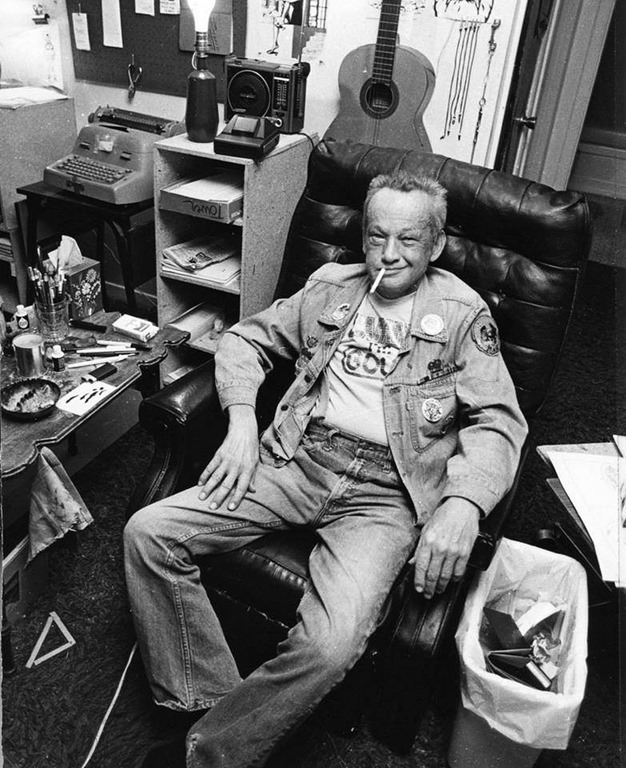
“Wallace Wood was one of the great comic book artists of the fifties and sixties.  His detail work for EC Comics and Mad is still astounding to look at.  Like many, he was also an alcoholic, and increasingly bitter as he aged.  His words in the song are from a late interview in some fanzine.

I can’t draw, so far be it from me to draw conclusions about success or happiness.  Or the scope of a talented artist’s frustrated Fifties ambitions.  What strikes me most are the words ‘And yet’ after a pause.  No matter what he says, no matter how things ‘work out,’ it was worth it for me and all the thousands of others who enjoyed his work.  Go look him up, you won’t forget him.”

Wally Wood Self PortraitWally Wood - Art Ain't Pretty

Wally Wood, combustible master of line

What did Wally Wood add the “And yet” to? Listen and find out, using the player below.

Wisconsin

One thing I like about the Parlando Project is how things we present end up reflecting on each other. Some of that I plan, but some of it just comes up.

Today’s piece “Wisconsin”  completes our series of pieces by songwriters who have won the Nobel Prize for literature, starting with Bengali Rabindranath Tagore who wrote thousands of songs, many of which are still sung today; then moving on to William Butler Yeats, who believed his poetry should be chanted to music and commissioned an instrument and a touring performer, Florence Farr, to realize his conception; and now today, Bob Dylan, the Midwestern American who has written hundreds of songs and whose birthday we’ll celebrate this month.

But “Wisconsin”  and Bob Dylan continues another topic, one from the last post, where I introduce the thoughts that enjoyment of a type of music is subjective, that the experience of the same music is subject to strange mutations of context in the passage of time, and that the judgement of merit and pleasure from music are two different things.

wagner opera costumes

A jam band looking to tune their banjo in the hills and feast on milk and cream


Like the lengthy operas of Richard Wagner or the exploratory playing of jam bands, Bob Dylan has never been universally appreciated. There’s evidence from his earliest years as a performer that this was intentional on Dylan’s part: to accept the freedom to perform in ways that caused part of an audience to reject his approach. Doing this in order to endear himself to another audience that would be attracted by this difference, this freedom, and yes—to a degree—to the power of the exclusion of that other audience.

This is not an unusual artistic stance. The artist who claims that audiences of Philistines cannot understand their work—and who may also aim steadfastly to make that claim true—is common enough to have been a comic stereotype from classical times. But Dylan distinguishes himself from that not only by becoming hugely influential, changing and expanding how songs will be written in English in a matter of a few years, but also because he was willing to change the nature of what audience he was repelling and attracting regularly, almost as if he had an over-arching artistic goal to say that this repel/attract response to art was a thing that we should examine with skepticism.

So one moment you are supposed to love or hate him because he’s an earnest politically-engaged folkie rejecting pop music and hedonism; and then you are supposed to love or hate him because he’s a loud rock’n’roll hip cynic deep into drugs and pop culture; and then you are supposed to love or hate him because he’s a Nashville country-music-factory family man embracing simple truths—but wait, now he’s not only that, he’s what, a Christian!? And then he’s someone adrift, trying to make records every wrong way in an era when everyone is making bales of money making records. Then he unplugs and makes two fine acoustic guitar records in his garage with not one self-written song, which only a handful notice; and then he makes five records in the last two decades that are either embraced or rejected as he writes songs full of richly imperfect characters and anti-heroes defiant and defeated. And now he has the nerve to ask us to listen to him singing songs Frank Sinatra would have sung. And all these twists and turns leave out three wonderful records that don’t fit these scenarios: “Blood on the Tracks”, “Desire”,  and “The Basement Tapes”— any one of which could be the masterpiece of most other songwriters’ careers.

Despite all this change, and more than 50 years as a notable performer, there are those who consistently don’t like his singing, don’t think much of his musicianship, who feel that the historic influence of his writing is somehow an embarrassing overachievement. Some of those people are musicians as well, some of them are smart and perceptive people, some of them hold to the duality of Bill Nye’s great sentence, who feel that like Richard Wagner’s, “Dylan’s music is better than it sounds.” How many of these people are sincere, how many are more at envious? How many are just smarter than I am, with better or different musical taste? How many can’t absorb Bob Dylan for the same mysterious reasons some can’t digest milk or gluten? Some of each.

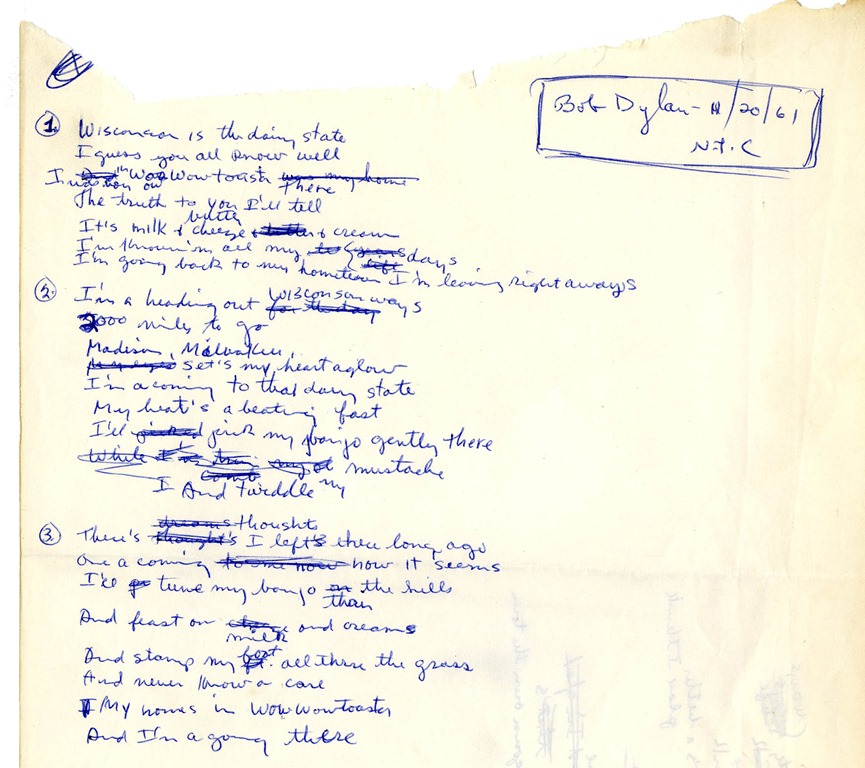
Now let’s take today’s Bob Dylan episode. “Wisconsin”  is a set of words, never used by Dylan, written when he was around 20. A handwritten manuscript was put up for auction last month with a minimum bid of $30,000, and I don’t think it made that minimum. Notices about the auction liked to poke fun at the unimportance and artlessness of the lyrics, particularly in the context of that songwriter getting a Nobel. Well, the Parlando Project is the place “Where Music and Words Meet,” and in this case the words are waiting for music and performance to animate them. On the scribbled page they are puppets without hands in them, so the LYL Band put their hands in.

dylan_wis_song

The Nobel is a long way off, but even the 20-year-old Dylan is revising what seems like off-the-cuff stuff

It turns out that the formula of nonsense and normality, commonplace and commotion, when animated with who-the-hell cares energy makes a fine rock’n’roll song. And you don’t need $30,000 to have that, you can get it here for nothing. Just click on the player below.

To A Friend Whose Work Has Come To Nothing

Given that poetry contributes the great majority of the words to the half of the  Parlando Project “Where Music and Words Meet,” it’s reasonable to suspect, if you are reading this, that you like poetry. That’s too bad. Even during the National Poetry Month and #npm17 that were are talking about this April.

You see, poetry is often a frustrating thing. That high-flown language may be artful, but it’s an earful too. If you were seeking directions to escape some emergency, would you want your rescuer to choose the most precise and beautiful words, words that say more about what a clever speaker your rescuer is than about which way you must turn and where the dangers are?

Do you love the dense allusions and surprising metaphors of poetry? Do you admire the narrative fracturing and careful examination of the shattered facets that expose the common lie of ordered stories? The next time you are searching for how to work some complex gadget or system, do you want your tutorial or manual to scatter its tale in novel ways?

Speaking of too simple statements, here’s one: that there are people who simply like poetry. No, most people who like poetry sometimes, hate poetry sometimes; just as most people who like music, hate music sometimes. The intensity of the like times does not decrease the intensity of the hate times. I think it’s important that poetry tries to capture the allusiveness of things. I continue to admire some poems I don’t really understand—that’s what the music is for, both the poem’s own music and the external music we apply to the words here at the Parlando Project. But there are times when you just want a poet to come out and say what they’re getting at.

The words to today’s episode, by William Butler Yeats, are clear in their meaning. “To A Friend Whose Work Has Come To Nothing”  is an example of “occasional verse,” a poem written in response to an event. In this case, almost everyone has forgotten the event, but the sentiments of the poem apply broadly anyway. Yeats has such a musical way of expressing himself, he could have flown off on some obscure path and we might have followed him anyway. As it turns out, the things he leaves out here, the particulars of the dispute, probably help the poem survive as a general piece of council.

Still, I’m a curious and literal sort. Who was the “Friend Whose Work Has Come To Nothing,” and what was the work? It was written about and perhaps to a man named Hugh Lane who wanted to donate his substantial modern art collection to a museum he proposed that Ireland should fund. And the man who would lie unashamed to oppose this? A newspaper publisher who opposed the gallery.

Hugh Lane

Yeats gave him good advice, but he didn’t tell him to not get on that boat.

What happened to Hugh Lane, whose work had come to nothing? About a year after Yeats wrote this poem, Lane went down when the Lusitania  was torpedoed during WWI. And his art collection? His will seemed to leave it to the British National Gallery after his proposal to fund the Irish museum failed, but Ireland disputed this will, and later in the 20th Century, after Lane’s and Yeats’ deaths, Lane’s collection was again on display in Dublin Ireland. So eventually, in prosaic history and after the work of some lean solicitors, Lane’s work succeeded.

Dublin City Gallery

The Dublin City Gallery where most of Hugh Lane’s collection ended up

Today’s audio piece is brief, so take a listen to the LYL Band performing “To A Friend Whose Work Has Come To Nothing” by clicking on the player below or with this highlighted hyperlink.

.

Biking on the Greenway with My Son and Bob Stinson

Minnesota goes wild in spring when it finally gets warm, and so today, which promises to touch 70 degrees, will surely display this. Like the day described in today’s episode, I’ll probably go for a bike ride with my young son, and we’ll ride on The Greenway, a several-mile-long reclaimed railroad cut that runs, as time does, east and west through the middle of Minneapolis.

Raising a child as a musician, writer, and sometime bohemian brings extra questions. Do you want your child to follow the most conventional and unquestioning path? Certainly not. You encourage them to question things, even allowing that this will encourage them to question you. You look at your own life backwards as you look at theirs coming forward, and wish them adventures, but only so much. You know there will be hardships and wrong choices, but you hope only enough to be instructive. As an artist you may worship art, but you’re not sure you’re comfortable with them adopting all the tenants of that religion.

Today’s piece “Biking on the Greenway with My Son and Bob Stinson”  speaks of this from the seat of a bicycle.

Bob Stinson was the animating force in The Replacements, an ‘80s alt-rock band that never tried to split the difference between insouciance and not giving a @#*&. As a guitarist he was an anarchist, and the band accidentally worked like the NY Dolls, the Kinks, or the Rolling Stones, with a great front man who had the lyrical wit and the staggering lead guitarist who embodied the music’s soul.

replacements on the greenway

The Replacements sit and wait for The Greenway bike path to come through. Bob Stinson, middle left.
The guy on the left is an artist. The guy on the right played in Guns and Roses. The guy on the middle right, writes songs.

The Replacements’ front man, Paul Westerberg, was quickly indicted as a fine rock’n’roll songwriter, which damaged the band because songwriting implies loitering with intent to commit James Taylor. The band rebelled by making sure that a regimented presentation of a set of songs was not the aim. On any given night, this could be inspiring or a shambles: Dada or do-do. Being blotto on stage to the point you couldn’t hide it was almost a requirement, and for no member of the Replacements more than for Bob Stinson.

Eventually the dichotomy demanded an ostomy, and Bob Stinson was asked to leave the band he founded. Things did not go well for Bob without his artistic outlet, and chemical dependency played out its run until he died, his body worn out at 35.

Self-destruction aside, you can see that as path of purity. Chasing after success and an ego-driven desire to rise above others can harm too. The addict and the monk believe they have two different gods, but the penitents have the same scourge. Negation and creativity; deny this, so that that can emerge, is part of the religion of art.

Music, Minneapolis, and life are different now 30 years later, and that’s the place my child and I now live in. Somewhere 30 years on from today will be the place they will live in, no longer young, if they survive rebellion and conformity, if they find the balance between the worship of the self and self-destruction.

This is National Poetry Month, so in the spirit of the Replacements, this is a post more about music, and the music in “Biking on the Greenway with My Son and Bob Stinson”  is not all that polished, tossed off by the LYL Band in one take. Still, you might enjoy clicking on the player below and listening to it. If you don’t see a player, this highlighted link will open a new tab with its own audio player.

Artists Hunting Monsters

The motto of the Parlando Project is “The Place Where Music and Words Meet,” but in practice it has been the place where music and poetry meet.  However, just as I want variety in the music used (within the limits of the musician’s talents) I don’t plan to always use poetry for the texts here. Today’s post is an example. I’m going to use a short public speech, but as I have done with poetry in other episodes, I’m going to treat the words as if they are specifically meaningful, and I’m going to treat those words as if they want to sing.

We are also continuing the investigation of artists and politics, something I’ve touched on several times already this winter.

A few days ago, a cast of actors received an award, and the actor acting as spokesmen for the cast delivered the acceptance speech. Though not entirely a political speech, it was received as one, and it was almost certainly intended to make a political point.

The actor, David Harbour, was speaking for the cast of a series available on Netflix called “Stranger Things.” That show is a sort of bumblebee. Like the famously un-aerodynamic bee, it shouldn’t fly, but it does.“Stranger Things” is a show that uses tropes of 1980s movies and books to tell a story set in that same decade. It should be a winking meta exercise where you spend more time noting the references than to the story itself, or a dreary “I’ve seen this one before” drama that plays as an unoriginal re-hash of ready-made plot points and incidents. Perhaps for some viewers it is one of those things, but for many viewers it’s an ingenious contradiction of all the ways it could fail, doesn’t, and instead flies.

bumblebee flying2

I read on the Internet this is supposed to work!

As an actor, Harbour was part of that levitation. In his acceptance speech, he makes a choice as doomed to fail as the concept of “Stranger Things.”  In his awards-banquet tuxedo, standing in front of an audience of actors, he gives his acceptance speech more-or-less in the person of his character, a gruff, down-on-his-heels Midwestern town sheriff.

What’s the percentages on this working? First off, actors are not their characters, often not even close. Humphrey Bogart wasn’t a grizzled tough guy, he was the son of a cardiac surgeon who grew up upper-middle class. John Wayne was a football player and son of a dirt farmer, not a cowboy or a military man. Actors themselves would know this more than anyone else. Secondly, whatever audience size “Stranger Things” has, that audience isn’t everyone. Will folks who haven’t watched “Stranger Things” get your message if it references tropes from your series?

Well, like the series, like the bumblebee, Harbour’s speech worked in the room none-the-less. You can view that short speech and the reaction here.

In turning this speech into today’s post, “Artists Hunting Monsters,” I changed a few things. First off, the video I first saw after the event did not include his prelude to the words I ended up using. In the part I didn’t have while composing, Harbour talks eloquently about his view of an artist’s role today. In editing the words I did have, sifting them down, and dressing them with music, I choose to universalize his rhetoric to the degree I could, so that even those who haven’t seen “Stranger Things” would have access the message; and in so doing, I changed things to address the role of artists in general, not only the actors that were his present audience.

I’m once more going to violate a principle I thought I would hold to here, and “explain” the text. Harbour, and my selection and recasting of his text, says that an artists’ job, an artist’s calling, is to offer succor to the disenfranchised: to show with our artifice, truth; with our play fighting, successful struggle; with our imagined detectives, the underlying monster.  It’s a call to arms for artists to pick up blunted stage-swords and to deploy magnifying metaphors against oppressive decisions, systems and persons.

How did I speak with the music? Well, I won’t be so bold as to dance about that architecture. The main melodic line is a guitar played with an Ebow, a device that drives an individual guitar string into a cycle of feedback where it sustains with increasing volume until the device is moved away from the string. As the name implies it, it can mimic the sound of a bowed instrument, but that increasing volume feedback loop takes some finesse to manage. The secondary electric guitar line that emerges about halfway into the piece is a guitar feeding back with an amplifier, an even more chaotic effect. I was playing that part live in the main tracking session with bass, drums, and keyboards and was trying to get to the feedback “spot” with the guitar, but mics and other stuff were in the way, and it wasn’t until the track was nearly over that I finally got it to howl properly. And so, I was “hunting monsters” during the main tracking session for recording this piece.

Ebow on Telecaster

This guitar D string is about to find out how bumblebees fly

Before we leave the music part, did you know that the way the bumblebee flies is the way those guitar strings vibrate?

There are still questions left to examine on the role of the arts, and more Parlando Project expressions of music meeting up with words to be posted here in the upcoming months. If you would like to be notified about these new pieces when they are posted, you can click  the little orange “RSS – Posts” icon down on the right side of this post. To hear the LYL Band perform “Artists Hunting Monsters”, use the player you should see just below.