I’m not a scholar, but I play one on the Internet

Let me write a post about something that I experienced recently, just like a real blog would do.

Early this month I attended a virtual symposium Sonnets from the American  organized by Dora Malech and Laura T. Smith.*  I’ve heard “Zoom Fatigue” is a thing now, but I found it energizing. I’m still integrating things from this experience, but here are a few preliminary things this three-day program brought forward.

There’s still a lot to be discovered out there for me.  Even when I saw the listing of sessions, I came upon the subject of Fredrick Tuckerman’s poetry, a name that I’d never heard, and someone who was certainly not part of the American Lit canon in my mid-century day. I can see why he’s a fascinating subject, and the simplest thing I can say about his biography is one could quick-take him as “a male Emily Dickinson.” Similar locations, times, and period of social isolation. I’ve read a few of his sonnets, and so far they aren’t grabbing me, but then that may be me. I’ve been quite distracted as this difficult year has progressed.

Americans don’t mind messing with the sonnet form.  I started writing sonnets around age 20 or so. It was the first poetry form I cottoned to, and the only one that I’ve ever practiced much. There’s something about the length of 14 lines, long enough for a contrasting pair of lyric statements, but not so long as to ask the reader to maintain the mind-meld intensity lyric poetry asks for past endurance. The venerated Petrarchan and English/Shakespearean forms have mechanisms that have been established to work, and I wrote close to the form to start. I recall writing a crown of English sonnets as a 20 year old in a barracks on a fair grounds, but mostly since then I’ve wanted to see how many variations I can create inside the 14 line form, while at the same time worrying that I was cheating by not being faithful enough to it.

In session after session I learned from scholars that Americans not only brought a different sensibility to the matter of their sonnets, but that they didn’t mind morphing the form too. And why not, after all the Elizabethans didn’t just clone the Italian form.

I’m pretty sure I’m not up to snuff as a scholar, but I like running into scholarship.  Compared to any scholar (and many avid readers) I’m under-read. I’ve perhaps read more poetry than a few, but I’ve read many fewer novels than almost any serious literature person, and I’ve got lots of holes in contemporary poetry that this project doesn’t help me in remediating. And at my age, there’s also the “I read it fifty-years ago” factor. The younger scholars at the event had a reasonable retention of what they had read, perhaps more than I have read in my longer time. Is there a minimum amount of poetry one has to have read to have a significant interaction with it? I’m unsure. But what the scholars presenting at the event brought to this is new outlooks, new connections. In my modest, under-read way, this is what I try to do here.

To non-scholars who read this, if you think (perhaps put off by scholarly terminology or personal educational experiences) that scholars have dissected poetry only from corpses, the Sonnets from the American  event let me see the real enthusiasms that are out there.

Just this month I’ve noticed that the Royal Holloway, University of London seems to have linked to some thing or things I’ve written here. The referrers link lets me know that folks are coming here via that institution, but the referring links are behind a staff/student login, so I don’t know what. I’m not sure if that’s a blessing. I might be embarrassed by what I wrote!

There are more light-skinned people writing about Afro-American poetry.  I’m a hybrid music and poetry guy, this shouldn’t have surprised me. While this is a complex and delicate subject which cannot help but interact with wider social forces and existential injustices that this post cannot even begin to cover, in my 20th century Afro-Americans tended to write (where they had the opportunity) about current or recent generations of Afro-American music, and white writers, performers, and impresarios did a lot of the noticed work in reviving interest and applying attention to older Afro-American musical artists and forms. This is changing in the 21st century.**

Again, there can’t help but be an overlay of the American racial caste system here, but my observation, blinkered as it may be, is that this factor still exists in music scholarship and non-institutional enthusiasm.

Now this project is enjoined by practicalities and by copyright law to concentrate on pre-1925 texts, which means that my interests in Afro-American poetry must make do with a shorter list of authors, but the Sonnets from the American event had plenty to interest me there. I could fill my dance card with presenters who’d have something to say about Paul Laurence Dunbar, Claude McKay, and Jean Toomer. One of my favorite pieces I’ve presented here, Toomer’s remarkable Modernist love poem “Her Lips are Copper Wire,”  a 12-liner that works like a sonnet, got mentioned in several sessions I attended. Another personal favorite of mine, Fenton Johnson, got a shout out in question time at another.

I don’t want to give a misleading impression here. There were people of color presenting at this event and presenting important insights, but in the current isolation of my project I could think I was the only white guy whose interests in “Other Peoples Stories” included Black Americans as well as Elizabethans, Tang Dynasty Chinese, South Asians, various early Modernists, some French-speaking guys, and sundry 19th century library stack dwellers.

Negro sharecropper and two wagehands shucking corn for the landlord, a white woman. On road to Cedar Grove, west of highway No. 14, Orange County, North Carolina, Sept 1939

Different tunes, same words:  “Happy Harvest” or “Maggies Farm

Since I’ve written this instead of working on new audio pieces, I’ll leave you with a piece I did last autumn, Paul Laurence Dunbar’s poem “October.”  Dunbar, the first successful Afro-American poet, emerging late in the 19th century, wrote in several styles: dialect poetry that I find hard to read and impossible to present, competent variations of late 19th century literary poetry and subjects, and a handful of poems speaking about the experience of an American Black man in an era when the promise of freedom was decaying steadily into a new era’s variation of denial of humanity. It’s those last poems, small as the number may be in his work, that he is most remembered for now. But what about this one? On the face of it, this is a harvest poem, a “happy autumn” number taking joy in the last bounty of fall.

It works entirely on that level. I’m not enough of a scholar to tell you if Dunbar ever expressed any other intent in writing it.

Now, listen to or read the poem again. Published in 1913, when large numbers of Afro-Americans were trapped in a feudal agricultural share-cropping system, where harvest’s bounty went to the white landowner and their family. I can’t unread the subtext here.  My performance of Dunbar’s “October”  can be heard with the player gadget you should find below.

.

*I found out about this symposium via writer/editor/professor Lesley Wheeler. A big thanks to her for that! Wheeler’s own presentation at the event was on sonnets with radically short lines, a variation that I hadn’t thought of or tried.

**And wait a few years, and any fresh Afro-American musical innovation will get adopted by white musicians. I’m an American musician—most of the notes are Black. This blog started out largely focusing on the early 20th century Modernist poetry revolution, part of a multi-art-form change. Fenton Johnson’s poetry and Toomer’s Cain  are public domain examples of Afro-American Modernist poetic work from this era that I’ve run into so far, though maybe there are others yet for me to find. But, but, but, if one asks the question: “Where are the pre-1925 Afro-American Modernists?” all you have to do is look to poetry’s sister art music and the blind will see.

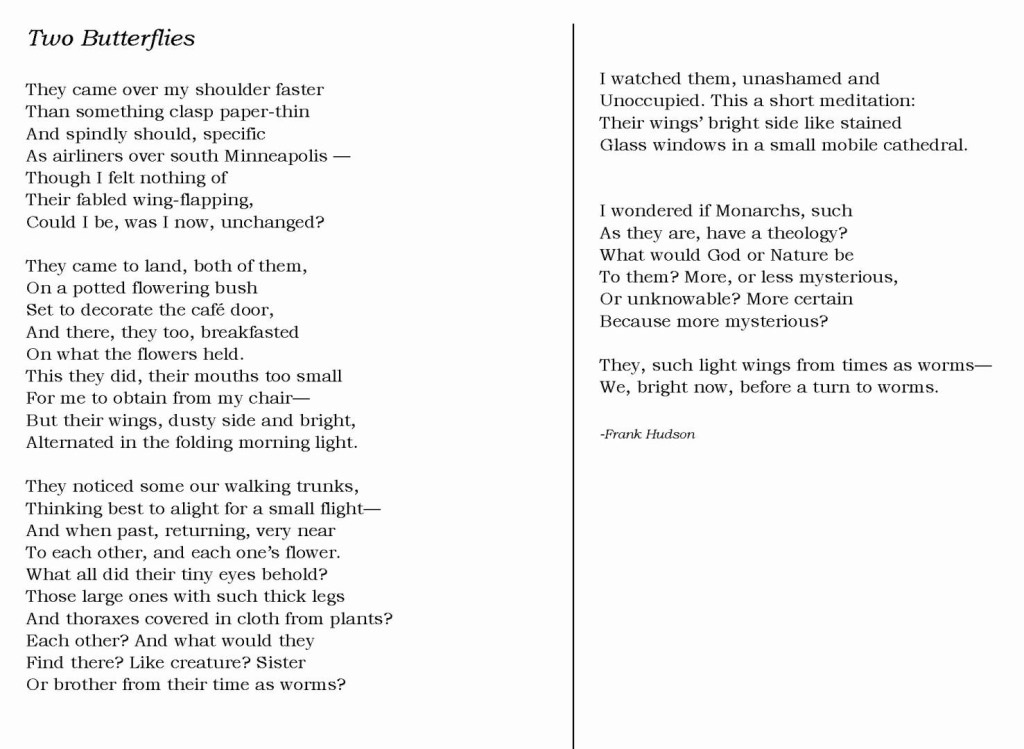
Two Butterflies

My wife remarked this morning that nature is often more beautiful than it needs to be—and if you need a testimonial to that, I present butterflies. What a marvelous structure their wings are, as if the most intricately colored flowers could fly. And fly they do—and unlike birds, they often seem to have no compunctions about flying near us oversized and under-winged creatures.

Butterflies close up

The Wordsworths didn’t carry a device that let them take pictures of lake country daffodils, but here’s the pair of butterflies that inspired today’s poem by flying over my shoulder.
.

This is a prelude to today’s diversion from our usual practice here of using “Other People’s Stories,” other writer’s words, for these encounters and performances. Since I wrote the words this time, I’ll have less to say about what I’ve found out about the author and how I react to their experience. Not that creative writing doesn’t lead to that sort of thing—far from it—but in a way I’ve already chosen how to present those things inside the poem that is today’s text.

I will say this instead: the course of this project, though it takes energy that I might apply to my own writing, as helped my own poetry. As a chronic and justified self-doubter, finding the variety of strengths and weaknesses in a range of others’ work gives me hope in my own attempts—but more importantly, each time I figure out how to present and perform the variety of words (mostly poetry) for the Parlando Project, I must find what is worthwhile, what is valid, vivid, and engaging. It’s a commonplace that reading and studying poetry helps figure out how you may write it, but performing  it helps you understand how to advocate for it, how to let its soul out.

In recent years I’ve increasingly watched other poets read their work. Regardless of the level of accomplishment I might recognize in their words, it’s not uncommon on all levels to hear them read it as if apologizing for the interruption, as if they themselves aren’t sure what to advocate for in what they wrote. Some do this because performance isn’t easy for many people (let me present another testimonial: my singing voice). I believe some do it because to fail with a level of over-florid reading, with too much Am-Dram-Ham, would be such an embarrassing failure. Even to purposefully aim for some anachronistic disinterested beatnik cool could be an unforgivable mistake.

Well that danger is  there. I’ve heard poets read with an attitude that what they are reading is important that I don’t share.*  That disconnect doesn’t make me like the poet or poetry in most cases either—but think of the automatic failure of not claiming the worthwhile nature of what we do. A danger of failure is not a license to aim for it. If performing your work as if it isn’t worthwhile is your defense, consider changing what you write so that you can more unabashedly attempt to claim an audience’s attention.

Yes, a great many poets (I’m one) are driven by doubts. Perhaps you are too. Poetry, like nature, like butterflies, is writing that is more beautiful than it needs to be. That beauty is there to illuminate those limits and doubts. Are they, limits and doubts, ugly? It depends, but illumination changes them.

Two Butterflies

Attentive readers might connect this breakfast scene with this summer’s earlier piece “Breakfast in a Pandemic.”  Yes, same outdoor seating.  City Lights Books is welcome to contact me for a potential chapbook “Breakfast Poems.” This month I think of the woman in that earlier poem who stoppeth one of three to ask “If you had to choose between Trump and Covid, which would you choose?” Now? We don’t have to choose!
.

There’s little room left to talk about my poem, but hopefully it speaks for itself. The poem expects the reader to know two pieces of information: the proverbial “Butterfly Effect” where small things like the flapping of an insect wing can change complex systems, and the metamorphical life stages of butterflies where the lithe butterfly begins life as a devouring worm-like caterpillar. The player gadget to hear my performance is below.

.

*My teenager, a Douglas Adams reader, has asked when I’ll feature Vogon poetry here, but then they think most of what I present here is close enough to Vogon poetry in effect. Poetry audiences, or those that fear being press-ganged into being part of a poetry audience, often recall Adams satire—but yes, many of us writers of poetry think of it too.

A Dream Within A Dream

I don’t know if this is still so, but in my mid-20th century youth it wasn’t unusual for children to read some of the American 19th century worthies in ways not unlike the Young Adult books of today. So before I was old enough to take drivers ed, I’d read Tom Sawyer and a smattering of other Twain, some shorter Longfellow poems (the epics didn’t attract), and lots of Edgar Allan Poe. In a year or so I would start to read Keats and Blake and move on to literature as school assignments.

Other than availability, I’m not sure what drew me to the Poe. The gothic stuff may have attracted me for its examination of human oddness, and I recall the hyper-rational side of the detectives or adventure stories like “The Descent into the Maelstrom”  pleased me. His poetry worked well enough, though I was not yet committed to poetry.

Did the antiqueness of the settings and language bother me? I don’t remember that being an issue. No, the world of Poe or Twain wasn’t the world of colorful tailfins and gray TV, but it seemed tolerably close to my own.

My Poe phase didn’t last long, and even finding out that some of the French poets who would intrigue me in my 20s had first or second-order influence from Poe didn’t make me want to re-read him. My casual judgement that I’d rather read something else has continued, and so today’s piece, “A Dream Within A Dream”  is Poe’s first appearance in this project.

Edgar Allan Poe

Mad, bad, and daguerreotype to know. Edgar Allan Poe.

.

“A Dream Within A Dream”  is not overly florid nor is it chained to a too-simplistic, toe-tapping rhythm. Grains of sand and tormented seashores may be over-used tropes, but this poem doesn’t pass these off as priceless revelation, only handy counters to make the poems stark point: that since life is transitory itself, those things that one creates within it, however placed in the scale from practical to fanciful while alive, are in a final judgement as substantial as dreams. It’s implied that—like many a poet, writer, or artist—the poem’s speaker’s life work was judged while alive pretty close to the not-useful, fanciful side. The poem’s tone seems sad about that, but then it has that subtle valedictory dig: the same holds true for those who think they are doing more important things.

This poem was first published in the last year of Poe’s life, and as Poe struggled to earn enough as a professional writer, it’s ironic that the Wikipedia article on this poem says that the next month the owner of the publication ceased paying writers.

This Wednesday, October 7th is the anniversary of Edgar Allan Poe’s death under mysterious circumstances where he was found dazed and confused in Baltimore and died after a short hospitalization there. Oddly, I didn’t know that I would be writing this on the eve of that anniversary, so maybe some of Poe’s sand grains have washed up here?

Poe still attracts musical settings, so maybe it’s time for me to weigh in with my efforts. It’s been awhile since I ventured into the world of synth created sounds, which are the dream created inside the dream of music. So, today’s piece let me use some weirder analog synth sounds that make no claim to reality. Though the featured sounds today are entirely digital, created inside a modern computer,  they are imitating analog synthesis waves with grains of ones and zeros, and I got to wiggle knobs to control parameters in real time just as the early analog synth players did.

Silicon music, like Poe’s grains of beach sand, the anonymous Internet sea will take almost as quickly as they are made. So before they slip away, you can use the player below to hear my performance of Edgar Allan Poe’s “A Dream Within A Dream.”

He Bids His Beloved Be At Peace

My time and energy is short tonight, so this post will reflect that, but I wanted to present this supple poem by William Butler Yeats written near the end of the 19th century, but, I think, applicable in our American year 2020.

How many of us as couples, as friends, as families this year have felt the need to be support and comfort for them; or in return, needed that from others? A year of shocks, changes, challenges, revelations, of noise and force. Cold deaths, hot fires. This past Tuesday’s national image of that televised, trampled talking over, the faulty assay that volume and audacity can just as well substitute for truth. That absurd equation that one can talk the longest and take the least responsibility. Is that what words are for, is that all  they are for?

I came upon this poem in another blog I read: Stuff Jeff Reads.  There the author figures that in this poem Yeats is using esoteric imagery, drawn from the poet’s well-known attraction to and participation in various hermetic organizations. I think he makes a good point, though some imagery may, without being directly decodable as some secret in-group code, be read by the receptive reader or listener, even if they are a non-adept. The full text of this poem appears in Jeff’s blog that I Iink here in case you want to read along.

Two images, one with physical mass, one auditory are weaved through this short poem. The massive one is the horse and in its plural sense, the Horses of Disaster. In Yeats’ 19th century the horse was still a large part of military force* and one of the largest animals that would be encountered daily in much of his British Isles. Our age may reduce that intimate knowledge. Someone like me, never part of the horsey set, who kept his small purse away from horse racing stakes, and rural in his youth in a tractor and truck sense, can only rely on fairs, events, and exhibitions to feel something of what Yeats’ horses meant to his contemporary reader. To stand, as I have, near a draft horse or to watch horses run at full gallop, and to imagine in my sparser memory that collection of momentum and force, is to feel something Yeats intended to convey.

But there may be accrued in the sparcer memory, that lack of daily familiarity something too. The horse, the Horses of Disaster, are more mysterious, more occult in daily fact than they may have seemed to a reader in 1896. One can often get out of the way of an actual run-away horse—our modern Horses of Disaster, not so much.

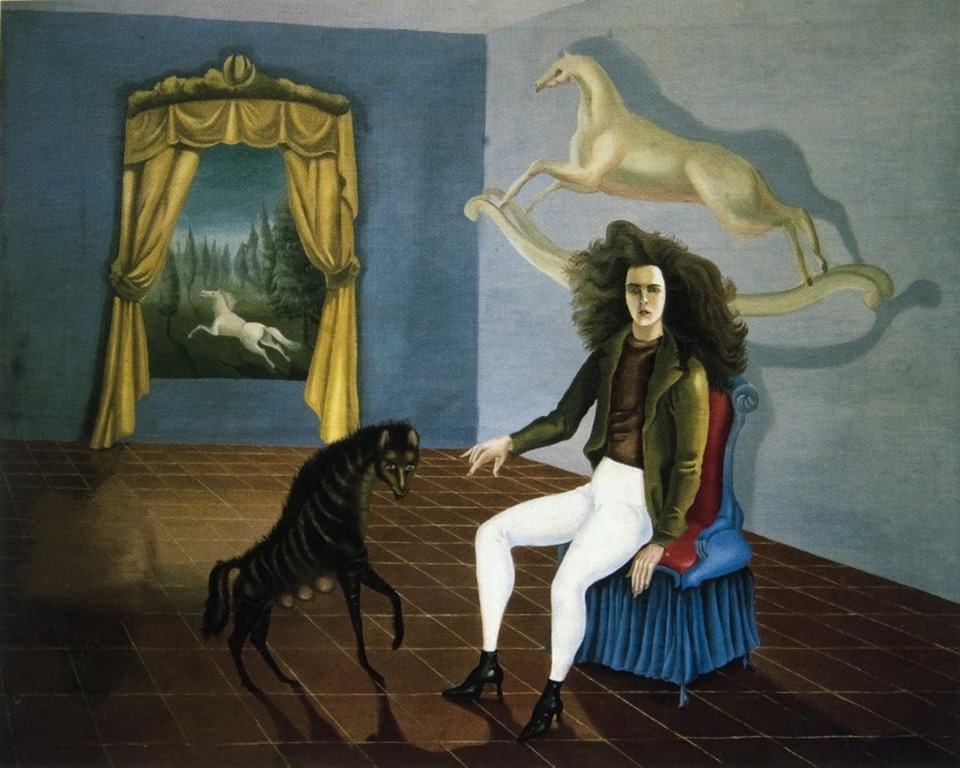
Self-Portrait by Leona Carrington

“Vanity of Sleep, Hope, Dream, endless Desire” The picture is “Self Portrait (Inn of the Dawn Horse)” by Leona Carrington, a Surrealist who deserves to be better known.

The other image, the auditory or conceptual one the poem weaves, is tumult—uproar, confusion—by definition, unpredictable, illogical, chaotic, the body and hooves one cannot sidestep easily.

So, I read this poem as a spell—and Yeats artistry is striking regardless of the efficacy of magical beliefs or practices.**  There is after all, the spell we cast with those we love and comfort. Come, the world will carelessly or concertedly hurt you, but I will not.

The player to hear my performance of Yeats’ “He Bids His Beloved Be At Rest”  is below. Don’t see a player? Then you can use this highlighted hyperlink. Wishing you justice and mercy.

.


*Consider the similar imagery in James Joyce’s “I Hear an Army.”

**I think of a saying I’ve always loved: “If wishes were horses, there’d be a whole lot more road-apples.”

Truth Never Dies

We’re going to travel some ground today, so hang on, it’s a longish post.

Today’s piece has an anonymous author. I’ll write a bit about what I can determine about it later on below, but a lot of the time when I write here of my encounter with the words I use as part of this project, I’ll write at least something about the author. Best as I can determine, I care some about who wrote the words.

I write myself, I know the particulars of my life, my outlook and working beliefs, my location in geography and society enter into what I create—but on the other hand, I don’t seem to care overly much about what these largely dead (and sometimes forgotten) writers believe. I’ve performed religious pieces infused with a variety of religious belief, and writings from Romantics, Stoic Classicists, and Modernists from a range of tribes. As I mentioned recently when I performed a piece unconcerned with matters of ethnicity by odd-ball all-purpose British racist Charles Kingsley: I seem open to occasionally read and perform work by writers whose political and social beliefs are for good reasons widely objectionable, and in that Kingsley post I brought up the foremost case in literary English-language Modernism: Ezra Pound, a man who became an overt fascist,*  and who aided the other side in one of the most clearly-cut good guys vs. bad guys wars in history.

Would I choose differently if I was presenting work by living writers? Well, I have used words here by folks who are my contemporaries and whose personal lives include considerable faults and whose politics do not align with mine—evidence there again that I may not care enough to exclude the work that seems of interest and worth because of the author’s lack of personal rectitude. I certainly understand why someone would choose to boycott a living artist for unacceptable writings, beliefs, or actions. Once I accept that, it’s an easy extension to extend allowances for boycotters to advocate for others to do the same. Fair enough, even if the specter of blacklists and non-persons can be said to follow. I do worry that the slippery slope tends to flow more forcefully from the heights of power and can be lubricated with money or blood.

But mostly my choices here are selfish. If a work pleases or interests me, if it works for the purposes of this project, I’m likely to favor it regardless of its author. It’s unlikely that I could imagine a work that itself  frankly advocates racism, homophobia, or sexism**  as having any pleasure for me, while still I know the authors of the words I use are not unfree of those faults. And yes, I worry that some of the tracks of those faults carry into the work I use. Often when I write about those faults in my reactions to the pieces used here, I caution the reader, as I caution myself, that for what we see clearly as condemnable in dead writers, the future and others will potentially find justifiably equivalent wrongs and faults in us.

But then I also believe, roughly, in the progress of civilization. If we find it unlikely that any fault of our time could be equal to the evils of slavery, near chattel status for women, or human sacrifices for religious beliefs, I ask you only to note that intelligent people, capable of creating art that still pleases us, believed or tolerated such things, and we must consider this part of what humans are capable of—even us.

So, what about “Truth Never Dies?”   Well, it doesn’t advocate for any particular thing. It does make a claim that activists or advocates who have lost a battle or a war might find comforting, and in its own non-specific way it’s similar to a contemporary motto suitable for coffee cup or t-shirt and attributed to Neil deGrasse Tyson: “The good thing about science is that it’s true whether or not you believe it.” And so even for activists working in expectation or demand for immediate action, a Plan B of some future realization of the truth of their request is not unwholesome. No effective movement can exist that can only live and breathe in the environment of success or potential success at hand, it must endure and continue after defeats.

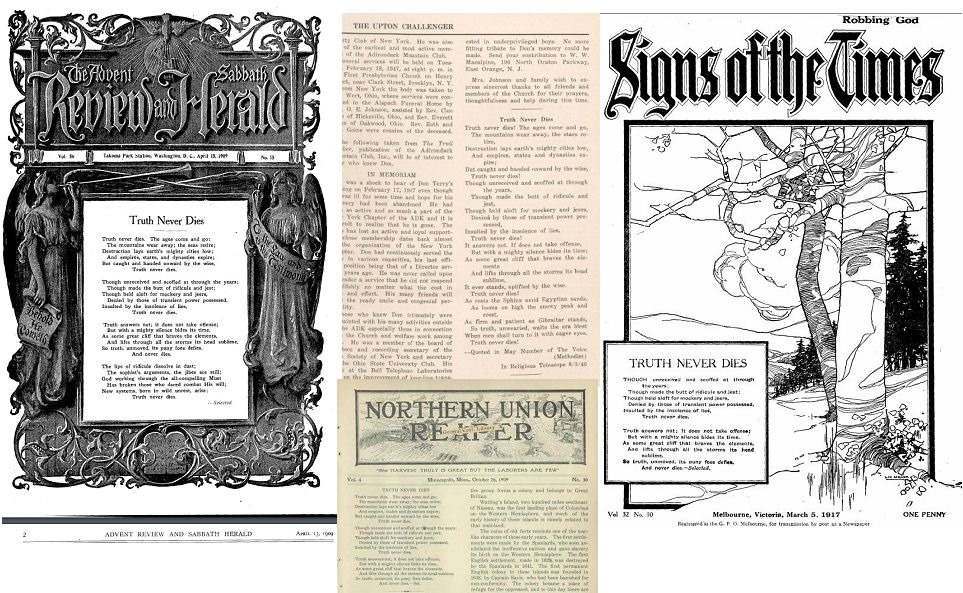
Truth Never Dies Collage

Kenne Turner’s blog will show you some fantastic color photography. The early 20th century Adventist publications which featured “Truth Never Dies” made do with monochrome.

.

As best as I can tell, this poem was likely written in the first decade of the 20th century. It seems strongly associated with American Protestant Christian circles at the time of its writing. The earliest appearances of “Truth Never Dies”  I have found are in a 1909 copy of The Northern Union Reaper  an Adventist quarterly from Minneapolis, a Seventh Day Adventist publication from Maryland, and several other Adventist publications from that year.*** I’ve also found it in the Adventist The Sabbath Recorder  of 1915, a New Zealand based Adventist magazine of 1917, and another Adventist book of 1917 which associates the poem with the visions in the book of Daniel chapter 8.**** A Carolina Mountaineer  newspaper from 1917 includes it, and it appears as a prominent embroidered forward to an 1914 issue of Sky-Land, a North Carolina magazine replete with Lost Cause Confederate reverence. The Scientific Temperance Journal  quarterly printed it in Boston in 1918. The Bottle Maker, a 1921 trade union publication for yes, bottle makers, (motto: “Labor Will Not Be Outlawed or Enslaved”) features it. A 1922 issue of The Railway Expressman from Wisconsin, another union publication, does so too. A 1941 The Preacher’s Magazine  from the Church of the Nazarene in Kansas City includes it. An Ohio-based United Brethren church bulletin of 1947 has it too, and attributes it to another, Methodist, publication.

The poem appears as from two to five stanzas in these publications, and sometimes it’s subscripted with a note “selected” that indicate that it may be a longer poem. I chose to perform just the first three stanzas, if for no other reason than length today.

From the earliest appearances, and some of the imagery of the poem, my guess is that the author was associated with the Adventists. The Venn diagram of Adventist practices and beliefs, temperance, early union movements, and the connections between Nazarene, United Brethren and Methodism fill in the edges.

The most surprising appearance of “Truth Never Dies?”  Easily, the November 14, 1981 episode of Saturday Night Live.  In a skit with Joe Piscopo and Mary Gross. Piscopo plays Nick the Knock, costumed as if a puppet, in a sort of a riff on the casual comic violence of the Punch and Judy sort of puppetry. After smashing a music record playing the skit’s opening music, he’s visited by a fairy played by the meek voiced Gross who tells him “I like to think I see beauty in you that others are too busy to notice. So I have brought you this: The gift of truth.” The fairy then speaks two entire stanzas of “Truth Never Dies.”   The puppet Nick ends the skit by exclaiming to the poetry fairy “I know what I’m gonna do to you, you little thing! I’m gonna eat your spine!” Which he does as the fairy screams. Rather than Daniel 8 or temperance, I’m going to assume that cocaine had something to do with the inspiration of this skit.

How did I  run into “Truth Never Dies?”   Over at Kenne Turner’s blog this month.

In the end, because we don’t really know who wrote “Truth Never Dies”  and because the author doesn’t feel that they need to outline the particulars of a Truth they feel will become self-evident, the poem remains a statement that can be applied quite broadly, and with an effectiveness that remains more than a hundred years after it was written. Readers will not know if they agree or disagree with that unknown author’s vision of Truth, which brings me to one of the things I think I’ve discovered about poetry during this project: that though ideas, including controversial ideas, may be presented in poetry, poetry is more about the experience  of ideas than those ideas themselves. So this poem works, not because it’s a religious catechism, a political platform, or a sophisticated philosophical treatise, but because we can read or hear it and share with it’s unknown author the feeling of a truth that will prevail even if it seems underrepresented among the powerful in the world today, or if there are acceptable substitutes for truth that can be endlessly manufactured for short-term tactical benefit.

The player gadget to hear my performance of “Truth Never Dies”  is below. Don’t see the gadget. Well, you can then truthfully hear it with this link that will open a new tab with its own audio player.

.

.

*Oh, there are mitigating factors if you had to defend Pound in some debate for points. It was the messier, less efficiently genocidal Italian brand of fascism he aided. It’s sometimes claimed it was all caused by a misunderstood dilettante’s interest in fringe economic theories. And there’s the “everybody was doing it” defense too: he’s not the only literary person of his time to have connections and sympathies to fascism. But let’s face it, if there’s a mid-20th century cancel culture, Pound would be someone we’d want to de-platform. Right now I happen to be reading his ABC of Reading,  a book he wrote in the 1930s largely about poetry, coincidently the same time he was finding or writing about his fascist affinities. He has a number of insightful things to say about the art of poetry and the enjoyment of it in this book so far, and I’ve come upon more than one thing where what Pound writes is simply a clearer statement of things I’ve discovered in my own life and during this project about the art of poetry. But he’s also repeatedly making a point I disagree with: that it’s imperative to choose the good art from the bad, and he’s going to tell you how to tell. It’s easy to think that a stubborn insistence in a singular insight into things leads one to larger distrust of democracy along with the ability to hold contrary opinions based on a fixed hierarchy of value.

**Authoritarianism or calls to the purity of violence are heavy lifts for me too.

***Stop the presses! No. What’s the 21st century blog equivalent? Oh, pause the RSS? Rip out the HTML? I’ve just found an even earlier version of this poem, with rarer final verses. Still an Adventist publication though: The Present Truth  November 15, 1906.

****Besides Biblical prophecy of the fall of nations, another reference I found to a similar rhetorical flourish was from a 1841 abolitionist speech by Thomas Paul in Boston where he, responding to the notion that abolition’s cause was dying out, said: “Dying away?….Truth never dies. Her course is always onward. Though obstacles may present themselves before her, she rides triumphantly over them….”

The most popular Parlando piece this past summer was…

Forever and Crumbling.  So if I disregard the outsized number of listens Hopkins’ poem got, this summer’s most liked and listened to was another Emily Dickinson-based piece where I joined two short and somewhat abstract Dickinson poems into what I thought was an interesting combination. I called my combination “Forever and Crumbling.”

“Forever”  talks about the localized instant we all live in, that Dickinson lived in too. “Crumbling”  talks about decay happening from a chain of those instants. In theory the two pieces, that Dickinson wrote separately, change/enlarge when related to each other. That and my musical performance of them is my contribution. Your likes and listens say that some of you found that worthwhile.

I’ve sat here most of the morning and now into the afternoon trying to write something useful in addition. If we are charged to “live in the moment,” 2020 makes that especially challenging. If we seek to halt and reverse the cobwebs and rust on our ideals and nation, like Dickinson’s “Crumbling”  it will take more than an instant’s act. Nothing I wrote today brings what I can believe adds anything to our instant in time or repairs our current state of dilapidation. When I first posted this piece in the first week of June, I felt the same awkwardness. I have faith (or is it only habit?) that art and beauty have worth, but it takes a lot of faith some days.

Wishing all of us justice and mercy, and some wisdom to see a balance of those.

.

A pleasing increase in our readership and then some oddities in our stats

Well before we break the suspense and reveal the most liked and listened to piece of this concluded summer, let me say just a bit about overall listenership and readership. Both are up to historic heights this summer. When this project officially launched a bit over four years ago listens of the audio pieces (which are also available as podcasts, even though our typical sub-5 minute “just the musical piece” format is not the norm for that talkative format) were listened to at a rate substantially greater than the page view stats for the blog posts. This may indicate that podcast listeners are more prone to sample new and little-known podcasts than blog readers, how older blogs with more posts and links get ranked in search engines, or it could say something about how folks like you may have changed how you consume content. Go figure. Then in the middle of last year, Spotify unilaterally stopped distributing the Parlando podcast audio, which apparently was because they decided that our format is unsuitable for their purposes. Not a big thing, as they were never more than 15% or so of our audio listens, and if you would like to hear Parlando Project audio in a podcast reader, most other podcast services, including Apple’s still carry our audio—but around the same time blog page views started to take off, and this spring and summer were the best yet. Then in August something odd started happening with listens to the audio pieces. I’m not sure what it is, or if it represents “real” listeners or something else, but unique listens to the audio in both August and September nearly tripled the average month earlier in the year, and September still has a week left!

Blog page views per monthaudio downloads per month

More people reading this blog, more people listening to the audio pieces. Thanks!

One thing that gratifies me when I look at the stats is that there are people listening to the old audio pieces all the time, and a great deal of the blog readership seems to come from folks finding a particular post, often one that is several years old, from a web search. It’s not uncommon that the most visited post in a day or week’s report is an older one. If literature was the news that stays news, the web hasn’t changed that. Another thing that gratifies me is all the listeners and readers from outside the U.S., which is one reason why I spend less time on current American politics than many other blogs do.

But those listens bring me to an issue in determining what is the most liked and listened to piece this past summer.

I said it was complicated. A number of older pieces got significant listenership this summer: Jean Toomer’s superb love poem “Her Lips are Copper Wire,”  William Blake’s parable “A Poison Tree,”  and Carl Sandburg’s summer neighborhood hymn “Back Yard.”  “Back Yard”  was nearly a repeat visitor this summer’s Top Ten by the audio listening stats. But then I noticed ¾ of it’s summer listens were from Washington state—a fine part of our country, but how had Sandburg or my performance spiked in interest there? Odd that. 90% of “A Poison Tree” listeners this summer were from Great Britain. OK, Blake is more revered in his home country. But there was an even more runaway oddity in the Summer 2020 listenership: Gerard Manley Hopkins’ “Pied Beauty,” an audio piece from last fall, got nearly twice the listens as most of the pieces you’ve seen so far in our Top Ten. I’d be calling it our most popular—and then I noticed: all but two of it’s listens were from Malaysia. The listens didn’t come in one big bunch, they were spread out almost equally between June, July, and August.

It looked like someone caring enough to game the system. Now I like Hopkins and what I did with his poem, and if this just happened out of genuine love for the poem or my performance, I thank that possible someone for their enthusiasm. As the listens for “Inversnaid”  this summer show, whoever that was isn’t alone in liking to hear Hopkins done the Parlando way.

So, decisions of the judges are final, and there will be another poem that will be named tomorrow as the most liked and listened to piece this past summer.

But here are player gadgets for those “golden oldies” to listen to why you wait.

“Her Lips are Copper Wire”

.

“A Poison Tree”

.

“Back Yard”

.

And yes, “Pied Beauty”

.

Thanks for reading and listening. While this is a time consuming and non-revenue project, I try to make it worth your attention. So, to see that these encounters with various words and various music have been worth that to you is what keeps it going.

Parlando Summer 2020 Top Ten, numbers 4-2

4. A Mien to Move a Queen by Emily Dickinson. My teenager, who suspects my musical output as being less than relevant, taunted me gently by asking as I started writing this post if I was presenting Winnie the Pooh. By “Pooh” we may decode: something simultaneously old and immature.

“No I said. I’ve never done any A. A. Milne.”

“Who’s A. A. Milne?”

“He wrote Winnie the Pooh—oh wait, I have  put Milne in a post. I was comparing an Emily Dickinson poem to Sixties psychedelic rock lyrics. I compared a poem of hers to a Milne/Pooh poem that was used by Jefferson Airplane in a song: ‘If I was a bird and flew very high…”

“Bored already.” He playfully rejoindered.

I can’t quite give you the flavor of this, but there’s a quicker wit in my house than mine even when my wife is out of town.

Well that post just happens to be the one that introduced the 4th most liked and listened to piece here this summer: Dickinson’s “A Mien to move a Queen.”  And yes, it is a strange poem, though it draws me in none-the-less. It may be one of Dickinson’s riddle poems, like “May-Flower”   though I can’t solve its riddle. Dickenson may be looking at another flower, or a bird or insect.

Well sometimes one can just let the mystery be.

.

3. Long Island Sound by Emma Lazarus. One of the least-famous poets with one of the most-famous poems ever presented here, Lazarus is the author of a sonnet associated with the Statue of Liberty: the “Give me your tired, your poor, your huddled masses…” one. That was a poem of hope, and I’d say to, so is this one that she also wrote. Therefore, I made “Long Island Sound”  into a happy little summer song.

Did a carefree song seem out of place in our 2020 summer? Or was it something we wanted to visit, if only for the minute and 46 seconds the performance lasts? Well, in any season there is happiness. Seething anger, somber reflection, these may seem to be the noble emotions this summer, but joy is not an ignoble emotion.

.

Black Joy Lives Here crop

The American Midwest loves lawn signs. I ride by many each morning in my neighborhood: election candidates, Justice for George Floyd, roofing contractors, high-school sports teams, and a couple of these too.

2. The Poet’s Voice from speeches by William Faulkner and Bob Dylan.  Our current American age is suffering much from insufficiency of empathy. What kills or mutes empathy? Fear is one thing. One sentence in William Faulkner’s Nobel Prize acceptance speech struck me so strongly when I read it this year. Not the one I was quoted so often by teachers then my age now, back when I was nearly 20, the one that went: “Man will not merely endure: he will prevail”—this, somehow, they seemed to be saying would come from literature, of all things, stuff written largely by dead men. Thanks pops. Now let me return to being worried about which of us is going to run out of tuition money or the will to continue this hidebound education, and get drafted. No, that one was Faulkner’s hopeful future, a future we haven’t yet made obsolete. Instead, it was this sentence, earlier in the speech, the one that should make you sit up and take notice:

Our tragedy today is a general and universal physical fear so long sustained by now that we can even bear it.”

Old man Faulkner, though he may be as imperfect as the brightest and most perceptive person today, is really saying something there. In the context of his entire speech he appears to be referring to the particular fear of a nuclear war, but then how strange that he calls this “so long sustained” when nuclear arms were around the age of our current Presidency’s term when he gave this speech in 1949.

So, if fear mutes empathy, let us acknowledge that carrying someone else’s song in your ear, your mind, your mouth, is the pathway through which it can infect your heart with empathy.

.

I’ll return soon with the post revealing the most popular piece here this past summer. That’s going to be a somewhat complicated story.

Parlando Summer 2020 Top Ten, numbers 7-5

Maybe it’d be a good time to remind new readers what the Parlando Project does. We take various words, mostly poetry, and combine them with original music. Because seeking allowance for performance of words still under copyright is difficult,* we tend to use words in the public domain.

One common response to this capsule description is, “You mean songs?” And yes, sometimes there is singing of words. When I say I compose music for this, particularly when I use orchestral instruments, there’s an expectation of the general field of art song. And when I say a particular performance is me speaking the words in front of a, sometimes live, band, there are generational expectations from the beatnik to the hip hop.

The Parlando Project is not solely any of those things, and in the midst of the various combinations it comes up with, I’d say I’m still seeking, even now after hundreds of pieces and more than four years, for new ways to combine music and words. Song, art song, and the wide range of spoken word with music all seek this too. I just try to do it allowing for exploration of all three.

So, let’s get on to the continued countdown from 10 to 1 for the most liked and listened to Parlando Project pieces last summer.

7. Inversnaid by Gerard Manley Hopkins. Just like with music-music, word-music is a subjective thing. One person’s sublime poetry for sound and flow may not please another at all, and one person’s favorite recording or performance might be torture or boredom to the next listener.

I can sometimes be both persons above, one day liking the complex, the next the simple, in one mood seeking sweet consonance and another day a rich bitterness, or bursts of enormous energy sometimes and then expository slowness other times. It is a good thing that I have access to a range of musics.

But even if for sound alone, the poetry of Gerard Manley Hopkins tends to please me. It may help that it’s not an overexposed sound. Most modern poetry has an easy conversational feel with underlying iambs, while Hopkins feel for stresses with varying valleys and rills between loosens the lockstep yet retains a home footfall.

A great many of you listened to and liked my performance of Hopkins’ “Inversnaid”  this past summer. As I mentioned in the original post, this is not a poem that is easy to understand through and through for meaning, but the sound of it can carry one over the spillway of it’s wilderness waters.

.

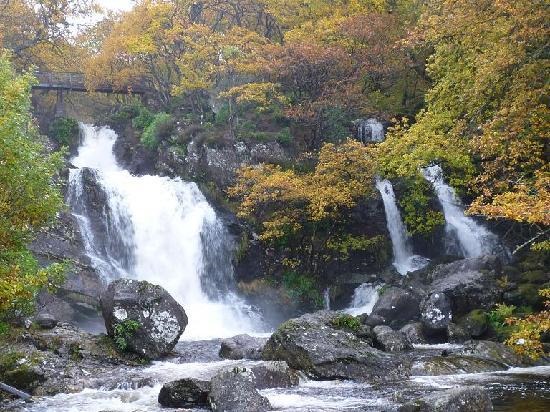
Falls at Inversnaid

A falls at Inversnaid. There’s a hotel right next door to these. Hopkins’ nature was to well, use nature to represent things. Sandburg often chose to use human-made things to explain humans.

.

6. Good Night by Carl Sandburg.  I remain immensely comforted by the range of Sandburg’s poetry. His concern for the commonality of people echoes one of this project’s goals: “Other people’s stories.” His eye for injustice is clear. Modernism has a reputation for solitary individuality, but in his best short poems he harnesses the continued freshness of Imagism with these concerns.

In times like these I can find in Sandburg the things I need, the necessary skepticism, the necessary hope, the indispensable love that allows endurance and asks for change.

One thing I’ve encouraged during this project’s presentation of Sandburg is to assume that he, no less than other Imagists, deserves deep reading. Obviously, many current aesthetic theories say this is true of anything, but I think for whatever it’s worth that it’s likely part of Sandburg’s intent in his best early work too. If he wrote in a garret in Paris. If Sandburg never achieved any of the general renown he accumulated (renown the times and mores eventually spent down during the 20th century) scattered scholars might look for that.

Is there something below the surface of his “Goodnight?”  I think he, the artist, chose  the trains and steamboats as the leaving things of sleep and its longer analog rather than conventional poetic things from a palette of sur-human nature. Now technological progress has added a nostalgic note to his specifically steam-powered leaving. That may be an accident the author didn’t intend, giving this poem an extended feeling, extending out down the track, down the river, over the horizon.

.

5. The Workman’s Dream by Edgar Guest. Does deep reading of poetry tire you? It does me sometimes. Does the chance that you’re missing the “real” meaning of some piece embarrass you once, and once is enough? Are you brave enough to laugh at Dorothy Parker’s smart-set summation** of the coolness-factor of “The Workman’s Dream’s”  author and still listen to him today?

Like Sandburg, Guest was a working journalist. Unlike the entire Sandburg, Guest’s poetry retains a certain work for hire desire to please over the coffee. Can we allow poetry to do that (sometimes) and not harm it? Well for Father’s Day I performed this one. The bold-face heading to each top ten listing will open in an new browser tab the original post I wrote, where in this case you can get the chords I used if you’d like to sing this one yourself.

.

*My estimation: mostly because the poetry rights holders don’t care to seek this—and even when asked. This indifference is also mixed with some concern that it could reduce their control over how the material is presented and any (improbable) revenue.

**”I rather flunk my Wasserman test then read a poem by Edgar Guest” said Parker.

Parlando Summer 2020 Top Ten, numbers 10-8

It’s time to look back over the summer and see which pieces you liked and listened to the most during this season. As always, I’m going to count up to the most popular in a series of posts here over the next few days. Each bold-face listing is a link to the original post, in case you’d like to read what I said when I first presented it.

10. Before Summer Rain by Rainer Maria Rilke.  Long time readers here will know that I like to take a crack at original translations, and I even wrote a post this summer about how I, a person with only a little French in high school over 50 years ago, goes about this—and why you might want to try this too. Regardless of your level of language mastery and your obligations to the original writer, a public translator must also take up an obligation to produce an impactful, living poem. It may be unavoidable that you bring your own gifts as a poet to this task—or even up your game to be able to do that while using another poet’s inspiration as your matter.

Rilke currently has a reputation as a poet of spiritual uplift, a man whose lines get Pinterested over photos, quoted in journal entries, and immortalized on refrigerator magnets. In short: the self-help poet of spiritual self-improvement. I’m not going to knock that. There’s a hell of a lot of lesser things that a work of art can do than to make someone feel better, less lonely in their thoughts, or to help them think that they can better themselves. Sure aesthetes, that’s not all poetry can do, and while I’m no Rilke scholar, I think that isn’t all Rilke can do either.

My translation focused on Rilke’s images in his poem, trying my best to make them understandable or at least striking, and to give the poem a working English word-music.

.

9. Huazi Ridge after a poem by Wang Wei. More translation. The cultural and linguistic audacity to translate classical Chinese poetry has to be a few orders of magnitude greater than translating 20th century German (a language I don’t speak, but I had grandparents who did).

I decided to term what I derived from the sparse literal translation I had of this poem “after Wang Wei,” which is likely more accurate than calling it a translation. But if you are going to use what is more frankly your impression of a poem, the charge remains the same: give us something vivid and give it some word-music that works in English.

The music music here includes my simple approach to the Chinese lute, the pipa. While guitarists might think they have some grounding with this not unrelated string instrument, the pipa, like the western lute, has almost no sustain compared to the modern guitar. Great players can wring a wide range of sophisticated effects from the pipa, but a naïve player like myself just hopes to add a little bit of a different timbre that reflects the culture that produced such distinctive and highly compressed lyric poetry.

.

If you like to hear what the pipa is capable of, Gao Hong demonstrates it’s range while performing her composition “Flying Dragon” in this video.


8. Government by Carl Sandburg. Carl, whose parents spoke Swedish, makes things easy for me by already writing his poem in informal modern English. Sandburg worked for the Socialist* mayor of Milwaukee before he started his career as a poet in Chicago and published his first collection, Chicago Poems, where this one appears. His day job in Chicago was working as a newspaper journalist in the era made famous by the play and movie The Front Page. These things mean that when Sandburg writes this poem and says repeatedly “I saw…” it’s not just some poetic trope.

His final stanza is a fairly sophisticated analysis of politics. Interestingly it’s not—in this poem—a ringing call for change. The statement here that government is made up of humans, and that it therefore inherits human characteristics, is on the face of it an explanation of the political failures this poem testifies to. But nested in this also is the idea the government can change as people change (and change it). No, it won’t be perfect, but it can be better.

.

*Midwestern Socialists of Sandburg’s time reached the highest level of Government administrative responsibility in US history.