It seems like a long way back to the beginning of National Poetry Month this April. One long tradition I’ve followed here for Poetry Month is to perform parts of T. S. Eliot’s “The Waste Land” accompanied by original music I write myself. I started doing this back in 2017, performing just two and a half minutes of the great poem’s “April is the cruelest month…” opening, and this year I’ve been tackling the poem’s longest section: “The Fire Sermon.”
Now April, cruel or not, is nearly over and we’re near the end of that section. “The Fire Sermon” started by the side of a dirty urban river, London’s Thames, and the poet asked the river to flow softly until he’d finished his song. And so today we’re back where “The Fire Sermon” started, with an unnamed narrator viewing the river. Even when “The Waste Land” isn’t shifting voices or shapeshifting who the narrator is, it’s likely to be drawing from it’s great mixtape of references to just about anything, and that’s pretty much what happens in this section. The busy commercial Thames circa 1920 that opens the poem gives way to brief singing by river nymphs,* who we were told had departed when “The Fire Sermon” opened—but they’re in earshot now, at least in the narrator’s imagination. And their singing gives way to—what!—Queen Elizabeth moving down the river on the royal barge.
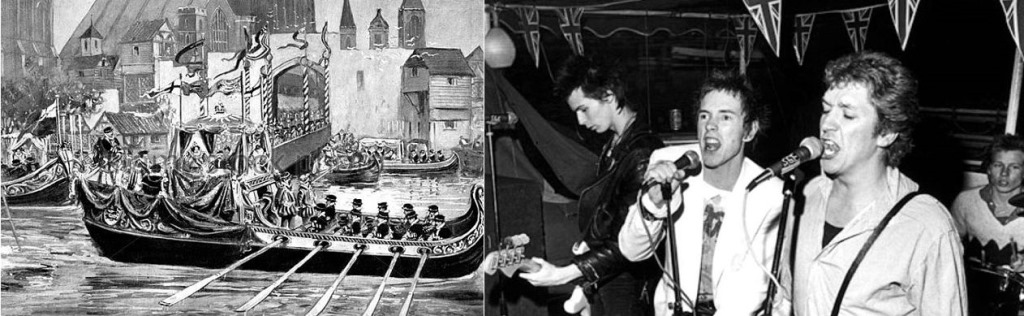
No, not that Queen Elizabeth, the other one, the one before Roman numerals were necessary—but if there’s to be a barge sailing down the Thames connected with some royal jubilee, I was hoping for the Sex Pistols in my small r republican heart.
Either/Oars: the Elizabethan royal barge the first time. The Sex Pistols on their Thames barge trying to drown out Elizabeth “The Deuce’s” Diamond Jubilee with their river nymph song.
Elizabeth is with her most constant suitor on the gilded royal barge, the Earl of Leicester, but historically the “Virgin Queen” never married. Some point to this couple as a continuation of “The Fire Sermon’s” main topic: the corruption and inconstancy of sex and love, but my reading of this barge episode is more at a vision of the passing of glory. Elizabeth and Leicester may not have been a fulfilled relationship, but it’s a great contrast to the man carbuncular and the poor typist from earlier in “The Fire Sermon,” and an Elizabethan gilded barge is a contrast to the commercial barge traffic of Eliot’s time.
When I first looked at this section this spring, for some reason I thought I’d try to do something musically referencing one of my favorite rock bands, Television. That’s not how this turned out. I can still see tiny bits of that idea in the chord sequence and the melodic top line I played on electric guitar. Instead, the arrangement developed as I worked to sonically depict passing glory.
Want to hear how it turned out? The player gadget is below.
*The nymphs’ song is from the Rhinemaidens in Wagner’s Das Rheingold, the start of his epic Ring Cycle, something I’m not very familiar with. Themes of water, fire, and the renunciation of love are present I’m told, and if so, that fits in well with the overall themes of “The Waste Land”.
In the department of coincidence, Wikipedia says the Rhinemaiden’s song melody is Eb, F, Ab, Bb and C, and the cadence in the main part of my music here is Eb, Ab, C, Ab, Db, Eb.
Still, the Dick Wagner I’m more au fait with would be the guy who played guitar on Lou Reed’s Berlin and Rock’n’Roll Animal records.
Today is Arbor Day, a curious holiday, born in the American Midwest, meant to celebrate and cultivate trees. It’s more established than the uncounted more recent designated days, special weeks and “National Months” like Poetry Month, but its observance is spotty.
Wikipedia says this is someone named “Birdsey Northrup” who helped popularize Arbor Day. Since this isn’t April Fools Day should we believe that?
I can’t say I remember and keep it myself, though I’ve always had an attraction to trees. I remember an old tree with exposed root tops outside my earliest remembered childhood schooldays, its roots large and far enough apart that we small school children would sit between them as if it was ground-level-low bench with bark covered armrests. And I remember forgetting where the tree was, like the location of Eden is forgotten, and being unable to locate it even only a decade or so later. That tree is no doubt gone, as many of those school children are gone by place of current location or end of life.
The backyard of the house I grew up in had four large walnut trees, majestic if a bit messy when the nuts fell, littering the ground like a green elfin golf-driving range. I remember that a major branch of one of them had a full long-handled scythe, like the grim reaper’s side-arm, crooked in a joint above anyone’s head or reach, it’s blade now being held in the teeth of the bark which had healed its wound. This I noted as a child, long before I thought to write, or write poetry, and it exists in my memory like a poem that doesn’t need to be written because it just was.
When I was looking for the house I live in now I wanted a yard with trees, which it has. The largest is outside the window as I write this, being old as a tree is and budding like the geriatric Sarah. I note that when Sarah’s husband Abraham met the three angels who told him that he, 100 years old, was to have son with his wife of near the same age, that he met these angels and heard this news under a great oak tree. Abraham, being a patriarch, and therefore by definition part of The Patriarchy, had his wife get busy making a quick meal for the angels, who as divine beings might not need earthly bread and could have said to Sarah, “Oh, don’t bother, we’ve already eaten.”
Anyway, in what is surely the strangest conversation with angels in a book of strange things, Sarah, hard at work on whatever quick-bread recipe that an antediluvian Epicurious might provide is said—right there in the first book of the books of Moses, the Holy Bible, in Genesis 18, in father Abraham’s tent—to have laughed.
Now the angels—who knows here what angels know—might have figured that Sarah’s laugh was the wisest thing they’d ever heard from a mortal, but it doesn’t say that in Genesis. Yes, it’s revered by many as a holy book, so the author may have figured he’d do something subtle here—or maybe it’s a blunder by a non-inspired editor somewhere down the line. Genesis just has Abraham being told they heard that laugh. Do angels joke? Did one of them wink to the others? Do angels wink? And then, to wind up the old geezer Abraham, who knows they’re angels, and is doing all he can to show how well he treats divine messengers who might only appear to be strangers who’ve wandered up to his tent, the angel looks Abraham in the eye and tells him “We heard Sarah’s laugh you know.” The term pregnant pause was invented then I think.
“I dunno, should we threaten to give him a bad Yelp review or something?” Sarah and Abraham with the 3 angels. Oak tree not pictured.
I don’t know what kind of pants folks wore in those days, if they even wore pants at all. If they did, let’s hope Abraham was wearing an old, brown pair. A divine being has just implied that your wife has been impolite, maybe even blasphemous. Genesis has other stories about what happens when you don’t treat angels right.
And 90-something Sarah, who’s just been told she’s about to become pregnant at that age, Sarah who laughed, quickly looses her wisdom—as we mortals who may find wisdom in a moment only to loose it in the next do—and she tells the angels she didn’t laugh. And the angels just said back, like trees do when we laugh beneath them, “Yes, you did laugh.”
No new audio piece today, but I hope to work on the next part of our National Poetry Month serialization of T. S. Eliot’s “The Waste Land” this weekend. Here’s a fairly recent piece that’s in our archives along with over 300 other ones, one that seems right for Arbor Day: Charlotte Mew’s “The Trees are Down.”You can read more about Mew and the poem here, or the full text here. But to hear the LYL Band perform it, use the player below.
What did Emily Dickinson think about the American Civil War, that great national trauma that occurred during her most productive time as a poet? And what did she think about the great national sin that was the cause of that war, slavery?
Emily Dickinson often writes puzzling poems, compressed like a set of speaker’s reminder notes on an index card. Despite occasional antique words and references to obsolete technology, Dickinson’s poems don’t really seem to dwell in a particular time or have any anchors in a time’s signature events. Instead we are left with the multiple capitalized idealized concepts that in the hands of most poets would doom a poem to vapid incorporeality—but the speed and brio of a Dickinson poem seems like the rush of thoughts, and that and they carry us along. All of this lets us see a remarkable mind thinking, but it doesn’t necessarily tell us the conclusions, only the methods by which it tries to reach them.
With many other American poets of her day we can tell what they thought of the Civil War and where they stood on the issues of slavery. Of course, we no longer read most of them, and we continue to read Dickinson. Even though my curiosity about these matters is personal, and in the end it doesn’t significantly change the originality and attraction of Dickinson’s work, I’ve still looked to see what I could find.
Dickinson’s father, Edward, was a politician, a member of the short-lived Whig party, and so there are political stands associated with him. The American Whig party, particularly for northern Whigs, was a “free soil” party. This meant that they did not stand for the abolition of existing slavery but wished to limit any expansion of the practice. Southern slaveholder interests were not content with that as a compromise. In an era when new territories and states were being added to the Union, they feared that they would eventually be too small a minority in a growing United States. In the 19th century before the Civil War, time and again these interests would come into conflict, and it was generally the Whigs who worked out some compromise that put off the Civil War. Edward Dickinson seems to have been an orthodox Whig, he supported those compromises, including voting for one of the last and most fateful of them, the Compromise of 1850 that gave the slave holders a Federal Fugitive Slave Act, giving license for bounty hunters of dubious ethics to haul escaped slaves back to the South (and financial rewards if they over-reached and just grabbed a free black person “by mistake”) and requiring local state authorities to assist in their efforts.
The injustices of the Fugitive Slave Act enraged Afro-Americans and energized abolitionist sentiments. And in the slave states who would secede at the start of the Civil War one of their chief complaints was that the Federal Government wasn’t doing enough to enforce this Fugitive Slave law against individual states that were hampering rather than aiding these “slave catcher” bounty hunters.
The Whig parties balancing act fell off the high wire shortly after that. It essentially split into two parties, the new Republican Party which was more adamant about free soil with no compromises, and eventually became the “party of Lincoln” and slavery’s abolition. The other part was the Constitutional Unionist Party which wanted to continue the Whig-style balancing act. Edward Dickinson seems to have aligned with the Constitutional Unionist faction, which completed the rapidly increasing progression to irrelevance for the Whigs.
On the other hand, both Edward and Emily Dickinson were on friendly terms with those who went the Republican route and even the more radical abolitionist bent. If yesterday’s story of Angeline Palmer might lead you to see a 19th century Massachusetts casting of To Kill a Mockingbird with Edward as Atticus Finch and the young Emily as Scout, the reality of the Dickinsons is much more ambiguous.
I’ve found various critics and commentators who have sought to answer my questions about what Emily Dickinson thought on these things. Some point to Dickinson poems and have suggested readings of them, but these are most often unconvincing to me. She does have poems mentioning warrior courage, duty and loss, but none of them seem to say anything about the causes or necessity of the pressing war in her time. Even more rare are references to slavery or people of color in the poems.
Mysterious and burning. Dickinson’s mind by lamplight
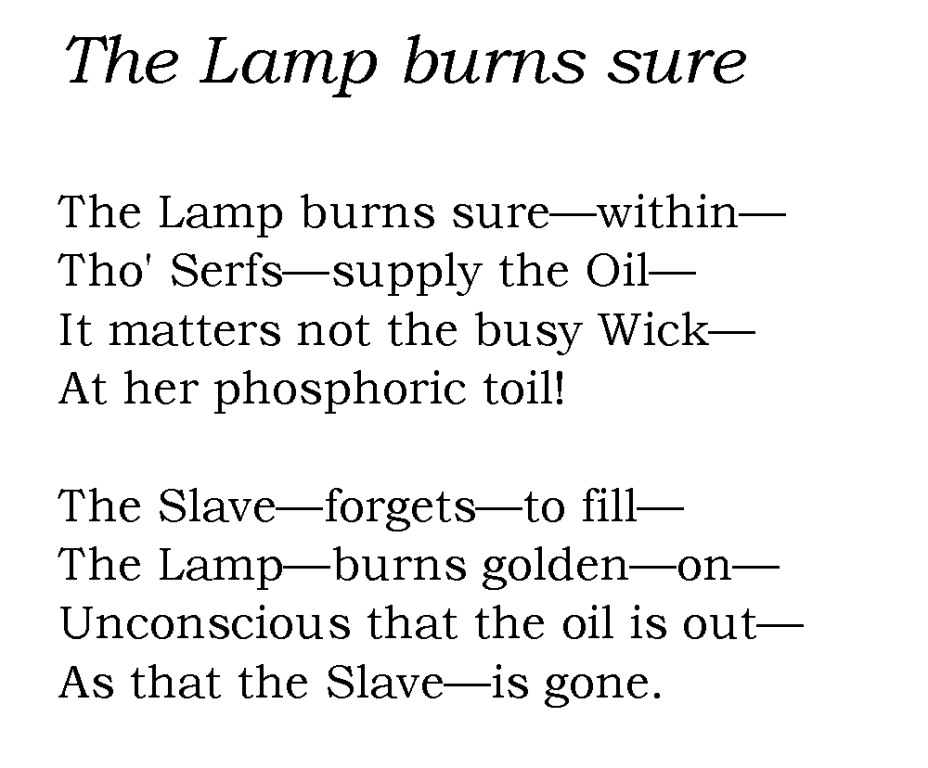
The poem I use for today’s piece is one of those rare ones. “The Lamp burns sure” is Dickinson at her most compressed and ambiguous. The poem’s plot is clear enough, an oil lamp whose oil is supplied by slaves or serfs (the poem says both at first, muddying the waters if it’s talking about slavery) runs out of oil because they have stopped filling the reservoir. The lamp’s wick is so busy burning that it doesn’t notice that it’s out of fuel and would in the normal course of events burn itself out shortly. The poem does not proceed to that end however. It leaves us only with the wick’s obliviousness, and then breaking the tie between the oil bringer’s role as being a serf or a slave, leaves us with the final statement that the busily burning wick is also unaware that the oil is out because “the Slave — is gone.” We don’t get to find out if the lamp is some Hanukkah mystery that will go on burning longer miraculously.
So, what does it mean, if it indeed means one thing? Some read it as a parable of creativity, that we’ll work ourselves past our resources in our passion. A key word there would be “within” indicating some imaginary inner lamp and the slave is just our body and emotional resources.
Some read it as a comment on the base labors that support a civilization that in turn supports arts, science or spiritual pursuits, and in that reading it’s an acknowledgment of the necessity of those labors—take them away, no light! The confusion of serf and slaves is a necessary confusion as it’s talking generally about civilizations.
And then some think, since this is a poem written in 1861 as the Civil War has broken out, and all the slave labor that has supported a large portion of the agricultural economy of the nation is now in question along with that nation itself, that this is not a generalized metaphor. The slave who’s gone, is an American slave, the light is an American light that will burn golden on.
Emily Dickinson’s desk with a whale oil lamp, a little luxury that could extend her writing hours
That last one would make it the closest to an Emily Dickinson statement on slavery and the Civil War. As I burn my own midnight oil tonight and I think of Emily Dickinson who wrote at night by the light of an oil lamp, I lean to the first reading. But some other day I might see something else and read it another way. I’d like to be surprised and to find out that Emily Dickinson’s keen and questioning mind could see what only some in her time could see about people of color and slavery, but that might not be the case. But here’s what I do find when I go to the music of that mind: a mind unafraid to be original and like Frederick Douglass in Robert Hayden’s poem, to believe freedom thought to be as needful as a heartbeat. Even if she didn’t free anyone from slavery like Lewis Frazier and his fellow servants in our last post, or agitate and orate like Douglass, I find there’s liberation there that burns sure.
Here’s my performance of Emily Dickinson’s “The Lamp burns sure.” You can use the player below to hear it if you can see one. No player? Then use this highlighted hyperlink.
Here’s a story. You can decide for yourself if it’s a sad or happy one.
It was a spring day in 1840 in a town in rural Massachusetts named Belchertown. For children you might expect that would be a fine day for play, but that’s not what this story is about, though it is about a child, one with a beautiful name: Angeline Palmer.
Angeline was a poor orphan and ten years old. Playtime was not on her mind. About a year back, the town poorhouse in which she’d lived since she was two years old had bonded her out as a servant to a prominent family in Belchertown. The town’s council ran the poorhouse, and Angeline was their ward legally, but such arrangements reduced the cost of running the almshouse.
I can’t be sure what work a nine or ten-year-old servant performed in those days in that place, but of course there were no appliances, and in rural towns there were not even stores stocked with things we might buy to save a household from having to make them. Households then were very labor intensive, so there must have been work for Angeline.
A servant like Angeline might dream of a better life on a spring day. Some would learn trades in household service that would allow them to start their own businesses. Or they might marry and start households of their own, where even if their lot would be the same sort of household work, they’d be servants of their own.
But Angeline wasn’t dreaming of a better life that day. Instead the future looked ominous. The man who owned the house was now staying in Georgia, looking for new business ventures. He had sent his wife all the way to Massachusetts to check on things at his house in Belchertown, and while she was there, a letter arrived. The letter had instructions for raising some money for his new business: ship Angeline Palmer down to Georgia. The letter figured she’d be worth $600 cash sold as a slave there. That’s about $17,000 today.
You see, Angeline Palmer was Afro-American. She was an orphan, poor, a servant—all things that limited her life, but she was free.
Servants in the house heard this letter being discussed, and quickly sent news of it back to the town where Angeline had been born. She had a half-brother there, Lewis Frazier, barely more than a teenager himself, he arranged a delegation to the town’s council, the men who were by law Angeline’s effective parents. The council wouldn’t take action.
Angeline was allowed to return to Amherst to say goodbye before the trip to Georgia and slavery. Her Grandmother was a servant at the home of the town’s postmaster. She asked him what could be done. Alas, the postmaster was the brother-in-law of the wife who’d been sent the letter. Instead of stopping this, he warned the Belchertown people that someone might be trying to stop the shipment of Angeline.
The postmaster worried someone might try to interrupt Angeline’s trip back to Belchertown by the scheduled stagecoach. Figuring they’d try something on the open road, he hired a liveryman to take her back by special wagon over a different route.
The postmaster was right. Angeline’s half-brother and a friend did flag down that stage, and of course Angeline was not on it. Slowly the pair walked back to town, sure that they’d failed.
But the liveryman had a servant too, and he knew the slower roundabout route the liveryman was taking back to Belchertown with Angeline. The town’s butcher loaned the liveryman’s servant a wagon and the now trio of rescuers sped off to Belchertown.
Despite the liveryman’s slow route, Angeline was already there, back in the house where she’d been a servant and from where she’d soon be shipped off to slavery. There was no time to waste, no one left to appeal to. Leaving the other two in the wagon, Lewis Frazier rushed into the house and found Angeline. Those in the house quickly reacted, and locked Angeline and her would-be rescuer in a room.
The other two men who’d raced from Amherst then left the safety of the buggy, ran up the stairs, pushed aside those trying to stop them, opened the door and took Angeline and her half-brother back down the stairs to their borrowed buggy. A crowd was beginning to form. Angeline and the three men didn’t wait to see what they might do, whipping back out of town as fast as their team could pull.
Angeline was secreted out of Amherst to an underground railroad safe house. Lewis Frazier and his two accomplices were arrested and charged. Though they’d stopped the fraudulent theft of a human being who would have been turned into property, who would have been owned along with her offspring, and bought and sold like livestock, the trio was charged with assault and kidnapping. The evil scheme of the man in Georgia was beyond the local court’s jurisdiction, and besides the three men had prevented that crime.
I don’t know how Belchertown looked upon this matter, but some in Amherst seemed to support the rescuers. Amherst’s most prestigious lawyer defended the trio of Afro-American men at the trial. That lawyer’s name was Edward Dickinson. Dickinson had a red-headed daughter, only a year older than Angeline Palmer, and her name was Emily Dickinson, who later would become known as a poet. Despite Dickinson’s efforts, the trio were convicted. They were given a sentence of 3 months, but it would be stayed if they would reveal where Angeline was hiding.
The dutiful trio didn’t take that deal, but the jailer seemed to be another who sympathized with them. While they slept in the jail at night during their sentence, he granted them liberty each day, and it’s said that townsfolk brought them gifts of extra food. The three men gave up some of their liberty for a short time but prevented a life of slavery.
So, what happened to Angeline Palmer? After a decade had passed, she returned to Amherst and married a relative of one of the men who had rescued her. She died, likely in childbirth, a few years after that. That may sound sad, but that was also the ordinary risk of a free woman living a married life in that time. They’d tried to steal her away and make her a slave, but a network of servants and three African-American men who cared for her risked all to prevent it. So, is that a sad story or a happy one?
A recent comment here by Mr. Steele has reminded me of this sonnet I wrote several years back. Part of the idea for the poem came from reading some theories about the earliest humans and what may have been the beginnings of human speech and art.
No one can say exactly when recognizably human speech began, or how sophisticated it became how quickly, or even when it became anatomically possible. DNA evidence has told us a lot of things in the last decade or so, but it apparently can’t answer this question, and bone and fossil evidence is hampered by the largely soft-tissue aspects of our voice boxes. Work with apes and other animals has suggested that they can learn fairly complex symbolic communication even if they don’t have the vocal chord apparatus to speak in a conventional sense, and of course animals do communicate sonically otherwise, from birdsong to the elaborate EDM-like sounds of marine mammals. Human brains with symbolic thought preceding human voice boxes could have communicated in other ways too, ways that might sound musical. Steele’s comment includes lots of links.
These stenciled handprints have been dated to Neanderthal times
One thing we do know about paleolithic age humans: they had a thing for handprints. Any child who’s made a Thanksgiving turkey by tracing their fingers, or any parent who’s received it, knows something of that art-form. Stone age people used a stencil method. A hand would be placed on a rock wall and a mouth would be filled with some ochre pigment which would be blown over the hand, leaving a negative stencil. The colorful drawings of hunted animals on cave walls may be striking artistic creations, but these handprints of humans who lived tens of thousands of years ago touch one—yes, I use that word deliberately.
And later, the written word. Here’s the text of my sonnet.
The poem opens by assuming that Neanderthals, who may not have had the ability to articulate speech, and who likely didn’t have projectile weapons, could have used silent hand signals when hunting. The poem closes by referring to a find which was first interpreted as evidence of a Neanderthal ritualized burial: a stone-age body’s bones mixed with flower pollen covered by a rock. I bring that into our times by using an altered phrase from the hymn “Amazing Grace” and wondering who may see our bone fragments mixed with flowers in an unimaginable future time.
This poem has never impacted anyone I’ve performed it for as much as it does me. It could be that few are interested in these earliest humans and the nature of their lives so long ago, and so this is a poor choice for an image, or that could be from other faults in its writing—but I get misty every time I perform it. To consider that someone, a creature more or less like me—who has the knowledge that they will someday die, who perhaps has no other way to say they were here, once—made a stencil of their hand maybe 50,000 years ago is moving to me. If I were to stand beside them while they were doing this, it would be certain that neither of us would have spoken language to discuss this. But we could both point to that hand, stenciled on the rock. That’s art.
As we continue to celebrate National Poetry Month here, I ask your indulgence—today’s piece isn’t based on a poem. Earlier this week I did use a Ralph Waldo Emerson poem, mentioning then that his poetry often fails. Well, there are compensations—as an essayist, Emerson often expresses himself poetically.
Today’s piece is part of an Emerson essay published in The Atlantic in April 1862 called “American Civilization.” In it Emerson ranges quite a bit, including some racial and regional stereotyping that may shock some modern readers with its ignorance and prejudice. But rather than concentrate on what Emerson got wrong—after all, I don’t need to go to 150-year-old writing to find that sort of thing, our own age will supply all we’ll ever need—I want to present to you some things that Emerson might have gotten right.
I’ve selected a handful of sections from Emerson’s essay for today, the parts of the essay that strike me as if they were a poem. I call my extracted text “Emerson’s Wagon,” in that one of the phrases it popularized became a pervasive folk-motto: “Hitch your wagon to a star.”
What do you think that means when you hear it today? Most likely you think it means have high ambitions, aim for success not mediocrity, that if you only make it half-way you’ll still get farther than if you’d set your sites lower.*
If so, you may be surprised to hear how Emerson meant that phrase. Indeed, the whole argument Emerson makes in today’s piece is a subtle and surprisingly contemporary one.
Emerson wondering if his essay will go viral—wait—can something go viral on the telegraph?
“Emerson’s Wagon” starts by telling a technology story. While he’s speaking about the telegraph, a recent marvel of his time, the metaphor here could just as easily be applied to the Internet on which you are reading this.** In this metaphor we meet the essay’s first wagon, and it’s, well, stuck and broken down. He points out technology has found a way to get around that.
Then mid-19th century Emerson starts considering renewable energy. A couple years back I was talking to someone about that very subject and he mentioned Massachusetts had fewer resources than some other parts of the U.S. for that, which I found ironic, because Emerson’s 19th century Massachusetts was leading the country in exploiting water and tidal energy for industrial power.
Here is Emerson’s second wagon, the first one he hitches to a star. He’s not talking about personal advancement particularly, he’s talking about harnessing nature’s renewable power, and working with it to improve our civilization.
Now his technological story is getting more interesting. How many times have you heard of nature and technology portrayed as opposites? Enough that you may think that technology inevitably destroys nature, or that technology is replacing nature, and so on?
Emerson’s asking you to think of technology (and also nature, as we’ll soon see) differently. Technology comes from close observation of and analysis of the powers of nature. And in concert, the book of nature can tell us something about how to use and deploy technology, and how we should share the bounty of that.
Finally, Emerson goes somewhere you probably won’t expect. His third wagon*** says that moral principles are natural principles (and vice versa). We moderns may have some doubts about this, but it was part of the Transcendentalist ideals that Emerson and his fellows believed. From that equivalence, he says that for American civilization to succeed, for us to fix those broken and stuck in the mud situations like that first wagon, we must align ourselves (if we wish to make change) with the moral principles of a nature that spreads over all and gives benevolently. To do so makes us more powerful agents of change that cannot be defeated in the long run.
An interesting thought for a time of lies and behavior that isn’t pulled forward by the tides of heroic stars, that instead aims at the lower level of personal enrichment defended with the muddy shield of not-quite-legally-indictable.
*It was a phrase my mother would use, and in this sense too. She raised her large and different family whose members did different things, so maybe it has some value used in this way as well.
***As he once more returns to the line “hitch your wagon to a star” Emerson eventually reels off a list of constellations named after heroes. You might be thrown by the first one on his list “Charles’ Wain.” I’d never heard of it. Turns out it’s another name for the Big Dipper. Wain is a Middle English word for, yes, wagon and together Charles’ Wain sort of morphs into the name of legendary king Charlemagne.
Isn’t it odd that early 20th century Modernists used the locomotive as one of their talismans? After all the railroad train wasn’t particularly new at the time, though like buildings and the airplane it eventually became a fine armature upon which to sculpt the curved Streamline Moderne style—but that was later in the century, and before it arrived the train was already the nightingale of the make-it-new crowd.
“…Shining, just like gold. Don’tcha hear me cryin? Ah Wooo-Hooo,,,”
It probably comes down to speed and power. Much of America in the pre-1920 years was still held between walking and horse-saunter speed, trains were exceeding the magic mile-a-minute rate, a supersonic difference to then. The sight of a long train rolling through the countryside must have been a majestic contrast of speed, noise, and human-constructed momentum.
Even back in the 19th century, the father and the mother of modern American poetry each wrote a train poem. Walt Whitman with his somber “Locomotive in Winter”, and Emily Dickinson* at her most playful with “I like to see it lap the Miles.” The strength of the train ideal is such, that without motion or even presence its gravity is silently impressed onto two classics of early 20th century poetry: “In a Station of the Metro” and “Adlestrop.”
Limited. Shortly before he died, my father told my son and I that he recalled one thing from his childhood visit to the Chicago Worlds Fair in 1933-34, the Zephyr streamlined train. That year we visited it, exhibited in the Chicago Museum of Science and Industry and sent him a picture of us by the train.
But today I want to celebrate Carl Sandburg during America’s National Poetry Month, and to advocate once again for this forgotten Modernist, the son of an immigrant, born in the Middle West of our continent. The poem I use today isn’t particularly difficult or full of samples and beats from everywhere like “The Waste Land,” or subtle in its questions like much of Emily Dickinson. Sandburg gets into it, drops its Imagist payload in a sentence, and then makes its point. As Harriet Monroe said in reviewing Sandburg’s Chicago Poems, in which “Limited” appears: “His book, whether you like it or not, whether you call it poetry or not, is fundamental in the…majestic sense.”
And a poem like “Limited” is fundamental. What it says isn’t novel, but what it says is low enough down beneath our florid lives to be overlooked. We often ask great poetry to tell us something we don’t know, to surprise us, but there may be a place for it also to tell us something to which we can say, dismissively, “Well, yes, I know that!” and for the poem to remain, silent at its ending, saying “If you know that, why haven’t you acted like it’s something you know?”
20th Century musicians loved the train too and its rhythms, that rattling phrasing and doppler marcato. For this performance of “Limited” I tried to touch on that and let some guitar tracks run out. You can hear it with the player gadget below. Not a long text today, but for those who like to see as well as hear the words, click here.
*One of the interesting side-lights I picked up in Genevieve Taggard’s Emily Dickinson biography, one of the first full-length treatments of her life and work, and written early enough that she could talk to people who overlapped Dickinson’s life in Amherst, was that her domineering father, who looks so stern and austere in his photograph was well known in the community for always wanting the fastest team of horses in for his buggy. I see Vin Diesel et al in a prequel Fast and Amherst, but Drift it Slant. Hollywood, call me, I can put the blog aside….
Here’s another post in one of our National Poetry Month series: The Roots of Emily Dickinson. We’ve already touched on Emily Bronte, who’s fierceness inspired the American Emily; and Helen Hunt Jackson, a childhood classmate who encouraged Dickinson to publish her work.* Today we look at a poem from the foremost public intellectual of her region and era, Ralph Waldo Emerson. We’ll see how it connects to Dickinson, and you may be surprised at how current Emerson’s thoughts about water are.
It’s difficult to think of a modern analog to Emerson. It’s not an exact fit, but Oprah Winfrey could be put forward—but that understates the level of Emerson’s pioneering in the mid-19th century when America was still seen as a backwater. Like Winfrey, Emerson’s approval or endorsement could do much to help a new writer come to the fore. Emerson’s opinions, not just on the arts, but on public culture in general, about how best to live and shape one’s own life, were widely distributed and read by a broad readership. But even if similar in fame and broad impact, Winfrey has never pretended to be a philosopher herself, while Emerson was viewed as a central figure in a movement called Transcendentalism. What is Transcendentalism is a book-length subject, but there are, within its core, beliefs in the powers of individual insight over religious authority and the desirability of a close reading of the book of nature.
If it was the middle of the 19th century, the guy on the right might be your Oprah.
When I would read Transcendentalist writings more than a hundred years after they were written, in my 1960s, I would be struck with how often (if one gave some allowances for language changes) they sounded like a hippie critique of 20th century culture,** and in the half-century and more since, if I dip back into them, I find some of their focus surprisingly contemporary.
Was Emily Dickinson a Transcendentalist? I can’t say for sure, but it’s near certain that Transcendentalist ideas, particularly as expressed by Emerson, were familiar to her. His thoughts were in the newspapers and magazines she read in her lifetime. We know she had been given a book of his poems by a friend, and we know she read them, and even copied at least one of them in her own handwriting. It’s possible that she attended one of Emerson’s popular public lectures.
Part of Emerson’s poem “Sacrifice” copied in Emily Dickinson’s own hand.
Emerson’s poetry rarely works well, and Dickinson is a great poet, yet in poems like today’s Emerson selection “Water” I can see similarities between them. Emerson punctuated his poem as one purported sentence, but its syntax is impossible to follow, and so “Water” is as fragmented as one of Dickinson’s heavily dashed poems. Incredible leaps occur from line to line with no attempt to bridge them with explanatory connections in either poet’s work. Emerson begins his poem with a striking phrase, similar to many of Dickinson’s great first lines: “The water understands/Civilization well;” but we soon meet a strange homey image of sticking a toe (or foot) in it, and Dickinson too loved to mix the universal and the mundane. Emerson’s poem develops with water personified as not having or having certain feelings, and then with little preparation we’re warned it can be the destroyer.
I think Emerson is making a very modern point here, one that he expressed also in his essay “Civilization.” When water is respected and harnessed appropriately for its utility *** we are in harmony with nature’s nature. But, if we ill-use nature, we literally go against the tide, and water will be our destroyer.
If Dickinson was influenced by Emerson’s ideas and outlook, and if she picked up his individualist style that dares to be somewhat obscure to stay true to the individual’s perceptions, why is she so often a great poet while Emerson isn’t?
I think Dickinson makes better word choices both for sound and impact. Having “decketh,” “adoreth,” and “doubleth” as three wet dish-rags in a four-word stretch is enough to make Emerson’s poem soggy. And Dickinson has a talent for intriguing mystery that pulls us along even to places we don’t fully understand. She does that partly with her hymn/ballad rhythms which Emerson doesn’t use. Dickinson is usually more immediate too. A few posts back I stated that a poem is not about ideas, but the experience of ideas. In an Emily Dickinson poem, I’m more often able to feel I’m experiencing those ideas as the are perceived, where I feel Emerson is summarizing his thoughts after the fact.
Unafraid, I waded through the -eth words and performed Emerson’s “Water” with my own music, and you can hear it with the player below. And here’s the text of Emerson’s poem if you’d like to follow along on the page.
*With the exception of one poem, which was published anonymously while Dickinson was alive, Jackson failed at that. Still, I think it possible that having some knowledge of her friend selecting poems for publication could have been motivation for Dickinson to create her hand-written booklets of poems which were found after her death.
**This is for good and ill. Idealistic critiques of society are important, but adventurers often take wrong turns. And idealists have a hard time figuring out viable new structures.
***Emerson’s Massachusetts led the nation in using water power for small to large industry in the 19th century. So, when the city of Minneapolis was founded largely due to it’s exploitable water power, a good portion of the city fathers had New England backgrounds. Many Minneapolis streets still bear the name of 19th century New England luminaries, including Emerson. Alas there’s no Dickinson Avenue, as Dickinson’s poems were not published until close to the end of the century.
We left “The Waste Land” last time in certainty and doubt. For one of the few times the narrating voice of a part of “The Waste Land” has given its name. Yet despite the male pronoun I used throughout our last post, that narrator, Tiresias, is noted in mythology as having lived as both a man and a woman. Tiresias tells us as he? observes a loveless evening, a coupling between a typist and a clerk in a lower-middle class London apartment that “I Tiresias have foresuffered all enacted on this same divan or bed.” What does Tiresias mean by that line? That he knew the dreary outcome on account of his ability to foretell the future from listening to the sound of birds? Or does Tiresias mean Tiresias has lived as both a man and a woman, experiencing cold and selfish desires from both sides?
There’s a third possibility: Tiresias is both the typist and the clerk, the man and the woman—or at least as far as Tiresias second sight and bi-gendered history offers wider insight, Tiresias may be living and empathetically experiencing this section in a way that is almost that. In today’s section we stay with the woman (or Tiresias as the woman) and reflect on the aftermath of the tryst. That Eliot makes that choice bears noting.
I’m embarrassingly unfamiliar with most of Eliot’s later work after “The Waste Land,” but by reputation and summary I’m unaware that gender fluidity features much in it, just as I’m unaware of any later works featuring a distinctly woman’s outlook. Eliot’s own romantic and inner emotional life has been subject to much conjecture, but at this point in time, influenced perhaps by his marriage and his wartime experiences teaching working-class women, he seems open to making an effort. Of course that doesn’t mean happy and fulfilled women, “The Waste Land” features no creatures of any gender like that.
The title of this section of “The Waste Land,” “The Fire Sermon” references a key lecture of the Buddha where he lists and describes all sensory inputs as burning, by which he means they are contaminated by inconstant and misleading desires. But as Eliot continues in painting his grubby and lifeless London, his portrait is largely passionless—sex and sexual matters are most often at the level of a business exchange. Eliot’s is not a straightaway dramatization of Buddha’s sermon, nor of the state of superseded desire Buddha preached as The Way. It is, however, a portrait of how a depressed individual views the world. Buddhists believe attachments to things desired brings suffering. Depressives may have achieved their state in reverse: suffering, they believe that nothing desired will bring joy.
Only at the end of today’s segment does any beauty sneak in. The narrator recalls being outside a bar, hearing music, and seeing “inexplicable splendor” in the interior of an old church. Where does it go from here? We’ll return to “The Waste Land” later this month and take things up from there.
A moment in the glass, a record on the gramophone.
Musically today, I couldn’t resist a connection between “The Fire Sermon” and its air of unsatisfying sexual barter and one of the earliest successful songs written by Jagger and Richards of the Rolling Stones: “Play with Fire.” I played off that song’s chorus riff somewhat, but my piece is so slowed down that it sounds like a 45 rpm single being played at 33 1/3 rpm. To hear my performance of the section of “The Fire Sermon” I call “The (Play with) Fire Sermon,” use the gadget below. To follow along with the text of the poem, it’s here.
Let me also mention that if the grim details of our exploration of “The Waste Land” isn’t to your taste, we have well over 300 other pieces here where we combine other words with original music in various styles.
Each April, as part of National Poetry Month I’ve been recording a performance of T. S. Eliot’s “The Waste Land” and presenting it here in serial fashion. This year we’re performing the third section of the poem, “The Fire Sermon.”
When we last left “The Fire Sermon” we were by the not-so-sweet Thames river where (as elsewhere in the poem) voices and diction were constantly changing. We don’t know who, or how many “whos,” were speaking in that segment, but the narrator in today’s section identifies himself as Tiresias. As we’ll soon see, Tiresias is as shape-shifting in body as the poem has been in voices.
Tiresias’ has many characteristics in the various mythological tales told of him. He’s able to predict the future, and he does this by studying birds (augury) and in particular by studying birdsong.* He’s blind but is able to perceive things anyway through second sight and acute hearing. He’s said to have been given the gift (or curse) of an extra-long life. He also has the ability to talk to the dead, and in some stories talk to the living after his death. But perhaps the most remarkable part of the Tiresias story is that he was transformed from a man to a woman, and back again.
Tiresias as he is transformed into a woman by Hera because he killed a female snake.
We open not with Tiresias introducing himself, but with his encounter with a merchant, who seeks some kind of meetup with the narrator. There are some who tell us the meetup locations suggested indicate that the narrator is being propositioned for a homosexual tryst. If so, this would be consistent with the closing song in the “Sweet Thames” section, referring to heterosexual prostitutes and that section’s opening in some kind of any-affiliation “after the party” ennui by the river. And so the theme is set: “The Fire Sermon” is going to talk about sex and what passes for love.
Now Tiresias introduces himself, and his sexual fluidity, as he begins to tell what seems at first a straightforward story: a typist has come home to her small apartment. Hers is a low-paid job in the early 20th century business/bureaucracy, one often filled by the new “working woman.” She’s taking care of after-work household necessities, including collecting her drying laundry scattered across the room’s couch (which also serves as her bed), and fixing a meal.
Tiresias tells us he already knows what’s going to happen, and since mythologically he’s told the fortunes of kings and heroes, he’s sort-of over-qualified to tell this story.
And sure enough, Tiresias tells us a young man (carbuncular, i.e. covered with zits) arrives. He’s another wage slave, a clerk, who affects a silk hat that he thinks makes him look like a wealthier man. The typist and the clerk have a meal the typist has cooked and then he, hurriedly, unromantically, and with no real consent, jumps her bones.
And here Tiresias tells us he’s not just seen this all before (in both senses of the phrase, as someone who can predict the future, but also as a demi-immortal for whom this story only changes costumes and scenery as it repeats) but that he’s experienced it as both genders.
And then it gets weirder. That back-story of Tiresias’ own history with sexual exploitation is told in a long compound sentence in parenthesis. Today’s section then ends with an unstated someone who “bestows one final patronizing kiss, and gropes his way, finding the stairs unlit” out of the apartment. Is that the young man carbuncular, or Tiresias, or are they one in the same? And for that matter what of the woman, the typist?
As they used to say in serials, tune in tomorrow, as our story continues. To listen to my performance of this segment of “The Waste Land” use the player below.
*And birdsong acts as a bridge between our first segment of “The Fire Sermon” and this one.
**There are a great many interpretations of “The Waste Land” and its sections. Mine is far from the most learned. I could use footnotes to try to explain every reference and connection in the poem—at least until my learning and research ran out—but I’m choosing to resist cataloging all the connections and references, so that we can appreciate the poem as an impressionistic, imagistic, musical suite of scenes, voices, and songs. If you’d like to read along, here the whole poem.