Here’s another elegy, but this time by modern American poet Kevin FitzPatrick. Dave and I are keeping Kevin in our memory, which is one place to store someone one knew who has died. Writers like Kevin get another keeping location, one that can be accessed by those that didn’t run into Kevin while he was alive, and that’s in their work.
I won’t sugar-coat this, even in this grief time. I’ve talked here before about what I call “Donald Hall’s Law.” It’s a cold assertion, made by poet Hall in one of his late-life essays, that the majority of poets who receive prizes, notice and ample publication in their time, will be unread 20 years after their death. Is this judgement of time clarifying and correct?
Well, we mere readers of poetry too will generally be forgotten. Forgotten is time’s henchman. Perhaps having only a few “immortals” allows us to focus on those whose work remains in front of us — the heroes who survive the cannonades to become included in the canon. Utility is one part of the argument here. How many poets can one teach in one survey course? How many pages of poets can an anthology’s binding hold? How many names can we contain in our own personal “poetry contacts” memory storage as we pause at a bookshelf? It may seem cruel that this is a rough process taken so casually by time.
So, let me pause here and ask myself, a person who knew the poet Kevin FitzPatrick to some degree, what did Kevin think of this process, this fate?
I never asked him. He never spoke of this matter in my presence. I did get to observe how he carried himself in life, the way he honored poetry and the people in it when he had the direct, living way to do so. That was perhaps his primary concern more than the matters to be observed by a ghost. And there is a scholarship fund to express some concern for legacy, a fine idea. Here’s a link to that. And here’s a link to Kevin’s obituary in our local newspaper published today.
A more recent photo of Kevin FitzPatrick. All grief connects, so I’ll use Kevin’s elegy for his father today to elegize Kevin.
.
But then I recalled that Dave and I had another performance of one of Kevin’s poems stored away somewhere. I found and listened again to this elegy written by Kevin about his father. “Timepiece” is about something Kevin felt about the work of a parent and the work of time’s henchman, but now too I think it says something about Kevin’s work.
It’s a good poem to remember of Kevin’s. You can help me remember it by listening to the LYL Band performing it over a decade ago with this highlighted hyperlink, or if your way of reading this blog displays it, with a player gadget below.
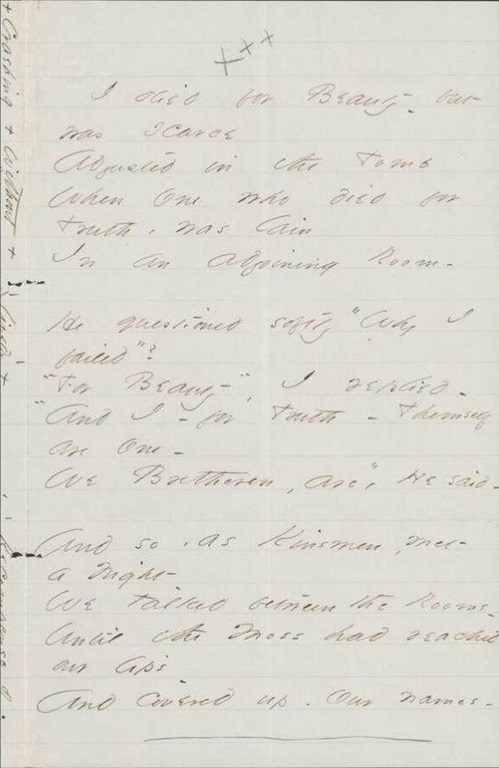
Earlier in the history of this blog I did a series called “The Roots of Emily Dickinson” talking about some influences that helped shape her poetic originality, but in that series I missed running into this ecstatic poem known by its first line “I think I was enchanted.” Scholars are fairly certain it’s the American poet’s elegy for British poet Elizabeth Barrett Browning.
Actually, it’s one of three Elizabeth Barrett Browning elegies Dickinson wrote, evidence that she truly wanted to record her appreciation for this poet. In my casting about for interesting material to perform and present here I came upon today’s piece only after finding another of the three, “I went to thank Her.” I had gone so far as to start writing music for the Parlando presentation of that poem, when, in looking for information, I came upon this other one via Susan Kornfeld’s fine blog on experiencing Dickinson’s poetry. You can use this link to read that post and today’s poem as she presented it. Kornfeld says “I went to thank Her” pales in comparison to “I think I was enchanted.” It’s certainly more intense — intense to the point I began to question my initial readings of the poem, as I often do with Dickinson.
One of the challenges with Dickinson’s poetry is that I have little sense of exactly what the author intended. We have no readings of her performing her own poetry written in the 1860s of course, and despite some saved correspondence, those letters seem to me to show a person who presents different personas in what for others would be casual prose.
I said this poem is often considered as an elegy, a poem of praise written after the death of the subject, but while “I went to thank Her” speaks of EBB’s grave, there’s no direct mention of her death in this one. Furthermore, “I think I was enchanted” has moments I read as humor, even satire, mixed with what could be read/heard as outlandish but sincerely intended Blakean visionary experiences.
Dickinson opens her poem with a distancing frame: she tells us this is how she responded to EBB’s poetry as a “somber girl” — and in one of her alternative notes in manuscript she considered “little girl.” Here’s she’s recounting how the younger goth-girl Dickinson encountered EBB, and I love Dickinson’s concise entry into that gothic outlook: “The Dark — felt beautiful.”
What follows is the Blakean part, an outright visionary state: time has no meaning, logic and proportion have fallen sloppy dead*, butterflies have become as large as swans. Dickinson has other poems that portray such states, and in some of them here I’ve mused that she had either/and visual disturbances like migraine/epileptic auras or full-fledged mystical transport where ordinary reality dropped away. But then observe how this vision recounted from childhood trails away. In our somber young girl’s vision, the older Dickinson says the sounds of bees and butterfly wings are audible but that they were little tunes “Nature murmured to herself to keep herself in Cheer — I took for Giants — practicing Titanic Opera.” I think the older Dickinson (she probably wrote this poem in her mid-30s) is allowing she was a little over the top in her feelings then. That she calls the sounds in her vision “opera**” is easily read as being over-dramatic in feeling by moderns, but I’m not certain how Dickinson would have viewed opera from her mid-19th century seat.
Emily Dickinson performs her tribute to Elizabeth Barrett Browning — wait that can’t be right! Well, it’s analogous, or psychedelic, or something.
.
The second half of the poem becomes more abstract, though opening with the metaphoric claim that ordinary days, even the “Homeliest” of them, are now transformed after reading EBB into a fancy-dress “Jubilee.” Another unusual word choice there, not prompted by rhyme. Did Dickinson mean something exact with “Jubilee?” Would she have been familiar with the Hebrew tradition*** from which the word derives? Possibly from Old-Testament sources.
The poem’s 6th stanza seems satiric to me. One of the most well-known examples of Emily Dickinson’s stubborn individualist character was her steadfast refusal to declare herself as “saved” by being reborn in the Protestant religious revival tradition of her time and place. That issue was part of what ended her formal education, and it set her apart from friends and family members. This stanza says, in my reading, that “What happened to my mind back then, I can’t really define and explain — but it’s not some simple declaration or decision, you have to live/experience it.” Thus sticking it once again to the just publicly accept Christ’s grace and be saved crowd. She continues the satire in the following stanza, in effect saying “You think I was out there, what with my butterfly bees beating opera tunes — well, your sanity without that luscious visionary intensity is dangerous to me! And if I ever get poisoned by that, well I have the antidote…” and she launches into a final stanza.
That stanza says EBB’s books of poems are “Tomes of Solid Witchcraft” — a phrase which slots right into a pagan-feminist bookshelf doesn’t it! And then a lovely fade to end: “Magicians are asleep” (the only possible reference to EBB’s death in this putative elegy) but she will remember the magic of that “somber girls” experience of EBB’s poetry, and the possibility of its creation by a woman, like as the religiously faithful remember the godhead/universe-creator.
In that reading I’ve outlined, I enjoyed this poem’s passionate mix of possible reflected youthful visions and the more mature satiric comparisons to a certain kind of religiosity. I did find it somewhat difficult to perform, as the syntactical jumps are hard to fit to breath and natural expression.
One thing still leaves me puzzled: Yes, I understand that Dickinson could easily feel that EBB was groundbreaking in her expression of woman’s ability to write and think and desire — and while that’s no settled notion even in our current age, it must have been even more striking in 1860. But even allowing for the framing device that Dickinson uses, the visionary experience engendered by encountering the poems as a young girl, I never have received that kind of jolt of new perception from reading any Elizabeth Barrett Browning. Maybe I haven’t come across the right poem? Maybe I can’t quite read them as Dickinson did from her situation?
Which is another reason to be grateful for Emily Dickinson, because in poems like this and others, this mid-20th century guy living in the 21st century can get that jolt from Dickinson.
To hear my performance of “I think I was enchanted” you can use a player gadget below if you see it, and this highlighted hyperlink if you don’t. Today’s music resulted from me specifically wanting to combine a variety of non-obtrusive percussion sounds (percussion being those pure “you hit it and sound comes out” instruments) with swelling synthesizer sounds that have no struck attack in them at all.
.
*Grace Slick riffed on a number of authors, not just Lewis Carroll, but I can’t think of an instance when she quoted Dickinson. Maybe she (like I) grew up in a time when Dickinson’s poems were thought and taught as simpler homely oddities. Grace, if you’re reading this blog, let me know what Dickinson meant to you.
**Like Dickinson I’m attracted to close, near, and slant rhymes, and when reading and performing this piece I was surprised that she missed the near-rhyme that “Titanic Overtures” would be in place of “Titanic Opera” with “To keep herself in Cheer.” “Opera” is a more strained rhyme, so maybe that exact word was important to her intent?
***Every 7 times 7 years farmland was to lay fallow and slaves were to be set free. This relationship to slavery led the term to be adopted by Afro-Americans in connection with the ending of slavery, a process that began in the United States around the time this poem was written. I have not solved to myself the mystery of Emily Dickinson’s opinions on American chattel slavery and Afro-Americans. Her father’s known political opinions on slavery (a huge issue when Dickinson was writing her poems) was as a “moderate.” But her Massachusetts had significant and militant abolitionists (including the Dickinson associate Thomas W. Higginson). Abolitionist positions are not synonymous with belief in the full and equal humanity of Black Americans; and it would not surprise me if Emily Dickinson, like Whitman, could hold racist opinions about Blacks while intellectually being whole-heartedly committed to freedom.
It’s also possible that Dickinson may have known of Roman Catholic Jubilee years; and in the context of a poem about a poet who lived in Italy and was connected with the turmoil there (which cancelled the 1850 Catholic Jubilee Year) this term could have been brought to mind.
It’s taken me a few days to write this post after learning of the death of Minnesota poet Kevin FitzPatrick. After someone dies, someone you know at some level, there’s an emptiness. While it’s impossible to feel emptiness, it may be the first obligation of grief to hold that sense for a little while. Was for me.
I didn’t know Kevin well. We were different sorts, and I myself am quite bad at friendship. But I knew him somewhat, and over time quite a bit as a poet. With some interruptions on my part for over 40 years I’d see him every month in a meeting that sometimes had as many as ten or so writers and sometimes was just Kevin, alternative Parlando voice Dave Moore, and myself. We’d meet in one of our places and those present would break out new work for comment and feedback.
I said we were different sorts. Back in the 1970s I was chiefly influenced by some hermetic and oppositional poetries: French Surrealists and para-Surrealists and those Americans who had read or influenced them. These poets tended to be ecstatic in mood and unafraid to puzzle or offend. Kevin had a different vision — he wanted his poetry to be comprehended and welcomed by ordinary folks, including working people of our parent’s generation. Is that the first or fifth thing I learned from Kevin? No, I’m still learning that one.
Let me speak ill of the dead. In our common youth I thought Kevin was prissy and way too afraid to offend. But we were young men then, and by now my younger self has passed from life to a degree near to what Kevin’s entire non-written life did this week. The way I see it now is that we were both half-right — but his half produced better poetry more often. So, I doubt he learned much from me, but I learned several things from him. You might want to learn some of these things now or later, so I’ll offer four things I learned from Kevin FitzPatrick’s writing today.
“You can’t tell a book by looking at it’s cover.” Kevin FitzPatrick edited the urban working-class Lake Street Review, but today’s piece has some farm boots in it.
.
Characters
Here’s the first and primary one, a lesson that I often told Kevin I would try to remember. Around the time of his first collection, Midwestern writer Meridel Le Sueur said that Kevin’s poems were poems with other people in them. Given Le Sueur’s life twining activism with writing, this was a fitting observation for her to make about Kevin’s writing. But stop and think for a moment of the poems you write, or even the poems you read or rate highly. How many of them have actual, flesh and blood characters in them? A great many poems, and to wildly generalize, many poems by male poets, have nothing but the poet’s own consciousness reflecting on itself. If something external intrudes on this, it may be nature or incorporeal spirits — or if human, they may appear as masses or classes in sociological case-folders. Kevin’s poems had a range of characters: friends and antagonists, folks that are richly neither, and people who you just run into in life. Kevin himself appeared in his poems, yes, but in many examples the poem was as much about Kevin as the novel The Great Gatsby is about Nick Carraway.
You may think that poetry, with its freedom of language and musical force can dispense with characters, that poetry may be particularly suited to delve into an individual’s own consciousness so otherwise unrepresented in human life. Good poems have been written from that conviction. But is that all it can be? What a lonely art making itself lonelier would result.
Dialog
Kevin’s use of dialog goes along with the characters. If you’re going to allow them to appear in your poetry and have autonomy, then they need to seem to speak independently. Kevin’s characters were not kept silent, and a good many of his poems had the texture of a compressed short-story, including the effective use of dialog.
Again, I’d argue that we are too exclusive when we talk about the poet’s voice and poetry as self-expression to the exclusion of all else. Yes, the world may be enriched by 100 poets writing in their own voice, saying out-loud or on the page their own individual experience. But if some of those poets would allow other voices to speak in their verse, to join in the choral and antiphonal song that is human experience, we might have at least 200 voices, if not 500, speaking in our poetry. How we speak, how we express ourselves is important. How we listen, what we hear, that too is important. The poet’s ear shouldn’t be cocked for just iambs and trochees.
Work and Workers
Why shouldn’t the world of work appear in poetry? I mentioned that earlier this month in dedicating my performance of a poem by Carl Sandburg to Kevin that Sandburg didn’t shy from talking about folks working, how that felt, what they encountered. FitzPatrick extended that in his poetry with a good degree of specificity. In his poems about encountering agricultural work in his fine final collection Still Living In Town, the specifics and groundedness of farm chores were taken into his poetry.
Yes, let us concede a dialectic. Many readers (and poets) go to poetry to escape that everyday grind, to celebrate the exceptions of romantic love, cosmic visions, rare events worthy of celebration. Fine. But why can’t poetry inform and illuminate what we are doing for a third or so of our lives?
Rural-Urban
Between the rural-urban divide is a great place for a poet to sit and write. I spoke of Kevin’s final collection from 2017, Still Living in Town above. In America, there’s an increasing division in outlook between those living in cities and those living in rural areas and small towns. Kevin’s poems in that collection, including characters, dialog, and those work-a-day issues, also allow us to see different locations and outlooks as he travels between his urban house, his capitol city office job, and a small farm.
How few travel between those worlds with open eyes, ears, and hearts and write verse about it! Kevin FitzPatrick did that in his final book. As I said above, I learned things by how Kevin approached his poetry and characters, but it’s important to also make clear that he’s not just a “poet’s poet,” but also a rewarding and entertaining writer to read. Books from the publisher of Still Living in Town are not available from the large, easily linkable mail-order booksellers — which depending on how you feel about such things may be a feature not a bug. Here’s a link to the WorldCat listing for FitzPatrick’s 2017 book which includes library availability and the ISBN number that might aid in ordering from your favorite indie bookstore.
OK, should there be my customary Parlando audio piece at the end of this post? With some trepidation I’ll offer this one, my performance based on an early version of a poem destined for Still Living in Town. It’s an old recording from 2013. Shortly after I recorded it, Kevin heard it and thought I misinterpreted the song. As I said, we were different sorts, though over the years I like to think we grew closer from our shared love of what poetry could do. Kevin said I missed the poem’s point; it was about the difference between the urban and rural cultures he was observing and writing about. He’s right, I undersold that element, seeking instead to stress how a customer service interaction went sideways from mistrust and was eventually resolved. I think he also might have reacted to my edgy, angsty delivery and music. Kevin was a calm, dry speaker in performance, and the speaker in this performance isn’t. It’s also important to know that “Returns” is just a piece of a greater work that took him several years to write. This isn’t the most singularly impactful poem Kevin ever wrote, just one in his series that I happened to perform one day because I liked the vignette, and that I had handy to put here today.
A few bits of scene-setting before you click on this performance: Kaplans* was a clothing store specializing in utilitarian work clothes and outerwear that was located then on Minneapolis’ famous working-class-to-under-class Lake Street. Wheeler Wisconsin where the scene shifts to in the conclusion is a town of 300. Tina, the deus ex machina of the poem’s story was Kevin’s partner who decided to buy an 80 acre farm which Kevin commuted to every weekend during the time of the book.
* The first winter I spent in Minneapolis, it was at Kaplans that I bought my first pair of Sorel boots, that genius Canadian design that has a waterproof leather and rubber outer boot with an inner insulating liner made of compressed wool. If you ever have to stand in -20 F cold and wait on a bus that might not run on-time, the un-frostbitten scansion of my poetic feet recommend them.
Readers often hear different poems when reading the same text. It’s unavoidable, even though it causes some authors to despair at how they are misread. So, it should be no surprise that it is possible in performance to recast poetry considerably without changing a word.
Around 1902 Irish poet William Butler Yeats wrote a poem taking exception to a too-easy consolation meant to comfort. He cared for the poem enough that around 20 years later he revised it slightly, to emphasize his response to this well-meaning gesture, explicitly writing out the one word concise enough to underline his feelings at the offer of comfort: “No.”
Those who study Yeats’ life are pretty sure this poem is biographical and is based on his unrequited courtship of Maude Gonne. That’s a long story, and to say that these were two complicated individuals is to understate the matter. If one reads today’s text, that poem “The Folly of Being Comforted,” in that biographical way, it makes sense. Here’s a link to that text. That reading, coldly condensed, would have it that someone told Yeats, “Hey, that hottie that you are so enamored with — I’ve heard she’s getting older, grey hair, older skin around her eyes. Sure, they say with age comes wisdom, but never mind any of that, she’s no longer so attractive that others will be chasing her. So now, maybe your chance will come around.” And to this Yeats gives his “No,” explaining that as he sees it, she’s not lost a step beauty and attractiveness-wise.
There’s a perfectly good romantic love sonnet there, and that’s not what I performed today.
I’m mentioned this year that I have family and others I know going through infirmities and transitions. It’s not my nature to talk about them, or even to directly write of my own experience of those situations. Even though one of the principles of this project has been to seek out and to present “Other People’s Stories,” I’m hesitant to speak over their own voices* in the same way that I’m comfortable talking about those long dead and in some cases too little remembered.
As I was working today on finishing the mix of the audio performance you can hear below, Dave called me to tell me that our friend and poet Kevin FitzPatrick had died last night. We were planning to visit him in hospice tomorrow. Now we’ll visit him when we think of him. Visiting hours are now unlimited.
For many years Kevin and Ethna would celebrate poetry in a public reading on St. Patrick’s Day in Minnesota.
.
Another poet we both know, Ethna McKiernan, is also facing a serious illness this year. When I read and then performed Yeats’ poem, I was thinking of these things. I recognized it was a romantic love poem, yes, but I read all sorts of undertones in it. We are meant to pass over them in the “correct” reading. Maude Gonne was all of 35 when Yeats first published his poem, the grey hair and “shadows…about her eyes” were likely subtle things. We’re all more than double that. Age is not subtle at that volume. When I read Yeats’ simple elaborating line “I have not a crumb of comfort, not a grain.” I felt my own lack of useful care or comfort I’ve offered Kevin or Ethna, partly because I fear I’d be rather bad at it, and partly because I’m less close to either of them than even Dave is. That said I’ve been acquainted with Ethna for about 40 years. I may have not been close to her in her “wild summer,” but I knew her when. Yes, the fire “burns more clearly” with her even now as Yeats says. After all, when you get our age, there’s more fuel.
Yeats called his poem, “The Folly of Being Comforted” and he ended the poem with that title. He likely had real feelings in this matter, long ago when he was alive. When I think of these mortal matters, now, here, my feelings are different than a witty sonnet about someone’s crude mistake regarding his estimate of Maude Gonne. And so I performed my feelings, using Yeats words.
The player to hear that performance is below for many of you, but some ways of reading this won’t display that. So, I also offer this highlighted hyperlink that will open a new tab window and play it.
.
*I feel I must guard myself in that partly because I’d easily fall into it if I didn’t.
I move back and forth with musical instruments and intent here, but since I started as a guitarist, there’s a lot of guitar playing in the Parlando Project pieces. When someone asks about my musical stuff, such as what I play, I often redirect, and make it a point to call myself “a composer” even though the poet in me knows that word’s connotations are fraught.
“Composer” risks putting the listener either in mind of some long past-tense powdered wig guy or a highly serious and educated modern theoretician. I’m neither. What I mean is that my intents with music are to invoke certain sonic combinations. I use various instruments to do that, and often that’s a struggle as I’m not as skilled as many players. Every note I play here comes after a committee meeting between the composer and the musician where the composer asks for things the musician can’t do and the musician suggests to the composer alternatives it can accomplish. Sometimes these are drawn-out affairs, and sometimes they are small latencies as I am asked to improvise then and there.
My poor guitars sit silently in the middle of this struggle, in days between pieces being finished, or in the moments between notes. These two sides win and lose and compromise. I’d certainly be a better composer if I could experiment in areas which my musicianship cannot empirically enter. I think I become a better musician in the times when the composer pushes me to think thematically or to not make the reflex choice.
If all that above seems dreary, it’s not. Yes, there’s friction, but each side enjoys it most of the time. And making music and hearing it are both sensuous acts. Thinking and scheming are involved, but what happens after that, when the next note is sounded, that just feels.
I mentioned last time that every September 18th I take some time to play an electric guitar and commemorate the date that Jimi Hendrix died after likely mistaking the dosage of some foreign sleeping pills. Think for a moment during this paragraph about the troubled history of musicians and drugs. Drugs to stay up, drugs to mellow out, drugs to excite creativity, drugs to sleep fast and deep. In terms of the life the composer asks so much, and the musician abuses the body’s instrument trying to extract those timbres and notes. It’s unavoidable for the composer and musician to struggle, but sometimes external and internal factors let this get out of control.
I played for a couple hours this Saturday, as much as I could spare. I had no ready words to include until I read on the same day an interview in Premier Guitar magazine with a band called Squid.* Squid is a British post-rock/math-rock kind of band, and that’s a genre I have some interest in, as bands that get those labels often are seeking new solutions to using conventional rock combo instruments. The band’s two guitarists had some interesting things to say about the electric guitar as it stands in 2021, more than 50 years after Jimi Hendrix helped redefine its parameters. So, I copied out a couple of quotes from the interview** and read them along with what occurred to me on the guitar in that hour and time.***
Today’s piece is what resulted. In the text, Squid guitarist Louis Borlase opens with an abstract theoretical statement, but soon offers a testimony affirming the expressiveness of the instrument, and for all of Squid’s make-it-new Modernism he ends by saying that that expressive voice allows you to aspire to “those people who came before you.”
Borlase implies a lot into what for someone of my age seems objectively a short amount of history for the electric guitar, which was only about 20 years old when I was born, and then whose extraordinary timbral variations were first exploited in my lifetime. But he’s not wrong, electric guitarists have stuffed a lot into that time since Hendrix’s. And electric guitar is also just another instrument, something to make music with, and we know we’ve done that since someone drilled some holes in a hollow bone or reed.
The second part quotes the other guitarist, Anton Pearson, who speaks theoretically again. Pearson says that the electric guitar is the “perfect marriage of technology and a gestural nature” which I believe at this time is true. Just as the invention of the modern drum set allowed for one drummer and their four limbs to command a combination of percussion voices and roles, the modern electric guitarist can use the fingers of both hands and foot-operated devices to create a large amount of playing instructions and sounds.
As beautiful and fundamental as wind instruments are to music, no one has extended them to that level. Keyboards come very close, including their modern use to control synthesizer timbral range and their ability to use all the fingers and limbs at once, but Pearson wisely restates his “gestural nature” of the guitar to include “visceral nature.” I have seen Keith Emerson stab knives into his keyboard and wrestle it to the ground. I have heard the groans and watched the creative agony on Keith Jarrett’s face while he played acoustic piano. Yet, they never touch the strings directly with either hand in various ways, they never move the instrument into the spot where the amp starts to possess the note.
“Is this a crime against the state? No! Someone controls electric guitar”
.
Are we past all that, is the electric guitar now a long-tail, trailing instrument tied to a passing era? The very thing I pedantically call myself, a composer, is now often modified to “beat maker” as folks think of new ways to order and modify sound, often without touching a conventional instrument. As listeners the instrumentation is immaterial after all. As I wrestle compositionally with my drum tracks, I know that rewards care, and succeeds or fails just as playing an instrument does.
But does anyone just power up and make beats for the sheer joy of it, not for recording or an audience, but just for the physical feel of the sounds being made, and made in real time, and for the ambiguity of the aches in my old finger joints after a session of fretting and neck wrangling? Does Jimi Hendrix, if and wherever his consciousness resides, miss that feel of that neck and the strings under his fingertips?
*If this sort of music sounds interesting to you, you can hear some of the actual sounds of Squid, touring dates, etc. at their web site at this link. Not your thing? I understand. It’s just one of the kinds of music that interests me personally.
**The full interview conducted by Tzvi Gluckin is available on Premier Guitar’s website at this hyperlink.
***Toolkit and process? Here’s details for guitar nerds. Everyone else is excused and can go home early. The drums are a software drum machine, which I intended to improve and then didn’t. I laid down the electric bass part with a Squier Jaguar bass. I did two passes and picked the best one. Last year I bought a set of TI flat-wound bass strings for this bass, which cost about a third of what the bass is worth, but I have old fingers and the soft feel of the TI strings are what they like. The guitar I naturally was drawn to on this day is my current Fender Stratocaster, a “reverse Strat” which emulates the pickup array and neck that lefty Hendrix would have on a regular right-handed Strat flipped upside down.
I tuned up and played for a couple of minutes to reacquaint my hands after playing bass, and then hit record and played for a bit over 16 minutes with the bass and drums. The lead guitar in the right channel is going through a reissue EH Triangle Big Muff fuzz pedal and a Cry Baby wah-wah pedal, though for some of what you’ll hear the wah pedal is left partway down for that Tallulah Bankhead “cocked wah” sound. Rather than emulating Hendrix (something I do sometimes on September 18th) I was aiming this time for the guitar to speak in different voices and over the 16 minutes it sort of does, but I decided to trim the piece down to mostly the parts where I read the Squid guys quotes about electric guitar. At over 6 minutes, even the edited piece is longer than I like to present for the Parlando Project.
The last track I laid down was the left channel rhythm guitar part. I used the same Stratocaster guitar, but it’s compressed with a Boss CS-3 compressor pedal and running through a Walrus Audio Lillian phaser, which even bought used is the most expensive guitar pedal I own. That track sounds almost like a modulated electric piano comping away, but it’s just electric guitar being versatile.
Both of the guitar parts are one pass, “live in the studio” parts. I didn’t have much time to do otherwise. The guitar amp for both electric guitar tracks is a Fender Hot Rod Deluxe.
My recording computer in my studio space is still an 11-year-old Mac Mini running an older version of Apple Logic Pro X.
Today’s piece uses a very short poem I wrote in immediate reaction to some sad news I heard this weekend. Despite that news’ immediacy and particular sadness, the poem that resulted became something else, and I’m not sure why, even as I was writing it, revising it, and then figuring out today’s music and performing it. Being present throughout, shouldn’t I know?
Without stepping on anyone’s own living story, and my limited understanding and participation in it, let me just say that not one, but two poets that Dave Moore and I have known for many years have been dealing with potentially mortal illnesses this summer. I started intending to write a personal poem about considering their possible deaths, and some very tangled words started to emerge.
Why those words? I’ve already told you I don’t know for sure. Perhaps the words were tangled because I don’t feel I’ve been a supportive friend in their time of illness for complicated reasons which include my social awkwardness and not really knowing to what degree they would welcome that in their situation. The tangled words were awfully impersonal, even if the person wrestling with them was infused with emotions.
I decided to leave the tangled syntax of what came out, because I came to feel that their odd flow was a potentially striking effect, slowing the reader to consider them more closely. I made attempts to bring the personal in, but none of my considered words seemed to fit when I did. Could the impersonality too be part of the way the poem means? Yes, by this point I truly wondered what my poem — my own poem — meant.
Why Now, Vocalissimus
Why now, when it is already so
when I listen to people sing in the night,
that so many of them are dead?
And some of the words that comfort us,
or cause us to wonder at why we’re not,
were written by those who now never talk.
But if you go to silence for after all,
leaving just words, sundered breath,
will they be but husks, after seed has left?
When I completed the draft I used today, I thought it had become a poem that isn’t about particular people, but about us (you, I, anyone) wondering about what a poet leaves when their poems no longer have a choice but to remain silent on the page. I know that is a problematic mode. T. S. Eliot, who like many effective poets was right and wrong about why his poetry — much less poetry in general — worked, would approve of this poem’s impersonality; but in our century now we often expect poetry to include diaristic detail, and while the muse wouldn’t supply it, I myself expect that the poem should be specific about those that I’m thinking of — and yet to include explicit thoughts of that while they live seemed morbid and presumptuous. Even though I present this piece today, I’m not sure the poem is done with me yet.
Poetry. Seeds. Speak it!
.
What’s with the weird Latin word in the title? It’s to lead you away from me and my particular poets in my thoughts, and back to just about the only appearance you’ll find of that word used in an English language poem: Wallace Stevens’ “To the Roaring Wind.” In that poem “vocalissimus” is that voice of the muse that asks to become the voice of the poet; and by extension asks us to be the voice of the poet beyond their lifetime, which is what this project is about in our normal course of presenting other people’s words.
Let me leave you with one thought: you here who write, read, speak poetry are part of a continuum. Poet’s poems dream of being more than your poem — the ones with personal details, the ones without. Few will achieve that dream, but still they dream it, before and after the dreamer.
I thought I might get a second American Labor Day piece in from a few ideas I had last week, and this is the one that survived the cut. Well, maybe it’s more than one, as it’s a two-in-one, combining poems written 40 years apart: Lola Ridge’s “Wind Rising in the Alleys” and Dave Moore’s “Big Kids in the Alley.”
Ridge is a figure that could fascinate several different ways. She has a life story that would defy the most expansive novelist to invent. She was “on the scene” in both the literary avant garde of the NYC area of the first half of the 20th century and in touch with the political radicalism* of that era, and as woman who clearly saw the limitations of gender roles, she was allied with the wave of feminism arising then as well. A several-time immigrant herself,** she wrote with insight into the immigrant experience.
Having an interesting life isn’t the same as writing interesting poetry or poetry that compounds its interest over time, and I blow hot and cold myself as I once more start to read some of it. She has more than one style of poetic diction, occasionally sounding a little bit 19th century, and then sometimes flat and spare, to other times striking out with passionately with intense tropes of natural phenomena intending prophetic power. The first time I featured her work here I could easily see how that last kind of writing could link in with our era of Climate Change. In my second time into her work this summer I may be starting to “get” her, and Ridge may be one of those poets who one needs to get over the ways she seems “wrong” before understanding what she’s doing that’s uniquely “right.”
Accidents or coincidences, can sometimes help me do that. Reading her poem about a so red sky in contemporary times of widespread fire-smoke is one such connection. And my second time with Ridge happened when I saw this poem where nature in an urban alley is portrayed at a prophetic level. When I read this poem first published in 1920 I thought of a Dave Moore lyric used in the first Fine Art record in 1978. I made a note immediately to myself that they could be combined.
Are these Labor Day poems? Sandburg’s piece from “Smoke and Steel” I used last time is certainly one in the context of the larger poem it concludes. “Wind Rising in the Alleys” is the concluding poem in Ridge’s Sun Up, a collection of mostly short, sometimes Imagist style, poems and “Wind Rising in the Alleys” is the last one printed in the book’s final sub-section which also includes poem-portraits of famed Anarchists Emma Goldman and Alexander Berkman. The poem for which the section is named, “Reveille” starts “Come forth, you workers!” and ends “Let us meet the fire of their guns/With greater fire/Till the birds shall fly to the mountains/For one safe bough.” “Reveille’s” militant final lines compress parts of Ridge’s rhetoric: fervent radicalism combined with a “who would guess it would come next” poetic image.
As I mention here political beliefs and calls for direct action following from them, I’m thinking that some of you may not share those beliefs. So, let me stop for a moment and mention something important to poetry as an art. Poetry is not a very efficient method of communicating ideas, much less particulars of strategy and tactics. To say that it fails in these things (or to overstate what it may do in some part) is to find the obvious, for poetry fails as expository work or argument closer to the degree that music does. What poetry can do instead, is to tell you what having some idea or intent feels like. Do you recognize what it feels like the moment that someone you love or desire lets you know that they feel the same? That’s what poetry can do, and do intensely. Of course, it may happen that that lover turns out to be flawed, or an outright heal, just as much as they can turn out to be a partner for a lifetime and the treasured ancestor of ancestors.
That moment of love and connection is powerful to feel, and it’s not just romantic love poetry that can present that connection.
The optimistic winds in the alley Ridge speaks of have hope in them, hope for change. I can’t say exactly when it was written, but for publication in 1920 it may have been written in a time that was not at all hopeful for American labor and political radicalism. Berkman and Goldman were deported in 1919, and that year saw red-scare round ups and a particularly deadly year for anti-Black race riots. Whatever it is, “Wind Rising in the Alleys” is not a victory march.
I write about poetry and music on May Day or Labor Day, you can easily find others who will discuss political and economic matters. Let me just summarize a lot of complex history to say that workers and capital have both advanced their lot in the United States greatly since 1919. Hooray for Labor Day. Has justice advanced too? Yes, but the argument that that has been to a lesser and insufficient amount is strong. Hooray for Labor Day — and the days afterward.
Here are the texts of the two allied alleys that I’ve put together today.
.
Step forward to 1978. Dave Moore’s “Big Kids in the Alley” was written at the request from a rock band named Fine Art forming and making its debut album. I’ve written elsewhere a short history of that band, one of the earlier bands in the Twin Cities area to make and record original music in the Punk to New Wave transit station on the route-way of Indie music. Just as “Wind Rising in the Alleys” was the “album closer” for Ridge’s Sun Up,“Big Kids in the Alley” closed Fine Art’s record and was the encore or set closer for a lot of live sets I saw. At this time it remains one of two studio-recorded songs of theirs that can be found on the Internet, and it was even sampled and used in a hip hop record in our current century. Here’s the YouTube link to that cut from the vinyl record.
You may think that’s quite the intense showpiece. On stage it could be even more so, and it’s certainly not the kind of song you’d want to put in the middle of a set list with other songs immediately following. Rhythm guitarist Ken Carlson was always solid and tasty, and vocalist Terry Paul used a more aggressive style here than what was customary for her, but “Big Kids in the Alley” was also a feature for Fine Art’s lead guitarist Colin Mansfield. You can hear effects pedals sweep frequencies in the song, and Colin would usually play all or most of the parts using the edges of a Zippo lighter in his right hand as a string and pickup exciter as well as a pick. Colin had some understanding of avant garde and other orchestral instrument music under his belt before Fine Art, and while what he was doing here was unprecedented in punk and new wave bandstands in the Twin Cities in the 70s, unorthodox sound generation methods had some pedigrees there. Outside and Free Jazz players would also do similar things, though because those styles were usually wind instrument based, the precedents are less direct. A short-lived rock band movement in NYC at the same time (documented in the No New York LP also of 1978) used random noises and alternative guitar tunings often played by naïve players.*** Colin wasn’t a naïve player.
Lyrically, Dave Moore’s words for “Big Kids in the Alley” starts as a parody of “The Internationale” the 19th century labor anthem. If you read this Wikipedia article compiling the various versions of “The Internationale’s” lyrics over time and in many languages, you can see that they vary considerably, but the opening’s general thrust, retained with some intensifying language in Moore’s parody, is mostly honored. I sometimes wonder how many folks in pioneering venues that supported “punk” or “new-wave” bands in the Twin Cities 40 some years ago recognized the reference. You never ask such things when dancing.
The final chorus of Moore’s version adds an unexpected departure. This morning I realized I’d never asked Dave what his intent was in what he wrote there. I called him up, and he explained “That you’re going to have setbacks, that they are going to react violently. That you should realize that.” Note that the arrangement on Fine Art’s version ends on Dave’s final thought, which emphasizes its impact.
I didn’t use Fine Art’s music for this performance, and my musical setting is simpler while referencing a similar flavor. I did dig out an old Zippo lighter I keep in a drawer in my studio space, but I didn’t quite get Colin’s exact effect in my “get’er done” charge to record today’s piece.
You can hear this loud rock band combination of these two texts written 40 years apart with the player below, or if winds haven’t blown that up your alley, this highlighted hyperlink in an alternative way to play it.
.
*Early American Modernists, unlike an appreciable number of European or European-based Modernists, tended to be left-leaning, even radical. Many of the American publications that printed the work of Modernist poets or visual artists were equally if not more so concerned with social reform or outright restructuring.
**Though, I do not consider the elements in anyone’s background determinative, I enjoy on a superficial level the diversity of ethnic and regional variety in English language poetry. Ridge is a case where the hyphenation cannot cope. Born in Ireland, immigrated to New Zealand at 8, then to Australia where her career in the arts gained a foothold, then to the American West Coast were she at least touched bases with the contemporary arts there, and finally to New York City where she lived the majority of her life, including time in the teaming immigrant Lower East Side.
***A less-remembered pioneering American punk band Pere Ubu was working some of these ideas as early as 1975. Sonic Youth was connected to and arose after the NYC No-Wave scene was receding, becoming a successful band in the Indie Rock era. In the Twin Cities, The Wallets later presented a more song-oriented version of what some of the NYC No-Wave bands did.
This is the weekend that ends in American Labor Day, and I’m going to see if I can put up at least a couple of pieces celebrating that.
The relationship between poetry and labor is complicated. On one hand, unlike entertainers, popular prose writers, or some other fields in the arts, almost no poet earns enough solely from poetry to escape a complete lifetime of some other everyday work. This could lead to the world of work and the concerns of those that do it being widely incorporated into poetry, but in my observation that’s not so. Why should that be? Well, as much or more than any other art, poetry, in self-image or in public image, sets itself apart from ordinary work.
Poets are seen as dallying with the muses, observing unsullied nature, being drawn to erotic passion, explaining the godhead and the nearly unreal, or engaging in an endless spree of derangement of the senses. None of this seems related to the world of work. Things like that may be a way to spend the weekend or a holiday, and so poetry may be attractive to those seeking to temporarily escape their workdays — but then not an art used to understand them, or to interrogate them.
American Modernist poet Carl Sandburg conspicuously didn’t avoid work and workers as a subject. Some elements of Modernism liked to write about the products of early 20th Century industry — odes to locomotives and airplanes could stand in for birdsong or daffodils just fine for the make-it-new crowd — but the systems that built them and the human effort involved were largely not viewed as fit subjects. Satires of the management classes could be undertaken, and by damning their mundane concerns, the world of work could be dismissed as a fallen human state.
In variety and extent of opportunities to observe work the poet Sandburg may have had an advantage, and he didn’t squander it. Itinerant laborer, municipal government functionary, labor-union agitator, journalist, small-time farmer — Sandburg certainly had his perch to observe work. He wrote about all of those trades from inside and beside. Today’s piece is taken from the very last section of the long title poem in his 1920 poetry collection “Smoke and Steel.” In the poem Sandburg concentrates on that backbone of American industry in his time, the smelting of iron ore into steel, and he does so by focusing on the laborers in that system. While he’s in a long-winded Whitmanesque mode, he brings to this task the miniatures of Imagism, and in this final section, if separated out as I did here, he presents an Imagist poem. Earlier in his poem we meet a lot of people and their tasks involved in the manual labor of steel making; and now in this Imagist ending we’re left with three or four objects. Once he violates the unity of the charged moment, but otherwise it follows Imagism’s rules. Here’s a link to “Smoke and Steel”, and the section I adapted and used today is at the end of the opening poem.
We first meet cobwebs, called “pearly” to indicate a beauty in them, and they’ve caught and held raindrops. Just a “flicker” of wind tears them away from the scene. Moonshine, golden and so also portrayed as beautiful, perhaps in a pool of rainwater, is likewise shivered and dispersed by the wind. Finally, a bar of steel is presented, and there’s contrast. It’s not so transient. Violating the unity of the moment, the poem says it’ll last a million years, even if nature will coat it with a “coat of rust, a “vest of moths” and “a shirt” of earth, images that seem to me to connotate the grave when we are also told the steel bar will “sleep.”
I’ll admit that while I could visualize the cobwebs with pearly rain drops and the moonshine rippling in short-lived puddles, just exactly what the steel bar was as an image to be visualized was puzzling to me. A railroad track? We don’t usually call rail tracks bars. A fence, or even a jail cell (“steel bars” as shorthand for jail)? Nothing earlier in the poem prepares us for that reading in this section. Some steel ingot stockpiled and stored outside? But destined to be forgotten and left for a million years? Other than that “million years” permanence we’re told only one other thing about the steel bar: that it looks “slant-eyed” on the cobwebs and pools of moonshine. I understood this as “side-eye” and that reading seems pretty solid to me. The steel bar knows it’s going to be there longer than the cobwebs and moonshine, so it can dismiss them as ephemeral.
Then looking to confirm if a slant-eye look would have been understood to Sandburg as side-eye, I could only run into the use of, and disparagement toward “slant-eye” as an ethnic slur. Though that slur wasn’t news to me, it hadn’t occurred to me as I don’t think it’s what Sandburg intends.* Realizing this after I’d completed recording today’s performance, I considered that it might harm the ability of some listeners to receive the poem’s intention, and if I was to perform the poem again, I might take my privilege with a work in the Public Domain and sing it as “side-eye.”
Coming as it does at the conclusion of Sandburg’s longer poem “Smoke and Steel” what do I think the cobwebs, steel and moonshine mean as they are met by the wind of time and change? We may abide by the convention that poetry and work are separate things, but as Sandburg has just written a long poem about work, we know he wants these things to be combined. The things we do everyday for pay, the work we do in arts like poetry — are the later the cobwebs and moonshine, beautiful, transitory, little noticed; and the former the steel, the solid, useful things that will last? Or is the steel the “real” that is buried, and the cobwebs and moonshine it distains the eternal now that returns fresh?
And then, can either be both?
The player gadget to hear my performance of an excerpt from Sandburg’s longer poem that I’ve titled “Cobwebs, Steel, and Moonshine” will appear below for many of you. Don’t see a player? Then this highlighted hyperlink is another way to play it.
.
*Sandburg is too comfortable with ethnic slurs for many modern tastes in his poetry, and “Smoke and Steel” contains a handful of them earlier in the poem. The unabashed way he uses them in his way argues against this ethnic-Asian slur being a 1920’s dog-whistle.
As promised, here’s the very next piece Dave and I tracked last July after our take on Bob Dylan’s “Went to See the Gypsy” which eventually broke out into a full orchestrated arrangement. It’s one of Dave’s songs, his words and music, a piece he wrote a couple of years ago called “E Flat.”
Dave says he wrote it after reading a report that planet Earth’s fundamental vibration was determined to be at the pitch of E♭, though this pitch was at an octave range much lower than human instruments or hearing go. I did a little searching today to see if I could re-find that report, and I’ve come up blank — though the concept of our planet having a frequency has been trotted out, often with a dose of cosmic woo-woo. The most popular Earth frequency I found was “Schumann’s Resonance” discovered in 1952 by a German electro-physicist Winfried Otto Schumann.* Schumann’s observations were made of electrical wave activity between the earth and the ionosphere, and were calculated to be on a fundamental frequency of 7.83 Hz. What pitch is that? Well, it depends, and if you follow some esoterica, that’s an important depends. Most musical stuff these days is set so that 440 Hz is an A note, but that was not historically the only way the pitch we call A was defined; and there’s a belief that one such past standard, 432 Hz, is better. Some of this belief is buttressed with “hear me out, this is very scientific, an objective fact” talk about powerful natural vibrations that have perfect ratio relations to a 432 Hz A.
So, I found that — but at A=432 Hz, 7.83 Hz is closest to a C note. At A=440, 7.83 Hz is closest to a B. So, no E♭ either way.
As of today, I can’t relocate the report Dave read, but that doesn’t mean his song isn’t close enough for rock’n’roll. When we performed it this summer, I set out a time-keeping drum beat, and while Dave sang I played a free-form guitar track swinging close to the amp speaker for feedback sustain. Some days after the live tracking I fancied up the drum track, added electric bass, and played the electric guitar chordal part that dominates the final track you can hear below. When Dave and I play we decide things very fast, and I didn’t do a great deal of thinking or composing for what I added later either. Working on this song was like painting with wet oil paints.
W. O. Schumann at the chalk-board and Patti Smith looking to run her nails on it.
.
By the time I was throwing on the last guitar track I was verging on consciously aiming for the sound of the Patti Smith Group’s “Radio Ethiopia,” the title track to Smith’s second LP. Not a very famous or prestigious record. Why’s that? Here’s the punk-rock-speed history.
A significant group of people (though not top-the-American-charts-sized then, or modern Internet multi-million-follower sized now) had taken Patti Smith’s first album, Horses to their hearts. I was one of that group. The chanted and declaimed poetry, the open references to rock’n’roll — that record’s sound was balanced between passion, looseness, and intent, unembarrassed in its declaration and performance. I also believe that impact was intensified because it was fronted by a young woman who acted unencumbered by gender roles.**
But that’s the first LP. I spoke above about the second LP, one that got tagged with the “difficult second record” label. “Difficult second record” syndrome is usually explained by a band having had a reasonable period to develop a range of material for their debut album, material that they have confidence in while still retaining a sense of freshness in their own experience of it. The second record now has expectations that have to be dealt with, expectations to either be mostly “the same, but better” or if not that, “different, but every bit as good.” But there’s less time to develop that second record while they tour to exploit the interest from the first.*** What was it they did right to make a splash with the first? Does a band have time to figure that out? What to keep, what to add?
Radio Ethiopia, the album, kept an element from the tracks that are often less remembered from Horses: the first record’s more conventional rock songs as opposed to the longer, idiosyncratic spoken word mixed with rock-references tracks — but in place of Horses longer pieces like “Gloria,” “Birdland,” and “Land,” we got a different style on Radio Ethiopia in songs like “Poppies” and particularly and problematically on the 10-minute title track. Smith’s vocals were mixed lower in these new long-form songs, at times down to a subliminal level, and the chordal guitar work got denser. Few liked it. Not “few” as in dedicated, knowledgeable fans — “few” as in not-very-many.
I liked it.
Here’s the lyric sheet Dave was singing from. Yes, the song’s in E♭
.
Will you like what I did to Dave’s song here then? Who can tell? It sure is musically different than the piece we performed just before it this summer, and the final resulting pieces you can hear here, even more different. I like different. If you don’t care for it, I’ll say that my aesthetic here is like Minnesota weather: don’t like it, or like it, today? It can, and will, be different tomorrow. Some will see a player gadget to play it below, but if you don’t here’s a highlighted hyperlink that will open a new tab window and play it.
.
*It would be so resonant if he was related to the composer Robert Schumann, but I’ve found no cite claiming that.
**One could, and likely someones have, written a treatise on Patti Smith’s relationship to gender, which is complex. Those hadn’t been written in 1975, which didn’t mean it didn’t have impact then. What some felt, got, resonated at pitch, would be emotions recollected in intellectuality later.
***Radio Ethiopia came out just 10 months after Horses.
Poems and songs about those artists who die young are easy to find.* Why should that be? Well, tragic aspects there are plain to see and it’s easy to note the lost potential in an early exit. I think there’s a further factor too: we are much in love with the trope of young artists whose work is caught in a rising arc before falling with melted wings. It’s extraordinarily difficult for an artist to continue to impress or delightfully surprise over a long career. We artists repeat ourselves and are judged to have become stale — or we change and produce work that isn’t judged correct to be coming from us. Perhaps this is inevitable. Or maybe in part it’s us as readers, listeners, audience, who contribute some faults to this by always seeking new faces — or the practical use of any failures as telling markers to drop attention.
I’ve made no secret here that I’m old. I missed out on being a has-been and I’m not anyone’s coming thing in the arts. In a strange way I find that frees me from those burdens, and I only need to carry my age and infirmities while producing new work. This summer as the blog and listenership has its seasonal drop off, I’ve indulged myself and your attention with more work with texts written by Dave or myself. I do notice that the poetry I’m presenting here of mine is overwhelmingly focused on loss, something Dave usually avoids. Young poets, young musicians, often add gravitas with similar emphasis — and I should note, young artists can and do directly experience those things outside of the world of imagining. Experienced artists may more likely realize this is a choice, one that we are free to question and doubt. But, speaking for myself and my summer it’s been more at reporting. The everlasting crisis of the wider world continues — unjust losses there are still noted — but each day I think of the closer infirmities of those I know: small losses for me beating in resonance to their greater losses, and less specific worries and predictions for myself standing before me as I look through them to assay these others unavoidably present and particular ones. This is likely the selfish and self-contained man’s version of empathy.
.
I enjoyed some dissonant chord colors and an “Is it in major or minor?” rub in this one’s music.
.
Today’s piece uses a text of mine I call “To Poets Not Dying Young.” The effect I’m trying to convey is the wearing of life on the body and soul of older poets who persist in their observation and writing, and it’s written in the hope that we, as audience, retain our ability to read and hear them. I do worry that the images are too enigmatic in this one, but maybe the connotations or some incantatory power will carry the effect through to you. Even to myself, their author, some of the images reflect more than one thing, and I’m not sure if that’s good or bad.