Here’s another early Langston Hughes poem from The Weary Blues, his collection which I’ve chosen to focus on during this Black History Month. Given Hughes’ esteemed position as part of the Harlem Renaissance and the long career that followed, it may be hard to remember that this is a poem by a young man, less than 25 years old. Of course, as I reminded myself as I tried to write the best poetry I could as a young person: famous British poet John Keats died at 25 — so there’s no reason for our Afro-American poet to wait to write either.*
Though it was Langston Hughes’ first book, The Weary Blues doesn’t make much of a point of his youth. While the perennial youthful topics of wine, love, and song make their appearances in this collection’s poems, there’s little if anything I can recall that makes explicit pleading that the author is of a new generation with new perceptions. The way Hughes did signal that was in the way he deals with the “song” part of that triumvirate: Jazz and Blues were still considered disreputable musics of little substance. The decade of the last Twenties may have been called “The Jazz Age,” but that then novel music was mostly the music to dance, drink, and swive to.
So, when Hughes claims right from the start that “The rhythm of life is a jazz rhythm” he’s making a fresh claim in 1926, that it’s not just some musical fad that’s passing through, a speeded-up frivolity. Even if white musicians and dancers were quick to latch onto the jaunty high-BPM rush of Jazz, Hughes is ready to claim that broken desires and pain were in there too.
Does he mean lovesick blues, or the Afro-American experience here when he makes that claim? Both I think. That’s a hella-reason why Afro-American forms pervade American music to this day: Americans as a whole have a long and strong dissatisfied streak. Plenty of musics sourced from around the world are good for dancing and signaling your erotic availability. Same for songs of utter sadness. But Afro-Americans figured out how to make sublime musics out of a combination of the oppressions and absurdities of life.
In his poem, Hughes twice makes the claim “The gods are laughing at us” — and despite the repetition of that line, he is ambiguous about what we should think of that. Are the gods the society that ignores, belittles, and oppresses? Or are the gods the wise eternals who know that we humans live short lives approaching half-knowledge, an absurdity that leaves laughing as wisdom?
I think at midnight — perhaps after some youthful partying that’s implied as preceding this poem — it’s a vibrating mixture of both. Overtones, undertones, Hughes says.
Overtones, undertones….Jazz in Hughes’ 1926 was still thought of as a way to shake your groove thing.
.
I often mention that my experience of the poems I use for texts here often changes in the process of making them into Parlando Project pieces. With this one, as I began to understand and express Hughes’ words I wanted to reply to the laughing gods in the original poem. So, I extended the original words with my own couplet: “Let them hear the laugh I return. / Let them understand the laugh I return.” Is that laugh and desire to the wise gods or the careless and oppressing system? Both. I’m far from 25, and that’s what I think reading and performing the young Hughes’ poem today.
Music in this piece is about as close as I can get to Jazz, though more of the Jazz of my youth than that of Hughes’ time. Yes, that fad was still going concern 40 years after Langston Hughes wrote his poem. I spent most of my time creating the piano part, which unlike a real pianist I have to compose by playing and selecting parts for each hand, but modern “virtual instruments” let me do stuff that Conlon Nancarrow had to hand-punch into player piano rolls to realize. I wanted a saxophone part too, but as I’ve already mentioned this winter, I can’t really get the articulations a good Jazz sax player relies on. My sax part sounded like an early student playing the most dismal society dance band number, and so I made the compromise I normally avoid and put in a short Gil Evans-ish horn section sample to enclose my sax part effectively.
This will be a short post. The last day here has not been a good day for thinking of this project and my planned series from Langston Hughes’ first book The Weary Blues. I’d intended to do a version of that book’s title poem, I’d even begun to collect some ideas in my head: different sections, different instrumentation for those sections — a fancier, fuller arrangement than I’ve had time to do this year.
Wednesday morning a young man got killed in a police raid in my town, never a good thing, but something that frankly has a lot of possible contexts. Since then we still don’t know everything, maybe not even enough yet — and yet here I am tempted to write something about that: that it’s a horrible act, stinking of systematic issues that existed long before that 7 A.M. no-knock raid, things that go beyond the specifics of the Black man killed; and a (likely white) cop shooter whose job it was to go, for us, inside a stranger’s door, apparently looking for a murderer and ending in a new killing.
If you’re not in our local area, you probably haven’t even heard of this. Apparently, this is an aberration that isn’t shocking or novel enough now. This is not a public policy or political information project, others will serve you if you feel in need of that.
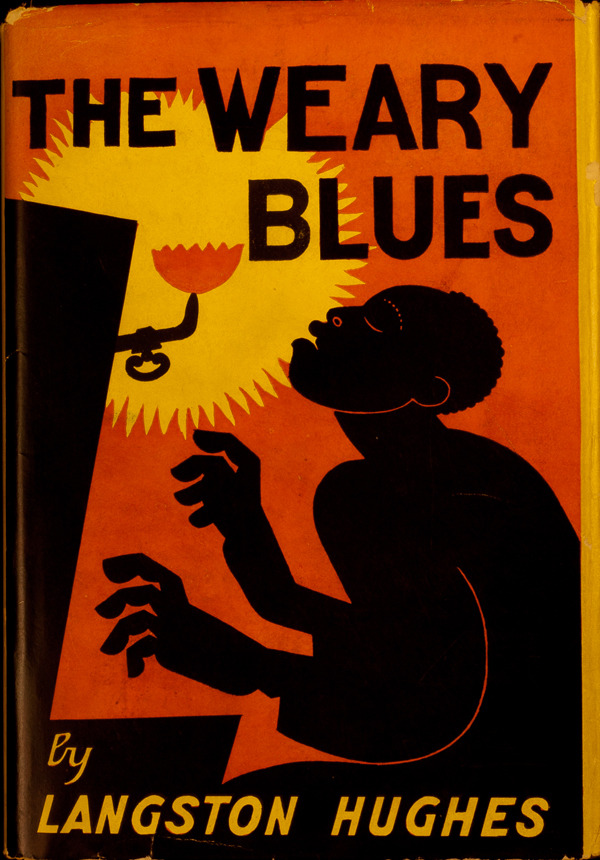
Cover of the original 1926 edition of The Weary Blues
.
Still, I’m deeply ambivalent today about my chosen project. When Langston Hughes wrote “The Weary Blues” in the last Twenties, almost a hundred years ago, racism, ignorance, prejudice, injustice, class-caste system — all were old enough to be blues one could be weary of. So now so, more weary so — and we’re alive to feel’em. Perhaps I’ll write more this weekend, but I was feeling our current hurt today, and less any release of joy or the blessings of overcoming.
Instead of fully realized version of Hughes’ “The Weary Blues,” what I’ll offer today is more like a quick demo: a beat, a guitar playing simple chords. When I finished laying it down, and with no more than a couple of minutes until I had to get off mic in my studio space, I started to riff on a variation adapted from another song, and I left a couple of lines of that in the fade out. That secondary song takes off from “I’d Rather Go Blind,” a song about love gone bad, where the heartbroken singer declares they wish they were blind so they wouldn’t see their unfaithful lover. In my variation, we ourselves must ask, heartbroken at things we don’t want to see: do we want to go blind? Is that what we want, would prefer? To just not see the hurt?
Player gadget below for some to hear my sketchy demo of Langston Hughes’ “The Weary Blues”, or this highlighted link for those who can’t see that.
It’s Black History Month, and I’m planning on presenting a series focusing on Langston Hughes’ first poetry collection: The Weary Blues — butbefore we get to today’s new Hughes’ piece, let me briefly set down a few reasons for why Langston Hughes.
This project presents early Modernist poets most often. From the American predecessors of Modernism (Whitman, Dickinson) we often jump to those of the 1905-1926 era who sought in various ways to “make it new.” While I continue to read and have interest in post-1926 work, less of that can be reused freely for this project. This reduces the Afro-American sources free to use, as the beginnings of the Harlem Renaissance have moved into Public Domain slowly, year by year, since this project began in 2016. My earlier Hughes’ pieces, even if they were eventually included in The Weary Blues, were published earlier and so had already moved into PD. It’s only on January 2022 that the whole book’s contents moved to public domain.
Our February focus: Langston Hughes’ first book.
.
A second reason: look at the title of Hughes’ first book, it includes “Blues.” As we celebrate Afro-American contributions and experience this month there’s an important parallel here. Americans, some of whom set up shop in England and France before WWI, are hugely important in establishing the Modernist break with the shopworn 19th century writing styles. At the same time, Afro-Americans were crucial in doing the same job for music. As I tried to briefly explain last Black History Month, a great deal of the American Black intelligentsia was caught flat-footed by this musical revolution happening around and by them.*
Let’s cut them some slack on that: cultural change is hard to understand while it’s happening, and the quick white adaptation of Afro-American musical ideas in The Jazz Age of the previous Twenties reflected back to the Black community some rough or even derogatory approximations of what was really going on.
Hughes was a young man when he wrote today’s poem. He’d crossed paths with Black intellectuals by then, but he wasn’t fully one of them. His father had cut a bargain for him to go to Columbia to become a professional. Langston skipped out, worked as a cook and at other restaurant jobs; and took to sea working on merchant ships. Hughes came quickly to an understanding of this new music, it’s complexities and its reflections.
Lastly, here’s one of the things I’ve come to understand about the beginning of Modernist poetry in English: there were substantial elements there that sought to strip back poetry, to simplify it to its essence, to make it immediate to an open heart and mind without pre-requisites. This mode was eventually superseded by a more academic and allusive poetry to the degree that some of the best of this early poetic Modernism was set aside or down-rated as simplistic and insufficient.
Over the years you’ve heard me sing the praises of Carl Sandburg, who seems to have been eventually excused away as cornball. But Sandburg was still vital to the young Langston Hughes in the 1920s, and Hughes took Sandburg’s Midwestern American Modernism and applied it to his own heritage and experience. The mainstream of Afro-American poetry retained more of the vitality and working-class connection that Sandburg expressed. Thank you, Afro-Americans.
Let’s move onto the poem I used as today’s text for the performance you’ll be able to hear below. “To Midnight Nan at Leroy’s” is not one of Hughes’ best-known works, though it deserves more attention. Here’s a link to the text. You could skim through it on the page and see the Blues connection, even if it’s not a Blues stanza as printed — though it could be refitted as one — but more importantly, it’s got a Blues sensibility. My reading of the poem says there may be a little playing going on, a little con and double consciousness which the whole of the work will show up. This will let the hip listener say on hearing it “Yeah, you and I know what that’s like.” That’s Blues sensibility.
I think the poem is a dialog. Nan of the title is performing at a club, and she’s expressing some eroticism in her performance. I think the poem’s other voice is hitting on Nan. The opening stanza is that other voice, the un-named man, who’s starts out teasingly acknowledging that he’s getting what she’s putting down.
The second stanza could be either voice. I performed it neutral, even as if it might be a narrator, a third voice. Note the loaded word “jungle” in it, one of the “primitive” adjectives used to describe this new Afro-American art. Primitive isn’t totally a derogatory or diminutive to the Modernists, who remember wanted to remove the cruft of a worn-out culture and get back to an essence; but in the context of a white-supremacist-soaked society it could surely slide over to being that. Black artists with intact self-respect did use labels such as “Jungle” in the 1920s, so it’s not simply an external white appellation, but it sure sounds like they’re partially reflecting with the white culture when they do. Pause at the last line: I hear Hughes’ “And the moon was white” with intent.
The third stanza is the man cheering on the singer/performer Nan, and I think also he’s suggesting that if “lovin’” is her object, he’s ready.
Fourth? Yes, the two get together. I perform this as Nan’s voice. Note Nan’s use of the diminutive “boy” for the man in this part of our dialog. He may have been acting the player in his earlier stanzas, but I think this is an intentional reveal that the male character is less than a fully actualized man. The white moon image returns, and their moments of Black joy contrast against it. One could write a moving essay on this poems white moon image, but I’ve already gone long.** You write it.
The poem concludes by refraining the entire first stanza. I perform in the man’s voice, now sour-grapes-ing the couples’ night. Who put one over on the other in this one-night? Maybe some of both, and maybe external social forces are part of the fate-mix too. Hughes chose to dedicate the poem to Nan, so I suspect his sympathies lie more with her. Another question: is Langston Hughes the unnamed male voice? Hughes’ sexuality is mysterious, and while that’s possible, my estimate is that he’s observing, not writing a poem as memoir here.
I performed “To Midnight Nan at Leroy’s” with my own one-man-band providing the trio accompaniment, and I hope your speakers can handle the bass part. Some of you will see a graphical player gadget below, but other ways of reading this blog won’t show it, so here too is a highlighted hyperlink to play it.
.
*Last years Black History Month book was 1925’s The New Negro , which included an essay worrying about the dilution of Black uplift and culture from the diversion of frivolous Jazz. Read my post on that essay here.
**As with Sandburg’s short poems, with Langston Hughes here it may help to imagine that you are translating this from Tang dynasty Chinese. The plain English words here could mislead us to think this a mere rote moon/June thing and that Hughes had nothing complex to say.
I’ve got reasons for kicking off Black History Month a few days early: my February is going to be appointment-filled, something that’s likely to reduce new work for this project, and I want to participate in this observance of American history.
Why was I so determined to do this? Well, note this project’s subtitle: “Where Music and Words Meet.” I’m an American composer, and American music is disproportionally Afro-American music. Yeah, it’s a big country, and many musicians with heritages from every continent* have contributed, but if you compose or play American music, a lot of the notes are Black. So let’s get to today’s piece through three short, linked, tales.
The First Story:
Who’s this Sonny Rollins, and what bridge is he selling us back in the Fifties of all decades? It’s easy writing about poetry as I do here most often, to get used to a constrained fame; but I suspect more of the general Internet audience will know Emily Dickinson, William Butler Yeats, or T. S. Eliot than know this man’s name and work. Mid 20th Century Americans, most often Black Americans, made a consolidated point of becoming masters of improvisation on the saxophone. Afterwards artistic accountants rank art and artists — and even if you think that’s wrong-headed, I’ll cite those who expend sincere effort in doing that and say that lists of great improvising saxophone players likely include Sonny Rollins.
But, just saying Rollins was good at it, a skilled musician, reduces him. For one thing, he had a dedication to the art of his craft, a need to expand the expression. So much so he famously spent a couple of years or so just dropping out of what was then still a viable commercial niche of jazz gigs and recording when he was considered to be one of the best and brightest on his instrument. To do what? To get better.
Insiders later learned some particulars of what he did. He went to a near deserted deck of a busy urban bridge and just played. And played. For months. For hours a day. In all kinds of weather. No, he wasn’t busking for spare change. Few noticed him. One of his records before this time was called Saxophone Colossus. This wasn’t ironic as a title, or laughable, or a piece of hopeless self-promotion. Once likened to a metal giant who could stride rivers, Rollins on the bridge was small and alone and unnoticed, one man in a wind-gap of a city’s gusts. Practicing there he was no more than a flea on the back of a colossus.
After around two years of this, he figured he found some of his new/better. If you’re writing a screenplay you know how the final scene plays out. Our hero walks off the bridge and into a recording studio. A selection of ominous natterers remind us of the stakes in quick cuts: “Was he kicking drugs, or failing to kick? Is he washed up?” “You know folks like it sweet and tropical, he should try to play bossa nova.” The next voice says, “Funky jazz is the thing.” And another says, “How can you be even more free than ‘free jazz?”
And you know the next beat in your screenplay: he emerges with a record or a concert or both — and all of a sudden everyone realizes that he’s found it, something great, unique, ground-breaking, resplendent and recognized.
Wait, you don’t know who Sonny Rollins is — or maybe you do, but you know the person next to you on the Internet doesn’t. The record that Rollins did make was called The Bridge in honor of the solitary workshopping he did over the East River. It was not a cultural event. Throw out your screenplay, the elevator doesn’t want your pitch. Even the experts then, the artistic accountants and grim critic-coroners were underwhelmed. Paging the Joseph Campbell who isn’tan under-recognized Irish poet, this is The Hero’s Journey that ends with a shrug.**
The Second Story.
Back in my youth you paid for music ala carte. Every bit you could access at will was on a material disk you had to pay for. A person like myself with more time and adventure than money might scrounge. One thing I liked to do was to go into charity and second-hand shops and look for used records that attracted me. I can’t recall the exact cost of a new LP then, but I think it was around $3 to $4 or so. Records in these dingy shops might be a dime or 25 cents. Those within cardboard covers gave you extra material to judge if it was worth your widow’s mite — but at those places and time, the most forlorn records were just bare black disks scuffing against each other in a bin, and sometimes those got an additional price break. Whenever I recall those naked disks, I think of those who cleaned up after someone died or skipped rent and town, who just shoveled it all off to Goodwill or the Salvation Army in whatever, Warholian, cardboard boxes.
That’s where I found Sonny Rollins’ The Bridge. I may have heard a bit about Rollins, how he was a particularly good improvisor because his improvisations had the logic of more considered compositions while retaining the flow of fresh idea after fresh idea.
Three things struck me about the record upon listening to it over and over and under its scratches and surface noise: that it mixed moods more than most jazz records. It wasn’t just a fast blowing session with a change of pace ballad or two, but that it was both angular and spare and hauntingly beautiful in both sorrow and joy.** That the guitar player, Jim Hall, on the record didn’t sound like “jazz guitar” as I had heard it then.*** Instead, Hall added unusual harmonic colors that Rollins would then carve from. Eventually I realized something else unusual about the record as I compared it to more jazz records: there was no piano or other keyboard instrument. I eventually learned that this was something Rollins’ made a practice of. Yes, Hall was giving pieces some harmonic framework, and bass players in non free Jazz contexts are often asked to, and then, play “the changes” indicating the chords; but keyboard players, even if it’s not their session, often dominate the harmonic and rhythmic structure of a track. Here there was none of that.
Poetry in Gray. I know this is a long post, and I value your time, but here’s 30 minutes of the same group that recorded The Bridge playing live with a short interview with the 32 year old Rollins.
.
The Third Story
I read this week an article by John Fordham in the Guardian that reminded me that Sonny Rollins went into the studio to start recording The Bridge on January 30th in 1962 — so, 60 years ago. Fordham remarked on the legend of Rollins’ time on the Williamsburg Bridge along with a new interview he did with Rollins.
Unlike almost every one of his mid-century saxophone contemporaries, Rollins is still alive. He’s 91 years old now, and I last saw him play when he was around 80. Rollins was performing in a trio on that night with just bass and drums, and for about an hour he tore it up covering so much sonic space with his monophonic but powerful instrument. I marveled then, and now that I’m approaching his age at that gig, my amazement increases. Rollins developed lung disease and can no longer play, but he seems to have retained his composer as improvisor ability to see the patterns and connections.
This month I’ve been trying to build up a little strength and chops on guitar again. Nothing like Rollins’ multiple hours each day on a bridge level of woodshedding, but enough so that I can play that instrument that requires some physicality to realize its sounds.
In the midst of this, in the middle of the night, I awoke with some thoughts I had been growing about Rollins and the task of being an American and Afro-American artist. I wrote a complete first draft of today’s text in that middle night awaking. Not quite a Kubla Khan dream, but still complete and formed enough to count today’s text as an improvisation. Wednesday, I came up with the song’s harmonic structure equally quickly. Yesterday I recorded it. Given that I’ve no access to other musicians — and I hardly make count-one-musician unless I beg the composer (who’s me, so I listen) to make things I can play — I had to play a track at a time. Today’s recording is a trio: drums and two guitar parts. I first recorded the chordal guitar part on a big archtop guitar (DeArmond X-155) along with the vocal. I’m no Jim Hall, but like Rollins’ The Bridge I let that instrument set the harmonic framework. I confess (though listeners have already convicted me) I’m not good at Jazz comping, a key guitarist’s skill in that genre. I pardoned myself and proceeded. I then did the drums, trying very hard to get them to play off the guitar’s rhythm feel. And then finally as my studio-space time was coming to a close, I got to “blow” with guitar for the lead part.**** I did four passes, and the third was the best, and there you are. No, it doesn’t sound like The Bridge LP, but then the point of The Bridge wasn’t to sound like what went before either. The player gadget to hear it is below. No gadget? This highlighted hyperlink will also play it.
.
*I must pedantically interrupt in footnote form to note that the continent of Antarctica has done little for American musical culture! It may be because our human species only visits there? One man, one guitarist at that, stands (sinks?) as the submariner of Antarctic-American guitar: Henry Kaiser. Here’s a 90 minute example. Yes, that’s him playing guitar, and doing the under-ice diving too.
**Joy? “Without a Song. ” Sorrow? “God Bless the Child.” Angular? The title cut’s cascade of heterodox melodic ideas. Or the stubborn “John S.” I used to share a workspace with a 20-something guy who liked his progressive metal. He was perfectly tolerant of my King Crimson live tour ‘70s tapes. But the opening riff of “Jon S.” would drive him right around the bend to a burlesqued old-person-like rant about “take off that noise.”
***Jazz guitar at that time was represented to me by John McLaughlin in his Mahavishnu Orchestra years and others exploring that bag. Those guitarists were loud and very in your melted-face with their expression. Even quieter, older generation jazz guitarists often played more notes in one song than Jim Hall played on the entire The Bridge LP. Magazines would have “best of” polls back then for musicians, and I’d always vote for Jim Hall, who’d end up in the fine print of “those also receiving votes.” Then strangely enough as the 20th century started to end, Jim Hall became the model for a number of other guitarists who came up later, for example: Pat Metheny and Bill Frisell.
The Bridge itself has come to be recognized as more vital in retrospect. Oh, not necessarily to the raters who will need to get numbers down for Kind of Blue, A Love Supreme, The Shape of Jazz to Come first, but to those who seek to learn new pleasures listening to music whose time has passed but whose timelessness remains. You may not like all of it if you just taste test it. Looking today, about eight times more Spotify listeners pleasantly listen to “God Bless the Child” than dig “John S.” By the way, the version on Spotify seems to be remastered, and to my memory Jim Hall’s parts are mixed up higher than they were in my vinyl memories.
****Should it have been saxophone? Yes, but I have a hard time wrangling any of my saxophone MIDI virtual instruments to get good expression, and Rollins is a master of saxophone expression. I stuck with my primary instrument for the lead instead. By the way, it’s the same jumbo DeArmond archtop that chopped the chords, but my little combo amp is turned up.
I’ve promised one more piece using texts taken from Irish-American poet Ethna McKiernan, and here it is. There are a couple of reasons why I left this one to the end of this series memorializing her work. The first reason: the poem’s persona seems to speak of her approaching death. The second reason: I don’t know if McKiernan actually liked or rated it as highly as I do. Let me make this plain at the start: I think this is a great poem, and I’ll go into why in just a bit.
I believe I encountered “Wolves” at the same writer’s group where I heard other work Ethna was working on in draft form.* These things make my performance today particularly fraught with issues. I only take this step of releasing this performance today because of my admiration for the poem, and my feeling that some out there in the rare and appreciated audience for this Project will welcome it. “Wolves” has what poetry often hopes for: it is beautiful and yet harrowing, and its experience is vivid while not guarded inside defined borders.
I hear the snow crust crack
into spider-fine antenna lines
with every thudded footbeat. It is so still
that their light scratch of nails on ice
rasps the air like flakes of metal filings.
Let’s grab this text as it grabbed me, even on first hearing, with the opening statement: “I hear the snow crust crack / into spider-fine antenna lines…” The meter has a lope of accents that appeals, the internal rhyme of “fine” and “lines” separated by the chime of the assonant “antenna.” The three strong accents together in “snow crust crack” which allow “crust” to not get the full stress it would normally get appeals and announces. “…with every thudded footbeat. It is so still / that their light scratch of nails on ice / rasps the air like flakes of metal filings.” follows — and if you’re not captured yet by this poem’s story, I can’t think of what language can do to do that.
This opening almost registers as synesthesia, as the sense invoking words rush in. “Snow-crust crack” is visual and auditory together — and for a winter clime resident, you feel that texture in your own feet too. Besides the word-music the visual of “spider-fine antenna lines” has the sense of the spreading broadcast of the wolves’ approach. The ordinary snow-surface footfall of a “thudded footbeat” made by the furry pads of the wolf would be only present in an unnatural silence — and then the quiet but more plausibly audible sound of talons on ice. The shivers of it, nails on blackboard-like, invokes the winter.
Listen carefully for those claws on the ice.
.
I could go on, but I think any listener who is pulled in by this opening will sense equally strong lines and images as McKiernan’s poem proceeds. The creative writers in my audience may benefit from analyzing for themselves why they work their attraction on us. There’s an overall effect of intimacy with nature in the midst of this poem: not a passive, uncomplicated, and easily beautiful nature, but one close enough to be (prematurely) incorporated with the poem’s speaker.
The cave mentioned in the poem means that this is almost certainly a persona poem. The voice we hear telling this story is not the literal biography of a modern Irish-American woman who normally lived in cities, yet the astonishingly vivid images lets us doubt this just enough to not judge that outright. Even the most personal and revealing poetry can benefit from real and fantastical lies.
I’ll not explicate the ending outright, for I want you to experience it in the course of the poem’s story. I’ll only say that it could possibly be why McKiernan did not select this poem for wider distribution while she lived. “Twist endings” can cloy or leave a reader/listener feeling tricked, but my judgement says this one only enriches what’s sensed as the description of the poem’s scene has unfolded. Like many a good ending of a great short poem, it may make us want to read/listen to it again immediately.
Before I direct you to my performance of Ethna McKIernan’s masterful “Wolves,” I’ll leave you with one thought the context of this poem leaves with me beyond the poem’s own effects: what might your art do that you don’t necessarily realize that it can do? For it’s a mystery to me why this wasn’t in a final selected poems. The poem seems to me to be fearless and exact, but the self-editor may have been frightened or dissatisfied.**
A player gadget to play this performance appears below in some ways this blog is read. Others will need to use this highlighted hyperlink to hear it.
.
*Just before I published this post I thought to do a final string-search for the opening lines of this poem — and found that it had indeed been published in The Poetry Ireland Review of January 1984! This published version uses exactly the text used for this performance, and you can find that text via this online link. That publication date is much earlier than I would have expected it to be. Did I somehow run across it — not as a draft as I recalled inside the Lake Street Writer’s Group — but in a publication that might have been shared with the group?
On publication it was titled “Letting Go the Wolves.” I had recorded the performance you can hear above a decade ago thinking the title was only “Wolves.”
**Another, if unlikely, possibility: Ethna may not have secured rights to secondary publication, though the grant of such is traditional within small-press poetry. As much as the wolves in the poem, I may be clambering on top of thin ice in presenting this poem, even though I only want to point out its value. If I haven’t made it clear recently: The Parlando Project is not even a non-profit organization — it’s a no-profit organization.
Here’s my performance of another poem from Irish-American poet Ethna McKiernan’s final collection Light Rolling Slowly Backwards. In McKiernan’s later years of life she did social work with people who were homeless, and she dedicated Light Rolling Slowly Backwards to “the hundreds of homeless clients I’ve worked with through the years — to their resilience, courage and care for each other.” Given that Ethna was somewhat frail even before her final illness, I marveled at her strength in taking that work on.
Why this one to start reading McKiernan? She herself created this “New & Selected Poems” book before she died late last year.
.
When I first encountered “Oh, Maria” in draft form as a member of the Lake Street Writers’ Group I couldn’t help but flashback to my time working in Emergency Departments as a young man. As one side-point Ethna’s poem tries to convey the feeling of being next to someone experiencing a sudden, and unexpected death. I’d summarize those memories of mine as being full of intense experience, intent action, and if stabilization isn’t achieved, a solemn ceasing. Ethna’s account adds poignancy because it’s missing that middle part. I ached with her both as she feels guilt for not immediately recognizing the mortal nature of Maria’s incident — and then comes the line as she considers if she should have performed CPR: “If I remembered, God help me, how.”
I probably did my usual awkwardness in responding to that first hearing, perhaps mentioning how it reminded me of my experiences — something which was likely no help in her revision process. I think I did express that her missing the initial diagnosis of what was happening was not only forgivable, but par for the course. Could that have been worthwhile?
Indeed, my experience was that most people, even people who are otherwise medically trained, are likely to get this wrong in some way. Although my experience is now decades ago, I’ve seen CPR being performed on breathing people with a pulse — which is not a good thing. And effective CPR requires a degree of skill and frankly cold intent that is hard to practice outside of repeated actual events. Given that I last worked in an Emergency Department more than 30 years ago, and last went through the practice-with-dummies certification around a dozen years ago, I myself would likely not be the best person to be next to you if you were to experience a cardiac arrest.
If you ever take, or have taken CPR training, pay attention to that first step of assessment. It’s important.*
So, besides the imperfectly empathic personal reaction I had, this poem’s core matter is Ethna’s continued sharing of the experience of those without homes, which exceeds even my old ER experience with our un or underhoused “regulars.” Notice the subtle point Ethna weaves into this poem: she expects that Maria is severely intoxicated when she collapses, and then she concludes her memories of this person dealing with complex problems imperfectly in the telling line “I laughed at your antics weekly.” What were the antics? Maria might have had a sense of humor, that could be part of it. It’s also possible, even probable, that Maria’s human attempts to deal with the difficult state of homelessness and its context were at times comically imperfect or ineffective.** Ethna knows this from her intimacy with Maria, just as you know it with those you have in your lives. Intimacy isn’t just the experience of joyous connection, it’s the experience of our misapprehensions too.
Same with poetry. We write it imperfectly, read it imperfectly. That is part of our human experience of it.
*Several decades ago a book called The House of God by Samuel Shem was written that was like unto a modern Machiavelli’s The Prince, only about practical hospital medical training instead of statecraft. In Shem’s book there is a list of “laws,” one of which is “At a cardiac arrest, the first procedure is to take your own pulse.”
**Dealing with homelessness either as one who has reached that state or, as McKiernan did, as someone trying to mitigate it, is much more difficult than dealing with cardiac arrest. In my couple of decades in Emergency Rooms, I’ll admit that in the course of a shift or two dealing with intractable problems and complexly impossible situations, the “break” of dealing with a crash-cart severe trauma case or a cardiac arrest with their steps of immediate choose/act instants was, strange as it might seem, a relief.
I’m going to write here a bit, but if you’re in a hurry, I urge you to do two things. The first is to simply listen to today’s audio piece. I think that will reward you. You’ll find a way to play that near the bottom of this post along with my second suggestion.
To a large extent this project adapts other people’s poetry in the process of combining it with music I write and record. Occasionally when I mention this, or when the more general topic of a difference between poetry and song lyrics comes up, there will be objections or distinctions brought forward: those two things (poetry found on the page and words designed to be combined with music) aren’t the same, they’re different.
I’ve written about this here in the past. My conclusions in summary: the thing we call poetry includes a great deal of unlike expressions,* and many are comfortable with that. Why chop off “song lyrics” as an appendix of non-poetry or not-quite-good-enough poetry? Well, if we do that are we forgetting that poetry across multiple cultures began as an oral presentation almost certainly combined with music? Why would that precedent not mean that literary poetry, however prized and skilled, has failed to sing or express its music explicitly?
So, if I move past those differences between poetry meant for the page and poetry meant for performance with music, and seek to test literary poetry in that context, what do I find? Well, a number of things that seem like problems with musical performance of Modernist page poetry are often less difficult than they seem. Poem doesn’t rhyme? That doesn’t help one memorize for unaided performance, but it’s not really a big deal. Uneven meter or line lengths? Modern musical expression has long slipped the bonds of straight beats or fixed length of melodic lines. One can even up shorter lines with musical elements too.
What is challenging? There are auditory challenges. Texts designed for performance often take into account pronunciation obstacles and allow space for breath. At least for myself there is a general difference in attention between words heard and words read in terms of attention. If a word or image requires one to pause for consideration on the silent page, there is an automatic “pause button” in our consciousness, and this is not so in the ear. The richest literary poetry may overwhelm us when listened to, though performance itself may also illuminate things we would never hear on the page, even after multiple readings.
In the context of today’s piece, let me speak of another issue. Work for performance, such a song lyrics, thrives on repetition, or refrains. Rhyme itself is one of those matters of repetition, even if it’s not required. Refrain draws our attention as it combines with the rest of the performed text, allows us to more fully absorb one part of what is expressed, and combines naturally with musical motifs that also repeat.
When I look through a poetry collection looking for Parlando candidates, the poems that use repetition will often be the ones that seem most suitable for performance — but that said, many pieces I’ve performed here have no refrain, no repeating chorus. Particularly with shorter texts this can still work, but piece after piece of poetry performed without repeating elements seems too much of avoiding that useful thing.
More than 50 years ago, a pioneering rock critic Richard Goldstein, published a book, The Poetry of Rock, examining the possibility that rock lyrics of that era could be considered as poetry. Despite the title, the book did not wholesale advocate for the conclusion that they were simply poetry. Instead Goldstein noted, as I’ll admit, that these two ways of encountering words lend themselves to different experiences.** One tactic Goldstein decided on when dealing with song refrains in his printed examples to be experienced as literary poetry was to not completely transcribe the refrains in his versions of the lyrics. Instead he might just put them once at the end of the set of words. Making them the final statement on the page gave them emphasis, as repetition in a chorus would, without overwhelming the expression of the verses.
Working the other way, as I will do today, one can reverse this tactic. One can simply repeat a stanza, perhaps the first one, as a chorus, or at the end. Or one can take a line and make it a refrain, as I did with Sheng-Yu’s “Lament” this fall.
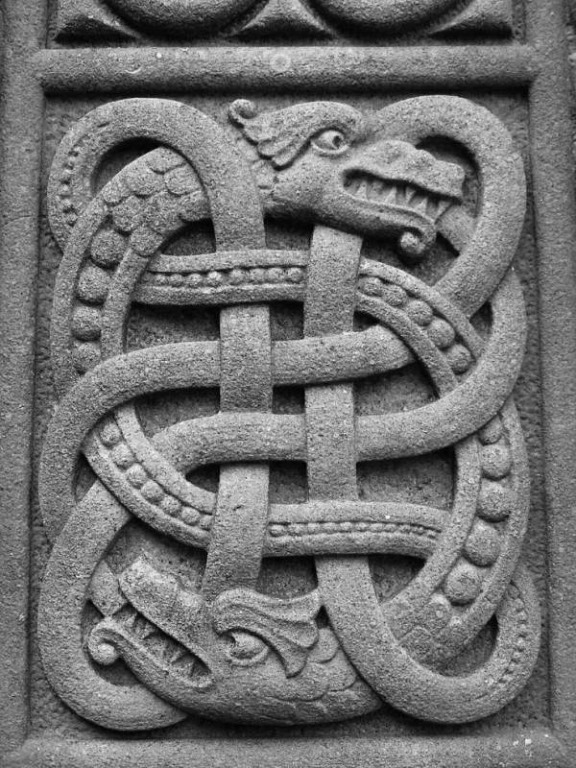
The Poetry of Rock? A Celtic representation of the ouroboros. This is a mystical symbol beloved by Jung and alchemists that is often used in graveyards. What does it mean? Thoughts differ, so may I offer one: Death can go kiss its own ass.
.
Did you skip to here? That’s fine.
OK, let’s get to the good stuff: this poem “Stones” appears in the new poems section of Ethna McKiernan’s Light Rolling Slowly Backwards. It’s a fine poem on the page, and I highly encourage you to experience more of McKiernan’s work there by buying her book or seeking it out via a library. Here’s the publisher’s link. That’s the other “ask” I have for you today. But “Stones” is also a poem of lyric experiences, it calls out to be performed with the context of its implied emotions shared in your ear.
And this I did. Besides presuming unilaterally to do that, I made one other adaptation in the piece for performance’s sake: I took a line in the final stanza and made it a refrain. Because that line is repeated now six extra times, I’m bringing it forward for you to make sure you notice it and its possible meanings.*** I could throw in some more paragraphs about what I considered those possible meanings to be as I performed this beautiful poem, but I’ll not do that today. May your ear link to your heart, and listen with the player gadget below —if your way of viewing this blog shows that — or this highlighted hyperlink otherwise.
.
*”Paradise Lost,” “Tyger,” “We grow accustomed to the dark,” and “The Red Wheelbarrow” are all worthy poems we might agree. Are they less different from each other than some random literary poem is from some song lyric?
**I may be repeating myself to say this here in a footnote — but that’s part of why I do the Parlando Project: because I expect you’ll experience the texts differently when you hear them performed with music.
Late last year I promised you’d get to hear some pieces based on the poetry of Ethna McKiernan. I thought about which one to start off with, and decided I’d perform this one for you first. Why? Because it may make you smile.
Regular readers here recently will have caught up with my connection with Ethna: how I heard her read work in progress in a small group of other writers who cycled through each other’s homes each month to do that. You’ll also know that the rest of the group was usually men in its later years.
When we met in Ethna’s our meeting would always start in her little kitchen. We’d stand near her sink and stove and brew up some tea and talk a bit about what happened since we last met, until our remaining writer’s group members accumulated. On one side of that room was the clipping and photo-decorated refrigerator door, a generalized cultural artifact, and on the other side a small table and chair. Her house was a modest South Minneapolis bungalow probably built in the last Twenties, a couple of blocks off of East Lake Street. Comfortable and reasonably roomy with the usual shelves of books in its main-floor rooms and a couple of wandering cats as one might find in a poet’s house. I never saw more than the main floor, but there was a second story up a wooden staircase, and as we shall shortly hear, a basement below. That all said, it seems Ethna wrote and revised mostly in that small kitchen.
Kitchens are a physical metaphor, the site of drudgery and giving, sustenance and routine. If I may gender a floorplan: the most female part of most houses.
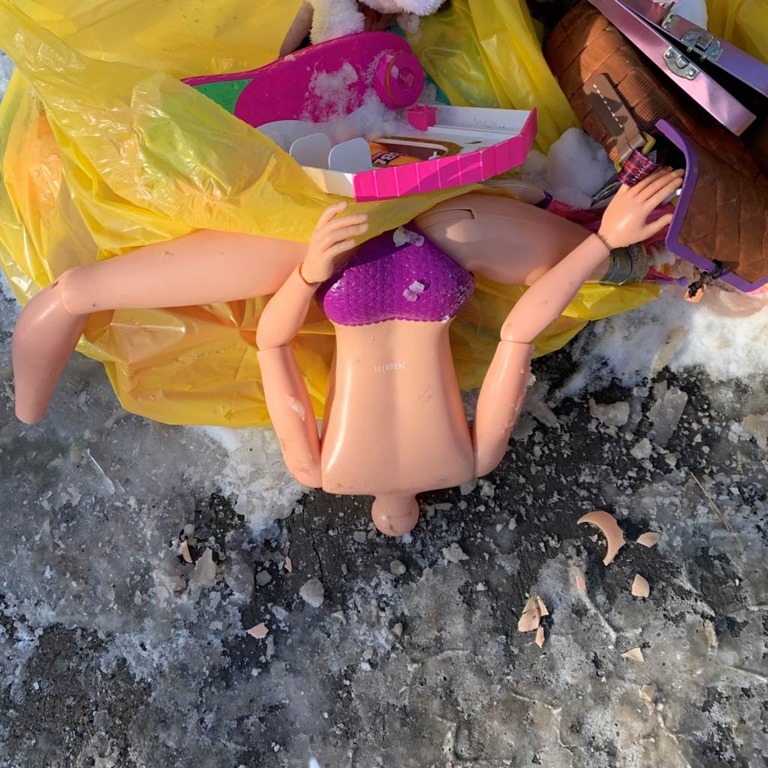
Approximately how some of us feel on winter days. If only there was some help…
.
I remember hearing “The Men in the Basement” at one of those meetings. Everyone enjoyed it, got it, right off the bat, which was far from a universal reaction to the work we shared. I heard her read it at least once at a public reading, and since it was included in her New and Selected collection* published just before her death late last year, we can be sure that Ethna herself liked this poem and expected audiences to do so too.
Do women understand this poem more than men do? How the hell should I know, though I suppose some raise themselves to opinions on such matters. I myself found it easy enough for my anima to perform it, though maybe some listeners will find that strange. Again, how the hell should I know? Anyway, given that we all bruise, want, wonder, live together and alone — and sorry, buzzkill for this entertainingly arch poem, we all sicken and die — I don’t find it worthwhile to predict or expect right now.
Musically I made this one an assortment of sounds, and I even worried that I may have over-egged it with the variety, but I’ll limit my predictions to that you’ll enjoy meeting Ethna’s text today. There’s a player gadget below for many of you, but you can also use this highlighted hyperlink where the player isn’t shown to hear it.
I’ve got a gorgeous song for you today, despite a difficult week for new work. I’ll try to get to it shortly, with only a little throat-clearing first.
It was 18 degrees F below zero* this morning. Oh, there was probably some wind chill too, but let’s not put too fine a point on temps like that — Minnesota January winter certainly doesn’t.
Our winter, to speak broadly, isn’t just cold. There’s also ice, snow, and winter cancellations and rescheduling. If that sounds grim, well, somedays it is — but then there’s a little something else about this sort of winter when you run across others out in it. Early this morning I saw another bicyclist with full face mask and goggles sawing their bike over the packed snow pavement. Before that, a woman walking her dog, each of them concentrating on getting such business done. In other duties, some school kids were walking to school. Every one of those fellow citizens are dealing with this shared winter too, and despite not being able to see much of their faces, you can likely feel something of a common cause.
But winter can also be experienced without even such scattered crowds. I used to commute around midnight on a bicycle, and the urban streets on rough winter nights would be the same as some new nowhere, like unto a SciFi paperback cover of the astronaut gazing through alien ruins. My wife sometimes runs just before dawn to a park that has no others but her and the existential animals.
Today’s piece is a winter poem by American poet Elinor Wylie, who wrote absolutely lovely short lyrical poems around 100 years ago. Hers is a slightly different winter. First, she’s walking with someone else. She doesn’t mention the temperature, but I doubt it quite as bitter-brittle as my morning. Hers is explicitly windless, but there is snow, the kind of loose powder that tends to fall when it’s colder than the soggy wet flakes.
Wylie’s reputation dropped fairly rapidly after her premature death in 1928. One knock against her pretty poems was that they were that and nothing else but attractive pictures drawn in word music. Well of course music itself doesn’t task itself with more than to be attractive, and visual art doesn’t need to support a philosophical argument or insight explicitly.
Sure it’s a pretty line: “I shall go shod in silk,” but damn it, open the door, it’s seriously winter out here!
.
I rather like this poem’s picture, because it’s something of a white-space void with just scant details coming out of the snow, like a Whistler painting. But it’s not even visual clues for the most part — the details are textures, feel images: veils, silk, wool and fleece, feathers and down, and then the velvet of the title. There is testimony that there is no noise, much less talk. Indeed, her partner in the walk is near-totally obscured, and this choice —conscious or unconscious — seems striking to me. Is she alienated from them, or so close that there’s no novelty in mentioning? The sensuality of the imagery may give undercurrents of erotic love, but the obscuring of the partner makes that reading stranger.
I seem to be specializing recently in taking leaps at alternate readings that even I don’t think likely, though not impossible either, like my wild-ass guess that Truth’s body moldering in the grave next to Emily Dickinson’s Died for Beauty could plausibly be John Brown. Don’t bet your grade on that one, students! But I thought of the woman walking her dog this cold and snow-covered morning. No reason to talk there, nor was the dog taking time out for a barking address. Wasn’t that dog wearing a wool sweater? Less romantic a poem, but not impossible.
Though it’s freshly done, I’m fond of the music I came up with for Wylie’s poem. Maybe you’ll like the little song they make together when I performed it this morning. The player gadget is below for some of you, and if you don’t have that, you have this highlighted hyperlink that will also play it.
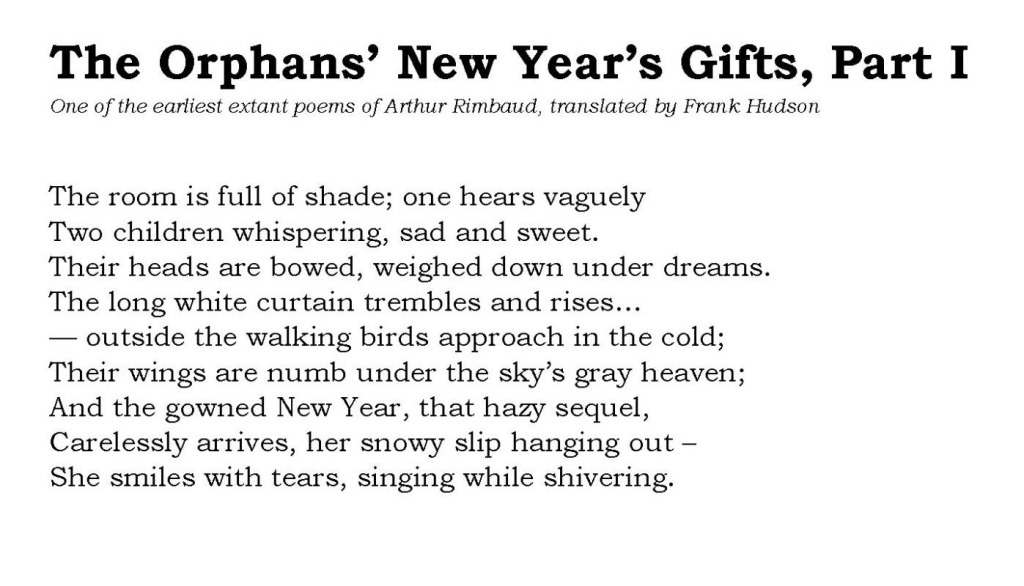
Last time I said I looked through Arthur Rimbaud’s collected works in the middle of the nighttime looking for something to translate, combine with music, and perform. I guess I could have saved myself some time, because I eventually chose the first poem in the collection, The Orphans’ New Years’ Gifts, placed first because it was the first poem he ever published. When it appeared in print on January 2nd, 1870 Rimbaud was all of 15 years old.
On first reading, it’s not representative of the poems Rimbaud would be writing in little more than a year or so. While the entire poem is a gothic story, it’s also quite sentimental and largely conventional. For reasons of time and preferring shorter works, I decided to only perform the first part, but spoiler alert: it’s soon revealed that the children are recently orphaned and they are dreaming of their family still being intact and how they will give their now dead mother they expect to find in their dreams a pair of “for mother” plaques from each of them as a New Year’s gift.
But for us, the performer and listeners today of this first section only, this is no matter, because it’s the last day of 2021 and tomorrow is a new year. We know nothing of 2022 save for dreams pleasant or frightening. The coming year is a more mysterious ghost to us than our past years.
It might seem odd to say, but I’m an orphan — that’s not unusual, at my age most everyone is. It’s a different matter to write this as a 15-year-old, as an adolescent, as Rimbaud was. Those are the years that children learn how to gradually break away from their parents in whatever manner they fall into. Rimbaud instead would do this early and abruptly, leaving his mother — and for Paris, and unrest, and rebellion of all sorts in that “about a year” timeframe. Poetically and emotionally, this poem hardly seems to be a rehearsal for the Rimbaud of 1871 and after.
As I worked on translating this poem, I saw a little window into that other Rimbaud in this short first section. Those intimations were unlikely put there by conscious choice. Maybe they were slipped in by Rimbaud’s future ghost?
A few notes on how I translate. I generally don’t try to bring over the word-music (too tough, too damaging to other elements of the translated poem). I start attempting to be as faithful as I can, but then while in process I am often tempted to sharpen or expand on the images I’m trying to bring forward into contemporary English; because those images expand in my mind as I consider them, and because I want them to remain vivid. I’m of two minds about doing that, and I try to make clear here when I’ve really inserted something altogether invented. If you’d like to read the whole poem in it’s original French, here’s a link.
My local forecast says –11 F (-24 C) for New Year’s dawn. I think of a blues song Leo Kottke used to sing with the line “So cold in China, the birds don’t even sing.” Maybe that’s why I choose the guzheng today?
.
Here are a few examples in this one, in ascending order of significance. I suspect the curtain Rimbaud has blowing in the winter drafts is a bed canopy, a largely unfamiliar antique item, and instead I’m leading you to see a window curtain. Leading you to the window lets me transition to an image I sharpened. Rimbaud doesn’t explicitly say the cold winter birds are walking, but I think he did intend to tell us they aren’t able to fly in this moment, and I thought I’d underline that. And the final image, the one of New Year arriving as a woman in a dress of snow, I wanted us to see a tipsy celebrant whose party gown is no longer arranged neatly. Did the 15-year-old Rimbaud intend that image? I don’t know, but his future ghost might well have chosen it!
Yesterday I revealed that I wanted to do this piece to honor ardent Rimbaud admirer Patti Smith. Obligation completed, though you may notice this is nothing like how Patti Smith or her band would characteristically perform this. The first instrument you hear is a Chinese guzheng,* a sophisticated zither family instrument, then eventually a variety of drums and percussive sounds arrive along with electric bass, and finally a low synth moan. But did I make clear in talking about Smith yesterday: one of the things she demonstrated was that untapped possibilities of presentation styles are the point, not just duplication of one’s heroes.
*With expensive and exotic instruments like this I usually use what are called “virtual instruments” that sample the notes and sounds of the entire range of the instrument; and as in today’s piece allow you to articulate some of the instrument’s particular attacks and variations, like the guzheng’s vibrato. I select and play the notes with a little plastic keyboard or my guitar with a MIDI interface.