For Once, Then, Something, or Robert Frost kicks it EDM

You know, I really mean it when I say I aim to combine various words (mostly poetry) with various original music. I find I’m a self-iconoclast. If I sense a few too many audio pieces leaning one way, I want to lean another.

Brave listener/reader, bear with me. If you like or even love something I present here, you might well find the next one meh to boring to obnoxious.

Today’s piece uses a poem by Robert Frost. Long-time readers will know that I didn’t much care for Frost in my youth. He seemed so conventional, the man to reassure us of timeless verities in verse and sentiment, a left-over Victorian. Even Emily Dickinson who I first absorbed, as she was taught then as a writer of gentle ironies, at least had a bit of the scamp about her. And in my young days Frost had the job of bringing up the rear of the poetry textbooks, the last in the line.*  Everything newer was unexplored, unteachable as to danger or value.

Carta Marina Beyond this point are Monsters

Beyond this point are monsters. This map makes it look like one could cross the North Sea by hopping from back to back. My mid-century text-books stayed onshore.


How soon did I hear Frost’s “playing tennis without a net” line, often deployed then against the Beats, those descendants of Whitman and Li Bai who were roaming the streets unschooled and braying? In high school I’d guess. I didn’t know then that Frost hated nearly every living poet, that Frost’s distain was like the rain, it fell on all.

I suppose I could have at least related to Frost’s rural themes in my little farm town, but that passed me by then. I do recall that a high school English teacher who I admired, Terry Brennan,** told us that Frost had not been successful in his short try as a farmer, and I still remember that assessment of Frost’s poetic persona as something of a phony mask. Carl Sandburg, still thought of as the proletarian urbanite, was more a man of the soil, his household goat farm likely more successful and certainly longer-lived.

Of course, few young persons—and not I, then—realize that all masks are phony, but they give you something to show for what you’re saying. To criticize a poet for putting on masks and speaking lines is like criticizing LeBron James for spending too much time dribbling when he could just drop the ball through the hoop from the top of a stepladder. Did I just restate Frost with larger balls and a different net? And you in the back row: that’s basketballs, stop snickering.

Frost’s true nature is as a stoic, a man sure of human failure and the unacknowledged dark humor in denying that. Sure, that outlook can be too reductive. Kindness, love, the act of caring, may be only momentary balms in the great scheme of things, but momentarily we live.

So why do I now present Robert Frost fairly often here? Well, in his early years he was a superb lyric poet. And as I’ve gotten older, I’m more and more drawn to the lyric poem, the short expression that says those who tell you everything in their poem, who are sure their next line will tell you more yet, are testing both my patience and my sense of how much anyone knows. If we live momentarily, then the lyric poet is our documentarian.

Frost’s “For Once, Then, Something”  is a defense of that understanding, a lyric poem about the Book of Nature that is itself about the momentariness of the lyric. I choose this unconventional musical setting to emphasize that other part of Frost, that he’s the hard man, and that if he’s a poet who can be taunted for spending too much time staring down wells, he isn’t going to lie about what little he can see. ***

Today’s piece marks the 350th audio piece that the Parlando Project has presented here, so that makes it particularly apt, not only because we most often focus on the lyric aspect of words, but because this project is about encountering those words and asking what is new or particular in our apprehension.

Disliking or liking a piece’s words, music, or performance are just two sides of the same coin in the wishing well. My dislike of the poet I thought Frost was at first led me to love other poets more, and then, eventually, in another once, I was able to come back to Frost and see him again, differently.

Rural Well!

You’ve given us your attention, so not wishing for you to toss coins…


If you like some of what we do, here’s what I ask of you: spread the news about it. Particularly if you use social media (I have too little time after doing this, nor do I have enough of the nature for it). The audience has grown in the nearly three years this has been going on, but the amount of effort to do this asks that this growth continue.

Here’s today’s audio piece, my performance of Robert Frost’s “For Once, Then, Something”  taken as a driving EDM piece. You can dance if you want to, and the player is below. If you’d like to read the text of the poem, now or later, it’s here.


*Carl Sandburg, who I’ve always liked, was actually a few years younger than Frost, but the books still seemed to choose Frost to end with. There was a generation of poets after them, born in the early 20th century before the Beats and their contemporaries, who were also still not in the textbooks then.

**I wonder if he’s alive, an old man if so. I owe him a debt. Like an early musical influence, my short-time college friend Don Williams, his name is too common to be easily searched.

***I suspect an intended undercurrent here of the Celtic tradition of wells being the domain of spirits, something that survives in enervated form with traditions like the “wishing well.”


Chains At Her Feet

Here’s a piece that I wrote* which is appropriate for July 4th, American Independence Day, since it talks about freedom and independence—but also because of its compositional back-story.

A few years back I got to travel to New York City with my wife and young son. An advantage of this trip is that I could see New York as a tourist. We stayed in Brooklyn, on the same block as a now unused building that was a waystation on the Underground Railroad, and we’d walk by it every day going to and from the subway station, that different underground railway. We visited the Tenement Museum (highly recommended) and my accompanying book for this trip was Rebels: Into Anarchy and Out Again, “Sweet Marie” Ganz’s** memoir of her life as a tenement-dwelling radical a hundred years before. We visited Ellis Island and my wife and son got to sit on one of the benches that immigrants sat on in the great hall awaiting decisions. We did what resident New Yorkers rarely do, we visited the Statue of Liberty, the giant statue that on Independence Day becomes the representational symbol for the American spirit.

Every American knows that statue as an image. For our large and diverse country, it’s the equivalent of ancient Athens’ civic sculpture of Athena. Still, here are two things that are lesser-known.

Two Civic Statues

“Not like the brazen giant of Greek fame..” The reconstruction of the Parthenon’s Athena sculpture is in Nashville Tennessee. Athena has a carving of Steve Earle in her right hand as stone-Earle proclaims Townes Van Zandt the greatest songwriter ever.

The pedestal of the monument rests on the repurposed ruins of an early 19th century fort which once guarded New York harbor. Visitors to Liberty Island can see a section of the fort’s lower structures left uncovered and accessible down a stairway: bricked-in doorways of a room that was once used as a military prison cell according to the placard. The author of the placard was likely not a poet, but the Statue of Liberty rests on top of the doors of a prison.

One part of the statue, otherwise so well known, is nearly impossible to see for visitors, but was intended as part of the work’s imagery by its creator: beneath the torch of “imprisoned lightning,” the halo of spiked rays,  the serene face, the tablet bearing the date July 4th 1776, and the copper-clad folds of its robe, the sandaled feet of this Lady Liberty stand on top of a broken shackle and chains.***  That would become the title image of “Chains At Her Feet.”

Statue of Liberty chains at her feet

“Flashing for the refugees on the unarmed road of flight”  some of the broken chains at her feet

It was sometime after that visit that I watched a young woman move out of a rooming house on my block. I could not discern all her story, but the small number of belongings, and the unable-to-tell relationship with a man who was assisting her with the move, but who left after helping with a couple of larger pieces of furniture, supplied the second set of images.

Why did I combine those two sets of images? Because it seemed emotionally right, though it may not be. A Dada principle, one beloved by composer/musician Frank Zappa, was “Anything, anytime, anyplace for no reason at all.” My understanding of Zappa’s artistic tactic is that combining things that don’t seem to go together, even things that seem outrageously incongruous, can create new and strong impressions. Chance, randomness, coincidence can be entryways to this.

I agree with that, though I’d caution you that my experience has been that most results of chance, incongruity and randomness will suffer from incomprehensibility and boredom, near and far misses. In practice, selection must occur, whether it happens before or after. Who selects? The artist and their audience. Zappa certainly chose, he was just happier choosing widely, and in some cases choosing things many people (and even I) will not like.

So, this combination in today’s piece “Chains At Her Feet,”  the Statue of Liberty and a young woman, leaving or going somewhere, sketched in clear lines, yet missing parts of the story, may not impress on readers/listeners what I intuited and felt in combining them. Would it be better if I filled in the missing parts, even with invented details? Some readers of it have thought so. The title/refrain “Chains at her feet,” a detail taken from our giant July 4th icon, puzzled people. Was that my intent? Yes and no. I wanted people to ask what that odd line meant. In singing it, I repeat it enough to make sure people know it’s not a mistake. Do I want listeners to think “Aha, that must be the Statue of Liberty?” No, but I wanted the effect Liberty’s sculptor wanted when he put those chains under his statue’s feet, the same sort of conjunction as the remains of the military fort and the jail doors under the pedestal on Liberty island.

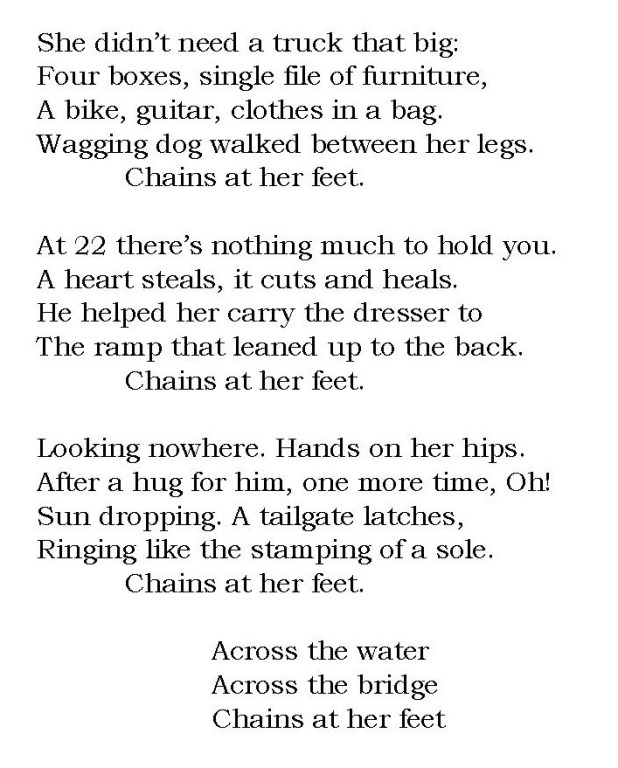
Chains At Her Feet lyrics

When singing this, I add more refrains. When reading it you see words I want as punned/double-meaning: “steals” and “sole.” Even “chains at her feet” sounds a bit like “change…” when drawn out.

So, who’s right? The answer is I don’t know. Long-time readers here know one of my dictums: “All artists fail.” Even the canonical greats bore and puzzle and meet with disinterest of most people most of the time—so unestablished artists like me certainly don’t know if what we do is any good.

No artist does. We do it anyway.

I like it when something connects with readers/listeners, I’m often sad when it doesn’t. My stance on what disconnect I find with what audience I find is to interrogate it and myself. I haven’t let it stop me making. Indeed, it sometimes leads me to additional making, seeking ways to make something work some of the time.

As important as it is that we artists respect, are even grateful, for genuine audiences, it is also important that we choose widely, even fail widely.

To hear “Chains At Her Feet”  performed, use the player below. No player visible? This highlighted hyperlink will also play the song.

*Regulars here know that presenting pieces with my own words is an intentional rarity here. I often fall into doing it when I’m running behind in developing pieces with other writer’s words or researching around that goal.

**Ganz’s story was fascinating to me, an immigrant sweat-shop garment worker from age 13, who through chutzpah and conviction toward justice became a street agitator for reforms in early 20th century NYC. Speaking of a conjunction that may be accidental or designed, I’ve wondered if the Sweet Marie in Bob Dylan’s “Absolutely Sweet Marie”  could have intentionally referenced her. Some of Dylan’s Greenwich Village cohort might have known of “Sweet Marie,” and her actions were less than 50 years old when Dylan hit town.

***Though Liberty’s tablet references the 4th of July, the proximal motivation for its creation was the ending of the American Civil War and American slavery. In statuary, having something beneath the feet of the figure or trodden on is not uncommon imagery, but chains and shackles aren’t just mythological images. In another juxtaposition, Juneteenth and July 4th sit close together on the calendar, if four score and seven years apart.

London In July

This is another time where I present a piece by a lesser-known writer, though one who seemed to be on her way to overcoming artistic and social obstacles in the 1880s. Amy Levy was something of a prodigy, publishing work in her teenage years, achieving admission to Cambridge (only the second person of Jewish heritage to do so), and then while in her 20s carving out a career in journalism, fiction, and poetry. A feminist*, she had made connections with the cadre of those that would soon be called “New Women,” and Oscar Wilde was impressed by her keen powers of social observation and sharp concise prose.** In quick succession she wrote and published two novels and two books of poetry that seemed well enough received.

Of course, she had obstacles, not just the universal ones of art, but the additional burdens of anti-Semitism, misogyny, and what appears to be a lesbian orientation, which only makes her achievement as she reached the age of 27 seem just that much more impressive.

Amy Levy

Amy Levy “Talkative, good-looking in a way, and full of the restlessness of the unhappy.”


At that point she had completed another novel, and in the summer of 1889 she was working on reviewing the proofs of her third book of poetry “A London Plane Tree.”  The poems, if not exactly avant-garde, were spare and modern enough that they wouldn’t sound outdated in the coming century.

A London Plane Tree

The front piece of the original 1889 edition of this book of Levy’s poems. Does anyone know what structure is pictured?


Today’s piece, “London In July,”  is from that collection. It’s a love poem, a common enough subject, and its language is plain and unshowy, but consider what is being described. It starts by saying that the poet thinks her senses are “cheating,” that they cannot be relied on to represent reality. “All the people” she sees in London (presumably men and  women) appear to her as having one person’s face.

The second stanza/verse hints at what face she’s seeing on everyone. It’s just a dirty-patina urban London summer day, but against this background, among the millions in the metropolis, she sees only what she must see: her beloved. She reminds us, her beloved is a London resident, she doesn’t leave for a country stay even in the heat of July.

In the third stanza, this situation has become a puzzle, a maze, and the size of the city a “waste,” as she only wishes to be were her beloved is.

And the city’s crowds, wearing the beloved’s face, are mocking the poet. Crying out to others in the crowd and market, yakking on about perhaps where they’d like to be rather than in the hot city this July: beside some rural stream, or at the seaside. The poet concludes: I’m not leaving, this city contains her. Hidden somewhere in its essence and hot summer, there is my beloved.

Perhaps the most striking thing, beyond the hallucinatory picture that is being painted here***, particularly to audiences in 1889, would be the same-sex desire that seems plainly part of this poem.**** That’s masked by having me perform it.

So how did audiences respond to that? How did Amy Levy deal with that response? Alas, that’s masked too. After completing her review of the proofs, but before the book was printed, she died by intentionally inhaling coal-gas in her room as the coroner judged it: “Under the influence of a disordered mind.”

I once again remind you that the first duty of an artist is to survive.

For a fairly simple musical concept I had trouble realizing the performance of this one. A pair of violas and three violins establish the cadence of the piece, playing unison lines in various registers, but then the electric bass plays a line that doesn’t consistently relate to the bowed strings key-center or root notes. I was trying for an unsettled rub between the bass and the strings. At one point I had an acoustic guitar part that tried to tie those two parts together, but I couldn’t execute it well enough, and conceptually I think it may work better to leave the contrast between the bass and strings unresolved. I’m past the point of deciding now, you decide. To hear it, click the player below. The text of the poem, is here.


*Her first major work was a poem presented in the voice of Xantippe, the wife of Socrates who appears there to have founded mansplaining alongside philosophy.

**Among her crew: Eleanor Marx (daughter of Karl) and Beatrice Webb, a founder of the Fabian society and the London School of Economics. She met Thomas Hardy and during the summer of 1889 she met Yeats who wrote later that Amy Levy was “Talkative, good-looking in a way, and full of the restlessness of the unhappy.”

***Part of what drew me to “A London Plane Tree”  was a description of the poetry within as being an early example of Symbolist poetry in English. In terms of poetic language, I can’t quite see that yet, but some of the mood and sensibility in the pieces connects.

****Other than a frankly lesbian reading (which seems supported by biographical info) the only other reading I can see would be an esoteric one, similar to those that see a level in “The Song of Solomon”  where the beloved is an incarnation of Israel or a state of union with the divine.

O My Darling Troubles Heaven

When we last left-off Kenneth Patchen he was beginning his career as a proletarian poet in the 1930s, writing a strikingly prophetic (in both senses of the word) poem about what the middle of the 20th century was holding in store. I’ll leave it to you to decide if that poem also speaks of our 21st century’s future.

Kenneth_Patchen_1952

I didn’t have time to discuss that Patchen’s 1952 Wikipedia picture looks like Thurston Howell from Gilligan’s Island.


Patchen never left his concerns with society’s dangers and constraints, it remained part of his poetry throughout his career until his death in 1972, but that’s not all or even much of what he became known for. Here are some of those things:

He was a significant influence on the post-WWII independent, largely non-academic Beat explosion. The bohemian aspects of his life and outlook, as well as the ways his writing expressed itself was a key living American model for the Beats.

And speaking of the Beats, he and his friend and fellow Kenneth, Kenneth Rexroth, were enthusiastic pioneers in the tradition of performing their poetry with musical accompaniment. Though many Beat Generation poems still live on the page, I’m not alone in hearing many of them, even when read in silence, as spoken voices, a jazz group cooling it behind. Patchen was more committed to this combination than most he influenced, touring his “Poetry-Jazz” in the late ‘50s.

Obviously, that style is part of what’s led to the Parlando Project, though I wish to expand on it. Patchen too seemed open to other musical genres with his writing: for example, a longer piece for radio performance with a musique concrete score by John Cage, “The City Wears a Slouch Hat.”

American bohemian arts flowed out from the Beat era, and Beat’s immediate predecessors like Patchen, in a series of connections and mutations. Diverted poet Jim Morrison used his psychedelic ballroom singer money to help Patchen publish one of his final books. And a figure as singular-seeming as Leonard Cohen has links in his expression that seem to connect closely with some of Patchen.*

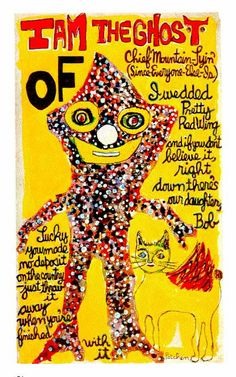
It wasn’t just music that Patchen combined his poetry with, but visual art—drawing and painting pages that were as much pictures as poems. While this has precedent in medieval illuminated manuscripts, the painter/poet/engraver William Blake, and some of Dada’s work, Patchen’s style of combining his own naïve art with epigrammatic text connects with some of the poster art of the Sixties.

I Am the Ghost art by Kenneth Patchen

Closer to Pedro Bell than William Blake? Art by Kenneth Patchen.


One of the reasons I so like presenting figures like Patchen or Blake is their “get in the van” indie spirit. Art does not need to ask permission, it perpetrates itself anyway, figuring out a way to use the resources it can scrounge together.

And lastly, another thing Patchen became known for, even if it wasn’t as widely imitated in the Beat era, was his love poetry. It would be restrictive to think of him as just a love poet, but it was a substantial part of his writing and audience. As the billboards changed from “The Beat Generation” to “The Love Generation,” Patchen was already there with his poetry. A case in point, today’s poem “O My Darling Troubles Heaven”  performed here by Dave Moore and the LYL Band.

So, enough talking without a band. Go ahead and click on the player below to hear Dave’s performance of Patchen’s poem.


*Like what? The love poetry combined with the prophetic social dread is a recognizable Patchen trope. The combinations of art and writing, such as in Cohen’s Book of Longing  can be similar. And while Cohen’s typical poetry plus music style isn’t often reminiscent of Patchen’s, the two obviously didn’t mind mixing those arts.

Back Yard

Just a couple of posts back I said that early Carl Sandburg poetry can be just as aligned with the ideals of the Imagist school as the Trans-Atlantic poets such as the then contemporary work of Ezra Pound, Amy Lowell, H.D., Richard Aldington, F. S. Flint, T. S. Eliot, William Carlos Williams, and T. E. Hulme was. Yet he’s rarely mentioned as such.*  Why might that be?

My guess is that there’s an issue with Sandburg’s more expansive mode, present in some of his work, Whitmanesque in character and scope. The Pound and Eliot school of Imagism wasn’t much on Whitman, charging him with lack of craftsmanship and concision. And then there’s the issue of cultural affinity, which while outside the text, is important. Of the above, only Lowell was from a wealthy background** (and Flint’s childhood seems positively Dickensian) but they all saw themselves as culturally elite. Most were familiar with classical languages, some had Ivy League educations (though none were Oxbridge, save for Hulme who was thrown out after a bit more than a year for rowdy behavior), most had spent time in Europe , even Williams, the most American-focused of these.

Sandburg? Born working class to two immigrants in the Midwest***. Drops out of school at age 13 to go to work. The jobs he had in the first 40 years of his life were modest in prestige, but varied in location and nature. Coal-heaver, farm laborer, Army private, milk-truck driver, political organizer, bricklayer, “The Front Page” era urban journalist. What T. S. Eliot knew about the whole of literature, Sandburg knew about the whole of working-class work and life.

One could make one mistaken generalization from Sandburg’s biography, that like Whitman self-advertised himself, he’d be “one of the roughs,” a man whose art would be artless and as unconcerned with the niceties of aesthetics as the correct fork for which dinner course. But just like the lazy assumption that there’d be no poets in foxholes, the idea there are no aesthetes who punch a clock is bogus. Sandburg’s early work is as concerned with Modernist beauty and style as working-class dignity—and he is very concerned with working-class dignity!

Is today’s Sandburg piece, “Back Yard”  an Imagist poem following the three Imagist rules? Let me paraphrase them:

Direct treatment of the thing: that is, the focus in the poem is on the image itself which will be described, instead of the image being a decoration and figure of speech within the body of a poem more concerned with its moral or message for which the image is only a “like” illustration. Conciseness: no extra words, and though not stated, it’s corollary is no less-apt words used only to make the rhyme. And freer rhythms: word-music, like sound-music, is not required to limit itself to only extraordinarily regular and repetitive rhythms.

Direct treatment? The outdoor, summer night scene is just that. One is hardly aware here that it’s an image, it seems like simple reportage. Is it merely the “hardly news” that on a summer night if one is outside, perhaps sitting on an open porch, you’ll hear and see other people outside too?

Concise? Pretty much. It’s not In A Station of the Metro,  or The Pool,  or The Red Wheelbarrow,  there is some re-iteration in it, even a single line refrain, but even by the standards of lyric poetry, this is a short poem. The elements of the scene are evoked, but there’s little extravagant or showy description. One element that many Imagist poems share (though never a formal rule AFAIK) is that colors are used to simply describe objects, though since this is a moonlit night scene the colors are more monochromatic.

A follow up question: how minor and mundane is “Back Yard”  really? I can’t claim it’s a poem of great originality—but that’s not the job of every poem, and this is more a poem of the continuity of change, a moment of shared perception, not a striking new vision.

I think its intent, in it’s just over 100 words, is for us to see a chain of life in a Chicago night early in the 20th century; and in its everyday exactness, state those things that might link to a night tonight where we live today. The silver moonlight in the scene seems almost a preservative, everything is frozen in that direct moment. In my night tonight it may not be an Italian boy with an accordion, but Mexican music from the back yard at the end of the block. The couple Sandburg says will marry next month, are now-dead grandparents of people as old as I am. An old man has fallen asleep in the late and waiting moment, his back-yard cherry tree’s fruits held in a moonlit unmoving until his eyes close. He will likely pass on sooner than the marrying couple, and his dreams and those long-ago cherries will be returned to the place that dreams, fruit, and poems go and come from.

The poem closes with a perennial thought delivered in the scene’s description. The clocks, the poet relates, say he too must go. The clocks say that to all of the characters in his poem, and by extension to us, his audience. Sandburg, the artist, the poet, has the job like the moon to fix this moment in silver. Was he thinking here of the silver of his brother-in-law Edward Steichen’s art photographs? What does he mean by the poem’s closing line? What are the “silver changes?” My best understanding is they are the endless succession of such fixed moments. There will be more and more silver changes, a great richness, even as we are entirely not there.

Edward Steichen Nocturne-Orangery Staircase

Fancier than my back yard: “Nocturne-Orangery Staircase” (1908). Sandburg occasionally collaborated with his brother-in-law and pioneer in fine art photography Edward Steichen.


For the performance of “Back Yard”  I decided to intersperse some other night moments, sung as commentary on Sandburg’s poem. You can hear it with the player gadget below. Want to read along? Here’s the text of the poem.


*Yes, Imagism is only a label, a piece of sticky paper put on some writers and writing. But because Imagism was so vital to the formation of English poetic Modernism, excluding Sandburg, “The Forgotten Imagist” from its usual ranks was part of how he was diminished in the late 20th century. The artistically-chosen stark simplicity of Imagism was admired, but similar directness in Sandburg was seen as populist simple-mindedness. For an example, here’s a long review of a late 20th century  biography, where the dagger is that Sandburg’s poetry was “dumbed-down Whitman” and the charge seems to be that he was a pretentious yokel who was also a phony who pretended to be a yokel.

**I’m of the impression that Eliot and Pound’s family had at least upper-middle-class wealth too, but my informal memory is that some estrangement or streak of independence led them to live outside their families’ wealth.

***Sandburg’s home-town area, the Quad Cities and its surroundings in Iowa and down-state Illinois, was a surprising well-spring of writers in his time.

Over Hill, Over Dale (from A Midsummer Night’s Dream)

Today is the summer solstice, and what better way to celebrate than a song from Shakespeare’s “A Midsummer Night’s Dream.”

The song “Over Hill, Over Dale”  comes early in the play, as the audience is introduced to the fairies’ world. I’d like to point out, the un-named fairy who sings it might be particularly relatable to creative types. How so?

On our creative days we may like to think ourselves’ that play’s Puck, “that shrewd and knavish sprite” capable of all kinds of life-shaping mischief with our words and creations; the Puck who gets the play’s ending speech where he represents as all effortless, dreaming creators to our audiences.

But Puck doesn’t sing today’s song.

Nope. The singer is just a fairy no-name. And, to be frank, this fairy is kind of a drudge. The song, delightful as it is—and meant to generate with word-pictures a wonderous world of nature’s magic in the audience’s mind—does this by a description of no-name fairy keeping their fay nose to the pixie grindstone. Dutiful, and busy, busy, busy.

Shakespeare has set no-name fairy’s job to be an exposition-character. After today’s scene-setting song, their dramatic task is to introduce Puck, through no-name recognizing the much better-known sprite and speechifying as Puck’s hype-man. After that, no-name leaves the play speaking lines about not wanting to be noticed.

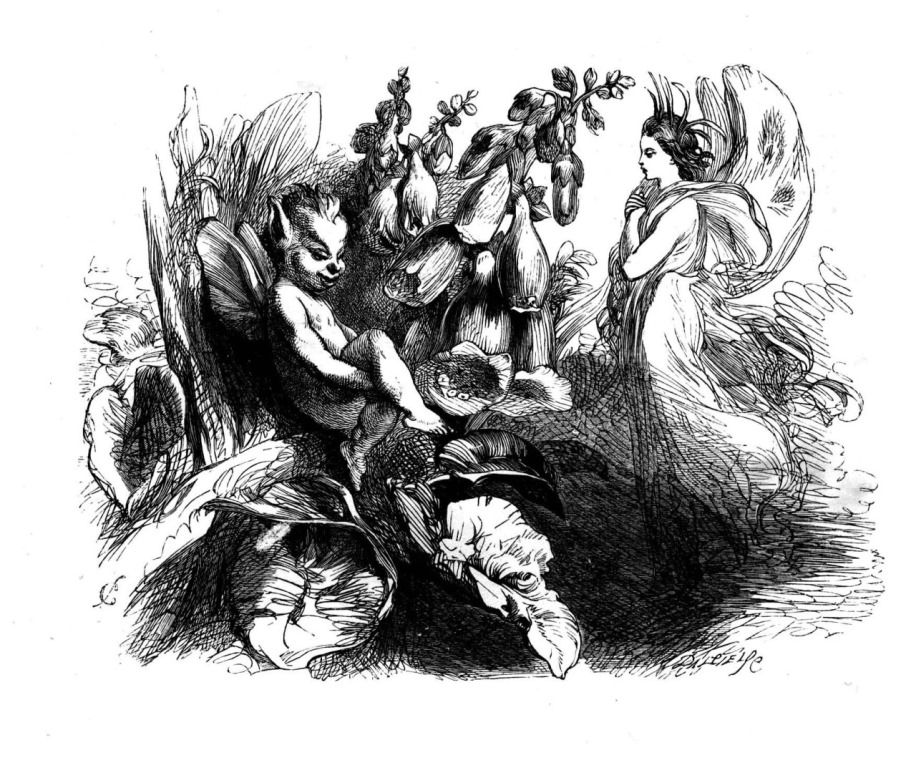
Puck and Fairy by John Gilbert

Consolations? This Victorian artist made our no-name fairy better-looking than Puck (on the left.)


OK, so what’s in this for creatives?

We’re not Puck, at least not most of us, mostly all the time, effortlessly casting our thrall. Magic and delight take a lot of grunt work. There’s always one more cowslip that’s missed its pearl-hanging, that’s a few rubies short of the categorical number.

And if we do our work well enough, it often seems like nature—you know, “You’re so creative. I could never come up with all your ideas!” Well, creative people aren’t the ones who come up with ideas (those are imaginative people, only some of which are creative)—creative people are the people who make things.

Musically, I get to work out my naïve piano playing while aiming for a funky feel on this one. I hear there’s a Midsummer party in the wood outside of Athens. What time? Oh, Elizabethan. The player gadget is below. If you want to read along, the song is at the start of Act 2, Scene 1, and you can read it here.


The Most Popular Parlando Project audio piece this past spring is…

Here’s something I’ve noted in the years I’ve been doing this: these quarterly Top 10 lists advantage pieces posted earlier in the season since they have more weeks to accumulate listens and likes. So it was quite an achievement for D. H. Lawrence’s “A Winter’s Tale”  posted near the end of February to make it to number 4 in our last-winter countdown, but it happens. After all, this time, “They Say Life is Precious”  released in the middle of May this year, made it to that 4th position in our spring’s list.

Still, past the earliest days after posting there’s a predictable drop off slope. Listens are “front-loaded” as people notice it as a new post or podcast, and after that it’s mainly the explorers and those who find things from a web search. I am gratified that many of you check out our archives and listen to the nearly 350 audio pieces we’ve already presented, but the sheer number of pieces means that the long-tail listenership tends to be spread between those hundreds of pieces, making repeat appearances in the Top Ten rare—but we have one this time, one all the way at the top.

And it’s that D. H. Lawrence piece, “A Winter’s Tale.”  I can see how: a large number of folks were still discovering and listening to it in March, and after the expected dip in April, more people actually listened to it in May than April. But I don’t really know the why.

D. H. Lawrence’s poetry* is not exactly forgotten, but he’s still better known as a novelist—but that could help if the interest in novelists is greater than that for poets.

Was it the music I wrote and played for it? My music for “A Winter’s Tale”  was rather explicitly ‘80s related, what with the piece’s arpeggiating synths and big reverbed drums. I do rather like what I accomplished there, both the recording and the ideas of the musical arrangement still sound good to me, and so perhaps they did to you. One memory I have of doing the piece was wanting to remember to make use of silence. I always need to remind myself to do that, and too often I don’t obey. Listening to Mark Hollis’ music as I wrote and arranged this piece may have made that reminder stronger this time.

Shakespeare-Hollils-Hendrix-Lawrence quadrent

OK, some of you guys must have helped make this spring’s Number One.


Was it the title? Shakespeare** seems to be a reliable boost to interest over the years (sort of like putting Jimi Hendrix on the cover of a guitarist magazine), and Lawrence’s title is shared with a Shakespeare play. Was it Lawrence or Shakespeare drawing those later listens, or the combined power of both?

Like I said, I don’t know why, but thanks for listening and reading this spring! There’s still a fair amount of In Real Life and studio re-organization putting pressure on the amount of new music I can put together, but I still hope to be dropping new audio pieces this summer and writing about my experience with the words.

So here it is, as we approach summer, the enigmatic story of D. H. Lawrence’s “A Winter’s Tale” that’s just a click on the player below away.


*I’ve called Carl Sandburg “The Forgotten Imagist.” His early poetry uses the Imagist rules, but despite the way he wrote, Sandburg as a person doesn’t “read” as an Imagist: an immigrant’s child who wasn’t seen in Paris and London, and who wrote often about the world of work and those who sought and were bound to it, he doesn’t seem the aesthete (even though he was, in part, that). D. H. Lawrence too doesn’t inevitably get called an Imagist, even though his verse shared some Imagist characteristics and he was published in the movement’s anthologies. Lawrence was never viewed as a theoretician or leader in Imagism, and socially he mixed with poets like Edward Thomas and Witter Bynner who were outside the movement. Is he too a forgotten Imagist, or just “Imagist-Adjacent?”

**One measure of Shakespeare’s strength to draw listeners is a piece I did taken from Shakespeare’s play “Twelfth Night”  which I still find embarrassing. After seeing what friend of the blog Weekesgaehl could do with her actual acting chops I figured I’d give it a go with a short scene from the play to frame a song found in it. The song turned out just OK, but my “acting” lead-in makes me cringe. Tragic fate and the draw of Shakespeare made sure a whole lot of people listened to that one—and continue to listen to that one—sustaining my embarrassment.

The Parlando Spring 2019 Top Ten Part 3

Now we’re nearing the topper-most of the top in our tip-top count-down of the most liked and listened to pieces this spring. Wait—did I just turn into a mid-20th century radio host? Out! Out! Commercial spirit! Timeless poetry knows no acne creams, Yardley scents, Thom McAn Beatle boots or white Levis. Well, maybe some of the music knows them—but honestly, it interrogates those pop intentions and asks us to re-evaluate that intent in the context of greater artistic accidents consciously or unconsciously evolved from the Modernist revolts of the last century.

No, no. Not that either. I mostly just want to make things that haven’t existed before, mix the known and the unknown, like and contrast the unlike, let poetry talk to music, and let music not shut up but talk back. As I do this, I look at things you and I and many others have looked at before and see if they’ve changed. And then sometimes I look at those poets whose names and poetry were writ in water.

It just so happens that our next three pieces in our count-down are from such writers, poets unknown to me, many literature students, and likely to you.

4. They Say Life is Precious. One of the principles of the Parlando Project is “Other Peoples’ Stories.” I don’t dislike memoir, self-narrative, words intended to establish or confess one’s selfhood. I couldn’t, or I’d have much less poetry to choose from to present here. But I feel that’s well served elsewhere, not just in literature but in blogs, podcasts, and social media. So, if and when we want that, we can find it. In the words of a wise boss I once had, it’s “ubiquitous everywhere.*”

What I do instead here is to encounter some other person’s words, see how they sound in my mouth, and ask myself what I hear, feel, and think when they are enthroned there.

I could suppose it’s a failure of a kind that a performance of one of my own poems is in this Spring Top Ten then. And indeed, I usually fall to using my own words when I find I’m behind in getting things posted because the research into the other writers adds to the tasks of writing, playing, and recording the music. “Well” I say to myself “At least I know that writer already.”

An unsafe assumption. We don’t really know ourselves effortlessly.

My favorite part of the music I did for this was the combination of bowed contra-bass with an upper register fretless electric bass part. What does that sound like? Listen below.


3. Everyday Alchemy. One of the things I love about this project is when I go crate-digging after poets I’ve never read and that I expect you haven’t either. Coming across this poem by Genevieve Taggard was one of those moments.

This is such a poem of sorrowful balance, yet it’s 11 lines contain a piercing analysis of society and its arrangements of obligations that are increasingly out of balance the farther down the chain one goes.

I’ve often spoken about the Confucian Odes  here, designated by the Chinese sage and his school as required instructional material for government functionaries. The Odes  are not, as educational poetry aids today might be, mnemonics of components, checklists or causes; but like “Everyday Alchemy”  they are mostly accounts of daily life near the bottom on the pyramid, a pyramid where the giant blocks of limestone are not lifted by alien magic.

If I were Confucius again, I’d select this poem as required reading. Anthology editors now, or of the future: include this poem! And in the meantime, you can listen to my performance of it with the following gadget.


Taggard's Bookplate

EX ARBOR, now dead with its ghost-pale sheets under a bookplate


2. Poppies on the Wheat. I reviewed the latest attempt at making Emily Dickinson cinematic this spring. TL;DNR: a mixed bag. The film had a consultant who’s a Dickinson scholar, something I’m not, and it’s likely they’ve read more and know more detail about Dickinson that I do. I wanted to cheer them on (forza Dickinson!)  and there were moments in the film where I could. But there were also moments, some of the funnier moments viewed (as intended) as comic bits, that made me feel like they were leading the viewers to misunderstand some of the characters I’ve covered in “The Roots of Emily Dickinson.”

I imagine the film creator’s response: “It’s a movie! Dramatic license! Evenhandedness isn’t entertaining!” Yup. Still felt unfair. It’s only after the movie that I’ve read more about and from Thomas Wentworth Higginson, the literary-connected “Preceptor” sought out by Dickinson who is thought to have misunderstood and underappreciated her genius. He’s used in the movie as a comic personification of The Patriarchy and White Privilege. The author of the second most popular piece this Spring, Helen Hunt Jackson gets one scene in the movie, where she’s portrayed as a vapid sentimental sort who Higginson prefers to the artistic rebel Dickinson.

Yes, that’s one of the reasons we so admire Dickinson, who is never sentimental, even if the 19th century seems to want and need sentimentality so badly. But that charge, of sentimentality, was also a sledgehammer used against most women writers of the age. The same slack I’d expect the film-makers would ask for in presenting their matter in the way present-day movie audiences might absorb it, is what I’d ask them to apply to Helen Hunt Jackson negotiating with her audience in her time.

Jackson’s “Poppies on the Wheat”  is a Wordsworthian sonnet whose argument in itself is a debate between practical commerce and the sentiments of memory and semi-wild beauty. Musically, it reflects a mood on my part this spring to put more focus on acoustic guitar. You can hear the result with the player below.


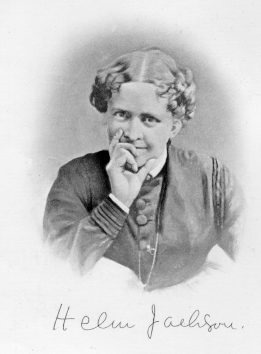
Helen Hunt Jackson defiant

Hard to tell personality from a picture, but those eyes and the start of a smile make Jackson look like she’s  about to dispute something or share a delicious secret.


That’s all but the most liked and listened to piece this spring, and I can tell you it was a run-away winner. Words from a famous poet or unknown one? Well, it’s sort of both. I’ll be back soon with that announcement.


*He laughed right after he said it, thinking it a fit pronouncement from the Department of Tautology Department.

The Parlando Spring 2019 Top Ten Part 2

Before we continue with our count-down of the most liked and listened to audio pieces this past spring, let me remind newcomers what the Parlando Project does. We take words (mostly other people’s, usually poetry) and perform them along with original music in various styles and sounds.

I really try to honor that intent for variety. My musical and singing limitations cannot be overcome just by intention—but the idea is to test limitations to see what will bend or break, not to treat them as barriers to be looked at from a safe distance off.

7. Water. One of our post series this spring I called “The Roots of Emily Dickinson.” I had the obligatory exposure to Dickinson during my education in the mid-20th century. My impression then was that she was treated as an approachable poet of the second rank. I think the shortness of her poems was part of that presumption of approachability, and that contributed to her subsidiary ranking too. And yes, the filter of gender stereotypes and prejudice had to be a factor. Common anthology poems like “Because I could not stop for death”  added a little gothic touch to our genteel high-school textbooks, and in my college life she got a place in American lit, though much less in more general literature or poetry courses.

But when you dive into Dickinson deeply you may find that the modest surface level of a Dickinson poem, which seems a homey back-lot pond, is rather a deep and mysterious well, and that you’ll run out of breath long before you touch the bottom of some of her little poems. If you’re curious like me, you can’t help but wonder: “What did Emily Dickinson think she was doing?”

So, this spring I looked at some of her models, confidants, and influences, and chief among them must be Transcendentalism, the hard to pin down American movement centered in Dickinson’s own region and time whose instigator and leading prophet was Ralph Waldo Emerson. I had fun in my original post on “Emerson’s Water”  by comparing Emerson’s fame and influence to Oprah Winfrey—but really, you’d have to add to Winfrey, Malcom Gladwell and the Dali Lama to get the range of Emerson’s influence.*  I was going to add some Robert Bly in there too, but though Emerson wrote poetry and influenced poets up to and including Robert Frost and Wallace Stevens, Emerson’s own poetry was not even wholly esteemed by other Transcendentalists.

Emerson’s poem “Water”  is still worth hearing, as many of you must have found here this spring. Back in The Sixties, when I first encountered the Transcendentalists’ story, I could see connections to the Hippie culture, and now in a generally more practical and materialist time I still see linkages. The Midwest had exceptionally widespread flooding issues this spring, and Emerson could have written “Water”  this year to address that. What’s Emerson got to say about water? The player is below.


Charles-Temple-Emily-Dickinson-silhouette

I could use this silhouette as metaphor for trying to understand Dickinson from what surrounded her. For the more mid-20th century among us: look at that chin and hear Charles Gounod’s music.


6. He Wishes for the Cloths of Heaven. William Butler Yeats is another familiar word-musician who supplies words to the Parlando Project. Perhaps I came closer to Yeats because I’ve ended up hanging around some Irish-American poets** once I moved to Minnesota, but if one is interested in musical sounding poetry in English, with things to consider beyond the inviting sound, eventually you’ll turn the corner and Yeats will be there.

The poem’s romantic closing lines are among several of Yeats’ that are well remembered by readers—memorability being one of the great tests of poetry. Hear those closing lines, for the first time or again, with the gadget below.


William Butler Yeats with cat

It was a classic battle of wills. The cat would not get up until Yeats agreed to get the cat food, and Yeats wouldn’t get the food until the cat got off his lap. Both were found and rescued in an emaciated state.***


5. May-Flower. From the roots present in Emerson, to the flower as expressed by Emily Dickinson herself, here’s the fifth most liked and listened to piece this spring.

Let’s return to the question of Dickinson’s intent. There some thought that this was written as merely a riddle-puzzle, that the reader was to guess the genus of the bloom from the clues in the poem. If that so, if that’s all, then it seems to me that Dickinson failed as a riddle-maker, as the clues don’t seem to determine the exact flower (and Dickinson, the avid botanist, would have had the knowledge to have done that). I decided to take her text and drill down to the mystical essentials she wrote of instead.

This is not the first time I’ve written of the psychedelic aspects of Dickinson. I can’t quite do the differential diagnosis on her eye problems (for which we know she needed medical attention) or decide on the theories that she may have had epilepsy or another disorder that could have caused auras and visual disturbances, but Dickinson often seems to be asking us to see differently, more intensely, as I believe she does here.

What kind of singular mind can toss this off as a riddle?

Hear my performance of “May-Flower”  with the player.


*All of these pop-culture comparisons understate the influence Emerson seems to have had in American academic life, also largely centered in New England at the time, but I don’t think they understate that Emerson’s readership in America’s 19th century extended deeply into the general literate class.

**Perhaps the most directly connected to Irish culture of them would be Ethna McKiernan. A footnote is not an adequate way to draw attention to the news that she has a new book, but she does.

***This is a joke, and only this footnote is serious. And don’t link to yesterday’s post for your homework as a cite that Carl Sandburg taught O’Hara, Baraka, and Wilbur about the building trades.

The Parlando Spring 2019 Top Ten Part 1

It’s time for the seasonal tallying of the pieces presented here that received the most listens and likes from you during the past three months.

We presented 36 or 37 pieces in that time, including our increased posting activity during April’s National Poetry Month, but the most notable event for me during this interval was May, which became the most active month ever here for both blog visits and audio piece streams. I’m grateful that you’ve lent this effort some of your attention, and that goes double for any of you that helped spread the word about what we do here informally or through things like Facebook and Twitter.

As usual we’re going to follow the count-down format, moving from the 10th most popular piece as determined by your listens and likes and moving up to the most popular one.

10. Sweet Thames. It was a close finish with Charlotte Mew’s “The Trees are Down,”   but one part of our ongoing annual April serial performance of “The Waste Land”  made it into the Top Ten. “Sweet Thames,”  the portion that kicks off that poem’s longest section “The Fire Sermon”  was the part that made it, while the rest did not. Perhaps the listens/likes were lower because I warned our audience that “The Waste Land,”  and particularly “The Fire Sermon”  part of it, is not light entertainment, and things only got darker as “The Fire Sermon”  continues after this. “Sweet Thames”  may seem to have jaunty parts, particularly the catchy Mrs. Porter section near the end, but even that has dark undertones as it was sung by the ANZAC troops heading for the disastrous Gallipoli campaign in WWI.

I did like the music I composed and played for it though, mixing some buzzy synth lines with American delta-blues style slide guitar. Listen to it here:


You could think of Dr. Tearle’s 3 minutes of video here as the trailer if “The Waste Land” was a film. Definitely not a date movie then.


9. Smoke and Steel. Frequent visitors here know my love for Carl Sandburg, and the Sandburg piece that made our Spring Top 10 was a selection I took from the longer poem that is the title piece from his 1920 collection Smoke and Steel.

I found Sandburg’s extended metaphor of our working lives as smoke incredibly moving, something that a few of you must have agreed with. Musically, the toughest part was the piano part, the song’s musical hook. It’s not a complicated part, but I had to record it in two passes on my tiny plastic keyboard due to my naïve piano skills. Here’s the gadget to hear it.

Carl Sandburg on the work site

Sandburg greets Richard Wilbur, Amiri Baraka, and Frank O’Hara at the start of a 20th century poetry symposium. “All poets must wear a hard hat and steel-toed boots before entering the typewriter area.”


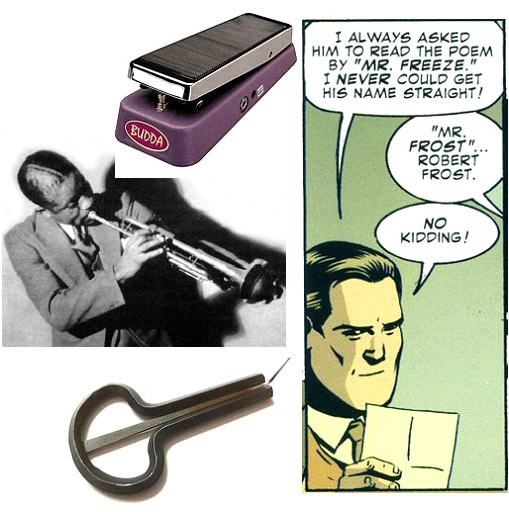
8. The Aim Was Song. Robert Frost’s ode to the genesis of poetry gave me an excuse to break out with an unapologetic electric lead-guitar song. The poem’s text talks about wind being shaped by the mouth, which may have clued me into using one of the oldest electric guitar effects devices: the wah-wah. The wah-wah is a foot-treadle pedal which when moved sweeps a frequency-band emphasis. The sweep of frequency seems to be changing the note as it sounds, like a jaw-harp or a horn plunger-mute. The player gadget for “The Aim Was Song”  is below.

Wah Wah Frost

Wah-Wah Robert Frost


Next time we’ll continue the count-down with numbers 7 through 5.