I woke up this morning to learn that it’s Emily Dickinson’s birthday—and I didn’t get her anything. Well, we do know how to do something here at the Parlando Project and that’s create musical presentations quickly, and it’s not like we’ve run out of Dickinson poems to use.
So today’s piece is a Dickinson poem about snowscapes. Having had the opportunity to visit the Dickinson family house in Amherst and hearing there that the area across the highway road was in Dickinson’s time a farm field helps me visualize Emily writing this. I can clearly sense her looking out the window from her bedroom writing table on that road and field that are this poem’s landscape.
This is Dickinson in her playful mode, but that doesn’t stop her mind from creating some exact and fanciful descriptions for the snowscape, starting right out with the snow fall being sifted like flour (do cooks still sift flour?) *
The least playful image in my mind is also the most striking in the poem, it’s a description of that farm field as “summer’s empty room”, not yet filled with snow (the furrows are still visible) and some now deserted plant stalks are jutting through picking up windy veils of snow. This is likely a poem written about an early winter, December, snow fall
In other work Dickinson can be harrowing or she might present us with some concise mysticism or philosophic equation, but that’s as close here to a darker note as we’ll get in this one. She seems content in her vision of a stilled winter and a smoothed and sparkling world—as I was today watching the white outdoors and below-zero temps just the other side of my glass as I wrangled a dense percussion track for this piece. It was afternoon before I moved on to a few keyboards. Then the final musical task was to add the 12-string electric guitar parts.
My electric 12-string, “recordless, but for them”
Long time readers here will know that the Twin Cities is something of a center for the 12-string guitar, an instrument I’ve used since shortly after I arrived here, but the electric 12-string remains a rare instrument here as it is elsewhere. Acoustic or electric, for each of the guitar’s conventional six strings the 12-string adds a paired string right next to it. Most of those additional paired-strings are conventionally tuned** an octave higher than the regular guitar strings, and the two strings when struck never quite vibrate in unison, adding a slight wobble that’s either charming or sea-sick depending on one’s taste and ear. I added to that with a whole load of echo, delay and reverb today, and all this called for the parts to be played sparsely and slowly. Even with an echo effect glitch*** that ruined the first couple of takes, I was able to lay down the parts quickly enough that you can hear it tonight with the player below. If you’d like to follow along with today’s poem (sometimes cataloged under its first line “It sifts from Leaden Sieves”)the full text is here.
*Emily would have sifted as the household’s baker. The flour in her time was less refined—and sifting also removes things like bugs or foreign matter that might be mixed in with the flour. And sifted flour is more suited for blending with other ingredients. Sifting seems metaphorical matter for creating art, doesn’t it?
**Conventionally the high B and high E strings are tuned in unison and the bottom 4 in octaves, but some players tune additional strings in unison rather than octaves (Steve Tibbetts and Huddie Ledbetter/Leadbelly for two unlike examples).
***User error on the part of the producer, engineer and musician, which is easier when they are all me. I also make the tea, so there’s no one else to blame.
When I started this project a few years ago I didn’t realize that I’d have to largely work with poetry which is in the public domain. This can still disappoint me, but there’s been a welcome side-effect.
This limitation caused me to look deeply into the first couple decades of the 20th century for texts to use. I knew a little about the pioneers of Modernist poetry in English, or thought I did—but as things often go, the more you find out, the more you find out you don’t know.
I had carried the impression in my younger years that Modernist English poetry started out with “Prufrock” and “Hugh Selwyn Mauberley” and that it soon moved on to “The Waste Land” and Wallace Stevens with his multi-section poems set off by roman numerals. All stuff with moments of beauty and extravagant language, but also a bit heavy-lifting if one wanted to take it all in, much less wonder what the poet was on about.
But when you look for the actual beginnings, you find Imagism in the time before WWI—and the poems are much more modest: often short, sub-sonnet length, and they aren’t out to wow you with the elaborateness of their imagery, which is concrete and immediate.
Are these slight poems, ones lacking the impact that the weight of a few hundred lines and some quotes from Latin or Tudor poetry could bring? You can read them that way. Absorb them like a short paragraph in a novel that you are rushing through to get to a waypoint of a plot, and then they may seem so.
But the men and women that wrote these poems didn’t intend these poems to be slight. They intended revolution or rejuvenation of the poetry of their language. Compression. Concision. The leaving out all express sentiment to be replaced by a call for their readers to be involved, to see the certain things the poem described and to feel them as fresh experience, not as an allusion to ideas about the experience.
Well here’s a poet and poem I didn’t know about before this project, and one that isn’t classed as one of the pre-WWI Imagists as far as I know, even though this poem is—intentionally or not—exactly an Imagist poem. The poet’s got more names than Du Fu, for he didn’t always write or name himself in English: the Irish poet Joseph Campbell, AKA Seosamh Mac Cathmhaoil, and Joseph McCahill.
No, not the “Power of Myth” guy, the other Joseph Campbell
Like many Irish poets of the turn of the 20th century he was involved in trying to end the colonial status of Ireland. He lived in Ireland the colony and the free state, England and the United States. He wrote lyrics to traditional Irish melodies, plays and other stuff (including a memoir of his imprisonment during the struggle for Irish Independence).
Like Frost’s “Stopping by Woods on a Snowy Evening,” Campbell’s “Night, and I Traveling” takes place in the old, unlit, rural night. And instead of a dark copse of trees, it’s a country house, perhaps more a hut, that the traveler pauses beside. What does Campbell see?
Light from a hearth burning peat, that not-quite-coal that served the country people of his time. There’s a dresser and some small array of porcelain dishes displayed on it. There’s an ambiguous line: he hears inside the hut “A woman’s voice crooning, as if to a child.”
Why did Campbell choose “as if” for two of his 46 words? Well, practically he might not have seen the woman, much less the child. It may be meant to suggest that the child is being lullabied to sleep and this may be the reason the traveler doesn’t even consider helloing to the home’s inhabitants. Or it could mean that the child is no longer home, grown and left for elsewhere, or even dead.
I don’t think I’m imagining that later implication, though it’s not explicit.
The last line is rich in ambiguity too, though it seems to suggest it’s resolving that spare line that preceded it. Is our traveler passing on into the darkness like the child who has left home or has left life? Or is he a traveler who has “miles to go before he sleeps” who cannot stop and rest or talk to those who live in the hut? Or is the traveler perhaps a person who knows or suspects he’ll never even have such a meagre but real home like the one he’s passing? I know too little of Campbell’s life as of this point to weigh that last possibility against his own biographical facts.
You’re free to hear the poem as saying any one, or all, of these things. It’s still a charged moment even without it being defined exactly—perhaps even more so for that. I’m not Irish, but it seems to me to be a concise emblem of Ireland at his centuries’ turn.
Musically, I used a 12-string acoustic guitar with tambura and sitar drone accompaniment today. I can’t say it’s authentic Irish music, but then Celtic music in the 20th century picked up a lot of things like alternative guitar tunings brought by a Scottish-Guyanese man traveling from Morocco and bouzoukis from Greece. To hear my music and performance for this poem, use the player below.
One peculiarity in the process of producing these pieces is that I plan sometimes based on odd intuitions. So, as I was looking forward to another session with LYL Band keyboard player Dave Moore late this fall I made a snap decision.
I had earlier noted this turn-of-December poem by A. E. Housman and made a note that it would be a good way to transition from the autumn to winter season here. That’s planning.
Then intuition stopped by.
Is intuition the Manic Pixie Dream Girl or Disreputable Boy Friend of an artist’s mind? I don’t know, but intuition was suggesting that for music I could combine Housman’s words with Motörhead. Somehow it’s hard for me to visualize the graceful classical muses dancing about me with their lyres and lutes suggesting this sort of thing.
Yes Dave, I’ve been working with cellos, violins and acoustic guitars a lot this fall. But the muses are suggesting: Lemmy!
I had less than a day to add more “plan” to this intuition. I listened to some Motörhead to refresh myself on them, and quickly settled on their name-sake song “Motorhead” as a rough template for what I’d try to do with Dave the next day. Taking the Housman poem text, I added some refrains* to bring out more song-like qualities, and to closer match the text of Lemmy’s “Motorhead” song.
Motörhead performs “Motorhead” for a group of people who seem to be waiting for the 12-step group meeting to start
Dave arrived and we did a quick pass through with the original lyrics to get the sense of the musical donor for this dodgy operation. I dropped a chord or two of this already simple song form, and then we were on to attempting “The Night is Freezing Fast.”
This week I listened to what we put down that day.
Dave acquitted himself admirably, as he often does, with this spontaneity. And the take you’ll hear below also has my original guitar playing from the session. But there was one substantial fault to it: all the tempo I could push myself to that day was still too slow for Motorhead.
Honoring intuition with plan, I none-the-less pressed on completing “The Night is Freezing Fast.” I added bass guitar to the track, guitar under the guitar solo (it wasn’t manic enough to stand without a second guitar) and recorded a final vocal.
What you can hear with the player below is an imperfect mixture of plan and intuition. Considering it now I think the intuition was even better than I hoped. The overall plot of Housman’s poem is a little gem: the onset of cold winter recalls to the poem’s speaker the otherwise un-explained Dick who hated the cold—and then a mere one additional verse comes which by sideways description tells us that Dick is dead and buried.
I’m not familiar with English idiom of Housman’s time and place, but one line in his text “prompt hand, and headpiece clever” is colorfully awkward to me, but in the context of the poem I read a stalwart and resourceful friend or workman being described.
Lemmy’s lyrics had a strong fatalistic tendency that meshes well here. The lines I added that were meant to echo “Motorhead’s” structure added an extra element to Housman’s spare poem, bringing out an undercurrent that’s there but easily missed. Housman says the dead friend has become the “turning globe:” he’s now part of the eternal seasons. The sea change (or ice change) that’s occurred implies that he’s become December, the always returning season of fresh death. In the run out after the verses I started interjecting some cries in the manner of John Lee Hooker.** Melding Lemmy and Housman was intuition’s idea, and a good one.
My planning and execution were, I think, less successful. On the other hand, it’s the best Housman/Lemmy mashup you’ll likely hear today (or most other days). Housman’s original text is here. Lemmy’s lyrics to “Motorhead” are here, suitable for your next book club or 12-step meeting. The player to hear the LYL Band performance of “The Night Is Freezing Fast” is below.
*Refrains, choruses, hooks—these sorts of things tend to make page-words more song-like. In this project I’m helped by having a liking for songs and other musical expressions with words that don’t use those structures, but in this case I thought they’d also help intensify some elements in Housman’s poem, and in this setting, intensity is a requirement.
**Specifically, I was recalling Hooker’s “I’m Goin’ Upstairs,” which ends with a magnificent and mysterious verse and an upper register ululation that chills me every time I hear it. Here are Hooker’s lyrics and the most-well-known recording.
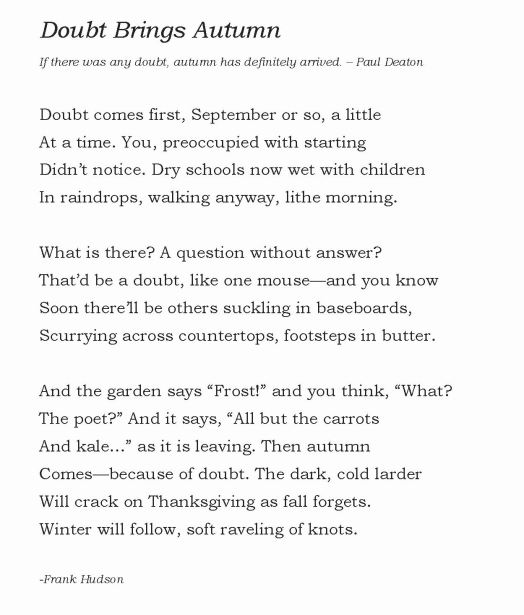
Today’s post includes the 400th audio piece since this blog officially launched in August of 2016. For such round numbers it seems appropriate to use a representative selection, but then the Parlando Project’s aesthetic is to avoid formula. So, the text for today “Doubt Brings Autumn” is from my own poem. Long-time readers/listeners here know that’s not my usual practice.
When I started the Parlando Project I hoped to create 100 to 120 of these combinations of various music with various words. The music would test my limits as a musician and composer, and the words would be focused on “Other Peoples’ Stories,” an emphasis on other writers and artists rather than my own life.*
I had no idea how enriching it would be to encounter the work I would turn to, looking not just at “Poetry’s Greatest Hits” but also at the lesser-known poems and poets. That choice made around four years ago largely by intuition and confoundedness still seems to be the right one.
I started with some pieces already done, and some already expected. Not nearly 100, but once this project ignited it was hard to put the fire out. Now at 400, the natural urge is to press on to 500.**
One key to keeping this process going and to avoid the formulaic is to introduce random or coincidental elements into the making of these things. One favorite toy of mine to play with is to intentionally seek out and explore misinterpretations of sentences. Syntax and context is a slippery thing after all, why not have some fun with it? Until last month I didn’t know what to call this kind of language play, when it suddenly occurred to me where I must have picked this concept up.
There was once a great comic duo called Burns and Allen, whose career spanned the later vaudeville stages to radio to early television. The act’s trick was for George Burns, the straight man, to report some mundane event or judgement and for the comic, his wife Gracie Allen, to then find some confounding misinterpretation of that statement. Hilarity ensued, as any attempt to put the Dada spring-snakes back into the can was met by more sproinging twisting of the otherwise obvious meaning.
Poetic license: I couldn’t find any short clips of the classic double act, but the concept extends to this scene
That realization led me to name this kind of language play a “Gracie.”
“Doubt Brings Autumn” began with a Gracie. A blog I read regularly written by an Iowan, Paul Deaton, had in series discussed the seasonal cycle of his food garden and an orchard he works at over the past year. His posts, as well as alternative voice and keyboardist here Dave Moore’s garden probably led me to use more stuff related to gardens this past year. In one post this fall Deaton remarked that frost and even some snow had come and that “If there is any doubt, autumn has definitely arrived.”
We all know what Paul meant, but if one takes this as a Gracie, it could just as clearly mean that doubt, even in small doses, causes, brings on, autumn. That became the germ, the seed, of this poem.
It’s been through a number of versions and revisions, and I revised it yet again slightly this morning after the performance you’ll hear was recorded, but the idea, inherent in both Paul’s life (he’s contemplating retirement) and mine (I’m “retired” but working near-constantly on this project, my “garden”) was a rich one. Our doubts, our questions about how to continue and react to our own seasons, are they cause or effect?
This is the current version with a small change in the next to last line
The last line works not just from its sound but gains also from another accident of English. The words unraveling and raveling are not opposites, each form of the word means the same—but raveling is the rarer word and subconsciously adds a paradoxical element that winter could intensify instead of relaxing and untangling our unanswered questions, our doubts.
Another note on this poem in process: when I read an earlier version an accomplished poet whose work I respect reacted to the pun for frost and Frost*** with dismay. All poems and poets work from their own sensibilities, but mine steadfastly believes that humor, even the coincidental humor of Gracies and puns is unavoidable in the human condition. That other poet’s reaction was likely right, in that many (who knows, maybe most) will find the mood broken by that move in my poem. I do wish I didn’t confound them, but I somehow must.
Musically, I’ve finally been able to play fiddle rather than violin on a piece using the MIDI interface on my guitar. The sound of largo bow work is lovely, but so too are many folk traditions which saw away more insistently. The player to hear “Doubt Brings Autumn” is below, and thanks to all that read and listen here!
*This insight came from a review of a book of Kevin FitzPatrick’s poems, where the reviewer seemed surprised and delighted to find many poems there “with other people in them.” “Why should this be rare?” I asked myself. In a musical metaphor I’d remark that I love solo acoustic guitar—just one set of hands and six strings—but what if all music or even all guitar music was only that or even mostly that? So much we would be missing!
**If I’m able to reach that number, I think that would be a good time to reassess the effort and focus it takes to do this project. If you’d like to help encourage this effort, the best thing you can do is spread the word. I have (too?) little inclination to promote this project on social media or even face-to-face. But even if I had that useful skill, I wouldn’t have time to do it.
***In my awkward defense, I pointed out that Robert Frost likely intended to pun on his own name in his magnificent “October” where the endangered garden grapes have already suffered a leaf-wide incursion of burning frost.
Emily Dickinson isn’t the only one of this project’s favorite American poets to write a Thanksgiving poem. Carl Sandburg did so too.
Long time readers here will know how much I like Sandburg and how often I like to speak toward the canon-keepers to point out that early Sandburg was a devoted Modernist with a strong American democratic take on Imagism, one that kept to Imagism’s unfussy and concise mode of expression without dressing itself up with any unnecessary scholastic references. Of course, I’m no opinion-shaper, and even if William Carlos Williams has undergone a reassessment as a domestic Modernist of the same era, Sandburg doesn’t seem to have benefited from the same second look.
I think this is a great pity. A poem like Sandburg’s “Clark Street Bridge” is as perfect an Imagist poem as any written in London or Paris, and Sandburg’s subject matter and life-experience is broader than most of his fellow Modernists, because he traveled across America with his Imagist eye and working-class soul.
That said, I have to say that today’s Sandburg text is a partial example of why this might be so. This is the kind of Sandburg poem that people think he wrote. It’s somewhat sentimental, unquestioningly patriotic, and there are almost no strong, immediate Imagist images in it. Although it’s not that long-winded, it seems to me longer than it is—and if it had broken into a Whitmanesque catalog of a hundred things at least it would have the courage of its convictions.
So, it’s a Thanksgiving poem, but it’s not great Sandburg. Why bother?
Its central Pilgrim history myth may not be entirely accurate, but it is a good story—one that children were told in his time and mine, and perhaps even sometimes now: tempest-tossed dissenting religious immigrants undergoing tremendous trials. For good or bad, Sandburg leaves out the native Americans who helped them survive,* and who were rewarded with a few decades of peace before the wars of conquest ignited in the Pilgrims’ region.
Historians like to point out that the Pilgrim Thanksgiving didn’t include most of the foods that we’ve come to expect for the modern American holiday harvest meal. Sandburg reduces it to “soup and a little less than a hobo handout today,” which is also inaccurate but makes the connection he’s trying to make. America always has pilgrims like these somewhat mythologized Pilgrims. Sandburg, the child of working-class immigrants knew this completely, the ones who worship the God of broken hearts and empty hands.
And though he doesn’t show it here, Sandburg also fully knows the imperfection of America, and yet still wishes to say yes to gratitude, to thanks “if so be” for himself and his child.** He wishes to say yes before perfection—and continue yes “Till the finish is come and gone.”
So, while this is not the poem to restore Sandburg’s rightful place in Modernism, I think it’s still worth hearing on this holiday. The full text of the poem is here, and the player to hear the LYL Band perform it live*** is below.
**And before we leave that, let me point out that Sandburg is the rare Modernist who deals with children wholeheartedly.
***LYL principals Dave Moore and myself are both dealing with the inability for our hands to follow what musical precepts we hold, and this has reduced the appearance here of the more spontaneous LYL Band recordings. I’ve been missing that element and we’re trying to do what we can.
Did you know that Emily Dickinson wrote a Thanksgiving poem? It’s not one of her “Greatest Hits” or anything, but it does represent a couple of Dickinsonian traits: skeptical humor and puzzling philosophical concision. You can read the text of it here as I discuss my encounter with it.
Dickinson didn’t use titles, and the first line, our entry into the poem, starts off with a strange tentativeness. What’s the series? All the days of our lives, of history? Or a series of holidays? I suspect the last, in that the next line throws up the American holiday inside quotes. It’s hard not to read “Thanksgiving Day” in Dickinson’s text without intonating the words with “air quotes,” that at least slightly dismissive way of saying “Well, you can call it that if you want.”
I’m not a Dickinson scholar but I get the impression that Dickinson uses quotes literally—that is, when she’s quoting someone*—but there is a sense here of our modern manner in the poems first half. And as the poem continues, its opening comments could be written this week by someone musing on the holiday. Yup, Thanksgiving is a strange mix: part a big meal, a gluttonous celebration; and part memories of worshiping dissenter pilgrims and family. And Dickinson, in her thirties as she wrote her poem, notes she’s not sitting at the kids table nor is she some honored elder closer to the pilgrims than the present. So, outsider in a middle place, she says she’ll post a review, from her “Hooded thinking.”
Maybe you’re visualizing The Handmaids Tale when you read “Hooded.” I think Dickinson is taking a bit of a religious acolyte’s stance in her review, even if playfully. Her two-word review: “Reflex Holiday.” You’re just going through the motions she seems to be saying.
One won’t get a turkey drumstick: Emily Dickinson on the left with her siblings.
The poem could end there, but Dickinson takes off in the second half in gnomic concision. This is often beautiful as word music, but it’s hard to follow her mind.
What’s the sharp subtraction for the early sum? A falling away from religious immediacy? Mankind’s fall from grace? Forgetting the history or piety of the holiday? The next two lines are even more weird. What the heck does “Not an acre or a Caption/Where was once a Room” mean? This is Dickinson the hermetic riddler. I’ve rolled that couplet around in my head for a week and it always slips from my grasp.
The tossed pebble wrinkling the sea lines have a Blakean tone. Here the mystic Dickinson is plain as any mystic can be in words: our lives, our actions, are small against creation—just visible, just for so long. Her final couplet seems to say that our thanks, our Reflex Holiday, is insufficient to the gift. This realization combined with the reflex action is, in a way, a more sublime and awe-some thanks.
What an odd poem! It starts out witty and lightly skeptical and (as best as I can figure it) closes on a humble mysticism.
Musically, I tried to hew to the mystery, if a strange resonant piano and wavery synth can portray that. The player is below. Thanks for reading and listening!
*If she is quoting a person, it may well be Sarah Hale, a New England journalist who campaigned for the importance of a Thanksgiving holiday during Dickinson’s day.
See, just as my son predicted, we’re back with more old dead poets, this time English poet Thomas Hardy. Today’s poem sort of pairs-up with Dave Moore’s piece from last time. Dave directly addressed youth in his song in the context of the cycle of generations, with the newer ones sure they’ve figured out something the old generation hasn’t—which is sort of true, at least enough to allow them the audacity to change things.
Hardy, in this fall poem written late in his life, isn’t so sure, but then Hardy never is. In the Hardy poems I’ve presented he’s very aware of the cycles of things, and he barely accepts that those eternal circles could have any inclined plane to their returning paths.
That’s a prodigious cookie duster you got there Mr. Hardy.
Since we’ve done so many autumn poems this year, we can see Hardy checking in with some perennial fall poem tropes: shorter days, birds leaving, colored and falling leaves. Hardy, whose late career overlapped the Imagists, is immediate and unfussy with his images in a modern manner. The one personified natural image in it: the waving evergreens like waltzers, is still not too far from one used by pioneering Imagist Richard Aldington. Note to, there’s not a single interior emotional term used here. To sense what the poet/speaker is feeling we need to take in the images and events.
The second stanza increases the originality, even while using colored and falling leaves. The light-yellow beach tree leaves floating in the air are like relics of the sun in a gray noontime. And as some old guys will recognize Hardy is saying they are also like inter-ocular “floaters,” tiny clouds that develop in the fluid of some aging eyes and drift across vision. The final two lines tell us that the poet/speaker is old enough that he planted trees in his youth that are now tall enough to block the sky in places. There’s some parallelism here: the leaves, like specks in his vision, block some of the sky like the trees he planted in youth do also. The former is transitory, moving, changing, the later seemingly less so.
The last stanza adds some children, who also are moving through the scene. Here the poem does resort to a internal term, though not an emotional one: the children we’re told “conceive” that those tall trees must have always been there (something the poet/speaker knows is not so—I set those damn trees in the ground myself is the implied thought). So those trees are not permanent things, and so like the leaves, like clouds in an old man’s eye after all.
I at first encountered the last line as puzzling, even awkward sounding. There seems to be two versions of the text. The one I found first and used has the last line as: “That none will in time be seen.” Others seem to have it as “A time when none will be seen.” The second version is less awkward and has a parallelism with it’s preceding line “A time when no tall trees grew here.” I had trouble singing that first version, I might have used the second one if I’d seen it before the performance. But now I’m thinking that the awkwardness, even the sense that the poem has ended on a “What’d he say?” note, may have value.
This line’s “none” has a hazy antecedent. I think we’re to first think it’s the children, who are unaware of the transient nature of themselves (something the poet/speaker knows and they don’t). But in the sentence it appears in, the statement can be referring to the trees (which the poet/speaker knows weren’t there until he planted them) that are not permanent.
In what ways are the trees not permanent? Well the poet/speaker is old, he may expect he will not see either those children or the trees he planted for many more autumns. Nor are the trees permanent to the children, rambling through in play. They will grow up, perhaps not stay there, or be at work inside and not outside in the fall air by the trees. I know little about Hardy’s particular English countryside, but is he even foreseeing a modern future where the trees will be cut down for progress? And by extension, is Hardy, taking as is his wont the long view, saying that any work he did in his long life will be forgotten by those children?
Musically, Benjamin Britten has set this poem to music. I listened to two performances which reminded me the problems I sometimes have with art song settings of poetry as a listener: a complex melody makes it hard to inhabit the words with humanity and feeling, and therefore obscures their meaning and makes everything empty decoration. I persisted and found a couple where the singers somewhat overcame these issues with Britten’s setting. Here’s the best one I’ve found so far.
Of the performances I’ve heard so far, Mark Wilde is best able to illuminate the words through Britten’s filigree.
Now of course I don’t mean to knock the skills of Britten as a composer. I could claim that I write music that has a wider variety in some sense, but let’s be serious: I don’t have 1% of Britten’s musical knowledge, or the knowledge of any other reasonably well-known “serious” composer. And as a singer I have trouble rendering even simpler melodies and for this reason I don’t try to write art-song style settings because I have no one handy to sing them.
So, what’d I do instead with my music for this Hardy poem? A rock band with three cranked-up Telecasters wailing away. I suggest you listen to it loud too. The player gadget is below.
And now for something completely diff…Oh, Monty Python references may be lost on a good portion of the modern audience—and then today November 22nd is one of those dates that some folks remember, and some don’t. Someone older than Dave, George Bernard Shaw, once said “We learn from history that we learn nothing from history.” Kurt Vonnegut said “History is merely a list of surprises. It can only prepare us to be surprised yet again.” And Ambrose Bierce who for all we know is still wandering around a Mexican border wall with a Sawzall and a book of poems by Du Fu, defined history as “An account false, of events mostly unimportant, which are brought about by rulers mostly knaves, and soldiers mostly fools.”
So how much should we care for all that? Well, as I often say here, my opinion is less important than yours. Today’s audio piece, written and sung by Dave Moore, says something like that too.
Note that in each case today I’m giving the opinions of humorists, the class of thinkers and writers who expect that whatever you attempt you’re going to fail at it a little or a lot. Maybe that’s the lesson of history: that every advance for humankind has been across a field of failure.
This gives me a chance to include another Bruegel painting. And it’s a good thing it’s a painting, because sightless people cannot be offended by seeing it.
Use the player below to hear Dave backed by the LYL Band sing his song to those that will dance upon our graves. For those who’ve come here expecting poetry: as my son predicts, it’s likely we’ll be back soon with more of that dead poets society stuff.
We’re a couple of weeks past Halloween, but let’s finish out our series on American poet Adelaide Crapsey with a ghost story about two families. Perhaps you don’t believe in ghosts? That’s OK. In this story one family believes in ghosts and the other one doesn’t.
As we learned yesterday, a young scholar and writer of poetry, Adelaide Crapsey was struck down just days after she turned 36 in 1914 by tuberculosis. Though greatly weakened by her illness, she had worked on organizing a book-length collection of her poems in her final year, including a section introducing examples of a new poetic form she had created.
Alas, she didn’t seem to have a publisher when she died. It’s uncertain who knew about the poems she’d selected. Adelaide had a strong belief in self-reliance and not burdening her friends and family, and so for as long as possible she’d kept the news of her grave diagnosis from them, and some of the poems in her manuscript (such as the ones used in our last post) spoke frankly about her illness, pain, and thoughts on mortality.
A grave marker that doesn’t burden you either. She ended her collection of poems: “Wouldst thou find my ashes? Look/In the pages of my book”
There were some external reasons for this desire not to burden her family. Her father, Algernon Crapsey* had been a prominent Episcopal priest in Rochester New York, one who had practiced a ministry to the poor and other disadvantaged portions of the Gilded Age. Adelaide’s father came to believe that certain spiritual beliefs of his church were not only of doubtful accuracy, but that taken on faith they would hinder service to the poor. Once he decided he was right about this, he wouldn’t shut up about it either. He preached it, he wrote articles and books about this: if you believe in miracles and heavenly rewards you are all too likely to not feel the need to make your own miracles by action here and now, in this life, on this Earth.
This put his church in a bind. Here was a churchman who was known for manifest good works around the state of New York, a Christian hero of a sort—but who was also vocally opposed to church doctrine.
So it was that a few years before Adelaide Crapsey died that a committee of investigators from the Episcopal diocese came to the parsonage where Adelaide had grown up to question her father on these matters. Her father was out, doing those good works. Her mother was worn-out from dealing with this all. Adelaide, like any good PK,** stepped in as hostess. The story is told that she served them tea and kept them graciously talking as the tea went down.
Oh, and she had spiked the tea with rum. It was said the investigators inquisitorial rigor suffered a decline during their wait.
But Adelaide’s father would not keep quiet. He eventually met with a church trial for heresy.*** He claimed the heresy of the church not serving the poor as Jesus commanded was far greater than any they could charge him with over supernatural events, but the church’s hierarchy convicted him. Maybe he wasn’t a heretic who believed in different gods or another heavenly host, but it just wouldn’t do to be a priest of their church who didn’t profess the right beliefs.
No burning at the stake though, he was just written out of his job and the church. The family had to leave the parsonage where they had lived for decades for a house some supporters found for them elsewhere in town.
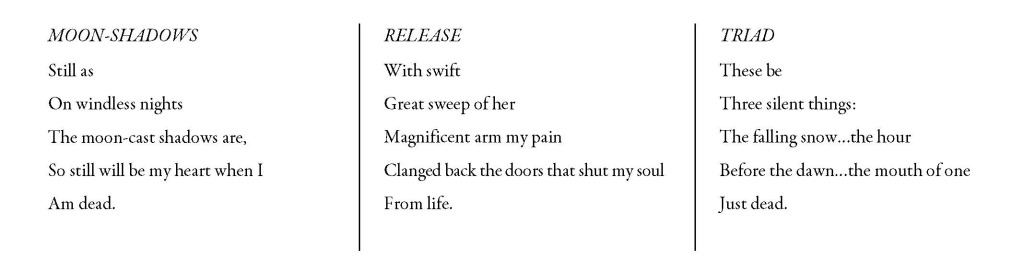
Adelaide, like her family, didn’t believe in heaven and hell. And now she was dead, and as her poem had put it, her mouth was now part of the quiet as with falling snow and the hour before dawn.
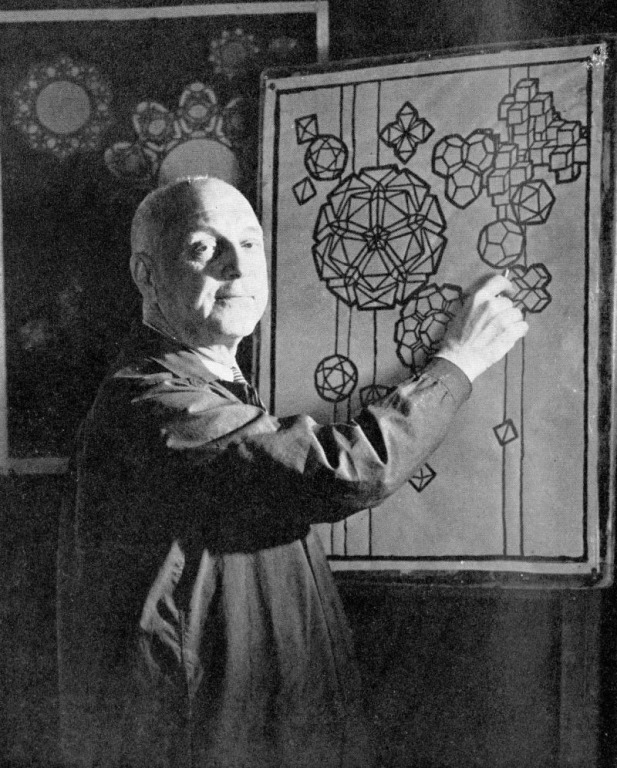
In another part of the same town, there was a successful architect, Claude Bragdon. What kind of architect? Do you know the names of Frank Lloyd Wright, Louis Sullivan, or Buckminster Fuller? Claude Bragdon was that type, committed to artistic principles, in his case to a religious and mystical level. Indeed, he had a strong side-interest in Theosophy, a 19th century unified field theory of spiritualism and hermetic knowledge. He had known the Crapsey family and Adelaide at least somewhat. Adelaide had taken his mystical bent in stride, calling him “cube man” due to his fascination with the hypercube (which I think may be related to Buckminster Fuller’s theories about the geometric nature of the universe).
“The geometry of innocence flesh on the bone/Causes Galileo’s math book to be thrown” Claude Bragdon sings the Tombstone Blues.
Claude Bragdon had not been married long when Adelaide Crapsey died. His new wife, Eugénie had never met Adelaide. One day, in that silent time of the hour before the dawn, something happened. Here’s how he described it in his autobiography:
One morning in the summer of 1915 I was awakened by my wife Eugénie, who asked me if I knew anyone by the name of Adelaide. I told her that Mrs. Algernon Crapsey’s name was Adelaide, and it had also been that of her daughter, who had died a short time before. “Take me to see Mrs. Crapsey,’ said Eugénie, ‘because I was awakened by the sound of her name, repeated over and over: Adelaide! Adelaide!’ “
Now if a chill runs up and down your spine to hear this, the architect and his wife may have taken it more calmly. Not only were spirit voices and mediumship part and parcel of Theosophy, Eugénie was a “Delphic Woman” in her husband’s estimation, one who used automatic writing to take down sayings and messages from the ether.**** And so now Eugénie’s automatic writing sessions became peppered with messages from the late Adelaide Crapsey. With a little interpretation, the messages seemed to be referring to the poems, the book-length collection Adelaide had been working on.
Book negotiations have been known to get complicated, and I haven’t read all the source materials for this story***** but somehow the husband and wife mystic family convinced the social-gospel materialist family to go through the late Adelaide Crapsey’s effects, and retrieve the manuscript. I can see this scene written in Mulder and Scully dialog.
Claude came out of the Arts and Crafts movement, so buildings weren’t his only art. He also ran a small press for books on his theories and other Theosophical works. He became the book designer and publisher that introduced the world to Adelaide Crapsey the poet and determined ghost.
What became of Adelaide’s ghostly voice? It didn’t do a book tour or poetry readings—pity that, it would have pipped Tupac’s hologram by nearly a century and spiced up the valves of many a bookstore. The final automatic writing messages thanked the Bragdons for their efforts and assured everyone that the other side was a fine and happy place where she didn’t miss living at all. Just so much “Bread and butter notes” from the beyond.
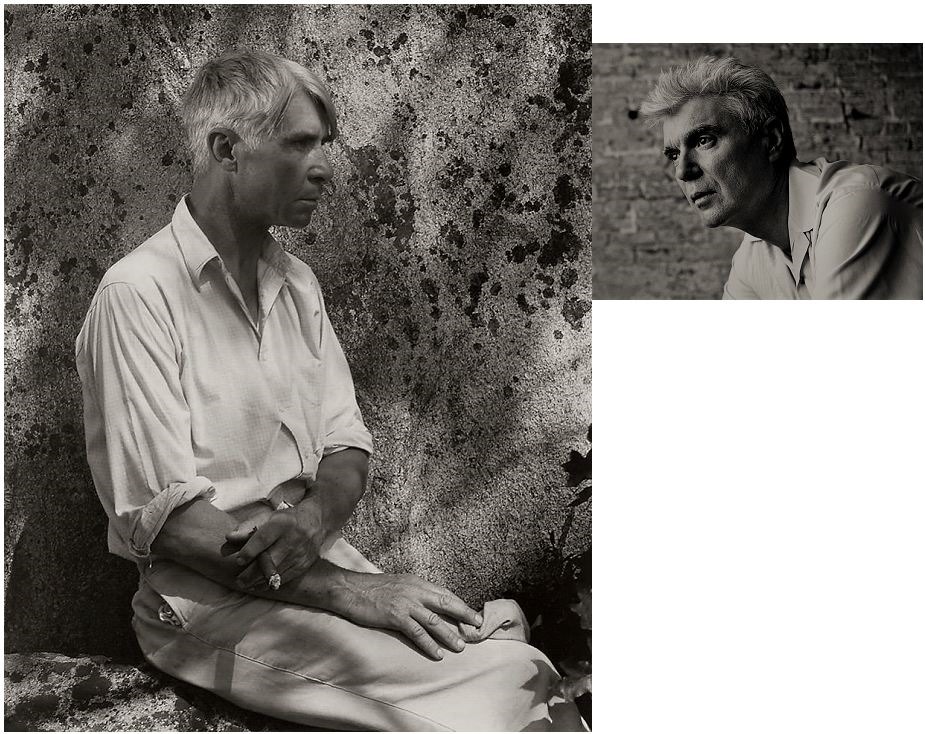
Well, I did say that Claude Bragdon had many artistic interests. One of his friends was Alfred Stieglitz, the pioneering art photographer who was connected to another famous photographer Edward Steichen, a friend and brother-in-law of Carl Sandburg. Either through that connection, or Sandburg’s strong early interest in short poems created with concrete images rather than abstract words, or some Great Lakes leftist linkage between Adelaide’s social gospel preaching progressive father and the Milwaukee and Chicago based socialist Sandburg (maybe more than one of the above?) made Carl Sandburg aware of Adelaide Crapsey’s poetry and story, and he wrote a passionate elegy for her.
*I should have warned you: as elsewhere in this story, the 19th century names are full-flavored. If Lemony Snicket reads this, let it be known that I will defend my intellectual property to the upmost here!
**PK, “Preacher’s Kid.” As a class, they have an opportunity to grow up with an interest in philosophy, ethics and words, but also with a childhood were the expectation to be good and the desire to rebel have to be balanced from a too-early age. Alternative reader here Dave Moore and my wife are both PKs.
***The story of Adelaide’s father Algernon Crapsey sounds eerily similar to a tale from The Sixties and another Episcopal clergyman (a bishop no less!) James Pike. Pike was also committed to social change and questioning of religious dogma and was threatened with an ecclesiastical trial for heresy. Coincidentally, Pike eventually worked with a medium to try to contact his dead son.
****We now use Twitter. Much better. But are those odd messages we read from bots or….the other side!
For several months, as summer 1913 turns to ’14 through autumn and winter, a 35-year-old woman is creating the manuscript for her first book-length collection of poetry. Creating a book-length manuscript is always a challenging task, and regardless of whatever realistic expectations the author might have for its reception, hope is normally the fuel for this. First collections are like that, as a poet figures out how to introduce themselves to strangers.
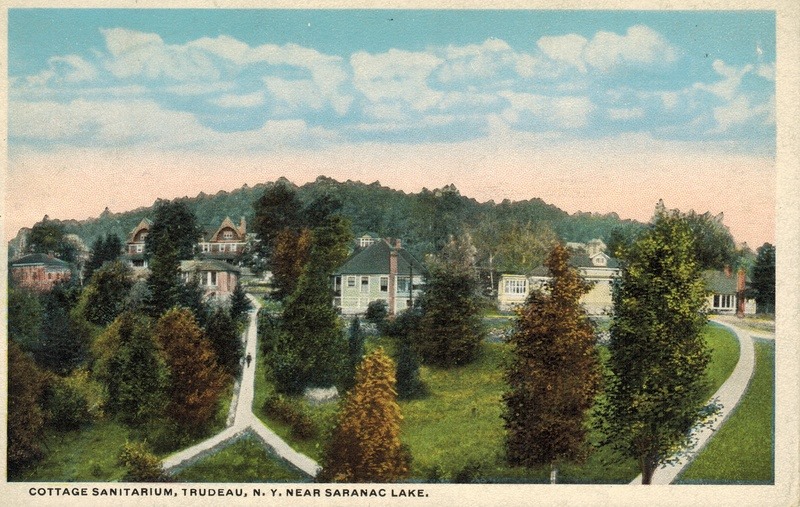
But this woman, Adelaide Crapsey, is also producing her final collection of poetry, and she likely knows that. She’s not working in her study or at some granted writer’s retreat, but at a sanitarium* where she’s suffering through the last stages of tuberculosis which has spread to her brain. If 1914 is The Year that Imagism Broke, it’s also the year that she will die.
The book that she is working on will be published in 1915, and it will be the place where she’ll introduce her own poetic form, the cinquain. The cinquain is a short five-line verse form, primarily iambic, that uses an increasing series of syllables: two in the first line, four in the second, six in the third, eight in the fourth, and then back to two in the final line. Some have noted that the increase creates an expectation of growth or expanding sense, only to have the ending come up short and terse. I’m not the first to see this as a symbol of Crapsey’s life and art itself.
Still it’s remarkable that Crapsey chose such a small, tight form into which to pour her thoughts on illness and approaching death. Some might choose a short but loose form to conserve energy; others might turn rangey trying to get all their last expressions in. Crapsey seems to find in the form’s limits the borders within to hold her place.
Here are the three cinquains I used today. Illness and the eventual passage of dying is something we all share. Crapsey used tiny poems to bear vivid witness.
In the early 20th century world of Modernist American poetry, her tragic story lent a degree of publicity to the posthumously published book, but it was a small fire which soon burnt out. As I mentioned last time, extremely short poems and the direct lyric impulse is not where Modernism headed after the 1920s—but in the long run, we can still access these poems the only way that poetry can be reached: by directly taking them inside us. These cinquains don’t ask for a large place.
For my performance of three more of Crapsey’s cinquains of 1913-1914 I composed music for strings which sounds acoustic even though there is some spare, bell-like Rhodes electric piano and a cello line that is treated with a strong resonant echo that I think adds some poignance. I don’t know where this melody and counterpoint came from, but as I tried and played some string lines on my MIDI guitar it came to me quickly, as if out of the air. You can hear it with the player below.




 Frank Hudson