Edward Thomas’ “The Owl” as heard in a yurt

Every so rarely I treat this Project as a “regular blog” and talk about what I’ve done recently. Not my usual mode, but this is one of those.

In case you’ve noticed a gap in posting, this week I’ve been in a yurt situated in a forest a few miles from Lake Superior. No cellphone service, no Internet, just books, bicycles, an acoustic guitar, and my woodland-nymph wife for whom this is just the right sort of place.

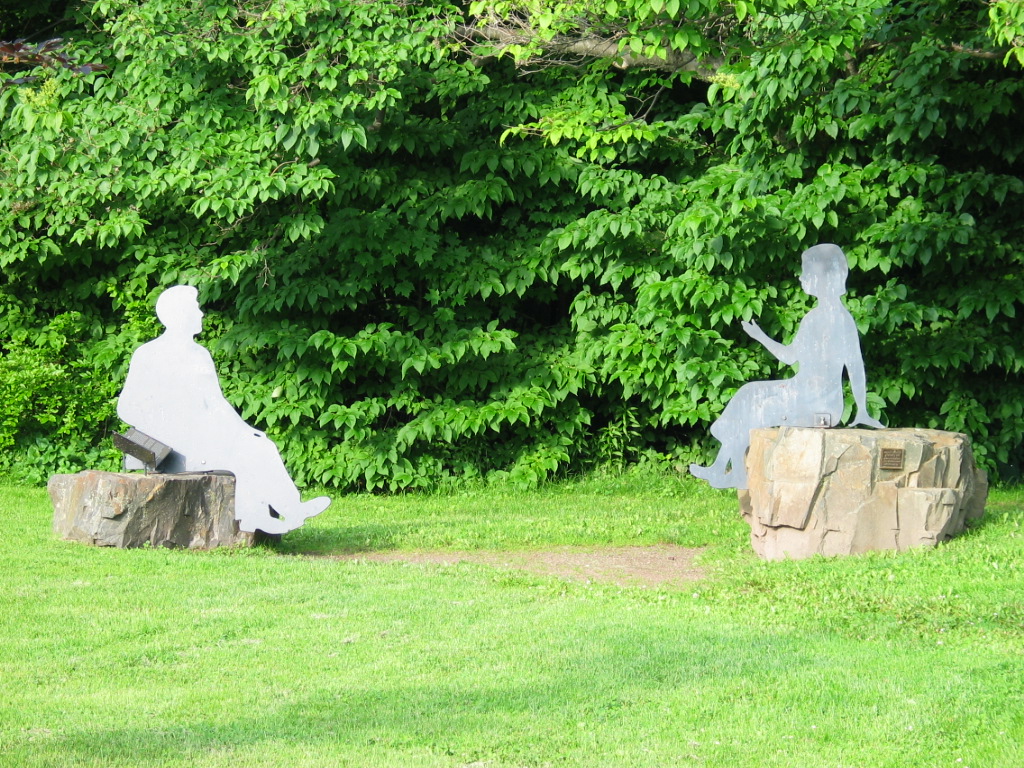
A yurt is a circular tent adapted from Central Asiatic designs.*  The tent fabric is stretched over a wooden lattice so that it becomes in effect a small rustic cabin with no corners and soft walls. In the example we rented for our stay it had an elevated wooden floor, a conventional bed, a couple of chairs, and a door and windows that looked out onto the woods it sat in. In the center of its fabric roof, where the smoke from a central fire would exit in the original yurts, the modern version substitutes a clear plexiglass dome, a device I always read as an emblematic Sistine Chapel of The Sixties: like those domes fitted to Ken Kesey’s Furthur bus or Ed Roth’s Beatnik Bandit.

Three Plexiglass Domes

Three Plexiglass domes. Salad bowls of my salad days.

.

I brought books, poetry and poetry adjacent: Rush Hour  and Still Living in Town  by Kevin FitzPatrick, Rhythmic Stories & Prehistoric Mythteries  by Dave Moore, Swimming with Shadows and Light Rolling Slowly Backwards New & Selected Poems  by Ethna McKiernan, How to Read a Poem  by Edward Hirsch, and Dickinson’s Nerves, Frost’s Woods  by William Logan.

The three from the poets I know were particularly piquant reads, Kevin having just died, Ethna facing serious illness, and Dave and I both a little worse for wear. This post won’t allow me to speak at length about those five books, which I read completely from cover to cover in the yurt. The Hirsch book turned out a little too basic and introductory for my mood, though it might well serve for someone seeking to get more involved with poetry. The Logan book was outrageous in a way that made me shake my head and yet keep reading.

I never assumed the Parlando Project was going to involve as much short essay writing. The reason that the Parlando audio pieces (which are available as podcasts in the usual places like Apple Podcasts et al) are simply the performances, not discussions and descriptions, is that I wanted to present and to allow listeners to experience poetry in the ear without a lot of framing or explaining, the same way that they largely experience lyrics in a song. But over the years I’ve fallen into writing here more about experiences with the poems, even delving into explications and musings about how the poems are set into poet’s lives.

When I enter into that mode and come upon a question — where many bloggers would simply say “I don’t know” or “One could guess” — I often make an attempt to find out if there’s an answer. These searches can take up more time than composing and recording the music. One of the most consistently popular posts here was my presentation of Yeats’ “To A Friend Whose Work Has Come to Nothing”  where I felt I had to find out who the friend was that the poem addresses, and what the work was. That wasn’t something easily discovered on the web — and apparently thanks to my post, it now is.

Logan takes this sort of thing to another level and then another, and another and…. I sensed him smiling and shaking his own head to the levels he was driven to go. In his discussion of Frost’s “Stopping by the Woods on a Snowy Evening”  Logan makes sure to determine what livery Frost’s farm owned in order to estimate what the speaker in Frost’s poem might be sitting in. In his discussion of Keats’ “On First Looking into Chapman’s Homer”  he takes note of a story surrounding it: that a draft of the quickly-written sonnet was in the hands of the other young man that Keats’ had spent an all-nighter reading a rare copy of Chapman’s English translation with, by early the following afternoon. Logan tries to determine if this was possible via normal “penny post” service in London at the time, or would it have to have been a specially hired courier service. For poetry obsessives, Logan’s book will wear you out with “do we know, can we find out” side-trips like that.

Meanwhile, back at the yurt whose woods we are knowing, upon a peak above Lake Superior, we had planned to ride our bikes into town for breakfast, a distance figured at three miles via GPS maps. The same maps accessed at home warned me that it was a nearly 400 foot elevation climb on the way back to our yurt’s address, but I have done double that and more in my dotage. Both of us took our original generation “mountain bikes” which by modern standards are both heavy and altogether too mechanically unsophisticated, but this was good in that the first-part of our journey was a rutted gravel access road from our yurt to the local highway which descended steeply for about a half a mile.

From that point on into town I could have passed for a motorcyclist, coasting at 30 mph on the steep downward slope of the blacktop highway. At a stop sign I looked over to my wife and said, “You know, we’re going to have to climb this on the way back.”

After breakfast, she went off to take pictures, and I started the ride back by myself. **

Three years ago this autumn, I climbed 800 feet in 25 miles on Minnesota’s Iron Range. Not only am I older but doing 450 feet of climb in 3.3 miles is different. Different, as in harder. Different in as pedaling up a wall verses pedaling up a ramp. The temp that day was in the 50s and I wore a light vest and a non-zip long-sleave shirt, both of which were good during the speed of the descent into town. But when I finally arrived back at the yurt, I was quite tired and soaked in sweat — an autumn mixture of hot and chilled as soon as you stop.

Bayfield Climb

Graph of the climb back to the yurt from town. My research said 400 feet net climb, but it didn’t include the steep gravel access road at the end which added another 50 feet. Well-conditioned bikers will scoff at this climb, but where’s your understanding of Robert Frosts wagons?

.

That night as we went to sleep in the yurt, the leaves falling on the taunt roof gave us a sound like we were inside a scattered drum-roll. Off in the distance then we heard piercing owl cries*** that this musical-obsessive would liken to Eric Clapton signaling the wind-up of Ginger Baker’s drum feature “Toad”  — but then this person, whose Project has made him equally poetry-obsessed, also thought of Edward Thomas, and his poem “The Owl.”

Thomas besides being an avid walker (he was the actual walking companion Frost was chiding in “The Road Not Taken”)  was also a bicyclist, and “The Owl”  appears to be telling of a bicycle tour ride as it begins “Downhill I came…” and the full text goes on to describe that cold “yet heat within me” feeling that vigorous exercise produces in changing temperatures like my October ride. Thomas’ poem and his welcome rest at nightly lodgings on his tour turns in the middle on the sound of an owl’s cry.

Thomas’ thoughts are turned in that cry not to the band Cream and rock power trios of The Sixties, but those who didn’t have shelter in the night. And I had been reading the new poems section of Ethna McKiernan’s New & Selected  which is dedicated by her to “the hundreds of homeless clients I’ve worked with through the years.”

I performed Thomas’ “The Owl”  a few years back, but it’s one of my performances that I don’t think got all it could out of the piece, so here’s a fresh performance of my setting of that poem, recorded back home, but in yurt-style with acoustic guitar. For some, you can use a player gadget below to hear it. Others won’t see that, so this highlighted hyperlink will also play it.

.

*This Wikipedia listing about yurts says that a Mongolian Buddhist variation is called “uyangiin ger” which means “home of the lyrics.” I didn’t know that.

**She too had to struggle with the climb. While she stopped often to take pictures, breaking up the exertion somewhat, she found it difficult to overcome gravity to get her old bike going from when she stopped on steeper sections. Pictures of what? This and that in the local scene, though the highlights were a catalog of closeup pictures of various fungi in their autumn-leaf colors and fairy architecture.

***I’m not sure what species of owl. It might have been a barred owl or a horned owl. The calls were not the characteristic “who cooks for you” barred owl melody, but it had a similar pitch and timbre.

Timepiece

Here’s another elegy, but this time by modern American poet Kevin FitzPatrick. Dave and I are keeping Kevin in our memory, which is one place to store someone one knew who has died. Writers like Kevin get another keeping location, one that can be accessed by those that didn’t run into Kevin while he was alive, and that’s in their work.

I won’t sugar-coat this, even in this grief time. I’ve talked here before about what I call “Donald Hall’s Law.” It’s a cold assertion, made by poet Hall in one of his late-life essays, that the majority of poets who receive prizes, notice and ample publication in their time, will be unread 20 years after their death. Is this judgement of time clarifying and correct?

Well, we mere readers of poetry too will generally be forgotten. Forgotten is time’s henchman. Perhaps having only a few “immortals” allows us to focus on those whose work remains in front of us — the heroes who survive the cannonades to become included in the canon. Utility is one part of the argument here. How many poets can one teach in one survey course? How many pages of poets can an anthology’s binding hold? How many names can we contain in our own personal “poetry contacts” memory storage as we pause at a bookshelf? It may seem cruel that this is a rough process taken so casually by time.

So, let me pause here and ask myself, a person who knew the poet Kevin FitzPatrick to some degree, what did Kevin think of this process, this fate?

I never asked him. He never spoke of this matter in my presence. I did get to observe how he carried himself in life, the way he honored poetry and the people in it when he had the direct, living way to do so. That was perhaps his primary concern more than the matters to be observed by a ghost. And there is  a scholarship fund to express some concern for legacy, a fine idea. Here’s a link to that. And here’s a link to Kevin’s obituary in our local newspaper published today.

Kevin FitzPatrick and book

A more recent photo of Kevin FitzPatrick. All grief connects, so I’ll use Kevin’s elegy for his father today to elegize Kevin.

.

But then I recalled that Dave and I had another performance of one of Kevin’s poems stored away somewhere. I found and listened again to this elegy written by Kevin about his father. “Timepiece”  is about something Kevin felt about the work of a parent and the work of time’s henchman, but now too I think it says something about Kevin’s work.

It’s a good poem to remember of Kevin’s. You can help me remember it by listening to the LYL Band performing it over a decade ago with this highlighted hyperlink, or if your way of reading this blog displays it, with a player gadget below.

.

Here’s a link to a site where you can purchase Kevin’s poetry collections.

.

I think I was enchanted

Earlier in the history of this blog I did a series called “The Roots of Emily Dickinson” talking about some influences that helped shape her poetic originality, but in that series I missed running into this ecstatic poem known by its first line “I think I was enchanted.”   Scholars are fairly certain it’s the American poet’s elegy for British poet Elizabeth Barrett Browning.

Actually, it’s one of three Elizabeth Barrett Browning elegies Dickinson wrote, evidence that she truly wanted to record her appreciation for this poet. In my casting about for interesting material to perform and present here I came upon today’s piece only after finding another of the three, “I went to thank Her.”   I had gone so far as to start writing music for the Parlando presentation of that poem, when, in looking for information, I came upon this other one via Susan Kornfeld’s fine blog on experiencing Dickinson’s poetry. You can use this link to read that post and today’s poem as she presented it.  Kornfeld says “I went to thank Her”  pales in comparison to “I think I was enchanted.”   It’s certainly more intense — intense to the point I began to question my initial readings of the poem, as I often do with Dickinson.

One of the challenges with Dickinson’s poetry is that I have little sense of exactly what the author intended. We have no readings of her performing her own poetry written in the 1860s of course, and despite some saved correspondence, those letters seem to me to show a person who presents different personas in what for others would be casual prose.

I said this poem is often considered as an elegy, a poem of praise written after the death of the subject, but while “I went to thank Her”   speaks of EBB’s grave, there’s no direct mention of her death in this one. Furthermore, “I think I was enchanted”   has moments I read as humor, even satire, mixed with what could be read/heard as outlandish but sincerely intended Blakean visionary experiences.

Dickinson opens her poem with a distancing frame: she tells us this is how she responded to EBB’s poetry as a “somber girl” — and in one of her alternative notes in manuscript she considered “little girl.” Here’s she’s recounting how the younger goth-girl Dickinson encountered EBB, and I love Dickinson’s concise entry into that gothic outlook: “The Dark — felt beautiful.”

What follows is the Blakean part, an outright visionary state: time has no meaning, logic and proportion have fallen sloppy dead*, butterflies have become as large as swans. Dickinson has other poems that portray such states, and in some of them here I’ve mused that she had either/and visual disturbances like migraine/epileptic auras or full-fledged mystical transport where ordinary reality dropped away. But then observe how this vision recounted from childhood trails away. In our somber young girl’s vision, the older Dickinson says the sounds of bees and butterfly wings are audible but that they were little tunes “Nature murmured to herself to keep herself in Cheer — I took for Giants — practicing Titanic Opera.” I think the older Dickinson (she probably wrote this poem in her mid-30s) is allowing she was a little over the top in her feelings then. That she calls the sounds in her vision “opera**” is easily read as being over-dramatic in feeling by moderns, but I’m not certain how Dickinson would have viewed opera from her mid-19th century seat.


Emily Dickinson performs her tribute to Elizabeth Barrett Browning — wait that can’t be right! Well, it’s analogous, or psychedelic, or something.

.

The second half of the poem becomes more abstract, though opening with the metaphoric claim that ordinary days, even the “Homeliest” of them, are now transformed after reading EBB into a fancy-dress “Jubilee.” Another unusual word choice there, not prompted by rhyme. Did Dickinson mean something exact with “Jubilee?” Would she have been familiar with the Hebrew tradition*** from which the word derives? Possibly from Old-Testament sources.

The poem’s 6th stanza seems satiric to me. One of the most well-known examples of Emily Dickinson’s stubborn individualist character was her steadfast refusal to declare herself as “saved” by being reborn in the Protestant religious revival tradition of her time and place. That issue was part of what ended her formal education, and it set her apart from friends and family members. This stanza says, in my reading, that “What happened to my mind back then, I can’t really define and explain — but it’s not some simple declaration or decision, you have to live/experience it.” Thus sticking it once again to the just publicly accept Christ’s grace and be saved crowd. She continues the satire in the following stanza, in effect saying “You think I was out there, what with my butterfly bees beating opera tunes — well, your sanity without that luscious visionary intensity is dangerous to me! And if I ever get poisoned by that, well I have the antidote…” and she launches into a final stanza.

That stanza says EBB’s books of poems are “Tomes of Solid Witchcraft” — a phrase which slots right into a pagan-feminist bookshelf doesn’t it! And then a lovely fade to end: “Magicians are asleep” (the only possible reference to EBB’s death in this putative elegy) but she will remember the magic of that “somber girls” experience of EBB’s poetry, and the possibility of its creation by a woman, like as the religiously faithful remember the godhead/universe-creator.

In that reading I’ve outlined, I enjoyed this poem’s passionate mix of possible reflected youthful visions and the more mature satiric comparisons to a certain kind of religiosity. I did find it somewhat difficult to perform, as the syntactical jumps are hard to fit to breath and natural expression.

One thing still leaves me puzzled: Yes, I understand that Dickinson could easily feel that EBB was groundbreaking in her expression of woman’s ability to write and think and desire — and while that’s no settled notion even in our current age, it must have been even more striking in 1860. But even allowing for the framing device that Dickinson uses, the visionary experience engendered by encountering the poems as a young girl, I never have received that kind of jolt of new perception from reading any Elizabeth Barrett Browning. Maybe I haven’t come across the right poem? Maybe I can’t quite read them as Dickinson did from her situation?

Which is another reason to be grateful for Emily Dickinson, because in poems like this and others, this mid-20th century guy living in the 21st century can  get that jolt from Dickinson.

To hear my performance of “I think I was enchanted”  you can use a player gadget below if you see it, and this highlighted hyperlink if you don’t. Today’s music resulted from me specifically wanting to combine a variety of non-obtrusive percussion sounds (percussion being those pure “you hit it and sound comes out” instruments) with swelling synthesizer sounds that have no struck attack in them at all.

.

*Grace Slick riffed on a number of authors, not just Lewis Carroll, but I can’t think of an instance when she quoted Dickinson. Maybe she (like I) grew up in a time when Dickinson’s poems were thought and taught as simpler homely oddities. Grace, if you’re reading this blog, let me know what Dickinson meant to you.

**Like Dickinson I’m attracted to close, near, and slant rhymes, and when reading and performing this piece I was surprised that she missed the near-rhyme that “Titanic Overtures” would be in place of “Titanic Opera” with “To keep herself in Cheer.” “Opera” is a more strained rhyme, so maybe that exact word was important to her intent?

***Every 7 times 7 years farmland was to lay fallow and slaves were to be set free. This relationship to slavery led the term to be adopted by Afro-Americans in connection with the ending of slavery, a process that began in the United States around the time this poem was written. I have not solved to myself the mystery of Emily Dickinson’s opinions on American chattel slavery and Afro-Americans. Her father’s known political opinions on slavery (a huge issue when Dickinson was writing her poems) was as a “moderate.” But her Massachusetts had significant and militant abolitionists (including the Dickinson associate Thomas W. Higginson). Abolitionist positions are not synonymous with belief in the full and equal humanity of Black Americans; and it would not surprise me if Emily Dickinson, like Whitman, could hold racist opinions about Blacks while intellectually being whole-heartedly committed to freedom.

It’s also possible that Dickinson may have known of Roman Catholic Jubilee years; and in the context of a poem about a poet who lived in Italy and was connected with the turmoil there (which cancelled the 1850 Catholic Jubilee Year) this term could have been brought to mind.

Four Things I Learned from the Poetry of Kevin FitzPatrick

It’s taken me a few days to write this post after learning of the death of Minnesota poet Kevin FitzPatrick. After someone dies, someone you know at some level, there’s an emptiness. While it’s impossible to feel emptiness, it may be the first obligation of grief to hold that sense for a little while. Was for me.

I didn’t know Kevin well. We were different sorts, and I myself am quite bad at friendship. But I knew him somewhat, and over time quite a bit as a poet. With some interruptions on my part for over 40 years I’d see him every month in a meeting that sometimes had as many as ten or so writers and sometimes was just Kevin, alternative Parlando voice Dave Moore, and myself. We’d meet in one of our places and those present would break out new work for comment and feedback.

I said we were different sorts. Back in the 1970s I was chiefly influenced by some hermetic and oppositional poetries: French Surrealists and para-Surrealists and those Americans who had read or influenced them. These poets tended to be ecstatic in mood and unafraid to puzzle or offend. Kevin had a different vision — he wanted his poetry to be comprehended and welcomed by ordinary folks, including working people of our parent’s generation. Is that the first or fifth thing I learned from Kevin? No, I’m still learning that one.

Let me speak ill of the dead. In our common youth I thought Kevin was prissy and way too afraid to offend. But we were young men then, and by now my younger self has passed from life to a degree near to what Kevin’s entire non-written life did this week. The way I see it now is that we were both half-right — but his half produced better poetry more often. So, I doubt he learned much from me, but I learned several things from him. You might want to learn some of these things now or later, so I’ll offer four things I learned from Kevin FitzPatrick’s writing today.

Kevin Obit Photo

“You can’t tell a book by looking at it’s cover.” Kevin FitzPatrick edited the urban working-class Lake Street Review, but today’s piece has some farm boots in it.

.

Characters

Here’s the first and primary one, a lesson that I often told Kevin I would try to remember. Around the time of his first collection, Midwestern writer Meridel Le Sueur said that Kevin’s poems were poems with other people in them. Given Le Sueur’s life twining activism with writing, this was a fitting observation for her to make about Kevin’s writing. But stop and think for a moment of the poems you write, or even the poems you read or rate highly. How many of them have actual, flesh and blood characters in them? A great many poems, and to wildly generalize, many poems by male poets, have nothing but the poet’s own consciousness reflecting on itself. If something external intrudes on this, it may be nature or incorporeal spirits — or if human, they may appear as masses or classes in sociological case-folders. Kevin’s poems had a range of characters: friends and antagonists, folks that are richly neither, and people who you just run into in life. Kevin himself appeared in his poems, yes, but in many examples the poem was as much about Kevin as the novel The Great Gatsby is about Nick Carraway.

You may think that poetry, with its freedom of language and musical force can dispense with characters, that poetry may be particularly suited to delve into an individual’s own consciousness so otherwise unrepresented in human life. Good poems have been written from that conviction. But is that all  it can be? What a lonely art making itself lonelier would result.

Dialog

Kevin’s use of dialog goes along with the characters. If you’re going to allow them to appear in your poetry and have autonomy, then they need to seem to speak independently. Kevin’s characters were not kept silent, and a good many of his poems had the texture of a compressed short-story, including the effective use of dialog.

Again, I’d argue that we are too exclusive when we talk about the poet’s voice and poetry as self-expression to the exclusion of all else. Yes, the world may be enriched by 100 poets writing in their own voice, saying out-loud or on the page their own individual experience. But if some of those poets would allow other voices to speak in their verse, to join in the choral and antiphonal song that is human experience, we might have at least 200 voices, if not 500, speaking in our poetry. How we speak, how we express ourselves is important. How we listen, what we hear, that too is important. The poet’s ear shouldn’t be cocked for just iambs and trochees.

Work and Workers

Why shouldn’t the world of work appear in poetry? I mentioned that earlier this month in dedicating my performance of a poem by Carl Sandburg to Kevin that Sandburg didn’t shy from talking about folks working, how that felt, what they encountered. FitzPatrick extended that in his poetry with a good degree of specificity. In his poems about encountering agricultural work in his fine final collection Still Living In Town, the specifics and groundedness of farm chores were taken into his poetry.

Yes, let us concede a dialectic. Many readers (and poets) go to poetry to escape that everyday grind, to celebrate the exceptions of romantic love, cosmic visions, rare events worthy of celebration. Fine. But why can’t poetry inform and illuminate what we are doing for a third or so of our lives?

Rural-Urban

Between the rural-urban divide is a great place for a poet to sit and write. I spoke of Kevin’s final collection from 2017, Still Living in Town  above. In America, there’s an increasing division in outlook between those living in cities and those living in rural areas and small towns. Kevin’s poems in that collection, including characters, dialog, and those work-a-day issues, also allow us to see different locations and outlooks as he travels between his urban house, his capitol city office job, and a small farm.

How few travel between those worlds with open eyes, ears, and hearts and write verse about it! Kevin FitzPatrick did that in his final book. As I said above, I learned things by how Kevin approached his poetry and characters, but it’s important to also make clear that he’s not just a  “poet’s poet,” but also a rewarding and entertaining writer to read. Books from the publisher of Still Living in Town  are not available from the large, easily linkable mail-order booksellers — which depending on how you feel about such things may be a feature not a bug. Here’s a link to the WorldCat listing for FitzPatrick’s 2017 book which includes library availability and the ISBN number that might aid in ordering from your favorite indie bookstore.

OK, should there be my customary Parlando audio piece at the end of this post? With some trepidation I’ll offer this one, my performance based on an early version of a poem destined for Still Living in Town.  It’s an old recording from 2013. Shortly after I recorded it, Kevin heard it and thought I misinterpreted the song. As I said, we were different sorts, though over the years I like to think we grew closer from our shared love of what poetry could do. Kevin said I missed the poem’s point; it was about the difference between the urban and rural cultures he was observing and writing about. He’s right, I undersold that element, seeking instead to stress how a customer service interaction went sideways from mistrust and was eventually resolved. I think he also might have reacted to my edgy, angsty delivery and music. Kevin was a calm, dry speaker in performance, and the speaker in this performance isn’t. It’s also important to know that “Returns”  is just a piece of a greater work that took him several years to write. This isn’t the most singularly impactful poem Kevin ever wrote, just one in his series that I happened to perform one day because I liked the vignette, and that I had handy to put here today.

A few bits of scene-setting before you click on this performance: Kaplans* was a clothing store specializing in utilitarian work clothes and outerwear that was located then on Minneapolis’ famous working-class-to-under-class Lake Street. Wheeler Wisconsin where the scene shifts to in the conclusion is a town of 300. Tina, the deus ex machina of the poem’s story was Kevin’s partner who decided to buy an 80 acre farm which Kevin commuted to every weekend during the time of the book.

Player gadget to hear it below for some, and if you don’t see that, this highlighted hyperlink is another way to play it.

.

* The first winter I spent in Minneapolis, it was at Kaplans that I bought my first pair of Sorel boots, that genius Canadian design that has a waterproof leather and rubber outer boot with an inner insulating liner made of compressed wool. If you ever have to stand in -20 F cold and wait on a bus that might not run on-time, the un-frostbitten scansion of my poetic feet recommend them.

The Folly of Being Comforted

Readers often hear different poems when reading the same text. It’s unavoidable, even though it causes some authors to despair at how they are misread. So, it should be no surprise that it is possible in performance to recast poetry considerably without changing a word.

Around 1902 Irish poet William Butler Yeats wrote a poem taking exception to a too-easy consolation meant to comfort. He cared for the poem enough that around 20 years later he revised it slightly, to emphasize his response to this well-meaning gesture, explicitly writing out the one word concise enough to underline his feelings at the offer of comfort: “No.”

Those who study Yeats’ life are pretty sure this poem is biographical and is based on his unrequited courtship of Maude Gonne. That’s a long story, and to say that these were two complicated individuals is to understate the matter. If one reads today’s text, that poem “The Folly of Being Comforted,”  in that biographical way, it makes sense. Here’s a link to that text.  That reading, coldly condensed, would have it that someone told Yeats, “Hey, that hottie that you are so enamored with — I’ve heard she’s getting older, grey hair, older skin around her eyes. Sure, they say with age comes wisdom, but never mind any of that, she’s no longer so attractive that others will be chasing her. So now, maybe your chance will come around.” And to this Yeats gives his “No,” explaining that as he sees it, she’s not lost a step beauty and attractiveness-wise.

There’s a perfectly good romantic love sonnet there, and that’s not what I performed today.

I’m mentioned this year that I have family and others I know going through infirmities and transitions. It’s not my nature to talk about them, or even to directly write of my own experience of those situations. Even though one of the principles of this project has been to seek out and to present “Other People’s Stories,” I’m hesitant to speak over their own voices*  in the same way that I’m comfortable talking about those long dead and in some cases too little remembered.

As I was working today on finishing the mix of the audio performance you can hear below, Dave called me to tell me that our friend and poet Kevin FitzPatrick had died last night. We were planning to visit him in hospice tomorrow. Now we’ll visit him when we think of him. Visiting hours are now unlimited.

Kevin FitzPatrick and Ethna McKiernan

For many years Kevin and Ethna would celebrate poetry in a public reading on St. Patrick’s Day in Minnesota.

.

Another poet we both know, Ethna McKiernan, is also facing a serious illness this year. When I read and then performed Yeats’ poem, I was thinking of these things. I recognized it was a romantic love poem, yes, but I read all sorts of undertones in it. We are meant to pass over them in the “correct” reading. Maude Gonne was all of 35 when Yeats first published his poem, the grey hair and “shadows…about her eyes” were likely subtle things. We’re all more than double that. Age is not subtle at that volume. When I read Yeats’ simple elaborating line “I have not a crumb of comfort, not a grain.” I felt my own lack of useful care or comfort I’ve offered Kevin or Ethna, partly because I fear I’d be rather bad at it, and partly because I’m less close to either of them than even Dave is. That said I’ve been acquainted with Ethna for about 40 years. I may have not been close to her in her “wild summer,” but I knew her when. Yes, the fire “burns more clearly” with her even now as Yeats says.  After all, when you get our age, there’s more fuel.

Yeats called his poem, “The Folly of Being Comforted”  and he ended the poem with that title. He likely had real feelings in this matter, long ago when he was alive. When I think of these mortal matters, now, here, my feelings are different than a witty sonnet about someone’s crude mistake regarding his estimate of Maude Gonne. And so I performed my feelings, using Yeats words.

The player to hear that performance is below for many of you, but some ways of reading this won’t display that. So, I also offer this highlighted hyperlink that will open a new tab window and play it.

.

*I feel I must guard myself in that partly because I’d easily fall into it if I didn’t.

Squid Speaks of the Electric Guitar

I move back and forth with musical instruments and intent here, but since I started as a guitarist, there’s a lot of guitar playing in the Parlando Project pieces. When someone asks about my musical stuff, such as what I play, I often redirect, and make it a point to call myself “a composer” even though the poet in me knows that word’s connotations are fraught.

“Composer” risks putting the listener either in mind of some long past-tense powdered wig guy or a highly serious and educated modern theoretician. I’m neither. What I mean is that my intents with music are to invoke certain sonic combinations. I use various instruments to do that, and often that’s a struggle as I’m not as skilled as many players. Every note I play here comes after a committee meeting between the composer and the musician where the composer asks for things the musician can’t do and the musician suggests to the composer alternatives it can accomplish. Sometimes these are drawn-out affairs, and sometimes they are small latencies as I am asked to improvise then and there.

My poor guitars sit silently in the middle of this struggle, in days between pieces being finished, or in the moments between notes. These two sides win and lose and compromise. I’d certainly be a better composer if I could experiment in areas which my musicianship cannot empirically enter. I think I become a better musician in the times when the composer pushes me to think thematically or to not make the reflex choice.

If all that above seems dreary, it’s not. Yes, there’s friction, but each side enjoys it most of the time. And making music and hearing it are both sensuous acts. Thinking and scheming are involved, but what happens after that, when the next note is sounded, that just feels.

I mentioned last time that every September 18th I take some time to play an electric guitar and commemorate the date that Jimi Hendrix died after likely mistaking the dosage of some foreign sleeping pills. Think for a moment during this paragraph about the troubled history of musicians and drugs. Drugs to stay up, drugs to mellow out, drugs to excite creativity, drugs to sleep fast and deep. In terms of the life the composer asks so much, and the musician abuses the body’s instrument trying to extract those timbres and notes. It’s unavoidable for the composer and musician to struggle, but sometimes external and internal factors let this get out of control.

I played for a couple hours this Saturday, as much as I could spare. I had no ready words to include until I read on the same day an interview in Premier Guitar magazine with a band called Squid.*  Squid is a British post-rock/math-rock kind of band, and that’s a genre I have some interest in, as bands that get those labels often are seeking new solutions to using conventional rock combo instruments. The band’s two guitarists had some interesting things to say about the electric guitar as it stands in 2021, more than 50 years after Jimi Hendrix helped redefine its parameters. So, I copied out a couple of quotes from the interview** and read them along with what occurred to me on the guitar in that hour and time.***

Today’s piece is what resulted. In the text, Squid guitarist Louis Borlase opens with an abstract theoretical statement, but soon offers a testimony affirming the expressiveness of the instrument, and for all of Squid’s make-it-new Modernism he ends by saying that that expressive voice allows you to aspire to “those people who came before you.”

Borlase implies a lot into what for someone of my age seems objectively a short amount of history for the electric guitar, which was only about 20 years old when I was born, and then whose extraordinary timbral variations were first exploited in my lifetime. But he’s not wrong, electric guitarists have stuffed a lot into that time since Hendrix’s. And electric guitar is also just another instrument, something to make music with, and we know we’ve done that since someone drilled some holes in a hollow bone or reed.

The second part quotes the other guitarist, Anton Pearson, who speaks theoretically again. Pearson says that the electric guitar is the “perfect marriage of technology and a gestural nature” which I believe at this time is true. Just as the invention of the modern drum set allowed for one drummer and their four limbs to command a combination of percussion voices and roles, the modern electric guitarist can use the fingers of both hands and foot-operated devices to create a large amount of playing instructions and sounds.

As beautiful and fundamental as wind instruments are to music, no one has extended them to that level. Keyboards come very close, including their modern use to control synthesizer timbral range and their ability to use all the fingers and limbs at once, but Pearson wisely restates his “gestural nature” of the guitar to include “visceral nature.” I have seen Keith Emerson stab knives into his keyboard and wrestle it to the ground. I have heard the groans and watched the creative agony on Keith Jarrett’s face while he played acoustic piano. Yet, they never touch the strings directly with either hand in various ways, they never move the instrument into the spot where the amp starts to possess the note.

Reverse Strat 1024

“Is this a crime against the state? No! Someone controls electric guitar”

.

Are we past all that, is the electric guitar now a long-tail, trailing instrument tied to a passing era? The very thing I pedantically call myself, a composer, is now often modified to “beat maker” as folks think of new ways to order and modify sound, often without touching a conventional instrument. As listeners the instrumentation is immaterial after all. As I wrestle compositionally with my drum tracks, I know that rewards care, and succeeds or fails just as playing an instrument does.

But does anyone just power up and make beats for the sheer joy of it, not for recording or an audience, but just for the physical feel of the sounds being made, and made in real time, and for the ambiguity of the aches in my old finger joints after a session of fretting and neck wrangling? Does Jimi Hendrix, if and wherever his consciousness resides, miss that feel of that neck and the strings under his fingertips?

The player gadget to hear the result is below for many of you, and if you don’t see it, this highlighted hyperlink will do the job too.

,

*If this sort of music sounds interesting to you, you can hear some of the actual sounds of Squid, touring dates, etc. at their web site at this link.  Not your thing? I understand. It’s just one of the kinds of music that interests me personally.

**The full interview conducted by Tzvi Gluckin is available on Premier Guitar’s website at this hyperlink.

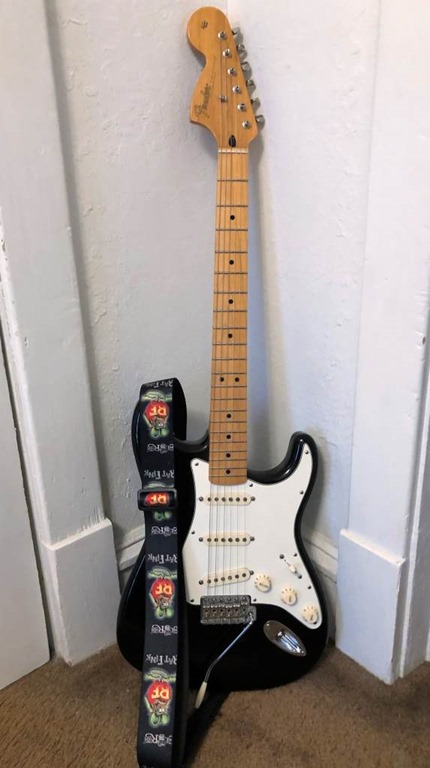
***Toolkit and process? Here’s details for guitar nerds. Everyone else is excused and can go home early. The drums are a software drum machine, which I intended to improve and then didn’t. I laid down the electric bass part with a Squier Jaguar bass. I did two passes and picked the best one. Last year I bought a set of TI flat-wound bass strings for this bass, which cost about a third of what the bass is worth, but I have old fingers and the soft feel of the TI strings are what they like. The guitar I naturally was drawn to on this day is my current Fender Stratocaster, a “reverse Strat” which emulates the pickup array and neck that lefty Hendrix would have on a regular right-handed Strat flipped upside down.

I tuned up and played for a couple of minutes to reacquaint my hands after playing bass, and then hit record and played for a bit over 16 minutes with the bass and drums. The lead guitar in the right channel is going through a reissue EH Triangle Big Muff fuzz pedal and a Cry Baby wah-wah pedal, though for some of what you’ll hear the wah pedal is left partway down for that Tallulah Bankhead “cocked wah” sound. Rather than emulating Hendrix (something I do sometimes on September 18th) I was aiming this time for the guitar to speak in different voices and over the 16 minutes it sort of does, but I decided to trim the piece down to mostly the parts where I read the Squid guys quotes about electric guitar. At over 6 minutes, even the edited piece is longer than I like to present for the Parlando Project.

The last track I laid down was the left channel rhythm guitar part. I used the same Stratocaster guitar, but it’s compressed with a Boss CS-3 compressor pedal and running through a Walrus Audio Lillian phaser, which even bought used is the most expensive guitar pedal I own. That track sounds almost like a modulated electric piano comping away, but it’s just electric guitar being versatile.

Both of the guitar parts are one pass, “live in the studio” parts. I didn’t have much time to do otherwise. The guitar amp for both electric guitar tracks is a Fender Hot Rod Deluxe.

My recording computer in my studio space is still an 11-year-old Mac Mini running an older version of Apple Logic Pro X.

The Most Popular Parlando Piece for Summer 2021

If you’ve followed this Top Ten countdown series of the most liked and listened to audio pieces this summer at the Parlando Project you’ve taken a bit of a journey, and I thank you for coming along. The kind of music I create and present here varies, and lately I’ve been doing some louder stuff with electric instruments which may not be your cup of noise. Stick with Parlando, we’re like Minnesota weather — we’ve got four Seasons!  and they play in repertory. Now on to the most played audio piece here this summer.

A Cradle Song by William Blake  You can think of this honest lullaby as a Blake out-take. It sounds like it belongs in one of his pair of engraved books of short poems, Songs of Innocence  and Songs of Experience,  but for whatever reason it was never engraved by this artist/printer/poet.

In the original post*  I commented on why I chose to perform this piece of worry and comfort. I said then that lullabies are designed to comfort the parent and  the child, and this piece still comforts me as transitions proceed around my life. Perhaps it’ll comfort you too. And as a bonus, here’s a chord sheet of my music for this text of Blake’s. I played this with a capo on the 4th fret, so the recording sounds in the key of C# minor, but the chords shown here have more open strings, and acoustic guitars love open strings.

A Cradle Song

Blake’s lullaby, with my music to suit.

.

Speaking of musical variation, I spent time yesterday in my studio space playing a Stratocaster electric guitar as part of my yearly September 18th commemoration of the death of Jimi Hendrix, and that squall delayed by a day this wrap-up of our summer Top Ten countdown. During this, a sixteen-minute torrent of notes was recorded yesterday, and being in the room with that sound too comforted me as much as this lullaby’s soft acoustic guitar.  I’ve edited the live take down to six and a half minutes, and there are words too, a sort of found poem. Follow this blog or check back, it’ll be here in the coming week.

To hear my musical setting of Blake, you can use a player gadget below if you see it, and if you don’t, then this highlighted hyperlink is another way to play it.

.

*Each bolded piece’s name listed in this countdown is a link to the original post and presentation of it, so if you like a piece or want to know more about my original encounter with it, clicking those bolded links will take you there.

Summer 2021 Parlando Project Top Ten, numbers 4-2

Continuing our countdown of the most listened to and liked pieces here this past summer we move today to the numbers 4 through 2 on our list. I’ve mentioned that blog traffic and listens have dropped off a bit this summer, which from looking at past years stats follows a yearly trend. Things are picking up this month, which is encouraging — and even before autumn has begun, we’ve already rolled up our most page views and visitors for a year ever. Most of the blog visits come from those using search engines stumbling onto a particular page, and there are some perennially popular Parlando blog posts that draw visitors month after month and year after year. Maybe sometime this fall I’ll talk about those, but when it comes to listens to the audio pieces this summer, the list is all recent work, so let’s move on to them.

4. I, Too by Langston Hughes  I did a double post for American Independence Day, using texts from Walt Whitman (“I Hear America Singing”)  and this answer piece by Langston Hughes. Hughes’ piece easily outdrew the Whitman in listens, perhaps because it’s fresher to some listeners (Whitman’s piece has already had at least one widely-sung setting). Then too, the music I wrote for “I, Too”  was a catchy little cycle of chords that I played in full strums on acoustic guitar. To my ears, and apparently many of yours, it was simply effective.

Hughes wrote his poem as an individual Afro-American’s story, one paralleling his own biography, but it’s easy to see he intends it as a fully-earned addition to Whitman’s catalog of Unum’s in the E Pluribus. I decided to add onto Mr. Hughes’ lyric one short phrase at the ending, “If not us, who else,” in part to double-down the Independence Day point being made. Questions of cultural appropriation may prick us, their needling will establish these concerns have small if sharp and painful points, but the overall issue of who tells, who sings is long past decision. Story tellers will tell. Singers will sing. Poets can do both at the same time.

If you haven’t heard this one, or want to hear it again, there may be a player gadget below, and if not, this highlighted hyperlink can also play the piece.

.

3. Sappho’s Old Age by Sappho  Speaking of cultural appropriation, yesterday in this Top Ten countdown we had a piece written by pioneering Canadian poet Bliss Carman presenting himself as if a reincarnated Sappho. Is that ridiculous? I guess it can’t help but be, but I honestly enjoyed his poem and performing it. However, this piece in today’s part of the countdown was somewhat more popular this summer and was actually largely written by Sappho.

Now it’s my turn to respectfully appropriate her work and twist it my way. Ancient Greek being — oh what’s a saying for this? Oh yes: “It’s Greek to me.” — I worked from literal glosses of the text and tried to turn it into singable modern English idiom. Then I got to the poem’s conclusion, and enchanted by the parallels with a poem by 19th century French poet Arthur Rimbaud that I presented here this spring, I decided to replace Sappho’s metaphor with one drawn from Rimbaud and his life.

Bliss, I guess you and I are in the same boat, probably on one of the lakes between my state and yours.

To hear the performance in my old age of Sappho’s song of her old age a lot of ages ago, you can use the gadget below or this highlighted hyperlink which will open a new tab window and play it.

.

Bee Busy Hearts

Bee busy! Hearts! Summer photos by Heidi Randen.

.

2. The Poem ‘The Wild Iris’ by Heidi Randen   Heidi wrote the text I used here at the end of a post at her blog this summer, though I added the music and additional repetitions and pauses of my device to the piece you’ll hear. In turn Heidi was resonating with something she had read in a poem by Louise Glück. So, in the end, I appropriated her work appropriating Glück’s. This process by which I appropriated the text as well as the musical repetition give it a rondeau effect if not that exact form.

Oddly, all this repetition was to present a thought about transitions, which Heidi and I are both going through this summer. Things cycle, things repeat, and then they don’t. Every day for months a parent picks up an infant and carries it somewhere. Then the toddler asks, and the parent lifts their toddling body to hip or shoulder and carries them bidden. One day they no longer ask, the parent no longer lifts, and never lifts again. And then sometimes, with time and age, the parent, will be carried by the child.

That and more. We can be so nearsighted with doorways, they sometime appear only when we are on the threshold.

You may see a player gadget below to play this highly popular piece from this summer, but some ways of reading the blog won’t show that. This highlighted hyperlink is another way to hear it.

Summer 2021 Parlando Project Top Ten, numbers 7-5

Let’s continue or count-down to the most listened to and liked Parlando Project piece over the last summer. Today we move to the half-way point, numbers 7 through 5.

Wait, maybe you’re new here. Parlando Project — what’s that? Well, for a little over five years I’ve been presenting combinations of various words (mostly poetry) with original music. The words are mostly poetry not just because poetry has musical elements built into the form, but because I like compression of expression. Typical Parlando pieces are 2 to 5 minutes in length. You may notice that I’m generally not doing poetry written during your lifetime or even mine, and that’s not by choice. American copyright law puts up heavy barriers to reuse of copyrighted work; but on the good side I happen to like some of what went on in the first quarter of the 20th century, and so you’ll see a lot of work by the pioneering Modernists here. One of the benefits of this Project is that I’ve been rediscovering in public what they did to “make it new,” and finding some of their ideas worthy of being revived today.

What kind of music then? I like to think I vary that, composing and arranging for different instruments and sounds. Some pieces are just voice and acoustic guitar (my first instrument), some have fuller arrangements using orchestral instruments, and some pieces use an off-the-cuff rock band. And some pieces use instruments you don’t hear all that often in America, or synthesizer sounds created or modified for the composition.

7. Answer July by Emily Dickinson  We left off with Dickinson’s childhood classmate and “You should really publish your stuff Emily” friend Helen Hunt Jackson. So, it’s a natural segue to this piece that was a bit more popular last spring.

What was I saying about unusual instruments? The main motif in this one is played on a sitar, the South Asian instrument that had a short vogue in The Sixties. Some composers and musicians who encountered sitar took the rich musical heritage associated with it to heart and incorporated, and still incorporate, elements there into music played on other instruments, but unless one wants to invoke a “Don’t be late for the Human Be-In” soundtrack vibe, the sound of the sitar isn’t something Americans get to hear much now, but it’s still a beautiful sound.

I’ve never actually owned one of the complex and somewhat fiddly sitar instruments, though I’ve used more than one “electric sitar” approximation over the years. The practical compromise I’ve come to favor is to use MIDI “virtual instruments” where I can play my guitar with a MIDI pickup and the sounds that come out are decent approximations of the real acoustic instruments playing that note.

Dickinson’s poem I used here is one of my favorite expressions of the ineffability of the summer season, and it seems a lot of you agreed this summer. To hear it again, (or for the first time) you may see a player gadget below. No gadget? Then this highlighted hyperlink is another way to play it.

.

6. Over the Roofs the Honey-Coloured Moon by Bliss Carman.  I had fun last month riffing on some late 19th/early 20th century poets’ names, but Canadian poet Bliss Carman’s name easily equals Algernon Charles Swinburne in promising the most in Yellow Book Aestheticism of that period. His audaciousness in the collection that introduced this piece Sappho: One Hundred Lyrics  was to “Imagine each lost lyric [of ancient Greek poet Sappho] as [if] discovered, and then to translate it.”  The first part of that description, which hints at mediumship is outrageous enough, but even the second clause reminds me of my own audacity in avidly translating work from cultures and languages I’m not native or intimate with.

His synthetic results still have their attractions. Sappho — however real and in what particulars she was, thought, and created in her reality — hardly exists. We have but two or three mostly complete poems, and a scattered field of quotes and fragments. We have thick books binding up Shakespeare’s works, and facsimile editions of Emily Dickinson’s manuscripts with every alternative and scratched out word, and yet we reinvent those authors and their work every generation or so, using such ample literary evidence and fresh insight. Carman was more cavalier with Sappho, and the best historical studies and literary scholarship can point out what are likely errors or mere imagining in this man’s early 20th century Canadian Sappho — but Sappho was a lyric poet, and lyric poetry exists in charged moments that seem as present. Lyric love poets may lie, may often prove untrue even if they are sincere during their moments, but isn’t it also so that we may accept those momentary lies if they are beautiful enough?

The player below will let you listen to my performance of one of Bliss Carman’s imaginings of Sappho’s lyrics, or if you don’t see that player, imagine this highlighted hyperlink which will also play it.  Beautiful enough? You decide.

.

Dickinson-Carman-Millay Collars and Neckwear

Taken maybe 80 years apart, three poets, their collars and neckwear. Each have their mouths basically in a neutral state though Carman’s is somewhat downturned and Millay has just a hint of a knowing smile. Dickinson seems to be looking right into the colloidal silver on the plate and saying, “I know, I burn you.”

.

5. Recuerdo by Edna St. Vincent Millay  Speaking of lyric poets able to interrogate romance, let’s move on to Millay. Each of the bolded listings in this Top Ten is a hyperlink back to the original post when I discussed the work in somewhat greater length, and with this one I compared Millay’s impact in her time to Joni Mitchell 50 years later.

I also wrote about the ambiguity I sensed in the tale of the infatuated young couple and their interaction with the old woman on the ferry. In that reading the old woman is meant to stand, imagistically, for economic and social inequality coexisting in the romantic night within the last time we called a decade “The Twenties.”

Maybe I’m reading too much in this, but it’s as if a great portion of the whole of the novel The Great Gatsby  was condensed into this poem that I can sing in four minutes. Well perhaps the 20th century cared more for novelists than lyric poets, but both Fitzgerald and Millay went through a period before their deaths when they were down-rated and thought too tied to now irrelevant past decades. Fitzgerald got reassessed in the second half of the 20th century while Millay’s examination of society and literary value continued to languish. Now our own Twenties can find its own reading of that previous Twenties. Reading, or listening? Here’s my performance of Millay’s “Recuerdo”  available with the player gadget where present, or with this highlighted hyperlink where it isn’t.

Summer 2021 Parlando Project Top Ten, numbers 10-8

It’s time for our quarterly look back at the pieces here the got the most listens and likes. We start today with the numbers 10 through 8. Each bolded listing as we count down from 10 to 1 is a link to the original post where I first discussed my encounter with the text used, and those original posts will also include the text of the poem used or a link to it.

10. I Am Laughing in the Dark Underground by Frank Hudson  The Parlando Project has from the beginning aimed to put other folks words to music we compose and play. Dave and I are both writers, so I could predominantly present work we wrote the words for here — but I find the encounter with other people’s words interesting for myself, and I hope it adds variety for you the reader and listener. Therefore, it was with some hesitation that I posted this self-written piece for the blog’s 5th Anniversary last month.

You can click on the bolded title above to read what I wrote about writing the words then, but in summary, this text came largely from my interrogating one of those vivid dreams that happen around dawn when you’re half waking and half still asleep. To hear the musical piece, you can use this highlighted hyperlink, or a player gadget that will appear below for some of you.

.

9. They’re Not the Grateful Dead by Dave Moore  By chance the next piece as we count down to number 1 is by alternate Parlando Project voice and frequent keyboard-contributing musician Dave Moore, though I wrote the music, sing it, and contributed one verse.*  This one mentions a series of  dead-too-soon musicians well-to-little-known to folks around our age. Anyone remember that sacrament to saccharine paean “If There’s a Rock and Roll Heaven (you know they’ve got a hell of a band)?   Well, this is Dave taking a skeptical look at that idea.

There’s a player device that some of you will see to hear Dave’s song as I performed it, and if you don’t see that, this highlighted hyperlink is another way.

.

By Moonlight a Goose Can Be A Swan by Heidi Randen 1024

“By Moonlight A Goose Can Be a Swan”  a late summer photo by Heidi Randen

.

8. August by Helen Hunt Jackson  Speaking of deceased musicians, recent new member of the choir invisible Michael Chapman had a musical life that ran with some marvelously miscellaneous combinations. Early in his career a singer/keyboard player wanted him to join his backing band. Chapman would recount that he figured his own front-man career was launching just fine, and said no thanks. The keyboard guy? Elton John. Chapman was based out of Leeds in England then, and he wanted another electric guitar in his band. He picked up just such a fellow from Hull who had to be lured away from his band for Chapman’s. That guy’s name was Mick Ronson. Having been pried away from one band, Ronson soon left Chapman’s group for another, becoming the notable guitarist and arranger for David Bowie’s breakthrough Spiders From Mars band.

Musicians love those kind of stories, because it’s assumed that many will have “close, but missed it” tales of successful opportunities slipping from their grasp. How about writers? I give you Helen Hunt Jackson. Jackson was a grade school classmate of one Emily Dickinson. Like Dickinson she connected with Thomas Wentworth Higginson, the late-period Transcendentalist critic, activist, and editor. Higginson, you may remember, later gets his knocks from history for not fully recognizing and promoting Dickinson’s unorthodox verse, though after Dickinson’s death he arranged and helped edit the publication of collections of Dickinson’s work that started Dickinson’s career posthumously.

Jackson on the other hand ardently pushed Dickinson to publish while she lived, and for that effort she got little support from the living Emily.

I first ran into Jackson around the same time I watched the often satirical Wild Nights with Emily  movie a few years ago. That mixed-bag film portrayed Higginson as a nincompoop and Jackson as a simpering all-to-Victorian fustian. I’ve read a lot of bad 19th century verse looking for stuff to use here** so I figured it worth the risk to look at some of Jackson’s own poetry.

No, it’s not Modernist before it’s time in the same way that Dickinson’s can sometimes strike you, but it can be more vivid and effective than many of her contemporaries with higher surviving profiles, and this sonnet “August”  is a fine example of that. Here’s the highlighted hyperlink to play my performance,  and some will see a player below that can do that too.

.

*Dave, a keyboard player, led off his song with Nicky Hopkins, who’s one of the lesser-knowns in the grouping. As a bass player I couldn’t let that role in the song’s “catacosmic” band go unfilled, and so I added the Jaco Pastorius verse.

**My general read on the later 19th century was that the Modernists were correct in rejecting what poetry had come to by the beginning of the 20th century. Stale metaphor, simple messages, perfunctory expression, hard-walled gotta make my rhyme and meter exact verse — there was good reason to make it new.