Let’s continue our Top Ten countdown of those pieces that you liked and listened to the most this autumn. Regular readers here may not be surprised that death features in some way in each of today’s three poems, as illnesses, infirmities — and yes, folks I’ve known a long time dying — have been part of the year for me.
Everyone that dies or is limited by infirmities is a lesson, one you listen to more richly and intently as you get older. It’s a lesson that makes me press immediately against what limits age has put on me, gives me a sense to use what I have presently before it’s gone. Oh, I am sad that I’ll not hear Kevin or Ethna’s voices again, except in memory or recordings — thin mirrors those. Dave reminds me that it reminds him when I post older LYL Band recordings where he was able to pound and roll the keys. Our family continues to deal with my wife’s mother descending, as politely as she can carry it, into dementia. But those that go before us are meant to teach us. Don’t skip the lessons.
Why Now, Vocalissimus by Frank Hudson. When I posted this audio piece, shortly after I wrote it, I said right out I wasn’t sure what I meant by it. That state may be unnerving for a writer. After all, aren’t you supposed to know? If you don’t know, how can you present anything vividly to the reader or listener?
Well, there’s a theoretical structure, a mythological structure, that seeks to explain that. It says that we are conduits for muses, external things. We don’t have to be outstandingly worthy, exceptionally preceptive, or precisely eloquent, since we are in this scheme conduits of something outside us. Frankly, this can lead to a lot of bad poetry: inchoate self-expression bearing the costume of inspiration. But then everything leads to bad poetry — all artists fail as I remind readers here often. But what of us readers, us listeners? We fail too, grasping partially what much art conveys.
My understanding of what I wrote back in September has grown as I live with this set of words. Part of our job as living, breathing artists is to carry forward the work of those who’ve left off working. We are not just creators, but also carriers. So, if you write poetry, bring words down onto the page or speak your own words, know that I’m charging you to also preserve and enliven those others who have no voices left to carry the spark. And that’s what I try to do here with the Parlando Project.
My performance of “Why Now, Vocalissimus” is available below with a graphical player. Don’t see it? Then his highlighted hyperlink.
.
Heidi Randen’s picture of a milkweed husk spoke to me this autumn.
.
6. The Shadow on the Stone by Thomas Hardy. A complicated ghost story, a complicated haunting. As I wrote when posting this, English poet Thomas Hardy had a dysfunctional marriage — and yet, like many folks forced by fact into the separation of death and mourning, he still felt the returning presence of the intimate dead.
I rather liked the music I composed and played for this one. It has a weird loping groove that I find attractive. To hear the performance, some will see the player, and the others can use this highlighted hyperlink.
.
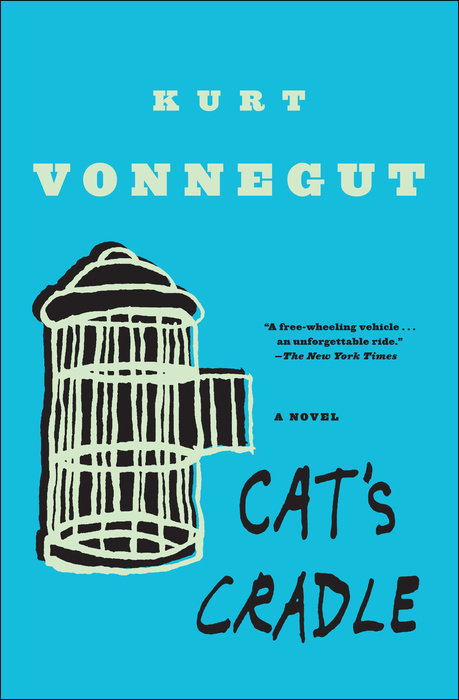
5. God Made Mud by Kurt Vonnegut. I decided to present several short excerpts from Vonnegut novels that work as poetry this fall on the occasion of the 99th anniversary of his birth. The LYL Band had recorded them well over a decade ago, on the week Vonnegut died. Why didn’t I wait for the nice, round 100-year birthday? See the start of this post for why.
In Vonnegut’s novel Cat’s Cradle the text I used here is the last rights of an imagined religion. Like the theoretical/mythological structure of muses directing us to write poetry, Vonnegut proposes a useful if compressed Genesis story that asks us to recognize that the nagging mystery of death is no harder to explain than the overlooked mystery of living at all.
It’s that time again when I present our quarterly countdown of the pieces most liked and listened to here at the Parlando Project during the past season. We’ll proceed from the 10th most popular and move up to number 1 in the next few posts. The bold-faced heading for each piece are links back to the original post that introduced the pieces here, in case you didn’t see them earlier this autumn.
10. Cobwebs, Steel, and Moonshine by Carl Sandburg. Longtime readers here will know of my admiration for American poet Carl Sandburg, and so it may be no surprise that this is actually the second time I used parts of a single Carl Sandburg poem for a Parlando Project audio piece. The Sandburg poem is “Smoke and Steel,” a poetic celebration of labor and laborers from a collection of the same name published in 1920. I used that whole poem’s title for the piece I created out of the beginning of it for May Day in 2019, but for this past American Labor Day I used the conclusion of “Smoke and Steel” and gave the result this title. I dedicated it to another American poet, Kevin FitzPatrick, who was suffering from a serious and unexpected illness that killed him later this fall. This is the first of three poems in this fall’s Top Ten dedicated to poets Dave and I knew and exchanged work with who were suffering mortal illnesses.
I’m thankful that long-time reader of the blog rmichaelroman submitted a good guess as to what the steel might be in Sandburg’s short ode to workers and work: rebar.
9. Bond and Free by Robert Frost. It’s been a while since I mentioned it, but Robert Frost bugged me when I was young. He was still alive, and omnipresent in anthologies one might find in school, which caused me to treat him like other 20th century poets and critics treated Longfellow: as a square preaching platitudes who stood in the way of younger and fresher voices who’d question all that with a more unruly poetry. I was misreading Frost of course, but through that error I did find others I thought in opposition to him that I found rewarding back then. Eventually I came around to love the word-music in his shorter lyric poems, and from that attraction found a starker and more divided meaning was there.
“Bond and Free” is Frost in his more metaphysical and frankly philosophic mode, which isn’t my favorite Frost, setting out here a cosmic stage where Love and Free Thought conflict. He sounds more like Shelley or Keats in “Bond and Free” than the more modern diction he was able to make sing in other poems, but sing the words do.
Three young poets at work. One played in the LYL Band.
.
8. They’re All Dead Now by Dave Moore. One of the most popular of my Halloween series this year, even though it’s a longer ballad form story that put my singing strength to the test. Longtime listeners here will know Dave as the most common alternate voice here at the Parlando Project as well as the keyboard player you’ve heard in the LYL Band.
He’s also a fine writer of poetry and songs. For reasons too complicated to deal with now, I fairly often sing Dave’s songs here rather than having him sing them himself. There’s a factor when someone sings another writers’ song. While they may bring a different kind of talent and musical craft, they may also somewhat misunderstand the song — or misunderstand (maybe more at “re-understand”) it in a valuable mutational way. Though I’m not a great singer, I do try to bring something to Dave’s songs when I present them here.
Every song stands to gain much more than one more life when sung by someone else. From time to time I’ve encouraged others to sing some of the Parlando Project songs. Anyone have their own cover of one of our Parlando Project pieces you’d like me to hear?
I’m nearly over the bout of upper-respiratory crud that has laid me low this month, so I felt it time to see if I could test the dulcet tones of my voice again with a new audio piece. Today’s is one by Emily Dickinson: “I died for Beauty — but was scarce.”
This poem is characteristically short, and “I died for Beauty” has long been one of Dickinson’s “better known” poems. Let’s do what I often like to do with one of Poetry’s Greatest Hits here and see what we may have missed, and why I might archly put that “better known” in quotes. Here’s a link to a blog post that starts with the full text of the poem in case you’d like to refer to that as I discuss it.
Let me get this out first: to certain sensibilities this is a poem that’s easy to find infused with a kind of corny gothic pretension. It’s got all the counters, common already in Dickinson’s mid-19th century, only more so now: graves, decomposing tragic corpses, sad death, and the world’s disinterest in earnest souls. And on top of this: it’s got capital letter Truth and Beauty. Even a school child who’s read and adored some Keats* will see Dickinson as dropping a shout-out to the doomed garageman’s son.
What can we infer about what Dickinson intended here? I’m no Dickinson scholar, but what I’ve gleaned from reading some of her letters as well as her poems is that while she had those gothic urges, she fiercely wielded a skeptical eye and a satirist’s pen. My guess is that she believed in capital letter Truth and Beauty, and Poetry for that matter, but she also knew the comic limits of humans dealing with them. I could be wrong, or projecting, but that’s the Dickinson I “read.”
The poem’s opening line, with its concluding start of a broken phrase “I died for Beauty — but was scarce” lets one suspect that the tomb is not exactly overflowing with heavenly beauty. So, our dead-in-the-tomb “died for beauty” narrator here finds death (like life) is asking for our narrator to become “adjusted.”
But wait there’s another voice! One equally devoted to capital letters! One who died for Truth! In case one thinks those capital letters are shouty, his voice is soft, somewhat defeated, and is asking about failure. Note that the died for Truth voice is male —we’ll have more to say regarding gendering in the poem soon.
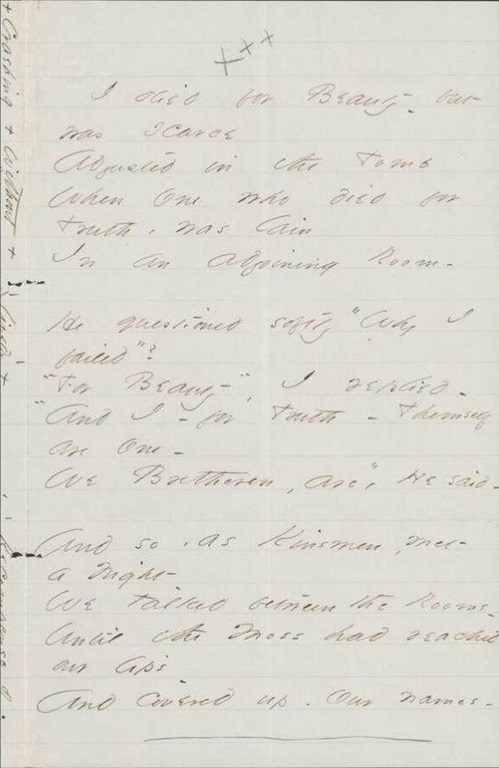
Here’s how Dickinson wrote down this poem of hers in one of her sewn-up fascicles.
.
Dickinson either makes an odd choice or is just awkward in the Truth guy’s opening question.** She writes it as he’s asking “Why I failed?” in quotes. In ordinary writing this would indicate that the voice is asking: “Why did I, the Truth Guy, fail.”*** However in the context of the poem the Beauty voice, our narrator, answers back as if they were asked why they died. It’s hard to convey in a single-voice performance, but if Dickinson intended this awkwardness, it’d be a demonstration of Beauty being consumed by their own state and so thinking the question was to them.
The conclusion of the 2nd stanza, Truth Guy’s reply to our Beauty narrator is stilted, even by mid-19th century formal speech standards. I don’t know if this is intended or simply a failure in Dickinson’s prosody. If intended, Truth Guy’s speech is demonstrably meaningful (truthful) while not being beautiful. I think of my thought about Dickinson growing up in a household consumed with lawyering and contracts and being genetically related to lawyers.
I’m indebted to Oliver Tearle in pointing out something else in Truth’s little speech: he calls our narrator “Brethren” which is continued in the summary of the next and final stanza as “Kinsmen.” Now if we are to assume that our narrator is Emily Dickinson, a woman, then she’s just changed gender or has been miss-gendered by Truth Guy. Now of course even though the poem begins with “I” we can’t be sure that Dickinson — even if consumed by the beauty of poetry and multiple times in her poems apt to cast herself as writing of herself after death — intends that I who died for Beauty to be herself.
This may be leading to the final two lines, where truthfully and beautifully the omnivorous (even consuming mineral!) moss consumes their bodies and eventually their grave’s marker stones, leaving nothing gendered, nothing specific, only their essences returning to our shared essence: the truth and beauty available to us all if we seek it, to borrow and use it, to find comfort with, and to comfort by.
I’ll pause here to note that poet Ethna McKiernan died this past Sunday. I worked on this Sunday and Monday before I heard the news.
A Player gadget is below for many of you to hear my performance of Emily Dickinson’s “I died for Beauty — but was scarce.” And if you don’t see that, this highlighted hyperlink will also play it.
I’ll offer my own tentative and inconclusive possible inspiration: It’s thought this poem was composed in 1862, and while we don’t know the particulars of Dickinson’s intent, there’d be this possible even more contemporary influence: the folk hymn adaption “John Brown’s body (lies a moldering in his grave/but his soul is marching on)” which was transmuted into a more grand literary composition with the chorus of “His truth is marching on.” As “The Battle Hymn of the Republic” Julia Ward Howe’s poem was published in the February 1862 number of the Atlantic Monthly where Dickinson surely would have seen it. Literally, the antecedent to “His” in Howe’s poem is the godhead, but folk-music-process wise, the antecedent is John Brown.
Posthumous editor and sought-out living “preceptor” (in her words) of Dickinson, Thomas Wentworth Higginson, was a backer of John Brown’s raid.
**Original Dickinson editors Mabel Loomis Todd and Thomas Wentworth Higginson removed the quotes Dickinson put around Truth Guy’s question, making it clearly a question to our died for Beauty narrator in their version. So “He questioned softly ‘Why I failed’?” in Dickinson’s hand then became “He questioned softly why I failed?” on first printing.
***”Failed” here is meant also to have a double meaning as in dying, but the fail in failed is too prominent. As this voice was first introduced, “One who died for Truth” is more noble sounding, as in martyrdom, than failed in truth.
Here’s one of my favorite pieces from the five-plus years of the Parlando Project, and given that winter has fully started off in Minnesota, it’s an apt one for what I see out my window. As I post this, I remind you that the archives here going back to 2016 have nearly 600 audio pieces, covering a considerable variety of words (mostly poetry) and music.
I’d planned several new pieces to start off December here, and I even had a few recorded tracks and sketched out compositions as the month began. Then stuff happens.
First off, the teenager got sick, which meant recording in my studio space was out for a week. Then just as they were getting better, I got sick — sick enough that sitting up in a chair was a goal and thinking, reading, and writing —much less playing instruments and singing — was a stretch. I’m still operating at less than 50%.
So instead of a new piece today, this piece created from a poem by D. H. Lawrence. Lawrence was perhaps better known as a novelist and literary critic, but his poetry took interesting approaches in the Modernist era of the early 20th century.
His “A Winter’s Tale” is as mysterious as any exotic Surrealist poem, and though metrical and all rhymed up, largely observant of the Imagist rules that broke English language poetry from off-the-shelf metaphors and the lot of tell-not-show imagery. Here’s a link to the text of Lawrence’s poem. It’s a lovely text, the words are a pleasure to put in one’s mouth or ear; and I’m also fond of the musical setting I created for this one. I’m often telling myself when arranging my music to give the compositions more patience and space — and then I go on and add one more thing and another, defeating that thought. Here I listened to myself.
When I first presented Lawrence’s “A Winter’s Tale,” I said I wasn’t quite sure what it means. More than two years later, I don’t know much more. Many readers sense some kind of “end of a romantic relationship” situation here, and taken that way the poem works. Strangely works, but works. Other possibilities occur to me as I’ve revisited “A Winter’s Tale” since I performed it. Some sort of animal hunting* seems implied here as much as human romance. Is that hunting subject, or the metaphor? Sometimes poems refuse to choose on that question.
Battle of the poets. Smokey Robinson brings it with this opening “Everyday brings change, and the world puts on a new face. Sudden things rearrange, and this whole world seems like a new place. Secretly I’ve been tailing you like a fox that prays on a rabbit.” Now, go to the bottom of this post to see what I can do to try to meet Motown’s popmusic-craft with my own thing.
.
Is it possible that what the poem speaks of and searches for is winter itself? At first this may seem a strained reading, after all the poem spends a good deal of its brief text describing winter scenery, so how can it be something the poet is seeking when it’s in front of them? Some of that description though is of winter’s haunting and elusive qualities: obscuring mists melding with snow, far off winds that sound like sobs or sighs. The winter in this poem does seem to be winter’s arrival, perhaps even earlier than normal arrivals, with grass blades at first not even covered by the early snow. In such a reading is what the poet has to tell this promptly arriving winter is that spring will follow it?
*One of my favorite early English sonnets, Thomas Wyatt’s “They Flee from Me” makes use of deer hunting as symbol for love’s vulnerability, long before Smokey Robinson’s song first presented by The Marvelettes “The Hunter Gets Captured by the Game” did likewise.
Long time readers here will know that one of this Project’s ideas is “Other People’s Stories.” I’ve chosen to make that one of its principles for a couple of reasons. First, the Internet is full of folks telling their own stories, and this is fine (after all, to me those would all be “Other People’s Stories”). I wanted to do something different, to focus on how you and I experience a variety of words from a variety of writers with a variety of outlooks. The second is that I’m rather uncomfortable with promoting myself. That one’s complex.* Like most writers or composers or artists I think my own work has value at some percentage over half the time. Which then, mathematically, allows that I doubt its value, or my handling of its value, or the costs of declaiming its value to the universe a bunch of the time too.
No one creates without the first thought. It would be impossible. And no one who cares about what they create, about their audiences, or about how much craft and care can be devoted to any art; without seeing the faults, the missed communication, the needs for just one more revision or tomorrow for any work.
Many of us create instinctively, because we have to — but sharing that work is a choice. I’m nearing 600 Parlando Project audio pieces presented here. I could have presented at least half or two-thirds of that easily with things Dave or I wrote, but I made a different choice. It’s less conflicted for me to publicly look at, to be honestly surprised and delighted at Emily Dickinson, William Butler Yeats, Carl Sandburg, Langston Hughes, Sara Teasdale, or Du Fu; and then to share that with you.
But there’s a problem with “Other People’s Stories.” I’m likely not understanding everything those authors intended.** And they’re their stories, their visions. I’ve talked recently here about how when I translate a poet who wrote in another language how I want to honor their work and transfer accurately their particular powers, and yet then become tempted to break off into something their work makes me see through my own eyes.
A long prolog to presenting today’s piece, one I wrote and titled “Ethna’s Dream.” Ethna is Ethna McKiernan, a poet who I used to meet and talk about work with once a month or so, along with two to four others. Ethna cared and crafted her work over decades, and in her life did other useful work: running an Irish heritage book and art shop, working with the homeless. She’s currently in hospice, comforted by family, and the reports are that she’s now mostly in an out of what appears as sleep.
I couldn’t call Ethna a close friend. I always sensed a distance there. I think often of her none the less these days, and of every rudeness, awkwardness, or self-dealing on my part around her; and those or any number of things could have caused that. The very fact of writing a poem about her death, her dying, that mostest personal thing, seems problematic.
So, when you listen to my piece “Ethna’s Dream” you now know all that. This is not a poem about those things I’ve discussed in prolog, or at least I hope so. Instead, my intent is that it’s a poem about what we should treasure of that sharing of the unconscious that we have with artists (including those whose main art is just living). What I present in “Ethna’s Dream” is not a romantic, imaginary, sentimental metaphor in my own mind — though it may attract or repel you if you see it as such — it’s more at the essences of what we do, share, and take with art.
There’s references to Bottom’s speech in Shakespeare’s A Midsummer Night’s Dream. Am I prettifying myself up with pretentiousness, or comparing myself to the foolish play character? I wrote it, and yet I can’t tell.
*One problem, leading to one fear, is that when offered the chance to promote myself I see myself as overdoing it, and coming off as a self-absorbed narcissist that runs on too long about the arts I work in, prattling about the obvious and the obscure in equally embarrassing ways. If you’re still reading at the footnote stage, you may have forgiven me for that.
**Beside just plain embarrassment of ignorance, we now more often talk about cultural appropriation in regards to this. The travesties of cultural appropriation are real, but my belief is that they should, must, be risked.
Life events are conspiring again to keep me out of my studio space to record new pieces — but it just so happens that I have this rocking Blues recorded back in 2007 with the LYL Band that’ll contrast with our pensive Frost meditation on work from last time. Today’s audio piece was made from Frost’s short poem titled “Fragmentary Blue,” now recast as “Fragmentary Blues.”
Unlike Carl Sandburg or Langston Hughes, I have no idea if the 1914 vintage Robert Frost had any experience or appreciation of this Afro-American musical form. A quick search found nothing, even though Frost’s lifetime overrode The Jazz Age, The Swing Era, and even early rock’n’roll.
But as poet Langston Hughes soon discovered, the lyrical expression of the Blues was a vital format worth picking up. A first draft of this post included a long aside about the importance of this Afro-American Modernist form, but on second thought I’m going to take less of our time today so that we can focus on how Frost’s poem can be expressed through that form.
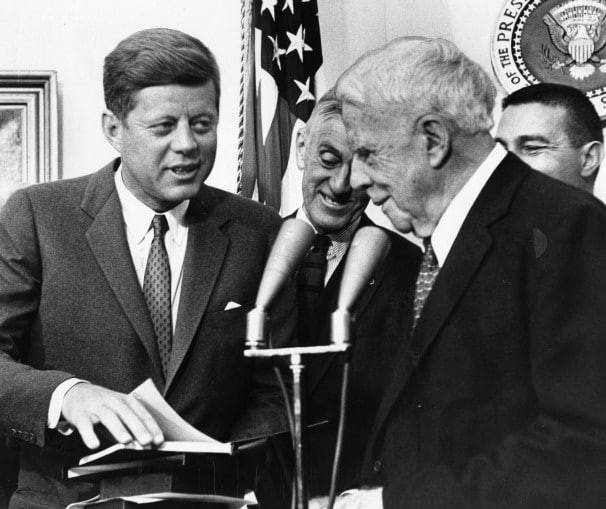
JFK: When you wrote “Come on mama, to the edge of town/I know where there’s a bird nest, built down on the ground” were you talking about what I think you were talking about? (wink wink). Frost: No, you’ve got me confused with another bucolic poet, that’s Charlie Patton — but I believe that’s a philosophic statement about how erotic desire is both natural and elusive. Patton was tuned in open Spanish for that one.”
Blues lyrics often used a stanza format of three lines: one a statement, the second a restatement that may be the same, nearly the same, or subtly varied while still gathering intensity via repetition; and then a third line which can go in any direction the writer/poet/singer wants to take it, though it usually rhymes with the ending of the first two lines. It’s a variation of that ancient and simple poetic scheme the rhyming couplet, but with that repetition allowing for something extra in the balance. And there’s often an element of call and response in the lines: that choral rock, and roll back that Sophocles, Skip James, and Pops Staples could share.
So, let’s go back to our 1914 Robert Frost poem “Fragmentary Blue.”
Why make so much of fragmentary blue
In here and there a bird, or butterfly,
Or flower, or wearing-stone, or open eye,
When heaven presents in sheets the solid hue?
Since earth is earth, perhaps, not heaven (as yet) —
Though some savants make earth include the sky;
And blue so far above us comes so high,
It only gives our wish for blue a whet.
Not in Blues stanza form. Instead, ABBA, and I don’t mean the Swedish pop group.* But Frost has made the center two lines in each stanza a sort of parenthetical, so that lines one and four are natural couplets and the middle two lines are already couplets that can stand by themselves. This means it was easy to turn “Fragmentary Blue” into “Fragmentary Blues.”
Why make so much of those fragmentary blues?
Why make so much of those fragmentary blues —
When heaven presents us sheets of a solid hue.
Here and there a bird, or a butterfly.
Here and there’s a bird, or a butterfly,
Or a flower, or a wearing stone, or an open eye.
There’s some savants say the earth includes the sky.
Some say, some say, that the earth includes the sky —
And the blues so far above us, it comes on so high.
Since earth is earth, it isn’t heaven yet.
Earth is earth. It ain’t heaven yet.
It only gives a wish for blues a whet.
So there you go, via show not tell, we rock up Robert Frost in the Blues form. If you read the two sets of words closely, you’ll see something has changed. Frost’s “blue” on first reading seems a stand-in for beauty, while the Blues treats its namesake emotional dissatisfaction as something less than beauty. But, consider again. Frost’s poem says we miss the immensity of natural beauty in our all too earthward human act of trying to possess its emulations. That difference, that dissatisfaction — that’s the Blues. My adaptation only brings out that subtext more overtly. You can hear the LYL Band express Frost most blues-wailingly with the player gadget below, or with this highlighted hyperlink that will play the performance. Most of the better guitar notes here were played by Andy Schultz who played with the LYL Band for a few times, and Dave Moore will once more hear himself back when he could pound and roll on the (plastic) ivories.
.
*Is it too late in their career to suggest that they produce a trans-Atlantic Carl Sandburg tribute record? I’m available, and you need my audience of dozens to hundreds of listeners.
Around America people are getting ready to celebrate Thanksgiving Day, a sort of remembered harvest festival, now a family get-together mostly celebrated by eating as most Americans are separated from farm work by some distance and decades. However, back in 1914, American poet Robert Frost was close enough to that work to write a masterful and closely observed poem about harvest time that I’m going to present for today: “After Apple Picking.” While I hope you’ll listen to my audio performance with my original music below, here’s a link to the poem in case you’d like to follow along with the text.
This poem is full of sensuous detail. Encountering it — even if you don’t do farm work — you should feel the completion and weariness of the poem’s speaker who is falling asleep at the end of his harvest season. The poem’s farmer has been working in an orchard, and that place is full of the scent of apples. In a fall orchard such as this, much of this scent may be from fallen apples which, even as they start to rot, give off a sweet musk. And it’s frost time, not just the poet’s name on the poem, but the livestock water-trough has a frozen sheet on top, so the picker has been racing against a loss of the crop. In a piece of rural surrealism, the farmer has, that morning, picked up a plate of this surface ice —which would be thin, wavy, and fragile — and looks through it as if they are magic spectacles at the morning frost on the grass. This lasts but a moment, the magic glass will disintegrate in his hands, but that’s of no matter, there’s work to complete.
While falling asleep his body is still weary, his feet are sore from standing on the round ladder rungs, but as dreams approach his mind once more magnifies and intensifies reality like the view through the wavy ice sheet, and he’s haunted by apples, by his job of picking and inspecting, his rush against the end of season frost.
As the poem moves to its conclusion the farmer seems to imply that his work to gather the crop before it’s lost is like unto the work of salvation. We might remember and notice that the poem started with a ladder pointing “toward heaven.” And those apples that touch the earth are held by it and not offered heavenly worth.
Frost ends his poem whimsically, not with an angel or a prayer, but with a small rodent, the woodchuck, which hibernates (“his long sleep”) in the winter. As the farmer falls off to sleep, he wonders how long a rest he has earned.
How big a slice of apple pie do you want? Stand back, I’ll cut you a piece.
.
When Frost wrote this poem about a third of Americans were farmers and farm workers. Now, most of us have other labors. Our harvests may not be food, we may not be tied to the cycle of seasons as exactly. My wife will be getting time off from working in a medical clinic, where she works to gather as many as she can, and Thursday she’ll be making a meal for us and her mother with dementia. I’m working past midnight to bring you a presentation of this poem. Our labors are many, they may make us weary, but perhaps, yet, we can be thankful for them.
My audio performance of Robert Frost’s harvest poem “After Apple Picking” can be heard with the player gadget below, or with this highlighted hyperlink. My music today is percussion, piano, cello, two violins, horn, and harp.
The poet and writer Robert Bly was unavoidable here in Minnesota, and to some degree that may be true elsewhere. Today would be the day this week I would have to record something new, but I’m going to write this instead on the week of his death.
I moved to Minnesota from New York in the mid-1970s, and Robert Bly was unavoidable even then, at least within poetry circles. Minnesota is used to single degrees, and it soon became clear to me that one didn’t need to reach a balmy high of 6 degrees of separation to connect a lot of the poets here to Bly.
Now as a younger man I was a big again’er, and so I was often moved to do by what I was in opposition to. Bly was this too, and he retained this spirit well into his middle age. I recall the first time I saw him read and then speak on more general cultural topics at a writers event. The reading was intriguing. I recall he spoke his poems in a Yeatsian* sing-song chant and I believe he may have strummed a mountain dulcimer haphazardly while intoning his poems. That sort of thing is not universally attractive, then or now, but I admired the attempt. The poetry held my attention while not bowling me over. I’m not entirely sure (memories of other Bly readings blur into my memory of my first) but he may have spent time in his reading speaking about the matters the following poem would be a distillation of. In effect a Bly reading sometimes seemed to be roughly in haibun form, prose talk containing associations and context, to be followed by a shorter lyric poem. In the mid-20th century this reading style was an again’er move, for the predominate public literary reading was flatter, trusting the words alone, or the persistence of memory from studying them on the page before or after, to bring forth the impact. The Beat poetry** with jazz thing still existed then, but this wasn’t quite that, and the Beats were still assayed plausibly as a faded popularizing fad with inferior poetry by many. Over the years my fondness/acceptance of Bly’s reading style continued, though I never wanted to sound like Bly reading.
Part of what might seem too much at a Bly reading, perhaps part of why he chose to explain the human connections not always overt in the poetry which followed, was that he really seemed to want us to treasure the words. That could seem vain or self-important — but of course he, or any of us poets, are only borrowing the words.
The video looks like it may be Bly reading around the same time I first heard him.
.
Later in the event series where I had heard him read, I heard him talk about culture. I recall the core of his talk that day was about how young people (he may have been restricting his subject to young men, even though this was years before Iron John) had this narcissistic irresponsibility and lack of order. He called those suffering from this syndrome “Boy Gods” and he said these two words so close together that I wondered if this was a new word I hadn’t heard before: “buoygaadz.” Anyway, I wasn’t having this. Yes, nearly all writers, and more nearly all poets, have a sliver of un-endorsed self-regard for their thoughts and work.*** And we don’t generally know what to do with what skills we have, but at a young age drawing on our own lives isn’t just narcissistic, it’s also largely what we have any grasp on so far in our short years.
So, my again’er back was up. Maybe it wasn’t me he was talking about? Didn’t occur to me. I’d been working full time since I was 20 first in nursing homes taking care of folks Bly’s parents’ age, then in urban Emergency Rooms where people had no where else or no choice but to come. I didn’t need some writer with writing prizes giving me tough love, it was my day job to provide some pretty tough love to some needy people.
That’s often what happens when two again’ers meet. How much did I misunderstand? How much was Bly wrong? As an old man I’m not sure. That again’er part of me still arises, even in old age; but now I’m prone to doubt that there’s one way and one understanding — which was always part of my being against stuff that claims there was. Similarly, I was never attracted to Bly’s denomination of a men’s movement, though some others who seem a decent sort of person in my estimate were. I have no understanding of that part of Bly’s lifework, and so look elsewhere if that’s what you’re looking for. Also missing in my accounting today will be that there was, even more so in the older Bly, a sense of general good humor about our less than murderous follies.
Skip forward some decades and into a new century. Partly from examining closely the early Modernists (who wrote differently than most Modernism that followed) and partly from a renewed interest in how the classical Chinese poets expressed poetry, my poetry became more like Bly’s without any direct intent on my part to write like him (remember, my first impressions of Bly’s poetry were: nice enough, but not impressive or something I needed to copy.) If you’ve listened to some of the hundreds of examples of various performance styles I’ve used here combining poetry and music, I don’t think you’ll find me sounding much like Bly reading — but he is one of several whose courage in trying different ways to make verse work aloud inspired me.
And then, as readers here will know, I started to do more translations. I did this to expand what I presented here, and also because I think it’s a great way to get inside other ways poetry can express itself for my own writerly benefit. In the course of doing that, I would run across works that Bly had translated. My first thoughts? “He put stuff in there that wasn’t in the poem. And he makes them all sound like Bly poems.” Well, there’s my again’er again! I told myself that I want to honor the poet I’m translating — and sure, I can’t move the exact word-music over, but it should remain their poem, not mine. Oh, I still think I’m trying to do that, but I’m failing into doing what I see in Bly’s translations more and more. I’m not sure how I’ll eventually feel about this failure on my part. I’ll say only this (in example) if you think you’re reading Rumi by reading Bly, you’re not. You’re looking over the shoulder or between the ears of Robert Bly reading Rumi. That may be a fine location, just don’t hang the wrong sign on it. Ah, but as with the poetry we write, we’re only borrowing the words.
Have I been too dismissive or hard on the man who has just died, and who earned his honors and esteem and perhaps deserved even more? And who am I to cast this as if Bly and I are peers in any estimation! I worry that I might give some readers those impressions, but no, my intent is to say this in gratitude to Bly; and then to say this to you: if you, even partially, progress by opposition know that opposition may be like a pair of powerful magnets with poles repelling — they may snap around in your intending hands, together.
Since this version from 2019, I’ve changed the 8th line to a less awkward one: “If you don’t have a house, you won’t build one now.”
.
You can hear me perform my translation combined with my own music either with the following player gadget (where shown) or with this highlighted hyperlink.
**While in New York I’d heard Ginsberg sing poetry; and though his pitch sense had issues, he was singing in full voice. Though I left New York before the hip-hop explosion, Gil Scott-Heron was a thing, and again, the cool, sly Beat infused (in both senses of the word) Scott-Heron thing wasn’t what Bly was doing. Bly then was always slowing the flow down, sometimes elongating the words almost like a stage hypnotist. The Last Poets sounded more like drill sergeant chants compared to Bly. Ken Nordine’s“Word Jazz” had moments of that slow, hypno-suggestion groove, but it also had rhythmic variety. Later Bly chopped with a raised hand while reading, chopping also the words off at their feet with more variety in tempo.
***Often fighting with a stubborn bit of self-destruction or outright self-hate. Many artists think they know what they’re doing maybe 51% of the time, and then “I don’t have any idea about how to do it” fills the remainder 49%. The former pride lets us work, maybe even impress the results on others, the later portion calls us self-deluded. Some self-medicate trying to dampen down one portion or the other, but the drugs, drink, etc are not accurate enough.
It was difficult to return to work on new pieces for this project yesterday. November was blustery and very gray, the whole world seemed to shiver. It was weather to huddle up, as curled and still and hidden as one could be. None-the-less I rode my bike to breakfast, and when I rode past a small pond I could see three ducks on the soon to be frozen water. I wondered; did they miss the migration memo? Are three enough of a formation to make the long southward flight? Are they waiting for a greater flock to gather that I suspect won’t be coming around?
Having completed my Kurt Vonnegut series, I am reminded of a whimsical concept his made-up religion Bokononism introduced: the “karass,” a term for a group of disparate people strangely linked together without their knowledge that yet still seem to be working with a common purpose and unknowable goal.
If so, poet Robert Okaji and I may be in such a flock.
Ostensibly independently, Okaji and I both find creating American English translations/adaptations of classical Chinese poetry rewarding. We even often use the same source of literal glosses of the poems since neither of us understand the language those poets wrote in. Okaji’s practices have informed some of what I do with translation in that he allows himself to extrapolate English poetry from these old poems where his or the modern American reader’s understanding might otherwise be puzzled, unsure, or unmoved.* This weekend I read one of his adaptations, “Sheng-yu’s Lament (after Mei Yao-ch’en)” and was struck, as he apparently was, by the depiction of grief and loss.
Okaji’s version is quite good, but I still wanted to try my own adaptation. I approach translating classical Chinese poetry like I approach translating from French, German, or Spanish. My primary goal is to understand first what the poet wants us to see, to sense — the imagery. With poetry the “word-music” is highly important in the original language, but generally I do not try to transpose the sounds or even the sound-organization of the original language into English. I do like to retain something of what I call “the music of thought” in the original poem, the order and arrangement of the images in the poem’s journey.
I always start wanting to honor the original poet, the original poem, but despite that I often get carried away with a desire to change the way the poem ends to something that occurs to me from the experience of the other poet’s poem. This may be a failure, a fault on my part, and so when I do that here I try to cite what liberties I took. Okaji has a concise way to handle this issue: he calls his adaptations into American English “After…” which gives one license to do what the muse wills.
I started out thinking about how to render the first word: “heaven” in the gloss, a word carried over by Okaji. Best as I understand Chinese culture, the term “heaven” often carries a connotation closer to the concept of “fate,” and I actually used fate in the second draft, and then reverted to heaven in the final version. I decided I needed the listener to be firmly in the experience of mourning and grief, and to a Westerner, heaven does that. My next problem to solve were two lines both plain and puzzling: “Two eyes although not dry/(Disc) heart will want die” Interestingly, they rhyme in the English gloss, and early-on I decided to make that into a refrain. The narrator seems stuck, and refrains are a great device to show that situation. Okaji plays his “after card” here, with the very fine “my heart slowly turns to ash” that may not be in the original but adds vividness.
I wanted to bring forward Mei Yao-che’en’s image in the next set of lines — that there are things that seem elusive, that we think of as gone, but they still exist —and there are objective, work-a-day methods to go into the depths to retrieve them. I was unable to find out any additional context for the Sheng-yu whose lament the poem is said to be reflecting. Given my own age I read this poem as an older man, a widower who has now also lost his son to death, although given the historical dangers of childbirth it could be a tale of a woman who died of childbirth complications and then the infant too dies. The poignant specifics of the pearl sinking into the sea asks for allusive meaning, pearls coming from oysters on seabeds, and so a returning, perhaps a child-soul coming forth and then returning to where it came from. Or given my old-man framing, a widower throwing a dead wife’s jewelry into the sea. If the story of Sheng-yu was known to Mei’s readers this might be understood more specifically, but lacking knowledge I let this specific mystery remain.
Mei’s lines “Only person return source below/Through the ages know self (yes)” are hard to grasp. Okaji made his estimate, and I made mine. My aim was in part to underline that this section is a contrasting development of the supposedly lost things in the depths of the earth or the sea.
Okaji’s adaptation ends strongly, and it seems to me to be a more likely accurate translation of the poem’s final line. While I like my solution to the next-to-last line, I decided to go with a much odder final line. In my choice, inspired by what I felt in Mei’s original poem, and from being an older person with many grievings — the dead whose immortality is, in part, made up of my remembrance of them — is that I do not have to dig down deep or dive deep to see them, that they are with me. In the thin depths of a mirror I find them, and that my fate is to join their fate soon enough in my passage of years.
Musically I wrote an entire other tune for this, a bit more R&B like, which I abandoned early in my attempts to record this. Instead, I returned to my thought of some unusual colors associated with the Velvet Underground, and particularly John Cale,** the Welsh viola playing member of that band. I created another spare and eccentric percussion part inspired by Velvet’s drummer Maureen Tucker’s inventions, and then laid down an electric bass line that anchors the melody. My guitar part came next, not R&B at all this time, the atmospheric arpeggios perhaps subconsciously connected to Chinese string instruments. The top instrumental lines are a cello and viola.
You can hear my performance of this lament with either this highlighted hyperlink or where available, this graphical player gadget you may see below.
**Two early John Cale solo LPs The Church of Anthrax and The Academy in Peril, like his settings for Nico recordings in the early Seventies, aren’t to everybody’s tastes but hearing them opened my mind then to different ways to combine orchestral instruments with modern songwriting and electric instruments. If you want to explore them now, I’d suggest starting with 1972’s The Academy in Peril which is the most accessible.
Let’s complete our series honoring American writer Kurt Vonnegut on the 99th anniversary of his birth with another piece taken from his novel Cat’s Cradle. In the world of this novel there’s an imaginary religion created called Bokononism whose elusive founder writes psalms and prayers that reference Caribbean musical styles. Even though Vonnegut never set music to them, he seemed happy that others did during his lifetime.*
The LYL Band, the loose organization of herded cats that Dave Moore and I have played under for about 40 years, performed several pieces using Bokonon’s psalms and other short passages we’d read in Vonnegut’s novels three days after his death was announced back in 2007. I wrote the music for these in that interim and did the vocals when they were performed “live in the studio” within two one-hour sets. As I mentioned in other episodes of this series, the performances aren’t perfect. For one thing, Dave is creating his keyboard parts on the fly after maybe hearing a quick run down and with nothing more than a chord chart. Given that I’m not a very good chord/rhythm player that’s a testament to him and what decades of playing together will do for a band. Another problem was that I was suffering from cold/allergies that day and my vocals had issues with congestion and phlegm.
I recorded those two sets, though I thought it a shame that my phlegm issues reduced the quality of the performances. Over the years since 2007 I’ve listened to those performances, and I found that I either had become inured to their sound or that the emotional moment of us honoring Vonnegut overcomes that.
“God Made Mud” was the next to last song we did that day.** It’s probably the best of our Vonnegut Memorial stuff in terms of my vocals. “God Made Mud” appears in Vonnegut’s novel as the text of “The Last Rites of the Bokononist Faith.” The Bokononism that Vonnegut invented is used in the novel in various ways to satirize human nature and our search for meaning. For some readers — oddly enough, atheists and secure believers both — those insights into belief are the emotional core of the book. For those in non-Abrahamic religions, there are echoes of Buddhist teachings, intentional or otherwise, mixed in there too.
But by the time Vonnegut gets to “God Made Mud” the sincerity of the final human situation, the miracle and the limits of our lives, completely overcomes the satire, and removed from the novel’s plot it moves me. It moved me then as we were performing it in the week of its author’s death, moved me later in consideration of other deaths and thoughts of gratitude for lives, and moves me again this autumn as I consider death and the approach of death by folks in my circle.
Click this highlighted hyperlink to hear the LYL Band’s performance of “God Made Mud” — or some of you may see a horizontal player gadget below this paragraph to play it. One last thing before I go: if you appreciate what this Project does and you think you know someone or some audience who might also appreciate these varied combinations of words and original music, help it continue by sharing links to the audio pieces or posts on social media or elsewhere. I almost never have the time to do that, and I’m bad at it anyway, so a good deal of this effort’s audience comes to it this way. Thanks!
.
* Oddly, most of those settings that I’ve heard make no reference to Caribbean musical styles implied in Vonnegut’s imaginary Bokonon texts. One of those styles, calypso, has lost most of its currency in North America, but in today’s piece I used a reggae feel as a reasonable substitute.





 Frank Hudson