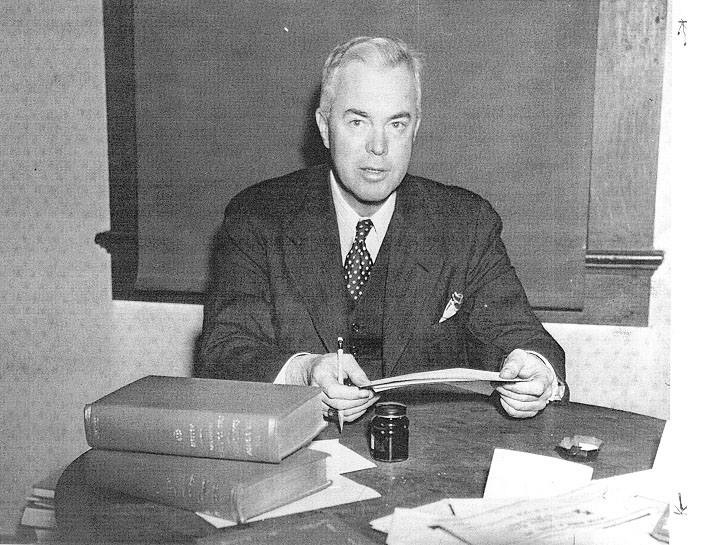
I hope you’ve been enjoying the bountiful crop of new musical pieces presented here this National Poetry Month.* Each of the dozen I’ve presented were based on poems found in Louis Untermeyer’s between-the-wars literary anthology Modern American Poetry. Here’s another of the poets that Untermeyer noted then, but that time has forgotten: a Pennsylvania school-teacher named Roy Helton.**
This won’t be a long post today: there’s not much easily accessible information about Helton. Combining Untermeyer’s modest introduction of him in his anthology and the absence of much else surviving online even makes me wonder how Helton came to be included in the anthology. Others in the “haven’t heard of” class I’ve already presented this month seemed to be substantial poets in their era – prize winners or prominent in other ways – but Helton has only a handful of collections to be noted, and there’s a passing mention that he had things published in Atlantic Monthly magazine.***
One “dog that hasn’t barked” I see is that he attended the University of Pennsylvania and graduated there in 1908. He may well then have overlapped the early-20th century presence there of poets H.D., William Carlos Williams, Marianne Moore, and maybe even Ezra Pound. Did one of them recommend Helton? Another possible vector: while I have no information on Helton’s politics, there’s the possibility that he may have had lefty connections in circles that overlapped Untermeyer or someone else.
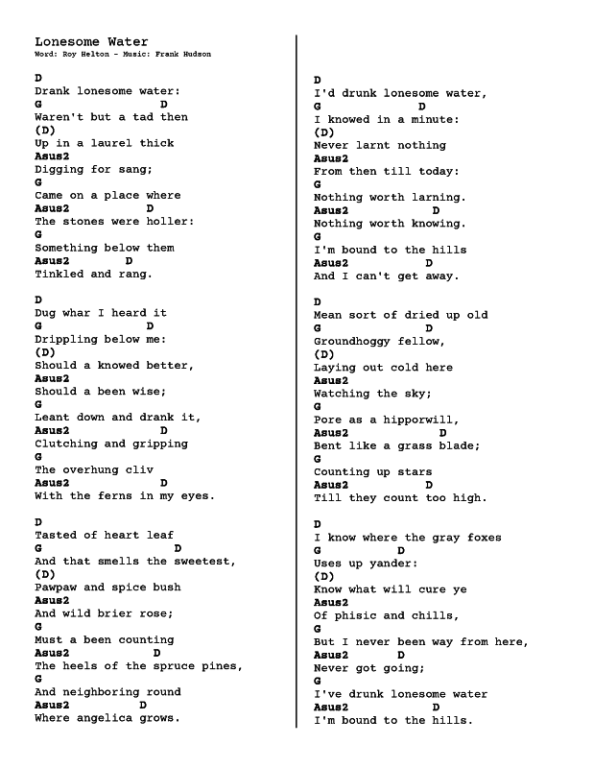
What’s remarkable about the small amount of his poetry that I’ve seen? Today’s piece “Lonesome Water” impresses me when seen on the pages of Untermeyer’s anthology as a folk-song lyric. Again, no evidence, but it’s difficult to take in the words of it and not imagine that Helton didn’t sing it.**** Assuming one is OK with the dialect, it’s an attractive piece melding herb-doctor mysticism with plaintive rural hermitage. Untermeyer says Helton spent time in Kentucky and North Carolina, but given that he seems to have been based occupationally in Philadelphia the choice of writing in Appalachian mountain dialect seems to be a poetic diction (or folklorist) choice as deliberate as Hart Crane’s King James Version portrait from last time.
Some dialect vocabulary here challenges me. “Sang” is ginseng. Is “cliv” a regional pronunciation of cliff?
.
Well, we don’t know if Helton sang, but the recording below says I sang it, best I could, to some music I had to supply to make that happen. I usually have trouble performing accents and dialect, but this one caused me fewer issues – maybe the spirit of Tennessee ancestor Susan Partain helped me out? Besides guitar, the other instrument I played on this track is the distinctive Appalachian regional instrument, the mountain dulcimer. You should be able to hear my performance with the audio player gadget below. Huh? Wasn’t some plant-enchantment hasn’t made that audio player invisible, you’re just are reading this in a manner that won’t show it. This highlighted link will open a new tab with its own audio player.
.
*I also worry I may have oversaturated even the huge and avid market for rough-voiced singers doing presentations of literary poetry. It could have been even more bountiful, or overwhelming here, but #NPM2026 is coming to a close and I think I’ll only get one more musical presentation of a literary poem out by tomorrow – but I hope that’ll be a good one: a lesser-known Langston Hughes poem for Poem in Your Pocket Day. Three or four other pieces from Untermeyer’s anthology remain in various states of completion, and they may appear later this year.
**Helton taught at the Pennsylvania Friends Central School, a K-12 institution. I don’t have info on what he taught at that school. Imagist H.D. (Hilda Doolittle) attended this school, but that would have been before Helton’s time as a teacher.
***I can find nothing online searching at the Atlantic’s site, or generally, as to what kinds of things Helton published in that magazine. One short piece of light verse is quoted redundantly in the stub-entries that turn up in most web searches, something which may have been printed in the Atlantic: “Oaks are the true conservatives;/They hold old leaves till summer gives/A green exchange.”
****In case you wonder, the folk-song collector/singer/poet was a thing by the between-world-wars era. Carl Sandburg blazed that trail. Foundational creative writing professor and poet Edwin Ford Piper was another (and he supplied testimony that Robert Frost could be coaxed into singing a rowdy sea-shanty).
A note in the unreleased “talk” section of Helton’s Wikipedia stub says that he played Walt Whitman on stage in 1927, so one cite of performing.
Of course, the “literary ballad” has a long page-poetry tradition too. When the dialect or setting is some misty British Isles locale, Celtic fairyland, or ancient days it’s easier to accept its high culture bonafides. Helton’s narrator is an American lower-class contemporary and lacks any such exotic cache. Myself, I find poetry in this poem, but in American academic culture it must have been a harder lift to romanticize a speaker sounding like Pa Kettle or Jed Clampett.
Louise Bogan is somewhat of a poet’s poet – and that’s sort of a mixed blessing. Earning that title means that other folks who work at the craft of poetry recognize the things she’s able to do even if they may not be noticeable by the general reader. Indeed, when done well, the kinds of skills Bogan had with the music of words or the music of thought may not be noticed because the poet deploys them without creaky prying levers, showy lifting, or grunts of effort.
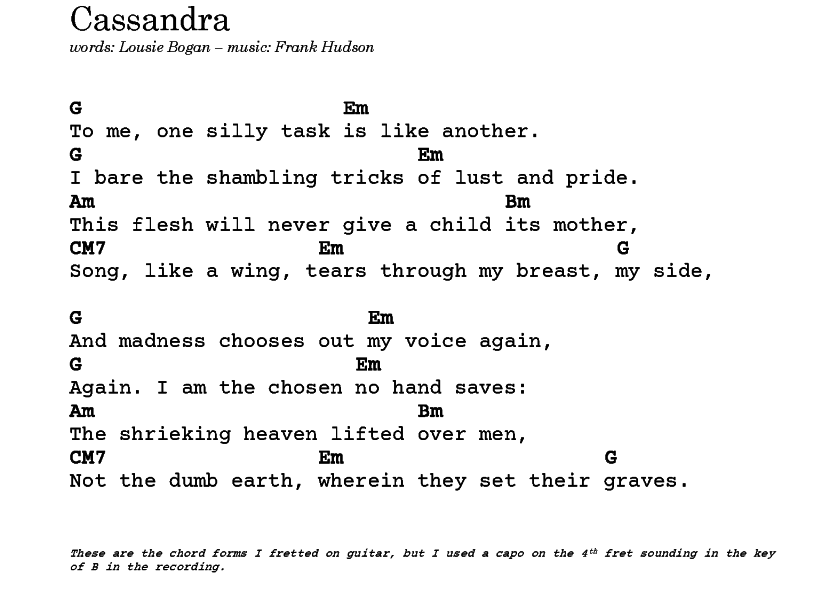
Continuing our celebration here of National Poetry Month, I selected a poem of hers out of Louis Untermeyer’s between-the-world-wars anthology Modern American Poetry. It’s titled “Cassandra.” We may therefore assume it’s in the voice of, or the shared experience of, this figure in classical mythology.* Cassandra had the gift of prophecy, but when she spoke her doomed predictions of the fall of Troy and the fate of those (on both sides) who took part of that conquest, she was more than disbelieved, she was deemed mad. Mixed blessing.
As I mention below, you could have heard this with Mellotron strings, but Cassandra predicted you won’t.
…
Of course, if you have the unerring gift of prophecy you might well know that’s how your messages will be received. Cassandra would also know her own fate (and like many Greek myths, it’s trigger-warning brutal) and she had to bear up under that too.
Louise Bogan took that paradox and put its facets into eight lines of pentameter with perfect rhymes. With a little less skill she might have chosen more space thinking that would demonstrate all the things she could do – and that poem would have been longer.
I love the opening two lines of this poem. Cassandra seems to be calling the gift of prophecy a “silly task,” a “trick” even if the myths say it was a gift from the gods, but she dismisses it as something any wise observer would say are the predictable extractions from the lust and pride of men. What a piece of characterization! The next four lines express knowing the future, and knowing too the foolishness of mankind, only adds pain. The concluding two: an unflinching statement of bearing up under the gift of being the knower-of. Her knowledge of fate gives her a vision of the gods of a “shrieking heaven.”
I tried quite a full arrangement of the music I wrote for this, with two tracks of Mellotron wheezing and some other things, and yet I struggled to come up with a mix that retained listener impact. This afternoon I decided to subtract, taking away track after track until I had just the voice, guitar, and bass – and sure enough there was more there with less. You can hear my performance of Louise Bogan’s “Cassandra” with the audio player below. What, has my prediction failed – there’s no player to be seen? No, I know that would happen since some ways of reading this won’t show the player, and so I offer this highlighted link that will open a new browser tab with its own audio player.
.
*I read a little about Bogan’s life before posting this piece today. Are there reasons she’d empathize with the struggles of Cassandra? One summary of her life that I read is so well done that if you’d like to know more about her, you’d do well to take a few minutes to read this link rather than for me to try to restate it.
I keep thinking that I’d probably like reading more of Bogan’s poetry later this year – and yes, likely present some more of it here too.
Unlike Emily Dickinson, or several other women poets of Lowell’s era,* Amy Lowell hasn’t been central to my own thinking. I was aware of the “Imagism Wars” where Lowell, a prominent promoter of the new free verse forms that emerged in the 19-teens was accused of hijacking the artistic movement by Ezra Pound, who with Englishman F. S. Flint had originated that name. Pound’s tactics in the battle included declarations that Imagism was now passé anyway, and it was time to move to new strains of Modernism. The stragglers, #Pound said, should now call their movement “Amygism.” And those weren’t the only projectiles in that battle: weighty Amy Lowell got the sniggering nickname “The Hippoetess.” Schoolboy behavior.
Those elements of Ezra Pound’s character (and his eventual abysmal politics) aside, I rather preferred the early poems from the Pound-Flint version of Imagism. And there was another factor, Lowell was from a long-important and financially secure family. Wealthy patrons of the arts have done good things certainly, and Lowell was out there promoting the new American Modernism with more than just banknotes – but even that was part of the problem. Was her place as a consideration-worthy poet more-or-less purchased? She did, in fact, put energy and study into being a poet, but my own background and nature is to suspect things like that, and to hope for better in the arts.
There’s a counterargument. Lowell didn’t choose her family, and no matter what one thinks of rich-kids and nepo-babies, talent and achievement happens where it happens. I’d already looked at Amy Lowell’s segment in Untermeyer’s book. Nothing jumped out at me on the first overview. The striking image, the musically attractive approach to language, the interesting approach to subject matter – I didn’t find it on my first glance. Reputation alone doesn’t make for a Parlando Project piece, as you may have already figured out from some of the “who’s they” selections I’ve already presented this month.
But shouldn’t I look again at the woman who Wallinga chose as her Beatrice guiding her look at women in poetry, the same woman who Hillyer calls out to Frost in his long poem about the state of poetry in the 1930s as “our friend at Sevenells?”
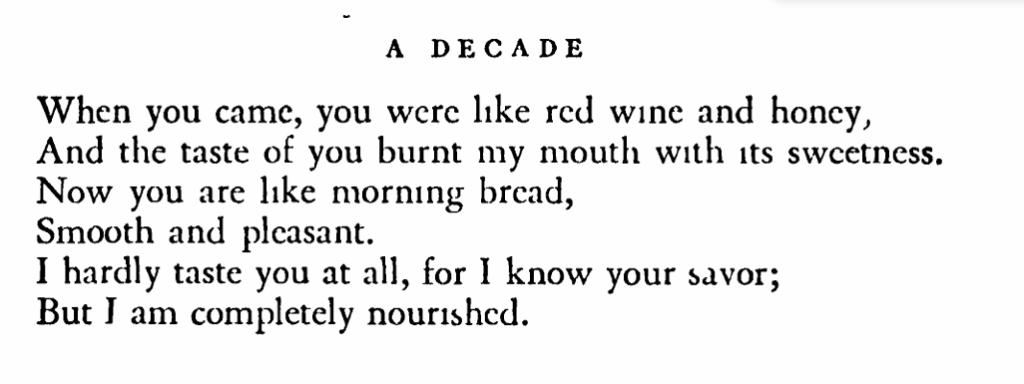
And that’s when on Monday afternoon my eyes fell on Lowell’s “A Decade.” First, it’s a short poem as a text, always a plus for me with my rapid and unpredictable production schedule. And I was, on second thought, attracted to this statement of passion melded into longer partnership.
It’s possible to read this poem as not about desire and a personal relationship I’d suppose, but I don’t read it that way. Does the consensus Untermeyer reflects below reflect a blindness, intentional or not, to Lowell’s relationship to Ada Russell Dwyer?
.
The next day was largely spent making the musical piece you can hear below from this poem. The music came together quickly. It’s a piano trio, but the fretless bass doesn’t offer its companionship until the ending, and the rest fell into place when I found for the piano an arpeggiator pattern that expressed a 5/4 beat that I liked. Harmonically, the music is remarkably static, occasional extensions and variations on a G major chord, an idea I felt complementary to the poem’s treatment of the relationship. Indeed, the experience of recording this musical setting changed my experience of Lowell’s poem tremendously. By making the poem audible, I could feel that transit from desire to devotion as I endeavored to make my limited voice an acceptable conveyance for her words.
Silent on the page it’s not the same poem I found by speaking, by performing, by singing the words. I looked back on the consensus reflected in Untermeyer’s introduction to Lowell in his book:
Miss Lowell was not at home among the emotions. She triumphed in the visual world, in the reflection of reflections, in capturing the minute disturbances of light and movement. It has been said that, though a poet, she failed as a humanist, that she never touched deep feelings because she never knew where to look for them.”
I had a recorded performance by Tuesday afternoon, and such a spare arrangement should have led to a quick mix of the tracks and a later Tuesday release. Except…
The recorded sonics were troubling me. First, I usually record my vocals pretty-much “dry” and fix EQ, leveling, and add things like reverb afterward, but in an effort to buck up the confidence of my singing voice I had applied more than a little “vanity reverb” (and delay)** while tracking. That did give me more confidence as I was singing, but in the cold light of the afternoon mixing, it lacked (using one of those vague terms people use to describe sound) “a solid place” in the mix. This issue was complicated in that I record on one computer system and software and mix on another. Removing or lowering the reverb and delay in modern computer software after recording is trivial as long as the musical tracks stay within that piece of software. Once extracted to “printed” tracks (which is what I mix with later) that flexibility is gone.
Furthermore, even in such a simple ensemble, getting the mix between the vocal and the featured piano was critical, and each time I made a mix that sounded right, it didn’t translate when I checked it on common earbuds that I suspect are used by many listeners to these pieces. I produced three “that’ll do it/no it won’t” mixes before settling on a fourth just before going to bed last night. The too airy and diffuse vocal was mitigated by a bit of low-mid EQ boost and the slightest of top end roll off, and now you can hear my performance with the audio player below. No audio player? Ah, that’s likely due to some ways of reading this blog suppressing showing the player – but this highlighted link will open a new browser tab with its own audio player then.
.
*Speaking just of early 20th century American-based women that come to mind this morning : Edna St. Vincent Millay, Anne Spencer, Sara Teasdale, H.D., Elinor Wylie, and Mina Loy have all received musical settings early and often over the decade of this Project.
**”Vanity Reverb” is a common producer tactic to help weak singers perform – it makes the vocal heard in the monitoring headphones sound grander to the shrinking vocalist. Even though I am both the producer and the singer here, the trick still works. Of course, it would have been best if Producer-I had left a dry signal track in there for more flexibility in mixing – but in my haste to get the recording done while I could, I forgot to do that.
Last time in our National Poetry Month series of musical settings of poems and poets included in Louis Untermeyer’s Modern American Poetry we heard from the poems of a leading practitioner of light verse, Ogden Nash. Today’s piece was made using some brief quotes from a much longer poem that fancies itself a step up from light verse.
In 1937 Robert Hillyer was a fresh winner of the Pulitzer Prize for poetry, and he had a professed friendship with the GOAT of all poetry Pulitzer winners, Robert Frost. That year he published a long poem in rhyming couplets, a format that in his day might make a cultured reader think of Alexander Pope – though a 21st century ear might hear in that rhyming form the philippics of Pulitzer winner Kendric Lamar. Couched as a letter to Frost, it’s a wry survey of the between-world-wars state of poetry. As an active professor of literature at Harvard, Hillyer’s in a good position to comment on and even change the nature of The Canon – that agreed upon pantheon of great poets to be taught and kept alive, even if as only as cadavers for academic dissection.
His poem from the start wants to make a point that The Canon is mutable – unlike arguments that it’s revealed truth only disputed by ignorant academic Visigoths with sub-rosa agendas. So, from the start (and the parts I chose to quote for today’s musical piece are all from the beginning of the poem) Hillyer uses himself and Frost (and meta-event! also the very anthology and anthologist that I’m drawing from for this month’s #NPM2026 series) to point out that we can change our mind and experience of poets, even long-dead ones.
His first case in point concerns Emily Dickinson. Let me do a quick attempt to summarize how that great poet – dead 50 years when Hillyer tells his tale – came to be vetted for a position in The Canon. Most of Dickinson’s best-considered work was written in the 1860s, and when she died in 1886 that work was almost entirely unknown, save for those poems she included in letters or otherwise distributed to intimates. None-the-less, in one of the cultural miracles of the ages, a large cache of hand-written fair copies of her poems were located after her death, and her surviving sister Lavinia Dickinson sought to publish them. More coincidence comes into play: Emily had corresponded with Thomas Higginson, a smart and well-connected Boston cultural figure, and two other culturally ambitious local women were willing to assist in editing these manuscripts: Emily’s sister-in-law (and now commonly assumed lover) Susan Gilbert Dickinson, and Mabel Loomis Todd, wife of a local astronomer and mistress of Emily Dickinson’s brother, the husband of Susan. No, this isn’t a season arc of Real Housewives of Amherst, that’s the mishigas/miracle that gives us one of America’s greatest poets.
Susan got first at bat with the surviving poems. She had grand plans for them, perhaps too grand. Lavinia grabbed the rights back and handed them to Mabel. Mabel Loomis Todd and Thomas Higginson were expeditious: they turned in a publishable manuscript quickly, doing what any responsible professional editor would do with this batch of handwritten “amateur” poems: cleaning up punctuation, spelling, grammar, etc., ordering their choice of best poems in a sequence, and adding helpful-to-the-casual-reader poem titles and subject-matter sub-sections.*
Still, the posthumous publication of a dead loved one’s poems generally produces about as much reaction as an engraved epigraph on a cemetery rock: a loving gesture with a small audience. Yet, surprisingly the Poems of Emily Dickinson sold very well, needing additional print runs only weeks after it was released. Two subsequent volumes containing more cleaned up and regularized poems quickly followed. So, at the turn of the 20th century, shortly before Modernism breaks out, this mid-19th century poet arrived.
When Untermeyer presents Emily Dickinson in his Modern American Poetry, it’s only her and Walt Whitman who are from the mid-19th century – the pair considered suitable to be considered “moderns” – but he points out that with the rise of High Modernism in the late 1920s, Dickinson’s poetry had taken a hit in critical assessment: she didn’t seem “serious” enough, and even with the Higginson-Todd edits, her prosody seemed sloppy. Untermeyer notes that the myth and mystery aspect of Dickinson’s biography, as understood then, was in danger of taking over from the verse: why did she withdraw socially, and was that part of some doomed romance?
That was still the Emily Dickinson that I read and heard about in school in the mid-20th century: a curious eccentric with a cozy-gothic-romance backstory to go with those poems of strangely polite funeral carriages. Real poets, like Frost, Stevens, and Eliot had no backstory, just texts that could support impersonal New Criticism exegesis.
But Emily Dickinson’s poetry was still to be written – or rather, printed. It was only in my lifetime that accurate and complete editions of her poetry were released. Shorn of half-measures, her language when faithfully conveyed, unleashed from conventional rules, now seemed less careless and more passionate and incisive. New readers started to see a Shakespearean width to Dickinson’s concerns, partly I suspect because there were smart women now with academic rhetorical skills who didn’t put blinders on when reading Dickinson, poems now sharper with the varnish taken off.
I took you on that little side-trip for two reasons. First, I wanted to be fair to Robert Hillyer as he recounts his and Frost reactions to Dickinson in the between-world-wars era. In the first blush of Modernism before the end of WWI, Dickinson (even if still regularized) seemed contemporary, because those early American Modernists prized concise directness and freedom from tired metaphorical tropes in poetry. Sandburg wrote a poem calling Dickinson an Imagist, the name taken for that early 20th century vanguard. And so it is too, that the young Hillyer recalls his original fondness for Dickinson, but then Hillyer’s journey as a poet and academic** taught him to value exactness in prosody: perfect rhymes, precise metrics, correct grammar arrayed in longer poems with grand themes. And what of his reporting of Frost reply to his youthful Dickinson enthusiasm: “Perhaps a genius, but mad?” Hillyer heard that judgement when Frost was teaching in Dickinson’s home town, people there still lived that knew the living Emily Dickinson, town eccentric.
I think it’s fine to (I quickly did this myself) ascribe the incident I extracted from Hillyer’s much longer poem to so much patriarchal prejudice – but the judgement of The Canon as its caissons go rolling along was for us to forget Hillyer’s verse and study Dickinson’s. The second reason I told Dickinson’s story, the greater point, and the reason I perform these few lines from Hillyer’s poem now, is to show that The Canon isn’t static, that it changes, or rather that we change it by our attention, what we find, what we take into ourselves. Because Hillyer’s long 1937 poem is likely still in copyright, I’m not able to provide a link to the full text on the Internet and I’ve chosen not to print the quotes I excerpted from it for educational purposes this National Poetry Month.
Robert Hillyer. I don’t know if he ever got to revise his learned opinion of Emily Dickinson’s poetry once again.
.
I also present this piece as evidence of the music in differing styles precept of this Project.*** I am a naïve composer with limited musician skills. I suspect nearly all composers compose on an instrument, and that most inform their trial-and-error exploration with more adequate skills on an instrument buttressed with more knowledge of musical theory that I have. My mitigations, which I hope to hide from listeners partway, it to use anything I can do with my instruments and voice in my compositions, and avoid those things I can’t. If I learn some new musical theory or tactic, I’ll turn it into a composition while remaining ignorant of the panorama of musical structural theory – and when I work with orchestral instruments, as I do today, I’m closer to the Lego school of musical construction, using arpeggiators, MIDI editing, and lots of trial and error to make something that may be worthwhile. Today’s piece is therefore limited – from its composition through to its recording you can hear below – by the composer/performer’s limits to realize it. I believe that it will still work for some listeners – perhaps you. The audio player to hear this short piece with quotes from Robert Hillyer’s “A Letter to Robert Frost” is below. No player seen? Some ways of viewing this blog won’t let audio player gadgets into the canon, but I offer this highlighted link that will open a new tab with its own audio player.
.
*Modern critics and scholars generally decry their work. Todd in particular is often taken to task today for suppressing anything in the poems related to Susan Gilbert Dickinson, and both are accused of making the genius of Emily Dickinson all too conventional with their edits. But, if they had not done their work, not gotten Emily published, not done the commercial “clean-up” that made her immediately approachable to general readers in print, we likely wouldn’t have an Emily Dickinson to be concerned with.
**Hillyer seems more remembered today as an important teacher at Harvard than as a poet.
***Beside my own listening to orchestral music and art song (amidst a broad palette of other musical expressions) two pieces by trained composers likely influenced this work. Many years ago I was able to hear a locally-based composer, Dominick Argento’s Letters from Composers performed, and much more recently I was delighted to hear the premier performance of young composer Patricia Wallinga’s The Sisters, a one-act opera featuring singers portraying Sappho, Emily Dickinson, Elizabeth Barrett Browning, and Amy Lowell together on stage singing about their poetic careers. I’d almost consider my little work today to be a modest response to The Sisters from the male side, as three of Wallinga’s quartet of women poets are observed in the Hillyer excerpt I performed. Where’s Amy Lowell? “Our friend at Sevenells” mentioned in Hillyer’s poetic letter to Frost is a reference to Amy Lowell’s home. Wallinga’s less-than-an-hour opera performance is available to be seen and heard at that hyperlink on YouTube.
You might notice that those composer/performer particulars I mention above limit the sophistication of my two-minute piece compared to these of course, my saving grace is the hope that my piece retains some value. I’ve taken to calling my efforts in this vein “punk orchestral” to make my case.
Three things mark Louis Untermeyer’s taste in his between-the-world-wars Modern American Poetry: comfort with elements of the Modernist avant garde, appreciation of the fantasy/gothic (Poe) strain in American poetry, and the inclusion of humorous verse in a “serious” anthology. We’re only partway into our National Poetry Month series featuring selections from that book, but we’ve seen H.D. and Maxwell Bodenheim’s Imagist poems, and Elizabeth Coatsworth’s subtle visitation of fantasy. Now we have a poem that combines elements of the last two – one written by a poet that many mid-century readers would have been as familiar with as with Frost, Eliot, or Millay: Ogden Nash, the at least once well-known 20th century practitioner of “light verse.*”
How much has Nash’s fame persisted into the 21st century? I suspect a small portion. That his verse includes humor might be a factor in that. Humor’s subjective and subject to fashion, but unlike the subjectivity regarding serious literary modes, few take the effort to make allowances for superficial mutations in its particulars or a joke not making a direct hit on our sense of humor. A solemn, carefully crafted poem about weighty subjects promotes itself for a balanced appreciation – so, even if we find it imperfect, we feel propriety requires we give it its due. In the age where much poetry presents memoir, “personal truth,” and exposition of experiences intimate, harrowing, or non-denominationally spiritual, this must be yet more so.
Even when present, humor may be deemphasized or missed in our poetic literary cannon. Many modern appreciators might be shocked to learn that Auden’s “Stop All the Clocks” elegy was not intended to be fulsomely solemn. Most readers miss the sly Robert Frost tweaking indecision about decisiveness in “The Road Not Taken.” Frank O’Hara’s beautiful humor can’t be denied, but it can still be deemphasized. Early readers of Emily Dickinson saw elements of what could be called light verse in her work, and that once hurt her standing in the literary canon. 21st century readers now are asked to see the signifiers of trauma and suppression in her poems, which there may well be, but some of the most sharply funny people have grown accustomed to injuries in the dark.
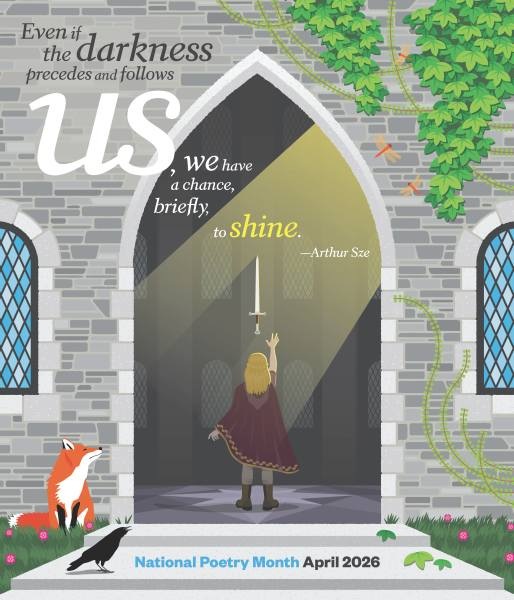
No chord sheet today, but this gives me a chance to say how much I love the Arthur Sze quote used on this year’s poster that speaks to what this Project hopes it’s doing.
.
Now, is Ogden Nash as essential as those poets? I’m not making that claim, but he can still be a whole lot of fun. What I have said, and still fervently believe, is that we harm poetry by worrying too much about “not-great poetry.” Because literary poetry now has a historically low presence in American culture, we may feel obligated to guard against a Gresham’s Law defacing its value. I question that tactic. I think vibrant arts are happy with all kinds of expression, and even if one’s aesthetic has constructed a defensible hierarchy, there’s room for vin ordinaire.**
So, I’m for intervals of fun, and “Adventures of Isobel” is fun, and I’d suspect even the toddler depicted in Nash’s mock epic might enjoy it once they become self-conscious – but there’s more: in our current times isn’t it good to revisit the stubborn “it’s not for me” or “you don’t scare me” bravado of the poem’s heroine? Those Americans recently pictured, standing up at streetside in their bathrobes (adult jammies, missing the bunny rabbits and shooting stars) as flack-jacketed masked federal troops are arrayed about them could be reviving that spirit. I often wonder about conscious intents and purposes that I speculate are found implied in poems I write about here. I can hear other intelligent readers – even the poets who wrote them – laughing at what I see under the poems. I may be subject to seeing shapes in clouds and tricks in the shadows, but were Nash and his muses just writing a funny poem with some jokes and outrageous rhymes to momentarily amuse a reader in 1936?*** Or did something compel him to prophesize: “You’ll be called the Greatest Generation. What’s fearful now will be yet more so. Look at how your kid takes on that which disgusts her, or demands that she mix fear with respect. You know that stuff is actually scary – but you’re going to need that.”
Alternate voice, and frequent keyboardist here, Dave Moore took a crack at Nash’s poem as a song to his music a few years ago with the LYL Band. I quite liked his take on it, and for today’s presentation I remixed the recording of that performance fixing a couple of things he and I thought didn’t work. You can hear it with the audio player below. Has the audio player fled, pursued by a bear? No, it’s just that some ways of reading this blog suppress showing it. There is a bear, but it won’t mind if you use this highlighted link to open a new tab with its own audio player to hear the song.
.
*Untermeyer also includes work in his anthology by Nash’s contemporary in between-wars light verse, F.P.A., as well as his own parodies of other poets, one of which I’ve performed here for the Parlando Project. I loved this Untermeyer loving parody of Walter De La Mare!
**There could be an argument against my stance based on overwhelming oversaturation. I worry that’s the case with music today. We have made its creation and distribution so trivially easy (something that happened even before the onset of AI) that we now have a market were new music qua music has a tough time finding traction. Visual capital (youthful good looks, sexual attractiveness, elaborate stage shows and video) becomes a requirement – not just an advantage – to bring forward a substantial audience. I don’t believe this is the case with poetry. With the exception of song lyrics in their ears, the modern literate person is likely to go for extended intervals without encountering any poetry whatsoever. And did Nash, F.P.A., or Untermeyer’s japes waylay readers from reading the canonical “great poets” of the 20th century?
***This year indicates that today’s poem is not clearly in the public domain. I normally refrain from using non-PD work. I plead good intentions toward keeping Ogden Nash’s work in mind and the Parlando Projects educational and entirely non-revenue practices.
By and large Halloween is a fun holiday, so as we continue our Halloween series here let’s have some fun with a classic poem of intimated horror — or rather a parody of same.
The man supplying our fun is Louis Untermeyer, an American 20th century poet, critic, and anthologist. And his subject? To stitch together a strange parodic monster using the nursery rhyme “Jack and Jill Went Up the Hill” with De La Mare’s poem “The Listeners.”
Untermeyer figures that if De La Mare’s tactics can make a man on horseback knocking and getting no answer scary, then it just might work to make a children’s poem a thing of considered horror. Well, unanswered doors, if not things of terror, are a matter of disappointment for trick or treaters, so maybe “The Listeners” has a built-in advantage as a Halloween piece? Let’s see what Untermeyer can do with his mashup:
I made an unusual choice for musical variety: the instrument playing lines in the left channel, including the A# G# F# motif at the start of each verse is a Bass VI, not a conventional electric guitar..
.
I decided to play it straight on my performance of Untermeyer’s parody, as if it’s as bleak a tale as the old murder ballad “Pretty Polly” — only with a water-pail and a dreadful accident instead of homicide. If I was to have Alfred Hitchcock drolly appear at the end of my performance, as he would in his TV show of my youth,* he would explain that local search and rescue units found Jack and that he’s recovering — but during that event they tested the water in the hilltop well and found it subtly yet dangerously poisoned.