The song below using the words of William Butler Yeats had a direct, contemporary inspiration: John “Paddy” Hemingway died this St. Patrick’s day. He was Dublin born, and in Dublin he died — and he was in the news because he was the last surviving RAF pilot from the Battle of Britain during WWII.
Reading the notice, I immediately thought of this Yeats poem, about a fatalistic Irish pilot during WWI who flew into battle having no love for the British Empire. John Hemingway’s Wikipedia summary mentions nothing about his weighing of the enormous risks he took in RAF battles, but a recounting of the number of times he was shot down and got back to flying again makes me think he’d accepted his death as a probable result of his service. Fate had sport with him, he lived to be 105.
Not much research required in this case, it’s widely recognized as a poem written as an elegy to a particular doomed Irish Airman, Robert Gregory, the son of a friend and ally of Yeats, Lady Gregory.
I know nothing of how this poem was received by the mother who’d lost a child. Yeats portrays a peculiar heroism with the poem’s subject. Using only the evidence within the poem’s boundaries, it’d be a fair reading to say that the titular airman here was driven to mortal combat because there was no hope otherwise in his country’s situation. Another reading, more specific to the man Yeats had in mind, might be that the airman was drawn to air warfare for the pure sport and sensation of it, but that latter reading still incorporates, if not an outright death wish, a sense that the most intense love of the moment asks for an acceptance of imminent death. So, an odd poem, poised between self-destructive despair and dark romantic thrills.
Well, whatever — it is a poem by Yeats, so of course it’ll sound wonderful, and reading it on the page will cause any number of its silent readers to want to sing it. After I completed my version, I listened to nearly 10 other musical versions, yet I still hope that my version isn’t superfluous.
Here’s the chord sheet for today’s song version of Yeats’ poem. Feel free to improve on my attempt. As I play it the G and A chords in the last line of each stanza are played at the 3rd & 5rh fret positions.
.
I chose to make my song entirely jaunty, a reverse of my minor key remembrance in the E. E. Cummings Spring poem last time. That doesn’t mean I want the listener to take it as a recruiting poster or an endorsement. Poetry is portraiture you can feel in your ears or breath, but you’re still allowed to think. Whatever his internal motivations or conflicts, the singer of Yeats’ words seems proud of his choice. John Hemingway likely thought he was in for the same deal that Robert Gregory signed up for. Fate laughed. Reports say Gregory, the brilliant Irish WWI flying ace, may have died either from friendly fire or pilot error secondary to a case of the flu. Another man, a proudly stupid one, once said that he liked pilots who didn’t get shot down. Hemingway, as it happens, was shot down several times in WWII, and yet had decades to live other pleasures I’d find more delightful than combat. And that otherwise unrelated man, the one who truncates his thought, but not before he asks to be judged by his judgements — how is he weighed?
You can hear my performance of Yeats’ “An Irish Airman foresees his Death” with the audio player below. No player to be seen? You can hear my performance stored somewhere in the clouds above by clicking this link, which will open a new tab with its own audio player.
My feature this February has been centered around an Afro-American scrapbook entrusted to me after it was found in a crawlspace at a former South Minneapolis rooming house in the middle 1970s. This series has taken me away from the usual Parlando focus, which is combining literary poetry with original music in differing styles. If you’ve been missing that, look to the bottom of today’s post — I’ll have something new for you today.
This exploration has taken a tremendous amount of time and effort, and I sometimes doubt how many readers will share my level of interest in looking back at what’s in and surrounding that scrapbook. It seems worthy of notice to me, and that supports my mind and heart work in this month’s effort. I did warn at the start of this series that what I’m writing here is coming fresh from an examination of the scrapbook, and some of my findings will be preliminary or subject to better evaluation — even little things in this larger than usual collection of writing. I just finished fixing a handful of typos on the previous episode that escaped my eye last night before I went to sleep, and now it’s time for the next one.
As a document the scrapbook spends a lot of time in the World War Two years. The book’s leading man, guitarist and singer Hank Hazlett, got his big show-business break then with the Jazz quartet The Cats and the Fiddle,* and the scrapbook evidences notice of the war in the things its maker chooses to include.
Here’s a Roy Wilkins column collected by the scrapbook maker rejecting racial prejudice in the US armed forces published during the war.
.
And here are a few more war related clippings in the scrapbook.
.
Another war-related story included in the scrapbook is a newspaper clipping that tells us of the Hank Hazlett era Cats opening for and then backing Lena Horne in a musical appearance in front of a hospital’s wounded soldiers. The Cat’s opening set was “Stomp, Stomp,” I Miss You So,” “Straighten Up and Fly Right,” with “Another Day” as their encore. With Horne at the mic, the combo supported her singing “Sometimes,” Stormy Weather,” and “Honeysuckle Rose.”
.
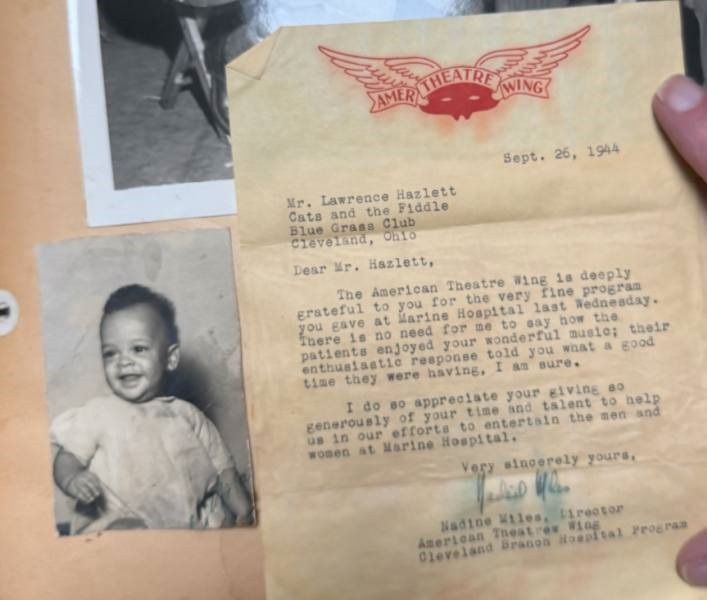
Having this dated letter from 1944 pasted next to the baby picture opens a theory regarding a possible child of Hank and Edith that I wrote about yesterday. A 1940s child could be part of Hank’s deferment, could be the right age to write Felicia’s letter to Daddy a few years later quoted in yesterday’s post, and later yet could also be a young, teenage woman, the subject of another picture in the scrapbook. That the thank you letter is addressed to Hank indicates to me that he might have been the de facto bandleader for the Cats and the Fiddle during his time with them. He was likely 6 or 7 years older than the other Cats in addition to taking the place of their regular lead singer — so, that role might have fallen to him.
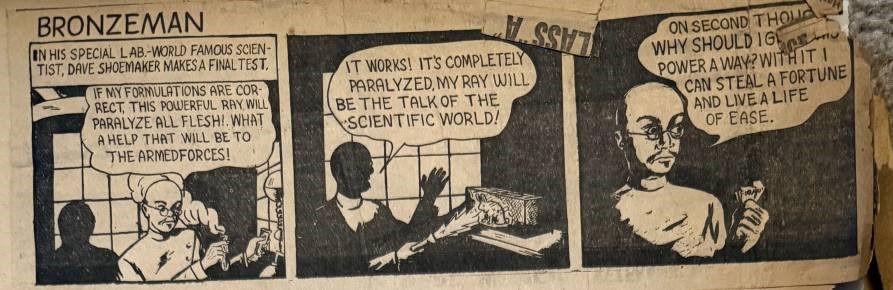
A strong theme throughout the scrapbook is Afro-American pride and their struggle for equity in the arts. Many clippings demonstrate that the maker of the scrapbook was concerned with the stereotyping and constraints on Black entertainers and some clippings celebrate their achievements in overcoming that. Here are a few of those items from the scrapbook:
Did a bronze man create this? Yes. A.C. Hollingsworth created Bronze Man in Blue Beetle #42. As in Paul Laurence Dunbar’s famous poem, he was to “wear a mask.” Publishers changed things though. See this link.
.
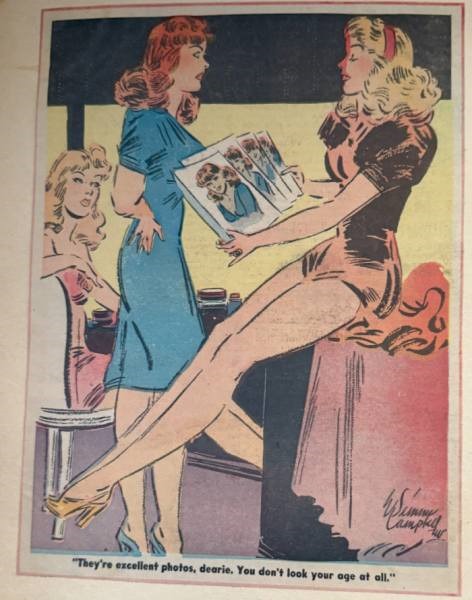
I wondered about a series of cartoons in the scrapbook. All white characters, nothing about music. What was the reason the scrapbook took note of them? The cartoonist E. Simms Campbell. was the first Afro-American cartoonist published in the big time U.S. “slick” magazines. His Wikipedia page says his work appeared in nearly every issue of Esquire magazine from 1933 to 1958, and in many other publications.
.
.
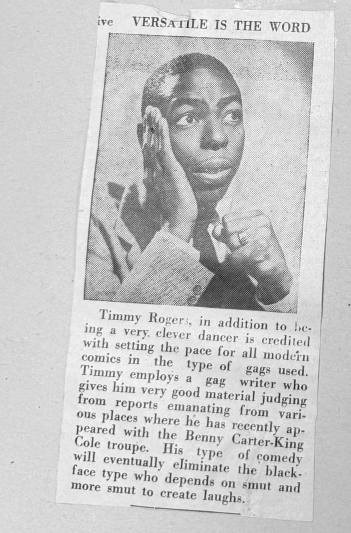
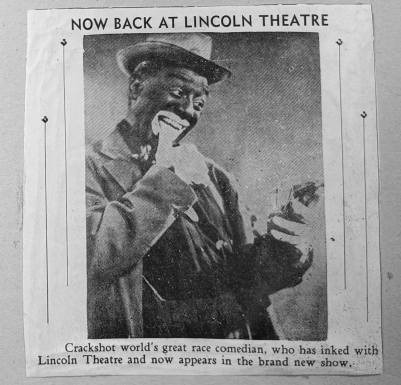
Dialectic, but make it funny: the clipping tells us Timmy Rogers was a Black comic who wanted to move beyond the blackface fool stereotypes. More info on Rogers. I can find nothing on Crackshot, though he’s given his clipping in the scrapbook too.
.
The entire multipage program for this landmark stage production starring the multi-talented Paul Robeson was pasted into the scrapbook.
.
Lena Horne, Dorothy Dandridge, and Butterfly McQueen. Three black women in entertainment who needed to struggle for non-stereotyped parts in the ‘40s. And keeping with our WWII subject, here are the Cats jamming with a white G.I. on bass. The armed forces may have been segregated, but music has established a beachhead. I note too, the scrapbook maker is paying considerable attention to women in the arts.
I knew about Lena Horne and Paul Robeson.
I knew about Robeson, Horne, Dandridge et al. I’d never heard of Pearl Primus before this month’s examination of the the scrapbook. Her Wikipedia entry tells what she did. This, Robeson’s Shakespeare, and the comics artists above are examples of how the scrapbook’s maker wasn’t just interested in music, but had a broad interest in the arts.
.
Our summary today: not all warriors carry a gun. We’ve had war today, and prejudice, and stereotypes — and me writing a bunch more words (with maybe fewer typos). So, let’s have a little music, and poetry — and love not war. Here’s a poem by Afro-American poet Alice Dunbar Nelson written in the last decade to be called The Twenties. This may be Black History Month, but all I read next to my breakfast each morning this month is telling me that the nonsensical denigration of Black American military and cultural contributions along with a side-helping of gay panic isn’t history, just as it wasn’t history to the maker or makers of the scrapbook. To hear Dunbar-Nelson’s poem “You! Inez!” as I sang it to music composed today in-between typing this, you can use the audio player gadget below. No player? Elon hasn’t fired it, it’s just that some ways of viewing this blog suppress it. This highlighted link will open a new tab with its own audio player.
.
*A founding member and most often featured singer of the Cats and the Fiddle was drafted. The scrapbook doesn’t deal with this, but I did wonder why Hank or other members of that quartet weren’t drafted. Hank Hazlett was born in 1911, and in 1940 he’d have been 29. The WWII draft was different than the Vietnam draft I’m most familiar with — in my day, most called up were younger than 27. In WWII draft men up to age 35 were commonly drafted. I only know the age of one of the original Cats quartet, but the bass player would have been 22 in 1940, and since the original quartet all knew each other from high school, I’m assuming they were near the same age — yet, as far as I know only Austin Powell was drafted. This is a complicated subject and we know so little about the men in the Cats. There were classes of deferments for various reasons, and even stories that some draft boards didn’t want to draft Afro-Americans for Jim Crowish reasons — this even though the Armed Forces were segregated throughout the war. There were also stipulations for physical condition that histories tell us bedeviled the system during WWII. One oft cited report had it that in the draft first year, 1940, “nearly half the men drafted were sent home” for not being fit enough for service.
Or course a great many Afro-Americans did work in war-industry, or were drafted or volunteered for the military, despite the Armed Forces still hewing to the Jim Crow segregation/white superiority regime of mid-century America.
Let’s open the scrapbook we’ve been talking about this month and look to see what it shows us about the beginnings of its central subject: the guitarist and singer Lawrence “Hank” Hazlett who’ve we know was a sometime member of a Jazz guitars-with-standup-bass quartet The Cats and the Fiddle. From previous posts in this series we know the Cats started in Chicago with a group of musicians that knew each other from high school. In 1937, while group members were not yet out of their teens, they left Chicago for Los Angeles and Hollywood where they managed to perform in a couple of small movies as themselves while also snagging a few appearances as extras in larger budget motion pictures. In 1939, back in Chicago, they get a contract with Bluebird records and start recording their material, most of which are short, self-written and self-accompanied songs, featuring Swing-Era hep-cat outlook, humor, and slang. Signed to the William Morris talent agency, they begin touring nationally.
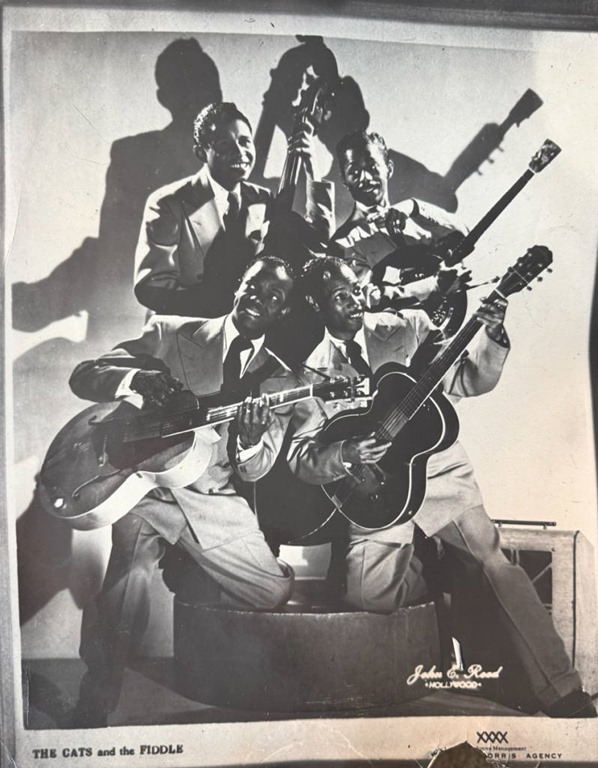
I have not seen this picture elsewhere outside of the scrapbook. It shows the act as still represented by William Morris. The shadowy photography here of a dark skinned face in the lower left doesn’t make it certain, but this could be a rare promo shot of Hank Hazlett with the WWII-era Cats without their leader Austin Powell.
.
As far as the scrapbook’s scope goes, Hazlett barely appears before joining the Cats midway in the combo’s career. The earliest thing the scrapbook has on him is a well-worn U.S. Employee Service Applicants Identification Card for Lawrence Hazlett. The card gives his address as 5159 Prairie Ave, but there’s no visible city. That address exists in the L.A. area near Lennox and W. Century Blvd., but also in Chicago’s Bronzeville — so we could place Hazlett in either city the Cats were active in during the late 1930s. The card has him 5’ 10” in height, 147 pounds, and there’s a filled-in blank that has the number 24 — I’m guessing that’s his age. Given that Marv Goldberg has Hazlett as being born in 1911 in St. Louis, that would make the card’s issuance as around 1935, and from that approximate date the card could be a government form related to unemployment insurance or the New Deal WPA.* There are two blanks to enter in “ssification” which I read as classification, a P. and S., with that second filled in as a “Jr. Artist.”
Anyone know more about this kind of ID card?
So, here we have the earliest thing I know for sure about the scrapbook’s leading man: a slip of paper from before the Cats and the Fiddle existed that says Hazlett may have pursued a career in art circa 1935.
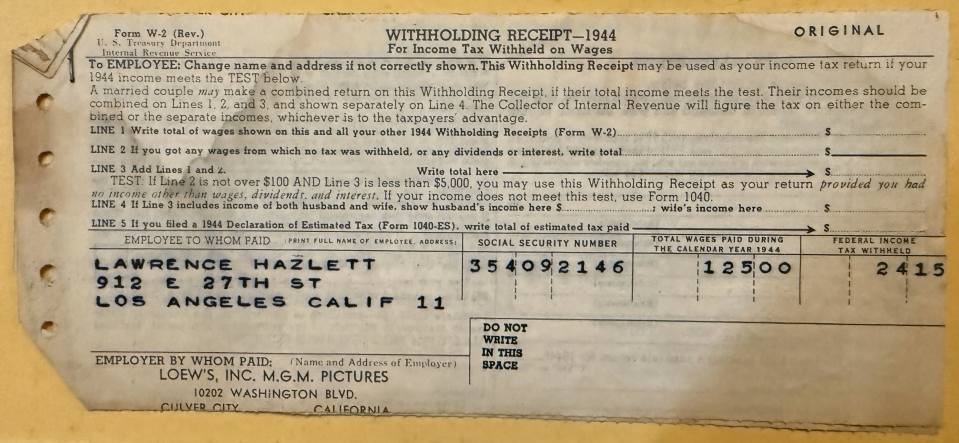
Histories of the Cats and the Fiddle tell us that in 1943, Austin Powell, the most often featured lead vocalist of the all-singing and all-playing quartet was drafted. This would be a serious blow to the group. Recordings were scant during the war years, but the act was touring and likely had gigs to meet. Hank Hazlett is selected as Powell’s replacement. Like Powell he played guitar, and evidence suggests he may have been at least Powell’s equal on that instrument.** I also assume he was a good singer with some on-stage showmanship. We don’t know where Hazlett joined up with the Cats, but it’s likely in Chicago or L.A. We have one other document in the scrapbook with a firm date around this time, a W2 for the year 1944 which shows Hazlett earned $125 from Loews Inc, M.G.M Pictures of California giving Hazlett’s address then as 912 E. 27th St. in L.A. This might have been for work as a movie extra or musician.
Extra in a movie? Soundtrack work? Movie theater appearance?
.
There are clippings and a few photos documenting the 2-3 years Hazlett was a member and touring with the Cats and the Fiddle in the scrapbook. Here are a few of them.
Some of the places and bills as Hazlett toured with the Cats and the Fiddle 1943-46. In the upper-center photo that’s Hazlett on the left playing a guitar that may be the one in the promo shot above.
.
The hypnotist Capt. De Zita’s work? Typo on the headline and dubious hype that the Cats and the Fiddle are appearing in person in L.A. for the first time in 1944
.
In 1946, Austin Powell is mustered out and returns to the group that is still working though not breaking through to upper levels of fame. Having the original lead singer back doesn’t seem to revive their career fortunes, though the act will continue until 1950. As far as anyone knows, Hazlett’s tenure with the Cats and the Fiddle ends when founding and featured member Powell comes back.
Hazlett seems to remain a professional musician though. There are new promo pictures made, taken by a Chicago-based photo studio for a new act: upright bass, piano, and Hazlett on guitar: the Hank Hazlett Trio. What we can see of them in the scrapbook is our topic for next time.
.
*I’m thinking more likely the WPA. The Works Progress Administration was a unique New Deal program to counter the Great Depression. In sites around the country it gave jobs to workers, writers, actors, musicians, and artists to produce or teach various projects and works of art. I know little about Hazlett’s family or situation growing up, even how long he was in St. Louis, his stated birthplace. His place of death was Los Angeles in one report I’ve seen, so he may have some connections there. It’s only a feeling, but I’m guessing he may have had a middle-class Black family with exposure to arts and culture before we find him in the scrapbook as a nationally touring musician.
If I hold to my current plan, there are going to be several more posts this February as I tie up this series dealing with an Afro-American scrapbook found at the house I stayed at when I came to Minneapolis in the 1970s. Those missing the Parlando Project focus on literary poetry combined with original music here should eventually get a return to usual service before the start of U.S. National Poetry Month.
So, that scrapbook, the thing in the middle of this series — I talked to Dave Moore who bought an old South Minneapolis house in 1975, about its discovery this week. As we learned last post, 3132 Park Avenue was originally built as the sort of house for an early 20th century businessman or upper-middle-class family: four large bedrooms on the second floor, spacious rooms on the first floor (two of which could be joined by opening a pair of large pocket doors) and a separate interior set of stairs to an attic third floor which may have been designed as quarters for live-in help. I summarized the house’s history last time, including that from the 1940s on, the house had a succession of tenants after its long-time grain-trader owner died in 1939, eventually becoming a rooming house catering to Black residents. Shortly after moving in, Dave was on that third floor, and he noted a small, about 3×3 foot, access door on one wall where the slope of the roof descended to less than full height. Opening the door, he crawled inside. It’s been decades, but Dave is pretty sure that the scrapbook was found there. “Anything else in there?” I asked him. “I remember an old carpet sweeper.”
The house still had furniture when Dave decided to buy it. By the time he took ownership the real-estate firm had taken all of that out, emptied the house — so for the scrapbook to have survived, it was lucky to have been secreted in a crawl space. Did its owner or creator hide it there? Who could that person have been? Today I’ll give you my best guess, and in following days you’ll get to look inside the scrapbook to see the clues that led me to that guess. In looking at what the scrapbook includes, you’ll get to look inside a particular document of what had the attention of a 1940s American Black person.
My initial guess, back when Dave gave me the scrapbook in the ‘70s: I figured it was made by a fan of Jazz music, then the popular music of the 1940s. Noting the movie and performing stars pictures clipped from entertainment magazines and newspapers — and that it was after all a scrapbook — I thought the greater probability was that it was a woman. Scrapbooking is not something that many grown men engage in, and so I imagined a young woman entranced by performers.
Later as I found out more about the Jazz-vocal-quartet The Cats and the Fiddle who figure prominently in what was chosen for inclusion in the scrapbook, I changed my theory. I learned that a man named Lawrence Hazlett (who professionally went by the name Hank Hazlett, and whose last name has been misspelled as Haslett and Hazelett) had been, during the 1940s, a member of the Cats and the Fiddle. I’d overlooked personal items pasted in the scrapbook connected to Lawrence Hazlett that a mere music fan wouldn’t have: his 1944 pay stub from MGM, a Department of Labor ID card. Hazlett was born in 1911 in St. Louis according to Marv Goldberg’s info. He may have lived at times in Indianapolis, Chicago, Minneapolis, and Los Angeles.* I changed my mind. This was a musician who was scrapbooking his career, and Hank Hazlett was that musician. At the start of the month, that’s what I thought I’d attribute the “authorship” of the compiled material in the scrapbook to.
I’ve now changed my mind again, due to this month’s research and closer re-examination of particular items included in the scrapbook, and my plan is that you’ll be looking over my shoulder at items in the scrapbook as I examine them in the next posts. These items engendered feelings, hunches — my attempts, however imperfectly but empathically, to think of why certain things were chosen to be saved and pasted on pages.
My current theory is that the scrapbook was made by a wife of Hank Hazlett, likely a woman named Edith I. Hazlett, with his collaboration.** If, instead, it’s my previous working theory that it was Hank himself documenting his life, the choices made in collating the material in the scrapbook would make him even more fascinating to me. The author (or collaborating authors) are more deeply and widely concerned with Black artistic expression than I would think most musicians were in the 1940s. There’s an undercurrent of feminist thought that can be extracted from some items in the scrapbook,*** though that may be a reflection of the decade of the 1940s when so many men were mobilized and out of the country. And dare I say it, at times there’s the slightest hint of gender non-conformity there too.****
It looks like the maker of the scrapbook altered the brand name of the now tattered scrapbook to Hazlett. The TV Troubleshooter booklet won’t tell you how to block annoying YouTube ads, nor offer fool-proof password sharing schemes. The torn photo may be a South Minneapolis snapshot of Hank Hazlett. Someone has to take snapshots (no selfies then) so it could be a clue that Hank isn’t the sole creator of the scrapbook.
.
Guitarist and singer Lawrence “Hank” Hazlett lived in the South Minneapolis neighborhood that the scrapbook was found in from 1953 to at least 1963. He worked steadily there as a musician, leading his own Hank Hazlett Trio for most of that time, and at least occasionally playing with other groups. Minneapolis city directories and some online histories of the Minnesota music scene document this information. But there’s a strikingly absent bit of data there: he’s never shown as living at 3132 Park Ave where the scrapbook was found. Instead, he was consistently recorded in city directories as living six blocks away at 3648 Portland Ave. Starting in 1953 and 1955 Lawrence Hazlett is listed as a musician at that address, and his wife is named as Edith. In the 1957 directory Lawrence Hazlett is missing from the directory listing, but a Mrs, Marian M. Hazlett is listed as living at that address. This continues in 1958 with Lawrence listed as the head of household and Marian as his wife onward to the last Minneapolis city directory in the Minnesota Historical Society collection, Marian is also identified in one directory of this era as working at the Minneapolis Public Library. So somewhere in the mid-‘50s, it appears that Lawrence has a different wife. There are no firmly dateable items in the scrapbook that can be fixed after the middle-50s. There are a couple photographs that could be estimated (from woman’s clothing styles) as early 1960s, so I can’t eliminate Marian the Librarian as the collaborating collator, but the masses of things from Los Angeles including current events clippings from the ‘40s indicate the book may have started before Hazlett or his wife were known to be in Minneapolis. In my ranking, Marian would be third on the list after Edith and then Lawrence/Hank himself. In this theory, Edith may have stopped using Hazlett as her last name and ended up at the 3132 Park address in its Black rooming house phase, carrying with her the scrapbook of her days in Hollywood and the following years in the musical scene in Minneapolis with Lawrence/Hank.
In the next few posts we’re going to take a ride through the crumbling pages of this scrapbook in detail. The details will go a lot of places. If you haven’t figured this out about me yet, I love that about details.
.
*The scrapbook has material listing addresses in LA and the Portland Ave. address in Minneapolis, and no other cities are explicitly listed as residences for Hazlett there.
**One surmise: Lawrence/Hank had off-handily collected stuff during his career, and his wife, seeing the value of what her husband did, decided to use a scrapbook to organize and present it, melding him in with other national entertainers. This might explain why things like publicity photos for line-ups of the Cats and the Fiddle dating from before Hank Hazlett was a member of the group are in there. That could be read as expressing symbolically “Here’s my husband, he’s good enough that they asked him to join this nationally-touring Jazz vocal group.
***There are also elements of laddish/Benny Hill-type sexual stereotypes in some cartoons — items that led my switch of maker-attribution to Lawrence/Hank — but the history of the cartoons broadened my understanding of them.
****Better scholars than this amateur, Afro-Americans who know by living things I’m ignorant of, or anyone who may have known the now dead people in the scrapbook may know better. I’m just an open-hearted person looking at this stuff and writing of my experience of it. I’m going to share an opportunity for you to do the same as the series next continues.
Here’s another lyric of Waring Cuney’s used on Josh White’s 1941 record Southern Exposure. Before I get on with presenting the song, let me briefly review who White and Cuney are.
Josh White was a Black American singer and guitarist who usually performed in the Afro-American Blues style. The Blues was a popular musical genre among Black Americans during the first half or so of the 20th century. During that century, some of the musical ideas and a great deal of the outlook and performance style of Blues were gradually absorbed into general American musical culture. As another Blues lyricist, Willie Dixon put it: “The Blues had a baby, and they called it Rock’n’Roll.” And so, when I was a young man, there were numerous young acts seeking to call attention to the centrality of Blues music to Rock music. However, most of these then young musical artists, like the majority of their audiences, were white. Unluckily, Josh White’s relationship to the Blues and it’s audiences was essentially premature — he was a man before his time.
Though White was a fine guitarist, singer, and performer who could have scuffled on the segregated Black performance circuit, for a complex set of reasons he became associated with the American political left and its largely white “Folk Music” performers. There’s a fascinating story on how that came to be that I can’t fit into a short blog post, but the shortest summary I can make of this is that equal rights for Afro-Americans was taken up as a left-wing cause, even more specifically as an American Communist cause, after the Lincoln-Grant Republican party became estranged from energetic advocacy for those rights. In the 1930s-50s era White performed for mixed, largely white audiences associated with the Left, while his contemporary Black Blues artists performed to overwhelmingly Black audiences. Want to know more? Here’s a link to an excellent blog post by Elijah Wald that explains how this premature Blues cross-over complicated White’s career. TL:DNR? Because he crossed-over before the Sixties, he was somehow considered inauthentic.
A later re-issue of the White-Cuney Southern Exposure record
.
Waring Cuney, as this month’s readers of this blog know, was associated with other young artists of the “Harlem Renaissance” even though his name became lesser-known than his colleagues. Always musically interested, he lent his poetic skills to White’s 1941 Southern Exposure album. Today’s selection, where I perform one of his lyrics from that with my own music, deals with a specific area of equal-rights advocacy for Afro-Americans: military service. In 1941, the American military was segregated, and like America in general in this era, the dictum “separate but equal” was largely an absurd charade, easily tied to pervasive white supremacy and ideas of Black inferiority. Ugly stuff — but in the era just before America entered into WWII, also stupid and counterproductive.
I’m going to oversimplify and compress again, but during the Civil War and in WWI segregated American Black soldier companies had proven their abilities as fighting units, but in the between-the-wars era the US Military had reduced itself to something reflective of the plantation South or the servant-class North. Roles for Afro-American military personnel were limited. Cuney’s “Uncle Sam Says” is a prophetic smart missile aimed at that situation. How so?
It’s a four-verse song, but let’s get on to how Cuney is able to foresee or encourage three things that became current events in the months around when White recorded his singing version of Cuney’s words.
Verse one: Black folks can’t fly combat airplanes. That takes a skilled knight of the air in the mind of the prejudiced. In the same 1941, an Air Corps unit was formed that became known as the Tuskegee Airmen. Yes, it was a segregated all-Black unit, but by 1943 they started proving their mettle.
Verse two: this one is almost eerie. American involvement in WWII combat began with the attack on Pearl Harbor. Aboard the battleship West Virginia there was a messman’s mate named Doris Miller who just before the enemy warplanes arrived was serving breakfast — as Cuney’s lyric says “Keep your apron son.” Miller was a big guy, fullback on his Texas high school team. He was deputized to help carry wounded out of fire and to aid stations on the ship while it was under attack, which he did, including being called on to carry the dying commander of the battleship to treatment. In the midst of this someone directed him to an unmanned machine gun. Miller had no machine gun training — remember, subservient roles in this Jim Crow military — but he’d hunted squirrels, and taking charge of the gun it’s said that he downed between 2 and 6 of the attacking aircraft.
Verse three: while the US hadn’t entered WWII when Cuney wrote his lyrics or when White sang them, the lyric’s prophetic claim that “when the trouble starts, we’ll all be in that same big fight” isn’t as specific as the opening two verses’ charges. Still, it’s a good point. Also note: when blindered folks maintain that the struggle for Afro-American civic equality is all about “privileges,” that it has also historically been a struggle for access to civic responsibilities too.
The last verse issues the call to action and wraps up this effective “message song.” I performed it —that’s a regular part of my encounters with the words this project explores — but if you’d like to hear Josh White’s original version here’s the link to his. The player gadget for my version is below, and if you don’t see that, here’s a link to my version. I have one more example yet from the young Black poets who published Fire!! planned if situations allow me this month, so follow this blog or check back for that.
It’s been sometime since I’ve posted here. Having fewer blocks of uninterrupted time to compose and record the audio pieces for this Project, I’ve spent time instead with that proudly designed to be a time-waster Twitter in the past week or so. Twitter* has its own news stories this week — but that’s not my subject today.
I have a tiny number of followers there, and what I tend to talk about on Twitter is poetry, and then less-popular types of music. Really, not unlike what I do here on this blog, but more cut-up and off-the-cuff — and with more typos from typing on a small tablet screen and screen-keyboard. While working with poetry and music might cross-train you to fit things into constrained spaces, the Twitter short post-length limits challenge even this fan of compressed verse and sub-1000-word essays.
I came upon this Tweet this morning though that brought to mind something I’ve not revisited here on the blog for a while. One of the regular Twitter poetry-posters put up the devastating Wilfred Owen poem “Dulce et Decorum Est,” and I once more thought of how powerfully the soldier-poets of World War I wrote about their war from the front lines — how to this day England recalls what they said combined with their presence as example casualties from that war, and in the sum, the tragedy all that entails. Long-time readers of this blog will know how thoroughly I’ve extracted poetry from WWI for presentation here.
Here’s a picture of a specific memorial to WWI poets in the Poet’s Corner of Britain’s Westminster Abbey
.
Perhaps it’s the Public Domain limitations of what can be freely reused in a Project like this, which puts my attention on pre-1927 work — but I was caused again to wonder, why don’t we have dozens of effective poems about WWII, many of which will be commonly anthologized and recalled by the general audience poetry retains? If called to find examples I might start (as would many others) with Auden’s “September 1, 1939” — but this isn’t a first-person “report from the front lines” poem like Owen, Sassoon, or T. E. Hulme presented back then. It’s not even as close to harms way as the incisive poems of Edward Thomas who wrote about his approach to volunteering for the British Army that led to his death in the conflict, or Apollinaire’s equivalent to Auden’s poem about the outbreak of WWI, “The Little Car.” It’s not that poets or writers didn’t serve, and a great many novelists who served had a war book in them it seems.** So, we can easily think of the novels about WWII written from frontline experience. But poems?
Was WWI poetic and WWII novelistic? I can’t make that case. Maybe you can. Is it down to the changes in the literary marketplace? Plausible, though within poetry’s more limited audience in the second half of the 20th century you think there’d be room for poetry as vivid as those of the WWI soldier-poets. Here’s a short list of a few of the notable American poets who did serve in WWII: James Dickey (Air Corps airborne navigator, though some reports say fighter pilot), Richard Wilbur (Army Signal Corps in Europe), Frank O’Hara (sailor on a destroyer in the Pacific), Richard Eberhart (gunnery trainer), Lawrence Ferlinghetti (Captain of a submarine chaser), Karl Shapiro (medical corps clerk in the Pacific theater), Kenneth Koch (infantryman in the Philippines), Randall Jarrell (“Celestial navigation tower operator,” which he claimed was the most poetic job in the Air Force).***
What happened? Why didn’t more of these poets write more about the details and moments of their service? My general observation is that instead they wrote consciously and unconsciously about how the war changed their outlook on the world. David Haven Blake wrote a short journal article on Wilbur’s World War II poetry, but instead makes the case more for this theory. He quotes Wilbur as saying “The war challenged me to organize a disordered sense of things, and so prepared me to write a poetry of maximum awareness and acknowledgement.” I’ve seen another quote from Wilbur circling the same thought “One does not use poetry for its major purposes, as a means to organize oneself and the world, until one’s world somehow gets out of hand.”
This non-scholar will now generalize wildly, but the WWI war poets used poetry, often structured metrical/rhyming poetry, to demonstrate the world out of joint, a genteel form container for barbarity and chaos. The WWII poets muted all that as unspeakable (or even over-spoken?) and sought to portray in poetry (that wasn’t always as formal) the values and observations of a peacetime more precious, however ambivalent and imperfect, from the militarized brutality of combat.
Let me dedicate this little essay to Robert Tallant Laudon. Laudon sought out the Lake Street Writers Group early this century as an 80-something veteran who had served in a logistical role in England during WWII. Though he became a music professor after the war, he seemed not completely sure of his skills as a poet, but he wanted to use poetry to portray something of his experiences during the war. By the time he was 86 he published a small chapbook “Among the Displaced — World War II” with the resulting poems. I now view the younger me who heard him workshopping drafts of these poems as a much younger man than I thought I was then. Such is the progression of age! His poetry, like much good poetry, was written in an immediate present while depicting the 1940s, and I’ll always treasure that experience.
I mentioned at the start no new music, but here’s a piece, a “found poem” I created out of a recorded interview with another music professor, Weston Noble, who had served in WWII and which I set to my own music early in this Project. The voice you’ll hear in this must-listen-to piece is Noble’s. He commanded a tank in Europe during that war. In other parts of that interview, he recalled that when under fire, another member of his crew would ask him to sing. Inside that steel turtle shell the war outside existed mostly audibly, and the fate of those vibrating inside was unsure. The voice of Noble somehow calmed his crew. And this person now, here, who writes this? I’m still afraid to sing, worried that the unpleasant sounds that I too-often utter will embarrass me and displease any listeners. When I hear this man, now far in age from the war he fought in, decades from the interior of that tank, speak to the recorder of “The Garden of Trust” claiming that it can be found in music, I invariably start to mist up.
Listen to this two-minute audio piece with the player below — or if you don’t see it, with this highlighted link provided as a backup.
.
*A new sole-proprietor owner has led many — who have through long activity and posting on this online service built up it’s usefulness for themselves and others — to worry about its continued existence.
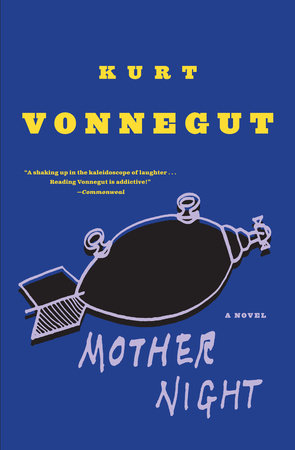
**Kurt Vonnegut did two WWII novels . One, Slaughterhouse Five, is one of the last first-person-experience-informed WWII novels, and another, Mother Night, is a personal favorite, and includes this WWII poem that this Project performed.
***I was able to start this list from an article on the Poetry Foundation’s web site linked here.
Even before I was interested much in literature, I developed a love for history. Today’s Veteran’s Day post will only briefly touch on literature, and instead offer a slice of history. Older readers may think they know all this, or know it better than what I’ll write today. Some younger readers won’t care, but perhaps a few will learn something they didn’t read or hear elsewhere. As with any short piece, I’m going to need to leave out many things. While this post was not written intending to be a puzzle, I noticed that one thing was left out of this Veteran’s Day post. By that I don’t mean some opinion or judgement, or even some biographic item — I mean a particular significant historical Veteran’s Day fact that I expect few will notice is missing. When I reveal it late in the post, I’m also thinking you’ll take that elision as something to consider.
So, a bit over 50 years ago there was a war going on, the Vietnam War. The way it was presented then: our great geo-political rival had invaded another country and we were morally obligated to resist that aggression. This doesn’t seem to have been the case, at least not in any way that could be simplified as such. Another summary would be that Vietnam had invaded Vietnam, as it had been doing since the days of WWII, seeking to become an independent country. In the course of things, they succeeded, and now are one of those more or less unremarkable governments around the world that may be good or bad to their citizens in some mixture that we don’t generally concern ourselves with.
This obligation eventually led to a considerable number of American troops fighting in South-East Asia, but luckily the post WWII Baby Boom had raised a bumper crop of what were considered prime fighting age 20-year-olds. I was one of them. Even though this was a war, there were only so many troops that could be used. The amounts that could be used were filled to a significant degree by draftees, young people conscripted (other words: forced, obligated, duty-bound) to serve in the military, and since there was a war going on, some percentage of those draftees would be asked to kill other people or to be killed themselves.
To a surprising extent, this was not remarkable then. I can imagine how many living adults now find that odd, what with present controversies about wearing cloth masks and getting vaccinations — as not only were these conscripted men plausibly in for the kill/killed experience, they were also vaccinated forthwith and forced to wear entire uniforms. And yes, in certain training situations they were instructed in how to put on masks.
I can say that as a teenager in that crop of draft-age men then, I thought about this, and remarked on it. Others in my cohort did too. But there were whole days when one didn’t think about it, and instead thought about sex, fun, school deadlines, the price of a pizza, the general meaning of life and what that meant for you personally, and so on and so on. Still, it was an issue considered by the young.
But no, in general the adult country was fine with this, and even to observable empirical level it was not the biggest deal for a lot of my immediate cohort. You see, I was in college, a small one in a not very big town in Iowa, and because only a certain number of troops were needed, college students were given “deferments.” They didn’t need to serve while in school, and if this was a political post one could get into why that might be so. I’ll also add that dropping out of school, or failing out, or being short of tuition funds, or just deciding to take a gap year — those things would make the draft imminent for a college student — but for college 20-year-old men it wasn’t a next Thursday kind of worry, though it could be a next year one.
Now I and a few of my friends did think this was a bad thing, the war, the draft — oh, and a lot of other stuff: racism, what recreational drugs were legal, female students having “hours” where they had to be back in dorms by a certain time each night. The “we should do something about this” group was probably around 5% of the student body at my college in 1968.
Then in the spring of 1970 something happened that surprised me. The President made public (as if it was a new decision rather than a more substantial incursion that couldn’t be kept secret) that US troops were going to invade countries next to Vietnam. To those who had been paying less attention, this seemed a sign that this was maybe going to be around a lot longer, like past graduation, with more draftees needed. Opposition to the war on college campuses had been growing for about a year, and this gave it another bump, and on an obscure Ohio campus, Kent State, this boiled over (as it occasionally had elsewhere) into disorder and vandalism which wasn’t enough to cancel classes, but was enough for the National Guard to be sent in.
Something happened, likely a confused Guard squad, and the Guard opened fire, A bunch of students got shot, some were just walking between classes — because again, whatever disorder this was, classes were in session — four died.
Of course, I was appalled, but did that surprise me? Not greatly. Even in my youthful life there had been the drumbeat of the civil rights movement martyrs and assassinations of Presidents and Presidential candidates. In my crowd the fatal Chicago police shooting of Fred Hampton was considered duplicated multiple times against the Black Panthers. And in 1969 there had been a shooting death in the People’s Park confrontations.
Here’s what surprised me more. Not only around the country, but in my little Iowa college, much larger numbers of students thought something had to be done right now about this. One by one colleges and universities suspended normal operations and any number of alternative actions were taken that spring. This was called a strike. Here’s something little remarked on about male students choosing to do this for what was then an unknown duration in 1970: it could’ve led to them becoming subject to the draft.
There are no pictures available of my 1970 memories, so the guy on the left will have to stand in. The statue on the right is a clue to this post’s subsidiary riddle. The Nov. 11th born veteran Vonnegut tried to speak between generations.
.
Ad hoc organization coalesced at my school and as I recall the one concrete action to “really do something” was to try to garner support for a federal bill that would restrict funding or expansion or authorization or some other matter regarding the war in SE Asia. The bill had been co-sponsored, or co-authored, or supported by one of Iowa’s Senators, Harold Hughes.*
Let me stop for a moment and get to a reason I’m writing this on a Veteran’s Day. Sometime, maybe a generation after these events, it became a commonplace that Vietnam war opponents, or college students, or hippies, or leftists, or some Sixties group hated soldiers in general. “In general” is a dodgy term, but I think it’s meaningful in this matter. I spent time with all those supposed soldier-hating groups, in both Iowa and New York (two fairly unlike places), and I never heard anything like that, not once. And it would have seemed so odd to me personally, that if I had heard it, I think I would have remembered it. And it wasn’t reticence or propriety that would have masked those feelings. Expressions against police were so common that I couldn’t count them then, much less now. And fairly soon, as early as 1971, I was running into ex-Vietnam era soldiers who could be put in those loosely defined groups above themselves.**
Back to working with this newly motivated group of Iowa college students who naively thought they had to do something right now about this expanding war. We were going to go door-to-door asking for folks to write letters in support of this bill. Now who takes point walking on a patrol, or even boring days painting what doesn’t move, or for that matter being under a napalm attack — this isn’t on that order (well, maybe the middle one is a little), but for some reason, I have memories of the few days I did this before leaving for New York. I believe now what we were doing was essentially meaningless, if the best we could come up with at the time.
In our door-knocking in town we might run into what was later called “The Greatest Generation.” Most said little to our spiel, but a couple of them, men, wanted to set us straight as to what we didn’t understand. Well, even then I suspected there were things I didn’t know, and now I can drop the suspected and replace it with certainty. The one I remember most vividly responded with a statement that I didn’t know what it was like to watch your buddies die.
I try to replay him saying that through the fog of the years. Although there was anger in it, I think it was a sincere personal statement. I often think since of what did that statement, however incongruous, mean? Did he mean that I should watch my buddies die? That that would be enlightening, educational? I don’t think so, no more than it was his considered opinion that such an experience had been worthwhile or ennobling for him. What he meant, putting my most empathetic interpretation on it, was that a certain sacrifice and commitment added something to one’s opinion on national matters.
More broadly though, his generational experience was why there was not a great deal of concern then, other than a slowly growing one among those of draft age, for the idea that young men could be conscripted to possibly kill or be killed. The Greatest Generation had faced the same sacrifice, and so this was normalized, not even Great yet, unexceptional. In the case of WWII good wasn’t a question, necessary was the question.
In those times, some in my generation eagerly latched onto WWII veteran Kurt Vonnegut’s books (and Joseph Heller’s Catch 22 as well) to portray everything else around the necessary part of WWII. They were our cross-generational allies in seeing and saying that war needed extraordinary necessity. Vonnegut even wanted to connect us 20-year-olds with his Dresden POW book Slaughterhouse Five, subtitling it “The Children’s Crusade” which had been a nickname for the 1968 US Presidential campaigning by folks often too young to vote for anti-Vietnam-war candidates, and which he then applied to the 18-20 year old range of his WWII cohort.
OK, what Veteran’s Day historical event did this old man leave out of the above story, dealing as it did with differences and connections between men serving in the Vietnam War era and those who wanted to end that war, and between 20-year-olds and the WWII generation then in middle age? I completed an entire first draft and didn’t notice it myself. And I’m not alone. American Veteran’s Day stories in 1970 and up until now almost always leave it out. It’s the Korean War. As with WWII, few living veterans of that war are left now, but it occurs to me that the fervent man at the door in 1970 could easily have been a Korean War vet. And in historical analysis, that war had as much or more to do with the missteps of the Vietnam War as WWII.
The musical piece today is another song from birthday-boy Kurt Vonnegut’s novel “Cat’s Cradle” in which his trickster guru character Bokonon muses ontologically. You don’t have to look up the word to appreciate this little song. Player gadget below to hear it, and if you don’t see that, you can click this highlighted hyperlink.
.
*I knew all those details then, even if I don’t remember them now. Harold Hughes is a little-remembered figure these days. Capsule description of Hughes: imagine if Johnny Cash had been a governor and then a U. S. senator. As to the general student feeling, I think it was close to how some people felt in the post-George Floyd murder reaction. The watchword was “We’ve got to do something.”
**Some of you may find this striking, The precipitating event of the college strikes of 1970 after all was men in military uniforms shooting and killing students, In this era, various acts were taken against what was considered part of the recruitment and processing of soldiers: draft boards, recruitment offices, ROTC buildings, that sort of place. I can’t know everything, but I never heard any of this characterized as “let’s go get those soldiers” and was more at “let stop more from being conscripted as soldiers.” Given human nature someone somewhere in 1970 may have said or thought that, but speaking of my experience: war-fighting soldiers were what we young men at that point increasingly feared being forced to become. Opinions differ on the nobility of those thoughts then and now, but we might have thought of cops differently if we knew that folks like us, and potentially us ourselves, might be forced to put on a police uniform.
Celebrating Kurt Vonnegut during this week that will mark the 99th anniversary of his birth allows two things to cross and connect, for he was born in 1922 on what would have been called Armistice Day then and will be called Veteran’s Day tomorrow in the US. Two decades later as a 20-year-old, he enlisted in the Army, served in WWII, and was rather famously a prisoner of war incarcerated in the German city of Dresden when it was subject to a massive firebombing raid from his own side.
As one might imagine that experience impressed itself mightily on Vonnegut, who as a writer eventually dealt with the matter in his best-known novel Slaughterhouse Five. But that was not his first novel to deal with WWII. That would be 1962’s Mother Night.
The short plot summary for Mother Night is that it concerns the story of an American who was in Nazi Germany during the war, and who tells us that all-the-while working with American undercover efforts he made fulsome fascist propaganda broadcasts. This situation gives us all kinds of resonances: with important American Modernist Ezra Pound for example,* with America’s own fascists, and with anyone who has ever found themselves working (for whatever reason) with a cause that they themselves feel they are not in alignment with.
The novel’s protagonist wrote “The Great Machine” in the novel as a poem explaining how he and his beloved German wife had done what they felt was necessary to survive, and once again the novelist while in character allowed Vonnegut license to write poetry.
Abstracted from the novel, and as a stand-alone poem, it mentions nothing of the fascist double-life theme of Mother Night however. Heard in this way, as the LYL Band performed it during the week of Vonnegut’s death in 2007, “The Great Machine” speaks instead to refugees trying to escape violent situations by whatever means they can muster. In such events it’s not uncommon for the “you really must understand” class of commentators to mention that the refugees should not be fleeing but should stay and try to counter the violence in their own countries. I don’t know if it’s absolutely required, but such commentators almost never seem to have been in similar situations themselves. In the saddest reportage in Vonnegut’s poem, it says that most people do not, in fact, flee in these situations, but ignorantly or fatalistically accept becoming victims of The Great Machine that is History.
After our first two installments of our Vonnegut series it’s gotten darker here, but you can hear The LYL Band’s performance of this poem found in a novel with the player gadget below, or by clicking this highlighted hyperlink.
.
*Living during the war in Italy, Pound (who had been attracted to outsider political ideas, not just fresh approaches to literature) made propaganda broadcasts for the Italian Fascists. Pound, as with several other Axis broadcasters from Allied countries, was arrested at the war’s end and faced charges of treason, with a possible death sentence. American literary figures helped lobby to have Pound instead declared insane, reducing his culpability. British humorist P. G. Woodhouse was in Germany during the war and made Axis broadcasts, which his literary admirers and defenders characterized as not propagandistic.
It’s easy for us at this remove to forget how close at hand these issues were when Vonnegut was working on his novel. WWII was as close as September 11 2001 and the wars that followed are to us now in 2021. Oddly though, American fascism, which had been a considerable issue during the ‘30s and ‘40s and is again now, was considered something of a comic non-entity in the 1962 world of his novel.
It occurs to me that since I’m an English speaker this project focuses on poetry in English, and though I’m an American, I do give a fair amount over to it to poetry from England itself. But that said, even when I’m not working on a translation* some of that English language poetry is written by writers for whom English is a colonial language.
Irish writers certainly lead that contingent here. If only for Mr. Yeats, this is unavoidable. English language South Asian writers have appeared here too, though South Asian musical influences on me contribute more often. Jamaican Claude McKay reminds me of the easy intersection of colonialism and racism. Afro-American writing in general, even for the native-born American, is often concerned with the issues of colonialism, since it’s more than a metaphor to say that Afro-American communities are treated as colonies in America. If I offend or irritate some white readers with that statement, let me offer this question as a small balm: to what degree does American literature and American poetry, taken as a whole, have aspects of dealing with colonialism?
Those bearded Smith Brothers of American poetic independence Longfellow and Whitman both had to plead that American subjects and American civic ideals were worthy along with their verse. Emily Dickinson didn’t seem to care that she didn’t write quite like her British influences, but to not care in one’s independence is an anti-colonialist stance inherently, isn’t it? Even into my century, Eliot and Pound got to have the immigrants’ revenge: to sit in Europe and reform poetry in English, while obscuring their Missouri and Wisconsin roots. The eventual 20th century American hegemony obscures this accomplishment, but I’ve got to hand it to those two cheeky fellows.
So, who’s left out in the former English colonies here? It seems odd that I haven’t found an in-the-public-domain Canadian to present, given that I live in Minnesota—or Baja Canada as it’s been called. A single Leonard Cohen parody doesn’t seem to be enough. Well how about Australia? Irish-New Zealander-Australian-American quadruple bank-shot Lola Ridge can’t cover all this by herself! Well, there is one other, one that I’ll present again today: Kenneth Slessor.
Does this look like a sensualist to you? Kenneth Slessor, shipboard “With my hands in my pockets and my coat collar high”
.
What would one have to overcome to be a Modernist Australian poet in the first half of the 20th century? As an American I can only guess. For starters, remoteness would be a significant issue. These days, when I post around midnight here in the American Midwest, folks read these posts in Australia right off in their afternoon before my North American neighbors have awakened. But 100 years ago? As an American I can suspect there was little interest in London literary circles in that time about what they might be missing in the antipodes. If the Irish, descendants of enslaved Africans and Bengalis had to worry about being seen as inferior human species, the descendants of European settlers in America and Australia had the lower but still significant prejudices that they were rubes from the sticks who didn’t know enough to do anything worthwhile.
I’m not going to say that Slessor is Yeats, Pound, or Eliot to the world, nor is he Tagore to his homeland. I said this month you might not have heard of Lola Ridge, but I’ll guess Slessor is even less well-known to world-wide English speakers. He doesn’t seem to have had a particularly interesting life. There aren’t juicy stories about who he rubbed elbows or other bodily parts with. His poetic output is modest: his career poetry collection published in Australia is 100 poems. As far as his typewriter’s mileage reports show, he was a working daily journalist for most of his life, though that includes a very important to his poetry stint as the official embedded Australian journalist to cover his country’s participation in WWII.**
I don’t know how many of his poems are as remarkable as “Sensuality.” As I’ve apologized this month, my scholarship, such as it is, includes a shocking lack of wide/deep reading. What little scholarship I’ve read on Slessor doesn’t even care much for this poem of his. I may have a bad or non-representative taste, but to me it’s a remarkable poem formally, emotionally intense, and for an apparently heterosexual middle-class male the just-as-it-says-on-the-tin sensuality of it (expressed within the Modernist manner of largely avoiding labeled emotion-words) still surprises. I suspect that’s part of the poem’s lack of esteem problem, for even if it’s entirely Modernist in it’s word-music; Imagism and the Modernism that followed most often reduces the senses to sight with a side-dish of sounds. Taste, smell, and touch are numbed. If one of the singular symptoms of Covid-19*** is that taste and smell go away, then poetry has been suffering from this for a long time. Sight seems high ruler of sense in much poetry, the intellectual sense allied with visual art, reading and higher learning. So, a poem without that seems to have failed in presenting compelling images. I joke here a lot about the patriarchal assumptions positing “lady brains” that are not up to vigorous art, and yet now I must suggest that the male sensorium of a lot of English-language poetry is lacking in being able to draw meaning in from most of the senses.
It’s been more than 10 years since I first encountered Slessor’s “Sensuality,” and the performance of it I present today is from shortly after I came upon it. Open yourself to feeling it as you read the text linked here, or listen to my performance of it with the player gadget below.
.
*As I am right now: one from German, one from French—as well as catching up on some overdue work with a small circle of poets who’ve read each others’ work for some decades now.
***The phrase in “Sensuality” about “touching Plague” has a currency today. If Covid-19 takes away taste and smell for some of those who get it, our necessary preventions take away touch too.
I know, I know. Some come to blogs like mine as a break from politics. Carl Sandburg used to mollify the editors of Poetry magazine who wondered about the encroachment of his politics into his Imagist poetry by suggesting that no, he was a poet, an artist—and if a little politics snuck in from time to time, well he couldn’t help it being that it was part of him.
Well, he was a poet, but maybe he didn’t want Poetry to know about the radical writing he was doing for the IWW at the same time he was writing his tight Modernist observations of our working life and living.
Woody Guthrie, who we might think of as the pluperfect tense of a protest singer, once said that anything that is human is anti-fascist, which would make a great deal of poetry into a political act, though I think he has to draw a rather gerrymandered line around the borders of human.
Many on the right find the continued use of racist and fascist as terms of approbation too broad a brush. I’d like to agree with them. I like exact words myself. I find in tired worn-out words a point of sadness, a heaviness in absence, a missed opportunity. But then sadness, oppression, and missed opportunities are not just dreary words I can discard for fresher ones, they are remaining realities.
Trump sucks the oxygen from a room, leaving only in the remaining vacuum assent or protest—but both of those are in an airless room. I post this photo I happened upon this morning because some of you will find enough air to laugh* and get some momentary relief from it.
Listen up team, there should be no “I” in “fascist.”
Will there be a few that won’t get the joke? Well that’s what I’m here for! The story I heard was that Woody Guthrie saw a sign in a war materials factory during WWII, and appropriated it for his guitar. I like that origin story, because it reminds me that my job as an artist is to get my work done, even though we’re in an emergency or emergencies—perhaps best to do it because we’re in an emergency.
Woody Guthrie in the upper left, inspire and inspired, “The workers in song” moving clockwise from Guthrie: Pete Seeger, Tom Morello, the fighting typist, Carl Sandburg (with my suggested machine sign), and two unidentified war-factory workers from WWII.
Those two women riveting an aircraft part in the collage above? That’s a very real part of a victorious war machine. Maybe they would also be part of the Seattle village helping raise war-baby Jimi Hendrix, an artist who made imaginary things. What does something imaginary have to do with winning a battle?** Every struggle, every war, is fought for things invisible as well as real. All progress is moving toward the invisible, like a future humanity that has moved beyond fascism and racism.
No new audio piece today, but of course there are hundreds of them to peruse here as part of the Parlando Project. Here’s one of them by Sandburg about work that you can hear with the player gadget below or with this highlighted link.
.
*More joke explanation. Right now in the U. S. there is a frank and acknowledged effort to reduce voting by mail during the current pandemic. The hope among those in the current administration and Senate is that this might not increase the right voters but it could exclude more of the wrong ones. This assumes that potential right or wrong voters won’t get mad about this.









 Frank Hudson