On the page, and probably in my recorded musical performance, this poem is an odd combination. Here’s a link to the text of Claude McKay’s “The Tired Worker.” Its subject is altogether common: the fatigue of someone who is overtaxed by their job, and a night whose worry and weariness has paradoxically robbed them of enough rest to hope for a better tomorrow. Claude McKay, the author I’m featuring this month, knew these feelings firsthand from the jobs he’d held to support himself as a newly landed US immigrant. I dare say most who read this poem have had nights like this too. As poem subjects go, it’s likely as broadly relatable as love and desire.* McKay doesn’t go into detail what kind of work the poem’s titular subject does – but calling them a “worker” and expressing their experience of tired hands and aching feet would indicate a manual labor or a service job.
And here’s what strikes me (and perhaps you) as odd, encountering this in my 21st century time: the poem is written in flowery, elevated, 19th century language. For a 1920’s worker to speak of their daily lot as if it’s an 1820 poem contemporary with John Keats seems anachronistic. I’m trying to think of what a current equivalent of this would be, and maybe that’s impossible in that we can’t see, as we can with history’s perspective on McKay’s poem, how out-of-place this poem’s language is with the daily language of its worker or worker-reader.**
That this poem was first printed in The Liberator, a radical socialist publication founded and edited by Max Eastman may be one clue. I’ve spent a few hours this week paging through its early 1920’s issues published from within the Greenwich Village progressive ferment of its time.
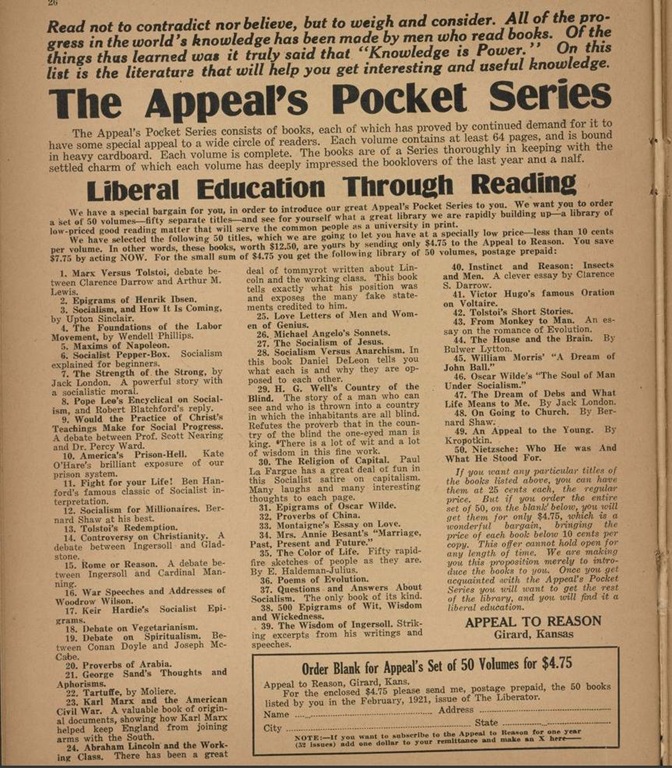
I’ve been fascinated by this scene, partly because I had a shirttail relative Susan Glaspell who was an integral part of it, but also because it was a rich mixture. Political, sexual, and artistic radicalism were literal bedfellows. The Liberator featured a great many ads for political tracts, but also for literary books, and many of latter were low-priced reprints aimed at a bohemian’s or workingman’s budget.
Doomscrolling in the 1920s? Michael Angelo’s Sonnets, Tolstoy, William Morris, Shaw, Voltaire, Wilde, and Nietzsche. Also socialism and the story of what Karl Marx did during the American Civil War. 10-50 cents a piece, or all 50 for $4.75. If one can’t sleep after a long workday, such a TBR pile near your bed could reach out to you.
.
And in between John Reed and Eastman’s first-hand reports from the Russian Soviet Revolution, there was much art and poetry. The art included political/social satire cartoons, illustrations/posters (often in a bold style depicting heroic workers or radicals,) and black and white art depicting nature or the human form. The latter was Modernism of a kind, though I don’t recall much full-fledged abstract works. The famous NYC Armory Modern Art show was nearly a decade past at this point. Carl Sandburg*** had won a Pulitzer in 1919 for his Imagist and free-verse poetry. From the same NYC scene as The Liberator, Others: A Magazine of the New Verse had completed its 4-year run publishing avant garde poetry. Yet, there was much less free-verse in The Liberator than one might expect.
It turns out The Liberator founder/editor Eastman was an early opponent of literary High Modernism. **** If the world and society needed to change, change radically, the old verities of prosody could still serve well to elevate mankind as they strove for that change.
Did Claude McKay feel the same way? I don’t know enough to say. During the early 1920s, he’s listed as an editor on The Liberator’s masthead. Its broad progressive outlook generally supported racial equality, and the NYC Harlem Renaissance and the Greenwich Village scenes overlapped.
Claude McKay and Max Eastman
.
Is that why McKay wrote his worker’s poem this way? There could be more to that choice – he apparently liked the sound of 19th century British verse; and knew how to extract some word-music beauty from it, as I hope examples I’ve performed may show. Perhaps he felt he was expressing his own soul existing within that workday fatigue – he wasn’t some generalized Worker, but his own particular self, Claude McKay, a man taking pride in knowing this part of his received culture. If so, a man, an Afro-American man, could express that dull proletarian grind with the same word-sounds that once extolled Grecian urns and English nightingales.
Yet, there’s a palpable disconnect here, and I was going to perform the song. I decided to just do my best to not linger on its anachronisms, the “O….thou.…wilts” of this poem. Maybe, the combined character speaking here as I performed it in 2026 is a man living in three centuries simultaneously while speaking in the manner of one class while living in the manner of another. McKay may be not so much colonized, as a colony-creature, a siphonophore banding together more than one mind and tongue. As I wrote talking about McKay earlier this month, poets are often, in effect, immigrants or exiles by their natures, souls seeking and divided from the world and nations they find themselves in.
You can hear my musical performance of Claude McKay’s “The Tired Worker” with the audio player you should see below. Has the graphical player gadget said screw-it and called in sick? No, some ways of viewing this blog suppress showing the player, and so I offer this highlighted link that will open a new tab with its own audio player.
.
*Once more I’ll remind readers that I’ve encouraged something I call “The Sandburg Test.” The test is to ask, does at least one poem in any substantial collection of poetry deal with the world of work? If you’re reading a Carl Sandburg collection, the answer will be yes. Other poets? Well, read, and ask yourself.
**The closest I could come up with would be the trope of some Americana artists of adapting decades-older styles of music and lyrics to express modern problems – but most of those borrowed styles are less formal and more-or-less reflect working-class speech of the past times.
****Eastman is a character I don’t have room to go into today. Escaping by the skin of his teeth from the grasp of the first American Red Scare as an editor of The Liberator’s radical forebearer The Masses in 1917 – that magazine was shut down by the federal government and he was arrested, charged, and tried with only a final hung jury keeping him out of prison. His long life saw him continue to resist the rise of obscure Modernist literature, while moving from founding fiery left-wing magazines in the WWI era, to becoming an editor of the Readers Digest during WWII, to contributing to the post-WWII launch of the conservative The National Review. and to at least qualified support for the second great American Red Scare in the 1950s.
One of the things about writing this series surrounding a scrapbook connected with a 1930-‘50s Afro-American Jazz combo is to observe the risk of writing here as an old white guy in the 21st century about a bunch of young Black Chicago musicians and what I might suppose about their lives. The Cats and the Fiddle in the scrapbook took their shot in the world of art and entertainment, but they’re not famous guys. They lived their lives, as I’ve lived mine, as you likely will live yours, with few persisting details or indelible marks. Perhaps I’m overly fixated with looking for those marks.
In today’s piece I’m going to look at the house where that scrapbook was found. It still exists: 3132 Park Ave South in Minneapolis. I’ve looked to see what I could find out about that inanimate place and the people who passed through it. I hoped any details might help me figure out who collated and left that scrapbook. I found what preceded the scrapbook’s discovery sustained my interest.
Back in the first part of the series I recounted that I lived there briefly in 1976 while helping a friend whose words, voice, and keyboard playing has appeared here over the years, Dave Moore. Dave and his then wife had purchased the somewhat rundown house at an attractive price for their planned little family and their small business. I helped a bit with their work in fixing it up and getting the business going.
The house had character, and this young couple, my friends, hoped to honor part of it by making it look a little more like it did in the house’s youthful years at the beginning of the century, looking for clues in old style books and in the “bones” of the house. Similarly, today’s post is going to start as far back as I can find information.
As Minneapolis started to grow as an upper-Midwest business hub, Park Avenue was a broad, tree-lined boulevard that ran north-south through the middle of the city from the southern neighborhoods to the rail depot and centers of government, business, and milling which were fast being established in Minneapolis’ downtown. Park Avenue became a prime site for the commerce titans to build their mansions. In the mid-70s you could still sort of squint and image that era: the trees were still there, elder elm branches arched much of the way over the wide street, and a handful of the mansions still remained.*
3132 was not one of the mansions. In 1902 it was built by an A. E. Rydlum (or Rydlun) who was a builder, and it was complete and offered for sale in the Spring of 1903 by Thorpe Brothers, who were an active real estate sales firm in this era of rapid growth and building of new housing in Minneapolis. Here’s how Thorpe listed it:
For Sale-Modern house, ten rooms, hardwood finish throughout; full basement, nickel open plumbing, hot water heating plant, sideboard, china closet, mantels, bookcase. Location 3132 Park Av; easy terms; will be sold soon.”
The next notice of the house I found was a birth announcement later that year. A Mr. and Mrs A. J. MacDougall were listed as living there in that announcement. Next year, 1903, they place an ad seeking “a nurse girl, 12 to 15 years old” for service at 3132. In 1904 they place another, similar, ad: “A nurse girl from 14 to 16 years old for 3-year-old boy.”
When I was working on the house, an attic servant’s quarters and separate stairway were part of the house. There was still a bell in the pantry off the kitchen that had a ringer button on the floor of the dining room. How many servants eventually lived there? How long did a 12 or 14 year old childcare worker likely stay an employee? The McDougall child had a theater birthday party at the downtown Orpheum Theater in 1908. The original Minneapolis Orpheum was a 1500 seat, ornate vaudeville house that had been built in 1904.
A recent Streetview picture of 3132 Park Ave S, servants quarters behind the three dormered windows at top.
.
I pictured a somewhat prosperous young family, that kind that the house seemed to be built for in this location. So, I thought Mr. MacDougall, the first owner of a fine large house with its attic servant’s quarters, was perhaps a middle-manager, a businessman, or the like. Then earlier this year I began to look at the city directories that are available from the Minnesota Historical Society. It might be helpful to my generation to say that these Directories were like the phone books of their time, a combination Yellow and White Pages of a city’s residents, businesses, and organizations — but younger readers will find that obsolete image useless. So let me reset: they were large books issued yearly, or near so, listing alphabetically by name the head of each household in a city, followed sometimes by the name of their spouse, sometimes by the name of their company or employer, and almost always by a general classification of their job.
No one is just their job, but as a shortcut to figuring out, however roughly, where someone and their family was in the class structure, city directories are a data source for everyday people in the past. Here’s what a series of annual Minneapolis city directories say about our MacDougall (whose first name was Allan or Allen — the first spelling used in earlier entries, and then the other):
1903 not in the directory. Likely the directory’s data predates his moving into 3132 Park
1904 he’s listed as “miller” living at our 3132 Park Ave. house
1905 his occupation is “lab,” short for laborer, living at 3132
1906 the “lab” adds that he works at “Washburn C” — Washburn Crosby was a large milling firm in Minneapolis that is now the corporation General Mills
1907 laborer again, no mention of what company, still living at 3132 Park
1908 job now changed to “foreman,” continues living at 3132 Park
1909 looks like he, still a foreman, (and likely his family, though none of these listings mentions his wife) now live at 3436 Columbus Ave, about three blocks away
This scant info tells me little and makes me wonder. Does a miller or an ordinary laborer afford this large new house — much less, live-in help, and theater birthday parties for his kid? Does the later classification as foreman tell us he wasn’t just a line worker? Was there a blip in the market that caused Thorpe to sell under normal market prices, or would they possibly rent an unsold house? Mortgage terms were shorter then, but moving a young family from a fine house in a great location after only 5 years could mean it turned out to be only aspirationally affordable to MacDougall.
The next residents appear in 1910 from the records I’ve found. A Mr. and Mrs. Peter W. Campbell — leaving a gap, 1909 is unaccounted for. The 1910 city directory lists him living at 3132 Park, and his daughter Elizabeth is married at the home that year. The newspaper account lists 25 guests at the wedding. The house I later knew had a big dining room and parlor joinable by opening a large set of pocket doors. I imagined that many guests, the bride and groom, the officiant. It’d be a cozy affair, but they’d probably all fit.
Peter Campbell is confirmed to be living at 3132 Park in the 1910 directory, but there’s no Peter Campbell in the 1911 Minneapolis directory at all, and he’s a boarder elsewhere in the city in 1912. These listings don’t list his job. This short-term occupancy for someone that doesn’t seem clearly homeowner class testifies against his ownership.
In 1910, during the same summer as the Campbell wedding, 3132 Park is listed for sale again: “”Elegant 8 room all modern home, fine lot, reduced price $6,250.” The house isn’t yet a decade old. It’s a fine upper middle class home in a desirable location in a growing city, and in this time servants-wanted ads were placed, and then placed again, curious residents arrive and leave. If this was a Stephen King novel, I could see the haunted story potential, but I don’t really know the story, just these little points.
I can’t say when the house sold but by 1913 we have yet another servants wanted ad, “girl for general housework.” This ad is likely announcing the family that would be the home’s longest occupants, The McLeods: husband John, wife Elizabeth. I note there have been three Scottish names in the house’s history: MacDougall, Campbell, McLeod. John McLeod was certainly Scottish, born on the Island of Lewis, a very northwestern part of the Outer Hebrides. McLeod was said to have built several grain elevators in North Dakota, but his job now in Minneapolis’ downtown was as an “independent grain trader.”** The McLeod’s were a middle-aged couple when they lived there, and Mrs. McLeod was an active clubwoman, holding regular meetings for the Columbian Club and her Presbyterian church at 3132. In 1921 the Columbian Club agenda was a talk on “Greece, the Reign of Pericles, the Glory of Phidias.” Rather than thinking of cursed winds crying “Heathcliff” around 3132 Park, the next 21 years record the kind of stable middle-class life the house’s builders might have expected.
In 1934 Mrs. McLeod dies. Then five years later, in April 1939. this headline appears in the local paper “Trader Collapses at Grain Exchange.” John McLeod was 77, still apparently working as a grain trader. He died the next day in an oxygen tent at the Swedish Hospital in South Minneapolis.
This more-or-less ends the upper middle-class phase of the fine house on 3132 Park. In May 1941 it’s listed for sale as a “very livable home” and “interior in excellent condition….must be sold to close an estate.” I think of all the hardwood trim, doors, built-ins — much of which Dave and I were chemically stripping of layers of paint in 1976. It was likely still pristine then, and still echoing with talk of Phidias and perhaps John McLeod’s mumbles about the Non-Partisan League’s pressures on his trading margins.
Two years past McLeod’s death to settle an estate? You got me on that, but there are indications that the Great Depression isn’t the best time to be selling a big house. The house is listed again in August and September of ’41, this time in the for rental ads. Rent? $50.
Yet in 1942 someone else is having social club meetings at 3132 Park: a Mrs. Jewell Bliss is holding a meeting there for the Juline Burr Tent, DUV to be followed by a social hour and cards. DUV is probably Daughters of Union Veterans and Mrs. Juline Gales Burr (who died in 1906) was a Minneapolis resident and the first state president of the Minnesota Grand Army of the Republic (another Union Civil War veterans organization). Also that year a luncheon for “past president of D. of H.” hosted by Jewell again. D of H is likely “Degree of Honor” a Catholic female fraternal benefit society.
Yet the house on 3132 remains in a murky state in 1942 as I look for mentions. I’ve found records for Jewell Bliss, who was married to a Norland (who went by Noel) Eldred Bliss. Since city directories are alphabetical by head of household (often husband) I looked for Noel Bliss. Throughout the entire US WWII years he lived on Penn Ave North, not Park Ave, and Jewell is listed as his wife, same address in 1942, ’44, and ’45 in the city directory. Noel’s occupation is listed as “beverages” and his business address seems to be 2501 Marshall in Minneapolis.*** Bliss was in the news in 1936 for being a liquor dealer indicted for perjury in Minneapolis. He pled not guilty — but alas, I have no more information on this case.
Noel Bliss: liquor dealer three years after the end of Prohibition, but facing charges.
.
But the situation at 3132 Park remains unclear. Jewell is holding meetings there, though she apparently doesn’t live there. In post-WWII years larger houses on Park Ave were used for offices of various organizations. Was 3132 Park being used at least temporarily in this way, or was Jewell an organizer using someone else’s home or apartment? Again, I think of the home’s two large main rooms, a good place to hold your social gathering.
1943, a short newspaper story about one of our house’s residents links to some fascinating details. A 14-year-old boy named Bruce Dybvig who lives at 3132 Park Ave stumbles on the shores of one of Minneapolis’ urban chain of lakes. He breaks his foot falling into Lake Nakomis where his injury inhibits his ability to swim. OK. I’m not trying to stress a 3132 Park Ave curse theme — and look, the newspaper story I found says a boy lifeguard, only 16 himself in these wartime years of military mobilization, pulls Dybvig out of the lake. Bruce is treated and released from a hospital, and surviving he soon goes on to become another teenage Jazz musician with a story comparable to our Cats and the Fiddle main thread this February.
A year after his accident, Dybvig takes up alto sax, and by 1946 he’s organizing Minneapolis high school students into a 16-piece Jazz orchestra to play the “books” of the hippest white Jazz big bands of that year: Stan Kenton and Woody Herman. What happens to Bruce and those kids? If I haven’t exhausted you with this thread about a house, you may be the kind to enjoy the Jazz-in-Minnesota side-trip to be found at this link.
Boy saved from drowning, the teenager then starts playing modern Big Band Jazz. Bruce Dybvig at the left of each picture. What’s with the Carnegie Hall sign behind him? I’ll tell you again, you might want to read that above link.
.
By 1953 the Park Avenue house is on the market listed again as “Lge. Inc. home, full basmt, gas heat, partly furnished, in excel repair, Ideal for rest home.” Two elderly men with different last names died in 1950 with 3132 Park as their address. This indicated to me that sometime in the early Fifties it may have become a “rest home,” a midcentury type nursing home/elder care facility.
In 1956 another for sale listing: “3132 Park Av S. See this lg, well kept home, 8 BRs, 2 1/2 baths, completely furnished for income, has gas HW heat, nice yard & gar.” It appears that sometime in the mid-50s the house’s rooms were subdivided or areas in attic and possibly the basement became living areas. In the mid ‘70s Dave was told the place had been a Black-owned rooming house.
In 1963 a teenager, Roosevelt Gains, likely a son living with his mother, a hotel maid, at 3132 Park, gets convicted of robbery.
In 1973 I found one more appearance of a 3132 Park resident in the newspapers, Bill Wilson, a house painter doing a little frozen lake winter fishing. In Minnesota this sometimes involves big trucks and semi-elaborate shacks pulled out on sledge runners, but Wilson is equipped with just regional hardiness and a hand-auger. Dave Moore, and then I, will be arriving soon to the Park Avenue house. The scrapbook that’s the idée fixe of this series will be uncovered there. Did 3132 Park Ave have a curse, or is the nature of the place simply the nature of the struggles and reprieves of life? I will be returning to the Black History focus of this series next, but leaving today’s stories of inconclusive fates and historical lacunae of largely white residents who lived at 3132 Park Ave, I’ll summarize. I don’t know even the names of everyone who lived in that house: those teenage servants advertised for (likely newly arrived European immigrants), other old people who may have lived in a midcentury rest home, the transient renters. I’ll leave you tonight as I go to sleep, saying these clippings of life collected here, outside the scrapbook that started things off, are exhibits of working class people in my South Minneapolis — Black, white, Asian, Latin and Native American — saying that our histories have commonalities of dreams (and yes, blunted dreams) passing under all our shades of eyelids, closed in our place across time.
Bill Wilson, one of the last tenants at 3132 Park Ave S. in its rooming house days.
.
If you want a short poem performed with original music after these decades, here’s the young Langston Hughes preparing to close his dark lids amidst his neighborhood in the last decade called the Twenties. Backup link in case you can’t see the audio player the rest of you will see below.
.
*Rather shortly after I arrived, nearly all of the remaining mansions were torn down, as they had no clear commercial or residential usage by then. We’ll discuss South Minneapolis in the later 20th century later in this series, but in 1976 as it is now, this Park Ave area is a series of varied working class to under and unemployed ethnic mix neighborhoods. Over in the other twin city in the 1960s and ‘70s, St. Paul’s similar Summit Ave, was preserving their grand pre-WWI houses which became once again homes to upper middle-class owners.
A surviving Park Avenue mansion is now the Swedish Institute. It was built by a Swedish immigrant businessman in 1908. It’s five blocks from where 3132 went up a few years earlier.
As to the tree canopy, most of the old trees were elms, and Dutch Elm disease wiped most of them out after I arrived. The city’s urban foresters have tried to replant, but it’s trees, and old trees take time.
**Noting McLeod’s North Dakota and Minneapolis connections, I think of the history of the successful organization of the Non-Partisan League in the Dakotas. Farmers there rankled at the low prices they got for their crops, and high markup profits by traders and middlemen who owned the grain elevators, the railroads, and the grain processing mills. Those latter folks often worked out of Minneapolis, but the eventual NPL elected governing majorities in state government, built their own elevators, and pressed with more leverage and bargaining power to improve the farmer’s lot.
***As late as 2022 Bliss’ old business address was the location of Betty Danger’s Country Club, a hip and eccentric restaurant. The owner listed it for sale that year, citing the reason for the sale in this report: her mental health. However many levels this is removed from 3132 Park, it’s another reason for Stephen King to contact me about that gothic novel.
I have a new audio piece today, combined with a continuation of my Parlando Project influences-as-episodic-memoir series. The audio piece uses text from Gertrude Stein’s Tender Buttons — worthy in itself — but what suggested it was a question that reading about Stein brought to my mind during The Seventies when I started to look into her life and work a bit.
Despite being nothing like an expert on Stein, I could fill this post with stuff about what she did and how she went about doing it. I’m going to make a summary of that a footnote, though that’s worth reading if you know even less about her than I do.* There’s one detail from Stein’s life that hooks into my story as I entered The Seventies. I’ll come back to that. Watch for it.
In the last post I’d left college in 1970, disconnected in the aftermath of the political activism post Kent State and my failure as a young editor of my college’s student newspaper. I wrote of some musical and poetry experiences in the early Seventies there. Another thing was both continuous and changed at this point: I needed to find a job. This was continuous because I’d most always worked from my middle teens. I’d had paper routes, did odd jobs for the local bank, and besides my work in my second year with the school paper, I’d been what was called a “work-study” student working most days in the college cafeteria. Although it didn’t occur to me then, I suspect the more well-off students may have noticed that I was doing kitchen work while they were only concerned with regular college life, but this continuousness of work was ever more complete from the time I was 20 until I was past the age of 65. Another way to say that was that I worked full-time hours all those year with no more of a break than a worker’s vacation. After leaving college I worked frying hamburgers at a fast-food restaurant and on a factory floor making vertical blinds, but in 1971 I was back in my small Iowa college town looking for work. I went to a nursing home in the town, thinking they might have kitchen work. Instead, they asked if I wanted to work as an orderly/nurses aide.** I took that job.
So, if work was continuous for me, what was changed? In some expectations one is supposed to find one’s career in their 20s. I had decided earlier that I wanted to write. In some other lifetimes perhaps I would have found an entry-level writing job, in another I might have wandered into something with politics. I’m not sure however if those alternative livelihoods would have suited me, for reasons I may discuss later in this series.
My job in the nursing home was in the Extended Care Facility, the wing for those patients who needed more-or-less complete bodily care for the rest of their lives. Many were completely bedridden, and many of that portion also unable to communicate. I worked the overnight 11-7 shift with one RN. I’m guessing we had around 20 patients in the unit. Our night work was turning the incapacitated every four hours to prevent bed sores, to clean up the incontinent and their bed linen, and to occasionally minister to those who awakened, often with some level of anxiety and agitation. It was hard physical work, and I will confess that I let the physical work deaden me somewhat at first to the Sisyphean nature of their lives and my tasks with them.
If one has a lot of triangles to move from Iowa to New York…
.
I moved to New York state to stay after a few months of that, carrying everything my wife and I owned in the bed of a rusty 1960 Chevy pickup truck that I’d purchased for $200 from my wages. The truck was so rusty that I could see the tires through holes in its floorboard, but other than a hydraulic clutch that would reengage itself if depressed too long, it ran OK in its rattly way. Back in New York I was living in a poor, mostly Black section of Westchester, renting a room from an elderly Mrs. Whitted who had a framed life-time membership certificate to the NAACP on her living room wall. I worked there first in another nursing home, a much fancier one in upscale Westchester, on the day shift this time. There were more staff there, but some elements of the care bothered me.*** Being low on the care system org chart I chose not to try to remedy that, and left for a job working on a med-surg floor at a Catholic hospital on the overnight shift again. The regular charge nurse on my floor was Miss Watson, a young highly competent Black Anglo-Jamaican with an impeccable English accent that would match a Sidney Poitier. We worked along with an LPN and at least one female aid (usually one of several Afro-Americans with a Great Migration southern-American accent) to complement my coverage of the male side of the patient census. I fully enjoyed working with Miss Watson. The most peculiar absurdity of her life that I got to observe was when patient relatives came in around the change to the morning shift after talking on the phone with Miss Watson. They’d assumed a starched-white Englishwoman, and so the recognition scenes when they arrived and saw her dark black skin always had me stifling a laugh. How much humor Miss Watson could consistently find in this might be another matter.
These orderly/nurse’s aide jobs paid a dime or so over minimum wage. The work was physically hard and even at its most basic levels it involved deep responsibilities all out of proportion to what it paid. Around this time, I came to embrace this necessary and underpaid work. It provided an inescapable, palpable, meaning to my life, something that struggling over a poem or prose draft could not demonstrate objectively. It allowed me access to all kinds of people in a wide range of economic classes and backgrounds. Occasionally, I thought of the members of my generation who served in the military, some drafted, and I told myself this was my service.
Eventually I moved up to Newburgh, New York, which will need to be another post. I worked my last overnight shift at the hospital and then I hitchhiked up to Newburgh at the end of my shift. I’d already gotten a job at St. Luke’s Hospital there in the Emergency Room. I’d work the 3-11 shift there the next day.
Are you waiting for Gertrude Stein to return? Here’s the connection. I can remember reading about the little Paris apartment she and her partner, edibles pioneer Alice B. Toklas, shared with Stein’s brother and a wall-smothering collection of Modernist art bought directly from artists that she knew, and the world would know later. It was there Stein lived from 1903 after leaving Johns Hopkins Medical School short of a medical degree.
As a time-travel destination that place is five-star. Artists, writers, critics, composers who once needed only to travel geographically to go there, wrote of it in their memoirs. A famous place.
Gertrude Stein in front of some of the Modernist paintings collected in her Paris apartment.
.
You know what I thought reading of that apartment? Yes, there was wonder. How did they figure which artists to collect? He, she, they, all of them were there, people before the pronouns. So and so met so and so there? Hemmingway finding part of his prose style in this small apartment — and from a woman? But my most nagging thought? Something else, another question: “Who paid the rent?”****
Many (most?) writers have the ability to be motivated by that experience, though in reading I can tell some are, and others are not. I myself am inconsistent. I have written and performed poems here that the richest and most comfortable person in my time might have written or could easily relate to. And then again, I may overselect poems whose speakers are in extremis.
Some take a commercial-first approach to their art, making sure it earns the rent money. My nursing work from age 20 to nearly 40 illustrated a variety of life to me, but it also allowed me (with worries) to pay the rent.***** Others take a cause-first approach, advocating with their art resolutely for remedies to what they see. Could my nursing work have reduced that aspect of my writing? That has just occurred to me. I’m not sure, though looking back I’m more at glad I didn’t have to point to my writing, and later my music, as what justified my life. And “Other People’s Stories?” Each day in the Emergency Room you’d meet up with other people’s stories. If your own were limited, or intractable, you could move their stories forward.
I had found a job that in those days allowed one to pay the rent. Inside that conceptual room, paid for by working with the sick and injured, I worked on the writing. And those years of unbroken work, of clock-in every working day, and rotating shifts? I suspect a habit retained as this Project approaches 700 pieces this year.
Today’s audio piece is from Gertrude Stein’s still controversial, still avant-garde, collection of “Cubist poems” Tender Buttons. That book is divided up into three sections: People, Objects, and Rooms. I performed the opening to the final section, Rooms today. Tender Buttons remains gnomic. Though the words themselves are plainspoken, a straightforward meaning is most often hard to make out. My performer’s working theory during the recording was that she’s making a statement about Modern Art and Cubism. Rather than a center and conventional panorama, Stein holds for more perspectives at once. She seems to be advocating for something not just decorative or the easy dessert of sentiment (“silver and sweet”). She sounds a “Life is real, Life is earnest” almost Longfellowean note when she says “A preparation is given to the ones preparing.” She perhaps compares a conventional painting with a center and a border to an empty dress, flat on a hanger. The final paragraph/stanza moves, synesthesia-wise, to music where the flowing facets of a Cubist painting may show a sequence of time.
.
Though printed as prose, the musical rhythm and rhyme of this poem arises with any earnest effort to read it aloud. If one was to modify it to conventional lineation, parts might almost pass as Emily Dickinson, albeit the more obscure and compressed Dickinson.
You can hear my performance with a drums, bass, piano, and electric guitar quartet with the player gadget below. No graphical gadget? This highlighted link is an alternative way to hear it.
.
*These footnotes are going to be long, and are for the more curious. They’re not necessary to enjoy the audio piece. Stein is easily classifiable as equal to Apollinaire and Ezra Pound (both of which she knew and interacted with) for influence on the emerging Modernist movement in the first quarter of the 20th century. Her influence on English language Modernist writing is not consistently admitted or admired, but her influence also extends to Modernist music — and along with her brother Leo, she’s absolutely central to the development and appreciation of Modern art.
The most amazing thing about her pre-Paris youth is that in a 19th century when women’s education and careers were constrained, she attended Radcliff (meeting, being mentored by, and admired by, William James) and then sought to become a medical doctor through graduate work at Johns Hopkins Medical School. Her center of interest was how the mind and its perceptions work, something she was studying at a time when Sigmund Freud had just started publishing. She dropped out of Johns Hopkins before graduating however.
**Job titles and even jobs listings were routinely gendered in 1970. Orderly was a male job, nurses’ aide the woman’s. Training for either was generally informal and on the job. Later in the Seventies I barely started an academic RN program, but affording the classes and especially the time and automotive costs of traveling to the nursing school put the brakes on that. Since I worked in teaching hospitals for over a decade after this as an aide hand-in-hand with nurses, interns, residents, and staff doctors, I learned a great deal of practical knowledge along the way. Administering medicine was not legally allowed, but I eventually did much of everything else the LPNs and RNs did. Afterwards, I always called what I did nursing, as it was a better description of my role for most of that decade-plus. In the middle 70s I helped in a small way to train early EMTs and given how much I liked the pace and variety of work in Emergency Rooms, I might have gotten into that line of work if I had come along a few years later.
The gendered job titles may have faded out as the Seventies progressed, but some of the work remained gendered. Despite having a poet’s level of athleticism and large muscle development, I was often called on to move or lift heavier patients, or to help restrain out-of-control people. Given how many stories there have been in recent years of people killed while being restrained (one in the news this month) I have wondered retrospectively if a different fate could have involved me in such a case. As things worked out, I never injured anyone while restraining them, though besides wear and tear I got a couple of minor injuries.
***I suspected a co-worker of patient abuse. I was new — they’d been there for some time. I had nothing concrete, and other longer-tenured coworkers thought they’d seen more, and that was part of my unease. A better person would have tried to organize a complaint and urge an investigation.
****Did you go to this footnote to find the answer? I’m not enough of a scholar to know all the details. Paris was dirt cheap then, there was some Stein family wealth, and the idea of artistically curious Americans of some means being gifted with broadening time abroad was common. Another Stein sibling, Michael, who also lived in Paris, has been cited as the man who handled the family finances there. The Stein bought-cheap-then paintings eventually became capital gains. At one later point someone noted a missing painting from the crowded apartment walls and Stein explained “We are eating the Cézanne.”
*****I’m no economist, but it’s my understanding that rent and housing costs have risen compared to the wages that of job earns now. It’s not my intent to engage in a walk-uphill-both-ways misery Olympics, just to explain some things that led to making this Project. Has any economist explained how jobs like the ones I held then, which are physically hard, unpleasant in some elements, demanding of all-shifts work, are at least mildly dangerous, have a chronic shortage of workers (much less good ones), and can have a life-and-death level of need and responsibility, yet pay less than much easier jobs for which there is a surplus of applicants? In my last few years of hospital work I moved to being a ward-clerk: typing, paperwork, general workflow organization and support (all of which I did as a nurses aide, as well as patient care) —and I then got a small raise.
It’s taken me a few days to write this post after learning of the death of Minnesota poet Kevin FitzPatrick. After someone dies, someone you know at some level, there’s an emptiness. While it’s impossible to feel emptiness, it may be the first obligation of grief to hold that sense for a little while. Was for me.
I didn’t know Kevin well. We were different sorts, and I myself am quite bad at friendship. But I knew him somewhat, and over time quite a bit as a poet. With some interruptions on my part for over 40 years I’d see him every month in a meeting that sometimes had as many as ten or so writers and sometimes was just Kevin, alternative Parlando voice Dave Moore, and myself. We’d meet in one of our places and those present would break out new work for comment and feedback.
I said we were different sorts. Back in the 1970s I was chiefly influenced by some hermetic and oppositional poetries: French Surrealists and para-Surrealists and those Americans who had read or influenced them. These poets tended to be ecstatic in mood and unafraid to puzzle or offend. Kevin had a different vision — he wanted his poetry to be comprehended and welcomed by ordinary folks, including working people of our parent’s generation. Is that the first or fifth thing I learned from Kevin? No, I’m still learning that one.
Let me speak ill of the dead. In our common youth I thought Kevin was prissy and way too afraid to offend. But we were young men then, and by now my younger self has passed from life to a degree near to what Kevin’s entire non-written life did this week. The way I see it now is that we were both half-right — but his half produced better poetry more often. So, I doubt he learned much from me, but I learned several things from him. You might want to learn some of these things now or later, so I’ll offer four things I learned from Kevin FitzPatrick’s writing today.
“You can’t tell a book by looking at it’s cover.” Kevin FitzPatrick edited the urban working-class Lake Street Review, but today’s piece has some farm boots in it.
.
Characters
Here’s the first and primary one, a lesson that I often told Kevin I would try to remember. Around the time of his first collection, Midwestern writer Meridel Le Sueur said that Kevin’s poems were poems with other people in them. Given Le Sueur’s life twining activism with writing, this was a fitting observation for her to make about Kevin’s writing. But stop and think for a moment of the poems you write, or even the poems you read or rate highly. How many of them have actual, flesh and blood characters in them? A great many poems, and to wildly generalize, many poems by male poets, have nothing but the poet’s own consciousness reflecting on itself. If something external intrudes on this, it may be nature or incorporeal spirits — or if human, they may appear as masses or classes in sociological case-folders. Kevin’s poems had a range of characters: friends and antagonists, folks that are richly neither, and people who you just run into in life. Kevin himself appeared in his poems, yes, but in many examples the poem was as much about Kevin as the novel The Great Gatsby is about Nick Carraway.
You may think that poetry, with its freedom of language and musical force can dispense with characters, that poetry may be particularly suited to delve into an individual’s own consciousness so otherwise unrepresented in human life. Good poems have been written from that conviction. But is that all it can be? What a lonely art making itself lonelier would result.
Dialog
Kevin’s use of dialog goes along with the characters. If you’re going to allow them to appear in your poetry and have autonomy, then they need to seem to speak independently. Kevin’s characters were not kept silent, and a good many of his poems had the texture of a compressed short-story, including the effective use of dialog.
Again, I’d argue that we are too exclusive when we talk about the poet’s voice and poetry as self-expression to the exclusion of all else. Yes, the world may be enriched by 100 poets writing in their own voice, saying out-loud or on the page their own individual experience. But if some of those poets would allow other voices to speak in their verse, to join in the choral and antiphonal song that is human experience, we might have at least 200 voices, if not 500, speaking in our poetry. How we speak, how we express ourselves is important. How we listen, what we hear, that too is important. The poet’s ear shouldn’t be cocked for just iambs and trochees.
Work and Workers
Why shouldn’t the world of work appear in poetry? I mentioned that earlier this month in dedicating my performance of a poem by Carl Sandburg to Kevin that Sandburg didn’t shy from talking about folks working, how that felt, what they encountered. FitzPatrick extended that in his poetry with a good degree of specificity. In his poems about encountering agricultural work in his fine final collection Still Living In Town, the specifics and groundedness of farm chores were taken into his poetry.
Yes, let us concede a dialectic. Many readers (and poets) go to poetry to escape that everyday grind, to celebrate the exceptions of romantic love, cosmic visions, rare events worthy of celebration. Fine. But why can’t poetry inform and illuminate what we are doing for a third or so of our lives?
Rural-Urban
Between the rural-urban divide is a great place for a poet to sit and write. I spoke of Kevin’s final collection from 2017, Still Living in Town above. In America, there’s an increasing division in outlook between those living in cities and those living in rural areas and small towns. Kevin’s poems in that collection, including characters, dialog, and those work-a-day issues, also allow us to see different locations and outlooks as he travels between his urban house, his capitol city office job, and a small farm.
How few travel between those worlds with open eyes, ears, and hearts and write verse about it! Kevin FitzPatrick did that in his final book. As I said above, I learned things by how Kevin approached his poetry and characters, but it’s important to also make clear that he’s not just a “poet’s poet,” but also a rewarding and entertaining writer to read. Books from the publisher of Still Living in Town are not available from the large, easily linkable mail-order booksellers — which depending on how you feel about such things may be a feature not a bug. Here’s a link to the WorldCat listing for FitzPatrick’s 2017 book which includes library availability and the ISBN number that might aid in ordering from your favorite indie bookstore.
OK, should there be my customary Parlando audio piece at the end of this post? With some trepidation I’ll offer this one, my performance based on an early version of a poem destined for Still Living in Town. It’s an old recording from 2013. Shortly after I recorded it, Kevin heard it and thought I misinterpreted the song. As I said, we were different sorts, though over the years I like to think we grew closer from our shared love of what poetry could do. Kevin said I missed the poem’s point; it was about the difference between the urban and rural cultures he was observing and writing about. He’s right, I undersold that element, seeking instead to stress how a customer service interaction went sideways from mistrust and was eventually resolved. I think he also might have reacted to my edgy, angsty delivery and music. Kevin was a calm, dry speaker in performance, and the speaker in this performance isn’t. It’s also important to know that “Returns” is just a piece of a greater work that took him several years to write. This isn’t the most singularly impactful poem Kevin ever wrote, just one in his series that I happened to perform one day because I liked the vignette, and that I had handy to put here today.
A few bits of scene-setting before you click on this performance: Kaplans* was a clothing store specializing in utilitarian work clothes and outerwear that was located then on Minneapolis’ famous working-class-to-under-class Lake Street. Wheeler Wisconsin where the scene shifts to in the conclusion is a town of 300. Tina, the deus ex machina of the poem’s story was Kevin’s partner who decided to buy an 80 acre farm which Kevin commuted to every weekend during the time of the book.
* The first winter I spent in Minneapolis, it was at Kaplans that I bought my first pair of Sorel boots, that genius Canadian design that has a waterproof leather and rubber outer boot with an inner insulating liner made of compressed wool. If you ever have to stand in -20 F cold and wait on a bus that might not run on-time, the un-frostbitten scansion of my poetic feet recommend them.
Just a couple of posts back I said that early Carl Sandburg poetry can be just as aligned with the ideals of the Imagist school as the Trans-Atlantic poets such as the then contemporary work of Ezra Pound, Amy Lowell, H.D., Richard Aldington, F. S. Flint, T. S. Eliot, William Carlos Williams, and T. E. Hulme was. Yet he’s rarely mentioned as such.* Why might that be?
My guess is that there’s an issue with Sandburg’s more expansive mode, present in some of his work, Whitmanesque in character and scope. The Pound and Eliot school of Imagism wasn’t much on Whitman, charging him with lack of craftsmanship and concision. And then there’s the issue of cultural affinity, which while outside the text, is important. Of the above, only Lowell was from a wealthy background** (and Flint’s childhood seems positively Dickensian) but they all saw themselves as culturally elite. Most were familiar with classical languages, some had Ivy League educations (though none were Oxbridge, save for Hulme who was thrown out after a bit more than a year for rowdy behavior), most had spent time in Europe , even Williams, the most American-focused of these.
Sandburg? Born working class to two immigrants in the Midwest***. Drops out of school at age 13 to go to work. The jobs he had in the first 40 years of his life were modest in prestige, but varied in location and nature. Coal-heaver, farm laborer, Army private, milk-truck driver, political organizer, bricklayer, “The Front Page” era urban journalist. What T. S. Eliot knew about the whole of literature, Sandburg knew about the whole of working-class work and life.
One could make one mistaken generalization from Sandburg’s biography, that like Whitman self-advertised himself, he’d be “one of the roughs,” a man whose art would be artless and as unconcerned with the niceties of aesthetics as the correct fork for which dinner course. But just like the lazy assumption that there’d be no poets in foxholes, the idea there are no aesthetes who punch a clock is bogus. Sandburg’s early work is as concerned with Modernist beauty and style as working-class dignity—and he is very concerned with working-class dignity!
Is today’s Sandburg piece, “Back Yard” an Imagist poem following the three Imagist rules? Let me paraphrase them:
Direct treatment of the thing: that is, the focus in the poem is on the image itself which will be described, instead of the image being a decoration and figure of speech within the body of a poem more concerned with its moral or message for which the image is only a “like” illustration. Conciseness: no extra words, and though not stated, it’s corollary is no less-apt words used only to make the rhyme. And freer rhythms: word-music, like sound-music, is not required to limit itself to only extraordinarily regular and repetitive rhythms.
Direct treatment? The outdoor, summer night scene is just that. One is hardly aware here that it’s an image, it seems like simple reportage. Is it merely the “hardly news” that on a summer night if one is outside, perhaps sitting on an open porch, you’ll hear and see other people outside too?
Concise? Pretty much. It’s not In A Station of the Metro, or The Pool, or The Red Wheelbarrow, there is some re-iteration in it, even a single line refrain, but even by the standards of lyric poetry, this is a short poem. The elements of the scene are evoked, but there’s little extravagant or showy description. One element that many Imagist poems share (though never a formal rule AFAIK) is that colors are used to simply describe objects, though since this is a moonlit night scene the colors are more monochromatic.
A follow up question: how minor and mundane is “Back Yard” really? I can’t claim it’s a poem of great originality—but that’s not the job of every poem, and this is more a poem of the continuity of change, a moment of shared perception, not a striking new vision.
I think its intent, in it’s just over 100 words, is for us to see a chain of life in a Chicago night early in the 20th century; and in its everyday exactness, state those things that might link to a night tonight where we live today. The silver moonlight in the scene seems almost a preservative, everything is frozen in that direct moment. In my night tonight it may not be an Italian boy with an accordion, but Mexican music from the back yard at the end of the block. The couple Sandburg says will marry next month, are now-dead grandparents of people as old as I am. An old man has fallen asleep in the late and waiting moment, his back-yard cherry tree’s fruits held in a moonlit unmoving until his eyes close. He will likely pass on sooner than the marrying couple, and his dreams and those long-ago cherries will be returned to the place that dreams, fruit, and poems go and come from.
The poem closes with a perennial thought delivered in the scene’s description. The clocks, the poet relates, say he too must go. The clocks say that to all of the characters in his poem, and by extension to us, his audience. Sandburg, the artist, the poet, has the job like the moon to fix this moment in silver. Was he thinking here of the silver of his brother-in-law Edward Steichen’s art photographs? What does he mean by the poem’s closing line? What are the “silver changes?” My best understanding is they are the endless succession of such fixed moments. There will be more and more silver changes, a great richness, even as we are entirely not there.
Fancier than my back yard: “Nocturne-Orangery Staircase” (1908). Sandburg occasionally collaborated with his brother-in-law and pioneer in fine art photography Edward Steichen.
For the performance of “Back Yard” I decided to intersperse some other night moments, sung as commentary on Sandburg’s poem. You can hear it with the player gadget below. Want to read along? Here’s the text of the poem.
*Yes, Imagism is only a label, a piece of sticky paper put on some writers and writing. But because Imagism was so vital to the formation of English poetic Modernism, excluding Sandburg, “The Forgotten Imagist” from its usual ranks was part of how he was diminished in the late 20th century. The artistically-chosen stark simplicity of Imagism was admired, but similar directness in Sandburg was seen as populist simple-mindedness. For an example, here’s a long review of a late 20th century biography, where the dagger is that Sandburg’s poetry was “dumbed-down Whitman” and the charge seems to be that he was a pretentious yokel who was also a phony who pretended to be a yokel.
**I’m of the impression that Eliot and Pound’s family had at least upper-middle-class wealth too, but my informal memory is that some estrangement or streak of independence led them to live outside their families’ wealth.
Despite Orrick Johns’ lack of poetic fame, our curious audience seems to be responding to “Ollendorf’s Wife.” Are you forgiving my unilateral revision of Johns’ 1917 words?
OK, here’s another rule breaker. The same day that I recorded the acoustic version of“Ollendorf’s Wife” I also recorded this folk-rock performance with bass, drums, organ, and electric guitars. Is it better or worse than the acoustic version? I can’t say.
By subtitling this post/version “’Bout Changes & Things” I’m making an obscure reference to a quixotic mid-60s LP by Eric Anderson. Anderson was one of a handful of Greenwich Village folkies well positioned in the ‘60s to step into the new post-Bob Dylan breakthrough were the singers were expected to write their own songs with poetic sounding lyrics. ’Bout Changes & Things had some of Anderson’s best early songs, songs that were already getting covered by some of the same acts that might also use a Dylan song.
However, about the time it came out another sea-change was occurring. Everyone’s folksinger records were starting to use electric instruments and drum-sets. Earnest acoustic guitar LPs with maybe Spike Lee’s dad on standup bass or Bruce Langhorne on “second guitar” were no longer what was expected. Dylan goes electric! The Byrds were having hits with folk songs and glorious electric 12-string guitars, John Sebastian and Zal Yanovsky had formed the Lovin’ Spoonful.
The trend was so strong that the production equivalent of revisionist history was resorted to. Tom Wilson overdubbed some session men on top of an already released but unnoticed Simon and Garfunkel song “The Sounds of Silence.”* Alan Douglas took old tapes of Richie Havens and added new instruments to make “Electric Havens.”** The former created a hit record and launched a career. The later couldn’t stop the undeniable soul force that was Havens.
Producers and piano players: Alan Douglass with Duke Ellington and Charles Mingus
Tom Wilson producing “Like a Rolling Stone” with Bob Dylan
Eric Anderson just went back into the studio and re-recorded his whole album with a band, and it was released as ’Bout Changes ‘n’ Things Take 2. It did nothing for his career, and maybe even hurt it. It probably seemed not authentic, scene chasing, or some other sin.
Revisions: One set of songs, two albums.
So, there you go, one guy in Greenwich Village years ago who seemed at one point the equal of a lot of other up-and-comers but turned out to be a damp squib that didn’t ignite. And another guy. Same story.
To hear my folk-rock performance of “Ollendorf’s Wife,” use the player below.
*Tom Wilson is another one of those “Why don’t more people know about him” characters. Besides midwifing Simon and Garfunkel’s first hit, even a brief look at who he worked with listed in his Wikipedia article should amaze anyone with any interest in mid-century American music. This labor of love web site can tell you more.
**Alan Douglas has an impressively varied producer’s resume similar to Wilson’s, but his ghost could probably stand to be less well-known. His overdubs of Havens work are largely forgotten, but he spent a couple of decades redoing tracks in the Jimi Hendrix archives (including replacing parts on the tapes with newly recorded session men) in an effort that was increasingly seen as fraudulent and cheesy. It’s not that I can’t see their critics’ point regarding Douglas’ Hendrix releases, and the resulting recordings are a mixed bag, but I indulge in the same sins of reusing and re-doing other artists work.
I’m going to do something this time that I’ve done before but is rarely done.
I’m going to revise someone else’s poem without their permission—which I would feel bound to obtain, but the author Orrick Johns is long dead. The last time I did this, it was Rupert Brooke’s work I used, and my excuse was that his fragment that I presented here as “On the Troop Ship to Gallipoli” was likely an early draft left unpolished due to Brooke’s death.
Orrick Johns published “Ollendorf’s Wife” in his first book-length 1917 collection Asphalt and Other Poems. There’s little online to help me make sense of Johns’ life, but it’s probable that Asphalt and Other Poems collected early work Johns had written in his twenties. While most of the poems are short lyrics, Johns works there in several styles. The poems are rhymed, not the free verse of “Blue Undershirts” that made such an impression on William Carlos Williams. The opening section, “Asphalt” is an odd set of doggerel poems in dialect. I have trouble reading dialect poems, and from my vantage point as a mid-20th century man I can’t make out what ethnicity Johns is representing in these poems. There’s a lot of dropped consonants and dere’s, dem’s and de’s. I assume these poems are intended to be proletarian poetry and demonstrate John’s solidarity.
Almost nothing in Asphalt and Other Poems grabbed me. Nothing passed the Emily Dickinson test, there was no spectral cold and the top of my head remained attached throughout. While it was trying to depict its modern world, the music was awkward for me, with some forced poetic diction and conventional sentiments that made it more similar to Margaret Widdemer than Millay or Sara Teasdale, contemporaries that were writing prize-winning short rhymed lyrics at the same time as Johns. Like Widdemer, and unlike Millay or Teasdale, the poetry in this book of Orrick John’s is understandably forgotten.
There was one poem in a section titled “Country Rhymes” that did seem to have a germ of something though.
Johns’ poem as it appeared in “Asphalt and Other Poems”
Like T. S. Eliot, Johns grew up in St. Louis, but unlike Eliot he stayed in the Midwest for college. The “Country Rhymes” section reflects that longer experience, and nowhere better than in “Ollendorf’s Wife.” First off, the poem is generally free verse, with uneven line lengths and sparse rhymes. And it has some vivid images. Ollendorf’s wife significantly has no name of her own in the poem. She works her farm plot assiduously, with no love showing in her face, but also as if it’s her last child. How many children, like her name, go significantly unmentioned? The fields she works, and the farm wife are “drawn together” by a “knowledge…greater” than “each other’s best.”
At its core, this poem works by the things it leaves out, fulfilling Hemmingway’s Modernist theory that you can remove the most important things in a story correctly, and by doing so depict them all the more intensely.
So out of care for “Ollendorf’s Wife,” I revised it, intensifying that paring away of the unneeded, leaving only the cutout cameo around the farm-wife’s charged day in a life. I added nothing really, but took away words that restated something otherwise established, and rewrote lines aiming to make connections stronger. I made one additional repeat of the “day after day” phrase, because there the repetition is the image. Though I intended to perform my revision, I generally wasn’t thinking of making the poem more “sing-able” as I changed things, but I suspect that factor worked its way in as well.
Here’s my revised version of Orrick John’s poem
As I said at the beginning, this is not something that is commonly done. There are poems that use the subscript of “after a poem by…” but those poems that are revised and re-voiced are usually much older or in a different language than the new version. Obviously, such an act could fail as well as succeed. You are the judge in this case. The gadget to hear my performance of my revised version of Orrick John’s “Ollendorf’s Wife” is below.
Today is May Day, the international labor day, so I spent it working, looking through poetry books for something about our lives of work. There’s less there than there should be I think, the world of work somehow not seeming as poetic as human love and desire or as sublime as the observation of nature and things of the spirit without any human sweat in it.
This lack leads me to admire poets who address this imbalance. And the first one that came to my mind turned out to be the one I ended up using today: Carl Sandburg. That Sandburg might come to mind for others too as a poet of labor probably didn’t help his reputation at the start of our current century. He doesn’t come by that classification lightly, having had a career as an itinerate worker and labor organizer before he began as a poet, and even while he was publishing groundbreaking works of early American Modernist poetry like his Chicago Poems in 1917, he had a second, less well-known life as a Socialist radical.
Carl clocking in in his later years when his day job was goat farmer
Somehow Sandburg survived both the post WWI and post WWII red scares without great harm to his reputation, but by late in the 20th century there was less interest in Modernists who wanted to write about work and labor issues. The bohemian fringe more or less looked at straight work as an unfortunate event*, and the academic establishment was more interested in aesthetic rigor and the ability to carry lightly evidence of a full-fledged college education for its poets.
Proletarian writing had been done already. Time to move on.
As I keep reminding you and myself, our current century is now old enough to vote, it’s approaching adulthood. It might want to re-evaluate those judgements the old century made about its youthful innovators.
So, for today, May Day, I took the opening to Sandburg’s longer poem that gave its name to his 1920 collection Smoke and Steel and turned it into a labor hymn. “By this sign all smokes know each other.”
I don’t have much to say yet about Genevieve Taggard, who wrote the words I perform today. Unlike (for example) Jean Toomer she’s not one of those writers who are only names to me, because until this month I’d never heard of her. I came upon Taggard reading John Dizikes’ Love Songs, a lively group biography of nine women in the poetic milieu of New York City during the first part of the 20th Century. I’m only halfway through the book, and he’s starting to tell about Taggard.
Genevieve Taggard
I’m told that, like Millay and Teasdale, Taggard began writing with a nuanced eye about love, that subject that combines not just desire and it’s thwarting, but also easily branches into the nature of relationships between people. I have so far read only two or three of Taggard’s poems from this era, but overviews of her career mention that after the Great Depression and the rise of Fascism, she was one of the writers who moved to direct political engagement on the leftist side, which in the ‘30s in the U.S. most often meant alignment with the Communists.
Taggard died fairly young in 1948, and her career never reached any heights to fall from. As it was, the second half of that century that I share with her was not very kind to many of those who made that move. For some their Red past was overlooked if they themselves acted as if they had overlooked it too. Some recanted their former beliefs, and of course there are reasons one might do that.*
Why would this harm an American artist like Taggard who didn’t live until the rise of an anti-Stalinist and non-Soviet Union aligned New Left? This was the era of the New Criticism, which took the stance that politics was an inferior non-Parnassian and transitory arena compared to art, and besides many of the New Critics “private” political views were conservative. Poor Taggard. Writing about love was considered a minor poet’s subject, the sort of thing non-serious women were prone to do, but leaving that and engaging in party-line political action wouldn’t gain anything from New Criticism either.
None of Taggard’s work is in print and I may never get around to finding, much less reading, her politically engaged work, so I can’t really speak to its quality.**
I figure I’ve just lost half my readers now, and I’m unsure why I brought this up, other than when I read “Everyday Alchemy” at the end of a chapter in Dizikes’ book, I was transfixed. Is this a political poem or a love poem? This is a poem that is both heartfelt and sharp in its analysis. Like much great art it’s balanced on razor’s edge, one half clear-eyed on the unfairness of the emotional burdens placed on women by men, and one-half equally sure that society gives poor and working-class men no other peace. In eleven lines Taggard speaks volumes on this. It’s nearly 100 years old, yet has it outdated? As poetry it works well too, ringing word-sounds via consonance and assonance, fragmented phrasing in a relentless dance. This is what it sounds like when doves cry.
If you’d like to read along while you listen, here’s the text of Taggard’s poem.
When I say a love poem can be as complicated, as analytical as any, “Everyday Alchemy” would be a great example. I’m told the 1930’s Taggard considered most of her early poetry about love as a mistaken focus after she moved on to her later political stuff. However, observers note that this poem, published in her first love-poem book For Eager Lovers, was reprinted again in her reputedly socialist realist volume Calling Western Union in 1936. This poem works both ways.
Here’s my performance of this remarkable poem, available with the player gadget below.
*This is a complex story, and I’m skipping over so much history and passion here, but it’s one of those things that is impossible to summarize adequately in a couple of sentences.
**I am seeking to get a hold of her 1930 biography The Life and Mind of Emily Dickinson via my local library system however.
Last week was a tough week to bear, from the guns of Louisville through Pittsburgh and the man with the bomb plan and his sheets of flag stamps. Evil should not surprise me, it should not baffle me—and yet it does baffle me. Should I also feel sad along with bafflement? A good question for lengthy political analysis, but that won’t change how I feel beholding this.
I’m not naïve. I’ve lived a long life, and I’ve met a fair cross-section of Americans in it. Ignorance, racism, clan and gender prejudice—humans are prone to this. If I had a great deal of experience outside of the U.S., I would expect to find these things elsewhere too. But now and here, we have a benighted charlatan—in over his head—who trashes around in these things, knowing in some simple, instinctual, skunk’s way that this cloud of stink will confuse us from considering him.
In a few days our imperfect democratic republic will have an election. I do not suppose to know what will happen. I’m a poet and musician, go elsewhere for predictions. Poetry and art allow us to see more vividly across our temporary borders of place and time, but that sort of perspective doesn’t necessarily make us better prognosticators. In poetry and music, like in history, everything is possible, and over the long time, a great deal of the possible will become.
So here I sat, in this mere and disturbing week, having trouble considering the attempted and achieved beauty of my arts—because, in this stink and sadness, what can be meaningfully beautiful?
Carl Sandburg essays a look that Leonard Cohen would cop to sometime later
As I did earlier this fall feeling like this, I turned again to reading Carl Sandburg for my soul’s sake, for the early 20th Century Sandburg had seen every evil I have seen, and yet retained an embrace of humanity. Often here I focus in on the neglected Modernist Sandburg, the forgotten Imagist Sandburg of short poems that sing our overlooked, ordinary, humanity. Sometimes I fear the more expansive, Whitmanesque voice that Sandburg also used has drowned out the individuality of his shorter, less shouty poems.
But I needed him to shout some of his heart into me this week, so here’s Sandburg’s “I Am the People, the Mob.” The player is below to hear it.


 Frank Hudson