In the U.S. this Monday is Labor Day. I’m not sure how often it occasions particular observances these days. To some degree, it’s the unofficial end of Summer, and is observed as that. I suppose there will be some celebrations of work and workers, even among the workers in song, our musicians and poets – but they will not overwhelm the American zeitgeist. The important things of the world, irregardless of our political philosophies, we ascribe to the powerful: politicians, oligarchies and the individually famous; or to nameless fate or divine will. The minor things of our enjoyment and sustaining survival we may well do this weekend, but we won’t make odes about it.*
I’m going to call on the words of Kenneth Patchen for the day, though his poem “In Order To” isn’t strictly speaking a celebration of work and workers. I love its slyness in observing some asymmetrical things about this matter. It opens with something workers may recognize: we can take, even perversely, pride in getting some assigned job done, while laughing at the ignorance of our taskmasters. We think, after all, that such forbearance is survival. Patchen wants us to note: that’s not necessarily so, the survival part.
Patchen ends on a killing joke. The damn fool stuff we put up with, because that’s “the way of the world” or a bill of work we can’t see our way to change, we endure – but we (or our fellow workers, feeling similarly) may not endure from it. Does that make those things, as they slide from idiocy to cruelty, from callousness to killing, our fault? Would he, would I, would you, say that, in part, that is so? Patchen wrote this poem in the 1930s, gave it its title, before the plea “I was just following orders” became infamous. The strongmen and monsters of history may give the orders bourn from their evil notions, but even as machines and mechanisms increasingly, inhumanly, carry them out, we are still asked to do our part, or to look away.
For those who’d like to read the text of Patchen’s poem, here’s a link to it.
My apologies to those looking for something merely restorative during this long weekend. I’m no consistent model of noble actions, and I know you can’t be that either, what with the burdens you carry. As summer ends, I think back to what I called out to the young men wearing their irregular uniforms and masks, deployed on the broad urban avenues on either side of my home last Winter: “Go home. You can quit your jobs, and go home. We’re already home – this is where we live, and we don’t want you here.” Some of them seemed to just be standing around, unsure of what to do. The more senior, perhaps more experienced, among them had a work plan: tear gas and flash-bangs. Other times the work was incarceration, or yes, bullets.
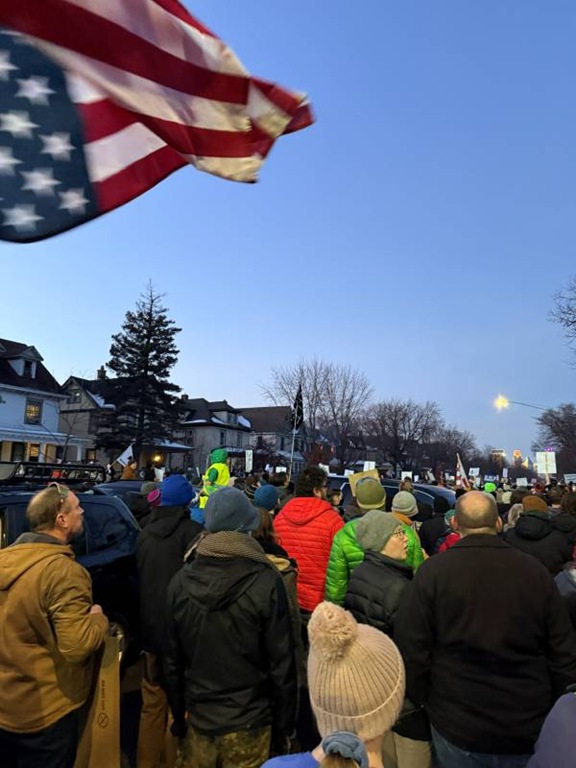
On this Labor Day, Minnesota crowds might be at the State Fair or in a park, but at the beginning of the year ordinary workers – not on holiday, but in dismay, – chose to stand together. When you saw captions then writing, “activists,” that would be inexact – mostly just folks who didn’t want to say “yes” to governmental activists.
.
This blog has a small audience. I think of it, I’m grateful for you, I’m not here to hector anyone or say I know better than you do with your best thoughts, best knowledge, best hearts. I imagine some will just nod in agreement as they read this. Others have tuned out before reaching this paragraph, tired (as I often am) and having no mood for civic matters, and this Project doesn’t intend to make you endure that instead of its usual inexact attempts at beauty and wonder. And maybe, even after reading this far, someone is reading this and saying “You don’t understand. It’s complicated. There’s this, and this, that you’re ignoring or don’t know.”
Yes, the things I think are evil, some may think are “complicated.” They are. They are. Evil – and even more certainly, even more so, is the restoration of things after evil acts. As I look toward the next Thirties that are to come after previous Thirties when Patchen wrote his poem, I can’t see how the great work of fixing evil and ineptitude can be imagined into plans, much less attempted, much less accomplished. I think of this as I laugh at the killing joke at the end of today’s piece.
You can hear my musical performance of Kenneth Patchen’s “In Order To” with the audio player below. If you think I’ve forgotten the work-order for that player, I assure you I haven’t, but I know you might be reading this blog in ways that won’t show the player, so there’s this highlighted link that will open a new tab with its own audio player.
.
*What about art on Labor Day? I think about the duties of artistic workers toward other workers, but in my observation many artists, and specifically poets, don’t reflect this in their poetry. Since most poets (and increasingly, many musicians) are not solely employed working in poetry, I suspect this is due to embarrassment at that lot – or it may be a hard-bitten escapism, a choice to do, and separate, their art work as respite from the everyday context of the “day job.” Joy is resistance! Beauty is opposition! Or you may not be called to be evangelists, you may be called to be saints. You may take spiritual pride in not writing dreary tracts in the costumes of poetry, and this may be blessed work. Anger, even righteous anger, can scare away the muses. Or you could simply need the commercial art paycheck to make ends meet.

