Today was the Autumn Equinox, which some use to mark the beginning Fall. Where I live it was very hot and muggy, hardly autumn-like at all, and even the reasonable breeze could not budge the heat. I went bicycling with my son, promising him ice-cream, which he accepted as adequate exchange, and picked up cold sandwiches for our supper, but in-between I worked on the setting for this piece, yet another by Christina Rossetti.
I wasn’t intending to return to Rossetti so soon, and I’m not sure how I ran into this poem, but it meshes so well with some others I featured here this month about summer and attitudes to love. I just couldn’t deny it.
Christina Rossetti: sadness that none-the-less sings in a lovely way
I know little of Christina Rossetti’s life, if she suffered from depression, or if this reflects a more temporary mood; but in whatever case, she fashioned a finely crafted lyric to present the experience. I find this sort of thing often in English poetry, sadness that none-the-less sings in a lovely way. Here is America we grew up some Blues, and we tend more to bargain with despair, or call it names and begin to insult its absurdity.
The title is a bit of puzzle to me, though. “From Sunset to Star Rise” has something of a “It’ll get better” connotation. Was she trying to remind herself of some wisdom that could come from this, or that there is some mystery yet to work out?
Musically I wrote this on acoustic guitar and the full arrangement retains the acoustic guitar part with some disconsolate drums and slowly building synth parts. To hear it, use the player gadget below.
Edna St. Vincent Millay was another poet who offered little to the “New Criticism” critics who largely set the canon for the 20th Century, even though her career, which covered the first half of the 20th Century, ran almost exactly through the same time as Eliot, Frost, Pound, William Carlos Williams, and Wallace Stevens, and even though she achieved significant readership and a level of awards and accolades while living.
What was their problem with Edna St. Vincent Millay? Well her popularity would be a negative in some lights. In this regard, critics are often no different than the record store clerks of my own day, whose estimation of any indie band would inevitably drop as soon as they achieved a widely-played record. And there’s the “her” and “she” problem. The level of disbelief of the idea of a woman artist probably varied among these critics, but literature was still a very male world at that time and unconscious prejudices are a given. But even if we skip those two, frankly illegitimate, factors, there is the issue of Millay’s plainspokenness.
Annie Clark performs as “St. Vincent,” Edna St. Vincent Millay is on the right. Google carefully!
Clark has said the stage name came from a NYC hospital, but if that’s so, it’s a remarkable coincidence.
Odd isn’t that? This value that you might rate highly in friend was held as low regard by the New Critics, who likely thought it common and unremarkable. A Millay poem typically says exactly what it means, right out. There may be images, but they might not pass Imagist muster. They aren’t stark omens whose meaning is felt and then deciphered, they may be more like the illustrative images the Imagists wanted to leave behind. Millay’s all tell and too little show for them.
And Millay’s language often seems stuck in the 19th Century too. Some lyrical poets like Yeats and Frost adopted Modernist tropes and were able to make their rhymed and metrical poems sound more like contemporary speech. Millay sometimes seemed to be reading from a somewhat musty library book when composing her poems.
The most extended image in “Sonnet 43” is a bare winter tree, which could be a borrowed image, or a homage, and I choose to manifest the later in this performance.
Can our modern (post-modern) age free up some respect for Edna St. Vincent Millay? I think so. With contemporary poets, we now sometimes value plainspokenness. And the cluster of things that Millay spoke plainly and honestly about include love, sex, and desire.
This sonnet was published in 1920, it’s nearing a century old. If we slide over some of the 19th Century “poetic diction” (something I found easy enough to do when performing this) it’s as honest and as nuanced report on the state of a heart as anything written then or now.
And if one must have ambiguities for art’s sake, honesty can contain that too. Some read this poem as bitter, or a lonely-hearts club statement, or as regret for a life that Millay’s time would’ve called promiscuous. That’s not how I understood it to perform it. I think the speaker is recalling an active love life they rather enjoyed. They reveal themselves (honestly) as something of a sensualist. As the Petrarchan sonnet wraps up its octet, the speaker allows a touch of regret about those lovers who turned to the speaker at midnight “with a cry.” What did the speaker offer them? I think the closing lines say some “summer,” a summer that “sang in me”—that is, that summer is not something the speaker intentionally gave or offered, and the speaker doubts that the muses of that summer offering will still speak through her. William Carlos Williams—unlike Millay, following all the Imagist rules—touches also on the caprices of summer and fulfilled desires in “It Is a Small Plant,” but some are more accustomed to a male author speaking ambiguously about the honest incursions and boundaries of desire.
Perhaps this poem benefits with some listeners in being heard performed in a male voice? I can’t say for sure on that.
Among the 20th Century admirers of Millay’s verse were my father (who grew up on the 19th Century Longfellow and the like, so Millay’s 19th Century diction was no bar) and a distant cousinoid of mine, the modern American theater pioneer Susan Glaspell.
I rather like the musical accompaniment for this one. I worked quite a bit on the drum part trying to bring out different colors, and for the bass I was able to supplement the electric bass with some bowed contra-bass, which is one one of my favorite sounds in the world. Ironically, Millay started out wanting to be a concert pianist, and the top line here is one of my naïve piano parts. To hear me perform Edna St. Vincent Millay’s “Sonnet 43” aka “What lips my lips have kissed…” use the player below.
September 17th is the birthday of the American Modernist poet and physician William Carlos Williams, and today’s piece uses the words from one of his poems “It Is a Small Plant,” the best known selection from a sequence of poems Williams called “The Flowers of August.”
Just because you have have a passport doesn’t mean you have to move overseas.
Unlike some other American Modernists—including two poets he met and befriended while a student at the University of Pennsylvania, H.D. and Ezra Pound—Williams spent most of his formative writing years in the United States, much of it in his native state of New Jersey where he practiced as a pediatrician. Like his fellow stay-at-home Modernist Carl Sandburg, Williams wrote poems the followed the new Imagist rules, at least at the start, finding them useful in breaking away from the old poetic styles.
One of those Imagist rules, the first one in fact, was “direct treatment of the ‘thing.” That doesn’t mean that you just directly state the message from your heart. Rather, it means that you honor and hone the image(s) that represent your meaning as palpable thing, not as mere poetic decoration for your words. “It Is a Small Plant” demonstrates that by spending nearly the entire poem presenting a description of a flowering plant.
In the series “The Flowers of August,” each of Williams’ other poems are titled with the name of a particular meadow or pasture flower, but not this one. So, I suspect this is meaningful. The description of the flower here sounds a bit to me like the common bluebell, but it’s possible that he diverged from botany in service of one of the poem’s images, or that the omission of the flower name in the title for this poem made a point for him.
The other, more important, mystery is who the “her” that is inspecting the flower with the poet is, the her who regards the subject flower as “a little plant without leaves.” At first. I wondered if it was perhaps a young girl looking at the flowers, but I now believe that it’s the “her” featured at the poem’s close: summer. If that’s so, that is the reason the flower has no name, as the human name doesn’t exist for nature and for nature’s incarnation as summer. And in the course of the poem, summer then too cannot care about the anthropomorphic desires presented in Williams’ presentation of the image of the flower.
Unlike William Blake, William Carlos Williams didn’t see Heaven in a wildflower,
but he did see nature observing himself observing the flower.
I’m not a quick understander of poetry. In working on this piece, I read Williams’ poem, enjoying some lines in themselves. The ostensible subject seemed to fit with the season and coincidentally with some other pieces I’m working on—but I wasn’t sure what it meant. In the course of fitting it with music, recording the vocal, and then tweaking and mixing the music, I lived with this poem for a good part of the last couple of days, reading or hearing the words over and over.
If I had been too concerned with its meaning, I might have stuck with my initial supposition, that it was child apprehending the flower. I was pre-disposed to that on first reading, having briefly re-meeting Margot Kreil earlier this week, a poet who wrote an excellent poem called “Weeds” which featured just such an image. But I was more concerned with getting the drums right, playing the bass, setting up delay divisions for the guitar lines, and marshalling my limited keyboard skills for the soft keyboard parts, and then making that all fit together.
Through you don’t have to go through those composition and production steps, this points out again one of the things that music can do to change the context for words when it’s combined with them. While music can emphasize some mood or presentation of the words, in the same way that suspense music makes a film clip of a character walking down an unremarkable hallway scary, it can also offer its art as a distraction from worrying about meaning too soon with a poem.
To hear my performance of William Carlos Williams’ “It Is a Small Plant,” use the player below.
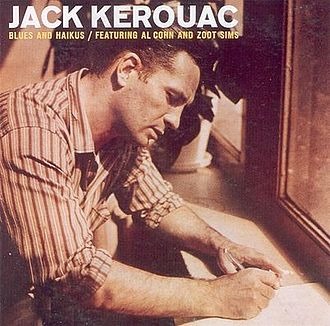
Today’s selection was also recorded a few years back, and is more conventionally in that “poet reading beat poetry while a band backs the poet up” school of performance. While that’s one of the influences that has led to the Parlando Project, I didn’t want to confine myself to that style, and if you’ve been following along here with what we’ve done over the past year, you’ve heard some of the other approaches we’ve taken.
As I’m in a busy end of August, I don’t have time for much commentary on this piece, but I don’t think it needs it either, which is part of why it’s here today. This is a story set distinctly in South Minneapolis and the early 21st Century, and it talks obliquely about the time of falling in love with my wife. The Riverview Theater mentioned in the poem is still a going concern, a neighborhood single-screen movie house that shows movies near the end of their theatrical release without concentrating on any one cinema genre, leading to marquee billings like the one the poem mentions, a series of titles that often seem like little Dada poems to me.
Minneapolis’ Riverview Theater: Dada poem generator or movie house marquee?
Outside of the localism of the poem, the main obscurity in it is the title: “Like John A Dreams.” That’s a reference to one of my favorite speeches in Shakespeare’s Hamlet. In the play’s Act II, the hero Hamlet is asking why he cannot take action on the death of his father, and he rebukes himself as “Like John A Dreams, unpregnant of my cause, and I can say nothing…” John A Dreams was apparently a stock folk character in Shakespeare’s time, a foolish character who lived in his imagination and ignored more pressing reality—a character flaw all writers should be able to appreciate.
Parlando influence Jack Kerouac. “Beat poetry while a band backs the poet up”
Allen Ginsberg once recalled Jack Kerouac reading Hamlet aloud, and in particular this speech, with special emphasis in his voice when he landed on the “John A Dreams” charge.
So, if you’re a writer or other artist, Hamlet’s speech is for you. Your life is quite possibly bifurcated between that artistic thing you do and the life you press aside to do it. Art is often about making “and” choices. Life is often about making “or” choices.
To hear the LYL Band perform “Like John A Dreams,” use the player below.
Just after the start of the 20th Century two teenagers met at the University of Pennsylvania. One was 16 years old, a smart and cocky boy without much in the way of money, who had somehow managed admission to the University at such a young age. The other was 15 and the only daughter of an astronomer and professor at the college. So devoted was the girl’s father to his astronomy, that it’s told that his wife needed to come by during the colder months with a kettle of hot water to unfreeze his eyelashes from the eyepiece of his telescope. This professor was the enlightened sort of early 20th century father who believed in women’s intellectual equality. He dreamed that his daughter would become another Marie Curie.
However, the two teenagers soon fell in with each other, and science was not in their bond. Poetry and the arts were. A year or so later, a new freshman arrived at the University to study medicine. That freshman was William Carlos Williams, and he would complete his studies and become a pediatrician and family doctor who practiced for decades in Patterson New Jersey while writing purely modern poetry. The boy and the girl fell in love, and were secretly engaged, knowing that the boy’s lack of money and established career would prevent the girl’s father from giving permission of them to marry.
The 1985 movie “Real Genius” is a documentary of this meeting between two teenagers in college.
The girl grew up and was sent to Bryn Mawr, a woman’s college that was known for having a tough “men’s curriculum,” following her father’s hope that she would become a scientist. There she met Marianne Moore, who also became a noted modernist American poet, but at Bryn Mawr she failed in her studies. The American oracle Barbie would later proclaim: “Math is hard!” and a career in science was out.
But wait. What of that cocky boy? Oh no, he’s gone to England! And double oh no, he now engaged to another woman there. After all this, we can now begin our story again.
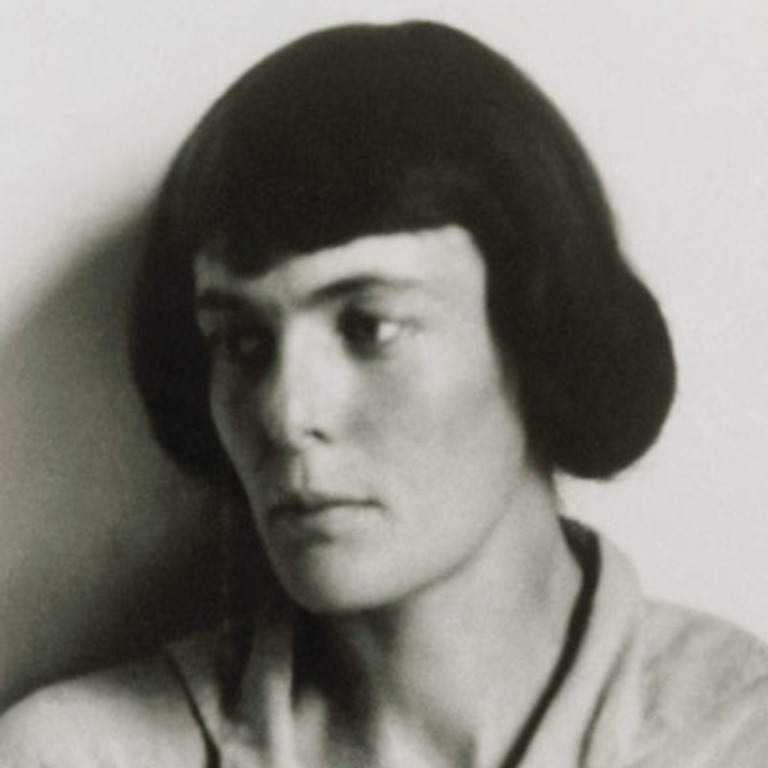
This now young woman who had already met and befriended William Carlos Williams and Marianne Moore, went to England to meet back up with the young man she had fallen in love with as a teenager. The young man was Ezra Pound, and the young woman was Hilda Doolittle—but she wouldn’t be much longer.
Sorry, “Real Genius” its really about how Tears for Fears was uncool, but now is kinda cool.
And here are the real and young Ezra and Hilda.
Pound was in England trying to stir up a poetic revolution, something that would forge past the reformation of William Morris and the Pre-Raphaelites and give poetry a fully modern cast. Hilda showed Ezra some of her new poems, and Ezra did three things that he would do repeatedly for other poets in the next couple of decades.
He immediately recognized that Hilda was writing the kind of fresh, spare, honest poetry that he thought necessary to break the grip of the past. He would see to it being published.
After admiring it, it took his pencil to it, and slashed out parts of the already concise poems. I can hear some of you drawing a breath on that, considering the sexual politics, ready to cry “Asshat!”—but that’s Pound, even with poets of genius: cut it, pare it down, make it new, not one extra word. A few years later he’d do the same thing to T.S. Eliot, and the surviving variorum manuscripts show why Eliot called Pound “The Better Maker” of “The Wasteland.” Pound’s editing pencil seemed to teach like the sensei’s stick, and once shown, poets like Hilda Doolittle and Eliot understood how to do the same thing themselves.
And then he took that editing pencil and signed Hilda’s poems “H.D. Imagisite.”
That last move was another part of Pound’s talents. He was probably more successful in launching other poet’s careers than he was his own. He had a shrewd promoter’s eye. “Imagiste” or “Imagist” was the name Pound would give to the modernist poetic movement that would during the years of WWI as radically reshape English poetry as the war would reshape the maps of the world, and here he was saying, rightly, that H.D.’s poems would be the ne plus ultra of that movement. As a name, H.D. was as pared down as the new poetry would be. If he’d lived long enough to see video screens with 1024 lines, he could have said calling them HD for “High Definition” was a tribute to his call for seeing things truly. And H.D. masked Hilda’s gender, still important in a world where women were widely thought to be incapable of great art. The former Hilda Doolittle didn’t object. She’d never liked the family name (“Do-Little” she thought it scanned) and besides, her sexual identity and friendship affinities were at least HD.
Let me admit that this post is unfair to H.D., the writer of the words of today’s piece. We’ve gone past my customary length limits and we’ve only barely touched on H.D.’s talents and extraordinary life. I’ll need to revisit her work soon and give H.D. her due.
What can I say about today’s piece “Heat?” Well it’s an appropriate July poem, and the titular heat, in true Imagist fashion is both a closely observed thing: actual summer heat, and an image that, without simile or extra framing, is imbued with complexity. Last episode we had Pound/Li Bai, two men, showing desire and longing in the “River Merchant’s Wife” with only a few actual named emotions or feelings. H.D., the better Imagist, shows female desire with not a single named emotion. The poem’s final phrase:
that presses up and blunts
the points of pears
and rounds the grapes.
is sensuous beyond words—it’s only 13 words to be beyond after all—and with four p and s sounds it holds four kisses.
To hear my performance of H.D.’s “Heat,” use the player below. And thanks again for the likes and the social media shares!
I sometimes like to ask musicians who sing folk songs “What is the oldest song you play?” As a person attracted to traditional English folk music at an early age, I often marveled at the gloriously old traditional ballads collected by Thomas Percy and Francis Child. There’s something interesting to me about singing not only “other people’s stories,” but very old stories at that.
Turns out that they are likely not all that old. Most of them are no older than Shakespeare, and despite many antique words and usages, they are in more or less modern English. That’s old, but it’s not old like Homer, Sappho, some of the Chinesepoems I’ve set to music here. Today’s piece, “Summer Is Icumen In” was nearly as old to the typical Child ballad author as Shakespeare is to us. You can say it’s words are written in English, but that’s only English within the broadest of meanings, as the words are even farther removed from the language we speak than Chaucer’s.
Unlike the now lost ancient Greeks’ music to accompany poetry, we even have the 13th Century music and a notated arrangement to present it sung as a canon or round.
Old joke. Q: how do you make a guitarist turn down? A: put sheet music in front of him
New joke: Q: how do you make a lead singer ask for less in the mix? A: put old English lyrics in front of him
One tradition in folk music is to not be overly traditional in re-using it, and I’ve done so here. My melody is only tenuously related to that old one. The original music is minor and mine is major key, and I don’t do it as round. Furthermore, I’ve taken liberties with the various modern English translations of the words. I have replaced a phrase with one that I like better, completely blowing a raspberry toward those who translate uerteþ in the original text as “fart”.
I’ve fattened up the arrangement with a goodly helping of a traditional English instrument of the antique 20th Century, the Mellotron. I told Dave Moore after I completed the mix with the new Mellotron parts that the singing wasn’t good enough for it to sound like the Beatles, and it wasn’t stately enough to remind anyone of King Crimson, and it didn’t have any undeniable pop music dynamics like the Moody Blues either—but what I may have gotten too was something in the 2000 light-years neighborhood of the Rolling Stones’ “Their Satanic Majesties Request”—which I will confess was one of the first trio of records I bought back when the Beatles “Sgt. Pepper” was threatening to reshape all pop music (a threat that was not carried forward for both good an ill).
Don’t adjust your monitor, the original LP’s 3D cover is really that blurry.
Also, any mention this Stones album’s name must now be done in Dana Carvey’s Church Lady voice.
Anyway, I’m using digital replicas of the original Mellotron’s cranky tapes in “Summer is Icumen In,” but even in that remove they add a certain character to the string parts. Dave’s original organ part, mixed in the right channel, now seems like a top line to the Mellotron parts, but it’s a good part, so listen for it. To hear the LYL Band’s performing this old English lyric in a non-traditional way, use the traditional player that appears below.
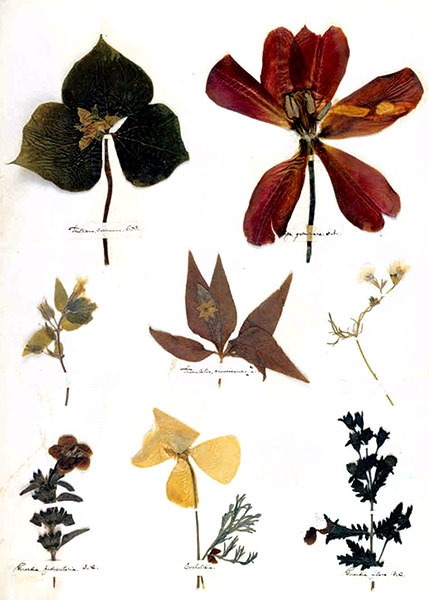
It would seem odd to us now, but when Emily Dickinson died, her most noted accomplishment was not her poems, but her plants. She was a serious gardener, known to her family, neighbors, and town for cultivating her plants even at night (which was also her customary writing time).
and often included flowers with her letters and privately distributed poems
There’s a lot of comparisons to be made there, that her poems are like flowers, pretty at first sight, but with their own alien structures, but I’ll leave that for now so that I can move on to today’s piece “I Know a Place Where Summer Strives.”
This is a poem that fits well with the Parlando Project’s tactics of combining poems with music, because it’s a poem that uses puzzles to tell its story. When you combine a puzzling lyric with music you can let those words ride along without requiring them to be immediately meaningful, as otherwise poems that go out of their way to be puzzling can frustrate readers not in the mood for non-straightforward speech.
I enjoyed “I Know a Place Where Summer Strives” before I had solved its puzzles. As usual, Dickinson doesn’t belabor her subject, just three stanzas and 12 lines, a nice dosage for puzzlement. The poem’s internal music flows nicely, and Dickinson’s use of unusual word choices in the final stanza adds decoration to the mysteries. After reading it a few times, writing the music for it, performing it with the LYL Band, and then mixing the recording available below, I have finally gotten around to trying to solve the riddles.
The first verse/riddle is a particularly cold spring, with “practiced frost” taking casualties among early blooming flowers. The second verse/riddle is a description of a building storm, which turns out not to be destructive, it brings “soft (ref)rains.” The third verse/riddle is more obscure yet, but the rain falls onto the hardened, adamant, ground. The last two lines of this verse are lovely to read and hear, but I couldn’t make any sense from them. At first thought I, like blogger Susan Kornfeld, wondered if this was a late-fall time image, and the quartz was ice forming on amber leaves—but then I noticed that the third verse clearly appears to be carrying forward the sentence and thought from the second verse, so it can’t be winter’s arrival: south wind, rain—that doesn’t sound like winter arriving.
Blogger Linda Sue Grimes suggests a solution, that the amber is mud on the shoe. This makes sense, and it could logically follow the rain on adamant hard ground, which could even be light yellowish, amber-colored, clay and not good dark garden soil, but I still am puzzled by the quartz. The line here is especially lovely: “That stiffens quietly to quartz” resonating with the “qu” “zee” and at “t” sounds, but I don’t think Dickinson cheated just to get the sound. Quartz can be brown like mud, though that’s not how I think of it, but its name and the modifier “stiffens” indicates this is something crystalline—not gooey, caked mud.
In performance I decided, intuitively, to repeat the first verse; and in so doing, I bring back the cyclical end of summer to close things.
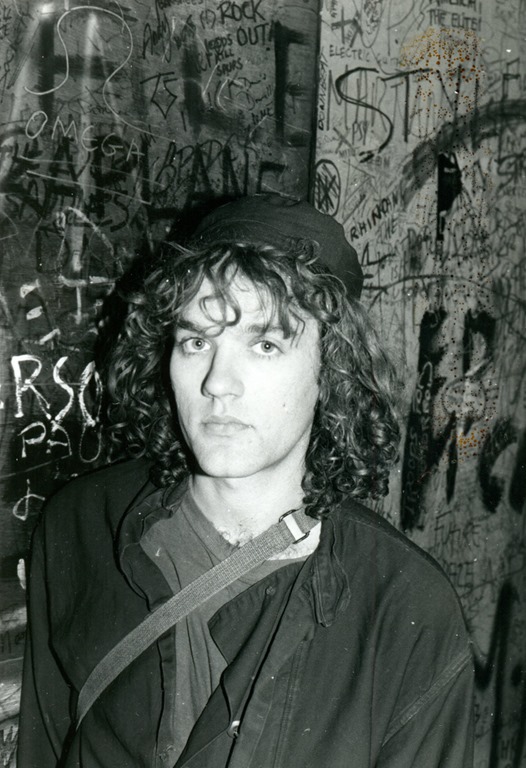
Michael Stipe when he was Gardening at Night.
Coincidentally, both he and the Parlando Project are in some part inspired by Patti Smith
When I read that Dickinson’s gardening extended even to nighttime work, I recalled the song from R.E.M.’s first EP, “Gardening at Night.” Michael Stipe’s early lyrics, are far more abstract than riddles, reading to me like abbreviated captions to blurry photos. A set of lines like:
We ankled up the garbage sound,
but they were busy in the rows.
We fell up not to see the sun,
gardening at night just didn’t grow.
Are as obscure as any poem, but I could, and still can, enjoy R.E.M. songs like that one. Stipe sincerely sang his own meanings, and he had a great band around him that supplied the music that lets the meaning ride.
To hear the LYL Band performance of “I Know a Place Where Summer Strives” you can use the player that appears below. Musically, you might find it to be vaguely R.E.M.-like too.
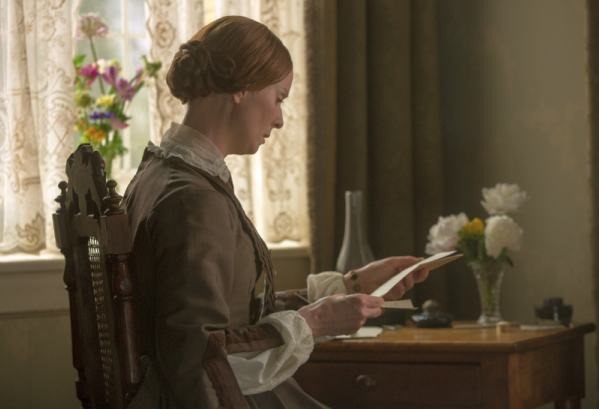
I got to see the Emily Dickenson biopic “A Quiet Passion” this month. I can recommend it with a warning: this is not a work that intends to be friendly or easy to digest. It does present a reasonable estimation of what may have made up Dickinson’s life experience, showing it with enough detail to be (for me) very moving. However, it also tries to show the intellectual ferment of Dickinson’s time in a very strange way, by spending a fair amount of the movie’s running time having people converse with each other in an extended series of Oscar Wildean epigrams.
This movie has no car chases or flying magician CGI battles
Of course, I have no way of knowing how people spoke in 1860 Amherst Massachusetts, but I doubt they spoke like this: epigram after epigram, back and forth like a free-style 19th-Century rap battle. What I guess the director/screenwriter is trying to do is give us some sense of Dickinson’s mind and the minds of others she paid attention to—Dickinson’s poetry is full of epigrams and busted epigrams after all. What he does is artificial, but then having folks read Emerson or other Transcendentalists out loud would be artificial too.
Another part that is harrowing is the time spent on the routines of death and dying in her time. Given Dickinson’s own gothic tendencies, this is not only defensible, it may be indispensable in conveying her outlook. And Cynthia Nixon’s performance as Dickinson is very very good.
So go see “A Quiet Passion” if you would be interested in a portrayal of a what Dickinson may have been like as a person and what drove her as an artist. But do not go to see it if you want a friendly, straightforward introductory film biography that would introduce you a writer you have not yet committed your interest to.
For once I’m happy that this is a long preamble to today’s piece, Emily Dickinson’s “Her Final Summer Was It,” because I do not really want to talk much about the work itself, as I don’t think I can speak a well as Dickinson’s own sparse words. I found in it great resonance to my own experience, particularly a summer 16 years ago—but as with all things we present here, the intent is not to dwell on my own life, but to connect to and impact yours. I hope I do the work justice.
Dickinson’s own hand-written manuscript of “Her final Summer was it”
You can hear my performance of “Her Final Summer Was It” by using the player below. If you’d like to hear other Emily Dickinson pieces interpreted by the Parlando Project, we have done fourotherDickinsonpoems with music here.
We’ve made it to more than 90 posts into the Parlando Project without doing any Shakespeare, which I believe may be some kind of record. It’s not an intentional slight, it’s just that we’ve been busy with other words.
I grew up in a little Iowa town named Stratford, the same name as Shakespeare’s birthplace, and this coincidence instituted by land speculators a hundred years or so before, impressed on me the importance of poetry. This was not the only misapprehension of my youth, but it was long lasting one, as here I am countless decades later, delighting in words being costumed in music.
Two summer’s days: one of these is the Avon river through the forest of Arden in England,
and the other is the Boone river near Stratford Iowa in the U.S.
Today’s episode uses the words from Shakespeare’s Sonnet 18, “Shall I compare thee to a summer’s day.” Like many Shakespeare pieces, there are lots of performances of it around, which is one the of the values of Shakespeare—you can contrast your performance against others. Many performers of Sonnet 18 like emphasize the wit in it; and wit there is, with it twisting around the idea of comparing one’s beloved with the beauties of nature, which is developed further as the idea that the inconstancies of nature necessarily include aging and death.
Others like to embody the sensual in the poem, the lush language. The third line ends with “the darling buds of May,” a phrase, good enough to be swiped for the name of a fine Welsh 90’s indie-rock band. I don’t think you can escape from that musical language. The entire second quatrain uses near and exact rhymes for each line, a sound that rubs and slides against the ear.
I made two choices in emphasis that differ from others. First, I wanted to bring out the brag in this. The speaker in this poem, who the author is at the least pretending to be, is claiming that he can make his beloved immortal by the power of his verse. No small claim—but in Shakespeare’s case, it’s not bragging if you can do it. And to add to the swagger, I stressed the beat a bit more than I might usually. I made the speaker a little less coy, a little less playful, and little more assured that he’s more than the “upstart crow” that he was seen as by some early in his career when he was writing his sonnets.
Musically I declined to use my main instrument, the guitar, this time. Once I had the drums and bass down, I thought they were enough to support the words on their own, so I added only some scattered piano chords to help outline the harmony.
To hear my performance of Shakespeare’s “Sonnet 18, Shall I compare thee to a summer’s day” use the audio player that appears below. Today’s piece is quite short, less than two minutes long, so it’s a good way to sample what the Parlando Project is doing. If you like it, we have more than 90 other audio pieces available here using various words combined with various music.
A couple of posts back we had a piece with words by Roy G. Dandridge who got called the “Paul Laurence Dunbar of Cincinnati.” Today’s episode’s words are by the Paul Laurence Dunbar of Paul Laurence Dunbar.
Paul Laurence Dunbar. Young, Gifted, and Black.
Dunbar grew up in Dayton Ohio, the Afro-American son of former slaves. In his town’s high school class of 1890, he was friends with another guy, a white guy, one who had varied enthusiasms. This other guy was a snappy dresser for his time, wearing newfangled wing-tip shoes, bowler hats, and a sporting a dashing waxed handlebar moustache. When the mandolin had a popularity boom, Dunbar’s classmate dude had to learn to play it, and he apparently drove his family around the bend as he practiced. Then later, the dude became interested in printing, and so designed and built his own printing press. He got so attached to printing and publishing that he dropped out of high school to start his own print shop with his brother. Then a couple of years later, the modern bicycle was invented, and his mechanical ability branched out to building, selling, and repairing bikes.
Dunbar with his high school class. Dunbar is in the upper left, our mystery dude in the shadows in the back.
And what’s with the guy on the left in the front row, shouldn’t he be in a band or something?
But let’s step back to that printing business. Paul Laurence Dunbar was already writing poetry as a high school student. After graduation, his family’s lack of funds and racial discrimination kept him from going to college, but he hungered to get into print. Our dandy, mandolin playing, designed-and-made-his-own-press print shop guy went into business with Dunbar and printed a newspaper that Dunbar edited and wrote for, even while Dunbar was still in high school–and then he used his connections in the business to get his classmate’s poems collected and published two years after Dunbar graduated from high school.
Dunbar’s books gathered attention. James Witcomb Riley, Frederick Douglass and William Dean Howells reviewed him favorably. By the end of the 19th century he had toured England, gotten a job with the Library of Congress, and written the lyrics for a Broadway musical and collaborated on an operetta, becoming the first widely known modern Afro-American poet before he was 30 years old. The 20th Century awaited him.
Then he contracted tuberculosis. His health declined, and though he tried to continue to build on his career, he died in 1906 at the age of 33.
He should have been one the older generation of the Harlem Renaissance of the 1920s. He could have taken his mastery of the lyrical 19th century style, and like Yeats in Ireland, transitioned seamlessly into the forms and topics of modernist poetry. Alas, none of that was to be.
Dunbar’s “A Summer’s Night” is a lovely, sensuous lyric. If one goes beyond the Victorian-drenched term “maiden” used almost as a refrain in the opening lines, and the slightly precious “perfumed bosom” of the southern breeze that closes the first half of the poem, the flitting last half that closes with carousing fireflies staggering home in the dark is just gorgeous It’s my hope that using our Parlando Project tactic of performing these words with music lets one more easily accept the sentiment of the more archaic words.
So, what happened to our mechanical aptitude dude, the guy who’s printing press began printing Paul Laurence Dunbar while they were High School classmates, helping launch the career of America’s first widely known modern black poet?
This bike looks pretty sweet even today. Dig the mono-tube rear stay, the tri-plane front fork, and the flipped moustache bars.
Turns out bicycles were one of the seed technologies of the 20th century. Our dude knew how fabricate his own stuff, and make it strong and light. The dude was named Orville Wright and he and his brother Wilbur took the modest profits from their printing and bike businesses, and three years before Dunbar died, they designed, built and flew the first airplane. There was a lot of disbelief that a high-school dropout from a hick town could do any such thing. Pioneers like Paul Laurence Dunbar and Orville Wright had to do it, otherwise no one would believe it.
To hear my performance of Paul Laurence Dunbar’s “A Summer’s Night” with music, use the player below. And thanks again for liking, following, and sharing.




![Summer Canon [Reading Rota] - caption: ''Sumer is icumen in''](https://frankhudson.org/wp-content/uploads/2017/06/sumer-is-icumen-in-sheet-music.jpg "Summer Canon [Reading Rota] - caption: ''Sumer is icumen in''")



 Frank Hudson