Back Yard

Just a couple of posts back I said that early Carl Sandburg poetry can be just as aligned with the ideals of the Imagist school as the Trans-Atlantic poets such as the then contemporary work of Ezra Pound, Amy Lowell, H.D., Richard Aldington, F. S. Flint, T. S. Eliot, William Carlos Williams, and T. E. Hulme was. Yet he’s rarely mentioned as such.*  Why might that be?

My guess is that there’s an issue with Sandburg’s more expansive mode, present in some of his work, Whitmanesque in character and scope. The Pound and Eliot school of Imagism wasn’t much on Whitman, charging him with lack of craftsmanship and concision. And then there’s the issue of cultural affinity, which while outside the text, is important. Of the above, only Lowell was from a wealthy background** (and Flint’s childhood seems positively Dickensian) but they all saw themselves as culturally elite. Most were familiar with classical languages, some had Ivy League educations (though none were Oxbridge, save for Hulme who was thrown out after a bit more than a year for rowdy behavior), most had spent time in Europe , even Williams, the most American-focused of these.

Sandburg? Born working class to two immigrants in the Midwest***. Drops out of school at age 13 to go to work. The jobs he had in the first 40 years of his life were modest in prestige, but varied in location and nature. Coal-heaver, farm laborer, Army private, milk-truck driver, political organizer, bricklayer, “The Front Page” era urban journalist. What T. S. Eliot knew about the whole of literature, Sandburg knew about the whole of working-class work and life.

One could make one mistaken generalization from Sandburg’s biography, that like Whitman self-advertised himself, he’d be “one of the roughs,” a man whose art would be artless and as unconcerned with the niceties of aesthetics as the correct fork for which dinner course. But just like the lazy assumption that there’d be no poets in foxholes, the idea there are no aesthetes who punch a clock is bogus. Sandburg’s early work is as concerned with Modernist beauty and style as working-class dignity—and he is very concerned with working-class dignity!

Is today’s Sandburg piece, “Back Yard”  an Imagist poem following the three Imagist rules? Let me paraphrase them:

Direct treatment of the thing: that is, the focus in the poem is on the image itself which will be described, instead of the image being a decoration and figure of speech within the body of a poem more concerned with its moral or message for which the image is only a “like” illustration. Conciseness: no extra words, and though not stated, it’s corollary is no less-apt words used only to make the rhyme. And freer rhythms: word-music, like sound-music, is not required to limit itself to only extraordinarily regular and repetitive rhythms.

Direct treatment? The outdoor, summer night scene is just that. One is hardly aware here that it’s an image, it seems like simple reportage. Is it merely the “hardly news” that on a summer night if one is outside, perhaps sitting on an open porch, you’ll hear and see other people outside too?

Concise? Pretty much. It’s not In A Station of the Metro,  or The Pool,  or The Red Wheelbarrow,  there is some re-iteration in it, even a single line refrain, but even by the standards of lyric poetry, this is a short poem. The elements of the scene are evoked, but there’s little extravagant or showy description. One element that many Imagist poems share (though never a formal rule AFAIK) is that colors are used to simply describe objects, though since this is a moonlit night scene the colors are more monochromatic.

A follow up question: how minor and mundane is “Back Yard”  really? I can’t claim it’s a poem of great originality—but that’s not the job of every poem, and this is more a poem of the continuity of change, a moment of shared perception, not a striking new vision.

I think its intent, in it’s just over 100 words, is for us to see a chain of life in a Chicago night early in the 20th century; and in its everyday exactness, state those things that might link to a night tonight where we live today. The silver moonlight in the scene seems almost a preservative, everything is frozen in that direct moment. In my night tonight it may not be an Italian boy with an accordion, but Mexican music from the back yard at the end of the block. The couple Sandburg says will marry next month, are now-dead grandparents of people as old as I am. An old man has fallen asleep in the late and waiting moment, his back-yard cherry tree’s fruits held in a moonlit unmoving until his eyes close. He will likely pass on sooner than the marrying couple, and his dreams and those long-ago cherries will be returned to the place that dreams, fruit, and poems go and come from.

The poem closes with a perennial thought delivered in the scene’s description. The clocks, the poet relates, say he too must go. The clocks say that to all of the characters in his poem, and by extension to us, his audience. Sandburg, the artist, the poet, has the job like the moon to fix this moment in silver. Was he thinking here of the silver of his brother-in-law Edward Steichen’s art photographs? What does he mean by the poem’s closing line? What are the “silver changes?” My best understanding is they are the endless succession of such fixed moments. There will be more and more silver changes, a great richness, even as we are entirely not there.

Edward Steichen Nocturne-Orangery Staircase

Fancier than my back yard: “Nocturne-Orangery Staircase” (1908). Sandburg occasionally collaborated with his brother-in-law and pioneer in fine art photography Edward Steichen.


For the performance of “Back Yard”  I decided to intersperse some other night moments, sung as commentary on Sandburg’s poem. You can hear it with the player gadget below. Want to read along? Here’s the text of the poem.


*Yes, Imagism is only a label, a piece of sticky paper put on some writers and writing. But because Imagism was so vital to the formation of English poetic Modernism, excluding Sandburg, “The Forgotten Imagist” from its usual ranks was part of how he was diminished in the late 20th century. The artistically-chosen stark simplicity of Imagism was admired, but similar directness in Sandburg was seen as populist simple-mindedness. For an example, here’s a long review of a late 20th century  biography, where the dagger is that Sandburg’s poetry was “dumbed-down Whitman” and the charge seems to be that he was a pretentious yokel who was also a phony who pretended to be a yokel.

**I’m of the impression that Eliot and Pound’s family had at least upper-middle-class wealth too, but my informal memory is that some estrangement or streak of independence led them to live outside their families’ wealth.

***Sandburg’s home-town area, the Quad Cities and its surroundings in Iowa and down-state Illinois, was a surprising well-spring of writers in his time.
Over Hill, Over Dale (from A Midsummer Night’s Dream)

Today is the summer solstice, and what better way to celebrate than a song from Shakespeare’s “A Midsummer Night’s Dream.”

The song “Over Hill, Over Dale”  comes early in the play, as the audience is introduced to the fairies’ world. I’d like to point out, the un-named fairy who sings it might be particularly relatable to creative types. How so?

On our creative days we may like to think ourselves’ that play’s Puck, “that shrewd and knavish sprite” capable of all kinds of life-shaping mischief with our words and creations; the Puck who gets the play’s ending speech where he represents as all effortless, dreaming creators to our audiences.

But Puck doesn’t sing today’s song.

Nope. The singer is just a fairy no-name. And, to be frank, this fairy is kind of a drudge. The song, delightful as it is—and meant to generate with word-pictures a wonderous world of nature’s magic in the audience’s mind—does this by a description of no-name fairy keeping their fay nose to the pixie grindstone. Dutiful, and busy, busy, busy.

Shakespeare has set no-name fairy’s job to be an exposition-character. After today’s scene-setting song, their dramatic task is to introduce Puck, through no-name recognizing the much better-known sprite and speechifying as Puck’s hype-man. After that, no-name leaves the play speaking lines about not wanting to be noticed.

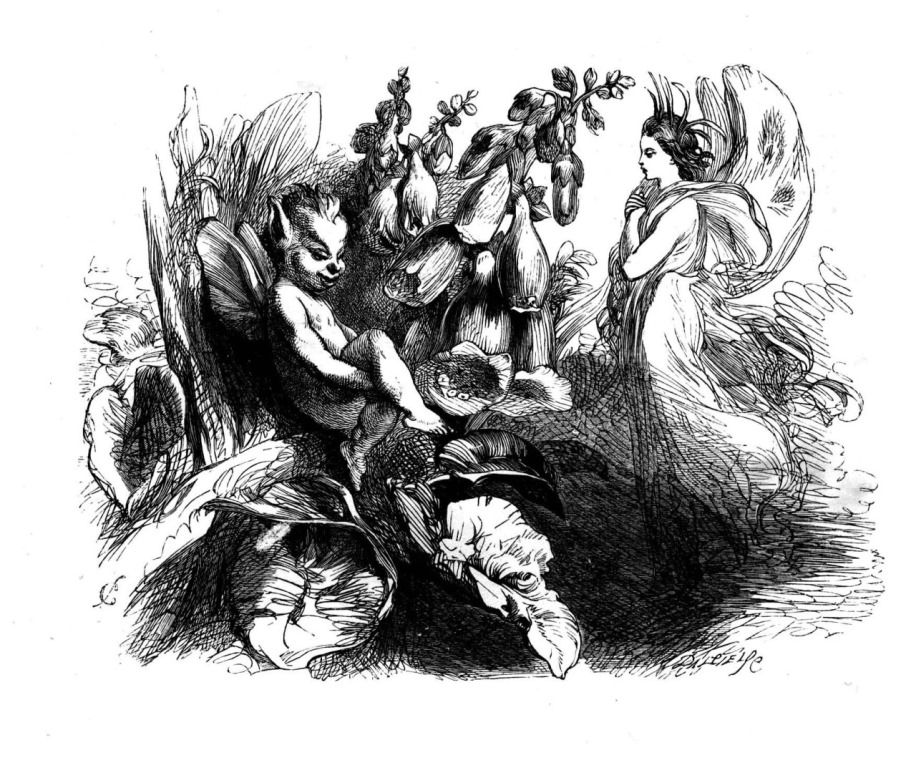
Puck and Fairy by John Gilbert

Consolations? This Victorian artist made our no-name fairy better-looking than Puck (on the left.)


OK, so what’s in this for creatives?

We’re not Puck, at least not most of us, mostly all the time, effortlessly casting our thrall. Magic and delight take a lot of grunt work. There’s always one more cowslip that’s missed its pearl-hanging, that’s a few rubies short of the categorical number.

And if we do our work well enough, it often seems like nature—you know, “You’re so creative. I could never come up with all your ideas!” Well, creative people aren’t the ones who come up with ideas (those are imaginative people, only some of which are creative)—creative people are the people who make things.

Musically, I get to work out my naïve piano playing while aiming for a funky feel on this one. I hear there’s a Midsummer party in the wood outside of Athens. What time? Oh, Elizabethan. The player gadget is below. If you want to read along, the song is at the start of Act 2, Scene 1, and you can read it here.


Thoreau’s June

We’ve already heard from Claude McKay and Thomas Wentworth Higginson on the month of June, and now it’s time to turn to one of the foremost spirits of the mid-19th century American Transcendentalist movement, Henry David Thoreau.

Thoreau is well-known for being in the activist, live-the-ideals, wing of Transcendentalism, though readers here have been introduced to Thoreau’s contemporary Thomas Wentworth Higginson—more than a footnote in the Emily Dickinson story—who also spent considerable time living those ideals.

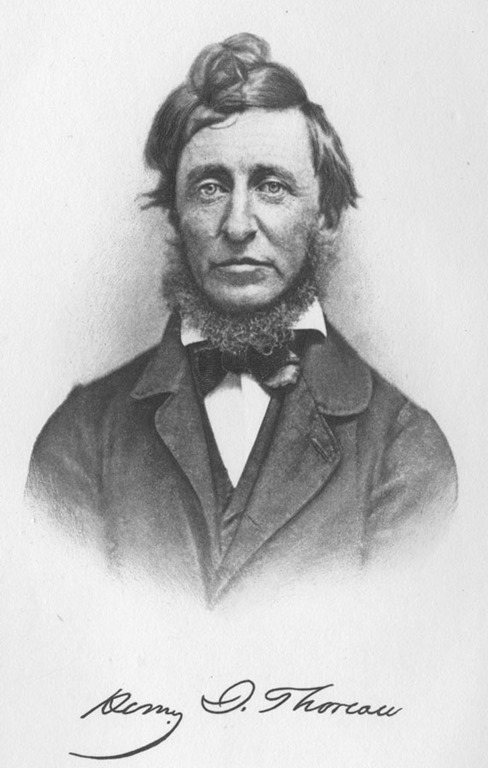
Henry David Thoreau

Collect the series: Unfortunate Hair Stylings of Important Personages


Thoreau and Transcendentalism’s major domo Ralph Waldo Emerson lived in the same town in Massachusetts, and one of the most striking things for me when I first visited that town, Concord, was to think that in a matter of a few blocks there lived Emerson, Thoreau, Hawthorne, Bronson and Louisa May Alcott—all in this place not that much larger than the small farming community I grew up in. What a town that must have been in those years!

Transcendentalism is a little hard to put a finger on exactly as a movement because it was interested in and had change-convictions about so many things. Higginson in his 1899 collection of memoir pieces Cheerful Yesterdays  calls it “The Period of the Newness” and speaks of “The Sisterhood of Reforms.”

My current working-definition of Transcendentalism is it is the belief that there is a primary knowledge to be obtained from the deep study and meditation on the structures and methods of nature, as opposed to the accumulation of received and conventional truths about it. Thoreau the Transcendental activist helped to pioneer this, often writing about his direct experience of nature. His thought process also caused him to develop political ideals, including Civil Disobedience to unjust and violent government actions, famously inspiring Gandhi and Martin Luther King.

Thoreau didn’t just inspire Gandhi and King with his writing. The first story I ever heard of Thoreau recounted the tale of Ralph Waldo Emerson visiting Thoreau who had been jailed for refusing to pay taxes as a protest against the Mexican-American war and its support of slavery.

Henry, what are you doing in there?” Emerson asked across the jail door bars.

“Waldo, the question is, what are you doing out there?” Thoreau replied.

But here’s one lesser known thing about Thoreau, the deep naturalist, writer and political activist: he was also something of an engineer. Between writing and other activities, he was active in his father’s business, a small factory that made pencils. A chief problem at the time was the formulation of the graphite used in the “lead” for these indispensable writing instruments. Thoreau’s father’s pencils, like other American pencils at the time, used a too soft binder that led to a crumbling point and blurry line. Through study of European pencils (and one suspects a little lab time on his part) Henry David Thoreau, Transcendentalist writer, philosopher, and activist figured out a clay formulation to mix with the powdery graphite to produce a much better American pencil. Profits from the sale of these pencils and the underlying technology* were largely what supported Thoreau’s writing career.

Not to make too fine a point of it—and King and Gandhi might have found other inspiration, and Thoreau other funding—but the 20th century Afro-American civil rights movement and the independence of the Indian sub-continent owe something to a thing as prosaic as a better pencil design—monumental things that literally come from a feet of clay.

Today’s piece is a short meditation taken from an entry in Thoreau’s Journals for June 6th 1857. Adding to the above connection, when Thoreau was writing his nature observations in the field, he most likely was doing so using a pencil of his own design. Note too that at one point engineer-Thoreau talks of the revolution of thought connected to the revolution of the natural cycle of seasons as if they are the meshing of a gear train.

Thoreau June 6 1857

Handwriting as bad as mine! The page from Thoreau’s journal containing today’s text.


Written as prose, it has a flow that I could find to recite and accompany it with music. The piece’s chordal part I played on an electric 12-string guitar recorded in the manner Roger McGuinn and the engineers on The Byrds recordings devised in the Sixties. Instead of the John Coltrane-inspired lead 12-string melodic line of something like “Eight Miles High”  I played an acoustic guitar with an E-Bow, a magnetic invention that drives a guitar string to vibrate and produce a flute-like sound. As I read a little about Thoreau this week, I came upon the information that he was also an avid flute player, so it seems appropriate.

The player gadget is below. My apologies for being away from this blog and blog activities so far in June—you know, life and things.


*Here’s more about Thoreau and his pencils. I first heard the story on the radio series “Engines of our Ingenuity”.

Summer 2018 Parlando Top Ten, Part Two

Continuing on with our countdown of the most liked and listened to audio pieces during this past summer here at the Parlando Project, today we’ll look at the pieces that came in 7 through 5 as we move up the list to the most popular piece.

7. The Hunter. Maybe, with Internet audiences, it’s the cats? I’ve playfully included pictures of William Carlos Williams with said cats in a few posts, and Williams, who sometimes thought he was overlooked as an American Modernist while he was alive, seems to be holding an audience, even though his poetry doesn’t present itself with open, easily accessible sentiments. His even more difficult “St. Francis Einstein of the Daffodils  almost gave Williams two appearances here this summer, falling just a couple of places back from the top ten. Or maybe it’s the informal American language that he uses? Other American Modernist contemporaries of Williams: T. S. Eliot, Ezra Pound, or Wallace Stevens often liked to drop leaves from a Word of the Day calendar into their poems, while the New Jersey doctor generally didn’t. Maybe there’s something here with Williams like the cats: familiar and domestic, intriguing, but not seeking to please? After all he once said: “I didn’t ask you to understand anything, only to listen.”


6. The Apotheosis of Harlan Ellison. I’ve warned readers already that this summer’s top ten has too many pieces where I wrote the words, and that’s not representative of what this project is about—and so, here we have the second of three pieces in this summer’s top ten where I wrote the words I perform. Well, at least this one is about someone else, the long-time critic, writer and SciFi anthologist Harlan Ellison.


James the imagined  author vs Jimi the reader of SF

I talked about how Ellison helped encourage Octavia Butler, but what if avid SF reader Jimi Hendrix had decided to go the literary route?


5. Beloved. My words again, although as I tried to explain in the original post here including it, I was inspired by a statement Bobby McFerrin once made about music, how it touches you inside on that sensitive flap of skin named the eardrum. Given that news this past week has included stories about unwelcome touches, that metaphor goes both ways.


WCW with a baby

Excuse me, while I kiss this baby. If cats and William Carlos Williams brings in readers, how about W.C.W. and babies?


Back soon with numbers 4 through 2 in our look back at Summer 2018’s most liked and listened to combinations of words and music.

The Temple of Summer

I spent Saturday riding my bicycle on the Mesabi Trail and visiting Hibbing, the Minnesota Iron Range hometown where Bob Dylan grew up non-ferrous.

To the visitor, the landscape there has a strangeness. Since the late 19th Century, open pit iron mining has been the industry of the region. An open pit mine is not the kind of underground tunneling and mole-dark pick-axe work you might visualize when you hear the word “mine.” Instead it is the removal of cubic miles of earth with explosives and huge shovels, work my wife describes as “making your own Grand Canyon.” The iron gives exposed rock and dirt a Martian red hue, and this colossal earthwork of generations of open pit mines has added extra hills, ridges, gorges, and small lakes. Though trees and brush eventually regrow and give these acts of men something of the appearance of nature, some hills retain the terraces where the trucks drove, giant Northern ziggurats or Mayan temples, now sprouted with pines—the Hanging Gardens of Bob Dylan.

postcard mesabi iron range

“Making your own Grand Canyon”


Since Bob Dylan grew up here, the strangeness of this landscape may not have impressed him in his youth, but an adulthood away might have eventually revealed its uniqueness. It is a singular place on a Labor Day weekend where one can see the mark of daily labor sculpted in a giant tableau.

How many of us can say the same for our labors? Children are raised, daily cares are met, that meeting makes a decision, a sick person is comforted and will live another couple of decades, the number of widgets on the planet increases infinitesimally, a project that will impact things for a few years is completed. In contrast, in the land around Hibbing, Virginia, and Mountain Iron, vistas are forever altered to mark a work life.

Virginia MN Bridge view

A view from the highest bridge in Minnesota spanning part of a no longer active open pit mine now filled with water outside the town of Virginia. The landscape you are viewing is man-made, not a natural feature.


An artist’s work, for all the literary pretentions to immortality, is at least as ephemeral as other work. The work is finished, and the earth has not changed its face. The work is read, seen, heard by its handful, and it melds at best into a memory in some part of those.

So, punch a clock or not, these are the same jobs, the same work. The poem, the performance, the painting, no less, no more, the product effort of applied human energy as any other work.

Occasionally, someone gets to be a Bob Dylan, and the vistas change. Leonard Cohen said that giving Bob Dylan a Nobel Prize is like pinning a medal on Mount Everest for being the highest mountain. I stood next to my bike on the state’s highest bridge spanning a man-made gorge and thought, maybe somehow, even subconsciously, this landscape gave Bob the idea.

Iron Range Truck

“Cruising down the highway in a Greyhound bus/All kinds of children they was hollerin’ at us…”


Today’s audio piece will not remind you of the Bard of Hibbing, as it is a fuzzy epitaph using Mellotron instead of giant earth-moving trucks to get its rocks off me. Here’s wishing all Parlando Project listeners a lanquid fall into the fluffiest possible snowbank. As you exit the Temple of Summer, listening to the music using the player below, I remind you that the Parlando Project appreciates your attention, but still needs listeners and readers. If you can, let others know what we’re doing here, and if you’re new to us, you may want to check out our archives with 250 other audio pieces combining various words with original music.

One Summer Morning, Which Isn’t

Here’s an audio piece that begins in the midst of a common life event: when a son leaves home to go off on his own independence. While this leave-taking could be for a job, or for military or other service, in the modern world, it might well be for college.

Other than its late summertime setting, and the odd moment when the son in this story is thinking of something he’s read in a book as much as what his father is saying as he leaves, there’s nothing in it that indicates the child is leaving for school. Perhaps the son (or the reader) at the start thinks that such a leave-taking will be the story of “One Summer Morning, Which Isn’t,”  but eventually things open to a broader story.

Many who read an earlier version of this were puzzled by the title. “Why isn’t it,  that, one summer morning?” they ask. I once revised the title to answer the puzzlement, but today’s version instead revises the text of the piece to try to better convey what I wanted to get at under its original title. Even that first morning in the opening is seen from two very different perspectives, and as the story expands I try to show that leaving-takings are, strangely, always present, they are not only a moment or a single day. Am I successful in that effort? I’m not sure. It’s gone through some revisions over six years, and by now I’m not even sure it’s a poem, or if it isn’t more of a compressed short story. Well, the new draft is done, and it’s ready for you to hear it performed.

Jaguar for Surfing Sounds

Listen! Gidget, Listen! You hear the grating roar
Of pebbles which the waves draw back, and fling
At their return, up the high strand,
Begin, and cease, and then again begin,
With tremulous cadence slow, and bring
The eternal note of sadness in.
Matthew “Hodaddy” Arnold


Today’s music is fairly spare: electric guitar, bass, and drums. Yes, that bass line, close but not identical, is meant to remind you of another piece of music, back before Steely Dan. The electric guitar is an inexpensive version of the Fender Jaguar. Just before the 4 minute mark on the track, that weird high wind-chimey sound is something available from its design: notes that can be plucked on the strings between the bridge and the tailpiece. I was reminded of this trick while listening in a car ride with my son when an old Sonic Youth track came on the radio earlier this month.

To hear “One Summer Morning, Which Isn’t,”  use the player below.

Summer For

Here is a short piece about an intense memory experience, where you believe you are fully re-experiencing something from earlier in your life. This is not déjà vu, and I don’t even know if there is any similar widely used term with plentiful accent marks over top the letters for this. And since this is a subjective experience, I can’t say for sure how common it is; but for me it happens fairly often. In these moments I’m not merely remembering something, I feel I’m re-living it, with access to the entire sensory experience—but the experience is felt by a mixture of the past me mixed with the present me.

This can be pleasant or not, but it always feels spooky to me. Subjectively (there’s that word again) it feels like the nature of time itself is being exposed, that the concept that time passes could be an illusion, that all time is happening now. Or that time may move in a boustrophedon manner wrapping back and forth next to itself.

as the oxen turns

Boustrophedon writing runs left to right, then wraps back right to left and so on “as the oxen turns” when plowing. Conceptually, what if time doesn’t run forward, but wraps back next to itself, or even over itself? Cue the hippy-trippy background music now. Also, be careful about stepping in the bovine exhaust.


I suspect some of you are going “Oh wow, that’s heavy.” Some “That’s some mystical B.S. there!” Others may wonder if chemical intoxicants are involved (short answer: nope). Some of you may even be puzzled about what I’m talking about, not having had the experience, or having had it and not stopping to fully encounter it.

Still, this is a subject that poetry allows, because, like all arts, poetry is about sharing the subjective human experience. Now-a-days this sometimes goes by the rubric “sharing one’s own truth.” I’m not fond of that phrase, though I believe compassionate people use it with good motives. Somewhere I’ve picked up the first principle of objective truth, even though that cannot be knowable out to all its edges, even if it must be handled with approximations.

So, I will make no Blakean claims of mystical revelation with “Summer For,”  but you may still find this an interesting experience to share for three minutes, along with some skittering acoustic guitar accompaniment. The player to hear it is right below.

An August Midnight

Today’s episode is something of a companion to our last one, what with moths appearing in each. Emily Dickinson’s sister-in-law Susan Gilbert Dickinson let the Book of Job fly in with her moth, and today Thomas Hardy’s open summer window lets in four bugs.

Our scene: a summer night, window open, a 19th Century lamp letting Hardy literally and literarily burn the midnight oil. The breeze and light brings on the bugs, and beside the moth we get a daddy-longlegs spider, a fly, and a dumbledore. Besides it making his rhyme, I think Hardy must have liked that charming name for his fourth bug, which is either a bumble bee or a beetle, though either will disappoint Harry Potter fans brought here by a search term.

Dumbledore Beetle and DOD Carcosa fuzz pedal

A dumbledore beetle and a DOD Carcosa fuzz pedal. They could be filed under “things you step on.”

What was Hardy writing when the bugs arrived? He doesn’t say, though of course to be meta, it should be this poem now shouldn’t it—but even if it was some other piece, the bugs interrupt it, marching over his just-penned wet ink and drawing his attention away to their antics. Susan Gilbert Dickinson called her moth “silly” and Hardy has his insects more or less performing a Three Stooges skit bumping into the glass of his artificial light.

Susan Gilbert Dickinson wanted to remind us of that harrowing Old Testament lesson that God can crush a human as easily as a bug. She wrote “Irony” and underlined it over the top of her poem’s manuscript. Hardy writes a slightly different conclusion. After watching his fab four beetles make a farce out of replacing the poet on top of his manuscript paper, he ends by declaring that those insects know more about nature than he does. I think that little insect play on his desk reminds him that he, like other poets, struggle to understand and portray nature.

Just as the last time I worked with Thomas Hardy poetry, the melody just flowed out effortlessly when I went to set his words. I quickly had the basic vocal and guitar track, and then added a couple of cello parts and an additional guitar melody that followed what I had so easily fallen into as I sang Hardy’s words.

That electric guitar melody line uses a DOD Carcosa fuzz pedal which I’ve been using a fair amount here lately. It’s a very flexible effects pedal, but I won’t interrupt this with any more guitar nerd material than that tonight. To hear my performance of Thomas Hardy’s “An August Midnight,”  use the player below. Don’t see a player? This highlighted hyperlink another way to play it.

Crushed Before the Moth

Increasingly, I am comprehending the miracle of Emily Dickinson. Fifty years before Ezra Pound and T. E. Hulme constructed a compressed modern poetry replacing conventional imagery with fresh and direct observation, a woman in a rural town in the woods of Massachusetts had already practiced their innovations over a thousand times.

Through a series of happy accidents, Dickinson’s poetry was preserved and published at the end of the 19th Century, just before the Imagists launched their Modernism—but even then, she was still like one of those unexploded bombs dug up by a construction crew decades after the war. Even after publication, the framing of her poetry still obscured it. Her posthumous editors cleaned up her punctuation and gave the poems titles, and on the page they looked so normal. As these were poems by an Emily, they were clearly the work of a woman, and so they were read as women were generally understood, even when not pressed between the boards of a poetry book. And Dickinson herself designed her poems to draw you in with their modest length, their frequent use of pious hymn meters and stanzas, their homey rhymes. Even into my mid-20th Century lifetime, it was perfectly possible to be aware of Emily Dickinson’s poetry and not be awed.

“Hey Joe, there’s a big chunk of metal buried way down in the mud! Here, listen when I give it a bit of a whack with my pipe wrench…”

UXB2

They still run across stuff like this from WWII around Europe. Decades old, and they can still go “Boom!”


Some early 20th Century Modernists looked more closely, and maybe saw some of what was there. Carl Sandburg straight-out called her an Imagist in a poem. I am unaware of how much attention the other early Modernists gave to Dickinson, but just on a promotional level, it might not be advantageous to talk much about poems written decades ago when your brand is “Make it new!” Remember too how Pound jabbed at Walt Whitman in his tribute poem: Walt Whitman you were a hacker out there in some unharvested forest, I’m a fine wood-carver able to bring out the finest detail. Dickinson’s near-rhymes and loose but familiar meters may have been read as imperfections to Modernism.

It took the last quarter of the 20th Century for Emily Dickinson to finally be seen, and we are still seeing more now as we look closer. What if, back in the mid-19th Century when Dickinson was creating this unprecedented expression, one had been able to talk with her about it? The value of writers’ groups, seminars, and MFA programs is not universally acknowledged, but most think these things at least have some effect on those who participate.

It just so happens, that occurred. Dickinson’s letters to Thomas Higginson give us some of her ideas, but as I read that correspondence I see Dickinson adopting masks, some playfully, some for protection. And Higginson, as varied as he was, was not, as far as I know, a poet, and therefore there was no chance that he would use Dickinson as a model for his own writing. But Dickinson’s long-time friend, neighbor, and sister-in-law Susan Gilbert Dickinson was a writer who dabbled in poetry.

Susan Gilbert Dickinson

Like Emily, Susan Gilbert was smart, was allowed some access to education, and wrote poetry


No other person saw as much of Emily Dickinson’s poetry while she was still alive as Susan. It’s also probable that no other person other than Emily Dickinson’s sister Lavinia (who seems to have had no artistic interests) was as intimate with the author. There is even speculation that there was an erotic bond between Susan and Emily. Besides the pant, pant passages in the letters between them, Emily praises Susan’s intelligence and cultural companionship. Given what must have been the loneliness of Emily Dickinson’s creative innovation, amplified by the cultural limitations for women in her time, we may all owe a debt of gratitude to Susan Gilbert in helping sustain Emily Dickinson.

Today’s piece uses a poem by Susan Gilbert Dickinson that shows some of the same elements one finds in Emily Dickinson’s poetry. Given that the prolific Emily Dickinson experimented with her expression, if “Crushed Before the Moth”  was slipped into some complete poems of Emily Dickinson volume it would not seem entirely out of place.

What elements of “Crushed Before the Moth”  are Dickinsonian? A short line length (six syllables, though not Emily’s familiar 6/8/6/8 hymn stanza). Alternating rhymed lines with unrhymed, though here first and third not second and fourth, and the rhymes are all perfect rhymes except the final “moth.” Even the use of a Bible verse (Job 4:19) is not unprecedented in Dickinson, who though a religious dissenter, was steeped in a Christian religious culture.

The poem begins, just as many of Emily’s poems will, with a close observation of nature. In Job, the moth is only a passing metaphor, in Susan’s poem it’s an actual moth, looked at closely enough to see the texture of its body in the evening. The moth is treated here as an Imagist would. It’s not some intellectual counter, a rote symbol only standing for something else, but an actual animal in an actual evening. The second stanza continues in the same vein, the moth the morning after, though with more characterization.

The concluding three lines, though they contain the only Emily-like slant rhyme, are the least like Dickinson’s poetry. That kind of envoi ending with a clear and orthodox moral lesson is not something Emily would write in her mature poetry, and the “Is this thy stronger host” line sounds unnatural and stilted.

Still, this might be the first poem ever written that imitates Emily Dickinson’s strengths and innovations. That Susan Gilbert Dickinson was a more orthodox Christian than her friend, and like all of us, not the genius that Emily Dickinson was, doesn’t keep her “Crushed Before the Moth”  from being an effective poem.

I’m back to acoustic guitar for today’s performance of this piece, which is available using the player below.

The Hunter

A couple of mornings ago, I awoke after a night’s sleep, and as I took my bicycle out to the alley to ride off for breakfast, I was surprised to see the road dusted in torn blossoms and several small tree branches cast about on the wet ground.

While I had been still and sleeping, a storm must have come up.

That contrast, the stillness and the broken change is at the heart of today’s poem by William Carlos Williams, “The Hunter.”   Williams opens his poem with an allusive image. “In the flashes and black shadows of July.” Is this the lightning of a summer storm? I thought so at first. But it might be just what one sees lying on summer grass and looking up through the boughs of a tree. The whims of a breeze or the caprices of squirrels and birds on the thin branches will flutter the leaves’ fan of shade revealing the sun in a flash.

Yet, summer “seems still.” The animals of summer appear “at ease.” But what if there is danger in the world, as in the unmet character in the poem’s title, the hunter?

William Carlos Williams with Kittens2

In a last-ditch attempt to increase readership of his poetry, William Carlos Williams decided to try that Internet staple: cute kittens.


In Williams’ poem, the hunter does not appear, ready to shoot the game. The hunter is invisible, as the hunter is time, the hunter is change.

For today’s music I combined an orchestral ensemble and electric guitar with an appearance of a harpsichord.  The player gadget to hear my performance of “The Hunter”  is at the bottom of this post.

I’ve noted that there has been a steady listenership for the other William Carlos Williams poems posted in the archives lately, and that helped inspire me to look for more of his work to present. As we move into summer, I remind visitors that there are over 220 pieces available here. Use the search box or just wander through the monthly links on the right.