The Vampire (Part 1)

  I’m going to be out on a limb in this Project’s treehouse of horror this Halloween. How so? With today’s post I’m starting to present what at completion will be a larger musical piece than this Project usually presents, and I’ve decided then to publish this poem setting in sections over a week, as movements or a kind of suite. That in itself is a bit ambitious. Among the hundreds of pieces the Parlando Project has issued, only two strike me as similar. The most ambitious of those two? I set with music all of T. S. Eliot’s Modernist landmark “The Waste Land”  – and that piece too was presented here in sections, but it was composed and performed over a period of years. The other similar suite of songs goes back to the formative times of this Project: a series of songs largely written by long-time Parlando collaborator and keyboardist Dave Moore about the pioneering early 1950s late-night horror movie host Vampira – but as I recall, all those Vampira songs were written and recorded before the first one was published here. I knew what I had before I made them public.

Not so with this planned Halloween 2026 piece, which is Conrad Aiken’s narrative poem “The Vampire.”  As I woke up this morning, I had a rough idea for the final section, and some music for that section recorded, but no vocals for that. But if I’m going to present this longer poem serially this week, I would need to start with the first section. I had Aiken’s words, and nothing else.
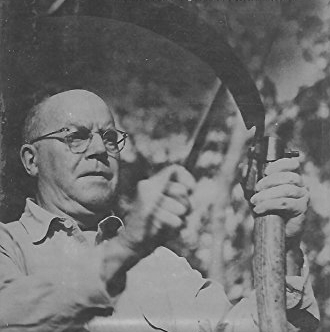
Conrad Aiken sharpens a scythe

Conrad Aiken: harvest time or sundering time?

.

So after a quick breakfast and glass of iced tea, I was onto composing the music for what will be the first, and shortest, section of Aiken’s “The Vampire.”   Working quickly, I started with modifying a drum sequence to use as a guide track for the rest. I next laid down two cello parts, a track using a pair of tape banks from the computer-emulated version of a 1960s’ tape storage “virtual instrument” the Mellotron,* and a clean electric guitar part. Despite the different instruments being sounded, and playing them one at a time, those three tracks were all played on an electric guitar, the non-guitar parts being played thru a MIDI pickup. I finished with an arco string-bass part – that one played on a little plastic keyboard MIDI controller because I want to use its volume wheel to articulate the bowed bass notes. “Real Musicians” and trained composers will recognize the simplicity of these parts. To explain myself, I’ve taken to calling compositions like this “Punk Orchestral.” This is shorthand to explain that just as a melodically simple 2-3 chord rock song played in an entirely non-virtuosic manner can still arguably be an effective piece, so too one might attempt the same thing with instruments we associate with “classical music.”  The vocals here are both spoken and sung. I have a limited skill set for this sort of singing, but I’m the one handy to realize this composition.

As we start then with my series of “The Vampire”  I feel called to do the Andrew Hickey** thing and warn listeners that this Aiken poem I’m presenting is a dark and distressing fantasy.  I had considered a more playful Halloween piece this year, partially because my country and the world has generated non-imagined horrors a plenty. Perversely, Aiken’s poem may have captured my attention because it approaches those current practical levels of fear, terror, and pity – and it has (I believe) a message about the dangers of human fancies. Today’s section of the poem isn’t telling us yet what will occur before we reach the poem’s end, for Aiken opens his story quietly with the world of his poem meeting a distressed and mysterious creature. You can hear it with the audio player below. Has the world darkened, and you can find no such player?  This highlighted link is your only hope (and fear) – it will open a new browser tab with its own audio player for the piece.

.

*One tape bank is a Mellotron string section, the other male choir voices. The voices are mixed very low today, for they are off in the distance in this part of the poem’s story.

**Hickey’s long-term project, A History of Rock Music in 500 Songs is amazing and goes further into detail and research on its subjects than even I do on mine. I think Hickey’s project’s title is less attractive than the series is – for yes, music nerds might be up for it, but it’s much more than that: it’s a still unspinning story about history, culture, capitalism, the large caldron of creativity, and racism, and sexism. Hickey is meticulous about warning listeners that they’re going to be hearing more than a treatise on what color a record’s original pressing label is or the most effective settings for a Fender Deluxe guitar amp.

The Entire “The Fire Sermon” from T. S. Eliot’s “The Waste Land”

Part of the ongoing adventure of doing this project over the years has been the performance of a section of the English Modernist poetic landmark “The Waste Land”  each April as part of our celebration of National Poetry Month. So far I’ve done three large sections, one each year.

My first preference in this has been to separate these larger “Waste Land”  sections into smaller pieces, lasting 2 to 6 minutes to match the usual length of other audio pieces here, but then each year as a “previously, on ‘The Waste Land”  recap I also present a combined audio file of the whole section that I’d done the previous April.

That means it’s time to present the third and longest section of Eliot’s poem, “The Fire Sermon.”  That’s a sizeable chunk of stuff just from the weighty nature of Eliot’s long poetic threnody on the disillusionment of post-WWI western civilization, his own experience of depression, and search for spiritual and cultural consolation—but I also wanted to fully combine my experience of it with the entire range of musical expression that I’ve used here over the years, which means that I haven’t tried to hurry things along in order to stuff “The Waste Land”  squirming and squealing into a smaller sack.

So, today’s rollup of the whole Fire Sermon section is about the length and experience of an entire vinyl LP record’s side, just a bit less than 21 minutes long. What kind of LP would it be then? Perhaps it’s the second side of a “Progressive Rock” album where the band is going to stretch out in a linked suite. At one time that seemed a fresh thing for the popular music consumer from The Sixties, who had been primed by a few years of short 3-minute singles that were masterpieces of varied kinds of expression. Could one group weave that variety themselves? Could these shorter pop music forms become movements like longer orchestral music made use of?

Lets listen to some LPs

Long ago people playing long playing records. The merman in the lower left mixes expansive rock with Blonde on Blonde and Lenny Bruce’s caustic spoken word take on sex and the culture, which may not be to far off today’s slab of vinyl.


Of course these cycles were, are, cyclical. Less than a decade later the short sharp stab of 3 minutes of squall in a singular mode was back in hip style again. And now? Perhaps we’re progressive suite makers clicking in Spotify or Apple Music, or consumers of Peel-ing playlists in our each streaming perfumed garden of earbuds.

In these we lose this once particular 20-minute-magic. For today’s piece “The Entire Fire Sermon”  was created in one period of time, and not just by one group of musicians, but by one person. I wrote the music, played all the instruments, and recorded it myself to create this. I don’t say this to brag*—it was more a matter of practicality—but to call your attention to an essential part of this, as it’s an essential part of “The Waste Land.”  All the voices, all the modes of expression in that poem are played by T. S. Eliot. The men. The women. Tiresias, the at-least-sometimes narrator who is both genders. Yes, there are elements of memoir as poetry in this; yes, there are places where Eliot’s representing himself, his particular culture, the early 20th century man who went from growing up white upper middle class in St Louis to Harvard to France to London before he was 30. If Tiresias is a prophet, he is also blind and cursed by error. Eliot has all these things in him too, just as you or I do.

“The Waste Land”  is a harrowing work. If Keats hopes art, as his urn, is a “friend to man,” this friend Eliot made is telling you about the parts of life where hope has to struggle to come out. This section, like other parts of “The Waste Land”  has a reputation for misogyny. In my current reading of it, I’m relieved to not have to figure out a way around that, because I don’t share that reading, even if it may be part of the artist. What it is, particularly here and in the previous section, is the complete opposite of sex-positive. There is absolutely no joy or consolation in desire. Sex acts are referenced, but there’s no love made or even pleasure, only bad deals on unequal terms.

Since I’m asking to take up 20 minutes of your time to listen to “The Entire Fire Sermon”  I’m not going to say more about “The Waste Land”  today. If you’ve come here for homework help or because you have a nagging question about “what’s that thing on about” these sites will help with notes on the many, many references in this poem that is in effect sampling and collaging dozens of myths and other works: here, here, here, and here. And last spring, in March and April, I wrote about the individual sections as I presented them anyway.

Another way to experience it is to just let it wash over you as the dirty water of an urban river. Relax between your speakers, put your headphones/ear buds on and let it flow until the side ends. You drop the needle by clicking on the player gadget below. I’ll be back soon with some shorter work by another poet from St. Louis.


*Listening back to it as I made this combined file today, I am reasonably proud of what I did with the music, though I the composer wish I the performer was a more skilled singer.