Abraham Lincoln Walks at Midnight

Here’s a piece for today’s U. S. holiday: President’s Day.

Long-time readers here know that’s not going to be simple, but it may be interesting.

For some time in this project I’ve thought I’ll have to deal with Vachel Lindsay. In the early days of poetic Modernism a century ago, when no one knew exactly how that movement would turn out, Lindsay was a force to be reckoned with, with a life story and approach to his art that was so outsized, that if he hadn’t actually existed, and instead you created him as a character, you would be charged with unrealistic and exaggerated imagination.

In the great American tradition of bohemian artistry, Lindsay was not well-off, not Ivy League educated, nor born in some cultural capitol. By force of will he decided that he would make his way in the increasingly business-oriented world of the 20th Century as a poet.

How’d that work out? Better than you might imagine, if only for a time. He made most of his bones touring the country intensively, reciting his poetry in a flamboyant style. Much like the life of a musician, it worked only to the degree that he was able to keep up a relentless road-dog touring schedule. Between tours, what time he had to write was also the time that he fell into debt and doubt.

If you think that poetry should be, at least in part, a spoken art form, Lindsay was there before. If one wants poetry to be appreciated as a popular form, with no academic prerequisites, Lindsay lived that. If you want poetry to be a force for social good, Lindsay too. Slam poetry? Lindsay was doing that before there was a name. Poetry inspired by and linked with vernacular music? Lindsay, a century ago.

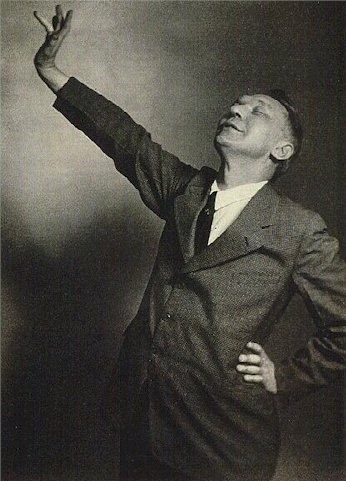
Vachel Lindsay strikes a pose

Vachel Lindsay is not doing the hokey-pokey here, but performing poetry.


So why haven’t I presented Vachel Lindsay before today? Three reasons.

One, he wrote a lot of bad or flawed poetry. Awkward, sentimental, not particularly striking in imagery, and despite his spoken word and musical inclinations, not always in tune with my sense of music.

Secondly, though he always claimed his heart was in the right place, his treatment of other cultures was so clumsy and ignorant that it’s too often indiscernible from racism. This isn’t a close call, or some case of modern politically correct revisionism, even in his own era this was noticed. It was more than 50 years ago when I first ran into one of his set pieces, “The Congo,”  and from that I figured I was done with Vachel Lindsay.*

These are both general reasons why Lindsay is not seriously considered along with his contemporary Modernists of the early 20th Century. But there is another, more personal reason: I fear the Vachel Lindsay in myself. When I see in my own writing awkwardness and flawed art, when I stop to consider the un-earned audacity of my own spoken word and musical expression, when I catch myself assuming that good intentions are sufficient, when I write here of other cultures and experiences, and despite my provincial and limited knowledge of them, perform works associated with them—then I fear I’m becoming my own variation of Vachel Lindsay. I continue to do those things anyway, stubbornly—again, like Lindsay.

Art is not just a place to model human potential. It’s also a revelation of human failures. Bad art can inspire good art. Failures illuminate as much as successes.

With that long introduction, let me now tell you that today’s piece, “Abraham Lincoln Walks at Midnight (in Springfield Illinois)”  is still worthy of four minutes of your attention. Unlike China or the Congo, Lindsay knows Lincoln’s adult hometown of Springfield Illinois, as it was his hometown too. “Abraham Lincoln Walks at Midnight”  is not a piece that extends language, it has no clever images that re-calibrate how you experience something, its word-music is not so beautiful that you’d be drawn to it before you even care what it’s about. We have long celebrated Abraham Lincoln as the President of our greatest national traumatic event, the American Civil War, fought over our greatest national sin, slavery. So, the poem has only an emotional, empathetic message, but this is all art delivers to us however plain or fancy the wrapping.

President’s Day is not a simple holiday today. Here’s my performance of Lindsay’s Lincoln poem. I kept the music simple enough and in that hometown key of C. The high melody part that sounds like a synth patch is actually 12-string guitar run through a lot of time and modulation effects and a compressor. The player is below:


*Here’s a recording of Lindsay reading part of “The Congo” which gives some idea of his performance style and also his manifold issues with understanding and appropriating African experience. And here are some excerpts of remarks on the poem and Lindsay.

How Do I Love Thee

Here’s the plot of a story. It’s a difficult one to tell without it sounding like a romance novel—yet as best as history knows, it’s what happened.

There was this woman who grew up in a rich family whose wealth came from exploiting slave labor in colonial Jamaica. Shortly after she reaches adulthood the family fortunes take a severe blow as Britain outlaws slavery. The men of the family might think this the work of do-gooders with their onerous regulations ruining their business, but our woman aligns with the do-gooders, holding for the abolition of slavery and writing poems for that cause. In fact, she’s a very prolific writer, and has been writing since she was near Hilda Conklin’s age. In 1840 when William Wordsworth dies, she’s even considered a British poet laureate candidate. Well no, that didn’t happen. Woman and all I suppose.

Now let’s add some more difficulties for our heroine. She’s got a long-standing opiate addiction based on a hard to diagnose and painful chronic illness. And there’s some domestic tyranny to go with all this. Her father has forbidden his children from marrying.

That stipulation seems odd. There’s one theory, one that our heroine had some belief in: she may have been creole, that is, mixed-race.

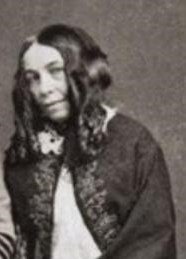
Elizabeth Barrett Browning crop

Elizabeth Barrett Browning, who believed she had “African blood”


None the less, as a woman of letters, her writing was free, and circulated widely. Her poetry found an admirer in another poet, Robert Browning, though he was at that point less successful than our heroine. They began to correspond and fell in love. Eventually there was a dramatic elopement. Her family condemned her and disowned her, but the love match seems to have sustained her for the rest of her life.

Other than her thought that she might have an African ancestor mixed in with the atrocity of slavery*, this story, Elizabeth Barrett Browning’s story, was once very well-known.

As romantic as the Elizabeth Barrett Browning/Robert Browning story was considered in its day, I can’t help but think how a supermarket tabloid or Internet gossip site would treat this today. I can see the blurb:

“Unable to shake drugs, Liz escapes abusive home with stranger!”


Shortly after her marriage, she wrote a series of sonnets to the love of her life. In 1850 the love sonnets were published as Sonnets from the Portuguese**,  and today’s piece is the most well-known of them. Indeed, it’s likely the most loved Victorian love poem, and no matter the excess of old-fashioned sounding “Thees” in it, it’s still hanging around as one of “Poetry’s Greatest Hits” as we approach Valentine’s Day.

Clasped_Hands_of_Robert_and_Elizabeth_Barrett_Browning_By Harriet Hosmer

Sculpture of Elizabeth Barrett Browning and Robert Browning’s clasped hands


Even if you feel too modern for it, or are concerned that the level of devotion expressed in it doesn’t seem consistent with a healthy independent self-image*** one should still be grateful for Elizabeth Barrett Browning, if only because she and the Bronte sisters were the chief models for Emily Dickinson.

To hear my performance of Elizabeth Barrett Browning’s “How Do I Love Thee,”  use the player below.


*This theory is not universally accepted, and as far as I know was first suggested in 1995 by Julia Markus in her book Dared and Done  about the marriage. As I read of this, I was struck by the coincidence of having just presented Jean Toomer’s striking Modernist love poem, written by another writer with ambivalence about his mixed-race ancestry.

**The collection’s title was first chosen because there were Victorian-era worries that the book, with its somewhat scandalous subject of a woman expressing agency in love, might need to be presented as a translation of an anonymous foreign author. It also referred to Robert Browning’s pet name for Elizabeth, “My little Portuguese,” likely based on her darker coloration.

***By the way, I do not recommend footnotes for any of you who may send someone a Valentine-poem.

To His Coy Mistress

I can’t remember exactly when I first encountered Andrew Marvell’s “To His Coy Mistress,”  but it was far enough back that I earnestly identified with the poem’s narrator and his desires to find or convince a romantic partner.

That poem I read then is not the poem I read today, but even back in my misty youth I probably appreciated the wit of it along with the point of its argument. When I took a quick look at how “To His Coy Mistress”  is currently viewed, I see that appreciation for the poem’s wit and artifice has increased in the past few decades. It may not be possible to determine just how invested Marvell was in convincing the lady in question versus showing off his poetic chops, or even how sincere he was in his variation on the classic “carpe diem” argument that if you don’t go to bed with me, now!,  that you (currently comely love object) clearly  don’t realize that you’ll be a rotting corpse soon.

How romantic that! Here’s a box of candy too—by the way, do you know that such foods high in sugar and fat will likely lead to cardiovascular and other diseases—not to mention tooth decay and gum disease? No? Well, let me tell you….

I’m not sure how often throughout history that real and actionable knickers came flying off at this idea—but poets love it. If love, death, and beauty are the  poetic stuff, any chance to mix all three is impossible to resist.

I normally feel I have to come up with some supposition to perform one of these pieces, and what I decided here was that as a polemic, Marvell’s poetic swain means it. Which doesn’t mean he isn’t going to have some fun talking about it. Even my teenager/reader could smile at that exaggeration of the delay of traveling to India to look for jewels first,*   but did I appreciate then the auction-like absurdity bidding up the hotness of his sweetie? Do I hear a hundred years? Two-thousand! Do I hear a-three…a-three…a-three—thirty-thousand,  sold!!

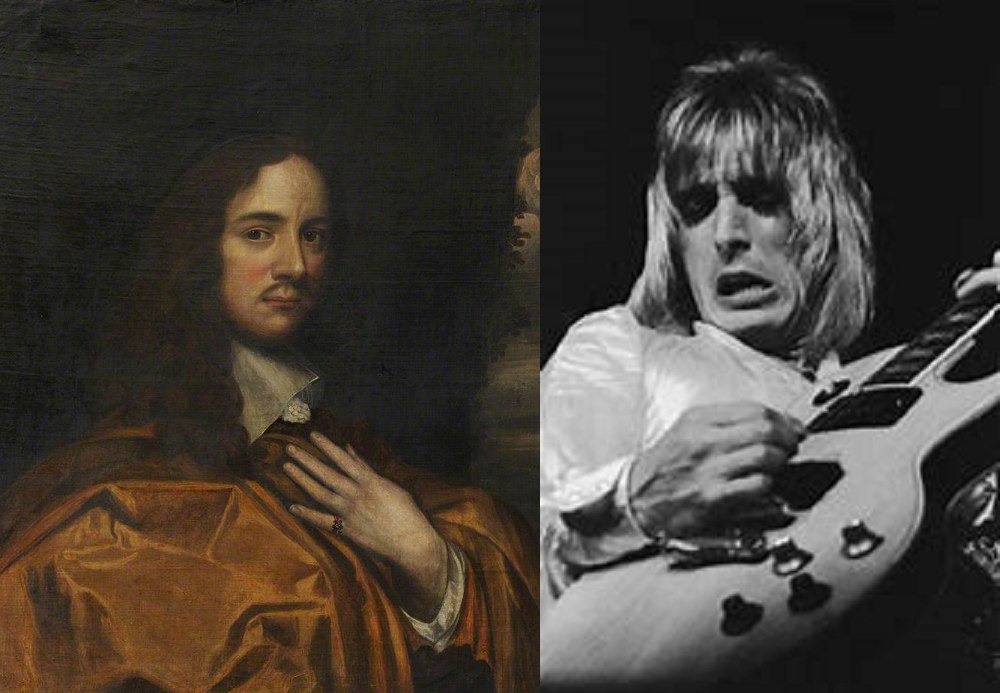
Andrew Marvell and Mick Ronson-two chaps from Hull

Random blokes from Hull: Andrew Marvell and Mick Ronson. Ronson looks like he just saw the cartoon below; Marvell, like he just burped.


But I think he’s serious with the unforgettable and oddly accented “At my back I always hear/Time’s wingèd chariot hurrying near.” And deflowering worms and cremated dusty lust may be over the top, but he’s not beneath crypt-keeper humor in this.

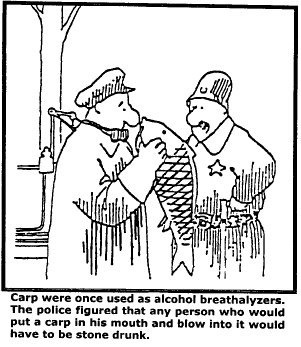
Carp Breathalyzers!

Carpe Diem! I think this is taken from a Dick Guindon cartoon. There are those who think that Dick Guindon was one of the greatest one-panel newspaper cartoonists ever. We call some of them Minnesotans.


As the poem rushes to its conclusion, I think some of the urgency passes beyond the bar of exaggeration for humorous effect. The poem’s last two couplets, which I think sincere, are as strong in my estimation as the more famous and remembered ones earlier in the poem.

For all of Marvell’s “To His Coy Mistress”  “poetry’s greatest hits” status, isn’t it odd that we don’t remember what I think are the poem’s four strongest lines, the ones that the poem ends with? Is it all about the chase and not what happens when we catch?

Here’s the player to hear my performance of Marvell’s poem with the LYL Band:


*It wasn’t until this month as I worked on this that I found out what the poem’s companion to the Indian Ganges trip,  “by the tide of Humber,” was on about. Turns out that the Humber is an estuary/river near Hull in northeastern England. It happens to be where Andrew Marvell was from, as well as (a few centuries later) Mick Ronson, the guitarist/arranger for David Bowie.

The Trees are Down

I indicated when I first presented a poem by Charlotte Mew this month that I’d talk more about her life, but what I know is so limited and sad that I’ll try to condense things.

She was born into a family that had more than its share of illness and mortality. Three siblings died in childhood, two were institutionalized for insanity. Her father died “without making adequate provision for his family” according to the Wikipedia article, leaving her mother and surviving sister to try to scrape by in late 19th Century London. She appears to have been socially awkward and eccentric. Eventually her mother died, and then her sister, with Mew ending up being the final caretaker for both. After the death of that final sister, Mew herself was unable to care for herself. She was institutionalized and committed suicide by the decidedly unromantic method of drinking Lysol.

There is so much unanswered detail in her story. For example, the two surviving sisters are said to have vowed not to marry for fear that the insanity might be hereditary. My now largely forgotten medical knowledge/experience wonders what the exact elements were of these early deaths and the cluster of undifferentiated mental illness. Quick, idle thoughts fall to something like Huntington’s Disease.

Anyway, during her life Mew was something of a writer’s writer. Thomas Hardy and Virginia Woolf both championed her and apparently got her a government stipend for support. She was not prolific, and she didn’t write grand poetic epics or found a new school of poetry or critical theory. Still from the first time I read her poems this year I was easily struck by how different they often were. In her era there were a lot of Modernist poets who were shockingly different then—and who often still retain easily seen uniqueness today. Gertrude Stein, E. E. Cummings, Mina Loy, Tristan Tzara, Marianne Moore, Wallace Stevens, H. D., and William Carlos Williams made individual showy breaks away from fusty tradition in the time Mew was writing her poetry.

But Mew wasn’t really a Modernist as they were, not in any card-carrying sense. Her breaks from poetic orthodoxy were sometimes subtle and sometimes seem artless in both the good and bad senses of that term.*

Today’s piece “The Trees are Down”  is a good example. Although I didn’t include it in the reading, it starts with a biblical epigraph from Revelation:  “—and he cried with a loud voice: Hurt not the earth, neither the sea, nor the trees—” What follows starts off as if it’s miscategorized prose, as casual as a diary entry, a letter, or blog post. But it soon adopts a subtle rhythm, something like F. S. Flint’s “unrhymed cadences,” with a little symphony of sound verbs and some mixed in background sound from the workmen felling trees.

A Plane Tree in London

A London plane tree. Poetic enough…


But Mew will turn from this abruptly, rather than developing that sound and theme, almost literalizing the cliché “red herring.” She recalls finding a dead rat—not at the site of the tree work, not recently—just a rat’s carcass once encountered some “long past spring.” And she remembers thinking that even this “god-forsaken thing” should be alive in spring.

rat carcass

…not quite as romantic as a majestic tree.


Then she leaves this odd aside and begins a passage of irregular rhyme and near rhyme, once more looping in a sample of the workmen’s cries (“Down now!”). Nearly every phrase has end-rhyme, but we are made to wait seven phrases for a rhyme between “fine grey rain” and her return to that seemingly unconnected dead rat with a remark that except for this strange connection with the rat carcass and the death of the trees “I might never have thought of him again.”**

And then she changes once more, back to the unrhymed cadences mode as she begins to introduce her final theme. Her cadence strengthens in her last stanza, and she closes with the introduction again of a series of end-rhymes. She makes her closing case so clearly that I feel no need to make any paraphrase. That case borders on the sentimental I suppose, and I’d guess that any of the few reading “The Trees are Down”  in Mew’s own time would see it as that in their context.

Today, when we encounter those same words Mew wrote, we might contextualize them differently. First, we may not be expecting Mew to sound like a fine regular poet with even meters and regular rhymes. Nor are some of us requiring she make it new in some bold way that makes a revolutionary show of novel ways of speaking and writing. We’re are more likely than readers in Mew’s time to be comfortable with poets speaking in unique and personal but merely human terms about events up unto death. The strange anecdote of the dead rat controls the sentimentality of the death of the great and stalwart trees. We may even see a subtext here, one we’ve come to increasingly realize: that of men callously controlling and seeking to reign over and reign in nature.

In the same way that we now read what had once been seen as inconsequential “relationship issues” in the poetry of Millay or Teasdale and see important social dynamics, we might read “The Trees are Down”  now a hundred years later and see an ecological perspective.

To hear the LYL Band perform Charlotte Mew’s “The Trees are Down”  use the player below.


*Harold Monro, who published Mew’s first book of poetry in 1916, tried to describe this difficulty in Mew’s je ne sais quoi “No argument, or quotation, can prove that the poetry of Charlotte Mew is above the average of our day. She writes with the naturalness of one whom real passion has excited; her diction is free from artificial conceits, is inspired by the force of its subject, and creates its own direct intellectual contact with the reader. Her phraseology is hard and concentrated.” For a modern appreciation of Mew’s style see Molly Peacock here.

**I wonder if Mew, an upright human towering over the dead rat is being compared with the those-who-are-about-to-die trees towering over the humans beneath them.

Self-Pity

Like Thomas Hardy or James Joyce, D. H. Lawrence is another writer remembered more as a novelist than a poet, though he published multiple books of poetry in a variety of forms in the early 20th Century.

He’s hard to place in the various “schools” of poetry of his time. He was published in Imagist anthologies, but he is also sometimes grouped with the Georgian Poets who eschewed free verse, though he often wrote free verse. He sometimes wrote compressed epigrams like the one I present today. “Self-Pity”  looks like a Modernist short poem on the page, but it doesn’t aim to work like most of those poems on the reader or listener.

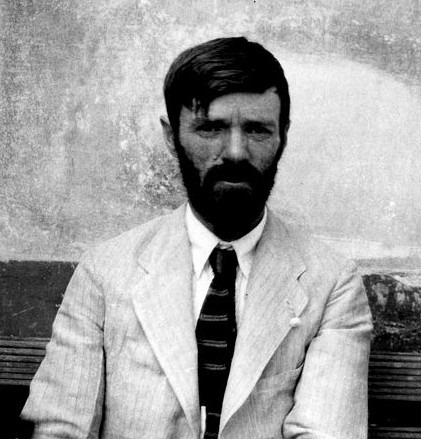
DH Lawrence  by Bynner

1923 photo of D. H. Lawrence by Witter Bynner


Oh “Self-Pity”  uses all the devices of poetry, save for rhyme. It’s loosely iambic with anapestic moments in meter, though the line lengths are uneven. This is consistent with much free verse, which still wants the beats of the words to be felt, without lock-step marching drills. It has a vivid image (the frozen, falling bird). It has a repetition (“sorry for itself”).

Why then does it seem different from other Modernist poems? Contrast Lawrence’s “Self-Pity”  to two other contemporary-to-it very short poems: William Carlos Williams’ The Red Wheelbarrow  and Carl Sandburg’s Fog”.  “The Red Wheelbarrow”  puzzles readers to this day about its message, other than it wants the wheelbarrow to be clearly real. I think it’s about the beauty and dignity of work and its tools, but perhaps I’m wrong. You may not draw any meaning at all when you first hear or read “The Red Wheelbarrow.” “Fog”  attracts immediately with its metaphor of silent fog and haunches-poised cat. It may seem to you at first a show of how metaphor cleverly works. “Wow, fog and a cat, I never thought of them together. Cool.” It’s only if you hold the poem longer in your mind and heart that you may ask why the fog/cat is at the harbor, that it’s not a pampered pet, but a feral or work animal.

“Self-pity”  is more directive. Many who hear or read it will get the point the first time. Yes, that frozen dropping bird is a vivid image, but it doesn’t lead off the poem, it comes after half-way, and it’s meant to work not as something the poet saw, but as an imagined image to illustrate his point.

Which way is the right way to go about it? That’s for you the reader/listener/writer/performer to decide. The Internet tells us some folks find the direct and pointed message of “Self-Pity”  helpful to them. I myself could stand to be reminded of it sometimes. Literary poetry of the 20th Century gradually made the decision to go with the non-directive imagery way, not with the more frankly didactic aims of Lawrence’s poem. Current writers and readers will get to re-decide this issue for our maturing, teen-aged, century.

“Self-Pity” was used in a Hollywood depiction of military training.  I imagine a Pythonesque skit where John Cleese or Graham Chapman submits other poetry to raw recruits. “I saw the best minds of my generation destroyed by madness, starving hysterical naked!” “Suppose an opponent comes at you armed with plums. So sweet. So cold. What would you do?” or “You are a pair of ragged claws scuttling across the floors of silent seas.”


What do I think? After all, this is the Internet. I must  have an opinion!

I’m eclectic. I don’t want poetry, or any art, to always work in the same way, to stop surprising me. If I could send myself back and offer advice to Lawrence on his poem, I’d tell him to spend more time on that bird before he tells us what the bird means. By not giving me the sense that a real human stood cold or bundled up or on the warm side of a window and watched that instant, that small bird, ruffling their feathers to hold what warmth was still there before the perch became its last, the poem loses potential power for me.

Thomas Hardy may have imagined his winter darkling thrush entirely as a useful image, but I feel that encounter with his bird. I’m convinced Rilke actually looked at an amputated and archaic torso of Apollo and wanted to see its present state fully before he delivered his reaction. I think Lawrence wanted to make a point, and that bird was a useful slide in his deck.

But that may be sentimentality on my part, and too much of that can be stifling and predictable. And perhaps the poem would loose some of it’s epigrammatic power. How often we see by opposition.

Musically, I spent a good deal of time on the drums/percussion for this track, trying to pull out the vibe of “Self-Pity’s”  meter. With the rest of the music I tried to balance my reaction to Lawrence’s resolution while transmitting the assertion of the epigram itself. To hear it, use the player below.


Longfellow Goes Beat

I live in one of the northernmost states in the U.S., a place where winter cannot be denied, and so we must make our treaty with cold and snow. Some will even claim it makes us better persons—hardier, accepting of the Zen of difficulties. Still, if Minnesota has inherent Buddhist elements, it doesn’t lessen my attachment to a shelf of warm clothes.

When I think of Buddhism I do not think first of ancient and overseas masters, but instead of the Beat Generation writers of my youth, the mostly men who reacted to the growing abstractions and high-mindedness of High Modernism with a return to immediacy and intimacy. The Beats could be seen as beaten-down by something, past the chance of winning a warm success, but they also asked that the word be understood as short for “beatific.” Allen Ginsberg explained: “The point of Beat is that you get beat down to a certain nakedness where you actually are able to see the world in a visionary way.*”

Like many things that meet America, Beat got absorbed and its rule-breaking became a style, a fad, a fashion, a look, a required attitude received with only enough meaning to make the accessory match the outfit. Every time I read to music here, I fear I’m seen as wearing a costume, playing a role.

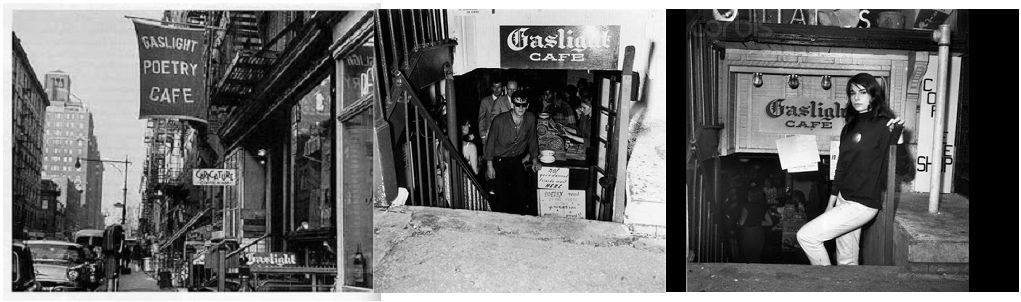
Gaslight Poetry Cafe

Not quite as portrayed on the Marvelous Mrs. Maisel, the legendary New York Gaslight coffee shop

So, what’s this got to do with Henry Wadsworth Longfellow—the square’s square—the man who wrote poetry that poets of the last 100 years find worthless?

Let me put Longfellow in a laboratory and see what we find. My lab: it’s a jazz club, probably downstairs, past the gray concrete curb turning winter white. It’s darkened enough inside the room that it’s sometime, night—but what year? The crowd is burbling, so’s the coffee machine. Wait staff are delivering and clearing tables, setting a tray on the bar for a moment to let another pass, talking of nights-off. A couple in the darker corner are nearly making out and can’t hear the band for the sight and breath of each other. A writer at a table closes a notebook, nothing more is in it today. The room is small but fairly full, about half talking their own talk and about half looking at the low bandstand, the quartet.**

The bass and drums begin, the guitar comments and the piano-player chords on the side. The bearded man steps to the mic, sheaf of paper in his hand.

“Snow-Flakes***”  he announces. Is this beatific? Is this visionary? Maybe it is, he looks that way. He is a strange cat: saying words “doth” and “bosoms”—like Lord Buckley perhaps. If he was translated into Chinese and then back to English, the Beat element would be clear; but even as it is, the words are beautiful, and he lets them slowly stay there that way, “This is the poem of the air.”

The drummer is still slapping the snare with his brushes, as the bearded man at the microphone gestures onward to the band, with a slight roll of his hand. His face changes. The vision’s past, is there a resolution? “Psalm of Life****”  he says.

This other poem is confrontation to everything we’d expect in this club for those who listen here and think about what they heard. “Mournful numbers,” are told on this stage every night, and he’s dissing them right off, and he ceases to pause his words now. The dance of the snowflakes becomes a march of “Let us, then, be up and doing.” What is this? The must be shoveling and stuck car after the beautiful, sorrowful snowfall?

He ambles off as the band riffs for another couple of minutes. What does this strange combination of poems mean? A snow-flake satori in a field, and then a command to earnestly strive. Yes, this Longfellow is a strange cat, even here.

My performance of Longfellow’s “Snow-Flakes”  and part of “A Psalm of Life,”  is available with the gadget below. Of if you are using a reader that doesn’t show the player gadget, this highlighted hyperlink will also play it.

.

*In the course of the long influences that led me to doing this project, a local Iowa rock band of the late Sixties, “Emergency Broadcast System,” would open their 1968 sets with the singer speaking a good portion of Ginsberg’s America  over the band riffing.

**I recorded this on Christmas afternoon, first laying down the drum track and playing my Bass VI, an odd instrument that adds two higher pitched strings to the conventional four-string bass, instead of adding lower strings, the more common variation. I used this higher range to play the repeating, descending riff that occurs throughout the song. I played guitar around this rhythm section and then played the block piano chords. As a last step, I figured if I’m going to impersonate a jazz quartet I might as well go all-in and put in some fake club ambience. Maybe this did come from binging The Marvelous Mrs. Maisel  this month with my wifeor from nights at the old Artists Quarter in St. Paul and listening to Sunday at the Village Vanguard  by the Bill Evans Trio too many times.

***This one goes out to Mary Grace McGeehan of My Year in 1918, who thought of this poem when she thought of Longfellow. It’s one I’d overlooked until she brought it up, and what a graceful lyric it is!

****I performed only about half of this once well-known poem of Longfellow’s here. Several phrases in it were mottos for my grandparents’ generation, and my parent’s generation passed them on to me in occasional speech under a thin varnish of irony to preserve them. As a result, both the poem’s claim that “Life is real! Life is earnest!” and it’s command to “Let us, then, be up and doing” have remained with me.

Fall 2018 Parlando Project Top 10 Numbers 10-8


Here we go with our quarterly run down of the most liked and listened to audio pieces over the past season. We’ll be counting up to the most listened to piece over the next few days as we approach winter solstice. Who’ll chart? The most famous poets with their best-loved words? The literary poets’ poets? The poems of the now largely forgotten figures I like to dig up sometimes?

10. “Seventeen Almost to Ohio,” words by Paul Blackburn arranged by me.  Where does Paul Blackburn fit now? Probably in the poets’ poet bin, though he’s also verging on forgotten. He doesn’t seem to have benefited from connections to a poetic movement, though he had them in overplus. He’s sometimes associated with the Black Mountain School, though he himself says he wasn’t really. He visited Ezra Pound and shared Pound’s interest in imaginative translation and the old French Provencal poets, and he is there connected to the original English language Modernist movement. He was based in New York coincident with the New York School of poets though he’s never mentioned as one in any summary roundup I’ve read. The Beats touched edges with the New York School—and with Blackburn, and again there are similarities in their approaches. Perhaps the most significant connection is that Blackburn was a leading NYC-based encourager of spoken and recorded poetry, including being the original organizer of the St. Marks poetry readings, a spoken word radio host, and a recordist of many other poets reading.

“Seventeen Almost to Ohio”  comes from an aside Blackburn made while recording Mina Loy in 1960, where he (apparently) spontaneously recalls an event from his own youth while asking Loy about hers at the dawn of Modernism. I lightly edited and arranged his anecdote and then composed the music.

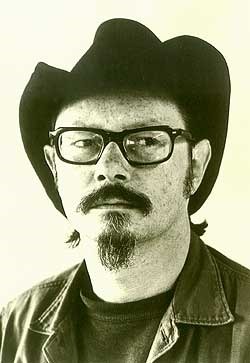
Cowboy_Paul_Blackburn

Paul “Does Jeff Tweedy look like me when he looks in the mirror” Blackburn


9. “Fog”, words by Carl Sandburg.  Early Modernists were fascinated by extreme compression and very short poems, and anthologists since then so often include Pound’s “A Station in the Metro,” Williams’ “The Red Wheelbarrow,”  and this 21-word Sandburg poem. And because it so baldly displays its central metaphor of fog and cat, the poem is often used to introduce grade-school children to metaphor.

In writing about “Fog”  this fall I wondered if there’s anything we’ve overlooked for over a century in this short poem, and came up with this question: Might it matter what kind of cat it is?


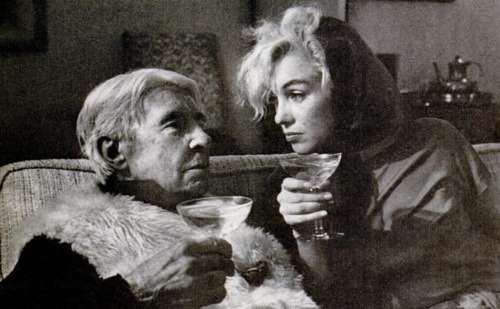
Carl Sandburg, Marilyn Monroe and some cocktails, 1962
Marilyn: Carl, Carl, you simply must tell me what kind of cat it was!
Carl: In good time, my dear—but first I need to finish inspiring Sonny Bono’s Sixties look.


8. “The Temple of Summer,” words by Frank Hudson.  Well, I’m almost as short-winded as the Sandburg of “Fog”  in this 31-word Mellotron drenched goodbye to summer. Longtime readers here will already know of my devotion to the sound of this primitive attempt at a sampling instrument used memorably in many late 60s and 70s British Prog-Rock recordings. The real thing is finicky, bulky, and hard-to-find and maintain, but the Mellotron’s sampling of real instruments to strips of recording tapes, whose notes can then be played by a keyboard press, is an easy trick for the computer-hosted Virtual Instruments that the Mellotron inspired and I use.

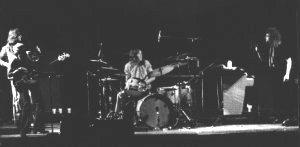
King Crimson with Mellotron on stage

Robert Fripp, on the right with King Crimson, declared after dealing with voltage issues on tour: “Tuning a Mellotron, doesn’t”


Want to nerd out on things Mellotron? This site looks very complete, and for the dabblers, they have just a listing of all the English Top 30 singles that used a Mellotron, which might refresh your memory on where you’ve heard that sound before.


The Book of Lu T’ang Chu

Why bother with little-known poets of the early Modernist age? Well, it’s conceivable that we can better understand the context the better-known poets were operating in by looking at the field the greats stood out from. And frankly, I get a kick out of looking at the left-behinds and odd corners. Like a crate-picker at a used record store, I’m looking for those weird finds that you can’t quite believe exist or that reflect some transitory moment in the culture.

I’ve already mentioned Arthur Davison Ficke in an earlier post as one of the Davenport Group, a bunch of Iowans, who with their rural Illinois cross-river neighbors, made a bit of a splash in American culture in the first part of the 20th Century. Ficke is not as obscure a character as Muriel Strode from our last post, but the separating distances of fame and achievement shrink as time moves on, so you’re not going to run into either of them in any survey course or even specialist literary class in school.

Unlike Strode, I could find out about Ficke’s family background. He grew up in one of Davenport’s richest and most cultured families. His father was a prominent lawyer and had amassed a considerable oriental art collection. After education in Davenport, Ficke was sent to Harvard where he was a classmate of Franklin Roosevelt. After graduation he was granted one of those traditions of the well off, an overseas tour which included travel to Japan.

Throughout his school years, Ficke was drawn to the arts, and yet family expectation dictated that he was to practice law. A career as an art critic and poet therefore progressed alongside lawyering. During WWI, and while serving as a military Judge Advocate, he met Edna St. Vincent Millay and eventually a post-war love affair blossomed. You may see some similarity to Millay in today’s Ficke-written piece, a rhymed, metrical sonnet, a form Millay also worked in.

Arthur Davidson Ficke and Edna St Vincent Millay

Arthur Davison Ficke with Edna St. Vincent Millay.


Like Millay, Ficke mixed with the Modernists socially while not consistently writing in the new Modernist style. This ambiguity of Ficke’s toward Modernism played out in an event we’ll cover in a future post.

I don’t find Ficke’s poetry as musical as Millay’s, but his“The Book of Lu T’ang Chu”  still has its charms. The poem combines Ficke’s interest in the Orient with a subtle observation about art in the modern age. This poem’s ancient Chinese emperor and Ficke himself are now both dust in the wind, as we all will be—but we can still listen to his meditation, set to my new music and performed on acoustic guitar, piano, and an attempt at playing (via a MIDI controlled “virtual instrument”) the Chinese traditional zither that came to the fore during the Tang dynasty, the guzheng. Use the gadget below to hear this.

The Vanishing Red

Do you think you know Robert Frost? You know: steadfast New England farmers, Currier and Ives snowfalls, happy roads less traveled by. We might think of Frost as the friendly Modernist, with good ol’rhymes and rhythms and narratives of American scenes of Americans bearing up to the burdens of life.

Robert-Frost on a wall

Robert Frost. Wry poet of the good old days—or maybe not?


Today’s piece is instead the hard-boiled Robert Frost. It’s blank verse, but the beat is implied, the sentence structures beat against it, and my performance choice was to not emphasize the meter. What “The Vanishing Red”  portrays is, straight up, a racially-motivated murder, and the way Frost tells the tale uses sly ways to frame this story.

He doesn’t get out of the first line before he starts this framing. One of our characters is called the “Red Man” by history. A term roughly equivalent to the N-word for indigenous Americans, but one that in Frost’s time was not considered socially unacceptable.*  Frost wasn’t going to shock or disgust his readers in 1916 with that epithet at the start of his poem, like he might some today, but he wants us to know from the start that the race and history of this man is material to what is going to happen—but we don’t meet him yet.

Instead we meet another man, the Miller, who’s talking in a way we might find familiar. He starts out by telling us he’s not guilty of something before he’s even been charged with it, claims too that he’s not one of that PC brigade who “talks round the barn” instead of straight talk, that he’s a get-it-done doer.

Frost adds just a tiny bit of narration after the Miller’s speech. Some may read this narration as excusing the man, but the narrator’s pointing us to think about two things as the story will continue. The narrator says, let’s not consider this as history (“too long a story”) or politics (“who began it”). As we’ll soon see, we’re going to consider this as an Imagist poet would consider it, as a presentation of what Ezra Pound called “an intellectual and emotional complex in an instant of time.” History can be dulled by time. Politics says there are two sides.

Old Grist Mill

Nostalgic postcard or dark satanic mills?  Frost reports, you decide.


But first we have one more exchange of dialog. Our unnamed “Red Man” is at the Miller’s mill, and we hear nothing he says directly, but we do hear what the Miller puzzles about what the other man is communicating. The Miller portrays the other man as without English words, but he interprets some “guttural exclamation” anyway as surprise, and this is somewhat sketchy. Is the native American puzzled by the mill’s mechanism? Surprised at being seen by the Miller?

Is the Miller even reading the other man well? I think not. Afterall, the Miller has another reaction, stronger than his sense of what the other man may be feeling, and Frost’s narrator also doesn’t “talk around the barn:” it’s disgust. But that’s not what our Miller portrays in his next piece of dialog. He acts friendly, offers to show “John” his mill.**  Ah, the “Red Man” has a name, he’s not some reductionist cypher for an entire continent’s indigenous peoples, and since it’s an English name, we might surmise that he might even be one of the Massachusetts tribes that attempted to synthesize with the new rulers, taking to Christianity and living in “praying towns.”

And now the Imagist poem begins, ten lines. The Miller opens a trap door and shows John the water-power wheel, and a poem that has been entirely without imagery suddenly gets a vivid image. The wheel’s water forebodingly is like struggling, thrashing fish. The door closes, and the door’s handle (a metal ring) we are told makes enough noise with this shutting to be heard above the noise of the mill. And the Miller returns upstairs, alone. The wheel’s turned around to the beginning of the story where the Miller laughs, though it’s not quite a laugh. He meets a customer carrying more meal to be ground at the mill, who doesn’t understand what has just happened. We ourselves are just understanding what has happened.

What has happened? The racist Miller has thrown John, the “Red Man” into the mechanism and killed him. Frost wants you to feel that by showing you this moment in time, but he also wants you to vividly feel the lack of notice, the vanishing in the title, which isn’t some passive mystery, it’s an act of human cruelty.

Today’s music is two pianos, bass and drums. I’ve been suffering from a cold for the past few days which made completing today’s spoken word component a challenge, and I did miss one phrase in Frost’s text and didn’t get another one completely correct, but you didn’t get to hear any of the coughs and voice cracks from the bad tracks either. To hear “The Vanishing Red”  use the player below.


*For example, the college I went to over 50 years ago called its sports teams the Redmen then. I had a tiny part in the beginning of the process to change that.

**Acton Massachusetts had a grist mill and more. I can’t find any pictures of them, but the town still has a Grist Mill Road.

Easter Monday (In Memoriam E. T.)

It’s 1956. World War One had ended less than 40 years ago, instead of 100. Robert Frost is the most celebrated living American poet, and he has traveled back to England to receive honors from both Oxford and Cambridge universities, a symbolic laurel helping to mark the 20th Century acceptance of American poetry into the pantheon of our polyglot language.

Two elderly women follow an invitation to an upstairs to-do in London, where the American poet has just landed. Eleanor Farjeon is one of the pair, then 75 years old, and here’s how she described what happened:

We approached a white-haired man who was talking to T.S. Eliot. ‘It’s Helen and Eleanor, Robert.’ He turned towards us quickly, unmistakably Robert. Were we as unmistakably ourselves? Eliot smiled at us and withdrew a little…. Robert muttered, ‘Well, well, well.’ Soon he and Helen were talking of their grandchildren.

Who are these ladies that broke off the tête-à-tête between the two Modernist poetic titans?

One was the widow of Edward Thomas, the man who Robert Frost called “the only brother I ever had.” The other was the woman who had introduced Edward Thomas to Frost in 1913, Eleanor Farjeon. The poet Edward Thomas is not well known outside of Britain, Farjeon even less so, but none-the-less she had a long and varied literary career as a poet, playwright, children’s book author, and songwriter in a life that spanned from the Pre-Raphaelites to Carnaby Street.

Eleanor Farjeon

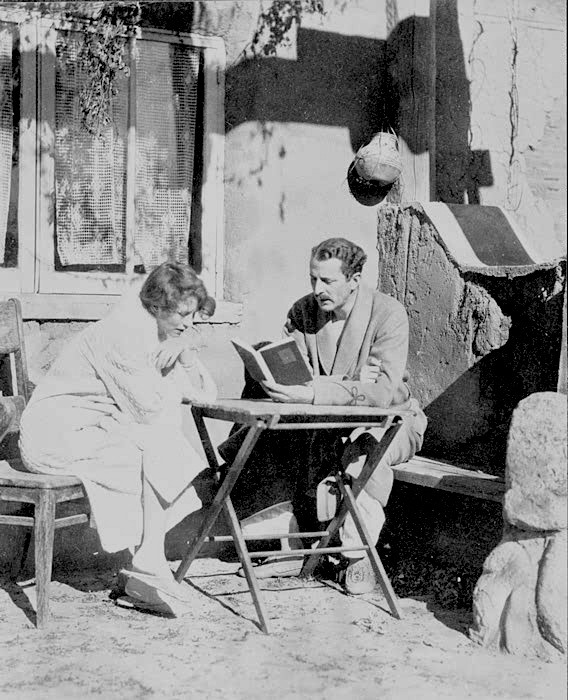
Eleanor Farjeon early and late in her life

Back just before and after the outbreak of WWI, the Frost Family, the Thomas Family, and Eleanor Farjeon were a sort of an extended pod of friendship and affiliations. The Thomas marriage had strains, and Farjeon was in love with Edward Thomas. Thomas’ spouse, Helen, surprisingly cast Eleanor Farjeon not as a rival but as a balm to Edward. And so, between her own writing, and typing manuscripts to help D. H. Lawrence (also hanging around this circle*) Farjeon, like Robert Frost, took to accompanying Edward Thomas on his indefatigable walks around the countryside.

Eleanor Farjeon was still a literary stem cell at the time. She later said “In my youth I dreamed of being a ‘real’ poet, but half way through my life that dream died, and whatever figments of it remained went into writing songs** and verses for children.”

When Edward Thomas decided to enlist and volunteer for the front lines in the war, the pod all shared correspondence with Thomas, a correspondence that continued right up to the very week of Thomas’ battle-death. And after that, they all shared the task of putting his literary affairs in order and promoting the poetry of the man who had only started writing it during that short pre-war period.

Robert Frost and Eleanor Farjeon both wrote elegies for Edward Thomas. It may surprise you, but I’m choosing to use Farjeon’s memorial sonnet here to cap off our Armistice Day series on Edward Thomas, instead of Frost’s poem. Farjeon might have thought of herself as not a “real” poet, but it’s us, the audience, that decides. Her poem may seem to be made of genteel English stuff: gardens, Easter eggs, love tokens, so that it has the patina of an antique valentine—but that’s just the surface. How about those relentless repetitions? You can hear James Joyce or Gertrude Stein tuning up in the distance if you listen for those. Did she mean the punning subtext of the repeated “Eve” with the repeated apples? If this were a Joyce poem we’d assume yes, so why not here? And that surface? It’s a paper scrim she means to tear, to rip—and yet when she does it in the last line, there’s no sound, only an invisible gap, an understated “apology”.

Here is what Eleanor Farjeon said, shortly before her own death, writing again about Edward Thomas and Robert Frost when recounting her last, 1956 meeting with Frost in the company of Thomas’ widow:  “We do not lose our friends when they die, we only lose sight of them.”

Here’s my performance of Farjeon’s “Easter Monday (In Memoriam E. T.)”  that you can hear using the player below or with this highlighted hyperlink.

*Sounds a bit unconventional for an Edwardian village in 1913 doesn’t it—but any bets on who did the housework?

**And it’s in this guise that Farjeon is likely to be best known in the U. S. Back in 1972, three denizens of that Sixties London: Cat Stevens (later Yusef Islam), Rick Wakeman (later caped-keyboardist of Prog Rock fame) and Paul Samwell-Smith (producer and former bass-player with the Yardbirds) created an arrangement of Farjeon’s hymn “Morning Has Broken”  for a best-selling LP and eventual #6 hit single on the Billboard U.S. charts.