Tiresias

Each April, as part of National Poetry Month I’ve been recording a performance of T. S. Eliot’s “The Waste Land”  and presenting it here in serial fashion. This year we’re performing the third section of the poem, “The Fire Sermon.”

When we last left “The Fire Sermon”  we were by the not-so-sweet Thames river where (as elsewhere in the poem) voices and diction were constantly changing. We don’t know who, or how many “whos,” were speaking in that segment, but the narrator in today’s section identifies himself as Tiresias. As we’ll soon see, Tiresias is as shape-shifting in body as the poem has been in voices.

Tiresias’ has many characteristics in the various mythological tales told of him. He’s able to predict the future, and he does this by studying birds (augury) and in particular by studying birdsong.*  He’s blind but is able to perceive things anyway through second sight and acute hearing. He’s said to have been given the gift (or curse) of an extra-long life. He also has the ability to talk to the dead, and in some stories talk to the living after his death. But perhaps the most remarkable part of the Tiresias story is that he was transformed from a man to a woman, and back again.

Tiresias_striking_the_snakes

Tiresias as he is transformed into a woman by Hera because he killed a female snake.


We open not with Tiresias introducing himself, but with his encounter with a merchant, who seeks some kind of meetup with the narrator. There are some who tell us the meetup locations suggested indicate that the narrator is being propositioned for a homosexual tryst. If so, this would be consistent with the closing song in the “Sweet Thames”  section, referring to heterosexual prostitutes and that section’s opening in some kind of any-affiliation “after the party” ennui by the river. And so the theme is set: “The Fire Sermon”  is going to talk about sex and what passes for love.

Now Tiresias introduces himself, and his sexual fluidity, as he begins to tell what seems at first a straightforward story: a typist has come home to her small  apartment. Hers is a low-paid job in the early 20th century business/bureaucracy, one often filled by the new “working woman.” She’s taking care of after-work household necessities, including collecting her drying laundry scattered across the room’s couch (which also serves as her bed), and fixing a meal.

Tiresias tells us he already knows what’s going to happen, and since mythologically he’s told the fortunes of kings and heroes, he’s sort-of over-qualified to tell this story.

And sure enough, Tiresias tells us a young man (carbuncular, i.e. covered with zits) arrives. He’s another wage slave, a clerk, who affects a silk hat that he thinks makes him look like a wealthier man. The typist and the clerk have a meal the typist has cooked and then he, hurriedly, unromantically, and with no real consent, jumps her bones.

And here Tiresias tells us he’s not just seen this all before (in both senses of the phrase, as someone who can predict the future, but also as a demi-immortal for whom this story only changes costumes and scenery as it repeats) but that he’s experienced it as both genders.

And then it gets weirder. That back-story of Tiresias’ own history with sexual exploitation is told in a long compound sentence in parenthesis. Today’s section then ends with an unstated someone who “bestows one final patronizing kiss, and gropes his way, finding the stairs unlit” out of the apartment. Is that the young man carbuncular, or Tiresias, or are they one in the same? And for that matter what of the woman, the typist?

As they used to say in serials, tune in tomorrow, as our story continues. To listen to my performance of this segment of “The Waste Land”  use the player below.


*And birdsong acts as a bridge between our first segment of “The Fire Sermon”  and this one.

**There are a great many interpretations of “The Waste Land”  and its sections. Mine is far from the most learned. I could use footnotes to try to explain every reference and connection in the poem—at least until my learning and research ran out—but I’m choosing to resist cataloging all the connections and references, so that we can appreciate the poem as an impressionistic, imagistic, musical suite of scenes, voices, and songs. If you’d like to read along, here the whole poem.

Sweet Thames

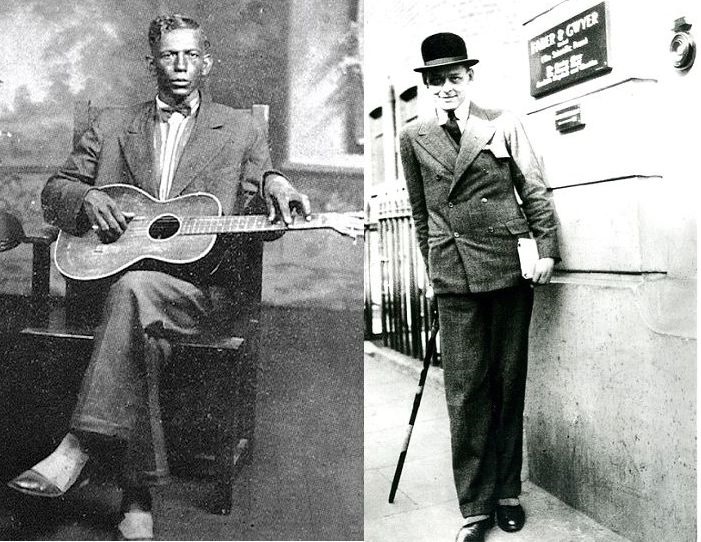
Was I being audacious when I compared Eliot’s “The Waste Land”  to a modern hip hop/rap production sampling various parts and levels of the world’s culture? I don’t think so (though maybe I should be worried). I’m not going to get into a rap battle between T. S. Eliot vs. Missy Elliot, or a discussion about “Kendrick Lamar, is he a ‘real poet?” like my generation used to discuss Bob Dylan. My aging generational knowledge isn’t deep enough to discuss Lamar or Elliot as intelligently as I should. I’m more comfortable discussing folks who were born long before I was, but someone like Charley Patton is too O. G. to bring up here often. After all, T. S. Eliot and Charley Patton are my grandfather’s generation, born in the 19th century. People like me can be pretty good in figuring out what lessons our grandparent’s completed lives impart, not so good at what lessons our children should learn from us, and terrible at what lessons our children could teach us.

Charley Patton and T. S. Eliot

Charlie Patton and T. S. Eliot: two young swells put their best foot forward beside different rivers in the 1920s.


Eliot may have thought he was copying cubist paintings or cinema montage or some French poetry, but he chose this sampling tactic or he would have done something else. Who was Charlie Patton copying? I don’t know exactly. Maybe he made it up. Maybe some griot or indigenous shaman whispered it in his ear.

T. S. Eliot was his own kind of odd guy, odd to his contemporaries, even if he eventually became enormously influential in the Modernist literary movement that had taken over poetry education by the time I was a student. When I first introduced “The Waste Land”  here I said there’s two things you need to know to approach it, and they aren’t esoteric at all: first that it’s musical and intended to be, and second that it’s written by a person suffering from depression, a common human malady that colors and filters perception profoundly. Now, following my grappling with it in the past few years, I’ll add two more things, neither of which require reading about Grail legends or From Ritual to Romance  either: it’s written by a man writing for a culture coming out of a tremendous wartime trauma and it’s written by a man struggling to come to terms with human sexuality, it’s sins, pleasures, and disappointments.

On the war issues, Eliot is guiltily living, not dead, in a world where many others weren’t so lucky. Estimates vary, but somewhere between 15 and 19 million people were killed in WWI, the majority from the European theater that had become Eliot’s home. Given this level of death, it’s not surprising that Eliot personally knew people killed in the war. Most of his British literary contemporaries served in the war, he didn’t. Indeed, while WWI raged, he tried to disengage from the war, to continue to focus only on scholarly issues and his literary writing.*

Eliot’s an American from St. Louis in a foreign country and he’s gotta figure out how to trans-Atlantic code-switch. He goes in full-force, becoming so completely English that he eventually was able to style himself as an authority on what was appropriately British. After the conclusion of the war, as a literary critic he can write about “objective corelative” and all that, but he can no longer ignore the trauma his adopted country and the rest of Europe has suffered.

Last year’s segment “A Game of Chess”  rolled-up into one audio file in our last post, portrays marriage darkly and introduces rape and sexual coercion as one of the underlying themes in “The Waste Land.”  Here we know little about Eliot’s own experience, other than his marriage to an English woman was dysfunctional. As we move further into our section for this year, “The Fire Sermon,”  sexuality is further brought forward in an unflattering light.

As the section begins in the segment I call “Sweet Thames”  we’re back in a ruined landscape, the titular “Waste Land.”  The scene seems post a debauched party season, missing even the messy vitality of that. Eliot, a man who grew up near the banks of the southern Mississippi is now on the banks of London’s Thames river.

And then he, or some incarnation of the poem’s speaker, the many voices in Eliot’s head, is fishing. Following the literary and critical references, this is the Fisher King, and we could look to a trail of ancient myths, but I chose to keep it immediate and funky in performance. This is a dirty, river-rat frequented urban river. He wants us to know that he’s fishing next to a gashouse, which I take to be one of those now obsolete processing furnaces that turned coal into coal gas, a smelly and polluting process usually relegated to the worst part of town. The anachronistic pendant in me found this amusing, as a decade after ex-St. Louis boy Eliot wrote “The Waste Land”  his home-town Cardinals baseball team used to intimidate their opponents by wearing stinky unwashed uniforms and were given the nickname “The Gashouse Gang”  for their smell and general lack of decorum. There’s no known connection for this coincidence, but it’s good that they didn’t wait until later in “The Fire Sermon”  and to then become the World Series winners dubbed “The Young Men Carbuncular.”

As the section nears an end point another song-sample break is dropped,** the Mrs. Porter section. Eliot noted that it was an Australian army folk song, and further research indicates that the Mrs. Porter may have been a Cairo brothel keeper known to the ANZAC troops heading for the disastrous Gallipoli campaign, where a dear friend of Eliot, Jean Verdenal was killed in battle. Depending on how salty the soldier-singer may have felt, the body parts being reported as washed varied.

I like to think that Charley Patton, further down the Mississippi river, might have known that tune, but since neither he nor T. S. Eliot are here to sing this, you can hear my performance using the gadget below. If you’d like to look at the text of “The Waste Land”  while you listen, the full text is here.


*Like Ezra Pound his overseas American citizenship status complicated things, and like Pound there are some stories that he made an effort to serve. Eliot did teach night-school literature classes to working-class English women during the war however, and it’s easy to speculate that he may have picked up things later incorporated into “The Waste Land”  from that experience.

**And for all you carpe diem fans, did you note the sample from Marvell’s To His Coy Mistress”  here, when just before Mrs. Porter soda-washing-song he says “But at my back from time to time I hear…” and instead of a winged chariot, it’s motorcar horns. If given the choice of grave or sex, I think Eliot would have held out for a third choice.

A Game of Chess, presenting T. S. Eliot’s “The Waste Land” for National Poetry Month

Each April, as part of our celebration of National Poetry Month, the Parlando Project has been presenting in serial form T. S. Eliot’s High Modernist masterpiece “The Waste Land.”  This year, we’re up to the third section of the poem “The Fire Sermon,”  but before we present new material, I want to give our newer listeners/readers a chance to catch up.

It’s possible to read the entire “Waste Land”  aloud as a dramatic monolog in less than 40 minutes total time. Fiona Shaw has done this, and her performances of it cannot be praised or recommended enough. But for me personally (and this goes back to my first readings of the poem) I’ve always been struck by “The Waste Land’s”  intense musicality. The collage process of various voices is musical, and “The Waste Land’s”  constant changes in tone and insertion of quotes from other poetry eerily predict hip hop mix tapes in a 78 rpm world. Themes emerge and fall back and are then repeated later on, just as they do in long-form musical composition. Eliot even quotes song lyrics multiple times in the poem.

The Waste Land cover

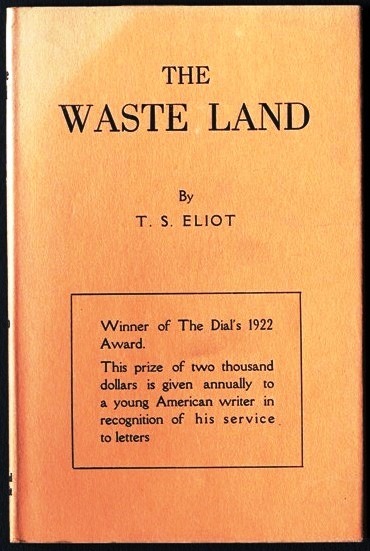
He got $2,000 for service to letters, but our aim is to demonstrate the music in it


So, I’ve long dreamed of performing “The Waste Land”  with music—and now, as part of this project I’m realizing that dream on the installment plan. While I think the music can help bring some solace and additional shadings to Eliot’s unstinting look at human failure and limitations, the resulting performance is lengthy. It’s not the kind of thing I can take on creating and performing lightly—and to listen to it, even casually, is not light entertainment either. The Parlando Project normally focuses on shorter poetry, the lyric impulse. Almost all of our pieces are under 5 minutes, and we have hundreds of them available here. So, don’t feel obligated to listen to these longer “Waste Land”  pieces. They are not for everybody, and I believe they are consistent with Eliot’s design to write only for those willing to look at dark impulses and feelings, to weigh and consider them within your mind and heart.

Here’s “I. The Burial of the Dead,”  the first section that famously opens with “April is the cruellest month, breeding/Lilacs out of the dead land…” which is likely a reason that April is U. S. National Poetry month (and may already be referring to another poem, Walt Whitman’s Lincoln elegy, When Lilacs Last in the Dooryard Bloom’d.”)


And here’s last year’s contributions, the section “II. A Game of Chess”  rolled up into one piece for the first time here. I start out this one by making an ex-post-facto connection of Eliot’s lavish and dissipated opening of “A Game of Chess”  with the late-night, dragged out, “Ain’t it just like the night” style of Blonde on Blonde era Bob Dylan, and it ends with an appearance of a guest reader Heidi Randen for the monolog about Lil and Albert and their just-discharged-from-the war marriage.


This month we’ll continue our serial presentation of “The Waste Land”  with one of its longest sections, “III. The Fire Sermon.”  If you’d like to read along with the text of the poem while listening, the full poem is here. With these musical presentations I maintain that you can listen to them and not feel that you need to understand what the poem means in the essay-question sense, and instead only require the poem’s words to strike you with scattered connotations and impacts. There are a great many resources for those who would like to delve into deeper meanings of “The Waste Land,”  all the things that Eliot intended to put there—and also the things he only inherently and accidentally included. For those that enjoy that, there’s much there at that level, but I remind you of the concept I laid down a couple of posts back regarding Emily Dickinson’s much shorter poem: a poem isn’t so much about ideas, it’s about the experience of ideas.

10 Definitions of Poetry from Carl Sandburg

Let’s continue our celebration of U. S. National Poetry Month!

If Emily Dickinson and Walt Whitman are the parents of modern American poetry, then one poet is most nearly the descendant with an equal inheritance from both: Carl Sandburg.

Sandburg’s poetry has two modes: the tightly compressed Imagist poem and the expansive, iterative, catalogic Whitman-like ode. I find him effective in both styles—and sometimes he mixes both, as in today’s selection. Each line in his “10 Definitions of Poetry”  is its own compressed poem, but taken together in a list they express different aspects of poetry.

Carl Sandburg in black cowl-neck

The forgotten American Modernist. Sandburg! thou shouldst be living at this hour!

.

I’m something of an advocate for Sandburg here, as I feel he’s fallen out of favor during my lifetime and now is more than due to be re-evaluated. The major knocks against him in the later part of the 20th century were that he wasn’t complex and subtle enough, that his poetry didn’t dig deep enough in to the hard-to-grasp philosophic questions at the core of meaning and human existence, and to a secondary degree that his poetry wasn’t, well, poetic, that it was neither lyrically beautiful nor painstakingly constructed.

I won’t lay out a complicated case for Sandburg on those two issues here today, but on the first issue I’ll say that Sandburg’s Socialist and working-class outlook leads him to address universal issues of the human condition, from top to bottom of our current social organization; while other poets, ones with an avowed aesthetic focus or a calling for self-contained spiritual insight look at only part of the situation. Even those that don’t share Sandburg’s politics can benefit from his insights. On the charge of Sandburg not being a poetic craftsman, I’ll say that while I don’t know much yet about his working methods, I can look closely at some of Sandburg’s shorter works and find well-chosen small things—and whether they were intuitively there in his vision or created by exhaustive study and revision, I find that less important than their existence.

I’m also sorry to say that Sandburg’s poetry can sometimes be—as reflected in some of his definitions in this list—fun, funny, entertaining. You’ll just have to overlook that.

And if he’s charged with those things, weren’t Whitman and Dickinson also charged with these faults throughout the 20th century? Our current century looks at Whitman and Dickinson and sees their still startling differences—but has begun to realize that where the past saw in those differences infelicities of expression or simple directness, that they are instead part of their genius, part of why our need for those poets has not been replaced. And if we need Whitman and Dickinson, then perhaps we also need their hybrid descendant Sandburg too—he of his synthesis of hyacinths and biscuits.

I took my musical inspiration today from Sandburg’s first definition: “Poetry is a projection across silence of cadences arranged to break that silence with definite intentions of echoes, syllables, wave lengths.” My guitar part runs through some modulation effects and an echo/delay; and underneath, working with my electric bass-line, a wobbly Mellotron* waves along. Hear this with the player gadget below, (of if you don’t see the player, you can use this highlighted link)  Check back soon for more combinations of various words with original music—and, oh yes, please let others know what we’re doing here at the Parlando Project.

.

*No, I don’t have an actual funky tape strip Mellotron. Thankfully the tapes have been converted into digital samples and can be played with an inexpensive MIDI keyboard or controller.

The Aim Was Song

Let’s give the lyrical reins over to Robert Frost one more time for another electric guitar driven piece. “The Aim Was Song”  is a poem from Frost’s 1923 Mountain Interval  collection, and not only is it a reasonably straightforward poetic credo from Frost, it speaks a little to Parlando’s goals too.

I put forward a definition of poetry as I was starting the Parlando Project as “Words that want to break into song.” I don’t recall where I read that definition, but when I searched this afternoon, all I can find is myself, so the source of that phrase may remain a mystery.

Careful with that axe Eugene. Robert Frost prepares to kick out the jams.

Unlike Sandburg and Yeats, Frost himself had no desire to sing or perform to music that I’m aware of, but his desire to use metrical/rhyming verse goads me to use him often here. And Frost had his own theory about how meter and language worked in poetry. He called it “The sound of sense,” and he once described it in a letter as akin to what comes through if you listen to talk in another room from the other side of a door. I don’t think he’s writing there about meter as commonly scanned in metrical poetry, I think instead he’s talking about human vitality that arrives through the panels of a door, the rise and fall, the breath and repetition. Frost’s theory was that you then laid that over the structure of metrical/syllabic prosody, so that each side pushes and pulls on each other. Too much evenness and it’s a motorik machine. Too little and you have only thoughts scattered on the page where only a silent and uncycling eye can gather them. You find that balance with one’s ear and heart.

Perhaps what Frost is aiming for here is the thing musicians call phrasing, but one thing that’s sure is that Frost believes poetry, even poetry of complex meaning or subtle rhetoric, is received through the ear and not the eye. So, even if Frost was not thinking directly of his poetry in association with music as we present things here, he is thinking of poetry as suffused with orality.

In “The Aim Was Song”  Frost develops one image throughout: how the human being captures breath, moving air in waves, the essence of that natural force of the fierce spring wind, and shapes it into a smaller but more intimate thing. That is the work of musicians and poets. I could almost hear Lord Buckley read this one, as Frost repeats some words in his short poem that seem to pun on musical terms, to “blow,” “how it ought to go,” and “measures.” I didn’t go that route (if I could) but consider that an undercurrent in this.

To hear my performance of Frost’s “The Aim Was Song,”  use the player below if you see it. Don’t see a player? This highlighted hyperlink will also play it.  U. S. National Poetry Month is coming up in a few days, and I’m hoping to have a good number of encounters between music and words here in April. Please check back or subscribe, and spread the word.

.

A Spring Song with Some Winter In It: Frost’s “A Patch of Old Snow”

A bit earlier this month we presented a landmark very short Imagist poem, Ezra Pound’s “In a Station of the Metro.”  14 words, and a prime example of the Modernist’s reaction to the rhetorical flourishes of a worn-out 19th century. Today I’m going to release a Robert Frost response, a 47-word rejoinder, a spring poem with some winter snow left in it.

Frost was born 145 years ago this week. His relationship with Pound is complex. On one hand Pound could view himself as responsible for launching Frost’s career, writing the first substantial review of Frost and seeing to it that his poems were published in Poetry  magazine. Without Pound’s endorsement, Frost had submitted poems there which had been rejected.

Frost tells the story of their initial meeting, with Frost’s first book A Boy’s Will  so newly published in England that he himself hadn’t gotten a hold of a copy. F. S. Flint (a too-often-forgotten pioneer of British Modernism) had met Frost at a bookstore reading, shortly after Frost had moved to England. Flint noticed Frost’s American shoes and insisted that he must meet his countryman Ezra Pound, now also residing in London. Frost later went to Pound’s apartment, and this is how Frost recounted their meeting:

[Pound] said, ‘Flint tells me you have a book.’ And I said, ‘Well, I ought to have.’ He said, ‘You haven’t seen it?’ And I said, ‘No.’ He said, ‘What do you say we go and get a copy?’ He was eager about being the first one to talk. That’s one of the best things you can say about Pound: he wanted to be the first to jump. Didn’t call people up on the telephone to see how they were going to jump. He was all silent with eagerness. We walked over to my publisher; he got the book. Didn’t show it to me—put it in his pocket. We went back to his room. He said, ‘You don’t mind our liking this?’ in his British accent, slightly. And I said, ‘Oh, go ahead and like it.”

Even in prose, there’s some Frost-ian ambiguity it his account. He notes in passing that the American Pound was putting on a British accent. And his sly quote of Pound “You don’t mind our liking it” before Pound has read it—a subtle dig at poetic politics that—and who’s the “our” here. Pound (and Flint too) were promoting a poetic movement, Imagism—poetry that used direct, concise treatment of “a thing” without any extra words whatsoever.

Frost never liked a movement that included more than him.

And to some degree this soon led to a break between the two poets. Pound thought that Frost fell short on the “use no extra word” dictum of Imagism. He apparently offered to help Frost learn to excise those surplus words—and though similar offers from Pound were taken up by literary giants like T. S. Eliot and Ernest Hemmingway, Frost refused it.

There was a second catch. In Pound’s review that launched Frost, Pound wanted to make a point of Frost’s rejection by American editors, and he was loudly saying this in an American magazine (one of those that had, in fact, rejected Frost). Many musicians and music fans will quickly recognize Pound’s move here. This is the punk/indie/”street cred” claim. This artist has too much honesty and individualism and lacks the subservient guile to please the suits and the mainstream! The problem here was that Frost was a middle-age man with a family—he wanted to cross-over to those editors. Frost thought Pound was pulling this move to show what a discerning critic he was more than to promote Frost as an outsider artist.

But note too in Frost’s account of his first fateful meeting with Pound, the subtle admission he makes about himself. “Oh, go ahead and like it.” He wanted, needed the help—by any means necessary.

Oddly, if you were to read Pound’s short review today, you might be surprised that it worked to launch Frost at all. There are condescending elements, Frost is almost treated as some idiot-savant country bumpkin. And worse for Pound, he goes on record as the first man to misread Frost as simple and earnest (the same mistake that I made as a teenager, but then I’m not Ezra Pound).

A Patch of Old Snow_1080

A patch of old snow, blossoms on wet dark bough not included


Here’s the text of Frost’s poem I use today and here’s Pound’s 14-word Imagist flagship. Look at Frost’s first stanza. Sure, Frost’s is rhymed and metrical, though Pound uses a near rhyme that many miss. If Frost ended there, his poem is purely Imagist. “Old” in front of snow isn’t a wasted word. We need to know it’s spring now, and that the snow is past its sell-by date. And it’s an interesting choice to say “blow-away paper” instead of blown-away—more immediate, and it indicates that its transient nature is inherent, not something acted upon from without.

Frost’s second stanza? Pound’s editor’s pencil might have suggested he’s restating the image from the first stanza, but Frost might have countered by noting that he’s making clear this isn’t just any crumpled scrap paper the snow is being made equivalent to, but a newspaper or other publication, with “small print.”

Here’s the Imagist difference. In conventional poetry, the images, the similes and metaphors, are only decorative—look, clever I can compare this to this. In Imagist poetry this comparison shouldn’t be just decorative—it’s the meaning of the poem.  This last edition of winter is “yesterday’s papers.” And bilaterally, wrong-headed reviews in Poetry?  They will pass like the lonely grimy snow-bergs.

The last line, “If I ever read it,” is Frost’s touch. Pure Imagism doesn’t like to draw conclusions, even enigmatic ones. Does it mean one thing? I think it predominantly says, it’s the past, I’ve endured, it’ll soon be gone completely. The poem first appeared in Frost’s third book, the first to be published in America not in England. Frost was on his way. But there’s an undercurrent—with Frost there always is.  Is that small print an edition of The Book of Nature? After all, we also know this: winter will return, and should we not read what it has written to us?

Frost will do that too in many of his greatest poems.

This morning I ask myself, what a strange way to spend a weekend full of news and melting snow, reading the small print about two poetic innovators at cross-purposes to each other.

Musically, I wanted to let loose a bit for this one. I’ve been playing acoustic guitar for many recent pieces, so I wanted an unleashed electric guitar. The wild spring bird-whistles near the end are feedback between the guitar’s pickups and the amplifier.


The Most Popular Parlando Audio Piece This Past Winter 2018-19

Let’s just name the winner right off, and kill the suspense: Wallace Stevens’ “To the Roaring Wind.”

There was a time in my teens and twenties when Wallace Stevens grabbed ahold of me. I think back at that young man and try to wonder why. Well there was the accident of a very affordable collection of his best work that I mentioned when I first posted “To the Roaring Wind”  back in early January. I think that I also liked the way his poems looked. Free verse looked right on the page to me as well to my ear—I was not writing metrical, rhymed poetry when I started—but the poems also looked ordered, focused, a tightly built thing. E. E. Cummings or Marianne Moore with their ragged lines and strange fragmentation looked like that they were confused about how to put things into words, where Stevens looked sure. Other favorites that came to me later in life, like Frost and Dickinson, seemed to my younger self all too pat and superficial then, and there was Stevens, his poems with majestic numerabled sections that seemed to be laying out a lawyerish or legislative structure filled in with an exact poet’s eye.

wallace-stevens

Poet Wallace Stevens. Gromit not pictured.


That I didn’t understand all that he was getting at in his poems wasn’t a problem. No, that was a benefit. For my paperback edition $1.45 I got work that one could re-read without knowing already how it would come out! I recall writing poems that I didn’t know how they would come out either, something I will still do. There was one longer one from that era, the first one of mine ever to be published.  It had Stevens’ influence all over it,  copying his Blackbirds-numbered sections.

Frost, who I thought was entirely too conventional then, claimed that he never liked Stevens’ work “Because it purports to make me think.”  Isn’t that line so Frost-ian? First you might high-five Frost and shout “burn!” And then, if you pause and think about it, in decrying Stevens Frost makes a good argument for why you might want to read him—indeed, why I wanted to read him.

Oddly, this poet who was attractive to this teenager, published his first collection Harmonium when he was 44 years old. Lewis Untermeyer, one of the canon-gatekeepers of Stevens’ time, reviewed it then:

“…lacking the spell of any emotion, Harmonium  loses both itself and its audience. It has much for the eye, something for the ear, but nothing for that central hunger which is at the heart of all the senses.”

Untermeyer and Frost may have been right to some degree. I fell away from Stevens as I aged, not from any conscious choice, but because I had other poetic worlds to explore, ones that often had emotional and visionary aspects that weren’t overt in Stevens work.

Here is where the Parlando Project, which performs the poems with music, comes in. There is no inherent emotional content in any series of notes stronger than what the musician manifests when they perform it.

As I noted that Harmonium,  as a work published in 1923. was now in the public domain as of the first of January 2019, I looked for a piece from it that wasn’t one of its “greatest hits,” a deep cut to represent the collection itself rather than an often anthologized and well-known poem. My attention fell on the last piece in the book, this one. As I did this, a connection emerged with a local poet and poetry-reading organizer, David Shove who I learned had died at the turn of the year. “To the Roaring Wind”  is a call to two things: to the muse, that time-honored concept that what supplies us as artists isn’t from our individual merits, but from things outside us that we must serve, and then, to speaking poetry aloud.

The Parlando Winter 2018-19 Top Ten part 3

Should I stop for a moment in our count-down of the most liked and listened to pieces this past winter to describe briefly what the Parlando Project is? After all, there are always new people coming upon this stuff.

What we do is take various people’s words, mostly poetry, and we combine them in various ways with original music. The music too is not one style. Sometimes we sing the words, but not always, or even usually. Sometimes we read them or chant them or talk-sing them. Singing gives a particular effect to the words, and though I admire many examples of art-song, including some examples that use the same texts that I’ve used, I think there are other facets of the poetry that can be shown with other performance styles.

I wish we had more modern or semi-modern poetry here, but very soon in this project I determined that the effort to obtain the rights to creatively engage with work still in copyright protection would reduce the amount of encounters we could produce.

Limits and restrictions often engender creativity though. I’ve found that being largely restricted to the pre-1923 public domain world still allows me centuries of material to pour over, and there seem to be a great many under-appreciated and forgotten writers to discover. A lot of what I end up using is work from the first part of the 20th century, the Modernists that established the world of literature we are still continuing and reacting to. It’s been fascinating to experience this early formative time of Modernism by adapting and performing their words.

Now let’s return to our countdown with numbers 4, 3, and 2 in popularity this winter. Yes, they’re all early-20th century Modernists. And one poet takes two slots in the countdown today.

4. A Winter’s Tale.  D. H. Lawrence is another novelist who was also a poet. In my youth he was probably better known for his novels, and their spicy rep in the mid-century world no doubt helped his youthful readership. I recall reading some Lawrence poems in the sixties and I remember liking them then, but I have to say that my interest in them didn’t continue. Now in this project, in this century, I’ve run into him again. The Imagists who kicked off British literary Modernism considered him one of them.

I liked this poem of his, even though I still can’t say for sure what’s going on in it, but we often can forgive that in the context of music and words. My musical setting for an early 20th century poem kind of took some small inspiration from the late 20th century music of Mark Hollis (of Talk Talk) who died last month.


D H Lawrence in Mexico 1923

D. H. Lawrence asks “Is that a Mexican poncho, or is that a Sears poncho?”


3. Gacela of the Dark Death.  Here’s another work that I translated into English myself for presentation here, a poem of passion and wit from Spanish poet Federico Garcia Lorca. I actually first heard this poem as part of a project that attempted to do something like what the Parlando Project does: Joan Baez and Peter Schickele’s 1968 LP Baptism.  Baez read Stephen Spender’s translation of Lorca’s poem earnestly there, and the poem’s title would lead one to read it as sorrowful. As I translated Lorca’s Spanish I sensed a more playful and mocking attitude in some of the images, and my performance tries to bring that out from my translation. As part of conveying the emotional range of the piece, I sang the opening and closing sections while speaking the middle of the poem—an example of how singing and speaking words changes the experience of them.


Baptism back cover

Baez and Schickele do Parlando 51 years ago


2. Self-Pity. D. H. Lawrence again, but a different kind of poem from “A Winter’s Tale.”  Shorter, and superficially an Imagist poem, it so clearly makes its “no whining” point that it was once used in a film by a drill sergeant. Poetry that makes straightforward self-improvement/empowerment points was not that common in early Modernism, and it’s not the usual way to literary cred these days either. I’m not sure why that would have to be. There’s an audience that likes it, and the 19th Century revered some poets who plied lessons like this poem does, although usually with many more words and stanzas. My best guess is that artists, particularly now in an era when literary poetry is something of an outsider art, like novelty and rebelliousness too much to settle for earnest self-improvement.

Well, this poem isn’t one of my favorites, but you know something: I need its message some days as much as anyone. I may have worked extra hard on the music I wrote and performed for it to compensate for that.


So what will be the most popular piece from last winter? I’ll be back soon to reveal that.

The Parlando Winter 2018-19 Top Ten part 1

It’s time to look at the most liked and listened to pieces here during our just ended winter. Overall, listenership was down in December and January, and I was a little discouraged by the drop off from the growth I was seeing throughout the rest of 2018. But then February was one of our most listened to months and March has started off strong too while readership of the blog posts here continues on a general upward trend.

As I’ve done for the past couple of years I’m going to count up our Top Ten audio pieces from 10 to 1 the rest of this week. I always enjoy tabulating these totals, as just like the Parlando Project in general it’s usually a mix of the “big names” as well as the lesser-known writers who I come upon looking for material we can use.

10. There Came a Lion into the Capitol. And we don’t have to wait long for a lesser-known. Walter J. Turner was a friend of Yeats who I hadn’t heard of until I read a book from 1920 seeking to summarize the British poetry scene, and saw Turner’s name. This one seems full of occult symbolism, something that links Turner to some of Yeats work as well. Since the lyrics mention the lion coming to the “blare of a great horn” I tried my best to play a trumpet line using a synthesizer “virtual instrument.”


Mew and Sinclair Virago Collectors Cards 16

A Lioness Comes to the Capitol, or ‘Shipping the Poets. At least by the accounts I’ve read, Mew and Sinclair’s relationship was more troubling than these trading cards have room to recount. The “sudden end” involves May unexpectedly chasing Sinclair around a bed


9. The Trees are Down. The same 1920 book that mentioned Turner had considerable praise for Charlotte Mew, who’s become a personal “talent deserving of greater recognition” cause  for me this year. You can see some similarities to Emily Dickinson, Thomas Hardy or Christina Rossetti in Mew, but she’s got her own sensibility that immediately stood out as I started to read her work. She seems to have been an eccentric person in her life, but one of the joys of art is that different often attracts. This one’s a surprisingly modern meditation on a group of urban trees and spring. I liked what I was able to do with the bass and guitar parts following each other as Dave’s piano playing filled up the middle of this LYL Band performance.


8. Archaic Torso of Apollo. Even though he wrote in German, Rainer Maria Rilke is, on the other hand, well-known even to English speakers. There’s a spiritual/philosophical element to his writing that seems to attract many seekers, whatever language they read him in. Several translators have tackled transmogrifying this poem from German to English, but I try to do my own translations here.

In the process of doing this project I find I have to dig into the words I use and try to figure out what they’re asking for in terms of music and presentation, but doubly so when I attempt translations to English. I’m not sure how good I am at the translation task, but it’s a very intimate experience, trying to see, sense and think like another poet. I highly recommend doing your own translations to poets seeking to stretch their literary muscles.

Musically I spent even more time than usual on getting the drum part right, as the opening of my performance is all spoken word over percussion.


I’ll be back next with numbers 7-5 in our Top Ten Winter Countdown.

In a Station of the Metro

As we were going to school this morning, my son and I were listening to reports from the South by Southwest event in Austin this week. The guy on the radio was explaining that while SXSW has broadened over the years, it’s still the place to go for Alternative Music.

“I wonder where you go if you’re looking for an alternative to Alternative Music?” I asked out-loud. Not the most original thought, but I’ve never liked labels even though we all use them.

My son—who’s reminded me for several years now that he is not a Millennial—replied “Well, I only listen to lowercase!”

Proud of that boy.

Well of course, Alternative Music or Indie music, or whatever you call it isn’t really a Millennial thing. It’s more of an outgrowth of Generation X* in the last century. And that in itself was just the next name stuck on whatever Dave and I were doing 40 years ago when someone thought Punk was the label. And then, scratch-off the sticky paper from a Punk from those days and most likely you’d find someone who was once a young Hippie. And Hippies were just kids that Beats thought hadn’t wised up yet.

I don’t know all that much of what Ezra Pound thought of the Beats, but I recall in the 1950s Allen Ginsberg wrote Pound in St. Elizabeth’s hospital where he was serving his commitment as crazy, the alternative to his prison cage for WWII treason.**  Ginsberg later met him in 1967 and Pound sorta-kinda apologized for the—you know, anti-Semitism and stuff.

But back in 1913, before either world war, Pound was trying to figure out modern poetry in English. If it would be, what it should be. He had some materials to reuse: medieval vernacular poetry, classical Chinese and Japanese poetry, some of the modern French poets, and he wasn’t the only smith at the poetry-forge either, Brits T. E. Hulme and F. S. Flint were working at this too.

Late 19th Century English poetry tended to be enwrought in the cloths of heaven, lofty abstract metaphors and repetitions of what were considered the usual Romantic poetic sentiments. Those poems sounded poetic, sure, but were they? But if so much of that was thrown out, what would be left, what could replace that?

In such a mood, in such preparation, Ezra Pound stepped out of a subway station in Paris. Something in the urban crowd he saw there struck him and he wrote a modest 30-line poem that is unknown to you and me. Pound did not like his 30-line poem. It may have sounded poetic, it may have looked poetic, but it seemed false. He wrung out the false and the result was two lines, the famous Imagist poem “In a Station of the Metro”  that begins “The apparition of these faces…”

Young Ezra Pound bundled up

Ah dude, nice marmot! The young Ezra Pound


I’ve used an excerpt of an account that Pound published three years later about his experience and aims in creating “In a Station of the Metro”  to begin today’s audio piece. I sometimes think of Pound as gruff, inward looking, full of unusual words and quotes from various languages I do not speak, a portrayal of a learned hermit that both of us want to leave alone. But if I’m to take him at his word as he tells this story, he is the transit-riding 20-something Pound, struck by ordinary daily beauty and not wanting to betray it with ordinary poetry.

What do the 14 words of “In a Station of the Metro”  tell us? It’s spring—for tree blossoms, like Meng Haoran’s famous short Chinese poem, are the central image. Perhaps there’s been a rain-shower while Pound was in the subway. He climbs up the stairs and unexpectedly the faces in the street are not cast down out of the no-longer rain. Perhaps the sun is peeking through. They are beautiful without saying, as blossom flowers are. As blossom flowers are, some would have been knocked down by rain, some nourished, and none will be even spring-forever.

To hear my performance of Pound’s account of how he came to write it, followed by the poem itself, use the player below.


*Has anyone fully blamed Billy Idol for that name? Idol claims he took his first band’s name from a 1950s book, but conceptually I’ve always wondered if Richard Hell and his song “Blank Generation”  was the fountainhead.

**Pound had remained in Italy where he had settled before WWII. Enamored of various esoteric theories he thought congruent with Italian Fascism, he recorded radio broadcasts which were characterized as propaganda for the enemy during the war. Captured after the fall of Mussolini, he was at first imprisoned as a traitor in an outdoor cage.