The Little Ghost

Tom Rapp is a singer-songwriter whose work I love, and whose 1972 joint setting of a Shakespeare and a Sara Teasdale poem is one of the inspirations for this project. Rapp had a favorite story about the earliest days of his overlooked career: while still a child he entered a talent contest in Minnesota. The story varies. He may have performed an Elvis Presley song. He finished second or third. Another Minnesota singer, a similarly young Bobby Zimmerman,* finished fifth. The Zimmerman kid eventually went on to have a career that outpaced Rapp’s.

But then, Rapp would always add, it was a baton twirler who finished first.

American poet Edna St. Vincent Millay is another poet who began writing and publishing early, sending poems to magazines when she was still a teenager. At age 20 she submitted one of her grander early poems to a literary magazine’s 1912 poetry contest, and that poem “Renascence”  oddly created considerable publicity when it didn’t win but finished fourth. She was a young, poor, rural kid and some said she should have won on the merits of her poem—even including the guy who won the contest, Orrick Johns. As with Tom Rapp, you may have to be a reader of blogs like this one to have some sense of who Orrick Johns was.

If you ever loose a talent or poetry contest, consider that baton twirler.

Millay suit and tie

Just kids. Whiten the background and Sinatra the jacket over one shoulder, and you’ve got that Robert Mapplethorpe/Patti Smith’s Horses cover a few decades early


After the contest and the brouhaha, a benefactor saw to it that Millay could attend college, and a few years later this other early poem of hers, “The Little Ghost,”  was included in her first poetry collection. “The Little Ghost”  isn’t the grandest or most incisive poem Millay would write, so even though I’ve done many Millay poems here, I had overlooked this one until I saw it this month over at the Fourteen Lines poetry blog.

My reaction is shared by most who encounter this poem: it’s charming and only a little bit chilling. Yes, there are a few mildly annoying inverted word order make-rhymes, but it’s the little details that make it work I think. That the ghost seems to enjoy the poet’s garden-work (gardening inherently partaking of the life-death-life cycle), that she enigmatically shows no sadness at being dead, that she (though immaterial) is gracefully careful of the poet’s favorite plant, that she walks away (though a ghost, and a ghost of a child) with the substantial while insubstantial bearing of a great lady.

There’s no redrum, no haunted charge to the living, no absolute-zero temperature of next to death. Millay doesn’t even make the revelation that the child is a ghost a held-off-for-the-big-surprise-reveal—that fact’s in the title and the first line. Still, in the moment the poem lets us experience, the poet doesn’t yet know what we know. That’s the little chill.

Some readers have said that Millay intentionally or otherwise put her own past childhood self in as an undercurrent of this little ghost, and that reading works too, though I don’t know that’s a secret meaning that one must get to fully enjoy the poem. What with the garden setting, and that annual reincarnation, I do get some sense of spiritual kinship between the poems living speaker and the ghost.

Did that inform the music choice? I am back in my South Asian mode today with hand percussion, tambura, and harmonium. The instrument in the right channel that sounds vaguely South Asian is an ordinary electric guitar, one with a vibrato arm that lets me get a bit of that characteristic pitch waver.

The player gadget to hear my performance of Edna St. Vincent Millay’s “The Little Ghost”  is right below.


*Zimmerman changed his last name to Dillon and then to Dylan. My late mother-in-law used to tell the story of meeting Betty Zimmerman at a function decades ago, and as mothers in those olden days were prone to do, they got to talking about each other’s children.

“You may have heard of one of my sons. He’s Bob Dylan.” Betty proudly said.

My future MIL Maxine came back with: “Who’s Bob Dielan?”

When she told me the story some years later, she explained “I didn’t know! I didn’t have much time for music back then.”

Poem 1 from Twenty Love Poems

Last post I said that Pablo Neruda’s departed lover was by definition absent by the time we got to the final love poem in his Twenty Love Poems and a Song of Despair.  I’ve now read the entire collection in an English translation, and I’d have to say that the lover is to a large degree absent throughout—not just in the sense that elements of a doomed romance are woven into the whole series, but in the sense that she isn’t really given a living presence.

Still, quiet, and dark are all attributes Neruda sees or applies to her.*  Erotic attention is  given, moments of apparent mutual intimacy are sketched, and most importantly to us as readers (as opposed to actual partners of Neruda) a range of striking imagery is used to represent her and the poem’s apprehension of his experience with her.

This last point may be crucial. Without it, this poetic series would be only another example of the syndrome of “The Male Gaze.” If that sort of thing, and the patriarchal power dynamics associated are a point of pain, this series of poems by the eventually Nobel Prize winning poet may not be for you.

Sexuality and its expressions, its inescapable intertwining with the rest of society’s hierarchies and prejudices, is not a simple thing. Twenty Love Poems’  popularity testifies that not everyone in the past 100 years sees it this way or is equally bothered by that element.

I’m willing to put Neruda on the stand, but only in our moot court, since he is now long dead, and no one now living likely had to try to negotiate an erotic relationship with him. He’s now become his writings, and his youthful lovers too have become the imagery that he preserved them as. Take that in the balance as we weigh the once living beings and their kindnesses, cravings and blindspots against the art that one of them has left.

“Poem 20”  in the series began by launching one last extravagant image about the love affair as it writes that there can be no more, but as I now turn to the opening of the series, the 19 year old Neruda is going to try numerous audacious images to describe his beloved and their relationship. They’re all going to be one-sided. She never speaks. Her emotions can be sometimes made out if one reads the poems in an Imagist manner (where emotional words are not used, but depicted with external description) but they are not the point of the series which is focused on the male speaker’s suffering, confusion, and dissatisfaction.

I’ve mentioned before that I fear that I may ere in my translations because my prime goal is to make vivid the images I discern in a poem. In Neruda’s “Poem 1,”  I differ from other translations I’ve read of it in that I see some images they have muted or made more abstract and “prettified.” I worried about my tendency here so much that I pulled back from some rawer translations I considered. This may be cowardice on my part—but the most noble explanation I can give is that to make a sure judgement on that level of tone I would need to be a fluent speaker of the source language and more familiar with the entirety of Neruda’s work.

Poem 1

Here’s the translation I mined from Neruda. “It’s much cheaper down in the South American towns where the miners work almost for nothing.”

.

Here are some brief notes on my experience of “Poem 1”  in making my fresh translation of it from the original Spanish.

The poem opens with an audacious image: the beloved is portrayed as an immense (if inhuman—not even animal, but mineral!) landscape. My reading is that Neruda is making an extended metaphor that erotically he’s engaged in mining his lover’s body. Are there subtexts here (I assume unintentional, but who knows) to foreign corporate exploitation of Chilean resources?

The first quatrain ends with what I read as a brag that lover-man Neruda is so potent that his lover could only conceive a son from his mining operation. See what I warned about? Either Neruda or I—or both of us—is risking risibility here.

In the second quatrain, Neruda recovers. This is flat-out marvelous and mysterious writing. Perhaps it benefits in that Neruda is no longer trying to describe his beloved, only himself here. In my translation task I worked a bit on what word to use for “túnel.” “Tunnel” is the obvious choice, but I never liked it as word-music when I tried it. I chose “cave” instead, preserving the anima subtext I sensed.

The third stanza, problematic again. It opens well, and as word-music compels. The “de leche ávida y firme” phrase is rendered by all the other translators in whatever their best Surrealistic/poetic manner finds. I’m more base it seems, and was struck by secondary Spanish meanings for “leche.” I could also have chosen the idiomatic meaning of smacking or bumping, even though other translators haven’t. Third line? If she was to speak: “Neruda, my absent eyes are up here!”   Fourth line. “Rosey pubis” is just bad, and I couldn’t justify linguistically my alternative.

OK, you in the back row. Stop snickering. Or otherwise we’ll stop with erotic poetry and go back to Longfellow right now!

Last stanza. How self-aware was Neruda when he wrote this?** As he refrains on woman and body, he goes and drops in the “my woman” formulation with it. Given that in the course of this series of poems or even the rest of this stanza, this isn’t going to be a long-term commitment, I’m not sure how he gets the deed and mineral rights on his beloved’s mortal corpus, but if you like you can just say that I’m 2020 anachronistically considering 1924. The final three lines make plain, even if it’s lovely verse, that, well: a man’s gotta ramble, I can’t be satisfied, and the problems of us little people don’t amount to a hill of beans in this crazy world.

Am I being unfair to Neruda? Even here as a 19-year-old he’s an accomplished poet who found an avid audience that bonded with what they received in his art. When reading his Twenty Love Poems and Song of Despair   I came across as many “wow!” lines as problematic ones, and I wasn’t bored. Not everyone looking for a lover, much less a love poet, is going to ask for the correct dialectic to get them through the night.

A possible defense is that this isn’t poetry as memoir (a common form today) and that the woman in the poem seems soul-less and silent because she is intentionally an abstracted metaphor. As I said when we started—whatever, she is now.

For my performance I chose not to go romantic for this as I did with “Poem 20”  last time. While there is a tender cello present, the main music is carried by pianos playing astringently. I performed it more as if it was a Browning-like dramatic monolog—for monolog it is. Feel free to hiss or sigh with the character of this very young dramatis personae.***  The text in Neruda’s original Spanish alongside another English translation is here. The player gadget to hear my performance is below. If you’re reading this in some blog reading software you may not see the player gadget, but this highlighted hyperlink should alternatively play the the performance.

.

*In “Poem 15”  the poet says to her “I like for you to be still: it is as though you were absent,/distant and full of sorrow as though you had died.” This may be taking a Goth stance a bit too far.

**In “Poem 14”  he shows a moment of sympathy, “How you must have suffered getting accustomed to me.”

***Former REM frontman Michael Stipe had one of those interviews via a standardized questionnaire recently. To the question “To whom would you most like to say sorry, and why?” he answered:

“Anyone I slept with before the age of 27…”

Song from Love’s Labour’s Lost

When I select which texts to present here it’s most often an informal, beneath the consciousness, process. This week I thought I’d follow on from my last post and continue on the theme of a poet’s experience of age, but instead the events and times we live in overcame me.

Earlier I was beginning to translate a French poet, but I couldn’t concentrate on that task. Thrashing about, I eventually found myself working on this song from a Shakespeare play. After all, songs in his plays are usually diversions: a little light variety to help entertain the audience or something to help bridge a scene change. So OK, a diversion—but when I check for the context of this song in the play that uses it, Love’s Labour’s Lost, I find that it comes at the very end of the play.  Could it be a diversion then, or is it an unusual summation?

On one hand it’s a very simple song isn’t it? A short nostalgic seasonal scene, though in Tudor-England times perhaps not so old-fashioned. Winter. Log hearth fires. Warm milk from the cow freezes in the pail. Icicles. The way-paths all fouled-up with snow and ruts.

But to throw it in at the very end of a play—a comedy yes, but one that I’m told is full of reference to all kinds of political events of Tudor times—that makes me ask if more attention is required.

One thing I notice is that although written centuries before the early 20th century Imagists, it operates just like an Imagist poem: it’s short, nothing is an elaborate metaphor developed over many lines. If it’s about winter and the cold, it never says “I’m sick of this lousy winter” or “It’s so cold!” Though a sense of palpable cold and wintertime stress pervades the poem, it’s only through physical images that this is portrayed.

A few minor language tweaks and it could have been written in 1915 not 1595 or so. Robert Frost could have hauled those logs. Ted Hughes could have witnessed the herdsman blow on his hands for warmth. The song could’ve appeared in Thornton Wilder’s The Skin of Our Teeth.

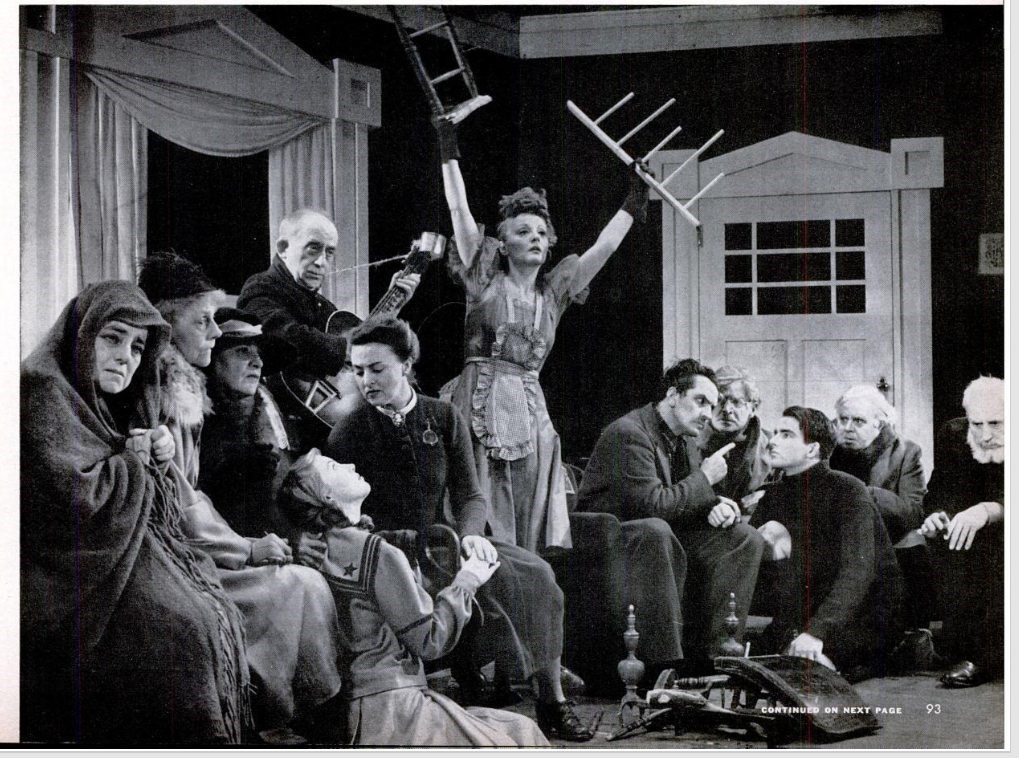
Scene from The Skin of Our Teeth2

“The ice age is coming, the sun’s zooming in.” A scene from the first act of Wilder’s  1942 “The Skin of Our Teeth.” That’s Tallulah Bankhead who’s broken up the chair for kindling.


Shakespeare’s winter song here is immediately preceded by another song in his play (the first song invoked spring.) Each song of the pair features a symbolic bird, and for this winter song we’re given an owl in its refrain,* a bird omen of unseen dread whose song, breaking with the Imagist show/don’t tell rule, is described as “a merry note.”

Merry? A little dark humor there I think. But even if that bird’s a bad omen, the fact that it’s singing means that it’s enduring. And the poem’s second and final stanza continues that theme of endurance. Everyone in church is sick and you can’t hear the sermon for the coughing (but coughing means you’re breathing, and who can tell how useful the sermon’s lesson might be anyway). The visible birds are hunkered down in feathers. There’s some crabs** sizzling in a bowl. There’s a fire. Tom’s brought more wood. There’s someone there to see greasy Joan cooking.

That refrain repeats and the song ends. Shakespeare’s play’s characters are kings, courtiers, and princesses and the plot their fancies. His actual world was full of war and deadly factions, brutal executions; a world of connivers, fools and tyrants, and even those who could combine all three. Yet, here he ends his comedy not with a wedding but with a song about modest endurance.

I think I lucked into this one this week. If one pays attention to this little song, it says something about those of us who are not kings or principal ministers.

Those who’ve endured my singing may be glad to hear this one is spoken word. The music is drums with a mix of four wintery synths played with my little plastic keyboard and MIDI guitar. The player to hear it is below. The full text of this short Shakespeare poem is here. I wish you the sustaining fires that are warm and illuminating, instead of the flames of fools.


*The refrain also features one of the more obscure words in the piece: greasy Joan is “keeling” the pot. I thought “stirring,” and there is some sense of that, though it may be particularly skimming fat off some stew.

**I thought of steamed crabs hissing, but if Shakespeare is remembering his rural Warwickshire it might not be seafood, but crabapples. Hot ale punch with floating crabapples was apparently a thing.

Do the Dead Know What Time It Is?

Here’s a poem by 20th Century American poet and artist Kenneth Patchen performed with music which manually realizes some ideas often produced by machinery.

Patchen is one of the original poetry accompanied by jazz guys, an idea that is one of the tributaries to the Parlando Project, but the poem of his I use today isn’t one that sings off the page when you first look at it. The speech in it seems casual, as if one is overhearing someone talking.

“Do the Dead Know What Time It Is?”  has a very unusual structure. It’s one part a Robert-Browning-like dramatic monolog and another part seeming snippets of a bar-room conversation. But Patchen doesn’t separate these out into differentiated sections of a multipart poem, rather the two modes seem to be occurring at once, the louder monolog spoken by “the old guy” to the younger man and then the often whispered and interrupted conversation between the younger man and a woman who is trying to pick him up.

Here’s Patchen reading this poem with a jazz combo. I also just discovered that The Blue Aeroplanes did a version of it with a rock band decades ago.


I first thought: oh, what a great thing for a recording! I’ll put one in one stereo channel and the other on the other side—but then I thought better. The claustrophobic nature of these two conversations is part of the effect Patchen has designed.

As barroom stories go, the old guy’s story is a good one, even if the younger man is only half-listening—but the second, whispered one, is all about what isn’t exactly said. I could go on at length about how the two stories connect, what they say to each other in the structure of the poem Patchen made, even though the two conversations in the bar never actually join each other. I found the poem quite moving, but I’ll leave it to you to connect them.

Instead, let me dance about the architecture of the music today. I’ve been on a loud electric guitar kick lately, which may frustrate those of you that prefer the acoustic music, which will return in good time. Music structured like this piece is often constructed by loops stored and manipulated by computer software or by small solid-state devices that can capture a phrase and repeat it. Similarly, the original rappers’ DJs used turntable manipulation to repeat a section of a grooved record, a task that can now also be emulated digitally at the press of a button. There’s nothing wrong with these methods or machines.

Still, I most often try to play the repetitive parts you hear here. It’s not something I’m naturally good at, and I allow some imperfections to occur. Perhaps I do this because I became enamored of the hand-played repetitions that made up the composed music emerging in New York near the time I left for the Midwest—but it’s not Steve Reich or Phillip Glass* that today’s piece sounds most like. The proximal influence is a record album that came out in the early 1970’s called No Pussyfooting  by Eno and Robert Fripp. That record’s guitar textures were produced by mechanical means too, two tape recorders set several feet apart from each other so that the “looping” was really a long loop of tape between them that allowed measures played by the guitar to repeat and get gradually added to in approximately real time. This seemed magical then, but a tidy little box that sits on the floor and costs about $100 can do all that these days.

No Pussyfooting

It was hard to find a barber shop with a fresh tarot deck in the ‘70s


There are two guitars in my music here, but the one that sounds throughout most of the piece I’m playing with loud sustaining notes that I (unconsciously) made sound as if they are a repeating loop with variations even though it’s real-time, straight through playing emulating Robert Fripp’s sound on that record which made such an impression on me at the time. One never knows what ghosts will visit when I plug in a guitar.

You can hear that music combined with Patchen’s words with the player below. The full text of “Do the Dead Know What Time It Is?”  is available here.


*Reich did use tape loops as well as live through-played instruments. Seeing the small ensemble Phillip Glass toured with in the ‘70s: electric combo organs that sounded like “96 Tears”  and “Light My Fire”  along with a handful of wind instruments was amazing in a small space.

Fire Dreams, or Carl Sandburg’s Come On, Pilgrim

Emily Dickinson isn’t the only one of this project’s favorite American poets to write a Thanksgiving poem. Carl Sandburg did so too.

Long time readers here will know how much I like Sandburg and how often I like to speak toward the canon-keepers to point out that early Sandburg was a devoted Modernist with a strong American democratic take on Imagism, one that kept to Imagism’s unfussy and concise mode of expression without dressing itself up with any unnecessary scholastic references. Of course, I’m no opinion-shaper, and even if William Carlos Williams has undergone a reassessment as a domestic Modernist of the same era, Sandburg doesn’t seem to have benefited from the same second look.

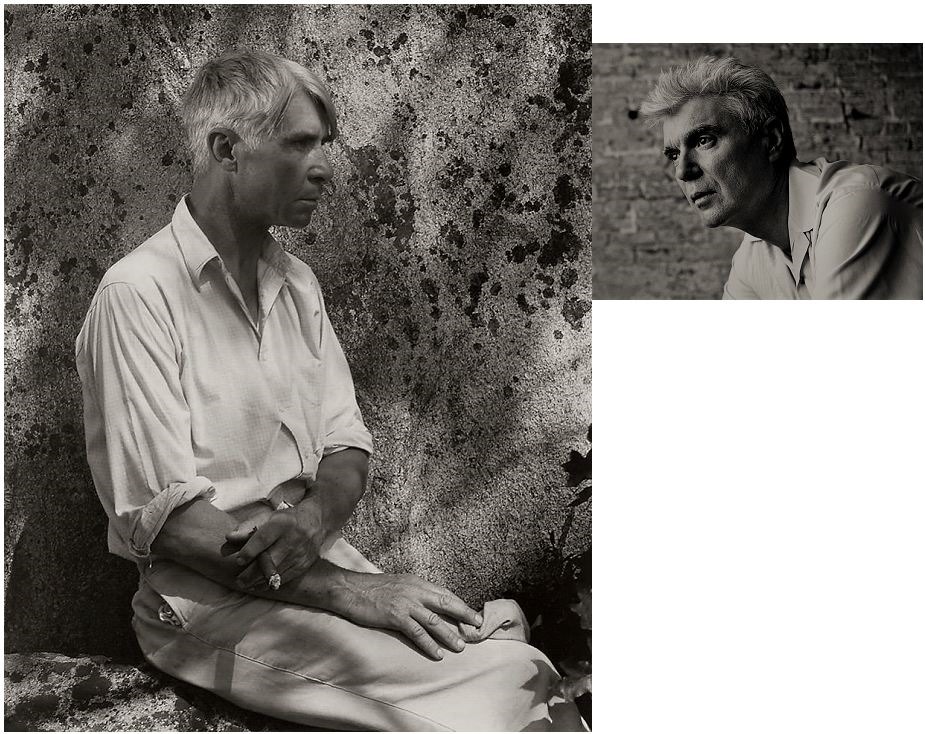
Sandburg and David Byrne seperated at birth

My title may reference the Pixies and Larry Norman, but I think this Edward Steichen image of Sandburg looks a little like David Byrne.


I think this is a great pity. A poem like Sandburg’s “Clark Street Bridge”  is as perfect an Imagist poem as any written in London or Paris, and Sandburg’s subject matter and life-experience is broader than most of his fellow Modernists, because he traveled across America with his Imagist eye and working-class soul.

That said, I have to say that today’s Sandburg text is a partial example of why this might be so. This is the kind of Sandburg poem that people think  he wrote. It’s somewhat sentimental, unquestioningly patriotic, and there are almost no strong, immediate Imagist images in it. Although it’s not that long-winded, it seems to me longer than it is—and if it had broken into a Whitmanesque catalog of a hundred things at least it would have the courage of its convictions.

So, it’s a Thanksgiving poem, but it’s not great Sandburg. Why bother?

Its central Pilgrim history myth may not be entirely accurate, but it is a good story—one that children were told in his time and mine, and perhaps even sometimes now: tempest-tossed dissenting religious immigrants undergoing tremendous trials. For good or bad, Sandburg leaves out the native Americans who helped them survive,* and who were rewarded with a few decades of peace before the wars of conquest ignited in the Pilgrims’ region.

Historians like to point out that the Pilgrim Thanksgiving didn’t include most of the foods that we’ve come to expect for the modern American holiday harvest meal. Sandburg reduces it to “soup and a little less than a hobo handout today,” which is also inaccurate but makes the connection he’s trying to make. America always has pilgrims like these somewhat mythologized Pilgrims. Sandburg, the child of working-class immigrants knew this completely, the ones who worship the God of broken hearts and empty hands.

And though he doesn’t show it here, Sandburg also fully knows the imperfection of America, and yet still wishes to say yes to gratitude, to thanks “if so be” for himself and his child.**  He wishes to say yes before perfection—and continue yes “Till the finish is come and gone.”

So, while this is not the poem to restore Sandburg’s rightful place in Modernism, I think it’s still worth hearing on this holiday. The full text of the poem is here, and the player to hear the LYL Band perform it live*** is below.


*In hearing the story of the Pilgrim Thanksgiving as a child I never absorbed the full story of Squanto (Tisquantum,) which deserves to be better explored. There is a long and detailed Wikipedia entry on the context of this American.

**And before we leave that, let me point out that Sandburg is the rare Modernist who deals with children wholeheartedly.

***LYL principals Dave Moore and myself are both dealing with the inability for our hands to follow what musical precepts we hold, and this has reduced the appearance here of the more spontaneous LYL Band recordings. I’ve been missing that element and we’re trying to do what we can.

One day there is of the series: Emily Dickinson’s Thanksgiving, sort of

Did you know that Emily Dickinson wrote a Thanksgiving poem? It’s not one of her “Greatest Hits” or anything, but it does represent a couple of Dickinsonian traits: skeptical humor and puzzling philosophical concision. You can read the text of it here as I discuss my encounter with it.

Dickinson didn’t use titles, and the first line, our entry into the poem, starts off with a strange tentativeness. What’s the series? All the days of our lives, of history? Or a series of holidays? I suspect the last, in that the next line throws up the American holiday inside quotes. It’s hard not to read “Thanksgiving Day” in Dickinson’s text without intonating the words with “air quotes,” that at least slightly dismissive way of saying “Well, you can call it that  if you want.”

I’m not a Dickinson scholar but I get the impression that Dickinson uses quotes literally—that is, when she’s quoting someone*—but there is a sense here of our modern manner in the poems first half. And as the poem continues, its opening comments could be written this week by someone musing on the holiday. Yup, Thanksgiving is a strange mix: part a big meal, a gluttonous celebration; and part memories of worshiping dissenter pilgrims and family. And Dickinson, in her thirties as she wrote her poem, notes she’s not sitting at the kids table nor is she some honored elder closer to the pilgrims than the present. So, outsider in a middle place, she says she’ll post a review, from her “Hooded thinking.”

Maybe you’re visualizing The Handmaids Tale  when you read “Hooded.” I think Dickinson is taking a bit of a religious acolyte’s stance in her review, even if playfully. Her two-word review: “Reflex Holiday.” You’re just going through the motions she seems to be saying.

Emily Dickinson family portrait

One won’t get a turkey drumstick: Emily Dickinson on the left with her siblings.


The poem could end there, but Dickinson takes off in the second half in gnomic concision. This is often beautiful as word music, but it’s hard to follow her mind.

What’s the sharp subtraction for the early sum? A falling away from religious immediacy? Mankind’s fall from grace? Forgetting the history or piety of the holiday? The next two lines are even more weird. What the heck does “Not an acre or a Caption/Where was once a Room” mean? This is Dickinson the hermetic riddler. I’ve rolled that couplet around in my head for a week and it always slips from my grasp.

The tossed pebble wrinkling the sea lines have a Blakean tone. Here the mystic Dickinson is plain as any mystic can be in words: our lives, our actions, are small against creation—just visible, just for so long. Her final couplet seems to say that our thanks, our Reflex Holiday, is insufficient to the gift. This realization combined with the reflex action is, in a way, a more sublime and awe-some thanks.

What an odd poem! It starts out witty and lightly skeptical and (as best as I can figure it) closes on a humble mysticism.

Musically, I tried to hew to the mystery, if a strange resonant piano and wavery synth can portray that. The player is below. Thanks for reading and listening!


*If she is quoting a person, it may well be Sarah Hale, a New England journalist who campaigned for the importance of a Thanksgiving holiday during Dickinson’s day.

Two Cinquains from Adelaide Crapsey

Let’s imagine that it’s 1914, and on both sides of the Atlantic curious short poems with precisely chosen and concrete imagery are appearing here and there. This is Imagism, the premier movement of Modernism in English. Long-time readers here will know* that these small and unpresupposing poems came from several sources: the away-with-19th-century-Romanticism ideas of T. E. Hulme, the promotional verve of Ezra Pound who also set out classical East Asian poetry as an ideal, things apprehended from French poetry by the slum-born F. S. Flint, and the fresh eyes and forms of Americans Emily Dickinson and Walt Whitman.

This new poetry was quite unlike the Tennysons and Longfellows that preceded it, but also it is by and large not Modernist poetry as we’ve come to know it later in that century or in our current one. It seems altogether simpler, pared down. It partakes of poetry’s timeless lyric impulse: the thought that a poem need not be long to be complex if it keeps itself true to the goal that the poem isn’t about ideas but the instantaneous experience of ideas. Nor is it a marathon course of those feelings and experiences, rendered on kaleidoscopic canvases.

To some this new kind of poetry is cheating. Where are the grand themes? If the poem doesn’t develop itself like an essay or history where is the effort or the worth of the effort? The poems often don’t seem to use heightened poetic language, and they may at first seem to have no metaphors—rather, the poem is the metaphor.  That these poems often eschewed rhyme or conventional meter added to the “anybody can do this” sense many had.

As I imply above, this is not the Modernism that eventually emerged triumphant. Yes, a Red Wheelbarrow” and A Station of the Metro  will be constantly anthologized, but Williams and Pound will become known for their longer more esoteric poems. Even if some WWI poets could use these compressed poetic methods to express horror while the fighting was going on, the post-war world wanted it all expanded on, and the thought that expansive sur-rationality was the appropriate response to world-wide mechanized violence came to the forefront. Art needed to be as big or bigger than the things it was opposed to.

Adelaide_Crapsey

“Reading” pictures is risky, but this photo of Crapsey just seems to say determination.


All this ferment brings us to Adelaide Crapsey, a woman who has been forgotten in all the fuss. First, look at that name. It sounds like a character in a satiric novel. It’s so pre-20th century that you can’t imagine Modernist verse having it attached to it (perhaps Hilda Doolittle was savvy in immediately accepting Pound’s rebranding of her as H. D.). Also, if there was such a thing as Middle School in her youth, can you imagine the trauma of carrying her family name?

In The Year Imagism Broke, 1914, Crapsey was not only writing Modernist verse in the initial Imagist sense, she had made a study of English prosody and had created her own form to put her concise poems into: the cinquain. Just as many of the short Imagist poems owed some of their tactics to classical East Asian poems, the cinquain sought to create an English language equivalent to the understanding of forms like the haiku.

Just as with Amy Lowell from earlier this month, I think it may be worthwhile to not let these two poems of Crapsey’s that I use today wash over you quickly, as if they are essays or narrative personal memoir in verse. Each word was chosen carefully, precisely, to evoke a moment you might choose to share inside of her experience.

two Cinquains from Adelaide Crapsey

Ten lines and two of Crapsey’s cinquains that seem to tell the story of this year’s late fall


Am I setting this method of shaping poetry out as the best or only way to approach verse? No, though I’ve come to believe that we may have lost something when we abandoned it for the new more impressive edifices of post 1920s Modernism.

Musically I was thinking of one of my musical heroes and models, Steve Tibbetts, but alas my deadlines, and my musical and production skills this week produced only a rough approximation of what Tibbetts can do. I really tried to rip him off here: a down-tuned acoustic 12-string with paired unison (not-octave) strings. Lots of time-based effects (like reverb, phasing, echo, and delay). Hand percussion leading off to heavier stick drumming. Feedback-loud electric guitar arriving from off-screen into the landscape.

Yesterday, my disappointment in what I had down was fairly complete. My electric guitar solo could be better, and it’s been too long since I’ve played at that volume. The 12-string wasn’t naked and exposed enough. Where’s the space I keep telling myself to leave in? I had no idea of how to duplicate Tibbetts’ characteristic delay and echo effects. My percussion tracks had nothing like the splendid variety that Tibbetts’ long-time collaborator Marc Anderson routinely achieves.

But my son reminds me that Kurt Cobain thought he was just ham-handedly ripping off the Pixies and still came up with something that was worthwhile, and the Steve Tibbetts’ thing is not something commonly heard—so 20% of Steve Tibbetts level might still be worth listening to for what it is, not what it wanted to be. So, here it is, available with the player below surrounding those two 1914 cinquains by Adelaide Crapsey describing our current November season.


*This is a reminder that since “poetry is the news that stays news” that the Parlando Project has nearly 400 examples of what we do that may be just as interesting to you as the current post. Using the search function or just diving in at random to the archives is worth considering.

The Birds Before Us

Most days I take a bike ride to and from a cafe I have breakfast at. It’s my conviction that exercise is a good thing for people of all ages, but it’s more at required for folks my age. The kind of sitting that goes into composing music or the reading and writing that contributes the texts this project uses is pleasant and absorbing, so I think that if I don’t start my day with something that gets me moving outdoors all I would see is screens and pages. No matter if they are blank or full pages, the book of nature cannot be found there.

When it comes to the book of nature I’m not well read. When I read poets like Emily Dickinson or Edward Thomas I can easily tell that. Therefore, my only advantage is that I get to read the book of nature as if for the first time.

Rust Lacework Truck

Chemical nature observed. My homage to the Yip Abides blog. I love how the rust has created a sunburst finish lacework that matches the original paint color of this truck I passed this month.

This spring I began to notice birdsong more and more. In early morning rides the birds were active and making a note of that with their calls and singing. Summer writes diminuendo, and by now my northern state is quite silent. Nor do I get to see any birds much, though the streets here are full of the year’s batch of weaned squirrels, now nearly adult-sized, who are dashing about as if they have a plan for winter. And with the squirrels I hear less of the cackles from those that take time to chase another squirrel for sport. I sometimes imagine those pursuing pairs were littermates, another they were once eyeless beside.

No one’s singing because there’s autumn work to be done—but what work? Will it bring reward? What to store, what to leave behind.

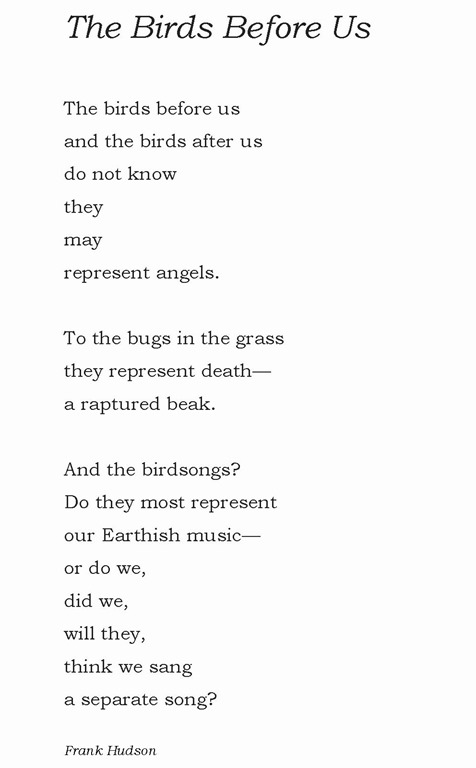
Today’s text is a poem I wrote about birdsong, and the larger book of nature in which we are only an entry, somewhere between horseflies and iguanas as alphabetized with our symbols. It’s occurred to me that I have taken time in this later year of my life to listen to the birdsongs, their piercing intervals; and that after I no longer roll down these streets looking for tea and scrambled bird eggs, that there will be birds in spring moving from note to note, and birds in fall, quiet and studious.

The Birds Before Us

Here’s the poem if you’d like to read along as you listen to the performance.

The piece is called “The Birds Before Us,”  and you can hear my performance of it with the gadget below. We’ll return soon with the usual Parlando Project thing: encounters with other people’s words.

The Galton Case

This is Parlando Project alternate reader Dave Moore’s birthday month, and so I thought it’d be a good time to interrupt the autumn poetry with his presentation of a short passage from detective novelist Ross MacDonald’s The Galton Case  first published in 1959.

Dave did this live performance that I recorded a few years back, and when I asked him earlier this fall about it, he wasn’t sure exactly what went into its choice. It may have been that some of the formative influences on the Parlando Project date to the era depicted in this scene in the novel, the “Beatnik*” phase where a certain kind of post WWII bohemia reached general public attention.

I’d characterize most of that general attention then as somewhere between comic amusement and pearl-clutching concern. The “beatnik” as a comic character became a stock item, and it’s easy to see the derivation from earlier foolish artist characters like Don Marquis’ Fothergil Finch.**  The world doesn’t understand their pure art, but in the comic context, the world is entirely right.  And then the concern-faction folks were writing that standards were surely slipping as free verse, free jazz, free-style prose myths, and free love were celebrated in the demimonde.

The Beatniks moive poster

Explosive ivory towers! The Beatnik id of the Fifties.


Fiction writers, even writers of detective fiction, have the choice of walking fine-borderlines on such things. Characters and voices can hit the comic notes, show the raggedness of the coloring outside the lines and the amputations when sharp lines cut, while allowing their readers the ability to vicariously experience those parts of town they would never visit. Attracted to the Beat but find it out of reach? Repelled by it? Find it phony? It’s possible to write a novel and hold the interest of readers who have one or more of those opinions of “Beatniks.”

This passage from Ross MacDonald is a good example. I’ve not read the book, I don’t know how it comes out, and what additional framing and information we might have if we did. Listening to the section Dave reads I wonder: does the narrator dislike the modern jazz playing behind the poet, or just dislike its incarnation that night? Is the poet reading to music a beatnik fool speaking useless nonsense, or a fool speaking the truth because they no longer care not to? What level of imposture is everyone portraying, and how can we know or find out?

We don’t know. We’ll turn pages so the detective can find out.

It occurs to me that detective fiction is allied on some essential level with literary criticism. Sherlock Holmes foretold the New Criticism; Edgar Allen Poe, one of the Fugitives before their time.

If last time Emily Dickinson was getting meta with autumn and poets who wrote about autumn, today we have Dave reading in front of the LYL Band this short, mysterious passage from The Galton Case  which describes—someone reading before a band.

Happy birthday Dave! The player is below…


*Beatnik was created by newspaper columnist Herb Caen who combined the term “Beat” used by some writers in the scene with the Russian suffix used for the tiny artificial earth satellite Sputnik launched in 1957. Many members of the “beat generation” didn’t like the term, which after all was a diminutive. People breaking molds don’t generally like labels anyway.

The successor term “Hippie” was similarly made by adding a diminutive suffix to an existing term “hip” that was used within the subculture. Both Hippie and Beatnik had connotations of a vague aspiration to bohemianism, particularly by those who might be too young to really understand.

**”The Poet of Revolt” as he self-branded. Furthermore in Marquis’ Hermoine and Her Little Group of Serious Thinkers  from 1916, we can find other characters like Voke Easeley the Modernist composer who “Doesn’t know a thing about music. He tried for years to learn and couldn’t. The only way he knows when you strike a chord on the piano is because he doesn’t like chords near as well as he does discords.”

Affliction

A dense occurrence of American political events has not quite stopped my reading of poetry and creation of music to combine with it, though there were hours this week when I could not help but wonder and rage at the sachems and attendents readings of the body politic and it’s befuddled head man.

Luckily, on days like these, one can reach into the corpus of poetry, and within little time find something someone wrote years ago that rings with the current day, like an old bell calling us for a current ceremony.

And it’s so that I came upon this poem written around 1650 by Welsh poet, physician, and mystic Henry Vaughn. It was written during the aftermath of the British Civil War (Vaughn’s family was on the Royalist/Anglican side, which had lost). When Vaughn writes of affliction, it’s from an intimate and substantial experience. Biographers tell us he was recently widowed, his family disinherited, his religion suppressed, and that he may have been suffering from some kind of illness as well. And of course, his country was broken, in ways that civil war and its divides make manifest.

This makes “Affliction”  an unusual poem, because it revels in this level of distress, makes of it a necessary part of his and his country’s spiritual maturation. Read with some attention to what I believe is Vaughn’s passion, I can compare it to the hymn “As an Eagle Stirreth in Her Nest”  based on a text from Deuteronomy chapter 32, “The Song of Moses,”  a text and hymn that have inspired many sermons given in Afro-American Christian churches, which also know, oh yes, something of affliction.*

Vaughn doesn’t use the Deuteronomy text, but he gets in his own licks here: “Crosses are but curbs/To check the mule, unruly man” for example. And “Kingdoms too have their physic, and for steel/Exchange their peace and furs.**”

silex cover

The Latin title of the book where this poem first appeared means “The Fiery Flint,” and the engraving shows the image it’s to portray: fire sparked from a heart of stone. And you in the back row who’ve just read the subtitle: stop snickering and read the later definition in the dictionary: “A short, sudden emotional utterance.”


Henry Vaughn has never been a big deal in English literature. Much of what I read checking on him goes on at length about Vaughn being Oasis to George Herbert’s Beatles. He gained a little given the interest on the Metaphysical poets engendered by the New Criticism guys like T. S. Eliot in the 20th century. One fan, who I wouldn’t have suspected: famed SF writer Phillip K. Dick.

Given the amount of time I wasted this week following our modern afflictions, I rushed this piece a bit, using a simple and repetitive bass and drum part I set up quickly,***  a “let’s give it a go” recording of the vocal, and a “live” one-pass guitar part: “Like strings stretch ev’ry part/Making the whole most musical” said Vaughn.

The text of “Affliction”  is here if you’d like to read along, and my performance of it is available with the player below. Will listening to it help one wax metaphysical within our current struggles? Felt good to me to do this one anyway.


*One preacher who famously delivered variations on this text was Aretha Franklin’s father, the Rev. C. L. Franklin, who had a popular recorded version on Chess Records in 1953, which would make him a label-mate of Harmonica Frank from last time.  Please don’t be disappointed if I don’t rise to Franklin’s level of transfixing declamation here.

** Physic is used as a medical metaphor in the poem, and of course, Vaughn later practiced as a physician. In the medical theories of the day, a cathartic drug, a physic, was often used to rebalance or reboot the humours of an ill human. Steel here stands for armor and swords, that is: warfare.