The Three Kings

Here’s a piece that will seem appropriate for Christmas, but to be exact, it’s actually early  and only due by January 6th. Yes, even though your standard-issue Christmas decoration depicts a stable with baby Jesus, his parents, livestock, shepherds, a hanging heavenly star, and that exotic trio: the Three Kings, the Three Wise men, the Magi, the reviewers who will give King Herod a scathing no-star* Yelp review—never mind that creche, the traditional story has it that the three kings arrive later.

the-adoration-of-the-magi by Rubens 1

In this painting by Rubens it looks like the Magi have  roadies, a security detail, and an all-access pass

.

There’s even a church holiday associated with this January date: Epiphany. And that date, the visit of the Magi, was also the endpoint of the English 12 Days of Christmas, something best remembered here in the U. S. via that crowded, livestock enriched, counting song.

But never you mind. On Christmas, angels appear on high, animals can talk, and Christians celebrate the coming of the Godhead as a small human baby. Let’s not sweat the small stuff.

I found this late Henry Wadsworth Longfellow poem, “The Three Kings,”  this week, and set about quickly seeing if I could turn it into a Parlando Project piece in time for Christmas. Turns out I can. And as a result, you all get a new Christmas carol today.

The Three Kings

You don’t need a word-a-day calendar when you have poetry. “Kine” is an archaic word for cattle. As to the breath of cattle, well, carbon-neutral poetic license there. “Paraclete” is the consoling aspect of the Holy Spirit.

.

The full original text is longer than what I’ll perform. Here’s a link to the full poem in case you want to see what I started with. Figuring that performing the whole thing would run long (I like to keep Parlando Project pieces under 5 minutes) I looked to see if I could excerpt a scene from it, and rather quickly I found what I think is the heart of the piece. Even though the Three Kings are the title characters, and lots of detail on their story is included in Longfellow’s original, the real central character is Mary, the mother of Jesus.

So, I open with the Kings arriving and finding the incongruous royal, holy, baby in the stable. I love the stanza where Longfellow so touchingly, and humanly, recounts something many first-time parents will relate to: Mary with joy and worry watching the fragile miracle of her newborn’s breathing.

And then he follows that with the exact details of the gifts that the Magi are offering, efficiently detailing what they symbolize, ending with the myrrh and the note that it is for burial of the body. Which, as one might expect, is not what worried Mary wants to hear.

I close on Longfellow’s next-to-last stanza, where Mary comforts herself with the annunciation message she had heard from an angel before Jesus’ birth, which didn’t include the fine print of her baby’s eventual suffering, torture and execution.

Longfellow may have a reduced reputation as an effective poet, but particularly when I zoom in on the heart of this piece, I don’t think he comes off badly. I believe also that the aged Longfellow has his own life to draw on here, not just as a parent, but as someone who lost his first beloved wife in childbirth and his second beloved wife to a fire that he himself tried to smother out on her body.

Longfellow himself says the moment of his poem mixes the joy of life with the terror of death—yet oh my, I’ve gone and mixed Christmas joy with sorrowful things, but I will not remove the above, nor decorate it with some statement that sorrow is what makes joy more intense, or that neither is everlasting, or some elaborate reminder that this happy holiday has been set so near our Northern hemisphere’s shortest day and longest night to set it off with hope. As I say from time to time here, it’s not what I believe that is important—it’s what you  believe.

Thank you for reading and listening. A player gadget should appear below to hear my performance of my selection from Longfellow’s “The Three Kings”  using my own music. If you don’t see the player, this highlighted hyperlink will also open a player in a new window so that you can hear it.

.

*Astrologers giving out a no-star review is the ultimate burn for those guys. See also haruspex dishing on bad chicken take-out, palm readers who really don’t want you to give them a hand, and numerologists who’ll correct your bad arithmetic.
I wake and feel the fell of dark

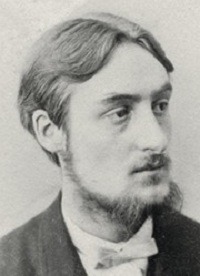
Once more let us look at winter-come darkness and see what we see there, this time through Gerard Manley Hopkins and one of his “Terrible Sonnets.”

The name “Terrible Sonnets” is not a review, though I’ll confess that on first hearing of them, that between Hopkins oh-so-British sounding triple name with an extra schoolboy snicker due for the middle name on top of that, that I too wondered what meaning I’d assign to that word “Terrible”. No, my teachers assured me, terrible in the same way that wonderful and awful can be synonyms in strict derivation English.

No, these are poems that have a good scholarly reputation, and some general readership yet today. If there is disagreement about them, it’s not about their worth or poetic quality, but rather if they show Hopkins in a profound spiritual crisis or in a clinical depression. One can find a number of essays online and elsewhere that argue for either, or perhaps both. Either way, this is the night darkness as we often think of it. Yesterday we had Joseph Campbell making a case for a mysterious outward darkness, the exact nature of which is just out of our understanding. Hopkins darkness in contrast is totally intimate. I find it interesting that both of them were writing in Ireland, then still a colonial possession. Campbell may be expressing his country’s subjugation and its ancestors’ sorrow at that in his poem. Hopkins, in turn, was a patriotic citizen of the empire that ruled over Campbell’s country. That’s not a frame I’ll follow up on today due to space, and because Hopkins wrote these poems in the late 19th century and there’s no way to start a Tweetstorm that he can read back then.

Gerard Manley Hopkins 2

Hopkins, about to be pwned for complicity in colonial exploitation, before everyone realized: wait, 1885, no iPhones.

.

Here’s another frame, another one with roots in colonialism and subjugation. In America we have a form, the Afro-American Modernist form forged around the same time that some white Americans were over in London helping create and popularize Imagism. That form was called “The Blues,*” and to some degree that indigo name has let it be casually and incorrectly considered a sorrowful song. And yes, a lot of bad and sad things are spoken of in The Blues, but it’s generally from a stance of: “Look what’s happened to me, what’s been done to me, the absurdity of it—but I’m still here to tell you about it.”

Today’s piece, using Hopkins’ Terrible Sonnet “I wake and feel the fell of dark,”  is not a Blues. But despite the harrowing statement of the inside of this poem’s speaker’s experience, it shares one thing with The Blues that makes it outstanding: “I wake and feel the fell of dark”  is full of energy. The description of the state inside the poem is cascading and vivid, coming at you so fast that it seems all at once. If this is depression being described, it’s not the mode of depression that is numbed beyond caring, but the depression that actively calls out and hates the depressive portion of the speaker’s mind. In this way, it shares something with The Blues, it can be cathartic. And indeed, some sufferers of depression (like too, some religious seekers) find the Terrible Sonnets worthwhile as a voice in darkness that can remind them that there are others who’ve felt and seen the same things.

Here’s a link to the full text of the poem if you’d like to refer to it.

I’ll risk trivializing Hopkins’ revered poem by pointing out two trivial things I noted in looking at the text, as few commentators on Hopkins’ work choose to sink to mundane levels. The section “I am gall, I am heartburn…bitter would have me taste: my taste was me” seems to me to me to be on one level a symptomatic report of the experience of nighttime gastric reflux. And in these days of 2020, with lots of long nights this year before this day of Winter Solstice, Hopkins back in 1885 was prophet enough to speak specifically of our popular pandemic baking fad of homemade sourdough bread in this poem’s line 12!

The player gadget to hear my performance of Gerard Manley Hopkins’ “I wake and feel the fell of dark” should appear below. Don’t see a player you can click on? Well, this highlighted hyperlink is another way to hear today’s audio piece.

.

*The Blues of course is a varied and mutating form whose essence exists beyond the bins carrying that label in record stores or playlist names on your phone. I use it as a name because it’s one that coalesced for the art form at the time it emerged around 1900 in America. I stand to be corrected by my betters in these matters, but I believe the Blues essence remains a vital part of Afro-American expression, and from that, American expression in general. I’m an American musician, and the notes are mostly black.

Twilight Fallen White and Cold

What do we see, what do we learn, what possibly do we gain here in the upper parts of the northern hemisphere from so much nighttime at the beginning of a cold and snowy winter?

Some might say we learn endurance, a sense of obligation besides the dark and ice to carry on. Or a concentration, winter solstice as the fasting of light. But night is a filter, a frame, offering another way of perceiving. So, I went looking for poems this month that might allow you or I to look at darkness and see differently. One of the strongest and strangest poems I found was this one by a little-known Irish poet named Joseph Campbell.*

I’m trying to gather more info on Campbell. He was born in colonial Ireland in 1879 and died 1944 in a now independent Ireland. Most of his available poetry was published before WWI. He was imprisoned in the events surrounding the Irish Civil War of the last Twenties** (he was aligned with the losing side) and afterward he lived for a couple of decades in the United States. Shortly before his death he returned to Ireland and died there. I’ve read one of his book-length collections of poetry and parts of two others, all of which predate Irish Independence and the Civil War. I find him a striking poet worthy of more interest. Most of his poetry is brief, rhymed lyrical poems, using short metrical lines, such as today’s selection. One collection, Irishry,  contains incisive small character sketches of Irish life at the turn of the 20th century. Another, The Gilly of Christ,  has elements of Christian mysticism. Inherent in many of the poems seems to be a speaker who has spent time hiking about the country, and in this regard, Campbell reminds me at times of Edward Thomas with his attention to the book of nature and the landscape. While he likes rural and sometimes peculiar words, his language is clean and modern without the taint of worn-out 19th century leftovers.

There are also a handful of poems I’ve read in the collections so far that are very much in the style of the early Imagists, and this is striking because they may date to around the same time as their initial ground-breaking experiments. I so far know of no direct connection between Campbell and the largely London-based pioneering Imagists, but like his Irish contemporaries Yeats*** and Joyce, Campbell seems to be an early Modernist voice regardless of his use of rhyme and meter for most of his poetry.

Twilight Fallen White and Cold

Here’s today’s piece with chords in case you want to make sounds in the winter night

.

Today’s Winter Solstice relatable piece “Twilight Fallen White and Cold”  mixes his modes a bit to produce an interesting effect. It’s on one layer a jaunty nature poem, almost nursery rhyme simple. This seems an easy effect to achieve, but particular to moderns, it’s not. Subtly mixed in with the “child in cradle, lamb in fold” comfortable lines are misty undercurrents. Well, yes, those trees are a bit ghostly in fading light and cold mist. Yes, birds are on the wing, but also “Black-winged vampires.” What? No, there are no vampire bats in Ireland.****  And in the last line of the second stanza we meet “rath and burial mounds,” the former a word that has an Irish meaning that an modern American reader might slide over. No, the burial mounds aren’t explicitly angry, a “rath” is the remains of an earthen-walled stronghold dating back to Celtic chieftains. The poem final stanza intensifies that hold and call from the indigenous past. Though Campbell is depicting an Irish landscape, these rounded-over and landscape-worn earthworks bring to mind the areas of North America in my native Midwest where indigenous people built similar structures.

But the most mysterious part is repeated as a refrain to make sure we don’t miss it: “Wounds of Eloim/Weep on me!”

The darkness of coming night may be mysterious, but this is more so. I don’t know exactly what Campbell is getting at there, other than the effect of mystification assuredly delivered. Eloim, which I believe in a variation of “Elohim,” is word that will not become less mysterious if one researches it. It appears to be a Semetic language family word for gods. In the Bible the word appears to have taken on several meanings. The Abrahamic Semites are famously monotheists, and they will use the word to refer to the multiple gods of the other tribes—but even though the word is plural, they will use it to refer to their own, singular god, or to the ambiguous angels that are not human but are also not plural gods. At some point, I believe post-Biblical times, this association with angels has led the word to be used at times as synonym for heaven.

Does that help us understand what Campbell meant to ring out multiple times in his poem? Not exactly. I gather some sense of a lost past, of a suppressed culture, is being invoked, but the mysticism never reduces itself to a “this stands for that, it’s just a code to be broken” level. That may increase its power, and it certainly increases the strangeness of this poem.

Returning to my original question, what might the darkness, our winter-come overwhelming night portion teach us? The example of this poem says that I shouldn’t answer that question quickly and simply—but that I should ask it.

A player gadget to hear my performance of Joseph Campbell’s “Twilight Fallen White and Cold”  will often appear below. If you don’t see it, this highlighted hyperlink will play it too.

.

*As I have to say whenever I mention Campbell to anyone: no, not the American Hero With A Thousand Faces  and “Follow your bliss” Joseph Campbell. This is another guy. The Irish Joseph Campbell also used a Gaelic name, Seosamh Mac Cathmhaoil which would have given him a more secure doing-business-as cultural brand, and near the end of his life a pen-name of Ultach.

**Until this year I was entirely ignorant of the events of the Irish Civil War and now only know the summary story as reflected in things like this Wikipedia entry. I am, so far, unacquainted with Campbell’s political beliefs and actions.

***Like Yeats, Campbell seems to have been a committed cultural nationalist, seeking to use the arts as a way to uplift his country’s prestige and as a foundation for independence from colonial status. Like Yeats he also seems to have been involved with theater and as a song lyricist. One tidbit I found, which may be related to the mysterious element in today’s poem, is that he may have been the source responsible for a broadside folk ballad “Reynardine,”  being performed in a version by several British Isle folk-revivalists later in the 20th century as a tale of a “were-fox” rather than in its original guise as tale of a bandit. Here’s two of my favorites versions, one by the incomparable Bert Jansch, and an unaccompanied one by the equally special Anne Briggs.

****Maybe St. Patrick and Van Helsing teamed up to take care of that?

Fall 2020 Parlando Project Top Ten, numbers 4-2, and what is it that you’re trying to do anyway?

Before continuing with our count-down of the most liked and listened to pieces here this past autumn, let me remind newcomers what the Parlando Project does. We take words, mostly other people’s words, usually poetry, and combine them in different ways with original music.

“Oh, you mean you make them into songs?” Well, sometimes, yes. But not always. I don’t always sing the words, thus the project’s name.

“So, it’s spoken word with some music in the background.” You could say that about some pieces, but I want the words and the music to interact, comment on each other. The music isn’t just background.

“Music with chanted words. Are you a rapper?” I wish. Can you imagine the commercial potential of old guys chanting poetry, often to acoustic instruments? House-party! I’ll bring the Gerard Manley Hopkins, Emily Dickinson, and Fenton Johnson! No, I’m not a rapper, but you could say that I’m more a separate branch growing off the roots of things that rap also grew from.

“Are you some kind of beatnik?” Wait, where’s my black turtleneck, I’m going to reverently listen to some cool jazz records now while trying to remember what was so important about being intoxicated first. Oh, what was the question again?

“The last few numbers on the Top Ten had those orchestral instruments. Are you setting poetry texts to music in the tradition of art song?” One limitation of this project is that neither Dave, nor certainly I, possess bel canto voices that can realize what most art song composers do. I’m conceptually doing what art song composers do, but the empirical results reflect my outlook, performance resources, and limitations. Also, like Yeats, I fear that elaborately sung melodies obscure the impact of the words.

OK, back to the countdown. If you’d like to read what I wrote when I first presented these pieces, the bold-faced titles are hyperlinks to that.

4. O Let Me Be Alone Awhile  by Emily Bronte.  You could feel bad for Emily B. that my Halloween piece using her spellbound poem didn’t make the Top 10, but this one, an introvert’s shout-out that some readers and listeners might have felt was especially appropriate in this pandemic “everyone stay at home” time, did. The player to hear this should be below, but if you don’t see the gadget, you can use this highlighted hyperlink instead.

.

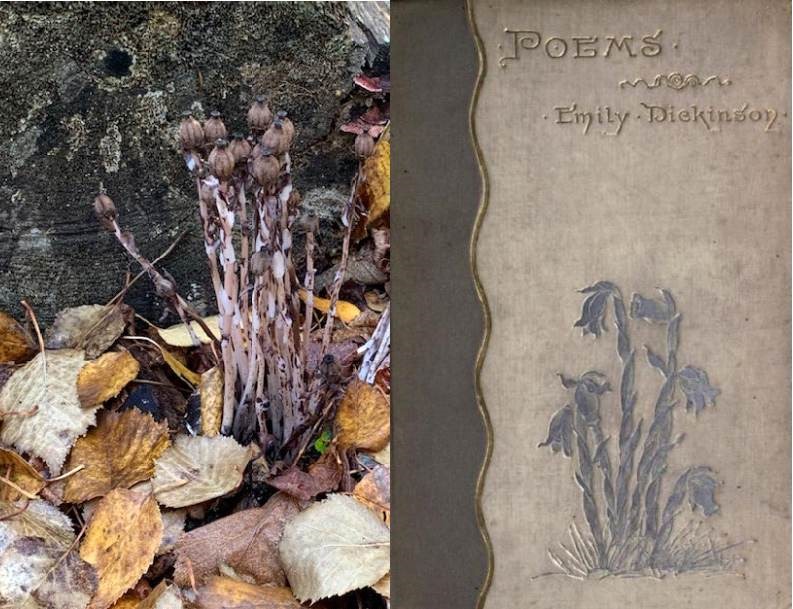
Autumn Indian Pipe and Dickinson Poems cover

The first edition of Dickinson’s poems featured a picture of Indian Pipe flowers in bloom, but like all flowers, autumn, if nothing else, ends their term. Indian Pipe (also called Ghost Pipe) is a strange plant that doesn’t use photosynthesis, but rather gets its energy from fungus. The picture was chosen because avid botanist Emily liked this unusual plant.

.

3. As if the sea should part  by Emily Dickinson.  From Emily B. to her American admirer Emily D. we go. For all the mythos about Dickinson’s later years of not leaving her family home, does anyone ever ask if being cooped up in a house with a family half-heartedly uninterested in poetry was all that comforting to her? In her most vital writing years, Dickinson still roamed some physically—and mentally. I’ve had some fun over the years here suggesting musically and graphically that Emily Dickinson would rhyme with Sixties psychedelia. “As if the Sea should part”  is certainly mental traveling of the purest sort. The player for this performance is below, or if you can’t see the player, you can use this hyperlink.

.

2. The Listeners  by Walter de la Mare.  When I started this project I thought I’d be rocking out more often than it’s turned out to be the case. Part of that result comes from being increasingly unable to record with Dave or others, and some from enjoying the novelty of being able to score and play orchestral instruments. My version of de la Mare’s weird minimalist ghost story isn’t crossing the hardcore boundary, but this is  a rock band arrangement that sounds good turned up on your speakers. The player to test that claim should be below, or if not, this highlighted hyperlink will play it.

.

Fall 2020 Parlando Project Top Ten, numbers 7-5

Continuing on with our count-down of the most listened to and liked pieces here this past autumn. A reminder, each of these selections starts with a bold-faced hyperlink to the post where I first presented the author’s piece. There you may find a bit more about the writer and a link to the full text of the poem I used.

7. Her Strong Enchantments Failing  by A. E. Housman. Our Halloween series of eerie spell-casting stories drew strong listenership, with this one coming in at number 7. It’s likely just coincidence, but I enjoyed thinking of Housman’s selection as if it could be a response to Emily Bronte’s poem “Spellbound.”

Musically this one combines electric guitar and electric piano, two instruments that don’t sound exactly like their acoustic siblings, but they mesh together just as well. There’s a player gadget below to hear Housman’s “Her Strong Enchantments Failing,” or you can use this highlighted hyperlink if you’re reading this in a reader that doesn’t show the player.

.

6. Truth Never Dies  by Anonymous. After encountering this poem extolling the endurance of truth despite human disbelief and ridicule on Kenne Turner’s blog, I just had to try and find out where it came from. In the end I wasn’t able to come up with any likely author despite a day or two of searches, but it now looks likely that “Truth Never Dies” was written in the early part of the 20th century, and the author likely was connected to the Seventh Day Adventists, though a version of the poem appeared in early trade union and temperance publications as well as church bulletins of various denominations.

Now of course most Protestant churches, labor halls, or temperance meetings wouldn’t have a string ensemble at their disposal, but I set “Truth Never Dies”  to one anyway. Once again, here’s a highlighted hyperlink to hear it, or you can use the player gadget below.

.Truth Never Dies4

Times, Times. It’s silly, no? When a rocket ship explodes and everybody still wants to fly…” (Prince was raised an Adventist)

.

5. The Dream  by Lola Ridge.  I may be attracted to lesser-known authors here from time to time, but then in some cases their personal biographies are often as rich in detail and adventures as any better-known poet. Ridge is one example of this. Ridge, like Mina Loy touched scenes on more than one country and continent early in the 20th Century, but like Loy she ended up connected to New York City bohemian circles around the time of WWI. After decades of obscurity, 21st century scholarship is starting to show more interest in Ridge. This poem of hers is as resolutely Modernist as Loy, William Carlos Williams, or Marianne Moore—but in our year 2020 of wildfires, pandemic, political illusions, street demonstrations and disorder, Ridge, and her more than a hundred-year-old poem, seemed to fit our zeitgeist.

Music for this? More strings, though a smaller group of them. Maybe it’s somewhat incongruous to hear my bellowing yap chanting along with bowed instruments, but those are just conventional expectations, and I don’t go to conventions. This is the hyperlink to hear my performance of “The Dream”  or you can use the player below.

Fall 2020 Parlando Project Top Ten, numbers 10-8

It’s time to count-down the audio pieces that you liked and listened to here most this past autumn. But before I get to the count-down I’ll mention that new pieces are getting harder for me to produce for a number of reasons. As of now, I still plan to produce some additional examples of what the Parlando Project does: combining various words (mostly poetry) with various original music (as varied as I can make it). Still, given the over 500 pieces already posted here, there will be a lot to explore while you’re waiting. What are those pieces like? Or unlike? Well, our quarterly top-tens are one way to see.

In each of the listings below and in the coming days, the bold-face titles are also links to the original posts where the pieces were presented in case you’d like to see what I wrote about them then.

10. The Poetry of the Root Crop  by Charles Kingsley.  I love coming across a remarkable poem I’d otherwise never come upon unless I was working on this project. “The Poetry of the Root Crop”  is largely unknown, and its author Charles Kingsley is too. No one seems to care much about his poetry, and even his lonely web biographic sketches barely mention it. I remember one I read saying his poetry was “competent.” Oh my. We poets are claimed to be a grandiose lot, and “competent” is a pen-knife between the ribs, not even a public execution. Kingsley the man is also lesser known, particularly here in the U.S., which might be unfair and yet favorable to us enjoying his poem. Considering Kingsley as a thinker and active force in his time has me going over this project’s many presented authors and recalling that while many had ideas I could agree with, they are often mixed with other prominent ideas and convictions that appalled me.

Poems can be about ideas, though they are not the ideal container for them as such I think. We are blessed that “The Poetry of the Root Crop”  isn’t a manifesto, though it uses some cultural markers as part of its scenery. What it is, what poetry is, is an apt container for communicating the experience of experience. Kingsley’s experience of a graveyard and/or garden can change how you see the thing yourself. To have that transference between minds isn’t merely “competent” I think. If you don’t see the player gadget to hear this piece, this link will also play it.

.

large tree stump 800

Snow started falling. I could hear the angel calling…He started to sing. He sang ‘Break it up, oh,  I don’t understand. Break it up, I can’t comprehend…”

.

9. No Common Ground  by Dave Moore.  Oh, how I miss having more of Dave Moore’s voice here. The pandemic has separated many artists, and performers most of all. How cruel this illness has been to have one of its earliest American super-spreading events to be through a group of people singing with each other!

So, it’s ironic that Dave’s piece that found so many listeners this Fall is about our chosen separations, one that I thought particularly apt for our current year when I reposted it on November 7th. The player gadget for “”No Common Ground”  is below, or as an alternative, this highlighted link for those that can’t see the gadget.

.

8. Back Yard  by Carl Sandburg.  I think it likely that Carl Sandburg had some ideas I don’t agree with, but I don’t look for them too hard, because I’m so grateful for the feeling of fellowship I often feel with him. “Back Yard”  too is not a manifesto, though it’s not hard to see its experience of the experience of an urban immigrant night as a statement by a son of a Swedish immigrant. Part of what I plan when I return to new pieces here is to talk a bit about our experience of the common ground of darkness as winter solstice approaches here in the Northern Hemisphere, and while Sandburg talks here of summer, his night somehow holds more than broad daylight can.

“Back Yard”  has continued to draw listens since it was first posted here two summers ago, and this September, as summer was leaving us, there was another strong spike in listens. My stats tell me I have listeners here who are approaching summer solstice below the equator, so this one is right on time for you.

Oh, there are a few words you’ll hear in the background that aren’t Sandburg’s. Some other angel’s alchemy from the common ground graveyard/garden of Kingsley’s poem perhaps? You can use the player to hear those night voices, or this alternate, highlighted link.

.

End of the Sky–A Doomscrolling Sonnet after Du Fu

In the 8th century, in China, there was a poem written by a man whose name we now write in our alphabet as Du Fu.*  It’s a short poem, 8 lines, and in it Du Fu addresses a friend, another Chinese poet of his time, Li Bai. Du Fu was able to compress a lot into those few lines about their shared task of writing. I’ve seen the poem’s title translated as “Thinking of Li Po at Sky’s End.”

Here’s a literal gloss of the original Chinese ideogramic text translated into English:

Cold wind rise sky end
Gentleman thought resemble what
Goose what time come
River lake autumn water much
Literature hate fate eminent
Demons happy people failure
Respond together wronged person language
Throw poems give Miluo

I’ve been carrying this gloss around in the background since August, thinking about how to render it when I chose to translate a poem by Li Bai instead. Then this November I was taking time out from the Parlando Project for a task I complete each month: to write up my reactions to a small group of poems from a circle of poets I’ve known for over 40 years. I try do do my best at this. The members of this group are generally accomplished, two of them markedly more so than I. In-between responding to their work, I continued to consider the Du Fu poem.

This project that you meet me at here has allowed me to explore intensively how I respond to poetry, poetry that is often of widely different styles. This only makes me more worried as I respond to this circle’s new work. I’ve seen varied ways poems can work, but I’ve seen the varied ways they can fail with an audience too. I try to respond authentically to the circle’s work, with an open heart, just as I do with the poems I present here, but in the end, what do I know for sure about what works or makes something work better or less well? What then to tell other poets, perhaps ones better than you?

After all, the same thing that seems to succeed in one poem seems to fail in another. I often think of how many musicians and writers have said that if they had the maps and mechanisms to make their art work each and every time, they would go to that place and never leave.

Similarly, if we knew as readers and listeners how to always pay the proper attention, would more poems, songs, or tunes succeed or fail?

This year I’ve begun writing a series of sonnets about my inability to come to grips with a number of simultaneous crises: a viral pandemic, a wider and painful realization of our racial caste system and its costs, the climate change frog-potboiling, and a government in proud, foolish, and willful disarray regarding these things and the judgement of voters. Round and round I go trying to find out what I don’t know. Trying to figure out what’s best to do. No next thing I read or watch will answer that, and some of what I come upon will dismay or anger me. That syndrome has been given a name: “doomscrolling,” and perhaps you have found yourself falling into it too. In honor of the obsessive nature of us little people trying to make sense of these senseless things and manage some mitigating protection for ourselves, friends, and family, I’m calling my series The Doomscrolling Sonnets.  We try to puzzle these things out, just as we continue to try to make poetry or other art work.

I think that may be what Du Fu wants to tell fellow poet Li Bai he understands in his poem.**

In my roundabout way, I came to a decision about how to present Du Fu’s poem. I decided to use it as a rough framework, an inspiration, as the kind of translation as starting point that is most accurately described as “After Du Fu” rather than an attempt at a faithful translation.***  This poem isn’t going to be written to Li Bai, it’s going to be to my friends, and to you if you too read, write, speak, or listen to poetry in this troubled time when our rudder is stuck hard to one side and we circle endlessly.

End of the Sky

.

I love dividing the 14 lines of a sonnet in various ways. Instead of an octet and sestet, this one is two 7-line stanzas with the turn/volta in the middle, and a closing couplet. Rather than end-rhyme, I decided to use a variety of internal rhymes, repeated words, and near-rhymes. The effect I’m aiming for here is a constant but irregular little chime occurring rather than a fixed rhyme that has the reader settling into an expectation.

I open the poem trying to render Du Fu’s autumn setting with some extra elaboration, though I translated it to my colder Minnesota clime. I think of the geese here as our occasional encounter with our muses and sometimes the song we hear from them isn’t as sublime as we’d like. And late autumn reminds us of what we must, and have, finished, what we’ve written down: the dried, settled ink and frozen surfaces of pages.

Chinesepoems.com, the source of the gloss above, gives us a helpful hint at what Du Fu is getting at with his closing line. Qu Yuan is a poet who, in a time of despair, threw himself into the Miluo river and drowned. In tribute, poets would come later and throw poems into the Miluo at the site of Qu Yuan’s death. Here again, I had my own localization to apply. I used to walk every day over a bridge crossing the Mississippi River, that mighty stream that runs through the middle of the Twin Cities and the rest of our country. A couple of years before I came to the Twin Cities, John Berryman, a poet and professor had copied Qu Yuan (or Hart Crane) and jumped from that bridge, a direct downward path taken presumably in giving up his own doomscrolling life and literary problems. I knew nothing of Qu Yuan or Du Fu back then when that was my daily walk, but I too once dropped a poem over the side of the bridge. Maybe Du Fu spoke to me before I knew his name? Muses will do that.

This poem’s two best lines I think are my attempt to directly translate Du Fu:

True literature doesn’t care if it is popular, and
It is only demons that care about a poet’s failures!”

You can stick that one by your keyboard or in your notebook. I think it’s better to listen to muses than demons, even if the muses lead us on, because muses tell us to write poems which we may throw in the water rather than throwing ourselves. I say that, even though I have reminded you here over the years: “All artists fail.” And so, we, poets, will fail. We fail mostly.

Mostly.  That’s important.

You should see a player gadget below to hear my performance of “End of the Sky.”  If you don’t, you can use this highlighted hyperlink to hear it.

.

* Du Fu is also spelled out as Tu Fu, and Li Bai as Li Po. The poet Ch’un Yuan referred to at the end of Du Fu’s poem can also be spelled Qu Yuan. It all has to do with the problem of taking Chinese language and portraying the names with the Western alphabet.

** Du Fu’s poem was written in a troubled time. The government of China was in turmoil, the country divided in civil conflict. Both Du Fu and Li Bai were imprisoned during this conflict, and Li Bai eventually had a death sentence handed down against him. Li Bai’s death sentence was commuted, but he was sent into exile. The two friends were separated for the rest of their lives.

*** I read poet and blogger Robert Okaji’s version of Du Fu’s “Thinking of Li Po at Sky’s End”  last month. Okaji, faced as I am with the challenges of translating Tang Dynasty poetry into an unlike language in a place centuries later, calls his versions “After…” rather than presenting them as translations. This year after reading some of his “After…” poems I’ve decided to do the same sometimes. Here’s a link to Okaji’s fine rendition.  For other examples of how “After a poem by…” translations may work see Campion’s “Let Us Live and Love”  after the Latin poet Catullus and Ezra Pound’s free translation of Li Bai’s “The River Merchant’s Wife: A Letter.”

Longfellow’s Harvest Moon

What value is mystery and strangeness to gratitude, to a sense of thanks? Let me try an experiment with you here.

American Thanksgiving still retains a degree of its nature as a harvest festival, and so when looking for a text to use today I came upon this one by highly unfashionable poet Henry Wadsworth Longfellow. Looking at the poem on the page one can see why modern poetic esteem may have passed Mr. Longfellow by. It’s a sonnet, intricately rhymed (ABBAABBA CDECDE), an antique skill that we no longer appreciate as much. Its imagery is both pat and removed from most of our daily lives, a rural landscape at night before the coming of electric lights, where moonlight can illuminate reflective objects and cast discernable if low-contrast shadows. Harvest signs include loaded wagons (“wains” is the charming old word for wagons chosen perhaps for rhyming needs), bundled sheaves of grain after reaping by hand, the changing of the bird population, falling leaves. In summary, we have imagery that is largely meaningless or lacking impact to us today in our modern America. It looks like stuff that is, and justly is, filed away in dusty poetry collections.

Harvest Moon

An illustration for “The Harvest Moon” from an 1880 edition of Longfellow poems

.

But what if we were to experiment a bit with Longfellow, and make him stranger and more mysterious? After all, this past rural world is now alien to most of us as some far-off land. And Longfellow, who we mistake as a rote poet here, has a subtle point to make, one that cultured British people might excavate and polish if this were a poem by Shelley or Keats, but which Americans may be too willing to overlook due to the old modes of Longfellow’s poetry.

In today’s performance of Longfellow’s “The Harvest Moon”  I attempt that act of mysteriousation. It started with breaking up the lines and underemphasizing the end-rhyme. This lets it act as an occult undercurrent, rather than a regular chime we know is coming. I sing the words as if this is new and not fully understood to the singer or listener. And as I often do here, I make the music I wrote and performed carry a lot of the load. The main harmony is carried by a 12-string acoustic guitar, which is playing primarily suspended chords, chords that remove the 3rd of the scale that makes a chord major or minor, and replaces that significant note instead with a not fully discordant but unexpected 2nd or 4th. The bass plays a busy but similarly unsettled melody line under this. And as a final signal that we are to regard this old American landscape with a time-tourists’ eye, and not as an old poem full of discarded conventions, I play a higher melody line and drone on a sitar,*  an instrument from another continent.

All that distancing effect is to force the listener to hear this poem as if it may have some meaning other than a decorative picture of a quaint and therefore meaningless scene. Longfellow outright begs us to do this in the text when he writes “All things are symbols.” This poem is late Longfellow, he’s nearly 70 when he wrote this, his America has passed through a horrible civil war, his life has passed through multiple family sorrows, and he is now an old man. The songbirds gone here are but counters perhaps, but his life of poetry is nearing its close. He’s spent his life helping establish that there can and should be an American poetry, that there can be American poets. We are them. Our grandparents and great-grandparents are the children asleep in those strange and now far-off curtained rooms. We are the piping quails, grounded birds gorging on the grain-seeds fallen to the under-shadows of the harvested sheaves.

Let us be grateful, let us be thankful, for those before us. Wrong and right they labored for us. Enslaved and wrongful masters they planted and harvested on lands that cannot forget the exiled feet of those before us. How strange, that it was exiles and the tempest-tossed that appropriated this place. Exiles creating exiles. There is a mystery in that.

The player gadget for my performance of “The Harvest Moon”  should be below. If you don’t see the player gadget, you can try to use this highlighted hyperlink to hear it instead.

.

*If you visualize me sitting cross-legged on a damask pillow with incense wafting in paisley curlicues while plucking on that elaborate musical device, it may be good for the effect of the piece—but in the spirit of full disclosure I’m playing a MIDI guitar here which allows my plucking to be translated into the notes and sounds of that difficult to maintain and master South Asian instrument.

In German November, or What? Nietzsche was a poet?

As a person educated in the mid-20th century this is what I knew about Fredrich Nietzsche: he was a philosopher who was all the rage in the late 19th and first half of the 20th century and he had this thing about achieving a more perfected human condition. Oh, I knew one more thing about him, something that discouraged all other curiosity: the Nazis liked him, saw him as an intellectual forerunner of their decidedly non-intellectual movement.

I know only a little more than that now. In the past few years it’s become accepted knowledge that the Nazi connection was to a large degree accidental. Nietzsche’s sister was his literary executor,* and she was a Nazi fan-girl who did a great deal to forge that linkage; and since the Nazis were nationalists, the available idea that there was a notable German cultural figure whose contradictory writings could dab some intellectual cologne onto their bully-boy stink was useful.

I vaguely knew that one of my childhood heroes George Bernard Shaw had admired him, but I had no idea how many leftist and anarchist figures rated Nietzsche. Remember Gustav Landauer, the German Anarchist theorist and grandfather of the famous director and improv comic pioneer Mike Nichols, brutally killed in the post WWI revolutionary activity in Germany? He was said to be influenced by Nietzsche too.

But this fall, while reading a blog I follow,** I learned another thing: that Nietzsche was also a poet. Which shouldn’t be news to me I guess, but it had never occurred to me, even though as a philosopher Nietzsche seemed to be something of a human quote machine who could turn out memorable phrases. And today’s text, “In German November,”  was the example that introduced me to that fact.

November Sadness by  Heidi Randen

Ah sunflower! Weary of cold and $%*@! snow.

.

I know only a little about German literary Romanticism, but what I know makes Nietzsche’s poem part of that tradition: worship of nature, doomed love—Damn! There’s even a prominent talking flower for Odin’s-sake! This can seem very twee in summary, but Nietzsche redeems it with his gift for language and characterization. Unlike other translations I’ve done here, this one’s poetic images and plot moved rather easily into English.

This is autumn: it — it just breaks your heart.”

After the poem establishes its “This is Autumn…” refrain by opening with it, the first full stanza has a graceful post-equinox image of a now lower sun against a mountain that would please Wang Wei. The poem’s second scene, set in a orchard with post-frost fruit starting to rot mixes sex and death tropes effectively. And then there’s that talking flower.

It takes some nerve to carry that scene off both as a writer and as a performer. I felt I had to push myself as a singer to portray the sunflower, and part of the reason I’ve started to put chord sheets up for some of my compositions here is to encourage better singers to improve on my attempts.

German November My Translation for song

Simple chords, but this one has opportunities for a singer.

.

Because Nietzsche’s German moves fairly easily to English my translation doesn’t differ that much from the one in this link, which also provides you with the original German. One choice/change I made: I wanted to emphasize the existential angst of the sunflower and to strengthen an image—and so the original German: “in ihrem Auge glänzet dann/Erinnerung auf” gains a repeated word “memorial” reflected in the dying flower/eye. I also thought the implied pause in Nietzsche’s refrain: “This is autumn: it—just breaks your heart.” could be emphasized further by repeating the “it” for a stutter effect.

As I mentioned above, I went for it in this performance, and given my limits as a singer it may not be to everyone’s taste, but it was the best I could do given the more limited recording opportunities I have these days. The player gadget to hear it is below. Thanks for reading and listening in whatever November wherever you are.

.

*Nietzsche died in 1900, late enough to give his ideas access to the early 20th century’s cultural ferment, but with the benefit that the proponent of those ideas wasn’t around to contradict the uses interpreters put them to.

**Byron’s Muse. I like to think I’ve outgrown youthful goth romanticism, which fits badly with my aged frame and less virginal connections to death, but Byron’s Muse sometimes reminds me that artistically there is still some attraction there.

O Let Me Be Alone Awhile

I’m going to take a walk around to get to a good small poem by Emily Bronte today. It won’t be a walk about the English moors, alas, but it’ll have to do in this otherwise wild and windy place we call the Internet.

My spouse and I have a worthwhile understanding that we are both a sort of introvert. Definitions vary between peoples and time, but one short definition of an introvert is that they are the people that gain strength and restoration from solitude rather than from gatherings of people. One can easily suspect that writers and their close allies, the readers, may be more likely introverts, but of course that’s not always so. That indispensable pioneer French Modernist Apollinaire*  was famously sociable within his element, a joyous bohemian boulevardier. Other writers, even while writing, seek out crowded places filled with voices and humanity to concentrate on their silent work. August Wilson, the great 20th century American dramatist, liked to write in cafes and coffee shops, places where other peoples’ voices were staging their own improvised plays.

But we can’t be sure that those two, or others like them, still aren’t introverts. My wife is good in typical social situations. I’m not. I’m so bad at social interactions that I’m sure I often leave a bad first, second, or last impression.**  Still, one thing that joins most introverts is that however well we perform the social whirl, it tires us out—and when we need to recharge it’s not a different self-selected group, even a group of friends or family, that we seek in order to recharge, instead it’s solitude.

So, I have a phrase that I use with my wife when she needs to recharge: “Oh, have a good time at your Introverts’ Support Group.” Which of course isn’t a group—it’s time alone.

I have a phrase that I use with my wife when she needs to recharge: “Oh, have a good time at your Introverts’ Support Group.” Which of course isn’t a group—it’s time alone.

This sort of time alone is particularly hard for non-wealthy women to find. In Bronte’s time a great deal of domestic and family labor was assumed to be their unquestionable duty, something that modern times and insufficient good intentions haven’t eliminated. I have some idea of the particular domestic duties of Emily Bronte admirer and like-named Emily, Emily Dickinson, but less of Bronte’s own family obligations, but I assume they were considerable.***

In our current Covid-19 age of shelter in place recommendations, the pressures of everyone at home may make more and more of us like unto residents of an isolated parsonage in the North of England like the Bronte’s. If so, today’s Emily Bronte poem, written it says in her collected poems on Sunday December 13th, 1840, may still speak to us. Arithmetic tells me Bronte would have been 22 when she wrote this. Here’s a link to the complete text in case you’d like to follow along.

Emily_Brontë_by_Patrick_Branwell_Brontë

Introvert Irony: the only image we have of Emily Bronte is a group portrait painted by her brother of her with her sisters.

.

On publication this poem bore the title “Retirement,”  but I’ve chosen not to use it as I don’t think Bronte is using the word in the sense most of us use it today. I believe the sense she intends is more at a wish to retire (as one would “retire to bed”) to rest and refresh oneself after a day of labor.

Indeed, the scene she wishes for and describes may be staged in sleep and dreams—though if so, her dreams are outside, alone, and in God’s nature. My wife’s most favored respite spots are walking in parks, nature reserves, and around wild lake shores. For introverts like Emily Bronte, my wife, and I, a concertedly apprehended nature is the other that somehow comforts us.

When we last did an Emily Bronte poem as part of this project, it was her spooky poem “Spellbound”  in which the poem’s speaker seems to be suspended in the air figuratively or in imaginative actuality. Interestingly, in today’s joyous poem, the speaker speaks poetically of “wings,” and a wish to “quit this joyless sod,” and so is again in “mental flight” somewhere between heaven and earth. Just as if I wondered if A. E. Housman’s spell-caster’s poem and Bronte’s were in conversation, and if Emily Dickinson’s bird and hope poem was reacting to an Emily Bronte bird and hope poem, Bronte herself returns to an airborne state in today’s poem.

Wishing all the readers and listeners here the companionship and solitude they need and desire, and, and but, in the proper mixture!  The player gadget to hear my performance of Emily Bronte’s “O Let Me Be Alone Awhile”  is below.

.

*102 years ago this month, Apollinaire died of the 1918 great influenza pandemic while still weakened from a wound he suffered in combat during the final days of WWI. The flu virus got him before he could see the end of that war, as noted in Tristan Tzara’s moving poem that I translated and presented here three years ago.

**I have something of the novelist’s eye for how those interactions can go wrong, but the social klutziness to do it all wrong anyway.

***Wikipedia says she did “most of the cooking, ironing, and cleaning” for her family.