Night, and I Traveling for National Poetry Month

A little contrast here in poetic fame from Shakespeare to a poet who’s equally unknown under each of his names: Joseph Campbell/Seosamh MacCathmhaoil. Most of his poetry was published under that first name, not the Gaelic version, and so I’ll use it today, even though I’m always obligated to say “No, not that Power of Myth guy.”  Over the years this project has promoted the idea that Campbell deserves wider recognition. Here’s a brief version of that case.

Belfast born, Campbell was active in the Irish cultural revival at the beginning of the 20th century, and like Yeats, he seems to have crossed paths with the London-based Modernist poets circle of T. E. Hulme, F. S. Flint, and Ezra Pound in the years before WWI. His involvement with the militant wing of Irish revolutionaries also grew during this time.*  After Irish independence he lived in America for more than a decade, while continuing to promote Irish culture; but he seems to have stopped publishing his poetry after the establishment of the Irish Republic. Late in his life he returned to Ireland and died there in 1944 where his ghost continues the task of becoming largely forgotten — at best a footnote, and often not even that.

Well, most poets are forgotten, even in a country like Ireland that does a better job of revering them than most, but here are some things that attracted me to Campbell: he worked effectively in the folk-song part of the Irish cultural revival, collecting, writing, and adapting song lyrics.** And his take on page poetry included both that folk song tradition — and uniquely among his Irish generation — a handful of very early poems in the pioneering English-language Modernist style that would be called Imagism.

In fact, I’ll put today’s piece up against any of the more famous short Imagist poems widely anthologized, I think it’s a masterpiece of the form.


Here’s the lyric video of the performance.

.

I find “Night, and I Traveling”  a hugely affecting example of direct presentation of a thing and a charged moment in time. Like Imagist poetry in general it does expect the reader to pay attention, as the poet did, and to supply from within themselves the emotional charge the presentation represents.

Campbell was a country walker in Ireland, and the door he observes while walking in the night is likely of a small rural dwelling, plausibly little more than a hut. The door is open. Perhaps the peat fire inside has gathered smoke. Perhaps the occupant is expecting someone to return. Let us also remember, this is more-than-a-hundred-year-old rural night. The ambient light he’s sees in the dark has a landscape context of moonlight at best. There’s a gleam of some porcelain dinnerware inside, perhaps the most valued possession in the hut, perhaps a dowry or wedding item. The poet hears the only occupant, a woman, singing, in the ambiguous, but I think rich phrase, “as if to a child.” Note this single simile in the poem. He could have written “to a child.” He did not, leaving the implication that I take: that there is no child — the child is dead or gone. Campbell passes on “into the darkness” and the poem ends.

Seven lines, and this poem slays me. How much is packed in there to an attentive reader: the poverty of the colonized Irish, the depopulation of those who needed to leave to survive, their meager treasure (part of which is song), the closely-held personal losses.

Yes, poetry such as this requires your attention to work. I ask for your attention to this poem and to Joseph Cambell.

There’s three ways to hear my performance of “Night, and I Traveling.”   There’s an audio player below for many of you, and this highlighted hyperlink that will open a new tab with an alternative audio player is provided if you don’t see that. As part of our National Poetry Month observation, there’s a new lyric video above for those who’d like to see the words while the performance plays.

.

*This revolutionary involvement seems to have been the proximate cause of Campbell’s literary career stalling. In the aftermath of Irish Independence, the Irish Civil war broke out between factions of the new Irish state. Campbell ended up on the losing side and was imprisoned for a while. Despite my admiration for Campbell’s poetry, I’m not an expert on his life or the political issues of the Irish Civil war. But these events seemed to traumatize the writer, and it’s not hard to imagine that politics and associations from a sectarian war might have caused him to be written off by some in Ireland.

**Sort of like Eleanor Farjeon from earlier in this April’s National Poetry Month series, Campbell may be “best-known” in the quasi-anonymous role of the lyricist of a song, “My Lagan Love.”   Campbell’s lyrics in this song include a more elaborated variation of a woman’s lonesome singing heard through a doorway with a “bogwood fire” and the singer ending the song “From out the dark of night.”

In a popular post last fall, I also revealed that Campbell likely originated making the subject of the song “Reynardine”   a supernatural creature.
Her Lips are Copper Wire for National Poetry Month

Even with its most popular and well-known poems, poetry works, works its impact, one reader, one listener, at a time.

Doing this project leads me to read a lot of poems. I’ll go through whole collections, entire anthologies, looking for things that I suspect I can create music for. That sense, “This could work with music” is hard to quantify. I’ve noticed repetition and refrain will often cause a second look. Longer poems will need to presently suggest selections as I’m seeking sub-5-minute pieces. Yes, graceful lines that sing on the page for whatever reason will suggest music. An image or an incident vividly depicted that grabs me will ask me to stop and consider it. Oh, I don’t really know, can’t say for sure, how I select things for this. I’m happy with it being a mystery, and I hope you, reader/listener are too.

Sometimes that attraction is strong though. The moment I finished my first reading of Jean Toomer’s “Her Lips are Copper Wire”  I knew I had to write music for it and do my best to realize it in performance. Perhaps I can’t say why that is. Little matter. The pull, the attraction, was undeniable.

This Surrealist love poem, like E. E. Cummings poem from last time, was written before the first Surrealist Manifesto, and is proof Americans could use English in this mode early in the Modernist era. Long time readers here will know I sometimes like to mesh in Blues and Jazz flavors with my music,* but Toomer, an early Afro-American Modernist, seemed to have already suggested that with this poem, so that I didn’t have to underline the point. I suppose it just strongly communicated the wonder of desire to me.

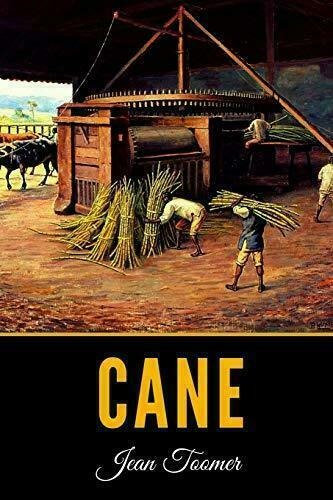
Cane cover

This poem was placed into Toomer’s Modernist masterpiece, the book-length mixed-form “Cane.”

.

It’s National Poetry Month, the reason I’m going through early Parlando Project pieces to present a more rapid posting schedule here this April. NPM tries to increase interest in poetry, but it’s hard to get a read on how significantly it achieves that. Arrayed against it is every poem someone didn’t “get” for whatever reason. Every poem that says only “Care about what I’m saying, even though you won’t understand,” poems without the bridge to “Here’s how you connect to this.” Every poem that bores us keeps us from poetry, and we are so easily bored. How many poems does it take to put up a wall against poetry, and will putting a poster on that wall dissolve the wall?

Is this the fault of the poets, their poetry? Is that the fault of us, the readers/listeners? Are there social structures that surpass us in enforcing this distance from the art?  That’s a mystery. I don’t know the answer. But I know that once in awhile I come upon a poem like “Her Lips are Copper Wire,”  and like another Surrealist love poet Paul Éluard I’m left compelled “to speak without having anything to say” — anything to say other than the words of this poem. That limerent pleasure is likely why you’re here, reading this, and listening to the performance of Toomer’s poem. Thanks to that mystery and you.

No lyric video today, but you can hear my performance of Jean Toomer’s poem with a player gadget below. Don’t see that? Well, this highlighted link will also do the job.

.

*I’ll bring that musical influence to any text, breaking out Delta slide for T. S. Eliot, turning German Dada verse and Robert Frost into blues stanzas — and anachronistically seeing Emily Dickinson as a scratchy blues 78 record, or Henry Wadsworth Longfellow at a beatnik Jazz café.

Crepuscule (I Will Wade Out) for National Poetry Month

Today’s re-released Parlando piece from our early years is “Crepuscule”  by American poet E. E. Cummings. This is certainly a passionate, ecstatic poem, isn’t it! Looking back at what I wrote about it in 2018, I was then taking the main meaning of the poem to be a portrayal of falling into a Surrealistic dream state. In the same post I confessed I hadn’t remembered that Björk had performed a version of this poem that seemed filled with erotic desire.

Rereading and reconsidering, I’m more unsure which is metaphor and which is meaning — and I think that’s often a good thing in poetry. We’re in one of those gestalt drawings created with a spell of words. We could be in the transport of desire, and it is like unleashing a spectacular dream: flowers are not just colorful, but burning with color. We will be still in bed, yet leaping with sleep-closed eyes. And so on.*  It’s difficult to not feel the erotic pull of the text. For a dream, the mystery is very much of the flesh. Mouths, thighs, bodily curves, fingers, lips…is it dream as sex or sex as dream?

An argument for the dream is the framing device of the poem reinforced by the title (crepuscule is an archaic word for twilight). Night and the dreamer have swallowed the sun, and the final line has one biting on the voltaic silver of the moon. But then Rimbaud took the arrival of dawn and sexualized it, so why couldn’t Cummings do the same for nightfall?

Here’s the new lyric video.

.

Three ways to hear my performance of E. E. Cummings “Crepuscle:”  there’s a player gadget below for many, and there’s a backup highlighted link for the others. Want some dream images flowing behind the words of a lyric video? That video is above.

.

*The most mysterious line has lovely word-music: “with chasteness of sea-girls.” I’m assuming a reference to nereids, sea nymphs, but I’m unsure if the poet’s speaker is becoming one, or trysting with one, in the rush of their dream. If water spirits, perhaps gender fluidity is a subliminal?

Gone, Gone Again for National Poetry Month

We continue today our National Poetry Month series where we re-release some of our favorite performances from the early days of this Project in the hopes that more ears will be able to hear them. Today’s piece steps forward a couple of years from yesterday’s, where in “Adlestrop”  British poet Edward Thomas had written with beautiful attention about the sweet nothingness of a day of peace while the precipitating event of World War I was only hours away.

Today’s poem, “Gone, Gone Again”  (also known as “The Blenheim Oranges,”)  was written about the same English landscape, only after the war had broken out. If “Adlestrop”  is a poem about present nothingness, then “Gone, Gone Again”  is a poem about absences. It starts with the calendar march of time until autumn, but now the boat landings* are unusually quiet and empty. Next Thomas notes the apple harvest** was not looked after. The apples have grubs, no orchardmen are looking after them, and instead of autumn harvest, they are simply falling to the earth to rot.

There’s a stanza that follows that starts by enigmatically referring to “When the lost one was here —” It seems impossible to determine who that is. It could be anyone missing their soldier overseas in the war, but one of Thomas’ biographers thinks it likely a young woman artist Edna Clarke Hall*** who had what was at least an emotional affair with Thomas. I wondered if the “lost one” could be American Poet Robert Frost, a man who never had many friends, but who had struck up a strong friendship with Thomas while Frost was in England before WWI. Frost had planned for Thomas and his family to emigrate to the United States so that they could continue their friendship, but then the war.

I’d guess the reason there isn’t more speculation on a possible particular “lost one” is that the same stanza ends on a couplet so strong that the opening two lines are overlooked. That couplet? “And when the war began/To turn young men to dung.”

The lyric video. There’s a picture there of the Blenheim apples to get citrus out of your mind, and when we get to the lost one, a photo of Edna Clarke Hall and then Frost.

.

The concluding four stanzas develop the theme of an abandoned house, something which rhymes with my own experience of abandoned farm houses in the American Midwest. The concluding stanza mourns the schoolboys who wantonly vandalize these absences, to which Thomas gives full and poetic attention.

I’ve always been happy with the music I composed and realized for this performance, including some parts for muted horns and woodwinds. I did mis-sing a number of Thomas’ words in the recorded take that was otherwise “the keeper.” I hope that won’t detract. On the other hand, one mistake I made I still consider an accidental improvement: “grass growing inside” in place of Thomas’ “grass growing instead” is not only a stronger image, it’s a better rhyme.

Three ways to hear my performance of Thomas’ “Gone, Gone Again:”  a player gadget is below for regular browser viewers of this blog, others may need to avail themselves of this highlighted hyperlink — and we’re continuing our special National Poetry Month series extra feature yet once more: there’s a lyric video above.

.

*Quay is an uncommon word in American English. I learned it first from an avid Scrabble player, who probably triple-word-scored with it. A quay can be a seaside dock, but from some knowledge of the landscape Thomas wrote about, it’s likely a river or canal landing he speaks of. With the men overseas in the war, I’d assume the regular canal traffic in the English countryside would be reduced.

**Blenheim Oranges are a British apple type. It’s possible Thomas chose this particular apple not just because it was cultivated in the area of England he knew best, but because it’s named for an estate built for the victorious English leader in a battle fought centuries earlier in Blenheim Germany.

***I knew nothing of her, and research is so rewarding when you come upon a character like her. She’s fascinating, and abundantly talented in an era when women artists weren’t considered. Edward Thomas’ emotional and love life is complicated enough that it would make a tremendous series, with characters any screenwriter or actor would hunger for.

Millay’s “Rosemary” for National Poetry Month

It’s my hope that some of you are newer people reading this as a result of my increased posting frequency and other activity during April’s National Poetry Month. If you’ve just found this: welcome! What we do here is combine words (usually poetry) with original music in varied styles, and then write about our encounters with those words and what we discover from performing them.

Since we’ve been doing this for 6 years and over 600 pieces, what we’ve been doing this Poetry Month has been to highlight some of my favorites from the first half of our Project. Since the composition, performing, and recording tasks are already done for these pieces, this has made the daily posts possible, but it has still been a lot of work at a time when life has made other calls on my time and concern. I’ll skip that story, but I want to take a moment to tell those other blog authors that I follow that I’ve been unable to read your posts for the past couple of weeks. I miss that, and I still intend to catch up.

Today’s piece is from a poem of love and respect lost by Edna St. Vincent Millay which is titled “Rosemary.”  As a lyric poem it’s somewhat mysterious in terms of time, place, and exact events. The opening verse’s rushes and bergamot have something of a house-cleaning feel to them. Rush stalks were used in place of rugs or other floor covering historically in homes as varied as Native American structures to European castles, and dried bergamot is fragrant and would be a nice way to make a place smell better, as is the herb rosemary, which may be the name of the speaker in the poem, and/or another way to freshen the smell of the house. Housekeeping is continued as a theme in the second verse. The final verse links back to the opening two lines, and I read it as a revelation that those tasks are being done out of duty and with a false-face of faithful servitude. After the final verse, those early fragrant herbs and fresh-straw-on-the-floor mentions now say something has gone off, is spoiled or rotten.

Millay on Chaise Lounge 3

I felt a contemporary link for dismay when I saw this picture of Millay “On a chaise lounge, on a chaise lounge, on a chaise lounge…”

.

Is the poem’s speaker a wife or partner in a cold relationship? Or possibly a servant? The poem’s “gentle sirs” in its next-to-last line indicates more than one master is being acknowledged, but I can’t eliminate the idea that it could be a spurned lover chiding a partner as if she’s now a servant.

I called this poem “mysterious” rather than “vague” largely because I find Millay’s word-music enticing. Another poem with the same matter, but without that extra factor, might merit that second term. In my performance I created a jaunty tune for this enigmatic but essentially sad story. That’s a common tactic in British Isles folk music, where you can have brisk tunes telling stories of unjust and sorrowful fates. The performance ensemble is a small acoustic band: drum set, bass, two acoustic guitars — but I’m a one-man band performing that in overdubs. Listening back on this several years later I admire that I was able to make it sound like a live take by an actual band. My musicianship has remained inconsistent throughout my life, but this one works, and is able to serve the composer (me), though I wish I was a better vocalist here and elsewhere.

The lyric video

.

Three ways to hear it: a player gadget below for some of you, and this backup highlighted link if you don’t see the player. And as I’ve done so far with all these re-releases of early Parlando Project performances, I’ve created a new lyric video that shows the full text of the poem above.

.

On the Troop Ship to Gallipoli for National Poetry Month

Though an often-puzzling poem, Eliot’s “The Waste Land”  is tightly written. I’m not talking about some raw stat like its number of lines, but that the language itself works in its sentences and small phrases directly and without much waste. That’s not a Modernist-only tactic, but early Modernism did make it a goal.

And a large amount of that vividness came not just from the sharpness of the experiences of grief, depression, and failure that Eliot had experienced, but from revision and re-writing, a process famously aided by Ezra Pound suggestions — most often excisions.

Back in this blog’s first year or so I decided to try an exercise based on those Modernist principles. I took this poem, or rather a fragment, written by British poet Rupert Brooke* while he was steaming on his way to the same disastrous Gallipoli landing in World War I that killed Eliot’s friend Verdenal.

My goal wasn’t just to do what Brooke himself might have done if he’d had time to polish up further drafts of his fragment, but to do what Ezra Pound would have done with his blue pencil. Even though I started with a 19-line fragment, I removed over a hundred words, including many that seemed uselessly archaic and flavorlessly formal. This wasn’t just a Readers Digest-style abridgment, I worked to remove the crud and bring forth the images as an Imagist would have.

Here’s the lyric video.

.

I maybe favoring myself, but I thought the result increased the power of the remainders considerably,** and once I composed and performed the eventual musical setting, I titled my adaptation“On the Troop Ship to Gallipoli.”   It remains one of my favorite pieces that I’ve presented here for the past six years, and it easily became one of my candidates for this National Poetry Month series where I’m re-releasing some of the earlier pieces from this project along with new lyric videos. You can hear it three ways. The graphical player is below for some, but if you don’t see that, this highlighted link will also play it.  And you’ve seen the thumbnail picture above that will play the lyric video.

.

*Brooke was — let’s not put too fine a point on it — a very good-looking young man, with full access to the class-bound academic and social circles of early 20th century Britain. Yeats called him “the handsomest young man in England.” He was considered promising as a poet, or certainly something, even before the war. Frances Cornford, a concise poet who counted Charles Darwin and William Wordsworth as her ancestors, wrote of Brooke “A young Apollo, golden-haired/Stands dreaming on the verge of strife/Magnificently unprepared/For the long littleness of life.”

So, when Byronically larger-than-life Brooke saw WWI’s outbreak, he saw a way to join in something big and heroic. He wrote an instantly famous sonnet about the honor of dying for one’s country in battle. That poem was read by the Dean of St. Paul’s Cathedral on Easter Sunday — and then less than a month later Brooke was dead. Back in 1915, an editor/fate blue-penciled this: Brooke never reached the doomed landing at Gallipoli. He was bitten by an insect which led to a generalized infection, which killed him three days before the battle.

**Perhaps I shouldn’t have left this for a footnote: you might want to try a similar exercise on some other person’s poem or two yourself, and then try what you learn on your own work. Yes, one can add lines and words in a revision, but what this exercise usually does is show how much you can add in power by excision.

“Sweet Thames” from Eliot’s “The Waste Land” for National Poetry Month

Today we’re going to commemorate something we did to celebrate National Poetry Month during the earlier years of this Project. In a series of posts and performances each April over five years we serially presented the entire “The Waste Land”  here.

Eliot’s Modernist masterpiece famously begins “April is the cruelest month…” — a line that is endlessly quoted during NPM and otherwise to make it as famous a line of poetry as any. Yet the extraordinary collage of words that follows may have frustrated or just turned-off as many poetry readers as it has attracted. To counter that, as I presented this poem over the years, I tried to make these points about it:

  • It’s abundantly musical. It’s possible to enjoy it while understanding little about what it’s trying to mean, as if it were a cousin of “Jabberwocky.”
  • For such a complex and multi-layered poem, it makes more sense more quickly spoken than on the page. “He do the police in different voices” was the working title for it. Vocalizing the various characters was assumed in its vision.
  • It’s a poem written by a depressive about their experience of depression. That might sound like a recipe for needless wallowing. Yet “Depressing English Majors is Like Shooting Fish in a Barrel” is not  a suitable blurb for “The Waste Land.”   It ends in uplift and a rage against self-pity.
  • Generalizing wildly: English poets sing melancholy songs, American ones sing the Blues. The Blues is analytical about sadness, tells sorrow it knows its game. Eliot, the America-to-England emigree, is somewhere in the middle, and then he draws on Buddha the bluesman.
  • The poem has a thread that examines sexual roles (summary: it excoriates them) and even indulges in some gender dimorphism. The theory that there’s a gay subtext hangs together pretty well — but objective correlative and all, the ghastly, haunting, lost, and unclaimed corpse of Jean Verdenal, and all the WWI dead, suffuses the poem. Alas, we’re now in another cruel spring of warfare this year.

But still and all, what’s the deal with a poem that has footnotes,* and seems to require them? Even my high school English teacher who did so much to introduce poetry to me thought that a little embarrassing back in the Sixties. Can we understand the wide range of quotes, parodies, references, allusions, and just plain collage better as Modernism has permeated our culture even more by our 21st century? Can we now see “The Waste Land”  as a big mix tape, full of samples being dropped? Can one dig the groove and general effect without needing to know where the sample was taken from, or what in-joke M. C. Eliot was putting down?

With a T and an S and L I @ / here to rock this mic with my river rats. / Think you’re a sick rhymer with a mad dose? / I’ve been to a Swiss asylum and been diagnosed,./ Dis my soft Thames flow while I’m singing my song,. / you might end up drowned like that Phoenician! /Peace (that passeth all understanding) out!

.

The section I decided to use to represent the entire serialized performance was this one, the start of the poem’s “The Fire Sermon”  section. In this part that I titled “Sweet Thames,”  we begin with a decidedly not-so-sweet urban river, a polluted river being actively polluted, an adjoining gashouse is visited (a hideously smelly polluter), and finally we get the corpse of Jean Verdenal, lost in the sea/sand verge of the disastrous WWI Gallipoli landing being sung to and fro to a bawdy hymn about a madam and her girls who euphemistically are washing their “feet” in water.

Two ways to hear it, one way to see and hear it. There’s player gadget below for some ways this blog is read. This highlighted link is here for those that don’t see the player.  And as we’ve been doing so far this April, there’s a lyric video too, linked here.

.

*Eliot later apologized for the footnotes.

Stopping by a Woods with Bad Cellphone Service for National Poetry Month

A couple of posts back I suggested we do more than poetry prompts or poem a day writing challenges for National Poetry Month. Here’s a demonstration of an idea that’s half-way there. While still a poetry writing prompt, it also acknowledges the tradition we’re working in.

Write a parody of a poem you like, you dislike, or you just have heard too too-often that you want to mess with it.*

One of the first teenage poems I wrote decades ago was a parody of Keats’ “Ode to a Grecian Urn”  titled “Ode to a 1953 Automobile Ad.”   I loved Keats’ poem, and while I wanted the smile that my title could engender, my parody was more at pointing out that Keats’ painful air of not-quite-realized truth portraying beauty wasn’t just a 19th century thing. Like most all of Sappho, that one may be lost to the ages, but here’s one recent enough to have been performed in the early years of this project: “Stopping by a Woods with Bad Cellphone Service.”

Did I like, hate, or just want to mess with Frost’s Stopping by a Woods on a Snowy Evening?”   Maybe a little of each. Long time readers here will remember that I disliked Frost in my youth. I thought then he was spouting platitudes, but I was wrong on that. When I presented Frost’s “Snowy Evening”  here years back I said that the most important thing in the poem has been little realized. The poem’s speaker isn’t being tempted by wasting time admiring natural beauty. He’s not seeking Transcendentalist truth by closely reading the book of nature — though Frost does read the book of nature, his readings are unusually dark. Those are common understandings of Frost’s poem, which do sort of find the poem’s ending as a platitude: “You know what you need to do, get to work.” So is it darker? Is he basically being tempted to crawl into the woods and end it all? Not quite that either. The most important fact in the story of this poem is that the speaker is lost  on a rural road in the early 20th century on the “darkest evening of the year,” which would be utter darkness in the days before electric light. There’s no beautiful Currier & Ives woods. It’s so deserted and without information you can hear snowflakes rubbing on each other. The famous opening is (with added italics) “Whose woods these are I think  I know.” Not really knowing = lost. When he decides to press on, it’s the act of acting without there being any knowledge that he’s going the right way. The poem sounds beautiful, and that ennobles that act, even if it says the speaker may have been foolish and is risking acting without knowledge at the end.

Frost Drake

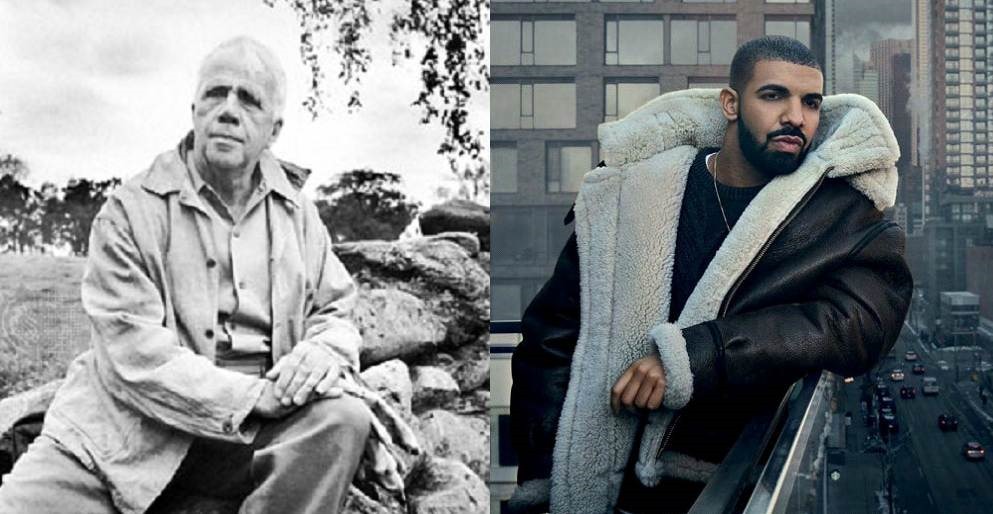
April is National Poetry Month, and spring is here. Two gentlemen are unbuttoning their coats.

.

My parody is more lighthearted, and is set in the 21st century, but like a lot of jokes the situation isn’t pleasant. By writing a parody you are acknowledging the poem and your knowledge of it — so even if your parody is meant as a corrective to make the reader never read the original poem the same way again, you are engaging in the type of activity I’m urging more of this Poetry Month: that we should encourage more expression not just by adding to the sum total of poetic examples of it, but by acknowledging it in others.

Three ways to hear The LYL Band rip into this snowy poem: this is the link to a lyric video, or (for some of you) a player gadget below to hear just the audio, and finally there’s this fallback link that will play it also.

.

*There’s a long tradition of this in poetry and songs. It’s not just Weird Al. In my youth they were called “answer records” — and later on in hip hop, a “dis track” might twist someone else’s rhymes or musical samples in service of dialectic. We’ve presented some poetic “answer records” here. Like this famous set of poems here and here. Or this quippish answer I appended to another short poem.

I also sometimes make moves that feel a little like parody in some of my looser or “after” translations of older poems. Here’s one example. And another. And one more. These aren’t meant to be “funny ha-hah,” but there’s a pleasure in finding history’s cultural “rhymes.”

The Aim Was Song for National Poetry Month

It’s National Poetry Month, and we’re celebrating here by re-releasing some of my favorite pieces from early in this project’s six-year history. Today’s poem’s poet is American Robert Frost speaking about spring, spring winds, and the poets’ transcendental task of continuing and shaping nature.

I’ve often reminded readers here that I didn’t care for Robert Frost when I was a young person. He was still a living poet while I was a teenager, and I associated him (wrongly) with dreary homilies and his placement in the school anthologies as the most recent poet included. More than once I complained to teachers and any fellow students who seemed at all interested in poetry that there had to be something, someone, newer and more relevant than Frost that could be studied.

What I didn’t know then was that Frost could be a nimble lyric poet delivering subtle messages, and that he was, in the generational nomenclature that would come 20 years later than my youthful 1960’s complaints, “a slacker.”

Frost spent the first 40 years of his life basically failing and flailing as a poet and human being. American interest in his poetry was nil. Only after wandering to England did he find a publisher for his first collection and a key promoter in fellow American in pre-WWI England, Ezra Pound. Pound was nearly a dozen years younger than Frost.

Frost didn’t write poetry as memoir, as many modern poets do, but all that experience made it into his poetry. Frost wrote often of failure and limitations* — but today’s poem “The Aim Was Song”  isn’t one of those poems. First published 101 years ago, this is Frost exulting in the triumphs of poets and poetry after he had finally broken through into acclaim in his home country. And it’s a good one for the Parlando Project to perform during National Poetry Month because Frost’s imagery here celebrates the oral, vocal, and musical heart of poetry. Also it’s an excuse for the composer to tell the guitar player: “Why don’t you turn up and play some.”**

Laptops were larger and more wooden in Robert Frost’s day. 

.

As with our other re-releases this April, you can hear my performance of this poem with the player gadget below (where seen), or this highlighted link, as well as with today’s low-budget lyric video that is trying to catch the attention of additional listeners to the Parlando Project.

.

*By the time his poem “Nothing Gold Can Stay”  was made into a motif in The Outsiders  movie in the 1980s, “slackers” could sense that kinship that I missed.

**OK, it’s the same guy, so the guitar player has considerable influence over the composer.

The Red Wheelbarrow for National Poetry Month

Besides being the first day of National Poetry Month, it’s April Fools day, so maybe it’s a good day to present a poem that caused many readers to wonder if it’s a joke: William Carlos Williams “The Red Wheelbarrow.”

I’m not against a poem causing wonderment, are you? It’s fine to look at it and respond “You can’t be serious — is that really a poem?” but I urge you to follow that question with other ones, such as “What use is it?” “Is this just an artsy provocation?” or “What should poetry be then?”

I think Williams’ poem is a late but effective representation of the movement that launched Modernist poetry in English: Imagism. Fairly quickly, a great deal of English language Modernism soon moved on to more complex poetry, a poetry that was often hard to grasp due to intense but hermetic personal material or elaborate references to other works of art, but “The Red Wheelbarrow”  is none of that. Instead it expresses, like a sub-two-minute punk song from the mid-1970s, a rejection and clarification of overly elaborate poetry.

2022 NATIONAL POETRY MONTH POSTER 1024

and this place has chickens. Also a short 12 tone-row composition.

.

I think Williams genuinely thinks the rain-water makes the wheelbarrow beautiful, and he doesn’t even think he needs to say that word “beauty” or make some elaborate metaphor to seal the deal. To say that, and just that,* is a provocation against poetry that asks more, and to readers that expect the poet to give them more. But it’s not just the momentary rain-water glaze that makes it poetic: it’s useful, something to depend on. Now that’s a goal for poetry (or any art) to meet at least some of the time, don’t you think? Self-impressive poetry, trickster poetry, poetry that gathers and unites widespread allusions — all have their place as well, but sometimes it’s good to see what there is seen naked in the rain. When the cave dwellers put their hand or the hand of their child up against the wall of the cave and blew red ochre dust around it, that’s art — not of the artists showing us skills, but the art of our shared and transient experiences made fixed.

Musically here I decided to use another contemporary early Modernist tactic: the tone-row. If one knocks “The Red Wheelbarrow”  for not having poetry’s elaborate or fanciful imagery, or some tight connection with the artist’s personal biography, perhaps this performance will show something traditional it retains: a lovely, largely iambic, word music. Yes, it’s music in miniature, but still that poetic element was there for me to express.

To hear my audio performance of William Carlos Williams’ “The Red Wheelbarrow”  set to my own music, you can use this highlighted link, or (if visible) a player gadget below. And as I’ve been doing with our National Poetry Month re-releases, there’s a simple, low-budget, lyric video at this link.

.

*Well, he also admires the contrasting chickens.