Veteran’s Day, Remembrance Day, Armistice Day

November 11th was first celebrated as Armistice Day, the day that World War I ended 99 years ago. As wars—even World Wars—continued after that war, the day has been pressed into other service. In the United States it’s Veteran’s Day, a day to think of and thank those that served in the armed forces. In the UK and Commonwealth Countries I hear it’s celebrated as Remembrance Day, making it more akin to the US Memorial Day.

Because I like modern poetry, and the most recent poetry I can use freely here is from before 1924, and because we are marking the centennial of World War 1, I’ve performed a lot of things from the the WWI era here, including poems about that war. Since many of you are new to this blog (traffic has grown considerably since this summer) I’m going to take this day to point out a few poems about the experience of soldiering, many of which are written by the veterans themselves.

“On the Troop Ship to Gallipoli”  has turned out to be one of the most popular pieces here. It’s my adaptation of a fragment written by Rupert Brooke. Brooke was a believer in the British cause in WWI, and this piece comes out of words he wrote shortly before his death of an illness he contracted while on the ship taking him to the front in Turkey. It’s a testament to people willing to put their life on the line for an idea.


“The Trenches St. Eloi”  is nearly a dispatch from the front in poetic form. It was written by T. E. Hulme, one of the founders of Imagism and modernist British poetry, though his own poetry is less known than it should be. St. Eloi was a major front in the trench warfare that stagnated for much of WWI. Eventually elaborate tunnels were dug at St. Eloi by Welsh coal miners in hopes of gaining an underground advantage. Hulme was wounded there serving in the British Army, came back to England to heal, and then returned to the war where he was later killed in action.


“South Folk in Cold Country”  was published in this form during the time of WWI, but it’s a translation (by Ezra Pound) of a work by classical Chinese poet, Li Bai. In it, the lot of the soldier sounds eerily similar to that Hulme was experiencing a thousand years later. Li Bai is the same poet that Pound used as the source for the more commonly anthologized poem “The River Merchant’s Wife.” Anthologies, and perhaps readers,  seem to prefer love poems to poems about war.


“Christ and the Soldier”  is by Siegfried Sassoon, who was a decorated hero of Britain’s army in WWI. However, he was at least as courageous in publically taking a stance against the war while still in service. A compromise was reached that he would be treated as a casualty of “shell-shock” at a asylum in Scotland rather than charged with treason or some other serious crime. Sassoon published poetry about the war during the fighting, but this one was held back and was not published until later.


As a break from the gravity of these men’s experience, let’s remember that the experience of soldiering, even in wartime, is not without absurdity. After WWII, several artists had a hit with a spoken word record written and originally performed by T. Texas Tyler called “The Deck of Cards.”  And it’s been occasionally revived, slightly revised, for later wars—which is only right, as the original concept of the disreputable deck of cards that symbolizes what is holy goes back to at least the 18th century. The song’s performer usually follows Tyler’s model and says at the end of the piece that they know it’s a true story because “I was that soldier.” Well, Tyler wasn’t from Texas and I’m not even sure he served in the second great war, but its enduring popularity says that the story of a disrespected common man who shows the brass that he’s just as pious and knows a thing or two is just so satisfying. English songwriter Robyn Hitchcock performed a parody of Tyler’s song from a more Dadaist angle a few years back, and this is my version inspired by Hitchcock’s. I’m not a soldier, but the story is  true: B. B. King did  ride a bicycle out of the Mississippi Delta to Memphis.


Finally, a complete change of mood, and perhaps more in the Remembrance Day or Memorial Day spirit, but here’s Spanish American War veteran Carl Sandburg’s elusive elegy to the peace all wars fail to, “Grass.”
 

Because I Could Not Stop for Death

One of the harder things to do when performing a song or a poem—or in talking about what either means—is to tackle a well-known piece. As far as American poetry goes, Emily Dickinson’s “Because I Could Not Stop for Death” qualifies as such a case. It’s one of those “most anthologized” poems. I’m certain I ran into it in high school, and it is like a lot of great and popular poems: it can be about three-quarters understood by a schoolchild being introduced to poetry scholastically.

Is there anything new and fresh that can be brought to it? And what may still be there in that other quarter of the poem beyond what one first understood as a teenager?

When I write and play the music or perform the words here I need to make choices. One of the most important of those choices is what is the mood? What is the overall outlook of the poem’s speaker? You can use educated guesses to what the author intended, or you can just make a wild guess, even a perverse one. For example, you take most any song that was written as a party anthem, and then slow it down and sing it with some doubt in one’s voice, you will completely undercut the swagger and good times vibe (as Aztec Camera’s cover of Van Halen’s “Jump”  proved years ago).

With “Because I Could Not Stop for Death”  I decided the mode I would use is sardonic. This is a good ground choice for any Dickinson poem in my mind. This is a poem about death, sure, but it’s a poem mocking death, or rather our appreciation of that subject.

That starts from the start: like death is a social appointment we don’t have time to schedule, but then also, a slow passage of the entire trip of life at a fine and boring pace is appropriate too, as it’s a trip to the graveyard in the metaphor of the 3rd verse.

In the sublime 4th stanza, when the speaker has passed the days of her life (the slow carriage ride of life so stately that the sun transit of a day outraces it) she finds herself unprepared for the cold weather of death, dressed only in useless, ladylike garments that may reference a bridal dress, a burial shroud or a nightgown.

The afterlife presented in the last two stanzas is not any heaven, but an eternity of nothingness. As a final irony, the speaker says the centuries of eternity seem like less of an experience than even a day of a slow life.

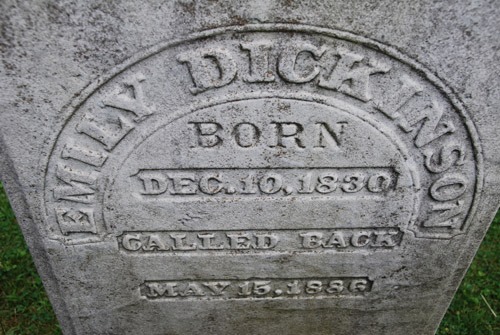
Emily Dickinson Gravestone
Emily’s family held more conventional views of heaven reflected on her gravestone

So, on one hand this is a mock solemn poem about death, spoken in a mode not that far from what Maila Nurmi/Vampira might have vamped on TV a century later. But it’s also a carpe diem poem, written this time by a woman, one whose artistic life is not giving her time to stop for death, nor the daily deaths of an unexamined, uncreative life. When Thomas Higginson was editing the first collection of Dickinson poems, he may have appreciated that aspect when he added the title “The Chariot”  to it. “The Chariot” as in “Time’s wingèd chariot” in Marvell’s poem.

At least that’s what I think is there. I could be wrong. You have to make choices.

Dickinson poems, which are largely written with her internalized Protestant hymn tune rhythms, can be set to music easily. And the basic track in my performance would have demonstrated that, as played on just a 12-string guitar, even though I undercut its simple three chord progression with some chord alterations. The piano part brings the strangeness in by playing simple arpeggiated chords, but in an insistent cross-rhythm.

So hop in the carriage, we’ve got the clip-clop of the hooves and the jangle of the harness to accompany us when you use the player below to listen to my performance of Emily Dickinson’s “Because I Could Not Stop for Death.”


Garden Elegy (for Grant Hart)

Sometimes the things we present here come together quickly. For example, some of the LYL Band pieces heard here are first takes where the musicians are reacting to the words spontaneously the best we can. Other pieces ask to spend a little time underground to think, like seeds think.

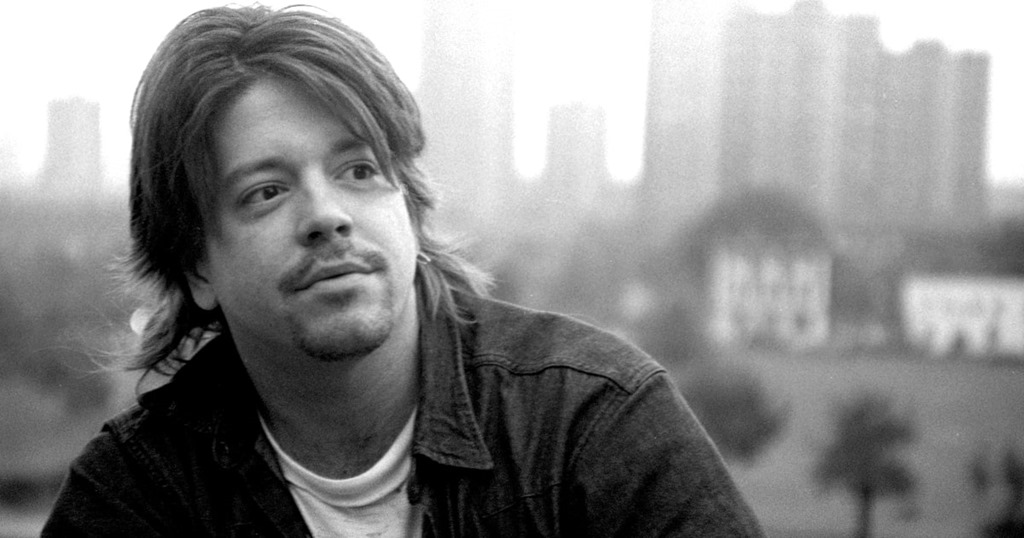
Today’s piece is one of those later ones. Nearly two months ago Grant Hart, a founding member of Hüsker Dü, a Minnesota indie rock group that achieved some fame before breaking up in the late 1980s, died. After Hüsker Dü broke up, Hart had continued working in music and visual art, some of it quite striking, none of it as well-known as it should have been. We are used to stories of a young person whose indie band is on the rise, there is less notice for those artists whose work continues past middle-age. After all, even when there are new levels to the work, there may be no apparent market. While thinking of him, I noticed, strangely, for the first time, that Grant’s name was, in effect, a two-word prayer.

younger Grant Hart

Young musicians, young artists, need will and lot of work to get a chance to succeed.
But at a certain age, they will need even more of that will to continue to make art.

.

Around the same time, I was talking with Dave Moore (who you’ve heard here, vocally, keyboardely, and composerly) about his household’s garden bounty coming to an end.

These two thoughts combined into the words for today’s piece back in September. And early last month I wrote the music—so this piece has existed, on paper, for a month. I performed it on acoustic guitar for a handful of people in a living room in October. It seemed to work. So why haven’t you heard it yet?

I really wanted to get the performance right. And this month I attempted that, getting as close as this recording. I wanted it to be good, but I didn’t want it to be polished either.

Garden Elegy

Here are the words to “Garden Elegy (for Grant Hart)”

.

The LYL Band began roughly the same time as Hüsker Dü. We even shared a producer of our first recordings back in the day (Colin Mansfield). But we were much different. We were a band of poets and artists, closer to the Fugs or Billy Bragg than the Who or the Jam. And I was then, as now, not a consistent and confident performer and a problematic singer. That was my problem as a band-member back then. As passionate as I could be in my writing, I couldn’t find the heart to focus that passion on stage, to the detriment of the band.

So, it didn’t take just the two months the song was in process, it took some decades to get close to what this song requires. When you listen to “Garden Elegy (for Grant Hart)”   you’ll hear me going for it as best I can, trying to focus passion. About halfway through you’ll hear the body of the guitar bang into the amplifier.

And that’s my prayer for artists today, perhaps your prayer too: that we may be granted heart.

Here’s the song:

.

Did you not see a player gadget above? Here’s another way to hear it, with this highlighted hyperlink that will open a player in a new tab window.

Oread

How did you spend your extra hour given to us by the Daylight Savings Time changeover? Some spent it snuggled with a loved one, or others for splendid dreams given time for extra chapters. I spent my night and hour wrestling with another poet’s poem and creating and performing music for it.

A few posts back we presented William Carlos Williams “The Red Wheelbarrow,” a widely anthologized and very short Imagist poem. My current feeling, shared in that post, was that Williams really was talking about a red wheelbarrow, a simple tool used for important tasks. Of course, he was also aware that the rain-glazed red paint of the wheelbarrow and the white chickens around it was a bold visual image, consistent with the modernist art he appreciated, and that he didn’t mind the provocation of calling attention to this without elaborate justification, any more than a classical painter or poet would think they would have been required to tell us why we should give a fig about Artemis.

Here’s another short Imagist poem, this time by Hilda Doolittle, who wrote as H. D.   H. D. knew William Carlos Williams from when Williams was a college student, but then H. D. knew or crossed paths with many of the principals of Modernism over her lifetime. Modernist poetry admitted more women creators than painting or music, or most other arts at the start of the 20th Century, but that’s a low bar to clear. H. D. cleared it however, and she continued to run her own race on her own course from the start of her career.

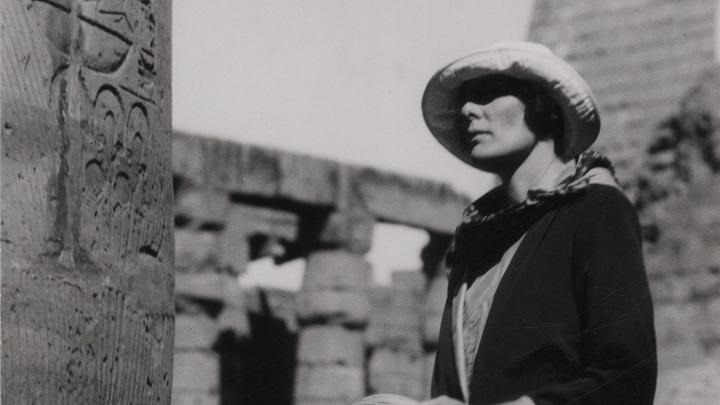
HD in Egypt

Another episode from HD’s remarkable life: she was present when King Tut’s tomb was opened in 1923


H. D.’s 26 word poem is much different from Williams’ 16 word one. It’s much stranger, and the internal state the external images present is more complex than even many longer poems reflect.

In some ways, the title “Oread”,  the effective 27th word, helps us. For those not up on Greek mythology, we can look it up, it’s a mountain nymph or spirit. Like many Greek nature spirits, an Oread is female.

So, from the title of the poem, we can say that it’s an Oread that’s speaking—but even if we grant that, this ain’t Tinkerbell. The supposed nymph is commanding nature, as a full-fledge god or goddess or a magician would. And the Oread is not asking it for protection, or forbearance, or even for it to put the hex on someone else, it’s asking it to do it’s best to overcome her. “Whirl” “pointed” “splash”, and “hurl” are some of those 26 words.

Another huge difference between Williams “Wheelbarrow”  and H. D.’s “Oread:”  the former is intensely visual, the later, just as intensely, tactile.

And who’s the Oread talking too? Three words in, it seems to make that clear: “sea.” Except the sea is described largely as a forest—a forest that can splash and form pools, but a forest at least as much as a sea. The sharpest readings of this is that the Oread is speaking of the sea with the images of the forested mountain (waves are like trees, water drops are like the needles of pines), but by saying it so, she is saying that the overcoming she commands is a merging of two like things.

I’m left with a conclusion that this is a spell of desire. Whether it is sensual, spiritual, or artistic desire makes no difference in the frenzied merger that is being called into being.

So, what did I do in writing music and performing “Oread?”  I repeat most of the lines at least twice, to emphasize the incantational aspect. Despite my recently expressed desire to re-explore artificial drum machine sounds, the percussion has lots of little instruments for a ceremonial air: shakers, maracas, cymbals, tambourine, even a chiming triangle. The main musical motif is a four-note synthesizer phrase that seems to be looping, but once again isn’t, as permutations occur throughout. The bass part rarely plays the same note as the synth motif, a musical effect that can be likened to “rubbing,” an apt metaphor for this sensuous poem.

To hear it, use the player below.


Zeppelins

For reasons of copyrights, I’ve been focusing a fair amount here on using words from the most recent poems whose rights are in the public domain (pre-1924). One side-effect of that: during the run of this project we’ve presented a good number of poems about World War I, which I recently called “The last war covered by poets.”

So, we’ve had a poem from a man waiting to enter his battle: Rupert Brooke writing on the troopship carrying him overseas; and poems written from first-hand views in the trenches by Siegfried Sassoon, Wilfred Owen, and T. E. Hulme. We’ve had reactions to the war and its losses from Ezra Pound, Tristan Tzara and Carl Sandburg. William Butler Yeats, even in refusal, is writing a war poem of a sort, one I suspect has a hidden barb at the politicians’ war propaganda.

For the most part, the poems I’ve used so far would not pass as journalism. Owen and Sassoon use fantasy to illustrate the war’s folly. Pound, Tzara, and Sandburg tell of the subjective emotional impact of the war’s losses. But Brooke’s fragment has the power of a closely observed diary entry, and T. E. Hulme comes closest so far to a straightforward war dispatch with his compressed account of the front at St. Eloi.

Today’s piece, using words by F. S. Flint, comes closer yet. Flint, the man who urged the “School of Images” in pre-war London to hew to a cadenced free verse, felt that verse and prose existed on a smooth and unbroken continuum, that good writing was good writing, regardless of the label on the tin.

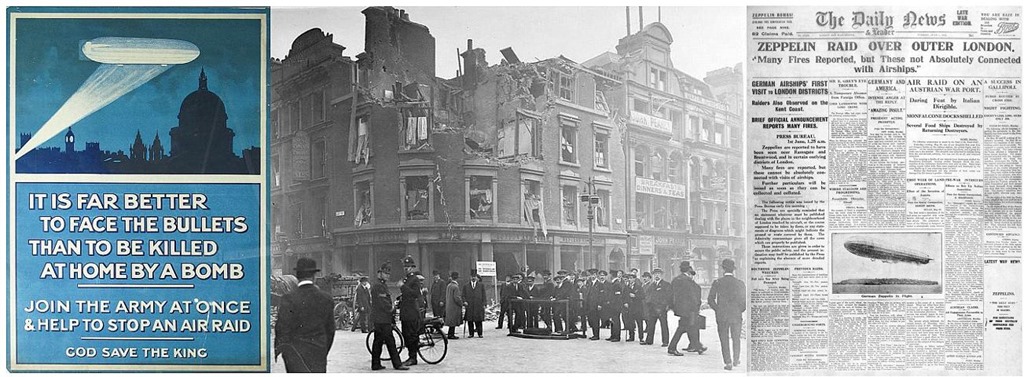
Besides being present at the birth of Modernist English poetry, Flint also was in the right place to witness another Modernist invention: aerial bombardment of cities. It’s little remembered now, but nighttime terror bombing of London was not an invention of Hitler’s air force in WWII—it was, instead, first carried out by Zeppelin airships in World War I.

Flint’s report, though artfully framed with its first-person account of being awakened from sleep in medias res, and ending with a surprising and telling conclusion, includes enough exact detail to say that it describes the first of these London raids on May 31st, 1915.

Zeppelin Raid

1915 reactions to the London Zeppelin raids of World War I

It’s a gripping account, no less than if it had been filed this year in Syria or somewhere else were bombs fall on civilians in our time. If you’d like to read “Zeppelins”  on the page, here’s a link.

Does the element in Flint’s work of mere journalism detract from its “poetic” qualities? The romantic element would say yes perhaps, there is no other “realer, now revealed” world invoked, no intense yoking of disparate images or modes of perception (although I would maintain it does just that  in a subtler way). More elaborate language, more elaborate metaphors could decorate this. Picasso’s Guernica”  is the same subject, painted decades later, but it’s also more worked out as a cubist statement.

In a sense this question is like a question I wrestle with here as I contemplate the Parlando Project which combines music with words. Does the addition of a substantial thing to something else: in the case of Flint’s “Zeppelins,”  documentary, journalistic facts to modernist poetic imagism; or in the case of my Parlando Project pieces, music and performance’s addition to what is often canonical page-poetry—are those things additive, making a greater sum—or do they, paradoxically, detract, diffusing or de-fusing the impact of the uncombined thing.

Or are these questions of art a sideline here? Do Henry and Caroline Good, dead of flames and smoke in their bedroom in that night in 1915, or Leah Lehrman, age 16 killed by a Zeppelin-dropped bomb explosion care? Do we appreciate that we live now and ponder these questions?

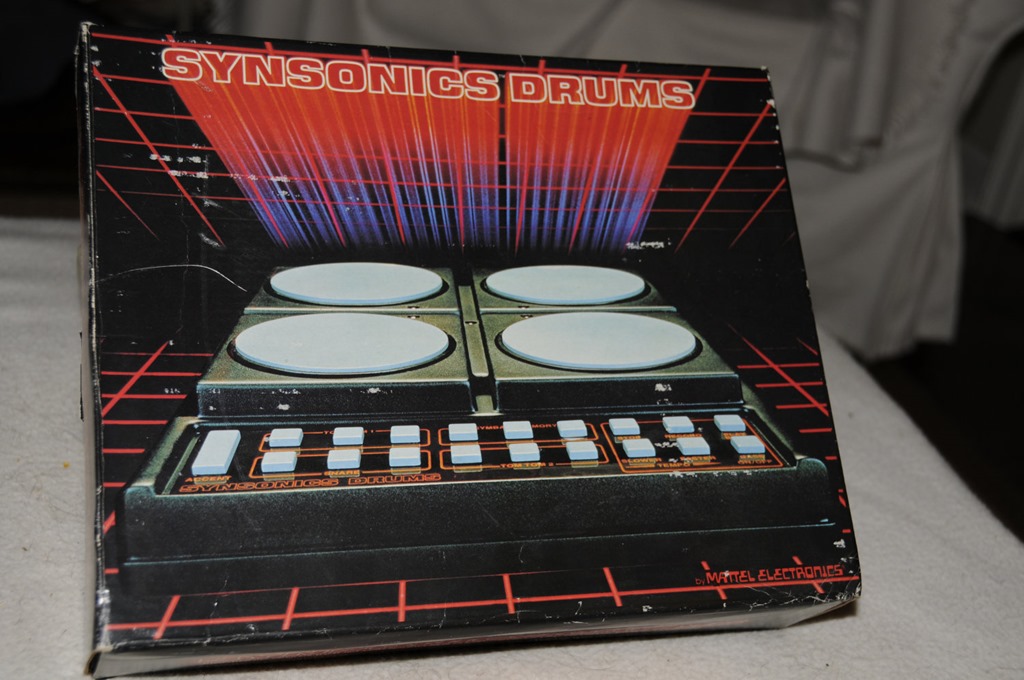
Synsonic Drums

Later that same 20th century, my first drum machine.

In writing and performing the music for Flint’s “Zeppelins,”  I wanted to lean toward Techno a bit. I avoid drum machines these days and work hard to humanize my beats on most pieces. Back in the 20th Century I used machine beats, they were all I could afford, and now in the 21st, no matter how skillfully deployed, they remind me of those crudely resolved sounds, a make-do.  My 12 year old son however enjoys them, the blippiest tracker pieces or a SID chip 8-bit beats please him with their antique charm. Then listening to Weekes new single this weekend reminded me of that charm (and made me wish I could sing better).  So I gave it a go.

You hear my performance of F. S. Flint’s “Zeppelins”  right here with the embedded player below. If you can’t see the player gadget, this highlight hyperlink will also play the performance. Something about those later 20th Century sounds just seemed right for an early 20th Century piece to me.

October November

By title this would be the perfect piece for today, though it does not describe the axis of these months this year in the upper Midwest, which is cold, gray, blustery, and threatening sleet or snow. So, this is not the day or night for sitting on arbor-seats in some garden, and the blazon leaves have already succumbed to a snow storm last week.

But never mind the weather, it’s an early enough poem from Hart Crane to have fallen into public domain, so that I can use it here. “October-November”  shows only a little of Crane’s eventual poetic style, but that means it might be a good way to introduce him.

Hart Crane and the Bridge

Would you like to buy a poem about this bridge? Crane in Brooklyn.

Crane’s just a bit younger than the other early 20th Century modernists, but you can see similarities to some of the branches of modernism we’ve already climbed out on. Like Tzara or the Surrealists he loves extravagant images; but though he is utterly romantic, there’s a certain classicism to many of the images he uses, just as H.D. or Eliot would. On the other hand, like the Futurists, he loves to touch on what was then modern technology. Like Edna St. Vincent Millay or Yeats his music can sound older than his subjects. Crane is a master of Elizabethan-style iambic meter and he doesn’t avoid the old habits of poetic diction. You can even see links in Crane to the original American Modernists: the ecstatic pronouncement of a new world and a new version of humanity like unto Walt Whitman and the concisely packed and puzzling lines of conclusion that Emily Dickinson could use.

But what you see most in Hart Crane, although it’s only hinted at in this early poem written when he was a teenager, is extraordinary, stunning, eloquence at the phrase level, lines with heart-stopping lyricism. Like Shakespeare, Dickinson or the writer of Ecclesiastes, a Crane poem may hold gnomic and gorgeous sounding lines, even if they are as inexplicable as what they sum up. One could write dozens of books or poems with titles taken from lines in Crane poems, though few have done so.

There’s more to say about Hart Crane, perhaps another post that tells about how the Modernists he lived and worked among never fully accepted him, but let me leave that for another day.

“October-November”  is simpler than later Crane, just a pair of images of sun dappling a garden as if it’s still summer followed by a fully delirious autumn night. I sense a growing intensity as this short poem proceeds, and tried to reflect that in the music I composed and played for this one, extending that ecstatic line in the instrumental section at the end.

One last ironic Halloween tie-in: Crane’s father invented Life-Savers, a candy that are now available in a rainbow diversity of sugared flavors that one might find in a ghost’s or skeleton’s bag at the end of tonight; but when invented, Life Savers was more of a breath mint line, successfully sold to cover up the vices of drink and tobacco on the breath. The thing that remains its essence? The round shape, the hole in the center, like the floating ring made to be tossed to a drowning person.

1917_Life_Savers_ad

Like a kid in a candy store. The Crane family business.

In 1932, a 32 year-old Hart Crane vaulted over the railing of the ocean liner carrying him back to New York City. One witness says they looked after, and “saw Crane, swimming strongly, but never again.” Perhaps his leap was too far and his swimming direction away from them, but there is no account of a round, perforated life preserver being tossed in after him before he disappeared and died.

To hear my performance of “October-November,”  use the player below.

Did You Miss It?

Let’s get one more Halloween appropriate piece in before the holiday.

We’ve featured a lot of words from Dave Moore this month, but not enough of his voice, so let’s get to that with a performance by Dave backed by the LYL Band. Dave’s a founding member of the LYL Band, singing and playing various keyboards with it. Beside his own band, Moore wrote lyrics for other bands back in the beginnings of the Twin Cities punk/new wave/indie rock scene. Around the same time, Dave worked with Kevin FitzPatrick on a well-loved literary magazine “The Lake Street Review.”  Besides poetry and songs, Dave Moore has produced the comic “The Spirit of Phillips”  for many years.

Besides Dave’s words, voice and keyboards that are often present here, you’ve also read me talking about Dave’s father, Les Moore (he of the Bauhaus name). That should be enough background from me.

Alan and Dave Moore

Alan Moore didn’t share any birthday cake with Dave. “Isn’t the book enough?”


I found Moore’s “Did You Miss It” mysterious, in a good way, so let’s let him tell us how it came to be:

“I could have called this ‘3 Moores Stew,’ where the ‘philosophies’ of Dave, Alan and Les collided in my head around the issue of predestination. It’s also an attempt to celebrate first-and-only-take songs.

For my birthday last year (#67), I got (my hero) Alan Moore’s 1200-pg. novel Jerusalem.  Wonderful, literally. Took a while to read such an intricate structure, and parts of it started to show up in my dreams.

Concurrently, I was editing my dad Les Moore’s sermons, typing over 50 transcripts. I’d class him as liberal Methodist, the admirable socially involved 60s Christian. I heard him speak every week till I went off to college & expected that many of his words would bang something up from my subconscious.

The lyric starts in Alan-psychogeography-zone, where one of his characters is choking to death for hundreds of pages as reality is explicated.

The joke of the chorus is also from Jerusalem, shared by Sir Thomas More with another shade. How could you miss the free will you didn’t have?

2nd verse (‘more hairy’) extrapolates Alan’s simultaneous beauty & death across time.

3rd verse (‘Belief’) is Les’s gift of Heavenly beauty despite death.

4th verse (‘Lights go on’) Dave points out you make your own beauty & might as well enjoy it. If it’s yours, you can get the joke.

Unlike most of my mistakes, those in the concluding instrumental are intentional. If everything’s pre-destined, who would bother pre-scripting this? Or could they?”

Dinty Moore Beef Stew Can

“Beef stew, I tell you there’s no beef stew…”


Dave points out the contrast we get from having LYL Band performances mixed with the more composed stuff here, where I play all the parts. “Did You Miss It”  is one of those “first and only takes songs” that we’ve done, were the arrangement and parts are happening just as the recording light is lit. Trick or treat? Mostly treat here I think.

Use the player below to hear Dave’s song.


The Red Wheelbarrow

Obscurity in modernist poetry is a funny issue. What makes some writing hard to grasp, difficult to understand? Esoteric and little-known words like Wallace Stevens loved? Far-flung allusions to works in several languages like T. S. Eliot was prone to? Exploding normal written syntax and logical flow as Gertrude Stein did? Taking images into realms where direct one-to-one symbolic meaning is not only impossible, but more than likely, not the aim, as Tristan Tzara or Paul Éluard demonstrate? Presenting things “slant” in iconoclastic riddles as Emily Dickinson could? Writing works of epic length that few if any human minds can comprehend in their whole, like the Cantos of Ezra Pound?

And then there’s this poem, the basis of today’s piece, William Carlos Williams’ “The Red Wheelbarrow.”

The Red Wheelbarrow

The whole of it: 16 words, no punctuation, all lower-case

From empirical evidence you could say that it’s the very peak of the canon of modern American poetry. Remember that compiled count of the poems that appeared most often in poetry anthologies, most of which were explicitly focused on modern American poetry? “The Red Wheelbarrow”  is alone at the top of that list, included in over half of the anthologies counted.

Does that make it a “best loved poem”? Does it even assure that critics consider it great, much less the greatest? No, it does not. I think I first ran into it as a teenage student, in one of those anthologies used in some English literature class. Did my young teacher point it out as a poem of special merit? Did I view it as such? No. If I can trust my memory, if it was discussed at all, it was as if it was some kind of stunt, an intended provocation that so short and mundane a piece could be considered artful. “Now class, let’s get back to T. S. Eliot and Wallace Stevens.”

And how about critics? They largely part like the Red Sea on “The Red Wheelbarrow”.  If we look to one side, in among the mollusks and manta rays now behind the water curtain of the divided sea, we find those who care little for it. There’s nothing there demanding to be written about. No virtuosity is demonstrated to be noted and admired. And what important point is it making, other than, well, no point at all?

So, we turn to the other side, those swimming with bemused dolphins who wonder if they could leap across the band of Israelites walking on damp seabed, those critics hoping to demonstrate their microscopic perception of the hidden art in this terribly short and compressed poem. Carol Rumens is concise and representative of this when she says of Williams’ poem “This is his manifesto, surely–a poem quietly declaring how modern poetry works.” And she also warns “A naïve reading could take it as a comment about the great usefulness of wheelbarrows on small-holdings where chickens are kept.”

And then, here I am, now. No longer the teenage student who was sure someone had figured these things out, and I need only to find them. I can’t see far enough ahead where Moses and Aaron are, nor can I see far enough back how close Pharaoh and those charioteers are getting. I’ve got my hasty bread and a few grabbed things in my little cart, pushing it across the mud. I think I must be naïve. Yes, Williams is a modernist, as committed to the new way of writing as clearly as possible, a proclaimer of “No ideas except in things,” which means in retrograde, the things must be the ideas. If he had wanted to write a manifesto, he could, and did in the other poem that stated that dictum.

The obscurity in this poem is that there is no obscurity other than what we bring to it externally. There is no allusive, secret meaning, other than the secrets we’ve kept from ourselves, of our tools and our companion responsibilities.

Yes, there is art in these 16 words: the line breaks that ask us to hold our gaze, even in the middle of words, the “so much depends” warning that bids us look. The choice to look at just these simple common things, is a choice, is an idea. I think the dolphin side of the parted sea has smarter companions than the mollusks’ side; but I am looking down at my wheelbarrow, and Williams’ wheelbarrow, and saying naively, that it matters, even if I’m in the middle of the band, unable to see Pharaoh or Moses.

I’ve spent too long on the words again, but I feel I need to say a bit about the music I composed for my performance of “The Red Wheelbarrow.” I chose to use a twelve-tone row, a modernist musical idea from the same time as when Williams was writing the poem. It would be pretentious for me to say I got this from deep study of Schoenberg or Webern, though I’ve listened to a good deal of modernist music. However, “serialism” never stuck with me until I heard the prologue part of “This Town Is a Sealed Tuna Fish Sandwich” written by Frank Zappa. I’ve loved that piece from the first time I heard it.

Twelve-tone music subverts expectations of a tonal center or “important” scalar notes, so it can sound a little woozy or random, but, of course it has its pattern, by definition, which the mind’s ear can hear if you stop thinking in expectation of familiar patterns, which is the simple and profound thing it is asking you to do.

For those who’s blog readers can display it, you can click on the player to hear my performance of “The Red Wheelbarrow.”  No player visible? This highlighted hyperlink is another way to play it.

Autumn Movement

I’ve been a bit long-winded in the past few posts, so a short-winded post about today’s piece. The words are another poem from Carl Sandburg, this time from his 1919 collection “Cornhuskers.”  There’s not very many words to it, a warning that there are not many leaves left here in the upper Midwest.

Cornhuskers cover

They were listening in London, and Sandburg’s “Cornhuskers” won him the Pulitzer prize.

I can compress talking about those words because I’ve already talked about Sandburg on the previous occasions when I’ve used his words here. In his poems of this era, he’s as perfect an imagist as any of the expatriates mixing up modernism in London and Paris around the same time.

Many of the Sandburg poems I’ve used previously have been from his landmark “Chicago Poems”  collection, but Sandburg, a child of middle, rural Illinois, spent time across the Midwest in his youth, from urban centers to the farms and small towns. The poem I use today, “Autumn Movement,”  is from that rural setting.

Images for autumn and fall foliage have been mined forever, which makes Sandburg’s key image here as unusual, even a century later, as T. E. Hulme’s red-faced farmer appearing as the harvest moon in his British autumn poem. Sandburg has the red and yellow of autumn leaves in a farm field vista as a yellow scarf with the copper color of a literally red-necked woman. So nearly has this skin color become an epithet, that few would think of using it today, as honest an image as it is.

Today’s audio piece is musically ars longa to the vita brevis of the words. I’ve been telling myself to allow space compositionally, and then going ahead anyway and filling things up like a compulsive cluttered room with only paths between piles of old newspapers. So, for this one, the drums (which are often quiet and spare) are the densest element. I added a simple bass line played on my fretless bass, a theme played on a Telecaster, and a digital synthesizer part that is a mix of four different patches played together rather than filling up the space with multiple synth parts. Give it a listen with the player  below. Or if you don’t see the player, you can use this highlighted hyperlink to play it.

The Emperor of Ice Cream

I was reminded of this poem, and Wallace Stevens in general, while writing about the 20 most anthologized modern American poems recently. It’s odd that I needed to be reminded of Stevens. His poems were always present in the anthologies of my school years, back in the last century, along with Frost (who I disliked when I was young), William Carlos Williams (who I didn’t understand), and Eliot (who I liked for his verbal music without much understanding). There must have been something about Stevens that attracted me, as when I recall the poems I wrote in my youth, they more often looked and sounded like Stevens than those others. There’s a wit of a very contrarian kind that’s all over Stevens’ work, so I’m sure that was a big part of it, but I think it was also Stevens’ verbal music that pulled me in, and unlike Eliot’s, I (subconsciously) imitated Stevens.

I later read that Stevens walked to his famously conventional job as an insurance executive every day, and composed his poems in his head as he walked. This makes sense, as I did the same thing, with the two-footed meter of walking informing the rhythm from the soles of the feet up, rather than from the head down. Another thing about writing while walking: the music of that rhythm carries you into a more hypnotic and subconscious space were lines that sound good and fit to the beat are carried and held into memory more than carefully considered phrases that one would compose at the keyboard or with thoughtful pen in hand—and that same flow can knit together the unlike before thought can reject it.

If you take Stevens’ particular perverse wit, and meld it with composition of poems while walking, you have the recipe for a Wallace Stevens poem like this one.

The title of “The Emperor of Ice-Cream”  has that impish quality. It seems to be light-hearted. Who’s his consort, the Dairy Queen? Is his uncle the King of Burgers? Did he know Prince? Queen Be? Duke, Duke, Duke, Duke of Gelato. And the poem starts off as if we are in a variation of the nursery rhyme “Old King Cole, he was a merry old soul” by calling for the strongest man to crank the ice cream maker.

A digression: do 21st Century people even know what an ice-cream maker is? It’s a bucket, no larger than one used to mop the floor, filled with ice that surrounds a smaller metal canister with a hand-crank-driven paddle screwed into the top. Salt is poured onto the ice, melting it so that it can get the canister colder than zero centigrade, as the crank is turned to churn the mixture of sugar and cream. As the process continues, the contents of the canister thickens and the force needed to turn the paddle increases. Even with a strong man cranking, the resulting ice cream will be softer than the concrete brick of modern ice cream, as that is a creature of refrigeration unknown in Stevens’ youth; but the cool, rich, sweet taste would also be all the rarer then too.

Ice Cream Maker Ad

“Call the roller of big cigars, the muscular one” churning that 2 gallon one would take a mighty man


So back to the poem. We have the strong cigar-maker man churning, amidst young, common, unmarried women and boys bringing flowers. The resulting ice cream demonstrates Stevens comically expanded vocabulary, it’s “concupiscent,” lustfully good!  Freud may have famously insisted that “a cigar is sometimes just a cigar,” but a multitude of Blues metaphors contemporary to Stevens would agree, this is a lusty scene.

And the title reappears. Pleasure, broadly drawn, is the ruler of all!

So far Stevens has only been perverse in the weird “Old King Cole”  language of the revelry, capped off with a word that most of us can’t even pronounce, much less spell or define.

Bang! Into the next stanza. I had always thought “dresser of deal” was flowery poetic diction for “we need to deal with” the situation in this next scene, but it’s more of Stevens’ vocabulary quiz. “Deal” is an archaic term for cheap pine wood. The exquisite detail of the missing drawer pulls, so much like the shabby second-hand dressers of the bedrooms of my pre-IKEA youth, yields to the fullness of the scene: it’s a room with a dead body.

Digression again: my son bursts into the room where I am writing this. He has just heard a robocall barking “If you or your loved one is over 65, they have a 1 in 3 chance of falling. Don’t let that fall be their last. Press 1 to…” He’s laughing, and continues “…hear about our warning-thingy scam…”

I follow on with my additions “…and press 2 if you want him to die anyway since he’s not allowing you any screen time today….and 3 if you are hard-of-hearing and WOULD LIKE US TO REPEAT THIS MESSAGE LOUDER.”

Back to the solemn dead body, cold and dumb, being covered with a sheet from the dresser of deal that is poignantly too short to cover the feet. Stevens leaves the light on, we need to see this clearly. And the title returns, now a refrain, and in this new context, the ruler of all offers only fleeting pleasures that one strives for, passes through, and melts away. The poem ends.

Stevens arrives at the insurance company offices. He strolls in past the receptionist, arrives at his office. Warren G. Harding is President. He asks his secretary to take this dictation. Obedient to her accustomed role, she folds back the steno pad, pencil in hand. Did she care for his poetry that she transcribed? That would be immaterial, she has only to listen.

Wallace Stevens Walking

Strolling Wallace Stevens in the 1920s. Cane in one hand, thesaurus in the other?


Two scenes. Two passing stations on a walk perhaps, or a flight of memories as lines emerge along steps. Only one more perversity to note, a puzzling line that looks like a typo: “Let be be finale of seem.” Let the steps the author is taking when he wrote this be our guide. One stride: “Let be”, then a double-time step: “be finale,” another step: “of seem.” I had never figured this line out, but someone on the Internet named Daniel E. Burke pointed me to this letter Stevens wrote in 1939. If Stevens had caught a crack in the sidewalk causing a hitch in his step, the line might have been more clearly composed as “Let being  be the finale of seem,” but the Hartford sidewalks were too-well maintained, and Stevens never cared to be understood anyway, only listened to.


I had meant to write more about the music I composed for this one, but I’ve run way too long again. I wanted prominent drums to represent the flow of time, a cello to represent the melancholy death thread and a jaunty acoustic guitar part representing the swiving partiers of the first part. Assessing the performance I first thought I should redo or remix it to keep the cello and the guitar to their respective stanzas, but then I rethought that too. Shouldn’t they both be present in each scene to give the flavor of Stevens’ perverse combination? To hear my performance of “The Emperor of Ice-Cream”  use the player below.