Art Song and Me

OK, I told you this is my summer plan: fewer readers, fewer listeners, and some of the posts are going to get weirder and deal with specialized topics that diverge from the usual stuff I write about here. Let’s start today with some personal history, something I worry about running on too long about, but I’ll try to keep it brief:

I have no formal musical training, and I even hesitate to call myself “self-taught,” as to me that infers that I have self-studied music and could demonstrate some organized mastery of it. One of my inspirations, Frank Zappa, for example, liked to recommend “Go to library, find some books, and learn how to compose.”* This is not the way complex, particularly orchestral, composition has traditionally been taught, but it made sense to me. I tried it. It didn’t stick. Though when younger, I made an effort for a couple of years to learn basics of theory and notation, but as soon as things got to examples I started to play with those examples which distracted my orderly hierarchical learning. This still happens: I’ll read some deconstruction of a musical piece, or I’ll come upon an explanation of a musical technique, and I’ll drop studying it and go off and try to use it for my own purposes.

In summary, I learned to compose music largely by playing with music. Complex or orchestral music has few examples of composers who learned in the absence of ordered instruction, but there are more examples of vernacular and popular music musicians who learned this way. Many/most of those musician/composers are effective musicians in the style they are composing in – and if large ensemble works are rarer, otherwise the complexity and sophistication of music by such composers is not necessarily limited. And now here’s the next limitation I have use ingenuity to deal with: I honestly don’t think I’m a competent musician. I’m an inconsistent guitarist with some ideas and techniques I can execute on good days. I started as a terrible singer and with improvement I hope my rough-hewn singing can rise to the level of eccentric stylist.

But – even as a child I had an appreciation for “classical music” – that highbrow stuff made with educations and exacting training. In 1960 or 61 I got an Airline transistor radio: one of those little chrome-plated trim plastic boxes a little larger and thicker than a cigarette pack that otherwise might occupy a mid-century pocket. This was in the interregnum between Rock’n’Roll’s emergent artists and the Beatles, and I listened largely to WOI-AM. Run out of a university, it could claim to be one of the first American “public radio” stations, and one that broadcast large blocks of classical music. Around this time, the wife of our little town’s public school superintendent tried to teach my classmates, farm kids, about orchestral music, and they wanted nothing to do with her seriousness about it. The besieged teacher appreciated my appreciation and likely strained herself tolerating my off-key signing in her school choir. I liked the pieces she played the class off records, often remembering them as snippets of the same pieces that were played as underscore in animated cartoons on TV. Any underground, prog rock, punk, indie, goth, etc kid from younger generations may appreciate: my peers not digging the Bach, Beethoven, and Brahms stuff was part of the attraction.

Then for two years I went to college, at a small school south of Des Moines, which, oddly enough had an ambitious opera program. Eventually the director behind this would have a nice, newly-build concert hall for his productions, but back then it was a tiny college theater or the flat-floor hall over the top of the college lunchroom. There I had the experience of hearing my classmates, kids my age, along with a few imported “ringers,” singing the classical repertoire, sometimes less than 10 yards away. This is human music, made by creatures like myself, even if I wasn’t – and wouldn’t be – able to duplicate their sound.

I promised you weird. Have I delivered? I at this point didn’t play any instrument, but I was enamored of and writing poetry. Somewhere around then I was introduced to art song.**

The same Willa Cather poem as our last Parlando episode has been set by two modern composers working in the classical tradition. This one is by William Bolcom, a composer whose breadth and aims I admire, even if I don’t think this works particularly well.

.

If I was to describe the Parlando Project it would sound like a definition of art song: “Literary poetry (generally not intended for musical performance when written) set to music by a composer who normally is not the adapted lyricist. From what I can see, art song pieces tend to be “audition” or “resume” pieces for classical music singers. Many are written to be sung with just piano or other solo instrument accompaniment, or at best, a small backing ensemble, and so are low-budget and logistically undemanding. Complex orchestrations can be added, large-scale opera and oratorio are the grander relations of this tradition.

Long time listeners here will not need me to say that a typical Parlando Project piece doesn’t sound like art song, even if it sits inside the definition. More on that soon – but art song ought to be right up my alley, right? I’ve listened to a fair amount of art song in the decades since. If my energy and life avails, I’m still amendable to hearing more of art song in concert, particularly by modern composers. And…

…I don’t care much for a lot of it. Oh, I almost always admire the training and skill of the singers and their competent musicians. I observe and admire the composers’ shared goals with my own. It’s easy for me to see them as fellow strivers intending to bring the expanded palette of music to the sound and dance of poetry. The whole enterprise, singers, accompanists, composers have resources objectively beyond those I can marshal – which should be a good thing. In thinking about this paradox, I think that’s part of the problem. And no, I’m not talking about jealousy. I genuinely want them to succeed every time, and if it’s only sometimes that I think they do – well, batting averages and shots on goal percentages come with the effort. They certainly do with my art.

Here’s a setting by Libby Larsen. Notice how the singer increases the level of ornamentation after the opening verse. I’ve briefly met Larsen, a couple of times., and like Bolcom I admire the aims of her work.

.

First off, the composers often write complex melodies. Hampered by my lousy singing talents, I feel my pieces should have more melody – but with the art song composers I often think their elaborateness obscures the impact of the words rather than reinforcing them. The “word-music” and phrasing of the poetry can be contorted to fit the melody’s interest, and only sometimes will that contortion produce interesting effects by abstracting the flow an actor would use rendering the words, with unexpected phrasing being applied from the notes. In these matters I sometimes think of the stillborn dream of one of the most musical of English-language poets, William Butler Yeats: to create a para-art-song tradition that would preserve more of his “word music.” I’m just a naïve composer, a nobody, but I’d suggest that harmonic or timbral elaboration might better stand in for over-reliance on melodic complexity in art song with significant poetry.

Another performance of Larsen’s setting of Cather’s poem. Would this singer be judged as lacking the technical polish of the ones above? Even if so, I preferred it. Sung at a slower tempo and I sense the singer wants to inflect more meaning into the words.

.

The singers or conductors, working from score, are asked to faithfully reproduce the composer, but I believe they are allowed some freedom in ornament. Given that constrained outlet, there’s a temptation to over-exercise this. Even from my limited knowledge, I know that some of the vocal articulations are traditional techniques in classical singing to express emotional states. Like all conventions (even contemporary ones in vernacular music) they risk being misunderstood or even taken for cliches when the convention isn’t correctly “translated” by the listener.

And now for someone else doing something with the same “The Hawthorn Tree” poem, using an approach much like mine. The performer (and, I believe composer) David Ellis has done nothing I can locate since issuing a set of 4 poem settings similar to this one, and they don’t seem to be widely available.

.

Does a thru-line become apparent as I wrap this up? I probably come to art song believing in the power of the words to work for an audience with less adornment, and this may be the prejudice of a poet who later composed music and preforms it with their personal limited skills.*** I suspect all these dangers and detriments are already known to trained composers and performers, just as I know intimately the limitations I work with in making my pieces here. I respect their hard work and knowledge.**** How some of their work is experienced by this listener may well be my limitations, though I suspect (however muffled inside my own makeup and experiences) I’m more amenable to traditional classical art song than large portions of its potential audience.


.

*This is a paraphrase from an interview I read, and a report of what he himself did. Flavorful quotes I can grab from Zappa: “Drop out of school before your mind rots from exposure to our mediocre educational system. Forget about the Senior Prom and go to the library and educate yourself if you’ve got any guts” and “If you want to get laid, go to college. If you want an education, go to the library.” Generally lacking money for college, this iconoclasm was promising to me, but let me point out empirically that sustainable non-academic orchestral composing is even more unlikely than following the thin odds of a conventional academic route.

**I also worked in my adulthood for more than 20 years for a radio network with a 24-hour classical music service. Kind of like I was saying about SF literature and fandom a couple of posts back: I’m not an expert in that field, but I’ve hung around with folks that where.

***Some singers in the folk music field, performing with single or sparce accompaniment can do this, but with more melodicism than my voice can provide. One of the more enthralling concerts I’ve experienced was June Tabor and a keyboardist. I felt the meaning of every single word she sang that night.

****The Parlando Project is designed, and has met its goals so far, as a non-revenue thing, despite my putting serious effort into it. Most classical-tradition performers and composers receive very little revenue for all their efforts, study, and hard work invested in their art. If we hear each other’s results differently (as I suspect we do) I recognize that difference/similarity.

The Hawthorn Tree

You could put Willa Cather within a group: writers known as novelists who also wrote some worthwhile poetry. I didn’t know she wrote verse, but this poem of thwarted love, “The Hawthorn Tree”  charmed me when I read it in an anthology this summer. Furthermore, I had sense immediately that it wanted to be sung.

Cather’s best-known prose deals with European immigrant pioneers settling in the rural American Great Plains; but though they’ve been recommended to me, I’ve never read her novels.*  Cather’s family moved to Nebraska when she was 9 and she attended college there. After college she moved east, and she lived most of her long life in New York, where she wrote of Nebraska while living far from it – a distance that has fueled many a novel.

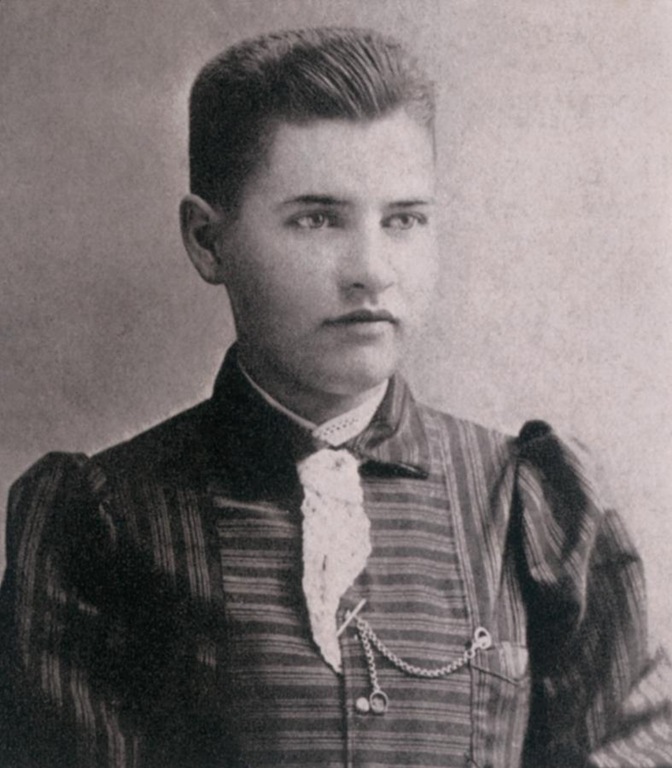
willa-cather-when-she-was-a-student-everett

The young Willa Cather in her student days

.

“The Hawthorn Tree”  poem doesn’t tell us where it takes place on any state map — it refrains instead on the titular tree somewhere, a location of a tryst between two people that the poem’s voice will tell, and not tell, us about. Since the hawthorn tree is a very widespread species, it’s not a clue about what state or time it occupies – but let’s ask: why is it a hawthorn, not an ash, maple, or apple tree? Perhaps it’s an accident of biography – a specific tree in some incident Cather herself experienced or knew of. I can’t rule that out, but it’s given such importance within this short poem I think the author made a choice to name it.

Here’s a link to the text of Willa Cather’s poem.

As the name implies, a hawthorn has thorny branches, a prickly botanical feature which is a common trope in poems and songs of thwarted love. Likewise, it has blossoms and sweet fruit in season, more reasons for it to be in a love poem. Not knowing Cather’s work, or much detail of her life, I can’t say what she might know about the myths, legends, or herbal-medicine knowledge regarding the hawthorn. I read that it’s a tree sacred to fairies, it’s thought to be a sentinel or guardian of gateways between worlds, and that the fruit can cure a broken heart.**

So, invention or memoir incident? That mystery accompanies the mysteries in this story’s telling. It could be rendering the common folk-song plot of a couple who briefly meet (and perhaps make love) somewhere while out in nature, and who are then parted. Cather could be taken with such folk songs and tales, could be writing her version of that – or it could be autobiographical.***  One other thing: we’ve been exploring poems of the faery world recently, it could be slyly fantastical – the unnamed creature who meets the poem’s singer from out of the mist could be from the faery realm. Cather’s poem happens in spring-time, another marker found in many of the folk-songs – which often start with some variation of “one morning in May” or the like – but Cather’s mysterious tale says its tryst happens in the night-time.

Whatever the exact and unsaid details, the poem had captured my attention, and those references to folk-song elements drove me to write music for it. I used an unusual open tuning here, one called Csus (CGCGCD), and the lower pitch of the tuning and the chord voicings I used caused me to break out my less-used larger-bodied dreadnaught guitar for this one.

I followed Cather’s text for the resulting song, but then at the end of the performance you can hear with the audio player below I adlibbed my own short variation expanding on the mysterious details of the meeting under the hawthorn tree. What ho? There’s no audio player for you? Ah, I have provided a gateway to a dimension that will show the audio player that’s hidden to you, mortal – likely due to the method you’re using to read this blog. Use this hawthorn branch – no, this highlighted link – which will open a new browser tab manifesting its own audio player.


.


*I’m far from well-read regarding novels. Poetry captured me in my youth, and that art meshed so easily with my love for music that I can easily be embarrassed in any literary crowd which takes “literature” to largely mean “fiction.”

**Besides folk-medicine, there’s been some modern pharmaceutical investigation of the hawthorn fruit’s ingredients. This video explains a bit about the hawthorn and the beliefs surrounding it.

***Cather’s love life is not an open book, but her life partner was a woman. The one from the mist who the poem’s voice meets under the hawthorn tree is a “he.” I made a choice not to alter the genders here, perhaps because this spring my home has been full of gender-dynamic visitors and residents. Or perhaps I’m following the example of famous gender-crossing singers like Eric Burdon and Ringo Starr.

Sara Teasdale’s “A Prayer”

Just time for a short post presenting a short musical piece made from a short poem by Sara Teasdale. Teasdale’s “A Prayer”  goes over some of the same ground (or gravely, below ground) as her better-known poem “I Shall Not Care,”  each poem ending a telling stanza with a variation of and end-of-life caring not.*  But of the two, “A Prayer”  is more positive and less bitter. “I Shall Not Care”  posits the grave’s lack of care as justice for lack of care from a lover, “A Prayer’s”  poetic voice vows careless love throughout a lifetime regardless of the elusiveness of mutual love.

A Prayer

Simple enough music for this short piece, though the F Major 7th is a favorite alternative flavor of mine. I also enjoyed coming up with the snap modulation in the little section between the two verses.

.

While working with this poem this past week I thought too of Teasdale’s contemporary Robert Frost’s proposed epitaph that he wrote at the end of a much longer poem of his:

I would have written of me on my stone:
I had a lover’s quarrel with the world.

You can hear my musical performance of Teasdale’s poem with the audio player gadget below. If you can’t see that gadget, I shall not care, because I’ve provided this highlighted link for you that will instead open a new browser tab with it’s own audio player.


*”I Shall Not Care”  was my introduction to Teasdale’s work, as I recount it this post from early in the Parlando Project about how a musical performance of it helped inspire how I do these things.

Gitanjali 58

Close readers will notice that I’ve slipped into my sparser (and sometimes weirder) summer publishing schedule with this Project. After a few years of doing Parlando, I noticed that summer readership/listenership predictably dropped off, so as a result I’ve come to treat summer as something between a vacation and what-the-hell-write-about-odd-topics season.

However, as spring was ending this year two different things had a combined effect on this changeover. The first was the increase in the number of young lovers and their friends staying and visiting at our house. All in their early 20s, this group is dealing with the fledgling era of life, trying to figure out how to live as whatever adults they will invent themselves as, with additional particularities secondary to being neuro-spicey and gender fluid. If this were to be a complete and well-written account, this statement would be followed by acutely-observed detail layered with statements of social analysis. This putative writer (who is not myself) would also be weaving into their account tales of how they are acting as a wise elder guiding the youth with articulate interventions and life lessons.

I’m not acting thus, nor writing my observational accounts here. My own memories of that era from my life years ago says I wanted to – and generally believed I was the best to – make my own life decisions, though later I also regretted never hearing from my elders how they felt about and solved these tasks of young adulthood in their fledgling time. I sometimes feel ashamed; sometimes feel I should make that effort – even if it would be likely rejected, or that my advice would be poor or based on misunderstanding of the specifics of their lives. I feel this, even though I’m not acting on it. My wife, already carrying burdens of a mother suffering dementia, tries to reach out to indifferent results, acts of hers I generally admire.

As to writing about my observation of their lives, I’m circumspect. If I were not an old man, I’d say I would write about those things 20 years from now when we’re all older and past this, but that’s demographically unlikely for me.

Two of the young lovers have had a parting in their relationship, but not a parting (yet) in their residence. This complicates things. The work of this Project is crowded out by this crowd in our small house. Objectively I should be paying more attention to helping or meddling with this situation – I wrote that deliberately: “helping” and “meddling” is a dichotomy.

And also now, strangely, with a level of importance that seems selfish and self-absorbed, I sometimes feel worried that I haven’t finished a new audio piece here for a couple of weeks. An interval that was planned in other Junes now has some anxiety around it.

Late last week I whined to my wife “I haven’t done anything  creative in so long that I fear I’ve forgotten how to start.” I call this whining because regardless of no new pieces, my nature has had me trying to learn in small ways various new things while I await some future time when I might have opportunity to implement them. How grateful I am, and yet how insufficient is my gratitude that I have such opportunities!

An answer to not having done anything creative is not to observe that situation and whine about it, but rather to do it.  Blow through or ignore the pre-requisites. Ignore fears about quality, for whatever care and resources one brings to making something – that’s never assured anyway.

I decided all I needed was a set of words that I felt said something about where I’m living in my life. Will it be by someone of my generation or life-stage? Perhaps another disappointed American facing a hollowed-out public anniversary presided over by a cruel and diminished King?

No, I found this: Gitanjali 58  from a 1912 English translation of a selection of song lyrics by the remarkable Bengali polymath Rabindranath Tagore. This work quickly earned Tagore the Nobel Prize for Literature in 1913 and the praise and introductory preface to an edition of it by William Butler Yeats. Though Tagore was, even more than Yeats was in his Ireland, involved in the anti-colonial movement in India, I recall no overt politics in this book. There are pieces in it with elements of erotic love, but within the overall spiritual cast of the work it would be arguable that they are (as, for example, some scholars say about the Hebrew Song of Songs)  metaphors for broader, even mystic, desires. Yet this was the text that attracted me when I needed some words to express.

Gitanjali 58

Among the changes I made to the text as printed in 1912, I arranged it on the page as if it was a poem

.

One problem with Gitanjali  is that Tagore did the English translation himself, and chose (presumably to emphasize the spiritual lessons in his lyrics) to publish them as English prose. As a person who has done translations I can see why he might make this choice. I almost never try to do rhyming translations or emulate the elements of prosody from another language. I’d rather concentrate on what the poet is observing and wants to transfer to contemporary readers in English, rather than play a game of Twister with another syntax and tactics of word sounds. Yet, I’m not alone in thinking he took the magic and incantatory power away, doubling the problem of song lyrics seeming dehydrated and without weight when deserted silently on the page. For reasons of my own life situation, and for greater musicality and clarity in performance, I lightly edited Tagore’s English prose text for today’s use. I admit this was an audacious thing to do, and here’s a link to how Tagore had it.

Given the length of this post, only one short note on the text: in Hindu and Buddhist symbology the red lotus mentioned here is the aspect of compassion, which could be cast as a painful burden. Is it painful to empathize with the suffering and struggle around one? Perhaps, but one has (however temporarily) whatever level of peace, understanding, and contemplative opportunity to do so.

If (as is likely) Tagore had his own melody to this, I don’t know it. It was necessary to move to making, both from lack of time and need to overcome inertia. I played and recorded the music quickly, having come up with a couple of motifs the electric guitar sounds over a quickly written cadence I had played on another guitar and electric bass, a harmonic framework also followed by my piano .* There’s no sung melody. I at first wanted to compose one, but that would delay finishing this, and I made the get-it-done spoken word choice. I’m avoiding 4/4 time more often these days, odd meters seem to express the unbalance I’m feeling, even though my computer drumset sequencer doesn’t express odd time signatures very well. You can hear the performance with the audio player gadget below. There’s no player visible? The first of the Four Noble Truths says getting what you want on the Internet can involve Suffering, and so some ways of reading this blog will not display the player. Aha! I provide this highlighted link that with meditation (or clicking, just clicking!) opens a new browser tab with its own audio player.


.


*I hadn’t played a Telecaster plugged into a classic Fender amp in a while. “This sounds way too thin and bright!” I was thinking, while also reminding my guitar player self that I didn’t have much time to fiddle with settings or try another setup. What the chordal guitar plays is, very roughly and impressionistically, taking the role a drone instrument might take in South Asian music, though this song uses Western-style harmonic movement; and the lead/melody guitar occasionally touches on my simplified approximation of some South Asian melodic moves. Even though they are traditionally acoustic instruments, while I was doing the mix on the recorded tracks I subsequently recalled that the sitar and the lower-register tambura are often bright sounding instruments compared to the thicker timbres of western acoustic guitars.

Frances Cornford’s Dirge

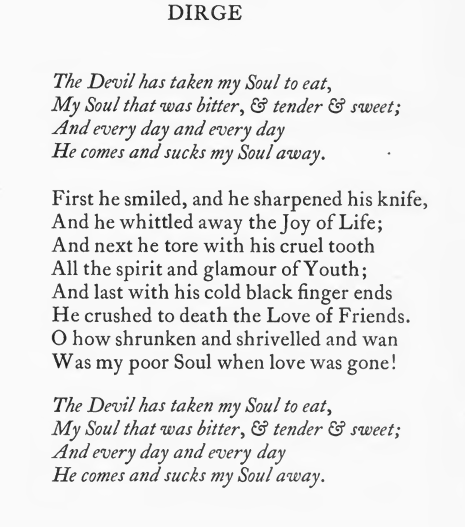
It’s been a while since I presented a musical performance of a poem by English poet Frances Cornford, but here’s one from her early book-length collection published in 1910 when the poet was 24 years old. The poem is brief, but it presents the speaker as having had their life and soul ransacked by evil. I don’t know a lot about the biography of Cornford’s youth,* but the situation outlined in the poem is so bleak that it brings up the suspicion that it may be a “persona poem” where the young poet is, perhaps as an exercise, trying to write poems from a variety of viewpoints.**

Many poets early books collect material originally drafted a few years before publication, so it’s plausible that this Edwardian-era poem was written by someone even younger than 24, and yet I, an old man living under a disreputable 21st century regime, found its complaints easy to slip into. I think it helps a modern performer (and I hope, a modern listener) that the poem expresses itself straightforwardly without a lot of shopworn 19th century metaphoric baggage which many of Cornford’s English contemporaries might easily fall into.

Cornford's Dirge

I love that description of the soul that had been taken from the singer, a soul that was “bitter, & tender & sweet.” Close readers will note that Cambridge-scene-raised Cornford eschews the Oxford comma in that inventory.

.

So, if this is a made-up poetic exercise by a young poet, she did a good clean job of making something. Despite its title and the daunting situation cataloged in the poem, Cornford’s prosody seems almost jaunty, and so that’s how I approached creating the music and performance for it. The words in the poem offer no consolation for all that the devil has taken from the singer – but just as in Afro-American Blues lyrics, the very fact that the singer is singing  (not whimpering in pain or self-pity) and accounting for what has been put upon them makes its own point of survival and ability to analyze what they’ve suffered.

You can hear my performance of Frances Cornford’s “Dirge”  with the audio player below. What, did the Devil take that away too? No, it’s just that some ways of reading this blog won’t show it, but I provide an alternative: this highlighted link that will open a new browser tab with its own audio player.


.


*Nepo baby rating? Cornford will see most any other writer’s hand and bust yah: her paternal grandfather was Charles Darwin, and on her mother’s side she was William Wordsworth’s great-niece. Her mother was a lecturer in English Literature at Newnham College. Her father was a notable botanist that flourished in the shade of his evolutionary father. At time of publication, she was newly married to a Cambridge classics scholar. Fun (and confusing) fact: her father and her husband’s given names were both Francis – so upon taking the conventional married name she repeated the complication of being a distaff homonym-named person in a household. One of her grandchildren, Adam Cornford (still living) followed the clans’ conflation of fields between poetry and science.

**Included in the same collection as “Dirge”  was Cornford’s best-known poem, the triolet about “A Fat Lady Seen from the Train.”   Similarly clean, spare, and sharply spoken in its verse as today’s poem, it curiously has one of the first plausibly disparaging uses of the term “white” by a white poet – and others took issue with that poem’s treatment of its subject almost immediately.

I think it’s possible that the speaker in that poem may not be Cornford, but an invention or external observation. I’ve even mused that since the “fat white woman who nobody loves” is seen through a train window, that the poem’s speaker is seeing her own reflection in the glass. In photos Cornford looks quite thin, making me then speculate about anorexia.

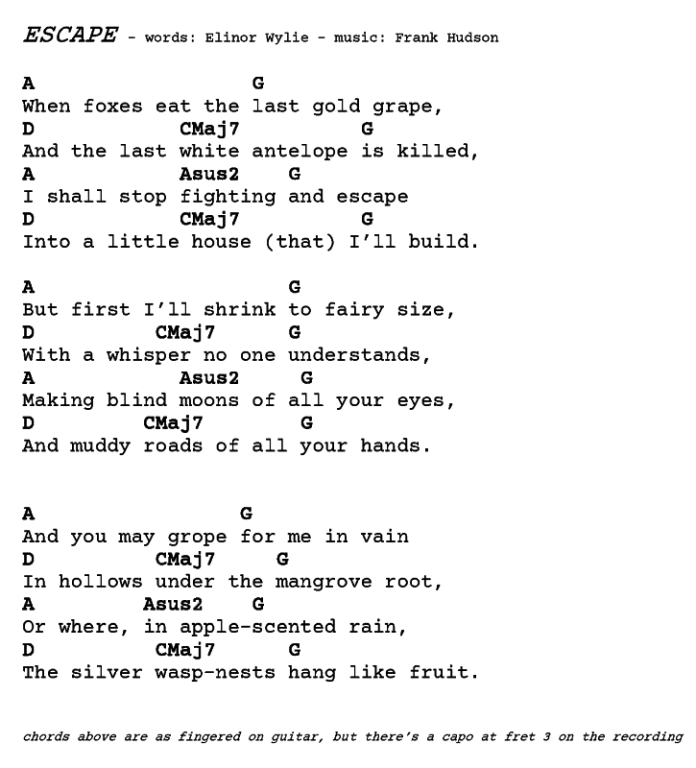
Elinor Wylie’s “Escape”

The process of creating music/recording performances of other people’s poetry as part of this Project usually leads me to some deeper understanding of the poem’s text. It’s not something I have to try to do, some preliminary task I need to check off to complete a Parlando Project piece. What kind of music? Who is the person in the text that I will give voice to, even with my limited vocal talents? What is the original, if page-silent, person seeing, feeling? Why are they paying attention to that? What might these things, shared by expression, mean to you and I?

I did write “usually” up there in that paragraph. I found this short poem by early 20th century American poet Elinor Wylie late last winter, and it’s one of those texts that at first glance you want to make it sound – a literary poem that begs to be sung. But if you’d asked me, what does it mean then, or even after I composed the music, even after I’d completed the simple acoustic guitar and voice recording you can hear below, I’d have said: “Well, not much. It means to evoke a sort of beauty I guess, and that may be enough for a few minutes of song.”

My situation right now makes it harder for me to get opportunities to record new things, but I had this recording of Wylie’s poem (like the Claude McKay poem from last time) from a session in my studio space last March. I did the final “mastered” version to distribute* yesterday morning, and then wondered what I’d write about it. Just say: “It’s pretty. That may be enough?”

Wylie's Escape

Besides Yeats, when Wylie mentions “the last white antelope is killed” I thought of this Edwin Ford Piper poem.

.

And then my wife came home, dealing with some highly distressing information secondary to her mother who’s been in dementia care for the past decade or so. There’s no easy solution, perhaps no solution, to the problem that news brought. I could only listen and share her distress.

As I tried to go to sleep after holding my wife close, this occurred to me, so late in the process with this poem of Wylie’s: had it attracted me in part because it reminded me of a beloved William Butler Yeats’ poem “The Lake Isle of Innisfree?”   Like Yeats, Wylie imagines a cabin enshrined in a nature scene – but Yeats, even though a practicing mystic, described a realistic cabin, one not unlike the one my wife and I just spent a blissful week in earlier this month.** Wylie’s cabin is not real, it’s a tiny faery house that she will need to transform herself to step inside. The nature around Wylie’s little house is drenched in esoteric symbols. Like Yeats’ Wandering Aengus, in another of that great Irish poet’s poems, with his silver and gold apples; she has apple-scented rain, golden grapes, and silver wasp nests. Yeats wrote his poem living in urban London, but he could go and live where he wrote about in “Innisfree.”   Wylie’s cabin is entirely one of imagination.

Suddenly, without planning, and after I had completed the musical piece you can hear with the audio player below, I understood this poem that Elinor Wylie titled “Escape”  in a fuller way: imaginative escape can be from dark and intractable life – a habitation in a glittering bubble floating briefly in heavy, toxic, air.

If for some reason your way of reading this post can’t imagine the audio player gadget, I offer this highlighted link that will open a new browser tab which will have its own audio player.


.


*”Mastering” is the making the final adjustments to the audio levels and frequency spectrum of a recording so that the resulting recording will sound within expectations in the context of other recordings. This is also a good place to remind readers here that if you want a way to receive or share the audio pieces I present here, without my little essays writing about my encounters: all the Parlando Project audio pieces are available as a podcast on Apple Podcasts or most of the other podcast catalogs/distributors. These are not hour-long chats about the poems and the music – they are just the musical performances themselves, typically 2-5 minutes in length.

**Our recent north shore of Lake Superior cabin wasn’t of clay and wattles made, but cabins in rural Ireland during Yeats’ time certainly were.

Claude McKay’s “On the Road” – and I went to a cabin in the woods

When I last posted I was planning on a trip to an off-the-grid cabin on the north shore of Lake Superior. I’ve now returned, and I’ll have some things I’ll write about here shortly. My goals for this trip: to spend some isolated time with my wife, and then while she would take the opportunity to go off on some nature hikes, to have some quiet time to do some reading or playing guitar amid the sounds of nature.*

The northern place we would stay in was in a birch-rich woods between a river and a tiny creek. It was comfortable, but it had no Wi-Fi, no power, no running water.** The place to park our car was ¾ mile from the cabin. The narrow path from there through the woods had steep rocky and root strewn portions. That concentrates one’s thoughts on what to take. Not a parsimonious hiker, I packed needing two car-to-cabin trips: a backpack with toiletries and a week’s clothes for various temperatures, and then a small acoustic guitar in a Tric guitar case that has attached backpack straps.***  In each trip between car and cabin these two backpacked bags left hands free to carry an additional bag. One trip would add a bag of food we brought with us, the other a bag of books: food for the mind and food for the rest of the body.

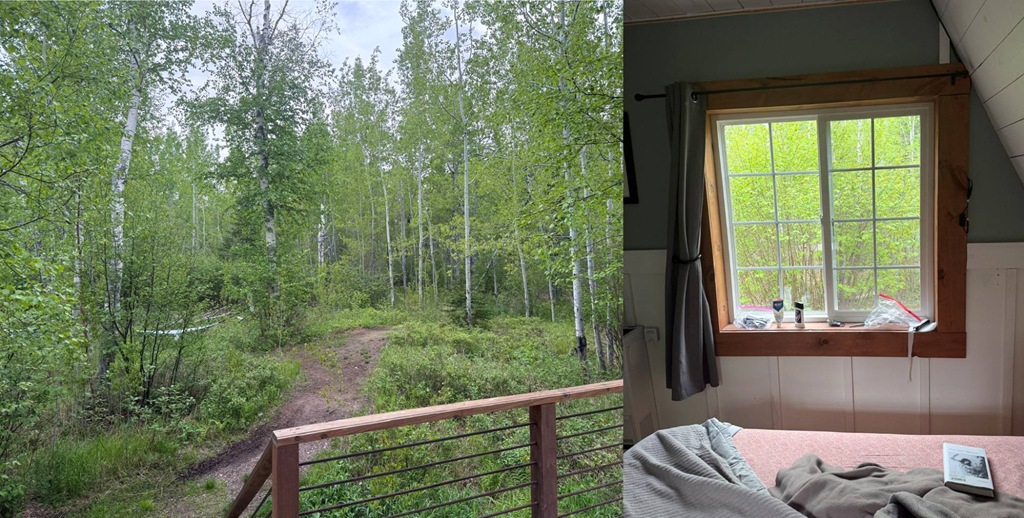
Two cabin June 2026 pictures

The forest from the front door of the cabin, with one of the flatter parts of the trail leading to it and the view out the back of the cabin from the bedroom. Every morning when dawn would break it was like living inside an Impressionist painting and looking out the frame through the dense pointillist leaved branches.

.


Though I plan to write in a later post or posts about my experiences borne from that bag of books – after all, that’s something regular blogs do – for now I’m finding it hard to get back into the rhythm of producing new musical pieces and more extended thoughts on the texts I combine with them.

So, to tide you over, here’s a little piece, “On the Road,”  a lesser-known, but still well-crafted poem by Claude McKay about common days of work enmeshed with people one didn’t choose to be with – rather than my week in the woods as half a pair who had made a determination to be such 22 years ago. Beside the recording below, here’s a link to the text of McKay’s poem.  This winter I did a whole month of posts and musical pieces on Jamaican-American immigrant McKay’s poetry, and this one was left-over from then. Audio player gadget below to hear it, and if there’s no such player to be seen, it hasn’t gone off swiving or drinking like McKay’s waitstaff, it’s just being suppressed by some ways of reading this blog which won’t show it. You can use this highlighted link instead – it will open a new browser tab with its own audio player.


.


*In theory (and in practice) I’m reading at home too, but I find there’s something added by the context of reading a book in place remote from one usual location, much in the same way that I would play guitar differently in a forest than on a streetcorner – and my home reading must be slotted in with other things. The pleasure of creating the music for this Project, no matter how tied it is to the poetic texts I use, takes away from reading time. There would be no recording equipment or power for a computer in the cabin. I’ll also confess that my country’s misrule has turned me into a habitual doomscroller – and while there are elements of citizenship and warning alertness in that, it’s rarely productive or satisfying.

**Telling a friend about this over breakfast on this my returning week, he asked if I “Went to the woods because I wished to live deliberately, to front only the essential facts of life….”

And I replied, “You mean like someone else, that other guy? Why yes, I did – but I somehow didn’t get around to writing my manifesto about which academic scientists need to die from letter bombs.”

My friend got the joke. Of “Unibomber” Ted Kaczynski’s nature I am not made nor cultivated. Elevating one’s own thoughts in solitude is a sort of two-headed beast though. Making thought’s resolutions from a majority of one doesn’t necessarily create a Henry David Thoreau. My own Transcendentalist solitude is more at Emily Dickinson’s mode. I enjoy condensing the music of the universe into little poems or six fretted strings, and like Dickinson’s book/frigate, my aged nature hikes are likely stanza to stanza rather than wooded ridge to rocky outcrop.

***The Tric is an excellent but now apparently discontinued guitar case made by Godin, a Canadian guitar maker. It looks (and has those backpack straps) like the “gig bags” sometimes used by musicians, particular those that need to travel by foot or public transit. Like a gig bag it has a tough nylon fabric exterior that is closed by a zipper – but inside a gig bag there is an inch more-or-less of soft foam, enough to protect the instrument inside from little bumps, but not from more serious insults. The Tric case has a couple of inches of rigid Styrofoam inside (like a motorcycle helmet) and that makes it overall as protective as a much heavier conventional standard guitar case made out of vinyl-covered plywood. Just as with a helmet, it’s a better system for absorbing shock from falls, and like a Styrofoam ice chest, it’s better than standard cases for regulating internal temperatures. Despite that added protection a Tric case is as light as non-rigid gig bag, and unlike some highly protective carbon fiber instrument cases it was sold at an affordable price.

(Still reading all the way down here? I think today I’ve finally realized the perfect post for my way of writing: the set of footnotes longer than the body of the post!)

A Faery Song (We who are old)

My wife, who I suspect of having some strain of a woodland nymph in her genetic background, is going to take me to her elflin grot  this summer – well, an off-the grid cabin on the North Shore of Lake Superior – close enough. During this stay, she will take supervisory woodland hikes where she will photograph fungi and wildflowers as part of documenting that nature is working up to spec. I, one of those who are old, will stay in the cabin and read poetry, a media format that doesn’t require any wired or wireless energy other than the long sunlight of a northern summer.

I’m unsure if this cabin will be explicitly in a bee-loud glade, but such plans make me think of William Butler Yeats, and here’s an early poem of his, written by a 20-something poet amplifying his Irish heritage amid the still extant 19th century fashion for antique fantasy.

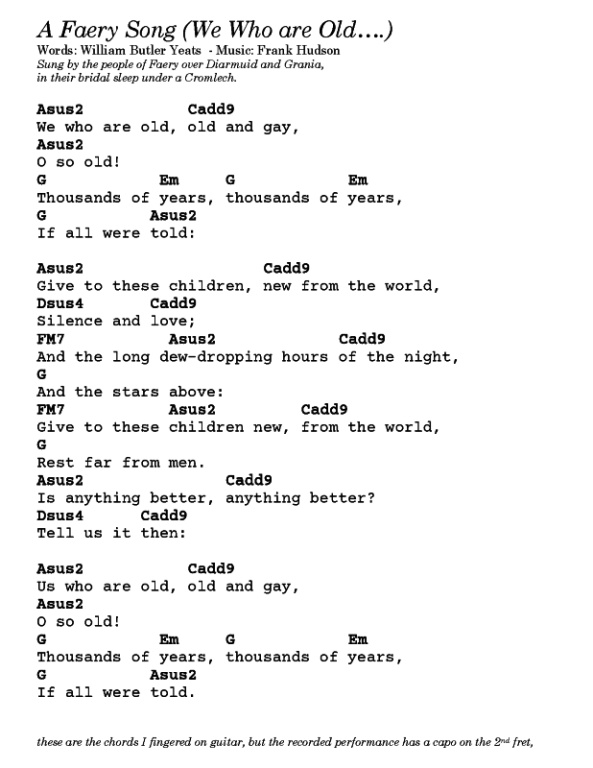
A Faery Song

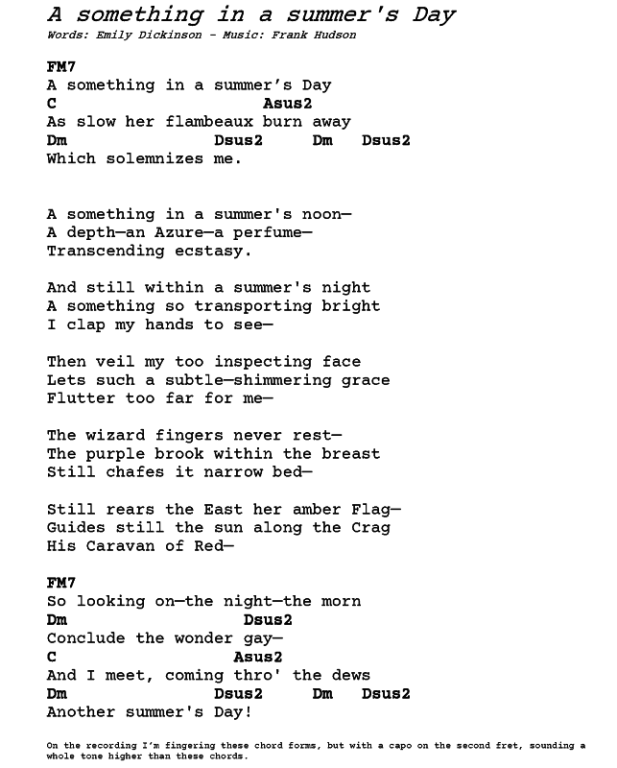
A chord sheet in case you want to sing it yourself

.

Yeats provides context for his lyric poem, with the note: “Sung by the people of Faery over Diarmuid and Grania, in their bridal sleep under a Cromlech.” Is there a tale alluded to there? Yes, and it’s a major part of Ireland’s bardic Fenian saga, set in the 3rd Century reign of king Cormac. The over-riding hero of these linked tales is a warrior with supernatural powers, Finn McCool,* who is the leader of the king’s army. McCool is not the hero of the Diarmuid and Grania part of story however, but a jealous third-wheel antagonist.

The story of Diarmuid and Grania has many retellings, which vary, but the general outline is that Cormac promises his daughter Grania to the aging great hero and warrior Finn. However, before this marriage can happen, one day in court Grania spies Diarmuid, who is a major young hottie of Lancelotian proportions. Not interested in the old Finn and the entire warlord power structure, she drugs Diarmuid with some enchantment potion causing him to carry her off elopement-style.**

There’s a great deal more to the tale, with a major twist that the noble Diarmund resists letting Grania seduce him sexually because he’s warrior-loyal to his leader Finn McCool; and even though the pursuing McCool, the great warrior who commands a literal “and whose army” wants to apprehend and likely kill him, he leaves a pre-Internet breadcrumb trail in hopes that the eloping couple would be found out.

Unless you’re Robert Bly booking your hero’s journey, there’s enough there that you may be wanting to just get on with Yeats’ short poem, but there’s one more detail in Yeats’ note: what’s a “Cromlech” where the fleeing couple bed down? No, that’s not the Gaelic-transcription-name for a low-powered Google notebook used in schools. It’s an ancient tomb made from piles of stones – no gmail or Google docs available there. The faeries looking over the Eros/Thanatos couple hiding in a tomb could have sung Thomas Campion’s loose translation of Catullus if they couldn’t book Yeats.

The skip-ahead reader, without all that backstory, might hear “A Faery Song”  as a “Forever Young”   blessing of young people by their elders and by the traditions of those elders. That’s a perfectly fine sentiment – and it’s not just some sweet cliché, but one I say is too rarely expressed. It was easy to think that way about the poem as I worked on the music and its recorded performance, being an aged man whose house has several young lovers moving through it. But I think Yeats was, in this context I’ve outlined, offering that ancient  heritage, older than any living. may speak to comfort and guide the young, give them rest from the elders in power, from a world of men (gender and species). Of course, that is made from fantasy, faery fantasy. It is a dream of wishes.

I had one other reason to move this short poem up in my “maybe do this one” pile: I’ve been trying to catch up on blogs I follow after the absorption of National Poetry Month,*** and I came upon this post by a friend of this Project Lesley Wheeler where a dream was recounted:

This weekend I dreamed that my problem joints (knees, hips, an ankle that requires babying) were replaced by faery joints (in the dream, I knew faery was spelled with an e!). They looked like cloudy ice or crystal. I like the idea of being a human-faery cyborg.”

While we cannot fully dream anyone else’s dream, poets and poetry can fancy some of their substance. Reading this I figured this in addition: ever light and gossamer wings sprouting from out our backs, devices that would radiate and transfer the sciatica from too many hours sitting with books and blank pages of paper.

Yes, that’s but a dream – but we carry our bodies around to have dreams and maybe to shelter other’s dreams.

My musical performance of Yeats’ “A Faery Song”  with that “e” is available to hear with the player gadget below. Has any such player dematerialized? No, it’s the Internet, that enclouded scrying crystal that will suppress the audio player when you’re reading this blog some ways – and so I offer this highlighted link that will open a new browser tab with its own audio player.

.

*All these names were originally in Gaelic, and how they are transcribed into English an inexact science. I can’t say in detail what choices went into rendering the name as “Finn McCool,” but you must admit it’s a most excellent name.

**Patriarchal gifting of daughters is historically accurate if grating. The quasi-sinister date-drugging gender reversal is hardly a clear symbol of women’s empowerment, and just exactly how sympathetically Grania is portrayed varies with the teller. In a play dramatizing this story that Yeats and George Moore later co-wrote, there was friction between the co-writers based on Yeats wanting a more sympathetic Grania. Another variation of the tale says that Diarmuid had a “love spot” on his forehead that caused any woman who looked at him desire him, and so dual-enchantment situation.

***I’m still weeks behind.

One more Sonny Rollins video clip, the one from Night Music

Many years ago now, my friend John Brower (the man who was in the Gamelan orchestra I mentioned without naming him earlier this month)  recommended a late night TV show to me, one called somewhat generically Night Music.  John was a font of recommendations, and no ordinary human vessel could pursue everything he would suggest. Years later, years too after John had died young, I followed up on that recommendation when the series became available on YouTube.

Night Music  as a series has some awkwardness. Looking at the series in order you get the sense that they were constantly rejiggering the presentation looking for the broadcast commercial viability they never could reach. I’d also suppose, that to some sensibilities, the attempts to render late 1980’s cool might look artificial and date-stamped – but what it was trying to do was worthwhile. The guiding hand of Hal Willner, the gifted musical eclectic was often apparent. Never more than in the video clip below.

It opens with the entire “God Bless the Child,”  a circa 1960 live performance on Jazz Casual  of Sonny Rollins and his group from the time of The Bridge  LP.  It assumes that there’s audience for that, sans any setup or context. Is that a foolish and unaware choice? Perhaps. Commercially unwise? Certainly. This is the dawn of the Alt-Rock era, and we see a group of dark-suited men on a gray screen playing a Billie Holliday ballad with no singer save for the man with the crooked brass saxophone and the balding man from accounting playing a big hollow-body guitar.

And then Leonard Cohen comes on screen. Cohen was still in his “we know you’re great, but we don’t know if you’re any good” era when his dour divine comedy was considered unsittable for release to American audiences by his own record company. And the song Cohen begins is his adaptation of the Jewish Unetanneh Tokef prayer, a meditation on death. Friday night, is it party time! or sabbath? Behind him is a large and mixed bag of great musicians, large enough that I can’t even say who all is playing. I see Robben Ford and members of the now more famous producer and record company head Don Was’ Detroit alt-soul music band Was Not Was, and they proceed to take the song to every kind of church, tabernacle, mosque, temple, ashram, and what not ever made. And the cantor isn’t necessarily Cohen, the song’s composer, whose baritone holds down the central drone of the melody, but this man Sonny Rollins, whose saxophone has become an angel he’s wrestling with in front of our eyes.

There’s about 15 minutes in this clip, completing with the roll the credits release of “I Can’t Turn You Loose”

.

Sonny Rollins would live another 35 years after that, still performing for most of those years. He was capable of doing that kind of playing on any given night on any given song, usually to a modest-sized room, rarely on mass media. When I read last night of the completion of his life, I thought of this performance as the musical expression of the meditation of death, in gratitude and tears.

To A Steam Roller: Marianne Moore comments on art and artificial intelligence?

I had worked on setting this 1920 poem by Marianne Moore to music for a few weeks, but it wasn’t until a couple of days ago that I had a shock of recognition: the words of this poem could easily be read as a comment on our own era’s confrontation with Artificial Intelligence (“AI”).

Coincidence — or evidence of Moore’s undocumented time travel? Am I starting to sound like the tease-narration on one of those facts-sort-of/conjecture-concupiscent videos? Ring the bell, like and subscribe — wait this isn’t YouTube — instead let’s go to the text of a poem:

to a Steam Roller

And those “chips or rock,” Marianne — are they silicon chips?

.

Once thought of, that AI reaction reading seems solid. An AI picture, a machine-made one, cares not what’s depicted, it’s just an illustration of certain styles and tactics. And since its engine operates largely on probabilities, everything surprising about art is downgraded in the algorithm, crushed down to a level with “how it’s supposed to sound.” What if it got good through continued improvement — or even random error — at seeming original or insightful? That would only be a trick: the machine can’t “mean,” it has no experience felt to be conveyed. A matrix of connections is not metaphysics. Moore’s poem suggests an experiment at the end of the poem: what if a butterfly was to land on this machine? Inconceivable, in that AI is incorporeal software. Would this unlikely scene, this image, suggest a blessing or even something useful for the organically lovely, pollinating butterfly to do? No, to believe such would be vanity, perhaps of the owner, creator, or operator of the AI machine.

If Marianne Moore could travel back to the 18th century as evidenced by her oft-favored tricorn hat, then why couldn’t she go back and forth to the 21st century?

.

It is poetic to believe Moore could have foreseen AI and made her poem in response. In time-bound reality, I think she was more likely commenting on a trope in the emerging Modernism of her time. New machinery, and forces of industrial change give Moore her particular metaphor: the steam-powered road and construction machine.* Futurists contemporary with her would grab at such a thing and see beauty in dynamism, an evaluation extended even to highly destructive and deadly machines. Is there a link in the aether between times? I myself sometimes see echoes of the Italian Futurists in modern TechBros, up to and including a growing fondness for authoritarianism sprouting from libertarianism. Moore’s poem questioned that then – and so we might well estimate she would now.

Musically, this began as an exercise I set for myself to orchestrate something using percussion instruments (both physical and of the virtual instrument** variety). The idea became: what range of sounds could I put together using just that sort of instrument. I had a late friend who played in an Indonesian Gamelan orchestra, a percussion-forward grouping of instruments, though my piece is a naïve one created by someone who hasn’t studied the form. I was also thinking of one of the more unusual record albums of 1968, the sole LP of a group calling itself The United States of America. They used early electronic circuits and a variety of instruments, stretching their expected tonalities. Their eclecticism and emphasis on unconventional musical combinations was a complete market failure – even to the psychedelic and widely stoned acceptancing audiences of the late 60s. That may have had something to do with their eccentric deemphasis on the groove. Other experimentalists of their time: The Velvet Underground, Jimi Hendrix, and even odd-time signature loving Frank Zappa may have asked for expanded ears with their recordings, but that didn’t mean they were abandoning its rhythmic core, or however outré, elements of showmanship in live performance.

You can hear my musical presentation of Marianne Moore’s “To A Steam Roller”  with the audio player below? Wait, has any such player disappeared along with a discernable Rock beat and guitars going widdley-widdley? Well, my musical piece will not be exiled to the cutout bin of some early 1970s store, next to the United States of America record with its album corner disgraced with a hole or corner clipping and a florescent under $2 price sticker. No, you can alternatively find my piece of music with this highlighted link that will open a new tab with its own audio player.


.


*Rather than 20th century Modernism, the power source here might also make Moore’s choice a late example of a 19th century style, one sometimes still revived as “Steam Punk.” As early as Dickinson and Whitman, American poets were loving steam trains.

**As I have often taken pains to explain here, virtual instruments (VI) are not AI. They are large digitally recorded sample libraries of actual instruments (or their electronic outgrowths) making their characteristic timbres, pitches, and articulations. I play a little plastic keyboard, or pluck my MIDI-interfaced guitar, call up a mark on a MIDI score, and the note produced is not a silent stroke, inaudible key press, or string vibration but the sound of a gong, clarinet, violin, grand piano, tambura, and even the cranky wire-to-wire patched oscillators and filters of an early Moog synth or the prone to warble tapes of a Mellotron.

I used a real thumb piano, a metal tongue drum, some shakers, and my size 12 foot-taps in today’s piece. The piano and the larger drums, bells, and gongs I played with VI.

The non-percussion instrument you’ll hear is also a VI: the song’s singer is a voice VI (sampled from a real – and the software company assures me – compensated, singer). I sang the notes, but then replaced the sound of my voice with the singer you’ll hear, but I had the vocal line sound an octave higher than my voice. I used the VI vocalist to sound more like the main singer in the United States of America, Dorothy Moskowitz. She’s alive, 85, still making music.