One thing I like about the Parlando Project is how things we present end up reflecting on each other. Some of that I plan, but some of it just comes up.
Today’s piece “Wisconsin” completes our series of pieces by songwriters who have won the Nobel Prize for literature, starting with Bengali Rabindranath Tagore who wrote thousands of songs, many of which are still sung today; then moving on to William Butler Yeats, who believed his poetry should be chanted to music and commissioned an instrument and a touring performer, Florence Farr, to realize his conception; and now today, Bob Dylan, the Midwestern American who has written hundreds of songs and whose birthday we’ll celebrate this month.
But “Wisconsin” and Bob Dylan continues another topic, one from the last post, where I introduce the thoughts that enjoyment of a type of music is subjective, that the experience of the same music is subject to strange mutations of context in the passage of time, and that the judgement of merit and pleasure from music are two different things.

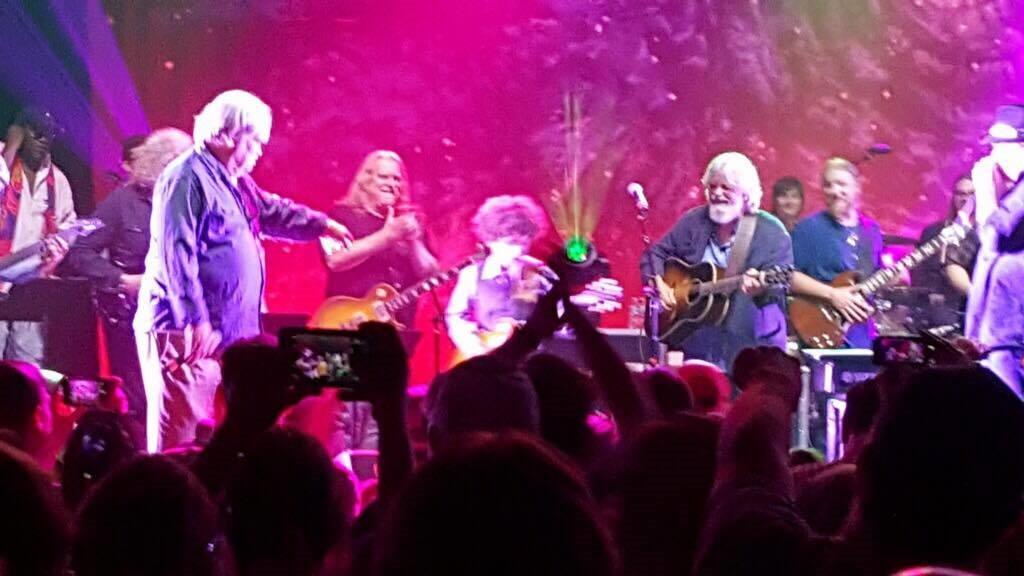
A jam band looking to tune their banjo in the hills and feast on milk and cream
Like the lengthy operas of Richard Wagner or the exploratory playing of jam bands, Bob Dylan has never been universally appreciated. There’s evidence from his earliest years as a performer that this was intentional on Dylan’s part: to accept the freedom to perform in ways that caused part of an audience to reject his approach. Doing this in order to endear himself to another audience that would be attracted by this difference, this freedom, and yes—to a degree—to the power of the exclusion of that other audience.
This is not an unusual artistic stance. The artist who claims that audiences of Philistines cannot understand their work—and who may also aim steadfastly to make that claim true—is common enough to have been a comic stereotype from classical times. But Dylan distinguishes himself from that not only by becoming hugely influential, changing and expanding how songs will be written in English in a matter of a few years, but also because he was willing to change the nature of what audience he was repelling and attracting regularly, almost as if he had an over-arching artistic goal to say that this repel/attract response to art was a thing that we should examine with skepticism.
So one moment you are supposed to love or hate him because he’s an earnest politically-engaged folkie rejecting pop music and hedonism; and then you are supposed to love or hate him because he’s a loud rock’n’roll hip cynic deep into drugs and pop culture; and then you are supposed to love or hate him because he’s a Nashville country-music-factory family man embracing simple truths—but wait, now he’s not only that, he’s what, a Christian!? And then he’s someone adrift, trying to make records every wrong way in an era when everyone is making bales of money making records. Then he unplugs and makes two fine acoustic guitar records in his garage with not one self-written song, which only a handful notice; and then he makes five records in the last two decades that are either embraced or rejected as he writes songs full of richly imperfect characters and anti-heroes defiant and defeated. And now he has the nerve to ask us to listen to him singing songs Frank Sinatra would have sung. And all these twists and turns leave out three wonderful records that don’t fit these scenarios: “Blood on the Tracks”, “Desire”, and “The Basement Tapes”— any one of which could be the masterpiece of most other songwriters’ careers.
Despite all this change, and more than 50 years as a notable performer, there are those who consistently don’t like his singing, don’t think much of his musicianship, who feel that the historic influence of his writing is somehow an embarrassing overachievement. Some of those people are musicians as well, some of them are smart and perceptive people, some of them hold to the duality of Bill Nye’s great sentence, who feel that like Richard Wagner’s, “Dylan’s music is better than it sounds.” How many of these people are sincere, how many are more at envious? How many are just smarter than I am, with better or different musical taste? How many can’t absorb Bob Dylan for the same mysterious reasons some can’t digest milk or gluten? Some of each.
Now let’s take today’s Bob Dylan episode. “Wisconsin” is a set of words, never used by Dylan, written when he was around 20. A handwritten manuscript was put up for auction last month with a minimum bid of $30,000, and I don’t think it made that minimum. Notices about the auction liked to poke fun at the unimportance and artlessness of the lyrics, particularly in the context of that songwriter getting a Nobel. Well, the Parlando Project is the place “Where Music and Words Meet,” and in this case the words are waiting for music and performance to animate them. On the scribbled page they are puppets without hands in them, so the LYL Band put their hands in.
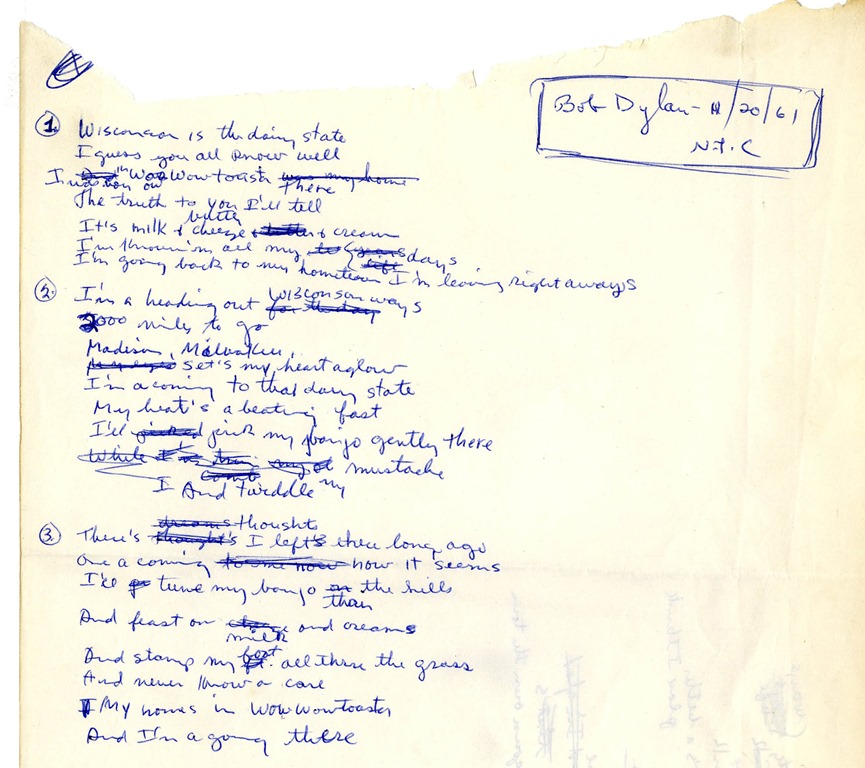
The Nobel is a long way off, but even the 20-year-old Dylan is revising what seems like off-the-cuff stuff
It turns out that the formula of nonsense and normality, commonplace and commotion, when animated with who-the-hell cares energy makes a fine rock’n’roll song. And you don’t need $30,000 to have that, you can get it here for nothing. Just click on the player below.


 Frank Hudson
