The Death of Guillaume Apollinaire for National Poetry Month

World War I entered the worlds of both of our last two poems, and that war’s poetry was one theme we visited over the early years of this Project that coincided with the centennial of that conflict. The interaction between that war and the arts was complex, but here’s a simple question: did WWI cause Modernism?

My best short answer: not exactly. The Modernist experiments were already underway before the war broke out. What the deadly and at times absurd war did for Modernism in the arts was twofold: it validated its breaks from past tactics and traditions, and it toughened it up and gave it more existential stakes. Hear, for example, of how quickly Imagist poetry could be turned from short poems about red-faced farmers to the harrowing urban bombing account of F. S. Flint’s “Zeppelins.”

One Modernist source-point that did owe something directly to the war was Dada, which emerged in neutral Switzerland among Europeans who had fled the conflict. Dada was all about experiment and tweaking tradition, and if I audaciously suggested that one can get something from the later High Modernism of Eliot’s “The Waste Land”  by reading it as if it were Lewis Carroll’s “Jabberwocky,”  Dada was clearly willing to use outright random non-sense in service of breaking down old patterns.

One of Dada’s originators was a pan-European man Tristan Tzara. And if the young Tzara and European Modernism had an overall figurehead in the years before the end of WWI, it was another pan-European man Guillaume Apollinaire. Americans (who had an outsized influence on English-language poetic Modernism) may not fully credit how invaluable Apollinaire was in this era. He coined the terms “cubism” and “surrealism,” he wrote poetry in a freer and more freely-associative way,* and he began to lay his words out on the page to typographically break up the phrases, predating and serving as a model for E. E. Cummings.

Apollinaire’s war-time fate was to bookend Rupert Brooke’s. Still convalescing from a head-wound suffered in military service, Apollinaire became another victim of the great flu epidemic that swirled around the end-game and aftermath of the war.

And that story brings us to today’s National Poetry Month poetry prompt for those looking to do more than simply add to the solitary outcroppings on the mountain of poetry, another way to mesh and meld with our poetic ancestors. Why not translate a poem?

What, you don’t know a foreign language? Well, you know something about poetry (or wish to) if you write it. Poetry itself is a second language you either already speak or wish to speak fluently. Translation is the way to work hand in hand, eyeball to eyeball, with another poet, and I maintain that any poet can benefit from it, even monolinguals. The Internet offers increasingly adequate automatic translators and online dictionaries for some languages.**  Mixing the two, some research, and your own knowledge of the dialect and tactics of poetry can produce worthwhile translations that can be shared — but here’s the main creative benefit: you’ll learn, intimately, the way a poem can be constructed under the skin. The exercise of trying to find the right sounding, feeling, and meaning English word for another poet’s vision is powerful.   If I could make one request, one rule, for creative writing programs everywhere, it would be to make translation part of the curriculum.***

In was in that spirit that I chose to translate Tzara’s poem “The Death of Guillaume Apollinaire.”   What would Dada’s young provocateur say about this death of this influence? I was surprised at the emotional depth of the piece — it’s an eulogy as a love poem — with opposites-imagery mirroring the opposites of the living considering the dead. I’m not sure how much better a translation of it I could do today, and I’m particularly proud of my rendering of the concluding two lines, a striking gothic image.

With Tzara’s “opposites-imagery” in his poem I couldn’t help but think of M. C. Escher’s later art used in this video.

.

You can hear my performance of my translation of Tzara’s “The Death of Guillaume Apollinaire”  from the French “La mort de Guillaume Apollinaire”  three ways. There’s a graphical player below for some, this highlighted link for others, and if you’d like to see the words and well as hear them performed, this brand-new lyric video.

.

*For an example, consider Apollinaire’s own poetic witness to the outbreak of WWI, “The Little Car,”  which I translated and presented here.

**You shouldn’t use those automatic translations as anything more than guide and gloss. Your appropriate aim is to produce a poem in English rather than the literality of one-to-one words, to bring the images and the way they are arrayed over to our language. Dictionaries, particularly ones that provide examples of the word used in context, are important adjuncts to the online AI translations.

***Another benefit: this kind of crowd-sourcing of translation can increase the number of translated poems available, increasing the diversity of our culture. And then, like Wallace Stevens 13 lookings at blackbirds, having a spread of translations of the same poem may be a truer representation of the poem’s essence and spreading possibilities than any single one. Cubism activism!

On the Troop Ship to Gallipoli for National Poetry Month

Though an often-puzzling poem, Eliot’s “The Waste Land”  is tightly written. I’m not talking about some raw stat like its number of lines, but that the language itself works in its sentences and small phrases directly and without much waste. That’s not a Modernist-only tactic, but early Modernism did make it a goal.

And a large amount of that vividness came not just from the sharpness of the experiences of grief, depression, and failure that Eliot had experienced, but from revision and re-writing, a process famously aided by Ezra Pound suggestions — most often excisions.

Back in this blog’s first year or so I decided to try an exercise based on those Modernist principles. I took this poem, or rather a fragment, written by British poet Rupert Brooke* while he was steaming on his way to the same disastrous Gallipoli landing in World War I that killed Eliot’s friend Verdenal.

My goal wasn’t just to do what Brooke himself might have done if he’d had time to polish up further drafts of his fragment, but to do what Ezra Pound would have done with his blue pencil. Even though I started with a 19-line fragment, I removed over a hundred words, including many that seemed uselessly archaic and flavorlessly formal. This wasn’t just a Readers Digest-style abridgment, I worked to remove the crud and bring forth the images as an Imagist would have.

Here’s the lyric video.

.

I maybe favoring myself, but I thought the result increased the power of the remainders considerably,** and once I composed and performed the eventual musical setting, I titled my adaptation“On the Troop Ship to Gallipoli.”   It remains one of my favorite pieces that I’ve presented here for the past six years, and it easily became one of my candidates for this National Poetry Month series where I’m re-releasing some of the earlier pieces from this project along with new lyric videos. You can hear it three ways. The graphical player is below for some, but if you don’t see that, this highlighted link will also play it.  And you’ve seen the thumbnail picture above that will play the lyric video.

.

*Brooke was — let’s not put too fine a point on it — a very good-looking young man, with full access to the class-bound academic and social circles of early 20th century Britain. Yeats called him “the handsomest young man in England.” He was considered promising as a poet, or certainly something, even before the war. Frances Cornford, a concise poet who counted Charles Darwin and William Wordsworth as her ancestors, wrote of Brooke “A young Apollo, golden-haired/Stands dreaming on the verge of strife/Magnificently unprepared/For the long littleness of life.”

So, when Byronically larger-than-life Brooke saw WWI’s outbreak, he saw a way to join in something big and heroic. He wrote an instantly famous sonnet about the honor of dying for one’s country in battle. That poem was read by the Dean of St. Paul’s Cathedral on Easter Sunday — and then less than a month later Brooke was dead. Back in 1915, an editor/fate blue-penciled this: Brooke never reached the doomed landing at Gallipoli. He was bitten by an insect which led to a generalized infection, which killed him three days before the battle.

**Perhaps I shouldn’t have left this for a footnote: you might want to try a similar exercise on some other person’s poem or two yourself, and then try what you learn on your own work. Yes, one can add lines and words in a revision, but what this exercise usually does is show how much you can add in power by excision.

“Sweet Thames” from Eliot’s “The Waste Land” for National Poetry Month

Today we’re going to commemorate something we did to celebrate National Poetry Month during the earlier years of this Project. In a series of posts and performances each April over five years we serially presented the entire “The Waste Land”  here.

Eliot’s Modernist masterpiece famously begins “April is the cruelest month…” — a line that is endlessly quoted during NPM and otherwise to make it as famous a line of poetry as any. Yet the extraordinary collage of words that follows may have frustrated or just turned-off as many poetry readers as it has attracted. To counter that, as I presented this poem over the years, I tried to make these points about it:

  • It’s abundantly musical. It’s possible to enjoy it while understanding little about what it’s trying to mean, as if it were a cousin of “Jabberwocky.”
  • For such a complex and multi-layered poem, it makes more sense more quickly spoken than on the page. “He do the police in different voices” was the working title for it. Vocalizing the various characters was assumed in its vision.
  • It’s a poem written by a depressive about their experience of depression. That might sound like a recipe for needless wallowing. Yet “Depressing English Majors is Like Shooting Fish in a Barrel” is not  a suitable blurb for “The Waste Land.”   It ends in uplift and a rage against self-pity.
  • Generalizing wildly: English poets sing melancholy songs, American ones sing the Blues. The Blues is analytical about sadness, tells sorrow it knows its game. Eliot, the America-to-England emigree, is somewhere in the middle, and then he draws on Buddha the bluesman.
  • The poem has a thread that examines sexual roles (summary: it excoriates them) and even indulges in some gender dimorphism. The theory that there’s a gay subtext hangs together pretty well — but objective correlative and all, the ghastly, haunting, lost, and unclaimed corpse of Jean Verdenal, and all the WWI dead, suffuses the poem. Alas, we’re now in another cruel spring of warfare this year.

But still and all, what’s the deal with a poem that has footnotes,* and seems to require them? Even my high school English teacher who did so much to introduce poetry to me thought that a little embarrassing back in the Sixties. Can we understand the wide range of quotes, parodies, references, allusions, and just plain collage better as Modernism has permeated our culture even more by our 21st century? Can we now see “The Waste Land”  as a big mix tape, full of samples being dropped? Can one dig the groove and general effect without needing to know where the sample was taken from, or what in-joke M. C. Eliot was putting down?

With a T and an S and L I @ / here to rock this mic with my river rats. / Think you’re a sick rhymer with a mad dose? / I’ve been to a Swiss asylum and been diagnosed,./ Dis my soft Thames flow while I’m singing my song,. / you might end up drowned like that Phoenician! /Peace (that passeth all understanding) out!

.

The section I decided to use to represent the entire serialized performance was this one, the start of the poem’s “The Fire Sermon”  section. In this part that I titled “Sweet Thames,”  we begin with a decidedly not-so-sweet urban river, a polluted river being actively polluted, an adjoining gashouse is visited (a hideously smelly polluter), and finally we get the corpse of Jean Verdenal, lost in the sea/sand verge of the disastrous WWI Gallipoli landing being sung to and fro to a bawdy hymn about a madam and her girls who euphemistically are washing their “feet” in water.

Two ways to hear it, one way to see and hear it. There’s player gadget below for some ways this blog is read. This highlighted link is here for those that don’t see the player.  And as we’ve been doing so far this April, there’s a lyric video too, linked here.

.

*Eliot later apologized for the footnotes.

Stopping by a Woods with Bad Cellphone Service for National Poetry Month

A couple of posts back I suggested we do more than poetry prompts or poem a day writing challenges for National Poetry Month. Here’s a demonstration of an idea that’s half-way there. While still a poetry writing prompt, it also acknowledges the tradition we’re working in.

Write a parody of a poem you like, you dislike, or you just have heard too too-often that you want to mess with it.*

One of the first teenage poems I wrote decades ago was a parody of Keats’ “Ode to a Grecian Urn”  titled “Ode to a 1953 Automobile Ad.”   I loved Keats’ poem, and while I wanted the smile that my title could engender, my parody was more at pointing out that Keats’ painful air of not-quite-realized truth portraying beauty wasn’t just a 19th century thing. Like most all of Sappho, that one may be lost to the ages, but here’s one recent enough to have been performed in the early years of this project: “Stopping by a Woods with Bad Cellphone Service.”

Did I like, hate, or just want to mess with Frost’s Stopping by a Woods on a Snowy Evening?”   Maybe a little of each. Long time readers here will remember that I disliked Frost in my youth. I thought then he was spouting platitudes, but I was wrong on that. When I presented Frost’s “Snowy Evening”  here years back I said that the most important thing in the poem has been little realized. The poem’s speaker isn’t being tempted by wasting time admiring natural beauty. He’s not seeking Transcendentalist truth by closely reading the book of nature — though Frost does read the book of nature, his readings are unusually dark. Those are common understandings of Frost’s poem, which do sort of find the poem’s ending as a platitude: “You know what you need to do, get to work.” So is it darker? Is he basically being tempted to crawl into the woods and end it all? Not quite that either. The most important fact in the story of this poem is that the speaker is lost  on a rural road in the early 20th century on the “darkest evening of the year,” which would be utter darkness in the days before electric light. There’s no beautiful Currier & Ives woods. It’s so deserted and without information you can hear snowflakes rubbing on each other. The famous opening is (with added italics) “Whose woods these are I think  I know.” Not really knowing = lost. When he decides to press on, it’s the act of acting without there being any knowledge that he’s going the right way. The poem sounds beautiful, and that ennobles that act, even if it says the speaker may have been foolish and is risking acting without knowledge at the end.

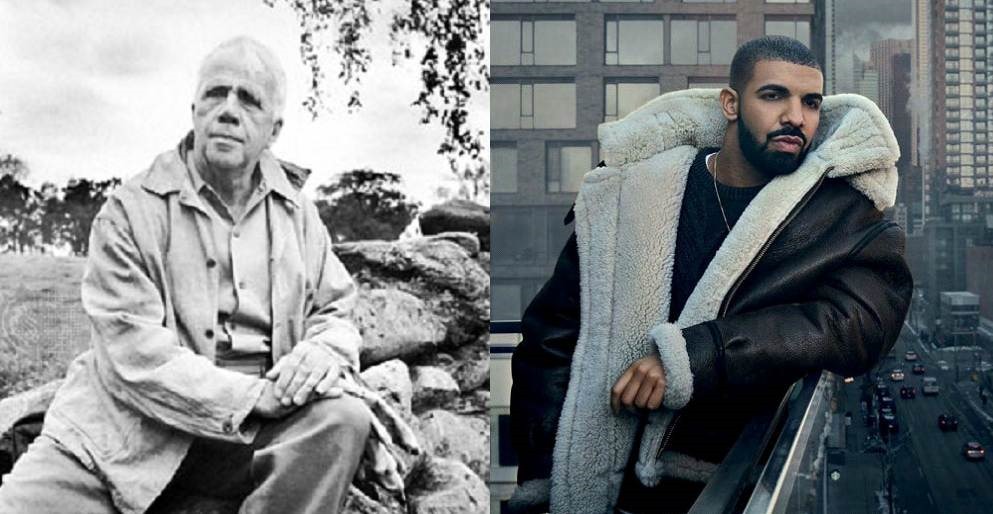
Frost Drake

April is National Poetry Month, and spring is here. Two gentlemen are unbuttoning their coats.

.

My parody is more lighthearted, and is set in the 21st century, but like a lot of jokes the situation isn’t pleasant. By writing a parody you are acknowledging the poem and your knowledge of it — so even if your parody is meant as a corrective to make the reader never read the original poem the same way again, you are engaging in the type of activity I’m urging more of this Poetry Month: that we should encourage more expression not just by adding to the sum total of poetic examples of it, but by acknowledging it in others.

Three ways to hear The LYL Band rip into this snowy poem: this is the link to a lyric video, or (for some of you) a player gadget below to hear just the audio, and finally there’s this fallback link that will play it also.

.

*There’s a long tradition of this in poetry and songs. It’s not just Weird Al. In my youth they were called “answer records” — and later on in hip hop, a “dis track” might twist someone else’s rhymes or musical samples in service of dialectic. We’ve presented some poetic “answer records” here. Like this famous set of poems here and here. Or this quippish answer I appended to another short poem.

I also sometimes make moves that feel a little like parody in some of my looser or “after” translations of older poems. Here’s one example. And another. And one more. These aren’t meant to be “funny ha-hah,” but there’s a pleasure in finding history’s cultural “rhymes.”

Marianne Moore’s “Poetry” for National Poetry Month

Here’s an old American joke I recall.

“No one knows the words to the second verse of the National Anthem.”

“Sure they do.”

“Oh? What’s the second verse then?”

“Play ball!”*

We continue our celebration of National Poetry Month while tipping our hat to American Baseball’s Opening Day. Marianne Moore’s poem “Poetry”  seemed fitting, not just because she was a lifelong baseball fan, but because this poem of hers always seemed to me to be American poetry’s National Anthem. Like our constitution’s “More perfect union” the overall thrust of the poem is that a real, complete poetry is still a goal, still in process, and so in the meanwhile it’s OK to snub poetry’s failures, but to pass the time, OK too to enjoy its at bats anyway.

Partway through the poem Moore explicitly calls up a baseball metaphor:

the base —
ball fan, the statistician—case after case
could be cited”

Here’s today’s lyric video. Baseball has Blue Jays, Cardinals, and Orioles. Why not Cockatoos?

.

Moore has already given us the choice to “Not admire what we cannot understand,” but my estimate of what she’s getting at there is that hitting a baseball effectively at a major league level is extraordinarily difficult. The very best players ever to play over more than a century fail to do it about two-thirds of the time over a career. Careful records have been kept. Fans know this is so. Poetry too may be a sublime effort to try to hit the implausible cleanly to land in the improbable place.

It’s become a common observation that baseball has diminished popularity because of this, because one needs to endure so much failure and not-quite to get to the aim of the game. Perhaps poetry can commiserate.

Here’s hoping my home team’s opening-day rookie pitcher can throw implausible stuff this week. Gnomic fastballs. Hermetic curves. Enjambed change-ups. Surreal sliders. Let the opposing bards wave their wands and form nothing but wind, and all their strokes come up trite and merely sentimental. Let their bats hang upside down, asleep.

This performance from our archives has vocals recorded in 2018 by the then members of the Lake Street Writers Group: Dave Moore, Ethna McKiernan, and Kevin FitzPatrick. Two-thirds of that lineup have been called up to another league since then, the one where we have no statisticians or toads — you may have read our memorial pieces to them here this winter. And now it’s spring, even if we don’t understand. How can we admire what we cannot understand?

Three strikes and you’re out, but three ways to hear this performance. There’s a graphical player below for some of you, and if you don’t see that, this highlighted link. And if you want to see the lyric video that I just made that is part of the series of those I’m doing for National Poetry Month, that’s above.

.

*Joke footnotes — they always add so much to the humor — but I know we have a lot of foreign readers. American baseball games traditionally start with a singing of the National Anthem. Yes, just the first verse. Patriotism, but in a measured dose there. After which, the head umpire announces the commencement of the game with the cry of “Play ball!”

Letters to Dead Imagists and A Pact for National Poetry Month

Within the limited time I can find for it, I’ve been informally surveying what others online are doing for National Poetry Month. I’ll make one casual observation, unbacked by rigor or focused study: a great deal I’ve seen this April is aimed solely at the supply side for poetry.

I’ve got nothing against urging more folks to write poetry. How could I? I’ve contributed additional verses to the Olympus of written —and albeit years ago — to the avalanche of published poetry. I’ve even advocated here for more poetry that isn’t judged as “great poetry,” or even intended as such, because I don’t believe in a poetic Gresham’s Law. Two others in my house have even started the “write a poem-a-day” challenge. If urging more poetry to be written is a crime, I’m part of a criminal syndicate.

But I find some things lacking. Some things that should be as large or larger but seem (on first glance at least) to be noticeably smaller this month: a profound and compelling case for the poetry already in existence, statements of its impact on us as poets or just people. I’d welcome testimony that folks are reading a poem a day on average, as a challenge if it must be, as a pleasure if possible.

Committed poets, like committed musicians, often talk freely about influences, while beginning or occassional poets seem to shrink from this. Are they afraid their individual expression will be blunted by reading others? Or that they will only find other poems lacking the particular thing they seek to write? I think most poets start by being compelled to write poetry. Should there be a time shortly after that when they see a need, as most musicians quickly find, to consider themselves as part of a continuum of poets?


In one moment in the video I Ken Burnsed it into trying to make it seem that Pound and Whitman were having a glare-off between each other.

.

Today’s piece, re-released from the archives of our first two years of the Parlando Project with a new lyric video, is an example written long before the first National Poetry Month of two crucial poets speaking to influences. First off, one of my own influences, Carl Sandburg, speaks of how Emily Dickinson’s view of transcendental nature illuminated him. I should note, Sandburg was writing this only 25 years after the world first saw Emily Dickinson’s poetry and long before her stature had risen to current levels. Note too that few would think of Sandburg as a nature poet. This old guy reminds himself, that in his time Dickinson was fresher than “classic rock” to Sandburg. The next influence Sandburg testifies to might be more at a “guilty pleasure.” Stephen Crane’s The Black Riderswas a book of gnomic free verse that was directly influenced by Crane being given a freshly published copy of Emily Dickinson’s first collection. Caught between creative monuments like Dickinson and Whitman, Crane’s contribution to poetry seems slight to most then or now, but Sandburg says that he picked up imagistic honesty from it.

Ezra Pound, an indispensable promoter* of the Modernist English-language poetry revolution as well as a poet, gives us a more ambiguous note of influence. His “A Pact”   is an example of just how useful it may be to read poetry that you don’t care for, or that just misses the mark, as a way to find out what it is that you do care for.

By doing what the Parlando Project is doing, today and for six years, we’re trying to add to the demand side of the poetry table. Constrained by practicalities of copyright and respect for living writers, we use mostly older poems, but they are part of our continuum. You can hear my performance combining Carl Sandburg’s “Letters to Dead Imagists”  with Ezra Pound’s “A Pact”  three ways. There’s a player gadget below to hear it for most of you, a video picture link above for those who’d like to watch the new lyric video, and then this highlighted link as an alternative way to hear the performance.

.

*Sandburg, who probably even then was politically at separate poles from Pound, said as much. See this 1916 piece where Sandburg sings Pound’s praises.

Anne Spencer’s “Dunbar” for National Poetry Month

In 1922, amazing Afro-American polymath James Weldon Johnson* published an audacious anthology titled The Book of American Negro Poetry.   Not only did it claim that there was a tradition worth an anthology at that early date; in his preface Johnson made the observation that Afro-American music was disproportionately important in American musical culture, and furthermore that he saw no reason that Afro-American’s literary impact shouldn’t also arise to that level.

A century later Johnson the prophet could be charged with underestimating Black American’s musical impact, but we are entering an era when his predictions about Afro-American poets are no longer considered exceptional cases, and not even a “why not” situation — but instead an “of course” predilection.

One has to give Johnson credit for declaring this back then, with what poets had managed to be published or otherwise eked out a career at a time when the ex-enslaved were still living. A few of the poets he put in his anthology would soon be known as the vanguard of the “Harlem Renaissance” and yet others would remain little-known afterward. Only one, Paul Laurence Dunbar, really had made writing a career at that point, and a large part of that career’s viability was on the back of a 19th century fashion for dialect writing, with rough printed approximation of regional and ethnic speech being put forward as evidence of America’s diversity or oddness. Reading Dunbar’s dialect poems today is rough going, a lot of context and translation cultural and phonetic is required.** But Dunbar also wrote fluent poetry in the rhymed metrical styles of the day, and those are the poems he’s remembered for now.

And what about those “deep cuts” in Johnson’s anthology, those poets and poems that aren’t required in a modern summary anthology of American poetry? One of those is Anne Spencer.  It’s an imperfect analogy, but you could roughly think of Spencer as a sepia Emily Dickinson. The two poets even shared a passion for gardening. Except there wasn’t a preserved and handed-down pack of good copies of poems in Spencer’s case. Imagine what we’d know of Emily Dickinson if the tiny number of poems that were published in Dickinson’s lifetime were all we had?

It’s plausible the proximate reason that Spencer’s poem praising Dunbar was included in Johnson’s anthology was that Spencer’s home was a waystation and salon frequented by Black artists and civil rights activists in the Jim Crow era, which would have included Johnson. But let’s just be grateful, it’s a lovely short lyric making in a handful of words, the case that Dunbar, and by extension Afro-American poets yet to come, can stand with and extend the tradition of British poets then considered “canon.” And by linking Dunbar with the struggling working-class poets Chatterton and Keats, and the exiled radical Shelley, Spencer may have been making a subtle point about where poetry could, or should, come from. And like Johnson, she predicted with her poem’s linkage that by our present time we’d remember Dunbar as a supple lyrical poet unlinked from the fashion of dialect poetry.

The lyric video includes a poster for a Dunbar performance and some photos of Spencer. Spencer wrote poetry throughout her life, but didn’t focus on publishing.

.

Three ways to hear my setting and performance of Spencer’s “Dunbar”  today. You can use a players that will be shown below in some ways this blog is read, or this highlighted link if you don’t see the player. And, as we’re doing this April, there’s the lyric video above.

.

*Polymath? Well, let’s see: key early civil rights leader, helped found NAACP, poetry, novels, wrote the lyrics to “Lift Every Voice and Sing”  (aka “the Negro National Anthem”), diplomat, teacher.

**Dunbar made a go of it touring and reading his poetry, the sort of thing that was the YouTuber or podcaster route for extra-literary revenue and publicity then. His dialect poems were often touted on the billings, and so may have been the crowd draw. I don’t know how integrated his audiences were, or indeed how the dialect stuff was presented. I’m unaware that any recordings of Dunbar exist, and I don’t know that we even have secondary recordings such as exist of folks who knew Twain, imitating him on early records from direct memory of performances.

Zeppelins for National Poetry Month

Here’s another piece from the early days of the Parlando Project that we’re re-releasing for this year’s National Poetry Month. This is the place where I’d often encourage you to listen to the musical performance made from this poem, but I also could see why you might want to skip it and wait for tomorrow’s.

The poem “Zeppelins”  is by F. S. Flint, a too-little-known man who rose from poverty to help launch English language Modernism early in the 20th century as one of the original Imagists who shucked off the expectations of overused poetic tactics and filigree for what he called “unrhymed cadences.”  As a piece of poetry, I think it still sounds modern, still hits this listener with an impact you can feel.

And there’s the rub regarding this poem. It intends to be disturbing, to communicate an intimate dread and revulsion. Not everyone respects Williams’ “Red Wheelbarrow”  celebration of utilitarian beauty for its insistence on simplicity. There are probably even some who won’t “get” Frost’s exuberant ode to the shaping of nature’s gusts to singing words. But neither of those poems will disturb you, and our lives may have enough disturbance that I can see one not wanting to seek out a poem that gives us more of that. Flint’s poem is the story of one of the first aerial bombing raids on a city, an attack in May of 1915 on London that caused around 100 casualties, including children.*

Furthermore, this poem from 1915 is disturbing for another reason: it’s still topical. It was so when I first posted it in 2017 — cities and towns were being bombed and civilians killed then. So it is today. As another bombing witness was wont to say: “So it goes.”

Imagism in action. Note how Flint intimately invokes confusion, dread, and fear directly in this rapidly accelerating narrative poem

.

So skip today’s poem if you don’t want to be subjected to that, if your life is already strafed. I’ll understand. Poetry like “Zeppelins”  can serve as a powerful witness, we should respect that, but I can see why we may ask poetry for something else too.

The performance is available three ways. You’ve seen the picture of the lyrics video above, you may see a graphical player below to play the audio of the performance, and then there’s this highlighted link to also play it.

.

*I felt obligated to put an advisory on the video, not because I desire a world of poetry that cannot frighten or offend, but because such a piece may be too much for children who may be introduced to poetry during National Poetry Month.

The Aim Was Song for National Poetry Month

It’s National Poetry Month, and we’re celebrating here by re-releasing some of my favorite pieces from early in this project’s six-year history. Today’s poem’s poet is American Robert Frost speaking about spring, spring winds, and the poets’ transcendental task of continuing and shaping nature.

I’ve often reminded readers here that I didn’t care for Robert Frost when I was a young person. He was still a living poet while I was a teenager, and I associated him (wrongly) with dreary homilies and his placement in the school anthologies as the most recent poet included. More than once I complained to teachers and any fellow students who seemed at all interested in poetry that there had to be something, someone, newer and more relevant than Frost that could be studied.

What I didn’t know then was that Frost could be a nimble lyric poet delivering subtle messages, and that he was, in the generational nomenclature that would come 20 years later than my youthful 1960’s complaints, “a slacker.”

Frost spent the first 40 years of his life basically failing and flailing as a poet and human being. American interest in his poetry was nil. Only after wandering to England did he find a publisher for his first collection and a key promoter in fellow American in pre-WWI England, Ezra Pound. Pound was nearly a dozen years younger than Frost.

Frost didn’t write poetry as memoir, as many modern poets do, but all that experience made it into his poetry. Frost wrote often of failure and limitations* — but today’s poem “The Aim Was Song”  isn’t one of those poems. First published 101 years ago, this is Frost exulting in the triumphs of poets and poetry after he had finally broken through into acclaim in his home country. And it’s a good one for the Parlando Project to perform during National Poetry Month because Frost’s imagery here celebrates the oral, vocal, and musical heart of poetry. Also it’s an excuse for the composer to tell the guitar player: “Why don’t you turn up and play some.”**

Laptops were larger and more wooden in Robert Frost’s day. 

.

As with our other re-releases this April, you can hear my performance of this poem with the player gadget below (where seen), or this highlighted link, as well as with today’s low-budget lyric video that is trying to catch the attention of additional listeners to the Parlando Project.

.

*By the time his poem “Nothing Gold Can Stay”  was made into a motif in The Outsiders  movie in the 1980s, “slackers” could sense that kinship that I missed.

**OK, it’s the same guy, so the guitar player has considerable influence over the composer.

The Red Wheelbarrow for National Poetry Month

Besides being the first day of National Poetry Month, it’s April Fools day, so maybe it’s a good day to present a poem that caused many readers to wonder if it’s a joke: William Carlos Williams “The Red Wheelbarrow.”

I’m not against a poem causing wonderment, are you? It’s fine to look at it and respond “You can’t be serious — is that really a poem?” but I urge you to follow that question with other ones, such as “What use is it?” “Is this just an artsy provocation?” or “What should poetry be then?”

I think Williams’ poem is a late but effective representation of the movement that launched Modernist poetry in English: Imagism. Fairly quickly, a great deal of English language Modernism soon moved on to more complex poetry, a poetry that was often hard to grasp due to intense but hermetic personal material or elaborate references to other works of art, but “The Red Wheelbarrow”  is none of that. Instead it expresses, like a sub-two-minute punk song from the mid-1970s, a rejection and clarification of overly elaborate poetry.

2022 NATIONAL POETRY MONTH POSTER 1024

and this place has chickens. Also a short 12 tone-row composition.

.

I think Williams genuinely thinks the rain-water makes the wheelbarrow beautiful, and he doesn’t even think he needs to say that word “beauty” or make some elaborate metaphor to seal the deal. To say that, and just that,* is a provocation against poetry that asks more, and to readers that expect the poet to give them more. But it’s not just the momentary rain-water glaze that makes it poetic: it’s useful, something to depend on. Now that’s a goal for poetry (or any art) to meet at least some of the time, don’t you think? Self-impressive poetry, trickster poetry, poetry that gathers and unites widespread allusions — all have their place as well, but sometimes it’s good to see what there is seen naked in the rain. When the cave dwellers put their hand or the hand of their child up against the wall of the cave and blew red ochre dust around it, that’s art — not of the artists showing us skills, but the art of our shared and transient experiences made fixed.

Musically here I decided to use another contemporary early Modernist tactic: the tone-row. If one knocks “The Red Wheelbarrow”  for not having poetry’s elaborate or fanciful imagery, or some tight connection with the artist’s personal biography, perhaps this performance will show something traditional it retains: a lovely, largely iambic, word music. Yes, it’s music in miniature, but still that poetic element was there for me to express.

To hear my audio performance of William Carlos Williams’ “The Red Wheelbarrow”  set to my own music, you can use this highlighted link, or (if visible) a player gadget below. And as I’ve been doing with our National Poetry Month re-releases, there’s a simple, low-budget, lyric video at this link.

.

*Well, he also admires the contrasting chickens.