Introducing National Poetry Month to Music

Here’s what we do here, usually a couple times a week: we combine original music written for the occasion with some words, which are usually poetry someone else has written.

Of course, poetry. The compression of poetry lets us fit the words into shorter pieces and leave room for some notes. And, of course music, because every poem has a music within it, even when hidden, that wants to come out.

There are lots of ways to do this, and we do many of them. The reader will speak the words, sing the words, chant the words. The music can be simple spontaneous band recordings or more elaborate compositions recorded a track at a time until the larger sound-field is filled in.

There’s something about that push and pull of combining words that want to sing with music that wants to say something. Even when I’m doing it casually and off the cuff as a musician or a reader, I can feel the two parts wanting to connect, asking to connect, demanding that the other half listen!

If you look at the over 190 audio pieces we’ve already published here you’ll see that we don’t usually feature our own words, though Dave and I have written poetry for decades. Even when we do use something we’ve written, it’s usually about someone else.

There is nothing intrinsically wrong with poetry about your own experience, but I’ve often felt that something extra is felt when the poetry tries to cross that gap from one person’s head to another person’s lips—that kiss you feel with the momentary connection that begs you to find its meaning. And music too, created silently inside the shadowed choir-loft of a musician’s head, becomes itself only when touching a little membrane of sensitive skin inside another’s ear before it can become part of the dancing bones.

krimmel-quilting-frolic-1813

The Internet’s shown up with poetry again, and there’s them musicians with’em this time!


Using other people’s stories, other people’s words—this lets us experience the poems with you. Encountering poetry with music lets us meet them with only the expectation that something will happen.

I’m planning to present more audio pieces here during April’s National Poetry Month (#npm2018) than ever before, so check back often. And don’t forget there are lots of poems with differing music, from the most familiar to the unknown, already here in our archives to check out.

When Lilacs Last in the Dooryard Bloom’d

We’re about to begin April’s National Poetry Month in the U. S., but I’m going to begin celebrating #NPM2018 today with a piece that’s a good way to start things off, the opening two sections of Walt Whitman’s “When Lilacs Last in the Dooryard Bloom’d.”

Large-Blue-RGB-National-Poetry-Month-Logo
We’re aiming to present even more audio pieces than usual this April
Use the Follow button to make sure you get a notice as they drop


National Poetry Month isn’t just for American poems or for American poets, but if it was, Whitman would be all the more inescapable. In the middle of the 19th Century, he and Emily Dickinson forged two original styles whose sounds and tactics can still be found in contemporary verse—Dickinson, with small lines in small poems that bind-up with puzzles immensities; Whitman with long lines and epic poems that offer a catalog of exultation. One sees a single, small thing and says it represents the universe, the other beholds the diversity of the world and says it’s really one thing. Complementary opposites.

Both were working at a prodigious pace during the 1860s, during America’s great Civil War. On April 14th of 1865 Abraham Lincoln, the US President during that war, was shot. The next day he died. Within weeks Whitman had produced the first published version of this poem along with other poems about Lincoln and the ending of the Civil War which he published as “Drum Taps.”  It would not be like Whitman to hold his thoughts on those great events inside. In contrast, Tennyson’s epic elegy on the death of a beloved friend, “In Memoriam”  took him more than 15 years before he published it.

At over 200 lines in its entirety, “When Lilacs Last in the Dooryard Bloom’d,”  taken as a whole, would exceed my usual mode here. I prefer my audio pieces more the length of the 45 RPM single records of my youth. So today, I present only the first two sections of Whitman’s poem. Whitman’s voice changes over the course of this long poem, but in these opening sections Whitman (albeit in free verse) is sounding somewhat like the poets his modernism would break from. Save for the absence of rhyme, his language here would not sound out of place in Tennyson (or even the earlier Romantics, like the Shelley of “Adonais.”)

Whitman's Parent's House

Is this the dooryard? Whitman was visiting his mother’s house when he heard Lincoln had died.
He stepped outside and saw the spring lilacs in bloom.


I did the same thing, presenting only the intro section, last April for the poem I believe is most responsible for April being National Poetry Month, T. S. Eliot’s The Wasteland,”  which begins memorably “April is the cruelest month…” Those that can finish that first sentence may recall it continues “Breeding lilacs out of the dead land.” So, Whitman’s elegy and Eliot’s poetic apotheosis of High-Modernism written over 50 years later, both begin in April, and with lilacs.

We’ll be revisiting territories in “The Wasteland”  later this April, but today you can start where Whitman started his poem, and from where Eliot got some of his inspiration for his. Musically, this one is fairly simple, but I hope effective: acoustic guitar and piano with a little low synthesizer groan eventually joining in. Use the player below to hear it.


The First Cuts are the Deepest

Earlier this month I posted the Parlando Project audio pieces that were the most listened to as of the start of this Spring. Turns out it’s a pretty good mix of what Dave and I are trying to do with this combination of music and words. However, in looking at the stats for the Parlando pieces, it looks as if a lot of readers and listeners are coming in partway into the project, starting around the beginning of this year. That’s fine. I think I’m getting a little better as I work intensively on the goal of 100 Parlando Project pieces by August of this year, but I think some of the early pieces are missing the listenership they otherwise might have gotten if I’d posted them later.

Since we’re still in National Poetry Month (#npm17), it stuck me that this might be a good time for some of our audience to catch up. So here are a few of the 2016 Parlando Project “deep cuts” from last year that you might want to check out:

Stars Songs Faces.  I wrote the music for this Carl Sandburg poem as my tribute to David Bowie in January of 2016, and it was the piece I choose to kick-off Parlando. Although I’m not the first to write music for these Sandburg words, I still like what I did, and the LYL Band performance realizes my intention well. This piece also reminds me that it’s been awhile since I posted a Carl Sandburg-based piece here. I’m working on one this week, but the orchestration is not going as well as I’d like it to yet.

The Prairie.  One of things I enjoy most about coming up with material for the Parlando Project is finding things in the public domain poetry cannon that I’d never read or even heard of. This is one of them. William Cullen Bryant was not on my radar until Dave Moore visited the Mississippi river valley mounds last year and began to write about them himself. This audio piece is on the longer side, which may account for the lower number of listens.

The Green Fairy.  Here’s a good piece written and performed by Dave Moore that hasn’t been listened to as much as some other pieces he’s written here. My notes in the accompanying post were written in mystery about the actual intent of Dave’s words. I’ve probably got some other poets’ intent wrong too, but remember that’s one of the points of the Parlando Project: you can appreciate poems when they are accompanied with music just as one appreciates song lyrics (or even music without words at all), as bits and pieces of language that sound good, or as lines or phrases that attach themselves to you with little pieces of meaning without any requirement that you understand the whole thing.

This is the Darkness.  I ascribe the lower listenership on this one to the dark tone. And indeed it might be an odd piece to listen too in the late Spring as days get longer and eventually warmer here in the upper Midwest. None-the-less, living around the 45th Parallel Minnesotans and Canadians should understand this.

Christ and the Soldier.  When I was my son’s age, I was following a day-to-day summary in the newspaper, a series called “100 Years Ago in the Civil War”  which covered the events just out of memory of the living in the American Civil War.  And now, since 2014, I’ve been informally following the centenary of World War I, which has similarly passed out of the memory of the living.  Siegfried Sassoon’s poem is a biting comment on WWI from a veteran of that war’s trenches. You know that old saying “There are no atheists in a foxhole?” Sassoon has a more complex view.

Triad

I find it a wonderful “Parlando – Where Music and Words Meet” coincidence that one of Christina Rossetti’s sonnets and one of David Crosby’s songs share a title, “Triad.”

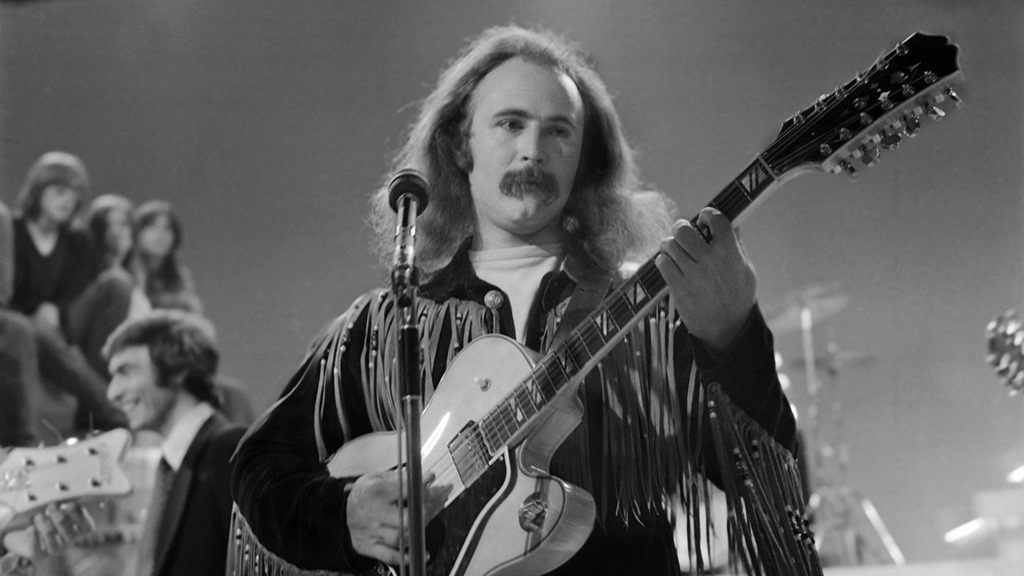
David Crosby is a musician and songwriter who first came to prominence in The Byrds and then as part of another triad, Crosby Stills and Nash. When I first came upon his songwriting many years ago, I was attracted to his distinctive abstract melodic and harmonic sense. Almost no one before, and few since, wrote music for songs that sound like his did then, with the exception of some Joni Mitchell tunes. Lyrically Crosby styled himself as unconventional as well. His “Triad”  is a blissful ode to free love—well at least free love as long as David Crosby is the one explaining how things will be.

David Crosby

David Crosby’s song starts by asking “You want to know how it will be?” and then he mansplains it


Christina Rossetti was a pioneering British 19th century female poet. Her biographical triad was that she had two brothers William Mitchell Rossetti and Dante Gabriel Rossetti, also writers, who went on to form the Pre-Raphaelite Brotherhood. Hmmm, “Brotherhood”—I wonder if girls get to join? Not officially, though she was used a model in some of their paintings.

Girlhood of Mary

Her brother Dante used Cristina Rossetti as the model for the Virgin Mary, far right.


Christina Rossetti’s “Triad”  is a not-so-happy look at romantic love, and the writer is none-so-sure how it should be either. Rossetti draws her portrait of three women who once sang together. One the stereotypical harlot, one the blue spinster, one the smooth compliant wife. Each of them finds the dead end of the limited paths available for passionate women. Conventionality decrees the hot harlot is shamed and the cold virgin dies for love, but Rossetti steps outside conventionality to tell us that the “temperate” spouse grew gross in her compromise until left with the devastating line droning “in sweetness like a fattened bee.” How much has changed since Rossetti’s Victorian England in this regard? Some things, not all things. New Rules are still rules, look at who makes them.

Musically here with our “Triad”,  the LYL Band somewhat refer to the psychedelic vibe of Crosby’s musical style to accompany Rossetti’s sad and lovely words. To hear it, use the player that appears below.

How We Make the Parlando Project Pieces

I started work on the Parlando Project early in 2016 by learning how distribute audio pieces via web-based player I could embed here in this blog and also through “Podcasting” where audio is listed for download on directories such as iTunes, Google’s Play Store, Player.fm and the like. Throughout the spring and early summer of that year I worked with Dave Moore to record some pieces to “bank” for a launch I planned for August 6th.

Frank-Dave thoughts CLEANED

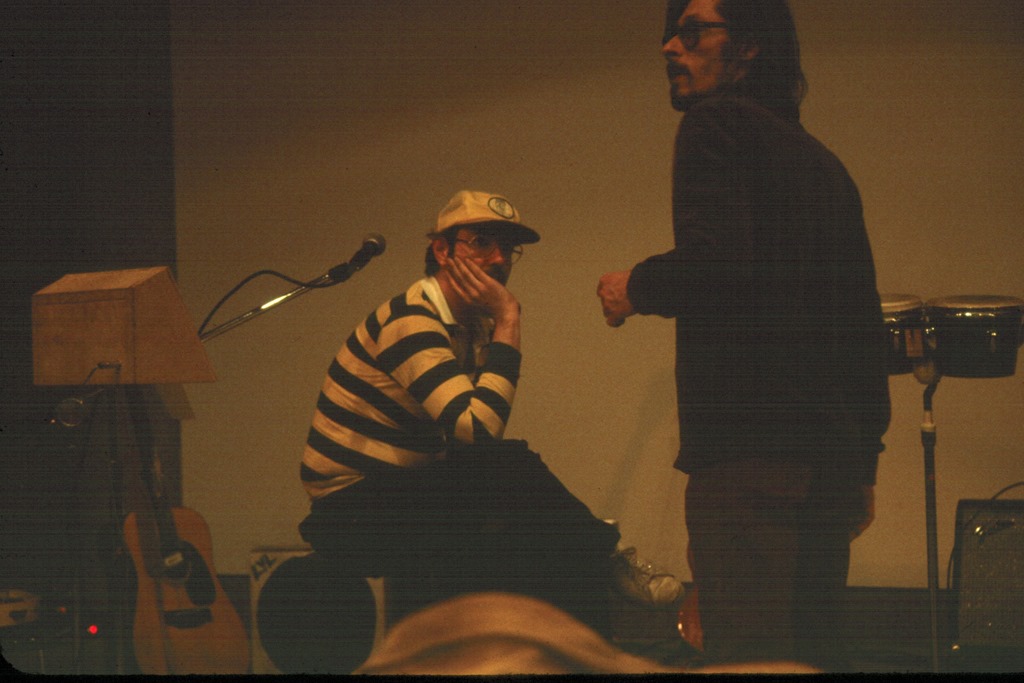
Dave and I look exactly like this today. Or we could if studied how to use Photoshop.


Dave and have written alongside each other for a great many years and played music together since 1979 in various line ups of the LYL Band. Adding the Parlando pieces to what we played seemed a natural outgrowth. Generally our approach to recording is very casual, particularly by modern standards. A great many things are not just first takes, they are only takes,  where the non-composer is working from a lead sheet on a piece they haven’t heard before. This is the same process favored by Miles Davis and Bob Dylan, comparisons that too much favor us as musicians, but the effect on the kind of playing that results is  there, even at our level.

First off, mistakes are inevitable, but you learn to try to understand mistakes quickly and try to find their hidden intentions. You listen intensely, because you have no other choice, there is no routine, learned,  part to fall back on. Arrangements just happen. The results are not polished, but in the best ones you can feel the excitement in the room when listening. And we give ourselves a punchers’ chance. In a 2 hour session we might record somewhere between 10 and 15 pieces. Most of them will be wild punches that don’t land, or strike only a glancing blow, but you only need to connect once.

Not everything we record is for the Parlando Project. Some things are for our own purposes and include material we do not have the rights to share with you.

Other pieces, the ones I record and play myself, follow a different path. I can think and work more compositionally if I choose, writing and considering parts. I record them myself, playing all the parts in turn. This is the modern way to go about it. I can achieve, within my limits as a musician, what I want to achieve. The cost is that I cannot achieve what I do not think I want to achieve, which can only happen when other musicians are involved.

I’ve looked for words to use for pieces continuously during this period. Since I have no knowledge on gaining usage rights for published work, almost everything Dave or I didn’t write here comes from works that are out of copyright and in the public domain. This process has been one of the unintended joys of the Parlando project, as I’ve learned more about writers I knew only in highlights like Yeats and Sassoon, and discovered writers I knew almost nothing about like Wheatley and Tagore. I’ve revisited old favorites of mine in Blake, Sandburg, and Dickinson, but also dipped my toes into translation with Du Fu and Pasternak.

As of yesterday’s post, we’re up to 67 pieces available here since the launch. My goal is 100 by the August 2017 anniversary. I’d estimate I’ve put perhaps a thousand hours into the Parlando Project since the start of 2016, all to produce less than 5 hours of audio combining surprising words with music as varied as I can compose and play. My goal is to introduce you to old work you thought you knew, new work that you will be happy to know, and to use the combination of music and words to create something uniquely powerful.

As we celebrate National Poetry Month I’m setting an April goal to have the most active month here in terms of the number of posts, of new audio pieces to stream, and of numbers of downloads. The audience grew substantially in March as folks are discovering us in various ways. If you’ve found something of value here, you can help us out by linking to your favorite piece on your blog, on Facebook, or on Twitter this month.

The Spring 2017 Top 10

Since this is National Poetry Month in the US I’m hoping that I can exceed the usual 7 to 8 posts a month pace I’ve kept up here since the Parlando project began last August. The next audio piece should be up this weekend. For those who haven’t read the early posts here about what the Parlando project is, I usually summarize it as:

The Parlando Project is words (mostly, but not always poetry) accompanied by music (various kinds).

The Parlando audio pieces have been downloaded by podcast subscribers since launch almost 4,000 times. Given that we are now past the halfway point, I thought it might interesting to let you know what the “Top Ten” downloads have been so far. In Casey Kasem form, we’ll count it down upwards from 10 to 1. There are links in the list if you missed one of these audio pieces and the posts about them.

10. The Spring of Dead Things. One of the 3 pieces in the top 10 where I wrote the words. That’s OK with me, but one of the Parlando Project aims is “Other People’s Stories” which leads me to feature other people’s words more often than not. There’s lots of folks reading their own poetry out there, which is good in itself—but there’s lots of people reading their own poetry, so think there’s an unmet need for reading others work.

9. The Garden of Trust. One of my personal favorites. Weston Noble’s thoughts on the power of music, hard-won thoughts he expressed after a lifetime of work, touched me the moment I first read them, and my feeling only deepened when I found I was able to hear him express those beautiful thoughts in a recording made before his death. My thanks again to Luther College for allowing me to use this recording in my piece. If you want to sample one thing that the Parlando Project represents, and it really doesn’t represent one thing, start here.

8. I Felt A Funeral in My Brain. Writing the Parlando music and considering the words for performance has deepened my appreciation for Emily Dickinson, whose words we’ve featured more than any other writer, and I rather like my music for this one as well.

7. For John Renbourn Dying Alone. I hope some of the listeners to this piece who like acoustic guitar music find this a gateway to Renbourn’s music.

6. Arthur Koestler’s Death Song.  Although we’ve featured Dave Moore reading and singing his own work here, and there will be more of that to come later this year, his Top 10 appearance is for a piece where he wrote the words and music, though I performed it.

5. Eros. I sometimes wonder if this one gets a bonus from those searching for or intrigued by its title. Another one where I’m happy with how the recording and the music turned out. I remind myself that I should learn more about Emerson’s Transcendentalist revolution.

4. 2ebruary. There’s no telling what the “bonus” may be that’s lead more people to this piece. It could be the discussion of the movie “Patterson”  in the notes, or it could be the connection to bicycling. Or perhaps it’s the connection to Frank O’Hara’s “I do this, I do that” poems that I treasure and try to emulate. If you like this, I have another bicycle ride poem coming up later this spring.

3. Boris Pasternak’s February. We’re into the top 3 now.  I was remarking to Dave Moore during a break in our recording session yesterday, that February rather than April should have been picked as National Poetry Month, as the deep dark end of winter engenders more cruel monthly poetry. Pasternak gets to help prove that point here. One regret I have with what we’ve done so far with the Parlando Project is that I have not received permission to post our version of Margaret Atwood’s “February”  here.

2. Hymn To Evening. Speaking of things I treasure, hearing Phillis Wheatley’s story on the Freedom Trail in Boston is another one. Art is this thing that, unlike even persons, no one can own. Colonialism is a system that crosses oceans to take things from other lands for profit. Art is the system that sends out messages that can crisscross time and oceans with the information inside our breasts.

dollar-bill

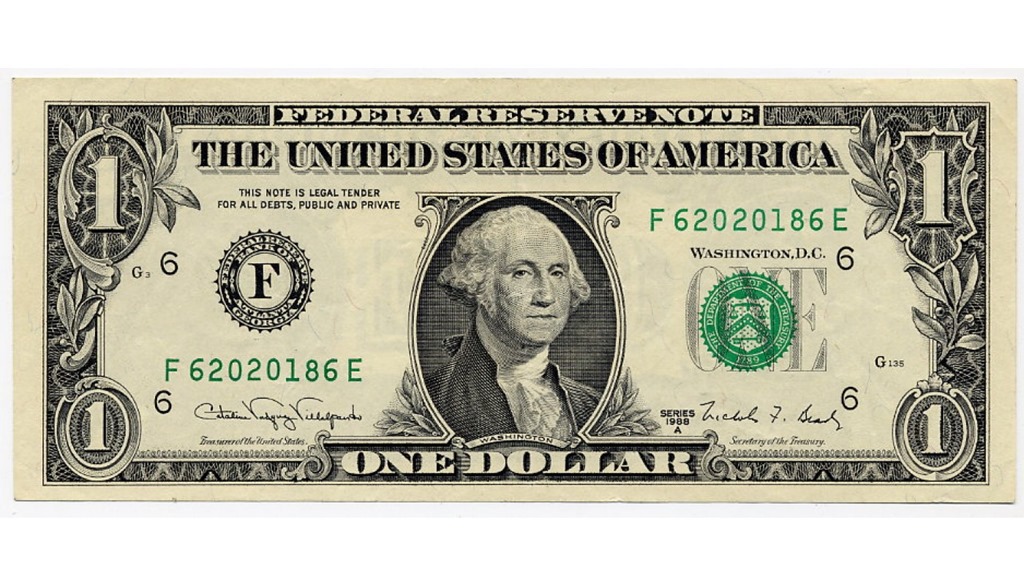
we’re offering pictures of our #1 Parlando Project author for only one dollar


1. Frances. Interesting that two pieces from the colonial United States are 1 and 2, and that a piece with words by an young amateur poet tops the list. Maybe this is a tribute to the Pixies/Nirvana loud/soft arrangement trick in the music? Or that when it comes to subjects, love conquers all? Or that acrostics are about to become a thing?

Please continue to read and listen this month. I have a lot of planned pieces I’ll think you’ll like coming up here. Remember that the Parlando Project seeks variety in music and words, so you may hear things you like as well as not like as we go along, but stick with us as we want to continue to surprise you. I also want to thank those that have hit the like buttons on their favorite posts, and those who have hit the RSS button to follow this blog.

Light

What is lost when poetry is translated? Robert Frost thought it outright: “Poetry  is what is lost in translation.” Those who’ve read my notes here on the Parlando project know that I hold that poetry is words that want to sing. Those sound effects of the flowing sound of words, the call and response of rhyme, the beats of the dancing syllables—all that music can hardly be asked to make it past the visa-check at the translation station on languages’ borders.

In recent posts here I translated two poems from classical Chinese. As a non-Chinese speaker, I could not even hope to convey what musical effects the originals had.  To better see this as English speakers, let us look the other direction, and think about what Emily Dickinson’s “I’ll Tell You How the Sun Rose” (featured in our last post) would lose if we were to translate it to classical Chinese.

Would Dickinson’s poetic music carry over? In English we have the movement of the common meter/ballad meter in her poem, a beat that is ingrained in those who sing common Christian hymns or know secular songs using this meter in the folk and popular music fields.  Since this is a common form in our culture, we are primed to move to this meter, and rich associations may arise from other times we have felt the same beat. All that is most likely lost in translation.

There’s a pun in the first line. The sun “rose” and is pink. Puns won’t likely make it across the border.

Dickinson rhymed her poem. Translators sometimes choose to create rhyming poems in their destination language, but adding this degree of difficulty to the task may cause other defects in translation as the rhyme is sought.

English sometimes has an advantage when one translates to and from it, because it is the language of a much-invaded island, which was then taken up by a polyglot country across the ocean. English as we know it today is full of words with Latin and Germanic origin, echoes of French, Spanish, German, and even more. Occasionally, puns or even rhymes can be saved when the foreign language has these connections. And metric rules for accents and syllables can be somewhat portable across the European range.

But what if we were to translate from English to classical Chinese? I’ll take an audacious shot at Dickinson’s first verse. The English gloss from the ideograms resulting might go like this:

Tell Sun Rise
Ribbon Sequence
Towers Wet Purple-Quartz
Squirrel Messengers
Hills Unpinned Hats
Birdsong Started
Soft Talk Inside
Sun Recognized

Well, there’s something still there isn’t there, even if we as English speakers see the losses. What remains is Dickinson’s attention to an ordinary event with extraordinary details. And there’s some musical structure remaining: parallelism, theme and variation that doesn’t rely on beats or syllables that can still peak through.

Today’s episode is an English translation from the original Bengali by its own author, Rabindranath Tagore. Despite having attended school in England, despite familiarity with English as a resident of a then colonial province of the British Empire, despite some rumored editorial assistance from renowned English language poet William Butler Yeats, and despite Tagore’s well-attested to genius, “Light”  was published in English in 1912 as a prose translation.

tagore-einstein2

Some amateur violin player (left) meets up with Rabindranath Tagore (right)

 
Paradoxically this may be due to the original’s musicality. I’ll have more to say on Tagore next time, but for now just know that Tagore was a composer and songwriter, and that his songs are widely known and appreciated by millions of Bengali speakers.
 
So, to try to restore some of the impact originally present in this piece, I composed and played a rather dense musical accompaniment for Tagore’s translated words. I did this in ignorance of if Tagore had his own melody for this poem in Bengali. Besides animation and illumination of his English prose, I aimed to combine some of my appreciation his native region’s music and Western electric guitar based music. To hear Rabindranath Tagore’s “Light”  with my music and performance, use the player below.