Thank You for your Robert W. Service

We’re entering a month in which Veterans Day will be celebrated with additional ceremony, because the 11th will be the 100th anniversary of the ending of the first world war. Earlier in the blog I remarked that World War 1 was the last war which was substantially narrated to us by poets.

That’s so for a complex set of reasons. Modernism, arising before the outbreak of the war, sought to revive a fresh poetry shorn of worn-out imagery and obligatory practices. The war brought both the old poetry and the new Modernist ideas into a great deadly laboratory to test their efficacy. The comfort of the old poetic music survived this test, but it was gravely wounded. The new practices were not exactly proved either, such was the horror and absurdity of the war. Indeed, the post war Modernism that came out the other end of the war’s meat grinder was oddly often much more obscure and seeking after esoteric tactics.

To a large degree, the post-WWI era marks an off-ramp for poetry. 20th century poetry emphasized the language of aesthetics and philosophy that might employ music to sweeten its sound, rather than the music of words that might employ philosophy as one of its harmonies. Eventually, by our current century, it turned again, and it is now largely about memoir and the establishment and explanation of personal identity.

World War 1 broke poetry, and in it’s wake, the Modernists ascendant decided the shards better reflected reality than some dusty Grecian Urn.

Any of these schemes can work (and not work) artistically, but there is a sort of hierarchy of needs and audience here. The old poetry was more universal, the post WWI High-Modernism the most exclusionary, and our current poetry can result in a multitude of voices crying “I’m here!” to the exclusion of “I see you!”

If one sets aside modern literary poetry, the old poetry still survives. One place you might find it is in the library that some carry about in their heads: memorized poetry. How rare is that today? I cannot say, but I can recall late in the last century, observing Garrison Keillor offering some prize (an autographed book? a T-shirt? I can’t recall the exact prize) to anyone in an admiring crowd who could recite a poem of more than 8 lines. I recall no one taking him up on that offer. Poetry started with those libraries in our heads, and we have the Iliad, the Odyssey and other ancient poetic epics because of prodigious memorization before writing. It isn’t just the noise from our glowing palm screens, or giant TVs that numbed this out of us, it started with the silent racket of all those printed books that call us to read them. Memorization seems a mooted point.

McDonald and McCain

Can you pick out the veteran in this picture?


But returning to that portable library in our heads, and returning da capo to where we started. Somewhere near the middle of the 20th Century, a U.S. Navy pilot was captured and imprisoned by the forces of the country they were bombing. Their captors were none-too-restrained in their treatment of their prisoners, torture and physical abuse was part of that; but in-between that and the constant lack of control that all prisoners face, the prison was made up of small solitary cells with deliberate and extraordinary limits on communication between the prisoners. The design was to break their will, not just their bodies.

The captured pilot was John McCain, who survived this and later went on to a long political career, but one thing that he said helped him persevere in his prison was another captured pilot teaching him a poem by Robert W. Service, essentially loaning out a book from the library of one prisoner’s head to the other. And the method of doing this was painstaking: a pseudo-Morse-code of taps on the wall of the cell that the prisoners devised.

Robert W. Service poems would fit well into taps, as his marching poetic feet can make one tap involuntarily—and the rhymes and narratives give a good structure to assist memorization too. Of course, this was a war prison, it wasn’t a graduate class in Modernist poetry, and if any of the prisoners might have known T. S. Eliot’s “The Wasteland”  they might have skipped it if they couldn’t add the famous published edition’s footnotes in tap codes.

Other than Service’s poetic aids to memorization that let his poetry be present in these solitary cells without possessions, another reason that it should be a poem of his that helped these prisoners endure is that some of Service’s best-known poems are about fatalistic endurance leavened by dark humor. Service’s poetry wasn’t just available without paper, it shared an outlook that helped sustain the prisoners.
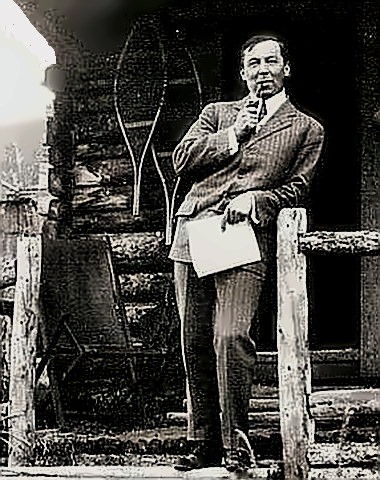
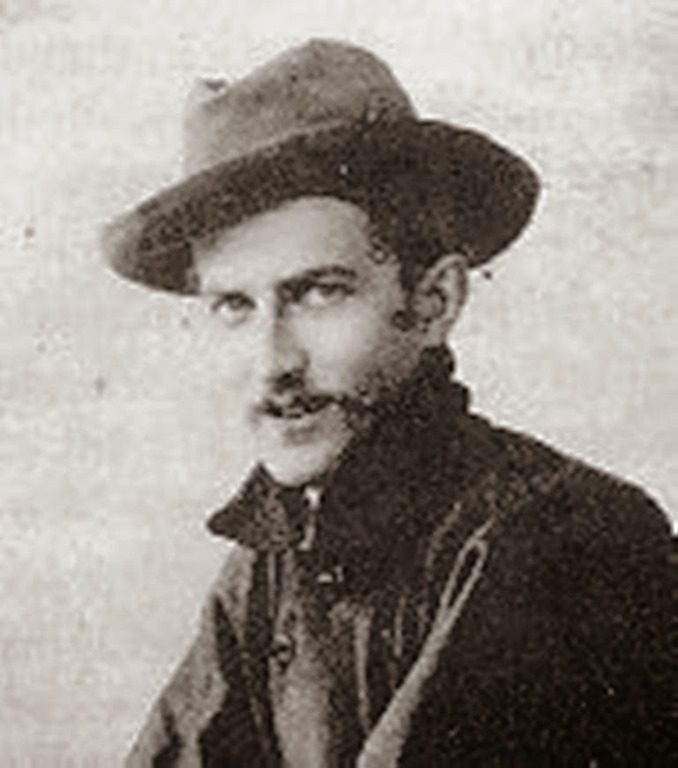
Robert W Service

Canadian poet Robert W. Service, not essaying a look that Leonard Cohen would own up to.


So that’s one veteran’s story from a war, decades after WWI.  Here’s another.

While McCain was imprisoned, another Navy veteran went into a studio in New York City and recorded an LP of Robert W. Service poems set to music.* While Service’s pre-war “Canadian Kipling” poetic style hadn’t changed, the outlook of the poems used in this record included Service’s rage at the horror and lies of WWI. Robert W. Service didn’t become a Modernist poet, but he showed in these poems the same WWI impact that broke other pre-war poetic outlooks.

The veteran in this case was “Country Joe” McDonald, and even if these Service poems talked distinctly of WWI and the British, French and Canadian experience of it, McDonald no doubt intended it to reflect on the then ongoing war in Vietnam. Of course, there were poems written after the WWI era about war, and McDonald had already tossed off one of the most famous Vietnam war songs himself: “I Feel Like I’m Fixin’ To Die Rag.**”   And yet, here he was, drawn to these poems about World War I to express something decades later.

For our audio piece today, here’s a Robert W. Service poem, “The Lone Trail,”  more from the endurance side of the poet, performed by Dave Moore with the LYL Band. Here’s the player to listen to it:


*The record War, War, War  largely draws on Service’s Rhymes of a Red-Cross Man  which was published in 1916. McDonald’s record is a true solo record, just acoustic 12-string guitar, vocals, a bit of harmonica, and some foot-stomping; a straightforward, earnest, and harrowing collection. Parlando Project voice Dave Moore owned that LP, part of the reason he performed today’s Robert W. Service piece.

**McDonald later tells the story of hearing that not only did the North Vietnamese appropriate his song for propaganda broadcasts meant for the U.S. troops, but they even piped it into that POW camp in Hanoi. In the story McDonald heard, the soldiers, and even the prisoners, would laugh. His analysis: the French-educated Vietnamese “Never understood…an American sense of humor.”

Crushed Before the Moth

Increasingly, I am comprehending the miracle of Emily Dickinson. Fifty years before Ezra Pound and T. E. Hulme constructed a compressed modern poetry replacing conventional imagery with fresh and direct observation, a woman in a rural town in the woods of Massachusetts had already practiced their innovations over a thousand times.

Through a series of happy accidents, Dickinson’s poetry was preserved and published at the end of the 19th Century, just before the Imagists launched their Modernism—but even then, she was still like one of those unexploded bombs dug up by a construction crew decades after the war. Even after publication, the framing of her poetry still obscured it. Her posthumous editors cleaned up her punctuation and gave the poems titles, and on the page they looked so normal. As these were poems by an Emily, they were clearly the work of a woman, and so they were read as women were generally understood, even when not pressed between the boards of a poetry book. And Dickinson herself designed her poems to draw you in with their modest length, their frequent use of pious hymn meters and stanzas, their homey rhymes. Even into my mid-20th Century lifetime, it was perfectly possible to be aware of Emily Dickinson’s poetry and not be awed.

“Hey Joe, there’s a big chunk of metal buried way down in the mud! Here, listen when I give it a bit of a whack with my pipe wrench…”

UXB2

They still run across stuff like this from WWII around Europe. Decades old, and they can still go “Boom!”


Some early 20th Century Modernists looked more closely, and maybe saw some of what was there. Carl Sandburg straight-out called her an Imagist in a poem. I am unaware of how much attention the other early Modernists gave to Dickinson, but just on a promotional level, it might not be advantageous to talk much about poems written decades ago when your brand is “Make it new!” Remember too how Pound jabbed at Walt Whitman in his tribute poem: Walt Whitman you were a hacker out there in some unharvested forest, I’m a fine wood-carver able to bring out the finest detail. Dickinson’s near-rhymes and loose but familiar meters may have been read as imperfections to Modernism.

It took the last quarter of the 20th Century for Emily Dickinson to finally be seen, and we are still seeing more now as we look closer. What if, back in the mid-19th Century when Dickinson was creating this unprecedented expression, one had been able to talk with her about it? The value of writers’ groups, seminars, and MFA programs is not universally acknowledged, but most think these things at least have some effect on those who participate.

It just so happens, that occurred. Dickinson’s letters to Thomas Higginson give us some of her ideas, but as I read that correspondence I see Dickinson adopting masks, some playfully, some for protection. And Higginson, as varied as he was, was not, as far as I know, a poet, and therefore there was no chance that he would use Dickinson as a model for his own writing. But Dickinson’s long-time friend, neighbor, and sister-in-law Susan Gilbert Dickinson was a writer who dabbled in poetry.

Susan Gilbert Dickinson

Like Emily, Susan Gilbert was smart, was allowed some access to education, and wrote poetry


No other person saw as much of Emily Dickinson’s poetry while she was still alive as Susan. It’s also probable that no other person other than Emily Dickinson’s sister Lavinia (who seems to have had no artistic interests) was as intimate with the author. There is even speculation that there was an erotic bond between Susan and Emily. Besides the pant, pant passages in the letters between them, Emily praises Susan’s intelligence and cultural companionship. Given what must have been the loneliness of Emily Dickinson’s creative innovation, amplified by the cultural limitations for women in her time, we may all owe a debt of gratitude to Susan Gilbert in helping sustain Emily Dickinson.

Today’s piece uses a poem by Susan Gilbert Dickinson that shows some of the same elements one finds in Emily Dickinson’s poetry. Given that the prolific Emily Dickinson experimented with her expression, if “Crushed Before the Moth”  was slipped into some complete poems of Emily Dickinson volume it would not seem entirely out of place.

What elements of “Crushed Before the Moth”  are Dickinsonian? A short line length (six syllables, though not Emily’s familiar 6/8/6/8 hymn stanza). Alternating rhymed lines with unrhymed, though here first and third not second and fourth, and the rhymes are all perfect rhymes except the final “moth.” Even the use of a Bible verse (Job 4:19) is not unprecedented in Dickinson, who though a religious dissenter, was steeped in a Christian religious culture.

The poem begins, just as many of Emily’s poems will, with a close observation of nature. In Job, the moth is only a passing metaphor, in Susan’s poem it’s an actual moth, looked at closely enough to see the texture of its body in the evening. The moth is treated here as an Imagist would. It’s not some intellectual counter, a rote symbol only standing for something else, but an actual animal in an actual evening. The second stanza continues in the same vein, the moth the morning after, though with more characterization.

The concluding three lines, though they contain the only Emily-like slant rhyme, are the least like Dickinson’s poetry. That kind of envoi ending with a clear and orthodox moral lesson is not something Emily would write in her mature poetry, and the “Is this thy stronger host” line sounds unnatural and stilted.

Still, this might be the first poem ever written that imitates Emily Dickinson’s strengths and innovations. That Susan Gilbert Dickinson was a more orthodox Christian than her friend, and like all of us, not the genius that Emily Dickinson was, doesn’t keep her “Crushed Before the Moth”  from being an effective poem.

I’m back to acoustic guitar for today’s performance of this piece, which is available using the player below.

Seventeen Almost to Ohio

Two threads lie here, waiting to be woven together. One thread: those young pre-WWI Modernists, the other: writers in old age.

Young: Mina Loy, Alfred Kreymborg, Glaspell and Cook of the Provincetown Playhouse, early in their careers, workers shaping modern literature—though none of them are remembered much now. Older poets: Longfellow, Donald Hall, and even Sarojini Naidu, Dave Moore and I, all speaking for carrying on past youth. Longfellow of course is no longer read for his intrinsic value, Naidu’s poetry is not read in the West, and Donald Hall concludes in his late-life essays, that he, like the majority of poets who receive prizes, notice and ample publication in their time, will be unread 20 years after their death. Moore and I of course are in a different, more perilous, class of ranked achievement. If Hall is right, Dave and I can look forward to equaling prize winner and American Poet Laurette Donald Hall’s status (unread, forgotten) in only 20 years!

There’s your writer’s affirmation for today.

What happened to those bright young Modernists? Cook died young. Kreymborg, that pre-WWI networking avant garde-ist, had a long post-war career judged by literary critics as undistinguished. Glaspell had an increasingly difficult second half of a career, though she won a Pulitzer Prize for drama in 1931 for a play that few praise now, the sort of late plaudit that sometimes comes to pioneers when prize committees compensate for overlooking earlier achievements. Like Hall, Mina Loy lived into her 80s, but unlike Hall, the last half of her life seems fallen from any career path. So, even before she died in 1966, she’d already achieved Hall’s 20-years-past-death status.

In 1960, Loy was 77 and living in the Western US when young poet Paul Blackburn was sent to interview her. A creaky hundred-minute tape exists of the encounter. Loy’s memory of things a half-century old seems spotty by this time, and this once eloquent poet grasps for words, even her own words, when asked to read her still modern sounding verse from her youth. Her readings are flat, though she occasionally is stirred by remembrance of the times and places when the poems were written. Once or twice she humble-brags or finds sincere surprise at how clever she had been. Listening, I wanted her to claim outright the fierceness she had shown back then. Instead, she seems an old 77, tired and distracted.

Mina Loy Paul Blackburn

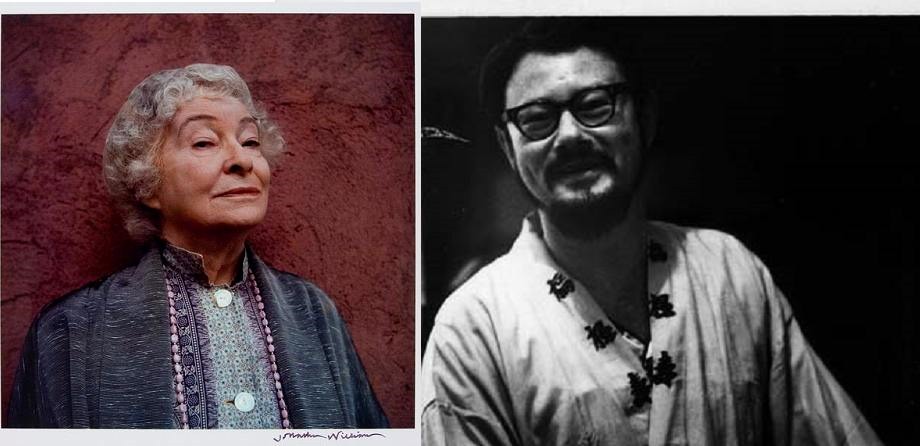
Mina Loy in later life by Jonathan Williams, Paul Blackburn 1966 by Elsa Dorfman


Blackburn is patient, and he rarely man-splains or talks over Loy, something I would be all too prone to do if I was the man holding the microphone. He seems to genuinely admire Loy’s poetry as he seeks to add to a record of a career that was forgotten then, and he wants her to know that in 1960, at least one reader “gets” what she wrote in 1914.

Just past one hour in the recording, something extraordinary happens. Blackburn, touched by one of Loy’s recovered memories, a feeling perhaps amplified by additional visual clues he would have in the room that are not imprinted on the audio tape, exchanges with Loy a memory from his own youth during the second instead of the first world war.

I have taken that story, much as Blackburn expressed it that day in 1960, with some minimal editing and shaping for the words of today’s audio piece.

Of course, we’ve now largely forgotten Paul Blackburn as a poet too, following Hall’s law. Blackburn died too young, and more than 20 years ago, but his story struck me as a tightly expressed spontaneous poem. What was this: a poem he had already written, one he was paraphrasing from memory for Loy? Was it a poem he was thinking of writing as he interviewed the aged poet, perhaps thinking the tape recorder could serve as well as a notebook jot to put a first draft down? Was Blackburn simply a practiced poet who could orally improvise from his skills a well-shaped improvisation?

Whichever, I think it’s beautiful. His story combines looking back at youth and a landscape that is no more, with Dante’s Inferno moved forward to Greatest Generation Pittsburg, and it has a closing that contains a remarkable Imagist jump into synesthesia. I call my arrangement of Blackburn’s anecdote told to Loy “Seventeen Almost to Ohio.”

Today’s music, like the interview, is restrained: contrabass, a pair of cellos, piano, and percussion. I strove in my  performance and arrangement to do justice to Paul Blackburn’s story. To hear it, use the player below.


To W.C.W. M.D.

It’s now 1916—well not really—but allow me immediate mode for the time being. Some early 20th Century Modernist characters we’ve already met are about to collaborate in New York City with a largely forgotten figure whose words we’ll meet today.

The Provincetown Playhouse, that CBGB’s of Modernist American theater, has moved its organization from the remote Cape Cod artist’s colony to New York’s Greenwich village, and they’re still looking for new types of plays by new playwrights. How about drama using Modernist poetry?

Verse drama, despite continuing productions of Shakespeare, is a thing that often generates rumors of revival while never really reviving. In 1916, the Provincetown group was open to trying this. Which poets can come up with something?

Alfred Kreymborg could. Kreymborg was a leading networker or influencer in the New York area for Modernist poetry. Ezra Pound, and then Amy Lowell, would publish anthology books of Imagist Poets. Harriet Monroe out of Chicago was also gathering new Modernist work for Poetry  magazine. In 1916 Kreymborg would do the same in New York, with a magazine and anthology book series called “Others.”  Kreymborg had also been writing poetry, short poems mostly, all of them free verse. Now a play.

Others group

The “Others” group: L to R in back: Jean Crotti, Marcel Duchamp, Walter Arensberg, Man Ray, R. A. Sanborn, Maxwell Bodenheim. In front: Alison Hartpence, Alfred Kreymborg (bowtie daddie), William Carlos Williams (w/ Internet click-bait cat) and Skip Cannell


The play he wrote is an odd thing to describe. Titled “Lima Beans,”  it’s a two-character play about a couple. The husband loves lima beans, the wife decides he might also like string beans and surprises him with the new beans—but no, he loves lima beans. He stalks off, angry. She scrambles and gets some lima beans. He realizes he loves his wife, returns and she’s got lima beans for him. Kiss. Curtain.

I guess this could be a Seinfeld  episode plot decades later, but that’s not how Kreymborg uses it. He writes his play with litanies of repeated words, hocketing between the two voices. After reading the play this month, I’m guessing a performance might sound like a cross between Dr. Suess’ Green Eggs and Ham  and a late 20th Century Minimalist musical work by someone like Phillip Glass or Meredith Monk. Or as Preston Sturges’ Sullivan would have it, Waiting for Godot  plus vegetables—but with a little sex in it. That musical comparison is particularly apt, because even though the play did not use musical accompaniment, Kreymborg saw it as a musical structure.

So here in 1916 we have the Provincetown group, putting on a play that pioneered a performance aesthetic that still seems audacious 50 or 60 years later. Who are you going to get as actors to realize this—words and a presentation of thought conveyed musically, without actual music?

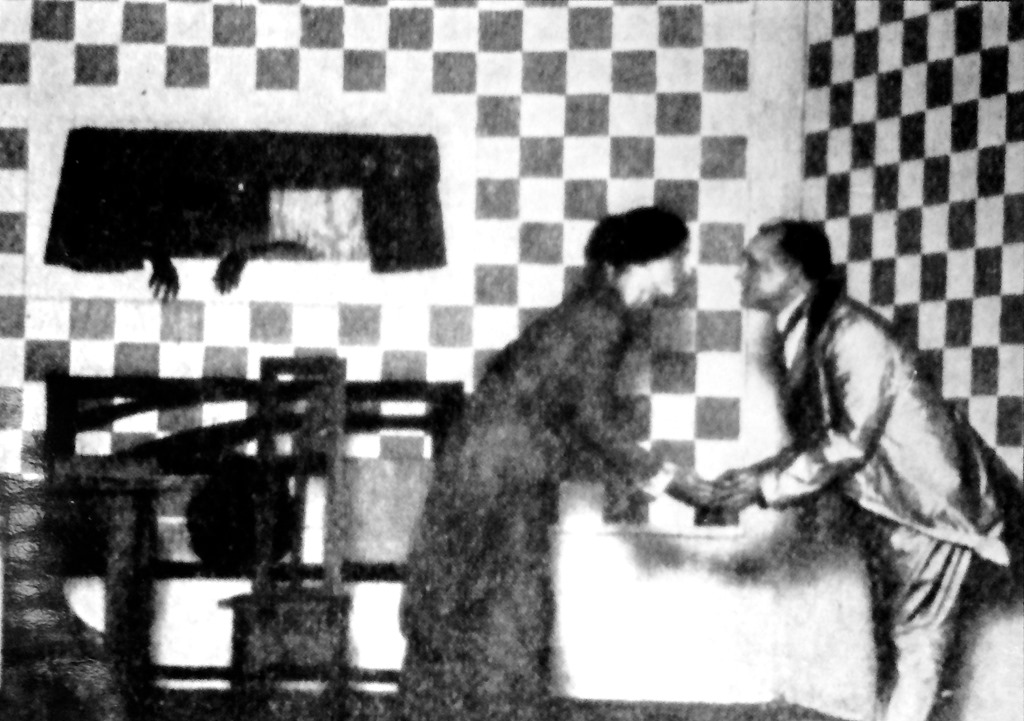
Poets.  In the role of the husband, William Carlos Williams. In the role of the wife, Mina Loy, who had just arrived in New York after getting away from those Italian Futurists. Neither poet had acted before, but Kreymborg rehearsed the two poets until they could present his free-verse vision.

Loy and Williams in Lima Beans

Mina Loy and William Carlos Williams in Lima Beans. The set for the proudly independent Provincetown Playhouse production cost $2.50, and its set designer, William Zorach,  also played the 3rd character whose hands are hanging, Soupy Sales-like, out the window.


I toyed with the idea of trying to realize Lima Beans  here, although with music this time. But it really needs two voices, and I wasn’t sure that a short section could do justice to the structure of the piece.

In it’s place, I looked for a short poem of Kreymborg’s to use instead. This proved more difficult than I thought it would be. I read his two poetry collections from this era, but no poem grabbed my attention. As in the play, he’s looking for a new poetic language in these poems, but it’s hard to grab the emotional center of many of them for performance.

In the end I chose today’s piece: “To W.C.W. M.D.”  It’s dedicated to William Carlos Williams. This might be more of Kreymborg’s log-rolling networking skills on display, but its subject also answered a desire I have to do a piece remembering my late wife Renee Robbins in some way today. As best as I can penetrate the emotional core of this poem, it speaks of the need to separate and not separate from those that have died.

Musically, the piece is based on one stacked chord, E minor7/11, but the notes are spread out between the instruments. Besides drums there are two bass guitars, piano, two viola parts, a violin part, and a clarinet in this. To hear it, use the player below.


Pig Cupid

Today we return to the early 20th Century Modernists with a piece using words by Mina Loy. Last post we had a poet taking a political stand: Longfellow aligning himself with the movement to abolish slavery. Decades later, the Modernists joined political movements too.

One might suppose that since Modernism sought to overthrow the old cultural order and revolutionize artistic expression that many Modernists would be attracted to political radicalism—and to a large degree that’s so.

You might also assume that these artistic radicals would be leftists, aligned with the growing Socialist movements in England and the United States, or attracted after 1917 to the as then untested promise of the new Communist government in Russia. Or perhaps they’d make common cause with anarchism. Or maybe they’d create their own playlist mixing all of the above.

And yes, you can find that. Carl Sandburg in the U. S. Midwest, most of the Surrealists, bohemians in New York’s Greenwich Village, Herbert Read and some other British Modernists.

However, one can also find Modernists who aligned with the right wing in this era—and not only garden-variety Tories, or even those who allied themselves with the “respectable” racist strains of U. S. politics. Even in the years before WWI, the social theories that would coalesce into Fascism found adherents in the new literary avant garde. As to Americans, the most famous case is the indispensable Modernist poet, editor and promotor, Ezra Pound, eventually charged with treason at the end of WWII.

Modernists seemed something like stem cells as their artistic revolution kicked off—they could develop into followers of any kind of political radicalism. At a time when political engagement for artists was common, there must have been a feeling in the air that a side must be chosen if one was to be a thorough-going cultural Modernist.

So, much as the French Surrealists once sought to make Communism a dictate for membership in the Surrealist movement, the slightly earlier Italian Futurists eventually made Fascism a core value of their artistic circle.

mina-loy

I love my baby, cause she does good sculptures, yeah!” The young Mina Loy

.

It’s now we get to Mina Loy. No, not the delightful Hollywood actress—that’s Myrna Loy (Myrna Loy was the stage name for the woman born Myrna Williams, and it’s just possible that Loy could have been chosen to refer to Mina).

It’s 1905. Modernism is kicking off first in the visual art world, followed just behind by the poets. Loy, in her 20s, has already done the visual art thing in London and Paris, but her marriage is failing, and she’s just had an infant child die. To change her life, she moves to Italy. She befriends Futurist artist Carlo Carra, and if you follow along on your Futurist score-card she had love-affairs there with two principals of Italian Futurism: F. T. Marinetti and Giovanni Papini.

Let’s re-set our scene. Here’s a young woman in a foreign country going through life stress events. The art-world is shifting under everyone’s feet. As a movement that will eventually fancy itself outright as the cultural well-spring of Italian Fascism, the circle she’s fallen in with isn’t just about making it new, it’s militaristic, paternalistic, nationalistic, and it worships violence. That isn’t what jealous opponents say about Futurism, it’s what its own manifestos brag about.

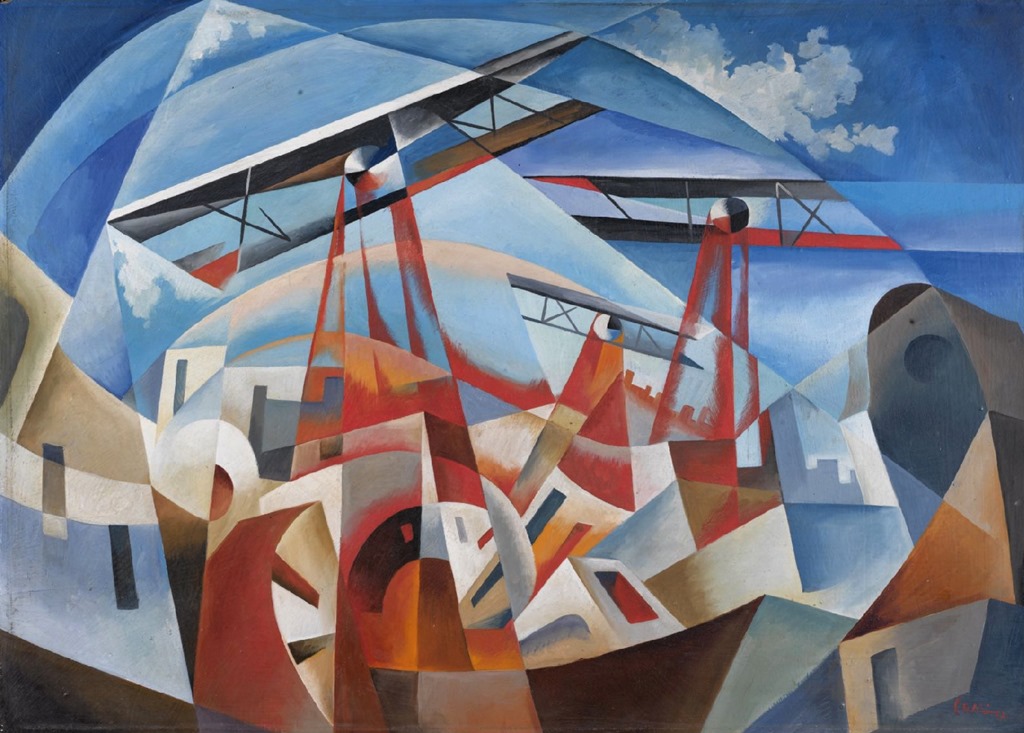
Tullio Crali - Bombardamento-aereo (1932)

Futurist war painting. Compare its outlook to Guernica or Flint’s poem “Zeppelins.
Marinetti’s Futurist Manifesto declared “We will glorify war—the world’s only hygiene”

.

As preparing actors say, all that would be part of the work to figure out what Mina Loy is experiencing. Here’s another bit of business you might grab onto: young, ambitious, male artists. I doubt some not-uncommon tropes have changed in that field.

What happens?

Mina becomes a poet. A fierce poet. Artistically she uses some of the new ideas that the Futurists are thinking about. Her poetry moves between time and tenses, voices and outlooks, in machine gun bursts. Conventional expression and sentiment? Blow them up, run them over with a locomotive. Sixty years later Harlan Ellison would write “Love is just sex misspelled” and be thought provocative. Mina had already been there in the horse-and-buggy era. How can a woman keep her selfhood (or for that matter, how can any human being do so) in the minefield of desire and relationships? What is deep and inherent in motherhood that society will not express openly?

Though she used some of the artistic ideas of Futurism as effectively as any writer, Loy seemed to resist most of its political ideas and she satirized the pretentions of the “Flabergasts” while writing about her Italian time as being in the “Lion’s Jaws.”  Leaving Italy, she next moved to New York, where she joined the Greenwich Village circle.

Today’s piece uses selections I took from a 34-poem sequence called “Songs to Johannes,”  inspired by the relationship with Giovanni Papini (Johannes and Giovanni are variations of the same root name). Loy published these in 1914, near the end of her Italian time. Within the little-magazine world of Modernism she made an immediate impact. Eliot, Pound, William Carlos Williams, and Gertrude Stein said good things about her work. Legendary founder of Poetry magazine Harriet Monroe seems to have been scared by Loy’s frankness. Amy Lowell, poet and influential anthologist, was so put off she is supposed to have said that she would not publish in any magazine that printed Loy.

If the patriarchy may have lost the battle with Mina Loy, for a long time they seem to have won the peace. It was only in the last few years of the 20th Century that Loy’s poems of the first part of that century began to be looked at again. Now, Loy has become a key poetic Modernist for literary scholars tired of the usual sausage-fest, but that opens up the danger that work like “Songs to Johannes”  may be introduced, academically, like this: “Loy in effect diagnoses an end to love poetry in the light of historical circumstance, anticipating that poststructuralist line of inquiry which urges a rereading of ‘lyric’ as a culturally responsive construct. Instead, her poetry constitutes a critique of the very demand that lyric expression be viewed apart from the social world.”

There’s nothing wrong with that view, but I find Loy’s pre-WWI writing here a lot more immediate assuming one has some applicable life experience to bring to it. Her diction sometimes reminds me of Emily Dickinson, and like Dickinson figuring out what is ironic, and what is earnest, and what is both, can sometimes be a challenge. In performance, any of those three choices seem to work for most phrases here. The greatest error would be to make them all of the same tenor. Also, like Dickinson, Loy will move from speaking concise abstraction to vivid metaphor using very few words. Thus, the high minded and the sensual nitty-gritty are juxtaposed.

My appreciation for this sequence grew tremendously as I constructed this performance. There are strong images, richly ambiguous expressions, and yes, lines that one could deconstruct at thesis length. I didn’t even have room to include the phrase from “Songs to Johannes”  that I’ve chosen to title today’s selection, but I can never look at a plump rococo cherub again without recalling it. But the real gift I got, the unique gift of art, is that I could experience some of Loy’s moments in the hot-house nexus of Fascism and Modernism.  “Pig Cupid”  would probably be more authentic if this was performed in a woman’s voice, but alas my voice is what I have available today. To hear my performance, you use the player below if your reader displays it, or this highlighted hyperlink will also play it.

Morituri Salutamus

I suspect no poet in the past couple of centuries has suffered a greater decline in esteem as Henry Wadsworth Longfellow. This is not due to some scandal in his biography, for as far as I can tell he lived an admirable life, but artistically he’s been indicted for a number of crimes and misdemeanors. Before I go over those, let me briefly summarize the heights from which Longfellow has fallen.

He was the first self-sustaining professional American poet, the first to reach a considerable level of national and international success. By the middle of the 19th Century he was roughly as famous as Tennyson and Dickens, known and generally admired by his contemporary poets, and avidly read by a broad non-academic readership. He sustained this fame for several decades and further, past his death in 1882. His general readership survived into my grandfather’s generation, and then through my father’s, and to a degree, into mine. Somewhere in the middle of the 20th Century, this engine of fame and readership broke down, and by now they’ve torn up the tracks of the Longfellow Line, and ragged grass grows over the railbed.

I grew up reading Longfellow as the next generations might read Dr. Suess or Sandra Boyton in childhood. As I reached the age of ridicule, I could revel in Bullwinkle the moose in his parody poetry corner reciting Longfellow poems that I knew. Now Longfellow is probably not well enough known to satirize.

So, what are Longfellow’s poetic crimes? Meter and rhyme and a certain amount of antique diction—though we are able to somewhat forgive the English romantics of the generation before Longfellow those afflictions. Earnestness and popularity, two things that no ironic 20th Century Modernist would wish to be accused of—but Robert Frost survived the later, while being seen (mistakenly) as expressing the former. Longfellow’s contemporary, Walt Whitman, explicitly sought to commit the earnestness and popularity crimes—though, as the old dis goes, for many years, Whitman couldn’t get arrested for it.

Whitman-Longfellow

The good gray poet Whitman, and his doppelganger the forgotten famous writer Longfellow.

But Longfellow’s capital offense, the crime his reputation has been executed for, is simplicity and conventionality of thought. If I had to be Longfellow’s defense lawyer on this charge, perhaps I’d be reduced to throwing his case on the mercy of the court. Longfellow’s writing is often expressly didactic, and impersonal sentimental themes abound. Over and over again, he counsels perseverance and its seeming opposite, acceptance of impermanence. A more metaphysical poet would show his work and do more with incident to earn his conclusions. A more modern poet would make sure to make his life’s painful particulars his main subject.

Ironically, Longfellow’s life story is full of such material. Today we often think of poetry and art as an extension of memoir, and that writers earn their license to express things from their life stories. Longfellow would have had that license.

Some forms of Modernism believe that the best way to deal with complex emotion or great pain is to put it in the silences, in the blank spaces. These Modernists believed this would be more effective, because they are signaling with this constrained and minimalist expression that the thoughtful audience needs to seek for what is not said.

20th Century Modernists decorated their foreground with images, not antique forms of literary expression, and the complex message is encrypted in those images as if by steganography. Could Longfellow be doing something similar in the blank spaces between the lines of his hypnotic verse?

Today’s piece uses words from a late Longfellow poem “Morituri Salutamus,”  a Latin title taken from the famous gladiator phrase “Those who are about to die salute you.” The bulk of this poem, written for the occasion of his 50th college class reunion when Longfellow was 68, is taken up with matter that might appear in a commencement speech or the granting of an honorary diploma. Its purported mode is lightly elegiac, advice to the young is given; but as it proceeds, Longfellow transitions to a not over-worn thought. He prepares for the poem’s final stanza by cataloging some swan-songsters of literary history: Simonides, Chaucer, Sophocles. For compression, and for my preference for briefer work, this last stanza is what I used for today’s piece.

In that final stanza, with supple verse, Longfellow concisely implores his aging generation (and himself) to continue to labor to create, to create better. That’s not a complex thought. Does it need to be? Is it easier or tougher to do because it’s a simple thought?

To hear my performance of the conclusion to Longfellow’s “Morituri Salutamus,”  use the player below. Some of you will not see the player, but then this highlighted hyperlink can be used instead to play it.

St. Francis Einstein of the Daffodils

Metaphor, that stuff that helps make the music of thought in poetry, is the linking or liking of things. This is like that. This stands for that. The sensation of this is like the sensation of that. This reminds us of something else. The way I say this recalls the way one says that. Metaphor recombines the stuff of our world even though it’s a combination that only exists in the imagination.

Metaphor can make something clearer to an audience. It’s so useful in that way that one can barely explain anything challenging to an audience, even in the most prosaic day-to-day business world, without falling into metaphor. In poetry however, the bounds of increased clarity can be stretched, broken, and abandoned. Depending on one’s mood as a reader, this can be frustrating or a pleasing play of the mind. With the Parlando Project we perform the poems with music. One hope from this is that you can relax and let the beauty or strangeness of the words carry you over gaps in meaning. Sometimes you can enjoy a poem before you understand it.

William Carlos Williams who wrote the words in today’s piece, gives us Spring weather with Spring flowers and fruit blossoms, gardens and orchards, and all under a title that combines a famous saint with his era’s most famous scientist. He gives us almost no help in combining that title with the poem, other than yoking them together. The linkage of metaphor is much strained here, even when he further explains his title by adding a sub-title: “On the first visit of Professor Einstein to the United States in the spring of 1921.”

How are we to make the connection that will construct the metaphor?

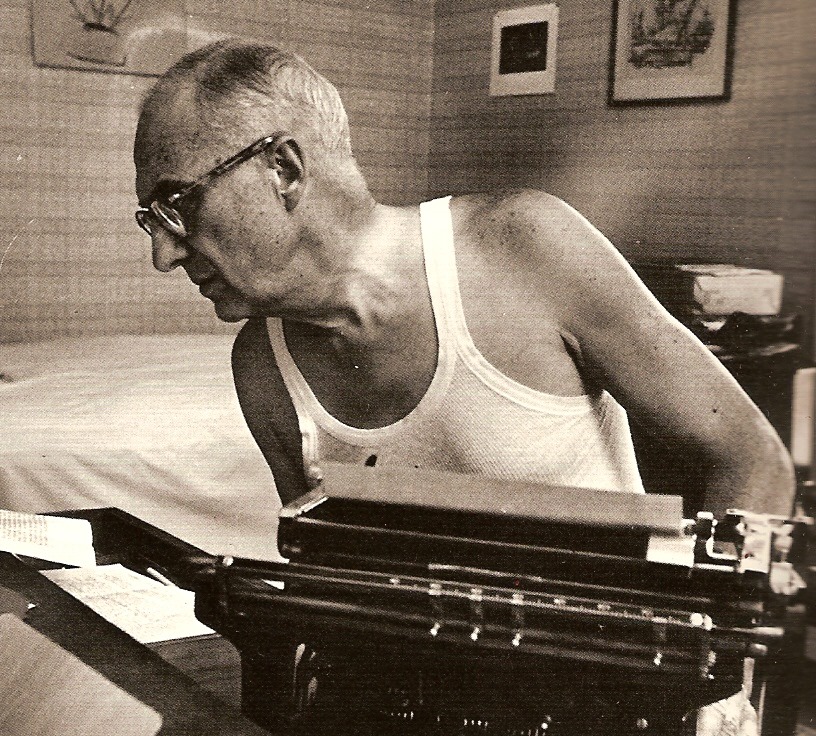
William Carlos Williams with typewriter

Just another hipster with his typewriter. William Carlos Williams throws off his covers.


My best understanding so far is that the connection is wonder and change. Recall our last post, where in his “Queen Mab”  Percy Bysshe Shelley, the Romantic early-19th Century poet, gave us a vision of the wonder of an immense cosmos, which Shelley’s own notes tell us he could also sense through the poetic/mathematical meter of the speed of light. The theoretical scientist and the visionary poet each seek to grasp some new metaphor of the world. Einstein was changing physics in the time that Williams and his fellow Modernists were seeking to change the apparatus of art. Williams elaborates on this theme mostly by vivid descriptions of the change of Spring. In the only mention of Einstein in the body of the poem, Einstein is “tall as a violet.” He is the Spring’s new growth.

There are a couple of obscure literary references in one section, the sort of thing T. S. Eliot or his imitators would have used. Who is “Samos, dead and buried?” I’m not sure, but my guess is that it’s Pythagoras of Samos, the famous classical Greek philosopher for whom science and the arts were one. And Lesbia? Catullus’ Roman poetic beloved, who we’ve met here in Elizabethan guise. It may be enough that they have ancient sounding names, and of such ancient classical modes, Williams, who is in some ways the Anti-T. S. Eliot, says “Sing of it no longer.” He moves right back into a present day of Spring. Pythagoras is dead, Catullus’ Lesbia is dead, and so is a black cat buried in a newly planted garden. Awhile later in the poem we may get one more connection to that cat part of this buried trio. A chicken-raising man who puts out poisoned fish-heads to keep the cats from his chickens. That man becomes like the Modernists, needing to kill the ancients to protect the new flock he’s raising.

As a side note, this poem’s chicken farmer, the white-haired negro, was quite likely the man whose rain-glistened red wheelbarrow sat next to the white chickens in William’s famous poem of admiration.

The poem closes with a sensuous image of Spring change, a night that grows warm as an orchard owner opens his windows and throws off the covers that were needed in the cold. In an earlier version of the poem, Williams had woven Einstein by name in and out of those Spring images explicitly, including this last one where Einstein was named as that man with the blossoming orchard, another grower of renewed things. In this later version, all these stated links to Einstein are removed (save for that one Einstein as a violet).

Professor Einstein Narcissus

Not a violet, but the “Professor Einstein Narcissus.” Has “great curb appeal” and “deer won’t eat” says this garden center.


Was that a right choice? The resulting poem is shorter and more mysterious, but it also doesn’t make it easy to see what Williams is getting at. He’s using metaphor, but he’s removed all the connections. I decided to perform the later version. I think it performs slightly better, and perhaps the music makes the obscurities less taunting.

A simple musical arrangement this time, just acoustic guitar and subdued electric bass. To hear my performance of William Carlos Williams’ “St. Francis Einstein of the Daffodils,”  use the player below.


Parlando Spring 2018 Top 10-Part Two

Continuing on with our count-down of the most listened to and liked audio pieces from the Parlando Project during the past quarter, we’ve now come to numbers seven through five.

At number seven this time is an example of how the Spotify listeners differ from the blog listeners. This piece received only a handful of listens on the blog this past spring, which isn’t unusual, as “Sky”  was posted there last summer, and blog users tend to listen to the latest posts unless brought here by a search engine. On Spotify though, “Sky”  has seen steady action, and enough plays there to make it one of the most listened to this spring..

I like the idea and outcome of looking at the Midwestern sky that multimedia artist Laurie Anderson explained in an interview that I quoted to make the words for this piece, but I’m not sure what attracted all the action on Spotify for it. Is it the short, somewhat generic, title perhaps? As we’ll see later this month in the countdown, another of the Parlando pieces with a one word title was very popular on Spotify in the past few months.

Well, no matter blog readers, here’s “Sky” brought to your attention by the listeners on Spotify.


One of the Parlando Project principles is “Other People’s Stories.” There are a good number of Internet locations where people post their own poems, and blogging in particular is often autobiographical. I could do the same, but I have a contrarian streak, and I find responding to other people’s words and figuring out how to perform them interesting.

I don’t dislike autobiographical blogs, I subscribe and happily read a handful of them myself. If prodded, I can go on way too long about myself, just as I have a tendency to do on any subject, and having had my first poem published almost 50 years ago, I’m certainly not against revealing my own poetry. “Other people’s stories” is a choice I find helpful, that’s all.

I will use my own poetry/lyrics in the audio pieces here from time to time, though I like it when they are my words about other people, such as the number six most popular piece last spring, “Anglers.”  This is the story of my father and his youngest brother’s sport fishing, something they spent many pleasant days doing before my father became too old and frail for his beloved outdoors. Those days seemed timeless even as they were occurring decades ago, and those lakes have become mysteriously reflective in memory now. So, in writing of them I added notes about passing between dimensions.

I’m proud of how this came out, and glad so many have taken the time to listen.


These Top Ten lists often include well-known poems by well-remembered poets, but that contrarian streak in me likes to look at those less remembered and see what might be of interest there. Richard Aldington is one such case, a writer who was active in the pre-WW1 London circle that created Modernist poetry in English. Coming in at number five on this spring’s list is this charming poem of his “The Poplar.”

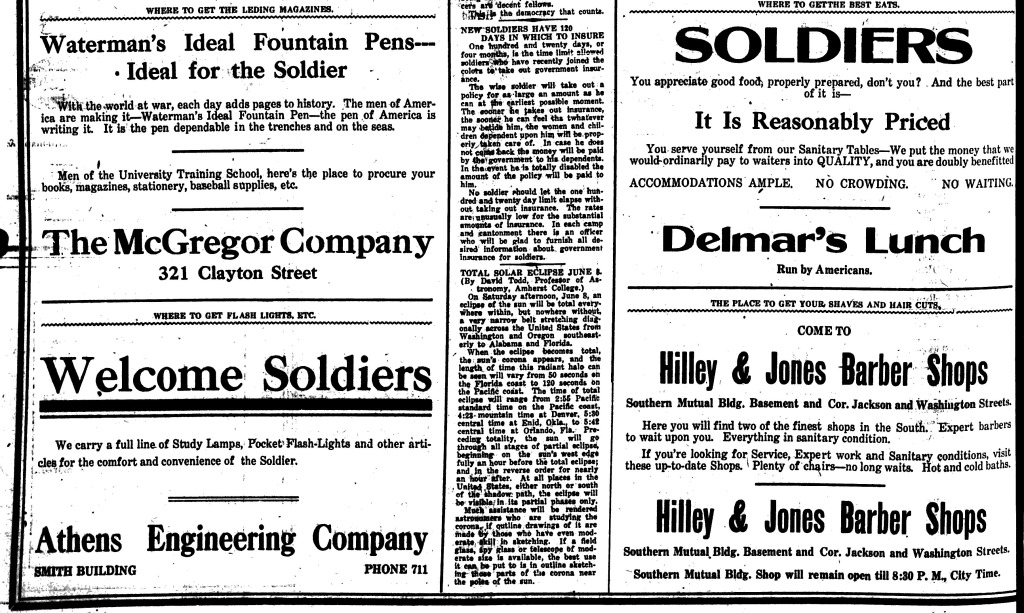
David Todd asks Athen GA artists to sketch eclipse

62 years before REM was formed in that town, astronomer David Todd asks artists in Athens Georgia to sketch the June 8th 1918 total solar eclipse. Note the ads pitching goods to WWI soldiers. “Delmer’s Lunch – Run by Americans”


Since it is easiest for me to use poems here that are in the public domain, the newest ones are often from that Modernist revolution that occurred in the first two decades or so of the 20th Century. There are weeks when I think I must be living 100 years ago more than in 2018, as I look for and read poetry from that era. Do I find this a refuge from 2018? No. The horrors of WWI (which impacted Aldington, who served, significantly), the realities of racial, class and gender attitudes then, mean this was no golden age. But what does surprise me reliving the genesis of English Modernist verse as I read their work now, is how they employed broadly accessible images in their Imagist poetry.

The post-1920 High Modernism that was largely used to represent the Modernist movement when I first encountered it is full of obscure references, exotic words and locations, events so far into the imagination and the special dialects the poet chose to reflect those inward locations, that a reader is confronted by a world they can’t comprehend the landscape of, much less the meaning of what occurs there. There can be beauty and insight in this, but it’s a world that assumes one will come prepared, well-equipped with poetry expedition gear and maps.

But before all this, as Modernism was forming itself, the poems are still in a world much like the one inhabited by the general reader, like this graceful and musical one. Give a listen to Richard Aldington’s “The Poplar”  below.


Other peoples stories. How can I connect sky-watcher and eclipse sketch promoter David Todd to poetry? Todd was a pioneer of “eclipse chasing” as well as a theorist of life on Mars. His wife, who documented his trips to view eclipses was Mabel Loomis Todd. Back in the 1880s Mabel had a scandalous long-running affair with Emily Dickinson’s brother, who lived next door to Emily. After Emily’s death, Mabel Loomis Todd was the person who saw to the publication of Emily Dickinson’s poetry. And when we return soon to continue our count-down, we’ll have a poem from Emily Dickinson.

Letters to Dead Imagists and A Pact

A few posts back I dropped a performance of Walt Whitman’s “Poets to Come,”  a piece where Whitman precisely states his understanding that he’s shown a new mode for poetry and allied arts, but that this new mode of expression will only be fully exploited and explored by artists in the future.

And of course, as Americans we’re still living in his future. And Emily Dickinson’s future. And Ezra Pound’s future. And to a degree we have yet to acknowledge, we’re living in Charley Patton’s future as well (more on that last one later).

So, in “Poets to Come”  Whitman foretold his legacy, but did Pound and the other founders of modern poetry in English fully acknowledge their American predecessors? I’m not sure, this is an area I haven’t studied yet. I’ve already mentioned in earlier episodes that Pound and his British allies seemed eager to point to modern French as well as ancient Greek, Chinese and Japanese influences in their Modernist verse.

Could Pound have been embarrassed by his American origins? Could could Englishmen T. E. Hulme and F. S. Flint have sought to emphasize the continental sources of their new aesthetic to compensate for their decidedly non-posh class status? That would be rash for me, who is not a scholar in this field, to claim on speculation. The strongest evidence in Pound’s case would be that as a man living outside the U. S., his cosmopolitan outlook was well-earned by his travels. Being drawn to the work of LI Bai or Sappho, or the French Symbolists requires no apologies.

Modernists who remained in America may have voted with their (metrical?) feet to more frankly explore the 19th Century American roots of modern poetry. A personal favorite of mine, Carl Sandburg certainly did this. That some of Sandburg’s longer poems sound too much like Whitman’s word-music has, I believe, disguised the degree that Sandburg was a committed Imagist, capable of writing spare, no-wasted word examinations of present objects in the Imagist manner. In his no-less than duality, Sandburg was the first successful poet to combine the innovations of Dickinson and Whitman.

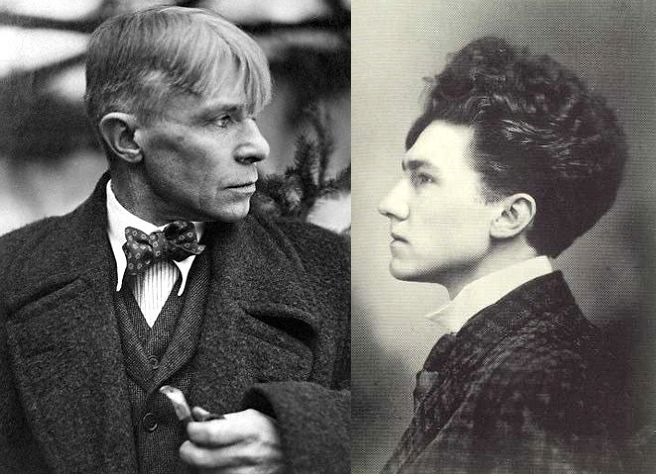
Young Sandburg and Pound

Young Modernists in suits: Carl Sandburg and Ezra Pound


Today’s piece combines two short poems, the first by Carl Sandburg and the second by the indispensable Modernist promoter Ezra Pound. Sandburg’s part “Letters to Dead Imagists”  speaks fondly and perceptively about Dickinson and then moves on to tenderly remember Stephen Crane as a poet, who, like Sandburg, tried to combine Whitman with Dickinson. By calling them Imagists, the term Pound used to promote his “make it new” style of poetry, Sandburg is directly endorsing their claim to being pioneering Modernists.

In the second part “A Pact”  we move on to Ezra Pound’s altogether more cranky voice, where he allows that Walt Whitman had broken “the new wood”, as if Whitman was some sawmill man who had roughly hewn some timber, which he contrasts to his, Pound’s, task and skill, which is to carve it artistically.

Chipewa Falls Water

Know your Modernist family trivia: Ezra Pound’s grandfather started this bottled water company


I’m unsure how much Pound knew about Whitman’s background, so when Pound talks about the “pig-headed father” I at first assumed that famously stubborn Pound was only projecting his own considerable intransigence onto Whitman. But the poem’s closing image, an extended riff on wood and timber, indicates that he may have known of Whitman’s father’s trade as a carpenter. Pound’s own family had connections with the lumbering industry. So in the end, when Pound proclaims that he and Whitman share “one sap and one root” he’s allowing they share the American grain.


The Black Riders XXXIX

In my episodic way here, I’ve touched on the rise of Free Verse in Modernist poetry. Free Verse poetry may still be rhythmic and musical, but it follows no strict meter, nor does it use any rhyme scheme. Now an established tradition, it came to poetry written in English in a non-straightforward way.

I think we can largely assign this happening to Walt Whitman, the American who was writing verse with eccentric line lengths and no rhymes by the middle of the 19th Century. Whitman did not immediately gain imitators in English, but French poets like Jules Laforgue took up the cause of Vers Libre later in the century. In Laforgue we can see a direct link from Whitman through his pioneering French translations of the American’s work.

The main thread of the Free Verse revolution for poetry in English then jumps to England, where before WWI Britons F. S. Flint and T. E. Hulme made common cause with American ex-patriot Ezra Pound. Pound must have certainly been aware of Whitman (more on this later) and though I’m unsure if Flint or Hulme knew of the American poet, all three shared an interest in Modernist French poetry.

I can only surmise, but in starting their Free Verse revolution, it may have been advantageous for this small group to present this as a French idea rather than as an American one. At the beginning of the 20th Century, France was an established cultural force, a place from where new intellectual and artistic ideas were expected to emerge—and in painting and music Frenchmen were the leading edge of artistic Modernism then in a way that Americans were not yet.

This strange path, from America to Paris to London misses one poet, a too often forgotten writer of Free Verse before the 20th Century, Stephen Crane. As a young man in his early 20s he was introduced to the just-published first collection of Emily Dickinson (1890), and mixing his take on Dickinson’s compressed musings on the infinite with the just-died Whitman’s Biblical cadences and love of parallelism, Crane in 1895 published a collection of short Free Verse poetry “The Black Riders.”  Today’s piece uses the words of one of those short, untitled poems from Crane’s book.

Stephen Crane

Stephen Crane:. He’d written Free Verse when Ezra Pound was still weighing in with sestinas

If, a couple decades later, one of the short poems in “The Black Riders” was to appear in an Imagist anthology, on a quick glance or reading it wouldn’t look or sound out of place, but the pieces in Crane’s collection are not really Imagist poems, not even in the same way that sections of Whitman or Dickinson are. Crane’s “Black Riders”  pieces are too full of abstract concepts and romantic notions—and even though Crane is questioning or mocking these concepts, he’s not presenting the issues through concrete new images as the Imagists would.

It’s interesting to wonder how Crane might have developed if he’d lived a full life, rather than dying at age 28 at the end of the 19th Century. Still and all, here was an American, in America, writing Modernist verse with Modernist attitudes while still a young man and with the 20th Century still on the horizon.

Musically, today marks a return of new pieces recorded with the LYL Band and Dave Moore. The music I compose and play myself can be created over a varied length of time, and in whole or in part, reconsidered and redone. The LYL Band on the other hand, just goes.  When we did some recording this week, Dave told me he was waiting for another instance of us starting off something with no more than my announcing  “G Minor.” Today’s Crane piece “The Black Riders XXXIX”  is not particularly complex or unpredictable musically, but we needed to knock off the rust. To hear it, use the player below.