Twelfth Night

As we near 170 audio pieces posted here, we now get our second set of Shakespeare’s words, but instead of one of his sonnets, here’s a short scene from one of his plays (Twelfth Night)  which, by his design, includes a song.

The play’s title indicates it was an occasional piece for an English holiday that takes place on the 12th day after Christmas. I read that the traditional English Twelfth Night partakes of various “floating” winter/winter solstice traditions, some dating back to Roman Saturnalia, with much party-play acting of role-reversals, selections of short-term random royalty, eating, drinking, and song.

Here in modern commercial America, the extending of Christmas is via a prelude, with ever extended shopping days before the holiday; but in the past, Christmas was instead broadened after the December 25th date, with the “Twelfth Night” being the end of the “12 Days of Christmas”—yes, those same 12 days the famous listing song counts off. Given the dreary length of winter in northern climes, the holiday season was sometimes extended even further to February 2nd, Candlemas.

And it was on Candlemas, 416 years ago that Shakespeare’s Twelfth Night  was first performed. The play has a complex series of plots, but the one central to today’s audio piece is that of a young woman, Viola, who’s been shipwrecked in a foreign land, has taken to dressing as a man, Cesario; and while still disguised and cross-dressing, she has fallen in love with Orsino, an older Duke of the foreign land. Orsino is sad because he’s in love with Olivia, a local lady, who refuses his attentions. Only one thing keeps Orsino going in his melancholy: music.

As we enter into the play with today’s audio piece, the “meta” gets laid on thick. Orsino, though unlucky in love himself, seeks to give the “young man” Cesario advice in love. And Cesario (infatuated Viola in disguise as a young man) tolerates this mansplaining in hope that Orsino might someday see something in her/him. And in Shakespeare’s time the young woman passing as a young man would have been played by—well, a young man passing for a woman. To simplify things, I read both actors’ parts myself in the audio piece.

As the scene ends, Orsino asks for an “old song” to cheer him up.

The song Orsino requests “Come, Come Away Death”  is so dour I wonder if Shakespeare is making more comedy against the excess of melancholy and the foolish suffering of unrequited love. It’s a cheery little ditty about refused love causing or requiring death, and the spurned lover wishing only that his grave be unknown so that there’s no chance his unresponsive sweetie will ever hypocritically mourn there.

Representative lyrics: “On my black coffin, let there be strown./Not a friend, not a friend greet/My poor corpse, where my bones shall be thrown.” If Judas Priest had recorded this, it certainly would have been brought up in the 1990’s trial where the heavy metal band was accused of driving listeners to suicide.

But, after all, Twelfth Night  is a comedy. No spoilers here, but despite multiple love triangles and more disguises and misunderstandings, fate is kind to multiple sets of lovers, something we can all wish for lovers this upcoming year.

twelfth night by Walter Howell Deverell

Melancholy Duke Orsino bids Feste to Kick Out the Jams while Viola/Cesario ponders gender roles

Since Orsino in the play’s text asks for “Come, Come Away Death”  to be sung, we know it was indeed sung with music in Shakespeare’s time, and there are several extant settings of it. The ones I’ve heard are in the Elizabethan style, usually for a high, plaintive tenor—and even when Elvis Costello sang it, it was in that manner. I went counter to this, taking a more rock stance, allowing the singer to mix some anger into his self-pity. To hear that, use the player below.

Mirabeau Bridge

Earlier this month I announced that my performance of Tristan Tzara’s The Death of Apollinaire”  was the most popular piece here last fall. Seeing this, it’s past time to present a poem by Guillaume Apollinaire himself.

If one was to draw a graphical map of the French Modernists of the early 20th Century, corresponding to the English-speaking ones we’ve been talking about a lot here, Apollinaire would be at a central place like Ezra Pound. Apollinaire knew everybody, he influenced everybody; as a critic, he wrote about everybody. Although, like Pound, he held strong opinions about what a more modern art needed, what little I know about how he was experienced as a living artist says that he was also loved by most everybody that he met as well.

Like Tristan Tzara he was an example of a European, though his work was centered in Paris and he wrote largely in French. His mother’s family was Polish or Belarussian, depending on where the borders were drawn at any one time. His father’s background was never definitively known. Born likely in Italy, he had traveled and spent time in several countries, and spoke several languages, before settling in Paris before he was 20.

Portrait of Guillaume Apollinarie by Picasso

“Don’t you be L7!” Picasso’s cubist portrait of Apollinaire

In the visual arts, he invented the word Cubism, and he also was the first to call his work Surrealist. He knew modernists in music, like Satie. He knew the young artists, like Picasso, Chagall, Henri Roussseau. Dadaists considered him an influence and a co-conspirator.

In 1913 he published his best-known collection of poetry “Alcools”  (Alcool is the French word for alcohol). In it, Apollinaire set out his direction in modern poetry, using various forms, often imbued with contemporary colloquial speech and connections to modern technology and urban life. One tic he adopted in “Alcools:”  he dropped the punctuation from his poetry, emphasizing the flow of his words, an effect that could be seen as presaging a modern rapper’s unstoppable flow.

Am I guessing at that? It just so happens, I’m not. On Christmas Eve in 1913, Apollinaire was recorded reading one of the poems from “Alcools:” “Le Pont Mirabeau”  (Mirabeau Bridge), and that recording, encrusted though it is with the scratch and noise of time, survives.

So, today’s piece, with my music and my English translation of his words, leads off with Apollinaire’s own reading of his poem in French.

1280px-Apollinaire_Sous_le_pont_Mirabeau

Mirabeau was the longest bridge in Paris when it was built using using new steel-reinforced methods in 1893.

Translating “Mirabeau Bridge”  was a challenge. Having heard and been transfixed by Apollinaire’s intensely rhymed and recited version, I had to bend my usual translation approach, which skips any attempt to keep the original “music” (the rhyme and meter) of the poem. And as I look at the many attempts to translate this poem to English, I see most tried to at least rhyme it. The Pogues used a rhymed English translation for a nice sung version a few years back.

As I approached “Mirabeau Bridge,”  I whined to my wife: “Richard F’ing Wilbur tried to translate this, and his  version is awkward—and Wilbur’s a master of poetics!”

Why do I usually skip trying to rhyme-up translations? It adds a great deal of difficulty to conveying the poem adequately. It almost always leads to awkward English, particularly when you try to follow a rhyme scheme from the French, with many more words that rhyme, using English, whose poetic tradition did not grow out of rhyming. Having been influenced by French poetry at an early age, when trying for similar effects I often use a variety of imperfect and near-rhymes, something an audience may accept or find grating, depending on their tastes, and that’s what I did here, along with a free and not regular rhyming scheme.

Give a listen. Consider it a trip-hop battle between Apollinaire and myself. Respect to Apollinaire. Can’t bust his moves.

A Song in the Garden of Love

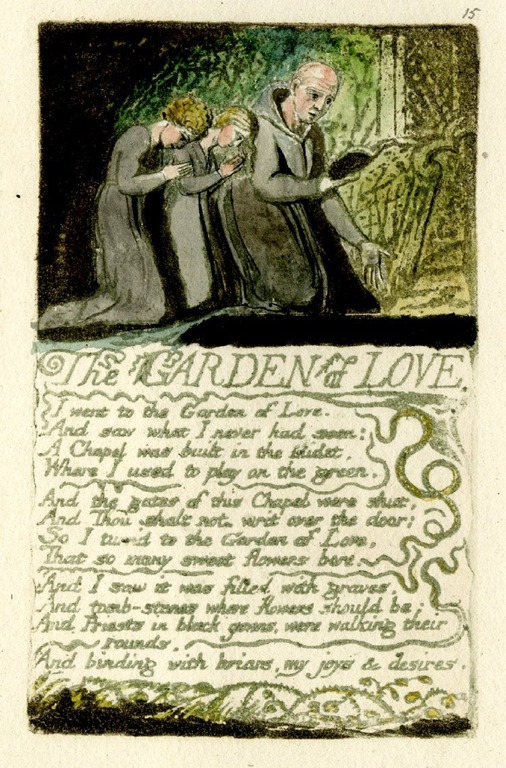
Today we offer a respite from my voice and the return of alternate Parlando Project presenter Dave Moore. And since it’s been a few days since the last new audio piece, today’s piece combines a lyric written by William Blake with one by Christina Rossetti. Two great poets in one piece! Ladies and gentlemen, there is no greater value you can find today in the poetic words mixed with music marketplace!

Both pieces are stated by their authors to be songs, either in the name of Blake’s collection where “The Garden of Love”  first appeared, “Songs of Experience,”  or in the title itself for Rossetti’s piece, which she called just “Song.”

So of course, both pieces have been set to music and sung before this, but it was Dave Moore’s idea to combine the two pieces; and one can immediately see once he did this, how tightly they fit, with Blake sorrowfully reporting the graves in the garden, and Rossetti musing on the grave and its landscape.

Rossetti wrote her “Song”  while still a teenager. Unlike Blake who was born in a religious dissenter family and grew increasingly distrustful of the corruptions of organized religion, Rossetti would become one of the most graceful and modest of the poets of the Victorian Christian revival. Strange, isn’t it, that the two poems mesh together.

Christina Rossette on staircase

“If you listen very hard, the tune will come to you at last”
Christina Rossetti listens for inspiration, or puzzles over her holiday gift list


Speaking from my poet/musician duality, the version of “The Garden of Love”  that I most recall is the one recorded by Allen Ginsberg in December of 1969. Ginsberg’s recording is played, followed by a 20-minute discussion of the poem and performance here. The four speakers in this discussion mull on the country music waltz feel Ginsberg performed the Blake too. If I were in that room, I could have replied from the musician side of that duality, that in 1969 there was a bloomlet of counter-cultural figures essaying country-music tropes to the puzzlement from the hippie audience as to what level of irony was intended. Two musical figures close to Allen Ginsberg had taken part in that move earlier that same year: Bob Dylan with “Nashville Skyline”  and Ed Sanders with “Sanders’ Truckstop.”

Wm Blake The Garden of Love

“A dominie in gray…led the flock away.” Blake’s self-illuminated song.


Our performance of this mixes Dave’s somewhat church-hymn organ (Ginsberg often used a hand-pumped harmonium organ in his live performances) with my country-ish Telecaster electric guitar, so perhaps Ginsberg’s country move was stuck in my memory as we performed this. Here’s what Dave Moore said about his performance:

“Wayback Machine time.

This song goes back to the early days of the Reagan years, which he ended up forgetting but we can’t.

Probably this is my first attempt to put music to classic poetry, I just thought they fit together so well & expressed both despair and hope so well. This one is my favorite vocal of all attempts at this piece. My introductory verses for each poet are new & I wish I’d separated them from the two little poems better, but that’s what you get with one-takes. Ah, sweet death, we can still sing.”

Dave points out a contrasting benefit of the pieces here performed as the LYL Band, which are not only “one-takes,” but are often pieces that only the composer-vocalist has any sense of the structure of, leaving the rest of us to follow and create parts on the fly. This leads to a certain roughness, and yes, at times, tentativeness too—but I believe there is a corresponding sense of the undiscovered and its discovery that may come across to the listener.

To listen to the LYL Band perform Dave Moore’s pairing of these two beautiful, yet sad, English lyrics, use the player below.


Rosemary

It’s been awhile since a new post, what with holidays and family occasions, but here’s another piece, “Rosemary,”  using the words by Edna St. Vincent Millay.

Millay was one of the most popular, most often read, poets of the first part of the 20th Century, but the later part of the century gave her less consideration. A contemporary of the Imagists and other poetic Modernists that we’ve featured a lot this year here, and while connected to their world, she didn’t sustain favor with the rise of the “New Criticism” that became the dominant academy in the English-speaking world after WWII.

Reasons? Well, there’s gender. One must assume that played a role. And popularity of the general-readership sort would not have been an asset either, as perhaps only Robert Frost and Emily Dickinson survived being read by a general readership in the mid-century without losing their high-art cred. Why couldn’t Millay have joined Frost and Dickinson in these critics’ esteem?

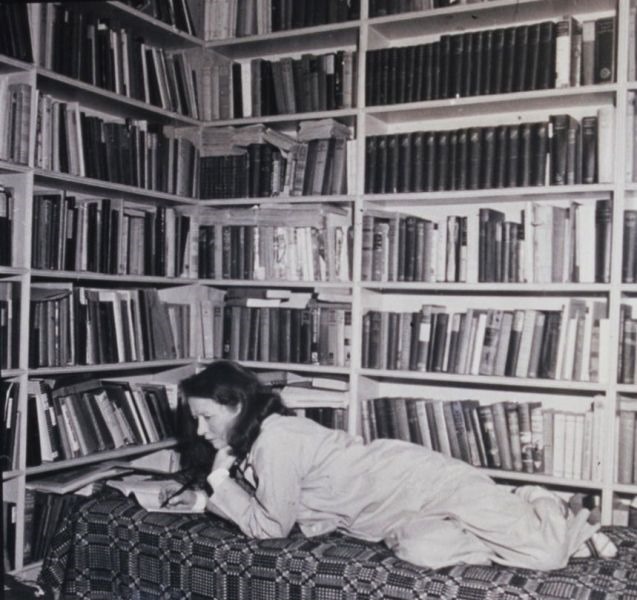
Millay with books

Millay at work. Other than the lack of guitars, just about the perfect décor.

I think it’s largely a case of her poetry not seeming to have the subject of their criticism: fresh, complex, allusive and illusive, imagery. Frost and Dickinson may have used homey sounding language, but in the end those funerals in the brain and snow, roads and woods added up to something to talk about in critical prose.

The New Critics were an inflection point. Before them, poetry was largely considered musical speech, a container that could hold a variety of subjects, after the New Critics, poetry was about the imagery, how you portrayed things with it. And unless one aimed for satire, such complex rhetorical structures must be in service to serious matters.

And so, there’s subject matter too. Millay’s great subject was love and affection, it’s presence, absence and all the shades in-between. In doing so, she addresses much of life and its condition, but did she receive enough credit for that? Is a heartbroken man a tragic philosopher of fate, and a woman merely a spurned lover? Narrow-mindedness can’t be ruled out.

“Rosemary”  allows us to examine these issues. This looks to be a poem about the death of a passionate love or the death of a dear one. I’m not sure which of those two possibilities is standing for the other, but for an audience, it does not matter as both events are common to our hearts.

I think there is an intent here to conjure a complex world of timeless folk magic. Though written in the 20th Century, it could have been written anywhere up to five centuries earlier. In the title we have rosemary, an herb associated with remembrance even in Shakespeare’s time (Ophelia’s mad speech in Hamlet for example), and in the first stanza we have rushes being scattered on a room’s floor, a custom from medieval times to hide the stink and mess of a less hygienic age, a strewing of reeds that may have included rosemary because it was thought to be something of an insecticide. Bergamot is another fragrant plant. Stink, rot and pestilence are all inferred subtly in this verse that on the face of it seems only a short catalog of flowers.

The second verse adds a rain barrel to catch rain, or is it tears? And what’s with that iron pot. Is it a cauldron? The poems last two lines are in quotes on the page. I was suspicious that the “An it please you, gentle sirs,” line was a quote, and finding out what it was from might be important, but I can’t place that line—if any reader knows, please clue me in.

And at the end of this timeless lament: “well-a-day,” which might sound to you or me like “have a nice day,” but is instead a word that harkens back to Old English, meaning woe-is-me.

What I think we have here is a poem, that read quickly, seems to be a trivial verse about some flowers with a bit of a kitchen scene, but it’s stated with deliberately archaic specifics so that the attentive modern reader might notice that time cannot heal this loss. And each thing in it is an image, though they don’t loudly announce themselves as such.

I’m reminded of my distant relative Susan Glaspell’s famous play “Trifles,”  where the domestic clues hide all the information the dense men seeking important information miss.

The Pentangle

The Pentangle. It’s not fair to compare. There’s 5 of them, and only 1 of me. Oh, and talent.

Musically, I went with bass, drums, two acoustic guitars and my voice for this. I was aiming for an impression of the sort of thing The Pentangle did many years ago. They were better at it, but it was good to try. Use the player below to hear my performance of Millay’s “Rosemary” or failing that, this highlighted link.

Love Song for a Woman I Do Not Love

One joy of this project’s exploration has been coming upon poets I know nothing about and acquiring their words in my bloodless version of that conqueror on the “peak in Darien.” Writing about Frost, Pound, HD and Eliot in England early in the 20th Century lead me to T. E. Hulme, an Englishman of pugnacious artistic pronouncements and surprisingly modest and moving poetry. And T. E. Hulme led me to F. S. Flint, another British writer and literary theorist in this circle in the years just before WWI.

Last month I introduced readers here to Flint’s amazing rise from Victorian poverty. In the interim I’ve been reading more of his work, including his 1920 collection of poems (he called them “cadences”) titled “Otherworld.”  Since Flint is not commonly studied or anthologized, each poem as I encountered in the collection was a fresh experience, no different than reading a new poet’s chapbook published this year. I could start a poem of his in “Otherworld”  about a confused midnight awakening, and come to find it’s a first-hand account of a deadly London air-raid by a German Zeppelin.

Today’s piece, in the same collection, held another surprise. It tells you it’s a Love Song, but contradicts that before the end of the title. What it is instead is an unstinting examination of the corrosion class and gender inflict on the grail of love. The singer of this song lays bare a combination of disgust at how he’s judged as a poor man, with an undisguised desire to own the things he does not have, including this other human being, the woman of the title.

Bright Coloured Cretonnes!

“Bright-coloured cretonnes…” What is the erotic despair of draperies and upholstery?

I can think of dozens of popular songs that deal in some variation of this, but it’s harder to come up with 100-year-old poems, much less ones as good as this one, that talk of this. Ignore a handful of references to the interior decorating trends of Flint’s time, and this poem could have been written yesterday, except few writers of any time would be as acute as Flint is in observing this.

What new poets of the Modernist movement do I get to discover and share with you in the upcoming year? I can’t be sure, but I noted that Flint’s “Otherworld”  is dedicated to Herbert Read, and from what few poems of his I can find online, Read seems just as fresh and fascinating.

But let’s not get ahead of ourselves. Musically I’ve been telling myself I want to utilize some of the methods of hip-hop records, and yet each time I set out to do this, I get side-tracked by my own idiosyncratic musical muse. The melodic top line is my appreciation of early 1960s hard-bop organ playing. The bass part is a combination of a left-hand organ part with electric bass. Two bass lines shouldn’t work, but I think it does here. That’s not the only duality in this: the drum machine beat is augmented by some percussion which keeps the drum machine from ruling the groove “correctly.” The hip-hop rhythm flow eludes me again, though maybe I recall some predecessors like Dr. John the Night Tripper?

To hear my performance of F. S. Flint’s “Love Song to a Woman I Do Not Love,”  use the player below.

Arrival

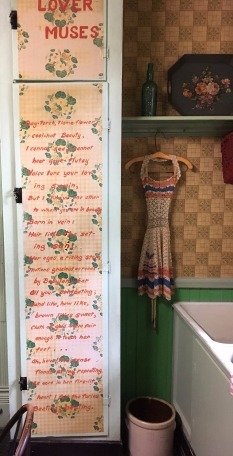
Today’s words are from William Carlos Williams. Unlike our last post, I wouldn’t call this a love poem. Oh, I believe there’s an assignation between two people in the opening section of this poem, but affection seems missing and the desire, if present, seems to be questioned—no, that’s not quite right—the questioning of desire is silent, present in its absence.

William Carlos Williams 1

Poet and physician William Carlos Williams casts a cold, clinical eye on desire

This is another poem I came across at the Interesting Literature blog, where it was included in a round-up of seduction poems. We’ve visited a few of that type of poem here as well, with shepherds, nymphs, a merchant’s wife, and Williams’ fellow physician-poet Thomas Campion making invitations—but this isn’t really a proposition, any more than it’s a love poem.

Williams’ poem is not titled something like “Come Live with Me and Be My Love”,  it’s titled “Arrival.”  So yes, an assignation, but one with a schedule like a train or airplane flight, or as we’ll soon see, like a season. Is there desire in the unhooking of the dress? In modernist, Imagist style, that emotion is not stated, but the passive voice and sparsest of descriptions argues that it’s there and is not there.

After the poem finds itself, as many of us have or will find ourselves one day, in a “strange bedroom,” a sea change occurs. The woman in the dress has disappeared. In her place: an autumn tree, disrobing its leaves because the season is felt arriving. Again, desire is not mentioned—it wouldn’t be mentioned, this is an Imagist “show not tell” poem—but this image is also passive and rote.

I’ll let you feel and figure out the image of the final few lines yourself. The now naked woman as bare winter tree? Or is her presumably male companion’s body being synecdoched?

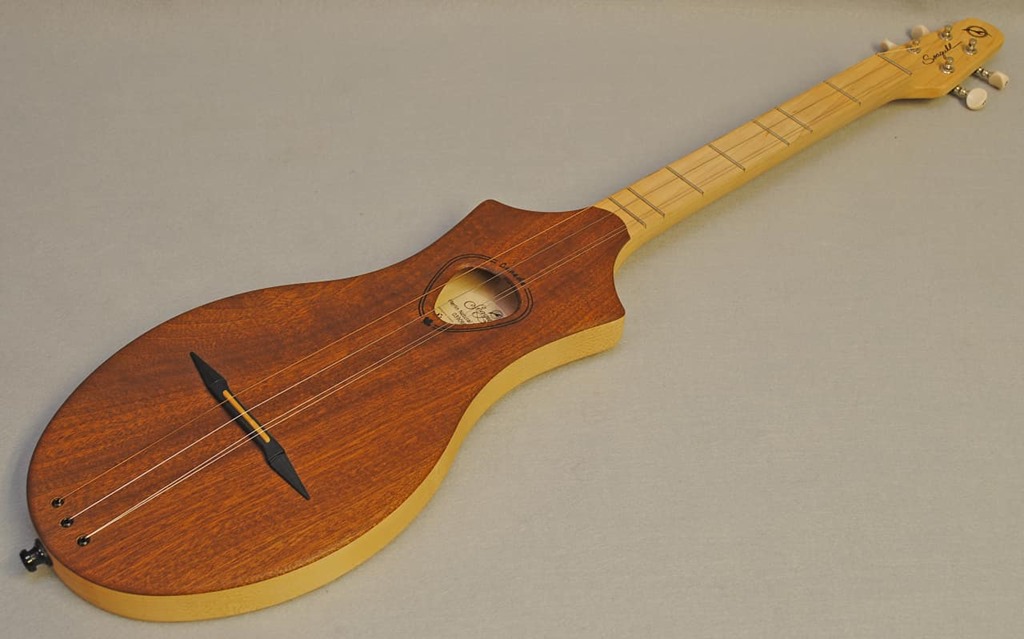
Merlin Dulcimer

“A dulcimer in a vision once I saw” The Seagull Merlin dulcimer I played on this.

What of the music today? The instrument that sounds something like a mandolin is an Appalachian dulcimer, a simple American instrument; but one, like the sitar used in the last post’s audio piece, that has drone strings. The music is modal too, based around D Dorian. On the percussion side I remain attracted lately to little instruments, so there are shakers, maracas, a cabasa, congas, a chime tree, even some finger snaps in this. I could say that this is a connection to William Carlos Williams’ Puerto Rican heritage, but really, it’s something that is pleasing me musically this month.

Here’s the piece, use the player gadget below to hear it. No gadget to be seen?  This highlighted hyperlink will also play it.

Did you like it? Want to help spread the word about this ongoing project to mix various words (mostly poetry) with various music? Hitting the like button here helps, but what does the most to bring this to the attention of new readers and listeners is to mention and share this blog on your own blog or on social media.

Want the audio pieces to listen to later? You can subscribe to the Parlando Project podcast on Itunes, Google Play Music, Stitcher, or wherever you get your podcasts.

She is As Near to My Heart

Here’s another piece adopting words by Rabindranath Tagore, the Nobel Prize winning songwriter and polymath. Tagore is a remarkable man about whom I know only a little more than the average Western musician or writer. His life as a writer is only a small part of his impact in South Asia, but that alone is enough to bring your attention to him. Knowing as little as I do about Bengali literature, I take it from others that he’s exquisite in that language, and that, at the beginning of the 20th Century, he accomplished the same task for his culture that the modernist poets writing in English did, bringing a fresher, more colloquial language to poetry.

Tagore wrote in many forms of literature, but when his Nobel Prize was awarded, the only work available in English was a book of his lyrics, which he had self-translated into English prose—which makes him the first songwriter to win the Nobel for Literature. Tagore’s own prose translations do not fully hide the musical nature of the works, but they often sound somewhat stilted to this English language reader. I’ve adopted his words somewhat for this piece. It’s a love song.

Now for those that come here for talk about the words used, we’re going to diverge this time and talk instead about the music.

It’s likely that Tagore also wrote music for this, but I do not know his tune. My knowledge of South Indian music is limited as well, but like many Westerners, my introduction was Ravi Shankar records that were widely available in the Sixties. Ravi Shankar had become something of a cultural fad then via his association with A Beatle!  and the sideways belief that this music was “psychedelic.” That word, a neologism of the times, was formed from the Greek words for “mind” and “manifesting,” meaning music that could produce altered states of consciousness, inferring that it was like mind-altering drugs, and that it might be a suitable aural counterpart to imbibing in same. Looking back, I find this a quaint sort of categorization, as much music—and even the mind itself—can change one’s appreciation of consciousness, perhaps not with the whipsaw impact as the psychoactive drugs of the time, but powerfully enough.

Mark me down as a man who doesn’t know when to let go of a fad. Despite my listener-only naiveté about South Asian music, three things attracted me upon hearing those recordings, or viewing the small portions appropriated to Shankar in the rock concert films of the era:

The drone. This is a complex music based not on a progression of chords, but instead where the color changed not from a new chord or key, but with timbre, melodic scale, rhythm, and expression against a static, home chord or tone. I might have grabbed this from something else eventually (John Lee Hooker and Miles Davis were also there to tell me this about the same time) but Shankar and South Asian commonplaces like tampura and harmonium drones were where I first appreciated this.

The tabla. The rhythmic structure of South Asian music is as complex as any I know, and is its most “foreign” element. The rhythmic structures have extraordinarily long cycles, difficult to “count” in a mathematical toe-tapping sense. I have a fair to poor sense of rhythm myself, but I heard these complex rhythms “melodically,” not as marks on a grid, but as a string of events with a compelling line of sound. As expressive hand drums capable of vibrato, the tabla encouraged this.

The sitar. To this day, the strum of a sitar is the go-to sound-effect clip to say “hippie.” Which is a shame because it’s a remarkable instrument with many musical features exploited by its virtuosos. To my ear, and to many guitarists who wanted to approximate the impact of the sitar, the main things were the ability to provide its reinforcement of the drone with resonating strings, and the raised frets that allowed notes that were in fact a cluster of microtones sounded in close vibrato.


Ravi Shankar with Alla Rakha Khan on tabla and Kamala Chakravaty on tampura


For “She Is as Near to My Heart”  I approximated all these things with non-South Asian instruments. The song’s harmonic home point is an arpeggiated cluster consisting mainly of D, E, G, and A notes, giving a key center that is ambiguous, but that I thought of as A minor for my purposes. In place of the tabla, I used a syncopated 4/4 that is comfortable to our rhythmic toes, but to give it that tabla sound, I used congas and a drum machine with its own electronic approximation of the tabla’s pitch bend. For the sitar element I used a MIDI interface to play a digital instrument approximation of the real thing with a guitar. And over the top, well why not, some electric guitar where I mixed blues with some more sitar-sounding licks like psychedelic guitarists liked to do in the Sixties.

Squier Fat Nashville Telecaster

Not a sitar, but…


You can hear this using the player below. We’ll return soon with more talk about words next time.


Vegetable Swallow

As I started doing some translations of Tristan Tzara, the man who was most famous for being one of the “Presidents of Dada,” I was surprised in more than one way.

Like some writers I’ve presented here, Tzara was known to me only by reputation, as a name, and that reputation was not only as a founder of Dada, but of being the theorist of its most nihilist and avant-garde wing. Dada as Tzara spoke of it seemed to say: let’s destroy everything, and see what remains. Sounds like a pretty fearsome guy, and from my generation’s punk rebellion in music, his reputation reminded me of the those just past the first wave of punk that bought into a first principle of denigrating everything that came before. That could be a useful corrective, a way to clear the creative mind from everything you feel has come to a dead end, whether it was “Tales of Topographic Oceans”  or Tennyson; the horrors of WWI or the denigrations of Reagan and Thatcher. Such a stance, pure as it is, has dangers of discarding the baby with the bain-eau.

Tzara also provoked with ideas like his “How to Make a Dada Poem:”

Take a newspaper

Take some scissors.

Choose from this paper an article the length you want to make your poem.

Cut out the article.

Next carefully cut out each of the words that make up this article and put them all in a bag.

Shake gently.

Next take out each cutting one after the other.

Copy conscientiously in the order in which they left the bag.

The poem will resemble you.

And there you are–an infinitely original author of charming sensibility, even though unappreciated by the vulgar herd.

One can read this and miss the satire in it (particularly that last line); or one can read this laughing, and miss the value in this practice, variations of which were carried out throughout the rest of the 20th Century by Surrealists and Beats and unclassifiable modernists like John Cage. I, myself, independently discovered an analogous method as a teenager, and composing pieces by randomly opening a dictionary and blindly pointing with a finger at word after word. And Tzara did publish pieces that seemed to be just such an assemblage of words and phrases, for example Bilan.”

Bilan by Tzara

Never Mind the Boustrophedon, Here’s a Tzara Poem as published in Dada magazine


Not only is “Bilan”  typographically incoherent, the phrases are such things as “the bloody revenge of the liberated two-step” or “satanic horoscope dilates under your vigor.”

I believe this sort of thing can work: as a corrective, as a breaker of writer’s-block, as a reminder of the random and irrational component in creation, and as an insight into the dead and clichéd language which infests all societies. I think it works best in small doses when needed, and longer pieces based on it, or continued reliance on it, can be analogous to over-reliance on laxatives.

So that was the Tzara I assumed I would meet as looked for pieces to translate and use here with music: a man with little to say other than to point out with broken language that language is broken.

And to some degree that was reinforced as I looked at the few English translations available on the web of his work. Occasional beautiful lines, perhaps of accidental beauty, mixed with incoherent lines. Here is a link to an English translation of a Tzara poem “Vegetable Swallow,”  though its translator is never credited on the several sites which have it with identical wording. This is the same poem which I use in today’s piece, but with my own translation from the original French.

I’ll talk more about what I found as I translated Tristan Tzara in my next post here, but I’ll summarize by saying that I found problems in the translation I linked to, surprising problems that sometimes feel to me a bit like reading the “bad quarto” of Shakespeare. I could be wrong in my interpretation of Tzara’s “Vegetable Swallow (Hirondelle Végétale)”— I am neither a scholar of Dada nor anything even close to a fluent French speaker—but I don’t even like the translation of the title, though I have kept it, because it may be what an English speaker is likely to know the poem as.  “Hirondelle” is French for the species of bird, the swallow. I might have my own inevitable and anachronistic “Monty Python and the Holy Grail”  connection with the swallow, but in the title’s context along with the English word “vegetable,” one thinks of that scary and prescriptive phrase from childhood: “Eat your vegetables”—not how it’d be understood in French.

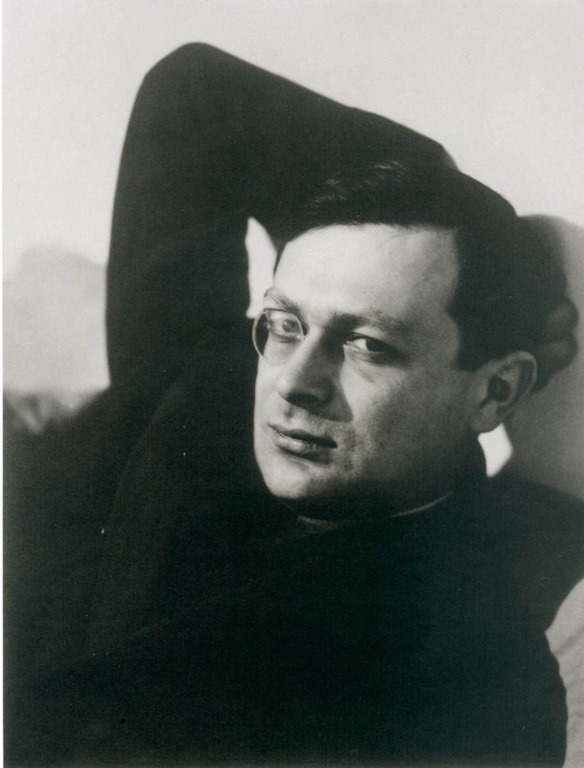
Tristan Tzara photograph by Man RayYoung Bill Gates grayscale

Steve Jobs would have told the young Bill Gates (on the right) to try a black sweater
Tristan Tzara (on the left, photo by Man Ray) would have suggested a monocle.

In my translation, Tristan Tzara is providing something more like a Surrealist’s Lover’s Rock lyric—more Paul Éluard than Dan Bern hilariously parodying Bob Dylan. Musically, I’m not attempting reggae though. I’m not even sure what genre to call my composition on this one, but it is,  like Tzara proclaims, “Swimming in disparate arpeggios.”

To hear it, use the player below.

At a Window

I was ready to post this new piece, Carl Sandburg’s At A Window,”  early yesterday when I had one of those days that come to challenge artists. Artists less fortunate than I can perhaps point to a single thing that holds them back, but with myself it’s often several smaller things.

I’m a habitual early morning reader of the news, a rhythm that may have started in my earliest teens when I delivered newspapers before school and continued through night-shifts in hospitals where I’d read the papers as they came out in the predawn hours. Nowadays, it’s not the papers I turn to for news, but Internet newsfeeds, and the pre-dawn hour was filled with the reports of another mass shooting profaning music, this time in Las Vegas. These events hurt me because I often spend as spend as much of my day as I can carve out making the music here in combination with the words that I combine with it. One of art’s purposes in my mind is to allow us to set aside momentarily the real consequences and strictures of life. Not necessarily to escape them—in fact, many times art allows us to examine them so that we can treat them as the reality of what they really are, because those strictures, even things we fear most, have their limitations, just as we do. And art can be the “R&D Department” of the soul and the repair of the world.

Thus, the hurt when those borders are crossed. Thus, the feelings of one’s work in an inadequate field.

Of course, my feelings on this matter are a small and abstract hurt, compared to the suffering of those more directly impacted. Small things closer to my heart feel larger than great things farther away. This is one of the limitations of our perception. Then my day continued with another unrelated hurt, closer yet to my heart, and I was reminded again of my limitations and imperfections.

Real hurt seems so large, art seems so small, and I feel like a poor worker in a field of playful trivia.

Which may be so, the limits of my perception may not be able to tell. However, I believe this is a common feeling for artists to have, and so if you create art, you may also have felt this. We try to do so much, and all we can see is so little. This is part of why the Parlando Project principle: “Other People’s Stories” has value. Speaking the words of others helps me by adding what their eyes and hearts have seen.

SONY DSC

“He is an observer with sympathy but without fear”

This morning, it turns out that Carl Sandburg, in the very piece I was working on this previous weekend, “At a Window,”  was speaking to this experience, though in my down-heartedness, I couldn’t hear him for a while. This short poem, appearing first in 1914 in Poetry  magazine alongside his “Chicago, hog butcher for the world…” poem which will overshadow it, waited patiently to speak into my ear. What good could a more than a 100-year-old poem have for me?

Poetry Magazine March 1914

Eight poems of Sandburg’s Chicago Poems debuted in this issue.

“At a Window”  says that even in shame and failure you must hunger for even more of the same. In the context of the sampling of Sandburg’s Chicago poems, which spoke so frankly about the situation of poor and working-class Americans, I think that window in the title means so many things. Yes, it means there is an imperative to look outside oneself as an artist. The dusk and shadows out the window lets one see little, but one must still look.

Will there be any consolation? Sandburg apparently had such consolation in his spouse, who championed his work, who he speaks of in the “Leave me a little love…” section. Perhaps you have such a champion in your life, perhaps you don’t. We are called in “At a Window’s”  conclusion to look out the window anyway. Perhaps the one who comes walking out of the dusk is yourself, to champion someone else?

To hear the performance of Sandburg’s “At a Window”  use the player below, and thank you for listening.

Millay’s Sonnet 43

Edna St. Vincent Millay was another poet who offered little to the “New Criticism” critics who largely set the canon for the 20th Century, even though her career, which covered the first half of the 20th Century, ran almost exactly through the same time as Eliot, Frost, Pound, William Carlos Williams, and Wallace Stevens, and even though she achieved significant readership and a level of awards and accolades while living.

What was their problem with Edna St. Vincent Millay? Well her popularity would be a negative in some lights. In this regard, critics are often no different than the record store clerks of my own day, whose estimation of any indie band would inevitably drop as soon as they achieved a widely-played record. And there’s the “her” and “she” problem. The level of disbelief of the idea of a woman artist probably varied among these critics, but literature was still a very male world at that time and unconscious prejudices are a given. But even if we skip those two, frankly illegitimate, factors, there is the issue of Millay’s plainspokenness.

St Vincent

Annie Clark performs as “St. Vincent,” Edna St. Vincent Millay is on the right. Google carefully!
Clark has said the stage name came from a NYC hospital, but if that’s so, it’s a remarkable coincidence.

Odd isn’t that? This value that you might rate highly in friend was held as low regard by the New Critics, who likely thought it common and unremarkable. A Millay poem typically says exactly what it means, right out. There may be images, but they might not pass Imagist muster. They aren’t stark omens whose meaning is felt and then deciphered, they may be more like the illustrative images the Imagists wanted to leave behind. Millay’s all tell and too little show for them.

And Millay’s language often seems stuck in the 19th Century too. Some lyrical poets like Yeats and Frost adopted Modernist tropes and were able to make their rhymed and metrical poems sound more like contemporary speech. Millay sometimes seemed to be reading from a somewhat musty library book when composing her poems.

The most extended image in “Sonnet 43”  is a bare winter tree, which could be a borrowed image, or a homage, and I choose to manifest the later in this performance.

Can our modern (post-modern) age free up some respect for Edna St. Vincent Millay? I think so. With contemporary poets, we now sometimes value plainspokenness. And the cluster of things that Millay spoke plainly and honestly about include love, sex, and desire.

This sonnet was published in 1920, it’s nearing a century old. If we slide over some of the 19th Century “poetic diction” (something I found easy enough to do when performing this) it’s as honest and as nuanced report on the state of a heart as anything written then or now.

And if one must have ambiguities for art’s sake, honesty can contain that too. Some read this poem as bitter, or a lonely-hearts club statement, or as regret for a life that Millay’s time would’ve called promiscuous. That’s not how I understood it to perform it. I think the speaker is recalling an active love life they rather enjoyed. They reveal themselves (honestly) as something of a sensualist. As the Petrarchan sonnet wraps up its octet, the speaker allows a touch of regret about those lovers who turned to the speaker at midnight “with a cry.” What did the speaker offer them? I think the closing lines say some “summer,” a summer that “sang in me”—that is, that summer is not something the speaker intentionally gave or offered, and the speaker doubts that the muses of that summer offering will still speak through her. William Carlos Williams—unlike Millay, following all the Imagist rules—touches also on the caprices of summer and fulfilled desires in It Is a Small Plant,”  but some are more accustomed to a male author speaking ambiguously about the honest incursions and boundaries of desire.

Perhaps this poem benefits with some listeners in being heard performed in a male voice? I can’t say for sure on that.

Among the 20th Century admirers of Millay’s verse were my father (who grew up on the 19th Century Longfellow and the like, so Millay’s 19th Century diction was no bar) and a distant cousinoid of mine, the modern American theater pioneer Susan Glaspell.

I rather like the musical accompaniment for this one. I worked quite a bit on the drum part trying to bring out different colors, and for the bass I was able to supplement the electric bass with some bowed contra-bass, which is one one of my favorite sounds in the world. Ironically, Millay started out wanting to be a concert pianist, and the top line here is one of my naïve piano parts. To hear me perform Edna St. Vincent Millay’s “Sonnet 43”  aka “What lips my lips have kissed…”  use the player below.