The great American poet Emily Dickinson writes about death a lot, so maybe I should pause for a moment to mention how inescapable the living’s experience of death was in her time and place, what with disease, injury, a deadly Civil War, graveyards within the city limits, and approaching death happening often at home.
Because I lived across the street from death? When a child, Emily Dickinson’s family did not live in the Dickinson Homestead (now the Dickinson Museum), but at another house, located across the road from the town cemetery where she would later be buried. A child is born, plays, grows up, and crosses the fence.
.
The poem I’ll sing below today speaks to that. If you’d like to follow along, here’s a link to the text of “As far from pity, as complaint.” This poem is more than its message —most good poems are — but let me write down here a sentence to summarize what I read this poem as saying: rather than pity, dread, or anger toward death, a result we cannot change, we should emulate the dead themselves who demonstrate that life is not everlasting — but the predicament of dying, and the predicament of living, are everlasting.
That’s a worthwhile thought, and poems in Dickinson’s time and place were often expected to deliver a lesson. But why is this a poem, why is this an Emily Dickinson poem? An essay, a sermon, a sympathy card, a letter, a conversation all could deliver this message as well or better as 12 lines not even pentameter-long and broken with the skeleton spaces of the pervasive Dickinson dashes (as if her “trade was bone.”)
Because it sings this situation, even silently on the page. There’s a dancer’s force, a singer’s force, an instrument’s augmented force in this way of telling. If death is inevitable — as is also meter, repetition, rhyme, the flow of sound into shapes — might we be comforted by these shapes? We live. We die. The shape of life continues. Quod Erat Demonstrandum, thus it is demonstrated.
When encountering this poem earlier this summer I sensed an intra-poem image-rhyme in this poems 7th and 8th lines. A better-known Dickinson poem which attracts us with what seems like mundane charm, “I’ll tell you how the Sun rose,*” has summer children playing from dawn — and at the end, disappearing over the horizon’s fence-line at sunset. That’s the continuing shape of our lives.
You can hear my musical performance of “As far from pity, as complaint” with the audio player below. If your way of reading this blog is numb to that revelation, don’t complain, I offer this highlighted link as a way to open a new tab that will have its own audio player so you can hear it.
Today’s piece from the two volumes of The Girls and The Boys Book of Verse pair is by a poet I’ve begun to revisit during the past year, Robert Louis Stevenson. Taken just as verse, Stevenson will impress the ears of adults and children alike as charming, but as I revisit his children’s poetry I’m finding additional resonances. So, let’s look very briefly at his “The Wind” today.
A chord sheet so you can sing this one yourself if you’d like. As you look at Stevenson’s poem here you can also participate by guessing if it was placed in the boys or the girls volume of the pair of 1920’s poetry anthologies I’ve been looking at all month. Answer below.
.
The two things the poem wants to establish about its title subject is the wind’s presence and its mysteriousness. It’s felt as a body pushing force, heard as gentle sound of fabric on grass. But its first-mover, its purpose, the meaning we are to derive from it, is expressed as unknown. The wind here is a symbol of motion. Those easily teleological or mythological might reduce this to a matter of God or gods. That might be Stevenson’s intent, and is likely some reader’s experience.
I prefer to find the poem restricted to what I see on the page, and there I find it as a poem of the growth and going of childhood. Stevenson chimes on that elsewhere in his children’s verse.
Do children feel that, that wind of their growth, or is it so merely there as to be unthought of? I, an old man on a bicycle this Spring, certainly think of it, wind in its expression of gusts. I huff and puff in it, mine a much weaker blowing back!
I’ve said this before but let me reiterate in this month when I’m examining a sample of the literature my parents might have experienced in childhood: a lot of good children’s literature speaks to the adult and the child with the same words, the same images — words heard, images seen, from two sides. I think that’s what Stevenson is doing here. The child will find the familiar feeling reflected on the page sensuously. The adult gets the mystery, the passingness.
In the final five days of this National Poetry Month, I’m going to try to move to completion a number of audio pieces I’ve got in various stages. The posts may come — will have to come if I do this — in rapid succession. I’m grateful for your attention, and I apologize if I will press or exceed it. The music for today’s piece is back to electric folk-rock combo mode: Telecaster guitar, drums and electric bass. You can hear my performance of Robert Louis Stevenson’s “The Wind” with the graphical audio player gadget below. Has that gadget blown away? No, you’re just reading this blog in one of the ways that suppresses showing that. This highlighted link will open a new tab with its own audio player so that you can hear my performance. And your answer to which of the two gendered poetry anthologies this poem appeared in: girls.
We mentioned Emily Dickinson in our last post, and it’s time to return to this essential American poet during this National Poetry Month. I saw this charming poem of hers earlier this week and thought I might be able to do something with it.
Over the years here I’ve delved into some of the more cryptic Dickinson poems, but her poem beginning “The things we thought that we should do” is reasonably clear on first reading, at least until you get to the end. Here’s a link to the poem’s text if you’d like to read along. This three-stanza poem uses exactly one rhyme, which helps its flow stick together, appropriate for a poem about how our lives sometimes seem to take us down one track that we never get around to changing. Our inability to shape our lives to what we think we should do is the first stanza’s statement. The second puts the untaken should-path and compares it to travel, or rather not traveling. Dickinson was often portrayed as homebound — though an examination of her life says she traveled more than many women of her time — but I think this is more metaphor than memoir. This stanza ends with the idea that one may then pass on the untaken task of some travel to a “son.” This may be legal language sneaking into Dickinson again,* but I also wonder if she’s punning on “sun,” since she has elsewhere used the day as a miniature measure of a lifetime. If so, she’s saying we think we’ll do these should-things tomorrow, or in the sense of generations following us, in another lifetime.
Poetry? Law? Poetry? Law? Screw it! I’m going to go outside and putter in my garden.
.
The last stanza is the response, the turn, the summing up. It starts out: If we haven’t been disciplined enough to do our shoulds, we likely won’t get our restful reward in heaven. And then the last line “But possibly the one —” Ah, the Dickinson dash, that little transition — but wait, there’s no more text. It ends on the dash!
This is ambiguous, and her syntax is jumbled. Did she not complete the poem, is this an unfinished draft? Or did she want the thoughtful reader to come up with the resolution that’s not stated, but derivable from the situation: that there’s a heaven even for those not doing all the shoulds, all the time? When she writes “possibly the one” is she saying that there’s only possibly one heaven, but she’s not certain — or even, that the heaven one finds outside the shoulds is plausibly the one?
I was able to bring together the music and performance for this one quickly, which was necessary since I’ve spent the past two days taking care of a computer failure over on my spouse’s desk. But I should — no, it’s not a should, it’s a desire — get another piece posted this April. So, acoustic guitar, piano, standup bass, and just a taste of celesta were called into play to realize the music that unusually is made up of mostly major 7th chords. You can hear it with the graphical player gadget below, or if that’s not there, with this backup, a highlighted link that will open a new tab with an audio player.
.
*I’m increasingly noticing that Emily Dickinson, growing up in a multigenerational family of lawyers, seems to have picked up a fair amount of legalese. As a woman in her time, she couldn’t take up the family trade, but her mind enjoys playing around with the concepts such as ceding a should obligation to another as if in a treaty or a property transfer.
When reading this poem, I also think of psychiatrist Karen Horney’s “Tyranny of the Shoulds” — and in this manuscript version linked here, it looks like Dickinson had considered “tyranny” in place of the version we have with “discipline.”
Some things others wrote this week brought to my mind an early post on this blog that has had thousands of web visits over the years: my presentation of William Butler Yeats’ “To A Friend Whose Work Has Come to Nothing.” Back in 2017 when I performed that Yeats’ poem I couldn’t help but wonder: who was the friend, what was the work that had come to nothing? I probably spent several hours researching that over a couple of days* and came up with the name of the man, the nature of his project, and the final fate of each. The man came to an abrupt end soon after Yeats wrote his poem, yet the project that was his aim eventually became partially successful. You can read that early Parlando Project post via this link.
When I looked back at that post, I found that I had spent the first half of it honestly dealing with the problematic nature of poetry as a method of communication. One can draw an auditable bottom line from those issues: most poets have few readers, many have nearly none. Furthermore, thoughtful, intelligent, deep engagement from those poetry readers would be from a subset of those small groups. That being so, the question of why do poets persist occurs, and that has no simple answer — but one element of that is that the act of writing has an ineffable magic. The very act of saying and recording, even what will rarely and barely be understood, has a power.**
Art & Nature: a Louis Sullivan building ornament with various fall fungi and lichens. Photos by Heidi Randen.
.
Around the time I performed Yeats’ poem and wrote about my encounter with it here, I wrote a poem of my own which was not successful in performance to the level that I could present publicly. Since the Parlando Project is primarily about presenting other people’s words not my own, it was easy to set this one aside. This past summer I found that old poem as I cleaned up the song-sheets in my studio space, and I considered a new performance of it. Given the way life is postponing my efforts still, finding out what a new performance would sound like took over a week, but I completed a version today. That poem, now song, “Write Me Down,” is about the challenges, duties, connections, and consolations of life. I fear “Write Me Down” is a confusing multi-faceted catalog of those things. The handful who read it years ago when new found it uncompelling and impenetrable, but I haven’t had heart or mind to revise it since. But here’s today’s point again: as the title might indicate, it says something too about the motivations to write things down, even poetry, to manifest them for an uncertain audience. We poets have great imagination! We can imagine an honest and merciful judge will read us, and we can do so even where our imagination retains other limits: where and while we don’t know how long we will work with our life, and we don’t know how close to nothing it will come to. We can only know the love in the work.
You can hear my performance of “Write Me Down” with a graphical player below if you see that, or with this backup highlighted link. Thanks, as always, for reading and listening.
.
*I was only able to find the significant details that Yeats left out of his poem to make it a more universal and general statement after work with Google’s index of published and not yet public domain books that was part of an ill-fated project that I understand was stopped due to copyright issues. I wish I had noted the book or books where I found that info, but the kind of in-between-life research that I found time to do, and my own general sloppiness, kept me from recording that. I regret that, and have tried later to make a point of linking others’ research that I’m grateful to have found.
**The direct inspiration for this piece’s words as I recall is a blessing associated with Rosh Hashanah new year’s celebration: “Shana Tova Tikateivu,” which means “May you be inscribed in the book of life for a good year.”
Let’s complete our series honoring American writer Kurt Vonnegut on the 99th anniversary of his birth with another piece taken from his novel Cat’s Cradle. In the world of this novel there’s an imaginary religion created called Bokononism whose elusive founder writes psalms and prayers that reference Caribbean musical styles. Even though Vonnegut never set music to them, he seemed happy that others did during his lifetime.*
The LYL Band, the loose organization of herded cats that Dave Moore and I have played under for about 40 years, performed several pieces using Bokonon’s psalms and other short passages we’d read in Vonnegut’s novels three days after his death was announced back in 2007. I wrote the music for these in that interim and did the vocals when they were performed “live in the studio” within two one-hour sets. As I mentioned in other episodes of this series, the performances aren’t perfect. For one thing, Dave is creating his keyboard parts on the fly after maybe hearing a quick run down and with nothing more than a chord chart. Given that I’m not a very good chord/rhythm player that’s a testament to him and what decades of playing together will do for a band. Another problem was that I was suffering from cold/allergies that day and my vocals had issues with congestion and phlegm.
I recorded those two sets, though I thought it a shame that my phlegm issues reduced the quality of the performances. Over the years since 2007 I’ve listened to those performances, and I found that I either had become inured to their sound or that the emotional moment of us honoring Vonnegut overcomes that.
“God Made Mud” was the next to last song we did that day.** It’s probably the best of our Vonnegut Memorial stuff in terms of my vocals. “God Made Mud” appears in Vonnegut’s novel as the text of “The Last Rites of the Bokononist Faith.” The Bokononism that Vonnegut invented is used in the novel in various ways to satirize human nature and our search for meaning. For some readers — oddly enough, atheists and secure believers both — those insights into belief are the emotional core of the book. For those in non-Abrahamic religions, there are echoes of Buddhist teachings, intentional or otherwise, mixed in there too.
But by the time Vonnegut gets to “God Made Mud” the sincerity of the final human situation, the miracle and the limits of our lives, completely overcomes the satire, and removed from the novel’s plot it moves me. It moved me then as we were performing it in the week of its author’s death, moved me later in consideration of other deaths and thoughts of gratitude for lives, and moves me again this autumn as I consider death and the approach of death by folks in my circle.
Click this highlighted hyperlink to hear the LYL Band’s performance of “God Made Mud” — or some of you may see a horizontal player gadget below this paragraph to play it. One last thing before I go: if you appreciate what this Project does and you think you know someone or some audience who might also appreciate these varied combinations of words and original music, help it continue by sharing links to the audio pieces or posts on social media or elsewhere. I almost never have the time to do that, and I’m bad at it anyway, so a good deal of this effort’s audience comes to it this way. Thanks!
.
* Oddly, most of those settings that I’ve heard make no reference to Caribbean musical styles implied in Vonnegut’s imaginary Bokonon texts. One of those styles, calypso, has lost most of its currency in North America, but in today’s piece I used a reggae feel as a reasonable substitute.
Celebrating Kurt Vonnegut during this week that will mark the 99th anniversary of his birth allows two things to cross and connect, for he was born in 1922 on what would have been called Armistice Day then and will be called Veteran’s Day tomorrow in the US. Two decades later as a 20-year-old, he enlisted in the Army, served in WWII, and was rather famously a prisoner of war incarcerated in the German city of Dresden when it was subject to a massive firebombing raid from his own side.
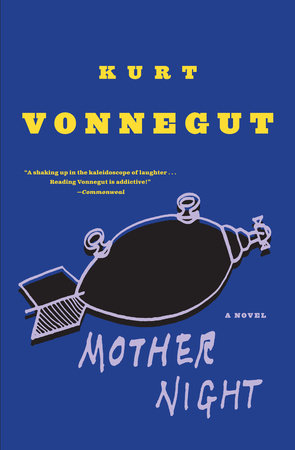
As one might imagine that experience impressed itself mightily on Vonnegut, who as a writer eventually dealt with the matter in his best-known novel Slaughterhouse Five. But that was not his first novel to deal with WWII. That would be 1962’s Mother Night.
The short plot summary for Mother Night is that it concerns the story of an American who was in Nazi Germany during the war, and who tells us that all-the-while working with American undercover efforts he made fulsome fascist propaganda broadcasts. This situation gives us all kinds of resonances: with important American Modernist Ezra Pound for example,* with America’s own fascists, and with anyone who has ever found themselves working (for whatever reason) with a cause that they themselves feel they are not in alignment with.
The novel’s protagonist wrote “The Great Machine” in the novel as a poem explaining how he and his beloved German wife had done what they felt was necessary to survive, and once again the novelist while in character allowed Vonnegut license to write poetry.
Abstracted from the novel, and as a stand-alone poem, it mentions nothing of the fascist double-life theme of Mother Night however. Heard in this way, as the LYL Band performed it during the week of Vonnegut’s death in 2007, “The Great Machine” speaks instead to refugees trying to escape violent situations by whatever means they can muster. In such events it’s not uncommon for the “you really must understand” class of commentators to mention that the refugees should not be fleeing but should stay and try to counter the violence in their own countries. I don’t know if it’s absolutely required, but such commentators almost never seem to have been in similar situations themselves. In the saddest reportage in Vonnegut’s poem, it says that most people do not, in fact, flee in these situations, but ignorantly or fatalistically accept becoming victims of The Great Machine that is History.
After our first two installments of our Vonnegut series it’s gotten darker here, but you can hear The LYL Band’s performance of this poem found in a novel with the player gadget below, or by clicking this highlighted hyperlink.
.
*Living during the war in Italy, Pound (who had been attracted to outsider political ideas, not just fresh approaches to literature) made propaganda broadcasts for the Italian Fascists. Pound, as with several other Axis broadcasters from Allied countries, was arrested at the war’s end and faced charges of treason, with a possible death sentence. American literary figures helped lobby to have Pound instead declared insane, reducing his culpability. British humorist P. G. Woodhouse was in Germany during the war and made Axis broadcasts, which his literary admirers and defenders characterized as not propagandistic.
It’s easy for us at this remove to forget how close at hand these issues were when Vonnegut was working on his novel. WWII was as close as September 11 2001 and the wars that followed are to us now in 2021. Oddly though, American fascism, which had been a considerable issue during the ‘30s and ‘40s and is again now, was considered something of a comic non-entity in the 1962 world of his novel.
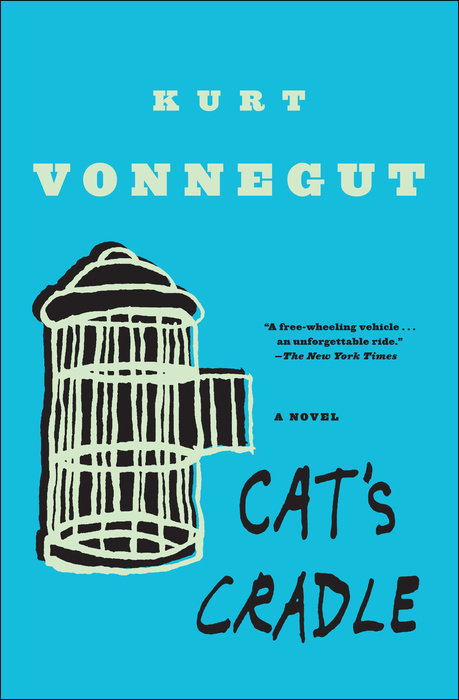
On to Kurt Vonnegut novels I have read and admired, as we continue this week’s Vonnegut series. In 1963’s Cat’s Cradle Vonnegut created one of the most elaborate satires I have ever read or heard of. What’s the target of the satire? I’d start to list them, but how much time do you have? What’s that you say?
“Busy, busy, busy…”
Well, let me talk a bit about Bokononism, a fictional religion created by Vonnegut as a Dadaist philosophical framework for this novel. I thought it a clever satire as a young man, but now as an old man I admire the richness of its contradictions and insights. Bokononism (named for its living, but elusive founder, Bokonon) is rich in meaningful/absurd contrasts. It’s said to have been invented by the West Indian sidekick of an accidental American imperialist* as an opiate of the masses for an impoverished Caribbean island nation. But not far under the cover of its optimistic and panegyric lies are sharp observations of life and how we think we make sense of it.
Instead of the Psalms of David, Bokonon wrote calypso songs. To many readers now calypso is but an obscure genre of Caribbean Afro-American music, but in the years immediately prior to Cat’s Cradle it had had a fairly significant US commercial visibility. Here’s a complexity in this calypso moment: to the typical US listener at the end of the 50s the music was “read” as carefree and only moderately exotic and absurdist.** But to calypso’s originators on their colonial islands, it was a sly comment on oppressions and troubles.
Creating such a song-writing character was an excuse for Vonnegut to do what many novelists stuck on silent pages would love to do: dress up and pretend to be pop music performers, even if only in a novelist’s imagination. Cut Kurt some slack: that pretending allows us to use Vonnegut’s sensibilities in the short formats the Parlando Project prefers.
Over a decade later, this lyric escaped from the novel, and what was presented as the trickster guru Bokonon’s scriptural “53rd Calypso” in the book had a second life as a song lyric under the title “Nice, Nice, Very Nice.” It made the American hit parade charts with this song by Ambrosia in 1975. Taken that way, it either can seem a simple, pleasing song; or a good reason in 1975 to form a punk band, without delay.
These guys wrote additional lyrics, sing better than I do, and were more concise in explaining Bokonon’s motivation for his religion “I wanted all things to make sense/So we’d be happy instead of tense” Still, I formed a punk band.
.
Simple isn’t without complexities. All we have is one quatrain and a short refrain — “Be Bop A Lula” is epic poetry compared to this. That one verse is a diverse catalog of the lowly and the high, the brave and the mundane, and the refrain wishes to claim they are part of the same “device” which rhymes with a repeated judgement that this is “nice.”
On one level this is a statement of shared humanity, and our connection. As complicated as the character of Bokonon is, I don’t think his creator Vonnegut would doubt the truth of that sharedness — but the “nice” and then too, the “device” part? There is the complex part of Vonnegut’s world-view.
Vonnegut portrays a world where kindness, love, and altruism are possibilities – no, necessities. Everything that is not those things exists too. We are all in a net of “butterfly effects” — even then in the novel’s 1963, even more so now in 2021. Is the world “nice?” In moments and pin-points it is. Let’s acknowledge that. In totality? “Busy, busy, busy” is said to be what a Bokononist says whenever they try to consider the complexity, the world’s intended and unintended awe of incomprehensibility. The implication: too complex to understand, to control.
At this point, in an earlier draft of this post I then tried to synthesize these things in my conclusion, but I don’t believe the book ever does, and certainly this little song that I present today doesn’t. So, let’s move on. Busy, busy, busy.
This song, performed in the same live set, back in the week of Vonnegut’s death in 2007 by the LYL Band, is unusual among the several musical settings I’ve since heard for it — I actually aimed for a calypso feel for the melody and groove, while others don’t. These 2007 performances I’ll use this week are each imperfect in some way, but as we approach the 99th anniversary of Vonnegut’s birth, it’s my hope that they still express some of his spirit.
There’s a player gadget for some to hear “Bokonon’s 53rd Calypso”, but if you don’t see it, tap this highlighted hyperlink.
.
*The very idea of accidental or coincidental imperialism is rich in itself. Even the minor threads in Cat’s Cradle are often like that.
**Just as I’m not much of an expert on the novel and its expressions, I can’t allow anyone to think of me as some expert on West Indian musical genres and political movements. But I am old enough to recall a bit about how the music was used and understood by white-Eurocentric-American culture circa 1960 — roughly, a darker-skinned Jimmy Buffett kind of thing. Some may recall a signal use in the goth-comedy Beetlejuice where the uptight urban sophisticates in a New England farmhouse were possessed and cursed to sing “Day-O (the Banana Boat Song),” which had been a big US hit in the late 50s. It’s an extraordinarily silly scene. I laugh at it. Vonnegut could (should) draw laughs too, but he is using a deeper, darker, slyer take on calypso.
Calypso’s use first by the American pop music industry, and then by white US filmmakers, as well as Vonnegut’s use of it in Cats Cradle could be viewed as cultural appropriation — I’d guess because it is. How would actual people of Trinidad/Tobago view Vonnegut’s reflection of their adaptation of African songcraft in a new colonialist world? I’d expect the opinions would vary, but I haven’t found anything on a simple web search.
I’ll let them judge Vonnegut in that regard. I’m an American musician, so I will not throw the first Rolling Stone from a country whose music is unique significantly because of kidnapped Afro-Americans. I feel that restricting art and tactics that oppose oppression only to each group who could claim ownership and a first, best understanding of them reduces the powers of resistance.
Today I’m going to start a short series here celebrating Kurt Vonnegut, a writer generally filed under “novelist” on bookshelves.
Most of the words this project uses started out as poetry, and poetry is a form of literature. So, one might assume that I’ve read a lot of novels. I haven’t. I’ve set no ban against the form, and I’ll read one or two a year, but the ones I read aren’t usually considered great literature. Essays, poetry, poetry collections, biographies (and less commonly memoirs), non-fiction accounts long and short, historical and current — my reading dance-card is full, and at my age I’m not sure I’ll ever rebalance my reading investments.
As he aged, Vonnegut apparently fell out with the conventional ideal of the novel too. Even some of his earlier novels had elements in opposition to long fiction either literary or popular as generally considered, and so his reputation as a “great writer” or as a “best seller” were both constrained.
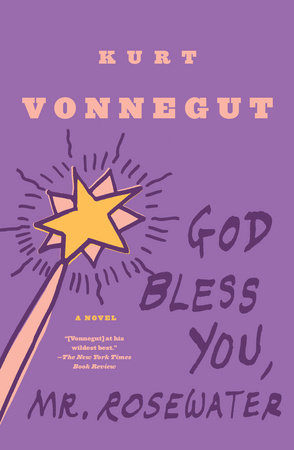
Luckily for this project, which likes to combine words with music in various ways, and prefers short, condensed forms of expression for that, Vonnegut is very quotable. Fictional characters who are quote collections and makers of short speeches are not the stuff of literary esteem, but then the results have other uses. Today’s piece is an infant-baptismal litany that a character in one of Vonnegut’s earlier novels* proposes to give, and it’s become one of Vonnegut’s most remembered and requoted passages.
The performance here, and probably the rest in the series to follow, was performed live in one-take by the LYL Band on April 15th 2007, the week that Vonnegut died, and these presentations are taking place in the week of the 99th anniversary of his birth. All these performances are imperfect in one way or another, but at least for me I still hear the emotions in-between the notes as Dave Moore and I made note of a departed writer’s spirit. Today’s piece was the first one we preformed that day.
*The Vonnegut novel this passage appears in is God Bless You, Mr. Rosewater, which I must confess I haven’t read. I say that just as a matter of honesty, not as a review or recommendation which I’m obviously not qualified to give. I suspect I’d like it when and if I get around to it. For counterpoint, here’s a review, contemporary with the novel’s publication, from the New York Times were the reviewer proves a maxim that I often repeat here: “All artists fail.”
Poems and songs about those artists who die young are easy to find.* Why should that be? Well, tragic aspects there are plain to see and it’s easy to note the lost potential in an early exit. I think there’s a further factor too: we are much in love with the trope of young artists whose work is caught in a rising arc before falling with melted wings. It’s extraordinarily difficult for an artist to continue to impress or delightfully surprise over a long career. We artists repeat ourselves and are judged to have become stale — or we change and produce work that isn’t judged correct to be coming from us. Perhaps this is inevitable. Or maybe in part it’s us as readers, listeners, audience, who contribute some faults to this by always seeking new faces — or the practical use of any failures as telling markers to drop attention.
I’ve made no secret here that I’m old. I missed out on being a has-been and I’m not anyone’s coming thing in the arts. In a strange way I find that frees me from those burdens, and I only need to carry my age and infirmities while producing new work. This summer as the blog and listenership has its seasonal drop off, I’ve indulged myself and your attention with more work with texts written by Dave or myself. I do notice that the poetry I’m presenting here of mine is overwhelmingly focused on loss, something Dave usually avoids. Young poets, young musicians, often add gravitas with similar emphasis — and I should note, young artists can and do directly experience those things outside of the world of imagining. Experienced artists may more likely realize this is a choice, one that we are free to question and doubt. But, speaking for myself and my summer it’s been more at reporting. The everlasting crisis of the wider world continues — unjust losses there are still noted — but each day I think of the closer infirmities of those I know: small losses for me beating in resonance to their greater losses, and less specific worries and predictions for myself standing before me as I look through them to assay these others unavoidably present and particular ones. This is likely the selfish and self-contained man’s version of empathy.
.
I enjoyed some dissonant chord colors and an “Is it in major or minor?” rub in this one’s music.
.
Today’s piece uses a text of mine I call “To Poets Not Dying Young.” The effect I’m trying to convey is the wearing of life on the body and soul of older poets who persist in their observation and writing, and it’s written in the hope that we, as audience, retain our ability to read and hear them. I do worry that the images are too enigmatic in this one, but maybe the connotations or some incantatory power will carry the effect through to you. Even to myself, their author, some of the images reflect more than one thing, and I’m not sure if that’s good or bad.
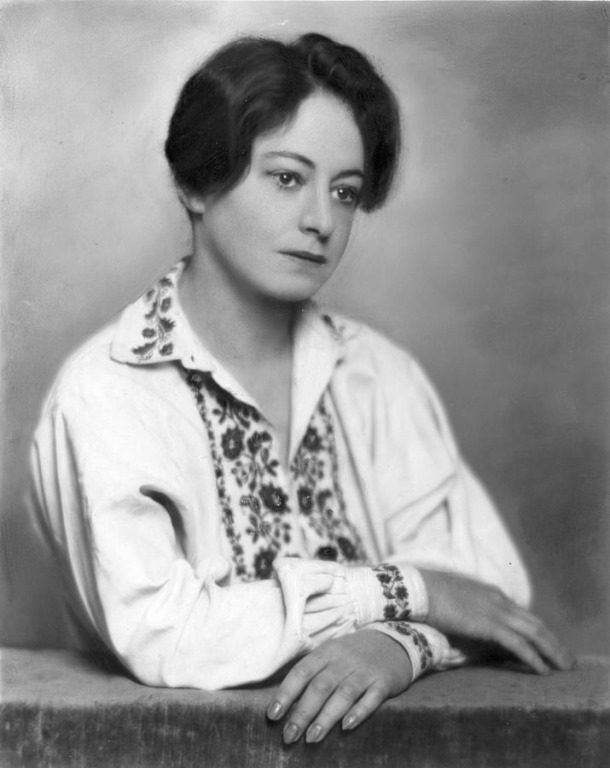
Here’s another woman writing very compressed verse about life and love around a hundred years ago, during that last decade we called “The Twenties.” She’s Dorothy Parker, and you’ll often find her work filed under “humorist.” As I said a few years ago when first talking here about Parker, I suspect that classification tended to prevent her work being discussed as poetry.
That label, used to set humor aside from “important work,” like the idea that verse sung with music is unlikely to be real poetry, seems not just needlessly exclusionary, but ahistorical. The western classical canon didn’t make this distinction when the verse was in Greek or Latin. Maybe translation slows down the appreciation of the jokes in Catullus for example? Perhaps Parker’s real fault (other than being a woman who wasn’t publishing in poetry journals in this era) was in being seen as “only” a humorist, and one that tended to write, like several other popular female poets of her time, about the abundant absurdities in human romantic relationships.*
This April I finished my several-year serial-performance of Eliot’s “The Waste Land,” a poem that wants to, indeed its innovative design is to, talk about a wide variety of things. Its middle part, like our middle parts, is very concerned with just such human miss-connections — but for good or ill that section is surrounded by an elaborate series of scenes time-adrift and spiritual that wear the mask of tragedy and religious/academic vestments. Does Eliot ever make you laugh at the absurdities? Well, there are a few sly jokes in it — but more in contrast, “The Waste Land” is long, it’s elaborate, and for me it remains powerful assuming you can accept the way Eliot sung his suite of songs printed silent on paper. Is elaboration the superior art? You tell me. I think it has its powers, as does concision. Are we less likely to be moved or changed by laughter or tears? Again, you tell me, I don’t know.
Where is it that Parker fails if we are not to consider her short pieces, printed in glossy magazines as witty amusements, as actual poetry? Are her observations merely trite, just a chuckle the first time we hear them, and unrewarding beyond that? Does humor outdate faster than solemn meditations?
I’ll sing a couple, and you decide. Today’s audio piece is an old recording where I combined two Parker poems, “Distance” and “Theory,” with a bit of acoustic guitar blues feeling. Combining short pieces is a tactic taken by several of the Modernists of Parker’s era:** the idea is that short, epigrammatic poems can gain power if presented as a facet in a collection of other short verses. The player gadget will appear below for some of you, and if you don’t see it, this highlighted hyperlink will open a new tab or window to allow you to hear it.
.
*Parker also ridicules patriarchal attitudes, which might have been minimized as mere jokes without consequence to assuage male privilege, but she’s also rough on some female-gendered behavior. This can be read by some as both-sides-ism, but maybe there’s also a reading that says it’s a more essential, radical critic of gender.
**I’ve been thinking about that tactic, used by poets Wallace Stevens, Alfred Kreymborg, Edgar Lee Masters, and others in the early Modernist era, and just now I recognized that the common practice of Blues singers of combining as series of floating or not directly related Blues verses has at least surface similarity. Perhaps this subconsciously led me to combining two Parker poems in my bluesy singing of them — but it could also be for a practical reason, one that may have obtained for some of the Blues singers: it made a piece out of shorter material that reaches a longer, desired length.




 Frank Hudson