Old Soldier

Today’s piece was created from a poem written by the Irish poet Padraic Colum. Colum was born in the 19th century, then traveled through the world of 20th Century Modernism, and lived on long enough to overlap my lifetime. Looking at the outlines of his life I am pleased to report that Colum connects a favorite of this Project, the undercelebrated Irish poet Joseph Campbell* and the American mythological theorist of the “Heroes’ Journey” also named Joseph Campbell. With the American Campbell, Colum connected because he was a folklorist as well as a poet, and he wrote several young adult and children’s collections of folk tales and retold myths which I’ve not yet read. With the former Campbell, besides being Irish literary revival contemporaries, he collected folk-songs.** Like that Irish Campbell, Colum’s best-known work today is arguably a folk song.

Long-time readers here may recall that the poet Campbell is likely responsible for the song “Reynardine”   being sung in a version featuring a supernatural, shape-shifting lover. At around the same time, and for the same publisher of Irish folk songs, Colum collected/wrote the lyrics to the song “She Moved Through the Fair.”   Why the slash notation on the authorship? There’s some controversy if Colum closely adapted a traditional set of lyrics, or largely wrote original lyrics to an existing tune. Colum claimed he wrote the lyrics, making use of only a few floating lines that are folk song ready-mades. The challenge to Colum’s authorship strikes me as highly suspect: it’s based on another collector writing in 1970 that he came across an old man who told him he’d learned it as a traditional song before Colum’s version was published in 1909.
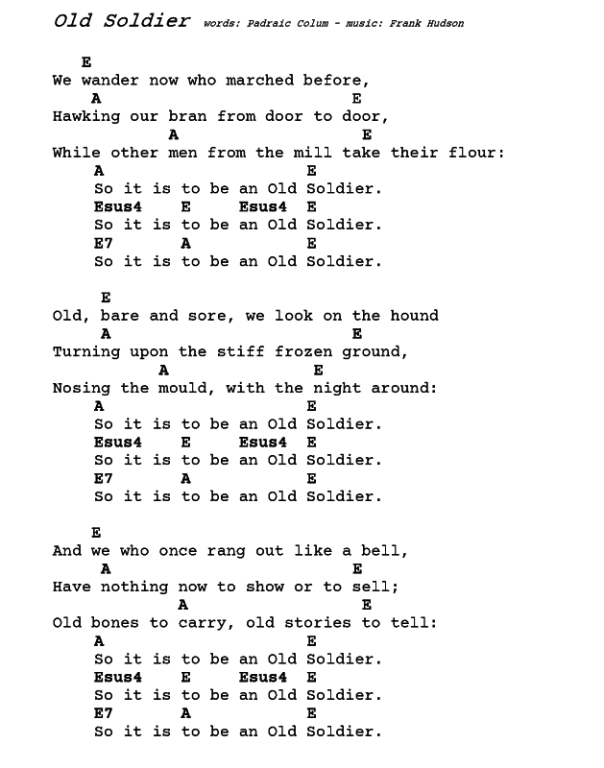
Old Soldier

I suspect there’s someone out there who can do a better job singing this song I created from Colum’s poem.

.

“She Moved Through the Fair”  was included as a poem in Colum’s first poetry collection “The Wild Earth”***  which also includes today’s poem. I note that “Old Soldier”  has some similarities with the lyrical methods of SMTtF:  both use spare details and leave out a great deal. Some of what is implied in the two lyrics may have become more obscure to modern listeners. SMTtF  very early on speaks of the singer’s “lack of kind” which uses a now archaic meaning of “kind,” meaning family. “Old Soldier”  opens with the titular old soldier going door to door. Since “hawking” (a hawker is a street-seller) is used as a verb in the second line I thought at first he was peddling, but from what I can find, no one sold flour that way. I think he’s begging for bran, which was then the discarded part of the milling of flour. That waste part after the wheat was milled or boulted, was thrown out or used as animal feed, though apparently the poor sometimes made use of it for human consumption.**** In the second stanza we meet the old soldier’s only companion, a dog, and the bran the soldier has garnered may have gathered mold.

I don’t know if “Old Soldier”  has been set to music before this, but it seems every bit as singable as “She Moved Through the Fair,”  and as soon as I read it, I wanted to sing it. I decided to use an arrangement soaked in South Asian musical influences, perhaps due to the wonderous extended version of the SMTtF tune played by Davy Graham. That link above includes one of Graham’s recordings of it, as well as Anne Briggs wonderous acapella version. Oh, hell, here’s that link again, click it indeed if you haven’t heard the song Colum made. Last week I recorded the basic tracks singing and playing a tune I created for Colum’s poem using my guitar in an alternate tuning driving a sitar virtual instrument though a MIDI pickup. To this first pass, I added harmonium, tanpura, tabla drums, acoustic guitar, and a final vocal.

Every one of those overdubbed passes felt good as I played them (save for my vocals, I’m never happy with my vocals) but the result was a whole bunch of tracks that would require careful mixing so that the instruments blended well. I set about doing that, working until midnight when I figured I might have a piece to present and saved a complete mix down. Awaking the next morning, I listened again, and the result wasn’t just flawed, it was a mess. A useful question for one mixing a piece of music with various instruments in an ensemble like this is “What track is the focus of the piece?” My putative mix had no good answer for that. The voicings of the chords on the sitar and the guitar didn’t mesh well. The harmonium and the tanpura were fighting over the same part of the sonic spectrum despite my efforts to give them their own sonic space. The tablas didn’t mesh with the acoustic guitar’s rhythm.

The wise solution would be to just re-track the piece. Maybe I should have more particularly considered that Davy Graham had made his impressive version of a Colum poem/song with only a solo acoustic guitar. But I would not have another opportunity to record with a sensitive open mic until this week, too late for Veteran’s Day. So last night I went to work stripping back the crud of my failed mix, leaving mostly the acoustic guitar and the vocal, with the tanpura and then the harmonium coming in for later parts of the song in turn. It’s not an ideal recording, but it’s my hope it lets one consider “Old Soldier”  as song today.

The more palatable version can be heard with the audio player below. The song itself is simple, and the remixed arrangement that builds a bit as the song continues serves it better. You don’t see any audio player gadget? No, I didn’t remove that, it’s a side-effect of some ways of viewing this blog. I have a plan B for that too: this highlighted link that will open a new tab with its own audio player.

.

*Joseph Campbell, who also wrote under the name Seosamh MacCathmhaoil, was acquainted with the original London Imagist circle, and wrote what I think is some excellent short verse in the form. His life and literary career were brought low by siding with the losing side in the Irish Civil War.

**Given that I’ve been doing this project for a decade, the folklorest/singer/collector and poet is a combination near to my heart. Besides Colum and Campbell, two American poets from the same era, Carl Sandburg and Edwin Ford Piper did both things, and I’ve tried to briefly make the case that Sandburg should be more often cited as instrumental in connecting folk song with progressive politics and literary poetry in the United States, which eventually leads to the case of a Nobel laureate in Bob Dylan. Around the same time as all these others, elements of the “Harlem Renaissance” in Afro-American literature were open to melding folk song with high literature too (Fenton Johnson, Langston Hughes, Jean Toomer, Waring Cuney, Zora Neale Hurston).

I’m going to jump far afield before leaving this footnote: I’m writing this on the 50th anniversary of the release of the Patti Smith Group’s glorious debut LP Horses. The Patti Smith Group started because Smith, a poet personally immersed in colloquial music, a paramour of Fugs-adjacent musician/actor/playwright Sam Shepard, joined up with a guitarist/rock critic/crucial anthologist of garage bands Lenny Kaye, wanting to make unexpected poetry combined with electric guitar.

***Just when Colum’s The Wild Earth was published is unclear to me. My copy has a 1927 American printing of a 1922 edition. Wikipedia says “She Moved Through the Fair”  was in a 1916 edition of the book, and then in their entry for Padraic Colum gives a 1907 date for the book.

****What, that’s the healthy part! Whole wheat! At the time the milled pure white flower was prized from making lighter baked goods and for a longer shelf life. The city I live in was growing rapidly at the time of this poem by finely milling the “Best” and the “Gold Medal” flour that had absolutely no bran or wheat germ at all.

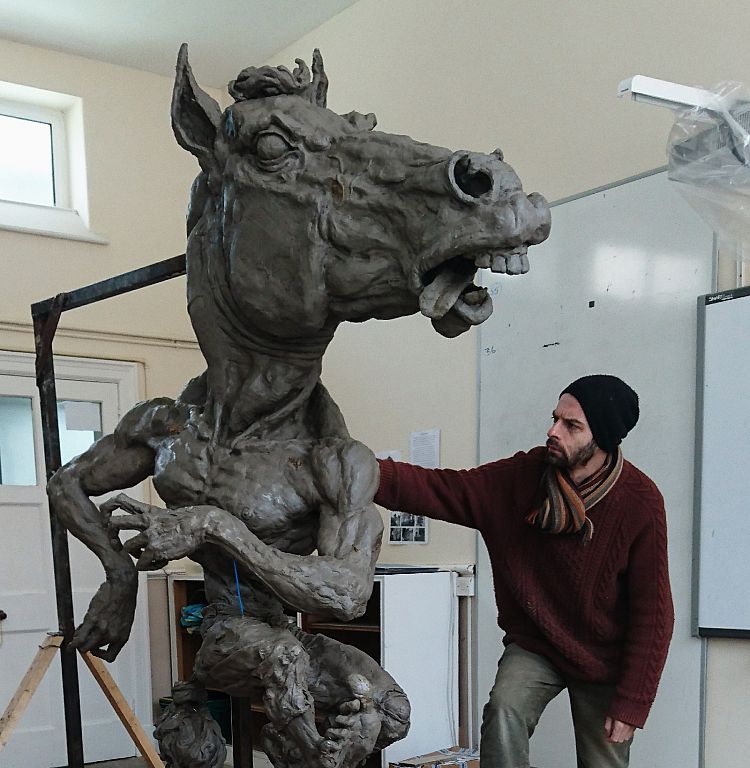
The Puca

As our Halloween series continues, let me advocate today for an element of the fantastical: the goblin. Some fantasy creatures are, by definition, not fully alive: your vampires, zombies, golem, all animated undead meat; your ghosts “spirited” in some way, but incorporeal. The goblin, like all the variations in the fairy realm, seems akin to the human, but not in the beautified, glammed-up way that many fairies are depicted; and also, like the human, goblins seem subject to motivations and whims, not driven by some designed in need.

Puca is a goblin name of uncertain etymology, and specifics of their appearance and nature are like the word’s origin, broad-ranging. That non-specific appearance is baked into many accounts: they are shapeshifters. Some accounts link them to taking on animal forms: rabbits, red-eyed horses, and so on.*  Today’s puca is related in a poem by Irish poet Joseph Campbell.**  While Campbell is attuned to shapeshifters, his puca doesn’t change species or form in his poem: he starts and remains a hairy creature of the forest, human-enough to mirror human behavior, which becomes the signal incident in the poem.

Puca drawing

Shapes of pucas. I don’t know the artists for the two on the sides, but the sculptor in the middle is Aidian Harte and his mid-transformation depiction caused a commotion in the Irish town it was to be displayed in.

.

If goblins are unpredictable, portrayed as helpful and troublesome, this puca does in a way transform. In my reading of the poem, I sensed it describes something of a turn-about: rather than a human encountering a magical creature and then by elfin spell or trickery the human is changed, Campbell describes the opposite: a shy creature emerges, is observed laughing, dancing, poetry on his lips. And then a stanza later, his mood is sad, distressed, bitter. What causes this change?

The poem doesn’t say, but another creature, the poem’s voice is observing the puca. Let us assume he’s human, even that he may be the poet himself. The unhappy puca is said to have become “the double of distress.” Does “double” just mean equal to the happiness of the second stanza? Or does it mean the puca has taken on, mirrored, the human who has revealed that he envies the puca’s “sunny mood” in the happy verse before?

The poem ends by telling us this human/goblin encounter has caused the puca to retreat back into its cave, hiding itself. The puca may have been enchanted by the human’s sadness, and thus fled from the human’s thrall.

Unsaid in the poem, but I’ll ask: is the human changed by this encounter? While the puca instinctively flees the dissatisfied human, it’s the poet that’s telling us this story, and I think they’ve concisely explained that their bitterness has an effect, causing the happy fantastic to leave. Did the poet learn something from this?

I’ll add this biographic note on the author: Campbell’s involvement with the Irish Civil War that followed independence broke him. He was imprisoned, faced at least some danger of execution — and once released, he fled the Ireland whose culture had fed his art. His literary efforts tailed off sharply and the “gall and bitterness” that the puca demonstrates was Campbell’s lot in the last part of his life.

But this is a poem of Campbell’s early career, first published in 1913. Mute on the page, it set out a spell for me to set it to music. I think “The Puca” shows one of Campbell’s strengths: concision. A great many literary balladeers want to write epics. While I admire those that can vivify a 10-minute ballad in performance, I also observe that that endurance is beyond me — and Campbell, fresh from rubbing shoulders with the concise Imagists, has packed a charged moment in time into four stanzas — and if my reading is valid, more is evoked in the incident described than might be explicated in extra verses.

I tried for the eerie in the music I composed and recorded here: a certain wildness in the keyboard line’s contour and oddness in their timbre. You can hear my performance with the graphical audio player below. What? Such player has crept away into a cave or twilight glen?  This highlighted link is an alternative, as it will open a new tab with its own audio player.

.

*Articles on the puca I read this month relate this creature to the Easter Bunny and the invisible friend in Harvey,  generally benign creatures — but then, the red-eyed horse is said to offer rides home to the inebriated, the acceptance of which will lead to a wild, bucking, bramble-scratched ride, ending with the rider being bucked off in a field far from home. Unmentioned in the pieces I read would be the animated cartoon character of Bugs Bunny, the gender-fluid trickster that I’d see as in this tradition too.

**Obligatory footnote every time I bring Joseph Campbell up — no, not the Power of Myth guy. This Campbell is a deserving-of-more-interest writer of the turn of the century Irish cultural revival. Like many others of his generation, he was caught up in the Irish independence struggle, used Celtic folklore material, and dabbled in writing for performance (plays and song-lyrics) — but he was also connected with the Imagists and early English language poetic Modernism that emerged in London before WWI.

Exit the were-fox, chased by the land-holding patriarchy, “Reynardine"

Did T. S. Eliot for Halloween* suffocate our audience with too much of the musty air of the classroom? I hoped those loud synth fanfares would set such terrors to run. Maybe not. Well, I’m ready to tempt you back with a bit of love and seduction, a song set away from graveyards and into castles. Our Halloween series continues, and this time with 100% wooden music I played on an acoustic guitar.

So, ladies in nightclothes flaunting impossibly flowing but still in good array hair, running through the forest under a moon over the branches kind of stuff? Maybe. First some literary history. Don’t worry, I won’t take long with that, and there’s a good creature-feature song at the end.

We started our Halloween series with Frost and Eliot, poets that many will know even if poetry isn’t an interest. Today’s piece uses words from a well-known name that when applied to a poet isn’t well-known: Belfast writer Joseph Campbell is that name. Yes, every cursèd time I mention his name here I’m required to say “No, not the Power of Myth guy.” Poet Campbell was a contemporary of Yeats. And like Yeats he visited London when F. S. Flint, T. E. Hulme, and the “What’s with the initials guys?” Yank-transplant Ezra Pound were taking up their make-it-new idea to be called Imagism. Several years before Pound and Flint published their famous essay on the tenants of Imagism, Campbell published some of the earliest Imagist poems.

Campbell’s relationship with Yeats is complex. They both were heavily into valorizing Irish culture. Campbell was even more so into Ireland throwing off its exploitative English colonial status. Both seemed to have an interest in the faerie and spirit realms, though Yeats had an interest in practicing wizardry, while Campbell, AFAIK, didn’t. Both had interest in music, but Yeats was specifically resistant to having his poems sung conventionally, while what of Campbell’s work survives (underrecognized) is as a lyricist** for songs better-known than he is.

As a song, today’s piece, “Reynardine,”  became oft-performed in the British 20th century folk revival. When those performers would present it, they would introduce it as an old song — which is true in part. Its melody is largely based on an old air. The name of its main character, and something in the general trope of “I’m in love with a mysterious bad boy” did have old ballad antecedents. But those revivalist performers would usually want their audiences to know that the main character, the haunting love interest the singer knows but society doesn’t, is a shape-shifter, a were-fox.

Campbell’s words as printed in “The Mountainy Singer” are better, more direct, than the lyrics usually used for performing this song. I made one change: Campbell has “took me for his leman” in his, and I translated this to “lover” for clarity.

.

As I discussed briefly when I first presented this one a couple of years ago: that doesn’t seem to be so in the extant pre-20th century versions of this song. In 1909, our “Reynardine,”  now a were-fox eluding the patriarchy and foxhound driving hunters, was published in two books: as a collected Irish folk song from Belfast, and as a page poem in Campbell’s poetry collection The Mountainy Singer.  This idea of the song’s dark hero emerged that recently, and I have every reason to believe it was the little remembered Joseph Campbell who cast him that way.

I did my best with my performance of this one, thinking I was emulating those folk revivalists whose work I greatly admire. The one special thing I did was use Campbell’s set of words as printed in his poetry collection. With one small alteration, I think they work well to sing to modern audiences, and his version has the compression and specific mystery that can make Imagist poems and short lyrical songs compelling when contrasted with lengthy poems and discursive sung ballads. Audio player to hear the performance below. No player? This highlighted link will open a tab with a player.

.

*Unlike the other pieces I’ll present in this series, my settings of Eliot are not listener favorites. I watch the stats here while not spending much time trying to maximize them. Eliot draws some interest outside the U.S., and very, very little from here in the States.

I also want to say that I want to celebrate Halloween this year (more about why later in this series) and I want to do it as Emily Dickinson once wrote she did in approaching some topics in her poetry “I sing, as the Boy does by the Burying Ground — because I am afraid.” But writing as Eliot did of his unreal city of corpses that can’t be hidden, and casting it as a song of fantasy, vision, or delusion, can be offensive in a time where real corpses are piling up not from natural death, but from human intention.

If I offend you, you likely aren’t reading this far. I assure you I offend myself in doing so. “You! hypocrite lecteur! — mon semblable, — mon frère!” “You! Hypocrite reader! — my fellow, — my brother!” quoted Eliot, quoting Baudelaire, quote I.

**Even as the composer part of most of the Parlando Project, I want to say that a pet peeve of mine is folks crediting a song solely to the music composer. I hear this all the time with contemporary songs, particularly when the melodist has sung the piece: Brian Wilson, Carole King, Elton John, and so on. Besides his unacknowledged work in recasting “Reynardine,”  Campbell is the lyricist for “The Garten Mother’s Lullaby”  and “My Lagan Love.”

The most popular Parlando Project piece for spring 2022

One unusual thing I did this spring to celebrate National Poetry Month was to re-release 31 pieces from the early years of this project. This was a way, despite reduced time and opportunities to create new pieces, to still celebrate and demonstrate the various poems and music combinations of the Parlando Project.

That April batch does show something of the range of words I’ve used. Famous poets? Shakespeare, Dickinson, Yeats, H.D., William Carlos Williams, Marianne Moore, Frost, Pound, Millay, Cummings, Eliot, Sandburg. Foreign poets less known in America than in their native countries? Edward Thomas, Tristan Tzara, Du Fu. Afro-Americans less-known to their fellow Americans: Fenton Johnson, Raymond Dandridge, Jean Toomer, Anne Spencer.

As part of this April celebration, I spent more time that I thought I would creating “lyric videos.” I figured I would just put in a couple of pictures in a video file and place the words to the poems on the screen in time with their appearance in the music, but they got a little more elaborate.

How popular were they? It doesn’t look like YouTube counts as views any plays of those videos from the inside-the-blog-posts thumbnail images, but it does count those who found them on YouTube itself. Given that sub-set it does count, the most popular of the April Poetry Month videos was our Parlando version of Yeats’ “He Wishes for the Cloths of Heaven.”   No surprise there: William Butler Yeats’ poetry is welcome to so many ears around the English-speaking world. If I was to look at most viewed posts (a metric I don’t use in these Top Ten lists) four out of the top ten most viewed posts so far this year are concerning Yeats’ poems. Yeats is a Poetry’s Greatest Hits poet.

The most listened to and liked piece this past spring was an Irish poem, but it wasn’t by Yeats. It was one of the April Poetry Month re-releases though, “Night, and I Traveling”  by too-little-known Belfast-born poet Joseph Campbell (who also published under the name Seosamh MacCathmhaoil).

I’m partway through a biography of Campbell that was an Anniversary gift from my wife. From it I’m getting more of a sense of the young man who wrote this poem — a poem which is remarkable not just for its tightly compressed and effecting scene, but for being published in 1909 so that it might be counted not just as the work of the first Irish poet to use free verse, but also as one of the earliest published examples of Imagism. It wasn’t until 1913 that F. S. Flint and Ezra Pound published their A few Don’ts by an Imagiste”  and laid out the three famous Imagist suggestions/rules, but before that in London Flint, Pound, and T. E. Hulme had been working out how to radically strip back poetry to a fresh, precise, and direct essence in the months before Campbell published “Night, and I Traveling.”

Night and I Traveling

The chord voicings I used for the 12-string guitar part here are bit unusual.

.

I now know that Campbell was in London and meeting with those incipit Imagists in that first decade of the 20th century. Alas I don’t know how junior a partner he was in their meetings, but “Night, And I Traveling”  is to my judgement as fine an early Imagist poem as the more famous and anthologized ones, arguably a more worthy example because of its empathetic attention to the isolated rural woman in a still-colonialized Irish hut in place of Pound’s  damp impressionistic leaf-faced Paris Metro riders published four years later.*   The biography, Joseph Cambell Poet & Nationalist   by Norah Saunders and A. A. Kelly, reminds us that Campbell liked country walks at night. Campbell wrote: “Night walking — all my best thoughts, I find, come to me that way. Poetry, like devilry, loves darkness.” Devilry? Campbell did write some of the supernatural, and would mix Christian and pagan mythologies —but in this one, this night, he stays in our earthly plane. Am I reading too much into the poem to note the poem’s only simile has the lone woman crooning “as if to child” when there is no child depicted? Is that child dead? Or perhaps emigrated to America?


Not as popular as Yeats on YouTube, but here’s the “lyric video” I did for this piece

.

You can hear my performance three ways. The “lyric video” is above, an audio player gadget should be below, and this highlighted link is a backup for those ways of viewing this blog that won’t show the player. Thanks again for reading about these encounters and listening to our combinations of music and words.

.

*Make of this connection what you will: Pound and Campbell would both eventually be imprisoned by their own countrymen for acts during wartime.

Night, and I Traveling for National Poetry Month

A little contrast here in poetic fame from Shakespeare to a poet who’s equally unknown under each of his names: Joseph Campbell/Seosamh MacCathmhaoil. Most of his poetry was published under that first name, not the Gaelic version, and so I’ll use it today, even though I’m always obligated to say “No, not that Power of Myth guy.”  Over the years this project has promoted the idea that Campbell deserves wider recognition. Here’s a brief version of that case.

Belfast born, Campbell was active in the Irish cultural revival at the beginning of the 20th century, and like Yeats, he seems to have crossed paths with the London-based Modernist poets circle of T. E. Hulme, F. S. Flint, and Ezra Pound in the years before WWI. His involvement with the militant wing of Irish revolutionaries also grew during this time.*  After Irish independence he lived in America for more than a decade, while continuing to promote Irish culture; but he seems to have stopped publishing his poetry after the establishment of the Irish Republic. Late in his life he returned to Ireland and died there in 1944 where his ghost continues the task of becoming largely forgotten — at best a footnote, and often not even that.

Well, most poets are forgotten, even in a country like Ireland that does a better job of revering them than most, but here are some things that attracted me to Campbell: he worked effectively in the folk-song part of the Irish cultural revival, collecting, writing, and adapting song lyrics.** And his take on page poetry included both that folk song tradition — and uniquely among his Irish generation — a handful of very early poems in the pioneering English-language Modernist style that would be called Imagism.

In fact, I’ll put today’s piece up against any of the more famous short Imagist poems widely anthologized, I think it’s a masterpiece of the form.


Here’s the lyric video of the performance.

.

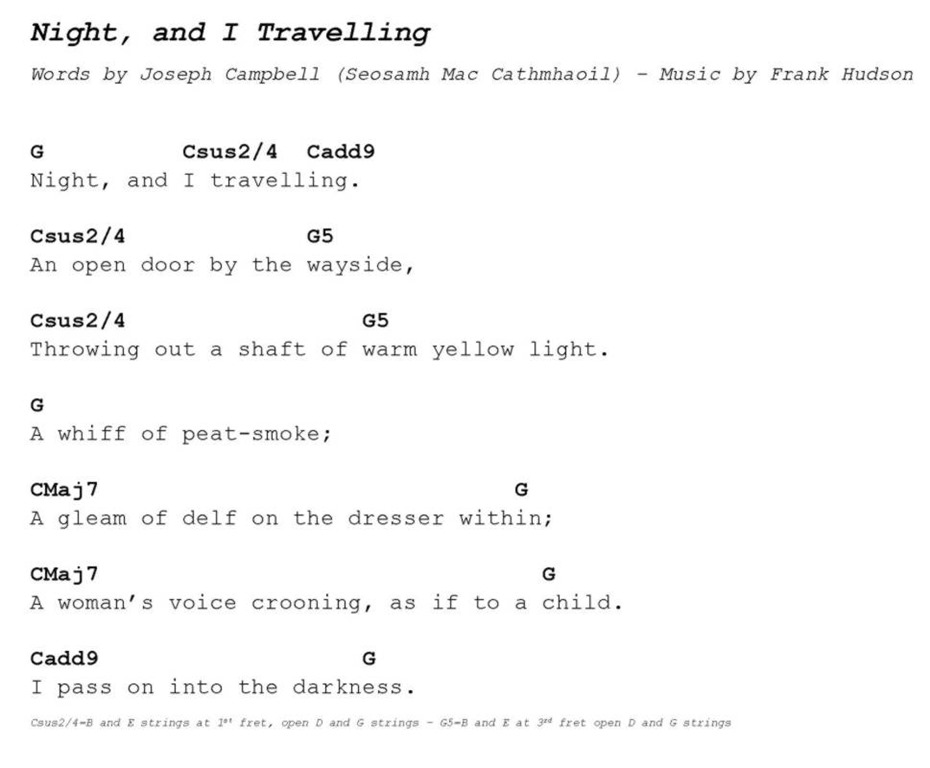
I find “Night, and I Traveling”  a hugely affecting example of direct presentation of a thing and a charged moment in time. Like Imagist poetry in general it does expect the reader to pay attention, as the poet did, and to supply from within themselves the emotional charge the presentation represents.

Campbell was a country walker in Ireland, and the door he observes while walking in the night is likely of a small rural dwelling, plausibly little more than a hut. The door is open. Perhaps the peat fire inside has gathered smoke. Perhaps the occupant is expecting someone to return. Let us also remember, this is more-than-a-hundred-year-old rural night. The ambient light he’s sees in the dark has a landscape context of moonlight at best. There’s a gleam of some porcelain dinnerware inside, perhaps the most valued possession in the hut, perhaps a dowry or wedding item. The poet hears the only occupant, a woman, singing, in the ambiguous, but I think rich phrase, “as if to a child.” Note this single simile in the poem. He could have written “to a child.” He did not, leaving the implication that I take: that there is no child — the child is dead or gone. Campbell passes on “into the darkness” and the poem ends.

Seven lines, and this poem slays me. How much is packed in there to an attentive reader: the poverty of the colonized Irish, the depopulation of those who needed to leave to survive, their meager treasure (part of which is song), the closely-held personal losses.

Yes, poetry such as this requires your attention to work. I ask for your attention to this poem and to Joseph Cambell.

There’s three ways to hear my performance of “Night, and I Traveling.”   There’s an audio player below for many of you, and this highlighted hyperlink that will open a new tab with an alternative audio player is provided if you don’t see that. As part of our National Poetry Month observation, there’s a new lyric video above for those who’d like to see the words while the performance plays.

.

*This revolutionary involvement seems to have been the proximate cause of Campbell’s literary career stalling. In the aftermath of Irish Independence, the Irish Civil war broke out between factions of the new Irish state. Campbell ended up on the losing side and was imprisoned for a while. Despite my admiration for Campbell’s poetry, I’m not an expert on his life or the political issues of the Irish Civil war. But these events seemed to traumatize the writer, and it’s not hard to imagine that politics and associations from a sectarian war might have caused him to be written off by some in Ireland.

**Sort of like Eleanor Farjeon from earlier in this April’s National Poetry Month series, Campbell may be “best-known” in the quasi-anonymous role of the lyricist of a song, “My Lagan Love.”   Campbell’s lyrics in this song include a more elaborated variation of a woman’s lonesome singing heard through a doorway with a “bogwood fire” and the singer ending the song “From out the dark of night.”

In a popular post last fall, I also revealed that Campbell likely originated making the subject of the song “Reynardine”   a supernatural creature.

Irish poets, we complete our Fall 2021 countdown, and Ethna McKiernan

I fear this is going to be one of those bad elegies, one where the writer goes on too much about themselves and not about the person who has died. I’ve already mentioned that I find myself unacceptable and self-absorbed when I talk about myself, and saying that again only digs the self-dug hole I’m going to speak from today deeper.

In the mid-1970s when I moved to Minnesota from New York I connected back up with Dave Moore who I knew from a year in my aborted attempt at college. Through Dave I fell in with a literary group that varied in size and was herd-of-cats led by Kevin FitzPatrick. The group had just started  a little magazine they called the Lake Street Review,  Lake Street being a long commercial and industrial street that ran east/west through the center of Minneapolis: bars, gendered barber and beauty shops, warehouses, grocery stores, used car lots, a high-towered Sears linked to a rail-freight line and distribution center behind it, neighborhood movie theaters and former such theaters now grinding porn, the recording studio where “Surfin’ Bird”  was recorded, a small attempt at a non-suburban shopping mall built on the tract where tractors and tanks were once factory-built, a “hardly a foot we can’t fit” shoe store whose upstairs apartments housed Robert Pirsig when he wrote Zen and the Art of Motorcycle Maintenance.  Literary magazines generally preferred foreign words, or landscape landmarks like rivers, lakes, or mountains for their names. Yes, there were lakes at the west end of Lake Street, a self-improvement plan for nature dredged out from what had been swampy wetlands as part of a series of landscaped urban parks that circled Minneapolis — but let me be clear to those who aren’t from around here: calling an artistic enterprise The Lake Street Review was something of a provocation. This was a group of working-class writers with a non-academic outlook toward poetry.

The groups earliest meetings were held at a bar, and Dave noted to me that a large portion of the informal membership was made up of bartenders. Let me also set one other demographic fact: this was a group of men moving from their 20s to their 30s. Eventually the membership thinned out, and the remainder continued meeting in rotation in the members homes and apartments.

As the clan leader, Kevin was generally gentle and accepting. A high-school graduate, working in an urban ER, the again’er in me was attracted to the outsider stance, but Kevin also wanted the magazine’s public work to be acceptable to the parents and grandparents of us young men. The 1970s had still extended the “generation gap” of the 60s, so the “Seven Dirty Words You Can’t Say on Television” you also couldn’t say on the pages of the Lake Street Review.  Feminism was mysterious, like women generally were to these young men, but those women were talking about it  which made the mystery unsettling. Anything gender-queer was probably beyond the pale.

I liked those folks, but some of this rankled me. Kevin’s desire to speak across the generation gap as a poet was more noble than I appreciated at the time, but I wanted to go much more radically into discussions of sexuality and sexual roles than Kevin did, and what work I shared with the group privately I thought was underappreciated and misunderstood. I skipped off to two other groups sometime in the 80s, only to return to the Lake Street Writers Group after more than a decade away.

By this time the group had become smaller and more fixed in membership and was no longer concerned with the discontinued magazine. Four or five others, interesting writers and persons in their own right, were regulars, and then not; until by the last few years it became a quartet that would meet every month to share and discuss work in progress.

So when that group ended, it was Kevin FitzPatrick, Dave Moore, Ethna McKiernan, and myself. I’m not sure exactly when Ethna became one of the group as it was likely during my sojourn away from it. At one point she was one of two women generally attending, but as we contracted into the quartet, she was the only woman. As we aged it’s possible that this was less of a filter or division, even if it didn’t disappear. Another thing that happened as we condensed: the group had become predominantly Irish-American. Ethna’s father had been a force in the Irish cultural renaissance, something I was almost entirely ignorant of,*  and Ethna’s speaking voice retained a distinct Irish pronunciation undertone. Kevin and Ethna took it upon themselves to establish an annual Twin Cities St. Patrick’s Day poetry reading, a reminder that non-descript leprechauns, green plastic hats, sham-shamrocks, and ever-filled and spilled red cups and flushed faces were not the sum total of Irishness.

Will I ever get to Ethna in this post? To my shame, I will speak more in silhouette, about myself. In many ways I felt the junior member of this group. Kevin and Ethna has several collections published. Ethna got arts grants, had an MFA. Kevin and Dave had degrees from fine private colleges, I was a High School graduate. I gave up trying to publish shortly after my temporary leaving of the group, and it would have been understandable if it irked Kevin and Ethna sometimes that here was this opinionated yet apparently non-professionally serious person taking up their time. I retained a close friendship and collaboration with Dave outside of the group throughout the decades, and grew to understand and appreciate Kevin’s artistic goals, but no such closening happened with Ethna. I knew much less about the details of her life, and what bits I picked up second hand, sometimes from the poetry itself and not from her own conversation, indicated a life with more than it’s share of staggering life events. I also got a not-unexpected sense that men had been part of some of those staggerings, something that she didn’t express much directly in our group of three men and herself. Here’s a statement: I know more about the life-details of Emily Dickinson than I know about the life of a poet, my own contemporary, who I shared a few hours with every month.**

Kevin’s mature poetry never seemed to aim at beauty as such. It is a beautiful thing to find beauty were it isn’t. Ethna indeed aimed for beauty, sometimes comforting and sometimes fierce, and as the saying goes, if you don’t know where you’re going, you’ll never get there. Ethna got there some of the time, which is all we artists can do. Looking through her recently published Light Rolling Slowly Backwards, New and Selected Poems  it is easy to find that she was the most skilled poet in our little group, which sounds like fish-in-small-pond praise — but if you (who don’t know us) were to read her, I think you might find similar achievement to whatever other poets you read. When I read Kevin and Ethna’s last books during my yurt retreat early this fall I observed that while I had heard almost every one of Kevin’s published pieces in Still Living in Town in early draft form, I hadn’t heard many of Ethna’s. I know she attended more than one group sharing works in progress, but the amount of work new to me was surprising. I do plan to share one of her striking poems with you soon, but let’s wrap this long introduction up and get to the final part of my countdown of the most listened to and liked Parlando pieces from this past fall.

Two grey guys and a colorful woman

Three Irish poets: Yeats, McKiernan, and Campbell.

.

2. The Folly of Being Comforted by William Butler Yeats.  Ethna never simply said something like “Read Yeats!” but before I encountered her I didn’t think much about him one way or the other. Now over the five plus years of this project you’ll have heard the fruits of that influence from her in my many well-liked presentations of Yeats. As I said when I presented it, Yeats was making a very specific point in his poem relating to his own life. I chose in my performance to stubbornly ignore what Yeats intended his poem to be about, and to instead sing it remotely to her on her hospice bed with my own intent. If I snub Ethna in this eulogy, I’ll ignore Yeats too. No respect.

It’s a challenge for me to work out my approximations of Jazz when I’m playing all the parts one pass at a time while being far from a master of any instrument. When it succeeds, as some thought here, I try to combine my simplicities (unimpressive I’m sure to a skilled musician) into something that still pleases when heard together. The highlighted title above will link to my original post on this where I discuss Yeats’ intended meaning, but you can hear my performance dedicated to Ethna with a graphical player (if you see that) or this highlighted hyperlink.

.

1. Reynardine by Joseph Campbell.  Before the depths of their illnesses, I asked Kevin and Ethna if they’d heard of this early 20th century Irish poet, and they both drew a blank, which I’ve now found is generally true about this overlooked and worthy of more study poet. If Ireland is thought known for exuberant and willing to risk excessiveness expression, Campbell is never more masterful than when he’s compressing things to a handful of words.

Reynardine is a supernatural story in three short verses. From what I’ve been able to determine (see the original post on this) the supernatural element may have been introduced by Campbell, who took an existing long-winded run-of-the-outlaw ballad, and boiled it down with a shapeshifter element. After he’d done that, the resulting folk revival song, one sung by many of the best revival singers of the British Isles, always includes at least hints of that element. My presentation uses Campbell’s original lyrics, which I think are superior to those usually sung.

As far as it’s popularity here this fall, this is an odd one. The blog post presenting it wasn’t read much at all, and the likes for my explanation there of how Campbell transformed the Reynardine story were low in number. But the listens to the song (as with all the audio pieces here, available via Apple Podcasts or most other podcast directories) were easily higher than any other recent piece. To hear it now you can use the player gadget if your blog reader shows it, or this highlighted hyperlink.

.

*I once joked, confessing my cultural ignorance there, that my idea of an Irish writer was Frank O’Hara. Joke or not, someone somewhere must have addressed what connections O’Hara’s poetry had with Irishness, but I haven’t found it.

** It was only a year or two ago, after my interest in Dickinson intensified that I found out that Ethna too had a deep appreciation for that genius. Of course, I have my portion of blame for this, just as with this inappropriate eulogy, but suspect she believed that I wouldn’t understand or have any sense of her experience or sensibility. I’d estimate she was wrong, but saying that only adds to my inappropriateness here today.

Reynardine

Are you familiar with the song “Reynardine?”  You might be. It’s been performed by many of the best performers in the modern folk revival: Anne Briggs, Fairport Convention, John Renbourn, June Tabor, Bert Jansch and others.*  Today as I extend our Halloween series, I’m going to introduce you to a version of the song you haven’t heard, a version that I’ll maintain uses more efficient and effective methods to convey an air of mystery. There’s supposition that this version may have been an indirect catalyst in the way the song you may know was presented, but this little-known version’s lyrics are so good that singers should consider using them in contemporary performances.

Where did I find this new version of “Reynardine?”   In the 1909 book of collected poetry by Irish poet Seosamh MacCathmhaoil (AKA Joseph Campbell) titled The Mountainy Singer.

I’ve spent a day or so in hurried research on this, even though long-time readers (or readers of our last post for that matter) will know that Joseph Campbell** has been of interest to me for a couple of years now. Here’s the shortest version of what I know that I can make.

Songs related to “Reynardine”  go back to the early 19th century in the British Isles and the U.S. Wikipedia gives us a representative early (1814) example, and this helpful page gives us a catalog of later 20th century versions. The older versions sometimes vary the name of the title character and contain no supernatural elements. The typical plot is a broadside ballad variation of what is still a staple romance-story trope: a woman meets an erotic stranger who she thinks may be disreputable and possibly stranger/dangerous — but who also may be wealthy or noble (Reynardine claims to have a castle in most versions.)  Over several verses there may be Victorian code-words like “kisses” and “fainting,” and the title man may leave the lady wondering where he’s run off to.

Skip forward to the early 20th century: in 1909 (the same year that Campbell as MacCathmhaoil publishes “The Mountainy Singer”)  a musicologist Herbert Hughes publishes the first volume in a series of successful song collections titled Irish Country Songs.  A great many songs that will be featured in Celtic and general folk-revival recordings, performances, and song anthologies are included in Hughes series of books.*** Hughes’ printed version of “Reynardine”  is shorter than most extant versions, a verse and a once-repeated refrain, and it’s even called a “Fragment of Ulster Ballad.” In a footnote at the bottom there is this note, unsupported by any of this song’s lyrics:

In the locality where I obtained this fragment Reynardine is known as the name of a faery that changes into the shape of a fox. -Ed.”

A century-old song, with many collected versions, and this is the first time that “Reynardine”  is said to have supernatural elements. Where did Hughes get this? I don’t have a direct link, but there is our version of “Reynardine,”  published in the same year by the Ulster-native Campbell who is not credited on Hughes’ score, though Campbell/ MacCathmhaoil is  credited in at least two other songs in Hughes’ Irish Country Songs.  The supposition is that Campbell is either “the locality” — or that Hughes and Campbell shared a traditional source which has left no extant song version that indicated to both of them that Reynardine is a supernatural creature.

Hughes' Irish Country Songs version of Reynardine

Footnotes! Pretty scary boys and girls! Herbert Hughes’ songbook presentation of Reynardine that likely changed how the song was viewed.

.

Did some of the later 20th century folk revival singers know of this footnote? Possibly. One highly influential revivalist A. L. Lloyd sang a version that included at times a remark that Reynardine had notable teeth which shined. In pre-dental-care England this detail may have been enough supernatural evidence. Furthermore, he wrote of the were-fox context in liner notes more than once 50-70 years ago which led other performers to explain the song that way, either as their own subtext or to audiences.

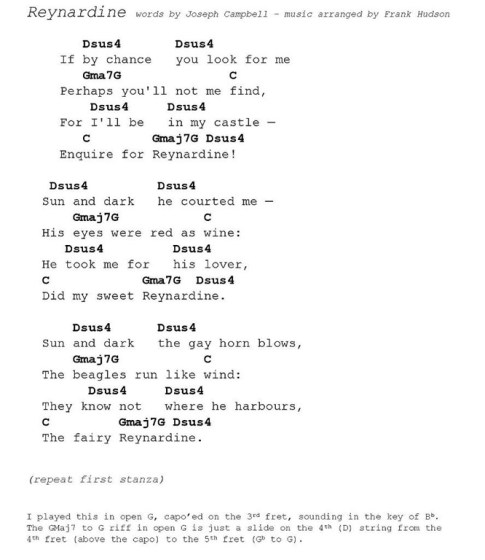
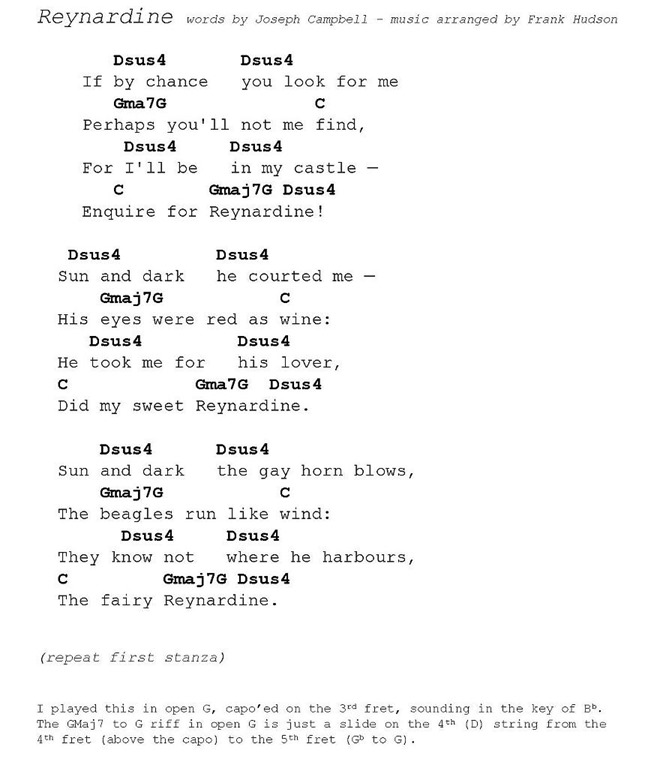
But here’s another mystery — and I’m saying, a useful one — why isn’t Campbell’s version of “Reynardine”  known and sung? Let’s look at it. The chords here are the ones I fingered, though I used Open G tuning and I formed the chords while capoing at the 3rd fret, so it sounds in the key of Bb. But the music “Reynardine” is sung to isn’t harmonically complicated (you could simplify the chords), and a better singer than I could better line out the attractive tune used by myself and most performers. ****

Reynardine Song

I made one change to Campbell’s masterfully compressed 1909 lyric. I use the more instantly recognizable, less antique word “lover” where Campbell had the easy to mishear “leman.”

.

Poets and lyricists: this is a marvel. No need of footnotes or spoken “this song is about…” intros. The supernatural element is subtly but clearly introduced. The refrained first stanza was as published by Hughes, and is commonly sung in modern versions. The second makes the bold move of changing a folk-song readymade where some damsel’s lips are found to be “red as wine” with an animalistic short-sharp-shock of Reynardine’s “eyes were red as wine.” The third stanza lets us know he can be a fox in form, subject to fox hunters with the brief but specific statements of the horn and hounds. Another subtle thing: Campbell repeats the “sun and dark” all-day-and-all-of-the-night lyrical motif to tell us this isn’t an ordinary fox hunt scheduled for seasonable days befitting rich people’s leisure, but a 24-hour emergency. The hunters know this fox isn’t normal. The refrained first verse reminds us that the lover may know that the were-fox can also take a human form, and make use of human defenses, such as castles, which the assiduous hunters do not.

As a page poem this has the vivid compression that Imagism preached. Compare the efficiency of this story-telling to “La Belle Dame sans Merci”  which has its sensuous pleasures, yes, but takes it’s time getting to the point. The two poems convey essentially the same tale, but Campbell can leave us with an equally mysterious effect using so few and aptly chosen words.

There’s a player below for some of you to hear my example of a performance of Joseph Campbell/ Seosamh MacCathmhaoil’s “Reynardine.”   Those who don’t see it can use this highlighted hyperlink instead.

Hopefully, I haven’t put any of you off with my own footnotes about this song’s unusual history and transformation. If you skipped to the end, here once more is my message today:

If you perform this sort of material, consider using Campbell’s lyrics instead of those you may have heard from other singers. They’re that good.”

.

*And more recently in a softly lovely version by Isobel Campbell, formerly of Belle and Sebastian.

**Obligatory statement: no, not the Power of Myth  guy. I suppose it could be worse, Campbell could have been named James Joyce or Sinead O’Connor, and confused us too.

***Besides “Reynardine,”  Vol. 1 includes another popular folk-revival song, erroneously considered to have wholly traditional lyrics: “She Moved Through the Fair”  which Hughes’ correctly credits lyrically to Irish poet Padraic Colum.

****I was somewhat working from a very rough memory of Bert Jansch’s version on his Rosemary Lane  LP. It’s a good thing I was rushing this and didn’t stop to listen to Jansch — his version is an acoustic guitar tour de force. If you’d like one performance to demonstrate why I, and many acoustic guitarists, revere his playing, that would be a good choice.

our Halloween Series starts with: The Good People

In the past month I’ve presented poetry by Robert Frost and Emily Dickinson, two of the most famous and best-loved American poets, and William Butler Yeats, the great Irish poet — but I also like to go beyond Poetry’s Greatest Hits and hunt for overlooked writers to combine with our original music. That’s how I found the work of Joseph Campbell who also wrote under the Gaelic version of his name as Seosamh MacCathmhaoil.

Ireland takes great pride in their poets, rightfully so, but Campbell seems to have slipped out of memory for the most part. I’m not yet sure why. Something about his personality? Political scores? The wealth of other poets to read? The lack of some widely acknowledged great poem that anthologies can’t ignore? It may just be that his limited level of fame and esteem in his most-active years before WWI didn’t reach a high enough point for his glide path to carry him into the 21st century.

When I found Campbell’s work, two things immediately attracted me: it’s lyrical and easily fits into the Parlando Project, and that he is likely the first Irish national to write in the Modernist short free-verse form that became known as Imagism. I don’t know how he came to write excellent examples in this style, but as the 20th century progressed that highly compressed and unpresupposing poetry was compartmentalized into a “you’ve proved your point” passing corrective to 19th century verse, and so Campbell’s fine examples in this style that were not widely anthologized and commented on when fresh carried little weight later.

But there’s another reason that his work fits with our “The Place Where Words and Music Meet” motto. Campbell seems to have collected and worked with traditional British Isles folk music. A few years back, author Greil Marcus came up with a fine phrase for America’s mashed-up folk musics and their contexts: “The Old Weird America” — but the British Isles traditions love ghosts, mysteries, and general strangeness too. In Campbell’s early 20th century books, right next to the free-verse Irish landscape Imagism, we may find poems that look a lot like folk song and which contain elements from traditional sources; but Campbell also shows a talent for vivid condensation (no 30 verse slowly iterating ballads for him) and luckily for our Halloween Series, he retains an emphasis on spooky and occult motifs.

So, let’s kick off a short Halloween series here with one of those poems which I’ve set to music: “The Good People.”

The Good People

What good’s a folk song if folks can’t sing and play it? Here are the accompaniment chords to my setting of “The Good People.”

.

The poem’s opening four lines set the scene, a mill path near a stream at night. Mist is rising off the mill stream, and it’s clear though dark. I was puzzled a bit by the black “lock,” but best as I can figure it may be a waterway-controlling lock. I don’t think it’s a spelling variant of the Scotch Gaelic “loch,” but it’s easy to think so just hearing it sung.

Ducks on a misty pond 1024

One misty morning early… Heidi Randen’s picture of autumn pond mist

.

In this quick-to-the mystery telling, the poem’s narrator lets us know there’s another group in this nighttime in the next quatrain. There’s a somber procession “along the grass.” I visualized small creatures, at least tall-grass short. One of them is apparently a queen of the creatures, and by now we should sense we’re in a fairy story. Two things, one obvious to any reader, and the other obscure to me until I read the poem are disclosed before this stanza ends: the queen is Aoibheall who is a prominent Irish supernatural creature. Besides noble prominence, she’s known for having a magic harp, and any human who hears this harp will soon die. Knowing that detail will set one up for the final two stanza’s concluding lines: the first of those lines we encounter tells us the little people are conveying a corpse.

This is not a victory march, the supernatural creatures are apparently The Good People in the title and they are sad and solemn. As the poem finishes, our narrator brings us to the final stanza-ending line, telling us that the corpse is possibly human.

Many, probably most, versions of traditional folk songs do not work like this, despite the rich folkloric flavor. Instead, British Isles folk songs often work like soap operas or podcast serials with a slow accretion of detail separated by many repeating refrains. At 12 lines and 72 words, Campbell’s lyric is very condensed.

To some who read or hear this, at least an air of strangeness should be conveyed efficiently. It’s also plausible, knowing the tales of Aoibheall and her harp, that a short sharp bolt of terror could occur to the narrator standing in this scene for us to imagine ourselves. The narrator surmises the corpse the fairies are bearing may be human. They (and now you) may know about Aiodheall’s harp. Did Aiodheall’s harp’s music kill the human they’re carrying? Will their dirge, already in progress, come to a harp part?

So, listen to today’s audio piece, if you dare. The player gadget will materialize below for some, but other ways to read this blog are under a powerful spell which forbids displaying it. Therefore, I’ve cast a highlighted hyperlink here to give you another chance to risk your life.

.

Winter ‘20-‘21 Parlando Project Top Ten, numbers 4-2

Today’s report on the most listened to and liked pieces featured here over the past quarter will show three experiences of the mystery of winter. So, let’s return to our countdown:

4 Twilight Fallen White and Cold  by Joseph Campbell.  I seem to have become something of a promotor of this little-known in the United States Irish-born poet who I still know little about. He published a series of poetry collections before the end of WWI, and then his poetic output dropped off, for reasons I’m not yet clear on, though the politics of his country’s decolonization struggle may have contributed. This piece using his words that a lot of you liked and listened to may be the most mysterious of today’s trio.

Best as I can figure it, this winter nature landscape poem may be an expression of his nation’s detracted state and situation, particularly in the invocation of ancient earthworks (raths) and burial mounds — but I cannot plumb the entirety of the refraining line of “wounds of Eliom/weep on me” that I feature in my setting of Campbell’s poem. Eliom is a plural word for gods, sometimes used for polytheistic gods, sometimes used for the singular monotheistic diety, and as it may be here, used for angels. If that’s so, then the starry constellations, the winged vampires, the curlew birds, the floating mists, the carrying sound of the ocean are all the Eliom, the angels in this changed winter nighttime vision.

To hear my setting of Campbell’s poem, you can use this highlighted hyperlink which may open a new window with a player, or in many cases, you’ll see a player gadget below to directly play it.

.

What the Story Tells Itself by Kenneth Patchen

It’s been too long since I’ve said this: thank you for coming to read or listen here.  It’s become harder for me to respond to comments or properly promote this project, but I appreciate so much those who come here, listen, and let others know what the Parlando Project does.

..


3 The Snow is Deep on the Ground  by Kenneth Patchen.  Lawrence Ferlinghetti, whose words we met earlier in this countdown, would sometimes remind folks that he wasn’t really part of the Beat Generation, even if he was associated with others who might have been so thought. Patchen is a similar case, or perhaps more so, in that his poetry career started in the 1930s,

As with many of the best Patchen poems, even the political ones, this is a love poem, delicately poised between the enchantment of love and the world that allows the shattering of it. If one can fully absorb the illumination of this poem, as with some of the best of Patchen, you would cry tears of joy and sadness at the same time.

You can hear my performance of Patchen’s “The Snow is Deep on the Ground”  with this highlighted hyperlink, or if you see it, with a player gadget below.

.

2 The Sky is low  by Emily Dickinson.  Some years back in this project I once compared Emily Dickinson to one of those unexploded, yet potential, bombs that are still unearthed in Britain or Europe from the World Wars. Originally she was found as the creator of curious little poems from an eccentric woman, then as a prescient 20th century Imagist, and now in our deconstructed age we can stare at one of her tiny poems, and like one trying to follow the decent of a single flake of snow in a flurry, fall as far as one can follow.

You can read, or listen to my performance, of “The Sky is low”  and find a whimsical nursery rhyme, and find enough enjoyment in that — but let it stick in your memory or repeated ear and a little dialog about predestination, first causes and fate is discernible. To listen, use this hyperlink, or you may see a player gadget to directly play it below.

.

One more post in the Top Ten countdown to go, and then we can move on from the mysteries of winter to the mysteries of spring.

Sail-Moon-Sheep

Here’s a piece celebrating our Spring springing forward that’s also appropriate for America’s celebration of Irish heritage on St. Patrick’s Day. It consists of three short poems by the Irish poet Joseph Campbell.* I put them together as I think they somehow increase their individual power presented that way. I call the combination “Sail-Moon-Sheep.”

Sail Moon Sheep art by Joseph Campbell

Campbell was also an artist. Here are his own illustrations for the three poems I used today: “Sail Answers Sail,” “The Moon,” and “Sheep.”

.

Campbell is one of the more fascinating discoveries I’ve made while doing this project. As far as I can tell he’s largely unknown in the United States, even though he spent some time here between the World Wars. And while it’s harder for me to assay his position in Irish arts and culture, he doesn’t seem to be highly esteemed and remembered there either.

What draws me to present him then? First, he seems to be an early Modernist poet, who writes in a mode those pioneers used — one that I think bares reconsidering today: short poems that present charged emotional states by physical description while eschewing both tired conventional metaphors or overly elaborate original imagery. A hundred years ago there was a name for this kind of writing. It was called Imagism. It rose as a force in opposition to established literary styles, flourished briefly attracting both writers we still celebrate and even some not-inconsiderable popular interest, and then was largely discarded for further evolutions of Modernism.

Campbell didn’t always write in this style, but he did so often enough for me to have work to present here. I’m not sure exactly where or when he picked up this mode of poetic expression. Today’s pieces are from a 1917 poetry collection of his called Earth of Cualann,  a year when Imagism would have been in more common currency as a poetic style, but he seems to have used it occasionally before 1910 when he might well have been independently inventing it — or he could have had some as yet undiscovered connection to the small pre-WWI Anglo-American group in London that would give the Imagist style a name.

Boat Moon Sheep in Chinese Ideograms

Chinese ideograms for sail (or rather, boat), moon, and sheep (though more at goat I gather). Some of Campbell’s poems seem to me to work very much like classical Chinese poetry too.

.

Secondly, he is like Yeats, intimately involved in the Irish cultural renaissance** that was an engine driving to Irish political independence. Indeed, in that second event he seems even more involved, perhaps to the detriment of his poetic career.***   My 20th century brought forward many anti-colonialist artists, but America has it’s own colonialism (both internal and external) and English language eloquence on these matters may be useful to us. Often when reading Campbell I think that aside from some simple translations of particulars I could be reading a poem by someone of American-Indigenous heritage and culture. Campbell’s connection to nature and his native landscape is deep and inescapable.

If one reads a book of Campbell’s poems, this repeated connection to the landscape and its history is so deep that it’s impossible to not think of it as an Imagist expression of a spiritual or religious feeling**** in the poems, even where that is not overtly mentioned. I know next-to-nothing of Campbell’s religious beliefs. Catholic Christianity is sometimes invoked, and at other times a Neo-Pagan-like stance seems to be displayed.

Well, it’s so like this project to say a whole lot about three very short poems from Campbell’s Earth of Cualann  that I present in the expectation that they hang together as a portrait of Spring, and then a Spring in a nation in need of renewal. It’s an Irish man’s depiction, and let us celebrate that too, but perhaps I’ve opened you to some further ways to consider that.

A player gadget should appear below to hear my performance of these three Campbell poems if you’re reading this in most full-fledged browsers — but some blog readers and reading views will not show the player. Then, this highlighted hyperlink will also allow you to hear the performance. I also normally provide a link for those of you that want to read the text along with or instead of the audio performance, but Campbell is so obscure that most of his poems are not available on the Internet so that I can link them. In place of that, here is a link to several book-length collections of Campbell’s work available at the invaluable Internet Archive. May Spring renew us all!

.

*As I must always say when mentioning his name — no, not that  Joseph Campbell — this is another man who also used a Gaelic name Seosamh MacCathmhaoil.

**It would not surprise me if the instigators of the Afro-American Harlem Renaissance featured here last month were not aware of the power of Irish elevation of Irish art, history, artists, and culture as a pre-requisite to self-determination as well as a significant argument for their value as citizens. And in other anti-colonialist cross-pollination: consider the mutual admiration of Rabindranath Tagore and William Butler Yeats, or Gandhi’s example to Martin Luther King.

***Imprisonment and exile, for two examples, were involved. Knowing a little now of some of the impassioned factions even among and between the Irish Nationalists, I fear finding out more of Campbell’s actual political beliefs, alliances, and possible revolutionary actions. It’s also plausible that it may have reduced his stature in Irish literature, as political opponents divided by violence often are unconcerned with merely literary merits.

****Remember, Imagism expects there to be few, if any, overt use of words naming emotions or reactions to what it is depicting. It expects — and when it works, it may even compel — the reader or listener to supply their own internal emotional reaction and impact from the poem’s description of a charged moment.