At the Threshold: marvels with French on sky-blue waters

We’re going to travel to one of the best short poems that late 19th century American poet Richard Hovey ever wrote, a strange poem about approaching death, a place far or near, with no trusty mileposts. As I like to do, we’re going in a round-about way. Let’s start with a blue lake.

I can remember what a wonder it was. My father and his youngest brother loved to fish on lakes, and in search of ever more pure sport-fishing beyond the sky-blue waters of northern Minnesota, they took to traveling up further into Ontario Canada. I was maybe 10 or 11, still at an age when I was open to whatever my parents led me toward. We stayed at a family-owned fishing lodge at the end of a gravel road outside of Reddit. A few small, well-kept cabins, a couple of outhouses, and a lake-dock — which was all the two brothers needed, as the day was mostly spent out fishing.

As I said, I was accepting of this. I gamely came along, earnestly operating a rod and reel, waiting, sensing for any piscatorial tugs on the line, listening to the two men occasionally talking about what fishing tactics were most promising. My youngest uncle, maybe 18 or 19, had been about my age when their father died, and my father now served as his younger brother’s father-figure. I was unaware then that more than lures and casting targets was in their talk.

I was never bored. I had a vast imagination when young, and could sit quietly daydreaming stories and ideas in my head for hours. I suspect a good poet would have been more observing of the boundless nature around me; and while I watched and listened to my dad and uncle some, they were too commonplace for me to treasure.

Instead, here is what I recall being fascinated by: I was in another country, Canada, subject to its laws, and a Queen, a governmental oddity that seemed a little out of time to me. A gallon wasn’t even the same gallon there, nor a dollar exactly a dollar! The lodge owning family and everyone we met in Canada spoke English of course, but since my imaginative and book-minded mind lived in words, I was amazed that all the groceries we picked up in Kenora on our way up had bilingual labels including French.

I was as if I had found the Rosetta stone all by myself. As a native Iowan, I already had a passing place-name experience with French from my state’s then 160 year past life as a French possession, but here in Canada a box of Wheaties or a carton of milk could be held inside other words. So, later in high school and in my truncated college studies, I selected French as my foreign language.

I was terrible at it as a school subject. I did OK (not outstanding) in basic vocabulary. I was passable in recalling the tenses and such. I accepted the arbitrary gendering of nouns. But my mouth stumbled entirely in the speaking of French, so obtusely bad at speaking it that I strongly suspect it is something in my neurological wiring. That I persisted with French as I entered college was at least in part because I was learning that French poetry had been so interactive with English language poetry, particularly in the formation of Modernism.*

After my formal education ended, I continued translating French poetry, not by any right of fluency, as I’ve confessed above, but because I wanted to bask in the secret sauce that helped form Modernism.

Richard Hovey seems to have been greatly enamored of what was modern French poetry to him. His published work includes translations of Verlaine, Maeterlinck, and Mallarmé. While going through his published work this summer I came upon this sonnet “Au Seuil,”  in French, dated as having been written in 1898. When I translated it, I found this graceful consideration of dying and some possible judgement and afterlife which I present to you in English today. As an old person, dying no longer requires any heroic situation, acute illness, or grandiose gothic stance to make such consideration apt for me. It’s a matter of petty logistics now.**

At the Threshold as published in French

The poem as published posthumously in a collection by the Vagabondia co-author titled “To the End of the Trail.”

At the Threshold

My translation, presented here as a chord sheet for the musical performance you can hear below. In performance I refrained the final line of the sonnet as shown here.

.

Was today’s poem written by an old man, or a young man staring down a deadly disease? No, Hovey was 34 years old, likely in vigorous health. Still, in less than two years he’d be dead, dying during a routine operation for something as unromantic as a varicocele. One can only wonder how he would have coped with the upcoming English poetic Modernism that would be sparked in part by French writers he admired.

Though subject to my language limitations, today’s poem to song turned out to be a relatively straightforward and faithful translation — with one exception. My usual poetry translation tactic is to primarily find the images in the poem and work at carrying them over vividly to English. I strive to have a non-creaky, natural syntax and word choice in the target language, and to make from that a poem in modern English word-music rather than trying to mimic the prosody of the poem’s native language. What was that one exception? In the poem’s 13th line, “ Qui nous benira de ses grands yeux bleus,” there’s an image I think.***  It could be that Hovey intends a witty little aside about a Nordic male god-in-heaven sitting on a throne of judgement, the cliché being then his point. As I worked on this line I wanted the possibility, however unexpected and wishful, of something universally marvelous. I dropped the andromorphic gendered pronoun as more than unnecessary, and then perhaps unconsciously recalling the poetry of the first-nations name for my current home-state of Minnesota, made the apprehending eyes more than humanly large.****

You can hear my musical performance of what is now an English language poem with the audio player gadget below. No player seen?  This highlighted link is the alternative, and it’ll open a new tab with its own audio player.

*Oddly it wasn’t Spanish poetry. In England we can assign this to not forgiving the Armada and all that — but large portions of the United States had been Spanish possessions after all. And while Canada’s French is spoken regionally, Spanish is the predominate language across our equally large southern border and in the American commonwealth of Puerto Rico.

**For example: when I replaced two bicycles stolen early this summer, ones I’d ridden for 20 and 40 years, I wondered at the return-on-investment of spending like-amounts in current market prices to replace them. My favorite old-person’s joke is that when someone offers me a lifetime guarantee, I ask if there’s a better offer.

***Literal: “Who will bless us with his big blue eyes.”

****Lakota compound word for the place of sky-reflecting-waters. And there I have returned to that boat with my father and his youngest brother, as Hovey wrote in a different language: “we know this hidden way/as one knows the ghost of a dead friend.”

The Things We Thought (That We Should Do)

We mentioned Emily Dickinson in our last post, and it’s time to return to this essential American poet during this National Poetry Month. I saw this charming poem of hers earlier this week and thought I might be able to do something with it.

Over the years here I’ve delved into some of the more cryptic Dickinson poems, but her poem beginning “The things we thought that we should do” is reasonably clear on first reading, at least until you get to the end. Here’s a link to the poem’s text if you’d like to read along. This three-stanza poem uses exactly one rhyme, which helps its flow stick together, appropriate for a poem about how our lives sometimes seem to take us down one track that we never get around to changing. Our inability to shape our lives to what we think we should do is the first stanza’s statement. The second puts the untaken should-path and compares it to travel, or rather not traveling. Dickinson was often portrayed as homebound — though an examination of her life says she traveled more than many women of her time — but I think this is more metaphor than memoir. This stanza ends with the idea that one may then pass on the untaken task of some travel to a “son.” This may be legal language sneaking into Dickinson again,* but I also wonder if she’s punning on “sun,” since she has elsewhere used the day as a miniature measure of a lifetime. If so, she’s saying we think we’ll do these should-things tomorrow, or in the sense of generations following us, in another lifetime.

Poetry vs Law 800

Poetry? Law? Poetry? Law? Screw it! I’m going to go outside and putter in my garden.

.

The last stanza is the response, the turn, the summing up. It starts out: If we haven’t been disciplined enough to do our shoulds, we likely won’t get our restful reward in heaven. And then the last line “But possibly the one —” Ah, the Dickinson dash, that little transition — but wait, there’s no more text. It ends on the dash!

This is ambiguous, and her syntax is jumbled. Did she not complete the poem, is this an unfinished draft? Or did she want the thoughtful reader to come up with the resolution that’s not stated, but derivable from the situation: that there’s a heaven even for those not doing all the shoulds, all the time? When she writes “possibly the one” is she saying that there’s only possibly  one heaven, but she’s not certain — or even, that the heaven one finds outside the shoulds is plausibly the one?

I was able to bring together the music and performance for this one quickly, which was necessary since I’ve spent the past two days taking care of a computer failure over on my spouse’s desk. But I should — no, it’s not a should, it’s a desire — get another piece posted this April. So, acoustic guitar, piano, standup bass, and just a taste of celesta were called into play to realize the music that unusually is made up of mostly major 7th chords. You can hear it with the graphical player gadget below, or if that’s not there, with this backup, a highlighted link that will open a new tab with an audio player.

.

*I’m increasingly noticing that Emily Dickinson, growing up in a multigenerational family of lawyers, seems to have picked up a fair amount of legalese. As a woman in her time, she couldn’t take up the family trade, but her mind enjoys playing around with the concepts such as ceding a should obligation to another as if in a treaty or a property transfer.

When reading this poem, I also think of psychiatrist Karen Horney’s “Tyranny of the Shoulds” — and in this manuscript version linked here, it looks like Dickinson had considered “tyranny” in place of the version we have with “discipline.”

They’re Not the Grateful Dead

Is it time to take a break from our sometimes intense presentations of poetry combined in some way with music? Well, here’s a little ditty about the lighter side of death, or rather the worship of dead rock stars.

My observation is that though there are still the occasional premature music casualties in the current environment, that the worship of “The Greats are Taken from Us Too Soon” variety is reduced among young people today. Perhaps that’s a healthy sign, or it could be secondary to the casualties not having the right mix of fame to burn brighter at the graveside. And in the past, the other half of this project’s concern, poetry, has not been immune to the praise of dead talent, particularly dead, young talent, either.

Sure, it can be a honorable thing to give respect to those who’ve gone, to carry their artistic flag further when they can’t, but there is another side, the romantic admiration for the risks and the access to excess that often precedes the early death of musicians, writers, and other artists. The first duty of an artist is to survive. Society is not generally on the artist’s side until they become successful commercially, and even when it grants them that success, it can withdraw it and their support quickly too. To add to that burden with one’s own self-medication and distractions seems like a compensation to that state, but it doesn’t always work that way.

Poet, songwriter, alternate voice, and frequent keyboard player here Dave Moore wrote a short poem about how an older person might view with a strange kind of envy the tentative fame and unbounded experiences that others in our musical/generational cohort enjoyed. Sex, drugs and Rock’n’Roll once seemed to be jobs on offer in the want ads in our youth, even if it turned out the positions were already filled and the items already sold. I adapted Dave’s words, added a verse of my own, and wrote music for my performance of “They’re Not the Grateful Dead”  some years back and thought you might enjoy it here. Oh, that “Grateful Dead” in the title? Translated folkie Jerry Garcia knew that this was a trad folk song trope where the dead magically and musically express some gratitude.

They're Not the Grateful Dead

Who’s who for any crate digger obsessives: Hopkins, Hendrix, Moon, Jaco, Saxon, and Thaxton are hereby linked.

.

One thing I like about Dave’s lyric is that, outside of Jimi Hendrix he doesn’t pull in the big names, the Boomer rock’n’roll Shelleys and Byrons, the ones that are still featured faces in the rear-view mirrors looking at the music and times. Starting right off with Nicky Hopkins* is a bold move, but then Dave is  a keyboard player.

The song’s conclusion has a little fun with the sentimental “If there’s a rock’n’roll heaven, you know they’ve got a hell of a band” thing. Keats’ unheard music may be sweet, but it’s still hard to hear.

My performance of this has a few flubs, but it’s hard for me to get more recording in right now, so we’ll make do with this older recording as is. The player gadget is below for many of you, but if you don’t see it, this highlighted hyperlink will also play my performance of “They’re Not the Grateful Dead.”

.


*Huh. Who? Those who didn’t ruin their eyesight fantasizing about debauched after-parties but by reading all the liner notes on every LP will know who Nicky Hopkins is.

Not for that City

Let me introduce newcomers to one of this project’s “finds,” the little-known early 20th century English poet Charlotte Mew. Of course, I didn’t really find her, some of her English contemporaries did, and they waged an unsuccessful campaign to bring her work to greater attention. Among those who thought she deserved more attention: Thomas Hardy, Virginia Woolf, Siegfried Sassoon, Walter de la Mare, John Masefield, and even Ezra Pound.

Her poetry touches on some different styles, but what unites it is a skeptical and iconoclastic attitude. She herself seems to have been something of a sui generis outsider, and her poetry reflects that, frequently focusing attention on outsider characters, and her poetry often makes unusual arguments or turns—and I suspect that’s the reason her poetry didn’t catch on. Even her era’s rebels like T. S. Eliot had a ready hook to grab attention: the trauma of WWI and the rise of a modern heterogeneous urban society and industrial economy were enough of a shock to the system that even the most high-brow and arcane poetic examinations had some access to the reading public’s attention. Particularly in America, there were a number of women poets who examined love and relationships* in sophisticated ways that were widely seen then as access to that mysterious creature of the era: “The New Woman.”

Mew didn’t really do the former much, and her take on love didn’t seem to always align with expectations, for she was noticeably androgynous as a person and as a poet.

So, what does today’s piece, Mew’s “Not for that City”  deal with instead? Glorious Heaven, and in language and imagery that would make for an ornate hymn about the rewards of same. Except it’s not saying that’s what some “we” really want.

The poem instead says that what “we” want is rest, not a surfeit of glory and splendor.

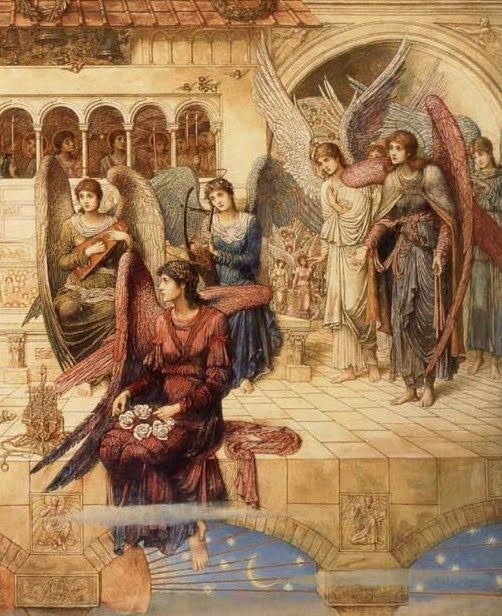
J M Studwich Angels
Yes it’s nice and all, but I could use some alone time.


Who’s the “we?” I’m not completely sure. Mew lived a somewhat weary life with long-running caretaker roles. Is she speaking of the poor and working classes, though she never names them as the “we” as such? Is this simply the testament of a religious skeptic? I can’t say for sure, but it works even if this isn’t determined.

I struggled long on the musical setting of this, completing two different sets of music, and then after choosing the music finally used, trying mightily to realize a full voiced, almost operatic singing line. That failed miserably, I just don’t have the voice or access to anyone else who does. The version you’ll hear with the player below is left with a track of my shabby talk-singing which is simply the best I can do to present this. I still think it’s worth hearing, and you can with the player gadget below. Full text for those who’d like to read along is here.


*We’ve presented some of them here: Edna St. Vincent Millay, Sara Teasdale, Margaret Widdemer, Mina Loy and Elinor Wylie. Being seen as “love poets” probably helped them with general audiences that still existed in the early 20th century for poetry, but then caused them to fall off the literary map later in the century which increasingly admired and required either political and philosophical advocacy, or a devotion to “serious and universal topics”—which for some reason did not include women’s observations of sexual and romantic politics.

The Apotheosis of Harlan Ellison

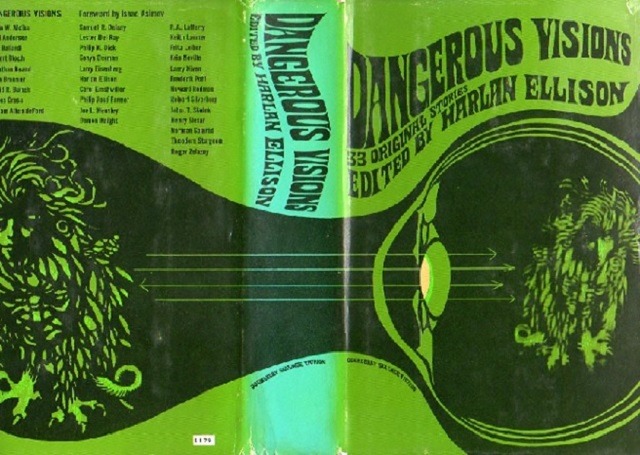
I’m not a fully-qualified Science/Speculative Fiction fan, though I did read it when I ran into it as a young man. Dave Moore, whose voice, songs and keyboard playing you’ll hear from time to time here, read more of it. I’m not sure if Dave introduced me to Harlan Ellison’s work, but my memory is that he did loan me a copy of Dangerous Visions  back in the Sixties. In that 1967 anthology, Ellison made the case that SF was the heir to a Modernist tradition of fiction using outrageous and unique situations—he was claiming SF could be more Kafka than L. Sprague de Camp.

It’s unlikely he was the only person thinking along those lines, but he certainly helped to popularize the idea at a time when an aging generation of SF writers, steeped in pulp magazines and cents-per-word paychecks were in danger of losing touch with the younger post-WWII generation who were more likely to be college educated and experienced in some chemically enhanced inner-space traveling.

Dangerous Visions cover

Used copies may have slight foxing (or are they cannabis stains?)


Ellison was an any-world-class curmudgeon. His non-fiction writing is full of enthusiasms and invective, with almost no middle ground. At times he reminds me of another late 20th Century artist/social critic: Frank Zappa. Both of them liked to remark that “The two most common elements in the universe are hydrogen and stupidity.” Over the course of his career Ellison seemed to transform from a US-born angry young man punching mostly up to a more generalized misanthropy, where at appearances he would sometimes riff like an insult comic. He once called my late wife who he had just met at an event, “Cathy Carbohydrate.”

These two things worked together. SF had always had a darker side, and the border between it and the gothic strain of fantasy or noir-ish mystery was crossed back and forth often. I believe a utopian, Transcendentalist wing of SF remains, but the terms SF and dystopia now seem to follow one another almost automatically.

Is this the artists’ fault or ours? A large question that.

Thursday night I read that Harlan Ellison had died. Friday I was booked to record with Dave. Friday morning, as I slept, I dreamed that Dave was showing me a binder full of typed manuscripts of stories he had written. As he flipped the pages I read parts of the stories. In style, they were the sort of thing a teenager just starting out would have written, so in the dream’s timeline they would have been written in the Sixties. In the dream, Dave, after learning of Ellison’s death, was telling me that Harlan Ellison had looked over these stories, and that Ellison didn’t like them very much, though he thought the last one had some promise. There was a short, encouraging note from Ellison scrawled in the margin on a page in the story. As I glanced up toward the middle of the page, I saw some dialog in which a character in the story was saying something. The character in this non-existent dream-story was named Octavia Butler.

Now I remind you: this is a dream. Dave never had Ellison critique any early stories he wrote. In the dream, these stories existed, in the waking world they don’t. But here’s the funny thing. I told you at the start that I’m not a fully-qualified SF fan. If you had mentioned Octavia Butler to me on Friday, the only impression I would have was that she was a writer. I wouldn’t have been able to name any of her work or have been able to place her in a genre. In the dream, I just thought it odd that Dave was using a writer’s name as a character in a story that the dream had had him writing 50 years ago. I was about to ask him why, when I woke up.

octavia-butler

Octavia Butler, before or after she was in my dream


I biked off for breakfast and hurriedly came back to write the piece you can listen to below.  Looking for info I might use in my song, I searched on Octavia Butler. In the Sixties, Butler was a young, unsure author, fearing that she was too “ugly and stupid, clumsy, and socially hopeless.” While she was still in school, Harlan Ellison, this man with a reputation as a scouring critic, had told her she had promise and should go to the Clarion Conference and present her work there, a suggestion that lead to her first publication in 1971.

Nothing there I could use in the song as it turns out, but strangely this was also nothing I knew when I had dreamed that dream early in the morning. I did use one bit I found in my searching: an interview with my former co-worker John Rabe that revealed that Ellison was still using a typewriter as his writing machine in the 21st Century. I thought of those older generation pulp writers and their per-word paychecks.

That afternoon, Dave and I recorded “The Apotheosis of Harlan Ellison.”  It turned out that in the waking world, Dave had not heard yet that Ellison had died. The player gadget below will let you hear it—though not on your typewriter.