Tomorrow is Christmas, a holiday that in the English-speaking world owes a lot to the English Victorians in conception, which gives me an excuse to present once again the words of the Victorian poet Christina Rossetti, this time in the guise of her popular and explicitly Christian-religious Christmas song “In the Bleak Midwinter.”
“You could have brought a casserole.” Victorian painter Edward Burne-Jones’ nativity.
Is it just me, or is Mary looking a little non-plussed by all the visitors?
The song used for Rossetti’s words seems to be attributed to Gustav Holst, a composer who is best known to me for his orchestral suite “The Planets,” which has been admired or borrowed from by both Frank Zappa and King Crimson. In my rush to complete this today I can’t say that I’ve done as much justice to his tune, though I used a rough approximation of it.
The tune is quite pretty, and it makes it a fine solo for any good singer, which therefore makes it a challenge for me, so I’ve resorted to my usual parlando. On the other hand, a great many versions of this song in hymn books and elsewhere seem to have modified Christina Rossetti’s words, changing terms and phrases, even dropping some stanzas, where I’ve been faithful to them. I don’t have my usual time today to research why this would be. The meter of her original text is slightly irregular, and so it may have been modified for better singability or for audience reasons.
Botticelli’s “Mystic Nativity.” Painted before the career of Raphael
So literally, a first-order “Pre-Raphaelite”
Rossetti’s approach makes use of her characteristic modesty in approaching religious subjects, with some lovely lines in the first verse picturing our northern Midwinter, and then going on to describe the stable setting, and the supernatural surrounding sentimental maternity and spiritual imminence.
Musically, I tried to compensate for my speaking the words by unleashing my bass playing. Like some gifts you may get this Christmas, it may not be the right size or color—but it was given in a good spirit at least.
One joy of this project’s exploration has been coming upon poets I know nothing about and acquiring their words in my bloodless version of that conqueror on the “peak in Darien.” Writing about Frost, Pound, HD and Eliot in England early in the 20th Century lead me to T. E. Hulme, an Englishman of pugnacious artistic pronouncements and surprisingly modest and moving poetry. And T. E. Hulme led me to F. S. Flint, another British writer and literary theorist in this circle in the years just before WWI.
Last month I introduced readers here to Flint’s amazing rise from Victorian poverty. In the interim I’ve been reading more of his work, including his 1920 collection of poems (he called them “cadences”) titled “Otherworld.” Since Flint is not commonly studied or anthologized, each poem as I encountered in the collection was a fresh experience, no different than reading a new poet’s chapbook published this year. I could start a poem of his in “Otherworld” about a confused midnight awakening, and come to find it’s a first-hand account of a deadly London air-raid by a German Zeppelin.
Today’s piece, in the same collection, held another surprise. It tells you it’s a Love Song, but contradicts that before the end of the title. What it is instead is an unstinting examination of the corrosion class and gender inflict on the grail of love. The singer of this song lays bare a combination of disgust at how he’s judged as a poor man, with an undisguised desire to own the things he does not have, including this other human being, the woman of the title.
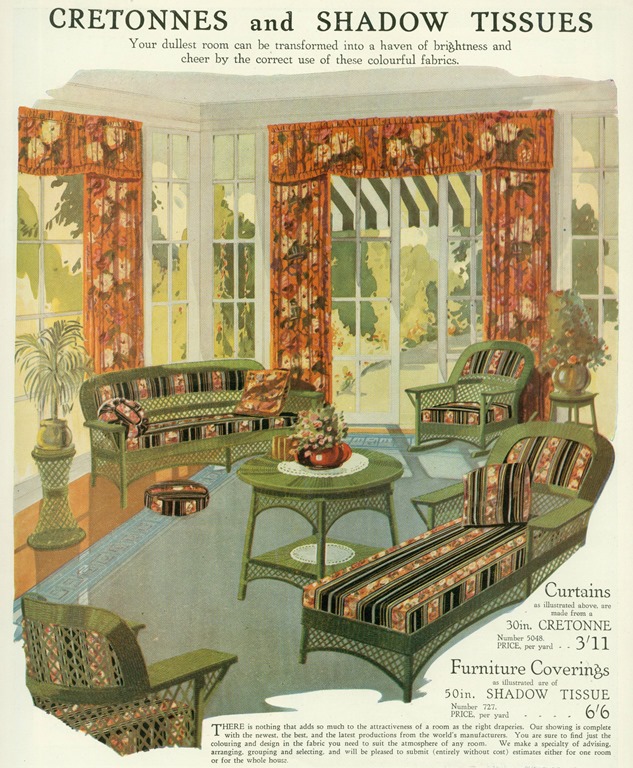
“Bright-coloured cretonnes…” What is the erotic despair of draperies and upholstery?
I can think of dozens of popular songs that deal in some variation of this, but it’s harder to come up with 100-year-old poems, much less ones as good as this one, that talk of this. Ignore a handful of references to the interior decorating trends of Flint’s time, and this poem could have been written yesterday, except few writers of any time would be as acute as Flint is in observing this.
What new poets of the Modernist movement do I get to discover and share with you in the upcoming year? I can’t be sure, but I noted that Flint’s “Otherworld” is dedicated to Herbert Read, and from what few poems of his I can find online, Read seems just as fresh and fascinating.
But let’s not get ahead of ourselves. Musically I’ve been telling myself I want to utilize some of the methods of hip-hop records, and yet each time I set out to do this, I get side-tracked by my own idiosyncratic musical muse. The melodic top line is my appreciation of early 1960s hard-bop organ playing. The bass part is a combination of a left-hand organ part with electric bass. Two bass lines shouldn’t work, but I think it does here. That’s not the only duality in this: the drum machine beat is augmented by some percussion which keeps the drum machine from ruling the groove “correctly.” The hip-hop rhythm flow eludes me again, though maybe I recall some predecessors like Dr. John the Night Tripper?
To hear my performance of F. S. Flint’s “Love Song to a Woman I Do Not Love,” use the player below.
For reasons of copyrights, I’ve been focusing a fair amount here on using words from the most recent poems whose rights are in the public domain (pre-1924). One side-effect of that: during the run of this project we’ve presented a good number of poems about World War I, which I recently called “The last war covered by poets.”
So, we’ve had a poem from a man waiting to enter his battle: Rupert Brooke writing on the troopship carrying him overseas; and poems written from first-hand views in the trenches by Siegfried Sassoon, Wilfred Owen, and T. E. Hulme. We’ve had reactions to the war and its losses from Ezra Pound, Tristan Tzara and Carl Sandburg. William Butler Yeats, even in refusal, is writing a war poem of a sort, one I suspect has a hidden barb at the politicians’ war propaganda.
For the most part, the poems I’ve used so far would not pass as journalism. Owen and Sassoon use fantasy to illustrate the war’s folly. Pound, Tzara, and Sandburg tell of the subjective emotional impact of the war’s losses. But Brooke’s fragment has the power of a closely observed diary entry, and T. E. Hulme comes closest so far to a straightforward war dispatch with his compressed account of the front at St. Eloi.
Today’s piece, using words by F. S. Flint, comes closer yet. Flint, the man who urged the “School of Images” in pre-war London to hew to a cadenced free verse, felt that verse and prose existed on a smooth and unbroken continuum, that good writing was good writing, regardless of the label on the tin.
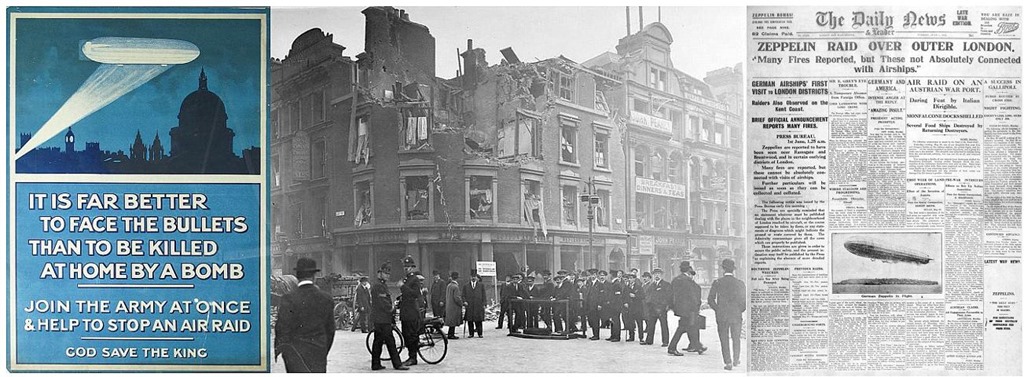
Besides being present at the birth of Modernist English poetry, Flint also was in the right place to witness another Modernist invention: aerial bombardment of cities. It’s little remembered now, but nighttime terror bombing of London was not an invention of Hitler’s air force in WWII—it was, instead, first carried out by Zeppelin airships in World War I.
Flint’s report, though artfully framed with its first-person account of being awakened from sleep in medias res, and ending with a surprising and telling conclusion, includes enough exact detail to say that it describes the first of these London raids on May 31st, 1915.
1915 reactions to the London Zeppelin raids of World War I
It’s a gripping account, no less than if it had been filed this year in Syria or somewhere else were bombs fall on civilians in our time. If you’d like to read “Zeppelins” on the page, here’s a link.
Does the element in Flint’s work of mere journalism detract from its “poetic” qualities? The romantic element would say yes perhaps, there is no other “realer, now revealed” world invoked, no intense yoking of disparate images or modes of perception (although I would maintain it does just that in a subtler way). More elaborate language, more elaborate metaphors could decorate this. Picasso’s “Guernica” is the same subject, painted decades later, but it’s also more worked out as a cubist statement.
In a sense this question is like a question I wrestle with here as I contemplate the Parlando Project which combines music with words. Does the addition of a substantial thing to something else: in the case of Flint’s “Zeppelins,” documentary, journalistic facts to modernist poetic imagism; or in the case of my Parlando Project pieces, music and performance’s addition to what is often canonical page-poetry—are those things additive, making a greater sum—or do they, paradoxically, detract, diffusing or de-fusing the impact of the uncombined thing.
Or are these questions of art a sideline here? Do Henry and Caroline Good, dead of flames and smoke in their bedroom in that night in 1915, or Leah Lehrman, age 16 killed by a Zeppelin-dropped bomb explosion care? Do we appreciate that we live now and ponder these questions?
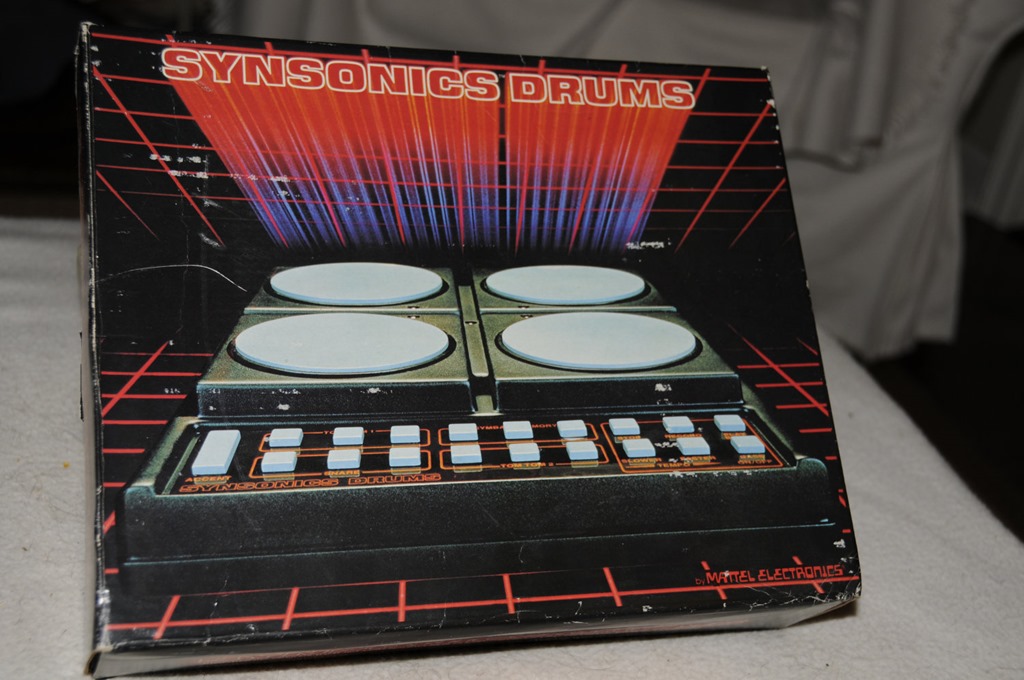
Later that same 20th century, my first drum machine.
In writing and performing the music for Flint’s “Zeppelins,” I wanted to lean toward Techno a bit. I avoid drum machines these days and work hard to humanize my beats on most pieces. Back in the 20th Century I used machine beats, they were all I could afford, and now in the 21st, no matter how skillfully deployed, they remind me of those crudely resolved sounds, a make-do. My 12 year old son however enjoys them, the blippiest tracker pieces or a SID chip 8-bit beats please him with their antique charm. Then listening to Weekes new single this weekend reminded me of that charm (and made me wish I could sing better). So I gave it a go.
You hear my performance of F. S. Flint’s “Zeppelins” right here with the embedded player below. If you can’t see the player gadget, this highlight hyperlink will also play the performance. Something about those later 20th Century sounds just seemed right for an early 20th Century piece to me.
Today’s piece is our first proper piece by English poet Thomas Hardy. In America Hardy may be better known as a novelist, though he considered himself a poet first and last. When Hardy began writing poetry in the 19th Century, William Wordsworth was but a decade dead, and at the end of his career in 1928, T. S. Eliot’s “The Wasteland” was several years old. So, Hardy’s career starts at the tail-end of the English Romantic revolution, and proceeds through the Modernist Explosion of the early 20th Century.
In some particularities of locales and events, Hardy’s poetry can seem of the 19th Century; but his language, direct, colloquial, and unfusty, seems as modern as the 20th Century modernists. Indeed, modernists from Robert Frost to Phillip Larkin found much to admire in Hardy. Setting many of his poems in the rural areas of western England diffuses the placement of some Hardy poems on a timeline, as the more rapid pace of cosmopolitan change does not mark them as sharply.
“Strap yourself to a tree with roots”
Gravestones moved by Thomas Hardy when progress impinged on a country graveyard.
Today’s Thomas Hardy piece is “The Self-Unseeing,” published in 1901, right in the turning of those centuries that Hardy spans. This is another poem brought to my attention by the Interesting Literature blog, and I cannot improve on the excellent analysis of the poem there.
In “The Self-Unseeing” there’s a visit, in a mix of memory and reality, to a long-ago childhood house, a mental voyage many of us can do, assuming we can ride out the emotional waves. Given the fires, floods, earthquakes and winds of the past couple of months across our continent, some will be being taking this visit now wholly in memory.
Bury my heart in Stinsford.
So, that’s it for analysis of the poem this time, but we’ll offer some music to go along with it: strummed acoustic guitars and bass, and a vocal that’s a bit more to the “sing” side of our usual talk-singing. To hear it, use the player that should appear below. If you like the variety of what we’re doing here, combining various words with various music, please help us by sharing links to here, hitting the like button, or otherwise letting folks know. Thanks!
It’s been too long since we featured one of the looser live performances of the LYL Band here at the Parlando Project, and with the interval, it’s also been too long since alternate voice Dave Moore has been featured. Given that we’re running up to Halloween, and that Dave has a long-standing interest in fantasy and scifi, it’s time to redress that.
Today’s piece is Dave’s adaptation of a short story by Anglo-Irish writer Lord Dunsay from Dunsay’s fantasy collection “The Book of Wonder”. The story is called “The Return of the Exiles.”
Yes, it’s Avebury, not Stonehenge. Poetic license applied for.
Lord Dunsay is one of those writers who had a long successful career during the first half of the 20th Century, but who now gets mentioned more as an inspiration than read as a writer. His Wikipedia entry has one of the longest lists of writers who’ve acknowledged him as an influence that I’ve run across. Everyone from Tolkien to Gaiman has tipped their hat to Dunsay.
Dunsay served in both World Wars and the Boer War.
Besides writing, Dunsay appears to have served in three wars. One hopes that future soldier-writers will be able to avoid reaching that achievement.
Dave adapted the short story to make it more musical, but his telling is generally faithful to the original. One detail retained, that I personally liked, is that our narrator is on a bicycle journey as the story begins.
To hear “The Return of the Exiles” use the player that should appear below.
In 1899, as the 19th Century was leaving in Victorian London, a 13-year-old boy from a large poor family left school and went to work at whatever jobs that could be found. An unremarkable story.
After several years, and some job security as a civil service typist, he could enroll at a workingman’s night school. This story too, unremarkable.
Men and women with stories like this often go on to form families, start small businesses; or slip into slightly better jobs, finding what opportunities are left unguarded or unattended by those who started further up the economic ladder (or wall). Working diligently, they sometimes become the mothers and grandfathers of poets and scholars, preachers and social reformers. That’s not the way this story goes however.
This teenager moved quick, and found out he had a talent for language, not only his own native English, but German, Spanish, Russian, Dutch, and French too—they all came under his control. He accelerated himself beyond the speed of night school, and in a matter of a couple of years, our young man became a poet and a leading proponent in his time for avant-garde French poetry. And then he began meeting with some other poets in the cafes of London.
This man was F. S. Flint. It would be easy to pair him with one of those artists he was making talk and friendship with: T. E. Hulme. Neither had privileged backgrounds, and both are too little known, read, and studied today. In 1909, ten years after this boy had left school at 13, the meetings in these cafes included not only Flint and Hulme, but Ezra Pound, H. D., Florence Farr, William Butler Yeats, and Robert Frost. What they were plotting was a poetic revolution—one that would succeed, and become the dominant strain of English poetry for the rest of their century.
Although all of them had avowed influences, often ancient ones—English and Celtic bards and Latin, classical Chinese and Greek poets—they were resolved to “make it new” in Pound’s famous motto. They all wanted to change the language and the sound of English poetry, and since words and music are what make up poetry, they wanted to change everything about it.
In terms of language, the thoughts centered around removing decades, even centuries, of encrusted dead metaphors that no longer had any meaning. The imagery in the new poems would need to be fresh, different, vital and intrinsic to the poem, not mere decoration. Extensive, romantic effusions of feelings would be replaced with palpable images.
The “School of Images” was coalescing. By some accounts it was Flint who suggested tacking the suffix“-ist”, (in French “-iste”) to “image” to brand the movement.
In terms of poetry’s music, there was less agreement. Yeats and Farr were trying to invent a new kind of chanted poetry to music. Frost and Yeats would write some of the most accomplished metrical poetry ever written in English, but with a naturalness that made it disappear into unfussy verbal music. Pound remained interested in combining music as in the days of the medieval troubadours. Hulme talked of “chords” harmonically struck in the mind when an image was right. Flint, along with Hulme, thought French vers libre, “free verse” without rhyme and strict meter, was the mode to use. Flint called his verbal music “unrhymed cadences.”
And that’s where today’s piece comes in. In these three loosely-linked and lovely London-based poems, Flint demonstrates what he means, and this sort of breath-based line has echoed in much English poetry since.
The three poems or sections that make up Flint’s “Poems in Unrhymed Cadence” seem connected to me, though the middle (swan) section had been published previously in a much more verbose version a few years before. I’ve only been a London visitor—Flint grew up there—but I personally associated the scenes throughout with Hyde Park/Kensington Gardens, with the silver birch trees, swans, lilies, and other flowers mentioned. However, the third section specifically mentions aspen trees, which I don’t believe are in Hyde Park or Kensington Gardens.
Hyde Park and Kensington Gardens in London—swans didn’t pose for me, no aspen trees in sight.
Following the three Imagist rules (which were first written down by Flint), the images are direct and exactly presented, the words are spare and free of unnecessary elaboration, and the “To compose in the sequence of the musical phrase” rule is something of a restatement of Flint’s “cadence.” Like most imagist poems—and even though these poems unmistakably reflect a mood—there is less spelling out of emotions by their abstract names that would have been customary before. It’s only at the end of the second (swan) section that the first of these, “sorrow,” is spoken, and when the third, final section unleashes “afraid,” “anguish” and “pain,” the images have set this emotional summary in a real physical, sensory place first.
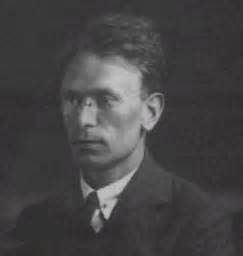
The only picture I can find of F. S. Flint
Musically, once again I don’t know what to call the music I wrote and performed for F. S. Flint’s set of poems. There are several orchestral parts and percussion, but the lead instrument that eventually emerges is a sitar. Since in the 21st Century chicken tikka masala can be said to be the British National dish, my limited skills on this instrument of virtuosos can be forgiven.
As I promised last month, there’s going to be a few more posts here without new audio pieces, discussing some side issues and ideas I’ve run into during the last year or so of the Parlando Project. Some of these are going to be lengthier, and they may not be as interesting to those who come here just hear surprising combinations of music and words. I’m using the tag “About” on this sort of post, so that you can easily filter the audio containing posts (Podcasts) from these.
Today’s post is about what I found as I looked at Tristan Tzara’s poem “Vegetable Swallow.”
Why was I looking at Tzara poetry? I have a long-standing interest in the Surrealists, a movement that followed Dada, and with whom Tzara sometimes made common cause. And my first translation of Tzara for use in an audio piece, his elegy to proto-Surrealist Apollinaire, was unexpectedly popular here, the third most listened-to piece of last summer. So, time to look into some more Tzara I thought.
I own books that I could have searched, but they are poorly stored and arranged, and so I relied on our modern vade mecum, The Internet, to see what else might be out there to compose music with. A familiar search engine found 122,000 results for Tzara poems, but of course all is relative. One of my favorite French Surrealist poets, Paul Éluard, still obscure to many English speakers, had 222,000 results, and Carl Sandburg turned up 448,000. Emily Dickinson? 23,000,000! So Tzara’s poetry is not as widely available as some. I did not look at all 122,000 results, but of the poems I found translated into English, a handful seemed to repeat, and looking through them, I eventually thought one titled “Vegetable Swallow” had the most potential for use along with music. Here is how it appeared on several web sites, in an unattributed English translation.
two smiles meet towards
the child-wheel of my zeal
the bloody baggage of creatures
made flesh in physical legends-lives
the nimble stags storms cloud over
rain falls under the scissors of
the dark hairdresser-furiously
swimming under the clashing arpeggios
in the machine’s sap grass
grows around with sharp eyes
here the share of our caresses
dead and departed with the waves
gives itself up to the judgment of time
parted by the meridian of hairs
non strikes in our hands
the spices of human pleasures
Why did I select “Vegetable Swallow?” It was a good, short length. It seemed to have some musical qualities. I liked how it concluded. Some of it was incomprehensible at first take—but it’s Dada isn’t it. This is, after all, a poet who taunted the art-world with the idea that randomly arranged words could be compared to the value of recognized literary art.
I found I had preferred my own translation of Tzara’s “The Death of Apollinaire,” and so I aimed to do my own translation of “Vegetable Swallow” too.
As I started work on “Vegetable Swallow,” I first had to find it in the original French. After some searching, I found an edition of Tzara’s “Poésies Complètes” to work from. Right from the top, at the title, I started to dissent from the English translation used elsewhere. Perhaps you read “Vegetable Swallow” as Dada: two unrelated words jammed together for the effect of absurdity, but one could also read it in English as a compression of the phrase “Eat your vegetables,” which can be a parent’s command, or a commonplace for feeling obligated to do the unpleasant but necessary thing. But in French, swallow as a verb is not the same word as swallow the bird. Tzara used: “Hirondelle,” and as Minnesota’s own Dada bards The Trashmen once proclaimed: “The Bird is the Word.” I would have chosen “Vegetable Martin” or “Vegetable Bird” as the title, because I clearly think I’m conveying Tzara’s presentation more accurately there—even though, in this case, I’m making the title more hermetic.
The next major puzzle I have is with the second line “l’enfant—une roue de ma ferveur.” In the online text the em dash has changed to a hypen, and we are pressed to visualize a compound noun “child-wheel,” rather than to break the thought after child/l’enfant. I made a more speculative translation of roue/wheel, when I saw that the same French word is used for the gymnastic “cartwheel”. Cartwheel is a very specific, vivid image. It’s also an inside joke relating to the story that Paul Éluard met his wife when she literally cartwheeled down the street. It does the job of making a hyphenated “child-wheel” comprehensible, even if child-wheel’s presence in the Internet version may be a typographical misunderstanding.
In summary, the first stanza is two lovers together, embracing (or at least realizing/admitting) their carnal physicality.
The second stanza to me describes a rain storm above our two lovers. I can’t tell if stags are the storm clouds, or creatures caught in the storm. I chose caught in the storm. Next up I probably make my own mistake, which I’m catching only now. I translated “coiffeur” as simply hair because one of my computer translators had it as hair and I didn’t double-check that, when it now looks like “barber” or “hairdresser,” as in the Internet version, is more likely correct. I love the image of the rain falling down like hair cut by the barber’s scissors. Maybe the image works better if the focus is on the dark hair as heavy rain instead of the immaterial hairdresser, but still, I’m likely wrong on what Tzara wrote.
I make the syntax of the third stanza more English, and I make the most substantial and speculative change in the last line there. I understand “mordues” to not mean dead, as the Internet version has it. It can mean bitten as a verb or a fan/fanatic as a noun from what I find. I chose to go with the fanatic choice. And “parties” can mean part, but it can also be used for a political or other faction. From my choice of “fanatic” I could have then gone with “faction” for the French “parties,” but instead I chose the image of the swirling waves as a convention of fans or fanatics. I liked that image in as a presentation of two ardent lovers sharing caresses within the stanza, but now I’m thinking maybe I should have gone with the ideas of bitten and apart, as it would foreshadow the final stanza to a degree.
In the final stanza, I change around some syntax a bit too, but, in the next to last line, I confront a typo, repeated over and over as the other translation is duplicated on the Internet: “non strikes in our hands.” This is surely Dada! Is this a crossword-puzzle clue for baseball fans with a naughty testicular subtext (but what does Tzara know of baseball?) Or is it a cry against our complicity in the suppression of organized labor’s rights? A clumsy bowler approaching the lane, about to roll another gutter-ball? Such rich poetry!
No. It’s a missing “o.”
Here again, accessing the original French helps, though I should have distrusted one of my machine translators more in other matters after it insisted on translating “midi”, the common French term for noon, as MIDI. Perhaps it knew that I would be using MIDI to play synthesizers from my guitar and little plastic keyboard?
Fixing the typo allows the poem to close strongly. The last stanza’s first line works in either the Internet translations more active voice (though I would have chosen the stronger “surrenders” to “gives up” if I went that way). My choice is more passive: “The hours’ judgement is offered.” I think the third stanza is something of a time-lagged aubade, were the lovers have reached a time (noon instead of the traditional dawn) when they must part. The Internet version of the next-to-last line, with the typo fixed: “noon strikes in our hands” is fine. My version, “gone noon in our hands” means to clarify what I feel is the image here, the reclining lovers atop each other, hands clasped together above their heads, like the hands of clock at noon, knowing they must part as the day reaches the border of PM (Post-Meridian); but typo fixed, the Internet version may be more accurate to what Tzara wrote. I’m afraid that by this point, I had been letting my poet half overtake my translator half, and I wanted the poem to end as well as it could by my lights, even if I was recasting what Tzara wrote to a sense of what I think he was getting at.
In the end, the Tristan Tzara poem “Vegetable Swallow” I found on the Internet in English is less of a Dada exercise in scourging language, and more of a sensuous love poem, albeit one with fresh images. And even if you are not an expert in the foreign language being translated, checking English translations against the original is revealing. Furthermore, just as in performing the work does, doing one’s own translations helps one see deeper into the choices the poet made.
So yesterday, proud of my work, I was disparaging the unknown translator of the “Internet Version” of “Vegetable Swallow.” Reviewing and double-checking my work after the deadlines of performance and recording were finished, his work comes off better upon further review. In the second and fourth stanzas, his work is more accurate than mine, and arguably better than mine (even if I’m doing the scoring). And with the hilarious “non strikes” typo, he’s blameless.
And from further research last night, I think I can identify the translator of the Internet version: it’s Lee Harwood. I was even able to find an audio link on the web where he reads “Vegetable Swallow.” Even just hearing the modesty in his voice at midnight, him reading “Vegetable Swallow” across the network as I stayed up too late tracking this down, I wished I could sit down with him and ask him more about his own work and that of Tristan Tzara. Alas, he died two years ago this summer.
Several Internet sites use Lee Harwood’s translations of Tzara, yet do not credit him.
For easy reference, here are links to the players of my translations and performances of Tristan Tzara’s “Vegetable Swallow” and “The Death of Apollinaire.”
100 years ago, a WWI German artillery shell ended the life of T. E. Hulme, the man who sparked off what we now know as modern English poetry. I was going to say “invented,” but that’s a dodgy word in art as much as in science. Hulme borrowed ideas from several places, and adapted poetic tactics the French and some Americans had already made use of. But we can still say he started things off because he collected the tinder and cordwood in the Poet’s Club in London in the first years of the 20th Century, and the spark was applied by suggesting that everything he thought poets were doing since, well, just about the Renaissance, was wrongheaded. Too flowery. Too ornamented. Too “romantic,” an error he believed made them think of mankind as exalted and godlike.
Hulme, interested in visual art as much as he was in literature, thought the new literary direction should be visual. Cold hard images, direct and vivid, not abstract, were to be the new order, but these images could even be homey and simple (as long as they retained that vividness), not the sort of thing that signaled high culture in the British poems of the past couple of centuries. He was very certain of this, and he either made a convincing case in person or provided the theoretical underpinnings through first or second-order influence to the soon to be mighty modernists: Pound, Eliot, Yeats, H.D., and Frost.
Bust of T. E. Hulme by Jacob Epstein, another member of the early 20th Century artistic “American Invasion” to England
Hulme illustrated his ideas with short poems. I’m not altogether sure how seriously he took these writings, but I find they have three attractive attributes. First, for all the bluster and pugnaciousness that he propounded his theories, the poems are very unassuming. In subject, they often seem to follow one of the principles I try to follow in the Parlando Project: “Other people’s stories.” Second, they are short, and I am attracted to the variety of expression that can succeed in short poetry. And lastly, they are the first. They have that charm, the same charm I might apprehend looking at a Chuck Statler music video, an Apple I or MITS Altair personal computer, an early horseless carriage, or the pictograms on a cave wall. The other beginners looked at this, and said “why not?” Ezra Pound related to Hulme’s ideas in formulating “Imagism.” T. S. Eliot either saw or was reinforced in his ideas for a new classicism in poetry in Hulme’s work.
What would be striking about today’s piece, Hulme’s “Autumn,” in 1908 when it was published?
It’s “free verse.” No rhyme, no regular metrical scheme. Besides some French poets, American Walt Whitman had done this, but this was still rare, and rarer still in England. The last part of Hulme’s “Autumn” is still musical however, essentially iambic, and sound echoes, if not rhyme, are present in “wistful stars with white faces.”
Hulme’s two substantial images in “Autumn” are extraordinarily unpretentious, particularly the first one: “the ruddy moon” at sunset leaning “over a hedge/Like a red-faced farmer.” Compare this to Shelley’s “To the Moon” where the moon is “of climbing heaven” and is addressed as “Thou chosen sister of the Spirit” or Wordsworth’s “With How Sad Steps, O Moon” which is “running among the clouds a Wood-nymph’s race”—and these are examples from good poems of the 19th Century, not the more forgettable lot.
Over at the Interesting Literature blog, where I discovered Hulme, it is pointed out that Hulme, who was from a rural district, also had a ruddy complexion. Perhaps Hulme is looking at himself when he sees the ruddy moon, or his hometown in the moon, but we don’t need to know this subtext to sense the nostalgic comfort in this scene. Except for “cold” near the beginning, which is a sensation as well as an emotion, the only other emotion that is “told” rather than “shown” in the poem is the adjective “wistful” applied to the stars.
Did Hulme toss this off, just to say “Look! You can write a poem like this.” I don’t know, but that’s beside the point. As a person myself who has emigrated from a small rural town, Hulme’s “Autumn” works as well or better than a grander poem in a more florid manner.
What would Hulme have done if he hadn’t insisted in serving his country in WWI, or if that shell had landed on some other poor soul? That, no one can tell.
Like Pound, Eliot, H. D., Frost, and Epstein, Miles Davis was another American making new art abroad.
For today’s performance, I was struck by rehearing a portion of Miles Davis’ soundtrack to “Ascenseur pour l’échafaud” earlier this week when a piece of it, “L’ Assassinat de Carala,” appeared unexpectedly in Ken Burns and Lynn Novick’s “Vietnam” documentary series.. Performed by Davis with a mostly French pickup band over a couple of days during a short stay in France, it’s something of a radically simple first of it’s own, as Davis essays a spare style with less harmonic movement, a style that he was soon to use with a company of more experienced and exceptional improvisers in his epochal “Kind of Blue” recording. Other than Davis’ own trumpet, the featured instrument on “Ascenseur pour l’échafaud” is Pierre Michelot’s bass. In my music for “Autumn” I made more use of the drums as well as the bass, as the only “trumpet” I could use was a synthesized approximation of the timbre of the real thing. There’s another first here: the first drum solo on a Parlando Project piece. To hear T. E. Hulme’s “Autumn” as I performed it, use the gadget below.
Today was the Autumn Equinox, which some use to mark the beginning Fall. Where I live it was very hot and muggy, hardly autumn-like at all, and even the reasonable breeze could not budge the heat. I went bicycling with my son, promising him ice-cream, which he accepted as adequate exchange, and picked up cold sandwiches for our supper, but in-between I worked on the setting for this piece, yet another by Christina Rossetti.
I wasn’t intending to return to Rossetti so soon, and I’m not sure how I ran into this poem, but it meshes so well with some others I featured here this month about summer and attitudes to love. I just couldn’t deny it.
Christina Rossetti: sadness that none-the-less sings in a lovely way
I know little of Christina Rossetti’s life, if she suffered from depression, or if this reflects a more temporary mood; but in whatever case, she fashioned a finely crafted lyric to present the experience. I find this sort of thing often in English poetry, sadness that none-the-less sings in a lovely way. Here is America we grew up some Blues, and we tend more to bargain with despair, or call it names and begin to insult its absurdity.
The title is a bit of puzzle to me, though. “From Sunset to Star Rise” has something of a “It’ll get better” connotation. Was she trying to remind herself of some wisdom that could come from this, or that there is some mystery yet to work out?
Musically I wrote this on acoustic guitar and the full arrangement retains the acoustic guitar part with some disconsolate drums and slowly building synth parts. To hear it, use the player gadget below.
Today’s audio piece is another by Christina Rossetti, connected through family with the Victorian art and literary movement that called itself the Pre-Raphaelite Brotherhood. In their painting and artwork, the Pre-Raphaelites often appeal to me. The paintings sometimes have a stunning, oversaturated palette; and they are fond of symbolic and esoteric subjects which fill the paintings with interesting details.
Eb Bb , Ab Eb , then Fm Fsus4 Fm, and Ab Eb Ebsus4 Eb—flat keys are murder
on guitar, just so Frank can play simple black key stuff on keyboards
Many associated with the PRB wrote poetry as well, but when I’ve gone looking for pieces I can present as part of the Parlando Project, the brothers in the brotherhood just didn’t do much for me. Surprisingly, the poet who did was Christina Rossetti. I don’t recall if she was even included in the “New Criticism” curated English literature anthologies of my school-age youth. She isn’t a poet with a lot of flash and filigree. A poem like today’s has not a single arresting image, and its language is simple too. Using the criteria of the Modernists who came to dominate the assessment of poetry in the 20th Century, this poem should have nothing to recommend it.
So, what does it have or do, why did I bother to write some music for it and perform it for you? Well, first it has a refreshing modesty of expression. This is a song of longing from first to last, a universal human experience. And the subject of the longing, is it for an earthly partner, the age-old “when will the right one come along” wish? Or is it for an otherworldly, completing partner, a presence beyond the moon and stars? Despite Rossetti’s homey words, it could be either, and the alteration of “near or far” with “far or near” in the 2nd and 3rd verses encourages us to see it both ways.
If one must choose which supposition, I lean to the spiritual object, and if so, the image, such as it is, if off-screen here: earthly love may stand for the longing for religious meaning and connection. The last couplet, the dying leaves falling on “turf grown green” is strangely incoherent, and it reminds me of some of images or rebirth and salvation in British folklore, leading me that way.
But if could also be a song of simple earthly longing for a suitable partner. Adding music to Rossetti’s “Something or Other” both adds decoration to the simple words and allows the listener to relax in that ambiguity without a need for an immediate conclusion.
See, E flat is so easy on piano, even saints can play it.
Today’s music for Rossetti’s poem combines acoustic guitar with some cello and strings integrated with a couple of piano parts in the background. It’s another short one, so go ahead and use the player below to listen to it.






 Frank Hudson