From Us She Wandered now a Year

How much did Emily Dickinson want her poetry to be understood? I can’t be sure, but I suspect she wanted it to be both puzzling and  understood.*  While she didn’t publish to any extent in her lifetime, she did send by mail or otherwise share poems with friends. The conventions of Dickinson’s 19th century America may be different, but it’s possible that not everyone understood each poem, or even welcomed the arrival of those poems’ enclosure, but these acts indicate that she had elements in her poetry that asked for a public place for her work.

The posthumous publication of a large selection of her poems in a series of books at the end of the 1800’s did find ample volunteer readers though. Selected from her handwritten manuscripts by outside editors and somewhat regularized, they were also presented with tacked-on titles and within subject sections like“Time and Eternity,”  which however criticized by current scholars helped frame her work for her first posthumous readers.

There’s a certain kind of Dickinson poem, often with a touch of gothic whimsy, that most easily attracts a general readership. Others feature proto-Imagist observations that continue to delight readers. While there were other American poets of Dickinson’s time who had a substantial non-academic readership, now more than a century-and-a-half later, few read any other than Dickinson and Whitman.**

Having a general readership should discount no one’s literary merit, but snobbery may ask to have its say. If Dickinson is a poet admired and even read by those who are otherwise unattracted to poetry, this can be introduced as evidence against her worth as a true poet.

Given that, I have been noticing someone on behalf of the Emily Dickinson Museum has been regularly posting short Dickinson poems on Twitter asking for those who come upon them what their interpretation of these poems are. Few of the Dickinson poems this Twitter docent shares are the well-known “Greatest Hits” of Dickinson. Many are eight short lines, and those lines are often full of Dickinson’s oddest syntax and metaphysical musings. Being asked for an on-the-spot interpretation freezes many a reader as much as an armed robbery would — but at least in such a street encounter one likely knows where one’s wallet and valuables are. While I’m old enough to have grown accustomed to my own misreading of subtle poems that my fears of embarrassment are diminished, even I am hesitant to offer a Twitter reply. And this is true even though I’ve already performed some of Dickinson’s poems of that sort. What this series of Twitter posts demonstrates most vividly I think is that a great deal of Dickinson, though a time-tested popular poet, verges on incomprehensibility. So why did Dickinson write such poems?

My theory is that Dickinson was seeking to record in these cryptic short pieces certain moments of personal insight. Why take the time to versify them then? There’s evidence that Dickinson had a musical mind, and containing them such may have been a combination of the matrix of natural “music of thought” and the practical mnemonic virtues of verse. Dickinson was known to write short poems down on household scrap paper, indicating that thought was going on during domestic workdays. Perhaps I’ve come up with this mentally-drafted commonplace-book theory in that I spent some of my ordinary working life composing poetic stanzas in my head that were informed by things I was seeing and thinking while my hands were occupied. Such work is not necessarily “public poetry,” though in Dickinson’s case it now can be viewed by us strangers far removed by Dickinson’s time and place. Here’s her poem. You can be one of those strangers.

From Us She wandered

In memory of my feelings. Dickinson’s austere compression here.

.

So what was Dickinson on about with her poem known by its first line: “From Us She wandered now a Year?”   I’m not sure, and I’m sort of comfortable with that. What is clear? It doesn’t have the attraction of imagery. “Wilderness” is totally undescribed, not rising to the level of an image, and “feet’ and “eye” are the only other concrete nouns in the entire poem. There’s no clear sense of where or when this poem occurs. While there’s some sense of separation or change as of the first phrase, the poem evokes no clear-cut emotional tone. “She” and “Us/We” are vague characters, though I read the latter as a general evocation of humanity. Dickinson’s eccentric capitalization invites us to consider many words as philosophic entities, not a “wish you were here” note about a traveling friend.***  Thomas Wentworth Higginson and Mabel Loomis Todd, her posthumous editors, put this poem in that “Time and Eternity”  section, and invented a title “Invisible”  for it, which indicated they didn’t know what she was on about either.

Do I have an impression? I think the poem’s “She” is Transcendentalist Nature, which as I understand Transcendentalism is essentially the revered manifestation of the true universe and any Creator. “Wandered now a year” is the unstoppable progression of seasonal time which goes forward over any barren obstacle that might stop a corporal creature (Wilderness) or without any memorial break for death or state of nothingness (Ethereal Zone). The second stanza says we cannot not fully understand this, though we may have some autumnal intimation at some part of this cycle, where we “took” (in) this “Mystery.”****

I could be wrong, but a worthy enough meaning. Still, the overall effect remains its stark unsensual expression. Few of the normal pleasures of poetry are found in these eight lines. No imagery, no statement of the senses meant to invoke feelings in the reader (other than mystification perhaps). Word-music alone is there in Dickinson’s hardwood-seat pew hymn-meter, the thing she used to write her own hymn book. This is a highly intellectualized and discorporate poetry, but as I said at the beginning, I don’t know if Dickinson intended us to read it. If not, then Dickinson’s feelings and experiences being left-out are beside the author’s point. After all, she herself may have sufficiently felt them, and this artifact is meant only to evoke that memory for herself.  I, this other human today, have this overall emotion evoked: awe at the dexterity of her mind.

Today’s performance has music I composed and played in my “punk orchestral” style along with 12-string guitar. I’m using simple musical structures for the orchestral instruments, but I tell myself I can do so in the same way that guitar combo bands using a few root-V chords can none-the-less communicate something. It’s a brief poem that I represent in a short musical piece you can hear below with the graphical player, or in its absence this alternative highlighted link.

.

*This is a common, if not always acknowledged goal of poets: to be worthy not just of a reading, not just of some understanding, but to be worthy of a deeper and more careful and caring reading. That’s a lot to ask for words, even beautiful sounding words.

**I considered adding Poe to this exceptions list. Despite my own efforts, I doubt I could make a case for Longfellow retaining 21st century readership.

***Possible that there’s a specific lower-case “she” and this poem is more simply a “missing you” poem? I’ll offer this aside my theory, that if Dickinson felt that toward specific shes then it could occur to her to personify a manifestation of at least a conceptual Godhead as “She.” It’s possible to be thirsty and thoughtful.

****Sandy Denny’s song “Who Knows Where the Time Goes”  would be an example of a more elaborate and sensuous expression of the same sort of thought. It’s also a feeling I tend to get each fall, which may help spur my Septober Energy, where I set out to harvest what creative energy I have.

From Cocoon forth a Butterfly – Emily Dickinson’s summer consideration

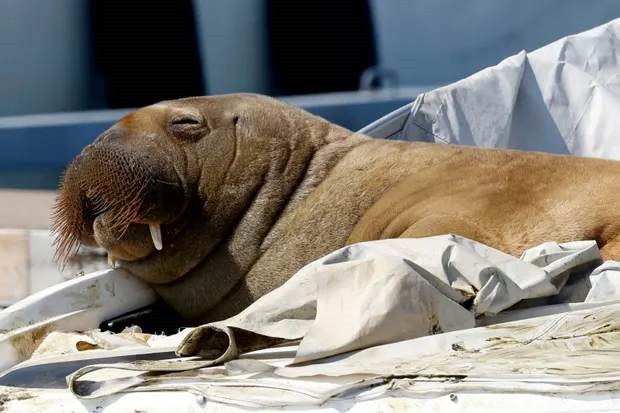
I shared with my wife, who has many concerns bearing down on her this summer, recent video clips of Freya, a celebrity lady walrus who’s lately been hanging out in Oslo Norway’s harbor. Freya is a young 1300-pound mermaid who spends around 20 hours a day sleeping while carelessly lounging on marina boats, sinking a few with her what-the-hell-I’m-wiggling-aboard anyways. During the other four hours Freya chases ducks and swans. The marina also has kayakers and paddleboard riders which she also likes chasing. Recent videos have caught her eating one of the swans,*  but perhaps thinking of her beach-body figure, she’s skipped eating the humans so far.

“Twenty hours of sleep…” my wife responded. “goals!”

Freya

Hot Girl Summer: Freya, in her liminal state between 20 hours of rest, bird and clam eating, boat wrecking, and being adored by her Norwegian fans.

.

Now as far as I know the great American poet Emily Dickinson never got to observe a walrus. On one hand, Emily did have a privileged life as the child of a successful lawyer, but then it was the 19th century and they had fewer smartphones, washing machines, lawn tractors, induction stovetops, and air conditioners. At least in her youth her parents believed strongly in self-reliance and careful household finances, and so distained servants, since after all they had a pair of daughters who could do that work. If we think of the later-life Emily Dickinson as the housebound hermit, you may not know that the younger Emily Dickinson divvied up the household work so that she had more outdoor chores compared to her sister.

One of the things I learned when I visited the Emily Dickinson house a few years back was that across the main road in front of the Dickinson house the family also had a field they farmed. And then on the house’s main lot there was an orchard and food garden which were largely the creature of Emily and her mother. Harvesting hay from the field was probably men’s work, but I was told that Emily would be tasked with bringing the harvesters water and food during their work. All that came back to me as I read this charming poem of Dickinson’s that is generally known by it’s first line: “From Cocoon forth a Butterfly.”  Here’s the full text of the poem if you’d like to follow along.

There are three or four characters in this little poetic drama. There’s our Butterfly (joined by others of her kind later), a “notwithstanding bee” who is proverbially occupied pollinating and presumably making honey, and the harvesting men. The fourth character is animated by the poet herself, a flower which despite being a plant is described as “zealous,” waving in a summer breeze for an afternoon.

Our main character, the Butterfly is described as if she’s an idle lady. She seems to have no task, something she flaunts in the poem. The field workers, the men, have obvious tasks. That hay won’t harvest itself. The bee, a cliché of purpose. The flower is a bit more ambiguous. If we assume Dickinson chose zealous carefully, the flower may be ardently worshiping the summer day or perhaps it’s divine author, shuckling in vegetative prayer.

Which character does Dickinson identify with? Maybe a little with all of them, if not entirely with one. If one has farm tasks (or for that matter the artistic tasks of a poet) the idle lady making a show of her leisure isn’t your model, even if you may feel a bit of envy — and yet poetry can be charged as like a butterfly, a piece of beauty that seems to do nothing. The men are doing useful work (see Robert Frost on mowing in this poem) but though Dickinson tends a garden this haying is not her work. Same for the bee. Dickinson no doubt knows the bee’s work, appreciates it too, but it’s not her work. We know Dickinson is highly knowledgeable about flowers, and often makes them the subject of her poems, but this zealot flower? If she’s serious about that characterization, she stands outside that level of belief.

The closing stanza, like her more famous “I’ll Tell You How the Sun Rose”  poem resolves this separation from her, the observer of it all — Vanity of Vanities, all is Vanity — and so the purposeful actors and the purposeless Butterfly will all be gone by end of day. Emily the poet remains, as does her poem if we take the time to observe with her again, many days and decades later.

Before I leave you with an opportunity to hear my performance of Dickinson’s “From Cocoon forth a Butterfly” I want to put in a note here about the lack of activity here this summer. I share some of the concerns of my spouse, and I am also trying to reevaluate this Project to see if I can make what I do here more useful, or beautiful, or something. Traffic and listenership always drops off in the summer, so a good time to reevaluate, and you may see fewer new pieces until autumn.

To hear my performance with original music you can use a player gadget many will see below. Don’t see any gadget?  This highlighted link is here as a backup for you.

.

*Showing a connoisseur’s appreciation for the swan greater than William Butler Yeats’ I’d say. Yeats only looks at his swans, and yet the great poet distains at putting his tusks into one like Freya. Walruses also eat clams, which as far as I know have never moved Yeats to poetic transport. Apparently, Norway has a problem with lots of invasive clams, which may be why Freya has been hanging out in Oslo.

Dickinson’s “Bloom”

If I didn’t read the news, it would still be spring.

I’ve mentioned it’s been hard to produce new pieces here recently. While there’s a variety of reasons for this, here’s one: I’d planned a little series on May flowers. I was inspired by my wife’s love for our native northland wildflowers and some gorgeous photographs of cactus blossoms by Kenne Turner that I recently viewed on his blog. I had this witty little poem by Emily Dickinson with a not so obscure moral underneath about being an artist — Emerson with a dose of playfulness. I’d completed composing the tune for it. And I planned to pair that Dickinson with a couple of poems by the master of Chinese classical poetry Du Fu.

But I was only halfway there in how captured I was by transient beauty. Earlier this spring on my morning bike ride I started to mull over this line that hasn’t found its poem yet: “This spring is filled with bird-songs and the death of young black men.” So, the horrible and the hortatory were already mixing in my thoughts, while I have nothing but good will and empathy to claim there.

Everyday I try to will myself to make useful or pleasurable work toward this project, and this, among other things, makes me pause. Am I missing the point? Do I even know what the point is, or the series of points that lead to it? I feel bad for the limits of what I can offer, and then I feel bad for not offering that little. Still, I’m stubborn with this. I keep butting against it, trying to push it over or trick my way around it.

And Tuesday I did. Starting early, I recorded an acceptable performance of the Dickinson poem with my music, worked on music for the Du Fu flower poems, and practiced my understanding of how to perform a poem of Kevin FitzPatrick’s that I will present at a memorial event this weekend. A good day it seemed, even if I missed the day’s near-perfect spring weather outside — never mind, the internal weather of being able to create, to illuminate for myself and perhaps for others the work of Dickinson, Du Fu, and Kevin was pleasant and enough.

Never mind, as I got ready to go to bed after this fruitful day, and I caught the news of another rain of bullets. Grade-school kids!

Should I have something appropriate to say, something useful about that? The horrible and the hortatory. Something that isn’t so entirely obvious to some and beside the point to others? Long time readers here will know one motto I have here: “All artists fail.” I’m certainly failing here for some today.

So, you’re going to hear me perform this little poem about flowers, about the work that goes into making mere transient beauty. Here’s a link to the text I used today if you’d like to read along. Dickinson judges right off that she’s sure this isn’t some “minor circumstance.” And Dickinson would know. She knew her flowers, wild and cultivated, intimately.* She was a serious gardener of food and flowers, and despite her growing reputation for being some secular nun always in cloister, she purposely chose that outdoor work with plants over other household chores. She knew their use for food, she knew their use for transient beauty. Flour and flowers.

Her little poem goes on, and the little bud fights several ways for survival. I love the litigious line she uses in passing that she may have borrowed from her male family’s life as lawyers “Obtain its right of dew.”

Prowling Bee by Heidi Randen

A prowling bee “Assisting in the Bright Affair so intricately done…”

.

My dear wife left me on the rise to her job with a hug this morning, wishing me success in being creative today. Was she being a “prowling bee?” If so, as another bard had it, “Sail on my little honey bee, sail on.”

To fail in art, as with Dickinson’s final judgement on our flower that blooms past bud, is a “Profound Responsibility.” If you’re working on art this spring, I’m not asking you to fail, or to be happy with failure — at least I never am. This spring is full of bird song and dead people, the lightness of flower petals laid on us are a suffocating “heavy brocade” as Du Fu had it in a poem of his, one I was able to complete a performance of. All I know and can tell you is how that feels.

To hear my musical performance of Dickinson’s  “Bloom” (Bloom — is Result — to meet a Flower)  you can use the audio player you may see just below, or if you don’t see the player, through this alternative highlighted link.

.

*As I mulled over this poem’s presentation, I was reminded of how seriously Dickinson took her connection with gardens and flowers by Twila Newey musing on Twitter that Dickinson’s mature aversion to publishing could have been the result of her individual conviction that transient and intimate beauty, as in her garden, was sufficient, or even superior to a wider advertisement fixed in type.

See Emily (Dickinson) Play — I recast her poem “May-Flower” for National Poetry Month

Yesterday I said poetry isn’t just beauty and wonder. Well, sometimes it is. Like this recasting of an Emily Dickinson poem into outright 1960’s wonderment.

I carried around a copy of the original text of “May-Flower”  today for Poem in Your Pocket Day, but alas I wasn’t assertive about it. Should I have been?

The staff at the café I biked to were maybe my best chance, but I was still waking up. Then at the bank, my own variation on Miss Stillwagon had needed to take several helpful minutes to go over questions from an African immigrant accented small businessman before I stepped up to her window, and I didn’t know if she wanted to know about Dickinson’s spring flower just then. Instead, we exchanged the brief small talk about how cold this April has been.

Then at the grocery store I always take the human checkout line, thinking that that supports someone’s job in this scanned beep and bloop age. The cashier in the lane I picked must have hit her off-switch for the Lane 8 sign simultaneously as I plopped the first bag of cherries I’ve seen this season on the belt.

“Didn’t you see my light was off?” Which I hadn’t, probably looking down in my cart for the next item to unload. “Well, that’s OK” she said as she efficiently rung up my small batch of items in a dozen seconds. Still, she didn’t seem all that open to Emily Dickinson’s offering of the aspects of a flower. Out in the parking lot, as I packed up the groceries, a pickup truck pulled in and had, I noticed, a “Media is the virus” Alex Jones bumper sticker. I was putting my N95 mask back in the envelope I pocket it in. I didn’t think it worth putting the mask back on to ask him about “May-Flower.”

So, you are left to hear it.

I sometimes sense when reading a certain kind of Emily Dickinson poem that she’s in a visionary or unusual state of perception. The various theories about her mysterious illness including vision symptoms are one level of explanation, but then I also suspect her cast of intellect and a dose of Transcendentalism could explain some of it. So it is with “May-Flower,”  which is ostensibly a riddle for which the reader is to guess the particular type of flower. That may be her intent, but the scattered aspects of the flower she reveals, and her trademark specific originality of word choices*  are as full of swirling fluorescents as any psychedelic poster or LP cover.

Was it the pinkness of the flower that made me think of Syd Barrett era Pink Floyd?

.

In this classic performance from our archives, I decided to further unravel the poem she wrote — and then re-weave the words in a variety of orders and alignments while playing electric guitars, bass, and combo organ in my best rock ballroom approximation of Sixties’ amazement. The 1960s — not Dickinson’s 1860s.

You can hear it three ways. There’s a player gadget below, but some won’t see that and can then use this highlighted link instead. And as we’ve done for almost every post this National Poetry Month, there’s a fresh lyric video above too.

.

*I recently read a short piece on Dickinson by Alexandra Socarides. In it she reveals a poetic mentor, Carolyn Williams, had taught her an interesting way to appreciate Dickinson’s originality. She calls the exercise “Dickinson Mad-libs.” Here’s how she describes the exercise best done with lesser-known Dickinson poems: “I choose a line, a stanza, or a whole poem, and I take out some of its words (usually nouns and adjectives, but sometimes verbs as well), and I simply leave blanks where those words were. Then I ask the students to fill in the blanks. I tend to switch up which poems I use, even though I know several that work particularly well. I’ll never forget the time I used “Grief is a ________.”

If you don’t know “May-Flower” and haven’t listened to today’s piece, or if you want to try this exercise with another poet, here’s the Mad-Libs game for the poem’s first stanza:

May-Flower

Pink, small, and [ADJECTIVE].
Aromatic, low,
[ADJECTIVE] in April,
[ADJECTIVE] in May,

Give anyone, even a poet, guesses — a dozen or a hundred — to what Dickinson would use in those three blanks, and what would be their batting average? And here’s the even better trick: because of the sound of those words, I don’t have any sense that their author is over-trying to be “original.” The sound attracts you to them, however rarely you’d expect them.

Emily Dickinson’s “Ample make this Bed”

Today’s piece for National Poetry Month is another Emily Dickinson: her gothic aubade “Ample make this Bed.”   Word-music is subjective, but I find this one of the most poignant and lovely of her poems.

As with many Dickinson poems the meaning tantalizes, at once clear on the surface and tangled beneath. The trope it’s using, the aubade, is highly common in love poems. In the aubade, the lovers are faced with the dawn and do not want to leave their night. The poem’s loveliest line “Let no sunrise’ yellow noise” is as good as a line as ever graced this poetic form. Yet, Dickinson’s stance has a twist in that there’s an implication just below the surface* that the “bed” is instead a buried coffin, which the voice of the poem declares will not be occupied for a lover’s single night, but until the Last Judgement at the end of time (as per some Christian doctrine).  Stop though, and consider — which is the metaphor and which the actual moment being portrayed? Is the bed our life, or our time after life?

Here’s today’s lyric video. I found the picture of the note at the end of the video in a post by Martha Ackmann of New England Public Media.

.

I think this is another example of a gestalt drawing as a poem. We’re to behold either and both.

The classic gestalt face/vase drawing asks us to alternate “figure” and “ground.”

.

The paired bedding metaphors of the first two lines of the second stanza may be overlooked on one’s first or second, or even further readings, so audacious is that overall bed/coffin in the grave pairing. So, let’s examine them for a moment. How often have we tossed and turned in a restless night? Nothing is right. The mattress is too firm, or swayed and too soft. The gentle corners of the pillow jab us, and it’s neither high or low enough. The mattress/pillow lines remind us that contentment is like unto the grave.

Can we make the bed of our lives ample — or the sum of our lives totaled at final judgement? Are the lovers ever fully ample when judged at end? Oh but it is beautiful and poignant to think they might be, and honorable to try.

As National Poetry Month continues for this week, we have three ways again to enjoy this re-release of one of my favorite audio pieces from the six-year history of the Parlando Project. There’s our graphic player gadget below in many cases, but I’ve provided this highlighted link as an alternative since some ways you can view this blog won’t show the player. And there’s our poetry month bonus: the lyric video above.’

.

*As usual, pun intended.

Soul Selector Blues for National Poetry Month

Just suppose that back in the 1920s someone wanted to record a Blues song based on Emily Dickinson’s “A Soul selects her own Society,”  and so they waxed a 78 rpm platter at Paramount records “New York Recording Laboratories,” located back then in, well, Wisconsin.*

If they did, it might sound a little like this.

We offer this sort of nonsense as part of our celebration of National Poetry Month. Then again, maybe it’s not nonsense. Dickinson’s poem does fit into “Old Weird America” and its music shockingly well. Why’s that?

As best as can be determined, Dickinson wrote “A Soul selects her own Society”  during her highly-productive mid-19th century, but for a variety of reasons, this poem, like almost all the other poems that she wrote, wasn’t published until near the end of that century. Somewhat “regularized,” Dickinson’s poetry was bound then into book-length collections that sold well for poetry by an otherwise unknown author, partly due to the myth of her eccentric later-life used as hype for the verse, and because some of her poetry was disarmingly informal and approachable — at least on the surface.

Literary poetry gradually began to take notice of her. I presented Sandburg’s audacious mention of her in 1914 as an “Imagist” earlier this month, and over the course of the 20th century her work has eventually been judged as important as Whitman’s in presaging 20th century Modernism. Now, I daresay that if one was to survey living poets in 21st century America for what 19th century American poet they read, admire, and use as an influence, Dickinson would beat out Whitman — and those two would leave the rest of the field far arrears.

What else happened around the beginning of the 20th century, but took serious critics and culture a while to notice? Afro-American secular music — Blues and Jazz — which would come to significantly define American music internationally and become the dominant strain of our country’s music ever since. Americans were highly important in English language poetic Modernism.** Afro-Americans had their Modernist revolution to offer too, and a great deal was musical in this era.***

So, in another way, this unlikely pairing of Dickinson and Blues isn’t as odd as it seems.

Paramount’s “race records” ads scattered in this video, like other white-owned firms marketing to Black listeners, ran often in Black publications like the Chicago Defender. Outside of these ads, the Defender of the ‘20s largely ignored Blues as problematic. From examples I’ve seen the Paramount ads were less stereotyped than other “race records” companies’. Paramount did hire a Black consultant, Mayo Williams, who may be partly responsible for that.

.

Three ways to hear this performance of speculative fiction: a graphical player is below for a portion of you, but if your way of reading this blog doesn’t show that, this highlighted link will also do the job.  And the new lyric videos we’re doing this month is the third way to hear “Soul Selector Blues.”   Oh — it’s not your speakers or computer — it’s supposed to sound like a Paramount 78 RPM record!

.

*Port Washington Wisconsin to be exact. I’m not entirely sure why Paramount Records wanted to make it sound like it was in New York, perhaps for prestige, and despite the name they had no connection with the motion picture company Paramount either. What was a record company doing in Wisconsin anyway? Well, they made furniture (the upper Midwest was a timber source) and that led them to make cabinets for the new entertainment device, the phonograph. And if they made phonographs, why not seek another income stream from the “software,” the disks to be played on them?

If you choose to view today’s lyric video you’ll see a sampling of how they marketed to Black Americans variously (I can hear the meeting: “Who really knows what they like and will buy…”). High culture to gut-bucket, spirituals to sexual rebels (Ma Rainey’s “Prove It On Me” is about exactly what the illustration on its Paramount ad might lead you to think it was about). They had a pitch for your money and ears.

**Curiously, almost exactly 50 years before the “English Invasion” brought British rock’n’roll bands to the U.S., a small but influential group of Americans were over in England evangelizing poetic Modernism. Were The Beatles payback for Ezra Pound and T. S. Eliot?

***Even literary minded Afro-American writers, critics, and poets weren’t necessarily ahead of the curve in seeing Jazz music and Blues lyrics as an authentic Modernist revitalization of tired-out existing tropes at first. Langston Hughes and Carl Sandburg were exceptions a century ago in seeing this.

We Grow Accustomed to the Dark for National Poetry Month

How has it been this far into National Poetry Month before featuring Emily Dickinson here? Well, no matter, time to get onto that today, as a number of our most popular pieces over the years have been related to Dickinson. Today’s piece is one of my personal favorites, our orchestral setting for her “We Grow Accustomed to the Dark.”

When I did this setting and then its subsequent performance back in 2017 I went intuitively with a contrary reading of this poem. Generally, Dickinson’s poem is read as saying that when we reach a point of uncertainty bordering on no knowledge whatsoever, we may still press ahead, and if we don’t exactly find our way, we may find way.*

But that message is delivered in a vivid little parable whose details can undercut that “persevere” moral — and those images’ undercurrent, along with some American cultural dread from that time, led me to make it more dismaying. The sense I was communicating in my music and performance was more at that we may become accustomed to the dark, but that’s not a good thing.

The lyric video

.

If we view this as a poem of voyaging mysticism or stoic perseverance — or if we view it as us no longer noticing that we’ve left the comity of friends and turned our back on knowledge — the poems finest choice in imagery is both odd and comic. Emily Dickinson seems to be something of a Transcendentalist, the insurgent “New Thought” movement of her era, and one that held that the universe’s highest knowledge and truth were to be found in the book of nature. Dickinson’s poem does meet nature partway in: a tree. Such reverence for nature eventually birthed an epithet: “Tree Hugger.” Dickinson doesn’t go with that exactly. How then? You can find out three ways. There’s a graphical player below for some, but for those who don’t see it, this highlighted link will open a backup player in a new tab. And as we’ve been doing during this National Poetry Month, we have a lyric video with a thumbnail picture link to view the video above.

.

* It occurs to me that Dickinson’s “We Grow Accustomed to the Dark”  is in some ways a pair with Robert Frost’s “Stopping by the Woods on a Snowy Evening”  as both are poems about being disoriented in darkness. My parody of “Stopping by the Woods”  was re-released here last week, but if you’d like to see what I did with Frost’s original, here’s a link to that.

Winter 2020-21 Parlando Top Ten (abbreviated edition)

Given the everything I’d rate between losses, troubles, and mere distractions I’ve gone through since late last autumn, I’m not in a mood this week to do the traditional Parlando Top Ten list for the past season. These are the same issues in repertory that have reduced the number of new pieces I was able to present here during that time. You, the audience for this Project, have stayed with this: readership to this blog is growing, overall listenership to the audio pieces is slightly up. Thank you. Thank you. Thank you. There’s more than three of you — I mean to thank all of you three times.

I know some of you do like these quarterly Top Tens, and I enjoy them myself — if only just to see what pieces from the variety presented here got the most response. That said, let’s rush through the numbers 10 up to 6 for the record:

10. Song to the Dark Virgin by Langston Hughes

9. Winter Solstice Consolations by Frank Hudson

8. I died for Beauty —  but was scarce by Emily Dickinson

7. Oh, Maria by Ethna McKiernan

6. Letting Go the Wolves by Ethna McKiernan

You can see in those five pieces two from my memorial observance for the Irish-American poet McKiernan who I had the privilege to know and examine poetry with, and one from my February Black History Month celebration of Langston Hughes’ first poetry collection The Weary Blues.  There in the middle, there’s one by long-time Parlando Project favorite Emily Dickinson. And my own piece in that group talks about the loss of Ethna and also my March memorial subject who Dave Moore and I also knew and worked with: Kevin FitzPatrick. If you missed any of these, each of that above list is a link to my original blog posting and the audio performance of it, just as the following ones bolded titles are.

We join the countdown to the most listened to and liked piece then at number 5.

Tommy Thaw card 800

Spring, a rebuttal.

.

5. Velvet Shoes by Elinor Wylie. A lovely, graceful winter poem by a too-often-overlooked poet from “The Last Twenties” in our previous century. I like the music and performance I created for this one just as much as I did when I created it back around the beginning of 2022.

One would think I’d be through with snow experiences this far into spring, but my morning bike ride today was in big wet flakes and a cold enough north wind. Wylie’s velvet snow is more the dry January sort, but then appreciating snow for its beauty qualities may be best done in past-tense. If so, you may enjoy listening to this one in what I hope is a pleasant spring.

.

4. Lenox Avenue: Midnight by Langston Hughes. “The rhythm of life is a Jazz rhythm” says the first line of Hughes’ poem. I did my best to honor that injunction from one of the first Afro-American poets to unabashedly celebrate that musical form. Although I’m a vary unskilled keyboard player I was able to compose a satisfying two-handed part using MIDI as a scoring tool. I wanted a saxophone solo too, which you can hear a bit of in this performance, but I just couldn’t score or execute enough articulation to “make it.” The piece’s final horn section flourish is one of my rare surrenders to using a sampled musical phrase.

Of course, motif sampling is now an oft honored tactic in the ongoing Afro-American musical tradition, so perhaps I shouldn’t view it as a failure on my part. On the audacity front: I decided to extend Hughes’ lyric which ended with “And the Gods are laughing at us” with a newly written affirmation from after the poem’s time of 1926, one that says that the young art of Jazz and of young writer Langston Hughes’ has answered those gods.

.

3. Sonny Rollins, The Bridge 1959. Staying with Jazz for this one, though with my own words straight through. There are beliefs — some sincere, some insincere — that Afro-American history is but a sorrowful tale, a grievance and a pandering response. If you can heartily do so, I ask you to improvise your own expletive response to the call of that fearful theory, one with as much eloquence and melodic force as you can deliver. Now our response may not be Sonny Rollins level improvisation. That’s not a reason not to — after all, Sonny Rollins wasn’t sure his improvisations were Sonny Rollins’ level improvisations. That’s the story in this piece.

.

2. After Apple Picking by Robert Frost. I made my pitch that Robert Frost was verging on being a bluesman elsewhere this winter, but that piece didn’t make the Top Ten as this one did. His Black American contemporary Langston Hughes called his first book and a featured poem in it The Weary Blues,  but this poem of Frost’s could have that name too. Both Hughes’ Weary Blues and Frost’s end in sleep.

I seem to lack the concentration, or the assured concentration of blocks of time, to do arrangements as full as the one I created for Frost’s poem right now. But you can still enjoy this one.

.

1. Stones by Ethna McKiernan. One answer to lack of compositional time is to write solo instrument pieces, which for me usually means acoustic guitar. Of the several pieces I did to introduce more of you to McKiernan’s range of poetry, this was the one that by far got the most listens this winter — in fact, more listens than any piece has received for more than a year during its first season after posting.

Before I leave you to listen to it, I want to say that beyond soothing my grief at Ethna’s death, that performing those pieces which used her words this winter made her seem closer than our too casual life connection sometimes had us. Wherever we voyage, the same waves lap the same sounds on the walls of our boats.

.

I died for Beauty — but was scarce

I’m nearly over the bout of upper-respiratory crud that has laid me low this month, so I felt it time to see if I could test the dulcet tones of my voice again with a new audio piece. Today’s is one by Emily Dickinson: “I died for Beauty — but was scarce.”

This poem is characteristically short, and “I died for Beauty”  has long been one of Dickinson’s “better known” poems. Let’s do what I often like to do with one of Poetry’s Greatest Hits here and see what we may have missed, and why I might archly put that “better known” in quotes. Here’s a link to a blog post that starts with the full text of the poem in case you’d like to refer to that as I discuss it.

Let me get this out first: to certain sensibilities this is a poem that’s easy to find infused with a kind of corny gothic pretension. It’s got all the counters, common already in Dickinson’s mid-19th century, only more so now: graves, decomposing tragic corpses, sad death, and the world’s disinterest in earnest souls. And on top of this: it’s got capital letter Truth and Beauty. Even a school child who’s read and adored some Keats* will see Dickinson as dropping a shout-out to the doomed garageman’s son.

What can we infer about what Dickinson intended here? I’m no Dickinson scholar, but what I’ve gleaned from reading some of her letters as well as her poems is that while she had those gothic urges, she fiercely wielded a skeptical eye and a satirist’s pen. My guess is that she believed in capital letter Truth and Beauty, and Poetry for that matter, but she also knew the comic limits of humans dealing with them. I could be wrong, or projecting, but that’s the Dickinson I “read.”

The poem’s opening line, with its concluding start of a broken phrase “I died for Beauty — but was scarce” lets one suspect that the tomb is not exactly overflowing with heavenly beauty. So, our dead-in-the-tomb “died for beauty” narrator here finds death (like life) is asking for our narrator to become “adjusted.”

But wait there’s another voice! One equally devoted to capital letters! One who died for Truth! In case one thinks those capital letters are shouty, his voice is soft, somewhat defeated, and is asking about failure. Note that the died for Truth voice is male —we’ll have more to say regarding gendering in the poem soon.

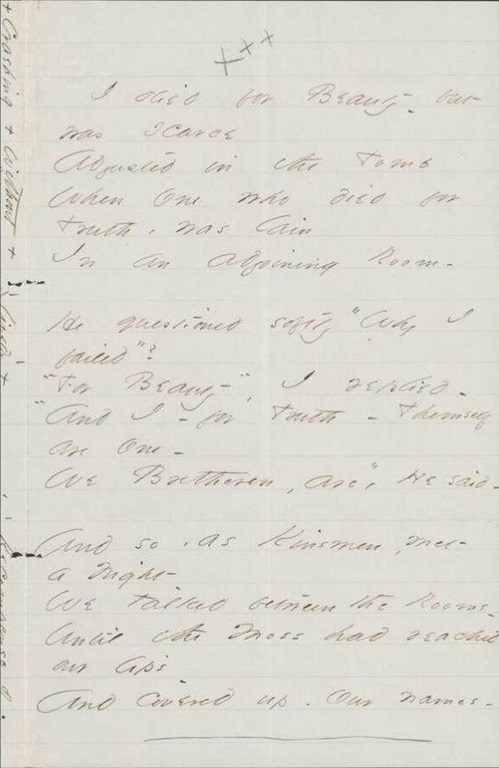
I died for Beauty ms

Here’s how Dickinson wrote down this poem of hers in one of her sewn-up fascicles.

.

Dickinson either makes an odd choice or is just awkward in the Truth guy’s opening question.**  She writes it as he’s asking “Why I failed?” in quotes. In ordinary writing this would indicate that the voice is asking: “Why did I, the Truth Guy, fail.”***  However in the context of the poem the Beauty voice, our narrator, answers back as if they  were asked why they died. It’s hard to convey in a single-voice performance, but if Dickinson intended this awkwardness, it’d be a demonstration of Beauty being consumed by their own state and so thinking the question was to them.

The conclusion of the 2nd stanza, Truth Guy’s reply to our Beauty narrator is stilted, even by mid-19th century formal speech standards. I don’t know if this is intended or simply a failure in Dickinson’s prosody. If intended, Truth Guy’s speech is demonstrably meaningful (truthful) while not  being beautiful. I think of my thought about Dickinson growing up in a household consumed with lawyering and contracts and being genetically related to lawyers.

I’m indebted to Oliver Tearle in pointing out something else in Truth’s little speech: he calls our narrator “Brethren” which is continued in the summary of the next and final stanza as “Kinsmen.” Now if we are to assume that our narrator is Emily Dickinson, a woman, then she’s just changed gender or has been miss-gendered by Truth Guy. Now of course even though the poem begins with “I” we can’t be sure that Dickinson — even if consumed by the beauty of poetry and multiple times in her poems apt to cast herself as writing of herself after death — intends that I who died for Beauty to be herself.

This may be leading to the final two lines, where truthfully and beautifully the omnivorous (even consuming mineral!) moss consumes their bodies and eventually their grave’s marker stones, leaving nothing gendered, nothing specific, only their essences returning to our shared essence: the truth and beauty available to us all if we seek it, to borrow and use it, to find comfort with, and to comfort by.

I’ll pause here to note that poet Ethna McKiernan died this past Sunday. I worked on this Sunday and Monday before I heard the news.

A Player gadget is below for many of you to hear my performance of Emily Dickinson’s “I died for Beauty — but was scarce.”  And if you don’t see that, this highlighted hyperlink will also play it.

.

*No shame in that. I was one. The long-running Prowling Bee blog project points out that the Truth and Beauty paring is also present in known Dickinson influence Elizabeth Barrett Browning’s epic poem “A Vision of Poets.”   It’s also worth considering that Keats’ Truth and Beauty urn is not simply a joyful object for contemplation, or even a clear model for the supremacy of art like Rilke’s white-scrubbed statue.

I’ll offer my own tentative and inconclusive possible inspiration: It’s thought this poem was composed in 1862, and while we don’t know the particulars of Dickinson’s intent, there’d be this possible even more contemporary influence: the folk hymn adaption “John Brown’s body (lies a moldering in his grave/but his soul is marching on)” which was transmuted into a more grand literary composition with the chorus of “His truth is marching on.” As “The Battle Hymn of the Republic”  Julia Ward Howe’s poem was published in the February 1862 number of the Atlantic Monthly where Dickinson surely would have seen it. Literally, the antecedent to “His” in Howe’s poem is the godhead, but folk-music-process wise, the antecedent is John Brown.

Posthumous editor and sought-out living “preceptor” (in her words) of Dickinson, Thomas Wentworth Higginson, was a backer of John Brown’s raid.

**Original Dickinson editors Mabel Loomis Todd and Thomas Wentworth Higginson removed the quotes Dickinson put around Truth Guy’s question, making it clearly a question to our died for Beauty narrator in their version. So “He questioned softly ‘Why I failed’?” in Dickinson’s hand then became “He questioned softly why I failed?” on first printing.

***”Failed” here is meant also to have a double meaning as in dying, but the fail in failed is too prominent. As this voice was first introduced, “One who died for Truth” is more noble sounding, as in martyrdom, than failed in truth.

I think I was enchanted

Earlier in the history of this blog I did a series called “The Roots of Emily Dickinson” talking about some influences that helped shape her poetic originality, but in that series I missed running into this ecstatic poem known by its first line “I think I was enchanted.”   Scholars are fairly certain it’s the American poet’s elegy for British poet Elizabeth Barrett Browning.

Actually, it’s one of three Elizabeth Barrett Browning elegies Dickinson wrote, evidence that she truly wanted to record her appreciation for this poet. In my casting about for interesting material to perform and present here I came upon today’s piece only after finding another of the three, “I went to thank Her.”   I had gone so far as to start writing music for the Parlando presentation of that poem, when, in looking for information, I came upon this other one via Susan Kornfeld’s fine blog on experiencing Dickinson’s poetry. You can use this link to read that post and today’s poem as she presented it.  Kornfeld says “I went to thank Her”  pales in comparison to “I think I was enchanted.”   It’s certainly more intense — intense to the point I began to question my initial readings of the poem, as I often do with Dickinson.

One of the challenges with Dickinson’s poetry is that I have little sense of exactly what the author intended. We have no readings of her performing her own poetry written in the 1860s of course, and despite some saved correspondence, those letters seem to me to show a person who presents different personas in what for others would be casual prose.

I said this poem is often considered as an elegy, a poem of praise written after the death of the subject, but while “I went to thank Her”   speaks of EBB’s grave, there’s no direct mention of her death in this one. Furthermore, “I think I was enchanted”   has moments I read as humor, even satire, mixed with what could be read/heard as outlandish but sincerely intended Blakean visionary experiences.

Dickinson opens her poem with a distancing frame: she tells us this is how she responded to EBB’s poetry as a “somber girl” — and in one of her alternative notes in manuscript she considered “little girl.” Here’s she’s recounting how the younger goth-girl Dickinson encountered EBB, and I love Dickinson’s concise entry into that gothic outlook: “The Dark — felt beautiful.”

What follows is the Blakean part, an outright visionary state: time has no meaning, logic and proportion have fallen sloppy dead*, butterflies have become as large as swans. Dickinson has other poems that portray such states, and in some of them here I’ve mused that she had either/and visual disturbances like migraine/epileptic auras or full-fledged mystical transport where ordinary reality dropped away. But then observe how this vision recounted from childhood trails away. In our somber young girl’s vision, the older Dickinson says the sounds of bees and butterfly wings are audible but that they were little tunes “Nature murmured to herself to keep herself in Cheer — I took for Giants — practicing Titanic Opera.” I think the older Dickinson (she probably wrote this poem in her mid-30s) is allowing she was a little over the top in her feelings then. That she calls the sounds in her vision “opera**” is easily read as being over-dramatic in feeling by moderns, but I’m not certain how Dickinson would have viewed opera from her mid-19th century seat.


Emily Dickinson performs her tribute to Elizabeth Barrett Browning — wait that can’t be right! Well, it’s analogous, or psychedelic, or something.

.

The second half of the poem becomes more abstract, though opening with the metaphoric claim that ordinary days, even the “Homeliest” of them, are now transformed after reading EBB into a fancy-dress “Jubilee.” Another unusual word choice there, not prompted by rhyme. Did Dickinson mean something exact with “Jubilee?” Would she have been familiar with the Hebrew tradition*** from which the word derives? Possibly from Old-Testament sources.

The poem’s 6th stanza seems satiric to me. One of the most well-known examples of Emily Dickinson’s stubborn individualist character was her steadfast refusal to declare herself as “saved” by being reborn in the Protestant religious revival tradition of her time and place. That issue was part of what ended her formal education, and it set her apart from friends and family members. This stanza says, in my reading, that “What happened to my mind back then, I can’t really define and explain — but it’s not some simple declaration or decision, you have to live/experience it.” Thus sticking it once again to the just publicly accept Christ’s grace and be saved crowd. She continues the satire in the following stanza, in effect saying “You think I was out there, what with my butterfly bees beating opera tunes — well, your sanity without that luscious visionary intensity is dangerous to me! And if I ever get poisoned by that, well I have the antidote…” and she launches into a final stanza.

That stanza says EBB’s books of poems are “Tomes of Solid Witchcraft” — a phrase which slots right into a pagan-feminist bookshelf doesn’t it! And then a lovely fade to end: “Magicians are asleep” (the only possible reference to EBB’s death in this putative elegy) but she will remember the magic of that “somber girls” experience of EBB’s poetry, and the possibility of its creation by a woman, like as the religiously faithful remember the godhead/universe-creator.

In that reading I’ve outlined, I enjoyed this poem’s passionate mix of possible reflected youthful visions and the more mature satiric comparisons to a certain kind of religiosity. I did find it somewhat difficult to perform, as the syntactical jumps are hard to fit to breath and natural expression.

One thing still leaves me puzzled: Yes, I understand that Dickinson could easily feel that EBB was groundbreaking in her expression of woman’s ability to write and think and desire — and while that’s no settled notion even in our current age, it must have been even more striking in 1860. But even allowing for the framing device that Dickinson uses, the visionary experience engendered by encountering the poems as a young girl, I never have received that kind of jolt of new perception from reading any Elizabeth Barrett Browning. Maybe I haven’t come across the right poem? Maybe I can’t quite read them as Dickinson did from her situation?

Which is another reason to be grateful for Emily Dickinson, because in poems like this and others, this mid-20th century guy living in the 21st century can  get that jolt from Dickinson.

To hear my performance of “I think I was enchanted”  you can use a player gadget below if you see it, and this highlighted hyperlink if you don’t. Today’s music resulted from me specifically wanting to combine a variety of non-obtrusive percussion sounds (percussion being those pure “you hit it and sound comes out” instruments) with swelling synthesizer sounds that have no struck attack in them at all.

.

*Grace Slick riffed on a number of authors, not just Lewis Carroll, but I can’t think of an instance when she quoted Dickinson. Maybe she (like I) grew up in a time when Dickinson’s poems were thought and taught as simpler homely oddities. Grace, if you’re reading this blog, let me know what Dickinson meant to you.

**Like Dickinson I’m attracted to close, near, and slant rhymes, and when reading and performing this piece I was surprised that she missed the near-rhyme that “Titanic Overtures” would be in place of “Titanic Opera” with “To keep herself in Cheer.” “Opera” is a more strained rhyme, so maybe that exact word was important to her intent?

***Every 7 times 7 years farmland was to lay fallow and slaves were to be set free. This relationship to slavery led the term to be adopted by Afro-Americans in connection with the ending of slavery, a process that began in the United States around the time this poem was written. I have not solved to myself the mystery of Emily Dickinson’s opinions on American chattel slavery and Afro-Americans. Her father’s known political opinions on slavery (a huge issue when Dickinson was writing her poems) was as a “moderate.” But her Massachusetts had significant and militant abolitionists (including the Dickinson associate Thomas W. Higginson). Abolitionist positions are not synonymous with belief in the full and equal humanity of Black Americans; and it would not surprise me if Emily Dickinson, like Whitman, could hold racist opinions about Blacks while intellectually being whole-heartedly committed to freedom.

It’s also possible that Dickinson may have known of Roman Catholic Jubilee years; and in the context of a poem about a poet who lived in Italy and was connected with the turmoil there (which cancelled the 1850 Catholic Jubilee Year) this term could have been brought to mind.