Later this month I’m hoping to attend remote online sessions of the Tell It Slant Poetry Festival run by the Emily Dickinson Museum in Amherst, perhaps as many as I did last year. Something they do that I enjoyed was listening to all the sessions where a range of readers read all of Dickinson’s 1789 poems.
Now was I sitting in rapt, solitary devotion for every hour of that multi-day marathon? No, though I was paying some attention throughout. I restrung some guitars, reduced the clutter in my office and studio space, put away laundry, and tended to the dishes. If I gardened or cooked, I could pretend I was work-a-day Emily herself.
What makes the marathon meaningful, even if one does it only in part? The multiple voices for one thing. A group of several people read the poems in rotation each session, so there was no careful preparation from foreknowledge of which poems exactly each reader would read. A prepared reading might be powerful — having trained actors or voice artists read the whole corpus would bring something to it. This is not that, yet worthwhile.
I’ve heard a lot of folks read poetry over the years. Several of the readers struck me as better than most, even given that they might be reading the poems that came up in rotation for their turn essentially cold.* Of course, every so often one of the readers in their turn would get one of ED’s greatest hits, and all of us: the reader, the other readers, and the attendant listeners would perk up. If one pays attention to this, that happenstance, it “dazzles gradually.”
But then too the ordinary readers, the times when someone stumbled on a word, the lesser-known poems, the small ones that might be no more than a quatrain or two — they two are part of the fullness of Emily Dickinson. She may have been a genius, but she produced these hundreds of poems among a more-or-less ordinary life, infusing them with worthwhile attention. With this many poems it’s unlikely anyone (certainly not I) can really hold all of Emily Dickinson’s work in memory. And so it is, in such a complete reading, that some poems will spark with my attention as if they were just written and never before read or heard. With the smaller poems especially, it may be not much more than a glimpse we share in real-time with Dickinson’s ability to see and think differently. Yet, those small visions add up over the hours, grander from their numbers of unique takes.
Which are the poems she drafted while baking, head full of the hymnal meter, hands dusted with flour? Which while in the garden? Which while caring for her sick mother?
Virtual attendance is planned for many of the Tell It Slant sessions that run from September 25th through October 1st. You can sign up for them at no cost at this link. No one’s taking attendance — see or not see any of the sessions as they fit into your life or level of interest. Given the uncertainties in my life, I’m not sure how many I will be able to fit in.
One game I played during the readings — where I eventually jumped into the chat window with exclamations — was whenever the poem cycle came upon a bee. Dickinson closely observes many plants and animals, but she seems to have had a particular affinity for the bee. Is it a symbol of the Puritan work ethic? A chunkier, easier to observe bug? A symbol of fertility? A flying rose with sweetness and a sting? A coworker the knowledgeable horticulturalist knows is essential to pollination?
Billy Strayhorn and Duke Ellington aside, sometimes the muse takes the bee train,
.
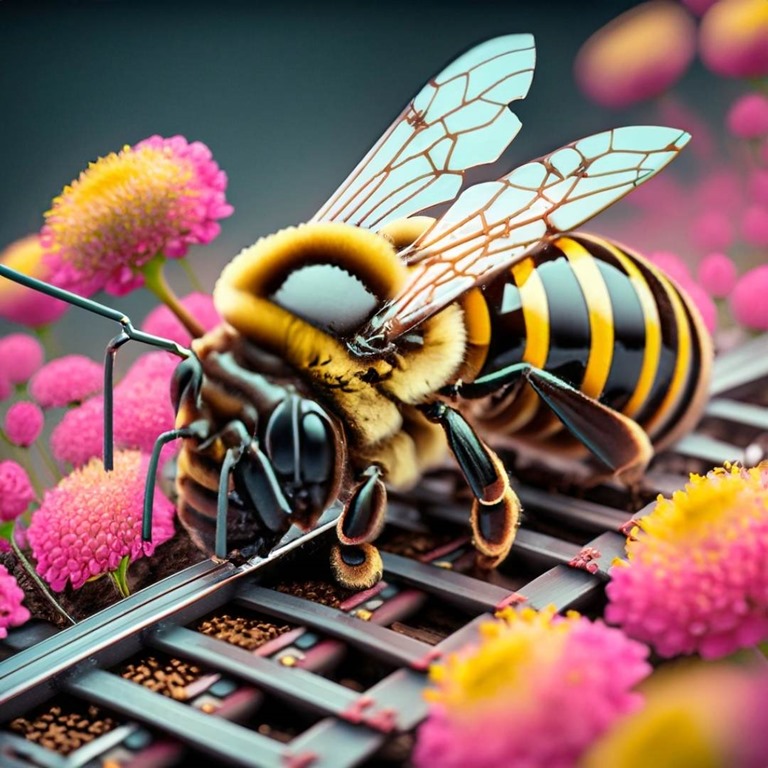
Here’s one of her short bee poems, particularly extravagant in its imagination. And here’s a link to what I believe to be the authoritative text.** That opening image alone should astound. Bees as a railroad train, with the plush flowers as directive as train-tracks —yet soft, not iron.*** “A jar” in the second line is ambiguous. A jar as in a container for the pollen it collects? Possibly, but I’m suspecting more at ajar’s meaning as apart or out of harmony. Bees as locomotives and their train of cars makes them outsized from reality’s proportions. They may move the petals on close examination, their industry is harder and heavier than the plants.
In the second stanza, the metaphor shifts. Now the bee is a knight, the flower a fortress or castle they assault. The bee-knight seems a strangely chivalrous marauder, if inconstant and ready to move off to the next bloom.
As an Imagist poem, this then can be apprehended as simply a picture, an observation of a charged moment of attention. How strange to see the tiny bee as a train or even a knight — but yes, it must travel in appointed commerce on its compelled track, and yes, like a wandering knight-errant it must move on.
But this bee could be a muse too, couldn’t it? It knows its schedule, even if we don’t. It arrives, shakes us like a passing train, assails our walls, then bids a courtly adieu and passes on to another artist, writer, musician.
You can hear my musical performance of this short Emily Dickinson poem “Like trains of cars on tracks of plush” below with the audio player gadget you should see there. No player? This highlighted link is another way to hear it, as it will open a new tab with its own audio player.
.
*I once worked for a radio network. Watching the on-air folks, I was reminded that the ability to cold read text is a skill. It sounds easy to do — when it’s done right.
**There’s a twice as long version out there which I think is derived from the 19th century Mabel Loomis Todd and Thomas W. Higginson posthumous collections. These were straightened up for easier public assimilation and were given, by the editors, their ideas of meaningful titles. Did they append two fragments thinking them connected? My apologies for not researching this issue further.
***As striking as Dickinson’s image is here, railroads were as essential to 19th century American commerce as bees are. Towns grew and shrunk based on their routes. Another plausible reason for the train image: one of Dickinson’s father’s commercial achievements for Amherst was assuring that it’d get a railroad line.
I can’t help it — actually I do try to help it, but sometimes I can’t. I was in a movie with my wife, the polemical Emily Dickinson biopic Wild Nights with Emily,* and they introduced Thomas W. Higginson as this nincompoop who couldn’t discern the poetic genius of Dickinson compared to the kind of poetry he preferred. For an example of the latter, the filmmakers briefly gave us Helen Hunt Jackson as a prim, forgettable, mediocrity.
I nudged my wife, “Jackson was better than that” I murmured.
This is what happens when you’re married to someone who likes to look in the odd, unswept-out corners of poetry’s storage shed. Jackson was a childhood classmate of Emily Dickinson. Jackson left for marriage to a brilliant engineer, who Emily then met and sorta-kinda-maybe had a crush on. Jackson’s husband was killed in an explosion working on a secret torpedo weapon during the Civil War, and widow-Jackson went on to a substantial literary career of her own with poems, novels, and early activism for Native American rights.
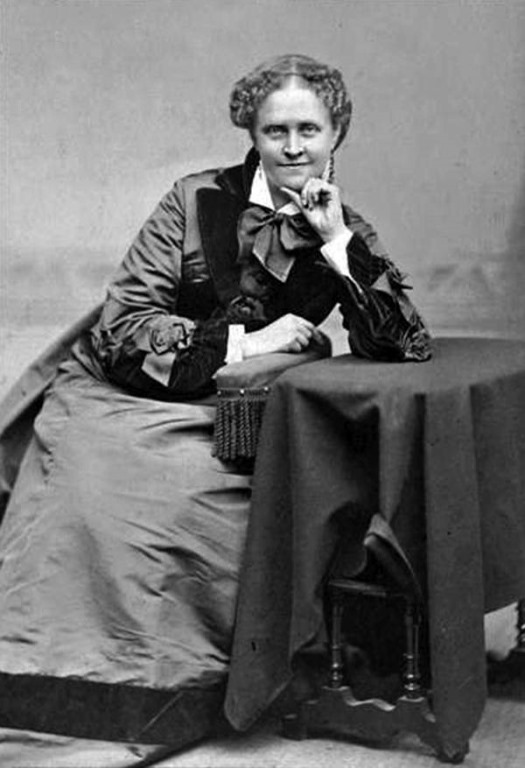
mid-19th century photographs often conceal their subject’s personality, which makes this one of Helen Hunt Jackson a bit special I think.
.
No, she’s not as original as Emily Dickinson, but the congress of poets who could claim that level is small even now. She understood Dickenson’s worth enough to plead with her childhood friend to publish — and though it appeared anonymously, she did include the only Dickinson poem to be published between hard-covers during Emily’s lifetime within an international anthology she produced.
Like Dickinson, these poems include a close examination of nature, though I don’t sense here the notes of humor often found in Dickinson’s nature. In Jackson’s July example, the flowers mentioned are in danger from heat and drought, something that seems contemporary in my own midwestern summer. Only the poem’s water lily seems immune from the danger.
You can hear my musical performance of Helen Hunt Jackson’s “July” with the audio player gadget below. Don’t see the player? This highlighted linkwill open a new tab with a player for you. Want to see the text of the poem? Here’s a link to that too.
.
*Released between the more scrupulous A Quiet Passion and the joyously anachronistic Apple TV series Dickinson, Wild Nights with Emily was the less fully realized, perhaps due to a lower budget. Its broad characterizations were intended in the service of satiric exaggeration. The film’s central point is to portray the often-suspected erotic bond between Dickinson and another childhood friend and confidant, Susan Gilbert.
It’d be possible to do something like this Project using only the poetry of the great American poet Emily Dickinson. While we’re approaching publishing our 700th piece of original music combined with various words (mostly literary poetry) — there are nearly 1800 poems that Dickinson wrote. That’s a lot of material.
The Parlando Project has featured poets all the way from classical antiquity through the first quarter or so of the 20th century,* and I like to vary moods and poetic approaches in the pieces I set to music here — but Dickinson has enough different modes that just her work alone might suffice for variety. Would I miss some of the freshness I find in early poetic Modernism? A woman of the middle of the 19th century, Dickinson was present in an America that is both like and unlike our present country, but like all poetic geniuses she has the power to make time and place fade in importance. As it happens, I was looking for and reading early 20th century poetry when this poem came across my screen, and I found it as immediately fresh and vivid as one of those newer poems. Dickinson’s poem here uses the title of convenience taken from the poem’s first line: “Those cattle smaller than the Bee,” and you can read the text at this link. Rather than a grand poem about important life points, specific social conditions, intense feelings, existential issues, or majestic nature, this is a poem about a prosaic insect, the fly. Dickinson starts out very much like a Surrealist here, imagining as if the fly was a useful domestic animal, like a cow or the honey-producing bee, but the poem then goes on describing what could be a bothersome number of flies inside the Dickinson Homestead house.
“Well Lavina, I’m thinking I’ll go for prize houseflies at the next town fair.” Surrealism manufactured by the AI art program that claims it’s trained on art work that the artists have been paid for.
.
I may be paying too much attention to detail in this playful poem, but I wondered what kinds of flies she’s observing. The season of winter is mentioned, and houseflies generally lay their eggs inside in colder parts of America to hatch during winter. Since Emily cooked for the family, I can imagine that hatching would not make for a pleasant kitchen. Noting Dickinson’s choice of an unusual word “odiouser” in the poem, that may be what that strong language is about.
The final stanza admits that the chapter of the Transcendentalist book of nature describing the worth and meaning of flies is one that Emily hasn’t yet read. Also note: she chose “remand,” a courtroom term, in that final verse — more evidence that Emily picked up some lawyerly ideas from her male family members’ line of business. The Bee mentioned in the first line is something of an Emily Dickinson touchstone, the word and animal appearing often in her poems. In contrast, the fly is quite rare in Dickinson compared to the bee or the butterfly. There is another Dickinson poem that begins “If you were coming in the fall” that mentions a housewife brushing away a fly — but by far the most famous fly in Dickinson is inside “I heard a fly buzz when I died,” one of her strangest and most gothic poems.
I tried to keep the music today reasonably light to go with the mode of today’s poem. You can hear my performance of Dickinson’s “Those cattle smaller than a Bee” with the audio player below. No player to be seen? This highlighted link will open a new tab with a player then.
.
*I rather like the early Modernist era of poetry, but another reason that I generally cut things off at 1927 is that such works clearly in the public domain are free to modify and use however I wish.
It’s been said of poets that they go out into a perfectly good morning only to think of glum existential thoughts. When I read something like that and look at the pieces this Project does, reflection is called forth. That certainly calls out a lot of subject matter I deal with here.
There’s a rebuttal, songwriter Townes Van Zandt said “There’s only two kinds of music: the blues and zippety doo-dah.” Poetry of course is music’s sister muse, but despite Steve Earle’s cowboy boots,* Van Zandt isn’t likely to be recognized as the world’s best songwriter. A dialectic of “blues and zippety doo-dah” risks falsely reducing Blues to a synonym for “sad songs.” One reason that Van Zandt, who was an excellent songwriter, won’t get the World’s Best award is that his songs vary between sad, sadder, and saddest. Doesn’t make them less perfect for what they are, just makes them suitable for certain moods while other songwriters might portray a range of outlooks and characters. I like Townes Van Zandt, I think “Flyin’ Shoes” is as near a perfect song as ever written, but a playlist of 20 to 30 Van Zandt songs would not carry my attention as well as a similar-length selection of Bob Dylan, B. B. King, Joni Mitchell, or Mose Allison.
An Emily Dickinson playlist would be equally as varied as anyone in that latter quartet. There’s the goth-girl Dickinson, the satirist of religion Dickinson, the legalistic philosopher, the altered-states psychedelic Dickinson, the secret bisexual passion Dickinson, and then there’s the Dickinson I’ll perform today: the botany nerd Dickinson. Part of what makes Dickinson such a fascinating writer is that all those personas talk to each other, seem to know each other.
I’ll not go into thousand-words territory on today’s Dickinson piece — I’ve been too long-winded lately for that. I’m going to treat her poem as a simple delight in the oddities of fungi. I have every reason to estimate that that was Dickinson’s intent, and we can enjoy that intent’s achievement. Here’s a link to the full text of the poem if you’d like to read it. To briefly brag about my restraint, there’s a possible deeper, subconscious, reading of the sporocarp fruiting body — but let’s be done with that. All the other Dickinsons may have been there when this poem was written, but we can simply enjoy one of them today.
Apostate mushroom, pleased grass, surreptitious summer. Emily Dickinson not pictured.
*A famous quote by fellow Texas songwriter Steve Earle was plastered on a Van Zandt album cover: “Townes Van Zandt is the best songwriter in the whole world, and I’ll stand on Bob Dylan’s coffee table in my cowboy boots and say that.” Wikipedia reports Van Zandt had a comeback when asked about that blurb too.
I’m going to share a musical performance of an Emily Dickinson poem, but before I get to that, I’m going to continue my memoir-of-influences series on things that formed the idea of the Parlando Project earlier in my life. I’m going to try to keep it short, which will force some amputations, but I feel embarrassed spending much time on the small events of my single life. Those in a hurry, or only interested in the new audio piece and what I have to say about that, can skip down to the second section of this post.
At the end of the last post I had moved to Newburgh, a town on the Hudson river about 60 miles north of New York City. I don’t know if the town knew what to do with The Seventies, it seemed between eras; and in some larger sense I might not have known what to do either, but like the town I had a daily job to do, and kept doing it. Can we say that had some value?
I liked many of the people I worked and lived with during my five years there. I still think of some of them from time to time, and they were often kind to me. The folks who worked with me at St. Luke’s Hospital, particularly those in the Emergency Department, worked hard under significant limitations trying to do things that we could only address partway. I could say much of that under-addressed were systematic issues — and I’d be right — and the levers of those systems were outside our direct grasp. Another part of those limitations were closer to us, internal. I said I’d try to be brief. I said there would be amputations. Newburgh had a racism problem. The town, the region, was populated by stratums of immigrants, with the original European WASP colonials to Irish, Italian, and Puerto Rican waves following on. Mixed in there were Afro-Americans who were there, as they were everywhere in the United States. I don’t know the exact demographic details, and I said I’d try to keep this concise, but I’d guess the Black Americans were first in the region from servant and slavery times, and then there was some low-paid and otherwise undesirable work that still may have seemed better than some parts of America for Black folks. Few poor people ever emigrate for marginal gains from acceptable situations.
That work had shriveled over the years, and what jobs there were, those other immigrant waves got some of the employment from the white folks who did the hiring. Again, I’m no expert, I may have some of this wrong, but when I think of the Irish and Italian Americans who can recount the derogatory tropes employed against their ancestors,* I still suspect that even within the cruel othering they received, they sometimes got, in practice, hiring preferences over Afro-Americans.
This led to the town, in the time I was there, with an underclass of underemployed Black folks viewed by too many of the white population as shiftless, ungrateful and unenterprising wards of the state. Think I’m amputating too much to say this was a prominent white attitude? Ten years before I arrived there was a controversy that was called “The Battle of Newburgh.” I didn’t know much of this specific history in 1971, but the attitudes were still easy to hear and feel while I lived there. Here’s a link to a 30 minute podcast on the 1971 controversy. Wonder what happened later? Here’s an article that updates things to 2015.
Back in my Emergency Room, The Seventies, we were the place anyone came when things broke down. Folks needing medical care that couldn’t pay. Victims of violence. Stressed out or addicted people. Worn-out old workers and beneath the working-class people. I worked the 3-11 shift, the busiest one in the ER. We’d typically get 50-70 such situations every shift. What could we do for them, right now, in our imminent place? Patch’em up. Give them a preliminary diagnosis and maybe a shot or some pills. Hand off a referral card to a medical system already fragmenting and requiring insurance levels of payment from various payers. Witness their deaths.
So those folks I worked with, who did this, were they racists? I’m not saying that. I can’t see into the hearts of them — not then, and not with any level of magnification now. I know we were frustrated with the people in and around the treatment beds at times, thinking that what’s close and in front of us was the most significant thing in what was going on. No, no, we’d no doubt say, that thought wasn’t from the color of their skin, that was what they did, or were doing, or weren’t doing. From what some of my coworkers said talking among our tired selves, I could hear racism, hear pat rationalizations. I’d be hearing this from folks on a modest paycheck given the responsibility of a past that isn’t even the past as Faulkner put it. Our actions were mostly care — yes I saw kindness too, even when our philosophies and capacities could not fully appreciate the lives of our patients and their families. Perhaps it was good that we were too busy to think about that incongruity. Would our care have been better if we — speaking now of the whole group of us, including myself — were less ignorant and more broadly empathetic? That’s certain. But such wiser folks weren’t there then, we were. Imperfection trying to heal what could be treated directly.
A couple of years before this, a songwriter was 40 miles to the north of me, goofing off with his Canadian R&B band buddies in a big pink house. Sing heavenly muse, he sang these lines:
Remember when you’re out there
Tryin’ to heal the sick
That you must always
First forgive them.”
To this day, when someone, almost always a white person, concludes some confession to me with a variety of the phrase “You might think I’m a racist because I said that.” I reply “You said it, and you might well be to some degree. So, what are you going to do about that, and about the situation that is before us?” Ignorance and prejudice may not guide us well in trying to solve things, to remedy faulty systems — so what efforts can reduce that so we can see more clearly? But beyond that, even though our thoughts and prejudices can make us work blindly or in the wrong direction, the injured and endangered may be more in need of helpful actions than faultless inner wisdom.
Is writing and performing poetry a helpful action? Well, it’s not clearly so as is binding wounds or performing CPR. Poetry is in the calling-attention business, including part I normally celebrate here as “Other People’s Stories.” With that focus, I feel conflicted in writing so much within this series which touches on individual and sometimes trivial things in my life. What good will calling those things to attention do? Perhaps it helps make you aware of the “unimportant” things in your life, or the dependencies we have in others who have broadened or deadened what we’ve seen and felt. It can be someone else’s story that helps you see the contours of your own story.
And then too, poetry is full of little, trivial things that poets write down to stand for the ineffable larger things. Can our lives stand for the larger things? They do I believe, or they can, in ways we never fully know.
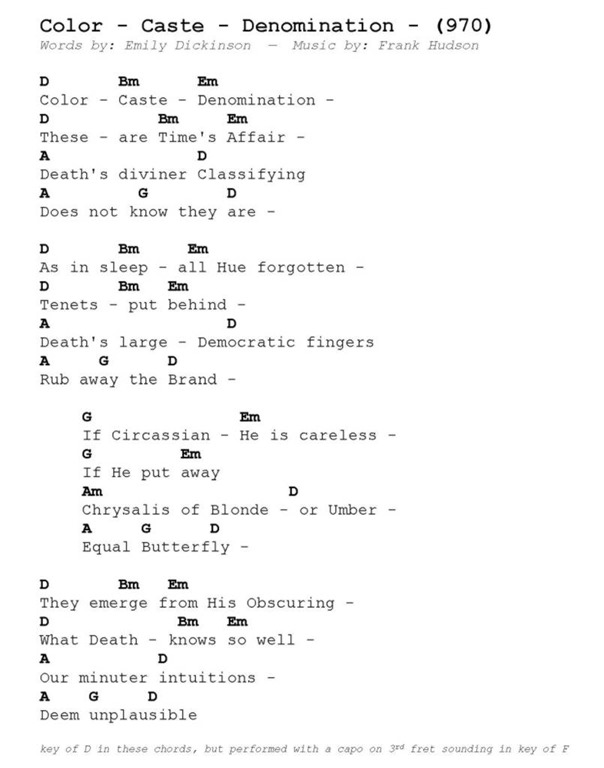
Once more a chord sheet if you’d like to sing this too.
.
The Emily Dickinson Poem
Emily Dickinson has many poems where the small things stand for larger, and then she has others using more philosophical language — yet I was still struck by the first line of today’s Emily Dickinson poem. Poems sometime seek to grab your attention right at the beginning, and this one does that with a trinity: “Color — Caste — Denomination.” These things rule so much of our lives. We may think we don’t let them rule us, but then we see the next person is using them to guide them — or perhaps guide them in how they view us. How can that not affect us. How many next persons can there be without us sometimes being one of those next persons, or yielding to the next person in our lives?
A couple of short notes on things to mention in the poem since we’re running too long. Who’s a “Circassian?” It’s a Middle-Eastern Muslim-believing ethnic group largely exiled from their homeland by the old Russian Empire. “Caste” is a word given by Portuguese colonialists to a hereditary hierarchy they found in South Asia, but it has taken on new usage in modern America to describe the intertwined prejudices and discriminations based on skin color, ethnic background, religion, and economic class. Both terms show a breath in Dickinson’s reading and education. Even though Dickinson’s America was approaching or undergoing a war around race-based chattel slavery when this poem was written, Dickinson seems to give religious prejudice equal or greater weight in the “minuter intuitions” her poem holds that we use to obscure our common humanity. Some scholars have pointed to this poem as a comment on Irish-Catholic immigration in Dickinson’s region at this time which led to a substantial reaction from the existing Protestant settlers.**
My musical setting for it is simple, just guitar and voice, as I’m somewhat rushed for time — and then wanting to use what gifted time I find available when I can record acoustic guitar with open microphones that would otherwise pickup other noise. Though that may have been a practical reason, I think the simplicity works for this hymn from Dickinson’s alternative hymnal. You can hear my performance with the audio player below, or with this alternative, a highlighted link that will open a new tab with an audio player.
.
*Not doubting those stories — see the next note as we see that connect to Emily Dickinson. And I haven’t mentioned anti-Semitism in its Jewish and Muslim varieties. Or the ugly anti-Chinese laws and hate. Oh, and First Nations? I could go on. And that’s just America. I know I have an international readership. Other countries have their own varieties of this, as we’ll see too in Dickinson’s poem. We had all kinds of supposed levels of intelligence and moral fitness that bedeviled us then and now.
**As I mentioned in one of my favorite posts on the roots of Emily Dickinson, her mid-19th century Amherst Massachusetts region had Afro-Americans, mostly in her time in servant class jobs. As she grew into adulthood, the Irish immigrant wave started to displace them, and anti-Irish sentiment ran high. Emily’s brother Austin, who she was close to, at least dabbled with the notorious anti-immigrant Know-Nothings. When young Austin was assigned to teach Irish immigrant kids in Boston, he found the job stressful. There’s a letter from his sister Emily where she jokes that it sounds so bad for him that he ought just as well to go and kill some of them, referencing in the same letter a notorious Boston murder case with anti-Catholic connections. Generously, I sense Emily the satirist there, but this kind of edge-lord humor, then as now, can just be “just joking” license as well. I think: Dickinson, for all her independence of mind, was part of systems, just as you and I are. Even Transcendentalism, the time’s new thought movement that sought to open up cultural enquiry, was not without racism and prejudice. Emerson’s “American Civilization”which I presented part of earlier here, and which is contemporary with this poem, contained portions with racist ethnography.
The most remarkable thing I can think of regarding Emily Dickinson and Irish-Catholic prejudice is that she ended up working elbow to elbow with Irish maids on her rural homestead that retained elements of its former farmhouse work-load carried with other poor first generation Irish immigrants as the hired help. The longest serving maid, Margaret “Maggie” Maher — did she recall Irish poetic bards and song? When Emily’s precious packets of her remarkable poems, overran a portion of a bureau drawer, Maggie offered up her immigrant’s trunk, in which she’d carried her all to America. When the Dickinsons decided they didn’t like the likeness in the oft-seen daguerreotype of Emily we rely on now, they tossed it out, and Maggie rescued it and kept it. Maggie worked beside Emily as she cared for her invalid mother during her prolonged illness, and she then cared for Emily as she lay dying. She was a loyal worker, but it’s said Emily told her to burn the poems. Then, she didn’t obey. When Mabel Loomis Todd was given the task of arranging the poems for posthumous publication, I read that Maggie did housework for Todd to free up her time for the editorial efforts.
And here’s the final thing, as final as death’s equivalence that today’s poem recounts. When Emily Dickinson died, she, this descendant of one of the town old-guard WASP leaders, asked that her coffin be carried by the Irish workers of her homestead. Aren’t you glad you read footnotes, patient reader? You can read a summary account I relied on for much of this in this academic paper available via JSTOR. It’s author Aife Murray expanded her research into this book, which I read a few years back.
We mentioned Emily Dickinson in our last post, and it’s time to return to this essential American poet during this National Poetry Month. I saw this charming poem of hers earlier this week and thought I might be able to do something with it.
Over the years here I’ve delved into some of the more cryptic Dickinson poems, but her poem beginning “The things we thought that we should do” is reasonably clear on first reading, at least until you get to the end. Here’s a link to the poem’s text if you’d like to read along. This three-stanza poem uses exactly one rhyme, which helps its flow stick together, appropriate for a poem about how our lives sometimes seem to take us down one track that we never get around to changing. Our inability to shape our lives to what we think we should do is the first stanza’s statement. The second puts the untaken should-path and compares it to travel, or rather not traveling. Dickinson was often portrayed as homebound — though an examination of her life says she traveled more than many women of her time — but I think this is more metaphor than memoir. This stanza ends with the idea that one may then pass on the untaken task of some travel to a “son.” This may be legal language sneaking into Dickinson again,* but I also wonder if she’s punning on “sun,” since she has elsewhere used the day as a miniature measure of a lifetime. If so, she’s saying we think we’ll do these should-things tomorrow, or in the sense of generations following us, in another lifetime.
Poetry? Law? Poetry? Law? Screw it! I’m going to go outside and putter in my garden.
.
The last stanza is the response, the turn, the summing up. It starts out: If we haven’t been disciplined enough to do our shoulds, we likely won’t get our restful reward in heaven. And then the last line “But possibly the one —” Ah, the Dickinson dash, that little transition — but wait, there’s no more text. It ends on the dash!
This is ambiguous, and her syntax is jumbled. Did she not complete the poem, is this an unfinished draft? Or did she want the thoughtful reader to come up with the resolution that’s not stated, but derivable from the situation: that there’s a heaven even for those not doing all the shoulds, all the time? When she writes “possibly the one” is she saying that there’s only possibly one heaven, but she’s not certain — or even, that the heaven one finds outside the shoulds is plausibly the one?
I was able to bring together the music and performance for this one quickly, which was necessary since I’ve spent the past two days taking care of a computer failure over on my spouse’s desk. But I should — no, it’s not a should, it’s a desire — get another piece posted this April. So, acoustic guitar, piano, standup bass, and just a taste of celesta were called into play to realize the music that unusually is made up of mostly major 7th chords. You can hear it with the graphical player gadget below, or if that’s not there, with this backup, a highlighted link that will open a new tab with an audio player.
.
*I’m increasingly noticing that Emily Dickinson, growing up in a multigenerational family of lawyers, seems to have picked up a fair amount of legalese. As a woman in her time, she couldn’t take up the family trade, but her mind enjoys playing around with the concepts such as ceding a should obligation to another as if in a treaty or a property transfer.
When reading this poem, I also think of psychiatrist Karen Horney’s “Tyranny of the Shoulds” — and in this manuscript version linked here, it looks like Dickinson had considered “tyranny” in place of the version we have with “discipline.”
The early 20th century American Modernist poets I often feature in this project were born in the 19th century. What American poets could they look to as their influences while they developed the poetry that rapidly re-shaped English language poetry? The answer/list for American American-Modernist influences is surprisingly short, and as a result these poets looked to writers from outside the United States. A summary list would include the early 19th century British Romantic poets and those still emulating that style in the UK. French writers got attention (even those French writers who had been influenced by American writers). Classical poets were still part of the British-influenced education system, so like Shakespeare the turn of the century Americans might have gotten “some Latin and little Greek” in school.
What are we left with for home-team poets? Poe, that formative poète maudit? Not much — even though his influence on some of the French writers was there second-hand. Dickinson? Less than some now may imagine in our age where she is considered a giant of American poetry. Dickinson was not significantly published in the mid-19th century, and so she was, on the printed page (beginning in the 1890s) a near contemporary of the Modernists. So, for our early Modernists at the beginning of the 20th century, Dickinson was considered more often as a new, interesting oddity than as the canonical mainstream. Longfellow, the massively successful American poet whose own roots lay in recasting European language poetic forms to American English? It is to laugh. Did even Vachel Lindsay or Carl Sandburg, the most populist and public minded of early Modernist era American poets ever dare to tip their hats to him? I haven’t seen it if they did, as Longfellow was already beneath contempt. Sandburg and the Black American Modernists like Fenton Johnson, Langston Hughes, and Gwendolyn Bennett did look to Afro-American Spirituals, Blues, Jazz lyrics and forms, but like Dickinson this influence would become greater later in the 20th century than it was in the first part. That leaves us with Whitman, who “broke the new wood,” as Ezra Pound put it, with his free verse, his hardly subtext eroticism, his ostensibly personal I-am-the-one-who-wrote-these-lines voice, and his poetry of mystical optimism.
Today I’m going to perform a poem by the only poet whose pioneering interests and corresponding influence are plausibly greater than Whitman — and not just because he was a direct influence on Whitman and Dickinson: Ralph Waldo Emerson. You can trace Emerson’s spirit in 20th century (and 21st century) American poetry not by his poetic tactics (he was often a mediocre-to-awkward poet) but by his underlying world-view, one that helped form a widely influential New Thought movement in the United States called Transcendentalism.
What did Transcendentalism give American poetry?*
Individualism and equality of office. Every person’s soul has an equal potential to receive important revelations and insights. From the start this included women and eventually it included all ethnic backgrounds and races.
The Book of Nature is the scripture. Nature isn’t just a decorative metaphor — it’s the revelation of all that is.
The job of poetry is not just to be beautiful, it’s to instruct. Transcendentalists didn’t do irony** that much and they almost never took to the poète maudit stance. That is not to say that it didn’t have stoic threads*** in its weave, or that its optimism was unbounded.
America is not only, maybe not even primarily, an Atlantic continent. It’s also a Pacific one. We should be open to China, India, Japan, et al as artistic and philosophic influences.
That last one is shown distinctly in today’s piece, a poem of Emerson’s from 1856 that shows he’s been deep into the Hindu Mahābhārata**** — something I haven’t been. Reading Emerson’s poem to prepare for composing my music and performing it, I’m as lost as an ordinary someone listening to a Tolkien adept, or as a father listening to my daughter talk anime or Homestuck. My research says that many of the stories in this Hindu sacred epic deal with wars and wars between gods — and that behind it all, though not usually as an active part, is Brahma, the maker of the universe, who, as Emerson’s poem tells us, is above and beyond such struggles. The poem final line, “Find me, and turn thy back on heaven” then says that all else, even some heavenly reward or alliance, is illusion — that nature, the all that is, Brahma’s abode, is the highest revelation.
Influencer. “Hey, @Fuller, @Thoreau, @Alcott — this easel thing is a great lifehack for reading Indian sacred literature.
.
My musical performance is available below with a graphical audio player. The acoustic guitar composition here is within another Asian and Afro-American influenced musical style, one that its founder called “American Primitive.” I’m not fond of that label, but John Fahey meant it in the sense that it looks to show a direct experience in the music, not that it was unsophisticated or ham-handed. In my case the pork-fingers are a risk, but it fits Emerson’s text (linked here) well. No player visible? This highlighted link is your alternative way to hear my performance.
.
*Note to readers: I am not a scholar of American literary history, just a curious visitor who writes about my exploration. I’m not an expert on Transcendentalism either. I could be wrong in details or significance in today’s post, or with many others here. All this is offered as “It seems to me (sometimes).”
**Dickinson, who may have been a Transcendentalist, and certainly was familiar with its precepts, does have access to a side-eyed, darkly humorous at times, irony.
***Robert Frost, the stoic, seems to have a deep and dark reading of the Book of Nature which he shared with his British friend Edward Thomas.
****By later in the century, we began to take for granted that South Asian and Japanese religion, philosophy, and art are available for American poetry, while Emerson was there at the beginning. I’d expect the non-Asians, however well-meaning, to misunderstand some of it, even as they appropriate it — but then I’d assume some Asians misunderstand, or differ in their understandings, too. Yankee Emerson was one of the first here, and I have no standing to discuss what he got egregiously wrong or surprisingly right. Let me also note since this is cruel April, that T. S. Eliot, a half-century after this Emerson poem was published, took to studying Indian religion in college, dropping his own samples from Hindu and Buddhist scripture into the Modernist landmark “The Waste Land” while still an expatriate American.
It occurs to me that it may have been a while since I’ve reminded new readers what the Parlando Project is, has done, and tries to do. It started as an idea around 2015 to focus on something I’d done off and on for decades: to combine other people’s words, usually literary poetry designed to be seen on silent pages, with a variety of original music.
I did this not only because I think it’s fun, but because the process allows me to more deeply absorb some sense of what the poets are trying to convey. At least for me, I can read a poem with my eyes and sense that there’s something wonderful there — but then to read it aloud, perhaps even to sing it, allows me to inhabit it, to visit the environment inside it, as if one is deep inside some forest, awash at a water-brink, or walking down its street or inside some meaningful building.
Reading a poem silently is like looking at a picture. Performing it aloud is painting the picture with the words still wet.
Early in the Project many of these performances were with others, most often my long-time musical partner Dave Moore. For a number of reasons those opportunities have decreased. These days the typical musical setting here is composed, and all the parts played or scored, by myself. I’ve done a handful of pieces in the Project without instruments, but that’s unusual. I think that even though they are played by a one-man-band I want the words to have companions. Even the loneliest poems can have these here.
I do these pieces myself, not because I have great confidence or a high appraisal of my musicianship. Far from it. I compose and play the parts because I’m available. I’m an amiable contractor to myself, I enjoy playing different instruments, and I’m unafraid to dive into a variety of musical environments. My estimate is that most musicians who hear what I produce for the Parlando Project are unimpressed by this work, in that I almost never get responses from them when they are exposed to it.* My guess is that is because I use simple ideas, and my realization of even these basic conceptions via my own playing has imperfections. My musical “thing” is more at participatory folk music or the punk/indie ethos — and though I try to produce good work here, and I’ve put effort into that, I don’t consider many of the Parlando Project pieces the best realization they could have. When I’ve taken to putting up chord sheets of some of the simpler acoustic guitar pieces here in the past year, I’m thinking that a better singer or player might take them to a better musical place.
Imaginary band gets down in beatnik cellar. Illustration shows my younger self & spouse in the center. W. H. Auden taps his cig on the ashtray in the foreground. Behind the drummer, Gertrude Stein considers Virgil Thomson.
.
Now let’s get on to a brief rundown of the Parlando pieces that were most liked and listened to this past winter. I do this countdown style, from 10 to the most popular. The highlighted titles are links in case you’d like to see what I wrote about the pieces when I first presented it.
10. All Souls Night by Hortense Flexner. Long-time readers here will know I like to go beyond “Poetry’s Greatest Hits” here, and this spooky piece by a little-remembered author from the time of WWI continued to be listened to long after Halloween.
.
9. “Uncle Sam Says” by Waring Cuney. This one, jumping forward to the WWII era, is almost cheating, as Cuney, a friend of Langston Hughes, engaged here in straight-out songwriting with bluesman Josh White. I’ve been playing a bit more bottleneck slide guitar this winter, and that’s what I used to accompany this message song about a segregated military.
.
8. “Now Winter Nights Enlarge” by Thomas Campion. Speaking of songwriters: poet, musician, and Elizabethan-age physician Campion also intended this to be sung — although, as with “Uncle Sam Says,” I didn’t use the original music for my performance.
.
7. “The House of Hospitalities” by Thomas Hardy. A poet who spanned significant chunks of the 19th and 20th centuries, Hardy was well-versed in poems of rich remembrances, as in this Christmas season memory of holiday celebrations past and gone.
5. “I’m Afraid to Own a Body” by Emily Dickinson. An opening line or two in a poem can grab even the most inattentive reader sometimes, and this poem’s opening pair of lines certainly did so for me this winter.
.
4. “Fairy Song” by William Butler Yeats. Like many a Yeats poem, this one beguiles you and me with its lovely word music. Then I read the play whereupon the poem appears and discovered that its context is exactly that for the song’s singing fairy: a beguiling away of a distressed person from their heart, hearth, and home. That wind that opens this poem is chilling once you know.
.
3. “I felt my life with both my hands” by Emily Dickinson. I cannot say authoritatively what Dickinson intended the context of this poem to be, but I read it as an examination of body dysphoria, though I’m unsure if anyone else has “read” her poem that way. As I have sometimes done, I’ve performed this with what I call an “Inline Epigraph,” quoting a line from a Lou Reed’s song “Candy Says” before the concluding section of Dickinson’s text in my performance. I often think of poems as being in conversation with each other.
.
2. Railroad Avenue by Langston Hughes. I spent an enjoyable but inconclusive time searching for the “real” Railroad Avenue, thinking it could be like Van Morrison’s Cyprus Avenue or a NYC address in a Frank O’Hara poem. Couldn’t find it. May be it’s only mapped in Hughes’ imagination, a construction for the purposes of the poem. Long-time reader rmichaelroman reminded us in comments that America’s separations often are lined by being right in one’s memories from the “wrong side of the tracks.”
.
1. “I’m Gonna Make Love to my Widow ‘fore I’m Gone” by Frank Hudson. Another bottleneck guitar piece that readers and listeners liked a lot this winter. Well — a self-penned piece about good old-fashioned winter randiness made it to the top of the Top Ten. Go figure. They’re talking single digit wind-chills and a March snowstorm as this week ends up here in Minnesota. Codger cuddling is carbon-free heating people!
.
.
*I ascribe this to politeness on their part. I tell myself that I overvalue the audacity and aims of what I do, when simple competence with simple ideas might be preferable.
Let us return to the genius of Emily Dickinson, as we have regularly here at this Project. As I look to her work over the years, I find that Dickinson has several modes. In one mode, her approach is charming, a just-between-slightly-weird-friends sharing of concrete observations of people and the physical world. Even when that Emily speaks of death and eternity, it takes as its conveyance and destination a horse-drawn fate and a well-made bed/grave. Another mode, not as well represented in her “greatest hits,” can be puzzlingly condensed and abstract, as if shorthand notes taken from her own mind of states of thought or insight that come upon her.
One aspect of genius is that it can get away with things that us more craft-assigned poets cannot. To be abstract and nearly impenetrable at any length tires out readers even as her other poems draw us in. If one reads Dickinson as an entire collection, these modes are interspersed. We might think, “Oh, there’s our friend Emily in one of her private moments we cannot join — moments we accept with partial-at-best understanding because we’ve come to love the other parts of her poetry.”
Today’s short Emily Dickinson poem bridges those two modes. It opens as arrestingly as any poem could with the striking statement “I am afraid to own a body.” As I did with our last Dickinson performance here, I wonder at that line and immediately relate it to body dysphoria, something that portions of our current society experiences and is more free to express.
The poem then moves on to an allied and contrasting statement nearly as striking: “I am afraid to own a soul.” The soul is by definition incorporeal, but by linking it with the body in the first line we may palpate it none-the-less. As the quatrain finishes these two connected things, body and soul, are described as valuable, and despite our fears, inescapably present. The poem might be too short if it ended there, but I’d recognize it as a complete koan of enlightenment — but it doesn’t end.
1st stanza draws us in. 2nd one confounds. You & I may not be able to get away with such writing, but let us trust in the genius of Emily Dickinson.
.
In the second quatrain we are off in the abstract Emily. I often seek to remind readers here that Emily lived in a house devoted to law with a father, grandfather, and brother who practiced law.* I think there’s passion and emotion in this second and final stanza, but if we are to follow it we must think as if we’re reading a contract or one of those user agreements we so often click “accept” on without reading. This stanza as saying that both body and soul are willed to us, like a “conditions attached” bequest in a will — and then after the stanza’s second em-dash, what? Who’s the “Duke?” Since rural mid-19th century Massachusetts was not supplied with titled nobility, I suspect this is connected to something Dickinson read. I’m going to take a flying leap of wild assumption here, one that you shouldn’t “take to the bank” any more than my “what if?” wondering that the mouldering man who died for truth in this other Dickinson poem could be John Brown, and a link much less certain than the idea that the kept in quotes “hope” bird was a reference to Emily Brontë. Could this poem’s Duke be Robert Browning’s monologuing one who speaks of “My Last Duchess?” I know Dickinson read Elizabeth Barrett Browning, so it’s not an impossible leap to think she read EBB’s spouse too.
If our Duke is exhibiting his deathless painting of his now dead (likely on his own orders) “last Duchess,” Dickinson is perhaps (in a very obscure and condensed way) mentioning drawbacks to our existence as a body** and as a questing soul.*** What then to make of the final line? I’m not sure. Is God the bequeather of the soul and body in the bargain our speaker is afraid of? Is God as cruel and exacting as Browning’s Duke? What’s the closing “Frontier?” The course of our lifetimes not yet mapped out? A “light out for the territory” escape? I’m not sure.
I’ll be honest, I recorded my performance of this second stanza not having figured out even these potentially wrong readings of it. What did I rely on then? There is some worthwhile word-music — and poetry using that tactic can give pleasure and connection before understanding. I trusted the mystery of the words might convey some mystery to the listener even if I had not opened the packet containing their meaning. My hope: that I could be, however imperfect and limited, one who carries Emily Dickinson’s genius to you.
You can hear my performance of Emily Dickinson’s “I Am Afraid to Own a Body” with the player gadget below. If you don’t see the player, there’s this highlighted link that will play it too. Speaking of links, there are other hyperlinks in the post above to some other Parlando Project Dickinson pieces that you might want to read.
.
*Have other better-known and credentialed scholars made much of Emily Dickinson’s connection to the law? I think the last time I searched I didn’t find much of anything. There’s a thesis topic for some young reincarnation of Wallace Stevens.
**Not much of a leap to a feminist reading of a female body here.
***One of my observations on reading my first full-length biography of Dickinson many decades ago was how remarkably determined she was to resist the pull of declaring herself as “saved” during her time and place’s Christian religious revival. Schoolmates, family, and community all declared, and she steadfastly refused.
The occasion for today’s post and audio piece is Emily Dickinson’s birthday, but I chose this poem of hers to set to music for other reasons. It’s been quite the year since spring for my little family, and this past month has had some additional things to deal with. I keep meaning to find a way to write about those things, but despite the large presence of I-own-my-part-of-the-story writing on the Internet and elsewhere, I can’t feel comfortable writing for the public about personal journeys of others I love and are close to me.
I’ve read through various collections of Emily Dickinson’s poetry over the years, and I even attended online a reading this past September of all 1,789 of her poems from one ascribed complete edition. Here’s one thing I notice about reading or listening to Dickinson: while I’m always ready to wave my hands in the air for her greatest hits, each time you dive into that alternate hymnal of hers some poem will seem new to you, will grab you with a fresh surprising turn of phrase or thought.
And so, it was a few weeks ago when someone shared today’s poem on the Internet. I wished I’d taken notes, as I have that person to thank. Even before I finished reading “I felt my life with both my hands” I said to myself “Is Dickinson talking about what I think she’s talking about — and if she isn’t, has she written a poem that accidentally speaks to certain things we think of as modern concerns?” I think the question comes around to if this is a spiritual poem about immortal souls, or if it’s a body image poem — and then, if we must necessarily divide those things, if Dickinson wanted us to. On the outward level this poem speaks of our inner spirit, of consciousness of selfhood, but the metaphors are often physical things one can touch and see, and since Dickinson has shown in other poems that she is comfortable writing in incorporeal abstracts, I can easily believe this imagery is a choice here.* In short, before I finished that singular reading of this poem this fall, I thought “Dickinson is writing a poem about body dysmorphia, or plausibly gender dysphoria.”
Both of those things weren’t named until after Dickinson’s death, and discussion and understandings about gender dysphoria are still somewhat new in our century, so it’s a leap to say that our mid-19th century poet means to write about those things. So let me go through the poem and try to extract a gloss of what Dickinson wrote.
I added an “inline epigraph” to the text of Dickinson’s poem. It appears in quotes above.
.
The first stanza refers to an antiquated test for life, holding a mirror up to a subject’s nose and mouth to see if it mists over from respiration — but she’s also portraying by association looking in a mirror. Of course in our day the glass we hold up to our faces is likely the screen of a smartphone with a selfie camera, but the image retains.
I don’t think one needs to insert much into the second stanza to see body dysmorphia. Sure, she could be reaching for a rhyme for “round” when she uses “pound.” I’m not knowledgeable enough to know what weight ideals were for Dickinson’s time and place, but what’s clear here imagistically is that the poem’s speaker is examining their body and feeling like they are not that body. Is it because they, their self, are philosophically a soul — or because that body doesn’t agree with their soul?
Third stanza. More body examination. “Jarred my hair” is a particular image. Is this some kind of pomade or other cosmetic? I think Dickinson has chosen jarred to pun on “jarring” here. The dimples image would again speak perhaps of weight concerns/dysmorphia.
The last four lines, Dickinson’s final stanza, indicates again the spirit or soul as essential self. Having left off with knowledge that the self/spirit and the body are not the same, the new place, the new home, the poem’s speaker finds themselves in is Heaven.
Nowadays speculations learned and affinititory about Dickinson’s sexuality have become common, yet I don’t see any first page search hits on her and gender dysphoria. The case for that here in this poem may well be accidental, if none-the-less striking, as the narratives of folks experiencing gender dysphoria might well fit into these poetic lines: the separation of the spirit and the body, the disconnection of the body from the authentic self, the feelings of relief when expressing outwardly their inner conviction. The third stanza’s jarring of hair and pushing in dimples takes another vivid incarnation if viewed in that frame.
Now those with the patience to read this far may still be interested in what I did with this experience of the poem — though if you’re a patient reader who is muttering “Balderdash” as you read the above, you are excused to go do something worthwhile. My impression from my encounter led me to alter Dickinson’s text with a sort of in-line epigraph from the song “Candy Says,” written by Lou Reed for the opening track on the LP eponymously called The Velvet Underground.* * The unpredictability and distress of the past couple of weeks has, I fear, given forth a less than ideal performance — but perhaps it’s imperfection has a certain authenticity to the times it was composed and recorded in. You can hear it with the player gadget below (where seen) or with this backup highlighted link.
May you find your joy and help others find theirs too. Production of new pieces and new blog posts here may be erratic, or they may be therapeutic, in unpredictable proportions, but there are the over 650 pieces in our archives here.
.
*Another choice is her use of “both my hands” in the first line. It’s not like the body would slip out of one’s grasp if you didn’t grab it with two hands. I think this is a choice to highlight duality.
**This song from 1969 opens with a clear dysphoria statement: “Candy says, I’ve come to hate my body, and all that it requires in this world.” I’m sure there are clever thinkers among spiritual people who can consolidate the idea of an inner soul which is not the physical body with a disbelief in gender dysphoria.