Barn, Burning

Here is a piece based on a poem by a second Irish-American poet, Ethna McKiernan, who before her death in 2021 would host a reading every St. Patrick’s Day. I can’t say I knew her very well as a person, though as mentioned last time she was a long-time participant in the Lake Street Writer’s Group with myself, Parlando contributor Dave Moore, and the poet featured last time, Kevin FitzPatrick. I’ll next be going off on a short tangent, as is my nature, but it any of this writing displeases or tires you, just skip to the bottom. I quite like the piece that is the occasion for writing this today, and you are excused to go there and just listen to it.

I don’t think Ethna liked me much as a person, and I can imagine any number of reasons why that might be so. Let me leave most of those guesses behind for today’s purposes. In my old age I’ve come to the realization that I am often a careless and inappropriate person. I suspect that’s for neurological reasons, but who can say, it may be a defect in my soul as would have been said in the old ways.

One peculiarity that I had in writing groups is that I was prone to writing long responses to drafts shared by other members. I’d often get quite detailed with noticing what works, and at least as much so with what I thought didn’t or had alternatives to be considered. The audience of this Project know that I have a broad appreciation for styles and approaches. I don’t hold to a narrow poetic style and down-rank anything that doesn’t follow it, but just as I do with editing audio or trying out compositional ideas in music, I tend to look closely, and over the years of doing this, I’d notice how zoomed in and nit-picky some of my responses were — and I wasn’t at all sure my suggestions for alternative approaches were actually improvements. It’s been a few years since I’ve done that, but I still cringe at some of the things I wrote, particularly in response to Ethna’s poems. After all, here was a poet with several published collections, a grant-winner with a distinct cultural connection to a great poetic culture, and who had taken advanced academic creative writing study. Me? I’m a high-school graduate from nowhere, who has no distinct poetic style to trumpet, who last was published in the 20th century. And need I add one more kicker — I would be in Etna’s case a man writing to a woman poet. Women poets reading this know how that often goes.

So in summary: matters of technique and poetic tactics vs. being emotionally myopic. A lot of the first only emphasizes the second.

My reactions to Ethna’s poems continue to trouble me because, at her best I considered her to be an excellent writer, but one that left me tantalized by another poet within her — a far stranger one, one that only materialized from time to time, and seemed to be constrained by her internal editor and self-anthologist.* Yes, it’s a writer’s prerogative to choose what to present or emphasize, but I wonder if other writer’s group respondents, creative-writing seminars, or outside editorial preferences/fashions kept that element down in McKiernan’s writing. Those things have standing, and it may be me who’s out of step, whose taste is questionable or unlikely. But that’s how I felt when reading the poem “Barn Burning” used to make today’s musical piece. I was compelled to do something that may be regrettable. I strongly thought that a developed image just past the midpoint of the poem was not quite as vivid as possible, and that the poem’s ending was short of how sharply spoken it could be.**

Light Rolling Slowly Backwards front cover

Want the author’s final selected poems collection without my blather? Ethna McKiernan’s “Light Rolling Slowly Backwards”  is available here.

.

Ethna is some years dead now. Poets have trouble finding audiences when alive, and once they cross the Lethe, our forgetting often matches the dead’s. Improper, inappropriate, imperious, presumptuous — convict me of the lot. I’m taking the risk that I’m damaging the poem, though that’s not my intent. It’s done out of love for the poem and in hopes of bringing forth this element of the poet who might be condemning me from the other side.

If the worst is the case, take the performance below as damaged, counterfeit goods. If the best of the case is so, enjoy this poem’s mystical experience with my best efforts at adding music to it. I’m not Irish, I just hung out with some Irish-American poets, and it seems consistent to make this offense out of admiration.

You can hear the resulting “Barn, Burning”  with the audio player below. What, has the player been incinerated and not even ash remains? Well then, your listening can be reborn with this highlighted link that will open a new tab with its own audio player.

.

*I remain puzzled why her poem “Letting Go the Wolves”  was not included in her own final new and selected collection Light Rolling Slowly Backwards.  While it’s a fine collection, well worth reading, to my tastes that’s a pluperfect anthology piece, one I’d say any poet could be proud of having be the one poem others know of their work. Of the poems included there, poems as strange as “Stones”  and “Barn Burning”  display moods not widely indulged in, even though her other poems have their virtues too.

**Should be? Let me say again, I don’t know. I’m just one reader, but one who chose to perform it, and who wants to maximize its impact. Here are the last six lines of “Barn Burning”  as McKiernan had them in her final collection: “The outline of the lit barn/and its lean bones;/the world changed suddenly/as baptism, my life changed/forever with the knowledge/of fire.” Here is what I performed: “The outline of the barn,/the eager edges of its light/surrounding reluctant bones./The world, now sudden as baptism./My life forever with fire knowledge.” And as evidence of how zoomed in my suggestions sometimes were: I think the poem’s title is stronger with a comma in the middle.

A Face Devoid of Love or Grace

Today is the anniversary of Emily Dickinson’s birthday. Let’s open a small present.

Her poem cataloged by its first line “A face devoid of love or grace”  transmits clearly on first reading. I hear it as describing a widespread human feeling: the disgust one might feel looking at a confidently self-satisfied face. So, a simple poem?

Simpler than some of Dickinson’s work, even though we should always consider that she can cloak unique thoughts in cottage-core embroidered-sampler language. The thing I think described is a bit of an odd emotion though. Why can we feel such disgust at sensing resolve and rest on the face of someone we dislike? Is it just our hate transferring to some visage a hate we’re sure we find behind the surfaces? Not if our judgements of the person behind the visage are valid — if what drives us to fury are the actions we know the expression covers.

A face devoid of love or grace

That’s an F Major 7, mixed in with all those minor chords. That’s been a favorite chord of mine for more than 40 years.

.

This week’s news includes the overthrow of a dictator, an event that brings obligatory photos of newly mutilated portraits of the disposed tyrant, and videos of the toppling of statues — enthusiasts performing the pre-requisite of “Ozymandias.”   While in my country, many see the calm, regularized-in-demeanor news-slug faces of our upcoming national administration while reading alongside them their announced motives and plans which horrify — the “sneer of cold command.”  There’s a disconnect there that many feel. “He looks so righteous, while your face is so changed” as yet another writer put it. So, the self-absorbed bureaucrats of disorder and disregard look unconcerned behind their hard successful faces.

In Dickinson’s verse I note a choice: she could have described the unconcerned face that stands for someone that disgusts her in a variety of ways. The one she chose, stone-like, brings along with it that idea of heroic statuary. And there’s an unexpected double-twist from her pencil at the end: that face and its metaphoric linkage with stone. Stone is rhymed* with “thrown.” It’s like stone, and like the stone that the angered would want to throw, rock against rock. And then too, something I didn’t notice until I was singing this, a possible intended pun: thrown/throne.

Am I dissecting a bog-simple nobody-frog of this short poem here? Could be. But even if this is a short birthday gift, it’s the thought that counts.

You can hear my musical performance of Dickinson’s “A face devoid of love or grace”  with the audio player below. It’ll only take 90 seconds of your time, about as much time as it takes to sing “Happy Birthday.”  No audio player to be seen? It hasn’t been blown-out and removed with frosting-feet, it’s just that some ways of viewing these posts won’t display it.  This highlighted link will open a new tab with its own audio player.

.

*Speaking of rhyme: I love the off-rhyme of “ease” and “acquaintances” in this poem.

Millay’s Thanksgiving

There’s a long tradition in poetry of civic poetry — poems not meant for an audience interested solely in the interior intimate experience of the poet, but speaking to larger, more public themes. I suspect modern poetry doesn’t do this mode directly much, even though some individualist poetry infers that purpose. American poetic Modernism began with an emphasis on the concrete, the thing specific: red wheelbarrow, ripples in a pool, a certain Chicago cat-fog, an exit on the Metro on a rainy day. Yet, a focused subject can still be an example that stands for more.

If the subject is small though, perhaps we poets expect our audience most often to be small too, compared to a variety of other, popular arts. But this was not always so. Longfellow and Whitman expected the nation to listen to their poems of democratic virtues. If the literary set eschew the mode, song-lyricists and non-literary poets will still assay it.

Just under four years ago, a poet Amanda Gorman who has written civic poetry, delivered a poem at the last U.S. Presidential inauguration, speaking of the nation’s fears, hopes, promises. The mode of the next Inauguration has changed. I’m not expecting poetry. Some will think, more-the-better — who wants a poet spouting off what I should think.

Why not, are they not citizens? What are the occupations that are allowed to speak?

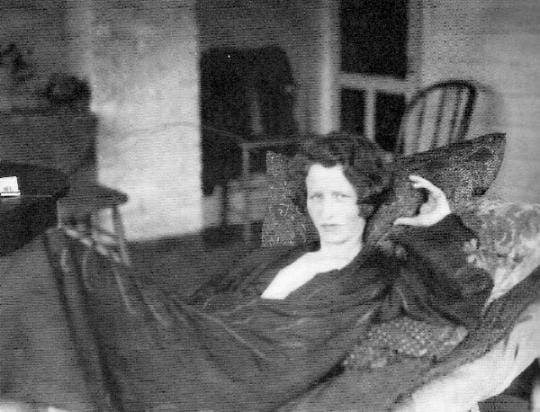
Nearly 75 years ago. American poet Edna St. Vincent Millay wrote a long poem for the American holiday of Thanksgiving. She expected a good-sized audience: it was published in the Saturday Evening Post, a weekly general interest magazine, the one that often featured Norman Rockwell paintings on the cover, that claimed Ben Franklin as its founder.

Millay NFTG

The most often used pictures of Millay show the young romantic adventurer. I’m also fond of this one that seems less all that. The poem which I perform excerpts from today was the last one she published before she died at age 58.

.

I’m sure there were specific things on Millay’s mind, geo-political, American issues. She writes five years after a war ended with two A-bombs. How long would be the peace? In 1950 there was another war going on overseas in Korea, there was a “Red Scare,” and to a large degree some deficiencies in American equality of opportunity were so far off to the side that too few even thought of them as political issues to address then. Millay didn’t cite any of that directly.

Instead, she wrote about how she thinks we, the citizenry, were feeling, assuming a general agreement that might be hard to gather today. Thanksgiving is a dual holiday occasion: it’s our harvest festival, a time to give thanks to what our work brought us, and it’s also a holiday to give thanks for what we’ve come through: it originated in a time of Civil War, and it commemorates the hardy survival of some early 17th century boat-people who landed without papers and survived on American shores. Millay’s Thanksgiving thoughts were more toward the latter than the former.

What will ring true in some American hearts this year will be her words of hopes dashed or at least deferred. Can one give thanks for having hopes that were unfulfilled? Can we at least forgive ourselves for hope? Her poem exists in that question. In the excerpts I performed today for this musically accompanied piece you can hear below, I focused on that sense, felt in my bones. “Cunning and guile persist; ferocity empowers” Millay writes. The lines that stand out for me as a Thanksgiving prayer this year are “Let us give thanks for the courage that was always ours; and pray for the wisdom which we never had.”

As civic prayer goes, that’s humble, but it has some bite in it.

You can hear my performance of portions from Millay’s “Thanksgiving…1950”  with the audio player below. The full poem’s text is at this link. No audio player gadget to be seen?  This highlighted link will open a new tab with its own audio player.

.

.

Ducks, as if Teenagers

This month my teenager, who I don’t write about much out of the belief that they should tell their own story, ceased being a teenager. They’re working full-time hours now, hoping to save enough to move to their own place, sharing hopes and connection with others who are likewise migrating across the border of growing up.

Late this summer, while on one of my bicycle rides down an urban residential street I saw an odd sight: a line of young ducks in their proverbial row waddling across the street. They seemed unconcerned with the intermittent traffic, and there was no mother duck leading the line. I could guess they thought an aged man on a bicycle was not an instinctual, usual threat — but it was grade-school pick-up time and the school buses were rumbling on their routes accumulating backpacked kids. Yet these young ducks, in their new adult colors, just waddled across anyway, as if their orderly line and intent were protection, as if it still was that some parental watch had checked the way clear.

Ducks as if teenagers

Here’s a chord sheet for the song made from the sonnet I wrote.

.

I jotted down a draft of a sonnet soon afterward, and this month as my child becomes less my child and more the cohort of others on their own, I produced a new draft, deciding to set it to music and sing it here. Longtime readers will know that one of The Parlando Project’s mottos is “Other People’s Stories” — my statement that I’ve chosen to not use this place to promote my own poetry, but rather to inhabit other’s words (usually words from literary poetry) and to write about my encounters with those words and what it feels like to sing them.

Maybe today’s piece is a symptom of my age, but I barely think of this poem as my own in the greater context of learning to think of my child as less my own. I anticipate a separated hope and worry, an elsewhere joy and adventure, when they move off as if we’ve taught them enough.

Which we never have.

You can hear the song made from the sonnet with the audio player below. No player? Don’t call home, it’s likely just the way you view this blog, some of which ways suppress showing the player gadget.  This highlighted link will open a new tab with its own audio player for you.

Let No Charitable Hope

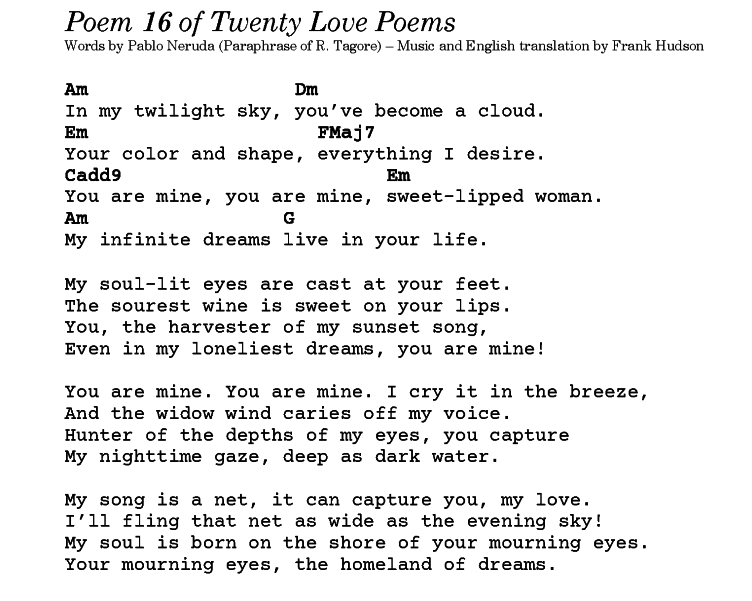
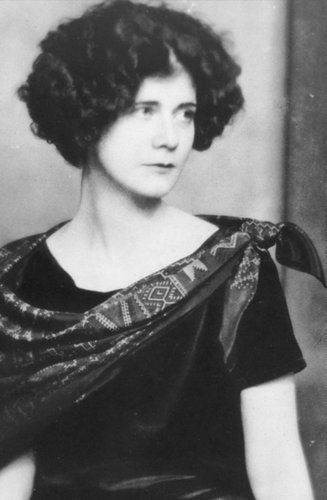
Elinor Wylie once was a reasonably successful poet, back in the last decade that was called The Twenties. I informally group her with some other American women poets of that time: Sara Teasdale, Edna St. Vincent Millay, Dorothy Parker, each of whom wrote often about the complexities of love and relationships. Though none of this group had careers of extended success,* Wylie’s poetry career arc was exceptionally short, contained entirely within the 1920s — though it was preceded by a few years of being a gossip item for a series of romantic elopements and divorces. I wrote a bit about that element of her life a few years back, but it seems that Wylie was playing at the Kardashian-family level of tempestuous celebritydom in her time. Read my link if you want a summary of the tea.

Young Elinor Wylie

Elinor Wylie. Runaway socialite and 1920s poet.

.

So how good was her poetry? Clearly better than the usual celebrity with a book of poetry. She’s highly musical and concise, an irresistible draw to my Project, and while ranking art is a foolish game, her best work stands up well against the trio I associated her with. Today’s piece uses a poem that was called one of her best works when I first read it as poets.org’s Poem-a-Day a year ago. Here’s a link to the poem’s text if you’d like to read along. I myself wouldn’t rank it that high if I somehow needed to rank her poems, though the musicality alone compelled me to set it with music this week. Why do I prefer, for example, her “Velvet Shoes?”  “Let No Charitable Hope”  is a bit abstract, despite the eagle and antelope that are cited in passing and the woman trying to get substance from a stone,** while “Velvet Shoes”  is as sensuous an experience in imagery as in sound. But as a complaint, “Let No Charitable Hope”  probably still connects. Many of us, maybe more for those women reading, are familiar with being misapprehended, of having a hard enough time maintaining one’s own hopes, and to then be asked to try to match the hopes of others. What does Wylie mean by her ending smile in the poem? Is she smiling at how mistaken the apprehension was, or is she allowing herself to smile at her own small lofting of her own hopes?

You can hear my musical performance of Wylie’s poem with the audio player below. I went all-out on the weird chords for this one, so it may not be to all tastes. Is your screen so woozy from fear of odd voicings that it’s obscured any such audio player? No, some ways of reading this blog suppress that player gadget, so I provide this highlighted link that will open a new tab with its own audio player.

.

*Like Wylie, Teasdale died young. Parker and Millay’s political commitment damaged their later careers. The New Morning of the The New Woman of the 1920s had its backlash as well — but this isn’t simple. It’s hard to maintain an artistic career in general, Parker suffered from writerly alcoholism, and some who shared Milay’s politics didn’t think her later work was as good as literature.

**One more concrete image occurs in the poem: masks. The line “Masks outrageous and austere” was sonorous enough for Tennessee Williams to cop it later on. As if sometimes does for me, I thought of masking as in autism, though the syntax of the poem’s last stanza seems to have masking being applied to the years, not the poem’s speaker’s smiling face. Still, I’d expect some ASD readers would see the disconnect of the “charitable hopes” of others viewing them verses their own internal reservoirs of hope and intent.

A Sonnet of Two Letters

It happens to us alone, but it happens to so many it’s a trope we share. It goes like this: you have one of those bad dreams. Something terrible has gone wrong — and you, inside the dream, feeling it is real, try to fix it — but you can’t because the other people in the dream are oblivious to the terrible and are acting stubbornly in odd, irrational ways. While dreaming you’re trapped in this desperately unsolvable situation only you can clearly see and try to act rationally on, running in place, thinking in circles.

I had one of those dreams this week: felt so real, so heart-wrenching. Then the dawn comes, and you realize that experience was a dream — oh, that’s why you couldn’t fix it, that’s why everyone else in the dream was acting so wrongly!

OK, exiting satire mode, but let’s stay strange.

Early this Fall I was cleaning out something: a box, a drawer, a binder, a little used bag, I can’t remember exactly what. But in it was a clutch of papers. I glanced at the pages and recognized it was a mix of things: some works-in-progress looking for first reads from the old group of poets I used to meet with every month, and some initial drafts of a longer, multipart poem I was writing as my mother was going through her last hospitalization, the one from which she would ask to return to the home I grew up in with my father and sisters in order that she could die there. I set those sheets of paper aside.*  I figured I’d look them over later, maybe digitally scan them, or put them in my filing cabinet. At that later I’d also look to see if there were any drafts in the small stack that were unfinished pieces I could revisit.

Now here it is, we’re November and I finally got around to that sort-out. One of the pages was a college-ruled notebook sheet with a complete intermittent draft of an irregular (American) sonnet. What was this? While I remember well working on the longer poem around my mother’s last illness 20-some years ago, I had no memory of working on this sonnet. Complete blank. Moreover, the sonnet seemed to speak of someone’s story that I didn’t recognize as mine — nor anyone else’s I could recall either.** With the time-interval between discovery of the papers and my finally going over them, I can’t even be sure if this sonnet was found among the stuff from the time of my mother’s death or not. Trying to determine why I didn’t remember it, I wondered if it was even older. I recalled that scholars date Emily Dickinson manuscripts by looking at the changes in her handwriting over time, so I tried that assay. Looked to me more like my 20th century handwriting, so the poem could be older. Still, it was my handwriting, testifying I, however unremembering, wrote this poem — and “What was it about?” That intrigued me. The poem asks the reader to work obliquely, details are supplied but not all the details, something that can tantalize.

A Sonnet of Two Letters

The gardening stake metaphor used in the final section reminds the 2024-me of Robert Frosts “Pea Brush,”  a poem I didn’t know when the me I was back then wrote it

.

Why did the voice in the poem not mail their first letter? What was it about the recipient’s husband that was germane to that decision? Was there an affair or appearance of one? Clearer to me was the latter part, the stuff of the second letter, a recalling of youthful aspirations and a friend who by what they said helped make them more substantial than pretensions. What an interesting yoking, I thought. The imperfect, the not said, or the thing whose saying we keep hidden — combined with the things that were said that help us realize our lives.

As you might tell from the previous paragraph, I was experiencing this poem just as I would the general run of Parlando Project poems, ones written by others in a project which has as one of its mottos “Other People’s Stories.” Its mystery and ambiguity captivated me, and so I set about making it into a Parlando song.

I did a revision of the initial handwritten draft I had found and worked on combining it with the music you’ll hear with it below this week. The music today is played as a conventional LP-era rock ensemble: there’s the usual quartet: bass, drums, chordal and “lead” guitar. Added to that are two keyboards, piano and Hammond organ. You can hear the result with the audio player gadget you should see just below. No gadget? Wake up, this highlighted link opens a new tab with its own audio player.

.

*Two of those poets have since died, I re-handled those pages, ones they’d typed in and handed to me years ago, and thought tenderly of them. My part of the household is due for an austere “death cleaning,” the tossing of those things an old man keeps to extend something of the life of that-and-those who’ve passed on. I have no grave illness, but the keeper now must consider that they will pass on and that there’s no real keeping.

**I did write from personas in my writing life regularly, a bit more so in prose than poetry. I was likely imagining the “short-story” plot that I then went about expressing in the sonnet.

Rilke’s Black Cat — and expanding the pie in the face of translations

Is today’s piece the Parlando Project’s surrender to the Internet’s pervasive cat fancies? No, this is a very serious piece of cultural distribution — and it’s Halloween fans, that grave and gothic lot, that we’re serving with content this month.

I do fresh translations into English as part of this Project semi-regularly. Translations bring benefits, important ones that would fulfill that serious…cultural  claim. Since poetry exists in nearly every society* no matter the language spoken, translation allows us to casually absorb more outlooks as readers. And as proud as English speakers can be about the home-team’s innings in verse, a great many poets have taken tactics, forms, and inspiration from writers that wrote in other languages. Adding to the corpus of translations then, is a service to readers and poets.

A couple of the poets I’ve translated here have almost nothing available online in English, a few more, little. Rilke, who wrote today’s piece in German is not such a case. He’s a favorite poet of many English-speaking readers, and has had many well-known translations. But even so, adding another Rilke translation is like adding another human perception of a piece of his writing. All translation comes with a viewpoint and a path taken by the translator to the point of translation. My viewpoint is not particularly learned. I’m not an expert in German literature, and I don’t speak German beyond a few phrases. While I happen to like my approach to writing or performing poetry (most poets get little love for their verse other than self-love, so we’d better have that regard to do the work) that’s about all I bring in qualifications to translating.

My translation approach is primarily image-centered. I want to try to absorb what the poet is seeing, and feeling and transfer that portrayal of sensation into contemporary English. I usually don’t try to convey the parallel sensation of the poems word-music in its original language, but I will give some weight to a sequence of the images as they convey the poem’s argument, the thing I call “the music of thought.” I do like there to be some English word-music in the end result, but as with my original poetry in English the images shouldn’t suffer much just to make some formal lock-step.

Which brings me to the other benefit of translating, the reason I recommend translation to every poet, to every creative-writing class: translating forces you to consider choices made by the original poet intimately, and to make subsequent English-language choices that are not dictated at origin by your  desire to tell your life-story or outlook. This separation allows you to practice, in separation, the craft of poetry.**

I took on Rilke’s “Black Cat”  because it seems like an apt Halloween poem — after all, it does start out with the cat being described as an apparition of mysterious supernatural powers.***  As I dug into the poem there was one mystery I didn’t solve: how much is Rilke joking with us? Is this cat a dark vision, a domestic cosmic black hole with a gravity that absorbs light? A real Rilke scholar might have a learned opinion on this, but I am not that person. The Rilke poems I know, and famous Letters to a Young Poet  essays seem utterly serious — I’d say almost to a fault as weighed by my own tastes. There’s a certain kind of Rilke fan, like a certain kind of Robert Bly fan, that makes me wary of the seriousness with which they take their precepts and scriptures.

Black Cat

The Internet was designed so that scientists, the military, and government could exchange ideas. And cat pictures like this one I found there. Well, the cat pictures came later, but I’m sure it was in the design. Now, who’s my dark little existential vision of non-being that meets my gaze…

.

But as I translate Rilke I occasionally find images that seem to fall into slapstick. Did Rilke intend this, or is that my own path, my outlook, reflecting off the surfaces of poems? Seriousness is indispensable to slapstick after all. My favorite part of this poem is when the frustrated viewer of the black cat resorts to enraged stomping about. Last time we had a poem about the pathos of black & grey ghosts seeming to manifest in a dark house. Is this dark cat a solemn symbol of ever-so-serious human-condition dread — or an excuse to burlesque the frustration of life we cannot fully control, things we cannot perceive clearly, yet are stuck trying to figure out anyway?

Black Cat Translation

This is what I came up with for today’s performance

.

It may not be what we’d wish, but as Rilke gets to his last line, I smile. We try to see in the darkness, we might try to command capricious cats, but in the end we’ll all be extinct as prehistoric insects captured in amber crystals — but at least by translating Rilke (or other poets) we can see our gaze in their gaze.

To hear my spoken word performance of my fresh translation of Rilke’s “Black Cat”  you can use the audio player below. What, has a black cat crossed your screen and obscured any such audio player gadget?  This highlighted link will open a new tab with its own audio player.

.

*Do historians and anthropologists know of any documented society that didn’t have a form of poetry? I’m neither — but I don’t know of one. If so, this seems a strange fact in the face of poetry’s peripheral place in modern American culture. Is poetry just an archaic skill, like how to make a stone knife or knowing which fungi are safe or sacred to eat?

**Current online language translators (Google’s seems particularly good) are generally adequate at giving you an English-language gloss to start with. For key words conveying images in a poem, online foreign language dictionaries can drill down into further insight. The translator’s job isn’t just turning some decoder ring though: the job is to find effective English language poetry to hold the poem you’re translating.

***Admitting my lack of portfolio to do so, there’s a third reason to do my own translations: I want to avoid — even for my “absolutely-no-profit” Project — taking other writer’s work that isn’t free for reuse. Rilke’s work is in the public domain in the U.S. — but this isn’t true of most English translations of it.

I Sing to use the Waiting — What Emily Dickinson does while waiting for that carriage

Is there a name for a poetic form made of two quatrains? Emily Dickinson wrote a good number of these 8-liners — brief, but a bit longer than one-stanza forms such as the haiku or the cinquain. One advantage of short forms is that they are easy to hold in memory, allowing them to be shaped and revised while one’s hands are busy with other daily tasks. We know Dickinson sometimes jotted down short pieces on household paper scraps, but maybe even those had earlier drafts before she could grab a pencil.

What can she put in such a container?

This one implies a short narrative. Someone (we’ll just say Dickinson for simplicity’s sake) is waiting at her house for something to arrive. She’s ready to tie on her bonnet (her outdoor hat) and on the waited arrival she’ll be going outside her home. In the second quatrain she says she’s awaiting “his…step.” The something is revealed as a male someone. Where are they going? Dickinson writes of a “journey to the Day.” Is this an odd way to say she expects a day-long journey? Perhaps, but she did capitalize “Day” as if it’s a particular concept rather than a 24-hour interval, and the poem ends with mention of a similarly capitalized “Dark.” Dickinson was fond of circular intervals standing for a lifetime, with a day’s sunset or nightfall standing for death. I suspect that’s what she’s getting at here.

I was captured by this poem, given my musical interests, by its citing of singing in each stanza. Examined carefully, the first line says something distinctive. “I sing to use  the Waiting.” What a striking statement to a musician — or to music’s sister art poetry and poets. Life is time, that’s its waiting. What counts its meter and shapes the air in-between? I think of composer Frank Zappa’s quote “Without music to decorate it, time is just a bunch of boring production deadlines or dates by which bills must be paid.” Poets and musicians sing to use that waiting.

In the ending sentence Dickinson says both she and the awaited are singing to “Keep the Dark away.” Does music — does poetry — hold off, or prevent, death? Well, it may not be that death=dark exactly. Dark may be the unknowable aspect of death, the frightening nature of the threshold we cannot see beyond.

A thought occurred to me as I was living with this poem over the past couple of days: it would seem to pair well with — as a prequel of sorts — to one of Emily Dickinson’s most famous poems: “Because I could not stop for Death.”   In “I sing to use the Waiting”  she’s awaiting that other poem’s he, Death, to bring around a carriage for her. If that’s so, we might expect that on the ensuing carriage ride the two, Death and Emily, are singing as they ride past the playground and the cemetery toward eternity.

The Phantom Carriage 1921 film still

I’m OK with all the night-time transparent carriage traffic, but I wish they’d stop singing so loud. Still from The Phantom Carriage (1921)

.

I had immediate ideas for the musical sounds for today’s Dickinson poem setting, which helped me get a rapid start of the process of composing and tracking it. I was aiming for mysterious, but when I went to mix the various tracks it began to sound odder than I had thought it would be. I explored different options at that point, but in the end I decided there was no going back from strange. I should more often remind listeners here that I go exploring a lot of different musical ideas, so don’t take any one piece you hear here as representative of what you might hear in the next piece, or the one after that.

You can hear my musical performance of Dickinson’s “I sing to use the Waiting”  with the audio player gadget below. Awaiting a gadget that never shows up?  This highlighted link is an alternative.

.

The Day Undressed Herself

Next week I’m going to be attending a number of events online that are part of the Emily Dickinson Museum’s annual “Tell It Slant” festival.*  While I’m not sure how this will change my production schedule for new pieces here, I’m hoping to present a series of Emily Dickinson musical settings before September ends.

The first of these pieces is Dickinson’s “The Day undressed Herself” — and what a charming poem it is. As my reading of Dickinson has expanded, I’ve become aware that some Dickinson poems are so compressed and abstract that extracting a clear meaning is very difficult, but despite this poem’s use of an un-introduced conceit throughout, it’s clearly a poem depicting a sunset. If something of a riddle, the subject is one most readers will “get” easily.

But poetry isn’t just plot and foreground. I don’t mean to replace the direct evidence of hearing the words sung in my performance, but the sounds here are so lovely, and the poet here is clearly choosing words for sound, starting right off with the fabric swish of the poem’s first line and continuing in the 1st verse with the now antique word “Dimities” (which are undergarments.) And Dickinson’s metaphoric details aren’t just sounds, they set this sunset, this emblem world and its cosmic time, in an intimate female universe.

Heron at sunset

The window next to me as I write this faces west too, but it’s only an urban alley. Here’s a sunset a few blocks east, the heron doesn’t seem to know they’re in a city.

.

It starts with a woman undressing, where in art a long tradition of erotic gaze comes with that choice. If that’s so here, it’s a deep and unstated undercurrent. Is she just readying for bed, for dreams perhaps? Or something else? By accounts, Dickinson wrote often at night. I don’t know if she wrote after a change into her bedclothes or not, but this possibility: the sunset’s heralding of an opening to the looser dress of imagination may be in Dickinson’s mind.

The 2nd stanza expands from Earth’s sunset, to let us know, as scientifically educated Dickinson did, that the Sun is but a single star — and if I read her right, that stars are being born daily in the universe.

Another trope that comes with the sunset: day’s end meaning life’s end. The poem’s 3rd verse indicates this is considered and taken as a side issue of this sunset — sunset’s ars longa isn’t so concerned with that — and as it happened, Dickinson’s night-scribed poetry became more than a lifetime-lived. In some mythologies, the sky gods are male —in this one, our western, setting sun is a “Lady of the Occident,” female.

The final stanza starts with a line: “Her Candle so expire” which if considered more fully isn’t just sunset extinguishing the last light before bed. My ear may be over-pun-sensitive, but I hear the rhyming word “fire” in “expire,” and once more the cosmologist is saying in that line that stars themselves have lifetimes.

Someone has been sailing on frigate-books in the closing two lines. I’m surprised at her knowledge of the truck in a sailing ship’s rigging, a ball where the halyard’s pass. It’s an unusual word, no-doubt chosen to consonante with Bosporus, the water separating Europe and Asia next to Constantinople/Istanbul. The dome in the final line is then the Hagia Sophia (“holy wisdom”) church in that city. And the final words, “Window Pane.” What’s this definitive, capitalized pane of glass? Dickinson’s bedroom faced west, her little writing table at a western window.

The Day Undressed Herself

Here’s a rough chord-sheet of today’s musical Dickinson.

.

I wanted to do something featuring a lush sounding steel-string acoustic guitar for this one. With luck I was able to just squeeze in the final take you can hear below as my studio space time so expire. You can hear that performance with the audio player gadget below. No player seen? This highlighted link is an alternative that will open a new tab with its own audio player.

.

*This Festival features a multi-day round-robin reading of all of Dickinson’s 1789 poems, and each time I go through that experience I’m reminded that it is as impossible to comprehend all of Dickinson’s poetry as to remember all the stars in the night sky. Each time through, “new poems” seem to have been inserted — which are in reality ones I had heard in previous years but wasn’t ready to feel until now. Just sitting through a small portion of the readers’ reading — an hour or even a half-hour — can change your appreciation of what Dickinson offers. Busy people might want to choose only one of the reading sessions that has a convenient time for them, and maybe do some hand mending, cooking, or housework as the variety of readers speak the poems in turn. Let the poems that you are ready to feel come to you in your household, as their author composed them in hers.

There are also a variety of programs discussing other aspects on this year’s schedule. It’s all free to attend, but you should sign up at this link.

I Dream I Am Falling

This August 6th is the 8th anniversary of the Parlando Project — but it’s also the 23rd anniversary of my late wife’s death and Hiroshima Day. This isn’t the first time I’ve linked these three observations with a single post and musical piece.

Given two-thirds of this anniversary, it’s not surprising that “I Dream I Am Falling”  is about grief and remembrance. It is a departure from the Parlando Project’s focus in that this freshly completed song uses a poem I wrote rather than our regular use of others’ words.

I continue to write poetry, though less often as I’ve aged. I think sometimes about prize-winning poet Donald Hall revealing in old age that he’d given up writing poetry. I don’t recall if he knew why he stopped writing poetry, or if he revealed the reasons for stopping if he knew them. For myself, there are elements of regular life interfering, but throughout my life the writing of poetry was the easiest art to interleave with other busyness. I would compose stanzas in my head, trusting memory retention as a good test of their value until they could be transcribed. Or like William Carlos Williams, I might jot down first drafts on prescription pads in slow worknight moments in the Emergency Department of a hospital.

Remembering that, I think writing poetry is unlike musical composition and recording, which for me is constrained by my life’s current contexts. Looking back I recall that as a younger person I was eager to write down observations from life which seemed to me to be important and unique. Now, in my older age, when I see similar things they seem less unique, and my expression of them less apt, for I sense that life I was once observing has all along been watching me too — watching me as the hunter does.

Still, the reason I set the official launch of this Project on my late wife’s death anniversary was to counter that. Life, the actuary, knows something, but I can sing in the meantime. The reason I sing others’ words in my unkempt voice is that the writers here are already dead, and I can stick my thumb in death’s eye by making their words current. Given that death’s eye socket is empty, that there’s no sensitive eyeball there, this does not stop Death — but it feels good to do it anyway.

Partway into this Project’s course I started to include Hiroshima Day, the anniversary of the first use of atomic weapons, in my August 6th observances. Death of one’s specific partner has an intimacy that sears because it’s so personal, but it’s not unique nor fully shareable. The death of thousands in a way that still threatens us by the millions or more — well, shouldn’t we share that?

Let me take then a tiny digression to this presentation of today’s musical piece. This summer I’ve been watching a 10-hour multi-episode documentary on Netflix titled Turning Point: The Bomb and the Cold War. I’m only about ¾ done with it, and maybe there’s something at the end that I should have waited to observe before writing about it, but I’ve found it so good I want to mention it today. For something of this length, its storytelling is compelling, and it often takes the sophisticated choice of leaping out of time’s lockstep to connect things. OK, it is 10 hours, but also roughly equivalent to a graduate-level course on the Cold War and atomic weapons strategy in the breadth of its concerns and detail.

I Dream I Am Falling

This is an American Sonnet, following my longstanding practice of breaking up the 14 lines in different ways.

.

Now, returning to the new song. I hope it speaks for itself. Many of you, my treasured audience, will have their own experience of grief to resonate with what it sings. I was able to compose and realize it without access to a studio space where I could use acoustic instruments and sensitive microphones. Only the vocal, through a less-sensitive microphone* recorded sounds vibrating in the air as I played the block chords appearing in the left-channel that established the song’s harmonic structure on my little plastic MIDI keyboard. You can hear “I Dream I Am Falling”  with the graphical audio player below. No player seen? This highlighted link is an alternative.

.

*ElectroVoice RE-20. Worth considering for anyone needing to record vocals in a space that is not acoustically proper for recording, where low-level unwanted sounds would otherwise end up on the recording. For my budget level, expensive, but it’s been an important tool for me. No, it’s not magic — louder sounds will still intrude — but the sensitive condenser microphones I use to record with acoustic guitar in my studio-space hear everything: HVAC sounds, louder computer fans, outside traffic, even sometimes footsteps on another floor of the building. In my converted bedroom home office where this was recorded, the studio-space condensers would be highly problematic.