Paying the Piper: Epilog

Those following my June series on my trip to investigate the life of a largely forgotten poet, folk-song collector, and teacher Edwin Ford Piper may wonder why I titled it “Paying the Piper.”  There were a couple of reasons I knew as I started writing the series after returning home after the trip.

The first: I’d be paying attention to Piper when nearly no one else was. That may be a strange choice, though it’s one I’m largely comfortable with. I enjoy looking at places others aren’t, and I love stories that connect seemingly unlike things. So, Piper’s settler family moving to the frontier of Nebraska just after The Civil War, raising a poet-son who educated himself on the plains amid those who stayed, and those who passed through. I being a guitarist who grew up in the folk song revival, I appreciated that he collected the songs that entertained those people, songs that I could run into decades later because of the work of collectors like Piper. Even my search on that elusive question I couldn’t solve had it’s rewards: what of the pervasive Workshop and MFA culture of poetry of the last 70 years arose, perhaps unwittingly, from Piper’s own methods.*

The reason we call it paying  attention implies it has a cost. I could have done more new musical pieces here, ones featuring poets there is more general interest in. The longer posts in June took a lot of work for a small audience. I chose to pay that cost. If you come here for the more known poets and for the musical performances, some of those are already in progress this week.

My wife and I returned home in the evening after my sojourn to the University library in Iowa City. I had a lot of notes, and pages captured but not yet analyzed, and I had ordered a couple of books to help that would arrive in the upcoming week. It was good to have gone on this trip. It was good to be home. Now the second paying.

What was the one thing I was most looking forward to at dawn the next day? Getting on one of my bicycles and moving my old body briskly through the cool morning air. I would ride to a café and have a frittata and a big glass of iced tea, read the newspaper, and think about poetry or music tasks for the upcoming day.

I walked out that next morning to the garage access door, and I found it slightly ajar, unlocked. I opened it. Sometime during my Iowa trip, my family’s bicycles had been stolen.**

I could write a thousand words here on the stolen bikes if I thought there was a readership for that. I lost my old original generation mountain bike. It was the first bike I bought to ride through Minnesota winters back in the early 1980s instead of buying a car. I rode it in snow as planned, and over rough trails in woods — and in a couple of returning trips, in the river valley hills and gravel roads of Iowa where I grew up, With less knobby-tires it worked well to ride around the city too. Over a decade ago it was the bike I attached a trailer bike to, to take my young child for rides. In the last few years it had become my rain bike since it had full length fenders, and it was the one I rode when the place I’d need to lock up was a little more risky. I’d figured, scratched up and faded, outdated in every regard, it didn’t look like anything to steal. But, it was gone, though I tell myself the memories aren’t stolen.

Diamondback Ridge Runner Spring 2013 600

Picture of the OG mountain bike taken a bit over 10 years ago, when it still had the trailer-bike hitch on it.

.

20 years ago I decided to replace it, and bought what was then a modern “Hybrid Bike.” It was an aluminum Trek, not the fanciest in their line then, but it had indexed gear shifting and the ability to run thin high-pressure tires that I thought would make the bike nimbler. However, the bike and I just didn’t bond. It never was a joy to ride, even with the 28mm narrow tires that were expected to make it faster and easier rolling. Aluminum frame bikes, particularly the ones from that generation, are known for having a harsh ride, maybe that was it I told myself — but whatever, it just wasn’t any fun. Then a couple of years ago I obtained a set of new wide 50mm tires that didn’t fit the bike they were bought for. I’m not sure why, but I mounted them on the aluminum Trek along with a Brooks Flyer leather saddle (that’s the one with springs). The bike was transformed. The extra tire air volume and the saddle not only made the bike more pleasant to ride, those tires made the bike feel more nimble (and more tolerant of bad street surfaces). In the past year it had become the bike I rode more than any other. It had been some mice and a pumpkin, then a splendid carriage and horses — and now, poof, it was gone.

The bike I was looking forward to ride that morning? A purple REI Randonnee that my wife and I had bought used with the idea that she might want to try longer bike rides at some point. It too was probably 20 years old like the Trek, but it had a smooth riding double-butted steel frame. That touring idea never worked out, but I had modified it over the years with a better set of handlebars, a tweaked stem height, some used “brifters” for indexed shifting (my wife never cared for the bar-end shifters it came with). I ended up riding it on longer rides. It was comfortable, responsive, and I miss it.

Also lost, both my wife’s and my winter “Fat Tire” bikes.

Just inanimate things, but I ride my bikes almost every day for joy and utility, the loss was something like loosing a pet.

All lost as I was in a library studying the life and times of a largely forgotten poet and singer of songs people kept.***

.

*I might write more on that Workshop/MFA issue for poets and writers later this summer, but one of the folks who helped guide me on my search S. L. Huang wrote a thoughtful article on the dangers of this paradigm for many writers which I’ll link here.

**I won’t go into the details of how/why the garage was unlocked, though I likely know.

***Besides the thing-grief of these oft-used tools for joy being gone, and the work of trying to nail down details with the Edwin and Janet Piper stories, a large part of my June was taken up replacing the stolen bikes. You’ll meet the replacement bikes later, likely in use.

Paying the Piper chapter 6: bonus library time & the widow Piper has some formidable opinions

After my rewarding visit to the Carl Sandburg birthplace, our plan was to return to Iowa City and leave early the next morning to return home. I felt I knew more about the lesser-known early 20th century poet I’d come to find out about, Edwin Ford Piper, and I had had the experience of seeing something of Sandburg’s roots. My wife had gotten to explore several habitats. And I was pleased to find out my old body could still get around walking while carrying a 10 pound bag — even as a shade of the young student I once was.

Every trip is like this for me: enjoyment at the new place, appreciation of the new things experienced — but once the final day arrives, I’m ready and looking forward to returning home. But that evening as we were getting ready for bed, I was making a quick check of Internet things and saw that I’d received a response from S. L. Huang, a writer who had initiated my interest in the idea that Piper had been foundational in the University of Iowa Writer’s Workshop method of teaching creative writing students.

Why would I (and plausibly you) care about that? The Iowa Writers’ Workshop was the origin-point of some things that have become pervasive in creative writing: the MFA degree, the workshop method of developing writers and critiquing work in progress, and the practice of literary writers being brought in and paid to be instructors in such programs.

Little I’d read in the Edwin Ford Piper papers before the Sandburg finale had addressed that element of his life directly, but Huang’s reply said there was more info on this in his widow Janet Piper’s papers which the University special collections also had. I mentioned this to my wife — she was agreeable to leaving at noon instead of dawn for the long drive home, and she would find one more landscape to explore while I made the walk back to the library for a half-day looking at Piper’s wife’s papers.*

By now I already knew the routine in the special collections reading room. The tough part would be that Janet Piper’s collection was larger than her husband’s, and only generally cataloged. I had gone into the husband’s papers knowing at least a few things about him, but all I knew about Janet Piper were references that she thought “politics” had led to her husband’s early and sudden death in 1939 just as the Workshop was getting underway.

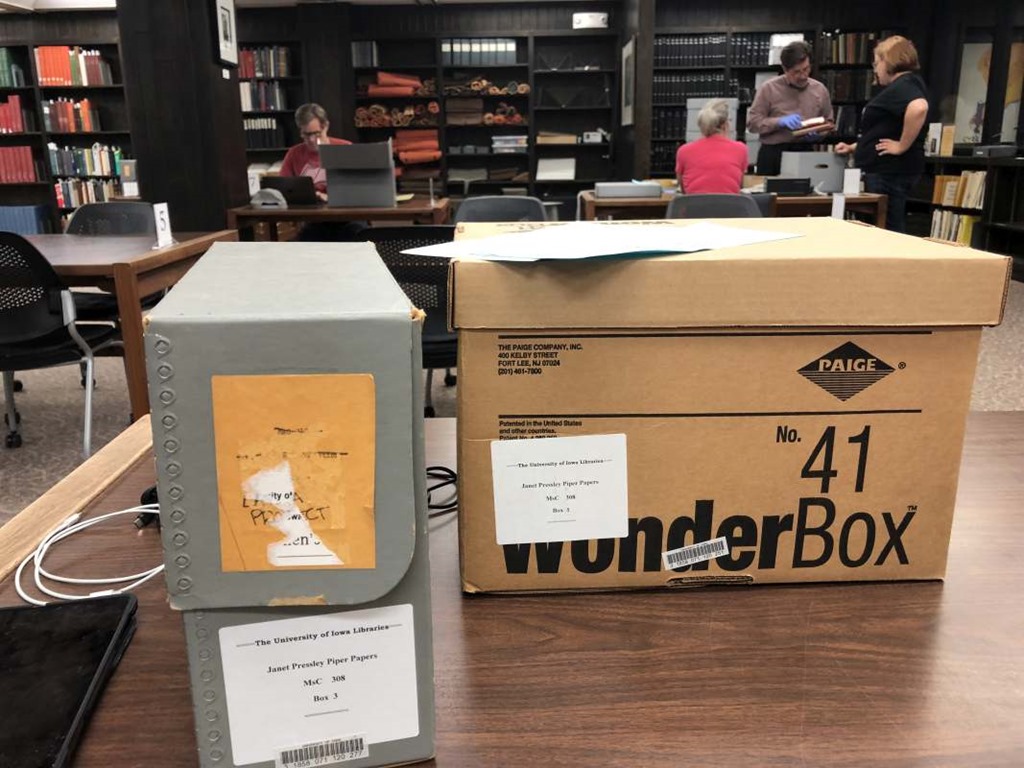
Janet Piper files 800

A small portion of Janet Piper’s papers in the University of Iowa collection, but my best guess at what might answer my questions about the beginnings of the Iowa Writers’ Workshop.

.

It’s taken me until the first day of July to read and comprehend what I captured for later perusal in those few last hours at the reading room. Later in June I also read Stephen Wilbers’ 1980 book The Iowa Writers’ Workshop  which aimed to show how that noted program came to be. Wilbers corresponded with Janet Piper while researching his book, duplicating a slightly earlier attempt by Janet W. Wylder to get information from Edwin Ford Piper’s widow. Wylder was attempting a similar book on the Writers’ Workshop that was never completed.**

Janet Piper’s papers include correspondence from these two with her, and a more than 100-page, response that seems to have gone through several revisions and titles, eventually being called “Edwin Ford Piper and the Iowa Workshop: a prehistory.”   It’s likely the best we have on the later adult life of Edwin Piper, who taught at Iowa for more than a generation and encouraged student creative writing throughout that time — right up until his sudden death just as the official Writers’ Workshop was launched. But spoiler alert: his wife’s account doesn’t live up to that promising title.

Since Janet Piper is even lesser-known than her husband, here’s a capsule bio extracted mostly from what I read in her papers and some web research:

Born (family last name: Pressley) in 1902 in Des Moines Iowa. May have moved to eastern Nebraska sometime in her childhood, and eventually attended college there and completed a Masters. She knew other young literary people in Nebraska and was already a poet who had won a couple of awards for her poetry while in that state. Began advanced degree work at the University of Iowa in Iowa City in the 1920s. Her academic work was interrupted by her 1927 marriage to Edwin Ford Piper, one of her professors, and by the following birth of their only child Edwin Ford Piper II in 1928.***  She writes little about the day to day of her marriage other than asides to the considerable duties of motherhood and being a faculty wife. She seems to admire and support her husband in his work and notes increasing change, stress, and conflict at the University then. She had resumed her academic work toward a PhD by the later 1930s — and then in 1939, her husband dies suddenly. She describes completing her final thesis defense in the midst of new widowhood in a disassociated state, flying on under auto-pilot. Various statements, some as corroboration, say this is likely the first PhD granted for a thesis consisting of creative writing.

She leaves Iowa in 1940 and within a couple of years takes up a teaching position at Sam Houston State in Texas, where she taught until retirement. In 1949 she made a suicide attempt by pills and was committed by her 21-year-old son to a facility in Texas, where she later writes she received the kind of coerced treatment, including electro-shock, that was common then. There’s some heartbreaking but formally-stated correspondence in her papers with her son from the early 1950s when they are estranged. She blames him for that mental facility commitment, and she says that he blames her for expecting too much of him as a child and not giving him appropriate attention.**** At her retirement in 1972 it’s written that she has continued to write poetry. She lives until 1997.

The Iowa Writers’ Workshop in their official histories started in 1936 — or it started in 1939 in other accountings. Edwin Piper had been encouraging students creative writing for decades, but the administration was now committed to allowing these efforts to be given academic credit and to become substantive toward degrees, a new concept for American academia. From Wilbers’ book and Janet Piper’s account, Edwin had some level of prominence in the mid-1930s in this now officially academic writers’ program — Wilbers writes it was more over the poetry sub-section while Janet Piper portrays her husband as being increasingly marginalized by the department’s administration, making the department head Norman Foerster a particular villain in the matter.

Yet, in a 1976 letter Wilbers includes in a footnote, a fascinating (but secondary to our story) figure Wilber Schramm recounts that he took over as director in 1939, being drafted into the job because of a pressing need occasioned by Piper’s death. In the Workshop’s official history, Schramm was the first director of the Iowa Writers’ Workshop, but Schramm doesn’t tell it that way.

Alas, from what I’ve been able to find out so far, there’s no solid information about how central Edwin Ford Piper was to instigating those Iowa Writers’ Workshop changes to how literary writing and writers live and work in our century. His career shows he’d long favored working with young writers, but Janet Piper portrays that she and her husband didn’t like some of the leaders making Iowa a pioneer in granting degrees, or their matter of going about it. There’s a cryptic report from the 1930s that Edwin didn’t like how the Workshop was turning into a promotional effort which I cannot completely evaluate. I was at first skeptical at Janet Piper’s constant reference to the malign forces of something she calls “New Humanism” ruining her life, her husband’s life, and literature in general. I knew nothing of that term, but a little research confirms that that was overtly the flag that her chief villain Norman Foerster and some of his allies were flying.*****

For a person like me who likes to know how directional changes happened, to see what turned us from one path to another, it was engrossing to try to chase this down, even if the crossroads turned out to be shrouded in fog. I’ll close by saying I’d like to thank Edwin and Janet Piper. Though they are dead, and they likely never concerned themselves exactly with my questions being formed in the 21st century, their papers gave me a window into their times and challenges. I’d like to thank the folks at the University of Iowa Special Collection section who were always helpful to this old and informal scholar. And thanks to you, rare and curious readers, who granted attention to this 1930s couple caught up in the changes in American literature and this 2020s couple celebrating their anniversary with their particular interests.

Watching my time carefully, just a few minutes before noon I packed up in the library, went down to the street, and swung into the car as my wife pulled up at the entrance curb. We were leaving for home.

.

*Coincidence: as I went looking into the beginnings of the Iowa Workshop, she visited the Devonian Fossil Gorge which I later read famed Workshop Director Paul Engle also liked to examine while still a student.

**This double pump seemed to frustrate Janet Piper. She at first thanked Wylder for rekindling her memories of her dead husband and her time with young writers at Iowa. Piper’s response appears to be a version of the around 100-page memoir which includes a long side-discussion of New Humanism. In her following correspondence with Wilbers she’s upset that Wylder had in effect ghosted her, and she wonders why Wilbers doesn’t have the material she sent Wylder. Moderns, remember: this is the era when producing 100 pages meant typing that singular ms. entirely and inhaling correction fluid, not just cutting/pasting and pressing send, or dumping pictures off your phone’s camera roll.

***More notes for Moderns: I can hear the ick factor bursting in your minds. This sort of thing was quite common, even into the years of my youth. Their contemporaries wouldn’t necessarily think this scandalous — or even unusual — though the age difference (56 to 25) here is broader than many of these male prof/female student marriages. That said, everything you object to was still possible despite different mores. Janet Piper’s papers give no indication it wasn’t a happy marriage.

****Whatever led Janet Piper to her suicide attempt isn’t spelled out in what I’ve read. The number of stressors and level of endurance it would take to be a single mom, a widow, a rare woman/academic in an era when that was even tougher than today, and while society is in the transition from the Great Depression to a World War — all that might batter anyone’s defenses. Similarly, I can only imagine a 21-year-old son having their only parent, their mother, trying to kill herself and being put in a position to try to decide what to do about that. I don’t know the particulars of Texas law at that time, but authorities themselves might be pressing for civil commitment. I’m not suited to be a novelist, but reading in Janet Piper’s papers on this matter I thought “There’s a novel.”

*****Let me resist trying to give an outline of New Humanism. Like a number of Fugitives, New Criticism proponents, and neo-Thomists that followed this movement and somewhat evolved from it, they tended toward political conservatism, and in the 1930s many were, at the least, permissive of fascist authoritarians, which some (including JP) might lay to them being already authoritarian in aesthetics. Janet Piper speaks distressingly of fascist Iowa professors in that era, even names some. Janet Piper’s papers that I’ve read don’t tell me exactly what Edwin Piper thought of this. Though a Chaucer specialist carrying that interest into a project completed at the end of his life, Edwin’s papers don’t demonstrate a pervasive appeal to timeless classical truths, and his folksong fascination would likely oppose a tight highbrow/middlebrow/lowbrow outlook. I can’t say for sure what Edwin Piper’s politics were, but his widow seems left/liberal in the 1970s and makes no mention that they disagreed on politics back in the 30s. Janet Piper’s summary that “politics” led to her husband’s early death leads to the question: what level of politics? In her mind it appears university politics and civic politics were indivisible.

When asked about this era in the 1970s. Janet Piper continually wants to talk about what she views as more than a cultural tendency or scheme, and more at an active, effective, powerful conspiracy originated by New Humanism. At times she’s detailed and footnoted with her charges, at other times vague and implying great harms in a broader and fuzzier way. More than once in her papers she refers to Ezra Pound, T. S. Eliot, and Conrad Aiken as the heads of a secret cabal advancing evil work — and I can’t quite “read” if I should take those expressions as satiric exaggerations. In a letter from Robert Hillyer, he agrees with her that she’s not a crank, using that word as if it had been applied to Janet. In what I read she spends less time than my curiosity would like expounding what she prefers in literary or cultural theory rather than what she damns.

It would take more study and knowledge to fully understand or evaluate that element in Janet Piper’s later writing. This element, often present in what I read, shows a life of great reading and learning exceeding my own, evidence of great energy for a person roughly my age — and likely at times I can’t quite measure, effective moments of literary criticism and insight.
Paying the Piper chapter 1

Very often I find myself unable to tell a story simply. While I find internal joy in expanding complexity there is a painful element too. Even when under the spell of things I’ve experienced and learned, I retain enough self-awareness to see what effect my expression has on others, the burden of strangeness. Then the reach between the teller and the listener becomes haphazard, unstable — pile it too high and it tiresomely topples — and so in some break for breath partway in, I realize I’ve dumped a cluttered mass of thought debris on a listener, long past any interest.

Perhaps this is why I’m attracted to lyric poetry, constrained as it is to moments, often held tight within the stiff glass bottles of forms.

Here’s a personal story that’ll go many places coming from the place I find myself in this June. It starts, I’ll guess, earlier this year when I came upon a poem, “The Last Antelope,”  a striking, empathetic account of the end of an animal’s life and wildness after settlers captured it. Edwin Ford Piper was the author, and there were only scattered bits of information to be found about him. Scattered and bits do not constrain my curiosity — if the bits were great distances apart, the space between them could hold a lot of things: born 1871 in rural Nebraska, parents part of early European-origin settlement there. Largely self-educated in a land of necessary child-farmhand-so-never-more-than-half-year schools, still goes on to university in Omaha studying literature with a specialization in Chaucer, and then to the University of Iowa where as a professor he helped establish the idea of teaching and granting degrees in creative writing.

The modern convention of a university as patronage for artists, and the rise of the credentialed MFA-holding poet is not without controversy — but isn’t it odd, this man who taught himself in a small town on the fluid boundary between the 19th Century Wild West and the 20th Century staid Midwest took that journey.

In the middle of this, the same man had a compulsion to collect songs ordinary people brought with them while journeying, the words and music carried in the light baggage of memory. He wrote down songs his relatives and townsfolk knew by heart. He asked others to send him more by mail. He paid particular attention to the songs of those on the move: hobos, cowboys, and other traveling workers. Did this connect with his literary poetry? There are no recordings of Piper reading his poetry, but accounts say he declaimed it with a musical lilt — perhaps like the surviving recordings of Yeats, or maybe like the more bombastic Vachel Lindsay — and at times he would break into full song. His students took to calling him “The Singing Professor.”

Since this Project is “Where Music and Words Meet” you can see why I’d be attracted. And I’m a small-Midwestern-town boy, though without degrees. But did that seem strange then, to mesh high culture and the songs remembered by old women and rude mechanicals?

Piper was born just west of the Missouri River in Nebraska — and in Illinois, just to the east of the Mississippi River and less than a decade later, Carl Sandburg was born to an immigrant railway blacksmith who signed his name with an X. Iowa, the state where I was born in the middle of the next century, and Minnesota, the state where I’ve lived the longest, sit in a delta between those two tremendous rivers. Sandburg too mixed the latest in Modernist poetry with folk songs he collected and sang. Did Piper influence Sandburg? Did Sandburg influence Piper? Or are they the same genus of plant, raised in the same climate, but in separate plots? Questions.

Answers fork like river systems. Even with little information being readily available on Piper, I was already in flood stage. And here’s how much my wife loves me: for our 20th anniversary she agreed to go on a road trip with me to Iowa City and Sandburg’s home-town of Galesburg. My scenery in Iowa City? An archive of Piper’s papers* held in the university library there. Our grand museum of the arts of poetry and song to visit on the trip: a railway worker’s shack in a small rust-belt city, a town worn-out but still running like a paint-shedding Oldsmobile.

Two considerations worried me as I thought about this trip, one for my wife and one for myself. For my wife, I worried if there’d be something rewarding for her to do while I enthused at the library. She was able to solve that one easily, locating nature reserves, parks, and trails within an hour’s drive. I often tell her that she’s a nymph, and I complement her on how seriously she takes her job to supervise the plants and animals when she returns with soggy hiking boots from her hikes with pictures of landscapes, mushrooms, wildflowers, birds, and other critters. I love her pictures and stories on return (her stories briefer and better organized) — but my old joints ache just thinking about hiking for hours.

For myself I worried about my old-ager endurance. The library was two-thirds of a mile from where we’d stay. I’d need to hoof it with my laptop bag back and forth, which would have been a trifle in my youth, but nowadays longer term standing and walking is troublesome. I considered taking a bicycle with me, which would have made the library to-and-from easy, but a lot of hotel/AirBnB places don’t have any good places to lock up overnight, and on further consideration I thought that a bike would just be one more thing to worry about, taking my focus away from the trip’s main goals. And then I worried too about spending full days at the library’s special collections reading room. Because my time was limited, and to minimize the walking, I planned no break for lunch. I’d need to keep my focus and energy up, something that I have not been consistently able to do this year even with all the comforts of home.

On average I bike at least once every day in my normal routine, often in the morning. In the past two years I’ve not been a longer distance bicyclist, but 30-50 miles a week easily exceeds those 150 minutes exercise recommendations, and it lets me get to a café for morning breakfast and handle a lot of routine shopping and other trips. I ride year-round. In 2016 I bought my first 21st Century winter bike with studded tires; and in 2019 I upgraded the winter season bicycle to a Fat Bike with monstrous 4.5-inch-wide tires that handled ice and snow with the challenging ice ruts and potholes that my city’s current “We’ll get to all the streets in 3 days after the snow stops” plowing regime supplies. My overall stamina for the walk wasn’t my worry so much as how well my joints and stiff back would take the more load-bearing walk.** And to make it through the day I’d planned, there’d be no old-man’s afternoon nap either.

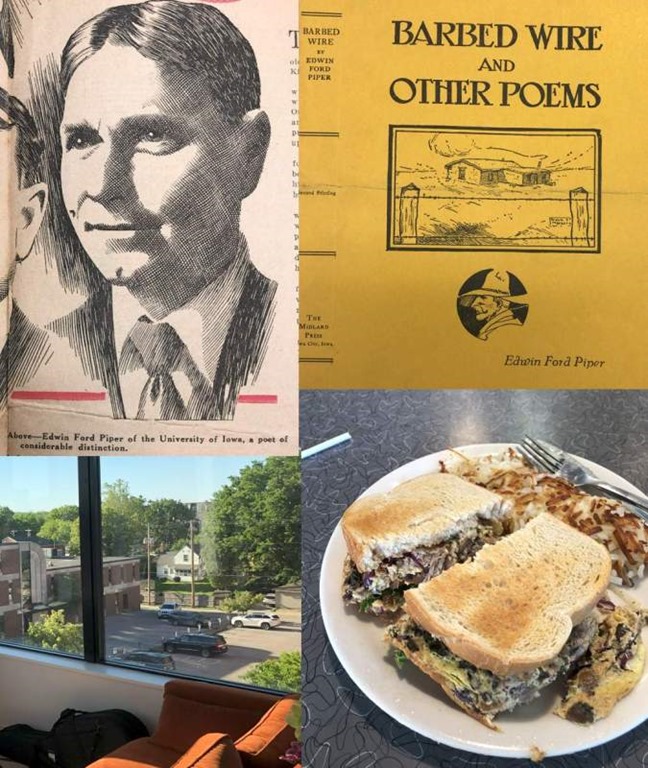
Pay the Piper Chapter 1 800
Piper, once a “poet of considerable distinction.” A later version of his collection Barb Wire. My Iowa City view, and yes the guitar got some use. Example breakfast.***

.

The first day we arrived at Iowa city was hot and very humid, so I put on my best hot weather clothing. Spouse-nymph headed off at dawn for her day’s supervisory encounter with nature, and I planned a big breakfast fuel-up. I’m a “eat little meat” kind of guy, but for good or ill I take the lacto-ovo part of my lesser meat diet seriously, so I’m a big frittata, omelet, hash, scrambler kind of guy most mornings. I note that I eat like an old-time farmer, despite never farming, but the good thing about this higher fat/protein kind of meal is that it can hold me until supper, and that was my plan.

I put on my best hot weather clothes, slung my bag over my shoulder, and headed for the university’s main library building for my encounter with poet-professor Piper’s papers.

Thus ends Chapter One.

Here’s a musical performance I put together in March of Piper’s “The Last Antelope.”   You can play it with the audio player you should see below. No player?  This highlighted link is another way to hear it.

.

*When I arrived at the library archives will-call desk, I asked them to pick Piper’s Papers. The librarian suggested puckishly that I was nearly reconstructing the old tongue-twister folk-rhyme, Roud Folk Song index 19745.

**Local papers/forums are full of folks who bemoan bike lanes in my city, often remarking that “not everyone is young and fit.” Despite that, most bicyclists I meet and see on my city’s streets aren’t of the MAMIL (Middle-Aged Man in Lycra) variety — and I’m maybe 1.5 letters of that acronym. I joke with my wife that as my joints get older, a bicycle is becoming a “fore-and-aft wheelchair” for me, allowing me increased mobility and beneficial low-impact movement for the old joints.

***That’s a St. Paul Sandwich: egg foo young on sourdough with lettuce, tomato slices and mayo. Near as anyone knows, my Twin City of St. Paul has no tradition regarding it, and no restaurant there serves it now. Its origin is something of mystery.

Pea Brush

There are more things than well-made that a poem can be — but as someone who’s worked to make their own poems work, I can use that experience to admire what Robert Frost does in today’s piece.

“Pea Brush”  is a rhymed iambic poem, based on four-foot lines, but it throws in enough variation that it never seems like it’s limping along in its gait. The rhymes aren’t fancy, and at least for me, they quietly chime along in the background without calling attention to themselves. This is prosody that isn’t bragging or showing off. It was easy to sing in my rough-hewn manner for the most part,*  but if I was to reformat it into blocks as if it was prose, it wouldn’t seem all that strange either. Indeed, as I performed it, I wanted to stress its conversational quality.

If you’d like to follow along, here’s a link to the text of Frost’s poem used for my performance.

I myself haven’t had a garden in decades, but one friend of the blog Paul Deaton covers their kitchen garden regularly at his blog, and alternative Parlando voice and keyboardist Dave Moore has a garden that we talk about sometimes. I could imagine reading the first-layer plot of this poem as a post Paul might make. “I’ve arranged with a neighbor to use the small limbs from some birch trees he’s clearing as poles for some of my climbing garden plants. When I went to pick them up on Sunday, I noticed bent-over wildflowers** blooming under the brush pile. My reuse of the felled branches will help my pea vines and give the wildflowers room to grow.”

Besides this clear plot line, there are fine clear images in the poem’s story: the smell of sap still in the air from the just-cut trees, the pause in the frog’s song, the near-like to a baby’s grip of an adult’s finger to the tendrils of a climbing plant on garden stakes.

Pea Vine Tendril!

 Wishing good luck to all the gardeners reading this.

.

Below this surface, what is the poem trying to convey? The poem’s speaker (as a character perhaps a more prosaic farmer than the poet and indifferent farmer that Frost was) just notes the practicality of the arrangement — free garden stakes — while letting us in on the blooming of May flowers and the promise of harvest aided by this arrangement. Frost the poet has written this well-made play, painted this scenery, blocked and directed its performance. The play portrays the give and take of humankind in nature. We’ll grow (and consume) the peas with their infant tendrils. Neighbor John has amputated the treescape for his own agricultural designs. These are planned acts of life and death. The episode of the frogs has them portraying those things outside our plans, their Sunday-service silence to hide from a two-footed demigod that might come to capture them to a final silence.

I’ll note too the poem’s ending “had to come” interjection breaking the meter to make a final statement of the budding wildflowers that couldn’t wait for humans to make their plans.

I had to make do with a single hour to get this musical performance down today, and I chose to grab an acoustic guitar to get this accomplished. The results felt right enough to produce this new piece that you can hear with the graphical audio player below. No player?  This highlighted link is an alternative that will open a new tab with its own audio player.

.

*The line “The same as you seize cat’s-cradle strings” is a bit of a tongue-twister. And while I get Frost’s image clearly in that line’s stanza, the syntax is a little disordered I think.

**Frost names his wildflowers as trillium. I don’t know if Frost was the exact botanist that his friend Edward Thomas or his great New England predecessor Emily Dickinson were. Neither am I, but I’m often open to researching specifics like this in poems. I find that one of the species of trillium that grows in Frost’s New England is the Nodding Trillium, a variation that grows crooked stems naturally, not because a brush pile has altered its growth.

Happy May Day to the workers in song

It was quite the April for me, and I’m resting up today before getting on with a bunch of tasks I’ve put off while working on the accelerated posting schedule for National Poetry Month. Readership was up substantially, busiest month ever for visitors at this blog, and page views blew past the old record by over a thousand. I should be better at replying to your comments and encouragement, but besides being focused on the work I have a mental Catch 22 where I often can’t decide the best way to respond, and in that indecision put off responding.

Car Sandburg - The Sandburg Test

.

I didn’t put anything new for International Workers Day today, but I’ll repost this piece with Carl Sandburg’s words from his longer poem “The Windy City”  that I created for last autumn’s U. S. Labor Day. In posting it last year I suggested something I had bounced off my old compatriots in The Lake Street Writer’s Group, something I call “The Sandburg Test.”

Let me suggest a rough analog of the Bechtel Test.  Let me call it The Sandburg Test. To be clear, it’s not my suggestion that every poem has to be about work, about the things we do for our daily bread. But, if we are viewing an anthology or substantial poetry collection from a poet, to pass The Sandburg Test it has to have poems that deal with work in some substantial way. How does the speaker or characters in the poem relate to work? What are they doing that work for? What is it in presenting them that portrays something about life? What are the mysteries, sensations, and systems of that work?

Here’s that musical performance of Sandburg’s words from “The Windy City” accessible with the graphical audio player you should see below. No player to been seen?  This highlighted link is an alternative.

.

Hills: children’s poetry, but written by a child

It’s 1914. A single mother is listening to her 4-year-old talk to her imaginary playmate. Has this always happened? Did children in pharaonic Egypt or ancient Ur exercise their fresh language skills and nascent social skills with such fancies while being buckled into their camel child-seats? There was no Mesopotamian Facebook — the only way we’d know this would be if someone wrote it down. No such accounts survive.

This mother was a professor of English at Smith College, associated with artists: visual artists, writers, musicians. She wrote poetry, and I’ve read she knew Robert Frost and Walter De La Mare. She chose, as an artist might do, as a mother might do, to write down some of the things that her child was saying.

At some later point, the daughter was asked if she knew what her mother was doing. “No, she was always scribbling” the daughter replied, she made nothing of it. Eventually, her mother revealed that she was writing down what the child was saying as poetry. What the child invented and spoke — at first to her imaginary friend, and now to her mother — was transcribed by the mother into lines and stanzas. The mother’s name was Grace Conkling, her child/poet was Hilda Conkling.

Short, compressed, Modernist free-verse was becoming a thing in America. Ezra Pound’s first Imagist anthology and Carl Sandburg’s Chicago Poems  were published in 1914. Edgar Lee Masters’ The Spoon River Anthology was released on New Years Day in 1915. The child’s mother was savvy enough to know that a few lines with fresh, direct imagery could be a poem even without strict meter or rhyme.

Over the next few years the mother and child produced poetry this way: the child speaking it, the mother writing it down. Some of the poems were sent to magazines by the mother, and they were published.*  In 1920, a book-length volume of the poetry, Poems of a Little Girl,  was published. It was successful enough that two other Hilda Conkling collections soon followed. Amy Lowell wrote a preface to the first Conkling book. I read this week that Louis Untermeyer called Hilda “the most gifted of all” child geniuses. Rimbaud, dead for 30 years, couldn’t complain. When the editors of our pair of 1922/1923 poetry anthologies for kids made their choices, they included four of Hilda Conkling’s poems, an unusually high number. Only Wordsworth and De La Mare had five selections in the volume that included Conkling — Shakespeare or Robert Louis Stevenson only warranted 3 each.

As I revealed earlier this month, Conkling’s poems are the only Modernist poetry in the Girls and Boys Book of Verse.**   That may somewhat account for that level of representation. The first two sentences in that book’s foreword say:

“Because real lovers of poetry know that time and place are of little importance, the poems in this book are brought together with no sense of the period in which they were written. From “The Song of Solomon” to Hilda Conkling’s “Spring Song” they are here because they are beautiful, with a beauty that neither years nor events can change.”

So, Conkling is there to represent the here and now, a representative not only for being the most recently published, but because she still hadn’t reached the age of 12 when those words were written — she wasn’t just content for an audience of boys or girls, she was still a young girl, plausibly a future as much as a present.

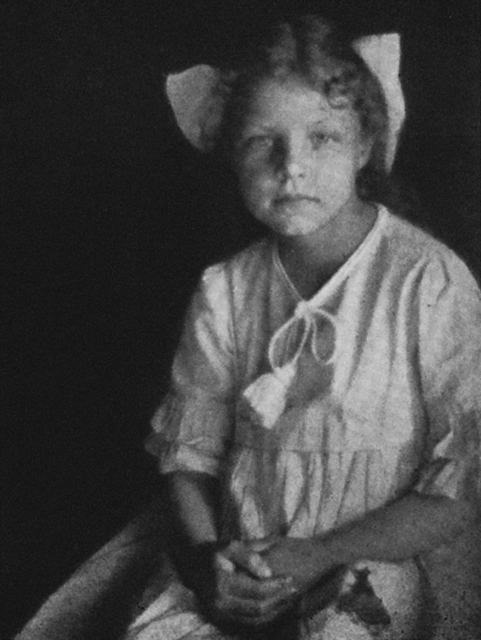
HildaConkling

Verse for children? I’m children, and a Modernist too!

.

Those who’ve been reading along this month know that since our anthologists decided to produce a gendered pair of books, The Girls Book of Verse  and The Boys Book of Verse,  I’m asking readers here this National Poetry Month to guess which book included the poem of this little girl. Answer below.

Hilda Conkling is now largely forgotten. When one looks at the published poems today, they still have their charms. When I’ve tired of reading so much derivative and rote late 19th century poetry and those 20th century poets who didn’t even try to “make it new” Conkling’s poems can be refreshingly free of the dead hand of influence or fears of being scored on exacting verse-craft. There are still effective lines in many of them. Unpretentious but striking images pop out. Professor/mother Grace Conkling was adamant that she didn’t edit the poems, that as their process developed she would read the transcribed poems to Hilda and that she would always obey Hilda’s corrections of anything she got wrong. What’s unsaid is how much selection or excision Grace did, what poems never were transcribed as unremarkable or if any lines were never transferred from scribbled notes to manuscript. Young Hilda Conkling wouldn’t be the first artist whose work was magnified by a sharp blue pencil and a shortening scissor wielded by a skilled editor.

Somewhere around the time the Hilda Conkling books were published, mother Grace, perhaps wanting Hilda to try her wings as a now literate adolescent, suggested that Hilda start writing down her poems herself. This seemed to break the spell. Some of Hilda’s published poems show a clear desire to not only emulate her mother, but to please her in doing so, so a motivation might have been stilled. Another factor: Grace may not have realized that like a “cold reader” charlatan can fake mind reading by picking up subtle clues from someone as they try to construct a convincing tale of reading the thoughts of a mark, that the very act of being the transcriptionist and first audience for Hilda’s poems might be part of their authorship.***

As far as anyone knows, Hilda stopped creating poems just as she became a teenager. If there were any later-life discarded drafts from adult revisiting of her childhood inspirations, they are unknown. She lived with her mother Grace until Grace died, and made her living working in bookstores in Boston, two things indicating that Hilda could have continued to connect with literary culture if she’d wanted to. Hilda’s story, her poetry, once held as so remarkable, became a literary curiosity that only attracts folks like me who want to think about art and Modernism thoroughly.****

Hills poem

.

I haven’t read anyone claiming that Hilda wrote her poems because she remembered past lives, because she was an “old soul” — but then or now, that sort of woo thing might have come up. Today, as I was finishing this post, days after completing the musical arrangement I used for her poem “Hills”  that you can hear below, I wondered how to explain the musical choices I made for that original music. The music is sorta-kinda South Asian, based slightly on my appreciation for those World Pacific Ravi Shankar LPs that entranced me as a young man and the Indian physicians I worked with in New York in the 70s. Specifically though, it’s more at the cod-raga experiments that many Western folk/rock musicians took to in the 60s. I always liked that stuff, and it’s more approachable with my musicianship than the real thing. Was something  asking me to musically express a reincarnation theory?

To hear my musical performance of the 8-year-old Hilda Conkling’s poem “Hills”  use the graphical audio player below. No player manifesting? The skepticism of your way of reading this post may be blocking the ectoplasm! Knocking on this highlighted spirit-table link will open a new tab with its own audio player.

.

*Poetry Magazine  published Conkling’s poems alongside a great many of the formative Modernist poets. But she also appeared in Good Housekeeping.

**As a fan of early Modernist poetry, I tell myself that I could have easily found a dozen or more suitable Modernist poems published before 1922 to include in their books.

***I’m also reminded of the curious case of acclaimed poet James Merrill and his partner David Jackson using a Ouija board in the creation of poems in the 1970s.

****I think of the work of New York School poet Kenneth Koch, who in the 1970’s started teaching poetry and creative writing to grade school children by reading them Modernist poetry (including poems that our 1920s anthologist overlooked) and then prompting them to create their own poems. A short web search revealed nothing so far, but the brief phenomenon of Hilda Conkling might easily have come up alongside Koch’s teaching ideas.

I have some hopes of finding the energy and audacity to write about a new attempt this year by a contemporary poet to inspire children to write poetry, but only time will tell on that one. Girls or boys book of verse for this poem of genderless camel-hills bearing the world on their backs? Girls.

The Coromandel Fishers

It’s Poem in Your Pocket Day in the midst of U. S. National Poetry Month. This lily gilding observance aims to integrate poetry more completely with ordinary life. A great way to do that would be to bring poetry and our workdays together, something we rarely do.

For National Poetry Month I have been selecting and performing poems from a pair of poetry anthologies published in the 1920s for children: The Boys  and The Girls Book of Verse.  There’s little in the two books about ordinary work life. You might explain that as “Well, those books were for kids after all” — but the same could be said about many a poetry collection or anthology, then or now.

Our last piece, a famous poem by Wordsworth, touches on the weariness of work, speaking of the getting and spending part of life. Other than military service, there is little else in these children’s books about working for a living, so today’s piece stands out. “The Coromandel Fishers”  sounds, even on the page, like a folk song, a work song, something that might be sung in the tedium and effort of daily labor. It’s author, Sarojini Naidu, published it in a section of her poetry that she called “Folk Songs,” so it really does ask to be sung, which you’ll see below I’ve done.

the Caromandel Fishers

A reminder of the casual game I’m playing here with this pair of gendered anthologies: was this in the girls or boys book of verse? Answer below.

.

Naidu is little known in America but led a fascinating and significant life. She was born in an India ruled by Great Britain as a colonial possession, was educated in England, and during that education touched bases with literary figures there. William Butler Yeats’ father, an artist, sketched her as a young student, and while a young poet she was called “The Yeats of India.” Despite that start, she more-or-less left poetry for a life of political activism. Upon her return to India she became a key lieutenant of Gandhi, marched and strategized with him, was imprisoned twice by the British for her activism, and after Indian independence served in the new Indian government.

Sarojini Naidu sketeched by John B Yeats and with Gandhi

The young Naidu while studying in England as sketched by W. B. Yeats’ father, and during the famous Salt March with Gandhi. Gandhi thought the Salt March would be to arduous for women, Naidu thought otherwise.

.

I happen to have had a few more hours to work on music this past week as my teenager has started their first job. I, an old man, think often about my decades of paid labor. I recall the dailiness — yes, sometimes the weariness — of that. But here’s what I think of more often: the coworkers — A fair feld, ful of folk, fond I there bytwene, of alle manere of men, the mene and the pore, worchyng and wandryng as this world asketh.*  I recall the thereness of these, my colleagues for the majority of my life’s waking hours, working in common cause. I’d often have a poem in my pocket in those years, a draft of my own, or a song of another on those days after days. Another thought: not often enough was the poem in my pocket about them, about the world of work we shared. Wordsworth said in his poem I sang last time that “The world is too much with us” — and we poets too often, too completely, stop at that phrase. I tried to outline in response: Wordsworth’s poem is more complex than we think it is, that his poem says everything is out of tune. Naidu’s fishermen, like the political activism she joined after writing this poem, says that we may sing to align us with the world.

Here’s an anecdote I read about Naidu. At the end of her life, she was weary from the wear-and-tear of political administration. Doctors said she must stop at whatever place she found herself, but she was restless, she could not rest. Finally, she asked a nurse to sing to her, and she fell asleep. In that night she died.

A couple unrelated last notes, and then you’ll have the opportunity to hear my performance of the song I made from Sarojini Naidu’s poem. She seems to have been the only person of color to have a poem in the two 1920s children’s anthologies,** and just as Wordsworth’s from last time, her poem of a world that’s with us, late and soon, ends up invoking the god of the sea. The audio player to hear me sing Naidu is below. No player? It’s not washed overboard, some ways of reading this blog hide it, so you can use this link as an alternative.

.

*Autocorrect didn’t have a stroke — can’t you read English? It’s a passage from the medieval poem Piers Plowman:

A fair field full of folk · found I in between,
Of all manner of men · the rich and the poor,
Working and wandering · as the world asketh.

**A fault I wouldn’t expect in any modern anthology for children, there are just too many good choices that are well-known and published now. It wouldn’t have hurt them to include a poem by American Paul Laurence Dunbar, or one of the translations from Chinese or Japanese by Arthur Walley — though the latter were new on the bookshelves at the time. I’ll allow them an excuse on a case near enough to the one for these 1922-1923 anthologies’ almost complete exclusion of Modernist poetry.

Are you taking part in this month’s quiz on which gendered book of verse Naidu’s poem appeared in. It was in The Boys Book of Verse.

Each in His Own Tongue and the “middlebrow” problem

Social media likes controversy, so it’s no surprise that two things have recently mingled there in provocative assertion: poet Mary Oliver and the dread “middlebrow” epithet.*  It’s not a long bridge between the two: Oliver’s poems are put forward as all too middlebrow in this charge, and middlebrow is a sign of significant lack of ambition or achievement. I’m not a fan of the term “middlebrow,” for a hierarchy is implied and I don’t care for hierarchies much — but to speak of this I should define middlebrow poetry. A definition that works for me is: poems that remind us of something we already sorta-kinda know, but maybe couldn’t quite put into words. These poems are usually immediately understandable on first reading by a significantly literate reader.

Why’s this bad or lacking? If this is a singular mode it rules out poems that tell us multivalent things, or mysterious things that require more thought to comprehend, thought perhaps taken in stages. It rules out shocking, utterly surprising poems. And such poetry doesn’t feed our playful desire to puzzle-solve with clues we are proud to have acquired.**

My view? I think various modes of poetry (even differing modes of reading the same poem) have diverse values, and I’m more than OK with that. Poetry’s eye should be the insect’s compound eye, containing a hundred, a thousand, ommatidia. And so, if it was up to me, the best cultures wouldn’t be restricted to, or rewarding of, one poetic mode. This may be a visceral thing with me: I get bored with all one type of thing quickly. Building towers of hierarchies might be fun, and illustrative of what one can stably hold long enough to build such a tower, but in the end, the domain one will look out on will have a lot of scenery that isn’t in your tower. In the right mood, I can get pleasure out of looking at the commonplace apprehension poem and a “difficult” avant-garde one — and in the wrong mood on my part, or insufficient achievement in the poet, not a touch of pleasure in either mode. And beyond all this meaning and metaphor, there’s the oldest part of poetry, the part even young children understand, that poetry also has abstract pleasures like music has — poetry is the instrument on which the meaning plays.

A great many of the poems in our pair of 1920s children’s poetry anthologies are as middlebrow as any Mary Oliver poem brought up on charges in this controversy. This shouldn’t surprise us. A modern children’s anthologist looking to duplicate the task of those in the previous decade called The Twenties would, I think, do likewise. Some of those pressures would be commercial: what will sell to parents, libraries, teachers. Some would be practical: these children aren’t yet bored with the lessons of the world — those lessons are new and useful building-blocks for their youthful towers — and maybe a lesson of my old age (and a lesson of Mary Oliver) is that I shouldn’t have been bored with the lessons of the world either.

I think too of what happened as the first childhood readers of these poems in the 1920s progressed into the economic distress of the Great Depression, the rise of nationalist dictators, the Second World War, and the Damoclean Cold War. All through the middle of their lives how much time would they have for poetry that offered them the highbrow pleasure of gnostic meaning, of shocking new combinations and collisions?

The answer is: some would find the time, some went on and made their own verses in those modes — and many others would not. Some kept food on the table, kept bolts tightened on airplanes, tended the sick, kept fuel in NATO tanks facing east. Some had their yet young lives ended sans poetic envoi. Others desired, birthed, and raised my generation.

Highbrow, middlebrow, it is neither sophistication nor no-nonsense populism to forget either part of that cohort.

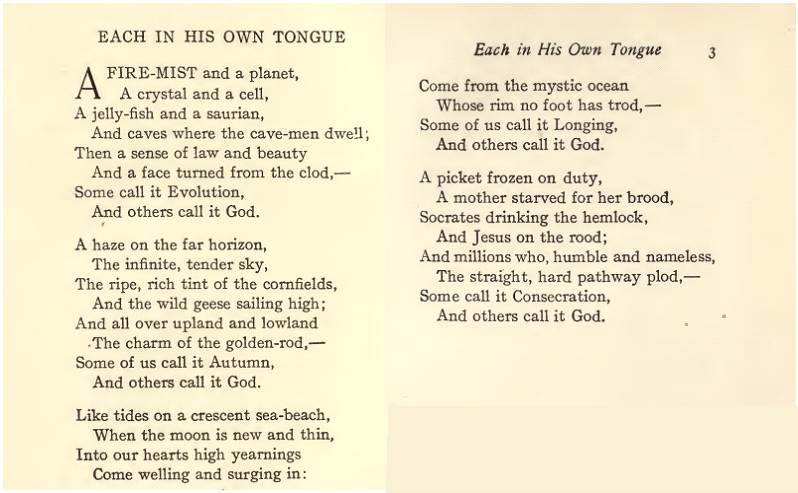
On to today’s poem, an example of a poem that earnestly intends to be a lesson: “Each in His Own Tongue”  by William Herbert Carruth. Look! Mary-Oliver-approved wild geese make their appearance in it, decades too early! I also offer this month’s puzzle challenge: the pair of 1920’s anthologies I’m drawing from were gendered: one for boys, one for girls. So as with each post this month, you’re asked to guess in which volume did the poem appear. Answer lower down.

Each in His Own Tongue

dedication to Ina Coolbrith

Here’s today’s poem as it appeared as the title poem in a book-length poetry collection by Carruth.. Marginalia picked up in the scan of  a copy of that poetry collection. Wonder who Ina Coolbrith is? Here’s a link.

.

The brief Wikipedia stub for Carruth tells me he was “president of the Pacific Coast Conference of the Unitarian Church.” One of my preacher relatives once said of an Unitarian school he’d attended “The only time anyone would speak of ‘God’ is when someone stubbed their toe.” I read this morning a brief poetic knot of a summary of Oliver’s earnest lessons delivered by A. M. Juster who wrote that he’s “Not a big fan or a big detractor of Mary Oliver” but then sums up his impressions of her work by saying “I also think her spirit wanted to write religious poetry, but her mind wouldn’t let her.” Each in their own tongue I’d say, ungendering Carruth. Carruth wrote “His,” and his poem appeared in the Boys Book of Verse. You can hear my musical performance with the audio player gadget below. No gadget to be seen? This highlighted link is a backup which will open a new tab with an audio player.

.

*Here’s a link to a well-done post on the controversy, and a refresher on Oliver’s poetry if you are not familiar with it.

*This last factor is less-often laid out as I just did, perhaps because it doesn’t seem serious when complex poetry is discussed. But let’s admit it: great portions of humanity loves puzzles and challenges in which they feel rewarded if they can progress farther than some other human.

Piping Down the Valleys Wild

From my Parlando outlook, this is a fine choice to start off a look at our twin girls and boys 1920’s poetry anthologies for National Poetry Month. Today it’s a poem by William Blake, a poet still known and rated today, and a poem that includes a child and praise for music inside of it. It’ll make a natural beginning I figured.

After I made that decision, I started to notice a couple of things. The poem began to seem stranger than it somewhat straightforward first reading might suggest. The odd thing I noticed first was the amount of insistent repetition in it. Lyric poetry, and even more so poetry meant to be sung. will often refrain lines, repeat entire verses or sections — look at many a modern charting pop song and you’ll see hooks as repetitious as today’s poem — but it still struck me as odd. The child continues to ask for song. The piper plays it. Immediately, the child asks for the song again. Parents experienced with young children may relate here — insert your own bête noire kids-song ear worm and insatiable toddler — those requests can be cute and dulling at the same time. Blake’s child is laughing at the time of the first request, weeping at the second, Why? Best guess: because the song is over, and they must hear it again. But then the child asks for a third song — perhaps the same one, perhaps not — and they are asking for it without the piper playing the pipe. Since most pipes are wind instruments it’s likely the piper in the poem hasn’t been singing the first two times.*

Combining the child’s responses after the first two requests which the piper has immediately fulfilled (laughing, weeping) the child “wept with joy” after the third go-round.

The picture I get here is joy in repetition, and woe at ending. The child makes one more request: the piper should cease the singing and write this music down. The piper MacGyvers up a pen and ink and gets to scoring.

Piping Down

Simple guitar chords on the chord sheet this time.

.

Then we’re told the child vanishes. This shouldn’t surprise us. If we were paying attention, this child appeared to the piper “on a cloud.” This child wasn’t a flesh and blood child — wasn’t one of the potential readers or listeners to the anthology’s contents — it’s a spiritual emanation of childhood.

OK, that’s a little weird, but Blake was a self-confessed visionary, and literary inspiration stories can be peculiar. Just another day at the poetic office for Blake. And as the piper makes his own pen and ink, I thought of one of the things that I found most inspirational in Blake’s life: that despite literary poverty he mastered the means of creating his own poetry, art, and engraved books.

Just after completing my musical version of this, another area of concern came to me. Just how strange did this seem to the children in the 1920s or to their parents who might read this to them if they were younger children?

I was a young child in post-WWII America, and in my time and place, I would have been puzzled. About the only piper I’d have any reference to was The Pied Piper, a page-bound storybook character. Yes, various kinds of musical pipes were extant then, as there would have been in the 1920s, but nothing I would expect in my time to see being played in wild valleys. Blake’s poem was over a century old when the 1920s anthology was made—  maybe late 18th century England had itinerant rural pipers?

As they grew up, the child reader, then or now, would likely understand this is fantasy, even if exactly what Blake was getting at with his fable might be missed. Its value would remain as a set of word-music that speaks to the joy found in music and the arts.

Is anyone trying to guess if this was in the girls’ or boys’ anthology? Male author. The cloud/child is male, the piper is not gendered. Is joy in music a gender role thing? Not really.

wild valley piper 3

Wilderness cumulous-carried spirit children are not a reliable compositional prompt.

.

It’s from the introductory section of the “for girls” book. My music is a simple folk music setting: acoustic guitar and bass, and eventually an Irish tin-whistle for piping. The tin-whistle is a played VI.** Two other instruments make a subtle entry in this recording. There’s a quiet electric piano in the piece, played and mixed so low it almost sounds like an overtone of the guitar, and another VI of a small obscure 1940s keyboard instrument, the Solovox that comes in for the next-to-last verse.

The Solovox was an FDR-era monophonic analog keyboard synthesizer, with glowing tubes and a wood-veneer case like a large table radio of the time. I used it for two reasons. If this song floats in fairy-tale time with children appearing and disappearing out of clouds, I thought the piper’s sound could change from the tin whistle to something more mid-20th century as a marker of how the children the anthologies were written for grew and changed. But also, I’ve seen, even briefly played, a particular real Solovox. The mother of alternative voice and keyboard player in this Project Dave Moore had one, and when he was young his mother would play piano and deftly slip one hand over to play melody lines on a Solovox. Dave now has his mother’s example of this old instrument, and has had it fixed so it plays, though with some glitches.

To hear “Piping Down the Valley’s Wild”  you can use the graphical audio player you should see below. Player vanished?  This highlighted link will open a new tab with an audio player. I plan more poems, adapted musical pieces, and observations from The Girls/The Boys Book of Verse  coming up soon.

.

*There are methods to do that, where a singer alternates using their breath to sound the instrument and to sing lines of song. And there are bagpipes and the like where the wind comes from a bellows. But the child has asked the piper to drop their pipe and sing, so it stands to reason this is a request for the piper to sing a song with words after playing instrumentally for two renditions. The song then progresses from melody, to sung words, to finally written words — a plausible metaphor for the writing of a poem.

**I explained VI/Virtual Instrument technology last time, but in short it’s playable software that tries to contain all the sounds an actual instrument makes, often by capturing all conceivable notes and many articulations of those notes with a microphone it makers placed on the real instrument.

Wanderers Nightsong II

Despite my inveterate bicycling and my wife’s love of nature walks, I’ve never been much of a hiker, and I’m very much not so in my old age. None-the-less I was charmed this winter when I saw this short poem because it appealed to my mental wandering. Walk with me: it’s not all that long a hike to a short audio piece.

When I saw today’s poem, I immediately noted that its translator from Goethe’s original German was the American poet Henry Wadsworth Longfellow. Let me reassure the poetry hardcore who might be reading this post that Longfellow was far from my interests when I started this project. While 19th century worthies Whitman and Dickinson remain staples of American poetry, Longfellow was to me only a schoolchild’s memory — and at that, not even a literary anthology schoolbook memory. My Midcentury-Modern anthologies of poetry in English didn’t concern themselves much with him, so I recalled only the Longfellow of illustrated poems for children that predated Dr. Seuss’ ascendency, Midnight rides, patriots at the bridge, culturally appropriated native Americans epics in stalwart meters. Longfellow’s Wikipedia page, reflecting critical consensus, still makes the case to downgrade him — and that’s hard to do, to downgrade someone who is now largely overlooked. The judgement handed down can be summarized: you don’t know him, and it’s probably best to keep it that way.

How did Longfellow come to me then? Part way into this Project I visited Massachusetts, planning to see the historic sites in Boston. While in Boston I decided to add a visit to the Washington/Longfellow house in Cambridge. This was a toss-in, yet it was while I was there that I heard about Longfellow’s life and I started to pay a bit more attention to the range of poetry he wrote.

While on that tour, our group was walked through Longfellow’s study where he wrote. I noticed right away that he had something that 21st century Americans would recognize immediately as a modern adaptation for intellectual work: a standing desk. If you must be deskbound, current theories hold, it’s best for your body to spend some of it on your feet during its mental wanderings.

The other thing that stood out was a statue on the desk. It’s not a small little desktop trinket that some of us keep on our own desks,* but something you could easily see across the room from behind the tour ropes. “Who’s the statue on the desk of?” I asked our guide.

“Goethe.” They replied.

If Longfellow has some incontrovertible objective value remaining, it’s that he established the idea of a preeminent American national poet. Those children’s books were thinly veiled citizenship lessons, direct appeals to America’s nationhood after all. So, what’s up with this German poet?

Longfellow, born of a generation where many living adults knew the American Revolution firsthand, was tasking himself with finding what could be an American poetry. What materials did he gather for this?

It’s likely he knew British literature of his time well, but he was officially a professor of Modern European Languages, and while still a young man he taught himself French, Spanish, Italian, Portuguese and German. He read literature in those languages, translated works from them into English. Whitman and Dickinson largely looked inward (within national and mental borders) for their remarkable American poetry, Longfellow was (as far as influences) a proper internationalist.

He could have decorated his desk with former householder: George Washington I suppose, or that other Washington who was a pioneering American literary figure, Washington Irving. Nope. The man he wanted staring at him when he stood and wrote was this formidable German poet and polymath.

Longfellows Desk 1080

Longfellow’s desk, and Goethe is right up in his grill when he wrote there.

.

Johann Wolfgang von Goethe was not a model for a faint-hearted writer, but perhaps one of the things from Goethe’s overstuffed portfolio might have interested Longfellow: Volkspoesie, “Folk poetry.” The idea here was that shared history, mythic tales, and interests of ordinary people experiencing their landscape was a nation-forming cultural foundation. Here’s a connection Longfellow might have felt: France, England, Spain, and Portugal had been nations for centuries by Goethe and Longfellow’s time: but Germany was not yet a nation in the modern sense, and Longfellow’s United States was only freshly one.**

“Wanderers Nightsong”  is not a grand, nation-building poem however. It’s a tiny little lyric, really only concerned with an internationally-known experience of being outside under one’s own power, perhaps by choice recreationally, perhaps in some outside-directed travel or need to escape, but anyway alone enough in one’s landscape that all things are silent. You can hear your own breath, feel your own accumulation of footsteps, and the landscape says: rest with us.

This means that Longfellow has a delicate task. The thoughts contained in Goethe’s German are not unique — indeed, they wish to speak of a shared experience. Nor are there striking images or clever language effects in the poem. No strange worlds or visions are portrayed. The song-sense here, even on the silent page, is the poem’s substance. Like Hank Williams’ American country song standard “I’m so Lonesome I Could Cry,”   the point here is not that the singer has seen something you haven’t seen, the point is that he sees what you’ve seen, felt what you’ve felt, and you, even reading silently, can sing it with them. Therefore, Longfellow chose to keep Goethe’s German rhyme scheme in his translation to English so that it continues to sing on the page in its new language.

wanderers nightsong

Schubert fans will tell you, I’m a follower not a lieder.

.

Longfellow’s choice here is the right one, and I’ve honored it while slightly modifying his syntax and usage. You can read Longfellow’s original text and Goethe’s German at this link. Coincidentally, the poem’s original germ was written on a wall, a fact shared by “Smells Like Teen Spirit”  and this poem presented here a few years back. My performance is not complicated — it’s folk-song like — though the chord structure uses some less-common chord extensions. I do use one of my standbys, the simple sustain-pedal piano notes which testify to my absolute non-mastery of that instrument while wanting to make use of its sonorities. Like some other poems I’ve presented here, an accomplished composer has set this before me. You can hear my simple version with English lyrics using the audio player gadget you should see below. No gadget?  This highlighted link is an alternative way that will open a new tab with its own audio player.

.

*I used to keep a sentimental ceramic rabbit that was a gift from my late wife on my writing desk. More recently, a Lego figure of Shakespeare my child assembled and gave to me.

**Yes, nationalism, and in particular German or American nationalism, has its downsides — but the case that it’s foundational to establishing a civic bond can be mooted without denying it’s plausible faults. I should also note for students: my knowledge of German literature is scant, despite my mother having been bilingual in her childhood, and her grandparents speaking German in their home and church. This is a blog written by a “layman” explorer of poetry and music, my scholarship is spotty, though my interests are broad.