At the Beginning

Before I present today’s audio piece, once more a story, one that has kept me up reading and thinking about it for the past week. Like many of the stories I’ll tell here, the events may seem at first to be far off and unrelated to you, as much a “who cares” as poetry is to many people. But the story behind the poem affected me, now, in our current age, just as poetry written long before I was born might.

In 1878, a man was born in Germany named Erich Mühsam. When he reached the proper age he was sent off to a fine boarding school where young Mühsam recognized two things: he didn’t much care for the school’s rigorous discipline (“corporal punishment,” the polite word for instructional beatings, was the order of the day) and that he wanted to become a writer, a poet. So, the teenaged Erich wrote an article for the local Socialist newspaper about the school’s abuses. For good or bad, that was his ticket out of there. He was expelled.

As the new 20th century began he returned to his home city of Berlin and fell in with some young folks who were running what in my day would have been called a commune: “Neue Gemeinschaft” (New Society). It’s there that Mühsam met Gustav Landauer, who though only eight years older, became a sort of guru to the young Mühsam. Landauer was a theorist, a charismatic one at that, for a type of Anarchism that believed that the most effective direct action was to begin living the theory rather than seeking (and likely waiting) for some revolution to give Anarchists that opportunity. He encouraged Mühsam to develop as a poet, and poetry was part of Landauer’s world-view. Landauer’s wife was also a poet and a German translator of works of Wilde, Poe, Rabindranath Tagore, and Walt Whitman.

Mühsam absorbed much from Landauer, and you can see that in the text for today’s piece, a poem Mühsam wrote in 1909—but Mühsam was a more active revolutionary, though much of it was through literary efforts: poetry, plays, cabaret works, essays, and editorship of his own anarcho-communist journal Kain. The Left in this period was (as it often is) splintered—sometimes most sure that those with beliefs most adjacent to a segment’s own were as dangerous to the cause as overt opponents. Mühsam was non-violent but open to alliances with those that weren’t. Landauer and Mühsam sometimes found themselves on opposing sides, but their relationship was never severed. Landauer was accused of being to professorial and uninvolved in active struggle. Mühsam was thought by some as too provocative. *

Muhsam-Landauer-Buber
Mühsam, Gustav Landauer, Martin Buber. How does that last guy fit in? Read on. Is it just me or does Mühsam have a little Marc Maron thing going on?


How many of you find this Anarchist theology boring? Well, here comes WWI. Boring also to some, but also deadly and existential.

The war stifled critics of the Imperial German government, at least at first. Even the activist Mühsam had a hot take where defending his country and citizens seemed an imperative.** Write anything critical of the government and you might be arrested and jailed. Support strikes by war-workers? Go directly to jail. So, eventually Mühsam was jailed.

By late 1918 the dam broke. Beside the mountains of deaths on all sides, unimaginable before this first full-scale mass-production European war, Germany was losing, and no amount of government propaganda could convince many that this was not so. Sacrifice for winning can be cast as heroic. Sacrifice for losing is a harder sell.

And if you were waiting for it, here it comes: revolution!

In November 1918 the Kaiser abdicates as WWI ends. In the Bavarian regional capitol, Munich, the Independent Socialist Party declared the “People’s State of Bavaria.” A guy named Kurt Eisner was named its President. Seeking alliances with others on the left, Mühsam and Landauer are offered positions in the new government. They don’t take them up on this, but during this time the two old friends are now in Munich.

Eisner’s Socialists were democratic, republican (small case, they believed in elections). In the midst of this chaos, with even basic social functions in turmoil and the new Socialist alliance unable to prove any of its theories, they held elections in January 1919. They lost. Eisner went to parliament to present his resignation, true to his beliefs. An assassin shot and killed him on the street before he arrived. Now a new government is proclaimed “The Bavarian Soviet Republic.”***  And now Mühsam and Landauer join up.

Ah, so now the story of sleek agitators and thoroughbred theorists pressed into harness as government draft-horse functionaries? If only my story could stay so boring. This government lasted six days. I’ve had left-over pizza that lasted longer than that! And Wikipedia says that during this less than a week time a “mentally ill Foreign Affairs deputy” declared war on Switzerland. How could they go up against all those multifunction knives and prevail? Oh! Such comedy, dark as it is!

Trust that dark. That’s where we’re going.

Now yet another government is declared in Munich, this time led by Communists and a guy that his contemporaries said “Wanted to be Lenin. He thought  he was  Lenin!” Mühsam is arrested by this new government and thrown back in jail. Given that he was so provocative, one doesn’t have to imagine him stretching his talents far to piss them off. Lucky him. The more mild-mannered Landauer has suffered in this winter the death of his talented literary wife (a victim of the 1918-19 flu pandemic) and the dashing of his hopes for wider realization of his theories. He sticks around, out of power. Is he frozen by grief that winter? Spring comes. There’s a revolution one can count on…

…but not just flowers are coming. The Freikorps, a right-wing militia, goes into Munich to put down the revolution. This they do, hundreds die. Who can tell Landauer’s mind, but Landauer had refused advice to leave in that spring. He’s rounded up, imprisoned. The day after May Day, the guards take him to a room. They beat and abuse him. They shoot him. They beat him some more. They shoot him again, finally killing him, and toss him into a common grave.

Mühsam escaped this because he had been imprisoned by the last revolutionary government. But in the aftermath, he’s still a notorious revolutionary, so he’s put in a new prison as an enemy of the new central German Republic government.

While he’s imprisoned, in 1920, a collection of his poems titled Brennende Erde (Burning Earth) is published, and this month I got a pdf scan copy and did a rough machine translation in order to peruse it. Why did I go looking for this obscure collection? I’d read a passing reference to him as a poet and activist, and something drew me to look, in this time when I’m questioning the arts and poetry and the seeming necessity of activism that I feel unequipped to take on.

I did a more careful, human, translation of the first poem in that collection, “Zum Beginn “ (“At the Beginning.”)  It carries a subheading there telling that “At the Beginning”  was first published in Gustav Landauer’s magazine, and given the importance of Landauer to Mühsam and the short interval between the publication date for the collection and Landauer’s death, it’s easy to read it as a comment on what Mühsam learned from his teacher. Here’s my English translation, the one I perform today:
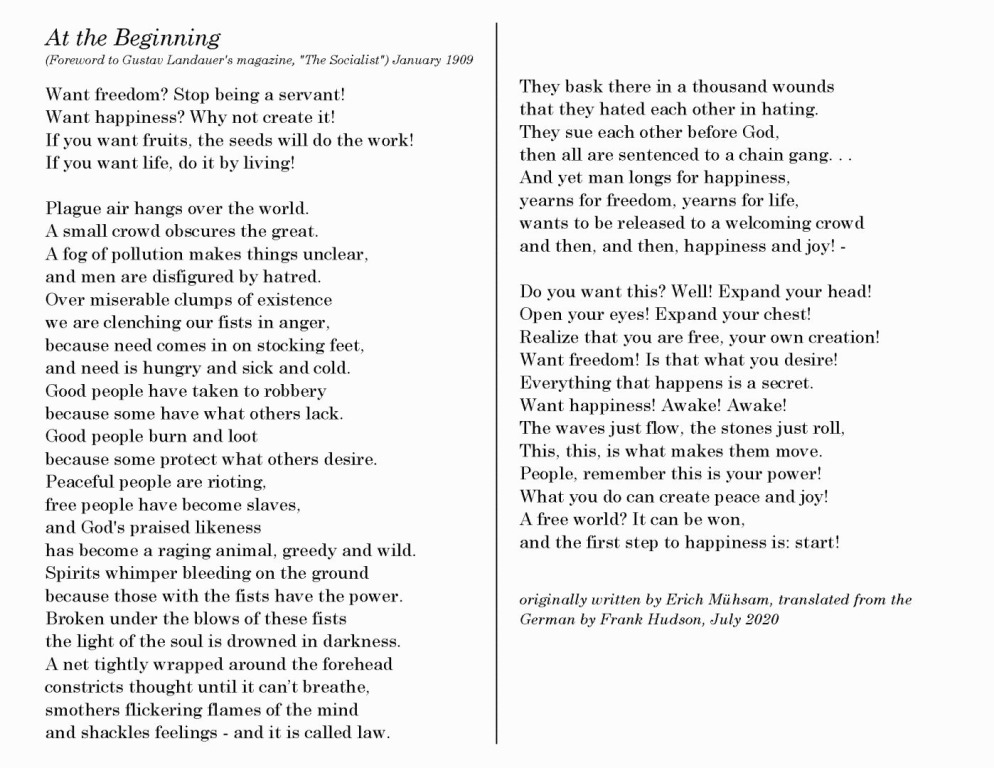
At the Beginning


Can one read things in it that seem to speak to today? I believe one can. I wonder if whoever was putting together the collection before publication thought it spoke to 1919 too. That line written in 1909: “Plague air hangs over the world” could be read in 1919 as a comment on the great influenza pandemic, not as a mere metaphor, just as you might read it now in Covid-19 times. The closing litany of people awakening to the power of realization, that too could be more than a dusty relic as folks marched this summer under a growing common understanding of oppression and “nets tightly wrapped around the forehead…until it can’t breathe.”

So, what happened to this young poet who turned activist/poet? In 1924 there was an amnesty declared for political prisoners and he was released. Lucky him! Another lucky man released by that amnesty had tried to declare a new government from Munich too, this time in 1923: a painter turned activist named Adolph Hitler. You probably haven’t heard much of his paintings.

Just as his 1909 poem foretold, Mühsam arrived by train in Berlin after release from prison and was met by a crowd of admirers, cheering and lifting him onto their shoulders. Someone thought things got out of hand, and soon the edges of the crowd were being attacked and beaten, though Mühsam was carried to safety that day. More than a decade after he wrote his poem, those with the fists still had the power—or some of it.

Mühsam took part in the artistic and political ferment in Berlin for almost ten years. Shortly after that pardoned painter/activist succeeded in getting power in Germany, someone burnt down the Reichstag, and it was time to round up those that had ticked off Hitler and his supporters. Mühsam was one of the first taken in. You know the quote attributed to the conservative German Lutheran pastor Martin Niemöller? The one that starts “First they came for…?” Jews, Gays, Leftists, avant garde artists? Was there any group Mühsam didn’t qualify for? Lucky man, head of the line.

He was sent to a concentration camp. There he was beaten and abused. In short order he was taken into a room and abused and beaten until he was dead. The guards hung his body and said he committed suicide.

There are martyrs we remember and martyrs we forget. Phil Ochs wrote a song “Too Many Martyrs”  and we might slag him off for stating the obvious rather than the artful—but the obvious is likely the truth here. At least in the United States we have next to no remembrance of Mühsam or Landauer. As far as I can tell from a brief search, Mühsam’s poetry has not attracted interest from English translators, with one site that did feature some English translations (and tantalizingly, some set to music) now defunct—and the domain name takes you to a place with bogus antivirus pop-ups flashing all over your screen. Both do have some interest to Anarchists as political figures. That’s a bit odd. Isn’t one of the romantic knocks against artists turning activists: ars longa, (and their political concerns), vita brevis? Countering that is what I call Donald Hall’s Law: that poet’s statement that almost all poets, even prize-winning poets, are largely unread 20 years after their death. I fight that here, but Hall may be right.

History had a few more things to offer me as I read this sad and affecting tale of these two men.

Mühsam wasn’t the only one who had their life impacted by Landauer and his idea of practicing egalitarian Anarchism right now in a communal and immediate relationship. His most famous pupil was probably Martin Buber, whose influence on humanism in the mid-20th century was considerable.

Remember Landauer and his wife, and his belief in the monad of domestic life as a model for change? Well that talented writer and translator and that theorist of humanist Anarchism had a child. And that child, Brigitte, survived her parents and married a doctor in Berlin. In 1931 they had a child, Mikhail—and later that decade they got out of Dodge before the painter/activist/ Führer got around to those not first on every part of his list.

They settled in America and adopted an easier to spell-and-say name, so their grade-school-aged son Mikhail Igor Peschkowsky became Mike Nichols. He became a radio folk-music DJ, an influential pioneer in popularizing improv comedy with Elaine May, and then on to a significant career as a stage and movie director.

Strange, the undernotes of history. I’ll likely never listen to a Nichols and May routine or watch a Nichols-directed movie like The Graduate  again without thinking of that grandfather, that heartbroken, widowed man being abused to death after watching the revolution, one he didn’t want to wait for, fail. I’ll still laugh. The laughs are just darker.

Today’s music is more in the “bash it out fast” manner, no pretty string quartets, no subtle sound design, just two electric guitars, bass, drums and my effort to speak the words. The player gadget is below if you read this in a browser. Apple WordPress Reader users, use the Reader’s gadget to open this in Safari to see the player.


*Among Mühsam’s early 20th century beliefs were “free love” and gay rights/acceptance. The communard Landauer believed that a loving and equalitarian family unit was a small-scale model for society.

**He took that back, and wrote anti-violence and war poetry during the war. Can one imagine Twitter in 1914? The telegraph lines would have melted.

***OK, if you stayed with me so far, with “Socialist” and “Communist” being thrown around in addition to the “aren’t they the guys who throw little black round bombs” “Anarchists,” “Soviet” might be the final straw  that chokes your metaphoric dolphin or turtle or other benevolent creature. “Soviet” means in this context, a worker’s council as a source of authority. As far as Anarchists were concerned, that’s a good thing. Anarchists are often against violence, and particularly state violence, torture, and oppression—but they are very much for long boring meetings, which have a special dispensation from being defined as torture or oppression.

The Poet’s Voice

Stick with me here valued audience. I know awards speeches are not a popular genre. First off, everyone watching has just lost except for the speaker—not just the tuxedos in the hall, but anyone watching at home who aren’t important enough to be invited to the event. So maybe it’s safest to thank others effusively until your time is up and the music plays you off. A choice to make other points can be ineffective.

Yet, this isn’t the first time I’ve used an awards speech as the text for a piece, though the other two times they were speeches by actors, David Harbour and Viola Davis. Both of those speeches made claims about the value of dramatic art: Harbour making the claim that we may use make-believe heroes to inspire us to do necessary things, and Davis testifying that art, because it includes the illuminated communication of intense human experience, is the only complete way to explore humanity.

The Nobel Prize award requests an acceptance “lecture,” which sounds more high-falutin and boring than an acceptance speech. The literature winners often take the bait and tell us something about the value of their art—but it just so happens that I’m listening for that right now, because I’m not sure about the value of the arts of poetry or music, the things this project is made of, in the midst of this year’s multiple crises: a pandemic, an economic downturn that I fear we haven’t sounded the bottom of, a king of misrule, and a tragic occasion to consider remedies to racial oppression. When I talked about these things this week with friends, they reminded me, “And we haven’t even talked about global warming lately.”

The first section of today’s piece is taken from William Faulkner’s 1949 Nobel Prize acceptance speech. Even a couple of decades later his statement was much loved in liberal arts departments as I was getting in touch with them in “The Sixties,” because we still hadn’t gotten over the fear we talk even less about: global atomic warfare destruction. Faulkner was a wordsmith to reckon with, even if he couldn’t figure out the plot of Raymond Chandler’s The Big Sleep.*  When I looked back at his speech this month, the line I open up with today grabbed me in 2020 as much or more than it would have back in the mid-20th century:

Our tragedy today is a general and universal physical fear so long sustained by now that we can even bear it.”

Don’t misread the end of that sentence. He is saying we can bear that fear (his contemporary fears, and ours) and go on writing. One may raise their hand before the Nobel-Dynamite-Prize winner Faulkner and ask: “Well, yes I suppose we could. But shouldn’t we be doing something else instead? A lot of people’s survival is at stake.”

The next section I quote from Faulkner’s speech tries to answer that. It’s a fine piece of writing too. If one abstracts the thought from the rhetoric, he’s saying that we have jobs in relationship to those that will be doing something else instead. This is akin to Viola Davis’ argument about art: no position paper, resolution, or negotiating point can fully connect one heart with another, and no struggle can see its way without full illumination of the human experience.

Is Faulkner right about that? I don’t know. It may not be right for you, but it’s a plausible idea for an old man like myself, one who lacks the social cohesion to build a barricade and the bravery to mount and advance over it.

Faulkner Stamp

An example of writers not being much good at other jobs, Faulkner was bad when given a job as a postmaster. His resignation letter read: “As long as I live under the capitalistic system, I expect to have my life influenced by the demands of moneyed people. But I will be damned if I propose to be at the beck and call of every itinerant scoundrel who has two cents to invest in a postage stamp.” The Postal Service had its revenge in 1987. Faulkner’s price had risen by 20 cents.


The concluding statement in today’s piece is from another American Nobel Literature prize winner’s “lecture,” Bob Dylan’s. The inspiration for this came from a gift Dave Moore gave me this month, a small, handsome book containing Dylan’s lecture. When Dylan won the Literature prize there was a great deal of consternation that what he did wasn’t literature, possibly also not very good, but for sure not literature. Some commentators seemed to feel that poetry might not even qualify, wondering what novels he had written.** But never mind, song lyrics can’t be poetry can they?

In the concluding part of his speech Dylan cleverly concedes that point, and then collapses his wings around those objecting that performed oral poetry is not literature. That’s books, stuff written and read on paper. Suddenly they are surrounded with no retreat. Shakespeare*** wrote for voices and audiences in common. We only know his plays in page form from bootleg tapers. Songs, music, are like that too. They are alive, they live on the currents of breath. Literature is an artifact—a voice is the art, a song is the immediate fact of an experience. I, you, anyone, can doubt art in its absence, in silence—while fear likes that space just fine. But while a song is sounding in your breath and ear, doubt is beside the point. “Songs are alive in the land of the living” Dylan proclaims.

My performance mashing up these quotes from the two Nobel Prize speeches accompanied by my own music can be heard with the player below. If you’d like to read the entirety of these two speeches, Faulkner’s text is here, and Dylan’s is here (with a link to his own audio reading).


*A Hollywood anecdote had Faulkner, who was working as screenwriter for hire in the 1940s, getting stumped about the famously convoluted plot of Chandler’s detective novel he was adapting for a classic 1946 movie. A point about an early murder that deepens the plot was unclear. “Yes, but who killed General Sternwood’s chauffeur?” he queried. Chandler replied: “Dammit, I don’t know either.”

**I found it interesting that novelist Faulkner more than once refers to poets as he speaks about the writer’s task in his speech.

***And Dylan closes with Homer, the blind one in the silence of sight, who didn’t ask the muses for paper but the music to tell the story.

Inversnaid

Before we get to this gorgeous poem by Gerard Manley Hopkins, let me talk a bit about what I believe regarding our experience of poetry. One of the reasons this project presents the (mostly) poems it uses as audio pieces is that I have a conviction that poetry has a word-music, a sound that is inherent and relevant to the form.

That doesn’t mean that poetry has to sound pretty in some immediate way, have regular meters, rhyme up, or even have some sense of “singing” imbedded in the authors intent. None of those things harm poetry in and of themselves, but all of them are just techniques of word-music, in the same way that the “rules” of music are discovered on a form that expresses itself in a variety of ways which may be successful with varied audiences.

Nor does it mean that poetry on the page isn’t a useful alternative way to experience poetry. Particularly complex poems, with subtle relationships, may more easily impress themselves when they can be comprehended in a non-linear way on the page where one may look up and down the stanzas and see relationships or indications of linkage. On the other hand, some complex and hermetic poems, or poems that use language in ways that are not in the form of ordinary literature, may be best experienced as we often experience songs or memorized verse (like nursery rhymes, folk sayings, or mnemonics) in a way where we encounter them more than once, in a portable form that we can hear in the background of other events and situations. Our memories as a playlist.

And now we return to Gerard Manley Hopkins and his poem “Inversnaid”  after that preface. Is there subtle thought in it? Yes, there may be. One could write an essay on deep ecology based on it. I suppose it could be a metaphor for Hopkins theology and philosophy, of which I know enough only to say that he was self-aware and concerned in those areas. Essays could be written, perhaps whole books inspired, though because it’s a short poem, it’s possible that one can carry “Inversnaid”  in a way that neither and essay or book can be.

But I’m not there yet with “Inversnaid,”  and I’m only the near-partway into my journey with Hopkins. No, what this poem is for me yet is: beautiful, sonorous, passionate, intense—it affects me. Frankly, I see only a bit of its matter, a little more each time. It shows the way that poetry, while it can contain ideas certainly, isn’t about ideas so much as it’s about the experience of ideas.

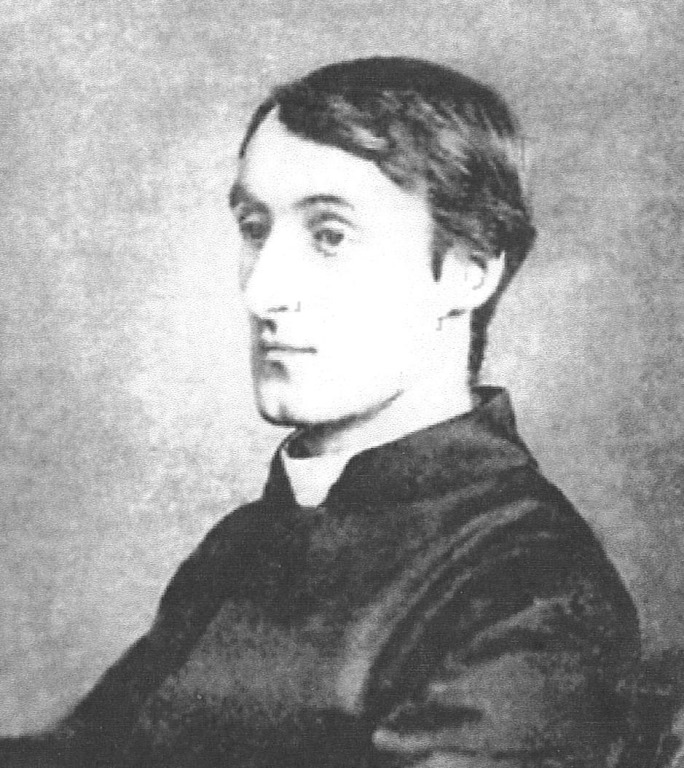
gerard-manley-hopkins

Another remarkable thing about Hopkins: like his near contemporary Emily Dickinson, he wrote his poems largely without thought of publication, and the extent of his work was unknown until a 1918 collection was published after his death.


Though Hopkins was a 19th century poet, a Victorian by calendar, and “Inversnaid”  is end-rhymed and follows Hopkins own appreciation for how English poetic metrics can work (ideas inspired from older Anglo-Saxon poetry) this is in some ways another Imagist poem before it’s time. There’s almost not a single emotional word in the entire poem. “Despair” and “bereft” do occur, but this poem doesn’t seem to be about either of those emotions except in contrast to them. Instead, like a good Imagist poem it’s about the immediate experience of a moment before those emotional words have appeared to frame or fence the experience in.

That Imagist effect is somewhat masked by Hopkins’ obscure language. This is a 12-line poem, not even sonnet length, written by a man whose shortened lifetime overlapped human beings whose lifetimes overlapped mine—yet there are more words than I, something of a language maven, didn’t know than one might find in an 16th century poem or the deepest subculture patois of a rap performance. Only the last quatrain stanza is in what one would call standard contemporary English.

One could intimidate a reader or listener easily by giving them a definition pop-quiz after hearing this poem. “OK, so you liked this poem! Well then, tell me what these words mean: burn, rollrock, coop, flutes, twindles, fell, degged, groins (stop snickering, this will be part of your final grade!), braes, flitches, heathpacks, and beadbonny.”*  I’d be surprised if many American English speakers could define a third of these. Residents of the British Isles might do better, but would they get over half?

We’re in near “Jabberwocky”  land here as readers. But we’re not quite as lost as listeners, because like Carroll’s nonsense poem, the sound makes us sense something of the intended meaning without dictionary. And the sound!

One could intimidate a reader or listener easily by giving them a definition pop-quiz after hearing this poem. ‘OK, so you liked this poem! Well then, tell me what these words mean: burn, rollrock, coop, flutes, twindles, fell, degged, groins (stop snickering, this will be part of your final grade!), braes, flitches, heathpacks, and beadbonny.”

This is really a proof-of-concept example of Hopkins’ “sprung rhythm” where unequal metrical feet are subsumed to attention to the set number of stressed syllables or words. And every one of those obscure words add to the sound so strongly as to be forgiven.

My performance of “Inversnaid”  should be available with a player gadget below. Full text of the poem if you like to read along is here. Thanks for reading and listening!


*I say this because I think I’d have gotten four as an American English speaker, and only that many with help from my love for old English-Scottish border ballads. Perhaps I should be docked a point though, for in my performance I misread “degged” instead as “dregged,” a word which sort of made sense to me. Some have attempted a glossary for this poem, here’s the best one I’ve found in a quick search.

Good Night

Here’s a mysterious poem by Carl Sandburg that makes its mystery in an unusual way. I think it may have been written for a child or for children, but by accident or design the matter of the poem makes a different sense as I read it now.

What makes me think it was written with children in mind? There’s the repetition of the idea of spelling these two short, common words in the title, neither of which are “spelling demons” that are difficult for adults to spell. And then further repetition in saying the two words “Good Night.” It seems something between a lullaby or a book like Goodnight Moon,  beloved of parents seeking to ease their child to sleep. The middle of the poem has three episodes of things gloriously becoming gone and away, as if being left for sleep and dreams.

This is where the poem now seems to take on a layer that I’m unsure was part of Sandburg’s intent in 1920 as I read it in 2020. He starts with fireworks—which are firing all about me on this Independence Day night as I write this post. Besides the noise—and noise normally has a note-length and measure—a visual aspect which a fireworks display is notable for is its short duration. Those colors and light against a night sky may be stunning, but they are short. They are memories almost from the moment they burst.

And then comes two other short episodes: a steam train and a steam boat. The steam train on a moonlit night is moving of course, but its spume of exhaust is also leaving skyward. Likewise, the river steamboat is moving past a geography leaving the sound of their steam powered horns carrying across the fields they are not as stationary as.

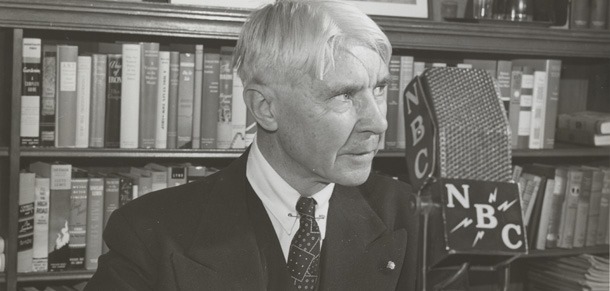
Carl Sandburg and a BIG microphone

Carl Sandburg. From the size of it, that microphone looks like it could be steam-powered too.

.

Sandburg the boy would have known those two steam-powered things. A child in 1920 could know them too. They were the ordinary things of freight and travel. In a few decades these steamers would be obsolete and all but extinct. 1920 is a little too early for Sandburg to know that. When he wrote his poem they were moving and gone. Now they are gone and gone. Carl Sandburg is gone too of course. And if he told this poem to his children? They grew up, aged, and are gone too. Many ways to say good night. Many ways to spell good night. Many ways, all leaving. Oh! the boom! The red and yellow, the blue and gold spreading and tailing! Ah! Many ways, all leaving.

The player gadget to hear my performance of Carl Sandburg’s “Good Night”  is below.* And here’s a link to the text of this short poem if you’d like to read along.

.

*Unless you’re reading this on the WordPress Reader app on an Apple phone or tablet, which for some reason can’t show the player. In those cases, this highlighted hyperlink will play it. Alternatively, the Parlando Project audio pieces are available as a podcast in Apple podcasts. Thanks for reading and listening!

Sail on, Oh Ship of State!

Claude McKay led an outsiders’ life, Allen Ginsberg became a near celebrity bohemian whose outsider status changed over his life. The author of today’s poem in our Independence Day series was more well-known than Ginsberg in his day, and he was as far from being an outsider as any American poet could be. At one time, as many knew and read his poems as Edgar Guest’s, and he was a much better versifier.

So, do you know today’s poem from the above title, or from the name of the longer work from which it’s excerpted, “The Building of the Ship?”   It’s highly unlikely that you would. The American writer Henry Wadsworth Longfellow went from being the stuffy square’s square, the kind of writer that Modernists didn’t want to be, to a forgotten man, the writer that no one remembers even to reject. He was a civic poet, a poet’s role that no longer exists in white America. Along with a handful of other men, most of whom he knew, he sought to create an American poetry in the first half of the 19th century when the American experiment was still new. After all, when he was born in 1817, many who celebrated July 4th were around for the July 4th!   And for much of his life Longfellow lived in a house that George Washington had lived in while commanding the American Revolutionary War troops.

Longfellow_National_Historic_Site,_Cambridge,_Massachusetts

George Washington lived here, and later so did Henry Wadsworth Longfellow. And a child named Darby Vassall. Haven’t heard of that last one? Read on.


In 1855, an elderly man visited that house where he had been born in 1769, meeting with Longfellow there. The man’s name was Darby Vassall, and this was the nature of his birth: he was born to enslaved Afro-Americans owned by the owners of that big house, which made him a slave by law from birth. When the Revolution came, his masters sided with the British, and so after the Battle of Bunker Hill, the owners skedaddled off to safer British-controlled territory. This left the house available for the new Revolutionary Army’s commander, General Washington, as spoils of war. Washington left his short-term smaller quarters and went to the big house to move in.

And here’s the story Darby Vassall liked to tell about meeting The Father of Our Country. There he was, six years old, and the revolution had by accident empirically freed him. He was swinging on the gate of the very house Longfellow now lived in, a time-honored childhood pastime then and now (see also sutures and Colles’ fracture.) General Washington, impressively tall for his time, and like the house’s absent owners, a rich slaveholder who traveled with an enslaved manservant, asked the boy if he would like to work for the new occupant, this man who’d become so honored and famous that people even now buy his portrait for something between 25 cents and a dollar.

Darby kept swinging, sizing up the tall white man, and then asked “How much are you paying?” Darby says Washington kind of lost interest in the conversation at that point—because, you know, slavery. He looked like a gentleman Darby later recounted, but “He was no gentleman.” Now that’s an Independence Day story!

We don’t know all Vassall told Longfellow about the house Longfellow now lived in, but the stories must have been interesting. The best-selling author blew off a meeting with his publisher to hear them all.

Have I forgotten to talk about Longfellow’s poem? No, this is another poem for our July 4th series. It comes at the end of a much longer poem Longfellow published in 1850, one that less than nobody reads today. The entire “The Building of the Ship”  is an allegorical story of a venerable ship builder* who with the help of a crew including a younger apprentice builds a ship for a merchant, more magnificent than any the builder has ever built. While building the ship, the apprentice and the master ship builder’s daughter fall in love, and the old master promises that on the day the ship launches his daughter and the apprentice will be wed. After many supple verse lines detailing the construction of this ship,** it’s complete and it launches with a epithalamium in which the new and lovely ship is embraced as a bride by the timeless, older, gray sea.

If the poem ended there it’d remain a curio of interest to scholars today, a romance in a European style adapted with distinctive American details and accomplished in English verse with a difficult rhyming scheme that never grates or seems fake, the sort of thing that is easier to do in French or Italian.***  But Longfellow had an envoi of sorts. The ship, as all man-made things do, would eventually wear out and come to a wrecked end. A downbeat, look-at-oneself-through-the-grave warning that would also not be out of place in romanticism.

This whole poem, along with that ending was sent to the publishers.

Then Longfellow called it back. He had a revision, with an entirely new ending. You can read the old ending and the story of the last-minute revision here. Not only is the new ending upbeat, it seemed to retroactively change the poem that proceeded it. That boat-like-a-bride thing was still there, but the ship was named “The Union,” and in those manifests of the things that made the ship, the entire young country seems to be the source. The Union becomes not just a marital union, it becomes the United States.

Here’s where that civic poet role comes into play. In the dozen years leading up to the Civil War, the delicate balance of slavery’s evil in a democratic country was becoming harder and harder to keep from spilling, the compromises seeking to keep the country in existence more and more difficult to negotiate. Longfellow’s new envoi, the one that I perform today, may seem anodyne if considered as an abstract statement of patriotism, but in 1850 it was a considered second-draft meant to say that ideals of the American experiment should continue, needed to continue, because those ideals, those plans, however imperfectly applied are contagious (in a good non-Covid-19 way). Enough for a small 6-year-old to stand up to Washington for example.

Now if we are to consider inspirational Afro-American patriotism, the best story that is likely not true is that Winston Churchill once quoted in a public speech Claude McKay’s “If We Must Die,”  a Black man’s valiant ode to self-defense written after the deadly “Red Summer” of 1919, but then applied during the darkest days of Great Britain standing against Nazi-occupied Europe. No one has such a transcript or recording. But there is  a recording of Churchill reading a section of the abolitionist**** Longfellow’s envoi during that time in a speech of endurance in 1940.


Maybe the strangest thing about this ship and it’s sailing on, even as the maker of the poem has slipped away from public consciousness, was “Sail on, O Ship of State”  being quoted in Leonard Cohen’s “Democracy,”  his excellent ode to the need to continue the American experiment, however flawed, because it’s flawed.

The player gadget to hear my performance of Longfellow’s “Sail On, Oh Ship of State”  is below. I’ll note that my performance has some flaws that I’m accepting for now in order to get this out in a timely manner, but the spirit is there. Happy 4th of July though it be just one date. May freedom and independence come to all of us. The revolution is plural.


*Though Longfellow lived and wrote much of his work in Cambridge Massachusetts, he was born and educated in Maine, and even at this late hour he probably vies with Stephen King and Edna St. Vincent Millay for the title of most well-known writer from Maine. Maine was a shipbuilding center in the 19th century and so the poems extended allegory of shipmaking was local color to Longfellow.

**I’m no expert here, but those who know about early 19th century American shipbuilding seem to feel that Longfellow got the details of ship design choices and construction right.

***Many prosody theorists think that rhyming English poetry is a mistake, as we have many fewer rhyming word-endings than other European languages. Longfellow’s poetry may not be to modern tastes, but one thing he did have was a non-forced and impressive “flow” in the hip-hop/rap sense.

****Among the favorable reviews from abolitionists: Thomas Wentworth Higginson said of “The Building of the Ship”  “The most complete and artistic which he ever wrote.” Lincoln was said to have quoted the envoi lines in private to his secretary as the Civil War broke out—and broke down in tears before he could finish them.

Huazi Ridge (after Wang Wei)

It’s been awhile since I last presented one of my fresh translations of a poem from another language here. Today I’m going to sing a version of a poem by classical Chinese poet Wang Wei, but first a few words about translation.

I’ve grown to love doing translations from other languages here. I view it as an extension of the Parlando Project where we combine various words, usually poetry, almost always by other people, with music we compose and play. That means that most everything here is a translation of a kind, as the author probably didn’t intend for their words to be combined with music, nor are they available to tell Dave or I how to read and present their words.

Translation from another language to English is an additional layer of the author’s work being filtered through what I see and react to in it. Sometimes the Dadaist in me comes around, and I supply music that isn’t conventionally appropriate for the text. This doesn’t bother me.*  But in translating their text, the words someone else wrote, I do  worry about being accurate, being a good steward of their cultural contribution. And I should  worry. I speak no foreign languages. I had High School French. A grandmother and my mother spoke German as a child, but not as an adult with us. I live in a neighborhood with many Spanish speakers. None of this adds up to any fluency. That makes translation a difficult process and my efforts are no guarantee against misunderstanding of the author’s work in their native language. Now add to this the time and cultural gap to Wang Wei, the 8th century Chinese poet—a greater degree of distance than Rimbaud, Rilke, or Neruda.

There is some help in the shortness of this poem. It leaves you fewer lines to recode. Wang Wei was not as slight as his poem is though. Indeed, he was quite the hyphenate. He was a painter, a musician, a poet, and a functionary in various positions in a Chinese government which was facing a serious rebellion in his time, which led to a period in which he was a political prisoner. He was said to be a Buddhist. I know little about the background of this individual poem of his. I first came upon it in another English translation by poet Robert Okaji, who long-time readers here have already been introduced to. Here’s a link to his translation. Okaji has a good tactic for dealing with the extraordinary difficulties in translating a poet so far from us as Wang Wei. His translations are taken, as my Chinese translations are, from a supplied literal transliteration into English. He titles his as “After….,” an indication that he only claims to be sending forth his impression and inspiration from the original author’s poem. Good idea. I chose to do the same today.

Here’s the literal transcription he and I used as our entry into this poem:

Fly bird go no limit
Join mountain again autumn colour
Up down Huazi Ridge
Melancholy feeling what extreme

My guess is that Okaji was struck by the visual imagery in Wang Wei’s poem, and more than I eventually did, Okaji well-portrayed that aspect. As an accomplished painter, Wang Wei was unsurprisingly known for the corresponding strength in his concise portrayal of natural scenes in his poetry. Though I didn’t go that way with “Huazi Ridge,” I often chose this route in translations: finding a way to make vivid the imagery the poet presented in my modern English.

I instead chose to go with two other aspects. The first that struck me was a strongly implied parallelism in this tiny poem: the birds who “go no limit” in the first line and the “Melancholy…what extreme” in the final line. The birds can fly, their possible course seems infinite. Even a mountain is no barrier to them. Sadness, suffering, dissatisfaction, and humanity’s attachment to that, is at the core of Buddha’s teachings. So, in trying to get at the meaningful linkage between those two lines I chose to see the birds as choosing to return to this mountain, this massively material earthly obstacle (perhaps as a migration or habitat) even though they could fly seemingly anywhere.

Here’s what I came up with in English:

Look these birds can fly without limits
Yet they return to this mountain in red autumn
All up and down Huazi Ridge
What then are the limits of sadness

A central fact in this poem remained unsettled as I worked on my translation. Where is Huazi Ridge and the associated mountain?** What is the landscape, why would Wang Wei choose it in particular? There some extra degrees of difficulty in a web search on Huazi. The western alphabet I’d search on is an approximation, and place names everywhere change with regionalism and time.

Web searches on Huazi often led to a Chinese Mount Hua. Here’s a somewhat irreverent but illustrative video of what it’s like to climb up and down it.

Turns out there are easily a dozen videos out there of what it’s like to climb the path up Mount Hua, but I still like this one.


The translation I came up with—my impression, however mistaken, yet (I hope) worthwhile—of Wang Wei’s poem sought to portray an earthbound, flightless human noting the birds who could easily fly over the mountain and anywhere else they would choose, but instead they return, captured perhaps by the autumn beauty or the immense thereness of the mountain. Ah, notices the poem’s speaker—“Look!” he urges, see this too: even the flight-blessed birds who do not need to trudge up and down at great peril and effort choose not to step off the wheel of return. What then are the limits of suffering, sadness, unsatisfaction? You climb the mountain once, twice, how many times? The noble truths of the Buddha’s teachings says that you will return, as the birds do, until you can choose to see all that is not the mountain.

What’s the other thing I sought to put in my English impression? I rendered it in metrical verse. And since it is said that Wang Wei played and composed for the pipa, the Chinese lute, my music today uses my attempt to portray a little of that instrument using the MIDI interface on my guitar along with a more Western drums, bass, and electric guitar ensemble. The player to hear my performance of “Huazi Ridge”  is below.


*Bother me? Hell no, it’s great fun—and unusual juxtapositions sometimes demonstrate something that otherwise wouldn’t be revealed in a work we perform. Since we use material in the public domain, there are no rights issues with authors preferences.

**I couldn’t even find a pronunciation for “Huazi,” and my fear is that this performance’s guess could be risibly bad by Chinese standards. I know I have some Chinese readers. Is Huazi mountain and/or ridge a well-known place that would be meaningful to a Chinese reader?

A Mien to Move a Queen

Ready to go on a roundabout trip with today’s blog post? Keep your hands inside the car, we’re going somewhere back to here on another wild-mouse ride.

A couple of things the foot-square vinyl LPs of my youth afforded us: liner notes to help guide us in appreciation of the grooves within, and more commonly as The Sixties progressed, lyric sheets.

Not every record had those lyric sheets. Some artists opposed them on principle—Bob Dylan was one—though to a large degree the reason we got them was due to that hold-out, Mr. Dylan. Dylan revolutionized song lyrics. Before Bob Dylan, no one wrote songs with lyrics like he did.*  After Dylan, a lot of everyones tried their hand at it. In the 21st century when we hear or see lyrics that use an accretion of rapidly changing metaphors and a kaleidoscope of dark-cylinder mental outlooks, we no longer notice that they are Dylanesque. It’s just a mode that songwriters can draw from the common.

Would that have happened if Dylan hadn’t happened? Possibly. And plausibly, only similarly, but distinctly different. Would Richard Farina (sans motorcycle accident) or Leonard Cohen have won a Nobel prize for reshaping a word form?

One argument that it would have still happened was the psychedelic phase of pop music that followed Dylan’s revolution. There, later in The Sixties, opaque and strange lyrics got another push, one that was largely ascribed to intoxicating chemicals which produced visual sequalae and baroque mental turns. Now of course the intoxicated or drug altered poet was already a thing in literary poetry, and the sober cold-water-army songwriter was likely a minority long before “The Sixties.” But Dylan had punctured the membrane that separated those two crowds, and so we got the Canyons of Your Mind school of songwriting too.

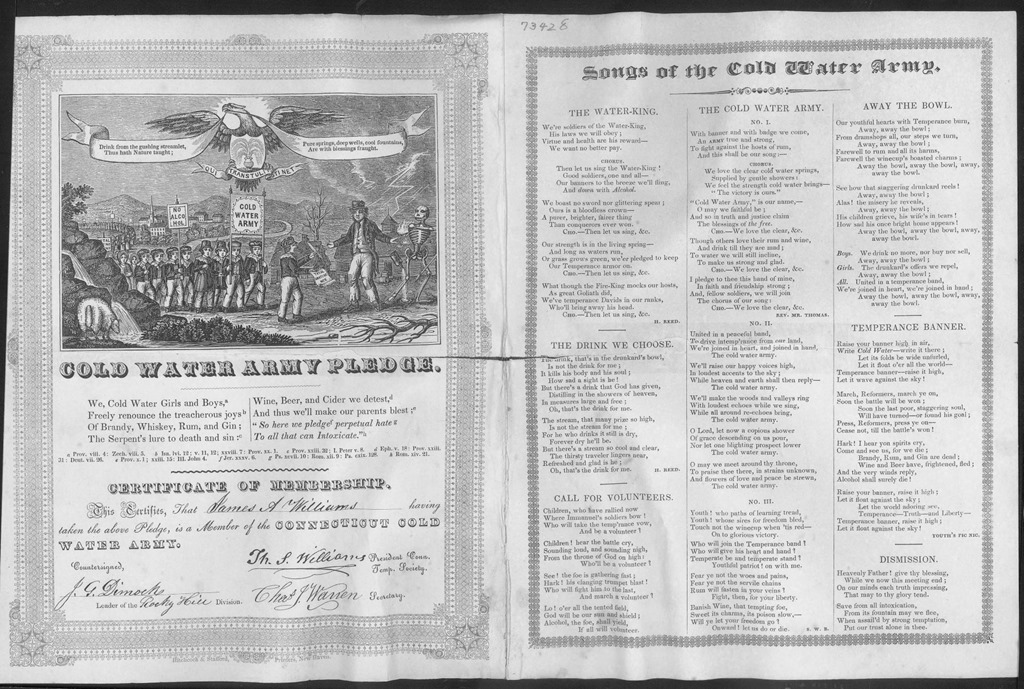
Cold Water Army

19th century straight-edge punks on dihydrogen monoxide, usually also anti-slavery and pro-women’s rights too. Comes with a lyric sheet!

Some of it was good, some of it bad—but then we might see lyric sheets to the wind like these:

Oh where are you now
Pussy willow that smiled on this leaf?
When I was alone
You promised the stone
From your heart….
Brandish her wand
With a feathery tongue

Or

A mien to move a queen
Half child—half heroine
An Orleans in the eye
That puts its manner by
For humbler company
When none are near
Even a tear
Its frequent visitor

Or

If you were a bird and lived very high
You leaned on the wind as the breeze came by
Say to the wind as it took you away
“That’s where I wanted to go today”

And

Bedouin tribes ascending
From the egg into the flower
Alpha information sending
States within the heaven shower
From disciples, the unending
Subtleties of river power

The chorus sings: “OK Boomer,” and you can ascribe all of these to chemical traces, wonder about their authors consequent mental damage, or coldly appreciate them as word music, but I’ll come at you from a minority report: the trip’s in your head, not in the drug. I gave up stuff you can smoke (mostly nicotine) around the time I passed the trustworthy border age of 30. I never spun the pill roulette wheel. Needles are for records or loose buttons.

Next stop for the psychedelic bus is some credit for those lyrics above. The first is from Syd Barrett’s post-Pink Floyd song “Dark Globe.”  The second is the beginning of an arresting if mysterious poem by Emily Dickinson. The third is by children’s writer, humorist, and WWI vet A. A. Milne quoted by songwriter Paul Kantner to begin the Jefferson Airplane’s “Ballad of You and Me and Pooneil.”  And the fourth is the start of “Slip Inside this House”  from the 13th Floor Elevators’ Tommy Hall and Roky Erickson.

A little day glo paint or patchouli and Emily Dickinson fits right in when she writes in this mode I think, even if she’s a century too soon, “The Eighteen-The-Sixties.” When I ran into that first stanza of her 1861 poem known by it’s first line “A Mien to Move a Queen”  earlier this month, I was immediately captured by its strange mystery, so much so that I worked out the music you hear today without even knowing that the poem was longer than that one stanza, and I was so entranced by it that the piece you hear today uses only the first and last parts of her poem because I think the middle parts break the mood that first stanza gave me. Want to see the entire poem? The link is here.

The omitted middle section seems playful to me—even as the British would say, twee, but I am of course editing a genius here. I still like my selection as I hope it adds some weight to the whimsey. What was Dickinson on about in this poem? Even living with it for a few days, I’m not entirely sure. The opening stanza is often read as connecting to Joan of Arc. Some read the poem as Emily reflecting on herself and constructing her own persona, and the middle section I omitted gives some evidence of that. Beside it’s general mysteriousness, there are to my mind two pieces of particular heightened sensitivity or even hallucinogenic imagery: the “Orleans in the Eye” line and the sensuous and heard quiet of the “Like Let of Snow” image.

So, we started with musty cardboard squares and moved through two steps of an era of wilder and wilder metaphors sung to music, and finished with Emily Dickinson, sewing 1861 fascicles by whale oil light while listening to Syd Barrett or A. A. Milne feedback on her record player long into the night. In between songs, the needle stops shimmying and she can hear the sound of snow moving across snow outside, filling, and not, summer’s empty room.

The player to hear my musical performance of a selection from Emily Dickinson’s “A Mien to Move a Queen”  is below. Thanks for reading and listening!


*Yes there are examples that made it into popular or semi-popular music pre-Dylan. Modernist poetry had already done all of these things earlier in the century, and  in addition, a big part of what Dylan used in creating his work were the un-acknowledged Modernists who created the Afro-American blues. None of that disproves the point that Bob Dylan showed that you could do that sort of thing in a proximate way that led to a revolution in the possibilities of song lyrics.

The Most Popular Parlando Piece, Spring 2020

Are there people today still falling in love, or not falling in love together, or remembering love and almost love? Seems like a silly or rhetorical question doesn’t it.

So, yes, I suspect there are, as there have been before.

People fall in love on marches, at the barricades. Policemen fall in love. People fall in love in the time of plagues. Old people fall in love. Young people remember love or almost love. Oppressed people fall in love. People fall in love, but their partner doesn’t, and sometimes that partner is the wiser of the two.

So, is this the time for a poem of romantic love to be the most popular piece this past season? This is a time of new dangers and old evils. This is a time that predicts greater uncertainties and promises change if we act, and despair if we don’t. Can poetry put its “Queer shoulder to the wheel” as Ginsberg wrote? Should it?

Dada for Juneteenth

You have nothing to buy but your chains! For today’s Juneteenth, some Dada in advertising algorithms.


I’ll be honest, I think about that a lot this spring. It’s a large part of why it’s hard for me to get around to creating new work here as this spring unfurled. Honestly I have little right to present short pieces here on Emily Dickinson, Du Fu or Arthur Rimbaud, but I may have even less authority to write briefly on politics, economics, sociology, or epidemiology—much less American racial dichotomy and all it’s injuries.

My observation that many who do  write of these things have no more authority than I do is not helpful. Another observation is that all us artists have is that: our observation. We must strive to be careful seers and more exact sayers of what we see, though we tend to be flat seers. Heaven and wildflowers: that’s leveling. Romantic love, that often-brief thing; and disaster, that sometimes-brief thing that harms long and painfully, we see them both, we write about them as if they’re equal.

As this turns out today, I will have slighted Mr. William Butler Yeats. I’ve talked not at all about his poem, the one that you listeners liked and listened to most this spring, though it’s hardly a perhaps to believe Yeats thought some of these thoughts and questions that I’ve filled this post with instead. You can read my original reaction to the poem, linked here, in place of something new today.

The player gadget to hear Yeats’ “When You Are Old,”  this love poem written by a 20-something about old age, is below. Thank you very much for reading and listening, and an extra thank you to those who’ve helped spread the word about the Parlando Project. There’s a lot of stuff here from the four years of this project to listen to, and I’ll still attempt to have new pieces here soon.


Spring 2020 Parlando Top Ten, numbers 4-2

Continuing on with our countdown of the most popular pieces here this past spring, I find a few things that break the usual patterns. So let’s get on with it and see what we find that were the most liked and listened to since March 1st. The bold-face titles are links to the original post presenting the poem, so you can easily visit those to read more about it and what I said back then.

4. To a Fat Lady Seen from a Train by Frances Cornford. This short poem in the tricky triolet form is as catchy as a nursery rhyme and is fairly well known in Cornford’s native Great Britain. Besides that earworm quality, the poem is weird in it’s shocking and concise frankness of observation, even more so when one considers it was published in 1910, pre-“Prufrock”  and “Hugh Selwyn Mauberley.”  It seems to have raised a little ruckus in its time too, as A. E. Housman and G. K. Chesterton both wrote parodies of it, and so by way of equal time I performed Chesterton’s parody as well in my presentation of Cornford’s poem.

Cornford is another of those worthy-of-greater-attention poets that I’ve enjoyed finding in this project. This spring I presented a poem of my own about the bourgeois and un-artistic lineages of some of our greatest poets. Cornford would be a countervailing case. She descended from William Wordsworth, the great reformer of English poetic language and Charles Darwin, the revolutionary evolutionary theorist. I may be something of a Leveler myself, but I won’t hold it against her.

Pattern breaking? This is a second poem by the same poet to appear in this Spring Top Ten, and it’s quite different from the charming Walter de la Mare-like narrative of “The Old Nurse.”


3. We Wear the Mask by Paul Laurence Dunbar. Pattern breaking? This isn’t a piece that was presented this spring, but back in February. Most of our pieces get a third or more of their listens in the first week, and in this one’s example, those listens were counted last winter—but listens continued this spring at a high enough level that here it is at number 3.

Dunbar is America’s first successful Afro-American poet, and this poem is often read as an eloquent statement of the burdens of bearing up under racial oppression. And that it is, and so it retains a still unavoidable relevance. If you follow the bolded link, the original post includes the guitar chords for my conversion of Dunbar’s poem into a broadside to sing.

Here’s the wisest thing I know about protest songs. Does singing a protest song change the world? Not necessarily. But for the moment you sing the song, perhaps together with others, it likely changes you, for as long as the song continues. Therefore, it’s good that we continue to remember Dunbar’s poem in voice and song.

Not to trivialize the immensity of the struggle against the evil of racial oppression, but as I write this in June 2020, I’m struck by the marchers and mourners here and elsewhere during our Covid-19 pandemic wearing their masks, a gesture to help protect others from the spreading of that virus. “We Wear the Mask”  indeed.


“We wear the mask” photo from Minnesota protests on the killing of George Floyd. photo by Derek Montgomery for MPR News.


2. The Stare’s Nest at My Window by William Butler Yeats. Odd how this poem snuck up on me. I noted a Yeats book it was in had moved into the public domain, and I read the entire poetic series it was part of with an initial shrug. The esoteric mysticism of Yeats is not what attracts me to him, and these poems seemed overdependent on that aspect.

So, what about Yeats attracts me? Well, the beauty of his language certainly, but also his quests to see poetry as something again suitable for performance and to revivify the cultural heritage of his nation which had been much damaged by colonialism.

Somehow I wanted to know the context of the poems, and to find that this poem was written in the midst of a civil war made it more pointed, more charged. Then, later this spring I sat in my room, flames and smoke within my own tower’s view. “A man is killed” and “We had fed the heart on fantasies” are phrases in a poem. Nice words, they scan well, just phrases in a poem?


I’ll be completing the countdown soon with the most listened to and liked piece from last spring. Hit follow or check back to find out what piece that’ll be.

Spring 2020 Parlando Top Ten, numbers 10-8

Each quarter I like to look at the pieces here that have received the most listens and likes. It’s time to look back at this year’s spring, and so I’ll be doing that this week. However, I once more need to report that it’s become increasingly hard for me to desire to create new pieces for this project. I say that partly as an apology to those who do enjoy the weird mix of the known and unknown writers whose work I present here, and partly as a statement of the cold facts of our time and how it impacts this artist. Perhaps I’ll write a post about this at greater length soon, but I don’t want to stand in the way of those of you who enjoy what the Parlando Project does. I appreciate you too much.

And too, part of these Top Tens is not just to point out what you liked, but also to help new readers and listeners understand this project beyond the one piece they find here from a web search or something you found linked-to on your social media feed or another blog. We have 460 audio pieces posted here in a range of musical styles and authors.

So on to our countdown, starting today with the 10th through 8th most liked and listened to piece. The bold title is also a link to the original post where the piece was first presented if you missed that earlier.

10. The Old Nurse by Frances Cornford.  One of the constraints of this project is that so much of it requires my own voice, which has its limits of which I’m aware. From the beginning Dave Moore has been a great boon as an alternate contributor here, but age and Covid-19 is making that difficult. This spring my wife Heidi Randen has been good enough to take time to contribute her voice a couple of times, and this piece received enough response to just make it onto the Spring Top 10.

“The Old Nurse”  is by little-known British poet Frances Cornford. I’ll write more about her soon, but this ghost story requires no introduction or framing to be effective I think.


9. Morning by Sara Teasdale.  This project loves the subject of poets whose work needs to be better known (or known in a different way.) Teasdale’s a good example of this. She’s a contemporary of T. S. Eliot (and grew up in the same town and neighborhood, though there’s no record they ever met that I’ve found) and for a time, just as Modernism was arising as a poetic movement in English around the years of WWI, she was recognized as a substantial writer.

And then she fell off the barrel of the canon while others got launched into the circus catch-net of remembered poetic artists. Was this because she was a woman, or that she wrote rhymed metrical verse? The former reason is important, the later not completely unimportant, but I’ve come to think a large part of this is that she wrote short, lyric poems. “Lyric” in this sense does not mean she wrote words to be set to music (though her poetry is extraordinarily amendable to that.)  Lyric means that her poems tend to be short and present “an intellectual and emotional complex in an instant of time.” That phrase, one of the definitions of pioneering Modernism in English, soon became honored more in the breach than the observance. Big subjects, tackled by big poems, often anchored once more in allusions to substantial cultural markers beyond our eternal instant became the ideal in the 20th century. Teasdale didn’t do that, it wasn’t in her range.

Our complex instants in time became a forgotten subject.

So, this project asks you to pay attention to the complexity of Teasdale’s spring moment.


Carl Sandburg guitar kids goats

Carl Sandburg and coven with a satanic familiar at his shoulder strike a chord for lyric poetry. Let’s sing along: “See the U.S.A. with your Chèvre, hey….” And guitarists: an interesting voicing for C minor 6 with a 9th in the bass if you sound the open D string.


8. Monotone by Carl Sandburg.  Sandburg isn’t exactly a case like Teasdale, though like her, he also is less honored now than during his lifetime. He was able to write long poems on big subjects, eventually becoming known for a multivolume biography of Abraham Lincoln that retained portions of his long-form poetic style. Where he became less rated as an important poet, it was due to his apartness from a later high-culture and academic-oriented school of poetry that viewed his work as insufficiently formed and shaped, as too unsophisticatedly straightforward in expression. The prose-poem looseness of his free verse became just as out of style as Teasdale’s verse.

All of which obscured the Imagist Sandburg, just as dedicated to the “intellectual and emotional complex in an instant of time” as Teasdale. Like Teasdale, I feel that these now less-remembered shorter poems of Sandburg deserve more attention and consideration of their complexity.