From Cocoon forth a Butterfly – Emily Dickinson’s summer consideration

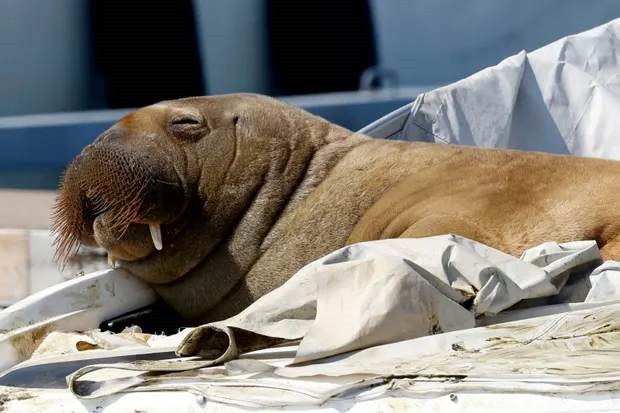
I shared with my wife, who has many concerns bearing down on her this summer, recent video clips of Freya, a celebrity lady walrus who’s lately been hanging out in Oslo Norway’s harbor. Freya is a young 1300-pound mermaid who spends around 20 hours a day sleeping while carelessly lounging on marina boats, sinking a few with her what-the-hell-I’m-wiggling-aboard anyways. During the other four hours Freya chases ducks and swans. The marina also has kayakers and paddleboard riders which she also likes chasing. Recent videos have caught her eating one of the swans,*  but perhaps thinking of her beach-body figure, she’s skipped eating the humans so far.

“Twenty hours of sleep…” my wife responded. “goals!”

Freya

Hot Girl Summer: Freya, in her liminal state between 20 hours of rest, bird and clam eating, boat wrecking, and being adored by her Norwegian fans.

.

Now as far as I know the great American poet Emily Dickinson never got to observe a walrus. On one hand, Emily did have a privileged life as the child of a successful lawyer, but then it was the 19th century and they had fewer smartphones, washing machines, lawn tractors, induction stovetops, and air conditioners. At least in her youth her parents believed strongly in self-reliance and careful household finances, and so distained servants, since after all they had a pair of daughters who could do that work. If we think of the later-life Emily Dickinson as the housebound hermit, you may not know that the younger Emily Dickinson divvied up the household work so that she had more outdoor chores compared to her sister.

One of the things I learned when I visited the Emily Dickinson house a few years back was that across the main road in front of the Dickinson house the family also had a field they farmed. And then on the house’s main lot there was an orchard and food garden which were largely the creature of Emily and her mother. Harvesting hay from the field was probably men’s work, but I was told that Emily would be tasked with bringing the harvesters water and food during their work. All that came back to me as I read this charming poem of Dickinson’s that is generally known by it’s first line: “From Cocoon forth a Butterfly.”  Here’s the full text of the poem if you’d like to follow along.

There are three or four characters in this little poetic drama. There’s our Butterfly (joined by others of her kind later), a “notwithstanding bee” who is proverbially occupied pollinating and presumably making honey, and the harvesting men. The fourth character is animated by the poet herself, a flower which despite being a plant is described as “zealous,” waving in a summer breeze for an afternoon.

Our main character, the Butterfly is described as if she’s an idle lady. She seems to have no task, something she flaunts in the poem. The field workers, the men, have obvious tasks. That hay won’t harvest itself. The bee, a cliché of purpose. The flower is a bit more ambiguous. If we assume Dickinson chose zealous carefully, the flower may be ardently worshiping the summer day or perhaps it’s divine author, shuckling in vegetative prayer.

Which character does Dickinson identify with? Maybe a little with all of them, if not entirely with one. If one has farm tasks (or for that matter the artistic tasks of a poet) the idle lady making a show of her leisure isn’t your model, even if you may feel a bit of envy — and yet poetry can be charged as like a butterfly, a piece of beauty that seems to do nothing. The men are doing useful work (see Robert Frost on mowing in this poem) but though Dickinson tends a garden this haying is not her work. Same for the bee. Dickinson no doubt knows the bee’s work, appreciates it too, but it’s not her work. We know Dickinson is highly knowledgeable about flowers, and often makes them the subject of her poems, but this zealot flower? If she’s serious about that characterization, she stands outside that level of belief.

The closing stanza, like her more famous “I’ll Tell You How the Sun Rose”  poem resolves this separation from her, the observer of it all — Vanity of Vanities, all is Vanity — and so the purposeful actors and the purposeless Butterfly will all be gone by end of day. Emily the poet remains, as does her poem if we take the time to observe with her again, many days and decades later.

Before I leave you with an opportunity to hear my performance of Dickinson’s “From Cocoon forth a Butterfly” I want to put in a note here about the lack of activity here this summer. I share some of the concerns of my spouse, and I am also trying to reevaluate this Project to see if I can make what I do here more useful, or beautiful, or something. Traffic and listenership always drops off in the summer, so a good time to reevaluate, and you may see fewer new pieces until autumn.

To hear my performance with original music you can use a player gadget many will see below. Don’t see any gadget?  This highlighted link is here as a backup for you.

.

*Showing a connoisseur’s appreciation for the swan greater than William Butler Yeats’ I’d say. Yeats only looks at his swans, and yet the great poet distains at putting his tusks into one like Freya. Walruses also eat clams, which as far as I know have never moved Yeats to poetic transport. Apparently, Norway has a problem with lots of invasive clams, which may be why Freya has been hanging out in Oslo.

Yellow Air (Heat)

Are you new here? If so, this is what the Parlando Project does: we take words (other people’s, mostly poetry) and combine them with a variety of music we compose, create, and perform. I find this fun, and I also find that even more than reading another person’s poem — even reading it aloud — performing it illuminates corners inside the text that I might otherwise overlook, so I write here about that experience. Then when you listen to the pieces you get to hear the poem in this new context to freshen your appreciation of poems you know, or to allow you an entry into a poem previously unknown to you.

Most of the time I’m faithful to the texts I use to create these pieces. Oh, I might take a part of a poem and make it a refrain/chorus, or I may select some tasty phrases from a prose paragraph so that expresses something more sharply, as if it was a poem — but my usual idea here is to honor some poet or their poem no matter how famous or little-known it is.

John Gould Fletcher is shelved in that little-known section these days, even though he was associated with writers and movements that are still studied, still read (at least by those interested in early 20th century American Modernist poetry.) I wanted to look at some of his work because I read that one of those associations was with those pioneering Modernists who took to calling themselves Imagists. Imagism was often that 2:40 punk-rock single of a hundred years ago. Instead of spendthrift merely decorative language, rhyme, and imagery, the Imagist poem wanted to get right down to it: direct treatment of something observable, not some ideal distilled from abstract thoughts imagined or philosophically proposed. No extra points would be scored for extra words. Rhyme, while not forbidden, was also not the main point. If rhyme led to extra words, those unneeded ones, it was worth discarding.

The musicality of poetry wasn’t thrown out, but like Modernist music, Modernist verse wasn’t interested in the old formal beats so much.

Best as I can tell from my early readings, Fletcher’s personal interpretation of Modernism and Imagism was not the same as others. He didn’t write much in hyper-short forms, while many of his fellow Modernists published whole collections, or sections in collections, made of sub-20-line poems. At least at first glance, Fletcher cared more for sound and less for freshness and concreteness in his imagery than others.

This Project likes shorter pieces, even more so now because my time and opportunities to compose and record are less than in the Project’s early years. In reading through a couple of Fletcher’s collections from a hundred years ago, I did come upon this short poem that was part of one of those roman-numeral separated sequences like other Modernists used. “Heat”  seemed an attempt at the short Imagist poem to me. Here’s how “Heat”  goes:

As if the sun had trodden down the sky,
Until no more it holds living air, but only humid vapour.
Heat pressing upon earth with irresistible langour.
Turns all the solid forest into half-liquid smudge.

The heavy clouds like cargo-boats strain slowly against its current;
And the flickering of the haze is like the thunder of ten thousand paddles
Against the heavy wall of the horizon, pale-blue and utterly windless.
Whereon the sun hangs motionless, a brassy disc of flame.

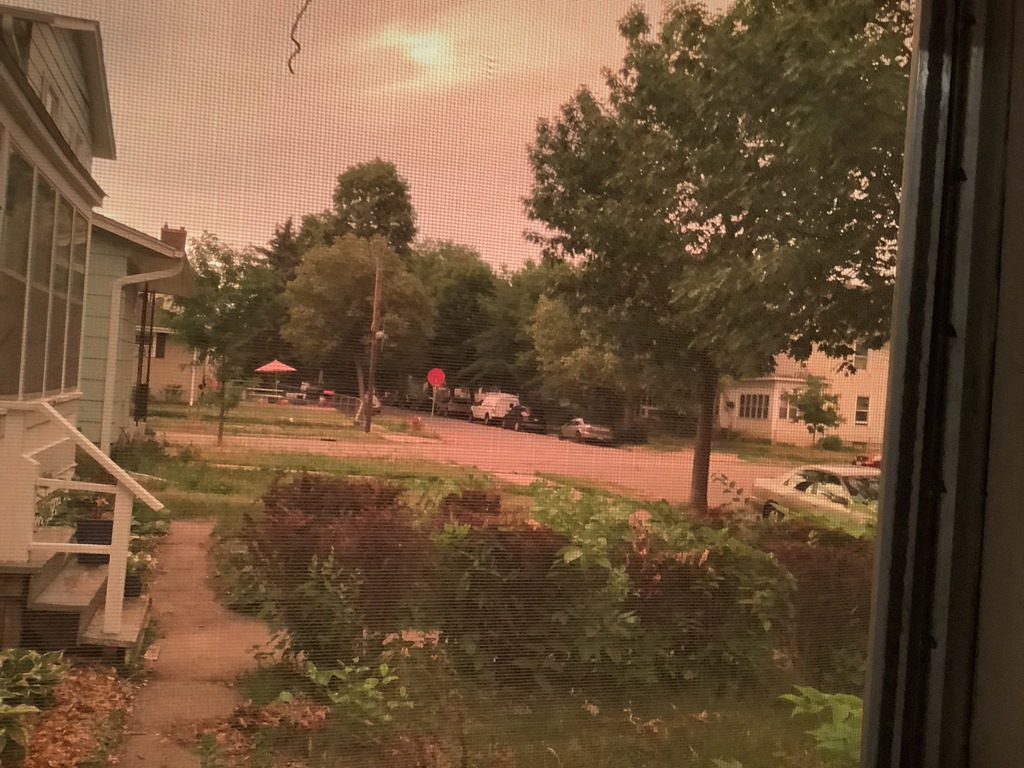
Short as it is, it’s a little wordy and formal in its manner of speech compared to other Imagists, but a palpable feeling is evoked in the description. I could have performed “Heat”  as it is above — but then a week ago tonight, I was sitting on my front porch after a summer thunderstorm when the entire outdoors started to take on an intense yellow cast.*

Yellow Sky the Picture 2

It was hard to get a modern digital picture of last Tuesday evening’s sky with a phone. The smartphone kept correcting the heavy yellow and darkening cast to that sky, and as I looked at the photo preview on the phone I wondered why my phone wouldn’t believe me as it showed things brighter and blue. I resorted to using a much less smart device with a lesser digital camera to get this.

.

I decided then and there to use Fletcher’s poem to remark on that experience. This recasting went through a few drafts and produced this reuse of some of Fletcher’s words in a different poem:

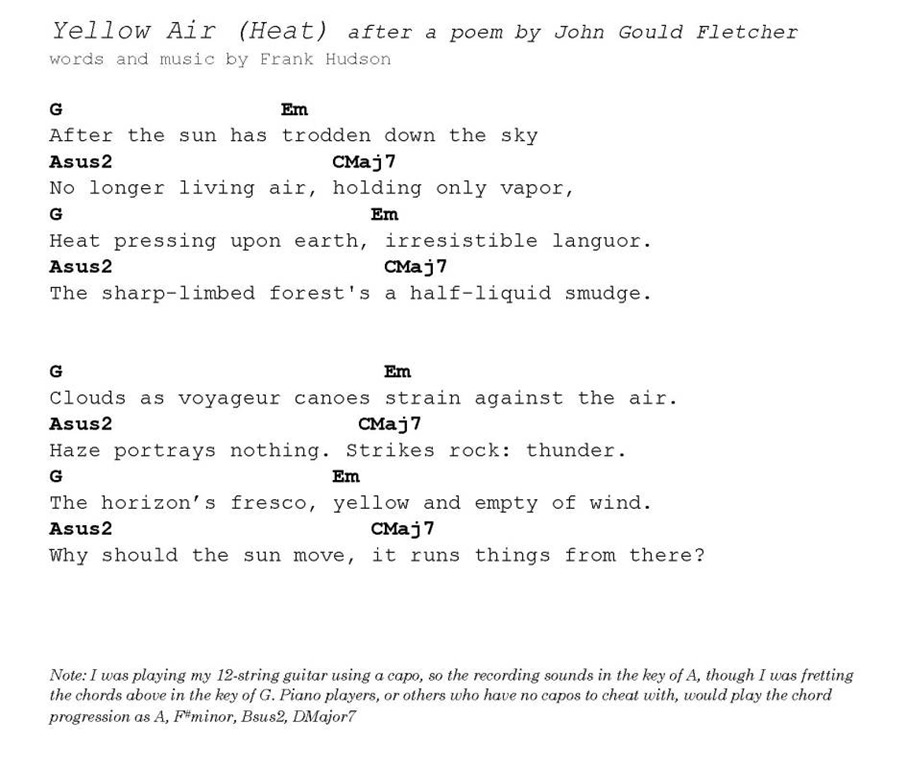
Yellow Air song PRINT VERSION

Here’s “Yellow Air” with chords in case you want to sing it yourself.

.

What did I change? I wanted my own yellow air in a hot, humid summer experience to be portrayed. Though I retained many of Fletcher’s original words and phrases, my variation is present tense and uses a much less literary/formal sentence structure. Mine’s 61 words — Fletchers, 80. The clouds as ships image is borderline cliché and Fletcher’s “cargo-boats” wasn’t specific enough to fight that, so I substituted my own upper-Midwest image: the 18th century indigenous cargo-boats of our region, the voyageur canoe — still reflected even today by those who use their modern canoes to carry themselves and gear into the Boundary Waters for camping. I wanted a more definitive ending too, and so ended my “After…” poem with the sun portrayed as a ruling strong-man who doesn’t care that the sky is yellow and the heat and humidity oppressive.

What I kept, or even tried to bring out was Fletcher’s word-music. Rhymes near and perfect were increased in number and paused on, and I tried to make this variation more easily singable than Fletcher’s more prolix lines.

You can hear the resulting song with the player gadget below, or if that won’t show up in your way of viewing this blog, with this backup highlighted link.

.

*The Twin Cities Weather Service explained last week’s yellow sky cast this way: “Behind thunderstorms in the evening, high clouds remain. The setting sun emits light that is bent with longer wavelengths. While the blue (shorter) wavelengths are scattered out, the yellow-orange-red part of the spectrum remain, thus producing the sky we’re seeing tonight.”

John Gould Fletcher’s weird “America”

It appears that no one reads or is concerned with American Modernist poet John Gould Fletcher these days. I came upon him in a passing mention that he was associated with Imagism, a pioneering English-language Modernist style that I find worthy of sustaining. Turns out this was only the half of it: in Fletcher’s “associated with” resume, later in the first part of the 20th century Fletcher was associated with a southern American ruralism movement known as The Agrarians which then morphed into The Fugitives who furthermore helped birth — not sheep or lambs — but the monastic New Criticism that reigned supreme when I was in school as a young man. I’ve learned only a little about Fletcher, so don’t make me out to be an expert on him, but this linked short bio is much better than his sparse Wikipedia entry for flavor and detail, and it makes it sound like sometimes Fletcher’s “associated with” was a brief prelude to a falling out.*

John Gould Fletcher by Edward McKnight Kauffer 1024
“Tell you ma, tell your pa, gonna send you back to Arkansas!” Fletcher traveled and lived overseas early in the Modernist era, but spent the last part of his life back in his home state of Arkansas. Here in 1924 he could pass for “Remain in Light” era Brian Eno don’t you think.

.

Thanks to the wonderful collection of scanned books at the Internet Archive I’ve spent this month looking through two of the nine books that Fletcher published in the era surrounding WWI. My impressions are early and will be subject to change, but he seems to be writing in a different mode than other early American Modernists that I admire and have presented here.

Like early Pound you can see elements of Victorian era poetry remaining in his verse. He’s generally less interested in short poems of specifically observed moments than many Imagists. His free-verse often has a definite beat and attention to sound — using, a century ago, word-music techniques that a skilled modern slam poet might select today. Reading poems like today’s selection, I could imagine a live in-you-face-off between Vachel Lindsay and Fletcher in their primes in front of a raucous audience.

He’s a more genteel poet than Lindsay, and among the 19th century influences I see in what I’ve read so far are Whitman, Rimbaud, and William Blake, and today’s selection will help illustrate that I think.

Fletcher’s “America, 1916”  comes in near the end of his 1921 Breaker and Granite  poetry collection. This “America”  is a six-page prose poem that, like the poems that precede it in the collection, attempts to sum up the state of America in 1916, but ends, in the final section that I performed, rhetorically like one of Blake’s prophetic books sung to the word-music of Rimbaud’s The Drunken Boat.**   There are no good online sources for the full text of this poem, but I’ll link here to a Google Books result that may allow you to read the whole thing.

Is there a prosaic political point to this poem? In the context of the rest of the poem it could be reduced to a call for America to enter World War I — which though the war had been raging for two years in 1916, was something that wouldn’t happen until a year after the poem’s date. But like Blake’s America, a Prophecy  (which after all includes specific contemporary references of the American Revolution) Fletcher’s poem is doing so by making a more esoteric call for an elusive greater spiritual body of America to be born.

Is America still in an extended, excruciating, labor toward that birth? I’m no prophet, I won’t tell you, but I’ll do my best to give voice to Fletcher’s 100-year-old-words. The final sentence of the poem is one place where I made a slight change in Fletcher’s text. Weirdly, in a way I can’t quite pick out the intended significance, Fletcher ends his piece with “thou shalt arise, perhaps in vain shalt seek, to rule the earth!” As a prophecy of the subsequent “American Century” this could be counted as a palpable hit. Here in 2022, I sought to echo the internal subtlety of Bob Dylan’s opening line to his “License to Kill:”***  “Man thinks ‘cause he rules the earth he can do with it as he pleases — and if things don’t change soon, he will.” With Fletcher’s last line I did it mostly by repeating the “in vain” twice more to add weight to the dangers of vanity.

I performed only the closing section of Fletcher’s “America, 1916”  today because composition and recording time are hard to come by right now. Lots of drums and I was able to play my own horn section this time thanks to getting short-term access to a better set of virtual instruments than I previously had at my disposal. You can hear my performance below either with a graphical player many will see, or with this backup highlighted link provided for those who won’t see a player.

.

*The bio mentions bipolar disorder, which might help to explain the bursts of output and the periods of disengagement.

**Stop the presses, ah, blog post — whatever. I’ve just discovered that the prose-poem style used in this and some other pieces in Fletcher’s collection are “Polyphonic Prose,” a term most associated with Amy Lowell, who Fletcher was specifically aligned with at the time. This short notice of Lowell’s use of the form in Poetry Magazine,  November 1918 shows Fletcher highly praising that poetic form two years after the date of “America, 1916,”  but before the publication of the collection in which I found Fletcher’s poem. Lowell (and to a lesser degree, Fletcher) credit a contemporary French poet Paul Fort as the inspiration of this form. At least in the Wikipedia article on Fort, Rimbaud is not mentioned as a direct influence on Fort, even though I heard Rimbaud word-music in Fletcher’s expression of the form.

***While there are few live-take liberties with the lyrics, this version of that song by Richie Havens is definitive to me.

Spring 2022 Parlando Top Ten numbers 10-8

It’s time to look back at the last quarter and see what pieces were the most liked and listened to during those months. I released (or re-released) 51 pieces since March 1st here, more than enough to return to our regular multi-post Top Ten countdown format, so let’s present numbers 10 through 8 today as we move toward the most popular one this spring. As usual, the bolded titles are links to the original post in case you’re new here and want to read what I said when I first presented them.

10. “Blackberries” by Kevin FitzPatrick.  Kevin, who died last year, was a contemporary and fellow poet to Dave Moore and myself, and this charming poem about his early experiences as a life-long urban dweller (and reader of Irish poetry) getting used to his life partner Tina’s small rural farm is a fine addition to our Top Ten today. This audio performance is a live take, and in honor of our mood of remembrance that day, I decided to leave our longish instrumental prelude in place for the version you heard here.

This poem was often a highlight when Kevin would read it, displaying his dry wit. I read it a little differently than Kevin might, but of course Kevin isn’t here to do that anymore. I will leave a reminder that Kevin’s poetry collections are available through this link run by his people.

The player gadget to hear the performance is below for many, and this highlighted link is a backup way to play it.

.

9. Sonnet To Beauty by Lola Ridge.  While reading Lesley Wheeler’s new book about encountering poems in the context of one’s life, Poetry’s Possible Worlds,  I was pleasantly surprised to find some poems there from modern New Zealand poets. If I had world enough and time, I’d like to be even more various here with the countries’ poets I present, even though most of what I know about New Zealand is from scholarly works: The Flight of the Concords and Wellington Paranormal.   Despite sharing a name with an Australian settler poet, I’ve only presented a couple of emotionally riveting and under-known poems by Australian Modernist Kenneth Slessor as part of the Parlando Project — and what, not a single New Zealander? Oh, wait. There’s Lola Ridge. Ridge was born in Ireland in 1873, moved with her family as a preschooler to New Zealand. After a brief marriage, she left for Australia and then finally to America where she spent most of her life, though her early poetry does reflect her times in the Antipodes.

“Sonnet to Beauty”  is likely one of those poems. Though Ridge soon became known early in the 20th century in the US as a staunch advocate of social reform and radicalism as well as knowing and interacting with many of the NYC area early 20th century Modernists, “Sonnet to Beauty”  is a regular sonnet about the radical appeal of the artistic life — even while life may present buzzards misapprehended as if swans. Ridge lived that twin social and artistic radicalism thoroughly from most short accounts I’ve read.

When I presented Ridge’s poem this March it was easy for me to pair that twinned dedication with another contemporary of Dave, Kevin, and myself: Irish-American poet Ethna McKiernan. Ethna died this past winter. Yes, somedays it’s hard to see the swans instead of the certain buzzards.

Same deal, player gadget if you see it, highlighted link if you don’t.

.

Kevin Lola Hilda

The 3 poets whose words I use today: tilt, tilt, and look away. The light turns a buzzard out a swan?

.

8. The Pool by H. D.   I said, re-released above, and here’s the story. Roughly a third of the listeners to this project’s audio pieces never read the posts I put up about my encounter with the poems or any thoughts I write on composing and realizing the original music. Instead, they find the recordings via podcast directories where I present only the musical pieces without the usual talking and joking that fills the running time of most podcast presentations. Having seen radio production done at a high level close-up for a couple of decades in my day-job life, I suppose I could have attempted a talking pod show about music and poetry — but if only for myself I see an appeal of these 5 minute or less podcasts that might serve as a palate cleanser between main courses of talk-talk-talk.

I’ve noticed that some of my most popular early episodes, ones that racked up a lot of listens in the early years of this Project, had rolled off the “last 100 episodes only” offering lists of most podcast directories, and so for April’s National Poetry Month I decided to “re-release” 30 of them. Even for the blog readers like you, I think many of them would be new to current readers here as well. Coming in at number 8 this Spring then is early Imagist Hilda Doolittle’s “The Pool,”  a mysterious very-short poem about a tidal pool encounter. It’s so short and compressed that even at one and a half minutes of run time I had to creatively elaborate the text a bit to reach that length. I rather like the music I composed and realized for this little piece. A lot of listeners did too.

See a player gadget? You can use it. Otherwise, this highlighted link plays it too.

.

Back with the next three pieces in our spring Top Ten rundown soon.

Generations, and Poetry’s Possible Worlds

I won’t take much time today in presenting another short 90-second musical piece I composed. I also wrote the text for today’s composition, which isn’t the normal thing here. One of our principles is “Other People’s Stories” — we try to emphasize the value of a variety of poetic expression and what it’s like to encounter that. It’s not like I discourage the writing of more poetry, I only wish to increase the engaged reader side of the equation and to pay tribute to traditions that I draw from when writing or composing.

I’ve been reading this month a new book by poet and teacher Lesley Wheeler: Poetry’s Possible Worlds.   It’s a fine and enjoyable example of that sort of thing hosted inside another mind and lifetime. Wheeler takes 12 not-particularly-well-known contemporary poems and applies care, consideration, and her life’s own insight to them. This would be a different book if these poems were Contemporary English Language Poetry Greatest Hits. Such another book could have value — but it would be more about known worlds with existing maps and pins already placed. This book does something else more uniquely valuable.

Because we perform the poems we present in the Parlando Project, we must breathe inside them. Poetry’s chest inflates when you do that. Wheeler’s book makes each of these poems a sibling, cousin, co-worker, friend, parent, or child — those who we encounter life beside and together with.

One last thing I want to stress about this book: it’s entirely approachable. While Wheeler has written elsewhere as a scholar, and I have one of her books in that line that I’m anticipating reading this summer, this is a book about life and poetry looking at each other that doesn’t require any prerequisite classes. Middle-aged people and above may particularly appreciate “Poetry’s Possible Worlds”  due to the life events encountered, but not every young person is uncurious about life-planets they haven’t voyaged to yet. Here’s a link to details in case you want to join me in reading this book.

So, here’s today’s piece, and since it’s called “Generations”  you may expect it has something to say about different ages speaking to one another. Read/listen carefully, there’s a little barb in the middle of it.

Generations

Is there a Möbius strip inside this one, or just a recognition of how we recall life-lessons when we get older?

.

Musically, this performance has a benefit from the new orchestral instruments I have available for the rest of the year in the richer French Horn that plays a prominent role. Player gadget below for many, and this backup highlighted link for the rest of you.

.

Did you come here looking to celebrate Bloomsday? The Parlando Project has got 2 1/2 minutes of your young, concise poetic James Joyce right here.

.

my adaptation of Li Bai’s “Staying the Night at a Mountain Temple.”

Let me write today about two possibly useful incidents in this project’s working process. Let’s start with the process of translation or adaptation of 8th century master Chinese poet Li Bai’s words. Long-time readers here will know I rely on English language glosses. Here’s the one I used to start work on today’s piece:

High tower high hundred feet
Hand can pluck stars
Not dare high voice speak
Fear startle heaven on person

.

Unlike some other glosses I start with, this presents a fairly clear setting: there’s a high tower, from the title, part of a temple. It’s so high and the 8th century sky is so clear at night that one can imagine grasping the stars. The final two lines say there’s a compelling notion to not speak loudly, that heaven might be startled by a loud voice. The first two lines, clear, objective, the last two lines, in that they seem to be reflecting something subjective, open to interpretation.

Here’s an even-tempered and minimal translation into modern English:

This tower is a hundred feet high.
From its top one’s hand can pluck down stars.
I shouldn’t talk in a loud voice,
for I might startle the people in heaven.

.

I could leave it at that. One might consider the above an accurate translation of a modest thought. One might ask why the concluding fear/shouldn’t statement, and answer that matter by saying the poet is in awe in this high nighttime temple. I later saw at least one published translation that goes this way.

That could be  what poet Li Bai was saying, or would say if he was speaking to us in modern English today, but I made another approach. My understanding, limited though it is, is that Li Bai was often not a respecter of conventional piety, and legends include stories of his early life as some kind of free-lance swordsman*  and his lifelong habits of drinking and intoxication. Chinese scholars think Li Bai helped bring an individualized mode of expression to classical Chinese poetry and that’s part of what he’s revered for.

Audaciously thinking then that I know those things, I took almost the same English words, and even though classical Chinese writing has no equivalent of the question mark, made the phrases questions — impudent questions at that, aimed as replies to whoever might be hosting a boisterous poet. This is the result of that approach:

Mountain Temple

Later below I mention my persistence in composing music, despite my limitations. Why not? Am I afraid I’m going to bother the people in heaven?

.

I like that. I think it’s a better poem in English, though I could be wrong about Li Bai’s attitude. Do not trust me as a Chinese scholar! Furthermore, do not trust fully any  translation. Even better scholars than I are making best guesses and practical choices while enclosed in their own mindsets while translating.

For a second chorus, here’s a short tale of how my music for this came to be. I’ve been dissatisfied with my musical efforts as of late. I call myself “a composer” because I don’t think I’m a competent musician most of the time.***  Yet a lot of the things I’ve been presenting lately are mostly to entirely live takes. Of course, instantaneous improvising is composition of a rapid kind. I enjoy that as a listener and player — yet I also didn’t think I was presenting enough music recently that was reflectively devised to my plans, making choices and re-choices before presentation. Even though I felt that, I couldn’t get started with that mode. And this was so, even as this spring I’d sprung for a yearly subscription to a larger set of orchestral virtual instruments. Weeks had passed by, and I hadn’t made use of them.

Would I this week? I kept telling myself: no, you have too many distractions, your energy level is too low, your musical concepts are probably too simple-minded anyway.****  But I willed myself to sit down with them and my MIDI keyboard and guitar and….

Several of the new sample libraries, present on an external hard drive, wouldn’t load. Couldn’t be found. I’d told the software where they resided, but somehow it hadn’t understood. I thrashed about trying to figure this out for nearly an hour (I’m not quick witted) and then finally told them again where the sample libraries, all those gigabytes of notes and articulations of notes, were sitting.

And that worked! By this point I was a bit mad at myself or the software or fate. But mad is energy. Over the next day or so I worked on today’s music as I made myself familiar with some of the new software’s system. Some of that aggression found it’s way into the orchestral swells, and I think it fits well with my portrayal of Li Bai’s belligerence when told to be quiet.

You can hear that example of my composed music, and my adaptation of Li Bai’s words in the recorded performance below using a graphic music player that many will see. Don’t see the player? This highlighted link is an alternative way to play it.

.

*Obligatory explanation: how Chinese character names are presented in western alphabets is a fraught process. Li Bai has often had his Chinese name presented in the West as Li Po. Same guy, just a different system/approximation.

**Given that early history, I’m tempted to adapt a Charles Mingus phrase about the influential bop saxophonist: “If Charlie Parker was a gunslinger, there’d be a whole lot of dead copycats.” The story is that Li Bai was handy with a deadly weapon. If Li came to us out of a time-machine, Western authors of inessential haikus — or chancey translators like me — might want to up their armor class before meeting up with him.

***This is not humble-brag, but a clear-minded evaluation. I’ve never developed a goodly number of useful musician skills, and even those things I can do some days to my reasonable satisfaction escape me on other days. A musician has a baseline and a variety of dependable skills I don’t have.

****I sometimes call what I do with orchestral instruments “Punk Orchestral” in that it asks simple motifs and naïve playing abilities to carry the weight over greater elaboration and musical knowledge. Via that approach, what comes out sometimes sounds to others like that Mid-Century musical movement that was dubbed Minimalism. I was aware of that movement in the 70s and 80s, attending Phillip Glass, Steve Reich, and others’ performances and listening to eventual recordings. But I don’t have a theoretical basis for what I do, I just make music with what I can figure out to do, trusting that simple concepts sometimes produce equal effects to more elaborate ones.

The Dick & the Dame, or Dave Moore goes Pulp Noir

This project spends a lot of time in the first quarter of the 20th century where the public domain diamonds are scattered free for recutting and reuse — but If I was able to expand this, I’d probably skip the Thirties and delve into the 1940-1965 mid-century quarter, the era I personally remember through youthful-eyed memory. What were those adults up to then, what were they thinking?

We can never answer that fully. Even through that time’s poetry and other art we can only get shadows and dappled sunlight. The high-level summary is “The Greatest Generation” with its dedication to institutions and its obverse face of turned-away conformity. One way the dark leaked out from this gloss color print with scattered blood stains was through paid-by-the-word hard-boiled detective fiction and the run-fast through the projector snap-traps of film-noir. This stuff was white-male written, and mostly for male audiences too. Misogynistic? Well, yes — and in its defense it’d plead misanthropic. That first quarter of the 20th century had its Lost Generation, but this quadrant had exiles. The former wandered off in search of something and doesn’t know where home is anymore. The latter was sent away from home and was pretty sure it couldn’t go back.

The misogyny can bother me when I read or view it, but the magnetic soundtrack of caustic oppositional views attracts me too. And then the outmoded slang involved can seem almost Shakespearian now, the anarchic becaming archaic.

Pulp Detectives 600

“The underwires on this dress are killing me, so don’t think for a moment I won’t use this piece.” Dames on the covers, dicks on the bylines.

.

When Dave Moore and I got back together to set down some live “in-the-moment” tracks this spring, Dave brought two outstanding longer pieces he’d written since we last worked together. The first, already presented here was “The Wall Around Heaven,”  a satire which is set in our present day. If you haven’t heard it, you should. Here’s a link to it.  I can’t praise it enough. The second I present today is a re-weaving of pulp detective and film noir tropes, told though. as Dave turns the pages, with his own poetic verve. Language of course was the chief freedom of the grayscale Abelards & Heloises in those stories, and Dave makes the most of that argot. In a note on the copy of the text we performed this spring, Dave wrote that “The Dick & the Dame”  was “inspired by Robert Coover’s Noir.”   Dave marked a handful of lines as “taken or shaped by Coover.”

The music here is Dave’s too, though some of the decoration is mine. There’d be a temptation to dress this set in mid-century Jazz sounds, which I didn’t do here. Afterall, Elvis Costello’s “Watching the Detectives”  went with the end of the mid-century era with its reggae and Secret Agent Man guitar twang. I went with funky electric guitar neck wringing and whammy bar abuse which would scorch the manners of the Jazz cigarette world. The result is longer than our usual pieces, and neither Dave nor I are well-known poets who’ve written well-known poems, so this breaks from our “Poetry’s Greatest Hits” format. I figure: by this point summer is breaking out and there are fewer listeners and readers of this project until fall anyway. Might as well turn it up and go loose today.

Warning: in this crescendo of innuendo, bad words and flawed people show up.  You can hear that and it with the player gadget below, or where that doesn’t show, with this highlighted hyperlink.

.

.

Burying the Poet’s Typewriter

Elegies are a funny business. Your job is to say something about the missing person — the missing and the person — in some combination. I’m personally committed to the short lyric poem, which asks furthermore that one finds short, immediate, and melodious things to stand for a life and loss. Proportions like that risk absurdity. I decided with this piece to run into that risk.

Absurd proportions in elegies can work. I think of Frank O’Hara’s pair of marvelously effective elegies A Step Away from Them”  and The Day Lady Died,”  which spend nearly their entire compressed length talking about the persona and the living activities of the mourner.

Do we expect Bunny Lang or Billie Holiday to rise up and slap O’Hara’s face or utter a sharp remark? “Who cares about your malted or gift shopping, your cracks about Puerto Ricans or African poets. I just died!”

Buy and large, we don’t object. Mundane specifics and little noticings go on after loss for the living. One wonders if the dead (if they have consciousness) miss them as much as the most luminous moments of their lives. And in the end, don’t those little tarrying things mock death most thoroughly?

The performance you can hear below is from last March, live in my studio space with the Dave Moore that’s also in the poem. I continue to tinker with the poem, a few lines or phrases may not be done yet. Go ahead and listen now at the bottom of the post if you’d like to experience the poem and the performance without further discussion from me. The rest of this post is unnecessary to that.

Burying the Poet's Typewriter Cover smaller

Other performances from this session were featured back in March 2022, and are available via our archives

.

The optional part begins here…

This poem is an American Sonnet, which means we hold the truths self-evident that we can change elements of the sonnet form. I wanted to set the opening, as many of Kevin’s poems did, firmly in working-class lives with old cars that work if you know what to do.

Burying the Poet's Typewriter

There are small differences in the above version that post-dates the live performance you can hear below.

.

Stanza two introduces elements of the typewriter in the title obscurely. Even though the title will prepare the most alert readers to what the object is, my expectation is that most readers are not oriented to the world of the poem yet. The typewriter serves as a generalized symbol here, though with a specific in-joke. In Real Life Kevin used a typewriter to present his poems well into this century. We’d gather to discuss work and exchange drafts each month and Kevin would hand us not some variety of computer printed high-resolution pages, but copies made with carbon-paper on his typewriter. I’d sometimes joke: “Kevin, mine’s from down in the stack. Could I have a darker one closer to the top?” All that’s missing from the poem today — except to Kevin’s family and friends who might hear or read it. Kevin’s place was always quite neat, nothing left out and un-put-away, so I don’t think I ever saw his typewriter, but I think it was a later generation electric typewriter. Yet, the one I present in the poem is more OG, one with an open keyboard with exposed metacarpal levers beneath the lettered key tips. Back when I took a typing class we called them “manual typewriters” (as opposed to the electric models that we had just one seat-row of in the classroom) and they metaphorically are our skeletal writing hands within the poem’s second stanza.

Kevin wrote an elegy, included in his final collection “Still Living in Town  for Katie, the incongruous farm-dog poodle that appeared in several poems in that collection. In it, Kevin struggles to bury the dog in frozen farm ground. Kevin’s poem is an Old Yeller-sized tear-jerker in reader effect, but he undercuts it with humor and anger that intensifies that effect. Here too the proportions are absurd, and that poem of Kevin’s has mechanics that are strange if one stops to look at them. I start the third stanza tipping my hat to that poem of his. I do worry that that connection is lost on the casual reader of this single poem of mine, but it may be enough in the self-contained world of the poem that it indicates that if we are burying Kevin’s typewriter we would choose a meaningful place. I’m trying to adjust the balance here between the missing person and the persons doing the missing.

My feeling/judgement/plan is that last line in that stanza works by strange underlayment of associations with several typewriter brands. Even now in the 21st century I fear this may already be footnote material as typewriters recede into history. These brand-names reeled off say this is a “royal” burial, “underwood,” of the mythical messenger Hermes, and finally the Mount of Olives significant to the Abrahamic religions.

Maybe this is a poem for folks my age — or the very diminished audience of those even older. Perhaps they are the only ones who have the shared experience to “Do not ask for whom the return bell tolls…”

Now why did I go through these other few paragraphs here? The planning and intent and selection I talk about is immaterial to the poem as an object. The reader or listener either gets what I put there and left out, or they don’t. I did this partly out of my nearsighted pride in my craft. More than one reader of this has commented “It seems like a dream.” Well, yes, there was imagination involved. Work at writing or any art long enough and your imagination may become trained, and your appreciation of imagination’s useful moments sharpened. But in the end the poem succeeds as an object based on craft. I’m unsure of my level of craft, but I continue to try to use it.

You can hear the LYL Band’s performance of “Burying the Writer’s Typewriter”  with a player below. Don’t see a player?  This highlighted hyperlink will also play it.

.

*Just so that there be no mistake, I admire Frank O’Hara and these two poems. And if you’ve got a moment, follow the hyperlink for “A Step Away from Them”  as it leads to a nice short appreciation of that poem by Rod Padgett.

Dickinson’s “Bloom”

If I didn’t read the news, it would still be spring.

I’ve mentioned it’s been hard to produce new pieces here recently. While there’s a variety of reasons for this, here’s one: I’d planned a little series on May flowers. I was inspired by my wife’s love for our native northland wildflowers and some gorgeous photographs of cactus blossoms by Kenne Turner that I recently viewed on his blog. I had this witty little poem by Emily Dickinson with a not so obscure moral underneath about being an artist — Emerson with a dose of playfulness. I’d completed composing the tune for it. And I planned to pair that Dickinson with a couple of poems by the master of Chinese classical poetry Du Fu.

But I was only halfway there in how captured I was by transient beauty. Earlier this spring on my morning bike ride I started to mull over this line that hasn’t found its poem yet: “This spring is filled with bird-songs and the death of young black men.” So, the horrible and the hortatory were already mixing in my thoughts, while I have nothing but good will and empathy to claim there.

Everyday I try to will myself to make useful or pleasurable work toward this project, and this, among other things, makes me pause. Am I missing the point? Do I even know what the point is, or the series of points that lead to it? I feel bad for the limits of what I can offer, and then I feel bad for not offering that little. Still, I’m stubborn with this. I keep butting against it, trying to push it over or trick my way around it.

And Tuesday I did. Starting early, I recorded an acceptable performance of the Dickinson poem with my music, worked on music for the Du Fu flower poems, and practiced my understanding of how to perform a poem of Kevin FitzPatrick’s that I will present at a memorial event this weekend. A good day it seemed, even if I missed the day’s near-perfect spring weather outside — never mind, the internal weather of being able to create, to illuminate for myself and perhaps for others the work of Dickinson, Du Fu, and Kevin was pleasant and enough.

Never mind, as I got ready to go to bed after this fruitful day, and I caught the news of another rain of bullets. Grade-school kids!

Should I have something appropriate to say, something useful about that? The horrible and the hortatory. Something that isn’t so entirely obvious to some and beside the point to others? Long time readers here will know one motto I have here: “All artists fail.” I’m certainly failing here for some today.

So, you’re going to hear me perform this little poem about flowers, about the work that goes into making mere transient beauty. Here’s a link to the text I used today if you’d like to read along. Dickinson judges right off that she’s sure this isn’t some “minor circumstance.” And Dickinson would know. She knew her flowers, wild and cultivated, intimately.* She was a serious gardener of food and flowers, and despite her growing reputation for being some secular nun always in cloister, she purposely chose that outdoor work with plants over other household chores. She knew their use for food, she knew their use for transient beauty. Flour and flowers.

Her little poem goes on, and the little bud fights several ways for survival. I love the litigious line she uses in passing that she may have borrowed from her male family’s life as lawyers “Obtain its right of dew.”

Prowling Bee by Heidi Randen

A prowling bee “Assisting in the Bright Affair so intricately done…”

.

My dear wife left me on the rise to her job with a hug this morning, wishing me success in being creative today. Was she being a “prowling bee?” If so, as another bard had it, “Sail on my little honey bee, sail on.”

To fail in art, as with Dickinson’s final judgement on our flower that blooms past bud, is a “Profound Responsibility.” If you’re working on art this spring, I’m not asking you to fail, or to be happy with failure — at least I never am. This spring is full of bird song and dead people, the lightness of flower petals laid on us are a suffocating “heavy brocade” as Du Fu had it in a poem of his, one I was able to complete a performance of. All I know and can tell you is how that feels.

To hear my musical performance of Dickinson’s  “Bloom” (Bloom — is Result — to meet a Flower)  you can use the audio player you may see just below, or if you don’t see the player, through this alternative highlighted link.

.

*As I mulled over this poem’s presentation, I was reminded of how seriously Dickinson took her connection with gardens and flowers by Twila Newey musing on Twitter that Dickinson’s mature aversion to publishing could have been the result of her individual conviction that transient and intimate beauty, as in her garden, was sufficient, or even superior to a wider advertisement fixed in type.

Edward Thomas’ “Cock-Crow” cleaves the wood of thoughts that grows by night

A lot of these performances begin somewhat randomly. Oh, Edward Thomas isn’t random, I’ve enjoyed exploring this British writer with you since I first ran into his connection with Robert Frost in the years just before WWI. Was I looking for a poem considering a particular subject or event? One could see today’s piece, “Cock-Crow”  as a spring poem. Well, spring is  random, the current one where I live more so than most. but I wasn’t looking for a spring poem so much as I wanted to find someone else to present from the early 20th century.

I picked up a poetry anthology from 1929. It’s titled 20th Century Poetry,  which would be audacious for a book published a little more than a quarter of the way in, but the editors were aware of that and they rightly note that their century milepost had marked a noticeable change in poetic expression.*

It starts with selections from 50 British Isles poets. Names you might expect are there: Yeats, Hardy, Houseman, De La Mare, Masefield, and so on. A couple of distinctive British women poets you may recall from posts here too: Charlotte Mew, Frances Cornford.

It’s to be expected, given that 1929-to-now allows plenty of shelf-life for poet’s readership and notice to expire, and because Britain and the United States do not share a completely unified poetic canon, that there are a good number of “Who?” names there too: Edmund Gosse, William Watson, Henry Newbolt, Clifford Bax, and Edward Shanks.

It may have been my mood, but though I would have loved to find a little-known poem I thought would be interesting to perform there, much of it was quite dreary as I skimmed through it. The copy I was reading was a library scan, and these books sometimes have interesting marginalia. In my boredom, I examined the library stamp:

Fort Huachuca stamp

.

I wondered where Fort Huachuca was, and what would be going on there between the World Wars? Turns out it’s near the Mexican border in Arizona. It was a military facility since Western Frontier times, and it was the base for a “Buffalo Soldiers” Afro-American Calvary Regiment. Just before America’s entry into WWI, the base commander was Charles Young, the Black officer that was the subject of this poetic tribute by Countee Cullen that I presented here last year. So, as I wandered off from the poems themselves, an interesting place for this poetry anthology to reside — even more so when I glanced at the Wikipedia list of the notable people who had been there over the years. That list includes Jayne Cortez a Black Arts Movement poet and (out)spoken-word performer who was born while her father was stationed there. She’d have been too young when she left Fort Huachuca to have read this anthology, but the momentary thought that perhaps her parents had read this volume I was scanning was more intriguing than many of the British poems — or at least it seemed to me reading through it in the middle of a 21st century night.

The editor** is faint-praise in his introductory note to Edward Thomas in his anthology, calling him accurately (but misleadingly) a “commencing poet” and saying that Thomas’ poetry “comes from a very shy and personal mood that sometimes seems to lack variety if we bear it company for long at a time.” He oddly concludes Thomas’ “Invention made no parade of vigour, but he borrowed hints from no one.” Gee, Johnny Editor, it’s the middle of my American night and a lot of the early 20th century British poets you’re presenting are boring me to the point I can’t get to sleep with their all-too-unoriginal “vigour” — an odd effect which I attribute to my hopefulness of discovery — but I’ll take Thomas’ originality thank you.

“Cock-Crow”  is a little 8-line poem describing awakening from disturbing or unresolved dream-sleep, or lack of it, to a set of chickens — not hanging out round a New Jersey wheelbarrow, but amusing Thomas with the bird-pair’s face-to-face rural dramatization of a veddy British heraldic motif. Is Thomas simply smiling at that coat-of-arms likeness, or is there a resonance toward Britain’s more overt class structure?

Heralds of Spendor

“Heralds of splendour’ he says of us! That’s about right. Lions’ll  go and eat you, and unicorns don’t even bother existing.”

.

The charm of this poem is that Thomas acknowledges the unsettling “wood of thoughts that grows by night”*** yet allows them to be chopped down by bird-song — and transcendental bird song is ever-present in Thomas’ poetry. And what revelation does that song bring? Farm workers putting their boots on and getting to work. So. Much. Depends. Upon. Putting your boots on and getting to work. Want to read the text while listening? Here’s a link.

Musically I started with a simple folk-guitar accompaniment, though I tried to be settled and unsettled with the harmonic cadence in this one. I ended it with a minute-long coda where I used a vocal chorus to spread out across the English countryside like all the birds of spring. Why do I do these audio pieces? Because I want to hear them —  and you can to. You can use the player that appears below, or this highlighted link in the player’s absence.

.

*We’re approaching a similar milepost in the 21st century. Can we say that English-language poetry has significantly changed since 2001? You might say “We’ll know later what we can’t see now in the midst of things.” But the editors of this book were in the midst, and yet thought they could see something distinct in their new quarter-century.

**John Drinkwater for the anthology’s British half.

***Whose woods these are, I think he knows. Thomas led a troubled life. Every peaceful British rural scene in a Thomas poem is set next to that dark woods of thought that grows by night.