I Wandered Lonely as a Cloud (Daffodils)

It may be U. S. National Poetry Month, but one can’t deny the impact that English poets have had on poetry, particularly before the Modernists launched with significant American participation.

Modernism, as practiced by those early 20th Century Imagists sought to cleanse poetry of the rust and rot of “poetic language” and rote abstract metaphors. Strong, exact words, no more complex or numerous than necessary were to describe things that were actual things, not merely decorative analogies to describe something else. By the 1920s, that American import, T. S. Eliot, became the standard of one large stream of Modernism. Although inspired by this fresh use of language, the Eliot wing of Modernism sought to rid poetry of “romanticism,” defined as a relentlessly subjective expression of personal experience unshaped by a greater historical and cultural understanding. Poetic language might be refreshed, but the cult of the great poem returned, and said that poetry is best to be in service of great themes and elaborate—rather than elegant—structures of thought.

Early Imagist/Modernist poems were about moments. The High Modernism of Eliot allowed it to be about eras. Imagists prized images of things formerly ignored or costumed only in the rhetorical finery in 19th Century poetry. High Modernism still allowed the mundane to stand for sublime thoughts, but it often sought to display a level of knowledge and literary scholarship along with the everyday in its choice of images.

This is why it’s important to look at the early part of artistic movements. Often their best ideas become mutated as the movements develop. Their revolutions become the new orthodoxy.

Today’s piece, “I Wandered Lonely as a Cloud (Daffodils)”  is by English poet William Wordsworth, one of the founders of Romanticism. It’s a poem that can be attached to an exact (April, Poetry Month) date: April 15th, 1802, and to a walk that Wordsworth and his sister took in rural England. But that’s not how the poem was written. Wordsworth wrote it a couple of years later. He referred to his sister’s detailed journal entry about the April walk to refresh his particulars. His wife supplied two critical lines for the final stanza. This was not a spontaneous outburst of subjective personal feeling at all.

Daffodils at Kew Gardens

I couldn’t make it to the Lake District, but even a month ago, daffodils were blooming during an English Spring in Kew Gardens
In a few weeks my lawn will look like this in Minnesota—only dandelions, not daffodils.


When I performed the version you’ll hear below, I made one significant change and one minor one. The minor change? I dropped the adjective golden from his line “A host, of golden daffodils.” I suspect I did this by accident as I performed it. Not to dis Wordsworth (and by the way, Billy, what’s with that obvious pen name “Words-worth” for your poetry gig?) but I think I improved the line when I sung it as “A host, a host of daffodils.” First off, daffodils are a common flower, and they are in the wild always yellow. Strict Imagists would say the golden adjective is therefore unnecessary—and it is, well, a gilding of the lily. I can’t recall my reason for the major change, dropping the next to last stanza—I may have desired to shorten the piece for performance—but it is the weakest stanza in the poem.

The resulting “Daffodils”  I perform wouldn’t have been far from what F. S. Flint or Richard Aldington would have written a century or more later as pioneering Modernists. After all, Wordsworth said that he was trying to cleanse English poetry from special, high-flown, poetic diction too, to return it to “as far as is possible, a selection of the language really spoken by men.”

I do retain something else Wordsworth does here, something I don’t recall the Imagists doing much. “Daffodils”  is presented in a framing device, while the Imagists were all about the presentation of immediacy. Wordsworth doesn’t say merely that looking at all these wildflowers, the temporary exultation of spring, was transfixing—and he says that less with that next-to-last stanza removed. This is not a poem only about letting us see them in their wild, external multitude through his eye on an April walk in nature.

No, the poem starts, deliberately, in past tense. “I wandered lonely as a cloud.” And the poem closes even more removed. The speaker of the poem is not the energetic nature-walker strolling in Spring. In the actual, unknown, later time of the poem, he’s lying on a daybed, vacant or pensive. These daffodils are now only obtainable by the “inward eye” of recollection.

Setting something in the past can be seen as a tactic of sentimentality, something the Modernists distained, but what we have here is worth that risk. How so?

I thought it a delightful little nature poem when I read it as a teenager. Then I read it decades later, as my Eagle Scout father, the angler long accustomed to waiting perpendicular on the flat surface of lakes, the man who had bicycled across his rural state many times—while then, as I re-read, he was further and further confined to lying flat in rooms with the erasing of days. In that later time, noting the wild daffodils bliss is told to us in memory, I reversed Wordsworth’s famous dictum on the origin of poetry. In my reading, in that time, it became a poem, a song, of tranquility recollected in emotion.

Here’s my performance of “Daffodils”  as I sang and accompanied it on acoustic guitar.

The Oven Bird

With today’s post, we’ve reached the 100th official episode of the Parlando Project, where we mix words from many sources (mainly poetry) with various kinds of music. For the 100th piece I’ve decided to feature an older recording of mine, almost 10 years old, of my performance of Robert Frost’s “The Oven Bird,”  because it marks some of the initial ideas that lead me to this ongoing Parlando Project.

Parlando Project 100th audio piece

the Parlando Project has posted 100 audio pieces combining music and words


Frost’s “The Oven Bird”  is a devastatingly accomplished lyric poem written early in the 20th Century. The rhythm of the lines both grooves and varies itself, like the best music, and the rhyme scheme is elaborate, yet it never falls into forced rhyme. Frost’s language here is so plainspoken, ironically saving the fanciest and longest word for the poem’s last line. Frost is as rigorous a modernist as any of his contemporaries in the Imagist school. He’s as willing as any of them to hack away all the overused and overgrown 19th century “poetic language” and to use no word more than needed, but he does it here while writing a sonnet in rhymed metrical verse that sounds as natural as any free verse.

Allow me to indulge for minute my musical interests for a moment. What Frost does here (and elsewhere) is like what John Coltrane did shortly before changing his focus to what was to be called “free jazz,” where melodic freedom was stressed by radically simplifying the underlying harmonic structure. Coltrane wrote and recorded the most devilish difficult set of rapid chord changes constantly shifting the harmonic center, an obstacle-course of a composition called “Giant Steps”,  and then proceeded to improvise over it as if it was no matter to him to make those changes. Like Coltrane, Frost could seem free, natural, and innovative, while writing inside a constraining form. This sort of kindred accomplishment speaks to what attracts me in the Parlando Project to equally privileging music and words.


“The Oven Bird”
  has a reputation as a downbeat poem, and while Frost will not sugar-coat the human condition, I did not, and still do not, find it so. In “The Oven Bird”  Frost draws our attention to a bird that sings on, past the promising days of spring, and whose song is none-the-less, loud and insistent, even though he’s singing in a season where he might well feel out of place and out of time for song. Then in the closing section we’re first told that the future holds the fall season—and by extension, both the fallen state of man and the death cycle of nature—and “the highway dust is over all.” Some have read that line as Frost noting the coming of the 20th Century roads that will close out even more forest and bring some measure of end to the natural world. I think instead the “highway dust” is more at a statement of the death of all living things (dust implies in my reading “to dust”) and that dust is the dust of a set, laid out, road.

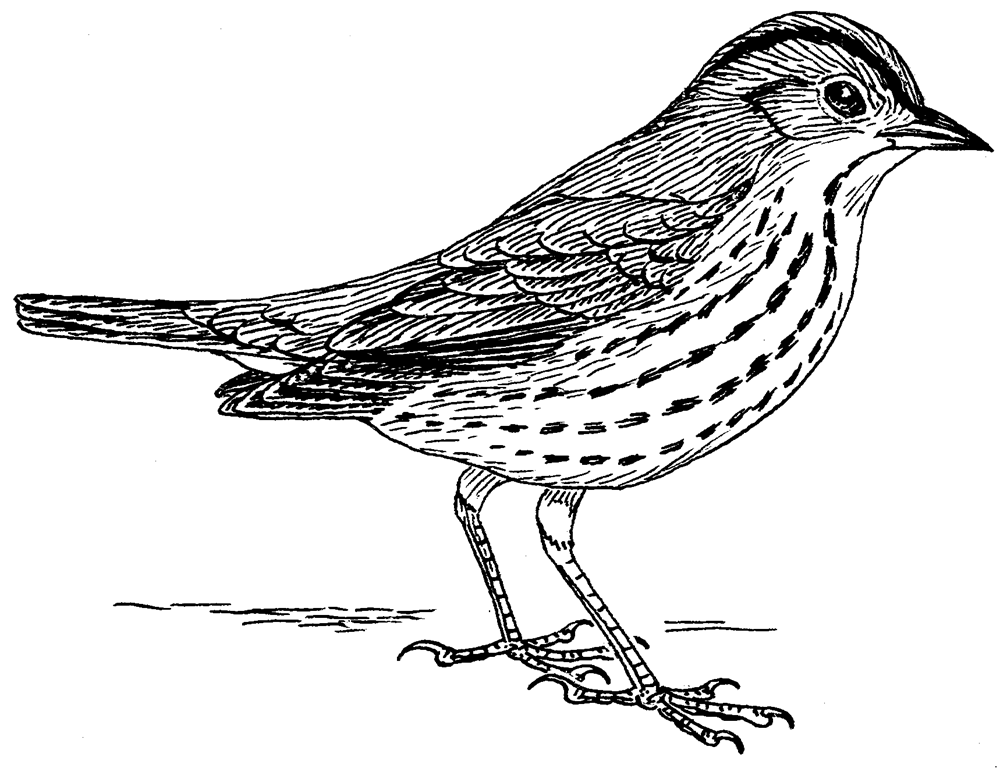
Oven Bird

The oven bird: “He knows in singing not to sing”


Finally, Frost hits us, and me specifically near 10 years ago, with his conclusion—one that says much for this project that seeks to find “The place where music and words meet.” He says those of us, also mid-summer and mid-wood who listen knowing these things, sharing the bird’s predicament, should know that the bird has these teachings to pass on to us, “He knows in singing not to sing” (a zen koan of a line) and that the present question is “what to make of a diminished thing.” What a progression to this, from the plainest language with simple words never more than three syllables long, singing us the oldest cycle known to self-conscious humans—and then Frost gives us a line suitable for meditative thought and a question.

This is where I break from those who see this as a despairing poem about death, failure and decline. The poem asks what to make of that, offering the example to loudly sing.

To hear my performance of Robert Frost’s “The Oven Bird”, the 100th offical audio piece posted here as part of the Parlando Project, use the player below. “The Oven Bird”  performance is voice and acoustic guitar, but if you listened to others,  you know that the music and poetry we use varies. If you haven’t listened to other audio pieces in this project, check out the monthly archives for more. And if you like this, hit the like button or the follow button, and share this post or this blog address on your favorite social media channels. Those who’ve already done so help keep Dave and I encouraged to create new material, and you have helped grow the number of people listening to pieces from “Parlando – The Place Where Music and Words Meet.”