Exhumation

I’ve already mentioned that I’ve been dispensing with a lot of stuff, the kind of winnowing that I like to refer to as “Death Cleaning.”* This has included going through a series of stored-away boxes and plastic bins which dated back to moving into my present house in the 1980s. While somewhat illogical, this isn’t, I think, unusual. When we move, we’re moving forward, and there’s a tendency to liberally bundle and box up those things we think we might still want – and then in the new place, present time takes over and one never gets to unboxing things one doesn’t need right away.

Things of mine I found in these dusty bins? Music tutorial books, and books on French poetry and language. The former because this was the height of the LYL Band’s live performance era and I was hoping to increase my skills and knowledge, the latter because I was interested in translating Symbolist and Modernist French poetry.** More than 40 years have passed. I now know that I know just a bit more about music: mostly what I’ve found out about in order to create the over 850 Parlando Project pieces composed this century. That’s what became my tutorial: doing. I never got around to translating as much French poetry as I planned, though you will still see that interest playing out here sometimes. Back then, I thought French poetry was the key to English-language Modernism, and while that’s not entirely untrue, I now know the American influences some of the French poets took note of.

One night in this clean-out task, working in a small room with shelving that I think had once been the coal or oil bin for our Edwardian house’s early furnace, I pulled open one of the stacked boxes there.

It was likely the contents of a desk or file cabinet drawer packed away by my late wife in the 1980s. Inside the larger cardboard one, there was a metal box, the kind one might keep important papers in – but this one was filled mostly with things she had written. Looking through the pages, there were a few things that might have dated back to high school, and a selection of poems and short-stories, some for college classwork,*** some for her just post-college time when she submitted and had published poetry. A couple looked like work for articles she had published in Seventeen, then a glossy magazine for the teenage girl market. Also in the cardboard box were the contents of many a desk in that era: sheets of typing paper, the chalky white strips that one could carefully pinch just above the belettered hammer of a typewriter to blank out a mistyped character, and a few miscellaneous things from a job she’d had with Control Data.

I was steeled for the job of getting rid of things that had an adjudged expiration date of meaning or usefulness. I could easily chuck the general detritus of this typewriter wielding ghost, but I couldn’t throw out the manuscripts. How many poems were in the stack? Might I be able to perform some of them here? Maybe. “Death cleaning” sternly says you won’t get around to it. The Parlando Project whispers otherwise.

Renee's Metal Box

In this case, Public Image Ltd was not involved: Renee’s metal box and folder of youthful creative writing work.

.

So, the metal box went into the to be saved pile – but of course there is no real keeping. I’ve survived my late wife for 24 years, and I’ve been with my living wife for almost exactly as long as I was with my wife who died all too young at 43 years old. Actuary tables say I will die before any more such multidecade interval. Death cleaning has its solid argument: the writings of a young woman, or those of myself, the young man she partnered up with, will not have any enduring memorial. It’s a near certainty that is so too of all the poets I’ve known. We write words like the immortals do, with the same goals, to the best of our craft – but there are only so many niches in the pantheon.

Today’s musical piece is a poem I wrote condensing that experience. I can imagine the readers I used to have in my small group of poets wondering at an imperfection of the poem’s ending. “Why end this personal poem with such a mundane little observation about – what? – a business you don’t even name? Needs another draft.”

And I confess to you here, that’s the thing I’m trying to say. The most practical and commercial things we do in life come to an end, are forgotten – all that stuff we’re told we should be doing instead of writing poems, making music, or creating art. So then, forgive us our arts.

You can hear my musical performance of the poem I call “Exhumation” with the audio player below. I wanted this to have rough edges, and so the guitar recording tries to capture and leave in pick and fretboard noises that you’d usually not hear by intent. What if the intended audio player gadget is not where I say it will be? No worries, some ways of reading this blog toss it out, but I supply this highlighted link that will open a new tab with its own audio player.

.

*I think when I first heard the term it was “Swedish Death Cleaning” and the process was imbued with practical Scandinavian modesty. The florid sentimentalist of objects within me has to listen to the memento mori enlightened elder in me: these are simply artifacts of one person’s life that are meaningless once that life ends. Somewhere in the corner, there’s a Modernist, smoking unfiltered cigarettes, in an Existentialist infested coffee shop, who exhales in blue and says to no one in particular, “Well, it’s all meaningless, save for what you compose it to be.”

**Mixed in were some faded to brown music papers from the Seventies and Eighties: Punk, New York Rocker, Sounds. I had them in the to-the-trash pile, but my kid wondered if they could digitize them and upload the scans to the Internet Archive. I doubt they will ever get around to that, but they’re young and should enjoy those provisional ideas.

***The little college she attended allowed her classes with Howard Mohr and Phillip Dacey.

May Day, Monarchs, Milkweed, and Langston Hughes’ “Teacher”

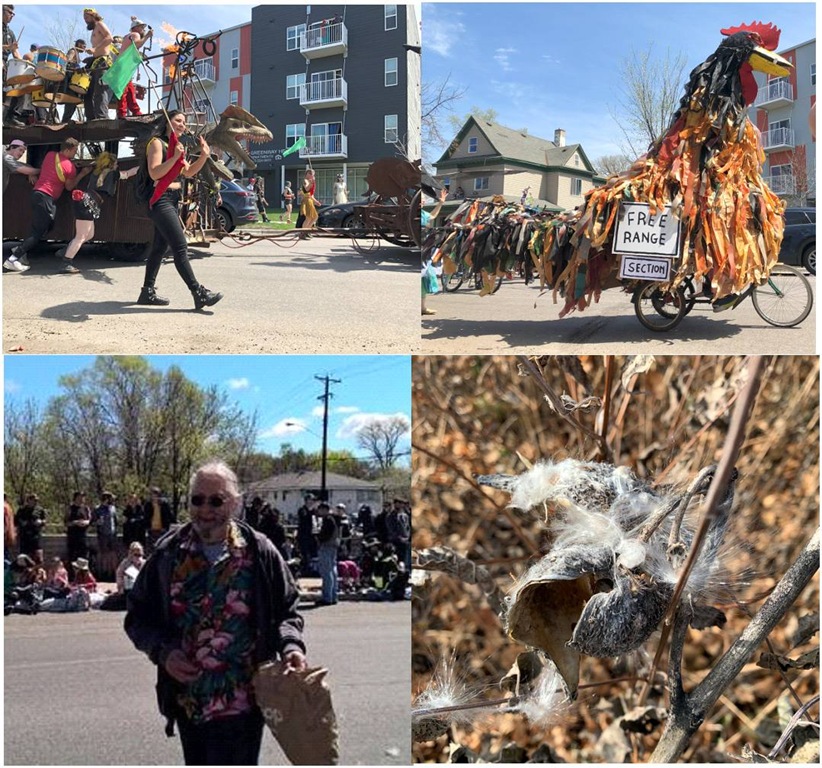
I went to one of the marker events of my year, the May Day Parade in South Minneapolis last Sunday. It’s a wonderful thing to return to, kids and neighbors dressing up and marching from Lake Street to an urban park, some putting on elaborate homemade puppet exoskeletons, others holding signs of local resistance, beating drums, playing instruments, and riding on contraptions ranging from customized bicycles to the mighty fire belching Southside Battletrain hauled upstreet by local Anarchists, a tribe of pierced and tattooed Sisyphus.

But more precious than all this exuberance was that I got to meet up with my old friend, poet, cartoonist, and musician Dave Moore and his partner. We did as we have for many years: we sat on the low concrete curb near the start of the street parade. The little curb, inches high, is a perfect seat for the lower children, the ones that would leap up near us on either side of the march as any promise of tossed candy delighted them. Dave and I are not children, far from it. Oh, very far. Our old bodies creak up and down when we stand to clap, call out, and cheer “Happy May Day!” as the parade passes by. The tumult covers the sound of our joints, our happy shouts outstay our grunts and groans.

And then there is the silent thing Dave does as our neighborhood starts to disperse back to their homes or other activities after the parade passes. Dave carries a bag of milkweed seeds to the parade each year. The bridge whose street side we’ve been sitting on spans the Greenway, a reclaimed railroad right of way that’s now a walking and biking trail. In its older, more overgrown times milkweed lined the tracks, and the hulking trains then whipped up their fluff from the dried pods — little vegetive boxcars unloading the slightest, near weightless freight of their commerce. And so after the parade, Dave takes handfuls of those seeds he’s brought, and tosses them to the present air. They rise like tiny albino angels, swirling into May skies with a job in their seeds: milkweed is the manna of the immigrant monarch butterflies who migrate from Mexico, whose children depend on it when they are infants bundled as caterpillars.

That, kind readers, is a holy moment. The noise, the quiet, the Spring, the joy of workers celebrating their day.

But there’s another chapter in this story. Someone Dave knows sees him and stops to chat. He’s happy enough with the parade of course, but his conversation is troubled. He’s a schoolteacher. Looking nearly as old as Dave and I, he’s still working as such, and he despairs. The children have no attention span, no lessons can adhere, he reports. No one realizes how tough it is now, he says, and I guess I’m an example of that, but I hope he’s partly wrong. I’m one of those dried seed pods now, I don’t know where the escaped fluff I release here lands, and that lofted randomness releases me.

May Day and Milkweed Collage

I made a choice to not take pictures this year at the May Day Parade — but here are some older pictures: part of the Southside Battletrain, a bike-powered puppet-float, Dave with his bag of milkweed, and a milkweed pod

.

I thought of this teacher and his tale alongside this poem I perform today written by the young Langston Hughes. Hughes was in his 20s when he published it, so it seems to be another of those poems about old age written surprisingly in youth. Did Hughes have a particular teacher in mind, or was he (even unknowingly) writing about an element of himself as he created this epitaph? In “Teacher”  Hughes is engaging the poetic trope of the grave as a place of unending reconsideration, but as a person in their 20s he was a chrysalis where the pulpy worm may turn to wings — not a pulpy corpse under a dissolving summary. Hughes has his teacher in the poem speak as if the unvarnished holding on to virtue pinches the soul – and yet virtues are something that young people are always being told they need to develop. I don’t think such lessons are entirely wrong, but they are not the entire either. I think the star-dust that cannot penetrate the poem’s speaker is the diffuse, the random, the broad-spreading possibility. It’s a signifier of entirely unsure hope, a precious kind. Here’s a link to the text of Hughes’ poem.

You can hear my performance of Langston Hughes’ “Teacher”  with the audio player below. Because I wanted a slow, long-hanging-in-the-air, timbre for the guitar here I chose to play electric guitar on this performance— appropriately my Guild Starfire guitar for this representation of star dust or milkweed fluff. No audio player to be seen? Some ways of reading this blog won’t show it, this highlighted link will germinate a new tab with its own audio player so you can hear it.

.

The Fade, a Rock song about aging and loss

So here it is, our 800th officially released audio piece from the Parlando Project. Perhaps it’s not representative: it’s not by a dead poet, and unlike almost everything else we do it may not have been written for the page without thought of it being sung. “The Fade”  was written and sung by the leading alternate voice of the Project and all-around inspiration Dave Moore. Dave and I go back to when we were leaving our teenage years. I met him then when he read two pieces in a church: one was his own poem, a cheeky number that mixed eros and agape, and the other was a reading (as if it was page poetry) of Bob Dylan’s “With God on Our Side.”   A decade later we started doing music together as the LYL Band, and some of what we were doing has become melded into what became the Parlando Project.

So, as I think again — is there any way to have a representative Parlando Project piece? Maybe not, and if so, by design. Variety and seeking something unexpected are founding goals.

Dave’s writing here, and our common efforts in making it the song you can hear below, strikes me as something too little done. Rock, whether it’s Rock’n’Roll, punk-rock, Alt-Rock, Indie-Rock, has tended to speak from a youthful perspective. Even the Classic-Rock acts that are still treading the boards at Dave’s or my age hew to topics that would interest those younger than they are. “The Fade”  is far from those common tropes: it’s about the diminishment of aging and particularly about the fogging and loss of memory.

Early this morning I watched an old documentary, a British South Bank Show done in the mid-1980s about the Velvet Underground, a band that was more than a decade defunct at that point, but all the principals (several dead now) were alive then, only entering into middle-age in the 80s, and of a mind to answer questions about the band’s influential work. The topic most covered as they spoke about their former joint project was what made the songs the original lineup put out of lasting importance when the idea of 20-year-old Rock songs having currency seemed novel.

Chief songwriter Lou Reed had it that he wrote about the things he saw around him rather than using the regular subjects of pop songs. True enough, but he chose subjects decidedly less ordinary in song in the times when he wrote them. He specifically wrote about things that frightened people enough that they left them out of the songs they wished to listen to: drug dependency, gay and gender issues, less-vanilla sexuality, and mental variations. And then several others, including the band’s PhD, Sterling Morrison, took pains to note that Reed presented those stories without editorial comment or stance, without sentimentality.

I’ll note now, that later in his career, past the times of that now 40-year-old documentary, Reed wrote one of the few Rock albums about aging and its disabilities: Magic and Loss.  It still stands pretty much alone. It’s also unlikely that even the adventurous readers and listeners that this Project has have heard it.

Dave and I recorded “The Fade”  this past spring. When I talked to Dave this morning we exchanged info on folks we know, folks our age or even a bit younger, who are moving into assisted living or who are suffering from dementia. I don’t know, there are probably a few songs about how sad Alzheimer’s and the like are, probably some songs that try to mitigate it with a chorus that mixes in the memories the sufferer no longer maintains. Dave’s song isn’t like those songs — if they exist — and I’m glad I helped make his song exist, and that I get to share it with you today.

The Fade

This is the sheet Dave handed me with brief scribbled chord notes on the day we recorded this. As you listen to the performance you may see that he did a masterful job of revising his typed words. I think the song gained power from the verses he left out.

.

You can hear that recording of “The Fade”  with the audio player below. I think Dave gets a bit of the VU-ara John Cale sound with the keyboards in it. I’m using feedback in it too, but not quite as the Velvet’s did. What? No player visible? No, you didn’t forget it along with where your keys are or what you came into the room for, it’s just not shown in some ways of reading this blog.  You can use this highlighted link as an alternative.

.

A Sonnet of Two Letters

It happens to us alone, but it happens to so many it’s a trope we share. It goes like this: you have one of those bad dreams. Something terrible has gone wrong — and you, inside the dream, feeling it is real, try to fix it — but you can’t because the other people in the dream are oblivious to the terrible and are acting stubbornly in odd, irrational ways. While dreaming you’re trapped in this desperately unsolvable situation only you can clearly see and try to act rationally on, running in place, thinking in circles.

I had one of those dreams this week: felt so real, so heart-wrenching. Then the dawn comes, and you realize that experience was a dream — oh, that’s why you couldn’t fix it, that’s why everyone else in the dream was acting so wrongly!

OK, exiting satire mode, but let’s stay strange.

Early this Fall I was cleaning out something: a box, a drawer, a binder, a little used bag, I can’t remember exactly what. But in it was a clutch of papers. I glanced at the pages and recognized it was a mix of things: some works-in-progress looking for first reads from the old group of poets I used to meet with every month, and some initial drafts of a longer, multipart poem I was writing as my mother was going through her last hospitalization, the one from which she would ask to return to the home I grew up in with my father and sisters in order that she could die there. I set those sheets of paper aside.*  I figured I’d look them over later, maybe digitally scan them, or put them in my filing cabinet. At that later I’d also look to see if there were any drafts in the small stack that were unfinished pieces I could revisit.

Now here it is, we’re November and I finally got around to that sort-out. One of the pages was a college-ruled notebook sheet with a complete intermittent draft of an irregular (American) sonnet. What was this? While I remember well working on the longer poem around my mother’s last illness 20-some years ago, I had no memory of working on this sonnet. Complete blank. Moreover, the sonnet seemed to speak of someone’s story that I didn’t recognize as mine — nor anyone else’s I could recall either.** With the time-interval between discovery of the papers and my finally going over them, I can’t even be sure if this sonnet was found among the stuff from the time of my mother’s death or not. Trying to determine why I didn’t remember it, I wondered if it was even older. I recalled that scholars date Emily Dickinson manuscripts by looking at the changes in her handwriting over time, so I tried that assay. Looked to me more like my 20th century handwriting, so the poem could be older. Still, it was my handwriting, testifying I, however unremembering, wrote this poem — and “What was it about?” That intrigued me. The poem asks the reader to work obliquely, details are supplied but not all the details, something that can tantalize.

A Sonnet of Two Letters

The gardening stake metaphor used in the final section reminds the 2024-me of Robert Frosts “Pea Brush,”  a poem I didn’t know when the me I was back then wrote it

.

Why did the voice in the poem not mail their first letter? What was it about the recipient’s husband that was germane to that decision? Was there an affair or appearance of one? Clearer to me was the latter part, the stuff of the second letter, a recalling of youthful aspirations and a friend who by what they said helped make them more substantial than pretensions. What an interesting yoking, I thought. The imperfect, the not said, or the thing whose saying we keep hidden — combined with the things that were said that help us realize our lives.

As you might tell from the previous paragraph, I was experiencing this poem just as I would the general run of Parlando Project poems, ones written by others in a project which has as one of its mottos “Other People’s Stories.” Its mystery and ambiguity captivated me, and so I set about making it into a Parlando song.

I did a revision of the initial handwritten draft I had found and worked on combining it with the music you’ll hear with it below this week. The music today is played as a conventional LP-era rock ensemble: there’s the usual quartet: bass, drums, chordal and “lead” guitar. Added to that are two keyboards, piano and Hammond organ. You can hear the result with the audio player gadget you should see just below. No gadget? Wake up, this highlighted link opens a new tab with its own audio player.

.

*Two of those poets have since died, I re-handled those pages, ones they’d typed in and handed to me years ago, and thought tenderly of them. My part of the household is due for an austere “death cleaning,” the tossing of those things an old man keeps to extend something of the life of that-and-those who’ve passed on. I have no grave illness, but the keeper now must consider that they will pass on and that there’s no real keeping.

**I did write from personas in my writing life regularly, a bit more so in prose than poetry. I was likely imagining the “short-story” plot that I then went about expressing in the sonnet.

Rejoicing Veins

Summer has event dates for me. Wedding anniversary for my living wife, death anniversary for my dead wife. In between, my birthday. A birthday has the same date on the calendar, but they change over the years in their nature. I can still recall the birthdays for singular digit ages, those massive markers toward becoming, achieving oneself. And then there are the rights-granting ages, 18 and 21; or certain decade mileposts, 30 and 50.

Now aged, the age number becomes hazy, defining less. A fair number of people who’d be my age aren’t, due to death. Most of my cohort have some collection of Marley’s Ghost chronic conditions, mild to significant. This is, after all, the portion of life that takes away things, slowly or all-at-once.

But it’s important to add to this calculation, life adds each day too. I’m celebrating my birthday today with my wife and a couple of friends. We’ll meet at an art museum’s restaurant. Everyone and I have not stopped breathing.

I celebrated my actual birthday by getting an ultrasound study of my aorta. My doctor suggested it since I had smoked in my twenties, and there’s some increased risk that this major artery can later swell and be at risk for a rupture, something that is in that all-at-once class of ageing events. Weird going through a test like the one when I first saw the shadow of my child, to know if I have a shadow of death inside me.*

To a degree not equaling my enjoyment of life right now with my little family and this Project, with still being able to hop on a bicycle and ride, with the ability to meet an instrument and come to an agreement on some music, I do have a sense of shadows. Multiple family members, all younger than me, have had some mild to more significant cognitive issues diagnosed this past year. Slowly or all-at-once — that’s birthdays, that’s aging. I’m enjoying the days slowly.

“Upon our couch we lay as lie the dead,/Sleeping away the unreturning time.” Go ahead Vincent, it’s OK to take a nap. It what you get done when you wake up that counts.

.

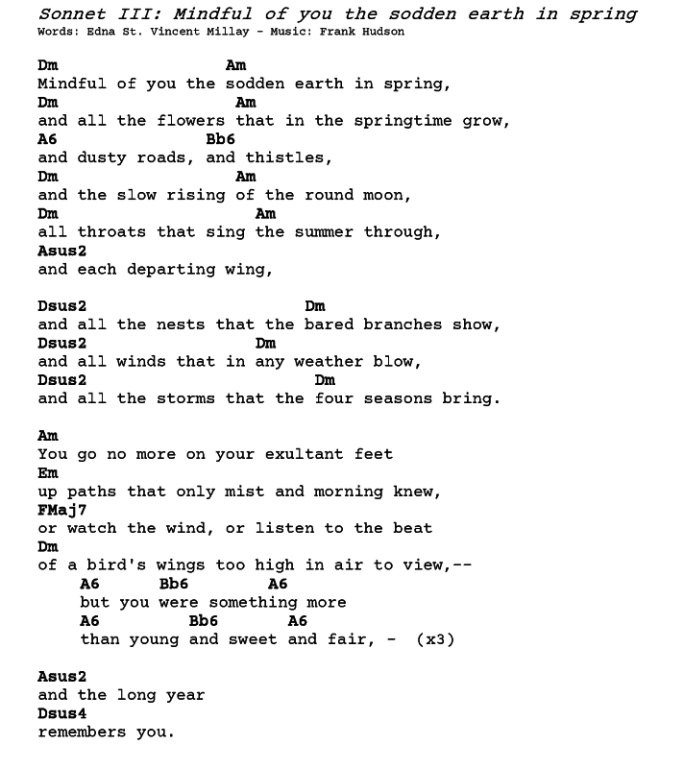
Today’s musical piece is my setting of a sonnet by Edna St. Vincent Millay. You can read the text of her poem here if you’d like at this link, and listen to my performance with the audio player below. I had a half-a-dozen beginnings/basic tracks of Parlando musical pieces sitting on my hard drive, and I selected this one mostly out of how near to being finished it seemed. Then as I set down to write today’s post — asking myself what I was thinking — I realized the poem expressed elements of my life this summer.

I remember when I presented my first Millay sonnet for this Project, years ago. I knocked her then for using too much archaic language and sentence order, an affliction her contemporary Modernists were seeking a cure for. “Rejoicing Veins”  is from later in Millay’s career, and by then the language in this one shows little of that fault. This is another poem that seems to me to speak accurately about old age, yet this was written by a 40-year-old poet. Vinny, that doesn’t seem so old to me, but you got it right!

There’s that graphical audio player now, or if you don’t see it, this highlighted link that will open a new tab with its own audio player.
.

*Test results? Everything looked fine. Rejoicing arteries?

I’m Gonna Make Love to My Widow ‘fore I’m Gone

I’m going to take a short break from our February celebration of 1926’s Fire!! Devoted to Younger Negro Artists*   to celebrate old people — really old people. The audio piece today is also not as solemn as some of the issues we’ve dealt with in other posts: it’s about love, desire, lust — and those feelings are represented as Shakespeare or many of the Afro-American Blues artists of our last decade to be called “The Twenties” might present it, as “country matters.”

There’s a long poetic lyrical tradition of mixing rural metaphors with desire. We’ve done more than one piece here over the years in the bucolic poetic tradition of lusty shepherds and comely rural maids, but it has occurred to me in my present old age that they are almost always young and single. I, on the other hand, am an old, long-married man. Not to put a damper on the prurience factor, but when I say old, I mean old enough to think about not being around to promise love forever. I’ll repeat what I’ve said here before: that at my age when offered a lifetime guarantee on a product, I’ll ask now if there’s a better deal. Yet, oddly enough, that for me makes the desire to connect with my beloved no less ardent. Carpe Diem is no longer just a trope to be trotted out.

Does today’s rambunctious piece do a good job of communicating that? I’m not sure. I presented an earlier draft of this a decade ago to a writer’s group I was participating in — and they, in the springtime of their mid-60s, thought it was a persona poem about someone wooing a rural widow, while I thought the inescapable ribald joke in the piece was that the singer wanted to, ahem, get down with it, before they died making their wife a widow. That group was often right about such lack of clarity, but I sometimes wonder if they were too young — and now that half that group has died, that they might have a different understanding of this lusty Blues poem. And it occurs to me that’s an additional joke! The audience for poetry may be small, but am I expecting the audience for this one to be made up of dead people?

Make Love to My Widow

Here’s my Blues-poem lyric. We’ll be back with other peoples’ words soon.

.

I don’t know, but I wish all of the readers and listeners here, of whatever age, a happy Valentine’s Day. We may not understand love — after all, we barely understand lust — but let us fumble toward that understanding with chocolates and flowers in a cold February. You can hear me perform this Blues-poem with bottleneck-slide guitar using the graphical player gadget below, or with this alternative highlighted link.

Are you looking to further connect Black History Month with love poetry? Patricia Smith is presenting new and existing Black love poems this February via a month of curating their Poem-a-Day feature.

.

*You might think, “1926, that’s old people!” but Fire!!  was organized, edited, and written by members of the famed Harlem Renaissance when they were barely out of their teens.

In a Disused Graveyard

To complete our Halloween series, here’s a poem by Robert Frost suitable for All-Saint’s and All-Soul’s Day: “In a Disused Graveyard.”

When I was a child and my father was alive, there would be times when my six sisters and I would be corralled up inside a Fifties American car for some long two-lane trip to a grandmother’s house or other destination. Yes it was crowded, and the wave-rolling suspensions of those pastel and chrome cars added another element: the possibility that one of us would vomit or simply rebel against the length of an uncountable trip.

To counter that, liquid Dramamine was administered to the younger kids from paper Dixie cups. This was given to suppress nausea, but the side-effect of sleepiness was welcomed too. Half of us might be drowsy to asleep and the other half just bored.

For that older half, my father introduced a car-ride game to help us endure the drive. It was called Zip, and I suspect it might have been something he learned with his family of mostly brothers back in the Model A era. Zip had simple rules. In the game, a handful of objects that could be spotted beside our rural roads could score points. A white horse would score 1 point. An old man with a white beard riding a bicycle would score 100 points. And cemeteries would score 10 points. The scoring child would need to shout “Zip” before any other and explain what scoring object they had spotted. It was an odd scoring system. White horses would be rare, and any spotting was subject to suits regarding — well spotting. Was that horse completely white? Did it count if it had a small blaze on the forehead? These days I am an old man with a white beard who rides his bicycle often, and I am still reminded that I could win most Zip games by spotting myself (if that is possible).  I can’t recall any of us scoring a come-from-behind miracle win from such in those days though,.

This meant cemeteries were the scoring thing. Any church steeple coming into our vision put us on the edge of our sagging seat-covered seats, tongue leaning on the fence of our teeth ready to “zip!” But the subtle player knew more, knew that some older farmhouses might have a private graveyard, or that there might be one where a church no longer was, its congregation consolidated in the ebb and flow of settlement.

Such would be Robert Frost unconsoled graveyard in his poem, with only past parishioners, homesteaders, and villagers buried there. And now we, as we travel our own roads, are picking out our own personal graveyards: grandparents, parents, aunts, uncles, siblings, friends, spouses. No farmhouse, no church, no village anymore.

Old Tombstone

“Sure of death the marbles rhyme” — also 10 points!

.

In such a graveyard the old stones, now much dated, contrast against our presence, alive, visiting such a place. Can this not seem to say there is a line between the living and the dead, a border, an underline — a place here, and a place there? As Frost reminds us, no, that’s a lie we act as if we believe, mostly, even if it can hardly fool a rock.

There are religious believers who pray for the dead on these first two days in November. And we could be praying for ourselves too once we reach an age of really knowing. Slightly premature ghosts, then we pray for those who’ve come to terms. After all, Yogi Berra was said to have said: “If you don’t go to other people’s funerals, they won’t go to yours.”

A simple acoustic guitar accompanied first-take today, as I’m pressed for time. The player gadget will appear for some, but this highlighted hyperlink is an alternative way to play my audio performance of “In a Disused Graveyard.”    Want to follow along with Frost’s original text? Here’s a link to that as well.

.

The Folly of Being Comforted

Readers often hear different poems when reading the same text. It’s unavoidable, even though it causes some authors to despair at how they are misread. So, it should be no surprise that it is possible in performance to recast poetry considerably without changing a word.

Around 1902 Irish poet William Butler Yeats wrote a poem taking exception to a too-easy consolation meant to comfort. He cared for the poem enough that around 20 years later he revised it slightly, to emphasize his response to this well-meaning gesture, explicitly writing out the one word concise enough to underline his feelings at the offer of comfort: “No.”

Those who study Yeats’ life are pretty sure this poem is biographical and is based on his unrequited courtship of Maude Gonne. That’s a long story, and to say that these were two complicated individuals is to understate the matter. If one reads today’s text, that poem “The Folly of Being Comforted,”  in that biographical way, it makes sense. Here’s a link to that text.  That reading, coldly condensed, would have it that someone told Yeats, “Hey, that hottie that you are so enamored with — I’ve heard she’s getting older, grey hair, older skin around her eyes. Sure, they say with age comes wisdom, but never mind any of that, she’s no longer so attractive that others will be chasing her. So now, maybe your chance will come around.” And to this Yeats gives his “No,” explaining that as he sees it, she’s not lost a step beauty and attractiveness-wise.

There’s a perfectly good romantic love sonnet there, and that’s not what I performed today.

I’m mentioned this year that I have family and others I know going through infirmities and transitions. It’s not my nature to talk about them, or even to directly write of my own experience of those situations. Even though one of the principles of this project has been to seek out and to present “Other People’s Stories,” I’m hesitant to speak over their own voices*  in the same way that I’m comfortable talking about those long dead and in some cases too little remembered.

As I was working today on finishing the mix of the audio performance you can hear below, Dave called me to tell me that our friend and poet Kevin FitzPatrick had died last night. We were planning to visit him in hospice tomorrow. Now we’ll visit him when we think of him. Visiting hours are now unlimited.

Kevin FitzPatrick and Ethna McKiernan

For many years Kevin and Ethna would celebrate poetry in a public reading on St. Patrick’s Day in Minnesota.

.

Another poet we both know, Ethna McKiernan, is also facing a serious illness this year. When I read and then performed Yeats’ poem, I was thinking of these things. I recognized it was a romantic love poem, yes, but I read all sorts of undertones in it. We are meant to pass over them in the “correct” reading. Maude Gonne was all of 35 when Yeats first published his poem, the grey hair and “shadows…about her eyes” were likely subtle things. We’re all more than double that. Age is not subtle at that volume. When I read Yeats’ simple elaborating line “I have not a crumb of comfort, not a grain.” I felt my own lack of useful care or comfort I’ve offered Kevin or Ethna, partly because I fear I’d be rather bad at it, and partly because I’m less close to either of them than even Dave is. That said I’ve been acquainted with Ethna for about 40 years. I may have not been close to her in her “wild summer,” but I knew her when. Yes, the fire “burns more clearly” with her even now as Yeats says.  After all, when you get our age, there’s more fuel.

Yeats called his poem, “The Folly of Being Comforted”  and he ended the poem with that title. He likely had real feelings in this matter, long ago when he was alive. When I think of these mortal matters, now, here, my feelings are different than a witty sonnet about someone’s crude mistake regarding his estimate of Maude Gonne. And so I performed my feelings, using Yeats words.

The player to hear that performance is below for many of you, but some ways of reading this won’t display that. So, I also offer this highlighted hyperlink that will open a new tab window and play it.

.

*I feel I must guard myself in that partly because I’d easily fall into it if I didn’t.

Why Now, Vocalissimus

Today’s piece uses a very short poem I wrote in immediate reaction to some sad news I heard this weekend. Despite that news’ immediacy and particular sadness, the poem that resulted became something else, and I’m not sure why, even as I was writing it, revising it, and then figuring out today’s music and performing it. Being present throughout, shouldn’t I know?

Without stepping on anyone’s own living story, and my limited understanding and participation in it, let me just say that not one, but two poets that Dave Moore and I have known for many years have been dealing with potentially mortal illnesses this summer. I started intending to write a personal poem about considering their possible deaths, and some very tangled words started to emerge.

Why those words? I’ve already told you I don’t know for sure. Perhaps the words were tangled because I don’t feel I’ve been a supportive friend in their time of illness for complicated reasons which include my social awkwardness and not really knowing to what degree they would welcome that in their situation. The tangled words were awfully impersonal, even if the person wrestling with them was infused with emotions.

I decided to leave the tangled syntax of what came out, because I came to feel that their odd flow was a potentially striking effect, slowing the reader to consider them more closely. I made attempts to bring the personal in, but none of my considered words seemed to fit when I did. Could the impersonality too be part of the way the poem means? Yes, by this point I truly wondered what my poem — my own poem — meant.

Why Now, Vocalissimus

Why now, when it is already so
when I listen to people sing in the night,
that so many of them are dead?

And some of the words that comfort us,
or cause us to wonder at why we’re not,
were written by those who now never talk.

But if you go to silence for after all,
leaving just words, sundered breath,
will they be but husks, after seed has left?

When I completed the draft I used today, I thought it had become a poem that isn’t about particular people, but about us (you, I, anyone) wondering about what a poet leaves when their poems no longer have a choice but to remain silent on the page. I know that is a problematic mode. T. S. Eliot, who like many effective poets was right and wrong about why his poetry — much less poetry in general — worked, would approve of this poem’s impersonality; but in our century now we often expect poetry to include diaristic detail, and while the muse wouldn’t supply it, I myself expect that the poem should be specific about those that I’m thinking of — and yet to include explicit thoughts of that while they live seemed morbid and presumptuous. Even though I present this piece today, I’m not sure the poem is done with me yet.

Empty Milkweed Husk by Heidi Randen 1024

Poetry. Seeds. Speak it!

.

What’s with the weird Latin word in the title? It’s to lead you away from me and my particular poets in my thoughts, and back to just about the only appearance you’ll find of that word used in an English language poem: Wallace Stevens’ “To the Roaring Wind.”  In that poem “vocalissimus” is that voice of the muse that asks to become the voice of the poet; and by extension asks us to be the voice of the poet beyond their lifetime, which is what this project is about in our normal course of presenting other people’s words.

Let me leave you with one thought: you here who write, read, speak poetry are part of a continuum. Poet’s poems dream of being more than your poem — the ones with personal details, the ones without. Few will achieve that dream, but still they dream it, before and after the dreamer.

Many will see a player gadget below to play my performance of “Why Now, Vocalissimus.”   Some won’t, so I supply this highlighted hyperlink that will also play it.

.

To Poets Not Dying Young

Poems and songs about those artists who die young are easy to find.*  Why should that be? Well, tragic aspects there are plain to see and it’s easy to note the lost potential in an early exit. I think there’s a further factor too: we are much in love with the trope of young artists whose work is caught in a rising arc before falling with melted wings. It’s extraordinarily difficult for an artist to continue to impress or delightfully surprise over a long career. We artists repeat ourselves and are judged to have become stale — or we change and produce work that isn’t judged correct to be coming from us. Perhaps this is inevitable. Or maybe in part it’s us as readers, listeners, audience, who contribute some faults to this by always seeking new faces — or the practical use of any failures as telling markers to drop attention.

I’ve made no secret here that I’m old. I missed out on being a has-been and I’m not anyone’s coming thing in the arts. In a strange way I find that frees me from those burdens, and I only need to carry my age and infirmities while producing new work. This summer as the blog and listenership has its seasonal drop off, I’ve indulged myself and your attention with more work with texts written by Dave or myself. I do notice that the poetry I’m presenting here of mine is overwhelmingly focused on loss, something Dave usually avoids. Young poets, young musicians, often add gravitas with similar emphasis — and I should note, young artists can and do directly experience those things outside of the world of imagining. Experienced artists may more likely realize this is a choice, one that we are free to question and doubt. But, speaking for myself and my summer it’s been more at reporting. The everlasting crisis of the wider world continues — unjust losses there are still noted — but each day I think of the closer infirmities of those I know: small losses for me beating in resonance to their greater losses, and less specific worries and predictions for myself standing before me as I look through them to assay these others unavoidably present and particular ones. This is likely the selfish and self-contained man’s version of empathy.

.

To Poets Not Dying Young

I enjoyed some dissonant chord colors and an “Is it in major or minor?” rub in this one’s music.

.

Today’s piece uses a text of mine I call “To Poets Not Dying Young.”   The effect I’m trying to convey is the wearing of life on the body and soul of older poets who persist in their observation and writing, and it’s written in the hope that we, as audience, retain our ability to read and hear them. I do worry that the images are too enigmatic in this one, but maybe the connotations or some incantatory power will carry the effect through to you. Even to myself, their author, some of the images reflect more than one thing, and I’m not sure if that’s good or bad.

The Parlando Project plans to restore our usual service in presenting texts by other writers in upcoming pieces you’ll see here soon, but to hear this one you can use a player gadget below if you see it, or this highlighted hyperlink which will open a new tab window with an audio player.

.

*Here’s a post and a short and graceful poem linking several “died young” poets by American poet Anne Spencer.  And here’s a real-life ghost story post that has as its musical bit a poem by Carl Sandburg about another poet who died young.

And here are three to argue from the other side for older artists persisting. An aged Longfellow calls on the spirits of other older artists to make his case.  And his contemporary in Britain, Tennyson famously hymned a possibly deluded old Ulysses asking for one more voyage. And here’s another one of mine, in full rock fury recalling a young man who was once thought a coming man in his field and who persisted in making art past fame. If you didn’t like today’s musical piece, these five pieces will give you a wider sample of what we do here.