Today we’re going to have our first Parlando Project double-header, two pieces whose words and music were written by Dave Moore back in the 1979-1982 era and both of which appeared on the Lose Your Lunch Band’s only official release, the cassette-only Driving the Porcelain Bus in 1982 1980*.
The LYL Band and Porcelain Bus were not entirely political, but the elements of political protest and social commentary were a big part of it. Some of this was based around the election of Ronald Reagan as US President in late 1980 which at the time seemed to be the culmination of a long conservative struggle dating back to the early ‘50s.** You could say it was like today’s post-Trump election era, and one could point to similarities, although the pendant in me could list considerable differences too. I’ll just let that rough likeness stand to simplify the history for our younger readers. It’s close enough for rock’n’roll.
Dave also points out that his spouse and her relatives at the time were politically interested, and discussions in their circle often included political analysis and issues. I’d add, knowing Dave from a decade before that, that the same could be said about him. Let’s just say that around 1980 it wouldn’t be strange for political dialectics to be part of a casual conversation in South Minneapolis, again, just as today.
But here’s something interesting I noted as I rethought those years, the local music scene really didn’t reflect that directly. I recall folk-singer Larry Long, a man who has sought to continue the legacy of Pete Seeger, as being around the cities during this era, but at least as far as recordings he comes later. John Trudell an activist and singer was based out of the region later in his career, but in the early 80s his musical expression was just beginning, and he was living in California then.
Of course, artists portraying the world and how people relate to it cannot help but reflect political and social connotations in their work, and to that degree that any of the biggest bands to eventually emerge out of the Twin Cities indie scene were political, it was largely that.*** Those bands had something to say about life: what they opposed, what they preferred. An argument can be made on both artistic and commercially-distributed subversion levels for that. But the songs Dave was writing then were sometimes upfront about their political stance. In those songs, subtext, which was also there, was what was beneath the politics, not the other way around.
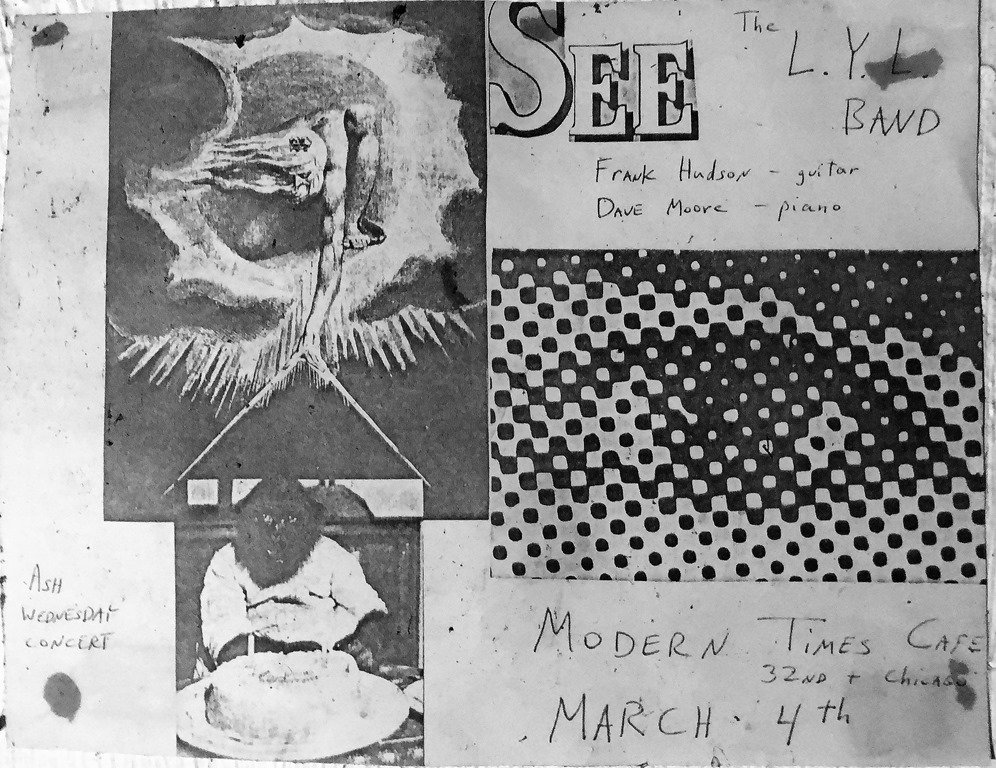
Traveling to a telephone pole of the past, we see a Dave Moore Dada poster for an early ‘80s show
So, let’s step out of the history and into the songs.
Here’s “Scrap” a companion song to “The Night Inspector” which you’ve already heard here, inspired by Dave’s work in a machine shop in this era. There was a good live version sung by Dave on Porcelain Bus, but I don’t have access to a digital copy of it right now, so in its place here’s a later solo acoustic guitar version where I sing it.
And here is an actual cut from the Porcelain Bus, engineered by Colin Mansfield, just after he was helping Husker Du get underway, a song asking the rhetorical question “What’s Wrong with That?”
If you’re asking yourself, where’s the poetry and various musical settings that you’ve seen here before, know that I plan only about one more history-of-a-band post before returning to our regularly scheduled programing. If, on the other hand, you wonder how this all turned out, the next post will be about that.
And, of course, footnotes, but we reject the hierarchy of superscript numbers for asterixis!
*I’ve just located a few digital scans I made years back of the even then moldering materials form this era, and they show the the Twin City Reader reviewed Porcelain Bus (see footnote below) in their issue that covered the upcoming week interval of January 7th to the 13th 1981. This would mean we recorded it in late 1980 and probably released it before the turn of the year.
**for a detailed history of this conservative effort, I recommend Before the Storm by Rick Perlstein. For me a lot of what he covers was current events, but for most present-day Americans, it’s history. His two follow-up books are good too, but why not start at the beginning?
***Two exceptions I can note, even if neither are the best-known songs in their respective catalogs: Paul Westerberg’s “Androgynous” from the 1984 Replacements LP Let It Be, a heart-felt yet casual sounding and appropriately ambiguous song about busting gender roles, and then Prince’s arch “Ronnie Talk to Russia” from 1981’s Controversy, where Prince sounds like the LYL Band would sound if they had Prince’s skills, work-ethic and recording studio (or at least a drummer and bass player). Perhaps Mr. Nelson was paying tribute to The LYL Band and our sound, but Prince’s song was released a little less than a year before “Driving the Porcelain Bus.” OK, the new date for Porcelain Bus means that theoretically Prince could have heard Dave’s Farisa drenched sound before he used a similar punky combo organ sound on “Ronnie Talk to Russia.” File this under “improbable.”
OK, that last part is irony for you English majors, but Porcelain Bus was reviewed and got a cover blurb on the local alternative weekly in 1982 January 1981, along with Prince protégé’s The Time’s LP. The blurb said “The Time Ain’t No Lose Your Lunch Band,” a statement that I think we can all agree on. The review said we might become a cult band. If you’ve read this far, you’re our last chance as cult adherents. You don’t have to shave your head, sell tracts, move to a compound in the country, or worship Dave as a semi-divine incarnation—unless you think it’ll really help. I believe Dave would rather be worshiped as an Andy Devine incarnation anyway.
I’m going to take a break from my Dave Moore series today, if only because I rather like this piece I’ve been working on and want to present it to you.
“Fog” is likely the most well-known poem by Carl Sandburg without Chicago in its title, and it appears in many school textbooks where it serves as an introduction to metaphor. The Carl Sandburg who wrote it didn’t intend it to be a lesson. I think he wanted to write a Modernist, Imagist poem, the way a small group of others were writing them in the era roughly 100 years ago.
One thing I’ve learned searching out pieces for this project was that Modernism in its High Modernism guise has overtaken the work done by those preceding Imagist pioneers. As those who’ve visited here during cruel April Poetry Month will know, I enjoy somewhat those knotty, learned, collaged and college-ruled works that T. S. Eliot’s The Wasteland laid out. And World War I, we should not forget, was a terrible disaster with near untellable loss of life and loss of hope for its generation. WWI probably had to change things. The Carl Sandburg who wrote his early Imagist poems went about his pre-WWI world with an open heart and open eyes. In his poetry and in his political writing there’s a panorama of evil and survival, loneliness and stubborn love.
So, to reduce “Fog” to a lesson on metaphor is to amputate that context, and to forget the Imagist quest to renovate entirely metaphor as it had been received by Sandburg’s generation. Imagist poems often wanted to break through the fourth wall of metaphor, to make it more than an a decorative, this stands for that, analogy. “Fog” is fog, and the cat is a cat. Yes, they have meaning beyond that, all reality does.
You could start by asking yourself, if this is a real cat then, what kind of cat is it?
A house pet, one used to demanding the pricey wet food and best place on the dry, warm bed? No, it’s on the docks. It could be a ship’s cat, a fellow laborer, or a feral cat making do with what it can find there. It can’t call attention to itself for its prey and its own risk, and so it’s silent—and like its life and labor, obscured by the fog, by the cat’s own actions and the actions of the world. Sandburg sees his worth to see that.
Carl Sandburg at the machine of his labor.
That’s an Imagist poem, a direct presentation of reality, with no false rhymes of conventional or show-off imagery. There’s love and respect in it too, for the working common of us, singing the insubstantial and all-covering fog of our lives and labor, that save for the notice of the poet or artist, is silent and then moves on.
That, dear readers and listeners, is why you should pay attention to Carl Sandburg, who’s nearly fallen out of the cannon of important Modernists and consideration as an important poet, who is, I tell you, as you are, more than an example of metaphor.
Remember back to the formation of the LYL Band were we self-labeled ourselves as “Punk Folk?” Given that folk music by definition doesn’t ask for certifications or approval to be performed, that was something of a tautology. It occurs to me that what I’m doing here with pieces like this, using a string quartet I play part by part along with two pianos (one electric) and a drum set could be Punk Orchestral. My string parts are extraordinarily simple, like unto a lot of downstroke strums of power chords in some Punk.
Decades back, the Pixies helped popularize the Punk soft/loud arrangement, but of course orchestral music did it OG before them, and I exploit that in this one. Some other incidental ideas that helped steer me in this piece came from reading some recent posts at the Brettworks blog, where a more trained and accomplished composer talks about some of his processes and inspirations. Specifically Brett was talking about creating a piano part that had enough space where the various notes could have enough time to express their decay trails. Musically, this piece started by exploring that idea, but then the string quartet decided to kick out their jam.
I peform Sandburg’s words like a stalking cat hunts, sliding forward and stopping, then slipping forward again before pouncing. To hear this, use the player gadget below.
Did I skip over Dave Moore the poet and writer to get to Dave Moore the words and music guy? Perhaps. Let’s step back away from the 1980s and recap a bit in word-print silence, without any musical noises at the beginning.
I met Dave almost exactly 50 years ago in 1968. And my first encounter found him reading his poetry in a church. He was also publishing what would have been called an “underground newspaper” in those days, an occasional Ditto-machine-printed* dozen pages or so of social, political and cultural comment, which I eventually contributed to. 1968 was a fabled year, like unto 1989 or perhaps some year coming soon in our current folly, full of momentous and contentious events. Odd as it may seem, it felt important to engage with them on paper, even for a small audience.
Dave left for Wisconsin to continue college, I ended up in New York to not. We didn’t see each other for over five years.
When I decided to cover Bob Dylan in reverse, and left New York for Minnesota in 1976, I ended up staying with Dave for a while and helping him work on rehabbing a run-down house he was living in. Dave had hooked up with a group of writers, the Lake Street Writers Group, all of whom lived a few blocks from that central east-west commercial/industrial strip in Minneapolis. As a group it was an unusual mix, including bartenders and low-paid workers, most with some college under their belts, but now in their mid-20s trying to figure out what to do with life that didn’t formally give college credits. These experiences gave the group something of a blue-collar, we’ll earn our cultural worth, not be awarded it, air that I liked. I too joined in the group.
The Revolution Will Not Be Duplicated…for less than 1/4 cent a copy! Just think, I could run off a few pages of this blog and have them in mailboxes by the morning!
Besides the usual get-together/critique/talk thing that writers’ groups have done forever, the Lake Street Writers Group ran a little magazine, The Lake Street Review. The first two bootstrap issues were printed on Dave’s Ditto machine, the magazine’s post office box was Dave’s too, and Dave was co-editor in the beginning along with the founding spirit of the enterprise, poet Kevin FitzPatrick.**
I asked Dave what poetry he remembered writing or publishing from this era today, and he reminded me that in the mid ‘70s he was concentrating more on stories. “Oh,” he recalled, “There was a song ‘Ballad of Mr. Lake Street vs. Mr. Id’ in the Lake Street Review.” That piece of Dada was attributed to John Lee Svenska in print, but it would have predated his work with Fine Art or the LYL Band by several years.
What would you get if you combined blue-collar with Dada? One answer would be some of the first songs Dave wrote for the LYL Band. Yesterday’s “Evil Man” would be one example, the man in the title morphing from childhood bully to sociopathic businessman to stickup man. You could see this as a new expression of the notable Woody Guthrie line about “Some will rob you with a six-gun, and some with a fountain pen,” but by having the evil man fade in and out of these equivalented roles from verse to verse, the Dada this-beside-this comparison is made. In today’s piece, Dave’s early ‘80s song “The Night Inspector,” the Ubu Roi rides a fork-lift in a factory. To give you some relief from the audio quality of the archival recordings from the early ‘80s, this performance is a later one where I sing Dave’s song with acoustic guitar. Go go Night Inspector (player) Gadget…
*I’m reminded that Fugs’ founder Ed Sanders was able to raise his ruckus in the ‘60s Greenwich Village scene at first by being the owner of a similar machine on which he printed his own little magazine and flyers. Ditto machines were better than Mimeograph machines. Mimeo machines printed in purple and their printed pages stank of that can’t-be-healthy-for-you volatile ink that is probably responsible for some of you getting lower mid-century grades than your parents expected on school tests. Ditto machines produced pages that looked more like “real” printed work with dark black text.
**Kevin FitzPatrick has continued to write poetry dealing with this milieu for his entire career, including a great number of poems, too rare in our culture, that deal with the complexity of day to day work as an employee. Here’s a link that will let you read part of his introduction to some selected poems of his, where Kevin talks about the life experience from this Lake Street Review era that helped inform his poems.
The ‘70s outburst of new bands that were called punk, then new wave, and finally indie can be traced to a beginning (or beginnings), and here’s what’s too-little recognized about that: it started with poets and writers.
Some who know that punk didn’t start with Johnny Rotten, say that it all can be traced back to a band that called itself Television who convinced a desperate bar owner that his Bowery bar called CBGB should let them play music there in 1974. Television wasn’t a gigging band, rather it was the idea of two poets, friends since high school who had moved to New York City and started to call themselves by suitably poetic names: Tom Verlaine and Richard Hell.
But even before that, two other NYC writers were combining poetry with rock’n’roll: Lenny Kaye, a guitarist and rock critic with tendencies to musicology, and Patti Smith, a poet who thought that if she wanted rock’n’roll to be a fit subject and context for poetry, maybe the sound of rock should come along explicitly. In 1971, the pair linked up to perform at St. Marks in the Bowery with Kaye on electric guitar, at a long-standing reading series (instigated by Paul Blackburn, who we’ve met here previously). Eventually there would be a band, the Patti Smith Group, but that band started as an idea of two writers, and for awhile it was just Kaye’s guitar and a piano player with Smith’s chanted vocals.
So how far back does that idea go, two poets or two writers, imagining a rock band? Let’s set the New York wayback machine 7 years further back, to 1964. Two poets and well-rounded Greenwich Village bohemians Ed Sanders and Tuli Kupferberg looked at the folk music scene, understood that the term means what it says, that any odd folk were allowed to make music, and so they gathered some handy musicians and imagined a band they called The Fugs. Their first recording was titled on its first pressing on Folkways The Fugs Sing Ballads of Contemporary Protest, Point of Views, and General Dissatisfaction, and it was produced by Harry Smith, the important folk anthologist, but they eventually became a rock band touring with an irregular accumulation of Village musicians. Besides having the foundational indie spirit of we’re going to make music without asking for permission, The Fugs were also sometimes gleefully obscene—something that bohemian poets had already done, and they brought this with them to music. In today’s world of autotuned rappers, their sexual hijinks may not shock as much now as their naked-to-the-world out of tune vocals.
And what bridges the Fugs to the ‘70s NYC punk-rock poets? Poet Lou Reed, musician John Cale, and eventual English Literature PhD Sterling Morrison formed the Velvet Underground. Like the other poet bands, the idea of forming a group preceded any complete organization into a band. The Velvet’s original drummer famously quit when the band got its first gig, because he thought accepting any gig would be selling out.
Do you notice a rhyme scheme here? None of these situations started with a full band of musicians looking for their chance. These weren’t musicians looking to get poetic, these were poets looking to get musical. Of the seven writers above, I believe only Kaye and Reed had ever played a gig before they dreamed their bands. What musicians were recruited, what musical skills would be developed or obtained, all came after the idea, an idea that was launched in performance before it became a fully-formed rock band.
These weren’t musicians looking to get poetic, these were poets looking to get musical.
I’m not suggesting this is the best way to start a band or establish a career, because this is pretty much the way the LYL Band started. Dave remembers that Fine Art had looked to him for words, and once asked, the words that could be songs started building up in him. I had been writing songs for a year or so before I came to the Twin Cities. I had an acoustic and electric guitar, Dave had an old upright piano in his living room. Sometime a few months after Fine Art got underway, in 1979, we started playing together, a two-person version of the traditional song pull. He’d do a song and I do a song and we’d try to figure out what went with what the other was playing.
Whose idea was it to form a band? I think it was likely Dave’s. Dave’s not entirely sure. The broader gestalt of punk and indie breaking out was part of it, including the example of Fine Art of course. We both shared an appreciation of The Fugs, and that anarchic idea of a band that would perform any idea for a song, even if their musical execution might be imperfect. Hell, their LP title “Ballads of Contemporary Protest, Point of Views, and General Dissatisfaction” could have been our tagline too.
The idea of just an acoustic piano and a single guitar as a band was incomplete and we knew it. Even in the loosest standard in the era, we couldn’t be a rock band. As Dave’s songs built up, we performed at a few open mics acoustically as a duo, and we started to call ourselves “punk-folk.” We played several midday informal gigs at the Modern Times restaurant on Chicago Avenue (I worked nights, which cut into more conventional times) and from this short-lived noon-time schedule we named ourselves The Lose Your Lunch Band.
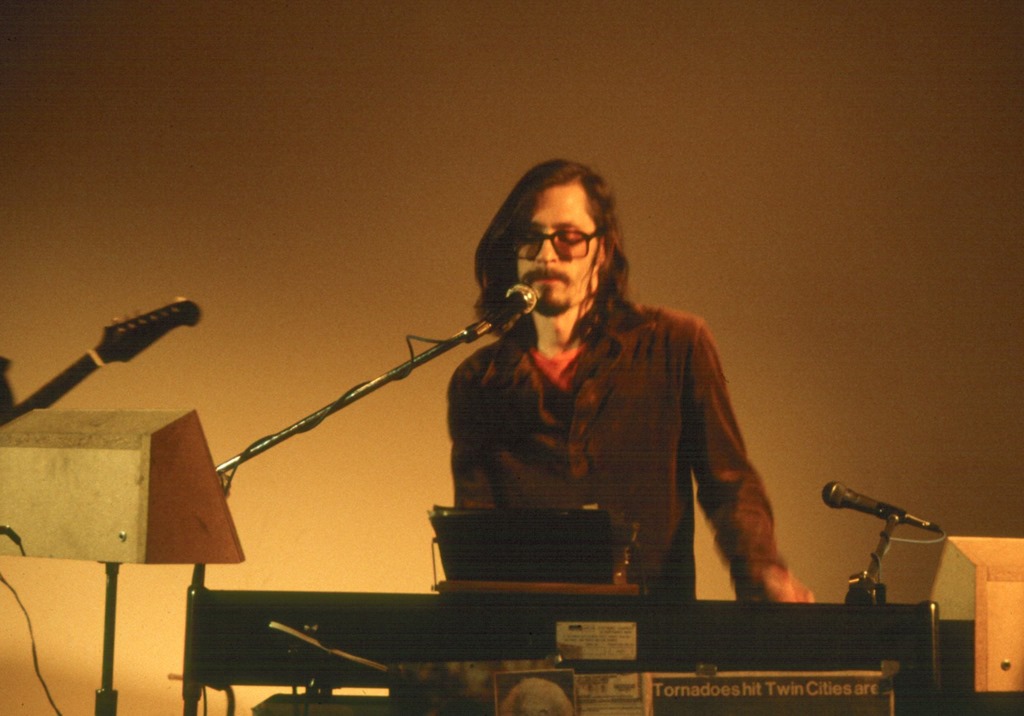
Poet to songwriter to performer: Dave Moore at the keyboards during a 1982 LYL Band concert.
Still a duo in 1982 we recorded our only “official” release, the mostly electric (Dave had bought an old Farfisa organ) Driving the Porcelain Bus. Recorded by Colin Mansfield on what was probably the same 4 track open-reel deck that recorded those Husker Du demos. You can see that we weren’t shy about the emetic band name, but it had nothing to do with the songs we were singing. We sang songs about political subjects, blue-color experiences, and satirized the Me generation. Driving the Porcelain Bus was probably the first cassette only release in the Twin Cities indie scene, but it came before there was a regular distribution method for pre-recorded cassettes. Besides the usual direct sales, I reverse-shoplifted the cassettes (each packaged in a folded brown-paper lunch sack with the track list printed on the paper) dropping them into spaces in the LP bins of record stores. I wonder if any clerks remember being asked to ring up a strange recording that wasn’t actually in inventory?
It was the Reagan decade, the rise of the new affabulatory GOP. Dave had lots of song material. We’ll continue the story of Dave’s new-found songwriting in another post, but here’s today’s audio piece: Dave Moore performing his song “Evil Man” live at the Modern Times sometime in 1981 with the two-person LYL Band. Dave is pounding the house piano within an inch of its life and has a vocal mic. The MT sound system had one more channel which meant that I’m trying to get my little acoustic guitar to be heard over the piano while shouting backing vocals into the mic halfway down my body to where the guitar was. I believe I recorded this on a portable cassette recorder sitting somewhere on one of the restaurant’s side tables. As they say in collector’s circles: archival interest only sound quality.
This month, I’m going to start a series here featuring the words and music of Dave Moore. This is different—and not—because long-time listeners will have heard Dave’s voice and words here from the beginning, but this time I’m going to expose a little more of Dave’s range of work. If you’ve come here expecting our usual eclectic mix of poetry from various eras with music, don’t worry, we’re not abandoning that (and there’s lots here, just look at the archives on the right), I’m just taking some time to present something different, and “something different” has been my aim since the start.
I’m going to try to put Dave’s stuff in context, at least the way I’ve seen it. I’ve known Dave for 50 years. He was writing poetry before I met him, and he’ll write things for the page to this day, but he became a songwriter and he has had a long-running one-panel comic for decades too. I’ll start by talking about the songs.
A little over 40 years ago Dave’s words were used for the lyrics of a third of the songs on one of the pioneering Twin Cities punk/new-wave/indie records: 1978’s Fine Art’s Fine Art. Dave didn’t perform with the band, and as far as I know, he didn’t have any direct input on the music the band created for the songs. Fine Art existed from just before their only LP was recorded until around 1983.
That you haven’t heard of Fine Art is likely derived from several reasons. The biggest one is that they, unlike some later Twin Cities’ Indie bands, never made it nationally, but I remain puzzled as to how they have disappeared from the memories, books, and posts of those who have sought to cover the local Minnesota-based heroes that made and made up the late 1970s scene that produced The Replacements, Husker Du, and Soul Asylum, and even to some degree Prince, a scene that was then the platform under an even later generation of Twin Cities connected indies like Babes in Toyland, The Hold Steady, or the Jayhawks. Like other cities who experienced the eruption of indie bands in the late 70s and early 80s, the Twin Cities has its own selection of “They were so good and original, how come they never made it as national acts?” bands. The Suicide Commandos, The Suburbs*, and The Wallets were unforgettable to most who saw them locally, but their national/international profiles never really existed, and are now, like our weather will be soon, below zero. Fine Art, who have a good case to being seminal to the scene, who staked their own distinctive sound within it, are forgotten even locally, and that pains and puzzles me.
So, if you make it through this post, you’ll know more about the band Fine Art than anything you’ll be able to find in a book or on the web. In talking about why they didn’t make it into history, I’m going to try to sneak in why you should care about what they did.
OK, what were the problems and obstacles that explain why you haven’t heard of Fine Art, even though they helped break the ground for a significant Indie rock scene?
Their name, Fine Art, can be understood unironically. Their leader**, Colin Mansfield was a highly experimental guitarist, and his compositional ideas were not punk pure nor entirely pop accessible. A sizeable portion of the Twin Cities scene followed the early 80’s movement to make hardcore music which was intense not only in its volume and velocity, but in the kind of loose authenticity that later was called grunge.*** “Art rock” was another of the labels hung on “Progressive Rock,” and that was the enemy to this segment. Fine Art, particularly in it’s early days, could be just as much (or even more) a focused frenzy as, for example, Husker Du,**** but that band had a non-sequitur, non-significant name, and Fine Art’s name on a concert handbill may have suggested the wrong thing to some of the market.
They were song-oriented. Despite the continuing connoisseur appreciation for Grant Hart, Paul Westerberg, and Bob Mould as songwriters, the early TC live indie music scene then was not conducive to them. PAs, live board ops, and venues tended to make all the bands vocals unintelligible. On record, the songs come through, but Fine Art issued too few recordings: essentially one self-titled LP of an early version of the band before they were fully formed, and one EP, Scan, that better represents the middle of the band’s life. I’m unaware of any other Minnesota band with the breadth and quality of material from this early ‘80s era which left so little recorded legacy—but then that proves my point I guess, how would I know if such other bands existed?
The Fine Art lineup in 1980 fronted by Terri Paul and Kay Maxwell, Colin Mansfield on the far right. Also visible is Liz, their bass player that year which gave the band a 50/50 male/female split.
Live shows. The power of Fine Art in a live show could be substantial, perhaps most intensely on a small stage in a small room, but despite having exceptional singers/front-women over the band’s lifetime, they didn’t always come over on the First Avenue mainstage, the largest venue to present indie acts by the early ‘80s. Their contemporary local heroes The Suburbs (who like Fine Art never limited themselves to hardcore punk-rock moves) would in this era have one of the most dynamic high-energy live shows I’ve ever seen. Last night I watched Sammy Hagar on TV relating what he thought the wisest words legendary concert promoter Bill Graham had imparted to him: “It isn’t the audience’s job to win you over, you have to win them over.” Sammy Hagar, then as now, wouldn’t be a cool re-teller of an always controversial promotor’s bromide, but Fine Art in all it’s incarnations, had a cool stage demeanor, putting out the best music they could devise without a smarmy sales pitch, but also never explicitly pulling the audience into their vision. This stance works more often after you’ve become famous, or (paradoxically) after you’ve become famous for not catering to audiences in an overt way, but it’s the more difficult shot to make, and Fine Art didn’t make its shot.
I was going to write even more dancing-architecture about Fine Art on stage when I discovered that there is available a good quality film of them just past the midlife of the band, performing at the famous 7th Street Entry small room in Minneapolis. This was a good lineup for the band musically, and the performance is about as open and inviting as any I recall seeing. The short film misses some of my favorite numbers, any 45 minute film would, and in particular it includes none of the songs that best showed singer Kay Maxwell’s more exploratory vocal work. But, apropos of my point above, this is about as open and warm as they got, even in a small club. Guitarist Colin Mansfield even smiles. On stage. While the camera is on him.*****
Fine Art in 1981 perform a set in First Ave’s small 7th Street Entry room. As per usual, I think Dave Moore may have written about a third of the lyrics in the songs here.
They didn’t tour. I can’t say for sure why they didn’t. Any bootstrap band has to commit to a “get in the van” leap even for an Indie tour. This means no income other than chancy part-of-the-door proceeds and increased costs even if only for gas and repairs. Hometown relationships will be sacrificed. And the logistics for a six-person band with two women are a much greater challenge than for say a three person trio male-bonding road trip. Realistically, if they had toured, would out-of-state audiences have reacted differently than Twin Cities ones? In some markets I think it’s possible, but far from assured.
Front women. Throughout almost the entire run of the band’s life it used dual female lead singers. This was unusual in this era, locally and nationally, but more so in Minnesota indie circles before the mid-‘80s. Gender mix at indie shows in this era from my memory showed a higher male attendance, and the tastemakers were almost entirely male. Early versions of the band paired Kay Maxwell with Terri Paul until Terri Paul left to marry Suburbs’ principal Chan Poling. Maxwell then was joined at the front of the stage by violinist/vocalist Jennifer Holt, who in turn left to form Tete Noires, another needs-to-be-remembered-more Twin Cities band that prefigured the Riot Grrl idea of the later ‘80s. In theory, you could expect CIS sex-appeal to be a marketplace-trumps-art plus, but remember Fine Art wasn’t a band that wanted to explicitly ingratiate itself with audiences, and the band’s songs almost never featured conventional or playful boy-girl romance or sexual come-ons. In fact, most Fine Art songs throughout the life of the band took a distinctly cool look at relationships and their frictions with individual autonomy, something that pop and rock music didn’t allow female singers to do much in the 70s.****** In this skeptical and examining regard, they were doing in the small Minnesota scene what some post-punk bands in England and the US coasts were doing, but it’s likely that Fine Art was developing this attitude independently. My guess is, that to the extent the young men of the Brent Kavanaugh generation heard the lyrics at a gig, or absorbed the stance portrayed by the singers on stage in a non-literary way, Fine Art wasn’t going to be their new favorite band. Would it be better if they listened? I certainly think so.
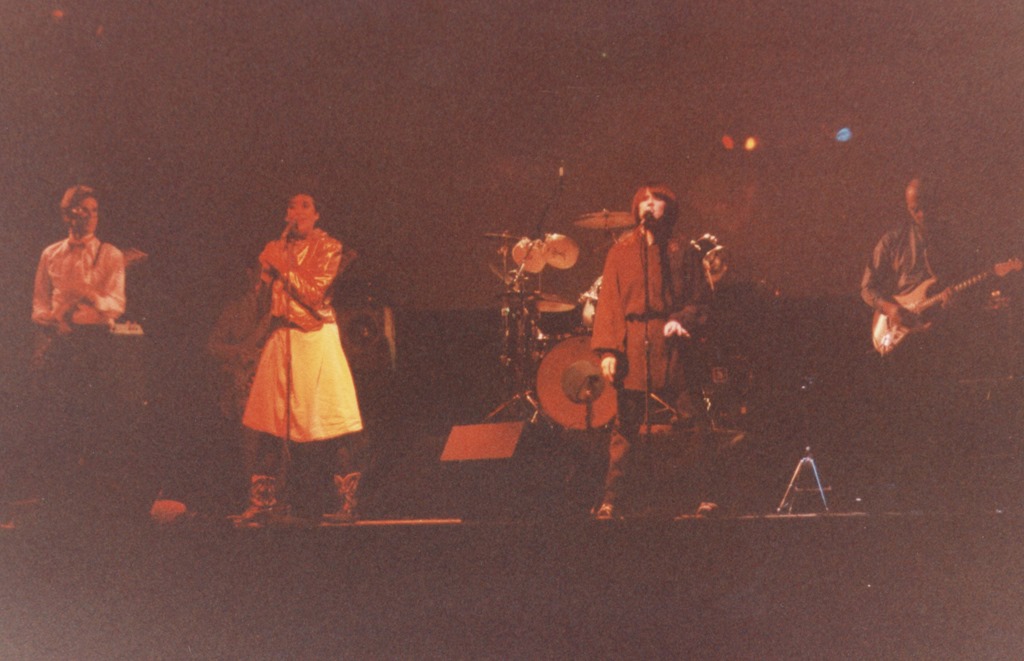
Fine Art circa 1982 on the First Avenue mainstage: Ken Carlson, Jennifer Holt, Kay Maxwell, and Colin Mansfield
Today as I think through these things I wonder what would have happened if I was rich and possessed a time machine, could I use cubic money and hindsight to change things? Could I have tried to break them as a recording act without local scene cred? No assurance in that. Try to move them to New York and ace out Blondie, but end up as The Shirts instead? Move to Athens Georgia and try to be the B52s, but end up as Pylon? I suspect the best fantasy bet would have been to move them to England, an even more imaginary gambit, but it was a scene more capable of breaking unusual bands because the extensive network of critics and music press there competed relentlessly to find unusual bands to champion.
OK, we’ve left Dave Moore for awhile here, so let’s circle back. Fine Art had women frontmen who handled the vocals. That means that Dave’s lyrics first were sung by women. A song like “Nailed,” performed by Fine Art on their LP and regularly in concert afterward, is ostensibly a vampire blues that might have been the text from an issue of Tales From the Crypt, takes on a different cast sung when sung by two women in harmony. Lines like “I gave you my body, and you took it too. Always thought you’d give it back—shows how much I knew” change in that context.
Here’s Dave Moore’s lyric “Nailed” performed not by Fine Art, but by the LYL Band. Colin Mansfield wrote the music here, and we only approximated it. I’m doing the lead vocal, though Dave peeks through on backing vocals. If you watched the Fine Art/7th Street Entry video you may be able to put together a mental construct of what the “real thing” sounded like on a good night. Let me assure you, it was even better than what you are imagining.
——————————————
Because what’s more punk-rock than footnotes
——————————————
*The Suburbs are perhaps the most similar Twin Cities band to Fine Art in style. Their principal Chan Poling brought a broad outside musical background into his band as did Fine Art’s Colin Mansfield. And at their best, each band’s rhythm section was solid, and their approach to songwriting eclectic and unafraid of oddness. The Suburbs had the more dynamic live show though, even on a large stage, and the conventional all-male lineup presented a show that could be enjoyed without further thought by the plastic beverage cup waving male club goer. My impression was that the Suburbs were soon a very consistent live draw for any venue hosting them, and Fine Art never was that. Of course, all that talent and appeal didn’t mean that even The Suburbs made it past local hero standing.
A survivor band version of The Suburbs still exists, and Poling (who performs with them) has gone on to a successful career in music that continues to today.
**I don’t know exactly how the band was organized, but Colin Mansfield, along with his then wife Kay Maxwell and outstanding rhythm guitarist, the late Ken Carlson were the three members who participated in every version of the band, and though music and lyrics were contributed not only by Dave Moore but as well by the rest of the band, I always got the impression that Colin was the organizer and collator of that process. I’ve lost the thread with Colin over the years, but he transitioned to in the box electronic music later on, and unlike the Fine Art material, that later work is available.
***As a marker for this aesthetic, I’ll note that Soul Asylum first performed under the band name Loud Fast Rules. The Replacements, whose IP holders should see about the availability from Blackglama of the phrase “What becomes a legend most,” were able to gain attention as the ultimate in anti-showbiz casualness, where a sloppy show meant that they really meant it.
****Colin Mansfield from Fine Art produced Husker Du’s first demos and their initial single, which sounds less like later Husker Du and more like Fine Art. After Husker Du broke up, Colin and Du bassist Greg Norton formed a short-lived trio Grey Area.
*****In my experience Colin Mansfield was a pleasant, understated and helpful man, as well as quite a musician. I once suggested, from my position on being less than any of those things, that it might help if he looked more animated and moved by the music on stage, and he asked back if there wouldn’t be some visual value in all that sound coming out a still and undemonstrative musician. We both were probably right, but he was right from a position of greater talent and achievement.
******Here for example are some of the other songs from that LP issued at the band’s beginnings in 1978, and remember all vocally performed by women: “Don’t Tell Me That,” “Too Much Pride,” “I’ve Got to Protect Myself,” Rapist,” and “Speak My Language.” Ken Carlson wrote the first three, Andy Schirmer wrote the third, and only the last was written by one of the vocalists, Terri Paul. It’s an odd dynamic isn’t it? Songs of self-assertion, anger, skepticism toward love relationships as a system, sometimes inward turning pain, written largely by men to be sung from the viewpoint and voice of two women. I don’t know if this was planned, my suspicion is that was something of an accidental combination which the band allowed to happen and then grew to embrace. I never asked. I don’t even know if any of the band men thought of themselves as feminist, and it wouldn’t shock me if any of the women in the band would have stories where the men failed to show feminist understanding. Human beings, they’re like that.
Partly for the reason of sadness and disappointment with my country, and partly for disappointment with myself, it’s been difficult to focus on combining words and music recently. This is a value of one of the Parlando Project’s principles: Other Peoples’ Stories. When I cannot put the words together, I can listen and absorb someone else’s.
Yesterday, feeling particularly sad and angry, and holding it in so as to not harm with it, I went looking for someone else expressing what I could not express myself.
I looked first at Carl Sandburg, who after all was a committed political radical as well as a too-often overlooked Modernist. But with Sandburg’s expression love was almost always present—a good thing, but not in tune with my feelings. Sandburg may have been the right medicine, and I took some of him in on Friday for my health, but I didn’t want only medicine.
And then I found my howl, and strangely at that. I knew Edna St. Vincent Millay had written political poems, that in fact they had harmed her artistic reputation. The witty line I recall was that Millay’s anti-fascist poems did more to harm her artistic standing than Pound’s pro-fascist ones. Today’s words are from one of her early political poems: “Justice Denied in Massachusetts.”
I can see where the Olympian “New Critics” docked Millay on the basis of this one. It’s chock-full of that awkward backwards and inside out “poetic” syntax that reads like a stiff translation from another language. The early Modernists, even as they translated, were dead set against this—and they have a good point. Millay’s words here were hard to read with emotion, so stilted and undirect as they are as sentences. However, that could well be part of Millay’s point here (consciously or unconsciously), as the poem’s speaker is not speaking clearly; and for my benefit—however difficult it is to perform—she is speaking precisely in a confused mixture of disgust and disappointment. All the reverse/”poetic” syntax just makes it more twisted in at itself. A poet today might make this matter even more obscure with modern poetic syntax that also abjures plain speaking in the service of art, but in our current context we’d be expected to accept this as the way art talks.
One problem with political poems is that to the extent they speak to an issue they can become museum pieces tied to forgotten events. If they were to be effective, they could even be seeking that fate. Millay is writing here in the immediate aftermath of the execution of Sacco and Vanzetti—a particular cause—but for my purposes, this has little bearing on the matter. She is speaking to women and domestic and domesticated people such as myself. Only the title is tied to then current events—the feeling and her point, ties to our own.
“Let us go home, and sit in the sitting room.” New Critic Cleanth Brooks placed his entry in the contest for most bone-head review of all time by reading this refrain line and Millay’s poem as a straightforward resignation at the course of events, rather than the ironic statement of disgust that it is. I can only hope that the savvy observers of our country are similarly wrong, similarly misreading.
Mr. Brooks, you may notice that I’m not sitting, but standing for something.
My music for this is based around a G suspended chord, where the third of the chord, which would dictate if it’s minor or major, is omitted. This gives the chord a feeling of awaiting change, awaiting formation. At times the replaced note to the defining third is a tangy second, other times a more consonant fourth. Risking grandiloquence, but I feel our country is similarly suspended now, and the cadence is to be ours.
Here’s my performance of Edna St. Vincent Millay’s “Justice Denied in Massachusetts.”
October 4th is National Poetry Day in the U.K. this year, an event similar, though more condensed, to the National Poetry Month in April promoted out of the U.S.
No one’s revealed why April for the Poetry Month, though Chaucer and T. S. Eliot may have put in their votes, and the reasons for the fall date for Poetry Day could be arbitrary too. But autumn would have an emotional claim. Fall is changeable in weather, an underrated Spring of warm days and cold shuffling themselves. It has its long-established events: school years underway, harvests and harvest festivals, the closing of summer venues, Halloween, Veterans Day/Remembrance Day. Fall can also be an easy metaphor for approaching death, but poetry is one buffer we use to handle that subject anyway.
John Keats wrote one of his last and finest poems to the season almost 200 years ago in the autumn of 1819. It’s full of the strengths of Keats’ writing. Even in his time Keats was both praised and dismissed for the sensuousness of his poetry, and not a line goes by without some sensation of taste, touch, color and sound, and all that is contained in beautiful word music and an off-balance rhyme scheme that may couplet-rhyme two lines together, or tantalizingly wait two or four lines for the rhyme.
Look at that great single-track behind you John. In only 160 years someone will invent the mountain bike
Even if some of his words are 200-years-old antique, or for us Americans, peculiarly English, he crams all these sensations in his poem without them seeming forced, as if they were special or unnatural “poetic” things. Many of the sense words in this poem are of ordinary manual labor: load, bend, fill, set, reap’d, laden, press, and borne.
Where he is outrageously poetic is that this poem is an apostrophe. The entire poem is addressed, just as the title says, as if the season was a person: “To Autumn.” A poet doing that today would, intentionally or otherwise, produce a humorous effect. Still, if we allow it, the second stanza gives us a leisurely fall, a farmer taking a break on a warm autumn day from rural labor, hiding in a barn, or taking a nap in a half-harvested field, but yet also returning to pressing cider from apples down to the last drop, and bearing away hand-gathered food on his head “like a gleaner.”
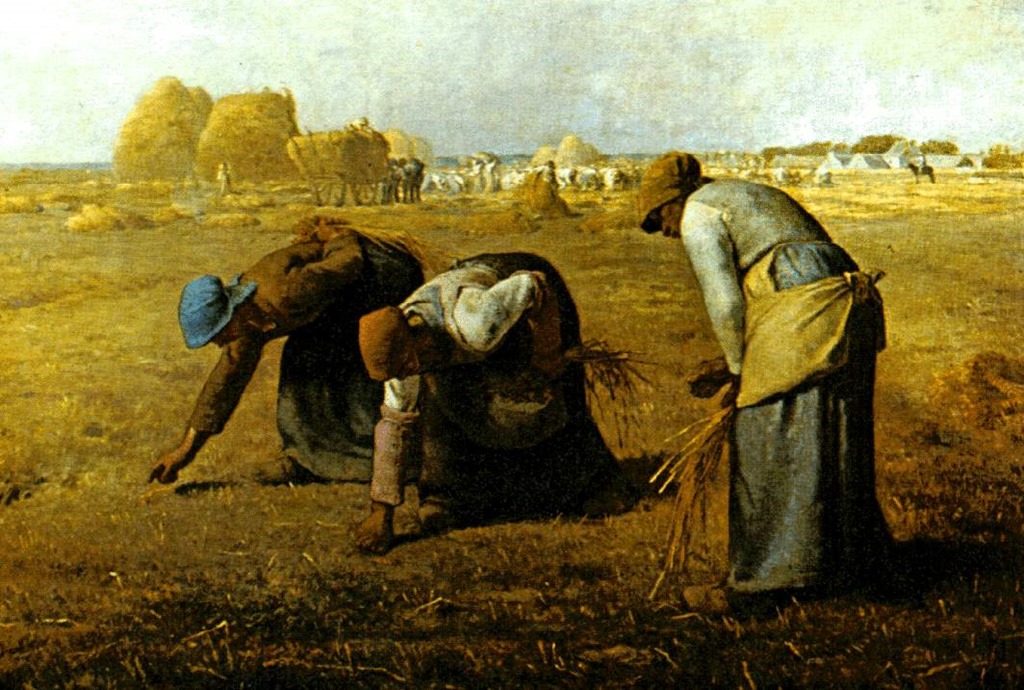
Gleaner is one of those antique words. It was a practice in some places to allow the poor and those without land to gather what leftover grain might be left in the fields after harvest. Just this week I was reading on the always Interesting Literature blog that Keats may have had this practice on his mind as gleaning had just been outlawed in England, and that other images in the poem may have had social resonances with Keats at the time.
Painters whose names suggest a subject for their painting: “The Gleaners” by François Millet
The poem’s final stanza retreats with distant banners flying, a symphony of extreme audio dynamic range. The infinitesimal sound of gnats flying is a choir. The wind crescendos and decrescendos. Lambs bleat loudly and then there is silence. Crickets arpeggiate for time. Birds whistle, twitter and leave in the sky, migrating away, and the poem ends.
Keats himself ends as a poet, this being one of his last works. He leaves for Italy in hopes it will help his tuberculosis, which it won’t. He’s dead in about a year.
My music for this today is acoustic guitar with bass and some orchestral parts: winds, a couple of cellos, a pair of violins. The player to hear it is just below.
Here’s a #nationalpoetryday bonus, featuring a very different British poetry from about a century later, T. E. Hulme’s “Autumn.”Hulme was a too-little-known instigator of Modernist poetry in English, and like a lot of instigators he moved by opposition to previous schools. In particular, he disliked the English Romantic tradition of Keats, viewing it as too flowery, to full of images that were no longer real and which had become only conventional symbols.
Interestingly, in his “Autumn,” Hulme’s central image is similar to Keats: instead of a farmer taking a break in his granary or napping in a field, he has a harvest moon looking over a hedge like “a red-faced farmer.”
Here’s my performance of Hulme’s “Autumn,” which you can also listen to with the player gadget below. If you like this sort of thing, be sure to spread the word about what we do here at the Parlando Project.
Earlier this month I mused a bit about renowned poets’ “batting averages” when I use their words here, that the hall-of-famers and MVPs don’t always get the most likes and listens, that many of our most popular pieces use words from poets that are much lesser known. Of course, those levels of response may be secondary to the music Dave and I supply and our performances having their own range of attractiveness, or it could be that the subject matter of the popular lesser-known poems resonates in some way with audiences.
Perhaps it’s just random fate at play, but poet and artist William Blake never attracts much of an audience here, though he remains dear to my heart for his stubborn individual persistence and production. Blake is an 18th Century writer who looked backwards to Milton and Dante as much as he predicted the early 19th Century romantics. In America, he’s loved by some outsider poets such as Allen Ginsberg* and Patti Smith, but in England he may be encountered as the lyricist of a national anthem “Jerusalem.” Compared to our founders of American Modernist verse, he can be in his “prophetic books” more long-winded than Whitman—and yet also as seaming simple and elusive as Emily Dickinson in his short lyrical poems. If you hear Blake as hard to value or difficult to appreciate quickly, you are likely hearing him right.
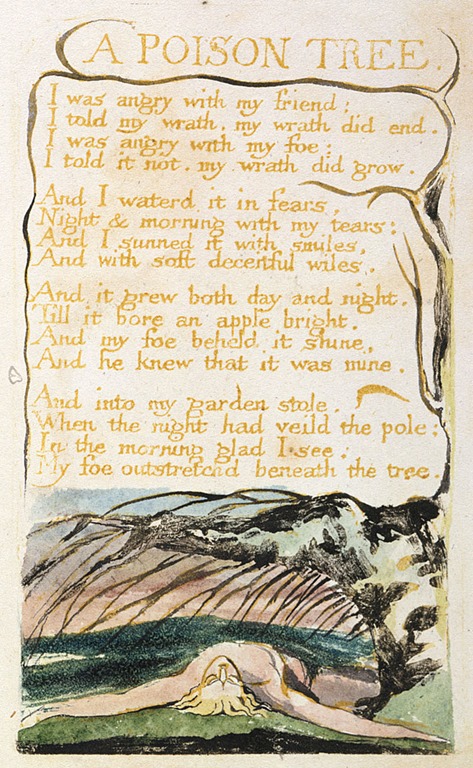
Take the piece that the LYL Band performs today, “A Poison Tree.” It’s Dickinson-short, and like some Dickinson, if you give it only cursory attention, it seems like a simple moral tale. It certainly starts off like one. To paraphrase, I was mad at my friend, but we were open about it, and it all blew over; but with my enemy, I kept my anger a secret from him and it didn’t go away. This poem was even once published under an (ironic) title “Christian Forgiveness,” and that may be what you expect to hear extoled. After its few moments this poem ends, it goes away, and that could be what you think you heard. But it’s stranger than that—unvarnished fairy-tale strange.
One nice thing about William Blake poems: I don’t have to hunt for illustrations
By the third verse the poet/speakers’ hidden, festering anger, has produced an apple, an Adam and Eve apple, a Snow White apple. Sure, magical realism, expected poetic imagery this. How’s the plot going to go on from here? Will he wicked-witch-trick the foe into eating the apple? Will he somehow reconsider his anger and resolve it? Will he somehow eat the apple himself by some misapprehension? Will he patent the apple’s genetic design and make so much money that the foe will be forever jealous?
Two lines into the third verse, it goes somewhere else than any of those easily comprehendible endings. The enemy sees that apple, that property of our poet/speaker. He wants it! He breaks into the speaker’s garden and steals it undercover of the night. Thus, the poison apple kills the foe. And the poems speaker sees this and is “glad.” Roll the credits, and anyone who’s been paying attention should walk out puzzled.
What the fruit!
Could Blake be saying that hidden anger is dangerous material, you need to be careful with it, as stuff could happen? Or is it a more elaborate allegory? Is Blake saying that our enemies will covet our anger, even if we think we are keeping it hidden, and the foe, seeking to seize this anger (perhaps it’s righteous or powerful) will kill themselves? Or, in the context of Blake’s overriding mythos—where the righteous, authoritarian deity, similar to the Old Testament Jehovah, is not simply good, and must be opposed—is Blake demonstrating that our festering anger will turn us into a trickster god who will allow the fall of man from Eden? Or is this a simpler anecdote about passive-aggressive sins, where the story is: well I was mad at him and he was my enemy after all, so why warn him off from my poison apple, he had it coming?
To those attracted to it, “A Poison Tree’s” power derives from this mystery couched so simply. But if it only confounds you, that’s OK too. The Parlando Project tries to vary things—not to confound you, but because we’re attracted to a diversity of ways this can work or fail.
To hear the LYL Band perform Blake, use the player below.
*Allen Ginsberg sang Blake poems regularly, once issuing an LP of his performances with an eclectic group of accompanying musicians and performing them live. His unguarded and guileless performances of Blake were one influence for what I do here.
Remember back a few posts ago when the Parlando Project performed a question posed by poet Vijay Seshadri? He asked what poetry, or any art, can say about children in cages. There are many answers to that for poets. One obvious one: to say in your work that it is wrong and that you oppose it. One can argue that shouldn’t be avoided. Even if denunciation is simple and obvious, it could still be appropriate. Others will find simple denunciation worse than not sufficient, that it may only be signaling your self-removal from it.
Some will say, poetry or art is beside the point in such cases, to the barricades! or the voting booth! The former is easier to say than a poem, though harder to do successfully—so hard, that the consequences of power, due should the revolution succeed, can most always be avoided. The later seems so prosaic and lacking in artistic verve and purity that we shrug it off as too easy or uninspiring.
Seshadri ends up suggesting that poetry and art can express reality and some moral order vibrating in the universe in a compelling way, that this is the sharp edge of its weapon or scalpel. A good point. That’s what art does, it’s a way to transfer experience, including the experience of this. But his question about dealing with great and obvious evils in a poem is still difficult to answer successfully. It’s easier to write a successful poem, a small sound-machine made out of words, against menial human faults: ignorance, self-importance, narrow thinking, the ordinary follies.
Perhaps it’s those small faults, ones we all share, that accumulate, and lead to great evil.
Henry Wadsworth Longfellow, that once hugely popular and now deeply unfashionable poet, seems to have tried but once to use his poetry to address great evil: a pamphlet of poems addressing slavery. His effort was not long-remembered, and it has not saved him from his fate to be cast off as a poet of undistinguished, conventional and sentimental verse, the very sort of thing that the Modernist movement needed to supersede.
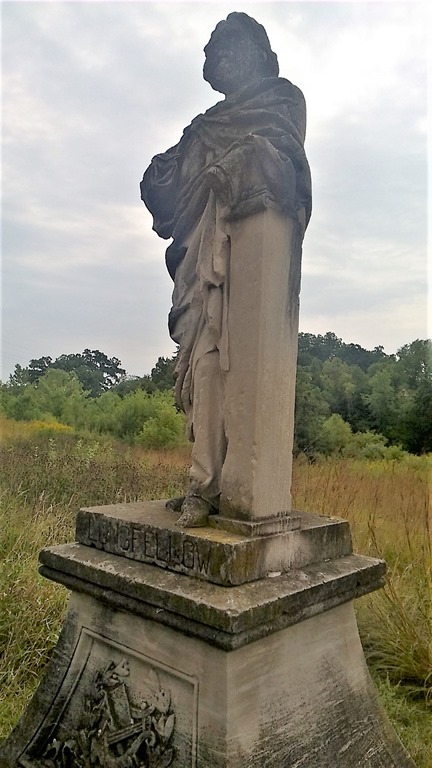
This eroded statue of Longfellow stands, missing its hands, in a little visited corner of an otherwise busy Minneapolis park, somehow saying something about how Longfellow is viewed today.
I’ve already performed one of those Longfellow poems on slavery: “The Witnesses.” I could have performed “The Quadroon Girl” instead, but I didn’t think I could. This is a level of evil so deep, compounding even the evil of slavery, that it is, paradoxically, a sort of sacred space. I didn’t think I was ready or worthy to go there.
I’m not going to further explicate “The Quadroon Girl” here. Despite the shakiness of my singing, it’s better to listen to it, to follow the story as it unfolds. I’ve performed it exactly twice, and I don’t know if I could perform it again. The player is below.
Since I’ve been keeping track, one thing has been consistent with the most popular piece each season: it’s been by a poet not widely known or read in the United States. So previously we’ve seen on top after a season of your listening: my translation of Dada principal Tristan Tzara’s “The Death of Apollinaire,” the better-known-in-the UK Edward Thomas’ “Adlestrop,” the too-often overlooked Chicago Modernist Fenton Johnson’s “The Banjo Player,” and “Frances,” the teenage love poem by George Washington, whose career as a poet never really took off.
This has happened even though I’ve featured (multiple times) most of the popular canon of pre-1923 English-language poets touched by the Modernist movement of the 20th Century: Frost, Yeats, Sandburg, Millay, Pound, Williams and Eliot.
Pat yourself on the back: the listeners here are open to a variety of writing, and they don’t necessarily need to have a name they already know attached to the words.
Still, it’s surprising that it’s surprising that we have Emily Dickinson coming in at the top spot this past summer.
Dickinson (along with Frost and Yeats) seem to be special cases with The Canon, in that all three have retained some level of popular readership and presence in that still-existing oral-tradition of memorization, even into our current century, without being denigrated into the bin of “not-great poetry.”
Our Summer 2018 most liked and listened to audio piece is “Ample Make this Bed.” Like many Dickinson poems it’s extraordinarily compressed, just eight lines—and like so many of her poems it invites us in and then mystifies us. Most of us have made a bed, and some of us have even been instructed in how to complete that task correctly. Here, with “Ample Make this Bed,” we may get six lines into the eight and we haven’t left domestic normality other than the ironic satisfaction with a job, that if done excellently, will stand forever. Ah, if only any domestic housekeeping task can stand ‘till judgement day, rather than the few hours until it needs to be done again!
The poem’s final two lines are so modestly telling and beautiful. Until them, no rhyme—and then internal rhyme and end-rhyme rush in! And the synesthesia of “yellow noise,” an image which could have been informed by Dickinson’s mysterious medical syndrome which included photophobia, but needs no biographic detective work to strike us boldly.
Is “Ample Make this Bed” about death, domestic drudgery, love, or the unstoppable passage of time? Emily Dickinson seemed to have taken care with her poetry, to make it ample and arranged to last until judgment day, so it’s likely intentionally undetermined—or mystically, exactly, all of those things united.
Musically, I’m quite proud of my music and performance of all the various parts with this one. If you missed it last July, why not go ahead and listen to it now. And if you like it, please let others know about what we do here.