Continuing the story of Minerva Jones: Doctor Meyers and Mrs. Meyers

These posts on Edgar Lee Masters’ Spoon River Anthology have run to the long side, so today I’ll be brief. I promised I’d tell you how the book of linked short epitaphs about a Midwestern town resolved the tale of Minerva Jones’ sexual assault.

Minerva Jones is possibly related to “Fiddler” Jones, the man who music had a hold of, and who the town wouldn’t let go of, for the joy of dancing to that music. She is the daughter of “Indignation” Jones, whose family including Minerva are jeered at for being poor and unkempt. Minerva is assaulted by a town rough, quite possibly one of the group that hoot at her because she is poor, not pretty, and yet she fancies herself “the village poetess.”

Music has utility, it’s entertainment, a movement in sound to dance with and loosen one cares. Poetry is pretension, it asks one to rise above everyday speech and outlook, and offends you when you don’t.

Sexual assault is often largely about power, not unbridled lust or desire, and this seems to be case here. Minerva’s rape is to teach her a lesson. No amount of understatement and fracturing of the story in Spoon River  can hide that this is one of the ugliest episodes in this book that contains full measures of hate, distrust, crooked deeds, hypocrisy, and crushed hopes.

So how does Masters’ resolve this story? Minerva’s epitaph has already alluded to her death, and Doctor Meyers is said to play a fateful part. You can read “Doctor Meyers”  here and his wife’s following epitaph here.

Masters, the lawyer/poet, wishes to prosecute this town’s crimes even further. Doctor Meyers tells us that he was a good man, maybe a touch proud of his good deeds and steadfast life as a father and husband, but that’s such a minor sin, and set out to set up his tragic fall. When Minerva comes to him after her rape the general reading of his poem/epitaph is that it’s for an abortion. It’s just slightly possible that the episode Doctor Meyers speaks of in his epitaph is her showing up at night right after the rape, injured from the assault. It’s even thinkable that she’s miscarrying a pregnancy when she arrives at his door.

Masters isn’t interested in making this clear. Doctor Meyers simply says Minerva Jones died that night she came to him “in her trouble.” In an odd fracturing of the story, in Minerva’s earlier-in-the-series epitaph we have a vivid two-line account of her going into shock from blood loss. Doctor Meyers’ account picks up intensity as he recounts what happens next. The town assumes his act was evil and criminal—the strongest evidence that what occurred that night was considered to be an abortion bolstered by the idea that “help her out” was a euphemism that would be understood as such by reader of the time.*  It’s slightly possible that he was presumed to be the rapist and then murderer of Minerva, or the father of the unborn child.**

I assume his “indicted me” is legally literal, but there’s no account of a trial, much less a verdict or sentence—and Masters the lawyer has lots  of trial and law stories in Spoon River.  Perhaps the “pneumonia finished me” event happened soon after the indictment and before any trial.***
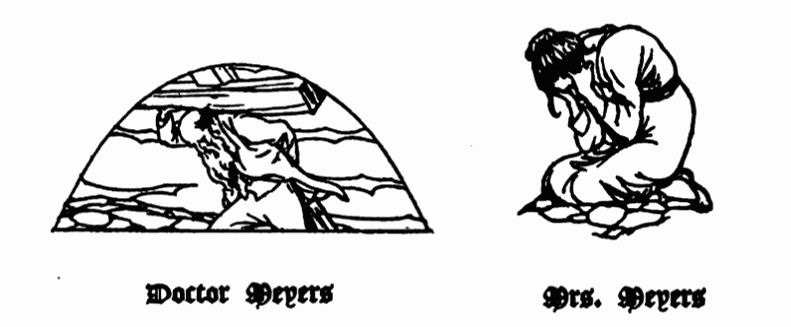
Doctor Meyers and Mrs Meyer woodcuts from Spoon River Anthology

I don’t know if Masters had control over the line drawings/gravestone engravings used to illustrate Spoon River in the 1919 edition, but if he did, these may tell us how he viewed these two characters, or how the characters view themselves


Doctor Meyers says his wife died of a broken heart. Her epitaph follows his, and the divided heart seems to me to be between some existing love or duty to her husband and her strong sense of propriety and morality that largely blames the “fallen woman” for tempting her husband into something she assesses is against “law human and divine.” Her testimony more or less cinches the abortion assumption, at least in the mind of Mrs. Meyers. If the accused crime was that Doctor Meyers was the rapist and murderer of Minerva Jones, she wouldn’t also use the possible abortion euphemism  “he…tried to help her” in her epitaph. She ends her epitaph preaching that the rules of morality are absolute, an unfailing guide to avoidance of shame. In the context of the story, her view is that Minerva Jones, even if she had a pitiable soul,**** got what she deserved and her husband was justly accused. I won’t blame readers for thinking this a chilling statement of callousness, because it is. But Mrs. Meyers is the victim as well as part of the cause and maintenance of the town’s cruelty. It is at least slightly pitiable to hear her clutch at the protections of adherence to a strict and legalistic morality and probity that didn’t protect her from the town’s patriarchal prejudice nor Minerva Jones from her tragedy of a pretense to poetry and useless beauty.

Mrs. Meyers epitaph directly follows “Doctor Meyers,”  which is proceeded by Minerva Jones’ father’s (not presented here) which follows Minerva’s. “Butch” Weldy, the rapist/attacker’s follows “Mrs. Meyers,”  with Masters the lawyer giving us a black-humored joke that you can think of as the final resolution.*****  Masters wanted us to clearly follow this story in this order. Other stories and linkages in Spoon River are more separated. In general, reading the epitaphs has a certain likeness to an open-world video game, and in any order the mosaic of events remain the pieces of a Cubist jigsaw puzzle loose in the box.

I performed “Doctor Meyers”  and “Mrs. Meyers”  together for today. A mild finger malady was making it hard for me to play guitar this past weekend, so it’s mostly piano today, though I could work out a way to play electric bass for this short piece. The player is below.


*Much of the action in Spoon River  occurs in the later half of the 19th century, a period during which abortions were made illegal in much of the United States. Illinois law was early in this change, so it’s clear he could have been indicted on this in the legal sense that would have been clear to lawyer Masters.

**In another of the epitaphs tangled linkages, we learn that another townsperson Willie Metcalf is said by some to be Doctor Meyers illegitimate son. We aren’t told if that is cause or effect of the disgrace of Dr. Meyers. I can imagine an elaborate Serial-style podcast relitigating the entire Jones/Meyers/Weldy case.

***During the course of writing Spoon River,  Masters himself, likely weakened by stress and an unhappy life, was stricken with pneumonia and may have been close to death, so this choice for Doctor Meyers coupe de grace may have not been random. “Webster Ford,” the pseudonym that Spoon River  was first published under in serial form in Reedy’s Mirror,  gets an epitaph in Spoon River Anthology:  a longer, more hermetic and supernatural one than most of the book’s.

****Masters’ syntax in Mrs. Meyers epitaph is confusing, perhaps designedly so. Even with the semicolon separator, “The newspapers lied about him…” is linked in sentence with “That he was not at fault in Minerva’s fall….” The newspapers disgracing him were claiming the opposite, and the sentence seems to reflect Mrs. Meyers’ own ambivalence. Likewise, the sentence starting “Poor soul so sunk in sin he could not see” is ambivalent. I think she’s largely referring to Minerva, “poor” in her possessions of morality and wealth, though some read it as referring to her husband.

*****Read the book if you want to find out.

A Misplaced Landmark in Modernist Poetry Part 3

Were you surprised or puzzled when I introduced this series on the Spoon River Anthology  by comparing it to the later bleak Modernist landmark “The Waste Land?”  I would have been. Not only is it often (usually?) left out of recent timelines of significant events in Modernist poetry’s emergence, the single epitaphs I recalled from it, the book’s “greatest hits,” were more similar to the ones I’ve presented so far here than to the bulk of Spoon River.  My first two Spoon River  posts: “Cooney Potter”  and “Fiddler Jones”  are ostensibly wistful, and while Cooney’s notice of the driving of his family and himself to increase his wealth and holdings has darker undertones, he’s telling this in the context of regret and guilt. He might even be exaggerating his faults.

Other unrepresentative Spoon River  “greatest hits” include the glowing and mildly tragic elegy for the putative love of the young Abe Lincoln’s life “Anne Rutledge,”  and “Lucinda Matlock*”  the stoic toting up of a full life by a pioneering settler who tells us she outlived (in a dual sense of the word) her troubles. The book’s opening introductory poem, “The Hill”  in its death-comes-to-us all catalog of outcomes remains elegiac. We might expect bittersweet with a strong flavor of nostalgia in the whole book. That’s how I’d cataloged Spoon River  informally in my mind.

SpoonRiverAnthology_cover

File under horror, not reminiscence


Reading the Spoon River Anthology this month has changed my understanding of it. Overall, the view of life and values in it is far more bitter than sweet. Many epitaphs are accounts of cruelty or unmitigated evil. Most relationships can be summed up (and are) as a grudge of one sort or another. It’s a harrowing read in its entirety if you are paying attention all the way through. With only a hint of the supernatural in it, it’s a horror story,  the mitigating moments and elements only relief before another crime or creep comes around the corner.

Today’s piece is perhaps the most chilling one in the entire book, as cold as a lynching poem—** and with gender replacing race, that’s approximately what it is. As I said when introducing last April’s sections of “The Waste Land”   this is not material for everyone.  It’s not poetry that soothes, reassures, or delights its attentive reader.  Masters is going to tell the story in first person, a somewhat unusual choice, and the narrator is going to fiercely understate in but 12 lines. Here’s a link to the text of “Minerva Jones” to follow along with.

As I said when introducing last April’s sections of “The Waste Land”   this is not material for everyone.  It’s not poetry that soothes, reassures, or delights its attentive reader.

We learn that Minerva Jones*** thinks of herself as the village poetess, and that some part of the village loves to taunt her, perhaps for her pretension, perhaps for lack of conventional femininity, perhaps just because she stands out as not conforming. Her father in his separate epitaph says he’s taunted for being Welsh and poor, so add that to her “crimes.”

And then she’s attacked by a village ne’re-do-well “Butch” Weldy, motivated by and/or knowing he’ll be excused by the village because of the above supposed transgressions of Minerva’s. We are given absolutely no details of the attack, another authorial choice. Many, and I, read this attack as rape. I think Masters intends that assumption. The choice to include no details of the attack itself could be discussed at length. It could be revealing of the speaker’s shame or decorum. It could be mental shock transcending even death. It could even be a level of what could be published at that time. Does that choice add or detract from the power of the poem? I suspect that varies from reader to reader. Think here of one of the core practices of Imagism:**** that one leaves out the core ineffable thing so that it may still be invoked by what is included.

Minerva tells us her attacker “left me to my fate with Doctor Meyers.” Here the story-telling gets more fractured and confusing, as this telling alone indicates that she sought medical treatment after the attack ends. However, in the context of other Spoon River poems that touch on this incident, the most likely reading is that a pregnancy resulted from this rape and her visit to Dr. Meyers was weeks later and for the purpose of seeking an illegal abortion.

At this point I’m more willing to say that Masters has made a narrative error, or at least disassociated one of the most powerful images in the entire book from its vivid context. Only by reading the other epitaphs dealing with this episode would it be clear to the reader that when Minerva Jones says in her sparse account: “And I sank into death, growing numb from the feet up/Like one stepping deeper and deeper into a stream of ice” that Masters has her acutely describing the feelings of a body undergoing hemorrhagic shock as she bleeds out in Dr. Meyers office. If one can distance oneself from the empathetic horror we may feel of the incident Masters is describing, these two lines are also Imagist: immediate, not mere decoration:

Anything that follows such a cruel situation and powerful lines must trail away. The next two lines have the power of pathos, posed as a question, not a command, and then the final two lines break with Imagist rules by stating emotions directly. After all the elision of the poem, many will forgive Masters for the value of these lines’ contrast with the cold account.

What happens next? Does Masters resolve this story? As they used to say in the days before binge referred to media consumption: stay tuned.

I too made a curious choice in performing “Minerva Jones.”  I could have gone with a big orchestral sound, something I’ve been exploring this summer. Then I’ve been thinking I’m missing the element here of loud “rawk” with guitars and band. And synthesizer/electronic sounds are almost a stereotypical way to express horror. Even solo acoustic guitar would be a conventional choice—many traditional ballads are as cold and bleak in their description of violence.

Totally out of the blue, and perhaps not correctly, I chose to instead use something out of my not-quite-jazz side. Dampened drums in a solid backbeat, always a good signifier of fate, a fretless bass line in a rolling walk, a chord progression sketched on piano that subtly violates expected cadences and harmonies, and then the guitar top line emphasizes the G-flat that adds stress to the harmonic structure. Like Masters, I fiercely understated. Did it work? The player is below.


*Rutledge is one of a handful of real people with real names included in the Anthology, but a great many others are thinly disguised real people from Masters hometowns or Chicago (some of whom weren’t dead, and recognized themselves), Matlock for example is his paternal grandmother at whose farm Masters spent time at in his childhood.

**Several times here I’ve considered poems about American lynchings for presentation. I’ve so far pulled back, and the why of that is complex. Dealing with the emotions brought forward in the Minerva Jones story walloped me, and I had to step away unable to continue work on this for a while.

***Is she related to Fiddler Jones I asked last time? Possibly, but I can’t recall that being established in the book, while Minerva’s connection to other epitaphs is made explicit. If she is, then there’s possibly a comment on how poetry is treated by the town (and presented by Masters) and music. Music is a recognized good, poetry something between an oddity or a fault. Two professions are probably overrepresented in the small town of Spoon River, mirroring Masters’ own life: poets (there are at least three) and lawyers and judges (I lost track, but there are many).

****While writing the Spoon River  poems, Masters once called his work “Imagiste” indicating that he thought the term fitting. Pound’s A Few Don’ts by an Imagiste”  along with F. S. Flint’s short report on “Imagisme  was published in Chicago-based Poetry in the spring of 1913 as Masters was thinking about how to shape his Illinois material; and though this has been less remembered later on, Chicago colleague Carl Sandburg was committed to using Imagist principles.

I’m indebted for some of this detail about Masters’ process to the only full-length Edgar Lee Masters biography extant: Herbert K. Russell’s 2005 book.

A Misplaced Landmark in Modernist Poetry Part 2

So how did the Spoon River Anthology  get created and published in 1914, such an early date in the emergence of Modernist verse? Let me see if I can summarize what I know so far. In the early part of the 20th century Edgar Lee Masters was a busy lawyer practicing in Chicago. The most oft-remarked part of that career was that for a time Masters was partnered with the famed Clarence Darrow known for his progressive views and participation in numerous famous cases of the era.

I’ve quickly scoured a great deal of information this month on Masters, learning more each day, but it’s clear that for some time before 1914 Masters wanted dearly to become a writer of some kind, with a “trunk” of prose, plays and poetry, and a fair amount of rejection letters. It’s possible that, in his time, he might have been categorized by writers and cultural figures as a type that still exists, which for lack of a better name I’ll call a “wanna-be.”

Like all stereotypes, the wanna-be is unfair to some tagged with it, while seeming to be a useful short-hand among those who apply it. Authors from book tours only need to start a story with another about the businessman who buttonholes the author to say that they too have a novel, often partly written or even “just an idea, but…” and the fellow author will nod and immediately fill in the stereotypical details. Modern authors maybe divided into commercial, academic and bohemian enclaves, but all three can bemoan someone from outside those realms who thinks they are a writer, while giving signs that their real-life choices, risks, experience, and focus lie elsewhere.

Masters was certainly not the kind of wanna-be who claimed he had a novel in him, or “I once wrote poetry when I was young.” Despite what he described as a busy legal practice, he was writing—good bad or indifferent, he was taking his swings.

Here’s another stereotype label that could be applied to Masters in his time: “womanizer*” which is someone who engages in endless, usually short-term, love affairs: a cycle of attraction, infatuation, discovery of imperfection or the newness wears off, and then repeat. For a time prior to writing Spoon River,  Masters was in a two-year extra-marital relationship with a Chicago woman Tennessee Mitchell.**  Mitchell was a musician who taught piano, broke a glass ceiling for women as piano-tuners (lady brains can’t handle the complex tempering of all those notes you know), and who ran a salon where patrons, artists, and radicals mingled.

One question I had when I wondered how Masters could write a thoroughly Modernist work of poetry so early in the movement was did he cross paths with Chicago’s Poetry magazine and Carl Sandburg, then living and working in Chicago. In the case of the later, he certainly did. He struck up an acquaintance with his fellow Midwestern Modernist,*** and they took walks together and presumably talked about poetry as Masters was writing Spoon River.  Masters referred to Sandburg in letters from this time as the “Swede Bard,” which even just between friends sounds dismissive and nativist, but this does point out something that shouldn’t be forgotten about Sandburg: he was the child of an immigrant. Masters didn’t have to “prove” his American legitimacy when he cast a critical eye on parts of its culture. Sandburg, though different in his politics from Masters, could be just as critical, but he was casting his critique from a different standing.

And Poetry magazine, a critical American organ in the dissemination of Modernism? Masters seems to have been stymied there. At one point he was having another of his affairs with a woman described in places as an editor at Poetry,***  but I so far haven’t seen that he was published in Poetry  prior to Spoon River.

Instead the Spoon River Anthology owes its major inspiration and initial publication to a man down the Mississippi from south-western Illinois, William Reedy, the editor of Reedy’s Mirror  in St. Louis, who like Harriet Monroe’s Poetry  was ready and willing to publish American poets who were unabashedly American and willing to forge American verse in new modes, as Whitman and Dickinson had shown was possible in the previous century.

Inspiration? Well, for someone promoting American verse, Reedy’s prime move was to send Masters a copy of a recent translation by a British scholar from classical Greek late in 1912: Epigrams from the Greek Anthology.

Epigrams from the Greek Anthology

A gift that helped start American Modernist poetry. Ironic, or Ionic?

.

Masters had an idea that stories from his southwest Illinois youth were good material, but he didn’t know how to present them. Even in 1913 he was thinking of shaping them into a play.**** As 1914 began, Masters, still being goaded by Reedy to drop his often florid and European-modeled verse and do something American, started writing the Spoon River  epitaphs, accepting the incongruity of a classical Greek style of summing up a life being used for American Midwestern townfolk as having a certain satiric flavor. Masters sent a batch of them to Reedy, and as Masters himself recounted this, they were submitted in something of a mood of: you want American, well I’ll give you American  and I’ll bet you won’t think it’s poetic.

Reedy published them, praised them. Throughout 1914 this process continued: Masters writing feverishly on the weekends while continuing a busy legal practice and sending off batches to Reedy and his Mirror of new Spoon River epitaphs to be published. Does Masters feel validated? Has he found his voice? There may be some ambivalence on his part at first. He has them published using a pen name Webster Ford. Some of that may be to protect his law career (lawyers who tell secrets about lives aren’t exactly sought out by clientele.) Part of it may be because he’s unsure. It’s even possible that “Webster Ford” may have been a way to escape his lawyer-who-thinks-he’s-a-poet issues with Chicago literary figures.

Ezra Pound, off in England, but considering himself the world-wide talent scout for all things Modernist, fires off a letter to Harriet Monroe. Pound is no stranger to urgency in speech, but he’s in full florid ALL CAPS shouting mode:

“GET SOME OF WEBSTER FORD’S STUFF FOR ‘POETRY’…Please observe above instruction as soon as possible.”

By the end of 1914, Masters drops the Webster Ford mask and puts his own name on the poems, and he’s looking to have Spoon River Anthology  published in book-length form. He’s on his way, even if he’ll soon enough loose it.

For today’s Spoon River  piece, here’s a companion to Cooney Potter,” “Fiddler Jones,”  showing the dialectical contrasts Masters likes to weave into his collection. With its invocation of music it was an immediate favorite with me. Besides the contrasts in values and outcomes that Masters uses, there are families’ and relationship stories throughout the book, but it’s unclear to me if Fiddler Jones is related to other Jones-surnamed characters in Spoon River.*****  Jones is a common name, used as synonym for “anyone” idiomatically. But it’s also Welsh in origin, and there is a Jones family of specifically Welsh ancestry in Spoon River.

Reading “Fiddler Jones”  I thought the character might be Afro-American. There’s one stated Afro-American character in Spoon River, and I wasn’t sure of the exact ethnic makeup of the region of Masters youth, but like finding out about the Afro-American community in Emily Dickinson’s region, assuming all-white is false default. As so often when I come to something like this, the Internet is my friend. It’s actually easy to search census demographic records for the two towns of Masters’ youth, and they were around 1% African American by those records. Of course, Masters’ book isn’t a documentary or demographic treatise, but that means there are 30-35 Afro-Americans living in Spoon River’s models in the later 19th century.


Strings link things: African styles mixed with Celtic styles in America.

.

From my musicological interests, the idea that that fiddler could have Celtic or Afro-American roots is apt, but in doing my music for today’s performance of “Fiddler Jones”  I didn’t really follow traditional fiddle styles. I don’t play violin, and the solo violin line featured in today’s piece was played on guitar with a MIDI pickup using a lot of string vibrato and little of the short, rhythmic chops that might drive a field of dancers. Wondering what’s the dance tune they step off too mentioned in the poem? This blog has a good guess. The lyrics to that tune also end, as does Spoon River’s  in the grave; and as Fiddler Jones does, with no regrets.

In composing the small orchestra accompaniment, I made sure to feature the bassoon and piccolos that bedevil Fiddler Jones in his mind as he tries to plow. I found myself rather enchanted as Fiddler Jones was, and as a result today’s piece is a bit longer than most here, but I hope you’ll find the spell as moving as I did. Player’s below.

.

*Particularly, but not exclusively, among arts and bohemians, even in Masters time there would also be women who were not called “mananizers” for some reason, and bisexuality and same-sex relationships too. The power relationships in such relationships would be too complex to discuss in a footnote: some exploitative, some less so, some respectful, some carnal, some duplicitous, some honest, and so on. So far, in my rapid overview of Masters he doesn’t seem particularly exploitative, and Spoon River  shows he’s listening to women.

**Click this link and read about Tennessee Mitchell! After the end of her affair with Masters she eventually married another wanna-be-but-actually-could writer, an advertising man and entrepreneur Sherwood Anderson who went on to write Spoon River’s  prose-in-law: Winesburg Ohio  in 1919.

***At this point, do we need to broach the question of if Edgar Lee Masters was trying to sleep his way to the top of Modernist poetry?

***Yes, I should have included Masters along with a remarkable group of folks from the turn-of-the-century south-east Iowa, south-west Illinois area, some of whom were key figures in the emergence of American Modernism.

****More irony, the brief poetic monologs in Spoon River  so revealing of key details of entire lives in flat descriptive dialog became a staple of audition readings for actors since they so readily allow an actor to show keen presentation of character in a few lines.

*****We’ll meet one of those other Jones in Spoon River  soon. You may think, small town, must be related, but in the 19th century Midwest residents are largely internal migrants from the previously settled regions of the U.S. and so, even later, it’s not certain. In my 20th century hometown, smaller than Spoon River, 20% of my class had the last name Johnson and were not related. As you might imagine, I thought the running joke in Blazing Saddles  that every white townsperson is named “Johnson” was particularly funny.

A Misplaced Landmark in Modernist Poetry Part 1

Readers here know I have an affinity for the lesser-known, the forgotten, the underpraised participants in the Modernist movement. In any historical or literary period, there have to be some that are overlooked. Why? Geographic, gender, racial prejudice? Bad luck or spotty publishing history? Yes, all those can play a role.

But today’s case is a weird one. He’s a white guy and not obscure, his breakthrough masterpiece sold well the year it was published and then for decades afterward. The early American Modernists praised it, recognized it as a Modernist work. There’s circumstantial evidence that it could have even influenced them when they produced their now esteemed breakthrough masterpieces.

Yet, it’s largely left out of the cannon today, and as such it’s also left out of the short histories of the emergence of English language Modernist poetry. One way to focus that story is to point to the publication in 1922 of T. S. Eliot’s “The Waste Land”  as the moment in which everyone had to stop and take notice of this new poetry.

Let me roughly state some things that were remarkable about this landmark work.

It was episodic. A longer poem, it was made up of shorter poems, retaining the compression of short lyrics while telling a larger, multivalent story. Characters drifted in and out.

It was written in free verse. It didn’t rhyme, it didn’t use a strict and unvarying meter, while still making use of the other tactics of poetry. Since this was still somewhat novel, the sound and form could take off from and seem to readers like a non-rhyming translation of poetry from a foreign language, even an old language like Latin, Greek, or Hebrew.

It’s highly skeptical and iconoclastic about modern society. War and business was corrupt, humanity shortsighted. Dialog was often in deadpan with an emphasis on the first syllable, as if spoken by ghosts.

There’s an anachronistic, satiric element to some of the talk too. Everyday people of the current era may speak at times in the form of older literature, and we’re meant to note this as strangely halfway between a sense that time has not changed humankind and it’s eternal problems, and a sense that modern folk are not really as noble as the classical fore bearers.

Though written by a man, women’s voices and a woman’s viewpoint are prominently given a place in the work.

Love and sex was not a balm in this world. In fact, partners are invariably at odds, yet often still yoked together somewhere between torment and ennui. So degraded is the sexual politics and power in this account, that rape is a crucial trope, with references to Ovid’s mythic tale of Tereus rape of Philomela serving as a talisman.

Endurance is still celebrated; one must suffer but keep on, even if it be in vain. Music, yes even popular or folk tunes, may help make this more bearable.

Oh, I may have confused you! I’m not speaking about Eliot’s “The Waste Land,”  I’m talking about this popular yet now misplaced Modernist breakthrough: The Spoon River Anthology  by Edgar Lee Masters. I’m going to talk more about it and present a few pieces from it in the Parlando Project manner, but before we end today with a piece from Spoon River,  here’s something that never was impressed on me as I learned about American literature, and in particular Modernist English poetry: “The Spoon River Anthology”  was largely written in 1913-1914 and published in 1915. Eliot was writing “Prufrock”  then, but it had not been published. Pound was making his transition from poetry as we presented here in our “Before they were Modernists” series into Imagism, with the first publications his new style in the U.S. in 1913. My personal favorite, Carl Sandburg was starting to write in this new compressed style with a cache of poems published in Poetry magazine in 1914.  Others,  Alfred Kreymborg and William Carlos Williams’ East-Coast-based and more avant garde journal of new verse is yet to come, it began in the middle of 1915. Franz Ferdinand is an obscure central-European duke who has yet to lend a name to a successful Scottish post-punk band.

Edgar Lee Masters

It’s been a quiet week in Spoon River, not so many rapes, murders, and early deaths as usual: Edgar Lee Masters


How much of this new verse style had Edgar Lee Masters read and how much of his style was he independently inventing and discovering from the 19th century’s Whitman (or Stephen Crane) and even older classical sources? Given that both Masters and Sandburg were present in Chicago and developing a similar sound for their free verse (while differing in sensibility) at the same time, it’s possible that there was a cross-influence there. One thing this timeline makes clear: The Spoon River Anthology  was not some later attempt to popularize or adopt the revolution of Modernist English language poetry to tell a Midwestern story, it’s created roughly at year zero.

The Spoon River Anthology  presents itself as a series of epitaphs for dead residents of Midwestern town like the one Masters grew up in, some short enough to be carved on a burial monument, others bending the form a bit into short monologs spoken by the dead. The lifetimes of the speaking dead vary and overlap but appear to be from two to three decades before the American Civil war until the early 20th century.

For an initial subject I’ll take one of the sons of the initial settlers,* who tells us he got 40 farm acres as his inheritance, and who sums his life and aims up in a few lines. His name was Cooney Potter.

The player to hear my performance of his Spoon River tale is below. For those of you that have waited for me to drop the synths, we’re back to acoustic instruments today: guitar, piano and tambura.


*Well, hmm, yes there were those other folks, the ones who lived there before.  Even though the Black Hawk War of 1832 between some indigenous peoples and these settlers and their government was fought in the Midwest during the times of this settlement, I don’t recall it or the Native Americans being addressed in Spoon River, though the 1861-1865 American Civil war fought by two factions of the settler government is significantly mentioned.

August Moonrise

I almost feel like I need to place a warning label on today’s piece: Rated RE Strong Romantic Emotional Content. Thanatopsic material. May not be suitable for those who have not sufficiently worked through issues with self-harm or the experience of self-dissolution.

Modernism had a strong tendency toward a critique and reaction to romanticism and its characteristic expression of emotional content. A man viewed as the founder of its English-language poetic wing, T. E. Hulme, wished to set it on a course of completely overturning Romanticism. But those bylaws didn’t always filter down to every chapter and member of the Modernist International. Readers here know I love some of the early Imagist works which are parsimonious with overt emotional words, even while seeking to charge their images with a fresh immediacy. These poems aren’t necessarily devoid of emotion if the reader has it to supply themselves—but then some Modernists, such as E. E. Cummings, were perfectly fine with frank emotional outpourings.

Sara Teasdale, in addition to being largely forgotten for the better part of the last 100 years, was never officially a Modernist, so there’s no movement membership to endanger and no expectations for her to fulfill anymore. She wrote intensely lyrical and musical verse in plainspoken and non-archaic language. That’s a surface shiny enough, devoid of hermetic imagery, and with sweet word-music that makes it too easy to miss what she’s saying.

Sara Teasdale2

Sara Teasdale is sick’n’tired of you mentioning how pretty her poems are

I knew this already, having presented Teasdale regularly here. Still, I had to go through a journey to inhabit and grasp this poem for this project. I collected it earlier this summer, seeking to stockpile a few seasonal poems ahead of time to have some on-the-shelf ideas for possible use.

Here’s the full text of the poem. If you skim through it, it looks like a fairly common poem subject: summer night. It might seem to hit the expected points too: hey, summer, it’s nice at night (maybe even better than the heat of afternoon). Plants, trees green and full, explicit birds. A Moon one can linger with long enough that you feel that if you stay the night you could watch it change its phase.

Teasdale can write a poem that seems like that. That’s a problem. It’s too easy to miss what she’s communicating if you leave it at “That’s pretty.” You could use her writing as a case-study in why some of the Modernist tactics that frustrate (or delay) understanding might not be counterproductive. Teasdale gets misunderstood quickly as one passes over the words, while someone like Mina Loy, Tristan Tzara, or Gertrude Stein causes those who won’t care to read carefully and empathetically to not stop in at all.

As I began to read, really read, “August Moonrise,”  to figure out how I might perform the words, the last section seemed dark—and not in the pretty moonlight way. Here are some of the words that hit the notes in her word-music after the poem’s midpoint: bitterness, sorrow, death, wavering, blind, fearful, fire, cold, vanish.

Seeing that, I reexamined the opening half for portents. The swallows are rushing, willfully, together and departing from each other. And is their willful act truly willful? Maybe not, it’s like the movement of dark tree leaves. If that was a spare Imagist poem, or a work of classical Chinese poetry, we’d be confronted with that image, asked on no uncertain terms to deal with it. Here you may think it’s so much minor scene-painting.

The scene-painting gets even more painterly next. Sunset, moonrise. The final palette: “a deeper blue than a flower could hold.” Is that merely a beautiful picture or a statement of more blue than can be sustained?

Teasdale’s singer in the poem is drawn in (note, she goes “down,” descends to it, even though the preceding birds, trees, sunset, moonrise are all things normally above the horizon) because it’s her, or because it will become her. The poem reaches—if only briefly—a quasi-orgasmic happiness. One line here: “I forgot the ways of men” is so rich in ambiguity. I could read it three or four ways easily.

This happiness, this intoxicated leaving of all but the senses (however brief) is portrayed as a consolation. Consolation for what?

And then we enter that section that is so full of darkness, loss, imperfection. Is this section spiritually sublime or just harrowing? I think you can play it either way, though I suspect it works best if the other choice is kept as an undertone. Compare this to Laurie Anderson’s childhood account of Buddhist Midwest night skies and the non-necessity of self, the archaic trials of the Lyke Wake Dirge, or to a searing inventory of imperfection, almost a suicide note.*

NY Times Teasdale Death Story

Teasdale: not waving, but drowning

Teasdale’s concluding couplet is so searing I think it must be performed understated. The crucial word in it, “theft,” says she doesn’t feel in control of this loss of control. Isn’t that frightening? Spending several hours with this text this week, fitting it to music, performing it, thinking about it was a journey, from “Oh, a summer night poem” to a consideration of the sameness and the difference of exceeding the self and end of the self.

So, am I out on a limb here, thinking this a major poem by a too overlooked poet? Has the seeming conventionality of its setting (subverted as it may be), the gender of its author, the musicality of its expression, the unabashed romanticism of its sensibility obscured our view? If this was Rilke translated from the German would we read it differently? If this was Yeats with swans instead of swallows would it matter? If a Cubist ran it through a copier a few times and then cut up all the lines and reassembled it, would we stop long enough to think about it? The issue of Teasdale’s membership or non-membership in Modernism might have seemed germane in the mid-20th century, but to a significant degree it’s immaterial now.

Well, I’ve done it again. Talked about the words so long that there’s no time to dance about the architecture of the music. Thinking about what I said above, I could have cut up and obscured Teasdale’s words rather than a straight recitation I recorded, but the choice I made has its strengths too. I did try to undersell the sensuousness of the lyric in hope it would cause the listener to consider it differently, but the opposite choice works too, for I’ve discovered this gorgeous and emotionally effecting choir setting of “August Moonrise”  by Blake Henson that had me in tears this morning. See my comments last post about how my limitations as a singer and no access to alternative skilled singers focuses my composition into other modes.

I intentionally avoid apologizing for my work. I think that’s a good practice. If you think you should do better, do better or do different, instead of talking about it. My approach to “August Moonlight”  with a skip-footed motorik beat and an ominous and fateful tone in the reading and music certainly contrasts with Henson. I could even imagine that hearing Henson’s work after considering Teasdale’s darker undercurrents intensifies it, as it did for me today. You can hear my version with the player below. Don’t see a player gadget? Then use this highlighted hyperlink to play it.

*There was a point in the production of this piece that I seriously considered abandoning my presentation of “August Moonlight”  because of this. Once I could see that element was present in the work (as it is in Teasdale’s life), I felt it shouldn’t be denied if I was to perform it. Many artists deal with feelings of self-harm and because “All artists fail” in the sense of imperfection and producing things farther, rather than “Something nearer your desire.” I hesitate to present work that might feed into that, particularly with a beautiful and romantic sheen to it all. In the end I decided that Teasdale is illuminating that, and if I presented it so that you can consider its danger, it could have value. Henson’s setting makes a choice to emphasize the perception of beauty, the singular hour of atonement, which also would have answered this concern.

Soon Be Gone

I start off talking about the words or context in which I experience the words, mostly poetry, that are used here. That goes on, and I notice that I’m getting near to—or even above—what I consider to be reasonable length for a blog post (around 1,000 words*) and I haven’t mentioned the music.

In the end I’ll often mutter a few things about the instruments used, urge you to listen—and roll the footnotes!

So, let’s start off today talking about the music for a little bit. I enjoy the variety of musical contexts I use for the words here. I have wide musical tastes, and yet there are still genres and sounds I haven’t yet used that I will use as this project continues to push toward 400 audio pieces. Inexpensive technology has offered an enormous audio palette to a composer/musician, unbelievable sounds and resources compared to what was available even to the commercially viable counterparts of my childhood. And yet all these possible variations are not used. How curious. How self-limiting.

Well, there are reasons for that. While I admire musicians that push out the boundaries of what they do, the marketplace often finds such efforts self-defeating, and I don’t know that they are misreading substantial audiences in their verdict on that. I’d like the audience for what the Parlando Project does to grow. Indeed, reflecting on the amount of effort that goes into this, it’s nutty that it continues at this level for an Internet audience a thousands-time smaller than pictures of a sandwich. But I’m also grateful for an audience that can at least tolerate my musical varieties on top of poetic varieties. That’s you. You’re rare. You’re not supposed to exist, and yet you do. That’s the audience this project deserves.

Perhaps a more important reason is that technology, tools, resources—while they can extend what an individual musician/composer can do—in the end revolve around the axis of the abilities of that musician/composer. I’m far from a virtuoso on any instrument, some days I’m not even competent on my core instrument, the guitar. And then there’s a key problem I work around constantly: I’m a poor singer.

I use spoken word, chant, talk-singing, altered timbres, but real, full-voiced, pitched singing of melodies escapes me. A beautiful resource I don’t have available! This limit constrains me, frustrates me—though it sometimes leads me to work on ways of integrating poetry and music other than the existing traditions of art song.**

But some material must be sung. Today’s piece is one of those. “Soon Be Gone”  is imaginatively taken from an episode early in the adult life of my late wife, who left her Twin Cities hometown to follow a mountebank to southeast Iowa where he had a job offer to work as a radio announcer. It didn’t go well, or work at all really, and she traveled back north by north-west to home where she accepted my pretentions.

When I wrote “Soon Be Gone”  some years back, not long after she had died, and decades after the events, I made some choices. I think primarily from my grief, I wrote it from the view of the mountebank, who in the piece is reflecting immediately on his loss of her.

Soon Be Gone lyrics

“Hebrew sun?” If you’re facing north, one reads its daily path from right to left


The opening two lines of the bridge section before the final chorus are a variation taken from a translation of “The Song of Solomon”  which had a special meaning to my wife and I.***

As a lyric writer I often prefer to leave “the plot” of a song undetermined, and if it works “Soon Be Gone”  doesn’t require that the listener know those things. I mention this as a suggestion to writers here that compression and leaving out details could add a mysterious power to a song or poem. If your listener wants to connect, give them space to fall into your words.

farfisa where the action is

It’s an organ. And it’s LIVE! Forget the dance—run!


The difficult and ultimately imperfect task of recording the vocals for this piece aside, I did enjoy plugging my Telecaster into real cranked-up amps and doing the two-guitar weave at the center of this song. The other featured element here is a Farfisa combo organ**** (well, a virtual instrument recreation of one) which is a tip of the hat to Dave Moore who played one with the LYL band back in the 80s.

To hear the results, use the player below. I’ll be back with more poetry and “other people’s stories” soon.


*It takes time to create shorter posts about complex subjects, but I feel the author owes it to their audience. I’ve subscribed to about two-dozen blogs that I read whenever I get a break from this project, and nothing pains me more than a talented and perceptive blog author with more words than content. Although elaborative words strung together have their pleasures, I’m often in the mood to spend more time thinking and doing than reading. This is probably why I’m drawn to the compressed lyric form in poetry.

**I rather like art song settings of poems, though they often seem to me to be one solution to the problem of setting complex texts to music while there are others less explored (what we do here.) And since I can’t sing them, there’s little incentive for me to write complicated melodic lines for singers, which means that even if I had singers to write for I’d probably find that skill undeveloped on my part.

***For example, the 8th chapter in the King James Christian version which renders things this way: “Set me as a seal upon thine heart, as a seal upon thine arm: for love is strong as death….”

****It’s falling back into the mists of time, but a player of a small electronic organ shaped like an elongated suitcase and fitted with a folding or removable set of legs was once a common feature of rock’n’roll bands. They were often played through overtaxed guitar amplifiers with only one hand playing arpeggiated parts like I use here. This sort of thing is sometimes associated with “garage rock” combos of the early 60s styled like The Kingsmen, ? and the Mysterians, The Sir Douglas Quintet, or Paul Revere and the Raiders et al. But that trope survived into the “Rock” evolution later in the decade too: The Doors, Country Joe and the Fish, early Pink Floyd and Grateful Dead and so on.

The Farfisa was an Italian-made-and-designed brand used in this role. Later in my century Phillip Glass utilized Farfisa combo organs in creating his version of composed music built on repetitive and driving organ arpeggios. The timbre of those combo organs always had me listening to Glass’ early work anticipating that they would, at any moment, break into “96 Tears”  or “Light My Fire.”

Pods (Neponset)

I’d planned to move on from Carl Sandburg, but I couldn’t lose my train of thought.

This weekend I got a book I’d ordered, Christmas on the Farm  by illustrator and writer Bob Artley. Why such a book in the dog days of summer? Well, three weeks ago I attended a memorial service for an uncle of mine, Lew Hudson, who’d been a friend and co-worker of Artley decades back at the Worthington Daily Globe  newspaper, and I noted that Lew had written a preface for this book.

Artley’s book has charm aplenty. It’s a memoir of his winter childhood on a family farm in the 1920s. I decided I would use the stories in his book to try to locate the farm of his childhood. And thanks to our modern Internet-hosted maps I did, by following an illustration and accounts in the book that the farm was between Coulter and Hampton, north of the road to those towns, north of the railroad (it looks like it’s a rails to trails bike path now), and north of two farms on either side of Spring Creek. In personal memories we travel in time, but modern tech makes virtual travel in space objectively accessible.

It’s not exactly next door to the Iowa farm town where I grew up (60 miles away) but the countryside would be close. And the 30 years difference between his time and mine? Not so much to me these days.

That got me thinking about little Midwest towns, and I saw this short Sandburg poem in my notes from summer reading and I decided to work it up.

Last post I mentioned my theory that Sandburg’s Whitmanesque mode, those broad catalogs of observations in his longer poems, have caused him to be remembered as a 20th century imitator of Walt; and that did him no good, as the High Modernists were only grudging acknowledgers of Whitman’s breakthrough style. When long Sandburg poems overshadow the short ones, what he thoroughly intended to be Imagist poems are instead seen as slight, one-dimensional miniatures, not charged moments in time.

Map of Neponset in 1905

“Neponset, the village, clings to the Burlington railway main line”


So, let’s look and listen to “Pods”  as if it could be what Sandburg intended it to be. Yes, its core is  a natural, real, and present image, not written as a simile, just yoked together by poet’s observation. The village of Neponset is like a peapod on its railroad line, one of many, too easily cast as having no concernable uniqueness (the cliché is “as alike as peas in a pod”). Given that it’s written before commercial air travel, the passing passenger train is there to reinforce that Neponset is “flyover country.*” Notice that the poem avoids almost all adjectives and sentiments, so we should notice the one striking one it does use: those passing, unstopping trains are “Terrible.” How so?

Well, they’re loud, big, massive, and they shake the peapods on the vine, they even shake the town “slightly.” Are those trains modernity and time passing Neponset by? They and their sleepers in their cars might think that so. Yet, peapods will not mind, they will continue their cycle—so why not the like thing, the village? After all, the poem in its sparse word-count (39 words) wants to connect with a repeat of “slightly” and linked tremors that the earth (planet or ground? No matter, essence either way) is also shaken. The “movers and shakers” are really only shakers here, their moving is no different that the pea vine’s revolving cycle of seed to seed. The sleepers in the train are too peas in a pod.

Burlington Line The West Wind

Naw pard, ain’t thinking of going off on vacation. Gotta roundup those peas and drive’em to LeSeur.


Commenter rmichaelroman thought the Omaha-headed train passenger in Sandburg’s Limited  was like Shelly’s Ozymandias.”  In the case of “Pods”  we have Imagist peapods/townsfolk on the bough, but it’s not Pound’s Paris with Impressionist painters living off every Metro stop. Sandburg’s American train is in can’t-stop motion, but his poem is a little like an anti-matter version of Britain’s beloved “Adlestrop,”  with the peapods continuance standing for all the birds in Oxfordshire.

Musically, this one has lots of synths, though now that I’ve reminded myself how to play electric bass again, I used that instrument to form the vine of this tune. There are two electric guitars on this track, but their signals are so modified that even I find it hard to pick them out from the keyboard synth parts. Vocally, I decided to let the last few lines, our passing trains, our unaware sleepers podded in their Pullman cars, repeat their cycles. Here’s the text of Sandburg’s poem, and the player to hear the performance of it is below.


*Why does Sandburg want us to know the limited (a train that makes stops at only the large cities) is going to “the Rockies and the Sierras?” Why not Chicago or Los Angeles or San Francisco, or even (as in another Sandburg limited train poem) Omaha? I wasn’t sure. Unlike the Midwest’s rolling hills, these are places of majestic natural heights invisible to Illinois townsfolk. Are these Mount Olympian ideals? I know that train companies were promoting trips to these scenic areas as vacation destinations, so our passengers may be more carefree in their travels than those remaining in the rural town. This could also be Sandburg the journalist fact-checking Sandburg the poet? The Burlington Route didn’t have through service to the West Coast, and Chicago (where this limited would have originated) is only 120 miles from the little village of Neponset, and so not exotically far away.

Travel to the mountains

No time or money for a train ride to the mountains? Early 20th century VR: the stereoscopic viewer!


And then I found this story, linking Sandburg to the village of Neponset and a job selling stereoscopic scenic pictures of far-away lands.

Black Horizons

How did you like that last Carl Sandburg piece? It’s about as majestic as Sandburg goes, what with its extensive catalog of life in its fullness and emptiness. It seemed to me about right to mark the anniversary of this project’s launch, and my late wife, and my son, and my wife and family, and my country, and you. And I much enjoyed making the large-scale orchestra music for it.

But if it catches you in the wrong mood or with a different and certain analysis of life it can seem a bit too new-agey, suffused as it is with non-denominational spirituality.

Sandburg is best taken in large and varied portions. He has many moods and is open-hearted in a way that many poets are not.*  Before I reminded myself I should do an anniversary piece earlier this week, I had another Sandburg poem I wanted to present, but I put “Black Horizons”  on hold and completed “For You.”  These two selections this week can be taken together to form a better picture of Sandburg.**

Sandburg can offer you balm and clarifying anger, and today’s piece is much closer to the later pole. Published in 1922, there’s not much I can think needs updating or footnoting to explain. You can read it, hear it, speak it yourself this month in 2019 and feel it as freshly as when it was written.

Carl Sandburg Rocks Out

Brothers and Sisters, the time has come for each and every one of you to decide whether you are going to be the problem or whether you are going to be the solution! You must choose Brothers, you must choose! It takes five seconds, five seconds of decision, five seconds to realize your purpose here on the planet! It takes five seconds to realize that it’s time to move, it’s time to get down with it! Brothers, it’s time to testify and I want to know, are you ready to testify? Are you ready? I give you a testimonial: Carl Sandburg!” ****


Musically, no orchestra today, just drums and percussion, fretless electric bass, acoustic guitar and voice. I tried to add a little color to my I, iii, IV, vi repeating cadence by flatting the 7th in the bass line, after watching Rick Beato on YouTube analyzing some Nirvana songs’ harmonic complexities.***  In a more ideal performance I think the piece would work great with a choir or audience singing the refrain.

The player to hear my performance of Carl Sandburg’s “Black Horizons”  is below (unless you’re reading this on an iPhone with the WordPress app—in which case, switch to a web browser to see the audio player, or you can subscribe to the audio pieces alone through most podcast services such as Apple Podcasts.)


*Why would that be? In literary circles by the middle of my century, poetry was the literary art devoted to complex, sometimes nearly unfathomable, emotional and perceptive states. A poet I heard read last night used a word “Apophasis,” which means describing something by what it is not, surrounding it with words that are not it. That term also describes a great deal of Modernist poetry. Poetry did this, at least in part, because so much tired verse of the preceding century or two repeated the same few emotional tropes until poets were tired of them. The great models of High Modernism made poetry a cult of misdirection, irony, personae, parody, and beautiful hermeticism. That poetry had power, if to a smaller audience, and one thing this project tries to do with music and performance is inject it with audible expression to illuminate the complex humanity in it.

**Yet they leave something out, the shorter, more purely Imagist Sandburg, a mode of his that I personally love and think deserves to be better remembered. That Sandburg has all the elusiveness and compression that Modernism propounded as a remedy to the overblown “listen to me play the cathedral organ stops of poetic sentiments” poetry it was rebelling against. For examples of the subtle Sandburg see this well-known poem and this deserves-to-be-better-known one.

Because of the more direct and Whitmanesque Sandburg, those Imagist poems are misread. They’re assumed to be slight, in a way that A Station in the Metro,” “The Red Wheelbarrow  or Oread  aren’t.

***My son has been learning Nirvana bass lines this year, which is stuff I can’t teach him because I only understand such things long enough to use them and because I lack the mimetic talent to transcribe existing pieces well. While recording this I discovered, to my horror, that I’d more or less forgotten how to play fretless bass while working on orchestration.

****Yes, it takes only seconds to decide. Revolution implies it takes only a little bit longer to implement that realization. We’re nearly 250 years into the American Revolution, and we’re still working on it. Sandburg’s poem is almost 100, and we’re still working on it. “The Sixties” are mostly 50 years old, and we’re still working on it. That’s your choice: still working on it, or giving up working on it.

For You

Here’s a poem by Carl Sandburg, whose poems can be returned to for their light illuminating justice and injustice, but also because he will give you endurance and compensating love.

Injustice is large, it is ancient. Love is short as life, but nearer to us, and like the palm of a nearby hand it can blot out an immense but distant mountain. If enough hands are raised together, the most foreboding mountain can not only be obscured, it can be leveled.

Carl Sandburg and Marilyn Monroe raising books

How many in favor of more music and poetry?


Today marks the third year since the official launch of this project. My goal when I started was to create 100 to 120 audio pieces using various words, mostly other people’s words, and mostly poetry, combined with original music, music I planned to be as varied as I could make it. Today’s piece is the 360th of these.

That number amazes me, even though/because I have been there creating each of those music/words combinations. It means that nearly every day in the past three years I have been—or I have been avoiding—searching for and selecting words, composing music, playing and recording that music and then presenting some thoughts on that encounter with you.

I started as a guitar player, and in this time I’ve become nearly a functional bass player and found ways to allow my naïve keyboard skills to direct music making from that direction too. My abilities to integrate bowed strings and orchestral instruments into these pieces has grown, something that I’ve been indulging in a bit this month.

During this time my son has grown from a grade-schooler to the doors of high school. I think he still finds this activity a little odd, and as far as I know he never reads these posts, only hears the audio pieces in their halting steps of creation. He might recognize it later. Many of the posts here were written with him as the audience in mind.

My wife has been patient and forgiving of the time I spend on this, for which I am grateful. These few words are not thanks enough.

Dave Moore (you’ll hear from him again here soon) has of course been an important inspiration and help in the overall project.

And you, readers and listeners and fellow bloggers, are a large part of why this project has continued. This project has no revenue, no grants, no sponsoring institution. The reason it has continued past the first 120 pieces has been your response and assistance in spreading the word about it. You weren’t the reason I started this, but you’re the largest reason I continue with this project. Your likes, links and sharing help keep it going.

Renee at Powerderhorn

Renée Robbins. A memory too strong to forget and too heavy to carry. “Whisper, Oh beginners in the hills. Tumble, Oh cubs…”


So why did I start this project officially in August? I was thinking of my late wife, Renée Robbins, a caring person who helped and befriended many. I lack the personal skills to do what she did in that regard, but I can, in my idiosyncratic way assist the writers I present here. If poetry is a living art, it lives not just in the mind and memory, but in the moment and the ear. Thanks for your moments and your ears.

Earlier this year I presented part of the title poem from Sandburg’s Smoke and Steel  collection, the first poem in that book of his. Today’s piece is the concluding one in the same book. As I mentioned above I’ve been working on larger orchestral arrangements with woodwinds, horns, and string sections lately, and that’s what I’m using here. I’m kind of moving through different orchestral colors in this short piece to match the range of Sandburg’s catalog in his poem.

The player gadget to hear Carl Sandburg’s “For You”  is below. If you want to read the text of the poem, it’s available here.


More on that exchange published in the prologue to Kora in Hell

Did you find yourself agreeing more with H.D. or William Carlos Williams in Thursday’s audio piece taken from Williams’ Kora in Hell?  If I was to survey listeners, I’d be surprised if Williams wouldn’t win far more applause. Being that it’s his  book, and he controls what H.D. presents before he responds, it wasn’t really a neutral-site debate.

That sort of exchange could remind you of our modern political ads, where candidate A is quoted or shown in some excerpt that appears outlandish, and then candidate B is cut to saying that they think that’s just as outlandish as you think it is, and I’d never take that position, so vote for me. Except, it’s in reverse. It’s Williams, candidate B, who’s taking the more extreme position. Still I think Williams will largely win the audience.

It’s also easy to see this as a male/female dynamic. H.D. makes a suggestion, plausibly insightful, asking only for self-reflection on W.C.W’s part. Williams responds to her, in much more forceful rhetoric, defending his freedom, saying in effect when you say “sacred” I hear “heretic.” I think a great many observers of gender roles would see this as a stereotypical exchange. I agree*, but I could imagine this same exchange with the genders switched—less common, but possible. And it certainly occurs in a same gender situation too.

Something else that came to mind as I read this was a division that was made in an influential essay at mid-century, something that was still current when I was in school. This month I re-read that essay after Kora in Hell  and the telling exchange I took from its prologue. It’s by critic Philip Rahv, published in 1939, and its title “Paleface and Redskin”**  sets out the framework of its thesis, something that professors still thought relevant when I was being taught. The title is a distinctive dichotomy Rahv had observed in American literature. This paragraph from Rahv’s essay summarized the two types:

…the redskin glories in his Americanism, to the paleface it is a source of endless ambiguities. Sociologically they can be distinguished as patrician vs. plebeian, and in their aesthetic ideals one is drawn to allegory and to the distillations of symbolism, whereas the other inclines to a gross, riotous naturalism. The paleface is a ‘highbrow,’ though his mentality…is often of the kind that excludes and repels general ideas; he is at the same time both something more and something less than an intellectual in the European sense. And the redskin deserves the epithet ‘lowbrow’ not because he is badly educated—which he might or might not be—but because his reactions are primarily emotional, spontaneous, and lacking in personal culture. The paleface continually hankers after religious norms and tends toward a refined estrangement from reality. The redskin, on the other hand, accepts his environment, at times to the degree of fusion with it, even when rebelling against one or another of its manifestations. At his highest level the paleface moves in an exquisite moral atmosphere; at his lowest he is genteel, snobbish, and pedantic. In giving expression to the vitality and to the aspirations of the people, the redskin is at his best; but at his worst he is a vulgar anti-intellectual, combining aggression with conformity and reverting to the crudest forms of frontier psychology.”

Rahv ostensibly doesn’t favor either side. His observation, made by a man who could claim to be an immigrant, outside observer, was that American Lit was binary and divided with authors on one side or the other and no synthesis, and that this was a bad thing. ***

Palefaces and Redskin Potatoes

Pale faces and redskins, or 3 artists and some spuds.


It’s easy to see that divide in the H.D. and William Carlos Williams exchange. H.D. in the moment captured in her letter to W.C.W. is paleface, and Williams is redskin. Rahv expends most of his examples on novelists, and Modernist novelists like Hemmingway and Faulkner and Sherwood Anderson he feels all fail to a significant degree due to redman tendencies. But Modernist poets weren’t really in either camp as Rahv defines them. Ezra Pound could be claimed as either, and even in the two early pre-Modernist poems I’ve just presented here he tries on each personae: in “Grace Before Song”  a pious poet in service of art who will be personally forgotten and in “In Thus in Nineveh”  as an unheralded poet who will be remembered because the people value the lively if imperfect vitality of his verse.

Feel free to consider Rahv’s classification system as silly, outdated, or even distasteful. I myself consider it an amusing parlor game kind of thing, more subjective than Rahv thinks it is, and as subject to superficial oversimplifications as taking a “Which Disney Princess are you” quiz. ****

I wasn’t going to include any audio with today’s post, but after spending a day avoiding completing this post so that I could play with orchestra scoring, I figured I could read a couple more sentences also from Rahv’s 1939 essay backed by a short example of what I was coming up with. The player’s below.


*Even though Williams and English language Modernism in general coincided with the rise of women’s independence and citizenship, and even if women were participants in this cultural revolution, that doesn’t mean that Modernist men were invariably feminist—far from it. There are things to admire about W.C.W. for sure, but even in my limited reading of his work I keep getting this weird vibe from him where women are concerned.

**Yup, Rahv went there with the casual use of the racial slur. As literary culture goes in this era, totally non-remarkable and non-controversial. The first college I attended, where I heard of Rahv’s essay, had named its sports teams The Redmen, a just  more polite term. I had a tiny part in asking this name be changed. In Rahv’s defense I’ll say that he was a Jewish heritage immigrant from the Pale of Settlement. If life experience is knowledge, he likely “understood” ethnic slurs as deeply as any of us.

The kind of dichotomy Rahv lays out has analogues in modern discussions on just how street a rapper is, or debates on if performance poetry can be “real poetry.”

***From the luxurious wisdom of history, I found it fun reading the essay to see who of his contemporaries he thought was fatally damaged by this inability to join the strengths of both groups. He seems to give obvious paleface T. S. Eliot a passing grade, though noting that he had to leave America. Rahv says “Faulkner’s horror stories have long ago ceased to have any recognizable value.” History disputes Rahv there. Hemmingway is just a retread Natty Bumppo he says, an arguable case still today (even though I’ll take the other side on that one). Emily Dickinson gets an atta girl notice as a more or less successful paleface. No, additional reflection since 1939 has discovered that Dickinson is a redskin with paleface trappings.

****I’m Jasmine.