Some Presidents Day Stories

I was talking to Glen at the café I rode to for breakfast this morning. “It’s President’s Day. Did you get him anything?”

Glen has a pretty quick mind, but he thought for a moment and countered “Well, it’s one of those vestigial holidays. We’ve got a tailbone, but how many million years since we’ve needed it? It’s on the calendar and that’s about it.”

I think he’s right. It used to be more at Washington’s Birthday, and in some states Lincoln’s Birthday was also celebrated this month. And then one of the reasons February is Black History Month is that this short month also includes the date celebrated as Fredrick Douglass’ Birthday.

No sub-text here: 19th century celebrating heavenly Presidential bromance

.

My celebration, my observance was taken up with the ubiquitous modern American civic act this weekend, watching things on a screen alone — which is kind of sad, but the others in my family have more proximate concerns nearer to them than my fiddly interest in musty histories and art.

I started by watching Lincoln’s Dilemma,  a four-part, four-hour documentary mini-series produced by a number of Afro-Americans that is available on Apple TV+ now. It covers the time from Lincoln’s entry into state politics until his burial, focusing on his evolving and politically and war charged relationship with American chattel slavery and the Afro-American’s subjected to that. I was a teenager during the centennial of the American Civil War who read avidly about it, and between that and my interest in American Black history there was a lot that was only refrain and time-line refreshment for me, but like any well-done extensive overview there’s a power in putting things together and linking this and that.

Two things discussed fairly early in the documentary were stories I hadn’t known. One deals with the Christiana Incident, something I’d heard nothing about. It’s easily as gripping as my own city’s Eliza Winston story, or the Emily Dickinson adjacent stories of Angeline Palmer or Dickinson’s “Preceptor” Thomas Higginson’s armed assault on a Boston jail. The other was its accounts from the under-covered period between Lincoln’s election, his subsequent spring-time inauguration, and the firing on Fort Sumter that started the Civil War. I would eagerly see entire documentaries or “based on a true story” depictions of either. For example, did you know (I didn’t) that during this period, as a last-ditch effort to placate southern states that were issuing their declarations of succession based on the Federal Government and its soon to be leader’s insufficient devotion to slavery, that a proposed 13th amendment that would constitutionally prohibit  the ending of slavery was put forward? It passed the House and Senate with the required 2/3 majorities. Although the Civil War would soon be raging, five! states ratified it.

If this sort of thing sounds interesting to you, and you have access to it, I easily recommend Lincoln’s Dilemma.

I took a break halfway in on Lincoln’s Dilemma  to watch John Ford’s 1939 Young Lincoln  staring a startlingly well-made-up Henry Fonda as Lincoln. For good and ill this well-made film hits all the John Ford tropes* and is very inconstant in a “print the myth” way regarding historical accuracy. I suspect Young Lincoln’s  emotional content no longer communicates, and more the same, it’s earnest civic lessons would be lost to most audiences today too. But it’s Ford, so we’re left with mise en scene and striking tableau frames that contemporary film makers might still copy. For humor’s sake I could try to hype its contemporary value as “The story of the trial of a pair of accused cop killers who are surprisingly defended by a lawyer reverently devoted to the law.”

Before I leave you, let me touch on George Washington, the man who posthumously gave up his birthday for President’s Day. The story of the Civil War and the end of slavery is but one example of a dictum often taken as absolute by revolutionaries: “Power concedes nothing without a demand. It never did and it never will.” And of course, as the leader of an armed revolution, Washington would seem to be an example** of demand backed by guns. But the singular greatest fact about Washington, a thing we should be grateful for beyond other things, is that after the American state got independence and he became its leader, he willingly, and without demand or struggle, gave up power. That’s rare.

Love of the thing one is struggling for, not for personal power, or opportunity, or mere revenge and expiation, is a hard thing to find — perhaps even more so in those who win some part of their struggles. So, let me leave off this Presidents Day not with a piece about a President, but about the man who stated that revolutionary’s dictum above, Frederick Douglass. Written by poet Robert Hayden,*** with my music and performance, you’ll can hear it with a graphical player below if you see that — or if you don’t, with this highlighted link.  If you want to read Hayden’s sonnet about Douglass as you listen, you can find the text here. Back with new pieces soon.

.

*Although I’m reasonably familiar with why Ford is viewed as an important foundational cinema artist, I actually haven’t seen all his best-regarded films. Only last year I saw his The Searchers  for the first time. As to that film: I found it highly compelling, significantly because it’s a film about racism made largely by men that could be fairly judged as patriarchal racists, and yet it’s not Triumph of the Will,  some sharply focused mirror of evil, either. Somehow, Ford and fate made it multivalent.

**Combining slavery and Washington is a natural combination alas, since Washington was a considerable slaveholder. Rather than the myths of cherry trees, I like this story of Washington and how he crossed paths with an Afro-American boy freed as the spoils of war.

*** Thanks to the publisher for permission to perform this. “Frederick Douglass” is Copyright © 1966 by Robert Hayden. From COLLECTED POEMS OF ROBERT HAYDEN by Robert Hayden edited by Frederick Glaysher. Used by permission of Liveright Publishing Company

The Story of the Mystery Patient

As I mentioned as January ended, this February has been challenging for me to keep up with this Project and it’s associated tasks. I still hope to have new pieces soon. In place of a new encounter and performance with a poem or other text, let me do one of those posts where I pretend this is a normal blog

I know nothing other than what I read in the news about the situation in Ukraine — and that news with Ukraine now is, in short, mostly about what is feared to be an imminent invasion. I’m sure this Internet is full of folks with takes and information and policy positions if you feel the need for that, but instead I’m going to tell you a little story from my youth.

Back in the 1970s I was working the overnight shift in an urban hospital’s Emergency Department. Overnight, those 11 PM to 7 AM shifts, are probably not good for one’s health or social life, but I rather liked them. Staffing is much lower, and there was in my day almost no administrative or support presence. No crowd of attending MDs looking for proper deference to their priorities, no administrators to set or enforce policy in between meetings. Therefore, hierarchies were radically flattened at night, and I got to see and participate in a lot of different medical things.

My ED then was staffed with myself, a registered nurse (RN), a clerk who typed in information to print up a chart and the handy labels that would be pasted on lab requests/samples, and a family practice resident*  Just down the hall from our suite of four treatment rooms was a door with a buzzer where anyone from the ambulance patients we’d expect after incoming radio calls, to those who’d called their doctor and clinic and were told to drive to the hospital for further evaluation that couldn’t wait until morning would appear. And then too, the walk in.**

I worked nearly 20 years in hospitals, most often in Emergency Rooms. This stock photo looks about the right vintage.

.

On the night I remember, the buzzer rang and there was an older man at the door. He had apparently walked up alone, and I usually was the one who went to the door to see what was the matter. And that was the issue from the start: he was speaking some foreign language, and he seemed to have only a scattered understanding of English and almost no English words to reply with. He looked to be in his seventies, had no obvious injuries, no severe distress. He moved slowly, but was walking.

Our door had a big lit-up Emergency Room sign, we could only assume he’d come in for treatment, but for what? You might assume that any 1970s urban hospital would have multiple language interpreters on hand, but that was not the case in ours then. And frankly, we wouldn’t even know what interpreter to call because we couldn’t figure out what language the man was speaking. Some words sounded a bit like German to me, so we called up a nurse working that night who spoke some German to come down. The RN and I hooked our mystery man up to the cardiac monitor, and the resident MD did a quick exam to see if we could figure out why this man had come to us. I think I may have even done an EKG on him, with no obvious issues found.

We looked for an ID in his clothes once we’d put him in a hospital gown and on a stretcher. There was none.

The nurse who spoke some German arrived. She got to her first preliminary question, which might have been “What is your name?” “Or why are you here?” and the mystery man exploded. At least some of the reply was in German. And our volunteer nurse interpreter said his angry words were that Germans had killed his family. How much German did he know? Made no difference, he wasn’t going to answer questions when asked in German.

I next got a bright idea. One of that class of residents was a young doctor who had a great facility in European languages, speaking at least a half-a-dozen of them. He wasn’t on call, and it was 4 AM, but I thought we should call him in. Given the infamous hours that residents worked in those days (maybe still do) that was asking a substantial favor, but he agreed to come in early. I was busy with something when our multilingual resident MD arrived. At one point he thought maybe Russian, and tried that. Later, I heard that once again the mystery patient became angry. Our resident didn’t know the man’s native language, but he got back something that was similar to our German speaking nurse — Russian was not a welcome language to our mystery patient.

Our multilingual resident was a smart guy though. One of the old-guard attending doctors on the hospital’s staff was Ukrainian American and had written a book dealing with Ukrainian culture in Ukrainian, a copy of which was on the shelf in the hospital’s medical library. Our resident showed that book to our mystery patient he later told us, and there was a quick realization that that was his language. After the regular day got underway, the older Ukrainian American doctor found that the man was one of his patients who was somewhat confused and had wandered to the hospital thinking that his doctor might just be there in the middle of the night.

So, as I said at the start, I know nothing about Ukraine — but I do think of that man who appeared in the night at the door of my Emergency Department and demonstrated how little I knew of him and what his country had been through.

Long guns, a poetic example.

.

What to bring forward for a musical piece today? How about this one about war and violence that combines a line or two of language expression from Afro-American singer Howlin’ Wolf with second generation Swedish immigrant Carl Sandburg’s poem about countries that pack those long guns. Player gadget below for some of you to play it, or you can use this highlighted link otherwise.

.

*Family Practice was the improved modern evolution of the old school “General Practitioner,” and the program that our hospital had treated that generalism like any other specialist residency to give the doctors who went through it a great deal of practical experience in things they would encounter. Almost every one of the residents I worked with there and then were fine people, who would come in some degree of unsure in the Emergency Room and leave after three years as the kind of doctor that I would want for myself or my family. Doctors and regular medical educators ran that program, but experienced nurses were so important in that too. Each June brought in new residents who really needed the steady hand of nurses at night to guide them in practical medical logistics and solutions.

**There was an indoor hockey rink across the street that had a fairly full set of bookings that ran until midnight. Yes, we needed to keep a lot of suture kits in stock.

Song to the Dark Virgin

I’ll promise you a love song at the end of this, but let’s look briefly at some other stuff that surrounds that song.

As I look in the Langston Hughes poetry collection I’m featuring this Black History Month for a Valentine’s Day piece, there is less to pick from than one might imagine. Even though his The Weary Blues  is a first book by a young man, and it includes some of the Afro-American poet’s best-known poems — poems of love or passionate desire are conspicuous in their absence.

Even for 1926, the year The Weary Blues  was published, this is somewhat unusual. You might think roughly a century ago the down and dirty lunge of love might be automatically missing, and to some degrees of physical explicitness you’d be correct, but poems on the emotional variety of love and desire were if anything the very fashion for the last decade called The Twenties. Popular and esteemed poets of that era Edna St. Vincent Millay, Sara Teasdale, and others were quite ready to talk frankly about desire. Nor were Afro-Americans silent on this subject. Jean Toomer wrote what I think is flat-out one of the best surrealist love poems of all time. Claude McKay wrote beautiful and passionate love sonnets, and the Blues singers performing and recording then were quite willing to serve in the lust and fond department of art.*

We’ve already said that Hughes was a pioneer in valuing those very Blues and Jazz singers. Early this month we performed Hughes’ “To Midnight Nan at Leroy’s,”   a Blues poem presenting just such a singer and a condensed late-night view of a hook up. Was the man in this poem Hughes himself? Possible, but I think the preponderance of the evidence says not. I think he’s an observer of the tryst, and even given the value he puts on short poems in his collection, he somewhat stints on the details.

No, Langston Hughes, for all his night-life settings and ash-can-school observations in The Weary Blues is almost prudish about sex and love. If he feels desire himself, he’s loath to talk about it — while all around him poets and singers were talking and talking about that.

I’m not a scholar, just a person who actively seeks out poetry encounters and then gathers some information that helps me grasp what the poem may be on about. Hughes was guarded about his sexuality. I gather this was true for his entire life. Some believe he was gay or bi, but then other poets of his time were and that didn’t stop them from writing about desire even if their readers didn’t necessarily understand the gender object of their affections.**   I read at least one piece that concluded Hughes was asexual. Frankly no one seems to know, and if you’re looking to date Langston Hughes, he’s dead, so it may not matter.

Today’s piece uses Hughes’ “Song to the Dark Virgin.”   It does show passion, and if not as Surrealist as Toomer’s great poem, it dips into almost a Robert Herrick style 17th century set of conceits***  Hughes’ use of the archaic pronoun “Thou” and a few other less current words in common speech show him code-switching to something a bit like the Bible’s “Song of Songs”  in the King James translation.

And speaking of “Song of Songs,”  it’s not even clear if this love poem is to some anonymous person or if in some sense it’s to Black people in general, just as “Song of Songs”  melds what seem like individual lovers into Judaism. If you read this poem as Black is Beautiful breaking out 40 years before it’s more publicized instances, you could make a good case.**** The Weary Blues  includes poems set in the various ports Hughes landed at around the world during his stint as a merchant sailor before assembling the book, and his father was living in Mexico. From this I wondered if the ”Dark Virgin” is a reference to the Black Madonna paintings and figures he might have encountered overseas. A possible clue to this not just being a young person’s love poem is that it’s titled “to the  Dark Virgin” not “to a.”

Mother of God of Andronicus

A Greek Orthodox icon, one of the examples of the Black Madonna found in Eurasia and Latin America.

.

But Valentines Day is here, so let’s perform this as a romantic love song. In Robert Herrick style, just calling out a love object as a virgin isn’t unusual. In such a reading or performance this is how the poem may be described: the poem opens with the idea of being a scattered and shattered love offering to the beloved in Part I. Part II gets a little more intimate: the speaker wants to be the layer of clothes next to the beloved skin. Kinky, but Herrick and for that matter “If I Was Your Girlfriend”  Prince would approve. Part III gets closer to consummation of desire as in the trope of consummation as consumed by fire. Yes, it’s a little bit of archaic dress up, but who knows, maybe a love whisper of “I want to annihilate your body” is still a working bedroom line?

Song to the Dark Virgin

The above are guitar chords as I fingered them, but the recording uses a capo on the 3rd fret, so it’s heard in the key of Bb today. Interesting progression, there’s no V chord in it!

.

If you follow the progress of the imagery Part I starts out with shining light, then the more obscured light inside folds of clothing, and finally in Part III it’s out in blazes of leaping flame.

I ardently performed this one today with guitar, chorused fretless bass, and a warped low string section. I let those bowed strings play what an electric bass would play so that the actual electric bass could do other things. Many of you can hear it with a graphical player below, but those whose way of reading this won’t show the player can use this highlighted link to play it.

.

*She’s not Black, but Genevieve Taggart wrote one of the most pointed and poignant of love poems about love on the poor side of town during the last Twenties too.

**Today’s poem never uses a gendered pronoun or name.

***No, not meaning he’s vain — it’s a poetic term for a metaphor that’s not afraid to be elaborately weird or fanciful.

****Back to “Song of Songs,”  get to the 5th verse and you get “I am black, but comely” in the KJV. Or as “Ecclesiastics”  had it: “Nothing new under the sun.”

More from Langston Hughes’ “The Weary Blues”

This month I’ve been doing a series of pieces based on poems from Langston Hughes’ first book-length collection The Weary Blues of 1926 — but maybe it’s time to mention that I have already presented two early pieces that were included in that book.

Here’s Hughes “Dream Variation”  which also offered its title to a section of the 1926 book.  “Dream Variation”  is an example of Hughes offering a quickly understandable surface message with a plausible deeper intent beneath that surface. The surface reading will connect easily with anyone stuck in a February northern location winter: “To fling my arms wide / In some place of the sun” is something most of us in Minnesota would be ready for, but are only dreaming of right now. Many here like to talk about our enjoyment of the outdoors even in our cold climate, and yes there was some sun when I rode out at 16 degrees F this morning on my bike. I was happy to get the exercise and to watch the crows big as black chickens and the binary oblivious to flurious* squirrels — but I’m tired by now of pulling on leggings and making sure my hands have enough covering to keep my fingers from the cold stiff numbness.

I talked about my encounter with the poem and it’s sometimes discussed deeper connotations here. You can hear the audio piece with guitar and piano clustering around a three-months-into-winter drone with either a graphic audio player that some of you will see, or this highlighted link.

.

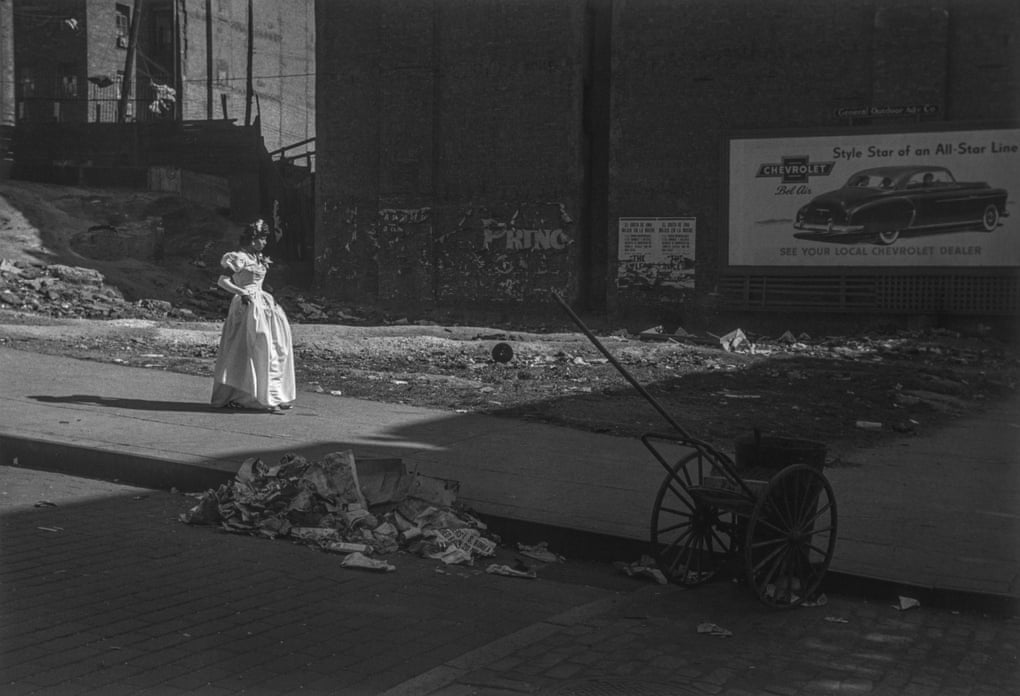
I was quite taken by this photo of Roy DeCarava’s “Graduation 1949” when I saw it this winter.

.

The Weary Blues  has another section that takes its title from one of Hughes’ best known poems “The Negro Speaks of Rivers.”   I was talking about this poem this morning to a fellow I sometimes meet in a café I ride to. I was saying this is a remarkable poem written by a 17 year old, one who literally crossed and looked at America’s Mississippi River on his way to New York City in furtherance of a compromise with his father on college education.**   Maybe this won’t seem remarkable to you, if you’re here already reading this far down about a poet who died in the last century, who wrote it generations back.

Hughes might have written about the exact details of his current life. He could have written about how he felt, what with the bargain he’d been forced to strike with his father. He was 17, and forming his own autonomous self is the task of any young person. His father probably didn’t know what the rest of the 20th century would be like for Langston, much less what we’d think of things now in the 21st. What would young Mr. Hughes have known? More, or less?

I was recently reading some jokes observing what are considered the perennial follies of youth. One of the zingers was “It’s best to hire young graduates while they still know everything.”  Queue the laugh track.

I don’t know if 17-year-old Langston Hughes thought he knew everything. I didn’t think so at that age myself. But as we consider why we might want to read or listen to poetry by long-dead poets, we might want to consider what Hughes’ poem asks us to consider: that we are the accumulations and results of our ancestors and neighbor’s ancestors. That doesn’t mean we are them, we are the sum on one side of the equals sign from a lot of figures to the left of it; and so the possible extensions, solutions, fulfillment and remediations of them.

That’s what’s remarkable about the young Mr. Hughes’ poem, its approachable impersonality and insistence on the distances yet salience of the past. It’s not “A Negro…” even, but “The Negro….”  In it, the current of the past is longer than any history of oppression, injustice, or any stories of conquest. Endurance yes, but beauty too. So, despite age-related-stereotypes, at 17 Mr. Hughes may not, and doesn’t have to, know everything — but it helps to know some things that came before you. Rivers flow. Rivers move. Langston Hughes wrote this moving to New York City — the place where he eventually lived most of his life, but not before changing what he did on the banks of another river.

That’s why we have Black History Month,*** and why I’m talking here to what I suspect is substantially a white audience about Hughes and that observance. Some of you may be nodding off by now, whatever color — “We know all this.” you may be muttering. Facts are not the soul, but poetry and music can speak of that.

I’ve always rather liked my electric guitar performance on my setting of “The Negro Speaks of Rivers”  that you can hear with the player gadget where seen below, or with this highlighted link.

.

*Yes, there wasn’t a word “flurious” until now. You are present at the creation!

**My original post on this poem has a longer summary of Langston Hughes’ family situation at the time he wrote this poem. In short, his father was adamant that instead of literature that Langston study engineering. Langston agreed, but then after trying to go along with his father’s wishes, he dropped out, shipped out to sea on merchant ships, and on return to the U. S. worked various lower-end jobs. I think of John Keats’ decision a hundred years before Langston Hughes’. Engineering and medical field students: I’m not suggesting poetry instead. Really, I’m not. Perhaps rather an and instead of or is best.

***It may not be coincidental, but one of the jobs Langston Hughes eventually had was a stint working with Carter Woodson, who first suggested an annual observance of Black history. So, all the more reason to focus on his work this February.

Lenox Avenue: Midnight, an extension

Here’s another early Langston Hughes poem from The Weary Blues,  his collection which I’ve chosen to focus on during this Black History Month. Given Hughes’ esteemed position as part of the Harlem Renaissance and the long career that followed, it may be hard to remember that this is a poem by a young man, less than 25 years old. Of course, as I reminded myself as I tried to write the best poetry I could as a young person: famous British poet John Keats died at 25 — so there’s no reason for our Afro-American poet to wait to write either.*

Though it was Langston Hughes’ first book, The Weary Blues  doesn’t make much of a point of his youth. While the perennial youthful topics of wine, love, and song make their appearances in this collection’s poems, there’s little if anything I can recall that makes explicit pleading that the author is of a new generation with new perceptions. The way Hughes did signal that was in the way he deals with the “song” part of that triumvirate: Jazz and Blues were still considered disreputable musics of little substance. The decade of the last Twenties may have been called “The Jazz Age,” but that then novel music was mostly the music to dance, drink, and swive to.

So, when Hughes claims right from the start that “The rhythm of life is a jazz rhythm” he’s making a fresh claim in 1926, that it’s not just some musical fad that’s passing through, a speeded-up frivolity. Even if white musicians and dancers were quick to latch onto the jaunty high-BPM rush of Jazz, Hughes is ready to claim that broken desires and pain were in there too.

Does he mean lovesick blues, or the Afro-American experience here when he makes that claim? Both I think. That’s a hella-reason why Afro-American forms pervade American music to this day: Americans as a whole have a long and strong dissatisfied streak. Plenty of musics sourced from around the world are good for dancing and signaling your erotic availability. Same for songs of utter sadness. But Afro-Americans figured out how to make sublime musics out of a combination of the oppressions and absurdities of life.

In his poem, Hughes twice makes the claim “The gods are laughing at us” — and despite the repetition of that line, he is ambiguous about what we should think of that. Are the gods the society that ignores, belittles, and oppresses? Or are the gods the wise eternals who know that we humans live short lives approaching half-knowledge, an absurdity that leaves laughing as wisdom?

I think at midnight — perhaps after some youthful partying that’s implied as preceding this poem — it’s a vibrating mixture of both. Overtones, undertones, Hughes says.

Move by Heidi Randen 800

Overtones, undertones….Jazz in Hughes’ 1926 was still thought of as a way to shake your groove thing.

.

I often mention that my experience of the poems I use for texts here often changes in the process of making them into Parlando Project pieces. With this one, as I began to understand and express Hughes’ words I wanted to reply to the laughing gods in the original poem. So, I extended the original words with my own couplet: “Let them hear the laugh I return. / Let them understand the laugh I return.” Is that laugh and desire to the wise gods or the careless and oppressing system? Both. I’m far from 25, and that’s what I think reading and performing the young Hughes’ poem today.

Music in this piece is about as close as I can get to Jazz, though more of the Jazz of my youth than that of Hughes’ time. Yes, that fad was still going concern 40 years after Langston Hughes wrote his poem. I spent most of my time creating the piano part, which unlike a real pianist I have to compose by playing and selecting parts for each hand, but modern “virtual instruments” let me do stuff that Conlon Nancarrow had to hand-punch into player piano rolls to realize. I wanted a saxophone part too, but as I’ve already mentioned this winter, I can’t really get the articulations a good Jazz sax player relies on. My sax part sounded like an early student playing the most dismal society dance band number, and so I made the compromise I normally avoid and put in a short Gil Evans-ish horn section sample to enclose my sax part effectively.

You can hear Langston Hughes’ “Lenox Avenue: Midnight”  and my extension to it with the player gadget below, if you see one — or this highlighted link which will open a new tab to play it.

.

*Lesser-known early 20th century Afro-American poet Anne Spencer made the same point eulogizing Paul Lawrence Dunbar with her short poem.

The Weary Blues (demo version)

This will be a short post. The last day here has not been a good day for thinking of this project and my planned series from Langston Hughes’ first book The Weary Blues.  I’d intended to do a version of that book’s title poem, I’d even begun to collect some ideas in my head: different sections, different instrumentation for those sections — a fancier, fuller arrangement than I’ve had time to do this year.

Wednesday morning a young man got killed in a police raid in my town, never a good thing, but something that frankly has a lot of possible contexts. Since then we still don’t know everything, maybe not even enough yet — and yet here I am tempted to write something about that: that it’s a horrible act, stinking of systematic issues that existed long before that 7 A.M. no-knock raid, things that go beyond the specifics of the Black man killed; and a (likely white) cop shooter whose job it was to go, for us, inside a stranger’s door, apparently looking for a murderer and ending in a new killing.

If you’re not in our local area, you probably haven’t even heard of this. Apparently, this is an aberration that isn’t shocking or novel enough now. This is not a public policy or political information project, others will serve you if you feel in need of that.

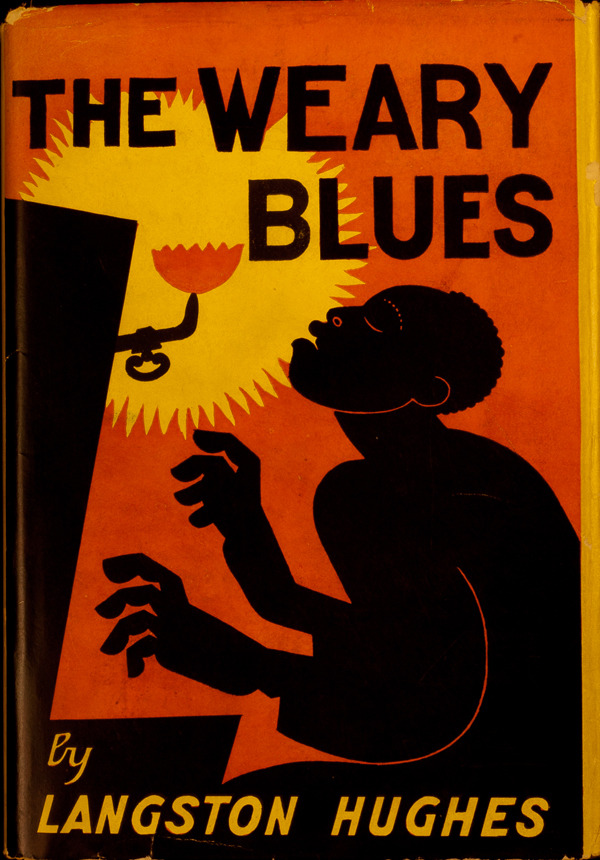
Cover of the original 1926 edition of The Weary Blues

.

Still, I’m deeply ambivalent today about my chosen project. When Langston Hughes wrote “The Weary Blues”  in the last Twenties, almost a hundred years ago, racism, ignorance, prejudice, injustice, class-caste system — all were old enough to be blues one could be weary of. So now so, more weary so — and we’re alive to feel’em. Perhaps I’ll write more this weekend, but I was feeling our current hurt today, and less any release of joy or the blessings of overcoming.

Instead of fully realized version of Hughes’ “The Weary Blues,”  what I’ll offer today is more like a quick demo: a beat, a guitar playing simple chords. When I finished laying it down, and with no more than a couple of minutes until I had to get off mic in my studio space, I started to riff on a variation adapted from another song, and I left a couple of lines of that in the fade out. That secondary song takes off from “I’d Rather Go Blind,”  a song about love gone bad, where the heartbroken singer declares they wish they were blind so they wouldn’t see their unfaithful lover. In my variation, we ourselves must ask, heartbroken at things we don’t want to see: do we want to go blind? Is that what we want, would prefer? To just not see the hurt?

Player gadget below for some to hear my sketchy demo of Langston Hughes’ “The Weary Blues”,  or this highlighted link for those who can’t see that.

.

To Midnight Nan at Leroy’s

It’s Black History Month, and I’m planning on presenting a series focusing on Langston Hughes’ first poetry collection: The Weary Blues — but before we get to today’s new Hughes’ piece, let me briefly set down a few reasons for why Langston Hughes.

This project presents early Modernist poets most often. From the American predecessors of Modernism (Whitman, Dickinson) we often jump to those of the 1905-1926 era who sought in various ways to “make it new.” While I continue to read and have interest in post-1926 work, less of that can be reused freely for this project. This reduces the Afro-American sources free to use, as the beginnings of the Harlem Renaissance have moved into Public Domain slowly, year by year, since this project began in 2016. My earlier Hughes’ pieces, even if they were eventually included in The Weary Blues,  were published earlier and so had already moved into PD. It’s only on January 2022 that the whole book’s contents moved to public domain.

The Weary Blues cover 1024

Our February focus: Langston Hughes’ first book.

.

A second reason: look at the title of Hughes’ first book, it includes “Blues.”  As we celebrate Afro-American contributions and experience this month there’s an important parallel here. Americans, some of whom set up shop in England and France before WWI, are hugely important in establishing the Modernist break with the shopworn 19th century writing styles. At the same time, Afro-Americans were crucial in doing the same job for music. As I tried to briefly explain last Black History Month, a great deal of the American Black intelligentsia was caught flat-footed by this musical revolution happening around and by them.*

Let’s cut them some slack on that: cultural change is hard to understand while it’s happening, and the quick white adaptation of Afro-American musical ideas in The Jazz Age of the previous Twenties reflected back to the Black community some rough or even derogatory approximations of what was really going on.

Hughes was a young man when he wrote today’s poem. He’d crossed paths with Black intellectuals by then, but he wasn’t fully one of them. His father had cut a bargain for him to go to Columbia to become a professional. Langston skipped out, worked as a cook and at other restaurant jobs; and took to sea working on merchant ships. Hughes came quickly to an understanding of this new music, it’s complexities and its reflections.

Lastly, here’s one of the things I’ve come to understand about the beginning of Modernist poetry in English: there were substantial elements there that sought to strip back poetry, to simplify it to its essence, to make it immediate to an open heart and mind without pre-requisites. This mode was eventually superseded by a more academic and allusive poetry to the degree that some of the best of this early poetic Modernism was set aside or down-rated as simplistic and insufficient.

Over the years you’ve heard me sing the praises of Carl Sandburg, who seems to have been eventually excused away as cornball. But Sandburg was still vital to the young Langston Hughes in the 1920s, and Hughes took Sandburg’s Midwestern American Modernism and applied it to his own heritage and experience. The mainstream of Afro-American poetry retained more of the vitality and working-class connection that Sandburg expressed. Thank you, Afro-Americans.

Let’s move onto the poem I used as today’s text for the performance you’ll be able to hear below. “To Midnight Nan at Leroy’s”  is not one of Hughes’ best-known works, though it deserves more attention. Here’s a link to the text. You could skim through it on the page and see the Blues connection, even if it’s not a Blues stanza as printed — though it could be refitted as one — but more importantly, it’s got a Blues sensibility. My reading of the poem says there may be a little playing going on, a little con and double consciousness which the whole of the work will show up. This will let the hip listener say on hearing it “Yeah, you and I know what that’s like.” That’s Blues sensibility.

I think the poem is a dialog. Nan of the title is performing at a club, and she’s expressing some eroticism in her performance. I think the poem’s other voice is hitting on Nan. The opening stanza is that other voice, the un-named man, who’s starts out teasingly acknowledging that he’s getting what she’s putting down.

The second stanza could be either voice. I performed it neutral, even as if it might be a narrator, a third voice. Note the loaded word “jungle” in it, one of the “primitive” adjectives used to describe this new Afro-American art. Primitive isn’t totally a derogatory or diminutive to the Modernists, who remember wanted to remove the cruft of a worn-out culture and get back to an essence; but in the context of a white-supremacist-soaked society it could surely slide over to being that. Black artists with intact self-respect did use labels such as “Jungle” in the 1920s, so it’s not simply an external white appellation, but it sure sounds like they’re partially reflecting with the white culture when they do. Pause at the last line: I hear Hughes’ “And the moon was white” with intent.

The third stanza is the man cheering on the singer/performer Nan, and I think also he’s suggesting that if “lovin’” is her object, he’s ready.

Fourth? Yes, the two get together. I perform this as Nan’s voice. Note Nan’s use of the diminutive “boy” for the man in this part of our dialog. He may have been acting the player in his earlier stanzas, but I think this is an intentional reveal that the male character is less than a fully actualized man. The white moon image returns, and their moments of Black joy contrast against it. One could write a moving essay on this poems white moon image, but I’ve already gone long.**  You write it.

The poem concludes by refraining the entire first stanza. I perform in the man’s voice, now sour-grapes-ing the couples’ night. Who put one over on the other in this one-night? Maybe some of both, and maybe external social forces are part of the fate-mix too. Hughes chose to dedicate the poem to Nan, so I suspect his sympathies lie more with her. Another question: is Langston Hughes the unnamed male voice? Hughes’ sexuality is mysterious, and while that’s possible, my estimate is that he’s observing, not writing a poem as memoir here.

I performed “To Midnight Nan at Leroy’s”  with my own one-man-band providing the trio accompaniment, and I hope your speakers can handle the bass part. Some of you will see a graphical player gadget below, but other ways of reading this blog won’t show it, so here too is a highlighted hyperlink  to play it.

.

*Last years Black History Month book was 1925’s The New Negro , which included an essay worrying about the dilution of Black uplift and culture from the diversion of frivolous Jazz. Read my post on that essay here.

**As with Sandburg’s short poems, with Langston Hughes here it may help to imagine that you are translating this from Tang dynasty Chinese. The plain English words here could mislead us to think this a mere rote moon/June thing and that Hughes had nothing complex to say.

Sonny Rollins, The Bridge, 1959

I’ve got reasons for kicking off Black History Month a few days early: my February is going to be appointment-filled, something that’s likely to reduce new work for this project, and I want to participate in this observance of American history.

Why was I so determined to do this? Well, note this project’s subtitle: “Where Music and Words Meet.” I’m an American composer, and American music is disproportionally Afro-American music. Yeah, it’s a big country, and many musicians with heritages from every continent*  have contributed, but if you compose or play American music, a lot of the notes are Black. So let’s get to today’s piece through three short, linked, tales.

The First Story:

Who’s this Sonny Rollins, and what bridge is he selling us back in the Fifties of all decades? It’s easy writing about poetry as I do here most often, to get used to a constrained fame; but I suspect more of the general Internet audience will know Emily Dickinson, William Butler Yeats, or T. S. Eliot than know this man’s name and work. Mid 20th Century Americans, most often Black Americans, made a consolidated point of becoming masters of improvisation on the saxophone. Afterwards artistic accountants rank art and artists — and even if you think that’s wrong-headed, I’ll cite those who expend sincere effort in doing that and say that lists of great improvising saxophone players likely include Sonny Rollins.

But, just saying Rollins was good at it, a skilled musician, reduces him. For one thing, he had a dedication to the art of his craft, a need to expand the expression. So much so he famously spent a couple of years or so just dropping out of what was then still a viable commercial niche of jazz gigs and recording when he was considered to be one of the best and brightest on his instrument. To do what? To get better.

Insiders later learned some particulars of what he did. He went to a near deserted deck of a busy urban bridge and just played. And played. For months. For hours a day. In all kinds of weather. No, he wasn’t busking for spare change. Few noticed him. One of his records before this time was called Saxophone Colossus.  This wasn’t ironic as a title, or laughable, or a piece of hopeless self-promotion. Once likened to a metal giant who could stride rivers, Rollins on the bridge was small and alone and unnoticed, one man in a wind-gap of a city’s gusts. Practicing there he was no more than a flea on the back of a colossus.

After around two years of this, he figured he found some of his new/better. If you’re writing a screenplay you know how the final scene plays out. Our hero walks off the bridge and into a recording studio. A selection of ominous natterers remind us of the stakes in quick cuts: “Was he kicking drugs, or failing to kick? Is he washed up?” “You know folks like it sweet and tropical, he should try to play bossa nova.” The next voice says, “Funky jazz is the thing.” And another says, “How can you be even more free than ‘free jazz?”

And you know the next beat in your screenplay: he emerges with a record or a concert or both — and all of a sudden everyone realizes that he’s found it, something great, unique, ground-breaking, resplendent and recognized.

Wait, you don’t know who Sonny Rollins is — or maybe you do, but you know the person next to you on the Internet doesn’t. The record that Rollins did make was called The Bridge  in honor of the solitary workshopping he did over the East River. It was not a cultural event. Throw out your screenplay, the elevator doesn’t want your pitch. Even the experts then, the artistic accountants and grim critic-coroners were underwhelmed. Paging the Joseph Campbell who isn’t  an under-recognized Irish poet, this is The Hero’s Journey that ends with a shrug.**

The Second Story.

Back in my youth you paid for music ala carte. Every bit you could access at will was on a material disk you had to pay for. A person like myself with more time and adventure than money might scrounge. One thing I liked to do was to go into charity and second-hand shops and look for used records that attracted me. I can’t recall the exact cost of a new LP then, but I think it was around $3 to $4 or so. Records in these dingy shops might be a dime or 25 cents. Those within cardboard covers gave you extra material to judge if it was worth your widow’s mite — but at those places and time, the most forlorn records were just bare black disks scuffing against each other in a bin, and sometimes those got an additional price break. Whenever I recall those naked disks, I think of those who cleaned up after someone died or skipped rent and town, who just shoveled it all off to Goodwill or the Salvation Army in whatever, Warholian, cardboard boxes.

That’s where I found Sonny Rollins’ The Bridge.  I may have heard a bit about Rollins, how he was a particularly good improvisor because his improvisations had the logic of more considered compositions while retaining the flow of fresh idea after fresh idea.

Three things struck me about the record upon listening to it over and over and under its scratches and surface noise: that it mixed moods more than most jazz records. It wasn’t just a fast blowing session with a change of pace ballad or two, but that it was both angular and spare and hauntingly beautiful in both sorrow and joy.**  That the guitar player, Jim Hall, on the record didn’t sound like “jazz guitar” as I had heard it then.***  Instead, Hall added unusual harmonic colors that Rollins would then carve from. Eventually I realized something else unusual about the record as I compared it to more jazz records: there was no piano or other keyboard instrument. I eventually learned that this was something Rollins’ made a practice of. Yes, Hall was giving pieces some harmonic framework, and bass players in non free Jazz contexts are often asked to, and then, play “the changes” indicating the chords; but keyboard players, even if it’s not their session, often dominate the harmonic and rhythmic structure of a track. Here there was none of that.

Poetry in Gray. I know this is a long post, and I value your time, but here’s 30 minutes of the same group that recorded The Bridge playing live with a short interview with the 32 year old Rollins.

.

The Third Story

I read this week an article by John Fordham in the Guardian  that reminded me that Sonny Rollins went into the studio to start recording The Bridge on January 30th in 1962 — so, 60 years ago. Fordham remarked on the legend of Rollins’ time on the Williamsburg Bridge along with a new interview he did with Rollins.

Unlike almost every one of his mid-century saxophone contemporaries, Rollins is still alive. He’s 91 years old now, and I last saw him play when he was around 80. Rollins was performing in a trio on that night with just bass and drums, and for about an hour he tore it up covering so much sonic space with his monophonic but powerful instrument. I marveled then, and now that I’m approaching his age at that gig, my amazement increases. Rollins developed lung disease and can no longer play, but he seems to have retained his composer as improvisor ability to see the patterns and connections.

This month I’ve been trying to build up a little strength and chops on guitar again. Nothing like Rollins’ multiple hours each day on a bridge level of woodshedding, but enough so that I can play that instrument that requires some physicality to realize its sounds.

In the midst of this, in the middle of the night, I awoke with some thoughts I had been growing about Rollins and the task of being an American and Afro-American artist. I wrote a complete first draft of today’s text in that middle night awaking. Not quite a Kubla Khan  dream, but still complete and formed enough to count today’s text as an improvisation. Wednesday, I came up with the song’s harmonic structure equally quickly. Yesterday I recorded it. Given that I’ve no access to other musicians — and I hardly make count-one-musician unless I beg the composer (who’s me, so I listen) to make things I can play — I had to play a track at a time. Today’s recording is a trio: drums and two guitar parts. I first recorded the chordal guitar part on a big archtop guitar (DeArmond X-155) along with the vocal. I’m no Jim Hall, but like Rollins’ The Bridge  I let that instrument set the harmonic framework. I confess (though listeners have already convicted me) I’m not good at Jazz comping, a key guitarist’s skill in that genre. I pardoned myself and proceeded. I then did the drums, trying very hard to get them to play off the guitar’s rhythm feel. And then finally as my studio-space time was coming to a close, I got to “blow” with guitar for the lead part.****  I did four passes, and the third was the best, and there you are. No, it doesn’t sound like The Bridge  LP, but then the point of The Bridge  wasn’t to sound like what went before either. The player gadget to hear it is below. No gadget? This highlighted hyperlink will also play it.

.

*I must pedantically interrupt in footnote form to note that the continent of Antarctica has done little for American musical culture! It may be because our human species only visits there? One man, one guitarist at that, stands (sinks?) as the submariner of Antarctic-American guitar: Henry Kaiser. Here’s a 90 minute example.  Yes, that’s him playing guitar, and doing the under-ice diving too.

**Joy? “Without a Song. ” Sorrow? “God Bless the Child.”  Angular? The title cut’s cascade of heterodox melodic ideas. Or the stubborn “John S.”   I used to share a workspace with a 20-something guy who liked his progressive metal. He was perfectly tolerant of my King Crimson live tour ‘70s tapes. But the opening riff of “Jon S.”  would drive him right around the bend to a burlesqued old-person-like rant about “take off that noise.”

***Jazz guitar at that time was represented to me by John McLaughlin in his Mahavishnu Orchestra years and others exploring that bag. Those guitarists were loud and very in your melted-face with their expression. Even quieter, older generation jazz guitarists often played more notes in one song than Jim Hall played on the entire The Bridge  LP. Magazines would have “best of” polls back then for musicians, and I’d always vote for Jim Hall, who’d end up in the fine print of “those also receiving votes.” Then strangely enough as the 20th century started to end, Jim Hall became the model for a number of other guitarists who came up later, for example: Pat Metheny and Bill Frisell.

The Bridge itself has come to be recognized as more vital in retrospect. Oh, not necessarily to the raters who will need to get numbers down for Kind of Blue, A Love Supreme, The Shape of Jazz to Come  first, but to those who seek to learn new pleasures listening to music whose time has passed but whose timelessness remains. You may not like all of it if you just taste test it. Looking today, about eight times more Spotify listeners pleasantly listen to “God Bless the Child”  than dig “John S.”   By the way, the version on Spotify seems to be remastered, and to my memory Jim Hall’s parts are mixed up higher than they were in my vinyl memories.

****Should it have been saxophone? Yes, but I have a hard time wrangling any of my saxophone MIDI virtual instruments to get good expression, and Rollins is a master of saxophone expression. I stuck with my primary instrument for the lead instead. By the way, it’s the same jumbo DeArmond archtop that chopped the chords, but my little combo amp is turned up.

Letting Go the Wolves: I praise Ethna’s wolves

I’ve promised one more piece using texts taken from Irish-American poet Ethna McKiernan, and here it is. There are a couple of reasons why I left this one to the end of this series memorializing her work. The first reason: the poem’s persona seems to speak of her approaching death. The second reason: I don’t know if McKiernan actually liked or rated it as highly as I do. Let me make this plain at the start: I think this is a great poem, and I’ll go into why in just a bit.

I believe I encountered “Wolves”  at the same writer’s group where I heard other work Ethna was working on in draft form.*  These things make my performance today particularly fraught with issues. I only take this step of releasing this performance today because of my admiration for the poem, and my feeling that some out there in the rare and appreciated audience for this Project will welcome it. “Wolves”  has what poetry often hopes for: it is beautiful and yet harrowing, and its experience is vivid while not guarded inside defined borders.

I hear the snow crust crack
into spider-fine antenna lines
with every thudded footbeat. It is so still
that their light scratch of nails on ice
rasps the air like flakes of metal filings.

Let’s grab this text as it grabbed me, even on first hearing, with the opening statement: “I hear the snow crust crack / into spider-fine antenna lines…” The meter has a lope of accents that appeals, the internal rhyme of “fine” and “lines” separated by the chime of the assonant “antenna.” The three strong accents together in “snow crust crack” which allow “crust” to not get the full stress it would normally get appeals and announces. “…with every thudded footbeat. It is so still / that their light scratch of nails on ice / rasps the air like flakes of metal filings.” follows — and if you’re not captured yet by this poem’s story, I can’t think of what language can do to do that.

This opening almost registers as synesthesia, as the sense invoking words rush in. “Snow-crust crack” is visual and auditory together — and for a winter clime resident, you feel that texture in your own feet too. Besides the word-music the visual of “spider-fine antenna lines” has the sense of the spreading broadcast of the wolves’ approach. The ordinary snow-surface footfall of a “thudded footbeat” made by the furry pads of the wolf would be only present in an unnatural silence — and then the quiet but more plausibly audible sound of talons on ice. The shivers of it, nails on blackboard-like, invokes the winter.

ice pond

Listen carefully for those claws on the ice.

.

I could go on, but I think any listener who is pulled in by this opening will sense equally strong lines and images as McKiernan’s poem proceeds. The creative writers in my audience may benefit from analyzing for themselves why they work their attraction on us. There’s an overall effect of intimacy with nature in the midst of this poem: not a passive, uncomplicated, and easily beautiful nature, but one close enough to be (prematurely) incorporated with the poem’s speaker.

The cave mentioned in the poem means that this is almost certainly a persona poem. The voice we hear telling this story is not the literal biography of a modern Irish-American woman who normally lived in cities, yet the astonishingly vivid images lets us doubt this just enough to not judge that outright. Even the most personal and revealing poetry can benefit from real and fantastical lies.

I’ll not explicate the ending outright, for I want you to experience it in the course of the poem’s story. I’ll only say that it could possibly be why McKiernan did not select this poem for wider distribution while she lived. “Twist endings” can cloy or leave a reader/listener feeling tricked, but my judgement says this one only enriches what’s sensed as the description of the poem’s scene has unfolded. Like many a good ending of a great short poem, it may make us want to read/listen to it again immediately.

Before I direct you to my performance of Ethna McKIernan’s masterful “Wolves,”  I’ll leave you with one thought the context of this poem leaves with me beyond the poem’s own effects: what might your art do that you don’t necessarily realize that it can do? For it’s a mystery to me why this wasn’t in a final selected poems. The poem seems to me to be fearless and exact, but the self-editor may have been frightened or dissatisfied.**

A player gadget to play this performance appears below in some ways this blog is read. Others will need to use this highlighted hyperlink to hear it.

.

*Just before I published this post I thought to do a final string-search for the opening lines of this poem — and found that it had indeed been published in The Poetry Ireland Review  of January 1984! This published version uses exactly the text used for this performance, and you can find that text via this online link. That publication date is much earlier than I would have expected it to be. Did I somehow run across it — not as a draft as I recalled inside the Lake Street Writer’s Group — but in a publication that might have been shared with the group?

On publication it was titled “Letting Go the Wolves.”   I had recorded the performance you can hear above  a decade ago thinking the title was only “Wolves.”

Did McKiernan feel it was too immature a work when making final judgements for her final “New &Selected” collection Light Rolling Slowly Backwards  compiled a few months before her death? I don’t judge it so.

**Another, if unlikely, possibility: Ethna may not have secured rights to secondary publication, though the grant of such is traditional within small-press poetry. As much as the wolves in the poem, I may be clambering on top of thin ice in presenting this poem, even though I only want to point out its value. If I haven’t made it clear recently: The Parlando Project is not even a non-profit organization — it’s a no-profit organization.

Oh, Maria

Here’s my performance of another poem from Irish-American poet Ethna McKiernan’s final collection Light Rolling Slowly Backwards.  In McKiernan’s later years of life she did social work with people who were homeless, and she dedicated Light Rolling Slowly Backwards  to “the hundreds of homeless clients I’ve worked with through the years — to their resilience, courage and care for each other.” Given that Ethna was somewhat frail even before her final illness, I marveled at her strength in taking that work on.

I recommend this collection, a fine summation of McKiernan’s poetry and its range. Here’s that link again to the Irish publisher of this book.

Why this one to start reading McKiernan? She herself created this “New & Selected Poems” book before she died late last year.

.

When I first encountered “Oh, Maria”  in draft form as a member of the Lake Street Writers’ Group I couldn’t help but flashback to my time working in Emergency Departments as a young man. As one side-point Ethna’s poem tries to convey the feeling of being next to someone experiencing a sudden, and unexpected death. I’d summarize those memories of mine as being full of intense experience, intent action, and if stabilization isn’t achieved, a solemn ceasing. Ethna’s account adds poignancy because it’s missing that middle part. I ached with her both as she feels guilt for not immediately recognizing the mortal nature of Maria’s incident — and then comes the line as she considers if she should have performed CPR: “If I remembered, God help me, how.”

I probably did my usual awkwardness in responding to that first hearing, perhaps mentioning how it reminded me of my experiences — something which was likely no help in her revision process. I think I did express that her missing the initial diagnosis of what was happening was not only forgivable, but par for the course. Could that have been worthwhile?

Indeed, my experience was that most people, even people who are otherwise medically trained, are likely to get this wrong in some way. Although my experience is now decades ago, I’ve seen CPR being performed on breathing people with a pulse — which is not a good thing. And effective CPR requires a degree of skill and frankly cold intent that is hard to practice outside of repeated actual events. Given that I last worked in an Emergency Department more than 30 years ago, and last went through the practice-with-dummies certification around a dozen years ago, I myself would likely not be the best person to be next to you if you were to experience a cardiac arrest.

If you ever take, or have taken CPR training, pay attention to that first step of assessment.   It’s important.*

So, besides the imperfectly empathic personal reaction I had, this poem’s core matter is Ethna’s continued sharing of the experience of those without homes, which exceeds even my old ER experience with our un or underhoused “regulars.” Notice the subtle point Ethna weaves into this poem: she expects that Maria is severely intoxicated when she collapses, and then she concludes her memories of this person dealing with complex problems imperfectly in the telling line “I laughed at your antics weekly.” What were the antics? Maria might have had a sense of humor, that could be part of it. It’s also possible, even probable, that Maria’s human attempts to deal with the difficult state of homelessness and its context were at times comically imperfect or ineffective.**   Ethna knows this from her intimacy with Maria, just as you know it with those you have in your lives. Intimacy isn’t just the experience of joyous connection, it’s the experience of our misapprehensions too.

Same with poetry. We write it imperfectly, read it imperfectly. That is part of our human experience of it.

To hear my performance of Ethna McKiernan’s “Oh, Maria”  you can use a player gadget if you see it below, or this highlighted hyperlink which will work if you don’t see the player.

.

*Several decades ago a book called The House of God  by Samuel Shem was written that was like unto a modern Machiavelli’s The Prince,  only about practical hospital medical training instead of statecraft. In Shem’s book there is a list of “laws,” one of which is “At a cardiac arrest, the first procedure is to take your own pulse.”

**Dealing with homelessness either as one who has reached that state or, as McKiernan did, as someone trying to mitigate it, is much more difficult than dealing with cardiac arrest. In my couple of decades in Emergency Rooms, I’ll admit that in the course of a shift or two dealing with intractable problems and complexly impossible situations, the “break” of dealing with a crash-cart severe trauma case or a cardiac arrest with their steps of immediate choose/act instants was, strange as it might seem, a relief.