I can’t help it — actually I do try to help it, but sometimes I can’t. I was in a movie with my wife, the polemical Emily Dickinson biopic Wild Nights with Emily,* and they introduced Thomas W. Higginson as this nincompoop who couldn’t discern the poetic genius of Dickinson compared to the kind of poetry he preferred. For an example of the latter, the filmmakers briefly gave us Helen Hunt Jackson as a prim, forgettable, mediocrity.
I nudged my wife, “Jackson was better than that” I murmured.
This is what happens when you’re married to someone who likes to look in the odd, unswept-out corners of poetry’s storage shed. Jackson was a childhood classmate of Emily Dickinson. Jackson left for marriage to a brilliant engineer, who Emily then met and sorta-kinda-maybe had a crush on. Jackson’s husband was killed in an explosion working on a secret torpedo weapon during the Civil War, and widow-Jackson went on to a substantial literary career of her own with poems, novels, and early activism for Native American rights.
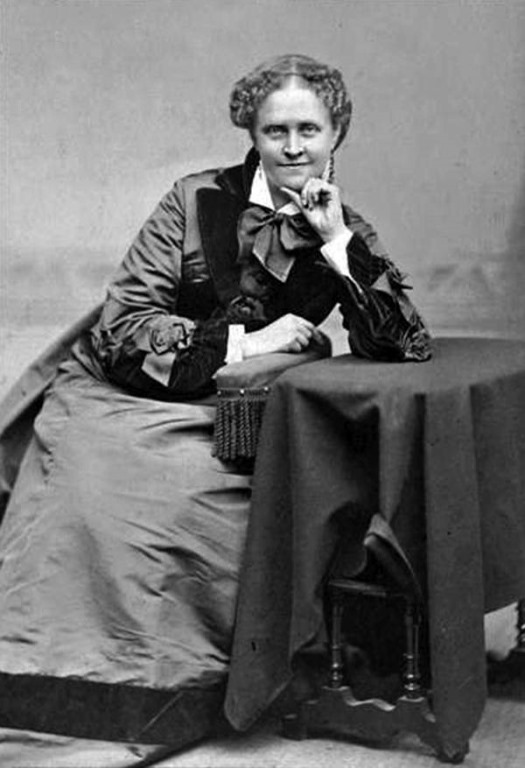
mid-19th century photographs often conceal their subject’s personality, which makes this one of Helen Hunt Jackson a bit special I think.
.
No, she’s not as original as Emily Dickinson, but the congress of poets who could claim that level is small even now. She understood Dickenson’s worth enough to plead with her childhood friend to publish — and though it appeared anonymously, she did include the only Dickinson poem to be published between hard-covers during Emily’s lifetime within an international anthology she produced.
One part of Jackson’s poetry that can be found online is a sonnet series on the months of the year. A couple of years ago I presented her August sonnet, and this summer I’m ready to give you her July sonnet.
Like Dickinson, these poems include a close examination of nature, though I don’t sense here the notes of humor often found in Dickinson’s nature. In Jackson’s July example, the flowers mentioned are in danger from heat and drought, something that seems contemporary in my own midwestern summer. Only the poem’s water lily seems immune from the danger.
You can hear my musical performance of Helen Hunt Jackson’s “July” with the audio player gadget below. Don’t see the player? This highlighted link will open a new tab with a player for you. Want to see the text of the poem? Here’s a link to that too.
.
*Released between the more scrupulous A Quiet Passion and the joyously anachronistic Apple TV series Dickinson, Wild Nights with Emily was the less fully realized, perhaps due to a lower budget. Its broad characterizations were intended in the service of satiric exaggeration. The film’s central point is to portray the often-suspected erotic bond between Dickinson and another childhood friend and confidant, Susan Gilbert.


Hi, Frank,
Thank you for introducing me to Helen Hunt Jackson’s sonnets. As my Ohio garden blooms shrivel, the pond vegetation indeed remains lush. I’ll take a walk today to appreciate the lily pads.
As usual, your post launched me on an exploration of poets, and poetry, new to me. And those poems open my eyes afresh to the world around me.
Best, Andrew
LikeLiked by 2 people
Yes on Jackson! I’ve long hesitated to watch Wild Nights–was it engaging in any way, or entirely irritating?
LikeLiked by 1 person
I haven’t revisited “Wild Nights with Emily” since I saw in on its first run, and I don’t want to be too tough on the film. I believe it was adapted from a cabaret or small theater show and the resulting film was clearly done on an indie budget. Its goal is to make some corrective points. Among them: that Mable Loomis Todd was a bit strange and had her own agenda, and that Susan Gilbert and Emily were lovers.
Neither of those points are far off from mainstream of current Dickinson studies from what I know of that field, but the original material may date from when those were newer ideas — and besides most movie or theater goers, or even admiring readers of Dickinson’s poetry will have no idea of those things. The film wants to make those points while mixing a tone of satire with para-reality scenes of a few of the poems being read, and then too some genuinely moving scenes. I recall the scene near the end when Susan is charged with washing and readying Emily’s body after her death as being especially moving. And that is a historically accurate scene. She actually was granted that task.
I can imagine the makers of the film over drinks frankly expressing gripes they were doing what the Apple TV series Dickinson was doing before that series was launched. Yes, they both sometimes use an imaginative modern eye and understanding to frame and present what may be essentially true about Dickinson. But the TV show had the budget, time, and whatever to do that more elaborately. I had more belly laughs watching the Apple TV Dickinson. The TV show pilloried Thoreau and Louisa Alcott hilariously in one episode, and I who can admire Thoreau didn’t mind.
In the end, I want to understand the 19th century people better. The early Modernists I like to present were almost all born in the 19th century. I grew up when many of them were still living. I can’t avoid looking at them knowing what we know now, but even with folks like T W Higginson and H H Jackson, and maybe even M L Todd — nearly as much as a genius like Emily Dickinson — I want to understand (as best I can) what they knew as they made their choices and images.
LikeLike