The Parlando Project combines various words (usually poetry) with music as varied as I can make it. When I planned the Parlando Project I did not intend to post detailed examinations of the poems’ meanings.
After all, I thought, listening to music is a sensuous experience, and poetry, as it is musical speech, also has its impact when hearing it, independent of any final meaning one could extract from it. Of course, assuming the poetry is in one’s own language, it’s nearly impossible to escape meaning if one allows oneself to listen at all. Some words and phrases will mean something, even on first hearing, even with the most confusing and difficult poetry.
In the end, we may experience a difficult or elusive poem as if it was a set of flat-pack furniture, or a jigsaw puzzle, or as one of those plastic model kits that I bought and glued together in my youth. But in those cases, a wordless black and white sheet with numbers and pointed arrows inside the carton tells you this is to be assembled as a dresser or end table, and the puzzle or model kit has the beautiful color picture on the box top that tells you the pieces’ assembled meaning.
With a poem like Emily Dickinson’s “There’s a Certain Slant of Light” there is no picture of it complete, there are no assembly instructions. If you try to put it together, you may feel there are pieces missing.
The pieces, though, are beautiful, even left unconnected, even if we don’t know what the whole is to be. Slanted light on a winter’s afternoon with a heft like music. Shadows holding their breath. Heavenly hurt without a scar.
See Emily play?
There’s no harm in going to the bottom of this post and using the player to hear my performance of “There’s A Certain Slant of Light” without reading the rest of this. There will be no test. There’s no correct answer. You never need to put down your pencil and close your test booklet. Dickinson didn’t write about what she intended with this poem, and intelligent readers have differed in what they found there. Some found an end-table, others a fine art painting, others a plastic 1940 Ford sedan built one of three ways. Some listeners will just enjoy the pieces. There’s a little piano motif I play in it: A, B, C, E ascending and then back to A again. What does that mean? It’s an arpeggiated A minor (add 9) chord, or it’s just a series of notes that sound “meaningful” in sequence without knowing the harmony.
It could look like this after you put it together
Here’s that player to hear my performance of Emily Dickinson’s “A Certain Slant of Light.” No assembly required.
Once more I’m going with a fresh translation for today’s words. And once more, they’re from the French, as I take on Pierre Reverdy’s “Clair Hiver” in English as “Clear Winter.” Unlike my last French translation, Apollinaire’s “Mirabeau Bridge,” this one hasn’t already been translated a dozen times, though the one translation I could find was by no less than John Ashbery, so I’m still a bit audacious in taking my swing at this.
Like Apollinaire or Tristan Tzara, Reverdy’s work isn’t well-known in English, but even more than those two Paris contemporaries of his, he’s been acknowledged as a substantial influence on post-WWII American poetry. Reverdy’s been studied, cited as an influence, and translated by Ashbery, Kenneth Rexroth, and Rod Padgett. Others connected with the 20th Century “New York School” of poetry were inspired by his work too.
Indeed, it’s through Frank O’Hara that Reverdy’s name may be best known in English, for as O’Hara took his famous summer stroll in Manhattan in the lines of his poem “A Step Away from Them,” he takes care to mention that “My heart is in my pocket, it is / ”Poems by Pierre Reverdy.”
My Heart is in my pocket, it is
“Poems by Pierre Reverdy”
When Pierre Reverdy died in 1960, Ashbery asked O’Hara if he had any poems to contribute to a memorial issue of a magazine he was curating. O’Hara replied, deferring, “I just couldn’t stand the amount of work it would seem to take, since the minute you mentioned it I decided that everything I’ve written…has been under his influence.”
I used that O’Hara connection as my entry point into Reverdy and to my translation of “Clear Winter.” Unlike Ashbery, I’m not a French speaker, and my high school French classes have long worn off—but O’Hara’s voice in English is somewhat ingrained in me, and so I used that as a guide as I completed my Reverdy translation.
But now I’m not so sure that was the right choice. Reading a trenchant analysis of Reverdy by Kenneth Rexroth, I may have overdetermined the images in my first translation of Reverdy—but for better or worse, this is my tendency as a translator. I try to sense in the foreign language the experience the poem speaks of, and then to vivify those sensations and thoughts I find in that examination into English. That often takes the form of using clear idiomatic, contemporary English to sharpen those images. Often in this process, I’ll take imaginative leaps into the poet’s intent—and, well, sometimes when one steps boldly into what one thinks is a pool of light in the darkness, it turns out to be a large pothole filled with ditch-water instead.
If my suppositions are mistakes, perhaps they are at least vivid mistakes.
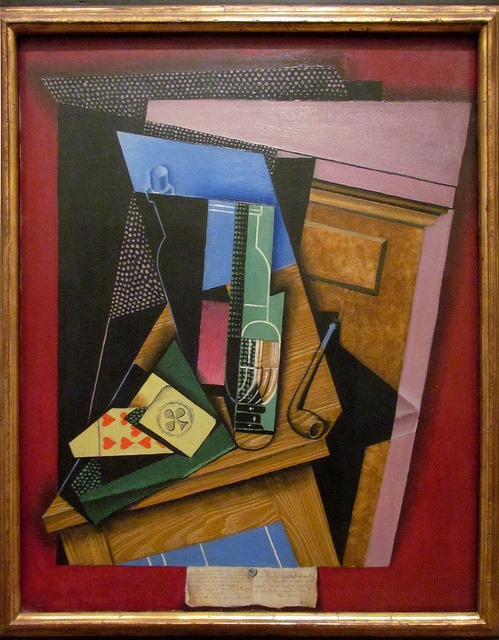
Post-It Notes™ go Cubist? Juan Gris’ “Still Life with Poem.”
And that poem is by his friend and collaborator, Pierre Reverdy.
Reverdy, like Apollinaire, has been called a cubist poet, and like Apollinaire he knew many of the painters who formed that faceted multi-perspective style in the Paris of the first part of the 20th Century. As the style developed, found objects such as newspaper, tickets, and wallpaper were pasted into the paintings. To reflect this musically this piece uses some various audio loops for melodic elements—something I don’t usually do. This is my attempt to make the sound of the cubist ethos of juxtaposed perspectives. That the loops should be unlike, yet somehow hang together, was the aim, and their repetitive nature is the analog to the cubist geometric forms.
That description makes my music for “Clear Winter” sound all high art, and I guess it would be in the early 20th Century, but some current popular music forms commonly do this. Electronic Dance Music and Hip Hop tracks love the unexpected intrusion of unusual sounds. So, though my performance of Reverdy’s “Clear Winter” (player below) is a short piece, I’d be glad to do an extended dance mix if the demand is there.
Tomorrow is Christmas, a holiday that in the English-speaking world owes a lot to the English Victorians in conception, which gives me an excuse to present once again the words of the Victorian poet Christina Rossetti, this time in the guise of her popular and explicitly Christian-religious Christmas song “In the Bleak Midwinter.”
“You could have brought a casserole.” Victorian painter Edward Burne-Jones’ nativity.
Is it just me, or is Mary looking a little non-plussed by all the visitors?
The song used for Rossetti’s words seems to be attributed to Gustav Holst, a composer who is best known to me for his orchestral suite “The Planets,” which has been admired or borrowed from by both Frank Zappa and King Crimson. In my rush to complete this today I can’t say that I’ve done as much justice to his tune, though I used a rough approximation of it.
The tune is quite pretty, and it makes it a fine solo for any good singer, which therefore makes it a challenge for me, so I’ve resorted to my usual parlando. On the other hand, a great many versions of this song in hymn books and elsewhere seem to have modified Christina Rossetti’s words, changing terms and phrases, even dropping some stanzas, where I’ve been faithful to them. I don’t have my usual time today to research why this would be. The meter of her original text is slightly irregular, and so it may have been modified for better singability or for audience reasons.
Botticelli’s “Mystic Nativity.” Painted before the career of Raphael
So literally, a first-order “Pre-Raphaelite”
Rossetti’s approach makes use of her characteristic modesty in approaching religious subjects, with some lovely lines in the first verse picturing our northern Midwinter, and then going on to describe the stable setting, and the supernatural surrounding sentimental maternity and spiritual imminence.
Musically, I tried to compensate for my speaking the words by unleashing my bass playing. Like some gifts you may get this Christmas, it may not be the right size or color—but it was given in a good spirit at least.
Yesterday’s post and audio piece had Dave Moore combining the poetry of William Blake and Christina Rossetti, but today we have him singing the work of yet another English mystic as well as his setting of a lyric by Emily Dickinson.
For those readers and listeners in the Northern Hemisphere, tomorrow is Winter Solstice. I write from Minnesota, fairly far upward and north in latitude. Winter Solstice is the darkest day of the year, with the sun not rising until almost 8 AM and the sunset clocking out of work early at 4:20 PM. Despite our colder climate, that’s about the same as London’s solstice daylight and a hour longer than Edinburgh. Minnesota’s famous Scandinavian immigrants, as one comic once put it, traveled across the whole wide ocean just to find the one place as cold, dark and miserable as the place they’d left—well I checked—they picked up 2 to 4 hours more midwinter light.
Of course the new year is less than two weeks off, and solstice is the shortest day—not the entry into a dark season, but the beginning of a gradual expansion of daylight, cold daylight though it may be. For this reason it’s been a fairly widespread feast day across cultures.
However, for writers and musicians, the cold and the dark is no great hindrance. Sure it may blunt our moods, and stunt some mitigating outdoor activities, but our products are part of the festive in the darkness, and they can be like the shared quilt or blanket on the coldest night. Yes, before indoor lighting technology, scholarly reading was curtailed, but the poets of that dark time could recite from memory, needing no light bulb on their lectern. The sounds of strings, the dunest drum and the golden cymbal, travel without light.
And our partners and families don’t need light either to be known to us. They don’t even need poetry or music, their plainest word in the darkness is song enough, if we can hear that as one note in the slowest song that is our life together.
So, for today and the Midwinter Solstice, here is Dave Moore singing Robyn Hitchcock’s “Winter Love.”
The LYL Band tackles the darkest time of year
And for the short passage of the daylight, here’s Emily Dickinson’s sublime lyric about the transit of a day, “I’ll Tell You How the Sun Rose,” also sung by Dave.
And don’t forget, we have over 160 audio pieces here, available in the archives on the right. Why not check out some from before the time you first heard of us?
For some time, I’ve disliked the way the idea of “generations” has been treated by the culture at large. Not the nugget of thought that’s in it, that cohorts of people in a particular time and place will share certain experiences, some of which will shape their outlook—but the nutty, pseudo-scientific way it’s been used. The balderdash that’s been added to “generations” includes the nonsense that there are some sharp and agreed on borders to them and that everyone inside of these sharp lines in time not only shares the same experience, but reacts to these things in the same way.
The crap labels we use like “Generation X” (Billy Idol and Richard Hell may have a lot to answer for, but let’s not hang this on them) or “Millennials,” (who could just as well be perennial grinders of grain for all the meaning I assign to that word) have become like unto the Sixties’ penchant for astrological signs. “Oh, you’re so Millennial” or “Members of Gen X think this way” have become the Moonchildren and Fire Signs of our age.
And of course, the borders of these deterministic generation containers are natural and inviolate—no, don’t look at them, as they will seem arbitrary and varied if you look too close. Are generations 12, 20, 30 years long? Don’t ask, as we don’t agree. And is someone born in 1946 exposed to the same set of experiences as someone born in 1963? Don’t look too close.
I bring this up, because this week I wrote a parody. And as humorists have been known to do, I went and used some generational stereotypes. I was pressed for time, those sorts of things are ready-mades, one or two people found it funny, if I use it humorously I’m making fun of it—Oh, I’m giving up. I’m ashamed.
Look, one of the good things about considering the experiences conveyed by writers whose words I use here, is that most have been dead for generations, no matter how long we define that term. Seems like they are each their own people, not clichés like “Victorians” or “the Lost Generation.”
New start. I had a serious thought as I started this. Earlier this month I revisited the well-known yet too-little-reconsidered Robert Frost poem“Stopping by a Woods on a Snowy Evening.” As I thought about the experience Robert Frost was describing (if an actual country winter buggy ride, some think it occurred in 1909), I considered how different the night and the rural roadscape would have been then, compared to how we have informally remembered Frost’s poem. I thought the opening stanza of that poem, starting with Frost’s line that’s fallen into too-famous-to-think-about status: “Whose woods these are, I think I know,” could be describing a person who was lost in a darkening, rural pre-electric light, night—instead of a poet some of us remember as irresponsibly stopping to look at a well-lit Christmas-card pretty sight of a woods in snowfall.
I was thinking then: “Now I’d have not just the possibility of bright headlights, but a cellphone in my pocket that should tell me just where I am, no matter what poetic truth I’d be trying to express.”
And then I thought again about that phone. There are still areas, even in North America, without cellphone service. GPS signals don’t penetrate everywhere. Those maps in our apps are not without errors.
Drake’s from Canada, but Minnesota and New England need cell coverage and warm coats too.
So, today’s piece, which I call “Stopping by a Woods with Bad Cellphone Service” is actually a serious piece of winter travel safety advice, not a scurrilous piece of generational stereotyping, which I would never stoop to doing here.
Here are today’s words, but you want to listen to the music don’t you?
But when you think of scurrilous, I hope you think of the LYL Band. It’s been awhile since I’ve had a piece that wasn’t created by that scrupulous and well-behaved group of musicians that is myself—recording it instrument by instrument, a track at a time. The LYL Band is an organization in the same way that a hockey fight or litter of kittens is organized, which is to say, barely, though we attack things with abandon playfully or otherwise. To hear us, use the player below.
Here’s another winter poem by Robert Frost to put to our uses. Writing about my last piece here, Frost’s “Stopping by Woods on a Snowy Evening,” I wondered about the actualities of the scene the poet was describing: a New England winter road in a dark snowy evening before the coming of rural electrification. Frost would know, of course, that it would be quite dark in those conditions. But did he use that knowledge when he wrote the poem? Did he, the author—like I did as a reader once (despite knowing too the darkness of rural night)—visualize a well-lit snowfall on trees, an alluring and beautiful sight that might tempt him to stay and watch for a while?
I can’t say for sure.
Frost’s “A Dust of Snow” is even shorter, and the accepted meaning of its images has been a settled thing for some time. Last time I wondered if “Stopping by Woods” was more a poem about a man who was lost in the dark in both levels of meaning rather than a man who was tempted by bright beauty. I could have been wrong, but I think it’s worth considering. With “A Dust of Snow” certain images have been determined by most academic readers to be, well, symbolic. What if we consider them as real, natural objects and not as handy metaphors?
Let’s cut down on our use of overdetermined symbols with Robert Frost
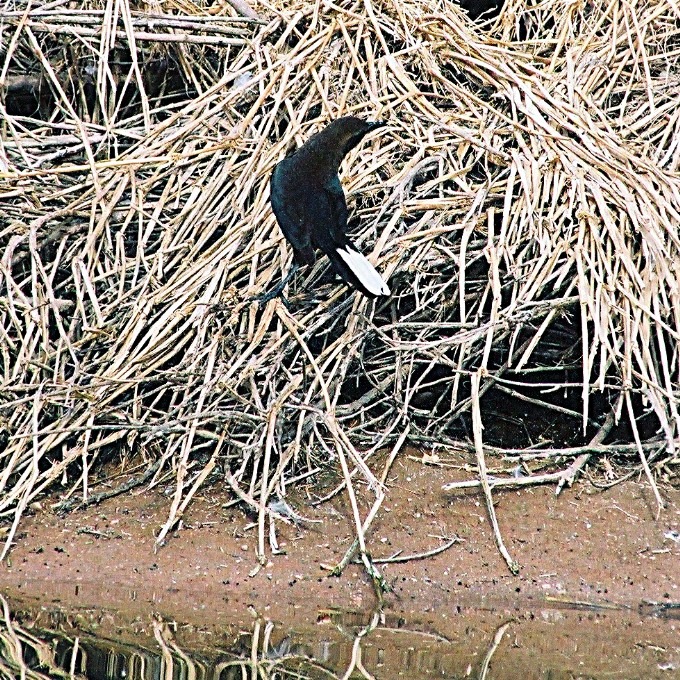
We start right off with a crow. “A symbol of death” it is said. Perhaps it doesn’t hurt the poem to think that. I think it’s a crow. A dark bird, darker yet against the snow, and no crow would let the poet that near without a racket of loud caws. The poet doesn’t let us hear the caws though. Instead, like the uncanny sound of sifting snow in “Stopping by Woods,” Frost wants us to feel just a dusting of snow falling from the branch as the bird flaps off. He wants the main action in the poem to be almost microscopic. He could have written that the bird’s takeoff “dumped a pound of cold slush down my collar”—but that wouldn’t be the poem he wrote. Is the dust a symbol of death too? Or is it an image of a tiny action of little weight? I hold to the later.
Oh, and symbol alert! The tree the bird left is a hemlock tree. Or as the movie “Real Genius” reminds us in “the immortal words of Socrates, who said: ‘I drank what?”
How aware was Frost that the American Hemlock is a pine tree and the European poison is a completely different, smaller plant? If this were written by the avid amateur botanist Emily Dickinson, we’d know the poet would know this. Even William Carlos Williams M. D. might have need to know about the derivations of poison. Like the crow being “death” or a bird, “hemlock” could be a reference to death or suicide—but the evergreen is also a symbol of life in winter too, if it must be a symbol. Frankly I think either taken in a one-to-one direct simile way may overdetermine the poem. In the book of nature, having a black bird against white snow causing the small, light amount of snow to fall from an evergreen tree is sufficient.
And this snow falls on the narrator of the poem, and the small sprinkling of snow lifts the rueful mood. I think that’s the essence of the poem: the smallest action of nature, a flighting crystalline snow sprinkle that may not have weighed an ounce, can lift a human out of their dense internal fixations. I think that’s a more graceful poem than the leaden march of death-crows, grave-dust snow and poison trees. I could be wrong, but I like that poem better.
Musically, a much simpler arrangement than last time, just a bass and 12-string guitar. I’m trying to carve out time to prepare for some more recording with the LYL Band tomorrow. Even if we are successful, you won’t hear those pieces for some time, so use the player below to hear “A Dust of Snow.”
Thanks again for the likes, comments, and the sharing of these pieces on your blogs or on social media.
Today I’m presenting a piece that is extraordinarily well-known, by an American poet whose work is still read and remembered outside of academic settings, Robert Frost.
In such cases it’s easy to think we know the poem, perhaps we’ve even memorized it in whole or in part, and we then say we know it in that special way. If we studied it in school, perhaps we learned or apprehended some deeper meanings for it. If this is so with you, I’ve had those experiences with “Stopping by the Woods on a Snowy Evening” too.
Yet, sometimes, when we look at something with intended freshness, things step out from our remembered poem and introduce us to things we didn’t realize were always there. Let’s start with just how I (and perhaps you) have visualized the setting for this poem.
In the rural winter of Frost’s time, things would be considerably more dark
.
Is Frost in a woods, a bright high-contrast Currier and Ives scene of crisp white snow and colored accents? Not as he wrote it. The title and a line in the second stanza tells us he’s on (presumably) a road, and that he is between the woods and a frozen lake. Is there a full moon and clear sky? No clear sky, it’s snowing, so overcast. He says “the darkest evening of the year,” so the moon isn’t adding significant light. In the rural New England of Frost’s time, it’s probably dark and getting darker, in a way that few of us know darkness today. There are no street lights, no farm yard lights, likely no headlights. One might see villages spotted with oil-lamp-lit windows from the crest of a hill, but he’s told us no village is in sight.
When he says he only thinks he knows “Whose woods these are,” he probably means, “I could tell you if it were noon, but not in this dark.” In the rural area of my youth, even forty years after this poem was written, directions were still given by knowing who owned (or once owned) a piece of land. Is he lost? Possibly. At the least, he wants us to know that he’s not exactly sure where he is.
At the end of the first stanza he says he stopping to watch the woods fill up with snow. If he accomplishes this, he doesn’t tell us. There are hundreds of good lines to describe snow falling on trees visually, and Frost has written many of them, but he doesn’t do it here. Is he leaving us to visualize it ourselves, from our own rich storehouse of memories? That’s possible. And if you and I remember the poem as having images of falling snow drifting through tree boughs in moonlight, that worked. My current guess is that Frost’s narrator could “see” this too, but like us, only in their mind.
It’s a testament to how thoroughly we prioritize visual imagery in poetry that we think those images are there, even if we’ve memorized the poem. Frost was especially proud of the poem’s third stanza, and justly so. It’s all sound images. The dark and solitary nature of being in the middle of un-occupied rural space at night allows sounds to take the place of what our eyes would lord over otherwise. It starts with the horse sounding his harness bells, bells not merely a decorative pretext to sing “Jingle Bells,” but a useful method of letting other narrow-road users know someone’s coming around a curve or hill-crest, particularly in the dark. And the snow image that’s really there? It’s so quiet and he’s so focused in the darkness, that he can hear the sweep of the top layer of snow blowing across the surface of the rest.
The infinite depth and darkness of the woods in the final stanza is not just a metaphor. It’s dark out, and it will not get lighter until morning. Its loveliness, invisible in the dark, is conceptual art at this point for Frost.
In this view, the decision about staying or continuing the journey is not a temptation of a seductive external snowfall-on-the-woods scene, nor is it a thought of embracing death or a contemplation of suicide, though those elements may be there as subtext. The situation is “I’m not even sure where I am on this road in the falling dark. The momentary beauty I sought here is elusive and mostly in my head. Keep following the road, though I don’t have sure landmarks and don’t know for how many miles. Better the finite, even if not quantifiable, promises of the rotating wheel of my buggy than the depth of a forest I cannot see.”
And the sleep he ends the poem with? Frost always maintained it wasn’t death in metaphorical disguise, despite what professors in electrically lit rooms might think. The story is that he wrote “Stopping by the Woods” at end of a long night of work on another, longer poem. Any writer would recognize that it’s actual sleep he now desires, rest that we only allow after exhausting our attempts to see what is lovely, dark and deep despite the night.
Musically, I sought to combine the familiar with a few twists for this one. There’s a reassuring folkie acoustic guitar part and even a cod banjo motif I played to my rusty ability. But then a cello and viola part carries throughout. Instead of bass guitar, I decided to play tambura, a traditional drone instrument of South Asian music, on my guitar using a MIDI interface.
I liked how it came out, maybe you will too. The player gadget below will let you hear it. Don’t see the player? This highlighted link will also play it.
Today’s words are from William Carlos Williams. Unlike our last post, I wouldn’t call this a love poem. Oh, I believe there’s an assignation between two people in the opening section of this poem, but affection seems missing and the desire, if present, seems to be questioned—no, that’s not quite right—the questioning of desire is silent, present in its absence.
Poet and physician William Carlos Williams casts a cold, clinical eye on desire
This is another poem I came across at the Interesting Literature blog, where it was included in a round-up of seduction poems. We’ve visited a few of that type of poem here as well, with shepherds, nymphs, a merchant’s wife, and Williams’ fellow physician-poet Thomas Campion making invitations—but this isn’t really a proposition, any more than it’s a love poem.
Williams’ poem is not titled something like “Come Live with Me and Be My Love”, it’s titled “Arrival.” So yes, an assignation, but one with a schedule like a train or airplane flight, or as we’ll soon see, like a season. Is there desire in the unhooking of the dress? In modernist, Imagist style, that emotion is not stated, but the passive voice and sparsest of descriptions argues that it’s there and is not there.
After the poem finds itself, as many of us have or will find ourselves one day, in a “strange bedroom,” a sea change occurs. The woman in the dress has disappeared. In her place: an autumn tree, disrobing its leaves because the season is felt arriving. Again, desire is not mentioned—it wouldn’t be mentioned, this is an Imagist “show not tell” poem—but this image is also passive and rote.
I’ll let you feel and figure out the image of the final few lines yourself. The now naked woman as bare winter tree? Or is her presumably male companion’s body being synecdoched?
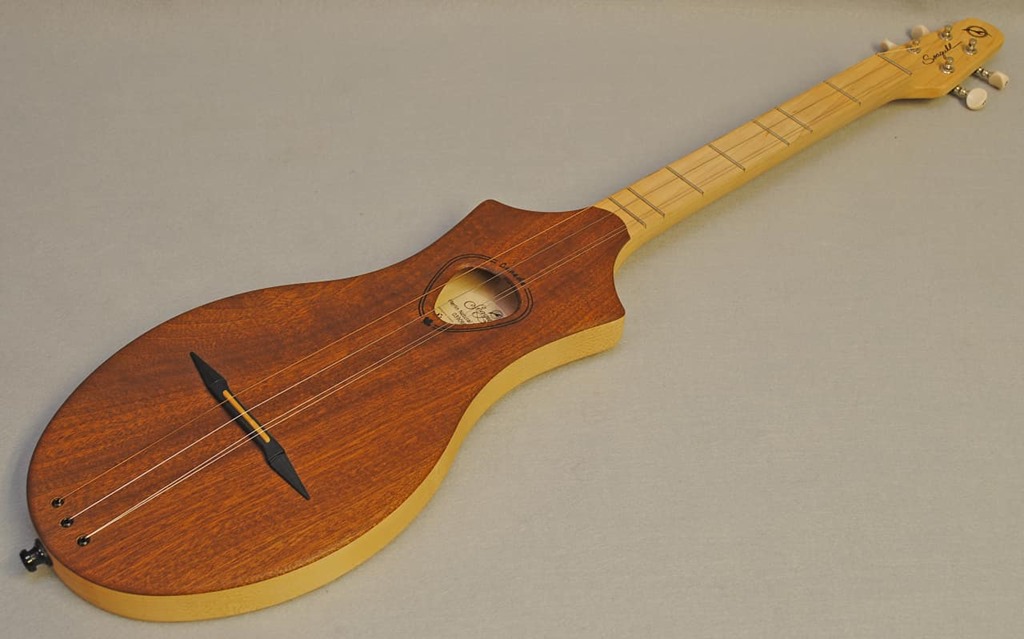
“A dulcimer in a vision once I saw” The Seagull Merlin dulcimer I played on this.
What of the music today? The instrument that sounds something like a mandolin is an Appalachian dulcimer, a simple American instrument; but one, like the sitar used in the last post’s audio piece, that has drone strings. The music is modal too, based around D Dorian. On the percussion side I remain attracted lately to little instruments, so there are shakers, maracas, a cabasa, congas, a chime tree, even some finger snaps in this. I could say that this is a connection to William Carlos Williams’ Puerto Rican heritage, but really, it’s something that is pleasing me musically this month.
Did you like it? Want to help spread the word about this ongoing project to mix various words (mostly poetry) with various music? Hitting the like button here helps, but what does the most to bring this to the attention of new readers and listeners is to mention and share this blog on your own blog or on social media.
Want the audio pieces to listen to later? You can subscribe to the Parlando Project podcast on Itunes, Google Play Music, Stitcher, or wherever you get your podcasts.
Monday night here in Minnesota it snowed. As I took my pre-teen son to school in the morning, he looked at the inch of fresh snow on the spring ground and said “Mother Nature is drunk. Shut her down!”
I rode my winter bike to breakfast that morning, and the trees overhanging the street were shedding overnight ice chunks that their budding branches were rejecting in the morning. As this shrugging hail fell on my ski helmet, it bounced off with a “ping!” like marbles or ping pong balls, and popped onto the icy street like broken ornaments. A few hours later, in the late afternoon, I rode again to the grocery store in considerable sunlight. The streets were dry and I was in shorts and a T shirt.
Plenty of patio seating available for Tuesday breakfast
Minnesotans have a well-worn phrase for our edition of the book of nature. It’s not a hand-bound collection of poems like our New Englander Emily Dickinson’s, but a play script. “The Theater of the Seasons” we call it. Famously, we try to hide emotions here, but we sure do enjoy a little drama with our weather forecasts, keeping an eye peeled for news of storms that can kill or injure you. Sitting in the upper Midwest we can receive weather sweeping up from the Gulf of Mexico or dropping down from the Northwest Territories. So, particularly in Spring and Fall, the Theater of the Seasons plays in repertory here in Minnesota.
Today’s audio piece is short, less than 2 minutes long, and it’s called“Theater of the Seasons,” expanding on that phrase a bit. I think you’ll enjoy it. The player gadget appears at the end of the post, as usual.
As part of this blog’s participation in National Poetry Month, we’re trying to provide even more audio pieces like this that you can stream. If you know someone who might enjoy words combined with music like this, why not take this month to let them know about us and our Parlando Project, or share this or another favorite on your own blog or chosen social media site.
Last night my computer news feed informed me that Chuck Berry had died. As with any 90 year old of a certain fame, the obits with their career summaries were already considered and ready. There were many elements the obits needed to include, and they did their job.
“Whenever a thing is done for the first time, it releases a little demon”
Around 40 years ago I wandered into a group of Minnesota poets who called themselves The Lake Street Writer’s Group, because they all lived, as I did then, within a few blocks of this main Twin Cities east/west commercial street—but what attracted me to them was that they had considered The Chuck Berry Writer’s Group as a leading alternative to that name.
I was then (as I am sometimes still) an obscure little poet. I like my works short, but I don’t require them to be all that clear or straightforward. I like them to play with words, both in the sense of assembling and using words in new ways; but also in the sense that they play with words in the same way that musicians play instruments. Chuck Berry was a beautiful example of that.
Tomorrow is the first day of spring. Here’s an example of my trying to do that. We know how to write the traditional spring poem. Spring! New beginnings! Happy blooming flowers! That’s probably the most welcome and acceptable way to write a spring song, because the world needs hope—but is it the only way?
What does spring’s beginning really look like? A few posts back I presented Boris Pasternak’s “February,” where he described a winter thaw not as a promise of Easter Bunny spring, but as a mucky, crow-ridden, rotten-fruit invocation of tears. Early spring is the cyclical end of dying, but as the wheel reaches March 20th, death is still palpably there to be ended.
For death, Spring is change—and how do we often react to change, particularly change that is imposed on us externally? I decided to tell that slant, to speak from those winter corpses at spring’s beginning. After all, we don’t choose spring, it’s decreed to us by nature and any ruler of nature we believe in, and nature is not a book only of triumphs, it’s full of predation and predestination.
“Nature is a Haunted House – but Art – a House that tries to be haunted.”
My audio piece “The Spring of Dead Things” is not in the musical mode of Chuck Berry—it’s more to the emo stylings of Emily Dickinson—but as players of words, these Americans had their slant bells to ring. To hear mine, use the gadget that appears below.