Shakespeare’s Sonnet 97 “How like a Winter hath my absence been”

What with Longfellow last time and Shakespeare this time, I’m thinking I’ll return soon to some of the more surreal and avant garde 20th century authors whose work has entered the public domain. That would be the New Year’s thing to do — but then once one penetrates the archaic language of this old sonnet, it gets plenty weird.
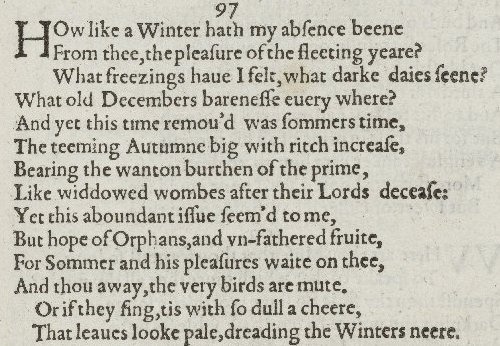
Sonnet_97_1609

How this poem looked in 1609. I note that most versions of this poem I find online replace the question marks in the opening sentences with exclamation points. I wonder why?

.

How many come here, perhaps via a web search for help in figuring out what some hard-to-understand poem might be on about? Well, here’s the usual “homework helper” summary of Sonnet 97:

The clever bi-amorous poet character* in the sonnet starts out bewailing that it’s winter and he’s away from his beloved. But wait, a few lines in, it’s summer, or maybe autumn harvest time, but the poet started out talking as if it’s wintertime because he misses the beloved so much and that makes it seem as bad as winter.

There you go, a greeting-card worthy poem when reduced to that meaning: “Miss you so much, summer’s like winter because of that.”

But all that ignores the strangeness of it. Don’t put this in your school work if you have a conventional teacher only looking to see that you’ve taken the effort to decode Elizabethan English,**  but is it just possible that the poem is really written in wintertime, or that the portrayed states of winter and summer in this poem are not actual, look-at-the-calendar fact? ***

That supposition that this poem is actually set in summer (or maybe autumn) has to be vague, because the statements about seasons in the poem are spread between four seasons: winter, summer, harvest-time and then near-winter fall — but the actual imagery Shakespeare goes with is much more at pregnancy**** and birth, and he’s not subtle about it at all, working a number of angles on that idea, and with a specifically  patriarchal slant on pregnancy.

Here’s what he says about what his state and season is in this poem: “teeming” (breeding with no concern of to excess), “increase,” “bearing” (and wanton at that), “burthen” (an archaic term that puns on birth, and was used for cargo in a ship’s hold, which the poem notes is owned by the principle, the prime, of the shipping company who has in that way impregnated the cargo), and outright “wombs,” “issue” (a legal term for children), and “orphans” (children again, though patriarchally, orphans from loss of just the father) and “un-fathered fruit” (from what little I know of horticulture and pollination, possible — but in this context, more orphan or bastard status being inferred). Shakespeare doesn’t really care to nail down if it’s summer or harvest because it’s not a calendar season he’s depicting. He’s been impregnated, and magically given birth perhaps more than once from this impregnation.

Now in terms of gender fluidity (no snickering in the back row — and Ms. Rowling, no passing notes you can’t share with the rest of the class) this is outrageous imagery, and something that I’ve seen no other reading of the poem address, though it seems to me overt enough that someone must have noticed it.

What is his point? What’s he getting at? I think the “issue,” the “orphans,” are the poet’s poems, even including this sonnet itself. His beloved is absent, so he shouldn’t be productive (maybe even an undercurrent here of infidelity or artistic parthenogenesis) and at least for the purposes of this poem he is exaggerating the patriarchal attitude that the father (not our fecund womb-bearing poet) owns the children, or if there be “issue” that isn’t his, they aren’t worthy.

There’s also a potential class layer here too, isn’t there. If the “Fair Youth” addressed in this and other sonnets is indeed a titled patron, that purported “only begetter” may be a fancy whose sexual politics shouldn’t be overlooked.

In that reading, it may really be winter outside, as on this late December day in my state it certainly is. And there may be a longing for an absent beloved, but the poet is writing the winter, writing the separation, teeming. I think Shakespeare may be playing with that claim that poetry without a patriarchal father is a dull song and illegitimate. As for us, we should write down our dark verse on the pale leaves of winter, and may you find pleasure in your own ever-fleeting year!

To hear my musical performance of Shakespeare’s Sonnet 97, “How like a Winter hath my absence been,”   you can use the player gadget below or this highlighted hyperlink that will also play it.

.

*Modern scholarship has generally come down on the side of thinking that Shakespeare’s sonnets are an invented work, using and playing changes on conventions of Renaissance sonnet topics and plot lines. But the desire to know “the real Shakespeare” still leads a great many to comment on what these poems, seemingly intimate and confessional, say about the person who wrote them. I’m going to write as if the poem is Shakespeare speaking as himself for simplicities sake, as writing “the character of the poet who is writing this poem” is too awkward to keep repeating.

**I wonder how many immigrant and Afro-American students realize that they have a possible advantage in appreciating and interpreting the archaic English of Shakespeare’s time in that they already have a contemporarily developed and working code-switch skill regarding language.

***When I first read this poem I thought of the Twilight Zone episode “The Midnight Sun”  in which (spoiler alert) two women are approaching death on an Earth that is growing ever hotter, only to have the twist ending be that it’s a near-death fantasy of our heroine on a planet that is instead growing ever colder.

****Human pregnancy having a 9 month term could account for some of the seasonal ambiguity and the poem not being clear about it being winter, summer, harvest mid-autumn or near winter/late fall.
I wake and feel the fell of dark

Once more let us look at winter-come darkness and see what we see there, this time through Gerard Manley Hopkins and one of his “Terrible Sonnets.”

The name “Terrible Sonnets” is not a review, though I’ll confess that on first hearing of them, that between Hopkins oh-so-British sounding triple name with an extra schoolboy snicker due for the middle name on top of that, that I too wondered what meaning I’d assign to that word “Terrible”. No, my teachers assured me, terrible in the same way that wonderful and awful can be synonyms in strict derivation English.

No, these are poems that have a good scholarly reputation, and some general readership yet today. If there is disagreement about them, it’s not about their worth or poetic quality, but rather if they show Hopkins in a profound spiritual crisis or in a clinical depression. One can find a number of essays online and elsewhere that argue for either, or perhaps both. Either way, this is the night darkness as we often think of it. Yesterday we had Joseph Campbell making a case for a mysterious outward darkness, the exact nature of which is just out of our understanding. Hopkins darkness in contrast is totally intimate. I find it interesting that both of them were writing in Ireland, then still a colonial possession. Campbell may be expressing his country’s subjugation and its ancestors’ sorrow at that in his poem. Hopkins, in turn, was a patriotic citizen of the empire that ruled over Campbell’s country. That’s not a frame I’ll follow up on today due to space, and because Hopkins wrote these poems in the late 19th century and there’s no way to start a Tweetstorm that he can read back then.

Gerard Manley Hopkins 2

Hopkins, about to be pwned for complicity in colonial exploitation, before everyone realized: wait, 1885, no iPhones.

.

Here’s another frame, another one with roots in colonialism and subjugation. In America we have a form, the Afro-American Modernist form forged around the same time that some white Americans were over in London helping create and popularize Imagism. That form was called “The Blues,*” and to some degree that indigo name has let it be casually and incorrectly considered a sorrowful song. And yes, a lot of bad and sad things are spoken of in The Blues, but it’s generally from a stance of: “Look what’s happened to me, what’s been done to me, the absurdity of it—but I’m still here to tell you about it.”

Today’s piece, using Hopkins’ Terrible Sonnet “I wake and feel the fell of dark,”  is not a Blues. But despite the harrowing statement of the inside of this poem’s speaker’s experience, it shares one thing with The Blues that makes it outstanding: “I wake and feel the fell of dark”  is full of energy. The description of the state inside the poem is cascading and vivid, coming at you so fast that it seems all at once. If this is depression being described, it’s not the mode of depression that is numbed beyond caring, but the depression that actively calls out and hates the depressive portion of the speaker’s mind. In this way, it shares something with The Blues, it can be cathartic. And indeed, some sufferers of depression (like too, some religious seekers) find the Terrible Sonnets worthwhile as a voice in darkness that can remind them that there are others who’ve felt and seen the same things.

Here’s a link to the full text of the poem if you’d like to refer to it.

I’ll risk trivializing Hopkins’ revered poem by pointing out two trivial things I noted in looking at the text, as few commentators on Hopkins’ work choose to sink to mundane levels. The section “I am gall, I am heartburn…bitter would have me taste: my taste was me” seems to me to me to be on one level a symptomatic report of the experience of nighttime gastric reflux. And in these days of 2020, with lots of long nights this year before this day of Winter Solstice, Hopkins back in 1885 was prophet enough to speak specifically of our popular pandemic baking fad of homemade sourdough bread in this poem’s line 12!

The player gadget to hear my performance of Gerard Manley Hopkins’ “I wake and feel the fell of dark” should appear below. Don’t see a player you can click on? Well, this highlighted hyperlink is another way to hear today’s audio piece.

.

*The Blues of course is a varied and mutating form whose essence exists beyond the bins carrying that label in record stores or playlist names on your phone. I use it as a name because it’s one that coalesced for the art form at the time it emerged around 1900 in America. I stand to be corrected by my betters in these matters, but I believe the Blues essence remains a vital part of Afro-American expression, and from that, American expression in general. I’m an American musician, and the notes are mostly black.

Twilight Fallen White and Cold

What do we see, what do we learn, what possibly do we gain here in the upper parts of the northern hemisphere from so much nighttime at the beginning of a cold and snowy winter?

Some might say we learn endurance, a sense of obligation besides the dark and ice to carry on. Or a concentration, winter solstice as the fasting of light. But night is a filter, a frame, offering another way of perceiving. So, I went looking for poems this month that might allow you or I to look at darkness and see differently. One of the strongest and strangest poems I found was this one by a little-known Irish poet named Joseph Campbell.*

I’m trying to gather more info on Campbell. He was born in colonial Ireland in 1879 and died 1944 in a now independent Ireland. Most of his available poetry was published before WWI. He was imprisoned in the events surrounding the Irish Civil War of the last Twenties** (he was aligned with the losing side) and afterward he lived for a couple of decades in the United States. Shortly before his death he returned to Ireland and died there. I’ve read one of his book-length collections of poetry and parts of two others, all of which predate Irish Independence and the Civil War. I find him a striking poet worthy of more interest. Most of his poetry is brief, rhymed lyrical poems, using short metrical lines, such as today’s selection. One collection, Irishry,  contains incisive small character sketches of Irish life at the turn of the 20th century. Another, The Gilly of Christ,  has elements of Christian mysticism. Inherent in many of the poems seems to be a speaker who has spent time hiking about the country, and in this regard, Campbell reminds me at times of Edward Thomas with his attention to the book of nature and the landscape. While he likes rural and sometimes peculiar words, his language is clean and modern without the taint of worn-out 19th century leftovers.

There are also a handful of poems I’ve read in the collections so far that are very much in the style of the early Imagists, and this is striking because they may date to around the same time as their initial ground-breaking experiments. I so far know of no direct connection between Campbell and the largely London-based pioneering Imagists, but like his Irish contemporaries Yeats*** and Joyce, Campbell seems to be an early Modernist voice regardless of his use of rhyme and meter for most of his poetry.

Twilight Fallen White and Cold

Here’s today’s piece with chords in case you want to make sounds in the winter night

.

Today’s Winter Solstice relatable piece “Twilight Fallen White and Cold”  mixes his modes a bit to produce an interesting effect. It’s on one layer a jaunty nature poem, almost nursery rhyme simple. This seems an easy effect to achieve, but particular to moderns, it’s not. Subtly mixed in with the “child in cradle, lamb in fold” comfortable lines are misty undercurrents. Well, yes, those trees are a bit ghostly in fading light and cold mist. Yes, birds are on the wing, but also “Black-winged vampires.” What? No, there are no vampire bats in Ireland.****  And in the last line of the second stanza we meet “rath and burial mounds,” the former a word that has an Irish meaning that an modern American reader might slide over. No, the burial mounds aren’t explicitly angry, a “rath” is the remains of an earthen-walled stronghold dating back to Celtic chieftains. The poem final stanza intensifies that hold and call from the indigenous past. Though Campbell is depicting an Irish landscape, these rounded-over and landscape-worn earthworks bring to mind the areas of North America in my native Midwest where indigenous people built similar structures.

But the most mysterious part is repeated as a refrain to make sure we don’t miss it: “Wounds of Eloim/Weep on me!”

The darkness of coming night may be mysterious, but this is more so. I don’t know exactly what Campbell is getting at there, other than the effect of mystification assuredly delivered. Eloim, which I believe in a variation of “Elohim,” is word that will not become less mysterious if one researches it. It appears to be a Semetic language family word for gods. In the Bible the word appears to have taken on several meanings. The Abrahamic Semites are famously monotheists, and they will use the word to refer to the multiple gods of the other tribes—but even though the word is plural, they will use it to refer to their own, singular god, or to the ambiguous angels that are not human but are also not plural gods. At some point, I believe post-Biblical times, this association with angels has led the word to be used at times as synonym for heaven.

Does that help us understand what Campbell meant to ring out multiple times in his poem? Not exactly. I gather some sense of a lost past, of a suppressed culture, is being invoked, but the mysticism never reduces itself to a “this stands for that, it’s just a code to be broken” level. That may increase its power, and it certainly increases the strangeness of this poem.

Returning to my original question, what might the darkness, our winter-come overwhelming night portion teach us? The example of this poem says that I shouldn’t answer that question quickly and simply—but that I should ask it.

A player gadget to hear my performance of Joseph Campbell’s “Twilight Fallen White and Cold”  will often appear below. If you don’t see it, this highlighted hyperlink will play it too.

.

*As I have to say whenever I mention Campbell to anyone: no, not the American Hero With A Thousand Faces  and “Follow your bliss” Joseph Campbell. This is another guy. The Irish Joseph Campbell also used a Gaelic name, Seosamh Mac Cathmhaoil which would have given him a more secure doing-business-as cultural brand, and near the end of his life a pen-name of Ultach.

**Until this year I was entirely ignorant of the events of the Irish Civil War and now only know the summary story as reflected in things like this Wikipedia entry. I am, so far, unacquainted with Campbell’s political beliefs and actions.

***Like Yeats, Campbell seems to have been a committed cultural nationalist, seeking to use the arts as a way to uplift his country’s prestige and as a foundation for independence from colonial status. Like Yeats he also seems to have been involved with theater and as a song lyricist. One tidbit I found, which may be related to the mysterious element in today’s poem, is that he may have been the source responsible for a broadside folk ballad “Reynardine,”  being performed in a version by several British Isle folk-revivalists later in the 20th century as a tale of a “were-fox” rather than in its original guise as tale of a bandit. Here’s two of my favorites versions, one by the incomparable Bert Jansch, and an unaccompanied one by the equally special Anne Briggs.

****Maybe St. Patrick and Van Helsing teamed up to take care of that?

Emily Bronte’s Spellbound

Let’s begin our celebration of Halloween here at the Parlando Project with a setting of a short poem by Emily Bronte that starts “The night is darkening round me.” What a marvelous short poem it is too.

Halloween here in the northland of Minnesota is in some years an early winter holiday, and this late year’s late October seems one of those. I’ve awakened to temperatures in the teens Fahrenheit already this month, snow and ice are on the ground, and of course it’s already twilight at 6 pm. So, given that the speaker in Bronte’s poem is enchanted by a spell, it’s easy to see this from my landscape as a Halloween poem, but if you are farther south you can consider it a Winter Solstice one. And if you live in the tropics? Well, I do promise “Other People’s Stories” here.

My wife and I live by the Norwegian proverb about there being no bad weather, only bad clothes. Our love gifts tend not to be lingerie or sharp dress duds, but things like merino wool and handlebar pogies*.  We each try to keep up outdoor activities in the winter, and as long as you are active, such clothing works well.

But Bronte opens up in a different situation. It’s night. It’s cold. It’s windy. And our poem’s speaker has been spellbound out in it. They can’t leave. The poem, short as it is, tolls a refrain over and over, the speaker “cannot go.”

spellbound

I played this with the eerie, hook-like appendage guitarists call “a capo,” so it sounds in Bb in the recording.

.

And the second stanza says the weather is getting, what? Worse! There’s already heavy snow on the tree branches. Where is the speaker bound in this spell in the foreboding night with a further storm coming on?

Not even hunkered down in a sheltered area or behind a windbreak. They are frozen (not soon to be a metaphoric word!) somewhere between the sky’s clouds and the winter, snow-covered wastes below. When I read this poem, I pictured the spellbound speaker held supernaturally some distance in the air (makes it easier to view the snow-load on those tree branches), but if you are less fantastic you could view them on a ridge or hillside and able to view lowland areas below, but still more than minimally exposed to the weather. I’ve even read a reading where the writer thought that Bronte had placed the speaker in Purgatory, and the clouds are heaven and the lower wastes hell. Well, Emily Bronte was a PK** and all, so that’s not impossible, but I’ll still take the picture with what Bronte gives us, stark as it is—and in its moment, without any route to salvation.***

Other close readers note the subtle change in the last “cannot go” refrain. The speaker says “I will not…go” the last time, not “I cannot…go.” Do they want to be in this predicament? Is there a kinky love bond with the tyrant who has them trapped in the spell? Plausible reading. My sensibility hears this “will” as a final realization that there’s no way out from the spell, that the speaker is not just temporarily trapped and cannot go, but they will be so in any future they can see.

So, a Halloween-scary poem. Back in the “real world” that we hope is safe enough to tell each other scary stories, we can reflect how this trope of being in a situation of oncoming dread and not being able to move is a common bad dream. Or if you, or someone you know, suffers from S.A.D. (Seasonal Affective Disorder) you may find the winter darkness brings on a torpor that’s hard to break out of.

A simple setting for today’s piece: guitar, bass, and piano. The weather’s too cold and dark to drag an orchestra outside I guess. I plan to be back with more Halloween spells this week, time allowing, so check follow, or check back. The player gadget to hear my performance of Emily Bronte’s “Spellbound”  also known as “The Night is Darkening Around Me”  is below. No player? This highlighted link will also play it.

.

*Pogies are neoprene hoods that allow one to operate bicycle controls inside their wind and warm shelter while wearing only normal gloves rather than bulky insulated mittens. They are the only solution that really works for subzero F. cold on bikes.

**PK means “Preachers Kid.” A class that Parlando Project alternate voices Dave Moore and my wife share with me. One thing this experience usually leads to is a youthful exposure to a lot of sermons. “Heaven and Hell” may not just be someone’s favorite Black Sabbath LP—or it may be, but one has yet another context for that.

***In its short, stark, three stanza format that could repeat in any order, and it’s no way out of here situation, this poem is sort of Emily Bronte’s “All Along the Watchtower.”  Except, Emily’s speaker has no one to talk this doom over with. A like-named Emily, Emily Dickinson, would appreciate the solitary nature of this kind of Bronte poetry. Earlier in this blog we discussed that Dickinson’s “Hope” in her famous “Hope’ is a thing with feathers”  poem may have been quoting Emily Bronte.

On the Grasshopper and the Cricket

There used to be a thing, back in the Seventies when “The Sixties” were being established as a retrospective era: “The Beatles or The Stones?” The idea was that this choice, which was supposed to be somehow exclusive, was an “opener,” a what’s your (astrological) sign query that would tell the questioner who you were—or at the least start a conversation.*

Among the smallish subset of 20th century young people who liked poetry in English and were inclined to the Romantic revolution launched by Wordsworth and Coleridge at the beginning of the 19th century, one could play a similar game: “Byron, Keats, or Shelley?”

Sarcastic Byron “Mad, bad and dangerous to know” was the bad boy. Shelley was the beautiful intellectual, the man whose genetic material you wanted to incorporate. And Keats was the misunderstood outsider, the garageman’s son who presumed words alone could elevate him.

English Romantic poetry’s boy band—choose your poster.

I was easily a Keats man in this forced choice. I’m not sure, but I think Parlando alternate voice and keyboardist Dave Moore was a Byron guy back then. Early supporter of this blog, Daze and Weekes, Shelley. There are no wrong choices there, and when it comes down to it, no necessarily exclusive choices there either.

Keats hasn’t played a lot here in the Parlando Project. I’ve expanded my interests much since my teenaged years, and I guess the English Romantics have fallen back into the pack of poetic schools as I moved on to other things. Coincidence can bring Keats back though.

John Keats and the Chirping Crickets 3

Unheard music will Not Fade Away! John Keats and his “Chirping” Crickets.


Last weekend I hesitantly went to the newly reopened Minneapolis Institute of the Arts with my family. It was my wife’s idea, a way she hoped would be fairly safe in these Covid-19 times and still get us out of the house. She wanted to see a special exhibit on the immigrant experience. I thought I’d like to review their Chinese section.**

I may well write about the immigrant exhibit later, but the reason I wanted to do a bit of a wander in the Chinese wing was from my recent presentations of 8th century Tang dynasty poets here: Du Fu, Wang Wei, and Li Bai. As it turns out the holdings are a bit lacking in artifacts from that time. While this was a golden age for classical Chinese culture, that might not have carried over to the tastes or availabilities of objects to Western collectors.

But as I wandered the hall, I noticed something that had persisted in Chinese culture for centuries that I hadn’t encountered before. Beside a large, lacquered Chinese string instrument (the size of a pedal-steel guitar), there was a note that Chinese interest in music extended to modifying pet crickets vibrating wing edges with metallic powders and resins to increase the qualities of the cricket’s song. That grabbed this music-nerd’s interest! I started to examine other displays: there were cages and holders for pet crickets, tiny dishes in cricket-scale to feed them, and in one, two tiny wands, like fine detail paint brushes, only finer, the brush a single small hair. These, the note told us, were cricket ticklers designed to encourage the insects to start their music.***

Chinese Qin and Cricket Note

Beatles or Stones? Qin, songbirds, or crickets? The sort of things that a Chinese scholar might have in China during the time of Keats.


I’d already been looking at Emma Lazarus’ summer sounds poem before this trip, with its pairing of cricket-chirp with far-off children’s laughter. And then I found this slight little sonnet by John Keats, another one with crickets. My favorite short Keats poem, In the Drear-Nighted December  is a fine quasi-Buddhist meditation on suffering depicted as an appreciation of a frozen winter water-run. This one, “On the Grasshopper and the Cricket”  doesn’t strike my heart as strongly, but it’s still charming in comparing warm days and winter. This one has almost a Midwestern tang to it. I could see James Whitcomb Riley or Paul Laurence Dunbar writing it. The humble man in nature noting the grasshopper’s****  song even in the hottest summer days, and the comparison of the like sound of a housebound cricket chirping behind a wood stove in darkest winter.

The player gadget to hear my performance of John Keats’ “On the Grasshopper and the Cricket” is below.


*Don’t ask a music-nerd like me this question. Yes, I understand the points it’s attempting to weigh, but I won’t be able to resist spilling out mini-improvised essays on The Animals, The Yardbirds, The Zombies, The Kinks and so on, and then I’ll interrogate the now exhausted and bored questioner about how these exotic British acts are viewed as “saving” us from Bobby Rydell et al, when Afro-American jazz and R&B artists—right on the other side of town in a lot of cases  here in the U.S. —were doing vital work then that inspired these Brits. You can see I’m no fun at parties now, can’t you.

**Like some American museums that date from the late 19th century, Asian art was a significant part of the MiA collection. A significant number of wealthy collectors then were interested in the “exotic east.”

***There’s more I learned. Besides keeping them as pets and enjoying their music, cricket fights were a broad Chinese cultural thing as well, and because a full-formed cricket’s life span is but a few months even without visits to the Disabled List, an entire industry rose up in the capture of crickets for song and sport, with a hunting season in August and September gathering the most from the wild.

****Despite their somewhat similar appearance and sounds, the cricket makes its spiccato with its wing-edges, the grasshopper with its legs. I plucked a 12-string guitar and had double-basses provide some heavy late-summer air for this piece, but probably the most cricket-like sounds in the recording are from a marimba. The old saw says that if you take the number of cricket chirps in a quarter-hour and add 40 to it you’ll get the temperature in Fahrenheit. If so, this is a fairly cool bpm cricket.

The Most Popular Parlando Project Piece for Winter 2020

December seems so long ago doesn’t it? More so this spring in our current crisis. Back on the 10th of December I awoke, took my bike ride to breakfast in a pleasantly crowded café, where I read that it was Emily Dickinson’s birthday. While eating breakfast I decided I should try to make a Dickinson piece before the day was done.

This morning in March, I rode to that same café. Normally there are 20 or 30 folks there drinking coffee, eating breakfast, talking, reading or fiddling with notebooks or notebook computers during the morning on a weekday—more on weekends. Today they are to close their dining area for the duration at noon, and the two couples eating breakfast several empty tables apart (along with some not-present more) will need to do what I did and pickup takeout fare to keep this place a going concern.

Last morning to dine in at Turtle Bread

Cold but sunny morning, and taking their last chance for awhile to have breakfast together.


When Emily Dickinson was a child, her family grew up not in the grander family house her grandfather had built and lost due to debts and business ineptitude, but in another house across the road from a cemetery. Some biographers think this molded the young mind of our great poet, but then the literature of that time had a decidedly gothic tinge to it anyway. And that’s not the place she lived as the poet we know.

Her father worked assiduously to repair the family wealth and regained the homestead. Emily’s room is in the front of the house. Out to her left would be the garden and orchard that she became the master of with the illness and eventual death of her mother. Below her, the kitchen where she and the family’s immigrant Irish servant fixed the family meals and baked. That garden and orchard is now gone as the world of her family and town moved on from its former rural self-sufficiency. Also gone is the 11-acre Dickinson meadow that would have been more or less straight-on in view for Emily at her writing table on one of her December birthdays.*

The famously sequestered Dickinson of her later adult years would have been living our current Covid-19 life of “social distancing” and stay-at-home self-isolation. You might think her poetry would be more solipsistic for that, but she really was a mind forever voyaging. The winterscape she portrays in this short poem is quite likely that Dickinson meadow or her bare garden.

Though the creation of the music and recorded performance of it was rapid even by this project’s quick pace, I don’t think it suffers from that at all as I listen to it again today. The post I wrote about it in December was not one of the most liked or read this winter, but the audio piece was listened to more than any other one during the past three months,** and by enough to score the top spot anyway.

As I consider my sequestered music making today—something I can create even in these times, by myself, playing each part in turn—I feel for those other musicians whose art and the revenue to support it requires a live venue, a paying crowd coming through the door. Of course, cooks, wait staff, musicians—small businesspeople for the most part and only a portion of our world—are not the only ones who will suffer through the duration of our current crisis, but they were in my thoughts as I write this.

Is Dickinson’s poem lighthearted and playful or more gothic in mood? My current reading of Dickinson is that it’s both. She is amazed at the shapes and filigrees of the barren landscape, yes—but it is a place of stilled and departed artisans as she portrays it. She sees an absence, that resonate line: “Summer’s empty room.”

My performance of Emily Dickinson’s “Snow” also known as  “It sifts from leaden sieves” is available with the player gadget below.


*Here’s a highly detailed blog post about the vantage point of Emily’s room in the Dickinson homestead. It even goes so far to suggest that the irregularities of mid-19th century glass may have been the genesis of some of the impressionistic or even visionary imagery in Dickinson’s poetry.

**The second most listened to piece was #6 on the list “Do the Dead Know What Time It Is.”

February Twilight

The cosmos says we need to get a leap year, and extra day, and yet we put it in February. It was a dozen degrees Fahrenheit this morning, and my bike ride back from breakfast was into an insistent north wind that explains to me that we’re in Minnesota and we’ll probably have a snowstorm or two yet before we can see spring—a spring that sometimes seems too short to form memories.

So, before we leave this month and season, I thought it a good time for a short poem referencing a short month from American poet Sara Teasdale. Teasdale is like Edna St. Vincent Millay, a poet that 100 years ago was thought a leading voice in this country’s verse, after which we spent the rest of the century more or less forgetting or down-grading their place.

When such re-evaluations happen, it’s common to assign them to the refined judgement of posterity, the further assay that separates momentarily sparkly stuff from the for-all-time classics. How does that happen?

One could assign this downward path to Teasdale (like Millay) writing metrical and rhyming verse in their prize-winning years early in the 20th century. The evil Modernist free-verse hordes in this view laid waste to all who dare to rhyme or march to a one-shoe-off beat.

There’s a factor there, sure, but this story doesn’t account for two giants whose statues were not toppled: Frost and Yeats. Nor the monuments on many campuses to canon sitters like Auden and Wilbur et al who were not primarily free-verse poets.

No, I think there are more important factors in this determination, one that is currently under revision in our new century. First, both were essentially lyric poets. “Lyric” in this sense doesn’t mean that they wrote song lyrics. Though of course this project finds them sing-able and otherwise suited to presentation with music, “Lyric” in the literary sense means that their poems tend to be set in the impressions and immediacy of a moment, and their final and considered judgement of that moment is not necessarily explicit. Lyric poems don’t usually have great themes developed with long arguments in verse. Nor do they have narratives the way a novel or story does, were we turn the page to find out what happens next. What happens in a lyric poem—happens! Right then. Right now.

The pioneering Modernists in the years before the end of WWI, those that were or wrote like Imagists, were fine with that. Indeed, this was the point of Imagism. Teasdale wasn’t called an Imagist, but she could write like one, albeit with rhyme and meter. The Imagists didn’t call for the end of rhyme and meter, they called for an end of poems that existed to fill out those forms without the vividness of the lyric.

But post Eliot and the Pound of the Cantos, post the sheltering of poetry inside the academic monasteries which could too easily fall into a rout of poems to be taught rather than poems to be experienced, these poems could seem slight. The Imagists were a fine exercise to break from the past, but they were not, in this outlook, the way to write great poetry.

And here’s the other reason. Gender. The academics were overwhelmingly men and were steeped in the things men were thinking about. And the world of the middle of the 20th century had a lot of concerns that made the concerns of Teasdale and other women poets of the early part of the 20th century seem like the line in Casablanca  uttered by Humphrey Bogart “The problems of three little people don’t amount to a hill of beans in this crazy world.”

For the first part of our double feature: 90 seconds of cinema that was an emotional touchstone to many. Also, mansplaining.


It took the culture until nearly the end of the 20th century to see that part of the world’s craziness was because men were still explaining how it worked to women.*

All that may be too much of a burden to bear for this short poem by Teasdale. But if “February Twilight”  was signed Frost or Yeats, I suspect more attention might be paid to her poem. It doesn’t read much like Yeats, but it could pass for the shorter, lyric Frost.

The lyric impulse in poetry survived the mid-20th century when colored with Dada and Surrealism. “See, it’s not me! I’m a serious poet, but I just chanced into this charged moment.”


What does Teasdale experience in the charged moment of her lyric? That it seems like she’s the only one that views this star, a manifest untruth we could explain to her, but which I think she knows as the final line presents. She doesn’t explain this to us, but we can stand in the cold, snowy February and experience it with her.

I’m choosing tambura and acoustic guitar again for my performance today, this time with an organ keyboard part. Click on that player gadget below to hear it.  “If you don’t, you’ll regret it. Maybe not today, and maybe not tomorrow, but soon, and for the rest of your life.”


*Which I’m doing here. Ha Ha! Here’s where one of the principles of the Parlando Project comes in: “Other People’s Stories.” I’m not claiming the exclusive right to mansplain mansplaining, but men speaking up about it has its place and value.

Oh, and explaining has value too. And I happen to like Casablanca  as a movie. And defeating fascism might have a value greater than the optimum choice for a snuggle-bunny. And I had huevos rancheros for breakfast. A hill of beans would be meaningful and sustaining to me!

The Times Are Nightfall

There’s a musical theme in today’s audio piece: things that pretend to be another instrument, and while they don’t quite get there, are still something else.

That low bowed-string sound that opens today’s piece? It should be no surprise to long time followers here that it’s a Mellotron,* the primitive magnetic tape ancestor to today’s computer-based virtual instruments. It doesn’t really sound like a cello as it lacks any variation of articulation, but it does have a sound of its own.

There’s no bass guitar (the cello part is solidly in the bass register anyway), but to add a little punch I added an emulation of the Fender Rhodes Piano Bass most famously used by The Doors. Used as The Doors did, it can do a fair job of sounding like the plunk of an electric string bass, but I filtered it here so that it sounds less like a real bass. And yes, there’s an old-style electric piano in there too, an instrument that doesn’t really sound like a piano, having more of a bell-like timbre. I love the sound of a real piano, but there’s something else in the electric piano that I like too.

And finally, there’s the instrument I wrote the song on: electric guitar. I don’t know that we still think of the electric guitar as a “not quite” approximation of a “real” acoustic guitar, but one can define it so. There was more than the usual unamplified leakage of the electric guitar’s strings into the vocal microphone when I recorded the live take of the guitar and vocals for this. Normally I’d consider that a fault and record a clean pass of the vocal without that extraneous noise, but I kind of liked the accident and decided to keep it.

A little past half-way a pair of “real” violins doubling a new melody line come in, but since I don’t play real violin once more it’s a virtual instrument played on my MIDI guitar. Even in this simple section you can probably hear the difference in articulation from a modern VI instead of the Mellotron.**

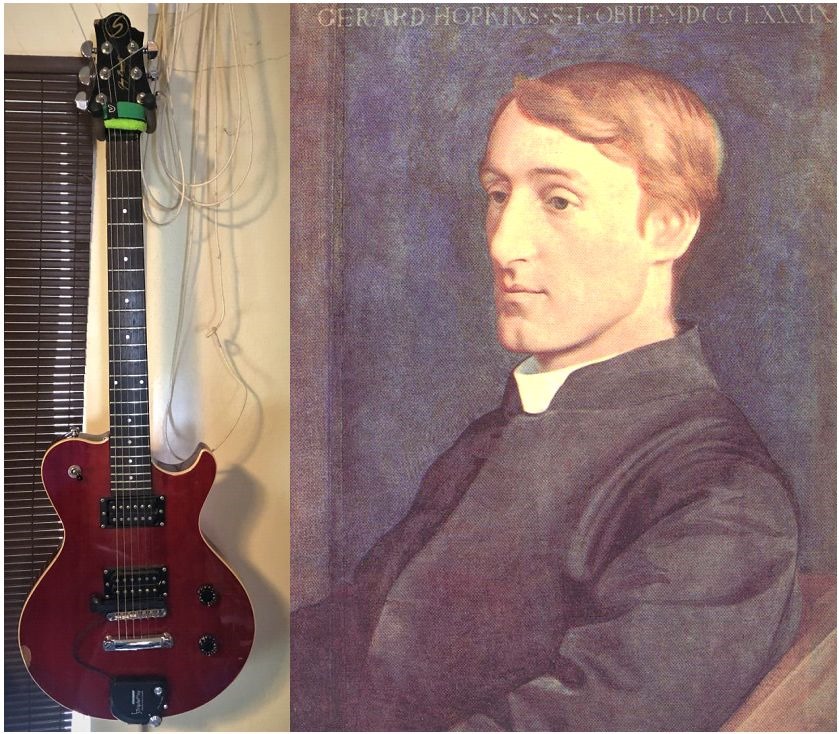
My Red MIDI Guitar and G M Hopkins

“I see only the basic material I may use…you may ask me why do I fail” I put a MIDI pickup on a cheap battered guitar that found in a used shop. David Sylvian lacks Hopkins fierce collision of images, but shares a sensibility with Hopkins in his song.


Well, all this is backward from the usual post here, were we talk about the encounter with the text used*** and then have only a line or two about the musical process, but the Parlando Project isn’t about consistency—it’s more about its opposite. Which is part of why you, the listeners and readers here are different. If you were someone who likes but one kind of music or one kind of poetry, we could disappoint you here. Our way is not the way to do it for maximum audience size, but if you’re a writer or musician—and even if wise council may be to find your style and consistently present it—an experience of alternatives can enrich that.

And then too, think of all those failed, not-quite instruments that don’t actually sound like the real thing. They sound like the exact and different failures they are.

To hear the performance of Hopkins’ poem, use the player gadget below. The full text of “The Times are Nightfall”  is here if you want to read along.


*It’s not actually a Mellotron: a rare, complicated and maintenance-requiring electro-mechanical instrument. The technology that greatly extended that concept, the modern “virtual instrument,” can more than handily represent it. Unlike the Mellotron’s single tape strips for each note, a virtual instrument can (all in software) represent different articulations and the various electrical subtleties of how the Mellotron was amplified and recorded back in the day. Even the peculiarity of the Mellotron’s notes being stored on strips of tape (not loops) that meant that after a few seconds the note would just end abruptly can be emulated or bypassed.

Music geek section: The Mellotron “VI” I used today is the M-Tron, who pioneered the idea of a software Mellotron. So far, I’m not quite grasping all its options, and I think I still prefer the Mellotron that’s part of MOTU’s Electric Keys collection.

**If you listen to “Endless Circle”  from late last month here you’ll hear how today’s piece might sound with more realistic instruments: cello, violin, piano, acoustic guitar, and vibraphone. It’s very much the same palette as today’s piece. My frank opinion today? I prefer the musical accompaniment of “Endless Circle”  and could never get a mix I was entirely happy with of “The Times are Nightfall.”  But I much prefer the vocal performance on “The Times are Nightfall”  and was unhappy with the vocals on “Endless Circle.”  In each case, I settled for the best I could do that week so that Genevieve Taggard and Hopkins’ poems could get presented.

***Hopkins’ most famous series of poems are called The Terrible Sonnets  not because they’re failed works, but because they are saturated with terror at failure and imperfection in human life. This poem has that too, but in its final section it seems to draft, in a New Year’s Resolution sort of way, a hope that personal discipline can lead one out of that state. The poem ends with ellipses, and I believe the poem may have been left unfinished by its author. My dictionary tells me that “ellipses” comes from the Greek for “falling short.” Even if unintentional, those things add meaning to the poem for me.

Though human discipline can do mighty things, it will  fall short. Whether divine or personal, some grace, some mercy, some beauty in imperfection is necessary. Thus that blessing I give: “All Artists Fail.”

Song from Love’s Labour’s Lost

When I select which texts to present here it’s most often an informal, beneath the consciousness, process. This week I thought I’d follow on from my last post and continue on the theme of a poet’s experience of age, but instead the events and times we live in overcame me.

Earlier I was beginning to translate a French poet, but I couldn’t concentrate on that task. Thrashing about, I eventually found myself working on this song from a Shakespeare play. After all, songs in his plays are usually diversions: a little light variety to help entertain the audience or something to help bridge a scene change. So OK, a diversion—but when I check for the context of this song in the play that uses it, Love’s Labour’s Lost, I find that it comes at the very end of the play.  Could it be a diversion then, or is it an unusual summation?

On one hand it’s a very simple song isn’t it? A short nostalgic seasonal scene, though in Tudor-England times perhaps not so old-fashioned. Winter. Log hearth fires. Warm milk from the cow freezes in the pail. Icicles. The way-paths all fouled-up with snow and ruts.

But to throw it in at the very end of a play—a comedy yes, but one that I’m told is full of reference to all kinds of political events of Tudor times—that makes me ask if more attention is required.

One thing I notice is that although written centuries before the early 20th century Imagists, it operates just like an Imagist poem: it’s short, nothing is an elaborate metaphor developed over many lines. If it’s about winter and the cold, it never says “I’m sick of this lousy winter” or “It’s so cold!” Though a sense of palpable cold and wintertime stress pervades the poem, it’s only through physical images that this is portrayed.

A few minor language tweaks and it could have been written in 1915 not 1595 or so. Robert Frost could have hauled those logs. Ted Hughes could have witnessed the herdsman blow on his hands for warmth. The song could’ve appeared in Thornton Wilder’s The Skin of Our Teeth.

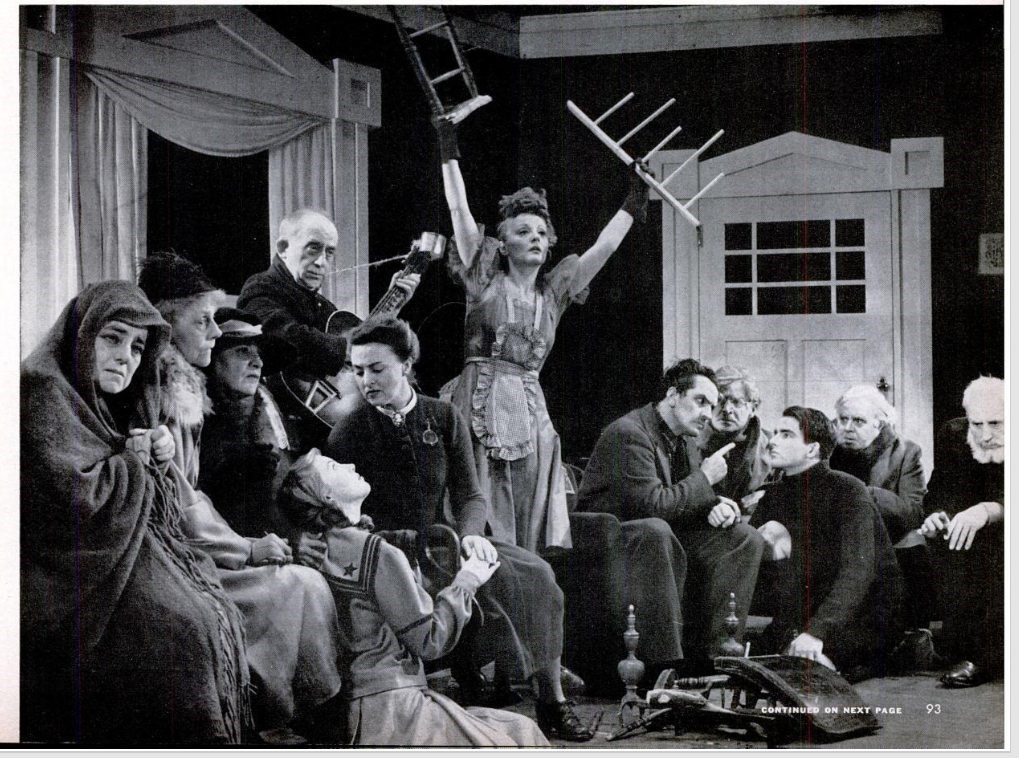
Scene from The Skin of Our Teeth2

“The ice age is coming, the sun’s zooming in.” A scene from the first act of Wilder’s  1942 “The Skin of Our Teeth.” That’s Tallulah Bankhead who’s broken up the chair for kindling.


Shakespeare’s winter song here is immediately preceded by another song in his play (the first song invoked spring.) Each song of the pair features a symbolic bird, and for this winter song we’re given an owl in its refrain,* a bird omen of unseen dread whose song, breaking with the Imagist show/don’t tell rule, is described as “a merry note.”

Merry? A little dark humor there I think. But even if that bird’s a bad omen, the fact that it’s singing means that it’s enduring. And the poem’s second and final stanza continues that theme of endurance. Everyone in church is sick and you can’t hear the sermon for the coughing (but coughing means you’re breathing, and who can tell how useful the sermon’s lesson might be anyway). The visible birds are hunkered down in feathers. There’s some crabs** sizzling in a bowl. There’s a fire. Tom’s brought more wood. There’s someone there to see greasy Joan cooking.

That refrain repeats and the song ends. Shakespeare’s play’s characters are kings, courtiers, and princesses and the plot their fancies. His actual world was full of war and deadly factions, brutal executions; a world of connivers, fools and tyrants, and even those who could combine all three. Yet, here he ends his comedy not with a wedding but with a song about modest endurance.

I think I lucked into this one this week. If one pays attention to this little song, it says something about those of us who are not kings or principal ministers.

Those who’ve endured my singing may be glad to hear this one is spoken word. The music is drums with a mix of four wintery synths played with my little plastic keyboard and MIDI guitar. The player to hear it is below. The full text of this short Shakespeare poem is here. I wish you the sustaining fires that are warm and illuminating, instead of the flames of fools.


*The refrain also features one of the more obscure words in the piece: greasy Joan is “keeling” the pot. I thought “stirring,” and there is some sense of that, though it may be particularly skimming fat off some stew.

**I thought of steamed crabs hissing, but if Shakespeare is remembering his rural Warwickshire it might not be seafood, but crabapples. Hot ale punch with floating crabapples was apparently a thing.

Winter Sleep

What age are we when we write poetry? What age should we be?

Poet Donald Hall while writing memoir in essay form after age 80 said that part of why he turned to prose was that after a certain age he no longer felt he had the urge to, or could, write poetry. I’m not that old yet, but after so many decades of writing poems I’m more likely to ask myself why this poem needs to exist.

This never occurred to me as a younger writer. It was enough that the urge was there, that the work of shaping it was rewarding, that the existence of some new set of words in some novel order representing a moment of experience had occurred. There are times when we may suppose this always is—at least approximately. We’re all our own first reader. For some of us, some of the time, our only readers. Even if we believe we’re writing a poem for someone else, that first audience is still inevitably connected with the poem’s creator.

I don’t know that there’s any pattern in that first audience disliking its own poem at times. Does one get better at crafting poems or observing experience with time? Does one get better at staying out of the way of the poem when that’s necessary? Does one get more preceptive at the ways the poem fails to meet, or cannot meet, some more perfect state? Does one just realize that some days you eat the bear, and other days the bear eats you?

A couple of years back I had some fun looking at a compiled list of the 20 most anthologized American poems of the modern era. Now of course such a list reflects any number of factors, some of which are extra-literary, such as prejudices, impact, and probably even some ivy-tower log-rolling. But still, these poems can safely be considered as successful with an experienced audience early in our century.

One thing surprised me. About half of these poems, the ones that are presumed to reflect the author’s masterpieces, were written in the author’s 40s. Six more were written in the author’s 30s. Just one was written by a writer past 50 (Elizabeth Bishop’s “One Art” published when the writer was 65). Only two were written by writer’s in their 20s (the list’s youngster was T. S. Eliot’s “Prufrock”,  completed when the author was 27.)

But how old were these poets in their souls of experience, the place from where they wrote these poems? It’s not unusual for younger poets to take on the air of more experienced people in their poems. This past fall we presented a couple of well-known and liked poems considered to be about old age: Rilke’s “Autumn Day”  and Shakespeare’s Sonnet 73 “Bare Ruined Choirs.”  Rilke wrote his autumn of one’s years poem in his 20s, Shakespeare’s was penned in his 30s.

Yet neither sounds false to this older reader.

Similarly, there are times when I’m writing that I feel younger than my years. It’s a commonplace that there’s a sense of play in the arts, something that past a certain age is increasingly rare to find in off-hand physical activity.

So perhaps you, like I, may feel unstuck in time when writing. Our writing may not be objectively timeless, but our mental flight seems so.

While thinking about these things this winter, I came upon this poem* that seemed to me to be a fine expression of the experience of old age experiencing the unsettledness of sense of age.

Edith M Thomas engraving

Edith Matilda Thomas. One thing I’ve found out: Emily Dickinson classmate Helen Hunt Jackson helped launch Thomas’ writing career.


There’s not much here today about the author, American Edith M. Thomas, who published “Winter Sleep”  in 1896, when she was just in her 40s. I don’t know that much about her yet. It’s strictly metrical and all rhymed up, but once or twice it seems to strain natural speech to make its rhyme and meter.

What’s impressive about it is that it strikingly presents not just old age, but the approach of death as an unstable state, the dream of life. This isn’t an “autumn of my years” poem—it’s a “winter of my years poem.” I immediately sought to set it to music for performance. To hear what I came up with, use the player gadget below.


*”Winter Sleep”  is another poem and poet I was introduced to by Poem-A-Day from the Academy of American Poets. Here’s a link to the text of the poem and you can sign up for Poem-A-Day there too.