Metaphors, implied or direct, are a form of an equation. If E=mc2 or 2+2=4 then should fog=little cats feet? Well, not exactly. But for some poems the metaphor, the image and “what it means,” is surprisingly equal at each side of the equals sign.
Here’s a poem that Ezra Pound included in the first Imagist anthology in 1914, written by someone we don’t normally think of as an Imagist, or even as a poet: James Joyce. While Joyce didn’t consider himself a member of the Imagist movement, his fellow Modernist Pound considered this work consistent with its principles.
Oddly, the case for Joyce as poet instead of the instigator of the modern literary short story form and the creator of increasingly avant-garde novels has been largely carried forward by folks (like me) who wish to combine words with music. The James Joyce poem I first knew, “Golden Hair,” came to me from Pink Floyd founder Syd Barrett’slovely setting written in the 1960s and used beautifully a decade or so ago to begin Tom Stoppard’s play “Rock’n’Roll.” Today’s words from Joyce, “I Hear an Army” was set to a complex piano accompaniment by famed 20th Century composer Samuel Barber along with two other Joyce poems as his 1939 “Three Songs” (Op. 10).”
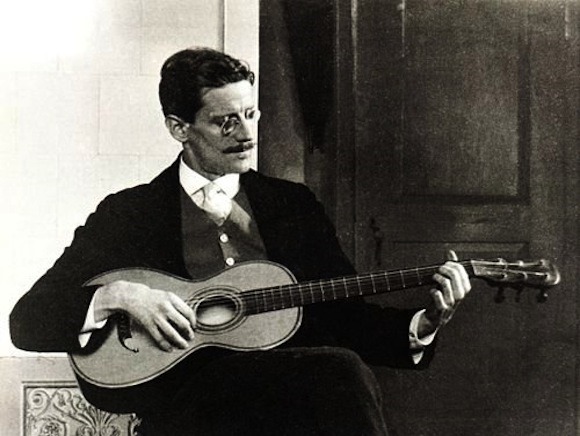
James “Blind Boy”Joyce kicks out the jams
As words, “I Hear an Army” is very musical (the consonance of “whirling laughter” alone is exquisite!), but that element wasn’t rated as highly by mid-20th Century critics who redefined poetry as a literature of complex and hermetic language. Still, its central image shows a bilateralism that I’d like to point out. I think most will see this first as a love song with a strong and strange metaphor of loneliness and separation from one’s beloved as feeling like the invasion of a grotesque and threatening army. Loneliness=as oppressive and overwhelming as an invading army.
But what if we reverse the equation? Is an invading army, this oncoming hoard, this force of arrogance, also like the absence of love, the sundered heart and the steeled will? Invasion, war=separation from love and our beloved—separation for not only the invaded but the invaders.
When an image can sustain this kind of bilateralism, it gains tremendous power. Maybe not mass times the speed of light squared, the force that hung over my youth, cleaving dreams, and whose blinding flame is seeking to haunt us again, but power none-the-less.
Vase or faces? Bilateralism in imagery.
Not to dis Barber, a giant, but I think there’s room for a different way to present “I Hear an Army” combined with music. If you use the player below, you’ll hear my original music for this, not Barber’s. Some take the Barber at rapid tempo, horses at full gallop. I don’t have a score to say what guidance Barber gave for that, but there’s a power in slowing dread—after all it’s a cinematic cliché to show an onrushing threat in slow-motion.
My predominant accompaniment for “I Hear an Army” is a vocal chorus using different vocal timbres, including a low part using Himalayan Tuvan throat singing where two pitches are sung simultaneously. Other than the two short rock band interludes, the only “instrument” used is electric bass.
November 11th was first celebrated as Armistice Day, the day that World War I ended 99 years ago. As wars—even World Wars—continued after that war, the day has been pressed into other service. In the United States it’s Veteran’s Day, a day to think of and thank those that served in the armed forces. In the UK and Commonwealth Countries I hear it’s celebrated as Remembrance Day, making it more akin to the US Memorial Day.
Because I like modern poetry, and the most recent poetry I can use freely here is from before 1924, and because we are marking the centennial of World War 1, I’ve performed a lot of things from the the WWI era here, including poems about that war. Since many of you are new to this blog (traffic has grown considerably since this summer) I’m going to take this day to point out a few poems about the experience of soldiering, many of which are written by the veterans themselves.
“On the Troop Ship to Gallipoli” has turned out to be one of the most popular pieces here. It’s my adaptation of a fragment written by Rupert Brooke. Brooke was a believer in the British cause in WWI, and this piece comes out of words he wrote shortly before his death of an illness he contracted while on the ship taking him to the front in Turkey. It’s a testament to people willing to put their life on the line for an idea.
“The Trenches St. Eloi” is nearly a dispatch from the front in poetic form. It was written by T. E. Hulme, one of the founders of Imagism and modernist British poetry, though his own poetry is less known than it should be. St. Eloi was a major front in the trench warfare that stagnated for much of WWI. Eventually elaborate tunnels were dug at St. Eloi by Welsh coal miners in hopes of gaining an underground advantage. Hulme was wounded there serving in the British Army, came back to England to heal, and then returned to the war where he was later killed in action.
“South Folk in Cold Country” was published in this form during the time of WWI, but it’s a translation (by Ezra Pound) of a work by classical Chinese poet, Li Bai. In it, the lot of the soldier sounds eerily similar to that Hulme was experiencing a thousand years later. Li Bai is the same poet that Pound used as the source for the more commonly anthologized poem “The River Merchant’s Wife.” Anthologies, and perhaps readers, seem to prefer love poems to poems about war.
“Christ and the Soldier” is by Siegfried Sassoon, who was a decorated hero of Britain’s army in WWI. However, he was at least as courageous in publically taking a stance against the war while still in service. A compromise was reached that he would be treated as a casualty of “shell-shock” at a asylum in Scotland rather than charged with treason or some other serious crime. Sassoon published poetry about the war during the fighting, but this one was held back and was not published until later.
As a break from the gravity of these men’s experience, let’s remember that the experience of soldiering, even in wartime, is not without absurdity. After WWII, several artists had a hit with a spoken word record written and originally performed by T. Texas Tyler called “The Deck of Cards.” And it’s been occasionally revived, slightly revised, for later wars—which is only right, as the original concept of the disreputable deck of cards that symbolizes what is holy goes back to at least the 18th century. The song’s performer usually follows Tyler’s model and says at the end of the piece that they know it’s a true story because “I was that soldier.” Well, Tyler wasn’t from Texas and I’m not even sure he served in the second great war, but its enduring popularity says that the story of a disrespected common man who shows the brass that he’s just as pious and knows a thing or two is just so satisfying. English songwriter Robyn Hitchcock performed a parody of Tyler’s song from a more Dadaist angle a few years back, and this is my version inspired by Hitchcock’s. I’m not a soldier, but the story is true: B. B. King did ride a bicycle out of the Mississippi Delta to Memphis.
Finally, a complete change of mood, and perhaps more in the Remembrance Day or Memorial Day spirit, but here’s Spanish American War veteran Carl Sandburg’s elusive elegy to the peace all wars fail to, “Grass.”
For reasons of copyrights, I’ve been focusing a fair amount here on using words from the most recent poems whose rights are in the public domain (pre-1924). One side-effect of that: during the run of this project we’ve presented a good number of poems about World War I, which I recently called “The last war covered by poets.”
So, we’ve had a poem from a man waiting to enter his battle: Rupert Brooke writing on the troopship carrying him overseas; and poems written from first-hand views in the trenches by Siegfried Sassoon, Wilfred Owen, and T. E. Hulme. We’ve had reactions to the war and its losses from Ezra Pound, Tristan Tzara and Carl Sandburg. William Butler Yeats, even in refusal, is writing a war poem of a sort, one I suspect has a hidden barb at the politicians’ war propaganda.
For the most part, the poems I’ve used so far would not pass as journalism. Owen and Sassoon use fantasy to illustrate the war’s folly. Pound, Tzara, and Sandburg tell of the subjective emotional impact of the war’s losses. But Brooke’s fragment has the power of a closely observed diary entry, and T. E. Hulme comes closest so far to a straightforward war dispatch with his compressed account of the front at St. Eloi.
Today’s piece, using words by F. S. Flint, comes closer yet. Flint, the man who urged the “School of Images” in pre-war London to hew to a cadenced free verse, felt that verse and prose existed on a smooth and unbroken continuum, that good writing was good writing, regardless of the label on the tin.
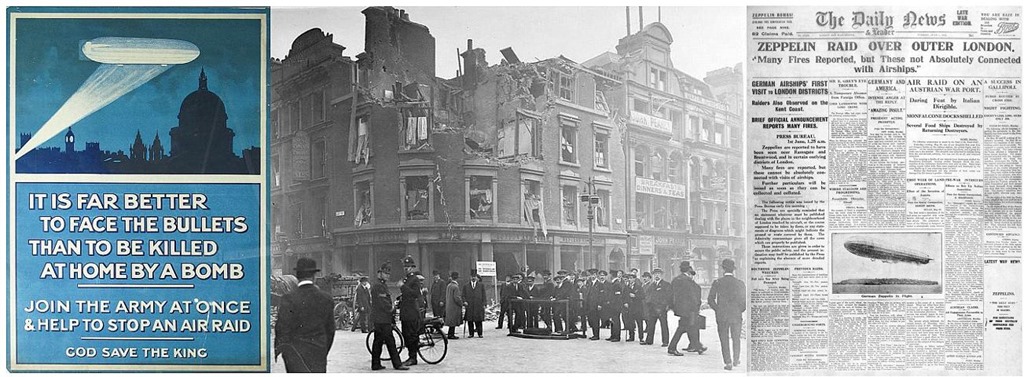
Besides being present at the birth of Modernist English poetry, Flint also was in the right place to witness another Modernist invention: aerial bombardment of cities. It’s little remembered now, but nighttime terror bombing of London was not an invention of Hitler’s air force in WWII—it was, instead, first carried out by Zeppelin airships in World War I.
Flint’s report, though artfully framed with its first-person account of being awakened from sleep in medias res, and ending with a surprising and telling conclusion, includes enough exact detail to say that it describes the first of these London raids on May 31st, 1915.
1915 reactions to the London Zeppelin raids of World War I
It’s a gripping account, no less than if it had been filed this year in Syria or somewhere else were bombs fall on civilians in our time. If you’d like to read “Zeppelins” on the page, here’s a link.
Does the element in Flint’s work of mere journalism detract from its “poetic” qualities? The romantic element would say yes perhaps, there is no other “realer, now revealed” world invoked, no intense yoking of disparate images or modes of perception (although I would maintain it does just that in a subtler way). More elaborate language, more elaborate metaphors could decorate this. Picasso’s “Guernica” is the same subject, painted decades later, but it’s also more worked out as a cubist statement.
In a sense this question is like a question I wrestle with here as I contemplate the Parlando Project which combines music with words. Does the addition of a substantial thing to something else: in the case of Flint’s “Zeppelins,” documentary, journalistic facts to modernist poetic imagism; or in the case of my Parlando Project pieces, music and performance’s addition to what is often canonical page-poetry—are those things additive, making a greater sum—or do they, paradoxically, detract, diffusing or de-fusing the impact of the uncombined thing.
Or are these questions of art a sideline here? Do Henry and Caroline Good, dead of flames and smoke in their bedroom in that night in 1915, or Leah Lehrman, age 16 killed by a Zeppelin-dropped bomb explosion care? Do we appreciate that we live now and ponder these questions?
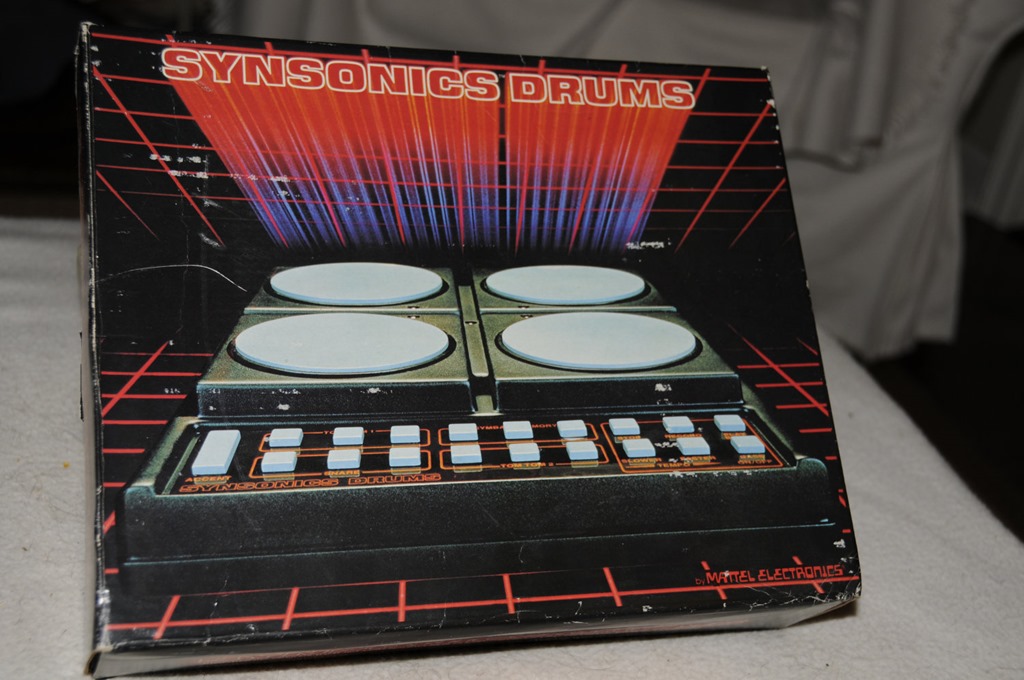
Later that same 20th century, my first drum machine.
In writing and performing the music for Flint’s “Zeppelins,” I wanted to lean toward Techno a bit. I avoid drum machines these days and work hard to humanize my beats on most pieces. Back in the 20th Century I used machine beats, they were all I could afford, and now in the 21st, no matter how skillfully deployed, they remind me of those crudely resolved sounds, a make-do. My 12 year old son however enjoys them, the blippiest tracker pieces or a SID chip 8-bit beats please him with their antique charm. Then listening to Weekes new single this weekend reminded me of that charm (and made me wish I could sing better). So I gave it a go.
You hear my performance of F. S. Flint’s “Zeppelins” right here with the embedded player below. If you can’t see the player gadget, this highlight hyperlink will also play the performance. Something about those later 20th Century sounds just seemed right for an early 20th Century piece to me.
I was talking with my wife this weekend. She’s reading a memoir about current military deployments (and redeployments) and she said a Wilfred Owen poem was mentioned in it.
“Well, World War I was the last war to be covered by poets.” I replied. Which is not strictly true of course. World War II generated a number of poems I’d love to share here, but I have no time to try to track down the rights issues to use words that still may be under copyright. And I suspect other wars have generated other poems since then, even if I don’t know many of them. But that’s not what I meant.
World War I was the last war to be covered by poets.
What I meant was that WWI was the last war in which a considerable portion of the English-speaking public looked to poetry for meaning and consolation regarding the battles and their losses. I’m not sure if they looked to poetry more than journalism or political oratory, but I believe that poetry then still operated somewhat in the same theater as these other words when addressing current events. Longer forms of literature, such as novels, tend to lag events substantially, changing or fixing our view of things afterwards, instead of framing it while the picture is still moving. I think of two epithets, for journalism and then for poetry: “The first draft of history” and “The news that stays news.”
I think of two epithets, for journalism and then for poetry: “The first draft of history” and “The news that stays news.”
This morning, my son wanted to show me this brilliantly parsed cartoon summary of the Iliad. The narrator there has a lot of fun with the meandering and seemingly arbitrary plot of that Greek epic poem, but it struck me that it’s possible that the ur-version of the Iliad might have been written contemporaneously to the events, only to be shaped afterward like a collection of old news dispatches repurposed for later use.
So, this is a long tradition in Europe from Homer to the war poets of WWI, for the battles and the experience of the battles being reported in poetry.
Why has this use of poetry, to report current and crucial events, fallen away? The first explanation that occurs to me is we have other media to do this now. Film, radio, video, and now cellphones capture the moment without pretending to rely on subjective art. The Imagists who forged their poetic theory in the years around WWI, would seem to have lost their territory as their theory won the war. A cellphone or nose-cam video of the bomb exploding follows two out of the three famous Imagist rules: The “thing” is treated directly, there are no unnecessarily words (indeed there may be no discernable words at all), while more or less ignoring the less-noticed third rule (the one we at the Parlando Project keep pointing to and speaking about), the one that asks for musical phrasing.
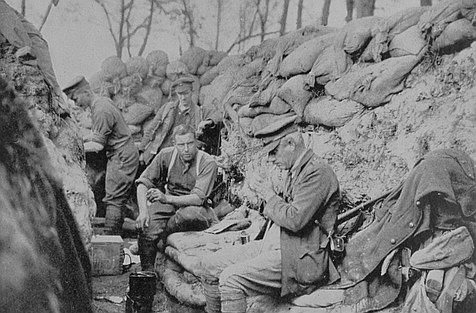
This photo shows men in T. E. Hulme’s Artillery company at St. Eloi in 1915
Poetry, like painting, is no longer necessary for reportage. Modernists often chose to respond to this by a movement into abstraction, conveying thoughts in motion and novel conceptions, seeking to demonstrate what can be meaningful without meaning.
Today’s piece “Trenches: St. Eloi” is attributed to T. E. Hulme, a man who helped form this Modernist revolution and died before he could live in it. I say “attributed” because, like Homer, he did not write it down. The exact attribution is “Abbreviated from the Conversation of Mr TEH” when it was published by Ezra Pound, and it may have been Pound who chose what to transcribe or how to lay out the transcription. My guess is that some of the language sounds like Hulme (the unusual, but so perfect word choice of “pottering,” the homey image of trench soldiers strolling compared to the shoppers on the busy London street of Piccadilly), but the overall arrangement sounds like Pound to me.
We know pretty much the where and when that is being talked about, more than we know of the actual history of Troy. Hulme got a chance to relate these details while in an English hospital after being wounded in the spring of 1915 in trench warfare in St. Eloi. He recovered, returned to the war, and to his eventual meeting with a German artillery shell that ended his life.
T. E. Hulme may have said it, Ezra Pound may have edited it and written it down, but to hear me perform it with my musical accompaniment, use the player below.
Here is one more war poem from WWI, this one by another soldier poet, Wilfred Owen.
Beside living with the trauma of his war service, Owen was another poet caught in the revolution as English poetry moved from old modes to newer modernist verse. Like his friend Siegfried Sassoon, he was a decorated soldier who came to broadly distrust the case for war. Unlike Sassoon, Owen did not take the risky public stand against the war while it was being fought; but also unlike Sassoon, his fate was to die at the front of the war. Owen’s war poetry was largely published after his death, with Sassoon’s assistance and promotion.
Wilfred Owen: poet, soldier, witness to warfare
If WWI was billed as the war to end all wars, the anti-war poetry Owen and Sassoon wrote also spoke to universal themes. At least to what I’ve read, their poetry is not an argument against specific issues of their war, rather it’s an angry argument against war itself, and the associated patriotic justifications for sacrifice. Owen and Sassoon both wanted to rub their readers faces in the bloodied mud of the trenches.
It’s sometimes said that artists, if only they would happen to suffer the real struggles of non-artistic life, would see that art is only a trivial sideshow, inessential entertainment and decoration. Men like Owen are an example of how this is not necessarily so.
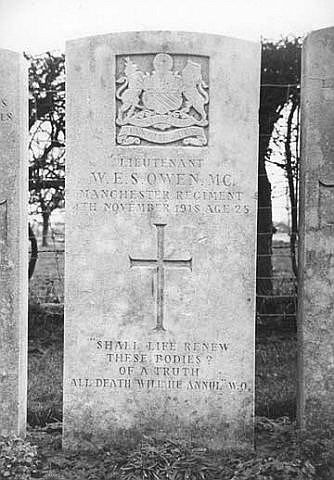
Wilfred Owen’s gravestone
Today’s episode, “Strange Meeting,” shows Owen’s anger, but because he’s a poet not yet fully in the 20th Century style, he expresses it sounding like a 19th Century poet, more like a Keats or early Yeats. As I came to grips with this piece, I felt the thought and subject matter was sometimes obscured by its march of rhymes and occasional poetic diction—and though a poem’s music is subjective, “Strange Meeting” doesn’t consistently sing to me like Yeats does, but then Yeats is a very high standard to meet, and Yeats never lived the brutal fighting the war poets like Owen went through.
Speaking of music, I’m finding myself repeating ideas (or finding a style?) with the settings lately. “Strange Meeting” starts with sustained piano chords, unsteady strings, and a plaintive wind instrument (in this case, an English horn). But I felt that carrying that all the way through would work against the grit and bitterness of the story here, just as Owen’s poetic diction does, so for much of the middle section I break it down to just drums and bass.
I hope I’m not overwhelming regular listeners with the war poetry from WWI this month. Perhaps I can find a change of pace soon, and some new variations in my musical arrangements too.
To hear my performance of Wilfred Owen’s WWI ghost story “Strange Meeting,” use the player below.
I don’t plan on making a habit of this, but the next morning after I posted the audio piece where I perform an “Imagist” revision of Rupert Brooke’s late fragment written shortly before his death while serving in WWI, I wanted to change a few things about the mix.
Soldiers on a World War I troop ship in transit
What’d I change? I delayed the entry of my piano part to a few bars later. I remixed the concluding electric guitar part entirely, it’s now a bit more forward in the mix. And finally I added an E-Bow electric guitar top line over the final section. Why did I make those changes? Just trying to give the piece a bit more sense of “build” as the troop ship steamed along carrying Brooke and his fellow soldiers to the disaster that would be the Gallipoli campaign. The newly added E-Bow part is probably the biggest change. The E-Bow is a clever gadget that magnetically drives a single instrument string as if it was excited by a bow. As the name suggests, it’s sometimes used to give the effect of violin or viola sound coming from a guitar—which Jimmy Page and Eddie Phillips aside, is not designed to be bowed, however I think the part I played sounds less like a orchestral violin and more like an overblown free-reed instrument.
In composing the music for the Parlando Project pieces, I like using different sounds like a writer might use different images or connotative words in text. If you listen, low in the background of the mix I have a Mellotron flute part. Of course this late 20th Century instrument would not have been known to Brooke and his fellow troops, but for those late 20th Century people a low Mellotron flute part brings to mind (ear?) The Beatles “Strawberry Field Forever” or “Lucy in the Sky with Diamonds” or other English rock band recordings of the 1960s, so I was trying to bring in some sense, however anachronistically, of the soldiers thinking of home, and then at end I add that much louder, strident and free-reed sound from the E-bow guitar part. Similarly my fizzy guitar phosphorescent plankton bow-wave and electric bass thrumming ships engines. Hope it all works for you.
The new mix replaces the old one as of early this morning. To make it easy to hear the new mix, I’ve embedded the player to hear “On the Troop Ship to Gallipoli” below. The explanation of how I revised Brooke’s words, as if he’d been edited by Ezra Pound or had lived long enough to embrace the ideas of modernist poetry, is covered in the previous post here.
In the past few posts I’ve mentioned how Ezra Pound was more than an exemplary writer, theorist, and promoter for the early 20th Century modernist poetic movement that he called Imagism. He was also an excellent editor.
His most famous blue pencil job remains T. S. Eliot’s “The Wasteland,” but he also worked with H.D. and Ernest Hemingway, teaching with his editing how to pare away extra words, overused similes, and extraneous authorial sentiment. And once shown, those writers we able to use Pound’s insights to do the create their own pared down, modern styles.
In the last episode, I noted that Pound had been critical of some WWI poems written by Rupert Brooke. Here for example is the first part of Brooke’s most famous war poem “The Soldier:”
If I should die, think only this of me:
That there’s some corner of a foreign field
That is forever England. There shall be
In that rich earth a richer dust concealed;
A dust whom England bore, shaped, made aware,
Gave, once, her flowers to love, her ways to roam,
A body of England’s, breathing English air,
Washed by the rivers, blest by suns of home.
Written as England entered into WWI, and as Brooke himself rushed to enlist, this poem was embraced by a patriotic public almost immediately. If one shares it’s sentiments, the actual technique of the poetry probably admits no impediments to a reader, even today—but ask yourself, does it have a sense of actual immediacy? As you read, do you share with a fellow human, feeling, seeing, smelling, this experience? What I get as I read it is a thought, where a soldier thinks that if he dies in battle and his body rots overseas, that his body will homeopathically retain its English birth and experience, and that experience, it is inferred, is worth dying for. Why? Well because the poet says so, and he says it with rather polite poetical words. “Die” and “dust” are perfectly good, simple words, but as a description of death and decomposition, they are surrounded by forevers, flowers, air, rivers, and sun—all presumably sweet and genteel.
Rupert Brooke died at age 27 of an illness he contracted while on his way to the Gallipoli campaign in his war, but what if he, like Yeats, had continued to live and react to the developments of his young century? And what if Ezra Pound had gotten a hold of him and showed him how to punch up his verse?
Today’s piece shows what could have happened. One of the last things Brooke wrote was this fragment written on the troop ship in the month he died. Here’s the original:
I strayed about the deck, an hour, to-night
Under a cloudy moonless sky; and peeped
In at the windows, watched my friends at table,
Or playing cards, or standing in the doorway,
Or coming out into the darkness. Still
No one could see me.
I would have thought of them
–Heedless, within a week of battle–in pity,
Pride in their strength and in the weight and firmness
And link’d beauty of bodies, and pity that
This gay machine of splendour ‘ld soon be broken,
Thought little of, pashed, scattered. . . .
Only, always,
I could but see them—against the lamplight–pass
Like coloured shadows, thinner than filmy glass,
Slight bubbles, fainter than the wave’s faint light,
That broke to phosphorous out in the night,
Perishing things and strange ghosts–soon to die
To other ghosts–this one, or that, or I.
What can I, acting as Pound might have, do with this? Well first I can locate the charged images in it, hidden as they are inside Brooke’s extraneous comment. What are they? The soldier pacing at night on his troop ship. He’s staring back inside the ship, looking at his fellow recruits on the way to their first battle. If we have any empathy as readers, we don’t need to be told anything about what he’s feeling if it can be conveyed by what he’s seeing. What are our charged images? The troops are playing cards, games of soldier’s chances. They can’t see the poet, and he can see them only imperfectly, backlit by uneven lighting, “coloured shadows,” which is a great image obscured by all the muck about it. And he sees the faint light of a wave’s phosphorescence as bioluminescent plankton are sweep aside by the wake of the ship. The soldiers, and the poet himself, are already in the course of war, like ghosts, fleetingly seen, or only partially and incorporeally seen.
Have you tried the exercise where you make a poem by taking a marker and blacking out most of page of text, revealing a poem could be in what remains? That’s like what I did with Brooke’s fragment:
On the Troop Ship to Gallipoli
I strayed about the deck, an hour,
Under a cloudy moonless sky.
Peeped in at the windows,
Watched my friends
At table, playing cards,
Standing in the doorway,
Out into the darkness.
No one could see me.
I could but see them
Against the lamplight,
Coloured shadows,
Thinner than glass.
A wave’s faint light,
Broken to phosphorous.
Perishing things and strange ghosts
Steaming to other ghosts,
Only, always.
I removed over a hundred words that didn’t need to be there, which covered up what did need to be there. I don’t need to say that these things relate to each other, putting them in a short poem together makes that clear. I added only one word, choosing to add “steaming” instead of just “to other ghosts” because it’s an action word, and because “steam,” though active and industrious, is another thing that dissipates and disappears.
I have two unfair advantages over Rupert Brooke as I transformed his words. First, he died in service to his country shortly after writing this, so he didn’t have the chance to revise his fragment. Secondly, the place he was going, Gallipoli, and the outcome for so many British and Commonwealth soldiers who were deployed there is now infamous for poor tactics and horrendous casualties. I can simply use “Gallipoli” in the title and magnify the dread of soldiers on their way to battle.
Today’s episode is dedicated to Julie Shapiro, who introduced me to Eric Bogle’s “The Band Played Waltzing Matilda.” This is a song about Australian troops at Gallipoli, and though I can link to one of my favorite singers, June Tabor’s, version of it, there is nothing but my memory to testify to the devastating version Julie used to perform.
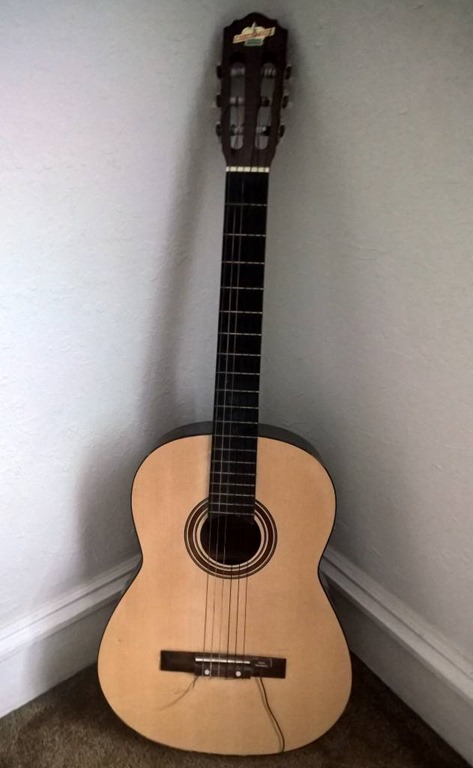
My first guitar, purchased for $40 in 1974, and played on today’s audio piece
Long post again, no time to talk much about the music for this performance. Perhaps I don’t need to tell, you just need to hear it. Use the player below then for my performance of a revised fragment by Rupert Brooke.
Here’s one more piece from Ezra Pound’s 1915 breakthrough collection “Cathay,” a war story he called “South Folk in Cold Country.”
At the time Pound was working from Ernest Fenollosa’s, and Fenollosa’s Japanese teachers,’ notes to translate classic Chinese poetry, World War I had broken out, and England, where Pound was living, had mobilized to fight this war. Like William Butler Yeats (with whom Pound was staying for part of this time) Pound did not want to take a side in the war. Not only skeptical of the war’s patriotic rationales, Pound also wanted to continue to focus on his modernist artistic revolution.
Earlier in the Parlando Project, we’ve seen how Yeats responded at the beginning of the war. His “On Being Asked For a War Poem”cloaked his disdain for statesmen’s’ rhetoric while seeming to take a aesthete’s stance of artistic superiority and inferiority.
Robert Frost needed to get to W. B. Yeats house,
so a helpful Ezra Pound drew him this map.
Pound felt similarly. He may not have been sure, at first, of the what he would eventually call lies by the politicians by the end of the war, but his poetic BS meter was immediately sure that the patriotic verse being produced to ennoble the war was false ethically and artistically. But Pound also recognized that any poetry he would write in such a charged environment would be inescapably seen in the context of the war.
Still, he was wary of writing about war as a civilian who had never fought in battle. At one point, he reported he had tried to enlist, but was turned down due to his (then neutral) American citizenship. At another point, he wrote a review critical of Rupert Brooke’s war poetry, only to have Brooke, who was serving in the British armed forces, die while in service, leading Pound to qualify that he was only criticizing the poetry, not the citizenship.
So as Pound created and promoted Imagism, his vision of new modernist poetry by recreating classical Chinese poetry in English, he came upon a solution. He would use the Chinese poets, both as the model for his new kind of verse and as a way to comment on the war.
Today’s audio piece is an example of how Pound went about those two things, once again translating and transforming the work of 9th Century Chinese poet Li Bai.
“South Folk in Cold Country” is an account by Li Bai of a military campaign in the north of China that had occurred almost a thousand years before he wrote. Pound, taking this for his modernism, has the soldiers who speak of their war experience say nothing of what they are feeling. There is not a word of them saying they are tired, confused, frustrated, or suffering, but their world is described by them as the image of all these things. While Li Bai/Pound’s “River Merchant’s Wife” reads musically off the page, despite being “free verse” in English, “South Folk in a Cold Country” has a more abrupt and doubtful music. Pound was trusting Li Bai and his own artistic sensibilities so that he might get some of the war experience right.
When I first read “South Folk in Cold Country” this year I thought: this sounds like a bag of fortune cookies mixed in with Ernest Hemingway. Either or both of those comparisons may sound dismissive to you, but I suspect the best fortune cookie aphorisms have some relationship, however strained, to the concision of classic Chinese poetry, and Hemingway, however familiar he may seem to us now, was using Pound’s ideas as part of what was to be Hemingway’s revolution in prose. Thanks to Hemingway, and in turn, to Pound who directly influenced and taught him, we now are not surprised by representations of war, violence, and death that assume concise description and charged observation can be truer than superfluous remarks by the author.
Hemingway, who did serve in WWI, sought out Ezra Pound to shape his writing about it
I did wonder about the General Rishogu mentioned at the end the piece. His Chinese name (remember, Pound was working from notes of Japanese scholars, not Chinese ones) was Li Guang, and his story is here. I like this as an ending. I’m not sure if Li Bai’s soldiers who speak in this piece are using Rishogu/Guang as an example of the hard fate of soldiers; or if they are saying, after what we’ve been through, making all those rapid marches to make Rishogu/Guang’s name, who among them will care about the general’s death. On the odds, I’ll take the later.
Musically I used some relentless vibes over electric piano and bass to stand for the rapid marches that the “swift moving” general kept ordering, and then some neighing winds from a synthesizer patch. To hear me perform “South Folk in Cold Country” with that music, use the player gadget below.
Today in the United States is Independence Day, a day celebrated with summer cookouts and fireworks explosions. Like many obligatory holidays in our modern age, what we are celebrating becomes obscure. Yes, Americans know it’s Independence Day, but what we think of as we celebrate is a mélange of things.
What makes up this celebratory mixture? We celebrate the warmth of summer, particularly here in the northern parts of the US where eating outside is a special season. Our children are celebrating what still seems like an endless summer away from school. Stores have banners of firecrackers and flags luring shoppers who have the day off from work. And we celebrate a diffuse patriotism affordable because America is a preeminent, powerful nation. Our modern patriotism is not short of convictions—far from it, our country is prominently divided by convictions—but that too is possible by the relative wealth and power of today’s America.
“Yes, treason against the crown and the divine right of kings, and we could all hang tomorrow,
but can I add a part about dispensing with the noisemakers? I could use a little sleep tonight.”
But the event we are celebrating is a sharp and definite thing. 241 years ago a group of Americans started an anti-colonial movement, and in the furtherance of that, they soon were to found the first modern republic. Those who did this many years ago perhaps did not know, or even think of themselves as anti-colonialists. Some merely had issues with particular colonial authorities and decisions. Some were indeed bound up in an immense evil of colonialism, human slavery exploiting yet other peoples and nations. Still, we should seek to understand them as their idea became understood through the Declaration of Independence they signed today: that the rights of kings and empires were not heaven’s design—rather, human rights were.
And as their rebellion against kings and empires evolved, it strikingly lead—not to the setup of a new king, or a new, locally-sourced strongman—but to a new form of government, a republic. Once again, these were not perfect men—their government “Of the people, for the people” was at first for white male men of property—but they were men of such devotion to the republican idea that they would not let even the worthiest of their lot become king. That was unprecedented, and even in all the time since, not one in ten or one in a hundred rebellions immediately ends in such a way.
I know not all who read this are Americans, but those are the two remarkable things that we celebrate here in my country today. And of these two things, the second is the most rare, and the thing we must take care to carry within us: that winners are not rightfully kings.
That reminds me, there was another Independence Day tradition, one that has fallen by the wayside: the patriotic speech in the town square. I guess I’ve just revived that. Today’s audio piece is based on another text by Dave Moore, but it’s my music and performance of it. When I asked Dave about “Implications of Fireworks” a few years back, he indicated it was more or less a diary of his impressions of a July 4th he had experienced. As filtered by Dave’s mind that day, those holiday explosions, cracks, and meat smoke brought different, less celebratory, feelings. If our independence was won with cannon and gun fire—if it’s maintained today by the same, and also with bombs made of seeds of sunfire—it is also must be maintained by, and be for, something more than that.
To hear my performance of Dave Moore’s “Implications of Fireworks” use the player below.
In the last post, I presented Ezra Pound’s rant about the society that lead so many to their deaths in WWI, deaths that included several of his own modernist artistic circle. Taking it personally, Pound exclaims that their “fortitude as never before” for change and their “frankness as never before,” lead only to equally great “disillusions”. He sees lies and liars leading others into the war and their sacrifices, and only liars as triumphing.
Speaking repeatedly about liars and lies and illusions, Pound’s “These Fought” would not be a very popular choice for a Memorial Day speech then, just as it probably would not be one now. If you agreed with him, you might enjoy his precise inventory of folly. If you didn’t, you’d say he was unappreciative of his friends (and so many others) sacrifice, and that his disbelief in the stated high motives for the war could be mere cynicism. I can hear what some voices must have said then (and would say now): “You can complain about what is imperfect, perhaps even foolish, but what’s your solution, other than to stand to the side and write poems?”
Alas for Pound, he did propose a solution. It was a solution chosen by many others disappointed after WWI, a fresh modernist conflation of race hate, nationalism, technology and authoritarianism, the fascism that lead to WWII.
What place is this? Where are we know?
Today’s episode: “Grass” by Carl Sandburg is just as pure a modernist, imagist poem as any by Pound, but it’s statement about the sacrifices of war is more indirect.
Sandburg has a reputation as a clear-spoken poet who makes his points straightforwardly, as if plain words mean simple thought. I believe this is mistaken. Sandburg’s mind was not a simple, unicameral mind. Sandburg was leading multiple lives at once during the WWI era. He was writing, sometimes under a pseudonym, for radical leftist/labor IWW publications, while writing for the mainstream Chicago dailies, while writing modernist poems. When Sandburg was protesting the jailing of IWW antiwar activists, and writing today’s compressed, Imagist, “Grass,” Sandburg had also published a long, Whitmanesque populist and blood-thirsty poem “Four Brothers” lauding the urge of Americans to go overseas and put the German Kaiser’s head on a pike. “Grass” too has its echoes of Whitman—not the martial revolutionary Whitman, but the Whitman who wrote of grass as “the beautiful, uncut hair of graves.”
So, this is a complicated and perhaps self-conflicted man who is writing this, and when we move in “Grass” from the catalog of history’s deadly battles, ending with two great battles of WWI, Sandburg’s poem takes a turn.
In two years or ten years, what is this sacrifice? In“Grass” the places of these battles become nowhere. Is this a hopeful statement, that after this “War to End All Wars,” we will now be able to forget war? Is this an anti-war statement that would say, as the radical Sandburg or Ezra Pound would have said: that after all such strife, the liars and those that run things will continue to run things anyway, as if the war settled nothing? Is it a statement of reconciliation to come, when elderly soldiers from opposing sides meet and speak of their common experience and equally lost comrades? Is this a statement of the democratic socialist Sandburg, that the forces of inevitable Marxist proletarian revolution will come and obsolete all that was before? Or is it a cool and detached statement that all human efforts are transient?
I don’t think it’s an accident that this divided man wrote a poem about the sacrifice of war that lets it be all those things.
To hear the LYL Band present Carl Sandburg’s “Grass,” use the player below.






 Frank Hudson
