Today’s piece is a fairly well-known poem by the Spanish poet. Given that I’ve played guitar nearly for 50 years and been interested in poetry for more than that, I keep thinking I must have run into it before this year. If that’s so, why don’t I recall considering it?
My answer is going to sound more judgmental than I mean it: bad translations. No, maybe I shouldn’t use “bad” here. I don’t suspect any moral failing or lack of effort by translators of this poem. And given that I’m not all that knowledgeable about the work of Lorca and have only the most limited grasp of his native language, I should have no standing to rate other published translations of “La Guitarra.” What I do know is that native speakers find his poetry passionate and vivid, and the English versions seem to my ears and heart (those being the entry points for poetry) stilted and muffled.
I’m not going to link any of the English translations I found of “The Guitar.” None I’ve seen seem fully effective to me, though I cannot say that they might be effective for others. I’m not going to link or line-by-line dis the translations I’ve seen. I will say that the first one I saw at one of the leading poets and poetry organization’s site was representative. I didn’t find it musically compelling, and it was a jumble of abstracted images that had little sock, little immediate feeling evoked. I assume the translator had the advantages I must clearly concede I don’t have. Why might their work not succeed, at least to this reader?
Two theories. Other translators may have been too literal in carrying over Lorca’s original sentence structure, which might be natural and unaffected in his Spanish. This is poetry, so one can make a case that how it’s said is essential — but when languages order words differently, following the original sentence structure and word order too exactly damages the natural vividness of a person speaking. Secondly, Lorca to my slight knowledge connects to Surrealist expression, a style of poetry I loved as a young man and still like to connect with today. Surrealism likes the wild and incongruous image; and from its ancestor Dada, it’s often willing to take an image in a random, raw and undercooked state. This creates a problem for me when I translate Surrealist and Dada work.
You see, I view my task as a translator to primarily find the images in the work and to then portray those images in clear modern English, and secondarily give the poem a word-music in the new language that gives pleasing movement and return to the poem. What if the original intent was to mystify the reader, to present an image that was intentionally confounding? I risk, while puzzling out the text in a language I don’t know well, to over-simplify or over-determine an image. I fear embarrassment of doing that, but I think it’s the better risk because vivid images that the reader/listener grasps and gasps are compelling to me.
As to the word-music, my version of “The Guitar” rephrased Lorca somewhat, aiming to make him sound like an English speaker. While doing that I tried to make the poem musical in English. The poem was already using repetition for poetic effect in Spanish, and I added just a touch more.
As you might imagine, this poem about the expression of a musical instrument has been set to music before my attempt you can hear today. While not a Lorca expert I know that he connected too with Spanish Deep Song and the evocation in that tradition of “Duende,” a difficult to translate term that some Afro-American musicians have seen as analogous to the Blues. I played a nylon string guitar for my setting, the type of guitar associated with Spain, and the simple chord progression I used would not be foreign to that tradition. But both from my skill level and inclination what I played for this song was simple and sparsely ornamented. Though the harmony wasn’t Blues, I approached playing this as if it was American Blues. Another Blues element I introduced that wasn’t in Lorca’s poem: my version has a gendered call and response. The guitar is a her, the singer (there’s no singer in Lorca’s poem) is a he.
A three-part post today — let’s see how short I can keep it, though we’re going to go far. Read on and we’ll leap from an important artistic movement whose poetry is forgotten, to the case of the odd filtering out of a woman artist from that movement, to some notes about translation and musical composition — and in the end to a remarkable trick, an April Fools’ joke of a sort I played on myself unconsciously.
Canons
It’s weird sometimes trying to figure out whose work gets remembered. It’s too much to ask for there to be some fair-minded, objective, and well-informed process of experts weighing the canon as our caissons go rolling along. Instead, quality and salience is supposed to just emerge. Emerge from what? Taken, via circular reasoning, from that memory. This sort of works, though how we know how well it’s working is hard to explain, as it may not consider those we aren’t as a culture considering. Canons have always changed — it’s ahistorical to say they haven’t, and when did we agree that history stops?
Dada poets are under-considered — or if they are, it’s as a conceptual statement more than a considered poetry. Visual arts will always include a Dada piece when discussing Modernism, literary arts are much less certain to. Dada’s evolution into Surrealism makes it almost easier to leave out Dada poetry. Dada poetry can be seen as the rough demonstration, the provocation that initiates a disruption.
My idea of presenting a Dada piece today comes out of an idea as question I had: “What can I do for April Fools’ Day?” Dada can be seen as an April Fools’ Joke. How so? Let me invent a manifesto of Dada that no Dadaist is likely to earnestly write as it violates the concept of Dada:
Much of what we’ve been given as meaningful can be seen in the human predicament as useless, maybe even harmful. Yet, we’re constantly being fooled with the trappings of power and precedent. Arbitrary examples of meaning, truth, and rules, dressed in the right costumes, framed in the expected way, keep us susceptible. So let us show how the trick is played and laugh at its absurdity.
Art Movement — and also the structure of an April Fools’ Joke.
Therefore, Dada presented poetry — a literary form we believe must be meaningful because it’s beautiful — that was random, perverse, taking the forms and frames of meaning while eschewing that meaning. Surrealism later posited meaning — or perhaps more exactly, the experience of art including poetry — as being above and beyond logical, conventional rationalizations, but the way was cleared by Dada’s withering can(n)on-fire that made merciless sport of the idea of hierarchical poetic meaning.
Still, we’re more comfortable with the idea of looking at the urinal/fountain or bicycle handlebars above a bike seat and seeing a worthwhile experience than we are looking at a series of chaotic words uttered incongruously as poetry. The first is a gentle poke in the ribs, it can easily elicit a pleasurable “See that?” The second worries us more, how should we take this? And the connection of denotative meaning (even an elusive one) that we rely on to carry us through an assemblage of words, is it indispensable? Is reader/listener boredom a legitimate artistic response, or one we’ll long endure?
The questions in some Dada poetry are valuable. The answers, not always so.
Emmy Hennings, forgotten because she was a Dadaist and because she wasn’t a Dadaist
Earlier this week I set myself a task to look at some Dada poetry to see what I could present here. I came upon a handful of poems by a name I believed I’d never seen: Emmy Hennings. I’ve retrospectively rechecked a couple of books I’ve read on Dada/Surrealism and I found my memory faulty. Hennings’ name was mentioned, but the context of those mentions didn’t make her seem anything like a key player. She was the partner and wife of Hugo Ball, a big macher in Dada, and consigned as a peripheral helper/muse/hanger-on. She did perform (from the very first Cabaret Voltaire performance!) but she was often characterized as a “music hall performer,” the kind of conventional entertainment that wasn’t what Dada was about. The supposition was put forward by the avant-garde that she was an interloper tempting Ball and the Cabaret away from real Dada into some kind of bourgeois, conventional performance career.
On further examination, there’s a case that she’s been underestimated.
Just kids. 1913, three years before the Cabaret Voltaire, but Emmy looks to me here like this could have been taken in 1975.
.
Looking over her poetry in a handful of human translations and quickie machine translations from her native German, I was immediately drawn in. It showed that essential Dada tactic as stated many years later by American Dada composer Frank Zappa: “Anything Anytime Anyplace For No Reason At All.” It also contained German Expressionist poverty-stricken darkness — and yes too, an element of erotic romanticism, though in the context that element was being set in place against the rest, implying criticism of it. Downrating her including music hall and folk song in her Cabaret Voltaire performances would seem to leave-out the case for Hennings consciously creating a Dada collage. If you put disparate things together as part of Zappa’s AAAFNRAA, those elements will talk to each other when viewed as one thing.
Here’s a secret factor most artists remain loath to admit: the random, or even the most carefully constructed miss-matches, can generate meaningful perception in the human mind. Yet Hennings didn’t write unalloyed gibberish, though outlandish collisions were allowed. She sometimes writes in a manner I recognize from later Surrealism — although from a woman’s mind and experience, a vantage point the Surrealists were loath to admit into their boy’s clubhouse.
Reading more about Hennings, I could see a rich collage of biographic and aesthetic components to her art.* I tried to sum that up to my wife by describing my emerging conception of Hennings as “A WWI sort-of Nick Cave: dark outlook, opiate addiction but hard working, catholic mysticism encrusted, mixed with elements of power-observing romantic eroticism.”
I already had a rough performance mix of the musical composition used for today’s piece before any of these Dada and April Fools’ ideas. I composed it using four new “virtual instruments”** that were newly available to me: a viola da gamba, a hardanger fiddle, a singing voice, and something that called itself a dulcimer.
I love bowed strings, and the somewhat rare and archaic viola da gamba is one that has long interested me, an interest that was sustained by once having a co-worker who played the instrument. The VI is a bit harsher sounding than hers (she used period correct gut strings and a softer bowing attack) but I used it to play the low-end lines in today’s piece.
The hardanger fiddle is a Norwegian folk-variation that uses sympathetic drone strings to add persistent, powerful overtones to the those actually fingered on the fretboard. A musical hero of mine, guitarist Steve Tibbetts once recorded an entire album featuring the instrument. My honest summary: I love drone, I love Tibbetts, my wife would testify I must love Norwegian-Americans, but I found it hard to take the sound of the hardanger for the length of an album — my reaction is similar to how some people experience bagpipe music. I also like sour tunings and harmony, but still that was my reaction. Dada being my goal, I went against sweetness however, and there’s a brief hardanger section in the middle of the piece.
By far the predominant sound in today’s music is from the VI that calls itself a dulcimer. I play the American mountain dulcimer a little bit. It’s a gentle diatonic scale instrument associated with American British Isles immigrants who settled in rural Appalachia, usually played by women as a quiet solo accompaniment for singing. This VI’s sound is nothing like anything I’ve played on mountain dulcimer. A demonstrator for the company that sells the VI says it sounds more like a lute. I’d expand that to say any of the oud variations or maybe even a mandolin family instrument. I treated its sound with a lot of reverb, so it’s more Coleridge’s opium dream Abyssinian maid dulcimer than some rustic American in a lone cabin.
The last thing I added to what was an otherwise vocal-less piece at this point: a high, keening VI voice. The human singing voice is something that VIs don’t yet allow easy access to. Perhaps eventually the ability for an easily available VI to sing all the components in human sung language will emerge, but for now what they do quickest is singing vowel-rich syllables. This VI went beyond the usual Oohs and Aahs with what sounded like nonsense words in no certain language. I hadn’t made the connection yet, but nonsense words are another part of Dada.***
So, on completion of the realized composition I surprised myself — I had what I then saw as a Dada piece without starting out with any such intent. That led me to seek out Dada poetry, and then to find and translate Emmy Hennings’ poetry to meld with my music.
“Singing at Dusk” is one of the few Hennings poems that has English translations I could find, but I made my own fresh translation. I followed a priority that guides my translations: determine what the images are in the original language and construct a contemporary English language way to convey those images. Since that is my primary goal, I will take liberties with the original’s sentence structure and wording. At times (and this happens here in this translation) I’ll even change the matter of the image in search of vividness. This latter choice is a historical fault, and I feel conflicted about it, but as I continue to translate, I catch other more renowned translators, resorting to it. Because I wanted a compelling sound to match up with the rather insistent music it was to mesh with, I also (uncharacteristically for my translations) decided to impose a rhyme scheme along with some other sound elements for this translation, which further caused me to depart from Hennings’ original. That kind of mutation to serve a form or rhyme scheme is another thing I catch other translators doing. Due to these choices, the result is partway between an earnest attempt a poetic translation and an “after a poem by” variation.
This version is a looser translation aimed for the needs of today’s performance
.
If it’s Dada, how much of this matters? It could, maybe should, be nonsense syllables, a random whatever. However, I didn’t find Hennings’ poem in the original German to be nonsense. Dedicated to her husband, Hugo Ball, it strikes me in German — and perhaps even more so in my looser translation — as a critical look at romance and marriage/partnership from a woman’s standpoint. Another element I bring out in my translation is the immigrant/exile experience. The originating Dadaists were from various countries, holed up in Switzerland, with a World War raging around them. They were writing work in German and French and a smattering of other languages, when those languages were being spoken in opposing trenches. National rootlessness was endemic in Dadaism, both as a choice and a fate.
Here’s the promised final observation: those keening nonsense words I generated from a VI played on my little plastic keyboard resolve at the end to something that I suddenly realized sounded very much like a woman singing “Jawohl.” What! They were just vocalese syllables, abstract sounds when I chose them — and they remained so for the dozens of times I’d listened to those passages, played even before I chose a German language poet to translate. Was that a trick of the ear? Here it was, the night-time, I was going to bed after a long day working on this piece. I was listening to this singing at dusk, and inside my earbuds I hear this voice loudly singing the German word for the certain and absolute “Yes.”
Will you have my experience with this musical piece? I can’t say, but you can hear it with the audio player below. No player? This highlighted link will open a new tab with its own audio player.
.
*Like some other Dadaists, she was a hyphenate: she wrote poetry, prose, sang, danced, made and performed with puppets, painted.
**A virtual instrument (VI) is a playable instrument made up of multiple samples (most often taken from a microphone in a recording studio placed on the “real thing”) of the various notes, ranges, and articulations of an actual instrument. One plays the VI by using a controller (a keyboard or perhaps a guitar with a MIDI pickup) that controls the notes played, or by scoring the music and selecting how that score should be played. This is a much more atomized use of sampling than the other kind of sampling that uses recorded snippets (often several bars long) of already recorded music afterward triggered to create musical beds and motifs in modern hip hop/rap music. The latter is another use of collage: thank Dada again.
Obviously, the tactile experience and idiosyncratic techniques of the real instrument cannot be brought over, but the results are increasingly convincing, at least to casual listeners. For composers without grant patronage or large exploitable friend networks, it’s a godsend. Even when the exact sound of a musician and acoustic instrument in the room isn’t produced, a musical something can be.
***The most famous Dada poem in any form known to modern English speakers is the Talking Heads song “I Zimbra.” When he presented it during his American Utopia theater piece, composer David Byrne explained that he adapted the vaguely foreign-sounding lyrics from a Dada nonsense-word poem by Hugo Ball, the partner of today’s poet Hennings.
Even with its most popular and well-known poems, poetry works, works its impact, one reader, one listener, at a time.
Doing this project leads me to read a lot of poems. I’ll go through whole collections, entire anthologies, looking for things that I suspect I can create music for. That sense, “This could work with music” is hard to quantify. I’ve noticed repetition and refrain will often cause a second look. Longer poems will need to presently suggest selections as I’m seeking sub-5-minute pieces. Yes, graceful lines that sing on the page for whatever reason will suggest music. An image or an incident vividly depicted that grabs me will ask me to stop and consider it. Oh, I don’t really know, can’t say for sure, how I select things for this. I’m happy with it being a mystery, and I hope you, reader/listener are too.
Sometimes that attraction is strong though. The moment I finished my first reading of Jean Toomer’s “Her Lips are Copper Wire” I knew I had to write music for it and do my best to realize it in performance. Perhaps I can’t say why that is. Little matter. The pull, the attraction, was undeniable.
This Surrealist love poem, like E. E. Cummings poem from last time, was written before the first Surrealist Manifesto, and is proof Americans could use English in this mode early in the Modernist era. Long time readers here will know I sometimes like to mesh in Blues and Jazz flavors with my music,* but Toomer, an early Afro-American Modernist, seemed to have already suggested that with this poem, so that I didn’t have to underline the point. I suppose it just strongly communicated the wonder of desire to me.
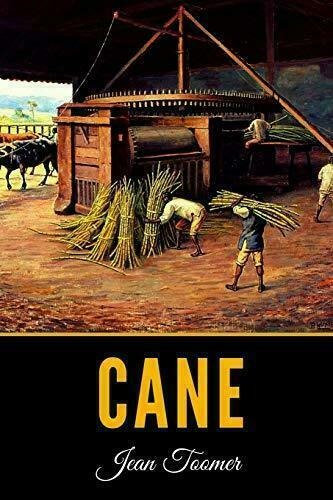
This poem was placed into Toomer’s Modernist masterpiece, the book-length mixed-form “Cane.”
.
It’s National Poetry Month, the reason I’m going through early Parlando Project pieces to present a more rapid posting schedule here this April. NPM tries to increase interest in poetry, but it’s hard to get a read on how significantly it achieves that. Arrayed against it is every poem someone didn’t “get” for whatever reason. Every poem that says only “Care about what I’m saying, even though you won’t understand,” poems without the bridge to “Here’s how you connect to this.” Every poem that bores us keeps us from poetry, and we are so easily bored. How many poems does it take to put up a wall against poetry, and will putting a poster on that wall dissolve the wall?
Is this the fault of the poets, their poetry? Is that the fault of us, the readers/listeners? Are there social structures that surpass us in enforcing this distance from the art? That’s a mystery. I don’t know the answer. But I know that once in awhile I come upon a poem like “Her Lips are Copper Wire,” and like another Surrealist love poet Paul Éluard I’m left compelled “to speak without having anything to say” — anything to say other than the words of this poem. That limerent pleasure is likely why you’re here, reading this, and listening to the performance of Toomer’s poem. Thanks to that mystery and you.
No lyric video today, but you can hear my performance of Jean Toomer’s poem with a player gadget below. Don’t see that? Well, this highlighted link will also do the job.
This project has gone on so long and produced so many pieces, so before February ends I thought I’d highlight five of the most popular pieces we’ve presented in past years that deal with Afro-American experience or history. The bold-faced start of each listing is a link to take you to the original Parlando Project post that presented this poem if you want to read my first reactions to it back then.
Lines to a Nasturtium by Anne Spencer. Another Afro-American poet who published before 1925’s The New Negro anthology, but who was not published much during the later half of her life. This poem may be her extant masterpiece. It still defeats me from extracting a simple prose “meaning” from it, but it’s just breath-takingly gorgeous in sound and a diffuse emotional impact remains even in its mystery.
.
The Witnesses by Henry Wadsworth Longfellow. What, a poem by a white guy? Well, white supremacy is — what, how does that term start? — a white problem. Here’s a 1841 poem about the notorious Middle Passage of African captives taken across the Atlantic written within the lifetime of those that would have chartered, manned, and benefited from that trade.
.
The Banjo Player by Fenton Johnson. Like Anne Spencer, Johnson published before 1925 and sometimes gets linked with the Harlem Renaissance — which is spiritually correct, but geographically misleading. He’s from, and spent a good deal of his life, in Chicago. He predates Langston Hughes in wanting to present ordinary Afro-Americans in the whole of their expression and experience without so much emphasis on the Talented Tenth. He’s also sometimes presented as an Afro-American radical-poet predating McKay and Hughes, though I still don’t know much about his actual political beliefs. This poem brings some humor to Black History Month, while coincidentally linking us to an historical reminder: the banjo is an Afro-American instrument first constructed by people that remembered African home fires and instruments.
.
Zalka Peetruza by Ray G. Dandridge. Another Midwesterner, this time from Cleveland Ohio, but as far as I’ve seen he’s not linked often to the Harlem Renaissance. If fact this piece is one of the Parlando Project pieces that has garnered outsized listenership without being a well-known poem or being written by a well-known poet. Perhaps folks liked the music I wrote for it, or maybe they just recognized it as a fine short poem that implies some good questions within its short character study. In my original write-up I thought it might stand being as well-known and discussed as Paul Lawrence Dunbar’s“We Wear the Mask.”
.
Portrait of Jean Toomer included in the 1925 “The New Negro” anthology that launched the Harlem Renaissance.
.
Her Lips Are Copper Wire by Jean Toomer. I’ll maintain this is one of the best short poems of love and desire ever written in English, and it would stand well with anything written in any other language too. Yes, I love me some Paul Eluard. Folks have rushed to read my pair of translations and accompanying thoughts on the young Pablo Neruda’sTwenty Love Poems. Kenneth Patchen can paint love in an unseeing world and break my heart. Yet. Yet. Toomer’s poem is as effective a surrealist work as any of that. It’s beautiful, mysterious, and charged — everything poetry should be.
Here’s a surreal, enigmatic, and yet compelling story by Dave Moore that I adopted and combined with some orchestral music I composed for it several years ago. Dave wrote this during a period when he had returned to Iowa to help is aged father who was dying, and while nothing in the piece refers directly to that situation, this reader feels something of that experience is present in its absence in this.
Dave’s father was a Protestant minister, and so church buildings of various sizes would have been part of his upbringing. And the mysterious boxes within boxes that the story’s protagonist must pack may be a visual image for the tasks of dealing with the stuff of wrapping up a life. But neither of those things can completely anchor the way this tale unwraps itself.
Easily the strongest, most enigmatic, and potentially objectionable image in the tale is the encounter with a young woman. A listener may meet this image in the story and react to it quickly (or thoughtfully) as an intrusion of some kind of male gaze trope, that thing that can be a tiring and reductionist frame on the real lives of half of humanity. But to my reading of this, it is the core image of this piece and it’s remarkably faceted with a cubist/surrealist multiplicity of reflections: an anima, a reminder of the exiled female in the masculine church, a strange mixture of sexuality, ambivalent reactions to sexuality, and yet also with a bit of the nature of parental caretaking roles reversing themselves. Many a time when I revisit this image by listening to this piece, I see something new in it.
Long time readers here will know that I admire Dave’s work, and once more I thank him for his contributions to this project with his voice and keyboard playing—but for you that is of little matter. Perhaps my specific and not necessarily popularly aligned taste, or knowing Dave and the circumstances around this pieces creation including that it’s my own music and performance that presents it here, distorts my evaluation of this image; but listen to this piece and see if you agree that the strange encounter at the center of this dusty and enigmatic tale is a remarkable image worth contemplating.
The player gadget to hear “The Cathedral” is below. If you are reading this in a reader or reading view that hides that player gadget, this highlighted link may allow you to listen to the audio piece. There is no text to link to today, so you’ll need to experience this less than 4 minute story by hearing it.
The story this time is failure, diversion, randomness, and Dada. Some of it’s mine.
After the largely pleasant interruptions of the holidays, I’ve been finding it hard to concentrate extensively on new pieces. This hurts the more intricate musical compositions, research on the context of their original creation and reception, and my fresh translations of poetry not originally in English.
I’m fairly good at limiting one scourge of the modern artist: social media. I get behind on responding to comments here (bad form!), I usually put off reading the blogs I follow to once every week or so. I’ve never dived into Twitter much and have entirely avoided Facebook and the rest. Other artists have other types of engagement with these things, I wouldn’t call myself a model in that regard. Indeed, I’m sure I’ve done this project no favors with my avoidance of these things. I ascribe a great deal of the growth of this audience to random searches and the intentional work some of you have done spreading the word about the Parlando Project. Thank you. Thank you. Thank you.
So, I’ve carved out the precious time for this. And then, I get to work, a blessing many never get. And sometimes, it just doesn’t happen.
I’ve started and broken off three or four translations this month. I’m often drawn to the more hermetic poets with translation: the ones with wilder syntax, unusual metaphor, elusive meanings. I think what draws me is the same that causes one to open the most mysterious wrapped gift first. What could it be? Sure, it could turn out to be the wrong size or color, or a complete misreading of your interests, but that desire to jump into mysteries is undeniable.
But this predilection does lead to issues with my translations. My goal as a translator is to make vivid to a contemporary audience the images in the original poem. I will not usually make any attempt at carrying over the sound-music to English, but I do like to honor the thinking-music of it, the order and cadence of the original poet experiencing the matter of the poem. This intellectual melody is a great deal of the pleasure I get out of a poem that works for me: that the poet would think and express this first, then this, and finish with that. If each of those is a surprise that I can share, art has happened.
But when taking on a Surrealist or Dada poem, or a poem that claims to be based on disordered sensations,* how can I be sure enough that I grasp the metaphor, divided as always by time, language, culture, but in addition with an aesthetic that seeks to confuse or confound the reader, at least at first.
That sort of thing takes a lot of attention, more than most close readings, even before the task of finding the new English words comes in. And this month, I get only partway in and then feel lost or discouraged—and something interrupts, or my energy flags, and the house of cards doesn’t necessarily fall down, it just remains a bunch of playing cards with no architectural reason to exist.
The closest I got to completing a new translation was this poem by Hugo Ball, one of the original Dadaists. It was the fifth in his series 7 Schizophrene Sonette.
Here’s the original:
Das Gespenst
Gewöhnlich kommt es, wenn die Lichter brennen.
Es poltert mit den Tellern und den Tassen.
Auf roten Schuhen schlurrt es in den nassen
Geschwenkten Nächten und man hört sein Flennen.
Von Zeit zu Zeit scheint es umherzurennen
Mit Trumpf, Atout und ausgespielten Assen.
Auf Seil und Räder scheint es aufzupassen
Und ist an seinem Lärmen zu erkennen.
Es ist beschäftigt in der Gängelschwemme
Und hochweis weht dann seine erzene Haube,
Auf seinen Fingern zittern Hahnenkämme,
Mit schrillen Glocken kugelt es im Staube.
Dann reißen plötzlich alle wehen Dämme
Und aus der Kuckucksuhr tritt eine Taube.
At the point I set aside the translation, here’s what I had tentatively and incompletely rendered in English:
The Ghost
It usually happens when the lights are on.
It rattles the plates and the cups.
On red shoes it slides in the damp
Swaying nights, and you hear its flames.
It seems to run around from time to time
With trumps, likely to play the ace.
It’s careful with the ropes and pulleys
And is recognizable by its noise.
It is busy in the Gängelschwemme
And then its white crown wavers in the wind,
Its tines tremble like cockscombs
With shrill bells it spins in the dust.
Sudden exploding dams are torn apart
And a dove emerges from the cuckoo clock.
Almost done, but I couldn’t figure out that word “Gängelschwemme.” Any reader here have a good solution for that?** It seems a compound word, the start having some sense of walk or lane I’m thinking and the last part may have some water connection, but as it became hard to continue my focus, the meaning seemed to tumble further away.
The image of that exploding dam. I thought of Kansas Joe McCoy and Memphis Minnie’s “When the Levee Breaks,” a song about impending disaster. The Blues have their own Dadaist streak,*** but this song is one of those that has a fairly easy to follow plot: a singer who tells us that no matter what he (and others do) to hold back an impending flood, when it comes he will be driven from his home, child, and spouse. There’s an undercurrent to that story if you look at it a second time. He says he has a “happy home.” And surely this great flood (the song is likely a reference to a significant and damaging 1927 American flood) will be destructive. But why is he not taking his spouse and child and fleeing with them at the point when there is nothing else that can be done to stop the flood? Because he can’t? Is he an imprisoned worker forced to work on the last defenses against the flood, or is he racially or economically constrained to leave the area? Is it because even if he knows there’s little chance that his labor on the levees will keep the flood in check, he must try to his upmost anyway? Could it even be possible that he has absorbed the impending disaster in his soul and he’s ready to leave that all behind as the flood has “intended.” Maybe his happiness isn’t as certain as the awesome disaster is.
One could write a novel or short story from that song. In one’s imagination one might link that specific situation to other things. But let’s stay with the lyric impulse, the exultation of the moment.
My new diversion was to turn Ball’s sonnet into a blues. This freed me up to make some more audacious adaptations as I merged the feeling of the lyric of “When the Levee Breaks” into another re-visioning of Ball’s poem. Doing this in a week of loud yet underexplained**** international explosions creeped into the resulting lyric too. Ball was writing his poem in 1924, but this week it seemed that a “a dove emerged from the cuckoo clock.”
Here’s the blues interpretation inspired by Ball’s sonnet:
Ghost Blues
The lights is on people, but it happens just the same.
The lights is on, happens just the same.
In the swaying nights, you can hear the flames.
Seems to run around, sometimes you see its face.
You see it time to time, see it face to face.
But when it’s got its trumps, likely to play the ace.
It’s careful with the ropes and pulleys, I can tell you boys.
It’s careful with those ropes and pulleys, I can tell you boys.
But no matter how careful, you can recognize it by its noise.
It’s busy at the spillway, white crown wavers in the wind.
It’s busy at the spillway, white crown wavers in the wind.
Peaks are trembling like a rooster’s comb when it begins.
I heard those shrill bells, there was spinning in the dust.
When I heard those shrill bells, there was spinning in the dust.
When the levee breaks, the dams is torn apart.
When the levee breaks, the ghosts begin to walk.
When the levee breaks, and the ghosts begin to walk,
I dreamed a dove emerged from the cuckoo clock.
You can hear me take it on with a quick musical interpretation using the player gadget below. If you don’t see a player gadget (some readers don’t) you can use this highlighted hyperlink instead. In another week, it might be better performed, but it felt good to get it out during this one.
.
*Yes, some of my translation failures this month have been with Rimbaud.
**Even though my draft had a tentative idea for “erzene Haube,” I really couldn’t figure that one out either, even if I had put something down in English that I could develop as a comprehensible image. But what comprehensibility did Dadaist Ball intend?
***Part of Bob Dylan’s genius was to not only borrow from Modernist page-poetry but from the Modernist Afro-Americans and some strange folk-songs to create his revolution in song lyrics. Don Van Vliet (Captain Beefheart) also did this extensively.
If one wonders where are the Afro-Americans doing what Pound, Eliot, W. C. Williams, Sandburg, H. D. etc. were doing in the first part of the 20th century—well, the bards of Blues and the creators of Jazz were making their own revolution we are still incorporating and absorbing.
In terms of page-poetry, much of the Harlem Renaissance is still to come into public domain availability, but this insight was one I share and partially derive from them. Also, see literary figures like Fenton Johnson.
****Could it have been a poltergeist that Ball’s poem seems to be referencing?
It’s that time again, when we look back on the past months and see what pieces were the most liked and listened to this summer. I do it countdown style, so here we start with the 10th, 9th, and 8th most popular pieces this season.
10. Pods (Neponset) by Carl Sandburg. Do I say Sandburg is the forgotten Imagist too often? Maybe, but to my mind this is one of the finest short Imagist poems I’ve come across in my wanderings through early Modernist verse. Another thing I keep trying to counteract: the idea that Sandburg is simplistic and that his verse is absent the levels of ambiguity and ineffability that “great poetry” is said to offer. This 7-line poem about a small Illinois village with gardens and the train passengers traveling to see scenic wonders is an example.
My family has to put up with an amount of interruption by the focused and repetitive work of producing these pieces. Listening to the process of composition, when it involves (as it sometimes does with me) a lot of trial and error is trying—but listening to the final mixing stages is excruciating. I mix at modest volume levels, but I’ve been told that headphones are not to be trusted in that work—so they hear these pieces sometimes being wiggled this way, and wrung out that way, over and over. Not a good way to appreciate a piece.
So, it was a surprise this summer when my wife came in and told me this one sounded like one of the best ones I’ve done. Maybe it made it to number 10 because it stands to be listened to more than once?
9. I Saw a Peacock by Anonymous. Long a leading composer in the folk music field, Anonymous can also craft a pretty good Surrealist poem with a humorous trick: the line breaks lead you to connect the thing previous with the last part of the line—when the “real” and much more mundane connection (as opposed to the wondrously apocalyptic thing you believe you’ve heard) is in the next line, after a breath pause of the line break.
I’ve read that this poem impressed Margaret Atwood in her early childhood with the wonder that poetry could create.
I seem to be working more and more with string and other orchestral compositions this summer. Part of that is that I’ve always been drawn to things that mix the attack-envelope of percussion instruments with the varieties of note length that stringed instruments, particularly bowed string instruments, can create—but it’s also because I was able to afford some additional orchestral instruments to play via my guitar’s MIDI pickup or with my little plastic keyboard this summer.
Didn’t work? OK, try Black Mountain school with polka. No? Dubstep Hildegard von Bingen! Hard Bop Thomas Hardy! Still coming? Tell the gunner to give’em both barrels then. No, no! Not those barrels…
8. For Once, Then, Something by Robert Frost. Here’s an example of why I’m particularly grateful to the hardy listeners of these pieces. While I’m constrained by difficulties in obtaining permission to present writings still in copyright, I hope that you can see that I vary the type and the outlook of the poetry and other writing that I can and do use. I try too to mix Poetry’s Greatest Hits with deep cuts from esteemed poets, and more than a little of the lesser-known but worth considering.
Of course, for some (Many? Most?) the idea of poetry as an everyday thing that is not some mix of fearsome and intended obscurity, snores-ville decorative excess, and hoity-toity crap for those with nothing better to do has already removed them from reading or listening here.
Well then, as I’ve described this project from the beginning, I combine these words, mostly poetry, with various music. While people might just ignore poetry, they actively hate music that they don’t like. That disgust leads some (Many? Most?) to cling to a genre of music they find most able to please them, and to mark other sonic places as “here be monsters”—hideous creatures that disrespect what is right in music.*
Music doesn’t know what’s right and proper. It just wants to sound itself.
So how many people are out there who want to hear even the beloved, famous, respected American poet Robert Frost chanted to a pulsating Electronic Dance Beat arrangement?
Well, if you are the kind of people who read, listen, follow, and help propagate what the Parlando Project does, there are enough of you to make this the 8th most popular piece this past summer!
*By the way, if you don’t like some of the audio pieces that are presented here, that’s OK, even expected. Given that I’m pushing my capabilities as a composer and musician, you might even agree with my intent, yet not wish to negotiate my actualities. That’s part of why I like to mention that we vary things: you may like the next one that comes out, or enjoy taking a look at the nearly 400 pieces we have in our archives.
The Parlando Project audio pieces are available on Spotify. With the current Spotify mobile app you can even create playlists of your Parlando favorites—and exclude your “not so much favorites.”
Long time readers will know the Parlando Project is generally about the encounter with, and performance with music, of other people’s words. But I have mixed in words I’ve written here from time to time.
Today’s piece combines both threads. I wrote it, but it was engendered by reading another poet who publishes online as well as on paper.
I actually don’t read many poet’s blogs. This is likely because I’m searching through and reading a lot of other poetry that is in the public domain and free for this project to use. So when it comes time to take a break and catch up with other folks in the blogging community, I may be reading about music, history, politics, or visual art. I do follow one blog almost entirely devoted to the blogger’s own poetry: Robert Okaji’s “O at the Edges.”
Okaji posts often, and I’d describe his poetry as solidly in the post-WWII Surrealist tradition. A typical* Okaji poem will have strong lines with images often formed from opposites or unlikely combinations. In many of his poems you may not recognize exactly what he’s getting at, as he often approaches his poems “meaning” in the Surrealist tradition of surrounding it with miscellaneous statements.
I too can stay puzzled by the elusive “meaning”, even though I’ve read a good deal of Surrealist poetry and spent a fair amount of my 20s focused on writing in this manner, and then cautioned readers here that the lyric poetry I most enjoy is not so much about ideas, but the experience of ideas.
In most human writing we’re tasked with being clear, and even in poetry, poets often choose to puzzle us as readers only a little bit, asking readers to focus on only a small set of questions around the meaning in a poem. I happen to believe that the arts work best in multiplicities. Writers that ask readers to puzzle more make the poems that ask readers to puzzle less work better—and vice versa; just as music that avoids expectations and common methods of loveliness makes simpler and more consonant music stronger—and the converse of that too.
And remember, Okaji is a writer of striking images. Outside of the stand-and-deliver classrooms where we are asked to tremble out the “real meaning” of poems, one can simply take pleasure in the thought-music of an image.
You do not have to write Surrealist poetry to treasure the infusion an unexpected, even inexplicable, image can give you. Trying to write poetry without reading poetry is like trying to write music without listening to music. How many times when I’m listening to music do I hear something and suddenly realize: you can do that in music! Okaji’s work may inspire you, even if you do not write in his style.
So a little over a month ago I’m reading this August post and poem of his, “A Herd of Watermelon,” and one couplet attracted me so much, I started writing my own poem immediately, which now has become this post and piece: “Don’t Frighten the Garden.”
Magritte had his apples, but Texans go for bigger fruit
Other than Okaji’s image of a herd of watermelon able to bolt, what else did I take from him for inspiration? Well, his scene and scenery has been to some degree Texas-based and I’ve been thinking a little more of Texas myself because my father’s family spent time in that state, and one of his brothers, an uncle of mine who was born in Texas, had just died this summer.
And so my watermelon herd is Texian.
I wrote my first few lines fairly quickly, and the rest of the poem developed over a month or so to full 14-line free-verse sonnet length. The final couplet seemed almost another voice coming in over the air as I composed it. Here I was, happily in Surrealist Texas free-verse land, when all of a sudden an Alexandrine pair of lines breaks in at the end! Did the spirit of Mallarmé know I was coming for him next?
Here’s the text of my poem “Do Not Frighten the Garden:”
I’ve been playing more guitar lately, trying to maintain what I call, in my more pretentious moments, “my technique.” So, surreally, today’s music is orchestral. However, the top line melody was actually played on guitar, which—via the magic of a MIDI pickup—played the violin you hear. I also was able to make effective use of a timpani virtual instrument that’s new to my collection of orchestral colors. Give a listen to it with the player below.
*Okaji is more eclectic in his style than I can briefly outline here. Nor is all of his poetry elusive with its denotative meaning. Among other things I like that he does: English translations of classical Chinese poetry.
There’s not much to say about the author of today’s words, as they are anonymous and somewhat older than I am—“I Saw a Peacock” dates to sometime before 1655. Somewhat like Emily Dickinson’s “May-Flower” poem, this poem is on the face of it a chronicle of wonders and mystery, but it can also be read as a puzzle. Here’s the text of it:
I Saw a Peacock, with a fiery tail,
I saw a Blazing Comet, drop down hail,
I saw a Cloud, with Ivy circled round,
I saw a sturdy Oak, creep on the ground,
I saw a Pismire, swallow up a Whale,
I saw a raging Sea, brim full of Ale,
I saw a Venice Glass, Sixteen foot deep,
I saw a well, full of mens’ tears that weep,
I saw their eyes, all in a flame of fire,
I saw a House, as big as the Moon and higher,
I saw the Sun, even in the midst of night,
I saw the man, that saw this wondrous sight.
The key to the puzzle is to read the lines starting at the middle and continuing to the middle of the next line. Read this way the things connected seem more commonplace and less mysterious. Given it’s age, there not a lot of out-dated words in it. A “pismire” is an ant.
This is a fairly sophisticated play with the powers of enjambment in a line of poetry, where the stop of the line makes one pause and consider (if only for a moment) the thought contained within the line, even if the thought is not actually completed yet. But I’ve chosen (as I did with Dickinson’s “May-Flower”) to not perform it as just a riddle or exercise. Emily Dickinson’s poetry for her flower riddle was too mysterious and sensuous for me not to play to the mystery. Similarly, “I Saw a Peacock’s” surface of surreal combinations of the like/unlike is too strong to not go with that side of the Mobius strip.
Although I just ran into “I Saw a Peacock” this month, the poem has collected its fans over the centuries. I saw it at the Interesting Literature blog (which is, by the way). Writer Margaret Atwood once wrote that it was “The first poem I can remember that opened up the possibility of poetry for me.”
My musical setting uses double instrumentation too. There’s a standard rock trio, albeit playing quietly (drum-set, electric bass, and electric guitar) and a quintet of double-bass, two cellos, violin and tuba.
You may have noticed I’ve been away from this blog for an interval of a few days as I work on another project this spring. I’ve noticed that folks are looking at the nearly 350 audio pieces we have here in our archives more and more, which is a great way to get your fix of music and words combining. To hear today’s piece, “I Saw a Peacock,” use the player gadget below.
The last few days I’ve been looking back over the past three months at the audio pieces that received the most listens and likes from visitors here, and we’ve now counted up to the post revealing the most popular piece.
But before I get to that, let me let newer visitors here know what the Parlando Project is. For the past few years I’ve been experimenting with the ways that words can be used along with music. Most of the words are going to be poetry, if only because I like shorter pieces for this, and poetry accommodates that desire most easily. The music? My goal is: as varied as we can make it. The “we” here are largely myself and Dave Moore, who I’ve played with as the LYL Band since the late 1970s. Dave also is the alternative voice of the Parlando Project, one that’s read or sung several popular pieces during the history of this project.
Dave and I have also been writers (Dave’s also a cartoonist) since our youth, but this project is not, in it’s greater part, about presenting our written work. Rather it’s about looking at a variety of other people’s experiences and expressions, reacting to them, and seeking to embody them in a way we hope you’ll find interesting.
Do we turn the poems into songs? Sometimes. Sometimes they were, or were meant to be, songs anyway (Tagore and Campion for example). But often we aim for something that is cast between spoken word and chant. As best as I can figure out, this is akin to what William Butler Yeats once aimed to do with poetry and poetic drama, and he thought William Blake, Sappho and the Celtic bards did the same. And for myself, in addition to those Yeats pointed to, it’s my spin on what Jack Kerouac, John Lee Hooker, Allen Ginsberg, and Patti Smith (along with others) did.
Rap/Hip Hop does this too, but as varied as those artists’ approaches are, most of their tactics I can’t make work for me. No disrespect, it’s just my limitations.
Well, here’s the Parlando Project’s most popular piece from the last three months: Tristan Tzara’s “The Death of Apollinaire.” It was number 3 last September, so it’s been getting the listens since last summer, yet it’s not one I selected because it was well-known or sure to be popular.
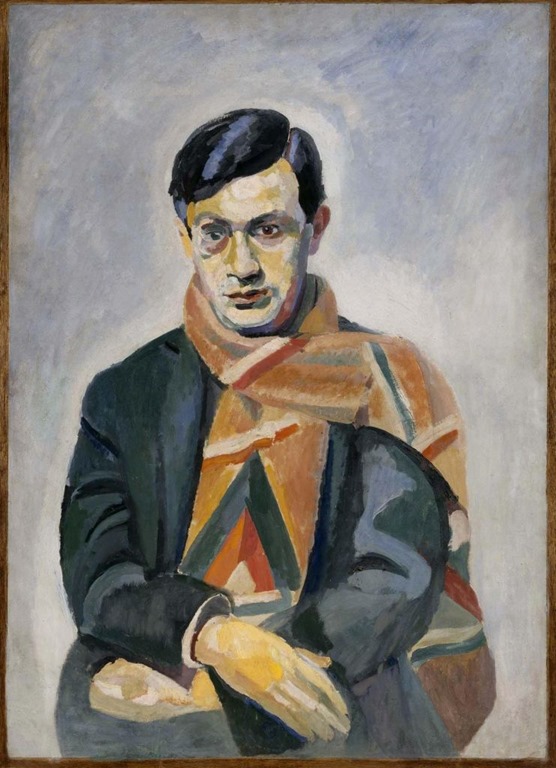
Accessorizing with knitted wear was the most important artistic dictum of Dada
Tristan Tzara, one of the founders of Dada, is not that widely available in English, and even the subject of this elegy, the influential Polish-French writer and critic Guillaume Apollinaire, has a fame that doesn’t transfer with full brightness off the European continent. I did my own translation from Tzara’s French for this piece. And though I’ve attempted to do this, off and on, since my youth, translating Surrealist, much less Dada, poetry into English has it’s extra complications: to what degree is an image meant to be impenetrable and random, meaningless as a stance; and to what degree is it instead a shockingly fresh juxtaposition?
I have a prejudice for the later. When I am translating poetry I take it for a given that I will not be able to convey the auditory music of the original, though I try to retain the musical development of its statements, and above all, I try to find English words and idiom that will grab the English-speaking reader’s interest with vividness. This approach has it’s dangers, as I’m not enough of a scholar of the lives of writers or of the their languages to make the most informed decisions, but in the case of “The Death of Apollinaire” I feel this leads to a very effective and affecting statement about the death of an artist still suffering from his battle wounds just after the end of the WWI.
My limitations aside, I hope I was faithful to Tzara’s voice, and I hope you’ll find it moving too. You can listen to it with the player below.
New pieces will be coming soon, so come back and check, or hit that “Follow this Blog” button up near the top-right to get notices of new pieces.





 Frank Hudson
