One way to get experience is to seek it through the directed travel of a pilgrimage. Many religious traditions include the idea of a such journeys, and one side-effect of a shared destination is the mingling of travelers from diverse setting-off points along the trail.
In the Middle Ages, in England, one pilgrimage had the greatest potential to bring a diverse group together, the pilgrimage to the Cathedral of Canterbury where the sainted Thomas Becket had been assassinated. A series of stories ostensibly told by various tellers together for this trip became the great early work of English literature: Geoffrey Chaucer’s “The Canterbury Tales.”
April is National Poetry Month in the US, and though this celebration’s founders give no exact reason for April being chosen, two widely known poems explicitly start in April, and whether it’s cause or effect, I think of these poems when I think of April and National Poetry Month. The oldest of these, is today’s post “The Prologue to the Canterbury Tales” which begins:
“Whan that aprill with his shoures soote The droghte of march hath perced to the roote”
Now I know I’ve let slip too many typos in these notes before today, but that’s not a particularly bad day at the keyboard—instead, it’s Chaucer’s version of English as spoken in the 15th Century. It’s a challenge to read this in the original pronunciation, though I once was delighted when a skilled classical music DJ mic checked at 5:45 AM one morning with a perfect rendition of this Prologue in Middle English. I’m not going to attempt the same; today’s episode uses a modern English version for clarity, and in consideration of my thicker tongue.
Musically I’m not in the Middle Ages or in Canterbury for this piece either. I’m going to use the 12-string guitar once more. There is no shrine here in the Twin Cities of Minnesota, but for some reason three of best players of this troublesome priest of an instrument came to prominence here: “Spider John” Koerner, Leo Kottke, and Steve Tibbetts. For this episode, the 12 String’s musical tale is told in the character of Steve Tibbetts—or rather a modest imitation on my part using Tibbetts’ distinct stringing of the 12 string, which uses octave strings only on the two lowest courses of the 12 string with unison string pairs on the rest.
More thick strings, fewer skinny ones, setting up a 12-string Tibbetts-style
.
To hear the 12 string strung that way, and to hear about the English April in Chaucer’s report, use the player that appears below. Don’t see the player? Well, this highlighted hyperlink will also play it.
Monday night here in Minnesota it snowed. As I took my pre-teen son to school in the morning, he looked at the inch of fresh snow on the spring ground and said “Mother Nature is drunk. Shut her down!”
I rode my winter bike to breakfast that morning, and the trees overhanging the street were shedding overnight ice chunks that their budding branches were rejecting in the morning. As this shrugging hail fell on my ski helmet, it bounced off with a “ping!” like marbles or ping pong balls, and popped onto the icy street like broken ornaments. A few hours later, in the late afternoon, I rode again to the grocery store in considerable sunlight. The streets were dry and I was in shorts and a T shirt.
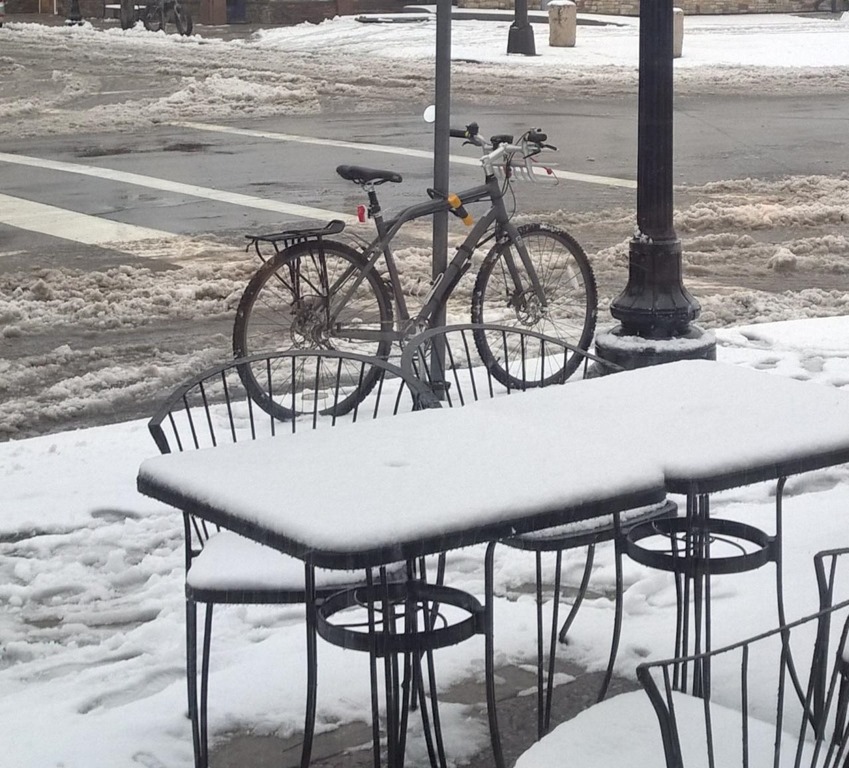
Plenty of patio seating available for Tuesday breakfast
Minnesotans have a well-worn phrase for our edition of the book of nature. It’s not a hand-bound collection of poems like our New Englander Emily Dickinson’s, but a play script. “The Theater of the Seasons” we call it. Famously, we try to hide emotions here, but we sure do enjoy a little drama with our weather forecasts, keeping an eye peeled for news of storms that can kill or injure you. Sitting in the upper Midwest we can receive weather sweeping up from the Gulf of Mexico or dropping down from the Northwest Territories. So, particularly in Spring and Fall, the Theater of the Seasons plays in repertory here in Minnesota.
Today’s audio piece is short, less than 2 minutes long, and it’s called“Theater of the Seasons,” expanding on that phrase a bit. I think you’ll enjoy it. The player gadget appears at the end of the post, as usual.
As part of this blog’s participation in National Poetry Month, we’re trying to provide even more audio pieces like this that you can stream. If you know someone who might enjoy words combined with music like this, why not take this month to let them know about us and our Parlando Project, or share this or another favorite on your own blog or chosen social media site.
Minnesota goes wild in spring when it finally gets warm, and so today, which promises to touch 70 degrees, will surely display this. Like the day described in today’s episode, I’ll probably go for a bike ride with my young son, and we’ll ride on The Greenway, a several-mile-long reclaimed railroad cut that runs, as time does, east and west through the middle of Minneapolis.
Raising a child as a musician, writer, and sometime bohemian brings extra questions. Do you want your child to follow the most conventional and unquestioning path? Certainly not. You encourage them to question things, even allowing that this will encourage them to question you. You look at your own life backwards as you look at theirs coming forward, and wish them adventures, but only so much. You know there will be hardships and wrong choices, but you hope only enough to be instructive. As an artist you may worship art, but you’re not sure you’re comfortable with them adopting all the tenants of that religion.
Today’s piece “Biking on the Greenway with My Son and Bob Stinson” speaks of this from the seat of a bicycle.
Bob Stinson was the animating force in The Replacements, an ‘80s alt-rock band that never tried to split the difference between insouciance and not giving a @#*&. As a guitarist he was an anarchist, and the band accidentally worked like the NY Dolls, the Kinks, or the Rolling Stones, with a great front man who had the lyrical wit and the staggering lead guitarist who embodied the music’s soul.
The Replacements sit and wait for The Greenway bike path to come through. Bob Stinson, middle left.
The guy on the left is an artist. The guy on the right played in Guns and Roses. The guy on the middle right, writes songs.
The Replacements’ front man, Paul Westerberg, was quickly indicted as a fine rock’n’roll songwriter, which damaged the band because songwriting implies loitering with intent to commit James Taylor. The band rebelled by making sure that a regimented presentation of a set of songs was not the aim. On any given night, this could be inspiring or a shambles: Dada or do-do. Being blotto on stage to the point you couldn’t hide it was almost a requirement, and for no member of the Replacements more than for Bob Stinson.
Eventually the dichotomy demanded an ostomy, and Bob Stinson was asked to leave the band he founded. Things did not go well for Bob without his artistic outlet, and chemical dependency played out its run until he died, his body worn out at 35.
Self-destruction aside, you can see that as path of purity. Chasing after success and an ego-driven desire to rise above others can harm too. The addict and the monk believe they have two different gods, but the penitents have the same scourge. Negation and creativity; deny this, so that that can emerge, is part of the religion of art.
Music, Minneapolis, and life are different now 30 years later, and that’s the place my child and I now live in. Somewhere 30 years on from today will be the place they will live in, no longer young, if they survive rebellion and conformity, if they find the balance between the worship of the self and self-destruction.
This is National Poetry Month, so in the spirit of the Replacements, this is a post more about music, and the music in “Biking on the Greenway with My Son and Bob Stinson” is not all that polished, tossed off by the LYL Band in one take. Still, you might enjoy clicking on the player below and listening to it. If you don’t see a player, this highlighted link will open a new tab with its own audio player.
Since this is National Poetry Month in the US I’m hoping that I can exceed the usual 7 to 8 posts a month pace I’ve kept up here since the Parlando project began last August. The next audio piece should be up this weekend. For those who haven’t read the early posts here about what the Parlando project is, I usually summarize it as:
The Parlando Project is words (mostly, but not always poetry) accompanied by music (various kinds).
The Parlando audio pieces have been downloaded by podcast subscribers since launch almost 4,000 times. Given that we are now past the halfway point, I thought it might interesting to let you know what the “Top Ten” downloads have been so far. In Casey Kasem form, we’ll count it down upwards from 10 to 1. There are links in the list if you missed one of these audio pieces and the posts about them.
10. The Spring of Dead Things. One of the 3 pieces in the top 10 where I wrote the words. That’s OK with me, but one of the Parlando Project aims is “Other People’s Stories” which leads me to feature other people’s words more often than not. There’s lots of folks reading their own poetry out there, which is good in itself—but there’s lots of people reading their own poetry, so think there’s an unmet need for reading others work.
9. The Garden of Trust. One of my personal favorites. Weston Noble’s thoughts on the power of music, hard-won thoughts he expressed after a lifetime of work, touched me the moment I first read them, and my feeling only deepened when I found I was able to hear him express those beautiful thoughts in a recording made before his death. My thanks again to Luther College for allowing me to use this recording in my piece. If you want to sample one thing that the Parlando Project represents, and it really doesn’t represent one thing, start here.
8. I Felt A Funeral in My Brain. Writing the Parlando music and considering the words for performance has deepened my appreciation for Emily Dickinson, whose words we’ve featured more than any other writer, and I rather like my music for this one as well.
7. For John Renbourn Dying Alone. I hope some of the listeners to this piece who like acoustic guitar music find this a gateway to Renbourn’s music.
6. Arthur Koestler’s Death Song. Although we’ve featured Dave Moore reading and singing his own work here, and there will be more of that to come later this year, his Top 10 appearance is for a piece where he wrote the words and music, though I performed it.
5. Eros. I sometimes wonder if this one gets a bonus from those searching for or intrigued by its title. Another one where I’m happy with how the recording and the music turned out. I remind myself that I should learn more about Emerson’s Transcendentalist revolution.
4. 2ebruary. There’s no telling what the “bonus” may be that’s lead more people to this piece. It could be the discussion of the movie “Patterson” in the notes, or it could be the connection to bicycling. Or perhaps it’s the connection to Frank O’Hara’s “I do this, I do that” poems that I treasure and try to emulate. If you like this, I have another bicycle ride poem coming up later this spring.
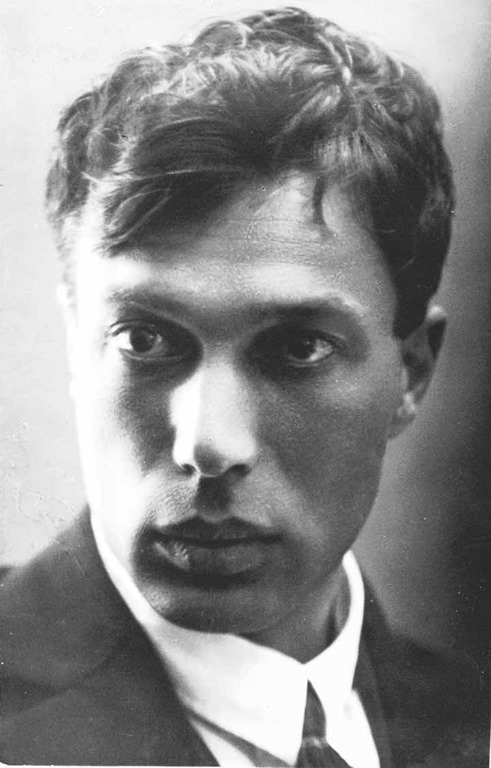
3. Boris Pasternak’s February. We’re into the top 3 now. I was remarking to Dave Moore during a break in our recording session yesterday, that February rather than April should have been picked as National Poetry Month, as the deep dark end of winter engenders more cruel monthly poetry. Pasternak gets to help prove that point here. One regret I have with what we’ve done so far with the Parlando Project is that I have not received permission to post our version of Margaret Atwood’s “February” here.
2. Hymn To Evening. Speaking of things I treasure, hearing Phillis Wheatley’s story on the Freedom Trail in Boston is another one. Art is this thing that, unlike even persons, no one can own. Colonialism is a system that crosses oceans to take things from other lands for profit. Art is the system that sends out messages that can crisscross time and oceans with the information inside our breasts.
we’re offering pictures of our #1 Parlando Project author for only one dollar
1. Frances. Interesting that two pieces from the colonial United States are 1 and 2, and that a piece with words by an young amateur poet tops the list. Maybe this is a tribute to the Pixies/Nirvana loud/soft arrangement trick in the music? Or that when it comes to subjects, love conquers all? Or that acrostics are about to become a thing?
Please continue to read and listen this month. I have a lot of planned pieces I’ll think you’ll like coming up here. Remember that the Parlando Project seeks variety in music and words, so you may hear things you like as well as not like as we go along, but stick with us as we want to continue to surprise you. I also want to thank those that have hit the like buttons on their favorite posts, and those who have hit the RSS button to follow this blog.
After our short trip to Chinese translation, let’s return again to Emily Dickinson, who is observing another morning.
This LYL Band performance of “I’ll Tell You How the Sun Rose” is a bit imperfect. Alternative Parlando Project reader Dave Moore takes the lead here, but he and I are singing instead of our usual recitative, and we’re caught at the top of our singing range as well. Dave even bobbles a word in the line “The hills untied their bonnets.” So, yes, this leads to some imperfection—but this lyric is so perfect that perhaps it can carry us along anyway.
I suggest you listen to this piece now and then read my discussion of what I see in it afterward. Dickinson, like a good melody, doesn’t require understanding before enjoyment. The player to hear it is at the bottom of this post.
“I’ll Tell You How the Sun Rose” begins with a homespun 19th century village dawn, and the singer starts right off almost bragging that they can tell us how the sun comes up. As proof, Dickinson unleashes a string of lovely, singing metaphors for sunrise, looking down from the dawn only once to let us see the squirrels running about as if with the news of the day. She concludes this section with finest simplicity: “That must have been the sun!”
Isn’t that a strange way to sum up dawn? It comes up and it’s already past tense, like Meng Haoran’s morning in the last post, and Dickinson comments on this common splendor as if she’s a surprised alien from another planet who has never seen the sun. Her boast that she can tell us “how the sun rose”—something she and all of us should already know, set in nothing more special than a prosaic town—becomes instead a small, whispered, apprehended wonder.
In the second section, Dickinson shifts gears so smoothly that no matter how many times you read or hear this poem you will never notice. There is a little engagement of the gears as she says of sunset “I know not,” unlike our first gear’s “I’ll tell you;” but we’re soon on to a rural scene with the sun rays like children climbing up and then down a stairway over a hedge or fence row (a stile). At that point, there’s a bustle in your hedgerow as the dusk becomes a grey robed “dominie,” a strange and archaic word perhaps even in Dickinson’s 19th century, and a sure stumper for any modern English speaker.
A dominie is a Latin word meaning the leader of a congregation, a minister, a pastor—and ‘pastor” is derived from the word for shepherd—and that’s just what our grey dusk becomes as it leads the children of the dawn, now dusk, away like a flock, closing the bars, closing the gate, so that they cannot return.
Some readers are so charmed by Dickinson’s first section that they feel it is pedantic to think that this sunset section is describing a passage to death, “The undiscovered country from whose bourn, no traveler returns,” so no wonder that Dickinson moved from “I’ll tell you” to “I know not.”
That dominie seems so removed from the pleasant village of the first section, so foreign. Another subtle word choice contrasts the two sections. There’s only 88 words in this piece, and five of them are colors. “Rose” puns for dawn pink in the first line and then dawn is “amethyst,” a word for both purple and a semi-precious stone. The sunray children are “yellow”, and our strange dominie is dusky “gray.” The stile sunset stairway that the sunray children are climbing is “purple.” So out of our five colors, one of them is roughly the same color. In the first section, it’s semi-precious and wondrous, but in the second it’s just purple—a ruling, royal color perhaps—but those sunset ray children’s steps are ruled over not ruling, not shining like the amethyst steeples of the dawn.
Putting on the stile
Did you listen to the performance of “I’ll Tell You How the Sun Rose” before reading all this? I feel a bit here as if I’m acting like that dominie myself, leading you past the plain and beautiful dawn, over the stile, and closing the gate to simply hearing the sound and the manner of expression of Dickinson. Too often we make too much of the meaning of poetry, and particular the deeper meaning of poems. Just as Meng Haoran’s poem from last time can be understood well enough to be enjoyed by children, this poem too can be enjoyed as compressed observation. Perhaps it’s because I am an old man, one who has tried to write and make music for many years, that I care to see what is underneath the sun rays, to look over the stile, and to find what is inside Emily Dickinson’s expression.
To hear the LYL Band perform “I’ll Tell You How the Sun Rose,” use the player below.
Imagine a world where what you thought was poetry was entirely different. A world where short poems could be as celebrated as longer literary works. A world where the most admired poems could be clear as can be about what is happening in the poem (the poem’s plot) with no elaborate obfuscation in the language; and yet the meaning, the thought and feelings the author means to convey, may remain allusive enough that the poem’s meaning seems to change over time as your experience grows. Imagine a world where poems can seem to have no metaphors at all, poems that don’t so much interpret the book of nature, but seem to be a page from that book itself.
That’s what Chinese poetry seems like to me.
It’s a refreshing change from the Western canon. I can see why a grumpy modernist like Ezra Pound, who wanted to sweep away the rot of his culture, would find it influential. Or why the forefathers of the “beat generation” in the western United States looked further west than California for a way to apprehend reality on the page.
I’m no scholar of Chinese poetry. These are the feelings of someone who likes what he reads and finds lessons in translating it.
For today’s post, I’m going to go over how I work on these translations with the aim of stripping away the mystery. I’ll use a short poem by Tang Dynasty poet Meng Haoran “A Spring Morning.” It seems to be a good first task for Chinese translation, and the original poem is apparently known almost to the level of a nursery rhyme in Chinese.
Texas guitarist Billy Gibbons…whoops, no, this is Meng Haoran
I do not read Chinese, however, it’s now possible to find glosses of many poems literally translated from the original ideograms. Here’s what “A Spring Morning” looks like when each of its lines five characters is translated into an English word :
Spring sleep not wake dawn
Everywhere hear cry bird
Night come wind rain sound
Flower fall know how many
The first problem is there is no punctuation, nor anything like English syntax. Still that’s an interesting way to approach a poem, where in English we are often trying to find the word to fit our flow of thoughts and music, but in working from this gloss we have the words, or at least “a word,” but need to find the flow instead.
I decided to render the first line as: “I slept late this spring morning, awaking just after dawn.” keeping the season (spring) and the more specific time of past the daybreak moment. I added late, which is not in the glosses’ words, because I thought the poem needed some reason why past the dawn was significant when I connect it with the third line.
The second line required less thought: “From everywhere I hear birds calling out.” The main choice here was the word I’d use for the sound of the birds. “Cry” used in the gloss has connotations of sorrow in English (not always, for example “war cry”) and I didn’t want to tip my hand toward sorrow in this line. And in Spring I know these bird calls, they are in fact just that: birds calling out for potential mates, birds setting up their territories, birds that want to say something to other birds.
The third line I write as: “Last night I tossed and turned in the sound of the wind and the rain.” This gives a reason for why the poet slept late, adds a note of drama and, in a particularly personal choice I made, alludes to a traditional English song refrain “Oh no, the wind and the rain.”
Now the final line: “Who knows how many petals have fallen?” Here seeing other people’s English translations helped, as it otherwise might not be clear that this is a question. In a vacuum one might render this as “I know how many flowers fell.” And that ending has validity, essentially saying “(in such a storm as last night) I know for sure how much my lovely spring blooms are going to be damaged.” Others who know more about Chinese idiom have chosen to make this a question, so I’ll trust that, and this makes the concluding thought more like “(I’m worried about the damage of Spring storms. but it was night and I was asleep) and no one can change the way Spring does this, blooming and storming, so it’s a mystery to you and me.”
Overall, notice how this modest four-line poem, suitable for children, encapsulates a sophisticated thought, one that young children wouldn’t need to understand yet. It shows us Spring, as a sleeper sleeps past the now earlier dawn, through a rain storm that grows and destroys (compare our nursery rhyme “April showers bring may flowers” meaning “you might get wet, but it’s good for flowers” vs. this Chinese storm), alludes subtlety to the love and war of birds, and concludes with a wise line that says our ability to comprehend this cycle of growth and destruction, change and renewal, is limited. To a child, that last line may mean no more than the thrust vectors that allow that “a cow jumped over the moon;” but to an older adult, it reminds us more, that we will never know.
For the music to accompany “A Spring View”, I used some drums playing an odd rhythmic figure, fretless electric bass, electric guitar, and two soft synthesizer voices: a washed out horn and another which is supposed to suggest a Chinese flute, which unlike Bob Dylan I did not take from a dancing child. Today’s audio piece is very short, and to play it use the gadget below.
I’m often attracted to Chinese poetry, and I’m not sure why. Perhaps it’s the deceptive simplicity to the images, that hardly seem like images at all if one expects the showy metaphors used by many western poets. The concision of many of the most admired Chinese poems can be shocking. And to me there seems to be a radically flat broadness to the way some of the poets consider society and politics. Like a lot of my favorite UK folk songs, the tales of royalty and servants, peasants and generals, saints and drunkards seem to treat them all with the same even diction and consideration.
From what I read, Du Fu is highly regarded as poet in Chinese culture. He wrote in the 8th Century, about the time someone in Europe was compiling Beowulf between long drinks of mead out of cups made from skulls. Du Fu’s time was a chaotic one, with the Chinese kingdom falling into rebellion and civil war. “Spring View” is his response after his side had lost the battle and he was in disgrace.
Du Fu: the red trucker cap or the pink pussy hat?
In translating Du Fu’s “Spring View,” I thought of our own times, particularly here in the United States, three months now into some kind of change. Alas for Du Fu, I became so enamored of seeing our own current events in his lament that halfway through I started to get more “free” with my translation, until by the time I reached the final line, I chose to conclude on a different thought altogether from the original. Consider it a theme and variation composition.
I do not read Chinese, but here is Du Fu’s “Spring View” as written:
春望
国破山河在 城春草木深 感时花溅泪 恨别鸟惊心 烽火连三月 家书抵万金 白头搔更短 浑欲不胜簪
Musically this piece uses 12 string acoustic guitar, an instrument I love to struggle with. The overtones and extra harmonics of the 12 strings are the attraction, and the danger too, as they can clash a bit. Some musicians work very hard to try to even out the intonation of those notes to minimize this, leading to one of my favorite music jokes. Question: how long does it take to tune a 12 string guitar? Answer: Nobody knows.
“Every politician should be issued a 12 string, because you never really tune it, you just negotiate with it.”
My approximate ear has come to embrace the somewhat woozy sound of the 12 string for much the same reason that loud electric musicians may choose to welcome feedback or that electronic musicians select the detuned effects of things like ring modulators.
To hear Spring View (after Du Fu) use the player below.
Last night my computer news feed informed me that Chuck Berry had died. As with any 90 year old of a certain fame, the obits with their career summaries were already considered and ready. There were many elements the obits needed to include, and they did their job.
“Whenever a thing is done for the first time, it releases a little demon”
Around 40 years ago I wandered into a group of Minnesota poets who called themselves The Lake Street Writer’s Group, because they all lived, as I did then, within a few blocks of this main Twin Cities east/west commercial street—but what attracted me to them was that they had considered The Chuck Berry Writer’s Group as a leading alternative to that name.
I was then (as I am sometimes still) an obscure little poet. I like my works short, but I don’t require them to be all that clear or straightforward. I like them to play with words, both in the sense of assembling and using words in new ways; but also in the sense that they play with words in the same way that musicians play instruments. Chuck Berry was a beautiful example of that.
Tomorrow is the first day of spring. Here’s an example of my trying to do that. We know how to write the traditional spring poem. Spring! New beginnings! Happy blooming flowers! That’s probably the most welcome and acceptable way to write a spring song, because the world needs hope—but is it the only way?
What does spring’s beginning really look like? A few posts back I presented Boris Pasternak’s “February,” where he described a winter thaw not as a promise of Easter Bunny spring, but as a mucky, crow-ridden, rotten-fruit invocation of tears. Early spring is the cyclical end of dying, but as the wheel reaches March 20th, death is still palpably there to be ended.
For death, Spring is change—and how do we often react to change, particularly change that is imposed on us externally? I decided to tell that slant, to speak from those winter corpses at spring’s beginning. After all, we don’t choose spring, it’s decreed to us by nature and any ruler of nature we believe in, and nature is not a book only of triumphs, it’s full of predation and predestination.
“Nature is a Haunted House – but Art – a House that tries to be haunted.”
My audio piece “The Spring of Dead Things” is not in the musical mode of Chuck Berry—it’s more to the emo stylings of Emily Dickinson—but as players of words, these Americans had their slant bells to ring. To hear mine, use the gadget that appears below.
A couple of posts back I mentioned that we’d meet Yeats “rook-delighting heaven” again as we visit some more expressions of the month of February. Well, here’s one, Boris Pasternak’s “February.”
Coincidently, it appears that Pasternak wrote his “February” within a few months one way or another of Yeats’ “A Cold Heaven.” And both poets put ravens in these poems, though Yeats’ crows show up early, and Pasternak’s drop in near the end. Though Yeats wrote his “A Cold Heaven” in more temperate Ireland, it resonated with a Northern Midwesterner like me with its burning ice and unwarming sun. Pasternak, presumably familiar with a colder climate more like my own, sets the thermostat on his February to an early spring melt; but this is a muddy, sodden spring. His black spring holds cold rains, mud, and slush—more like a real early spring than a happy-butterflies-and-wildflowers May spring.
Bluesman?
I’m not fluent in Russian, but the challenge of translating this lyrical poem from Russian to English has attracted many. As I recall, when I tried to put together the text for this performance, I used several of those as gloss, tempered with Internet translator apps fed the Russian. I know nothing of Russian diction, so I aimed for an informal American diction, and unlike some translators, I didn’t try to keep the original poem’s rhyme scheme in English—after all, I knew I’d be supplying music for this.
I believe the music I choose here, bluesy rock’n’roll, while American, is fitting. I hear Pasternak here singing the Russian Blues: blues like unto our great American music of endurance, and rock’n’roll that cares only to seek the state he speaks of in the last two lines:
The more haphazard, the more true, the poetry that sobs its heart out.
So I’ll be putting this post up, and then I’ll go out in our haphazard too-early spring February myself. I too will head out past the noise of city church bells, past the cars, biking to the edge of my city where I’m going to buy George Saunders sad new novel.
Today’s episode is dedicated Renee Robbins, who once was lost on the edge of Moscow herself, the last passenger remaining at the end of a bus route. She found her way back long enough for us to know her.
To hear the LYL Band perform Boris Pasternak’s “February” use the player that appears below.





 Frank Hudson